EP1064065B2 - Verfahren zur anreicherung optischer isomere in einem simulierten wanderbett - Google Patents
Verfahren zur anreicherung optischer isomere in einem simulierten wanderbett Download PDFInfo
- Publication number
- EP1064065B2 EP1064065B2 EP98914948A EP98914948A EP1064065B2 EP 1064065 B2 EP1064065 B2 EP 1064065B2 EP 98914948 A EP98914948 A EP 98914948A EP 98914948 A EP98914948 A EP 98914948A EP 1064065 B2 EP1064065 B2 EP 1064065B2
- Authority
- EP
- European Patent Office
- Prior art keywords
- factor
- zone
- charge
- stationary phase
- amount
- Prior art date
- Legal status (The legal status is an assumption and is not a legal conclusion. Google has not performed a legal analysis and makes no representation as to the accuracy of the status listed.)
- Expired - Lifetime
Links
- 238000000034 method Methods 0.000 title claims description 40
- 230000003287 optical effect Effects 0.000 title claims description 39
- 230000005526 G1 to G0 transition Effects 0.000 claims description 30
- 239000003480 eluent Substances 0.000 claims description 26
- 239000000203 mixture Substances 0.000 claims description 26
- 238000012937 correction Methods 0.000 claims description 23
- 238000000926 separation method Methods 0.000 claims description 9
- 230000003247 decreasing effect Effects 0.000 claims description 5
- 230000004907 flux Effects 0.000 claims description 5
- 230000000717 retained effect Effects 0.000 description 39
- 230000008569 process Effects 0.000 description 13
- IMNFDUFMRHMDMM-UHFFFAOYSA-N N-Heptane Chemical compound CCCCCCC IMNFDUFMRHMDMM-UHFFFAOYSA-N 0.000 description 12
- KFZMGEQAYNKOFK-UHFFFAOYSA-N Isopropanol Chemical compound CC(C)O KFZMGEQAYNKOFK-UHFFFAOYSA-N 0.000 description 10
- HBAQYPYDRFILMT-UHFFFAOYSA-N 8-[3-(1-cyclopropylpyrazol-4-yl)-1H-pyrazolo[4,3-d]pyrimidin-5-yl]-3-methyl-3,8-diazabicyclo[3.2.1]octan-2-one Chemical class C1(CC1)N1N=CC(=C1)C1=NNC2=C1N=C(N=C2)N1C2C(N(CC1CC2)C)=O HBAQYPYDRFILMT-UHFFFAOYSA-N 0.000 description 8
- 238000002347 injection Methods 0.000 description 7
- 239000007924 injection Substances 0.000 description 7
- OKKJLVBELUTLKV-UHFFFAOYSA-N Methanol Chemical compound OC OKKJLVBELUTLKV-UHFFFAOYSA-N 0.000 description 6
- 239000012530 fluid Substances 0.000 description 6
- 238000001179 sorption measurement Methods 0.000 description 5
- 238000003795 desorption Methods 0.000 description 4
- 239000000945 filler Substances 0.000 description 4
- DVWQNBIUTWDZMW-UHFFFAOYSA-N 1-naphthalen-1-ylnaphthalen-2-ol Chemical compound C1=CC=C2C(C3=C4C=CC=CC4=CC=C3O)=CC=CC2=C1 DVWQNBIUTWDZMW-UHFFFAOYSA-N 0.000 description 3
- 230000003416 augmentation Effects 0.000 description 3
- 239000003085 diluting agent Substances 0.000 description 3
- 150000002148 esters Chemical class 0.000 description 3
- 238000009434 installation Methods 0.000 description 3
- 238000011084 recovery Methods 0.000 description 3
- 239000007787 solid Substances 0.000 description 3
- 239000001913 cellulose Substances 0.000 description 2
- 229920002678 cellulose Polymers 0.000 description 2
- 230000008859 change Effects 0.000 description 2
- 238000003821 enantio-separation Methods 0.000 description 2
- 230000014759 maintenance of location Effects 0.000 description 2
- 239000002904 solvent Substances 0.000 description 2
- 238000012360 testing method Methods 0.000 description 2
- SBTVLCPCSXMWIQ-UHFFFAOYSA-N (3,5-dimethylphenyl) carbamate Chemical compound CC1=CC(C)=CC(OC(N)=O)=C1 SBTVLCPCSXMWIQ-UHFFFAOYSA-N 0.000 description 1
- 229920000856 Amylose Polymers 0.000 description 1
- 229930091371 Fructose Natural products 0.000 description 1
- RFSUNEUAIZKAJO-ARQDHWQXSA-N Fructose Chemical compound OC[C@H]1O[C@](O)(CO)[C@@H](O)[C@@H]1O RFSUNEUAIZKAJO-ARQDHWQXSA-N 0.000 description 1
- 239000005715 Fructose Substances 0.000 description 1
- 241001415961 Gaviidae Species 0.000 description 1
- WQZGKKKJIJFFOK-GASJEMHNSA-N Glucose Natural products OC[C@H]1OC(O)[C@H](O)[C@@H](O)[C@@H]1O WQZGKKKJIJFFOK-GASJEMHNSA-N 0.000 description 1
- AJXPJJZHWIXJCJ-UHFFFAOYSA-N Methsuximide Chemical compound O=C1N(C)C(=O)CC1(C)C1=CC=CC=C1 AJXPJJZHWIXJCJ-UHFFFAOYSA-N 0.000 description 1
- CTQNGGLPUBDAKN-UHFFFAOYSA-N O-Xylene Chemical class CC1=CC=CC=C1C CTQNGGLPUBDAKN-UHFFFAOYSA-N 0.000 description 1
- 241001080024 Telles Species 0.000 description 1
- WPYMKLBDIGXBTP-UHFFFAOYSA-N benzoic acid Chemical compound OC(=O)C1=CC=CC=C1 WPYMKLBDIGXBTP-UHFFFAOYSA-N 0.000 description 1
- WQZGKKKJIJFFOK-VFUOTHLCSA-N beta-D-glucose Chemical compound OC[C@H]1O[C@@H](O)[C@H](O)[C@@H](O)[C@@H]1O WQZGKKKJIJFFOK-VFUOTHLCSA-N 0.000 description 1
- -1 called charge Substances 0.000 description 1
- 238000003889 chemical engineering Methods 0.000 description 1
- 238000004587 chromatography analysis Methods 0.000 description 1
- 150000001875 compounds Chemical class 0.000 description 1
- 239000000470 constituent Substances 0.000 description 1
- 238000002425 crystallisation Methods 0.000 description 1
- 230000008025 crystallization Effects 0.000 description 1
- 238000011161 development Methods 0.000 description 1
- 238000006073 displacement reaction Methods 0.000 description 1
- 235000021183 entrée Nutrition 0.000 description 1
- 238000002474 experimental method Methods 0.000 description 1
- 239000008103 glucose Substances 0.000 description 1
- 229960003729 mesuximide Drugs 0.000 description 1
- 125000002496 methyl group Chemical group [H]C([H])([H])* 0.000 description 1
- 238000012986 modification Methods 0.000 description 1
- 230000004048 modification Effects 0.000 description 1
- SYSQUGFVNFXIIT-UHFFFAOYSA-N n-[4-(1,3-benzoxazol-2-yl)phenyl]-4-nitrobenzenesulfonamide Chemical class C1=CC([N+](=O)[O-])=CC=C1S(=O)(=O)NC1=CC=C(C=2OC3=CC=CC=C3N=2)C=C1 SYSQUGFVNFXIIT-UHFFFAOYSA-N 0.000 description 1
- LPNBBFKOUUSUDB-UHFFFAOYSA-M p-toluate Chemical compound CC1=CC=C(C([O-])=O)C=C1 LPNBBFKOUUSUDB-UHFFFAOYSA-M 0.000 description 1
- 239000002245 particle Substances 0.000 description 1
- 230000000737 periodic effect Effects 0.000 description 1
- 238000012545 processing Methods 0.000 description 1
- 230000006340 racemization Effects 0.000 description 1
- 238000011160 research Methods 0.000 description 1
- 239000000243 solution Substances 0.000 description 1
- 238000011144 upstream manufacturing Methods 0.000 description 1
- 239000008096 xylene Substances 0.000 description 1
Images



Definitions
- the present invention relates to a method for separating a mixture of two optical isomers by means of a simulated moving bed (LMS) using a chiral stationary phase and an achiral eluent.
- LMS simulated moving bed
- porous solids are used with which a mixture of two optical isomers dissolved in a fluid, or a mixture of fluids, which have different adsorption properties with respect to each of the isomers, is contacted. optics. These porous solids are called chiral stationary phases or PSCs.
- the chiral chromatography methods use a single column filled with chiral stationary phase, which is traversed by a fluid, called eluent.
- a fluid called eluent.
- the mixture of optical isomers to be separated which is dissolved in a suitable fluid, which may in particular consist of the eluent itself, is injected into the eluent stream.
- the mixture of optical isomers is thus entrained in the column and, in known manner, the less adsorbed optical isomer is recovered at the outlet thereof before the most adsorbed optical isomer.
- a simulated moving bed consists of a given number of columns containing a stationary phase which are interconnected in series.
- a solution consisting of the mixture of the compounds to be separated dissolved in a suitable fluid, called charge, and an eluent, are injected continuously at the inlet of two different columns.
- a stream called raffinate
- a flux called extract
- extract is collected which contains the enantiomer most retained in the eluent.
- the injection and withdrawal points are offset at regular time intervals in the direction of flow.
- the time interval between two offsets of the injection / withdrawal points is called the period.
- a major disadvantage of this type of technique is that, beyond a given productivity, referred to as the maximum productivity of the plant, any increase in the quantity of filler is to the detriment of the purity of the products obtained, which limits the development of such techniques.
- EP-A-0 471082 discloses a process for separating a mixture of two optical isomers in a simulated moving bed, filled with a filling with optical resolution, consisting of a set of columns arranged in series, which are distributed in four zones, namely an adsorption zone, a concentration zone, a desorption zone and an eluent recovery zone.
- the mixture is injected at the inlet of the adsorption zone, at the outlet of which the raffinate is withdrawn.
- the eluent is injected at the entrance of the desorption zone, at the exit of which the extract is withdrawn.
- WO-A-9108815 discloses a method of separating a mixture in a simulated moving bed consisting of a series of beds in series, which are divided into several zones (four in the example). The injection of an eluent makes it possible to separate a raffinate and an extract from the feed mixture. The flows entering and leaving the process are varied during the implementation of the process.
- US-A-4498991 discloses a method for separating a mixture in a simulated moving bed, consisting of a set of columns arranged in series, which are divided into four zones, namely an adsorption zone, a zone of concentration, a desorption zone and an eluent recovery zone.
- the mixture is injected at the inlet of the adsorption zone, at the outlet of which the raffinate is withdrawn.
- the eluent is injected at the entrance of the desorption zone, at the exit of which the extract is withdrawn.
- the Applicant has established that it is possible to exceed the maximum productivity obtained in simulated moving beds operating according to the methods of the prior art, while maintaining the purity of one or other of the separate enantiomers. To achieve such a result, the Applicant has established that appropriate modifications of the functions performed at the different zones of the simulated moving bed and the flow rates used were necessary.
- the object of the present invention is therefore to propose a process for separating optical isomers which makes it possible to improve the yield of the processes according to the prior art, while preserving the purity of one of the isomers obtained, or even by increasing the latter.
- the simulated moving bed comprises four zones, the fourth zone being located downstream of the raffinate withdrawal point and, in the reference state. the least retained optical isomer in the stationary phase is completely adsorbed in this fourth zone.
- the output of the last zone is possibly connected to the entry of the first zone.
- the factor of increase of the quantity of charge that is to say the ratio of the quantity of charge injected according to the invention on the quantity of charge injected into the reference state, for narrow ranges of this factor
- the extract rate correction factor i.e. the ratio of the extract rate to the ratio of the extract rate in the state of reference
- the charge amount increase factor and the extract rate correction factor are linked by a linear relationship expressing the ratio of the charge increase factor to the charge ratio. extract rate correction factor minus a value of one, as a function of the charge rate correction factor decreased by a value of one. It has also been established that the proportionality factor of said linear relationship comprises the value of the selectivity of the stationary phase used. More precisely, said proportionality factor is substantially equal to one quarter of the value of the selectivity.
- the present invention applies to a simulated moving bed system consisting of a given number of columns arranged in series following zones affected by different functionalities.
- the mixture of the optical isomers that it is desired to separate and one or two achiral desorbents are introduced continuously into the columns containing an optically active stationary phase.
- Two streams containing enriched optical isomers are continuously extracted from the row of columns.
- the feedstock and the or desorbents are injected by injection points which are staggered periodically in the direction of displacement of the eluent.
- the two streams of enriched optical isomers are recovered in recovery points staggered in this periodic manner.
- FIG. 1 An installation intended to ensure the separation of two optical isomers by means of a simulated moving bed device, which consists in this case of a series of eight C 1 columns. , C 2 , ...., C 8 which are divided into four zones of two columns I, II, III, IV, these numberings being made in the direction of flow.
- Zone I extends over the first two columns C 1 and C 2 between a point 3, where the eluent is injected via line 1 and point 5, where the most adsorbed optical isomer is withdrawn. , in the extract stream by a pipe 7.
- Zone II extends over the columns C 3 and C 4, namely between the draw-off point 5 and a point 9 where the charge is injected, continuously, via a pipe 11, which is the mixture of optical isomers which it is desired to separate which are dissolved in a diluent, which may in particular consist of the eluent injected at point 3.
- Zone III extends over the columns C5 and C6, namely between the point of injection 9 of the charge and a point 13, where the less adsorbed optical isomer is withdrawn, in the raffinate stream by a driving 15.
- Zone IV extends over the columns C7 and C8, namely between the draw-off point 13 of the raffinate and the injection point 3 of the eluent.
- the output of column C8 is connected to the input of column C1.
- the stationary phase was a chiral phase of cellulose typetri (p-methyl) benzoate with a particle size of 20 to 45 micrometers.
- the diameter of each column was 26 mm and its length 10 cm.
- the eluent injected at point 3 was methanol.
- the treatment temperature was 25 ° C.
- the starting point, or reference state was determined by the conditions according to the prior art in which a maximum of productivity is obtained.
- the flow rate of the feed injected at point 9 was 6.2 ml / min
- the rate of extract withdrawn at point 5 was 24.1 ml / min
- the raffinate flow withdrawn at point 13 was 6.1 ml / min
- the flow of eluent injected at point 3 was 24 ml / min
- flow rate Q 1 was 44.9 ml / min and the period was 14.6 min.
- the purity of the least retained enantiomer which was withdrawn at point 13 in the raffinate was 99.2% (3 g / l) and the purity of the most retained enantiomer which was withdrawn at point 5. in the extract, was 98.2%.
- the productivity was 18.5 mg / min of the least retained enantiomer.
- the amount of filler injected at point 9 was increased to a value of 9.3 ml / min, ie a factor of increase of the charge quantity ⁇ of 1.5, which was obtained by increasing the flow rate of the feedstock, and the extract flow rate correspondingly increased by a factor of 1.2, hereinafter referred to as the extract flow rate correction factor ⁇ .
- the purity and productivity of the desired ererantiomer were measured in the present case, namely the least retained enantiomer. It was found that 23.2 mg / min of this enantiomer was obtained with a purity of 99.5%.
- FIG. 2 shows the variation curves for the most conserved enantiomer concentration C (curve a) and the least retained enantiomer (curve b) in mobile bed devices respectively simulated according to the prior state of the art. (Curves in dotted lines) and according to the invention (curves in solid lines), at the input of each of the eight columns C1 to C8 of the device.
- a second example of implementation of the invention in which it is proposed to separate a racemic, namely binaphthol, which is dissolved in a solvent, which is the eluent used in the process, and which will be described below, will be described below.
- a racemic namely binaphthol
- a solvent which is the eluent used in the process, and which will be described below.
- racemic binaphthol selectivity 1.45 Diluent Equivolumic mixture of heptane and isopropanol Racemic concentration 8 g / l Nature of the eluent Equivolumic mixture of heptane and isopropanol Treatment temperature 20 ° C Stationary phase tri (3,5 dimethylphenyl carbamate) amylose marketed under the tradename "CHIRALPAK AD" Wanted enantiomer The least retained
- the amount of filler introduced in point 9 has been multiplied by a load increase factor ⁇ equal to 3 and the amount of extract withdrawn at point 5 has also been increased.
- FIG. 3 shows the variation curves for the most conserved enantiomer concentration C (curve a) and the least retained enantiomer (curve b) in mobile bed devices simulated respectively according to the prior state of the art. (dotted line curves) and according to the invention (curves in solid lines), at the input of each of the eight columns C1 to C8 of the device.
- the present invention makes it possible to improve not only the productivity of one of the two enantiomers, but also the purity thereof.
- the amount of filler introduced in point 9 has been multiplied by a charge quantity increase factor ⁇ , equal to 1.3, and the quantity of extract has also been increased. taken from point 5.
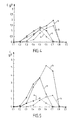
- FIG. 4 shows the variation curves for the most conserved enantiomer concentration C (curve a) and the least retained enantiomer (curve b) in mobile bed devices respectively simulated according to the prior state of the art. (dotted line curves) and according to the invention (curves in solid lines), at the input of each of the eight columns C1 to C8 of the device.
- FIG. 5 shows the variation curves for the most conserved enantiomer concentration C (curve a) and the least retained enantiomer (curve b) in mobile bed devices simulated respectively according to the prior state of the art. (Curved dotted lines) and according to the invention (curves in solid lines), at the entry of each of the eight columns C1 to C8 of the device.
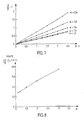
- FIG. 6 shows the curves of variation of the extract flow correction factor ⁇ as a function of the factor of increase of the charge quantity ⁇ for various values of the ⁇ selectivity and in particular for the values enantiomers studied, namely: Ref. Curve enantiomer selectivity at Methyl 2-cyano-5-phenyl pentanoate 1.1 b Racemic Ester 1.3 vs binaphthol 1.4 d (+/-) - 5- [1,2,3,4-tetrahydro-6-chinolyl] -6-methyl-3,6-dihydro-2H-1,3,4-chiadiazin-2-one 1.8 e methsuximide 2.8
- the plaintiff by the numerous tests that she has carried out, has established that the curve (FIG. 7) represents the variation of the ratio of the factor of increase of the quantity of charge ⁇ to the correction factor of the flow rate.
- extract minus a value of one ie the value ⁇ / ⁇ -1) as a function of the factor of increase of the quantity of charge ⁇ minus one (ie the value ⁇ -1) was a straight line.
- the slope of this line depends on the value of the ⁇ selectivity of the stationary phase with respect to the two enantiomers considered. More precisely, it has been established that this slope (as shown in FIG. 8) was substantially equal to a quarter of the ⁇ selectivity of the stationary phase (ie the value 0.25 ⁇ ).
- the present invention may be followed by an additional processing step, such as racemization, to recycle a mixture of optical isomers in the process according to the invention from the enriched and undesired optical isomer.
- an additional processing step such as racemization
- the present invention can of course also be implemented when it is desired to increase the productivity and the purity of the most retained enantiomer.
- the procedure would then be the same as above, with the difference that the amount of extract would then be decreased, by dividing it by the extract flow correction factor ⁇ .
Landscapes
- Organic Low-Molecular-Weight Compounds And Preparation Thereof (AREA)
- Treatment Of Liquids With Adsorbents In General (AREA)
Claims (9)
- Verfahren zur Trennung einer Mischung von zwei optischen Isomeren, die sich dazu eignen, in einer chiralen stationären Phase mehr oder weniger zurückgehalten zu werden, wobei das Verfahren von einem Typ ist, bei dem ein simuliertes Fluid- bzw. Wanderbett angewandt wird, welches aus einem Aufbau von in Reihe angeordneten, mit einer chiralen stationären Phase gefüllten Kolonnen (C1, C2, C3, C4, C5, C6, C7, C8) zusammengesetzt ist, die in mindestens drei aufeinanderfolgende Zonen unterteilt sind, nämlich eine erste Zone (I), bei dessen Eingang ein Eluierungsmittel injiziert wird und bei dessen Ausgang ein Fluß abgezogen wird, Extraktfluß genannt, der hauptsächlich das mehr zurückgehaltene Enantiomer enthält, eine zweite Zone (II), bei dessen Ausgang die besagte Mischung injiziert wird, und eine dritte Zone (III), bei dessen Ausgang ein Fluß abgezogen wird, Raffinatfluß genannt, der hauptsächlich das weniger zurückgehaltene Enantiomer enthält, dadurch gekennzeichnet, daß, im Vergleich zu einem Refefenzzustand, bei dem a) das in der stationären Phase mehr zurückgehaltene optische Isomere in der ersten Zone (I) vollständig desorbiert wird und in der dritten Zone (III) vollständig adsorbiert wird und das in der stationären Phase weniger zurückgehaltene optische Isomere in der zweiten Zone (II) vollständig desorbiert wird, und b) die Beladungsmenge maximal ist,• die injizierte Beladungsmenge höher ist als die des Referenzzustands, indem der Volumendurchsatz der Beladung eingestellt wird,• die Extrakt-Durchflußmenge höher ist als die des Referenzzustands, wenn die Reinheit des weniger zurückgehaltenen Enantiomeren wenigstens aufrechterhalten werden soll, oder die Extrakt-Durchflußmenge geringer als die des Referenzzustands ist, wenn die Reinheit des mehr zurückgehaltenen Enantiomeren wenigstens aufrechterhalten werden soll.
- Verfahren gemäß dem vorangehenden Anspruch, dadurch gekennzeichnet, daß ein simuliertes Fluid- bzw. Wanderbett verwendet wird, welches vier Zonen (I, II, III, IV) enthält, wobei die vierte Zone (IV) sich stromabwärts vom Punkt des Abzugs (13) des Raffinats befindet, und daß im Referenzzustand das optische Isomere, welches in der stationären Phase weniger zurückgehalten wird, in dieser vierten Zone (IV) vollständig adsorbiert wird.
- Verfahren gemäß einem der vorangehenden Ansprüche, dadurch gekennzeichnet, daß der Ausgang der letzten Zone zu dem Eingang der ersten Zone zurückgeführt wird.
- Verfahren gemäß einem der vorangehenden Ansprüche, dadurch gekennzeichnet, daß in einer ersten Annäherung der Anstiegsfaktor der Beladungsmenge (γ), das heißt, das Verhältnis der injizierten Beladungsmengezu der Beladungsmenge im Referenzzustand, für enge Intervalle dieses Faktors, und der Korrekturfaktor der Extrakt-Durchflußmenge (β), das heißt, das Verhältnis der Extrakt-Durchflußmenge zu der Extrakt-Durchflußmenge im Referenzzustand, in einer mathematisch im wesentlichen linearen Beziehung zueinander stehen.
- Verfahren gemäß Anspruch 4, dadurch gekennzeichnet, daß die Neigung der gekrümmten Linie, die die Variation des Korrekturfaktors der Extrakt-Durchflußmenge (β) in Abhängigkeit von der Variation des Anstiegsfaktors der Beladungsmenge (γ) wiedergibt, in umgekehrtem Verhältnis variiert zu dem Wert der Selektivität (α) der verwendeten stationären Phase.
- Verfahren gemäß einem der Ansprüche 1 bis 3, dadurch gekennzeichnet, daß der Anstiegsfaktor der Beladungsmenge (γ) und der Korrekturfaktor der Extrakt-Durchflußmenge (β) in einer linearen Beziehung zueinander stehen, die das Verhältnis des Anstiegsfaktors der Beladungsmenge zu dem Korrekturfaktor der Extrakt-Durchflußmenge (γ/β), vermindert um einen Wert von eins (γ/β-1), in Abhängigkeit vom Korrekturfaktor der Beladungs-Durchflußmenge (γ), vermindert um den Wert eins, ausdrückt.
- Verfahren gemäß Anspruch 6, dadurch gekennzeichnet, daß der Proportionalitätsfaktor der besagten linearen Beziehung den Wert der Selektivität (α) der verwendeten stationären Phase einschließt.
- Verfahren gemäß Anspruch 7, dadurch gekennzeichnet, daß der besagte Proportionalitätsfaktor im wesentlichen gleich einem Viertel des Werts der Selektivität (α) ist.
- Verfahren gemäß einem der Ansprüche 6 bis 8, dadurch gekennzeichnet, daß der Anstiegsfaktor der Beladungsmenge (γ), der Korrekturfaktor der Extrakt-Durchflußmenge (β) und die Selektivität (α) im wesentlichen durch die Beziehung in Verbindung stehen:

Applications Claiming Priority (1)
| Application Number | Priority Date | Filing Date | Title |
|---|---|---|---|
| PCT/FR1998/000550 WO1999047228A1 (fr) | 1997-03-04 | 1998-03-19 | Perfectionnement au procede d'enrichissement d'isomeres optiques par lit mobile simule |
Publications (3)
| Publication Number | Publication Date |
|---|---|
| EP1064065A1 EP1064065A1 (de) | 2001-01-03 |
| EP1064065B1 EP1064065B1 (de) | 2003-08-27 |
| EP1064065B2 true EP1064065B2 (de) | 2006-08-16 |
Family
ID=9521940
Family Applications (1)
| Application Number | Title | Priority Date | Filing Date |
|---|---|---|---|
| EP98914948A Expired - Lifetime EP1064065B2 (de) | 1998-03-19 | 1998-03-19 | Verfahren zur anreicherung optischer isomere in einem simulierten wanderbett |
Country Status (3)
| Country | Link |
|---|---|
| EP (1) | EP1064065B2 (de) |
| JP (1) | JP2002506715A (de) |
| DE (1) | DE69817625T3 (de) |
-
1998
- 1998-03-19 JP JP2000536456A patent/JP2002506715A/ja active Pending
- 1998-03-19 DE DE69817625T patent/DE69817625T3/de not_active Expired - Fee Related
- 1998-03-19 EP EP98914948A patent/EP1064065B2/de not_active Expired - Lifetime
Non-Patent Citations (3)
| Title |
|---|
| Francotte et al., Journal of Chromatography A., 769 (1997)101-107 † |
| Lim et al., Journal of Chromatography A., 734 (1996)247-258 † |
| Pais et al., Journal of Chromatography A., 769 (1997)25-35 † |
Also Published As
| Publication number | Publication date |
|---|---|
| DE69817625T3 (de) | 2007-04-05 |
| EP1064065B1 (de) | 2003-08-27 |
| EP1064065A1 (de) | 2001-01-03 |
| JP2002506715A (ja) | 2002-03-05 |
| DE69817625T2 (de) | 2004-06-24 |
| DE69817625D1 (de) | 2003-10-02 |
Similar Documents
| Publication | Publication Date | Title |
|---|---|---|
| WO1999047228A1 (fr) | Perfectionnement au procede d'enrichissement d'isomeres optiques par lit mobile simule | |
| WO2009122281A1 (fr) | Procédé de séparation multicolonnes à gradient | |
| EP0415821A1 (de) | Kontinuierliches Verfahren und Vorrichtung für eine chromatographische Trennung einer Mischung von mindestens drei Bestandteilen in drei gereinigte Ausflüsse mittels zwei Lösungsmitteln | |
| FR2757507A1 (fr) | Procede de separation de paraxylene comprenant une adsorption avec injection d'eau et une cristallisation | |
| EP2062043B1 (de) | Verfahren zur anreicherung einer oder mehrerer verbindungen eines gemischs unter verwendung einer ein gas enthaltenden flüssigen mobilen phase | |
| FR2656231A1 (fr) | Procede et equipement pour la separation fractionnaire chromatographique d'un fluide. | |
| FR2976280A1 (fr) | Procede de production d'une solution de chlorure de lithium a partir d'une saumure | |
| EP3079787B1 (de) | Reinigung von fettsäuren durch ein chromatografisches verfahren | |
| EP0797472A1 (de) | Verfahren und anlage zur trennung von schweren und leichten verbindungen durch extraktion mit einem überkritischen fluid und durch nanofiltration | |
| EP0679421B1 (de) | "Simuliertes Wanderbett"-Trennungsverfahren mit konstantem Rezirkulationsstrom | |
| FR2764822A1 (fr) | Methode pour optimiser le fonctionnement d'un systeme de separation des constituants d'un melange | |
| EP3473318B1 (de) | Chromatographisches reinigungsverfahren einer fettsäure | |
| EP1166840A1 (de) | Verfahren und Vorrichtung zur Trennung im simulierten Wanderbett wenigstens eines Bestandteils in Kolonnen mit einem geeigneten Verhältnis von Länge zum Durchmesser | |
| EP2637760B1 (de) | Trennverfahren mittels kontinuierlicher chromatographie mit hohem durchfluss und entsprechende vorrichtung | |
| WO2004039468A2 (fr) | Procede et dispositif de chromatographie integrant une etape de concentration | |
| CH692905A5 (fr) | Procédé pour le contrôle de la pression dans un système de séparation à lit mobile simulé. | |
| EP1064065B1 (de) | Verfahren zur anreicherung optischer isomere in einem simulierten wanderbett | |
| FR2632302A1 (fr) | Procede de recuperation d'acide citrique a partir d'une liqueur en contenant | |
| FR2754730A1 (fr) | Procede d'enrichissement d'isomeres optiques par lit mobile simule | |
| EP0822250B1 (de) | Verfahren zur Extraktion von 2-Phenylethanol | |
| CA2148307C (fr) | Procede de separation en lit mobile simule a debit de recyclage constant | |
| EP3863745A1 (de) | Verfahren und vorrichtung zur kontinuierlichen gegenstromübertragung von material zwischen zwei fluidphasen | |
| FR2900059A1 (fr) | Dispositif experimental pour l'etude et l'extrapolation de procedes en lit mobile simule reactif | |
| CA3039158A1 (fr) | Utilisation de gaz comprime pour le deplacement d'eluant applique a la chromatographie | |
| EP0284697A1 (de) | Verfahren, verwendbar bei der kontinuierlichen Vergärung einer wässerigen Maische durch Saccharomyces Cerevisiae, zur Herstellung von Alkohol und/oder Hefe-Biomasse |
Legal Events
| Date | Code | Title | Description |
|---|---|---|---|
| PUAI | Public reference made under article 153(3) epc to a published international application that has entered the european phase |
Free format text: ORIGINAL CODE: 0009012 |
|
| 17P | Request for examination filed |
Effective date: 20000907 |
|
| AK | Designated contracting states |
Kind code of ref document: A1 Designated state(s): BE CH DE DK FR IE IT LI NL |
|
| 17Q | First examination report despatched |
Effective date: 20010712 |
|
| GRAH | Despatch of communication of intention to grant a patent |
Free format text: ORIGINAL CODE: EPIDOS IGRA |
|
| GRAS | Grant fee paid |
Free format text: ORIGINAL CODE: EPIDOSNIGR3 |
|
| GRAA | (expected) grant |
Free format text: ORIGINAL CODE: 0009210 |
|
| AK | Designated contracting states |
Designated state(s): BE CH DE DK FR IE IT LI NL |
|
| PG25 | Lapsed in a contracting state [announced via postgrant information from national office to epo] |
Ref country code: NL Free format text: LAPSE BECAUSE OF FAILURE TO SUBMIT A TRANSLATION OF THE DESCRIPTION OR TO PAY THE FEE WITHIN THE PRESCRIBED TIME-LIMIT Effective date: 20030827 Ref country code: IT Free format text: LAPSE BECAUSE OF FAILURE TO SUBMIT A TRANSLATION OF THE DESCRIPTION OR TO PAY THE FEE WITHIN THE PRESCRIBED TIME-LIMIT;WARNING: LAPSES OF ITALIAN PATENTS WITH EFFECTIVE DATE BEFORE 2007 MAY HAVE OCCURRED AT ANY TIME BEFORE 2007. THE CORRECT EFFECTIVE DATE MAY BE DIFFERENT FROM THE ONE RECORDED. Effective date: 20030827 Ref country code: IE Free format text: LAPSE BECAUSE OF FAILURE TO SUBMIT A TRANSLATION OF THE DESCRIPTION OR TO PAY THE FEE WITHIN THE PRESCRIBED TIME-LIMIT Effective date: 20030827 |
|
| REG | Reference to a national code |
Ref country code: CH Ref legal event code: EP |
|
| REG | Reference to a national code |
Ref country code: IE Ref legal event code: FG4D Free format text: FRENCH |
|
| REF | Corresponds to: |
Ref document number: 69817625 Country of ref document: DE Date of ref document: 20031002 Kind code of ref document: P |
|
| PG25 | Lapsed in a contracting state [announced via postgrant information from national office to epo] |
Ref country code: DK Free format text: LAPSE BECAUSE OF FAILURE TO SUBMIT A TRANSLATION OF THE DESCRIPTION OR TO PAY THE FEE WITHIN THE PRESCRIBED TIME-LIMIT Effective date: 20031127 |
|
| NLV1 | Nl: lapsed or annulled due to failure to fulfill the requirements of art. 29p and 29m of the patents act | ||
| PG25 | Lapsed in a contracting state [announced via postgrant information from national office to epo] |
Ref country code: BE Free format text: LAPSE BECAUSE OF NON-PAYMENT OF DUE FEES Effective date: 20040331 |
|
| REG | Reference to a national code |
Ref country code: IE Ref legal event code: FD4D |
|
| PLBI | Opposition filed |
Free format text: ORIGINAL CODE: 0009260 |
|
| PLAX | Notice of opposition and request to file observation + time limit sent |
Free format text: ORIGINAL CODE: EPIDOSNOBS2 |
|
| 26 | Opposition filed |
Opponent name: KATZAMEYER,DR.,MICHAEL Effective date: 20040526 |
|
| BERE | Be: lapsed |
Owner name: S.A. *NOVASEP Effective date: 20040331 |
|
| PLAX | Notice of opposition and request to file observation + time limit sent |
Free format text: ORIGINAL CODE: EPIDOSNOBS2 |
|
| REG | Reference to a national code |
Ref country code: CH Ref legal event code: NV Representative=s name: PATMED AG |
|
| PLAX | Notice of opposition and request to file observation + time limit sent |
Free format text: ORIGINAL CODE: EPIDOSNOBS2 |
|
| PLBB | Reply of patent proprietor to notice(s) of opposition received |
Free format text: ORIGINAL CODE: EPIDOSNOBS3 |
|
| PLAB | Opposition data, opponent's data or that of the opponent's representative modified |
Free format text: ORIGINAL CODE: 0009299OPPO |
|
| R26 | Opposition filed (corrected) |
Opponent name: KATZAMEYER,DR.,MICHAEL Effective date: 20040526 |
|
| PUAH | Patent maintained in amended form |
Free format text: ORIGINAL CODE: 0009272 |
|
| STAA | Information on the status of an ep patent application or granted ep patent |
Free format text: STATUS: PATENT MAINTAINED AS AMENDED |
|
| 27A | Patent maintained in amended form |
Effective date: 20060816 |
|
| AK | Designated contracting states |
Kind code of ref document: B2 Designated state(s): BE CH DE DK FR IE IT LI NL |
|
| REG | Reference to a national code |
Ref country code: CH Ref legal event code: AEN Free format text: MAINTIEN DU BREVET DONT L'ETENDUE A ETE MODIFIEE |
|
| PGFP | Annual fee paid to national office [announced via postgrant information from national office to epo] |
Ref country code: DE Payment date: 20070307 Year of fee payment: 10 |
|
| PGFP | Annual fee paid to national office [announced via postgrant information from national office to epo] |
Ref country code: CH Payment date: 20070320 Year of fee payment: 10 |
|
| PGFP | Annual fee paid to national office [announced via postgrant information from national office to epo] |
Ref country code: FR Payment date: 20070227 Year of fee payment: 10 |
|
| REG | Reference to a national code |
Ref country code: CH Ref legal event code: PL |
|
| REG | Reference to a national code |
Ref country code: FR Ref legal event code: ST Effective date: 20081125 |
|
| PG25 | Lapsed in a contracting state [announced via postgrant information from national office to epo] |
Ref country code: LI Free format text: LAPSE BECAUSE OF NON-PAYMENT OF DUE FEES Effective date: 20080331 Ref country code: DE Free format text: LAPSE BECAUSE OF NON-PAYMENT OF DUE FEES Effective date: 20081001 Ref country code: CH Free format text: LAPSE BECAUSE OF NON-PAYMENT OF DUE FEES Effective date: 20080331 |
|
| PG25 | Lapsed in a contracting state [announced via postgrant information from national office to epo] |
Ref country code: FR Free format text: LAPSE BECAUSE OF NON-PAYMENT OF DUE FEES Effective date: 20080331 |