EP1066246B1 - Kationische kuppler deren verwendung zum oxidativen färben - Google Patents
Kationische kuppler deren verwendung zum oxidativen färben Download PDFInfo
- Publication number
- EP1066246B1 EP1066246B1 EP00900641A EP00900641A EP1066246B1 EP 1066246 B1 EP1066246 B1 EP 1066246B1 EP 00900641 A EP00900641 A EP 00900641A EP 00900641 A EP00900641 A EP 00900641A EP 1066246 B1 EP1066246 B1 EP 1066246B1
- Authority
- EP
- European Patent Office
- Prior art keywords
- radical
- methyl
- group
- hydroxy
- ylcarbamoyl
- Prior art date
- Legal status (The legal status is an assumption and is not a legal conclusion. Google has not performed a legal analysis and makes no representation as to the accuracy of the status listed.)
- Expired - Lifetime
Links
Classifications
-
- A—HUMAN NECESSITIES
- A61—MEDICAL OR VETERINARY SCIENCE; HYGIENE
- A61K—PREPARATIONS FOR MEDICAL, DENTAL OR TOILETRY PURPOSES
- A61K8/00—Cosmetics or similar toiletry preparations
- A61K8/18—Cosmetics or similar toiletry preparations characterised by the composition
- A61K8/30—Cosmetics or similar toiletry preparations characterised by the composition containing organic compounds
- A61K8/49—Cosmetics or similar toiletry preparations characterised by the composition containing organic compounds containing heterocyclic compounds
-
- A—HUMAN NECESSITIES
- A61—MEDICAL OR VETERINARY SCIENCE; HYGIENE
- A61K—PREPARATIONS FOR MEDICAL, DENTAL OR TOILETRY PURPOSES
- A61K8/00—Cosmetics or similar toiletry preparations
- A61K8/18—Cosmetics or similar toiletry preparations characterised by the composition
- A61K8/30—Cosmetics or similar toiletry preparations characterised by the composition containing organic compounds
- A61K8/49—Cosmetics or similar toiletry preparations characterised by the composition containing organic compounds containing heterocyclic compounds
- A61K8/4906—Cosmetics or similar toiletry preparations characterised by the composition containing organic compounds containing heterocyclic compounds with one nitrogen as the only hetero atom
- A61K8/4913—Cosmetics or similar toiletry preparations characterised by the composition containing organic compounds containing heterocyclic compounds with one nitrogen as the only hetero atom having five membered rings, e.g. pyrrolidone carboxylic acid
-
- A—HUMAN NECESSITIES
- A61—MEDICAL OR VETERINARY SCIENCE; HYGIENE
- A61K—PREPARATIONS FOR MEDICAL, DENTAL OR TOILETRY PURPOSES
- A61K8/00—Cosmetics or similar toiletry preparations
- A61K8/18—Cosmetics or similar toiletry preparations characterised by the composition
- A61K8/30—Cosmetics or similar toiletry preparations characterised by the composition containing organic compounds
- A61K8/49—Cosmetics or similar toiletry preparations characterised by the composition containing organic compounds containing heterocyclic compounds
- A61K8/4906—Cosmetics or similar toiletry preparations characterised by the composition containing organic compounds containing heterocyclic compounds with one nitrogen as the only hetero atom
- A61K8/4926—Cosmetics or similar toiletry preparations characterised by the composition containing organic compounds containing heterocyclic compounds with one nitrogen as the only hetero atom having six membered rings
-
- A—HUMAN NECESSITIES
- A61—MEDICAL OR VETERINARY SCIENCE; HYGIENE
- A61K—PREPARATIONS FOR MEDICAL, DENTAL OR TOILETRY PURPOSES
- A61K8/00—Cosmetics or similar toiletry preparations
- A61K8/18—Cosmetics or similar toiletry preparations characterised by the composition
- A61K8/30—Cosmetics or similar toiletry preparations characterised by the composition containing organic compounds
- A61K8/49—Cosmetics or similar toiletry preparations characterised by the composition containing organic compounds containing heterocyclic compounds
- A61K8/494—Cosmetics or similar toiletry preparations characterised by the composition containing organic compounds containing heterocyclic compounds with more than one nitrogen as the only hetero atom
-
- A—HUMAN NECESSITIES
- A61—MEDICAL OR VETERINARY SCIENCE; HYGIENE
- A61Q—SPECIFIC USE OF COSMETICS OR SIMILAR TOILETRY PREPARATIONS
- A61Q5/00—Preparations for care of the hair
- A61Q5/10—Preparations for permanently dyeing the hair
-
- C—CHEMISTRY; METALLURGY
- C07—ORGANIC CHEMISTRY
- C07D—HETEROCYCLIC COMPOUNDS
- C07D317/00—Heterocyclic compounds containing five-membered rings having two oxygen atoms as the only ring hetero atoms
- C07D317/08—Heterocyclic compounds containing five-membered rings having two oxygen atoms as the only ring hetero atoms having the hetero atoms in positions 1 and 3
- C07D317/44—Heterocyclic compounds containing five-membered rings having two oxygen atoms as the only ring hetero atoms having the hetero atoms in positions 1 and 3 ortho- or peri-condensed with carbocyclic rings or ring systems
- C07D317/46—Heterocyclic compounds containing five-membered rings having two oxygen atoms as the only ring hetero atoms having the hetero atoms in positions 1 and 3 ortho- or peri-condensed with carbocyclic rings or ring systems condensed with one six-membered ring
- C07D317/48—Methylenedioxybenzenes or hydrogenated methylenedioxybenzenes, unsubstituted on the hetero ring
- C07D317/62—Methylenedioxybenzenes or hydrogenated methylenedioxybenzenes, unsubstituted on the hetero ring with hetero atoms or with carbon atoms having three bonds to hetero atoms with at the most one bond to halogen, e.g. ester or nitrile radicals, directly attached to atoms of the carbocyclic ring
- C07D317/66—Nitrogen atoms not forming part of a nitro radical
-
- C—CHEMISTRY; METALLURGY
- C07—ORGANIC CHEMISTRY
- C07D—HETEROCYCLIC COMPOUNDS
- C07D405/00—Heterocyclic compounds containing both one or more hetero rings having oxygen atoms as the only ring hetero atoms, and one or more rings having nitrogen as the only ring hetero atom
- C07D405/14—Heterocyclic compounds containing both one or more hetero rings having oxygen atoms as the only ring hetero atoms, and one or more rings having nitrogen as the only ring hetero atom containing three or more hetero rings
Definitions
- the invention relates to novel compounds derived from naphth-1-ol which can be represented by formula (I) and comprising at least one group cationic Z of formula (II), their use as a coupler for dyeing for the oxidation of keratin fibers, the compositions for dyeing for the oxidation of keratin fibers, and in particular of keratin fibers human such as the hair comprising them in association with at least an oxidation base; as well as the oxidation dyeing processes implementing.
- formula (I) can be represented by formula (I) and comprising at least one group cationic Z of formula (II)
- oxidation bases It is known to dye keratin fibers and in particular the hair humans with dye compositions containing precursors of oxidation dye, in particular paraphenylenediamines, ortho or paraaminophenols, heterocyclic compounds such as derivatives of diaminopyrazole, generally called oxidation bases.
- precursors of oxidation dyes, or oxidation bases are colorless or weakly colored which, combined with oxidizing products, can give birth through a process of oxidative condensation to compounds colored and dyes.
- couplers or modifiers of coloring the latter being chosen in particular from metadiamines aromatics, metaaminophenols, metadiphenols, non-naphthols cationic or certain heterocyclic compounds such as by examples of indole couplers.
- the dyes should also cover white hair, and finally be the least selective possible, that is to say allow to obtain differences the lowest possible coloring throughout the same keratin fiber, which can be sensitized differently (i.e. damaged) between its tip and its root.
- R 2 and R 3 preferably represent, independently of one another, a hydrogen or chlorine atom; a group Z; a methyl or methoxy radical; an amino, methylamino, 2-hydroxyethylamino radical; a group -NH (CO) R 15 in which R 15 represents one of the radicals listed in the group (G1) consisting of a methyl, ethyl, propyl, isopropyl, butyl, isobutyl, tert-butyl, pentyl, isopentyl, neopentyl radical, hexyl, cyclopropyl, cyclobutyl, cyclopentyl, cyclopentylmethyl, 3-cyclopentyl-propyl, cyclohexyl, 2-cyclohexyl-ethyl, norbornane-2-yl, vinyl, 1-methylvinyl, 2-methylvinyl, 2,2-dimethylvinyl, allyl, 3-
- R 2 and R 3 independently of one another, a hydrogen atom; a group -OE-D ', -NH-E-D', -NH (CO) -D ', -NH (CO) -E-D', -NH (CO) OE-D ', -NH (CO ) NH-ED 'or -NH (SO 2 ) -E-D', in which -E- represents an arm - (CH 2 ) q -, q being an integer equal to 1 or 2, and in which D ' represents the groups 3-methylimidazolidinium-1-yl, 3- (2-hydroxyethyl) -imidazolidinium-1-yl, 1,2,4-triazolinium-1-yl, 1,2,4-triazolinium-4-yl, N -alkyl (C1-C4) pyridinium-2-yl, N-alkyl (C 1 -C 4 ) pyri
- group A 1 is intended to mean a linear or branched C 1 -C 8 alkyl radical which may bear one or two double bonds or one triple bond, be substituted or unsubstituted by a group chosen from a group A 2 , a group A 4 , a group A 5 , be substituted or unsubstituted by one or two groups, identical or different, chosen from N-alkyl (C 1 -C 3 ) amino, N-alkyl (C 1 -C 3 ) -N groups -alkyl (C 1 -C 3 ) amino, alkoxy (C 1 -C 6 ), oxo, alkoxycarbonyl, acyloxy, amide, acylamino, ureyl, sulfoxy, sulfonyl, sulfonamido, sulfonylamino, bromo, cyano, carboxy, and be substituted or unsubstituted by one or more hydroxyl
- group A 2 is intended to mean an aromatic group of phenyl or naphthyl type, which may be substituted or unsubstituted by one to three groups, identical or different, chosen from the methyl, trifluoromethyl, ethyl, isopropyl, butyl, pentyl, fluoro groups, chloro, bromo, methoxy, trifluoromethoxy, ethoxy, propyloxy, acetyloxy, acetyl and cyano.
- group A 3 means heteroaromatic groups chosen from the furanyl, thiophenyl, pyrrolyl, imidazolyl, thiazolyl, oxazolyl, 1,2,3-triazolyl, 1,2,4-triazolyl, isoxazolyl, isothiazolyl, pyrazolyl, pyrazoltriazolyl, pyrazoloimidyl groups.
- pyrrolotriazolyle pyrazolopyrimidyle, pyrazolopyridyle, pyridyle, pyrimidyle, benzoimidazolyle, benzoxazolyle, benzothiazolyle, indolyle, indolidinyle, isoindolyle, indazolyle, benzotriazolyle, quinolinyl, benzoimidazidyl, benzoimidazolyl, benzoimidazolyle C 1 -C 4 linear or branched monohydroxyalkyl, C 1 -C 4 polyhydroxyalkyl, C 2 -C 4 alkyl, carboxy, alkoxycarbonyl, halogen, amido, amino and hydroxy.
- group A 4 is intended to mean a C 3 -C 7 cycloalkyl radical, a norbomanyl radical, bearing or not a double bond and substituted or unsubstituted by 1 or 2 radicals chosen from linear C 1 -C 4 alkyl radicals or branched monohydroxyalkyl, C 1 -C 4 polyhydroxyalkyl, C 2 -C 4 alkyl, carboxy, alkoxycarbonyl, halogen, amido, amino and hydroxy.
- group A 5 is intended to mean a heterocycle chosen from the dihydrofuranyl, tetrahydrofuranyl, butyrolact-one-yl, dihydrothiophenyl, tetrahydrothiophenyl, tetrahydrothiophen-one-yl, iminothiolane, dihydropyrrolyl, yyldyridinid, pyrrolidinyl, pyrrolidinyl imidazolidinthione-yl, oxazolidinyl, oxazolidin-one-yl, oxazolanethione, thiazolidinyl, isothiazol-one-yl, mercaptothiazolinyl, pyrazolidin-one-yl, iminothiolane, dioxolanyl, pentalactone, dioxanyl, dihydropyridinyl, piperidinyl, piperidinyl, piperidinyl, piperid
- R 4 more particularly represents a hydrogen atom; a methyl, ethyl, isopropyl, allyl, phenyl, benzyl, fluorobenzyl, hydroxybenzyl, difluorobenzyl, trifluorobenzyl, chlorobenzyl, bromobenzyl, methoxybenzyl, dimethoxybenzyl, (trifluoromethoxy) benzyl, 3,4-methylenedioxyethyl, 4-chlorobenzyl, 4-chlorobenzyl radical, -methylsulfonylbenzyl, 4-acetylaminobenzyl, 4-carboxybenzyl, 1-naphthomethyl, 2-naphtomethyl; or a 2-hydroxethyl, 2-methoxyethyl or 2-ethoxyethyl group.
- R 4 represents a hydrogen atom or a methyl radical.
- R 5 preferably denotes a hydrogen atom, an amino group; a group Z; a group A 1 , A 2 , A 3 , A 4 or A 5 as defined above, optionally separated from the carbon (in position 2) of the amide function of the compound of formula (I) by a group -O-, -NH , -NAlkyl (C 1 -C 3 ) -, - (CO) -.
- radicals a group Z or a radical chosen from the group (G1) as defined above is more particularly preferred for R 5 .
- R 5 represents a group Z; a radical chosen from the group (G3) consisting of a methyl, ethyl, propyl, allyl, phenyl, tetrahydrofuran-2-yl, furan-2-yl, thiophene-2-yl, pyridinyl, piperazin-2-yl, fluoromethyl radical , chloromethyl, 2-chloroethyl, methoxymethyl, acetoxymethyl, 1,2-dihydroxyethyl, methoxycarbonyl, 2-carboxyethyl, methoxy, ethoxy, propoxy, allyloxy, 2-chloroethoxy, 2-methoxyethoxy, amino, ethylamino, allylamino, 2-chloroamino , dimethylamino, 1-pyrolidinyl, 4-morpholinyl.
- G3 a radical chosen from the group (G3) consisting of a methyl, ethyl, propy
- R 5 represents a group -D ', -E-D', -OED 'or -NH-ED' in which -E- represents an arm - (CH 2 ) q -, q being a number integer equal to 1 or 2, and Of a group as defined above; a radical chosen from the group (G4) consisting of a methyl, methoxymethyl, 2-carboxyethyl, methoxy, amino, ethylamino and 1-pyrolidinyl radical.
- said ring is preferably chosen from the groups 2-pyrrolidinon-1-yl, methyl-2-pyrrolidinon-1-yl, 5-carboxy-2-pyrrolidinon-1-yl, 5 -methoxycarbonyl-2-pyrrolidinone-1-yl, pyrazolinone-1-yl, succinimide-1-yl, 3,5-diketopyrazolidin-1-yl, oxindolin-1-yl, maleimide-1yl, isoindole-1,3-dione -2-yl, 2-piperidinone-1-yl and glutarimide-1-yl.
- R 6 preferably represents a hydrogen atom or a group A 1 , A 2 , A 3 , A 4 or A 5 as defined above.
- R 6 is a hydrogen atom; a methyl, ethyl, isopropyl, allyl radical; phenyl, benzyl, fluorobenzyl, hydroxybenzyl, difluorobenzyl, trifluorobenzyl, chlorobenzyl, bromobenzyl, methoxybenzyl, dimethoxybenzyl, (trifluoromethoxy) benzyl, 3,4-methylendioxybenzyl, 6-chloropiperonyl, 4-methylbenzyl, 4-methylthiobenzyl, 4-methyl-benzyl , 1-naphthomethyl, 2-naphthomethyl; a 2-hydroxethyl, 2-methoxyethyl or 2-ethoxyethyl group.
- R 6 represents a hydrogen atom or a methyl radical.
- R 8 preferably denotes a group Z; a hydrogen atom or a group A 1 , A 2 , A 3 , A 4 or A 5 as defined above.
- a group Z is more particularly preferred for R 8 ; a hydrogen atom; a methyl, ethyl, isopropyl, allyl radical; phenyl, benzyl, fluorobenzyl, hydroxybenzyl, difluorobenzyl, trifluorobenzyl, chlorobenzyl, bromobenzyl, methoxybenzyl, dimethoxybenzyl, (trifluoromethoxy) benzyl, 3,4-methylendioxybenzyl, 6-chloropiperonyl, 4-methylbenzyl, 4-methylthiobenzyl, 4-methyl-benzyl , 1-naphthomethyl or 2-naphthomethyl; a 2-hydroxethyl, 2-methoxyethyl or 2-ethoxyethyl group.
- R 8 represents a hydrogen atom or a methyl radical, a group -D ', -E-D', in which -E- represents an arm - (CH 2 ) q -, q being a integer equal to 1 or 2, and Of a group as defined above.
- said cycle is preferably chosen from the pyrolidinyl, piperidinyl, morpholinyl, pyrazolyl, isoxazolyl, imidazolyl, thiazolyl, indolyl, indolidinyl, indazolyl, pyrazolotriazolyl, pyrrolotriazolyl, pyrazoloimidolylolyrolidolyl group. and pyrazinyl.
- R 7 preferably denotes an amino group; a group Z; a group A 1 , a group A 2 , a group A 3 , a group A 4 or a group A 5 as defined above, optionally separated from the sulfur of the sufonyl group of the compound of formula (I) by a group -NH, or NAlkyl (C 1 -C 3 ) -.
- a group Z is more particularly preferred for R 7 , one of the radicals listed in the group (G4) consisting of the methyl, trifluoromethyl, ethyl, 2-chloroethyl, propyl, 3-chloropropyl, isopropyl, butyl and thiophene radicals.
- G4 one of the radicals listed in the group (G4) consisting of the methyl, trifluoromethyl, ethyl, 2-chloroethyl, propyl, 3-chloropropyl, isopropyl, butyl and thiophene radicals.
- R 7 represents a group -D ', -ED' or -NH-E-D ', in which -E- represents an arm - (CH 2 ) q -, q being an integer equal to 1 or 2, and Of a group as defined above; a methyl, ethyl or dimethylamino radical.
- Y preferably represents a radical chosen from the group comprising: a hydrogen, chlorine, fluorine or bromine atom; methoxy, ethoxy, propoxy, benzyloxy, phenoxy groups; -OCH 2 CH 2 OMe; -OCH 2 CH 2 OMe; -OCH 2 CH 2 NMe 2 ; -OCH 2 (CO) OH, -OCH 2 (CO) OMe, -OCH 2 (CO) OEt, -SCH 2 CH 2 CO 2 H and NHSO 2 Me.
- a radical chosen from the group comprising: a hydrogen, chlorine, fluorine or bromine atom; methoxy, ethoxy, propoxy, benzyloxy, phenoxy groups; -OCH 2 CH 2 OMe; -OCH 2 CH 2 OMe; -OCH 2 CH 2 NMe 2 ; -OCH 2 (CO) OH, -OCH 2 (CO) OMe, -OCH 2 (CO)
- radicals particularly preferred for Y are the radicals chosen from the group consisting of a hydrogen and chlorine atom, the methoxy group, -OCH 2 (CO) OH, -OCH 2 (CO) OMe.
- the group D can be chosen from in particular the imidazolinium, thiazolinium, oxazolinium, pyrrolinium, 1,2,3-triazolinium, 1,2,4-triazolinium, isoxazolinium, isothiazolinium, imidazolidinium, thiazolidinium, pyrazolinium, pyrazolidinium, oxazolidinium, pyrazoltriazolin groups pyrazoloimidazolinium, pyrrolotriazolinium, pyrazolopyrimidinium, pyrazolopyridinium, pyridinium, pyrimidinium, pyrazinium, triazinium, benzoimidazolinium, benzoxazolinium, benzothiazolinium, indolinium, indolidinium, isoindolinium, indazolinium, benzotriazolinium, quinolinium, tetrahydroquinolinium, benzoimidazolidinium, benzopyrimi
- the group D can be chosen from the 3-methylimidazolidinium-1-yl, 3- (2-hydroxyethyl) imidazolidinium-1-yl, 1,2,4-triazolinium-1-yl, 1, 2,4-triazolinium-4-yl, N-alkyl (C 1 -C 4 ) pyridinium-2-yl, N-alkyl (C 1 -C 4 ) pyridinium-3-yl, N-alkyl (C 1 -C 4 ) pyridinium-4-yl, N- (2-hydroxyethyl) pyridinium-2-yl, N- (2-hydroxyethyl) pyridinium-3-yl, N- (2-hydroxyethyl) pyridinium-4-yl, pyridinium-1 -yl, trialkyl (C 1 -C 4 ) ammonium-N-yl, 1-methylpiperidinium-1-yl and 1,4-dimetyl, N-al
- a subject of the invention is also (the use of the compounds of formula (I) in as a coupler for the oxidation dyeing of keratin fibers and particularly human keratin fibers such as the hair.
- the compound (s) of formula (I) in accordance with the invention and / or the salt (s) thereof of addition with an acid preferably represent from 0.0005 to 12% by weight about the total weight of the dye composition, and even more preferably from 0.005 to 6% by weight approximately of this weight.
- the oxidation dye composition containing the compound or compounds of formula (I) according to the invention allows obtain powerful colors in shades ranging from red to blue and also showing remarkable tenacity in the various treatments that can undergo keratin fibers. These properties are particularly remarkable especially with regard to the resistance of colorings obtained with regard to the action of light, bad weather, washing, permanent waving and sweating.
- oxidation base (s) that can be used in the dye composition according to the invention is not critical. They are from preferably chosen from the oxidation bases conventionally used in oxidation dye and among which there may be mentioned in particular the paraphenylenediamines, bis-phenylalkylenediamines, para-aminophenols, ortho-aminophenols and heterocyclic bases.
- paraphenylenediamine mention may more particularly be made as example, paraphenylenediamine, paratoluylenediamine, 2-chloro paraphenylenediamine, 2,3-dimethyl paraphenylenediamine, 2,6-dimethyl paraphenylenediamine, 2,6-diethyl paraphenylenediamine, 2,5-dimethyl paraphenylenediamine, N, N-dimethyl paraphenylenediamine, N, N-diethyl paraphenylenediamine, N, N-dipropyl paraphenylenediamine, 4-amino N, N-diethyl 3-methyl aniline, N, N-bis- ( ⁇ -hydroxyethyl) paraphenylenediamine, 4-N, N-bis- ( ⁇ -hydroxyethyl) amino 2-methyl aniline, 4-N, N-bis- ( ⁇ -hydroxyethyl) amino 2-chloro aniline, 2- ⁇ -hydroxyethyl paraphenylenediamine, 2-
- paraphenylenediamines all are preferred particularly paraphenylenediamine, paratoluylenediamine, 2-isopropyl paraphenylenediamine, 2- ⁇ -hydroxyethyl paraphenylenediamine, 2- ⁇ -hydroxyethyloxy paraphenylenediamine, 2,6-dimethyl paraphenylenediamine, 2,6-diethyl paraphenylenediamine, 2,3-dimethyl paraphenylenediamine, N, N-bis- ( ⁇ -hydroxyethyl) paraphenylenediamine, 2-chloro paraphenylenediamine, 2- ⁇ -acetylaminoethyloxy paraphenylenediamine, and their addition salts with an acid.
- the bis-phenylalkylenediamines there may be mentioned more particularly as for example, N, N'-bis- ( ⁇ -hydroxyethyl) N, N'-bis- (4'-aminophenyl) 1,3-diamino propanol, N, N'-bis- ( ⁇ -hydroxyethyl) N, N'-bis- (4'-aminophenyl) ethylenediamine, N, N'-bis- (4-aminophenyl) tetramethylenediamine, N, N'-bis- ( ⁇ -hydroxyethyl) N, N'-bis- (4-aminophenyl) tetramethylenediamine, the N, N'-bis- (4-methyl-aminophenyl) tetramethylenediamine, N, N'-bis- (ethyl) N, N'-bis- (4'-amino, 3'-methylphenyl) ethylenediamine, 1,8-bis- (2,5-bis-
- para-aminophenol there may be mentioned more particularly as example, para-aminophenol, 4-amino 3-methyl phenol, 4-amino 3-fluoro phenol, 4-amino 3-hydroxymethyl phenol, 4-amino 2-methyl phenol, 4-amino 2-hydroxymethyl phenol, 4-amino 2-methoxymethyl phenol, 4-amino 2-aminomethyl phenol, 4-amino 2- ( ⁇ -hydroxyethyl aminomethyl) phenol, 4-amino 2-fluoro phenol, and their addition salts with an acid.
- ortho-aminophenols there may be mentioned more particularly as for example, 2-amino phenol, 2-amino 5-methyl phenol, 2-amino 6-methyl phenol, 5-acetamido 2-amino phenol, and their addition salts with an acid.
- heterocyclic bases there may be mentioned more particularly as for example, pyridine derivatives, pyrimidine derivatives and derivatives pyrazole.
- pyridine derivatives mention may be made more particularly of the compounds described for example in patents GB 1,026,978 and GB 1,153,196, as the 2,5-diamino pyridine, 2- (4-methoxyphenyl) amino 3-amino pyridine, 2,3-diamino 6-methoxy pyridine, 2- ( ⁇ -methoxyethyl) amino 3-amino 6-methoxy pyridine, 3,4-diamino pyridine, and their addition salts with a acid.
- pyrimidine derivatives mention may more particularly be made of compounds described for example in German patents DE 2,359,399 or Japanese JP 88-169 571 and JP 91-10659 or patent application WO 96/15765, such as 2,4,5,6-tetra-aminopyrimidine, 4-hydroxy 2,5,6-triaminopyrimidine, 2-hydroxy 4,5,6-triaminopyrimidine, 2,4-dihydroxy 5,6-diaminopyrimidine, 2,5,6-triaminopyrimidine, and pyrazolo-pyrimidine derivatives such as those mentioned in patent application FR-A-2 750 048 and among which are may include pyrazolo- [1,5-a] -pyrimidine-3,7-diamine; 2,5-dimethyl pyrazolo [1,5-a] -pyrimidine-3,7-diamine; pyrazolo- [1,5-a] -pyrimidine-3,5-diamine ; 2,7
- pyrazole derivatives mention may be made more particularly of compounds described in patents DE 3,843,892, DE 4,133,957 and applications WO 94/08969, WO 94/08970, FR-A-2 733 749 and DE 195 43 988 such as 4,5-diamino 1-methyl pyrazole, 3,4-diamino pyrazole, 4,5-diamino 1- (4'-chlorobenzyl) pyrazole, 4,5-diamino 1,3-dimethyl pyrazole, 4,5-diamino 3-methyl 1-phenyl pyrazole, 4,5-diamino 1-methyl 3-phenyl pyrazole, 4-amino 1,3-dimethyl 5-hydrazino pyrazole, 1-benzyl 4,5-diamino 3-methyl pyrazole, 4,5-diamino 3-tert-butyl 1-methyl pyrazole, 4,5-diamino 1-tert-butyl 1-
- the dye compositions containing one or more paraphenylenediamines and / or one or more oxidation bases heterocyclics are particularly preferred.
- the oxidation base (s) preferably represent from 0.0005 to 12% by weight about the total weight of the dye composition, and even more preferably from 0.005 to 6% by weight approximately of this weight.
- the dye composition in accordance with the invention may also contain, in more of the compound (s) of formula (I) above, one or more couplers which can be chosen from the couplers used classic in oxidation dyeing and among which there may be mentioned in particular the metaphenylenediamines, meta-aminophenols, metadiphenols and heterocyclic couplers such as, for example, indole derivatives, indolinic derivatives, pyridine derivatives and pyrazolones, and their salts addition with an acid.
- couplers which can be chosen from the couplers used classic in oxidation dyeing and among which there may be mentioned in particular the metaphenylenediamines, meta-aminophenols, metadiphenols and heterocyclic couplers such as, for example, indole derivatives, indolinic derivatives, pyridine derivatives and pyrazolones, and their salts addition with an acid.
- couplers are more particularly chosen from 2-methyl 5-amino phenol, 5-N- ( ⁇ -hydroxyethyl) amino 2-methyl phenol, 3-amino phenol, 1,3-dihydroxy benzene, 1,3-dihydroxy 2-methyl benzene, 4-chloro 1,3-dihydroxy benzene, 2,4-diamino 1- ( ⁇ -hydroxyethyloxy) benzene, 2-amino 4- ( ⁇ -hydroxyethylamino) 1-methoxy benzene, 1,3-diamino benzene, 1,3-bis- (2,4-diaminophenoxy) propane, sesamol, ⁇ -naphthol, 6-hydroxy indole, 4-hydroxy indole, 4-hydroxy N-methyl indole, 6-hydroxy indoline, 2,6-dihydroxy 4-methyl pyridine, 1-H 3-methyl pyrazole 5-one, 1-phenyl 3-methyl pyrazole 5-one, and their addition salts with an acid.
- these additional couplers preferably represent from 0.0001 to 10% by weight approximately of the total weight of the dye composition and even more preferably from 0.005 to 5% by weight approximately of this weight.
- addition salts with an acid which can be used in the framework of the dye compositions of the invention are chosen in particular from hydrochlorides, hydrobromides, sulfates, citrates, succinates, tartrates, lactates and acetates.
- the medium suitable for dyeing generally consists of water or of a mixture of water and at least one organic solvent to dissolve the compounds which are not sufficiently soluble in water.
- organic solvent mention may, for example, be made of lower C 1 -C 4 alkanols, such as ethanol and isopropanol; glycerol; glycols and glycol ethers such as 2-butoxyethanol, propylene glycol, propylene glycol monomethyl ether, monoethyl ether and diethylene glycol monomethyl ether, as well as aromatic alcohols such as benzyl alcohol or phenoxyethanol, analogous products and mixtures thereof.
- the solvents may be present in proportions preferably between 1 and 40% by weight approximately relative to the total weight of the dye composition, and even more preferably between 5 and 30% by weight approx.
- the pH of the dye composition in accordance with the invention is generally between 3 and 12 approximately, and preferably between 5 and 11 approximately. he can be adjusted to the desired value using acidifying or basifying agents usually used in dyeing keratin fibers.
- basifying agents there may be mentioned, by way of example, ammonia, alkali carbonates, alkanolamines such as mono-, di- and triethanolamines as well as their derivatives, sodium or potassium hydroxides and compounds of following formula (V): in which W is a propylene residue substituted or unsubstituted by a hydroxyl group or a C 1 -C 6 alkyl radical; R 23, R 24, R 25 and R 26, identical or different, represent a hydrogen atom, an alkyl radical C 1 -C 6 alkyl or hydroxy C 1 -C 6.
- the oxidation dye compositions according to the invention can also contain at least one direct dye, in particular to modify the nuances or enrich them with reflections.
- the dye composition in accordance with the invention may also contain various adjuvants conventionally used in dye compositions hair, such as anionic, cationic, nonionic surfactants, amphoteric, zwitterionic or mixtures thereof, polymers anionic, cationic, nonionic, amphoteric, zwitterionic or their mixtures, mineral or organic thickening agents, agents antioxidants, penetration agents, sequestering agents, perfumes, tampons, dispersing agents, conditioning agents such as for example volatile or non-volatile silicones, modified or not modified, film-forming agents, ceramides, preservatives, opacifying agents.
- adjuvants conventionally used in dye compositions hair
- anionic, cationic, nonionic surfactants amphoteric, zwitterionic or mixtures thereof
- polymers anionic, cationic, nonionic, amphoteric, zwitterionic or their mixtures mineral or organic thickening agents, agents antioxidants, penetration agents, sequestering agents
- the dye composition according to the invention can be in forms various, such as liquids, creams, gels, or any another suitable form for dyeing keratin fibers, and especially human hair.
- the invention also relates to a process for dyeing oxidation of keratin fibers and in particular human keratin fibers such as the hair using the dye composition as defined previously.
- At least one composition is applied to the fibers dye as defined above, the color being revealed at acidic pH, neutral or alkaline using an oxidizing agent which is added just when use in the dye composition or which is present in a composition oxidant applied simultaneously or sequentially.
- the composition is preferably mixed, at the time of use, dye described above with an oxidizing composition containing, in a medium suitable for dyeing, at least one oxidizing agent present in one enough to develop a color.
- the mixture obtained is then applied to the keratin fibers and left to stand for 3 to 50 minutes approximately, preferably 5 to 30 minutes approximately, after which one rinses, one wash with shampoo, rinse again and dry.
- the oxidizing agent can be chosen from conventionally oxidizing agents used for the oxidation dyeing of keratin fibers, and among which are may include hydrogen peroxide, urea peroxide, bromates of alkali metals, persalts such as perborates and persulfates, and enzymes such as peroxidases, laccases, tyrosynases and oxidoreductases among which we can in particular mention the pyranose oxidases, glucose oxidases, glycerol oxidases, lactates oxidases, pyruvate oxidases, and uricases.
- conventionally oxidizing agents used for the oxidation dyeing of keratin fibers and among which are may include hydrogen peroxide, urea peroxide, bromates of alkali metals, persalts such as perborates and persulfates, and enzymes such as peroxidases, laccases, tyrosynases and oxidore
- the pH of the oxidizing composition containing the oxidizing agent as defined above is such that after mixing with the dye composition, the pH of the resulting composition applied to keratin fibers preferably varies between 3 and 12 approximately, and even more preferably between 5 and 11. It is adjusted to the desired value using acidifying or basifying agents usually used in dyeing keratin fibers and as defined previously.
- the oxidizing composition as defined above may also contain various adjuvants conventionally used in dye compositions hair and as defined above.
- composition which is finally applied to the keratin fibers can be present in various forms, such as in the form of liquids, creams, gels, or any other suitable form to achieve a dyeing of keratin fibers, and in particular human hair.
- Another object of the invention is a device with several compartments or "kit” dyeing or any other multiple packaging system compartments of which a first compartment contains the composition dye as defined above and a second compartment contains the oxidizing composition as defined above.
- These devices can be equipped with a means for delivering the mixture to the hair desired, such as the devices described in patent FR-2,586,913 in the name of the plaintiff.
- PREPARATION EXAMPLE 1 Synthesis of 3 - [(1-hydroxynaphthalen-2-ylcarbamoyl) -methyl] -1-methyl-3H-imidazol-1-ium chloride.
- PREPARATION EXAMPLE 2 Synthesis of 3 - [(5-acetylamino-1-hydroxy-naphthalen-2-ylcarbamoyl) -methyl] -1-methyl-3H-imidazol-1-chloride.
- step d In a solution of N- (5-acetylamino-1-hydroxy-naphthalen-2-yl) -2-chloro-acetamide obtained above in step d), (0.9 g, 3 mmol) in 20 ml of dioxane was introduced 0.25 ml of N-methylimidazole (3.1 mmol). The middle The reaction was heated at reflux for 7 hours and 30 minutes.
- PREPARATION EXAMPLE 3 Synthesis of 3 - [(1-hydroxy-5-methanesulfonylamino-naphthalen-2-ylcarbamoyl) -methyl] -1-methyl-3H-imidazol-1-chloride.
- the mixture obtained was applied to locks of natural gray hair to 90% white for 30 minutes.
- the wicks were then rinsed, washed with a standard shampoo, rinsed again and then dried.
- EXAMPLE dye pH Nuance obtained 10 ⁇ 0.2 Light purple light brown 2 10 ⁇ 0.2 Light iridescent light purple chestnut 3 10 ⁇ 0.2 Blue 4 10 ⁇ 0.2 Ash brown 5 10 ⁇ 0.2 Dark iridescent copper blonde 6 10 ⁇ 0.2 Lightly iridescent purple 7 10 ⁇ 0.2 Slightly ash blue
Landscapes
- Health & Medical Sciences (AREA)
- Life Sciences & Earth Sciences (AREA)
- Organic Chemistry (AREA)
- Chemical & Material Sciences (AREA)
- Public Health (AREA)
- Animal Behavior & Ethology (AREA)
- General Health & Medical Sciences (AREA)
- Veterinary Medicine (AREA)
- Epidemiology (AREA)
- Birds (AREA)
- Cosmetics (AREA)
- Plural Heterocyclic Compounds (AREA)
- Pharmaceuticals Containing Other Organic And Inorganic Compounds (AREA)
- Nitrogen And Oxygen Or Sulfur-Condensed Heterocyclic Ring Systems (AREA)
- Organic Low-Molecular-Weight Compounds And Preparation Thereof (AREA)
- Pyridine Compounds (AREA)
- Coloring (AREA)
Claims (36)
- Verbindung der folgenden Formel (I) und deren Additionssalze mit einer Säure:worin bedeuten:
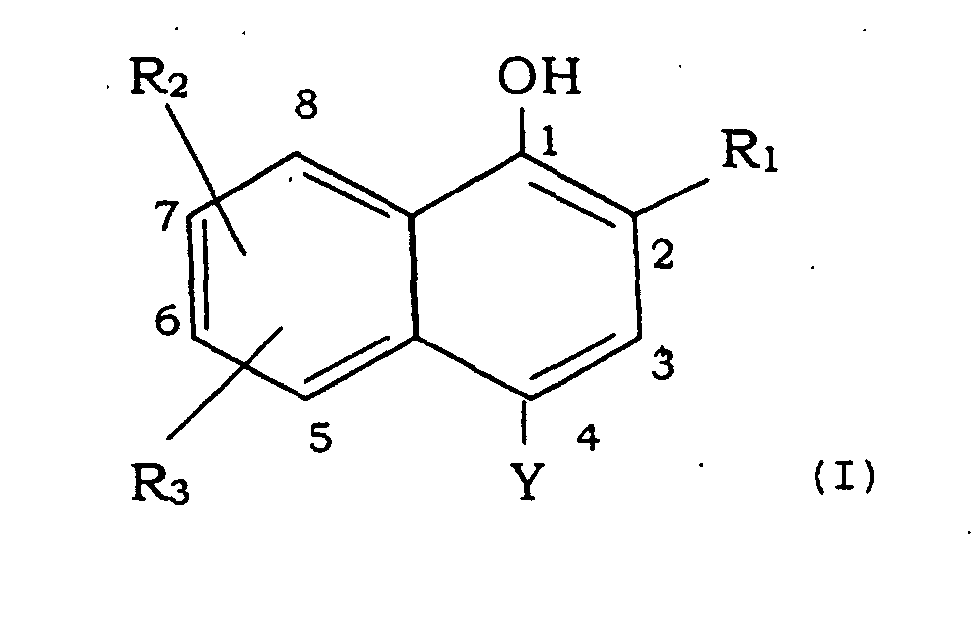 mit der Maßgabe, dass:R1 eine Gruppe, die unter -NR4(C=O)R5, -NR6SO2R7 und -(C=O)NR6R8 ausgewählt ist, wobei die Gruppen R4, R5, R6, R7, und R8 nachstehend definiert sind;R2 und R3, die gleich oder verschieden sind, Wasserstoff; Halogen; eine nachstehend definierte Gruppe Z; eine geradkettige oder verzweigte Gruppe mit 1 bis 20 Kohlenstoffatomen (wobei der Zweig oder die Zweige einen oder mehrere 3-bis 7-gliedrige kohlenstoffhaltige Ringe bilden können), die eine oder mehrere Doppelbindungen und/oder eine oder mehrere Dreifachbindungen enthalten kann (wobei die Doppelbindungen gegebenenfalls zu aromatischen Gruppen führen), in der ein oder mehrere Kohlenstoffatome durch ein Sauerstoffatom, Stickstoffatom, Schwefelatom oder eine Gruppe -SO2 ersetzt sein können und in die Kohlenstoffatome unabhängig voneinander mit einem oder mehreren Halogenatomen substituiert sein können;die Gruppen R2 und R3 nicht über eine Binding -NH-NH- an den Benzolring der Formel (I) gebunden sein können; und die Gruppen R2 und R3 keine Peroxidbindung und keine Diazogruppe, Nitrogruppe oder Nitrosogruppe enthalten;die Gruppen R2 und R3 keine Hydroxygruppe oder Thiogruppe bedeuten können; unddie Gruppen R2 und R3 nicht gleichzeitig Amino, Alkylamino, Acylamino oder Sulfonylamino bedeuten können;
Y Wasserstoff, Halogen; eine Gruppe -OR9, -SR9 oder -NH-SO2R9, worin R9 eine geradkettige oder verzweigte C1-6-Alkylgruppe bedeutet (wobei der Zweig oder die Zweige einen oder mehrere 3- bis 6-gliedrige Ringe bilden können), die unsubstituiert vorliegt oder mit einer oder mehreren Gruppen substituiert ist, die unter Halogen, Hydroxy, C1-4-Alkoxy, Amino und C1-4-Aminoalkyl ausgewählt sind; eine Phenylgruppe, die gegebenenfalls mit einer oder zwei Gruppen substituiert ist, die unter C1-4-Alkyl, Trifluormethyl, Carboxy, C1-4-Alkoxycarbonyl, Halogen, Hydroxy, C1-4-Alkoxy, Amino und C1-4-Aminoalkyl ausgewählt sind; oder eine Benzylgruppe; R4, R6 und R8, die gleich oder verschieden sind, Wasserstoff; eine nachstehend definierte Gruppe Z; eine geradkettige oder verzweigte Gruppe mit 1 bis 15 Kohlenstoffatomen (wobei der Zweig oder die Zweige einen oder mehrere 3- bis 7-gliedrige kohlenstoffhaltige Ringe bilden können), die eine oder mehrere Doppelbindungen und/oder eine oder mehrere Dreifachbindungen enthalten kann (wobei die Doppelbindungen gegebenenfalls zu aromatischen Gruppen führen), in der ein oder mehrere Kohlenstoffatome durch ein Sauerstoffatom, Stickstoffatom, Schwefelatom oder eine Gruppe SO2 ersetzt sein können und in der die Kohlenstoffatome unabhängig voneinander mit einem oder mehreren Halogenatomen substituiert sein können;
mit der Maßgabe, dass die Gruppe SO2 nicht direkt an das Stickstoffatom gebunden sein kann, welches die Gruppe R4 oder R6 trägt;
mit der Maßgabe, dass die Gruppe -(C=O)- nicht direkt an das Stickstoffatom gebunden sein kann, welches die Gruppe R6 trägt;
mit der Maßgabe, dass die Gruppen R4, R6 und R8 keine Peroxidbindung und keine Diazogruppe, Nitrogruppe oder Nitrosogruppe enthalten;
mit der Maßgabe, dass die Gruppen R4, R6 und R8 nicht Hydroxy, Thio, Amino, Alkoxy oder Alkylthio bedeuten können;R5 und R7, die gleich oder verschieden sind, Wasserstoff; eine nachstehend definierte Gruppe Z; eine geradkettige oder verzweigte Gruppe mit 1 bis 20 Kohlenstoffatomen (wobei der Zweig oder die Zweige einen oder mehrere 3- bis 7-gliedrige kohlenstoffhaltige Ringe bilden können), die eine oder mehrere Doppelbindungen und/oder eine oder mehrere Dreifachbindungen enthalten kann (wobei die Doppelbindungen gegebenenfalls zu aromatischen Gruppen führen), in der ein oder mehrere Kohlenstoffatome durch ein Sauerstoffatom, Stickstoffatom, Schwefelatom oder eine Gruppe SO2 ersetzt sein können und in der die Kohlenstoffatome unabhängig voneinander mit einem oder mehreren Halogenatomen substituiert sein können;
mit der Maßgabe, dass die Gruppen R5 und R7 keine Peroxidbindung und keine Diazogruppe, Nitrogruppe oder Nitrosogruppe enthalten;
mit der Maßgabe, dass die Gruppe R5 keine Hydroxygruppe und keine Thiogruppe bedeuten kann;
mit der Maßgabe, dass die Gruppe R7 keine Thiogruppe bedeuten kann;
mit der Maßgabe, dass einerseits die Gruppen R4 und R5 und andererseits die Gruppen R6 und R8 ferner unabhängig voneinander einen 5- bis 7-gliedrigen, gesättigten oder ungesättigten Ring bilden können, der aus Kohlenstoff, Stickstoff und/oder Acyl besteht, wobei jedes Kettenglied gegebenenfalls mit einer oder zwei identischen oder voneinander verschiedenen Gruppen R substituiert sein kann, wobei R eine geradkettige oder verzweigte C1-8-Alkylgruppe bedeutet (wobei der Zweig oder die Zweige einen oder mehrere 3- bis 7-gliedrige Ringe bilden können), die eine oder mehrere Doppelbindungen und/oder eine oder mehrere Dreifachbindungen enthalten kann (wobei die Doppelbindungen gegebenenfalls zu aromatischen Gruppen führen), in der ein oder mehrere Kohlenstoffatome durch ein Sauerstoffatom, Stickstoffatom, Schwefelatom oder eine Gruppe SO2 ersetzt sein können und in der die Kohlenstoffatome unabhängig voneinander mit einem oder mehreren Halogenatomen substituiert sein können; wobei die Ringe keine Peroxidbindung und keine Diazogruppe, Nitrogruppe oder Nitrosogruppe enthalten;Z eine kationische Gruppe der folgenden Formel (II):worin bedeuten: wobei in den Formeln:n 0 oder 1,B eine geradkettige oder verzweigte (wobei der Zweig oder die Zweige einen oder mehrere 3- bis 7-gliedrige Ringe bilden können) Alkylgruppe mit 1 bis 15 Kohlenstoffatomen, die eine oder mehrere Doppelbindungen und/oder eine oder mehrere Dreifachbindungen enthalten kann, wobei die Doppelbindungen gegebenenfalls zu aromatischen Gruppen führen, und in der ein oder mehrere Kohlenstoffatome durch ein Sauerstoffatom, Stickstoffatom, Schwefelatom oder eine Gruppe -SO2 ersetzt sein können und in der ein oder mehrere Kohlenstoffatome unabhängig voneinander mit einem oder mehreren Halogenatomen oder einer oder mehreren Gruppen Z substituiert sein können; wobei die Gruppe B keine Peroxidbindung und keine Diazogruppe, Nitrogruppe oder Nitrosogruppe enthält;D eine Gruppe, die unter den kationischen Gruppen der folgenden Formeln (III) und (IV) ausgewählt ist:
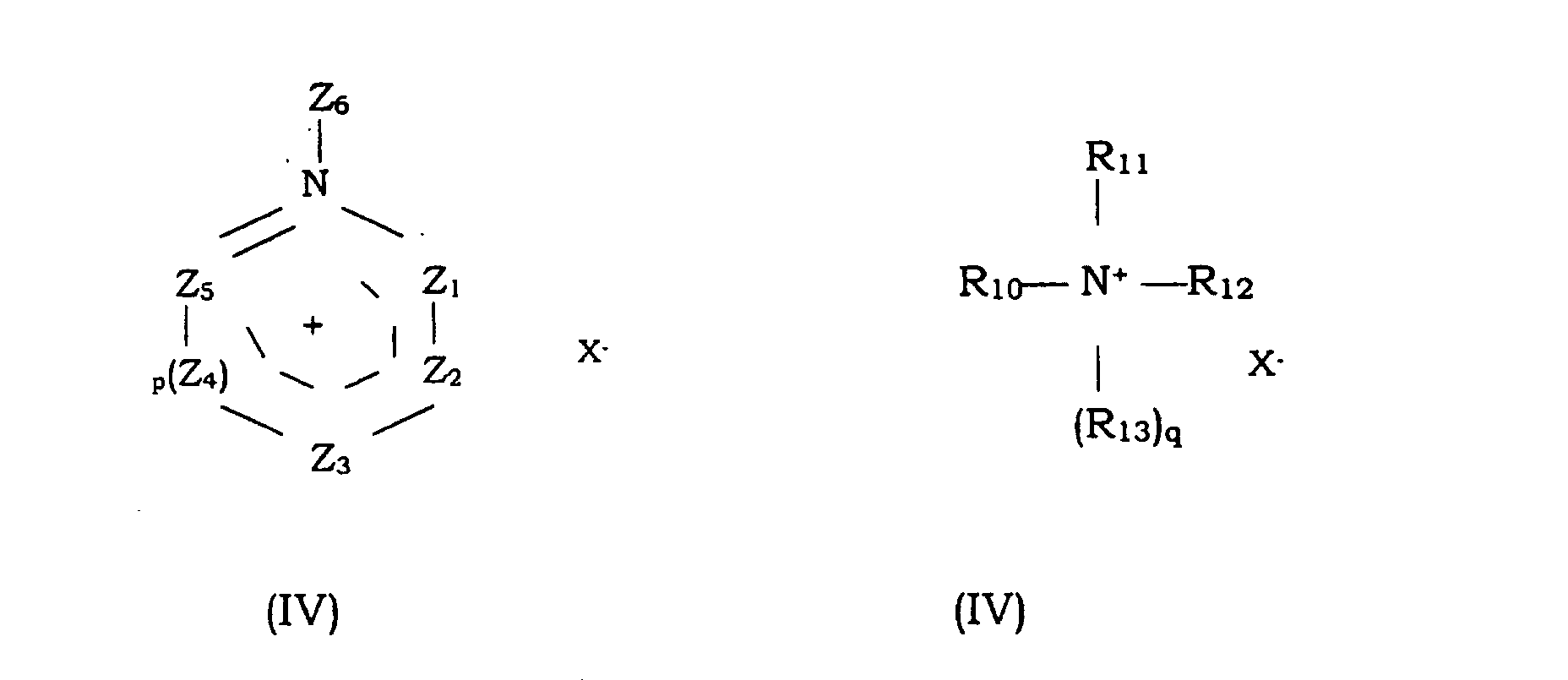 p und q unabhängig voneinander den Wert 0 oder 1 haben;die Gruppe B über ein beliebiges Atom der Gruppe D an die Gruppe D gebunden ist;die Gruppe der Formel (IV) direkt über das Stickstoffatom der quartären Ammoniumgruppe an die Verbindung der Formel (I) gebunden sein kann, wenn n = 0 und q = 0;Z1, Z2, Z3 und Z4 unabhängig voneinander ein Sauerstoffatom, Schwefelatom, ein unsubstituiertes oder mit einer Gruppe R14 substituiertes Stickstoffatom oder ein unsubstituiertes oder mit einer oder zwei gleichen oder verschiedenen Gruppen R14 substituiertes Kohlenstoffatom bedeuten;Z5 ein Stickstoffatom oder ein unsubstituiertes oder mit einer Gruppe R14 substituiertes Kohlenstoffatom bedeutet;Z6 die nachstehend für die Gruppe R14 angegebenen Bedeutungen annehmen kann, mit der Maßgabe, dass Z6 von Wasserstoff verschieden ist;wobei die Gruppen Z1 oder Z5 ferner mit Z6 einen 5- bis 7-gliedrigen, gesättigten oder ungesättigten Ring bilden können, wobei jedes Kettenglied gegebenenfalls mit einer oder zwei gleichen oder verschiedenen Gruppen R14 substituiert ist;R14 Wasserstoff; eine Gruppe Z; eine geradkettige oder verzweigte Gruppe mit 1 bis 10 Kohlenstoffatomen bedeutet, die eine oder mehrere Doppelbindungen und/oder eine oder mehrere Dreifachbindungen enthalten kann, wobei die Doppelbindungen gegebenenfalls zu aromatischen Gruppen führen, in der ein oder mehrere Kohlenstoffatome durch ein Sauerstoffatom, Stickstoffatom, Schwefelatom oder eine Gruppe SO2 ersetzt sein können und in der ein oder mehrere Kohlenstoffatome unabhängig voneinander mit einem oder mehreren Halogenatomen substituiert sein können; wobei die Gruppe keine Peroxidbindung und keine Diazogruppe, Nitrogruppe oder Nitrosogruppe enthält;wobei zwei angrenzende Gruppen Z1, Z2, Z3, Z4 und Z5 ferner einen 5- bis 7-gliedrigen Ring bilden können, wobei jedes Kettenglied unabhängig ein Kohlenstoffatom, das gegebenenfalls mit einer oder zwei gleichen oder verschiedenen Gruppen R14 substituiert ist, ein unsubstituiertes oder mit einer Gruppe R14 substituiertes Stickstoffatom, ein Sauerstoffatom oder ein Schwefelatom bedeuten kann;die Gruppen R10, R11, R12 und R13, die gleich oder verschieden sind, die oben für die Gruppe R14 angegebenen Bedeutungen haben;wobei jeweils 2 der Gruppen R10, R11, R12 und R13 ferner mit dem quartären Stickstoffatom, an das sie gebunden sind, einen oder mehrere, gesättigte 5- bis 7-gliedrige Ringe bilden können, wobei jedes Kettenglied unabhängig ein Kohlenstoffatom, das gegebenenfalls mit einer oder zwei gleichen oder verschiedenen Gruppen R14 substituiert ist, ein unsubstituiertes oder mit einer Gruppe R14 substituiertes Stickstoffatom, ein Sauerstoffatom oder ein Schwefelatom bedeuten kann;X ein organisches oder anorganisches Anion bedeutet;
mit der Maßgabe, dass mindestens eine der Gruppen R1 bis R3 eine Gruppe Z bedeutet oder eine Gruppe Z enthält. - Verbindung nach Anspruch 1, dadurch gekennzeichnet, dass die Gruppen R2 und R3 unabhängig voneinander bedeuten:Wasserstoff; Chlor; eine Gruppe Z; Methyl oder Methoxy; Amino, Methylamino, 2-Hydroxyethylamino; eine Gruppe -NH(CO)R15, wobei R15 eine Gruppe bedeutet, die aus der Gruppe (G1) ausgewählt ist, die aus den folgenden Gruppen besteht: Methyl, Ethyl, Propyl, Isopropyl, Butyl, Isobutyl, t-Butyl, Pentyl, Isopentyl, Neopentyl, Hexyl, Cyclopropyl, Cyclobutyl, Cyclopentyl, Cyclopentylmethyl, 3-Cyclopentylpropyl, Cyclohexyl, 2-Cyclohexylethyl, Norbornan-2-yl, Vinyl, 1-Methylvinyl, 2-Methylvinyl, 2,2-Dimethylvinyl, Allyl, 3-Butenyl, Phenyl, Methylphenyl, Dimethylphenyl, 2,4,6-Trimethylphenyl, 4-Ethylphenyl, (Trifluormethyl)-phenyl, Hydroxyphenyl, Methoxyphenyl, Ethoxyphenyl, Acetoxyphenyl, (Trifluormethoxy)phenyl, Aminophenyl, 4-Dimethylaminopheriyl, Fluorphenyl, Difluorphenyl, Fluor(trifluormethyl)-phenyl, Chlorphenyl, Dichlorphenyl, Bromphenyl, Naphth-1-yl, Naphth-2-yl, (2-Methoxy)naphth-1-yl, Benzyl, 4'-Methoxybenzyl, 2',5'-Dimethoxybenzyl, 3',4'-Dimethoxybenzyl, 4'-Fluorbenzyl, 4'-Chlorbenzyl, Phenethyl, 2-Phenylvinyl, (1-Naphthyl)methyl, (2-Naphthyl)methyl; Tetrahydrofuran-2-yl, Furan-2-yl, 5-Methyl-2-(trifluormethyl)furan-3-yl, 2-Methyl-5-phenylfuran-3-yl, Thiophen-2-yl, (Thiophen-2-yl)methyl, 3-Chlorthiophen-2-yl, 2,5-Dichlorthiophen-3-yl, Benzothiophen-2-yl, 3-Chlorbenzothiophen-2-yl, Isoxazol-5-yl, 5-Methylisoxazol-3-yl, 3,5-Dimethylisoxazol-4-yl, 1,3-Dimethylpyrazol-5-yl, 1-Ethyl-3-methylpyrazol-5-yl, 1-t-Butyl-3-methylpyrazol-5-yl, 3-t-Butyl-1-methylpyrazol-5-yl, 4-Brom-1-ethyl-3-methylpyrazol-5-yl, Pyridinyl, Chlorpyridinyl, Dichlorpyridinyl, 5-(Brom)pyridin-3-yl, Piperazin-2-yl, 2-Chlor-4-(trifluormethyl)pyrimidin-5-yl, Chinoxal-2-yl, Benzofurazan-5-yl, Fluormethyl, Difluormethyl, Trifluormethyl, 1,1,2,2-Tetrafluorethyl, Pentafluorethyl, Heptafluorpropyl, 1,1,2,2,3,3,4,4-Octafluorbutyl, Nonafluorbutyl, Chlormethyl, Chlorethyl, 1,1-Dimethyl-2-chlorethyl, 1,2-Dichlorethyl, 1-Chlorpropyl, 3-Chlorpropyl, 4-Chlorbutyl, Hydroxymethyl, Methoxymethyl, Phenoxymethyl, (4-Chlorphenoxy)methyl, Benzyloxymethyl, Acetoxymethyl, 1,2-Dihydroxyethyl, 1-Phenoxyethyl, 1-Acetoxyethyl, 2-(2-Carboxyethoxy)ethyl, 1-Phenoxyethyl, 1-Acetoxyethyl, (Methoxycarbonyl)methyl, 2-Carboxyethyl, 2-(Methoxycarbonyl)ethyl, 2-Carboxycyclopropyl, 2-Carboxycyclohexan, Methoxy, Ethoxy, Propoxy, Isopropoxy, Butoxy, Isobutoxy, Pentoxy, Neopentoxy, Hexyloxy, Cyclopentyloxy, Cyclohexyloxy, Vinyloxy, Allyloxy, Propargyloxy, Chlormethoxy, 1-Chlorethoxy, 2-Methoxyethoxy, 4-Chlorbutoxy, Phenoxy, 4-Methylphenoxy, 4-Fluorphenoxy, 4-Bromphenoxy, 4-Chlorphenoxy, 4-Methoxyphenoxy, Naphth-2-yloxy, Benzyloxy; Amino, Methylamino, Ethylamino, Propylamino, Isopropylamino, Butylamino, Cyclohexylamino, Allylamino, 2-Chlorethylamino, 3-Chlorpropylamino, Carboxymethylamino, Phenylamino, Fluorphenylamino, (Trifluormethyl)phenylaino, Chlorphenylamino, Bromphenylamino, 4-Acetylphenylamino, Methoxyphenylamino, (Trifluormethoxy)phenylamino, Naphth-1-ylamino, Benzylamino, Phenetylamino, Pyrid-3-ylamino, Dimethylamino, 1-Pyrolidinyl und 4-Morpholinyl; oder eine Gruppe -NHSO2R16, wobei R16 eine Gruppe bedeutet, die aus der Gruppe (G2) ausgewählt ist, die aus Methyl, Trifluormethyl, Ethyl, 2-Chlorethyl, Propyl, 3-Chlorpropyl, Isopropyl, Butyl, Thiophen-2-yl, Hydroxy, Ethoxy, Amino und Dimethylamino besteht.
- Verbindung nach Anspruch 2, dadurch gekennzeichnet, dass die Gruppen R2 und R3 unabhängig voneinander bedeuten:Wasserstoff; eine Gruppe O-E-D', -NH-E-D', -NH(CO)-D', -NH(CO)-E-D', -NH(CO)O-E-D', -NH(CO)NH-E-D oder -NH(SO2)-E-D', wobei -E- eine Kette -(CH2)q- bedeutet, worin q 1 oder 2 ist, und D' 3-Methylimidazolidinium-1-yl, 3-(2-Hydroxyethyl)-imidazolidinium-1-yl, 1,2,4-Triazolinium-1-yl, 1,2,4-Triazolinium-4-yl, N-Alkyl(C1-4)pyridinium-2-yl, N-Alkyl(C1-4)pyridinium-3-yl, N-Alkyl(C1-4)pyridinium-4-yl, N-(2-Hydroxyethyl)-pyridinium-2-yl, N-(2-Hydroxyethyl)pyridinium-3-yl, N-(2-Hydroxyethyl)pyridinium-4-yl, Pyridinium-1-yl, Trialkyl(C1-4)-ammonium-N-yl, 1-Methylpiperidinium-1-yl und 1,4-Dimethylpiperazinium-1-yl; eine Gruppe Methyl, Methoxy, Amino oder Methylamino; eine Gruppe-NHSO2R17, wobei R17 aus der oben definierten Gruppe (G2) stammt; oder Methansulfonylamino, Ethansulfonylamino oder Dimethylaminosulfonylamino bedeutet.
- Verbindung nach einem der vorhergehenden Ansprüche, dadurch gekennzeichnet, dass die Gruppe R4 bedeutet: Wasserstoffatom; eine Gruppe A1, die eine geradkettige oder verzweigte C1-8-Alkylgruppe ist, die eine oder zwei Doppelbindungen oder eine Dreifachbindung enthalten kann und die unsubstituiert vorliegt oder gegebenenfalls mit einer Gruppe, die unter den nachfolgend definierten Gruppen A2, A4 und A5 ausgewählt ist, gegebenenfalls mit einer oder zwei Gruppen, die identisch oder voneinander verschieden sind und unter den Gruppen N-Alkyl(C1-3)amino, N-Alkyl(C1-3)-N-alkyl(C1-3)amino, Alkoxy(C1-6), Oxo, Alkoxycarbonyl, Acyloxy, Amid, Acylamino, Ureyl, Sulfoxy, Sulfonyl, Sulfonamido, Sulfonylamino, Brom, Cyano und Carboxy ausgewählt sind, und gegebenenfalls mit einer oder mehreren Hydroxygruppen, Fluoratomen oder Chloratomen substituiert ist; eine Gruppe A2, bei der es sich um eine aromatische Gruppe vom Typ Phenyl oder Naphthyl handelt, die unsubstituiert vorliegen oder gegebenenfalls mit 1 bis 3 Gruppen substituiert sein kann, die gleich oder verschieden sind und unter den Gruppen Methyl, Trifluormethyl, Ethyl, Isopropyl, Butyl, Pentyl, Fluor, Chlor, Brom, Methoxy, Trifluormethoxy, Ethoxy, Propyloxy, Acetyloxy, Acetyl und Cyano ausgewählt sind; eine Gruppe A3, wobei es sich um heteroaromatische Gruppen handelt, die unter den folgenden Gruppen ausgewählt sind: Furanyl, Thiophenyl, Pyrrolyl, Imidazolyl, Thiazolyl, Oxazolyl, 1,2,3-Triazolyl, 1,2,4-Triazolyl, Isoxazolyl, Isothiazolyl, Pyrazolyl, Pyrazoltriazolyl, Pyrazoloimidazolyl, Pyrrolotriazolyl, Pyrazolopyrimidyl, Pyrazolopyridyl, Pyridyl, Pyrimidyl, Benzoimidazolyl, Benzoxazolyl, Benzothiazolyl, Indolyl, Indolidinyl, Isoindolyl, Indazolyl, Benzotriazolyl, Chinolinyl, Benzoimidazolyl und Benzopyrimidyl, wobei diese heteroaromatischen Gruppen gegebenenfalls mit 1 bis 3 Gruppen substituiert sein können, die unter den geradkettigen oder verzweigten C1-4-Alkylgruppen, C1-4-Monohydroxyalkyl, C2-4-Polyhydroxyalkyl, Carboxy, Alkoxycarbonyl, Halogen, Amido, Amino und Hydroxy ausgewählt sind; eine Gruppe A4, wobei des sich um C3-7-Cycloalkyl oder eine Norbornanylgruppe handelt und wobei sie gegebenenfalls eine Doppelbindung aufweist und gegebenenfalls mit einer oder zwei Gruppen substituiert ist, die unter den geradkettigen oder verzweigten C1-4-Alkylgruppen, C1-4-Monohydroxyalkyl, C2-4-Polyhydroxyalkyl, Carboxy, Alkoxycarbonyl, Halogen, Amido, Amino und Hydroxy ausgewählt sind, oder eine Gruppe A5, die ein Heterocyclus ist, der unter Dihydrofuranyl, Tetrahydrofuranyl, Butyrolact-on-yl, Dihydrothiophenyl, Tetrahydrothiophenyl, Tetrahydrothiophen-onyl, Iminothiolan, Dihydropyrrolyl, Pyrrolidinyl, Pyrrolidin-on-yl, Imidazolidin-on-yl, Imidazolidinthionyl, Oxazolidinyl, Oxazolidinon-yl, Oxazolanthion, Thiazolidinyl, Isothiazol-on-yl, Mercaptothiazolinyl, Pyrazolidin-on-yl, Iminothiolan, Dioxolanyl, Pentalacton, Dioxanyl, Dihydropyridinyl, Piperdinyl, Pentalactam, Morpholinyl, Pyrazoli(di)nyl, Pyrimi(di)nyl, Pyrazinyl, Piperazinyl und Azepinyl ausgewählt ist, wobei die Gruppen A1, A2, A3, A4 und/oder As gegebenenfalls über eine Gruppe -(CO)- an das Stickstoffatom der Gruppe -NR4(C=O)R5 gebunden sind.
- Verbindung nach Anspruch 4, dadurch gekennzeichnet, dass R4 bedeutet: Wasserstoff, Methyl, Ethyl, Isopropyl, Allyl, Phenyl, Benzyl, Fluorbenzyl, Hydroxybenzyl, Difluorbenzyl, Trifluorbenzyl, Chlorbenzyl, Brombenzyl, Methoxybenzyl, Dimethoxybenzyl, (Trinuorm.ethoxy)benzyl, 3,4-Methylendioxybenzyl, 6-Chlorpiperonyl, 4-Methylthiobenzyl, 4-Methylsulfonylbenzyl, 4-Acetylaminobenzyl, 4-Carboxybenzyl, 1-Naphtomethyl, 2-Naphthomethyl; 2-Hydroxyethyl, 2-Methoxyethyl oder 2-Ethoxyethyl.
- Verbindung nach einem der vorhergehenden Ansprüche, dadurch gekennzeichnet, dass die Gruppe R5 bedeutet: Wasserstoff, Amino; eine Gruppe Z; oder eine in Anspruch 4 definierte Gruppe A1, A2, A3, A4 oder A5, die gegebenenfalls über eine Gruppe -O-, -NH-, -Nalkyl(C1-3)- oder -(CO)- an das Kohlenstoffatom (in 2-Stellung) der Amidfunktion der Verbindung der Formel (I) gebunden ist.
- Verbindung nach Anspruch 6, dadurch gekennzeichnet, dass die Gruppe R5 bedeutet: eine Gruppe Z; oder eine Gruppe, die zur Gruppe (G3) gehört, welche aus Methyl, Ethyl, Propyl, Allyl, Phenyl, Tetrahydrofuran-2-yl, Furan-2-yl, Thiophen-2-yl, Pyridinyl, Piperazin-2-yl, Fluormethyl, Chlormethyl, 2-Chlorethyl, Methoxymethyl, Acetoxymethyl, 1,2-Dihydroxyethyl, Methoxycarbonyl, 2-Carboxyethyl, Methoxy, Ethoxy, Propoxy, Allyloxy, 2-Chlorethoxy, 2-Methoxyethoxy, Amino, Ethylamino, Allylamino, 2-Chlorethylamino, Pyridylamino, Dimethylamino, 1-Pyrolidinyl und 4-Morpholinyl besteht.
- Verbindung nach Anspruch 7, dadurch gekennzeichnet, dass die Gruppe R5 bedeutet: -D', -E-D', -O-E-D' oder -NH-E-D', wobei -E- eine Kette -(CH2)q-, worin q 1 oder 2 ist, und D' eine in Anspruch 3 definierte Gruppe bedeutet; oder eine Gruppe, die zur Gruppe (G4) gehört, welche aus Methyl, Methoxymethyl, 2-Carboxyethyl, Methoxy, Amino, Ethylamino und 1-Pyrolidinyl besteht.
- Verbindung nach einem der vorhergehenden Ansprüche, dadurch gekennzeichnet, dass, falls die Gruppen R4 und R5 einen Ring bilden, der Ring ausgewählt ist unter: 2-Pyrrolidinon-1-yl, Methyl-2-pyrrolidinon-1-yl, 5-Carboxy-2-pyrrolidinon-1-yl, 5-Methoxycarbonyl-2-pyrrolidinon-1-yl, Pyrazolinon-1-yl, Succinimd-1-yl, 3,5-Diketopyrazolidin-1-yl, Oxindolin-1-yl, Maleimid-1-yl, Isoindol-1,3-dion-2-yl, 2-Piperidinon-1-yl und Glutarimid-1-yl.
- Verbindung nach einem der vorhergehenden Ansprüche, dadurch gekennzeichnet, dass die Gruppe R6 bedeutet: Wasserstoff oder eine in Anspruch 4 definierte Gruppe A1, A2, A3, A4 oder A5.
- Verbindung nach Anspruch 10, dadurch gekennzeichnet, dass die Gruppe R6 bedeutet: Wasserstoff; Methyl, Ethyl, Isopropyl, Allyl; Phenyl, Benzyl, Fluorbenzyl, Hydroxybenzyl, Difluorbenzyl, Trifluorbenzyl, Chlorbenzyl, Brombenzyl, Methoxybenzyl, Dimethoxybenzyl, (Trifluormethoxy)benzyl, 3,4-Methylendioxybenzyl, 6-Chlorpiperonyl, 4-Methylthiobenzyl, 4-Methylsulfonylbenzyl, 4-Acetylaminobenzyl, 4-Carboxybenzyl, 1-Naphtomethyl, 2-Naphthomethyl; 2-Hydroxyethyl, 2-Methoxyethyl oder 2-Ethoxyethyl.
- Verbindung nach einem der vorhergehenden Ansprüche, dadurch gekennzeichnet, dass die Gruppe R8 bedeutet: eine Gruppe Z; Wasserstoff oder eine in Anspruch 4 definierte Gruppe A1, A2, A3, A4 oder A5.
- Verbindung nach Anspruch 12, dadurch gekennzeichnet, dass die Gruppe R8 bedeutet: eine Gruppe Z; Wasserstoff; Methyl, Ethyl, Isopropyl, Allyl; Phenyl, Benzyl, Fluorbenzyl, Hydroxybenzyl, Difluorbenzyl, Trifluorbenzyl, Chlorbenzyl, Brombenzyl, Methoxybenzyl, Dimethoxybenzyl, (Trifluormethoxy)benzyl, 3,4-Methylendioxybenzyl, 6-Chlorpiperonyl, 4-Methylthiobenzyl, 4-Methylsulfonylbenzyl, 4-Acetylaminobenzyl, 4-Carboxybenzyl, 1-Naphtomethyl, 2-Naphthomethyl; 2-Hydroxyethyl, 2-Methoxyethyl oder 2-Ethoxyethyl.
- Verbindung nach Anspruch 13, dadurch gekennzeichnet, dass die Gruppe R8 bedeutet: Wasserstoff, Methyl oder eine Gruppe -D' oder -E-D', worin -E- eine Kette -(CH2)q mit q = 1 oder 2 bedeutet und D' eine in Anspruch 3 definierte Gruppe ist.
- Verbindung nach einem der vorhergehenden Ansprüche, dadurch gekennzeichnet, dass, falls die Gruppen R6 und R8 einen Ring bilden, der Ring ausgewählt ist unter: Pyrrolidinyl, Piperidinyl, Morpholinyl, Pyrazolyl, Isoxazolyl, Imidazolyl, Thiazolyl, Indolyl, Indolidinyl, Indazolyl, Pyrazolotriazolyl, Pyrrolotriazolyl, Pyrazoloimidazolyl, Pyrazolidinyl, Thiomorpholinyl, Thiazolyl und Pyrazinyl.
- Verbindung nach einem der vorhergehenden Ansprüche, dadurch gekennzeichnet, dass die Gruppe R7 bedeutet: Amino; eine Gruppe Z; oder eine in Anspruch 4 definierte Gruppe A1, A2, A3, A4 oder A5, die gegebenenfalls über eine Gruppe-NH oder Nalkyl(C1-3) an den Schwefel der Sulfonylgruppe der Verbindung der Formel (I) gebunden sein kann.
- Verbindung nach Anspruch 16, dadurch gekennzeichnet, dass die Gruppe R7 bedeutet: eine Gruppe Z oder eine Gruppe aus der Gruppe (G4), welche aus Methyl, Trifluormethyl, Ethyl, 2-Chlorethyl, Propyl, 3-Chlorpropyl, Isopropyl, Butyl, Thiophen-2-yl, Hydroxy, Ethoxy, Amino und Dimethylamino besteht.
- Verbindung nach Anspruch 17, dadurch gekennzeichnet, dass die Gruppe R7 bedeutet: eine Gruppe -D', E-D' oder -NH-E-D', worin -E- eine Kette -(CH2)q mit q = 1 oder 2 ist und D' eine oben definierte Gruppe bedeutet; Methyl, Ethyl oder Dimethylamino.
- Verbindung nach einem der vorhergehenden Ansprüche, dadurch gekennzeichnet, dass Y vorzugsweise bedeutet: Wasserstoff, Chlor, Fluor oder Brom; Methoxy, Ethoxy, Propoxy, Benzyloxy, Phenoxy; -OCH2CH2OMe; -OCH2CH2OMe; -OCH2CH2NMe2; -OCH2(CO)OH, -OCH2(CO)OMe, -OCH2(CO)OEt, -SCH2CH2CO2H oder -NHSO2Me
- Verbindung nach Anspruch 19, dadurch gekennzeichnet, dass die Gruppe Y bedeutet: Wasserstoff, Chlor, Methoxy, -OCH2(CO)OH oder -OCH2(CO)OMe.
- Verbindung nach einem der vorhergehenden Ansprüche, dadurch gekennzeichnet, dass D ausgewählt ist unter: Imidazolinium, Thiazolinium, Oxazolinium, Pyrrolinium, 1,2,3-Triazolinium, 1,2,4-Triazolinium, Isoxazolinium, Isothiazolinium, Imidazolidinium, Thiazolidinium, Pyrazolinium, Pyrazolidinium, Oxazolidinium, Pyrazoltriazolinium, Pyrazoloimidazolinium, Pyrrolotriazolinium, Pyrazolopyrimidinium, Pyrazolopyridinium, Pyridinium, Pyrimidinium, Pyrazinium, Triazinium, Benzimidazolinium, Benzoxazolinium, Benzothiazolinium, Indolinium, Indolidinium, Isoindolinium, Indazolinium, Benzotriazolinium, Chinolinium, Tetrahydrochinolinium, Benzoimidazolidinium, Benzopyrimidinium, Tetra-alkyl(C1-4)-ammonium, Dialkylpiperidinium, Dialkylpyrrolidinium, Dialkylmorpholinium, Dialkylthiomorpholinium, Dialkylpiperazinium, Azepinium und 1,4-Diazabicyclo-[2,2,2]octanium.
- Verbindung nach Anspruch 21, dadurch gekennzeichnet, dass D ausgewählt ist unter: 3-Methylimidazolidinium-1-yl, 3-(2-Hydroxyethyl)imidazolidinium-1-yl, 1,2,4-Triazolinium-1-yl, 1,2,4-Triazolinium-4-yl, N-Alkyl(C1-4)pyridinium-2-yl, N-Alkyl(C1-6)pyridinium-3-yl, N-Alkyl(C1-4)pyridinium-4-yl, N-(2-Hydroxyethyl)pyridinium-2-yl, N-(2-Hydroxyethyl)pyridinium-3-yl, N-(2-Hydroxyethyl)pyridinium-4-yl, Pyridinium-1-yl, Trialkyl(C1-4)ammonium-N-yl, 1-Methylpiperidinium-1-yl und 1,4-Dimethylpiperazinium-1-yl.
- Verbindung nach einem der vorhergehenden Ansprüche, dadurch gekennzeichnet, dass sie unter den Verbindungen ausgewählt ist, worin:i) - R1 eine Gruppe bedeutet, die aus der Gruppe (G5) ausgewählt ist, welche aus Acetylamino, Methansulfonylamino, Amido, Methylamido, -NH-C(O)-CH2-D1, -NH-SO2-CH2-CH2-D1 und -(CO)-NH-CH2-CH2-D1 besteht, wobei D1 3-Methylimidazolidinium-1-yl, Triazolinium-1-yl, Pyridinium-1-yl oder Trimethylammonium-N-yl bedeutet;R2 sich in 5-Stellung befindet und eine Gruppe bedeutet, die aus der Gruppe (G6) ausgewählt ist, welche aus Amino, Methylamino, Acetylamino, Methansulfonylamino, -NH-[C(O)]m-CH2-D1 mit m = 0 oder 1 oder -NH-SO2-CH2-CH2-D1 besteht;R3 Wasserstoff bedeutet;Y aus (G7) ausgewählt ist, wobei die Gruppe (G7) aus Wasserstoff, Chlor und Methoxy besteht; oderii) - R1 eine Gruppe aus der oben definierten Gruppe (G5) bedeutet;R2 sich in 8-Stellung befindet und eine Gruppe bedeutet, die zur oben definierten Gruppe (G6) gehört;R3 Wasserstoff bedeutet;Y eine Gruppe aus der oben definierten Gruppe (G7) ist; oderiii) - R1 eine Gruppe aus der oben definierten Gruppe (G5) bedeutet;R2 und R3 Wasserstoff bedeuten;Y eine Gruppe aus der oben definierten Gruppe (G7) ist.
- Verbindung nach einem der vorhergehenden Ansprüche, dadurch gekennzeichnet, dass sie unter den folgenden Verbindungen ausgewählt ist:3-[(1-Hydroxy-naphthalin-2-ylcarbamoyl)-methyl]-1-methyl-3H-imidazol-1-iumchlorid;3-[(1-Hydroxy-5-(2-(3-methyl-1H-imidazol-3-ium-1-yl)-acetyl)-amino-naphthalin-2-ylcarbamoyl)-methyl]-1-methyl-3H-imidazol-1-iumdichlorid;3-[(1-Hydroxy-8-(2-(3-methyl-1H-imidazol-3-ium-1-yl)-acetyl)-amino-naphthalin-2-ylcarbamoyl)-methyl]-1-methyl-3H-imidazol-1-iumdichlorid;3-[(1-Hydroxy-5-amino-naphthalin-2-ylcarbamoyl)-methyl]-1-methyl-3H-imidazol-1-iumchlorid;3-[(1-Hydroxy-5-acetylamino-naphthalin-2-ylcarbamoyl)-methyl]-1-methyl-3H-imidazol-1-iumchlorid;3-[(1-Hydroxy-5-methoxycarbonylamino-naphthalin-2-ylcarbamoyl)-methyl]-1-methyl-3H-imidazol-1-iumchlorid;3-[(1-Hydroxy-2-acetylamino-naphthalin-5-ylcarbamoyl)-methyl]-1-methyl-3H-imidazol-1-iumchlorid;3-[(1-Hydroxy-2-methoxycarbonylamino-naphthalin-5-ylcarbamoyl)-methyl]-1-methyl-3H-imidazol-1-iumchlorid;3-[(1-Hydroxy-5-methansulfonylamino-naphthalin-2-ylcarbamoyl)-methyl]-1-methyl-3H-imidazol-1-iumchlorid;3-[(1-Hydroxy-8-amino-naphthalin-2-ylcarbamoyl)-methyl]-1-methyl-3H-imidazol-1-iumchlorid;3-[(1-Hydroxy-8-acetylamino-naphthalin-2-ylcarbamoyl)-methyl]-1-methyl-3H-imidazol-1-iumchlorid;3-[(1-Hydroxy-8-methoxycarbonylamino-naphthalin-2-ylcarbamoyl)-methyl]-1-methyl-3H-imidazol-1-iumchlorid;3-[(1-Hydroxy-2-acetylamino-naphthalin-8-ylcarbamoyl)-methyl]-1-methyl-3H-imidazol-1-iumchlorid;3-[(1-Hydroxy-2-methoxycarbonylamino-naphthalin-8-ylcarbamoyl)-methyl]-1-methyl-3H-imidazol-1-iumchlorid;3-[(1-Hydroxy-8-methansulfonylamino-naphthalin-2-ylcarbamoyl)-methyl]-1-methyl-3H-imidazol-1-iumchlorid;1-[(1-Hydroxy-naphthalin-2-ylcarbamoyl)-methyl]-pyridiniumchlorid;1-[(1-Hydroxy-5-(2-(pyridinium-1-yl)-acetyl)amino-naphthalin-2-ylcarbamoyl)-methyl]-pyridiniumdichlorid;1-[(1-Hydroxy-8-(2-(pyridinium-1-yl)-acetyl)amino-naphthalin-2-ylcarbamoyl)-methyl]-pyridiniumdichlorid;1-[(1-Hydroxy-5-amino-naphthalin-2-ylcarbamoyl)-methyl]-pyridiniumchlorid;1-[(1-Hydroxy-5-acetylamino-naphthalin-2-ylcarbamoyl)-methyl]-pyridiniumchlorid;1-[(1-Hydroxy-5-methoxycarbonylamino-naphthalin-2-ylcarbamoyl)-methyl]-pyridiniumchlorid;1-[(1-Hydroxy-2-acetylamino-naphthalin-5-ylcarbamoyl)-methyl]-pyridiniumchlorid;1-[(1-Hydroxy-2-methoxycarbonylamino-naphthalin-5-ylcarbamoyl)-methyl]-pyridiniumchlorid;1-[(1-Hydroxy-5-methansulfonylamino-naphthalin-2-ylcarbamoyl)-methyl]-pyridiniumchlorid;1-[(1-Hydroxy-8-amino-naphthalin-2-ylcarbamoyl)-methyl]-pyridiniumchlorid;1-[(1-Hydroxy-8-acetylamino-naphthalin-2-ylcarbamoyl)-methyl]-pyridiniumchlorid;1-[(1-Hydroxy-8-methoxycarbonylamino-naphthalin-2-ylcarbamoyl)-methyl]-pyridiniumchlorid;1-[(1-Hydroxy-2-acetylamino-naphthalin-8-ylcarbamoyl)-methyl]-pyridiniumchlorid;1-[(1-Hydroxy-2-methoxycarbonylamino-naphthalin-8-ylcarbamoyl)-methyl]-pyridiniumchlorid;1-[(1-Hydroxy-8-methansulfonylamino-naphthalin-2-ylcarbamoyl)-methyl]-pyridiniumchlorid;1-[(1-Hydroxy-naphthalin-2-ylcarbamoyl)-methyl]-1,4-dimethyl-piperazin-1-iumchlorid;1-[(1-Hydroxy-5-(2-(1,4-dimethyl-piperazin-1-ium-1-yl)-acetyl)amino-naphthalin-2-ylcarbamoyl)-methyl]-1,4-dimethyl-piperazin-1-iumdichlorid;1-[(1-Hydroxy-8-(2-(1,4-dimethyl-piperazin-1-ium-1-yl)-acetyl)amino-naphthalin-2-ylcarbamoyl)-methyl]-1,4-dimethyl-piperazin-1-iumdichlorid;1-[(1-Hydroxy-5-amino-naphthalin-2-ylcarbamoyl)-methyl]-1,4-dimethyl-piperazin-1-iumchlorid;1-[(1-Hydroxy-5-acetylamino-naphthalin-2-ylcarbamoyl)-methyl]-1,4-dimethyl-piperazin-1-iumchlorid;1-[(1-Hydroxy-5-methoxycarbonylamino-naphthalin-2-ylcarbamoyl)-methyl]-1,4-dimethyl-piperazin-1-iumchlorid;1-[(1-Hydroxy-2-acetylamino-naphthalin-5-ylcarbamoyl)-methyl]-1,4-dimethyl-piperazin-1-iumchlorid;1-[(1-Hydroxy-2-methoxycarbonylamino-naphthalin-5-ylcarbamoyl)-methyl]-1,4-dimethyl-piperazin-1-iumchlorid;1-[(1-Hydroxy-5-methansulfonylamino-naphthalin-2-ylcarbamoyl)-methyl]-1,4-dimethyl-piperazin-1-iumchlorid;1-[(1-Hydroxy-8-amino-naphthalin-2-ylcarbamoyl)-methyl]-1,4-dimethyl-piperazin-1-iumchlorid;1-[(1-Hydroxy-8-acetylamino-naphthalin-2-ylcarbamoyl)-methyl]-1,4-dimethyl-piperazin-1-iumchlorid;1-[(1-Hydroxy-8-methoxycarbonylamino-naphthalin-2-ylcarbamoyl)-methyl]-1,4-dimethyl-piperazin-1-iumchlorid;1-[(1-Hydroxy-2-acetylamino-naphthalin-8-ylcarbamoyl)-methyl]-1,4-dimethyl-piperazin-1-iumchlorid;1-[(1-Hydroxy-2-methoxycarbonylamino-naphthalin-8-ylcarbamoyl)-methyl]-1,4-dimethyl-piperazin-1-iumchlorid;1-[(1-Hydroxy-8-methansulfonylamino-naphthalin-2-ylcarbamoyl)-methyl]-1,4-dimethyl-piperazin-1-iumchlorid; und deren Additionssalze mit einer Säure.
- Verbindung nach einem der vorhergehenden Ansprüche, dadurch gekennzeichnet, dass die Additionssalze mit einer Säure unter den Hydrochloriden, Hydrobromiden, Sulfaten, Citraten, Succinaten, Tartraten, Lactaten und Acetaten ausgewählt sind.
- Verwendung von Verbindungen der Formel (I) nach einem der Ansprüche 1 bis 24 als Kuppler zum oxidativen Färben von Keratinfasern.
- Zusammensetzung zum oxidativen Färben von Keratinfasern, dadurch gekennzeichnet, daß sie in einem zum Färben geeigneten Medium enthält:mindestens eine Oxidationsbase, undmindestens einen Kuppler, der unten den Verbindungen der Formel (I) nach einem der Ansprüche 1 bis 25 ausgewählt ist.
- Zusammensetzung nach Anspruch 27, dadurch gekennzeichnet, dass die Verbindung(en) der Formel (I) und/oder ihr(e) Additionssalz(e) mit einer Säure 0,0005 bis 12 Gew.-% des Gesamtgewichts der Farbmittelzusammensetzung ausmachen.
- Zusammensetzung nach Anspruch 27 oder 28, dadurch gekennzeichnet, dass die die Oxidationsbase(n) unter den p-Phenylendiaminen, Bisphenylalkylendiaminen, p-Aminophenolen, o-Aminophenolen und den heterocyclischen Basen und ihren Additionssalzen mit einer Säure ausgewählt sind.
- Zusammensetzung nach einem der Ansprüche 27 bis 29, dadurch gekennzeichnet, dass die Oxidationsbase(n) 0,0005 bis 12 Gew.-% des Gesamtgewichts der Farbmittelzusammensetzung ausmachen.
- Zusammensetzung nach einem der Ansprüche 27 bis 30, dadurch gekennzeichnet, dass sie neben der oder den Verbindungen der Formel (I) ferner einen oder mehrere zusätzliche Kuppler, die unter den m-Phenylendiaminen, m-Aminophenolen, m-Dihydroxybenzolen und den heterocyclischen Kupplern ausgewählt sind, und ihre Additionssalze mit einer Säure und/oder einen oder mehrere Direktfarbstoffe enthält.
- Zusammensetzung nach Anspruch 31, dadurch gekennzeichnet, daß der oder die zusätzlichen Kuppler 0,0001 bis 10 Gew.-% des Gesamtgewichts der Farbmittelzusammensetzung ausmachen.
- Zusammensetzung nach einem der Ansprüche 27 bis 29, dadurch gekennzeichnet, dass die Additionssalze mit einer Säure unter den Hydrochloriden, Hydrobromiden, Sulfaten, Citraten, Succinaten, Tartraten, Lactaten und Acetaten ausgewählt sind.
- Verfahren zum oxidativen Färben von Keratinfasern, dadurch gekennzeichnet, dass auf die Fasern mindestens eine Farbmittelzusammensetzung nach einem der Ansprüche 27 bis 33 aufgetragen wird und die Farbe bei einem sauren, neutralen oder alkalischen pH-Wert mit einem Oxidationsmittel entwickelt wird, das kurz vor der Anwendung zu der Farbmittelzusammensetzung gegeben wird oder das in einer oxidierenden Zusammensetzung vorliegt, die gleichzeitig oder getrennt davon anschließend aufgetragen wird.
- Verfahren nach Anspruch 34, dadurch gekennzeichnet, daß das Oxidationsmittel unter Wasserstoffperoxid, Harnstoffperoxid, Alkalimetallbromaten, Salzen von Persäuren und Enzymen ausgewählt ist.
- Vorrichtung mit mehreren Abteilungen oder "Kit" zum Färben mit mehreren Abteilungen, wobei eine erste Abteilung eine Farbmittelzusammensetzung nach einem der Ansprüche 27 bis 33 und eine zweite Abteilung eine oxidierende Zusammensetzung enthält.
Applications Claiming Priority (3)
| Application Number | Priority Date | Filing Date | Title |
|---|---|---|---|
| FR9900639A FR2788769B1 (fr) | 1999-01-21 | 1999-01-21 | Nouveaux coupleurs cationiques, leur utilisation pour la teinture d'oxydation, compositions pour la teinture les comprenant, et procedes de teinture |
| FR9900639 | 1999-01-21 | ||
| PCT/FR2000/000140 WO2000043356A1 (fr) | 1999-01-21 | 2000-01-21 | Nouveaux coupleurs cationiques et leur utilisation pour la teinture d'oxydation |
Publications (2)
| Publication Number | Publication Date |
|---|---|
| EP1066246A1 EP1066246A1 (de) | 2001-01-10 |
| EP1066246B1 true EP1066246B1 (de) | 2003-11-05 |
Family
ID=9541075
Family Applications (1)
| Application Number | Title | Priority Date | Filing Date |
|---|---|---|---|
| EP00900641A Expired - Lifetime EP1066246B1 (de) | 1999-01-21 | 2000-01-21 | Kationische kuppler deren verwendung zum oxidativen färben |
Country Status (10)
| Country | Link |
|---|---|
| US (1) | US6605124B1 (de) |
| EP (1) | EP1066246B1 (de) |
| JP (1) | JP2002535305A (de) |
| AT (1) | ATE253551T1 (de) |
| AU (1) | AU3058300A (de) |
| CA (1) | CA2323708A1 (de) |
| DE (1) | DE60006318T2 (de) |
| ES (1) | ES2209805T3 (de) |
| FR (1) | FR2788769B1 (de) |
| WO (1) | WO2000043356A1 (de) |
Families Citing this family (6)
| Publication number | Priority date | Publication date | Assignee | Title |
|---|---|---|---|---|
| MXPA03004379A (es) * | 2000-11-17 | 2005-01-25 | P & G Clariol Inc | Nuevo acoplador para usarse en la tincion oxidativa del cabello. |
| DE10120914A1 (de) | 2001-04-27 | 2002-10-31 | Schwarzkopf Gmbh Hans | Pflegende Wirkstoffkombination für Haarfärbemittel |
| FR2825622B1 (fr) | 2001-06-11 | 2007-06-29 | Oreal | Composition pour la teinture des fibres keratiniques comprenant un colorant diazoique dicationique particulier |
| DE102004020501A1 (de) * | 2004-04-26 | 2005-11-10 | Henkel Kgaa | Verwendung von Organosilikon-Copolymeren in Haarfärbemitteln |
| FR2957346B1 (fr) * | 2010-03-12 | 2012-06-15 | Oreal | Nouvelles 7-amino-1,2,3,4-tetrahydroquinoleines cationiques, composition tinctoriale comprenantune 7-amino-1,2,3,4- tetrahydroquinoleine cationique, procedes et utilisations |
| JPWO2023182233A1 (de) * | 2022-03-23 | 2023-09-28 |
Family Cites Families (29)
| Publication number | Priority date | Publication date | Assignee | Title |
|---|---|---|---|---|
| DE285095C (de) | ||||
| BE626050A (de) | 1962-03-30 | |||
| DE1492175A1 (de) | 1965-07-07 | 1970-02-12 | Schwarzkopf Gmbh Hans | Verfahren zum Faerben von lebenden Haaren |
| DE2359399C3 (de) | 1973-11-29 | 1979-01-25 | Henkel Kgaa, 4000 Duesseldorf | Haarfärbemittel |
| US4003699A (en) | 1974-11-22 | 1977-01-18 | Henkel & Cie G.M.B.H. | Oxidation hair dyes based upon tetraaminopyrimidine developers |
| DE2706029C2 (de) * | 1977-02-12 | 1985-10-31 | Henkel KGaA, 4000 Düsseldorf | Haarfärbemittel |
| GB2016502A (en) * | 1978-02-28 | 1979-09-26 | Ciba Geigy Ag | Novel chemical compounds |
| NL7901377A (nl) * | 1978-02-28 | 1979-08-30 | Ciba Geigy | Werkwijze voor de vervaardiging van fotografische beelden door kleurstofdiffusie-overdracht en fotogra- fisch materiaal, dat voor deze werkwijze geschikt is. |
| FR2586913B1 (fr) | 1985-09-10 | 1990-08-03 | Oreal | Procede pour former in situ une composition constituee de deux parties conditionnees separement et ensemble distributeur pour la mise en oeuvre de ce procede |
| JPH0723353B2 (ja) | 1987-04-16 | 1995-03-15 | 富士写真フイルム株式会社 | 5−置換アミノ−1−ヒドロキシ−2−ナフトエ酸アリ−ル化合物 |
| EP0303301A3 (en) * | 1987-08-14 | 1989-05-17 | Fuji Photo Film Co., Ltd. | Silver halide photographic material |
| JPH01186859A (ja) | 1988-01-19 | 1989-07-26 | Fuji Photo Film Co Ltd | 4−アルキルチオ−1−ナフトール化合物の製造方法 |
| JPH0720852B2 (ja) * | 1988-06-08 | 1995-03-08 | 花王株式会社 | 角質繊維用染色組成物 |
| JP2526099B2 (ja) | 1988-07-07 | 1996-08-21 | 花王株式会社 | 角質繊維染色組成物 |
| DE3843892A1 (de) | 1988-12-24 | 1990-06-28 | Wella Ag | Oxidationshaarfaerbemittel mit einem gehalt an diaminopyrazolderivaten und neue diaminopyrazolderivate |
| JP2881233B2 (ja) * | 1989-03-16 | 1999-04-12 | 富士写真フイルム株式会社 | ハロゲン化銀写真感光材料 |
| EP0440195B1 (de) * | 1990-01-31 | 1997-07-30 | Fuji Photo Film Co., Ltd. | Farbphotographisches Silberhalogenidmaterial |
| DE4133957A1 (de) | 1991-10-14 | 1993-04-15 | Wella Ag | Haarfaerbemittel mit einem gehalt an aminopyrazolderivaten sowie neue pyrazolderivate |
| DE4234887A1 (de) | 1992-10-16 | 1994-04-21 | Wella Ag | Oxidationshaarfärbemittel mit einem Gehalt an 4,5-Diaminopyrazolderivaten sowie neue 4,5-Diaminopyrazolderivate und Verfahren zu ihrer Herstellung |
| DE4234885A1 (de) | 1992-10-16 | 1994-04-21 | Wella Ag | Verfahren zur Herstellung von 4,5-Diaminopyrazol-Derivaten, deren Verwendung zum Färben von Haaren sowie neue Pyrazol-Derivate |
| US5344463A (en) * | 1993-05-17 | 1994-09-06 | Clairol, Inc. | Hair dye compositions and methods utilizing 2-substituted-1-naphthol couplers |
| DE4440957A1 (de) | 1994-11-17 | 1996-05-23 | Henkel Kgaa | Oxidationsfärbemittel |
| JPH08310999A (ja) | 1995-03-15 | 1996-11-26 | Fuji Photo Film Co Ltd | 4−ハロ−1−ナフトール化合物の製造方法 |
| FR2733749B1 (fr) | 1995-05-05 | 1997-06-13 | Oreal | Compositions pour la teinture des fibres keratiniques contenant des diamino pyrazoles, procede de teinture, nouveaux diamino pyrazoles et leur procede de preparation |
| US5529583A (en) * | 1995-09-14 | 1996-06-25 | Clairol Incorporated | Storage stable 2-methyl-1-naphthol couplers |
| DE19539264C2 (de) | 1995-10-21 | 1998-04-09 | Goldwell Gmbh | Haarfärbemittel |
| DE19543988A1 (de) | 1995-11-25 | 1997-05-28 | Wella Ag | Oxidationshaarfärbemittel mit einem Gehalt an 3,4,5-Triaminopyrazolderivaten sowie neue 3,4,5-Triaminopyrazolderivate |
| FR2750048B1 (fr) | 1996-06-21 | 1998-08-14 | Oreal | Compositions de teinture des fibres keratiniques contenant des derives pyrazolo-(1, 5-a)-pyrimidine, procede de teinture, nouveaux derives pyrazolo-(1, 5-a)-pyrimidine et leur procede de preparation |
| US5849042A (en) * | 1997-11-19 | 1998-12-15 | Bristol-Myers Squibb | Hair dye compositions containing 2,3 dialkyl-4-aminophenol and a 2-alkyl-1-naphthol |
-
1999
- 1999-01-21 FR FR9900639A patent/FR2788769B1/fr not_active Expired - Fee Related
-
2000
- 2000-01-21 ES ES00900641T patent/ES2209805T3/es not_active Expired - Lifetime
- 2000-01-21 AU AU30583/00A patent/AU3058300A/en not_active Abandoned
- 2000-01-21 EP EP00900641A patent/EP1066246B1/de not_active Expired - Lifetime
- 2000-01-21 AT AT00900641T patent/ATE253551T1/de not_active IP Right Cessation
- 2000-01-21 WO PCT/FR2000/000140 patent/WO2000043356A1/fr not_active Ceased
- 2000-01-21 JP JP2000594773A patent/JP2002535305A/ja active Pending
- 2000-01-21 CA CA002323708A patent/CA2323708A1/fr not_active Abandoned
- 2000-01-21 DE DE60006318T patent/DE60006318T2/de not_active Expired - Fee Related
- 2000-01-21 US US09/646,647 patent/US6605124B1/en not_active Expired - Fee Related
Also Published As
| Publication number | Publication date |
|---|---|
| FR2788769A1 (fr) | 2000-07-28 |
| ES2209805T3 (es) | 2004-07-01 |
| EP1066246A1 (de) | 2001-01-10 |
| FR2788769B1 (fr) | 2001-02-16 |
| CA2323708A1 (fr) | 2000-07-27 |
| DE60006318T2 (de) | 2004-09-16 |
| ATE253551T1 (de) | 2003-11-15 |
| US6605124B1 (en) | 2003-08-12 |
| WO2000043356A1 (fr) | 2000-07-27 |
| DE60006318D1 (de) | 2003-12-11 |
| AU3058300A (en) | 2000-08-07 |
| JP2002535305A (ja) | 2002-10-22 |
Similar Documents
| Publication | Publication Date | Title |
|---|---|---|
| EP0740931B1 (de) | Zusammensetzungen für die Färbung von keratinischen Fibern, die Diaminopyrazole enthalten, Verfahren zum Färben, Diaminopyrazole und Verfahren zu ihrer Herstellung | |
| EP1341508A1 (de) | Oxidationsfärbezusammensetzung auf basis von zumindest in position 2 und 3 substituierten 1-(4-aminophenyl)-pyrrolidinen | |
| EP1129689A2 (de) | Färbemittel für Keratinfasern enthaltend N-(2-Hydroxybenzol)carbamat- oder N-(2-Hydroxybenzol)harnstoff-Derivate als Kuppler und Färbungsverfahren | |
| EP1341509A1 (de) | Oxidationsfärbezusammensetzung auf basis von in position 2 substituierten 1-(4-aminophenyl)-pyrrolidinen | |
| WO2002045672A1 (fr) | Composition de teinture d'oxydation a base de 1-(4-aminophenyl)pyrrolidines substituees en position 2 et 4 | |
| EP1066246B1 (de) | Kationische kuppler deren verwendung zum oxidativen färben | |
| EP1066022B1 (de) | Zusammensetzungen zur färbung keratinischer fasern, enthaltend einen kationischen kuppler, neue kationische kuppler, deren verwendung zur oxidativen färbung und färbeverfahren | |
| FR2805160A1 (fr) | Compositions pour la teinture d'oxydation des fibres keratiniques comprenant un n(2-hydroxybenzene)-carbramate ou un n-(2-hydroxybenzene)-uree et une pyrazolopyrimidine, et procedes de teinture | |
| EP1341507A1 (de) | Oxidationsfärbezusammensetzung auf basis von in position 2 und 5 substituierten 1-(4-aminophenyl)-pyrrolidinen | |
| EP1341510A1 (de) | Oxidationsfärbezusammensetzung auf basis von in position 3 und 4 substituierten 1-(4-aminophenyl)-pyrrolidinen und färbemethode unter verwendung dieser zusammensetzungen | |
| WO2000043388A1 (fr) | Methylenedioxy-benzenes cationiques, leur utilisation pour la teinture d'oxydation des fibres keratiniques, compositions et procede de teinture | |
| EP1066263A1 (de) | Kationische acylaminophenole, deren verwendung als kuppler zum oxidativen färben keratinischer fasern, färbemittel und färbeverfahren | |
| EP1066264B1 (de) | Kationische 2-sulfonylaminophenole, ihre anwendung als kuppler für die oxidationsfärbung, diese enthaltende zusammensetzungen und färbungsverfahren | |
| EP1205176A1 (de) | Verwendung von 2-Sulfonylaminophenolen als Kupplungskomponenten zum oxidativen Färben | |
| EP1066282A1 (de) | Kationische di-methylendioxy-benzole, deren verwendung für oxydationsfärbemittel von keratinfasern | |
| EP1120405A2 (de) | Oxidationsbasen mit Guanidin Kette, Verfahren zu deren Herstellung, deren Verwendung zur oxidativen Färbung von keratinischen Fasern, Farbmitteltzusammensetzung und Färbeverfahren |
Legal Events
| Date | Code | Title | Description |
|---|---|---|---|
| PUAI | Public reference made under article 153(3) epc to a published international application that has entered the european phase |
Free format text: ORIGINAL CODE: 0009012 |
|
| AK | Designated contracting states |
Kind code of ref document: A1 Designated state(s): AT BE CH CY DE DK ES FI FR GB GR IE IT LI LU MC NL PT SE |
|
| 17P | Request for examination filed |
Effective date: 20010129 |
|
| 17Q | First examination report despatched |
Effective date: 20020308 |
|
| GRAH | Despatch of communication of intention to grant a patent |
Free format text: ORIGINAL CODE: EPIDOS IGRA |
|
| GRAS | Grant fee paid |
Free format text: ORIGINAL CODE: EPIDOSNIGR3 |
|
| GRAA | (expected) grant |
Free format text: ORIGINAL CODE: 0009210 |
|
| AK | Designated contracting states |
Kind code of ref document: B1 Designated state(s): AT BE CH CY DE DK ES FI FR GB GR IE IT LI LU MC NL PT SE |
|
| PG25 | Lapsed in a contracting state [announced via postgrant information from national office to epo] |
Ref country code: IE Free format text: LAPSE BECAUSE OF FAILURE TO SUBMIT A TRANSLATION OF THE DESCRIPTION OR TO PAY THE FEE WITHIN THE PRESCRIBED TIME-LIMIT Effective date: 20031105 Ref country code: CY Free format text: LAPSE BECAUSE OF FAILURE TO SUBMIT A TRANSLATION OF THE DESCRIPTION OR TO PAY THE FEE WITHIN THE PRESCRIBED TIME-LIMIT Effective date: 20031105 Ref country code: AT Free format text: LAPSE BECAUSE OF FAILURE TO SUBMIT A TRANSLATION OF THE DESCRIPTION OR TO PAY THE FEE WITHIN THE PRESCRIBED TIME-LIMIT Effective date: 20031105 Ref country code: FI Free format text: LAPSE BECAUSE OF FAILURE TO SUBMIT A TRANSLATION OF THE DESCRIPTION OR TO PAY THE FEE WITHIN THE PRESCRIBED TIME-LIMIT Effective date: 20031105 Ref country code: NL Free format text: LAPSE BECAUSE OF FAILURE TO SUBMIT A TRANSLATION OF THE DESCRIPTION OR TO PAY THE FEE WITHIN THE PRESCRIBED TIME-LIMIT Effective date: 20031105 |
|
| REG | Reference to a national code |
Ref country code: GB Ref legal event code: FG4D Free format text: NOT ENGLISH |
|
| REG | Reference to a national code |
Ref country code: CH Ref legal event code: EP |
|
| REF | Corresponds to: |
Ref document number: 60006318 Country of ref document: DE Date of ref document: 20031211 Kind code of ref document: P |
|
| PGFP | Annual fee paid to national office [announced via postgrant information from national office to epo] |
Ref country code: MC Payment date: 20031229 Year of fee payment: 5 |
|
| REG | Reference to a national code |
Ref country code: IE Ref legal event code: FG4D Free format text: FRENCH |
|
| PGFP | Annual fee paid to national office [announced via postgrant information from national office to epo] |
Ref country code: SE Payment date: 20040107 Year of fee payment: 5 |
|
| PGFP | Annual fee paid to national office [announced via postgrant information from national office to epo] |
Ref country code: NL Payment date: 20040121 Year of fee payment: 5 |
|
| PGFP | Annual fee paid to national office [announced via postgrant information from national office to epo] |
Ref country code: IE Payment date: 20040122 Year of fee payment: 5 |
|
| PGFP | Annual fee paid to national office [announced via postgrant information from national office to epo] |
Ref country code: GR Payment date: 20040123 Year of fee payment: 5 |
|
| PGFP | Annual fee paid to national office [announced via postgrant information from national office to epo] |
Ref country code: CH Payment date: 20040129 Year of fee payment: 5 Ref country code: LU Payment date: 20040129 Year of fee payment: 5 |
|
| PG25 | Lapsed in a contracting state [announced via postgrant information from national office to epo] |
Ref country code: DK Free format text: LAPSE BECAUSE OF FAILURE TO SUBMIT A TRANSLATION OF THE DESCRIPTION OR TO PAY THE FEE WITHIN THE PRESCRIBED TIME-LIMIT Effective date: 20040205 Ref country code: SE Free format text: LAPSE BECAUSE OF FAILURE TO SUBMIT A TRANSLATION OF THE DESCRIPTION OR TO PAY THE FEE WITHIN THE PRESCRIBED TIME-LIMIT Effective date: 20040205 Ref country code: GR Free format text: LAPSE BECAUSE OF FAILURE TO SUBMIT A TRANSLATION OF THE DESCRIPTION OR TO PAY THE FEE WITHIN THE PRESCRIBED TIME-LIMIT Effective date: 20040205 |
|
| GBT | Gb: translation of ep patent filed (gb section 77(6)(a)/1977) |
Effective date: 20040117 |
|
| PGFP | Annual fee paid to national office [announced via postgrant information from national office to epo] |
Ref country code: DK Payment date: 20040308 Year of fee payment: 5 |
|
| NLV1 | Nl: lapsed or annulled due to failure to fulfill the requirements of art. 29p and 29m of the patents act | ||
| PGFP | Annual fee paid to national office [announced via postgrant information from national office to epo] |
Ref country code: BE Payment date: 20040409 Year of fee payment: 5 |
|
| REG | Reference to a national code |
Ref country code: IE Ref legal event code: FD4D |
|
| REG | Reference to a national code |
Ref country code: ES Ref legal event code: FG2A Ref document number: 2209805 Country of ref document: ES Kind code of ref document: T3 |
|
| PLBE | No opposition filed within time limit |
Free format text: ORIGINAL CODE: 0009261 |
|
| STAA | Information on the status of an ep patent application or granted ep patent |
Free format text: STATUS: NO OPPOSITION FILED WITHIN TIME LIMIT |
|
| 26N | No opposition filed |
Effective date: 20040806 |
|
| PGFP | Annual fee paid to national office [announced via postgrant information from national office to epo] |
Ref country code: GB Payment date: 20050119 Year of fee payment: 6 |
|
| PG25 | Lapsed in a contracting state [announced via postgrant information from national office to epo] |
Ref country code: LU Free format text: LAPSE BECAUSE OF NON-PAYMENT OF DUE FEES Effective date: 20050121 |
|
| PG25 | Lapsed in a contracting state [announced via postgrant information from national office to epo] |
Ref country code: MC Free format text: LAPSE BECAUSE OF NON-PAYMENT OF DUE FEES Effective date: 20050131 Ref country code: LI Free format text: LAPSE BECAUSE OF NON-PAYMENT OF DUE FEES Effective date: 20050131 Ref country code: BE Free format text: LAPSE BECAUSE OF NON-PAYMENT OF DUE FEES Effective date: 20050131 Ref country code: CH Free format text: LAPSE BECAUSE OF NON-PAYMENT OF DUE FEES Effective date: 20050131 |
|
| PGFP | Annual fee paid to national office [announced via postgrant information from national office to epo] |
Ref country code: ES Payment date: 20050211 Year of fee payment: 6 |
|
| BERE | Be: lapsed |
Owner name: L'*OREAL Effective date: 20050131 |
|
| REG | Reference to a national code |
Ref country code: CH Ref legal event code: PL |
|
| PG25 | Lapsed in a contracting state [announced via postgrant information from national office to epo] |
Ref country code: GB Free format text: LAPSE BECAUSE OF NON-PAYMENT OF DUE FEES Effective date: 20060121 |
|
| PG25 | Lapsed in a contracting state [announced via postgrant information from national office to epo] |
Ref country code: ES Free format text: LAPSE BECAUSE OF NON-PAYMENT OF DUE FEES Effective date: 20060123 |
|
| PGFP | Annual fee paid to national office [announced via postgrant information from national office to epo] |
Ref country code: IT Payment date: 20060131 Year of fee payment: 7 |
|
| GBPC | Gb: european patent ceased through non-payment of renewal fee |
Effective date: 20060121 |
|
| REG | Reference to a national code |
Ref country code: ES Ref legal event code: FD2A Effective date: 20060123 |
|
| BERE | Be: lapsed |
Owner name: L'*OREAL Effective date: 20050131 |
|
| PG25 | Lapsed in a contracting state [announced via postgrant information from national office to epo] |
Ref country code: PT Free format text: LAPSE BECAUSE OF NON-PAYMENT OF DUE FEES Effective date: 20040405 |
|
| PGFP | Annual fee paid to national office [announced via postgrant information from national office to epo] |
Ref country code: DE Payment date: 20080117 Year of fee payment: 9 |
|
| PGFP | Annual fee paid to national office [announced via postgrant information from national office to epo] |
Ref country code: FR Payment date: 20080108 Year of fee payment: 9 |
|
| PG25 | Lapsed in a contracting state [announced via postgrant information from national office to epo] |
Ref country code: IT Free format text: LAPSE BECAUSE OF NON-PAYMENT OF DUE FEES Effective date: 20070121 |
|
| PG25 | Lapsed in a contracting state [announced via postgrant information from national office to epo] |
Ref country code: DE Free format text: LAPSE BECAUSE OF NON-PAYMENT OF DUE FEES Effective date: 20090801 |
|
| REG | Reference to a national code |
Ref country code: FR Ref legal event code: ST Effective date: 20091030 |
|
| PG25 | Lapsed in a contracting state [announced via postgrant information from national office to epo] |
Ref country code: FR Free format text: LAPSE BECAUSE OF NON-PAYMENT OF DUE FEES Effective date: 20090202 |