EP1067157A1 - Composition d'encre pour encre fusible et procédé d'impression d'un substrat utilisant cette composition - Google Patents
Composition d'encre pour encre fusible et procédé d'impression d'un substrat utilisant cette composition Download PDFInfo
- Publication number
- EP1067157A1 EP1067157A1 EP00202260A EP00202260A EP1067157A1 EP 1067157 A1 EP1067157 A1 EP 1067157A1 EP 00202260 A EP00202260 A EP 00202260A EP 00202260 A EP00202260 A EP 00202260A EP 1067157 A1 EP1067157 A1 EP 1067157A1
- Authority
- EP
- European Patent Office
- Prior art keywords
- ink
- ink composition
- temperature
- composition according
- gelling agent
- Prior art date
- Legal status (The legal status is an assumption and is not a legal conclusion. Google has not performed a legal analysis and makes no representation as to the accuracy of the status listed.)
- Granted
Links
- 239000000203 mixture Substances 0.000 title claims abstract description 137
- 239000000758 substrate Substances 0.000 title claims abstract description 33
- 238000000034 method Methods 0.000 title claims abstract description 8
- 239000003349 gelling agent Substances 0.000 claims abstract description 74
- 238000011282 treatment Methods 0.000 claims abstract description 16
- 239000003795 chemical substances by application Substances 0.000 claims abstract description 7
- 150000001875 compounds Chemical class 0.000 claims description 19
- 239000000463 material Substances 0.000 claims description 18
- 239000012530 fluid Substances 0.000 claims description 11
- PEDCQBHIVMGVHV-UHFFFAOYSA-N Glycerine Chemical compound OCC(O)CO PEDCQBHIVMGVHV-UHFFFAOYSA-N 0.000 claims description 9
- 239000011230 binding agent Substances 0.000 claims description 4
- KQWGXHWJMSMDJJ-UHFFFAOYSA-N cyclohexyl isocyanate Chemical compound O=C=NC1CCCCC1 KQWGXHWJMSMDJJ-UHFFFAOYSA-N 0.000 claims description 4
- WXZMFSXDPGVJKK-UHFFFAOYSA-N pentaerythritol Chemical compound OCC(CO)(CO)CO WXZMFSXDPGVJKK-UHFFFAOYSA-N 0.000 claims description 3
- WMYINDVYGQKYMI-UHFFFAOYSA-N 2-[2,2-bis(hydroxymethyl)butoxymethyl]-2-ethylpropane-1,3-diol Chemical compound CCC(CO)(CO)COCC(CC)(CO)CO WMYINDVYGQKYMI-UHFFFAOYSA-N 0.000 claims description 2
- JOYRKODLDBILNP-UHFFFAOYSA-N Ethyl urethane Chemical compound CCOC(N)=O JOYRKODLDBILNP-UHFFFAOYSA-N 0.000 claims 3
- 150000005846 sugar alcohols Polymers 0.000 claims 3
- OQURWGJAWSLGQG-UHFFFAOYSA-N 1-isocyanatopropane Chemical compound CCCN=C=O OQURWGJAWSLGQG-UHFFFAOYSA-N 0.000 claims 1
- QWGRWMMWNDWRQN-UHFFFAOYSA-N 2-methylpropane-1,3-diol Chemical compound OCC(C)CO QWGRWMMWNDWRQN-UHFFFAOYSA-N 0.000 claims 1
- VMBMNYJHIDBZGP-UHFFFAOYSA-N 4-(4-methylbenzoyl)oxybutyl 4-methylbenzoate Chemical compound C1=CC(C)=CC=C1C(=O)OCCCCOC(=O)C1=CC=C(C)C=C1 VMBMNYJHIDBZGP-UHFFFAOYSA-N 0.000 claims 1
- PMVVWYMWJBCMMI-UHFFFAOYSA-N 4-phenoxybutoxybenzene Chemical compound C=1C=CC=CC=1OCCCCOC1=CC=CC=C1 PMVVWYMWJBCMMI-UHFFFAOYSA-N 0.000 claims 1
- HNFGOVKSAJHYCB-UHFFFAOYSA-N 6-(4-methylbenzoyl)oxyhexyl 4-methylbenzoate Chemical compound C1=CC(C)=CC=C1C(=O)OCCCCCCOC(=O)C1=CC=C(C)C=C1 HNFGOVKSAJHYCB-UHFFFAOYSA-N 0.000 claims 1
- QCYZRFDNQTVERI-VEDCIHCFSA-N C1(CC=CC=C1)(C)C(=O)OC[C@@H]1CC[C@H](CC1)COC(=O)C1(CC=CC=C1)C Chemical compound C1(CC=CC=C1)(C)C(=O)OC[C@@H]1CC[C@H](CC1)COC(=O)C1(CC=CC=C1)C QCYZRFDNQTVERI-VEDCIHCFSA-N 0.000 claims 1
- 239000000976 ink Substances 0.000 abstract description 260
- 238000001816 cooling Methods 0.000 abstract description 4
- 230000008569 process Effects 0.000 abstract description 4
- 239000007788 liquid Substances 0.000 description 24
- 230000000694 effects Effects 0.000 description 13
- 238000007711 solidification Methods 0.000 description 12
- 230000008023 solidification Effects 0.000 description 12
- 239000007787 solid Substances 0.000 description 11
- 239000002178 crystalline material Substances 0.000 description 10
- 230000008901 benefit Effects 0.000 description 9
- WVDDGKGOMKODPV-UHFFFAOYSA-N Benzyl alcohol Chemical compound OCC1=CC=CC=C1 WVDDGKGOMKODPV-UHFFFAOYSA-N 0.000 description 7
- 230000001965 increasing effect Effects 0.000 description 7
- WRMNZCZEMHIOCP-UHFFFAOYSA-N 2-phenylethanol Chemical compound OCCC1=CC=CC=C1 WRMNZCZEMHIOCP-UHFFFAOYSA-N 0.000 description 6
- 230000002411 adverse Effects 0.000 description 6
- 238000006748 scratching Methods 0.000 description 6
- 230000002393 scratching effect Effects 0.000 description 6
- 238000002425 crystallisation Methods 0.000 description 5
- 239000012943 hotmelt Substances 0.000 description 5
- 230000003993 interaction Effects 0.000 description 5
- 239000002245 particle Substances 0.000 description 5
- 229920000642 polymer Polymers 0.000 description 5
- LFQSCWFLJHTTHZ-UHFFFAOYSA-N Ethanol Chemical compound CCO LFQSCWFLJHTTHZ-UHFFFAOYSA-N 0.000 description 4
- 239000007859 condensation product Substances 0.000 description 4
- 239000000470 constituent Substances 0.000 description 4
- ZSIAUFGUXNUGDI-UHFFFAOYSA-N hexan-1-ol Chemical compound CCCCCCO ZSIAUFGUXNUGDI-UHFFFAOYSA-N 0.000 description 4
- 239000011159 matrix material Substances 0.000 description 4
- -1 toluate ester Chemical class 0.000 description 4
- 230000007704 transition Effects 0.000 description 4
- 150000003673 urethanes Chemical class 0.000 description 4
- 229920001634 Copolyester Polymers 0.000 description 3
- LYCAIKOWRPUZTN-UHFFFAOYSA-N Ethylene glycol Chemical compound OCCO LYCAIKOWRPUZTN-UHFFFAOYSA-N 0.000 description 3
- KFZMGEQAYNKOFK-UHFFFAOYSA-N Isopropanol Chemical compound CC(C)O KFZMGEQAYNKOFK-UHFFFAOYSA-N 0.000 description 3
- OKKJLVBELUTLKV-UHFFFAOYSA-N Methanol Chemical compound OC OKKJLVBELUTLKV-UHFFFAOYSA-N 0.000 description 3
- 239000000975 dye Substances 0.000 description 3
- 235000019441 ethanol Nutrition 0.000 description 3
- 238000002474 experimental method Methods 0.000 description 3
- 230000003287 optical effect Effects 0.000 description 3
- 229940067107 phenylethyl alcohol Drugs 0.000 description 3
- 239000000126 substance Substances 0.000 description 3
- LMYRWZFENFIFIT-UHFFFAOYSA-N toluene-4-sulfonamide Chemical compound CC1=CC=C(S(N)(=O)=O)C=C1 LMYRWZFENFIFIT-UHFFFAOYSA-N 0.000 description 3
- RSWGJHLUYNHPMX-UHFFFAOYSA-N Abietic-Saeure Natural products C12CCC(C(C)C)=CC2=CCC2C1(C)CCCC2(C)C(O)=O RSWGJHLUYNHPMX-UHFFFAOYSA-N 0.000 description 2
- 239000005057 Hexamethylene diisocyanate Substances 0.000 description 2
- DNIAPMSPPWPWGF-UHFFFAOYSA-N Propylene glycol Chemical compound CC(O)CO DNIAPMSPPWPWGF-UHFFFAOYSA-N 0.000 description 2
- KHPCPRHQVVSZAH-HUOMCSJISA-N Rosin Natural products O(C/C=C/c1ccccc1)[C@H]1[C@H](O)[C@@H](O)[C@@H](O)[C@@H](CO)O1 KHPCPRHQVVSZAH-HUOMCSJISA-N 0.000 description 2
- 235000019445 benzyl alcohol Nutrition 0.000 description 2
- 230000015572 biosynthetic process Effects 0.000 description 2
- IMHDGJOMLMDPJN-UHFFFAOYSA-N biphenyl-2,2'-diol Chemical compound OC1=CC=CC=C1C1=CC=CC=C1O IMHDGJOMLMDPJN-UHFFFAOYSA-N 0.000 description 2
- 230000008859 change Effects 0.000 description 2
- 239000007795 chemical reaction product Substances 0.000 description 2
- 239000003153 chemical reaction reagent Substances 0.000 description 2
- 230000015271 coagulation Effects 0.000 description 2
- 238000005345 coagulation Methods 0.000 description 2
- 230000008025 crystallization Effects 0.000 description 2
- IONMUCYQDGALHX-UHFFFAOYSA-N formaldehyde;1-phenylethanone Chemical compound O=C.CC(=O)C1=CC=CC=C1 IONMUCYQDGALHX-UHFFFAOYSA-N 0.000 description 2
- 230000009477 glass transition Effects 0.000 description 2
- 238000010438 heat treatment Methods 0.000 description 2
- RRAMGCGOFNQTLD-UHFFFAOYSA-N hexamethylene diisocyanate Chemical compound O=C=NCCCCCCN=C=O RRAMGCGOFNQTLD-UHFFFAOYSA-N 0.000 description 2
- 238000004519 manufacturing process Methods 0.000 description 2
- 239000000155 melt Substances 0.000 description 2
- 238000002844 melting Methods 0.000 description 2
- 230000008018 melting Effects 0.000 description 2
- 238000002156 mixing Methods 0.000 description 2
- 239000000178 monomer Substances 0.000 description 2
- NRZWYNLTFLDQQX-UHFFFAOYSA-N p-tert-Amylphenol Chemical compound CCC(C)(C)C1=CC=C(O)C=C1 NRZWYNLTFLDQQX-UHFFFAOYSA-N 0.000 description 2
- 239000012071 phase Substances 0.000 description 2
- 239000000049 pigment Substances 0.000 description 2
- 239000006187 pill Substances 0.000 description 2
- 239000002861 polymer material Substances 0.000 description 2
- 235000013772 propylene glycol Nutrition 0.000 description 2
- 238000010008 shearing Methods 0.000 description 2
- 239000007790 solid phase Substances 0.000 description 2
- 229940124530 sulfonamide Drugs 0.000 description 2
- KHPCPRHQVVSZAH-UHFFFAOYSA-N trans-cinnamyl beta-D-glucopyranoside Natural products OC1C(O)C(O)C(CO)OC1OCC=CC1=CC=CC=C1 KHPCPRHQVVSZAH-UHFFFAOYSA-N 0.000 description 2
- 238000012546 transfer Methods 0.000 description 2
- 239000000080 wetting agent Substances 0.000 description 2
- GHYOCDFICYLMRF-UTIIJYGPSA-N (2S,3R)-N-[(2S)-3-(cyclopenten-1-yl)-1-[(2R)-2-methyloxiran-2-yl]-1-oxopropan-2-yl]-3-hydroxy-3-(4-methoxyphenyl)-2-[[(2S)-2-[(2-morpholin-4-ylacetyl)amino]propanoyl]amino]propanamide Chemical compound C1(=CCCC1)C[C@@H](C(=O)[C@@]1(OC1)C)NC([C@H]([C@@H](C1=CC=C(C=C1)OC)O)NC([C@H](C)NC(CN1CCOCC1)=O)=O)=O GHYOCDFICYLMRF-UTIIJYGPSA-N 0.000 description 1
- DNIAPMSPPWPWGF-GSVOUGTGSA-N (R)-(-)-Propylene glycol Chemical compound C[C@@H](O)CO DNIAPMSPPWPWGF-GSVOUGTGSA-N 0.000 description 1
- LUNMJRJMSXZSLC-UHFFFAOYSA-N 2-cyclopropylethanol Chemical compound OCCC1CC1 LUNMJRJMSXZSLC-UHFFFAOYSA-N 0.000 description 1
- YCMLQMDWSXFTIF-UHFFFAOYSA-N 2-methylbenzenesulfonimidic acid Chemical compound CC1=CC=CC=C1S(N)(=O)=O YCMLQMDWSXFTIF-UHFFFAOYSA-N 0.000 description 1
- UPMLOUAZCHDJJD-UHFFFAOYSA-N 4,4'-Diphenylmethane Diisocyanate Chemical compound C1=CC(N=C=O)=CC=C1CC1=CC=C(N=C=O)C=C1 UPMLOUAZCHDJJD-UHFFFAOYSA-N 0.000 description 1
- ZEYHEAKUIGZSGI-UHFFFAOYSA-M 4-methoxybenzoate Chemical compound COC1=CC=C(C([O-])=O)C=C1 ZEYHEAKUIGZSGI-UHFFFAOYSA-M 0.000 description 1
- QHPQWRBYOIRBIT-UHFFFAOYSA-N 4-tert-butylphenol Chemical compound CC(C)(C)C1=CC=C(O)C=C1 QHPQWRBYOIRBIT-UHFFFAOYSA-N 0.000 description 1
- 244000215068 Acacia senegal Species 0.000 description 1
- 244000007835 Cyamopsis tetragonoloba Species 0.000 description 1
- 239000004150 EU approved colour Substances 0.000 description 1
- 229920000084 Gum arabic Polymers 0.000 description 1
- 239000005058 Isophorone diisocyanate Substances 0.000 description 1
- 206010067482 No adverse event Diseases 0.000 description 1
- KXBFLNPZHXDQLV-UHFFFAOYSA-N [cyclohexyl(diisocyanato)methyl]cyclohexane Chemical compound C1CCCCC1C(N=C=O)(N=C=O)C1CCCCC1 KXBFLNPZHXDQLV-UHFFFAOYSA-N 0.000 description 1
- 239000000205 acacia gum Substances 0.000 description 1
- 235000010489 acacia gum Nutrition 0.000 description 1
- 239000002253 acid Substances 0.000 description 1
- 230000003213 activating effect Effects 0.000 description 1
- 239000000654 additive Substances 0.000 description 1
- 239000000853 adhesive Substances 0.000 description 1
- 230000001070 adhesive effect Effects 0.000 description 1
- 150000001335 aliphatic alkanes Chemical group 0.000 description 1
- 125000001931 aliphatic group Chemical group 0.000 description 1
- XYLMUPLGERFSHI-UHFFFAOYSA-N alpha-Methylstyrene Chemical compound CC(=C)C1=CC=CC=C1 XYLMUPLGERFSHI-UHFFFAOYSA-N 0.000 description 1
- 239000003963 antioxidant agent Substances 0.000 description 1
- IISBACLAFKSPIT-UHFFFAOYSA-N bisphenol A Chemical compound C=1C=C(O)C=CC=1C(C)(C)C1=CC=C(O)C=C1 IISBACLAFKSPIT-UHFFFAOYSA-N 0.000 description 1
- 230000000740 bleeding effect Effects 0.000 description 1
- BMRWNKZVCUKKSR-UHFFFAOYSA-N butane-1,2-diol Chemical compound CCC(O)CO BMRWNKZVCUKKSR-UHFFFAOYSA-N 0.000 description 1
- 239000003086 colorant Substances 0.000 description 1
- 229940125904 compound 1 Drugs 0.000 description 1
- 229940125797 compound 12 Drugs 0.000 description 1
- 229940125898 compound 5 Drugs 0.000 description 1
- 238000010276 construction Methods 0.000 description 1
- 238000005260 corrosion Methods 0.000 description 1
- 230000007797 corrosion Effects 0.000 description 1
- 238000004132 cross linking Methods 0.000 description 1
- JHIVVAPYMSGYDF-UHFFFAOYSA-N cyclohexyloxide Natural products O=C1CCCCC1 JHIVVAPYMSGYDF-UHFFFAOYSA-N 0.000 description 1
- 230000007423 decrease Effects 0.000 description 1
- 230000003247 decreasing effect Effects 0.000 description 1
- 230000001419 dependent effect Effects 0.000 description 1
- 238000011161 development Methods 0.000 description 1
- 235000014113 dietary fatty acids Nutrition 0.000 description 1
- GYZLOYUZLJXAJU-UHFFFAOYSA-N diglycidyl ether Chemical compound C1OC1COCC1CO1 GYZLOYUZLJXAJU-UHFFFAOYSA-N 0.000 description 1
- ROORDVPLFPIABK-UHFFFAOYSA-N diphenyl carbonate Chemical compound C=1C=CC=CC=1OC(=O)OC1=CC=CC=C1 ROORDVPLFPIABK-UHFFFAOYSA-N 0.000 description 1
- 239000002270 dispersing agent Substances 0.000 description 1
- 238000009826 distribution Methods 0.000 description 1
- 230000002708 enhancing effect Effects 0.000 description 1
- 150000002148 esters Chemical class 0.000 description 1
- 229930195729 fatty acid Natural products 0.000 description 1
- 239000000194 fatty acid Substances 0.000 description 1
- 150000004665 fatty acids Chemical class 0.000 description 1
- 239000003112 inhibitor Substances 0.000 description 1
- NIMLQBUJDJZYEJ-UHFFFAOYSA-N isophorone diisocyanate Chemical compound CC1(C)CC(N=C=O)CC(C)(CN=C=O)C1 NIMLQBUJDJZYEJ-UHFFFAOYSA-N 0.000 description 1
- 239000007791 liquid phase Substances 0.000 description 1
- 238000005259 measurement Methods 0.000 description 1
- QMBQJKNEMAWLKA-UHFFFAOYSA-N n-(5-benzamido-4-methylpentyl)benzamide Chemical compound C=1C=CC=CC=1C(=O)NCC(C)CCCNC(=O)C1=CC=CC=C1 QMBQJKNEMAWLKA-UHFFFAOYSA-N 0.000 description 1
- 229940006093 opthalmologic coloring agent diagnostic Drugs 0.000 description 1
- ILUJQPXNXACGAN-UHFFFAOYSA-N ortho-methoxybenzoic acid Natural products COC1=CC=CC=C1C(O)=O ILUJQPXNXACGAN-UHFFFAOYSA-N 0.000 description 1
- LPNBBFKOUUSUDB-UHFFFAOYSA-M p-toluate Chemical class CC1=CC=C(C([O-])=O)C=C1 LPNBBFKOUUSUDB-UHFFFAOYSA-M 0.000 description 1
- 239000001814 pectin Substances 0.000 description 1
- 235000010987 pectin Nutrition 0.000 description 1
- 229920001277 pectin Polymers 0.000 description 1
- ISWSIDIOOBJBQZ-UHFFFAOYSA-N phenol group Chemical group C1(=CC=CC=C1)O ISWSIDIOOBJBQZ-UHFFFAOYSA-N 0.000 description 1
- 230000000704 physical effect Effects 0.000 description 1
- 230000010399 physical interaction Effects 0.000 description 1
- 238000012545 processing Methods 0.000 description 1
- 230000005855 radiation Effects 0.000 description 1
- 238000001953 recrystallisation Methods 0.000 description 1
- 230000009467 reduction Effects 0.000 description 1
- 230000003014 reinforcing effect Effects 0.000 description 1
- 230000002441 reversible effect Effects 0.000 description 1
- 238000004513 sizing Methods 0.000 description 1
- 150000003384 small molecules Chemical class 0.000 description 1
- 239000002904 solvent Substances 0.000 description 1
- 238000003892 spreading Methods 0.000 description 1
- 230000007480 spreading Effects 0.000 description 1
- 150000003456 sulfonamides Chemical class 0.000 description 1
- 239000004094 surface-active agent Substances 0.000 description 1
- 238000001757 thermogravimetry curve Methods 0.000 description 1
- 239000001993 wax Substances 0.000 description 1
Images




Classifications
-
- C—CHEMISTRY; METALLURGY
- C09—DYES; PAINTS; POLISHES; NATURAL RESINS; ADHESIVES; COMPOSITIONS NOT OTHERWISE PROVIDED FOR; APPLICATIONS OF MATERIALS NOT OTHERWISE PROVIDED FOR
- C09D—COATING COMPOSITIONS, e.g. PAINTS, VARNISHES OR LACQUERS; FILLING PASTES; CHEMICAL PAINT OR INK REMOVERS; INKS; CORRECTING FLUIDS; WOODSTAINS; PASTES OR SOLIDS FOR COLOURING OR PRINTING; USE OF MATERIALS THEREFOR
- C09D11/00—Inks
- C09D11/30—Inkjet printing inks
- C09D11/34—Hot-melt inks
Definitions
- the invention relates to an ink composition for a meltable ink usable in a printing device in which ink drops are ejected from ink ducts, comprising an agent which reversibly cross-links the fluid ink.
- the invention also relates to a method of printing a substrate with such an ink composition.
- Inks of this kind which are solid at room temperature and liquid at an elevated temperature are known from US Patent 5 380 769.
- These inks are reactive compositions which contain at least two components, i.e. a basic ink component and a reagent, the components being transferred to a receiving medium separately from one another.
- an ink composition of this kind consists of two separate components which have to be transferred successively to a receiving medium. This makes the printing device complex and the production and processing of the ink expensive.
- the object of the invention is to obviate these disadvantages.
- an ink composition has been invented in which the agent which reversibly cross-links the fluid ink comprises a gelling agent.
- a gelling agent is capable as such to thicken a liquid by forming a three-dimensional structure therein. The liquid thus passes over into the form of a gel.
- a gelling agent can consist inter alia of high and low molecular compounds, a mixture of compounds, or of discrete particles.
- the molecules or particles of the gelling agent so interact with one another in the gel that a network is formed in the liquid.
- the molecules or particles of which the gelling agent consists it is not necessary for the molecules or particles of which the gelling agent consists to be actually chemically bonded or have physical contact. All that is required is that they should have a physical interaction such as to result in a reinforcing effect in the liquid. As a result the viscosity of the liquid increases without it passing over into a solid phase.
- Typical gelling agents are high-molecular elongated molecules which form an elastic network in a medium, the interstices of the network being filled with the medium which can be in a liquid or a solid state. If the medium in the interstices is in a liquid state, a gel arises which has some fluid-like properties, such as the property that molecules can diffuse relatively easily into the continuous liquid matrix and some solid-like properties such as the property that the gel can withstand a certain shear stress without deformation occurring, before the gel starts to flow like a liquid. When the liquid in the interstices of the network solidifies, the gel passes over to the solid state.
- the ink composition is preferably a gel at a temperature equal to or higher than room temperature.
- the ink composition is a gel at a first temperature and a sot at a second temperature higher than the first temperature.
- a sot is a tow viscosity, homogeneous liquid, which may contain colloidal particles.
- the ink is cross-linked in such a fashion that the links are broken when the temperature is elevated above the second temperature, also called gel-transition temperature.
- gel-transition temperature also called gel-transition temperature.
- getting agents is of course known from liquid inks (aqueous and solvent inks), but these gelling agents cannot be directly used in a meltable ink, It is in fact impossible a priori to select a molecule or particle that can cause a liquid to pass over into a gel. Whether a specific compound has the property of being able to cause a liquid to pass over into the form of a gel also depends on the properties of the liquid.
- meltable inks it is difficult accurately to co-ordinate the different solubilities of the different components in such a manner as to form a homogenous melt at the temperature at which ink drops are ejected from the ink ducts, and a specific solidification and crystallisation behaviour is exhibited on cooling of the melted ink. This makes the development of meltable inks very complex.
- Known gelling agents such as carragenan, laminarane, pectin and gums such as gum arabic, xanthane and guar gums, are high-molecular polymers. Since meltable inks of themselves are already more viscous than liquid inks at the temperature at which the ink drops are ejected from the ink ducts, the addition of a small quantity of such high-molecular gelling agents can lead to an unacceptably high viscosity in the melted state, and this means that there is an adverse effect on the jet properties of the ink. Oligomer gelling agents, i.e.
- gelling agents with a molecular weight less than 10000, which are less common are therefore preferably used, so that a higher percentage of gelling agent can be added to the ink composition without having an adverse effect on the melt viscosity of the ink composition.
- low-molecular gelling agents are used, i.e. gelling agents with a molecular weight less than 1,000. The fact that oligomer and low-molecular compounds can have gelling properties despite their relatively low molecular weight can be explained as follows.
- the molecules separate from the melted ink on an adequate reduction of the temperature, and form long compound chains via mutual non-covalent interactions, said chains behaving in accordance with the high-molecular polymers in the previously mentioned gelling agents: the compound chains can form a network which causes the melted ink composition to pass over into a gel. Since the molecules of the gelling agent form a network structure, concentrations of the gelling agent as low as 25% should be sufficient to gel the liquid ink composition. When the gel is heated up, the interactions between the molecules of the gelling agent are interrupted and a sol re-forms.
- a supplementary advantage of the use of oligomer and low molecular gelling agents is that the gel-sol transition takes place relatively quickly, because for this transition it is only necessary to break the relatively weak non-covalent bonds between the compound molecules of the polymer chains.
- small molecules will be mixed homogeneously in the melted ink matrix more rapidly. This is an important advantage because a meltable ink frequently has to be brought into the melted state quickly, e.g. when a printing machine is started up and the user wants to print an image immediately.
- a gelling agent is preferably used which has amphiphilic properties, i.e partly polar and partly apolar properties.
- gelling agent with a straight alkane backbone and some additional polar groups. Because of the amphiphilic properties the combining of the gelling agent with various hot melt ink compositions is simplified. Gelling agents having optimal function according to the invention only need be present in a quantity of less than 10% based on the total weight of the ink composition. Finding such gelling agents is difficult but has the advantage that no adverse effects on the viscosity of the melted ink and other physical properties, such as the melt-temperature and the adhesive and mechanical properties of the solidified ink, nor the solibility properties of the liquid ink are expected as a result. In a further preferred embodiment, the gelling agent constitutes less than 5% of the total ink composition.
- the ink is preferably a low-viscosity sol at the temperature at which the ink drops are ejected from the ink ducts (the "temperature of use", typically 60°C to 160°C) and a gel at a lower temperature differing by at least 10°C from the temperature of use.
- the temperature at which the ink composition passes from a sol to a gel is preferably at least 20°C different from the temperature of use.
- an ink drop obtains the strength required to offer sufficient resistance to mechanical deformation resulting, for example, from gumming, scratching and folding of the substrate.
- US 5,902,841 discloses hot melt ink jet inks which contain hydroxy-functional fatty-acids. These inks transfer into a metastable gel-phase when cooled from a liquid phase at elevated temperatures to a solid phase at ambient temperatures.
- the metastable gel-phase is a solid state gel in which the interstices of the network are filled with solidified ink.
- these inks differ from the ink composition of the present invention which relates to the gelling or cross-linking of an ink being in a fluid state.
- a meltable ink composition containing a gelling agent has a number of surprising advantages compared with the known meltable inks.
- the most important advantage is that an ink composition according to the invention gives very good printed results on porous substrates such as paper. Even in the case of relatively hot substrates there is no unacceptable running of the ink drops, which might result in printed lines becoming unsharp (" feathering "), colours running into one another (" colour bleed ”) or ink at the back of the substrate (" bleeding "). If the ink already passes over into the gel state at a relatively high temperature during the cooling process, this has the result that the drops become relatively immobile because of the increased viscosity. This prevents the ink drops from flowing uncontrollably into the paper.
- the ink in spite of its gelled state, still has sufficient fluid-like properties. These properties are present since the ink in the interstices of the network is still in a melted, fluid state. This way, a gelled ink drop can readily penetrate in the paper in order to prevent setting of the ink on the upper surface of the paper. Inks without gelling agents continue to behave as a liquid for as long as the temperature of a drop is above the solidification point. In the case of hot substrates in particular, ink drops frequently cool too slowly. As a result, ink drops with known ink compositions remain fluid for too long so that a printed pattern becomes unsharp. In the known inks, this is prevented inter alia by selecting an ink composition with a higher solidification point.
- a composition of this kind has several disadvantages. Firstly, a higher solidification point normally goes together with a higher melting point, so that a printing device has to be heated to a higher temperature, and this subjects the printing device construction to much more stringent requirements. Secondly, an ink drop with a higher solidification point tends to set on the upper surface of a receiving medium, This way the ink dot cannot withstand mechanical impact and will for example be subjected to smearing, a phenomenon that is very common in conjunction with hot melt inks.
- a concomitant advantage of an ink composition according to the invention is that the running of the ink drops is no longer dependent on the solidification behaviour of the other components present in the ink composition.
- running is determined by the temperature at which the ink passes over into the gel state and not by the temperature at which the ink passes over to the solid state (for example because a crystalline or amorphous component in the ink composition solidifies).
- the other materials forming part of the ink composition can be selected from materials which solidify more slowly or more quickly without this having a perceptible adverse effect on the running of the ink drops.
- a slower solidffication may be desired, for example, in order to give an ink a stronger interaction with the sizings of a substrate.
- a faster solidification may be desired to give the printed substrate the required resistance to gumming, scratching and folding sooner.
- the network of gelling agent molecules can also serve as a seed for the solidification of the other materials. If, for example, a crystalline material is selected as an important constituent of an ink composition, the addition of a gelling agent can result in a more microcrystalline matrix which delivers smooth matt-gloss prints. With such an ink it is possible to use a less pure crystalline material or to add more amorphous material to the ink composition, for example to increase the dissolving power for dyes, if the crystallisation of the crystalline material in the ink matrix is sufficiently stimulated.
- a faster crystallisation of an ink constituent could be advantageous because than the ink compostion becomes hard relatively soon after cooling of the ink composition to room temperature.
- This is not only advantageous in the printing of substrates (printed substrates will be resistent against mechanical impact, such as gumming, scratching and folding, relatively soon after printing), but is also advantageous in the manufacturing of ink pills out of molten ink (pills solidifying in moulds will become sufficiently hard relatively fast so that they can be released from their moulds after a short while to be handled further).
- a disturbing after- or re-crystallization which could become visible as a white haze in a printed image, can be prevented. It is possible to apply a mixture of gelling agents in an ink composition.
- the gel-forming proces can be adjusted precisely and next to that, the solidifying of the other ink constituents, in particular the crystallization of a crystalline constituent, can be stimulated in any desired way.
- pigmented inks it has been found that the use of a gelling agent gives a better distribution of the pigment, so that printed layers of such an ink are more uniform than if no gelling agent is used.
- a concomitant advantage of an ink composition occurs when the ink is used for multi-layer prints, as is conventional with tour-colour printing.
- a following drop is printed on a preceding drop when the preceding drop has not yet completely solidified. This results in good adhesion and colour mixing.
- inks are selected which remain fluid on a substrate for a fairly long time. However, if ink drops remain fluid too long, unwanted running occurs, so that printed images become unsharp.
- an ink composition according to the invention it is possible to prevent unwanted running of an ink drop that has not yet set, and yet good adhesion occurs with a following ink drop.
- a gelled ink drop behaves like a fluid ink drop in so far as adhesion and colour mixing is concerned, but does not suffer from the adverse feathering.
- an ink composition according to the invention is very suitable for a printing device provided with an after-treatment device, particularly when the after-treatment is combined with a heat transfer to the ink drops: what is known as thermal after-treatment.
- an after-treatment device particularly when the after-treatment is combined with a heat transfer to the ink drops: what is known as thermal after-treatment.
- Table 1 gives a selection of gelling agents suitable for use in an ink composition according to the invention.
- the Table starts with practically aliphatic substantially non-polar gelling agents and ends with gelling agents which give rise to strong polar interactions.
- Table 2 gives a selection of crystalline materials which can be used in an ink composition according to the invention.
- Part A of the Table gives a number of crystalline bis-urethanes, in this case the reaction products of hexamethylene diisocyanate (HMDI) and respectively methyl ethylene glycol (MEG), ethyl ethylene glycol (EEG), hexanol (HA) and phenyl ethyl alcohol (PEA).
- HMDI hexamethylene diisocyanate
- MEG methyl ethylene glycol
- EEG ethyl ethylene glycol
- HA hexanol
- PEA phenyl ethyl alcohol
- Table B gives a number of sulphonamides, namely, para-toluene sulphonamide, a 40/60 mixture of ortho and para-toluene sulphonamide, para-ethyl benzene sulphonamide and a mixture of para-toluene sulphonamide and para-ethyl benzene sulphonamide and para-n-butyl benzene sulphonamide.
- Part C gives data on a number of (di)-alcohols.
- Other compounds suitable for use in an ink composition according to the invention are shown in part D of the Table.
- Table 3a gives a selection of amorphous monomer and oligomer materials which can be used in an ink composition according to the invention.
- Part A of this Table gives compounds of pentaerythritol: compound 1 is pentaerythritol tetrabenzoate, compounds 2, 3 and 4 are respectively the ortho, meta and para toluate ester, and compound 5 is a statistical synthetic mixture of the meta and para toluate compounds, 6 is the tetra-anisilate compound.
- Compounds 9 to 12 shown in part B of the Table are partly analogous di-pentaerythritol compounds.
- Compound 12 is the hexa-carbonate compound of di-pentaerythritol.
- Part C of Table 3a gives compounds of isophorone diisocyanate with an aliphatic alcohol (e.g. isopropyl alcohol, methyl alcohol, ethyl alcohol) or aromatic alcohol (e.g. benzyl alcohol).
- the compounds of 4,4' dicyclohexylmethane diisocyanate with an alcohol are shown in part D of Table 3a.
- Part E of this Table gives data on a number of other bis-urethanes on the basis of diphenylmethane diisocyanate and an alcohol.
- Part F shows the data concerning a number of reaction products of the diglycidyl ether of bis-phenol A with, respectively, para-phenol (21), para-cyclohexyl phenol (22), para-tert-amyl phenol (23) and para-tert-butyl phenol (24).
- Part G of the Table shows compounds derived from 2,2'-biphenol. Respectively the esters of biphenol with methoxybenzoic acid (25), ortho-, meta- and paramethylbenzoic acid (26, 27, 28) and the phenyl carbonate of biphenol (29).
- Part H gives urethanes derived from propoxylated glycerol and cyclohexyl isocyanate (30).
- Part I shows urethanes derived from pentaerythritol and cyclohexyl-isocyanate (31).
- x is on average approximately equal to 1
- a mixture of urethanes of this kind has a glass transition temperature of 23°C.
- Part J gives a mixture of urethanes on the basis of di-trimethylolpropane and 50 mole equivalents cyclohexyl isocyanate (32).
- part K gives the compound N,N'-bis-(benzoyl)-2-methyl-1,5-diaminopentane (33).
- This Table gives a selection of commercially available amorphous oligomer and polymer materials which can be used in an ink composition according to the invention.
- Table 4 shows the meltable fraction of a number of compositions of inks according to the invention.
- the meltable fraction of these inks contains a gelling agent, a crystalline material as the main component to make the inks sufficiently hard, and an amorphous material to make the inks sufficiently flexible so that printed ink layers have sufficient resistance to mechanical stresses such as gumming, scratching and folding of the substrate.
- a gelling agent a crystalline material as the main component to make the inks sufficiently hard
- an amorphous material to make the inks sufficiently flexible so that printed ink layers have sufficient resistance to mechanical stresses such as gumming, scratching and folding of the substrate.
- the meltable fraction of an ink can also be built up from a combination of a number of amorphous materials, which may or may not be supplemented with one or more crystalline materials.
- the Table gives the percentages by weight of the various components present in the ink compositions.
- one or more colouring agents such as pigments or dyes, are added to a meltable mixture.
- the usual additives can be added to each of the inks, e.g. antioxidants, corrosion inhibitors where necessary, compounds which improve the mutual solubilities of the components, adhesion improvers, wetting agents, surfactants, dispersants, and so on. All this depends inter alia on the required properties of the ink in the liquid and solid state, the type of printing device, the printing rate, the type of substrate, and the required mechanical properties of the ink.
- Table 5 gives three ink compositions I, II and III according to the invention.
- Each of these ink compositions contains a crystalline material (K), an amorphous material (A) and a gelling agent (G).
- the ink compositions are provided with a dye (KI), Macrolex Rot (Bayer) in the case of the ink compositions I and III, Orasol Blau (Ciba-Geigy) in the case of composition II.
- the three ink compositions are provided with wetting agent (V) BYK 307 (Byk Chemie).
- Table 6 gives ink compositions as in Table 5, but without the addition of a gelling agent to the ink compositions.
- Table 7 indicates, for the ink compositions I (Table 5) and I' (Table 6), the effect of adding a gelling agent to the spread of an ink drop when it is transferred to a substrate, depending on the temperature of said substrate.
- the experiment took place by heating the print head of a piezo printer to 135°C and ejecting ink drops of the associated ink composition on to a glossy paper (Océ Royal Digital Gloss) with a thickness (weight per unit area) of 135 g/m 2 .
- the diameter of the ejected ink drops in this case was about 36 ⁇ m.
- the distance between the outflow openings and the paper was about 0.8 mm.
- the paper temperature varied between 25°C and 43°C.
- a drop of the ink composition without the gelling agent is 1.8 times as large as the reference drop, compared with 1.5 times in the case of the ink according to the invention.
- these figures are as much as 2.3 and 1.8 times respectively.
- Fig. 1 shows the shear stress * (indicated on the y-axis, in pascal) required to achieve a specific shear rate (indicated in reciprocal seconds on the x-axis) for ink compositions with and without gelling properties.
- the measurements were carried out in a Rheometrics DSR-200 Dynamic Stress Rheometer, by exposing a melt of the relevant inks in a steady mode to a gradually increasing shear stress and measuring the associated shear rate.
- This drawing shows the connection for an ink composition built up from 70% HMDI-MEG as the base material (Table 2), 20% PBPA-BuP as binder material (Table 3a) with or without the gelling agent gel-23 (Table 1).
- Fig. 2 shows how the viscosity of the three ink compositions as described above in connection with Fig. 1 depends on the shear rate.
- the viscosity can be derived in known manner from the relationship between the shear stress and the shear rate. It is clear from the graph that the viscosities of the three ink compositions coincide approximately at high shear rates. If the temperature of the ink were increased further to above the gel transition temperature, so that the network of gelling agent molecules is broken, there is no appreciable difference in viscosity over the entire rate range. This means that the addition of a gelling agent need not have adverse effects on the jet properties of the ink composition if the ejection of the ink drops takes place above the gel transition temperature.
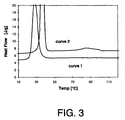
- Fig. 3 is a thermogram showing the solidification behaviour of two ink compositions expressed in the enthalpy change of a composition in joules per gram, against the temperature in degrees C, recorded with a DSC.
- An example of a DSC measuring instrument is the Perkin Elmer DSC-7, made by Perkin Elmer Co., Norwalk, CT.
- Curve 1 shows the enthalpy change of ink composition III' (Table 6) when it is cooled from 120°C to 10°C. It will be seen from the graph that the ink undergoes a highly exothermic process at 27°C: the ink composition solidifies at that temperature.
- the solidification temperature of the ink composition is now 10°C higher than if no gelling agent is added, it is apparent that the presence of a network of gelling agent molecules can appreciably influence the solidification of the other ink components (e.g. a crystalline material or an amorphous binder). In this case the gelling agent causes accelerated solidification of the crystalline material.
- a network of gelling agent molecules can appreciably influence the solidification of the other ink components (e.g. a crystalline material or an amorphous binder).
- the gelling agent causes accelerated solidification of the crystalline material.
- Fig. 4 shows the printed results for the ink compositions II (Table 5) and II' (Table 6).
- a line pattern was printed on paper (Océ Red Label), consisting of respectively three lines of a width of 1 pixel row (a "1-pixel” line), two lines with a width of 2 pixel rows (2-pixel line) and 1 line with a width of 5 pixel rows (5-pixel line) at a temperature of 28°C.
- the images were printed by heating the print head of a piezo hot melt printer to 135°C and ejecting the ink drops in a size of 37 ⁇ m. The distance between the print head and the paper was 0.8 mm.
- Image 1 is the result of printing with ink composition II
- image 2 is the result of printing with the same ink without the gelling agent (ink composition II'). It is clear that the addition of the small quantity (2%) of gelling agent has an appreciable effect on the sharpness of the printed image.
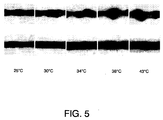
- Fig. 5 shows printed results of ink compositions I (Table 5) and I' (Table 6) against paper temperature.
- the ink was printed on glossy paper (Océ Royal Digital Gloss).
- the image relates to a line having a width of about 120 ⁇ m.
- the print head of a piezo printer was heated to 135°C, whereafter ink drops of a diameter of approximately 36 ⁇ m were ejected by activating the piezo elements.
- the distance between the outflow openings of the print head and the paper was about 0.8 mm.
- the first series of five images shows the effect of increasing the paper temperature on printing the said line with an ink of composition I'.
- the paper temperature was increased from 25°C for the image on the far left, via 30°C for the second image, 34°C for the third image and 38°C for the fourth image to 43°C for the fifth image. It is clear that increasing the temperature is combined with a falling off of the edge sharpness of the line, in this case because the still liquid ink drops coagulate to form larger ink drops. As a result, a printed line not only becomes wider but also has a lower optical density.
- the same experiment is reproduced for an ink with composition I. It is clear from the illustration that there is hardly any effect on the image when the temperature of the paper is raised from 25°C (via 30°C, 34°C and 38°C) to 43°C. Evidently, when the ink cools on the substrate, it is much less mobile so that coagulation of the ink drops is prevented.
- Fig. 6 shows the effect of an after-treatment of a printed image on image quality.
- images of ink compositions I (Table 5) and I' (Table 6) were printed with a piezo printer, the print head of which was heated to 135°C.
- the diameter of the ejected ink drops was approximately 35 ⁇ m.
- the drops were printed on paper (Océ Red Label) with a temperature of 25°C.
- the images in each case consist of four ink drops.
- the first series of three images shows the effect of thermal after-treatment on a printed image for an ink of composition I'.
- the first image is the reference image, i.e. the image that forms when the drops are printed on a substrate at 25°C, without after-treatment.
- the second image is obtained with a 10 second after-treatment at a temperature of 60°C.
- the ink drops already show distinct feathering resulting in unsharp edges and a lower optical density.
- 30-second after-treatment at 60°C these adverse effects are even more pronounced (third image).
- ink composition I is subjected to the same series of after-treatments, it has been found that they have practically no negative effect on the print quality as shown in the second series of Fig. 6. It is clear that the ink drops hardly run and accordingly there is practically no decline in optical density.
- the quantities are quantities by weight Ink I ink II ink III K 58.3 HMDI-MEG 67.6 CYCLO-2T 66.8 HMDI-MEG A 38.1 DITRIM-50CHI 28.8 GLYPOCHI 28.6 PBPA-BuP G 3 Gel-23 2 Gel-1 4 Gel-23 KI 0.5 Macrolex Rot 1.5 Orasol Blau 0.5 Macrolex Rot V 0.1 BYK 307 0.1 BYK 307 0.1 BYK 307 Ink compositions for comparison.
- the quantities are quantities by weight Ink I' ink II' ink III' K 60.2 HMDI-MEG 69 CYCLO-2T 69.6 HMDI-MEG A 39.2 DITRIM-50CHI 29.4 GLYPOCHI 29.8 PBPA-BuP G - - - KI 0.5 Macrolex Rot 1.5 Orasol Blau 0.5 Macrolex Rot V 0.1 BYK 307 0.1 BYK 307 0.1 BYK 307 Spread of an ink drop against substrate temperature Substrate temperature (°C) Relative spread ink I Relative spread ink I' 25 1 1 1 30 1.1 1.1 34 1.4 1.4 38 1.5 1.8 43 1.8 2.3
Landscapes
- Chemical & Material Sciences (AREA)
- Life Sciences & Earth Sciences (AREA)
- Engineering & Computer Science (AREA)
- Materials Engineering (AREA)
- Wood Science & Technology (AREA)
- Organic Chemistry (AREA)
- Ink Jet Recording Methods And Recording Media Thereof (AREA)
- Inks, Pencil-Leads, Or Crayons (AREA)
- Ink Jet (AREA)
Applications Claiming Priority (2)
| Application Number | Priority Date | Filing Date | Title |
|---|---|---|---|
| NL1012549 | 1999-07-09 | ||
| NL1012549A NL1012549C2 (nl) | 1999-07-09 | 1999-07-09 | Inktsamenstelling voor een smeltbare inkt en een werkwijze voor het bedrukken van een substraat met een dergelijke inktsamenstelling. |
Publications (2)
| Publication Number | Publication Date |
|---|---|
| EP1067157A1 true EP1067157A1 (fr) | 2001-01-10 |
| EP1067157B1 EP1067157B1 (fr) | 2004-05-06 |
Family
ID=19769529
Family Applications (1)
| Application Number | Title | Priority Date | Filing Date |
|---|---|---|---|
| EP00202260A Expired - Lifetime EP1067157B1 (fr) | 1999-07-09 | 2000-06-29 | Composition d'encre pour encre fusible et procédé d'impression d'un substrat utilisant cette composition |
Country Status (5)
| Country | Link |
|---|---|
| US (1) | US6471758B1 (fr) |
| EP (1) | EP1067157B1 (fr) |
| JP (2) | JP2001064556A (fr) |
| DE (1) | DE60010378T2 (fr) |
| NL (1) | NL1012549C2 (fr) |
Cited By (16)
| Publication number | Priority date | Publication date | Assignee | Title |
|---|---|---|---|---|
| NL1017049C2 (nl) * | 2001-01-08 | 2002-07-09 | Ocu Technologies B V | Inktsamenstelling voor een smeltbare inkt. |
| EP1260559A1 (fr) * | 2001-05-21 | 2002-11-27 | Océ-Technologies B.V. | Procédé de fabrication de pastilles d'encre thermo-fusibles |
| EP1260562A1 (fr) * | 2001-05-21 | 2002-11-27 | Océ-Technologies B.V. | Procédé de fabrication de pastilles d'encre thermo-fusibles |
| NL1021010C2 (nl) | 2002-07-05 | 2004-01-06 | Oce Tech Bv | Werkwijze voor het bedrukken van een ontvangstmateriaal met hot melt inkt en een inkjet printer geschikt om deze werkwijze toe te passen. |
| NL1021011C2 (nl) * | 2002-07-05 | 2004-01-06 | Oce Tech Bv | Smeltbare inkt voor een inkjet printer en een werkwijze voor het selecteren van een dergelijke inkt. |
| KR100440977B1 (ko) * | 2002-09-10 | 2004-07-21 | 삼성전자주식회사 | 습식인쇄기의 현상유닛 |
| US6906118B2 (en) | 2001-09-07 | 2005-06-14 | Xerox Corporation | Phase change ink compositions |
| EP1666456A1 (fr) * | 2004-12-04 | 2006-06-07 | Xerox Corporation | Composés bis(urée-uréthane) et encres à changement de phase les contenant |
| EP1666549A1 (fr) * | 2004-12-04 | 2006-06-07 | Xerox Corporation | Formulation d'encre à changement de phase contenant des composés bis-urée-uréthane |
| EP1760124A1 (fr) * | 2005-09-01 | 2007-03-07 | Océ-Technologies B.V. | Procédé d'impression d'un substrat avec une encre durcissable par rayonnement, et une encre utilisable dans cette méthode |
| EP1892115A1 (fr) | 2006-08-22 | 2008-02-27 | Océ-Technologies B.V. | Procédé de formation d'image utilisant une encre à changement de phase sur un matériau auto-laminant |
| US7576235B2 (en) | 2004-12-04 | 2009-08-18 | Xerox Corporation | Processes for preparing bis(urea-urethane) compounds |
| EP2166048A1 (fr) * | 2008-09-23 | 2010-03-24 | Xerox Corporation | Supports d'encre contenant des cires fonctionnalisées à faible viscosité, encres de changement de phase les incluant et leurs procédés de fabrication |
| US7981203B2 (en) | 2006-08-01 | 2011-07-19 | Oce-Technologies B.V. | Hot melt ink |
| WO2013102607A3 (fr) * | 2012-01-06 | 2013-11-14 | Oce-Technologies B.V. | Composition d'encre thermofusible, son procédé de préparation et son utilisation |
| US20150124030A1 (en) * | 2012-07-24 | 2015-05-07 | Oce-Technologies B.V. | Hot melt ink composition, method for preparing a hot melt ink composition and use of a hot melt ink composition |
Families Citing this family (50)
| Publication number | Priority date | Publication date | Assignee | Title |
|---|---|---|---|---|
| JP2003291334A (ja) * | 2002-03-29 | 2003-10-14 | Seiko Epson Corp | インクジェット式記録装置および同装置における記録ヘッドの駆動方法 |
| NL1020682C2 (nl) * | 2002-05-27 | 2003-11-28 | Oce Tech Bv | Smeltbare inktsamenstelling. |
| US7297454B2 (en) * | 2002-07-30 | 2007-11-20 | Hewlett-Packard Development Company, L.P. | Colorless inkjet ink compositions for improved image quality |
| DE10255290B4 (de) | 2002-11-26 | 2006-02-16 | Vb Autobatterie Gmbh | Akkumulator und Verschlussstopfen für einen Akkumulator |
| DE10306072B4 (de) * | 2003-02-13 | 2009-04-02 | Veritas Ag | Mehrschichtiger Schlauch |
| US6960248B2 (en) * | 2003-05-22 | 2005-11-01 | Arizona Chemical Company | Cyclic bisamides useful in formulating inks for phase-change printing |
| AU2005201094A1 (en) * | 2004-04-28 | 2005-11-17 | Oce-Technologies B.V. | Hot melt ink having carrier derived from alkylketene dimer |
| US6989052B1 (en) * | 2004-06-30 | 2006-01-24 | Xerox Corporation | Phase change ink printing process |
| US7416597B2 (en) * | 2004-07-13 | 2008-08-26 | Hewlett-Packard Development Company, L.P. | Self-dispersed pigment ink formulations, ink-jet ink sets, print systems, and methods of printing |
| US7153349B2 (en) | 2004-12-04 | 2006-12-26 | Xerox Corporation | Phase change inks containing curable trans-1,2-cyclohexane bis(urea-urethane) compounds |
| US7317122B2 (en) | 2004-12-04 | 2008-01-08 | Xerox Corporation | Curable trans-1,2-cyclohexane bis(urea-urethane) compounds |
| US7144450B2 (en) * | 2004-12-04 | 2006-12-05 | Xerox Corporation | Phase change inks containing trans-1,2-cyclohexane bis(urea-urethane) compounds |
| US7314949B2 (en) | 2004-12-04 | 2008-01-01 | Xerox Corporation | Trans-1,2-cyclohexane bis(urea-urethane) compounds |
| US7459014B2 (en) * | 2005-01-14 | 2008-12-02 | Xerox Corporation | Radiation curable inks containing curable gelator additives |
| WO2006082014A1 (fr) | 2005-02-04 | 2006-08-10 | Oce-Technologies B.V. | Procede et moule pour la fabrication de pastilles d'encre thermofusible |
| US7767011B2 (en) * | 2005-05-31 | 2010-08-03 | Xerox Corporation | Aqueous gel ink compositions and method of printing same |
| US7563313B2 (en) * | 2005-07-13 | 2009-07-21 | Xerox Corporation | Ink carriers, phase change inks including same and methods for making same |
| AU2006203245A1 (en) * | 2005-09-01 | 2007-03-15 | Oce-Technologies B.V. | A method for printing a substrate with radiation curable ink, and an ink suitable for application in the said method |
| US7563314B2 (en) * | 2005-11-30 | 2009-07-21 | Xerox Corporation | Ink carriers containing nanoparticles, phase change inks including same and methods for making same |
| US7699922B2 (en) * | 2006-06-13 | 2010-04-20 | Xerox Corporation | Organic phase change carriers containing nanoparticles, phase change inks including same and methods for making same |
| DE602007003908D1 (de) * | 2006-08-22 | 2010-02-04 | Oce Tech Bv | Bilderzeugungsverfahren, das eine Phasenaustauschtinte auf einem selbstlaminierenden Aufzeichnungsmedium verwendet |
| US20080098929A1 (en) * | 2006-10-26 | 2008-05-01 | Xerox Corporation | Phase change inks |
| US8791202B2 (en) * | 2007-09-21 | 2014-07-29 | Xerox Corporation | Phase change ink compositions |
| TWI471127B (zh) | 2009-04-29 | 2015-02-01 | Intervet Int Bv | 供人類使用之口服崩解錠劑的製備方法、所製得之口服崩解錠劑、以及含有該口服崩解錠劑的包裝物 |
| JP5760300B2 (ja) | 2009-09-10 | 2015-08-05 | 株式会社リコー | インクジェット用インク組成物材料及びインクジェット用インク組成物 |
| US8465579B2 (en) | 2011-04-27 | 2013-06-18 | Xerox Corporation | Solid ink compositions comprising crystalline esters of tartaric acid |
| US8506040B2 (en) | 2011-04-27 | 2013-08-13 | Xerox Corporation | Solid ink compositions comprising crystalline-amorphous mixtures |
| US8308859B1 (en) | 2011-04-27 | 2012-11-13 | Xerox Corporation | Phase change ink components and methods of making the same |
| US8506694B2 (en) * | 2011-04-27 | 2013-08-13 | Xerox Corporation | Phase separation ink |
| US8328924B2 (en) | 2011-04-27 | 2012-12-11 | Xerox Corporation | Phase change inks and methods of making the same |
| US8500896B2 (en) | 2011-04-27 | 2013-08-06 | Xerox Corporation | Solid ink compositions comprising amorphous esters of tartaric acid |
| US8287632B1 (en) | 2011-04-27 | 2012-10-16 | Xerox Corporation | Solid ink compositions comprising amorphous esters of citric acid |
| US8833917B2 (en) | 2011-04-27 | 2014-09-16 | Xerox Corporation | Solid ink compositions comprising crystalline-amorphous mixtures |
| US8372189B2 (en) | 2011-04-27 | 2013-02-12 | Xerox Corporation | Phase change inks and methods of making the same |
| EP2726564A2 (fr) * | 2011-06-30 | 2014-05-07 | OCE-Technologies B.V. | Composition d'encre thermofusible comprenant un copolyester et procédé pour la préparation d'un copolyester |
| US8888907B2 (en) * | 2011-08-02 | 2014-11-18 | Xerox Corporation | Solid phase change ink compositions comprising oxazolines |
| US9528015B2 (en) * | 2012-04-26 | 2016-12-27 | Xerox Corporation | Phase change ink compositions comprising crystalline diurethanes and derivatives thereof |
| US9228101B2 (en) * | 2012-04-26 | 2016-01-05 | Xerox Corporation | Rapidly crystallizing phase change inks and methods for forming the same |
| US8894762B2 (en) * | 2012-09-24 | 2014-11-25 | Xerox Corporation | Phase change ink comprising a polyhydroxyalkanoate compound |
| US8778069B2 (en) * | 2012-11-19 | 2014-07-15 | Xerox Corporation | Phase change inks containing oligomeric rosin esters |
| US8827393B2 (en) * | 2013-01-16 | 2014-09-09 | Xerox Corporation | Fluorescent phase change ink compositions |
| US8940935B2 (en) * | 2013-01-28 | 2015-01-27 | Xerox Corporation | Bis-urea gelators for curable ink applications |
| US8779021B1 (en) * | 2013-01-28 | 2014-07-15 | Xerox Corporation | Curable inks comprising diurethane gelators |
| US9328248B2 (en) | 2013-01-28 | 2016-05-03 | Xerox Corporation | Curable inks comprising bis-urea gelators |
| US9006478B2 (en) | 2013-01-28 | 2015-04-14 | Xerox Corporation | Diurethane gelators for curable ink applications |
| US9303172B2 (en) * | 2013-10-31 | 2016-04-05 | Xerox Corporation | Spreadable ink composition and method of predicting whether ink composition will have acceptable spreading performance |
| WO2016071264A1 (fr) | 2014-11-03 | 2016-05-12 | Erutan B.V. | Procédé de production de tapis tufté et pâte destinée à être utilisée dans ledit procédé |
| JP6820554B2 (ja) * | 2017-02-28 | 2021-01-27 | パナソニックIpマネジメント株式会社 | 基地局装置 |
| WO2019021639A1 (fr) | 2017-07-26 | 2019-01-31 | 富士フイルム株式会社 | Composition d'encre, son procédé de production et procédé de formation d'image |
| JP6938652B2 (ja) * | 2017-09-25 | 2021-09-22 | 富士フイルム株式会社 | インク組成物及びその製造方法、並びに画像形成方法 |
Citations (3)
| Publication number | Priority date | Publication date | Assignee | Title |
|---|---|---|---|---|
| EP0329026A1 (fr) * | 1988-02-19 | 1989-08-23 | Dataproducts Corporation | Encre à changement de phase sol-gel thermiquement réversible ou encre pour systèmes pulsés |
| US5531817A (en) * | 1994-09-01 | 1996-07-02 | Hewlett-Packard Company | Use of high viscosity, meltable gel inks for controlling bleed |
| EP0856565A1 (fr) * | 1997-02-04 | 1998-08-05 | Océ-Technologies B.V. | Composition d'encre pour encre fusible |
Family Cites Families (15)
| Publication number | Priority date | Publication date | Assignee | Title |
|---|---|---|---|---|
| US5100468A (en) * | 1987-09-09 | 1992-03-31 | Canon Kabushiki Kaisha | Image recording ink |
| US5021802A (en) * | 1988-02-19 | 1991-06-04 | Dataproducts Corporation | Thermally reversible sol-gel phase change ink or bubble jet ink |
| JP2655894B2 (ja) * | 1988-11-11 | 1997-09-24 | 株式会社リコー | インクジェット記録用インク組成物 |
| KR100191762B1 (ko) * | 1990-05-23 | 1999-06-15 | 무명씨 | 투명한 고온 용융 제트 잉크 |
| US5053079A (en) * | 1990-05-23 | 1991-10-01 | Coates Electrographics Limited | Dispersed pigmented hot melt ink |
| JP3039031B2 (ja) * | 1990-09-10 | 2000-05-08 | セイコーエプソン株式会社 | ホットメルトインク組成物 |
| US5178672A (en) * | 1991-04-08 | 1993-01-12 | Canadian Fine Color Company Limited | Printing compositions |
| JP3453399B2 (ja) * | 1992-07-30 | 2003-10-06 | キヤノン株式会社 | サーマルインクジェット記録方法 |
| US5462591A (en) * | 1994-05-06 | 1995-10-31 | Tektronix, Inc. | Hyperthermogelling aqueous phase change inks and methods for using them in an ink jet printer |
| US6245135B1 (en) * | 1997-08-22 | 2001-06-12 | Xerox Corporation | Phase change ink composition |
| JPH09255905A (ja) * | 1996-03-27 | 1997-09-30 | Brother Ind Ltd | 熱溶融性インク |
| US5830942A (en) * | 1996-06-28 | 1998-11-03 | Tektronix, Inc. | Phase change ink formulation using a urethane and urethane/urea isocyanate-derived resins |
| US6028138A (en) * | 1996-06-28 | 2000-02-22 | Tektronix, Inc. | Phase change ink formulation using urethane isocyanate-derived resins, a polyethylene wax and toughening agent |
| US5989325A (en) * | 1998-03-05 | 1999-11-23 | Xerox Corporation | Ink compositions |
| US5973036A (en) * | 1998-05-08 | 1999-10-26 | Westvaco Corporation | Reversibly-crosslinked-polymers for shear-thinning phase change ink jet inks |
-
1999
- 1999-07-09 NL NL1012549A patent/NL1012549C2/nl not_active IP Right Cessation
-
2000
- 2000-06-22 JP JP2000187158A patent/JP2001064556A/ja not_active Withdrawn
- 2000-06-29 EP EP00202260A patent/EP1067157B1/fr not_active Expired - Lifetime
- 2000-06-29 DE DE60010378T patent/DE60010378T2/de not_active Expired - Lifetime
- 2000-07-07 US US09/612,096 patent/US6471758B1/en not_active Expired - Lifetime
-
2012
- 2012-07-23 JP JP2012162687A patent/JP2013007039A/ja active Pending
Patent Citations (3)
| Publication number | Priority date | Publication date | Assignee | Title |
|---|---|---|---|---|
| EP0329026A1 (fr) * | 1988-02-19 | 1989-08-23 | Dataproducts Corporation | Encre à changement de phase sol-gel thermiquement réversible ou encre pour systèmes pulsés |
| US5531817A (en) * | 1994-09-01 | 1996-07-02 | Hewlett-Packard Company | Use of high viscosity, meltable gel inks for controlling bleed |
| EP0856565A1 (fr) * | 1997-02-04 | 1998-08-05 | Océ-Technologies B.V. | Composition d'encre pour encre fusible |
Cited By (25)
| Publication number | Priority date | Publication date | Assignee | Title |
|---|---|---|---|---|
| NL1017049C2 (nl) * | 2001-01-08 | 2002-07-09 | Ocu Technologies B V | Inktsamenstelling voor een smeltbare inkt. |
| EP1221467A1 (fr) * | 2001-01-08 | 2002-07-10 | Océ-Technologies B.V. | Composition d'encre pour encre fusible |
| US6682587B2 (en) | 2001-01-08 | 2004-01-27 | Oce-Technologies B.V. | Meltable ink composition |
| EP1260559A1 (fr) * | 2001-05-21 | 2002-11-27 | Océ-Technologies B.V. | Procédé de fabrication de pastilles d'encre thermo-fusibles |
| EP1260562A1 (fr) * | 2001-05-21 | 2002-11-27 | Océ-Technologies B.V. | Procédé de fabrication de pastilles d'encre thermo-fusibles |
| US6692668B2 (en) | 2001-05-21 | 2004-02-17 | Oce-Technologies B.V. | Method for manufacturing pellets of hot-melt ink |
| US6906118B2 (en) | 2001-09-07 | 2005-06-14 | Xerox Corporation | Phase change ink compositions |
| NL1021010C2 (nl) | 2002-07-05 | 2004-01-06 | Oce Tech Bv | Werkwijze voor het bedrukken van een ontvangstmateriaal met hot melt inkt en een inkjet printer geschikt om deze werkwijze toe te passen. |
| NL1021011C2 (nl) * | 2002-07-05 | 2004-01-06 | Oce Tech Bv | Smeltbare inkt voor een inkjet printer en een werkwijze voor het selecteren van een dergelijke inkt. |
| EP1378551A1 (fr) * | 2002-07-05 | 2004-01-07 | Océ-Technologies B.V. | Encre fusible pour une imprimante à jet d'encre et une méthode pour choisir cette encre |
| KR100440977B1 (ko) * | 2002-09-10 | 2004-07-21 | 삼성전자주식회사 | 습식인쇄기의 현상유닛 |
| EP1666549A1 (fr) * | 2004-12-04 | 2006-06-07 | Xerox Corporation | Formulation d'encre à changement de phase contenant des composés bis-urée-uréthane |
| US7576235B2 (en) | 2004-12-04 | 2009-08-18 | Xerox Corporation | Processes for preparing bis(urea-urethane) compounds |
| EP1666456A1 (fr) * | 2004-12-04 | 2006-06-07 | Xerox Corporation | Composés bis(urée-uréthane) et encres à changement de phase les contenant |
| EP1760124A1 (fr) * | 2005-09-01 | 2007-03-07 | Océ-Technologies B.V. | Procédé d'impression d'un substrat avec une encre durcissable par rayonnement, et une encre utilisable dans cette méthode |
| US7981203B2 (en) | 2006-08-01 | 2011-07-19 | Oce-Technologies B.V. | Hot melt ink |
| EP1892115A1 (fr) | 2006-08-22 | 2008-02-27 | Océ-Technologies B.V. | Procédé de formation d'image utilisant une encre à changement de phase sur un matériau auto-laminant |
| US8029861B2 (en) | 2008-09-23 | 2011-10-04 | Xerox Corporation | Ink carriers containing low viscosity functionalized waxes, phase change inks including same, and methods for making same |
| EP2166048A1 (fr) * | 2008-09-23 | 2010-03-24 | Xerox Corporation | Supports d'encre contenant des cires fonctionnalisées à faible viscosité, encres de changement de phase les incluant et leurs procédés de fabrication |
| CN101684216B (zh) * | 2008-09-23 | 2014-01-29 | 施乐公司 | 含低粘度官能化蜡的油墨载体,含该载体的相变油墨,及制备方法 |
| WO2013102607A3 (fr) * | 2012-01-06 | 2013-11-14 | Oce-Technologies B.V. | Composition d'encre thermofusible, son procédé de préparation et son utilisation |
| CN104024348A (zh) * | 2012-01-06 | 2014-09-03 | 奥西-技术有限公司 | 热熔墨水组合物、制备热熔墨水组合物的方法及其用途 |
| US9051487B2 (en) | 2012-01-06 | 2015-06-09 | Oce-Technologies B.V. | Hot melt ink composition, method for preparing a hot melt ink composition and use thereof |
| US20150124030A1 (en) * | 2012-07-24 | 2015-05-07 | Oce-Technologies B.V. | Hot melt ink composition, method for preparing a hot melt ink composition and use of a hot melt ink composition |
| US9303176B2 (en) * | 2012-07-24 | 2016-04-05 | Oce-Technologies B.V. | Hot melt ink composition, method for preparing a hot melt ink composition and use of a hot melt ink composition |
Also Published As
| Publication number | Publication date |
|---|---|
| US6471758B1 (en) | 2002-10-29 |
| DE60010378T2 (de) | 2005-05-04 |
| JP2001064556A (ja) | 2001-03-13 |
| DE60010378D1 (de) | 2004-06-09 |
| JP2013007039A (ja) | 2013-01-10 |
| NL1012549C2 (nl) | 2001-01-10 |
| EP1067157B1 (fr) | 2004-05-06 |
Similar Documents
| Publication | Publication Date | Title |
|---|---|---|
| EP1067157B1 (fr) | Composition d'encre pour encre fusible et procédé d'impression d'un substrat utilisant cette composition | |
| US5259873A (en) | Hot melt ink used for ink jet printer | |
| CN101362869B (zh) | 相变油墨组合物 | |
| US5700316A (en) | Acoustic ink compositions | |
| EP0844287B1 (fr) | Composition d'encre solide thermofusible | |
| US5409530A (en) | Hot-melt ink composition | |
| US5932630A (en) | Ink compositions | |
| EP1792954A1 (fr) | Encres à changement de phase | |
| KR101931389B1 (ko) | 결정성 술폰 화합물 및 이의 유도체를 포함하는 상 변화 잉크 조성물 | |
| JPH06206368A (ja) | 選択的相変化インク組成物及びその付着方法 | |
| JP3180619B2 (ja) | 相変化型水性インク組成物 | |
| JPH09137112A (ja) | 水性相変化インク組成物及びそのプリント方法 | |
| US4992304A (en) | Methods for coating a light-transmissive substrate to promote adhesion of a phase-change ink | |
| EP0854177A1 (fr) | Compositions d'encre | |
| EP1367103B1 (fr) | Composition d'encre pour encre fusible | |
| JP2001508104A (ja) | ホットメルトジェットインク組成物 | |
| KR20130121037A (ko) | 빠르게 결정화되는 결정질-비결정질 잉크 조성물 및 이의 제조 방법 | |
| US7578875B2 (en) | Black inks and method for making same | |
| EP2107088B1 (fr) | Encres à changement de phase contenant des cires de Fischer-Tropsch | |
| US5072234A (en) | Thermal transfer printing elements with mesomorphic inks | |
| US5110665A (en) | Light-transmissive substrates coated to promote adhesion of phase-change inks | |
| JPS61189994A (ja) | 感熱転写紙 | |
| JP6016703B2 (ja) | 無機核化剤を含む相転移インク | |
| JP3039031B2 (ja) | ホットメルトインク組成物 | |
| JP4263833B2 (ja) | 熱転写媒体 |
Legal Events
| Date | Code | Title | Description |
|---|---|---|---|
| PUAI | Public reference made under article 153(3) epc to a published international application that has entered the european phase |
Free format text: ORIGINAL CODE: 0009012 |
|
| AK | Designated contracting states |
Kind code of ref document: A1 Designated state(s): DE FR GB NL |
|
| AX | Request for extension of the european patent |
Free format text: AL;LT;LV;MK;RO;SI |
|
| 17P | Request for examination filed |
Effective date: 20010710 |
|
| AKX | Designation fees paid |
Free format text: DE FR GB NL |
|
| 17Q | First examination report despatched |
Effective date: 20030327 |
|
| GRAP | Despatch of communication of intention to grant a patent |
Free format text: ORIGINAL CODE: EPIDOSNIGR1 |
|
| RTI1 | Title (correction) |
Free format text: INK COMPOSITION FOR A MELTABLE INK AND A METHOD OF PRINTING A SUBSTRATE WITH SUCH AN INK COMPOSITION |
|
| GRAS | Grant fee paid |
Free format text: ORIGINAL CODE: EPIDOSNIGR3 |
|
| GRAA | (expected) grant |
Free format text: ORIGINAL CODE: 0009210 |
|
| AK | Designated contracting states |
Kind code of ref document: B1 Designated state(s): DE FR GB NL |
|
| REG | Reference to a national code |
Ref country code: GB Ref legal event code: FG4D |
|
| REF | Corresponds to: |
Ref document number: 60010378 Country of ref document: DE Date of ref document: 20040609 Kind code of ref document: P |
|
| ET | Fr: translation filed | ||
| PLBE | No opposition filed within time limit |
Free format text: ORIGINAL CODE: 0009261 |
|
| STAA | Information on the status of an ep patent application or granted ep patent |
Free format text: STATUS: NO OPPOSITION FILED WITHIN TIME LIMIT |
|
| 26N | No opposition filed |
Effective date: 20050208 |
|
| REG | Reference to a national code |
Ref country code: FR Ref legal event code: PLFP Year of fee payment: 17 |
|
| REG | Reference to a national code |
Ref country code: FR Ref legal event code: PLFP Year of fee payment: 18 |
|
| REG | Reference to a national code |
Ref country code: FR Ref legal event code: PLFP Year of fee payment: 19 |
|
| PGFP | Annual fee paid to national office [announced via postgrant information from national office to epo] |
Ref country code: DE Payment date: 20180625 Year of fee payment: 19 Ref country code: NL Payment date: 20180618 Year of fee payment: 19 |
|
| PGFP | Annual fee paid to national office [announced via postgrant information from national office to epo] |
Ref country code: FR Payment date: 20180620 Year of fee payment: 19 |
|
| PGFP | Annual fee paid to national office [announced via postgrant information from national office to epo] |
Ref country code: GB Payment date: 20180620 Year of fee payment: 19 |
|
| REG | Reference to a national code |
Ref country code: DE Ref legal event code: R119 Ref document number: 60010378 Country of ref document: DE |
|
| REG | Reference to a national code |
Ref country code: NL Ref legal event code: MM Effective date: 20190701 |
|
| GBPC | Gb: european patent ceased through non-payment of renewal fee |
Effective date: 20190629 |
|
| PG25 | Lapsed in a contracting state [announced via postgrant information from national office to epo] |
Ref country code: GB Free format text: LAPSE BECAUSE OF NON-PAYMENT OF DUE FEES Effective date: 20190629 Ref country code: NL Free format text: LAPSE BECAUSE OF NON-PAYMENT OF DUE FEES Effective date: 20190701 Ref country code: DE Free format text: LAPSE BECAUSE OF NON-PAYMENT OF DUE FEES Effective date: 20200101 |
|
| PG25 | Lapsed in a contracting state [announced via postgrant information from national office to epo] |
Ref country code: FR Free format text: LAPSE BECAUSE OF NON-PAYMENT OF DUE FEES Effective date: 20190630 |