EP1070686A1 - Flüssigphasengesinterte Siliciumcarbid-Formkörper mit verbesserter Bruchzähigkeit sowie hohem elektrischen Widerstand und Verfahren zu ihrer Herstellung - Google Patents
Flüssigphasengesinterte Siliciumcarbid-Formkörper mit verbesserter Bruchzähigkeit sowie hohem elektrischen Widerstand und Verfahren zu ihrer Herstellung Download PDFInfo
- Publication number
- EP1070686A1 EP1070686A1 EP00113040A EP00113040A EP1070686A1 EP 1070686 A1 EP1070686 A1 EP 1070686A1 EP 00113040 A EP00113040 A EP 00113040A EP 00113040 A EP00113040 A EP 00113040A EP 1070686 A1 EP1070686 A1 EP 1070686A1
- Authority
- EP
- European Patent Office
- Prior art keywords
- sic
- mass
- sintering
- phase
- sintered
- Prior art date
- Legal status (The legal status is an assumption and is not a legal conclusion. Google has not performed a legal analysis and makes no representation as to the accuracy of the status listed.)
- Granted
Links
- 229910010271 silicon carbide Inorganic materials 0.000 title claims description 154
- 238000004519 manufacturing process Methods 0.000 title claims description 7
- HBMJWWWQQXIZIP-UHFFFAOYSA-N silicon carbide Chemical compound [Si+]#[C-] HBMJWWWQQXIZIP-UHFFFAOYSA-N 0.000 title description 129
- 239000007791 liquid phase Substances 0.000 title description 39
- 238000005245 sintering Methods 0.000 claims abstract description 101
- 238000000034 method Methods 0.000 claims abstract description 36
- 239000000203 mixture Substances 0.000 claims abstract description 29
- 239000013078 crystal Substances 0.000 claims abstract description 16
- 238000000465 moulding Methods 0.000 claims abstract description 15
- 229910052761 rare earth metal Inorganic materials 0.000 claims abstract description 15
- 150000002910 rare earth metals Chemical class 0.000 claims abstract description 10
- 238000010438 heat treatment Methods 0.000 claims abstract description 7
- 239000000843 powder Substances 0.000 claims description 43
- XKRFYHLGVUSROY-UHFFFAOYSA-N Argon Chemical compound [Ar] XKRFYHLGVUSROY-UHFFFAOYSA-N 0.000 claims description 36
- 239000007789 gas Substances 0.000 claims description 33
- IJGRMHOSHXDMSA-UHFFFAOYSA-N Atomic nitrogen Chemical compound N#N IJGRMHOSHXDMSA-UHFFFAOYSA-N 0.000 claims description 31
- PMHQVHHXPFUNSP-UHFFFAOYSA-M copper(1+);methylsulfanylmethane;bromide Chemical compound Br[Cu].CSC PMHQVHHXPFUNSP-UHFFFAOYSA-M 0.000 claims description 29
- 239000000463 material Substances 0.000 claims description 28
- 230000008569 process Effects 0.000 claims description 23
- 229910052757 nitrogen Inorganic materials 0.000 claims description 21
- 229910052760 oxygen Inorganic materials 0.000 claims description 20
- 229910004298 SiO 2 Inorganic materials 0.000 claims description 19
- 229910052799 carbon Inorganic materials 0.000 claims description 19
- OKTJSMMVPCPJKN-UHFFFAOYSA-N Carbon Chemical compound [C] OKTJSMMVPCPJKN-UHFFFAOYSA-N 0.000 claims description 18
- 229910052786 argon Inorganic materials 0.000 claims description 18
- QVGXLLKOCUKJST-UHFFFAOYSA-N atomic oxygen Chemical compound [O] QVGXLLKOCUKJST-UHFFFAOYSA-N 0.000 claims description 16
- 239000001301 oxygen Substances 0.000 claims description 16
- 229910052782 aluminium Inorganic materials 0.000 claims description 14
- 230000015572 biosynthetic process Effects 0.000 claims description 11
- 150000004645 aluminates Chemical class 0.000 claims description 10
- XAGFODPZIPBFFR-UHFFFAOYSA-N aluminium Chemical compound [Al] XAGFODPZIPBFFR-UHFFFAOYSA-N 0.000 claims description 10
- 239000000919 ceramic Substances 0.000 claims description 10
- 238000003825 pressing Methods 0.000 claims description 9
- -1 rare earth metal aluminate Chemical class 0.000 claims description 9
- 238000007906 compression Methods 0.000 claims description 8
- 230000001681 protective effect Effects 0.000 claims description 8
- 239000012300 argon atmosphere Substances 0.000 claims description 7
- 230000006835 compression Effects 0.000 claims description 7
- 239000012298 atmosphere Substances 0.000 claims description 6
- 230000005540 biological transmission Effects 0.000 claims description 6
- 238000007789 sealing Methods 0.000 claims description 5
- 238000005253 cladding Methods 0.000 claims description 4
- 238000005096 rolling process Methods 0.000 claims description 4
- 230000003595 spectral effect Effects 0.000 claims description 4
- 239000000758 substrate Substances 0.000 claims description 4
- 238000004040 coloring Methods 0.000 claims description 3
- 230000035508 accumulation Effects 0.000 claims description 2
- 238000009825 accumulation Methods 0.000 claims description 2
- 230000031700 light absorption Effects 0.000 claims description 2
- 229910002059 quaternary alloy Inorganic materials 0.000 claims description 2
- 229910018540 Si C Inorganic materials 0.000 claims 1
- 239000003795 chemical substances by application Substances 0.000 claims 1
- 239000011230 binding agent Substances 0.000 abstract description 17
- 229910018514 Al—O—N Inorganic materials 0.000 abstract description 6
- 238000005056 compaction Methods 0.000 abstract description 2
- 229910018557 Si O Inorganic materials 0.000 abstract 1
- 238000010304 firing Methods 0.000 abstract 1
- 238000009472 formulation Methods 0.000 abstract 1
- 239000002244 precipitate Substances 0.000 abstract 1
- LIVNPJMFVYWSIS-UHFFFAOYSA-N silicon monoxide Inorganic materials [Si-]#[O+] LIVNPJMFVYWSIS-UHFFFAOYSA-N 0.000 abstract 1
- 239000012071 phase Substances 0.000 description 60
- 239000000654 additive Substances 0.000 description 41
- 230000000996 additive effect Effects 0.000 description 17
- 239000002245 particle Substances 0.000 description 11
- 229910052727 yttrium Inorganic materials 0.000 description 10
- 230000007797 corrosion Effects 0.000 description 9
- 238000005260 corrosion Methods 0.000 description 9
- 230000003647 oxidation Effects 0.000 description 9
- 238000007254 oxidation reaction Methods 0.000 description 9
- 239000000126 substance Substances 0.000 description 9
- 238000004458 analytical method Methods 0.000 description 8
- 239000002223 garnet Substances 0.000 description 8
- 239000007790 solid phase Substances 0.000 description 8
- 229910021431 alpha silicon carbide Inorganic materials 0.000 description 7
- 230000000052 comparative effect Effects 0.000 description 7
- 238000005261 decarburization Methods 0.000 description 7
- VWQVUPCCIRVNHF-UHFFFAOYSA-N yttrium atom Chemical compound [Y] VWQVUPCCIRVNHF-UHFFFAOYSA-N 0.000 description 7
- 229910018072 Al 2 O 3 Inorganic materials 0.000 description 6
- 238000000227 grinding Methods 0.000 description 5
- 230000002787 reinforcement Effects 0.000 description 5
- ZOXJGFHDIHLPTG-UHFFFAOYSA-N Boron Chemical compound [B] ZOXJGFHDIHLPTG-UHFFFAOYSA-N 0.000 description 4
- 238000007792 addition Methods 0.000 description 4
- 238000005452 bending Methods 0.000 description 4
- 229910052796 boron Inorganic materials 0.000 description 4
- 238000006243 chemical reaction Methods 0.000 description 4
- 239000008187 granular material Substances 0.000 description 4
- 238000010191 image analysis Methods 0.000 description 4
- 238000011065 in-situ storage Methods 0.000 description 4
- 229910052751 metal Inorganic materials 0.000 description 4
- 239000002184 metal Substances 0.000 description 4
- 229910052710 silicon Inorganic materials 0.000 description 4
- 238000012360 testing method Methods 0.000 description 4
- VEXZGXHMUGYJMC-UHFFFAOYSA-N Hydrochloric acid Chemical compound Cl VEXZGXHMUGYJMC-UHFFFAOYSA-N 0.000 description 3
- 229910052581 Si3N4 Inorganic materials 0.000 description 3
- 239000007795 chemical reaction product Substances 0.000 description 3
- 239000011258 core-shell material Substances 0.000 description 3
- 238000009826 distribution Methods 0.000 description 3
- 230000000694 effects Effects 0.000 description 3
- 239000010408 film Substances 0.000 description 3
- 230000006872 improvement Effects 0.000 description 3
- 230000004048 modification Effects 0.000 description 3
- 238000012986 modification Methods 0.000 description 3
- 239000000047 product Substances 0.000 description 3
- 229910001404 rare earth metal oxide Inorganic materials 0.000 description 3
- HQVNEWCFYHHQES-UHFFFAOYSA-N silicon nitride Chemical compound N12[Si]34N5[Si]62N3[Si]51N64 HQVNEWCFYHHQES-UHFFFAOYSA-N 0.000 description 3
- 239000007787 solid Substances 0.000 description 3
- 238000001228 spectrum Methods 0.000 description 3
- 229910017493 Nd 2 O 3 Inorganic materials 0.000 description 2
- 238000000137 annealing Methods 0.000 description 2
- 230000008901 benefit Effects 0.000 description 2
- 230000008033 biological extinction Effects 0.000 description 2
- 230000008859 change Effects 0.000 description 2
- 150000001875 compounds Chemical class 0.000 description 2
- 238000005520 cutting process Methods 0.000 description 2
- 238000000280 densification Methods 0.000 description 2
- 238000011161 development Methods 0.000 description 2
- 230000029087 digestion Effects 0.000 description 2
- 239000006185 dispersion Substances 0.000 description 2
- 238000005516 engineering process Methods 0.000 description 2
- 238000000605 extraction Methods 0.000 description 2
- 239000011521 glass Substances 0.000 description 2
- 238000002354 inductively-coupled plasma atomic emission spectroscopy Methods 0.000 description 2
- 238000011089 mechanical engineering Methods 0.000 description 2
- 230000007246 mechanism Effects 0.000 description 2
- 150000002739 metals Chemical class 0.000 description 2
- 239000012299 nitrogen atmosphere Substances 0.000 description 2
- 230000003287 optical effect Effects 0.000 description 2
- 238000001020 plasma etching Methods 0.000 description 2
- 229920001343 polytetrafluoroethylene Polymers 0.000 description 2
- 239000004810 polytetrafluoroethylene Substances 0.000 description 2
- 238000012805 post-processing Methods 0.000 description 2
- 238000001272 pressureless sintering Methods 0.000 description 2
- 239000006104 solid solution Substances 0.000 description 2
- 239000007921 spray Substances 0.000 description 2
- 238000006467 substitution reaction Methods 0.000 description 2
- 239000010409 thin film Substances 0.000 description 2
- XLYOFNOQVPJJNP-UHFFFAOYSA-N water Substances O XLYOFNOQVPJJNP-UHFFFAOYSA-N 0.000 description 2
- PIGFYZPCRLYGLF-UHFFFAOYSA-N Aluminum nitride Chemical compound [Al]#N PIGFYZPCRLYGLF-UHFFFAOYSA-N 0.000 description 1
- 102100038542 Calcium homeostasis modulator protein 6 Human genes 0.000 description 1
- 229910052684 Cerium Inorganic materials 0.000 description 1
- 101000741361 Homo sapiens Calcium homeostasis modulator protein 6 Proteins 0.000 description 1
- 229910052779 Neodymium Inorganic materials 0.000 description 1
- 239000002202 Polyethylene glycol Substances 0.000 description 1
- 239000004372 Polyvinyl alcohol Substances 0.000 description 1
- 235000021355 Stearic acid Nutrition 0.000 description 1
- 240000000147 Torreya grandis Species 0.000 description 1
- 238000002441 X-ray diffraction Methods 0.000 description 1
- 229910052769 Ytterbium Inorganic materials 0.000 description 1
- PWKWDCOTNGQLID-UHFFFAOYSA-N [N].[Ar] Chemical compound [N].[Ar] PWKWDCOTNGQLID-UHFFFAOYSA-N 0.000 description 1
- 238000002835 absorbance Methods 0.000 description 1
- 238000010521 absorption reaction Methods 0.000 description 1
- 230000009471 action Effects 0.000 description 1
- AZDRQVAHHNSJOQ-UHFFFAOYSA-N alumane Chemical class [AlH3] AZDRQVAHHNSJOQ-UHFFFAOYSA-N 0.000 description 1
- JNDMLEXHDPKVFC-UHFFFAOYSA-N aluminum;oxygen(2-);yttrium(3+) Chemical compound [O-2].[O-2].[O-2].[Al+3].[Y+3] JNDMLEXHDPKVFC-UHFFFAOYSA-N 0.000 description 1
- 238000013459 approach Methods 0.000 description 1
- 229910052790 beryllium Inorganic materials 0.000 description 1
- ATBAMAFKBVZNFJ-UHFFFAOYSA-N beryllium atom Chemical compound [Be] ATBAMAFKBVZNFJ-UHFFFAOYSA-N 0.000 description 1
- 150000001573 beryllium compounds Chemical class 0.000 description 1
- 230000002902 bimodal effect Effects 0.000 description 1
- 150000001639 boron compounds Chemical class 0.000 description 1
- 238000004364 calculation method Methods 0.000 description 1
- 239000002775 capsule Substances 0.000 description 1
- 125000004432 carbon atom Chemical group C* 0.000 description 1
- 229910002091 carbon monoxide Inorganic materials 0.000 description 1
- 239000012159 carrier gas Substances 0.000 description 1
- ZMIGMASIKSOYAM-UHFFFAOYSA-N cerium Chemical compound [Ce][Ce][Ce][Ce][Ce][Ce][Ce][Ce][Ce][Ce][Ce][Ce][Ce][Ce][Ce][Ce][Ce][Ce][Ce][Ce][Ce][Ce][Ce][Ce][Ce][Ce][Ce][Ce][Ce][Ce][Ce][Ce][Ce][Ce][Ce][Ce][Ce][Ce] ZMIGMASIKSOYAM-UHFFFAOYSA-N 0.000 description 1
- 238000012512 characterization method Methods 0.000 description 1
- 229910052729 chemical element Inorganic materials 0.000 description 1
- 238000004140 cleaning Methods 0.000 description 1
- 239000004035 construction material Substances 0.000 description 1
- 238000000354 decomposition reaction Methods 0.000 description 1
- 230000007423 decrease Effects 0.000 description 1
- 230000007547 defect Effects 0.000 description 1
- 238000001739 density measurement Methods 0.000 description 1
- 230000008021 deposition Effects 0.000 description 1
- 229910003460 diamond Inorganic materials 0.000 description 1
- 239000010432 diamond Substances 0.000 description 1
- 238000007723 die pressing method Methods 0.000 description 1
- 238000009792 diffusion process Methods 0.000 description 1
- 238000010790 dilution Methods 0.000 description 1
- 239000012895 dilution Substances 0.000 description 1
- 238000004870 electrical engineering Methods 0.000 description 1
- 238000010292 electrical insulation Methods 0.000 description 1
- 230000005496 eutectics Effects 0.000 description 1
- 238000007656 fracture toughness test Methods 0.000 description 1
- 239000012634 fragment Substances 0.000 description 1
- 229910002804 graphite Inorganic materials 0.000 description 1
- 239000010439 graphite Substances 0.000 description 1
- 238000007731 hot pressing Methods 0.000 description 1
- 239000012535 impurity Substances 0.000 description 1
- 229910010272 inorganic material Inorganic materials 0.000 description 1
- 239000011147 inorganic material Substances 0.000 description 1
- 238000009434 installation Methods 0.000 description 1
- 239000012774 insulation material Substances 0.000 description 1
- 238000011835 investigation Methods 0.000 description 1
- 238000000462 isostatic pressing Methods 0.000 description 1
- 229910052747 lanthanoid Inorganic materials 0.000 description 1
- 150000002602 lanthanoids Chemical class 0.000 description 1
- 229910052746 lanthanum Inorganic materials 0.000 description 1
- FZLIPJUXYLNCLC-UHFFFAOYSA-N lanthanum atom Chemical compound [La] FZLIPJUXYLNCLC-UHFFFAOYSA-N 0.000 description 1
- 239000000314 lubricant Substances 0.000 description 1
- 238000004949 mass spectrometry Methods 0.000 description 1
- 239000008204 material by function Substances 0.000 description 1
- 239000011159 matrix material Substances 0.000 description 1
- 238000005259 measurement Methods 0.000 description 1
- 238000000691 measurement method Methods 0.000 description 1
- 238000002844 melting Methods 0.000 description 1
- 229910044991 metal oxide Inorganic materials 0.000 description 1
- 150000004706 metal oxides Chemical class 0.000 description 1
- 238000000386 microscopy Methods 0.000 description 1
- 238000003801 milling Methods 0.000 description 1
- 150000004767 nitrides Chemical class 0.000 description 1
- 125000004433 nitrogen atom Chemical group N* 0.000 description 1
- QIQXTHQIDYTFRH-UHFFFAOYSA-N octadecanoic acid Chemical compound CCCCCCCCCCCCCCCCCC(O)=O QIQXTHQIDYTFRH-UHFFFAOYSA-N 0.000 description 1
- OQCDKBAXFALNLD-UHFFFAOYSA-N octadecanoic acid Natural products CCCCCCCC(C)CCCCCCCCC(O)=O OQCDKBAXFALNLD-UHFFFAOYSA-N 0.000 description 1
- 125000004430 oxygen atom Chemical group O* 0.000 description 1
- RUDFQVOCFDJEEF-UHFFFAOYSA-N oxygen(2-);yttrium(3+) Chemical compound [O-2].[O-2].[O-2].[Y+3].[Y+3] RUDFQVOCFDJEEF-UHFFFAOYSA-N 0.000 description 1
- 238000012856 packing Methods 0.000 description 1
- 238000013001 point bending Methods 0.000 description 1
- 238000005498 polishing Methods 0.000 description 1
- 229920001223 polyethylene glycol Polymers 0.000 description 1
- 229920002451 polyvinyl alcohol Polymers 0.000 description 1
- 150000002909 rare earth metal compounds Chemical class 0.000 description 1
- 239000002994 raw material Substances 0.000 description 1
- 230000008707 rearrangement Effects 0.000 description 1
- 238000001953 recrystallisation Methods 0.000 description 1
- 230000009467 reduction Effects 0.000 description 1
- 238000011160 research Methods 0.000 description 1
- 229910052706 scandium Inorganic materials 0.000 description 1
- 238000001878 scanning electron micrograph Methods 0.000 description 1
- 238000000926 separation method Methods 0.000 description 1
- 238000007493 shaping process Methods 0.000 description 1
- 230000035939 shock Effects 0.000 description 1
- 239000010703 silicon Substances 0.000 description 1
- 239000002002 slurry Substances 0.000 description 1
- 230000007928 solubilization Effects 0.000 description 1
- 238000005063 solubilization Methods 0.000 description 1
- 239000000243 solution Substances 0.000 description 1
- 238000010183 spectrum analysis Methods 0.000 description 1
- 238000001694 spray drying Methods 0.000 description 1
- 239000007858 starting material Substances 0.000 description 1
- 239000008117 stearic acid Substances 0.000 description 1
- 238000003756 stirring Methods 0.000 description 1
- 229910019655 synthetic inorganic crystalline material Inorganic materials 0.000 description 1
- 230000009897 systematic effect Effects 0.000 description 1
- 238000005496 tempering Methods 0.000 description 1
- 230000009466 transformation Effects 0.000 description 1
- 230000004580 weight loss Effects 0.000 description 1
- 238000009736 wetting Methods 0.000 description 1
- 229910019901 yttrium aluminum garnet Inorganic materials 0.000 description 1
Images

Classifications
-
- C—CHEMISTRY; METALLURGY
- C04—CEMENTS; CONCRETE; ARTIFICIAL STONE; CERAMICS; REFRACTORIES
- C04B—LIME, MAGNESIA; SLAG; CEMENTS; COMPOSITIONS THEREOF, e.g. MORTARS, CONCRETE OR LIKE BUILDING MATERIALS; ARTIFICIAL STONE; CERAMICS; REFRACTORIES; TREATMENT OF NATURAL STONE
- C04B35/00—Shaped ceramic products characterised by their composition; Ceramics compositions; Processing powders of inorganic compounds preparatory to the manufacturing of ceramic products
- C04B35/515—Shaped ceramic products characterised by their composition; Ceramics compositions; Processing powders of inorganic compounds preparatory to the manufacturing of ceramic products based on non-oxide ceramics
- C04B35/56—Shaped ceramic products characterised by their composition; Ceramics compositions; Processing powders of inorganic compounds preparatory to the manufacturing of ceramic products based on non-oxide ceramics based on carbides or oxycarbides
- C04B35/565—Shaped ceramic products characterised by their composition; Ceramics compositions; Processing powders of inorganic compounds preparatory to the manufacturing of ceramic products based on non-oxide ceramics based on carbides or oxycarbides based on silicon carbide
- C04B35/575—Shaped ceramic products characterised by their composition; Ceramics compositions; Processing powders of inorganic compounds preparatory to the manufacturing of ceramic products based on non-oxide ceramics based on carbides or oxycarbides based on silicon carbide obtained by pressure sintering
Definitions
- the invention relates to liquid phase sintered SiC moldings with improved fracture toughness and high electrical Resistance and process for their manufacture.
- Dense sintered SiC is characterized by a combination valuable properties such as high hardness and wear resistance, High temperature resistance, high thermal conductivity, Resistance to thermal shock as well as resistance to oxidation and corrosion. Because of these properties today solid phase sintered SiC as an almost ideal material for Wear-bearing plain bearings and mechanical seals in the chemical apparatus and mechanical engineering introduced. For unpressurized Sintering was done using alpha or beta SiC sinter powder Particle sizes in the submicron range (average grain size ⁇ 1 ⁇ m) and a simultaneous addition of up to 2% carbon and Boron recognized as a prerequisite. Instead of boron or Boron compounds can also be aluminum and aluminum compounds or beryllium and beryllium compounds with the same effect can be used.
- Beta-SiC powder doped with boron tend to secondary recrystallization (giant grain growth) while starting from alpha-SiC powder with boron or Aluminum doping a fine-grained globular or bimodal Structure consisting of a fine matrix with plate-shaped Crystals of high degree of stretching is obtained.
- the solid phase sintered SiC bodies generally break transcrystalline and reach at a relative density of 95-98% of theoretical density (% TD) a room temperature resistance of up to 450 MPa, even at high temperatures up to 1500 ° C is maintained.
- % TD theoretical density
- Dense sintered SiC with intergranular fracture mode, improved fracture toughness and room temperature resistance can today be produced in analogy to silicon nitride (Si 3 N 4 ) using a liquid phase sintering process.
- silicon nitride Si 3 N 4
- suitable metal oxides or nitrides which form deep-melting eutectics with SiC and the adhering SiO 2
- a liquid phase is formed during the sintering process, which contributes significantly to the densification of the ceramic.
- Mixtures of Al 2 O 3 and Y 2 O 3 are predominantly recommended as sintering additives (M.
- liquid phase sintering can be carried out without pressure, ie under atmospheric pressure, possibly using powder fillings, or by using gas pressure sintering technology at elevated gas pressure without investment material.
- a liquid-phase sintered SiC (LPSSiC) introduced by Wacker-Chemie GmbH under the brand name EKasic T shows a practically non-porous, fine-crystalline structure (average SiC grain size approx. 1 ⁇ m), a flexural strength of approx.
- EKasic T The high electrical resistance of EKasic T is caused by the presence of a continuous, glass-like grain boundary phase, which insulates the SiC grains in the form of a thin film (approx. 1 nm).
- This continuous grain boundary phase together with the sintering aid Y-Al-garnet, forms the so-called binding phase at the triple points of the SiC grains, which connects the SiC hard material grains to form a firm bond.
- silicon carbide powders are made together with sintering additives based on 3-30 mass% AlN, 0-15 mass% oxides of the IIIa metals (especially yttrium, lanthanum and cerium) and 0-20% by mass of SiO 2 , Al 2 O 3 or Si 3 N 4 without pressure under argon or nitrogen atmosphere or under gas pressure at 2000-2200 ° C for 2 to 10 hours to SiC- Molded bodies with a density of over 95% of the theoretically possible density, which have bending strengths> 800 MPa both at room temperature and at 1400 ° C.
- sintering additives based on 3-30 mass% AlN, 0-15 mass% oxides of the IIIa metals (especially yttrium, lanthanum and cerium) and 0-20% by mass of SiO 2 , Al 2 O 3 or Si 3 N 4 without pressure under argon or nitrogen atmosphere or under gas pressure at 2000-2200 ° C for 2 to 10 hours to SiC- Molded bodies with a density of over 9
- the structure of these SiC sintered bodies shows elongated and / or tabular grains (average grain length 3-5 ⁇ m) of a SiC-AlN mixed crystal and a crystalline grain boundary phase.
- the composition of the sintered body consists essentially of SiC with 2-20 mass% Al, 0.2-10 mass% N, 0.2-5 mass% O and 0 to 15 mass% of a metal of group IIIa. With sinter additive additives with less than 3 mass% AlN, only insufficient sinter densities are obtained.
- Starting powder mixtures which, in addition to silicon carbide, 0.5-15% by mass of AlN, 0.1-, are also produced by the process known from US Pat. No. 5,298,470 dated March 29, 1994 (corresponds to EP 419271, invented by: Chia et al./Fa. 15% by mass of Y 2 O 3 (or other SE 2 O 3 ) and up to 10% by mass of SiO 2 as sintering additives contain sintered without pressure under an argon atmosphere and preferably using a powder embedding.
- the powder bed also contains the additives, as a result of which their extensive depletion in the adjacent sintered body, that is to say their reaction with SiC to form gaseous decomposition products and a resulting less satisfactory compression, should be avoided.
- dense SiC sintered bodies of high fracture toughness are claimed, with a structure characterized by fine grain, homogeneity, predominantly equiaxial grain shape and the presence of a discontinuous crystalline accompanying phase (preferably yttrium aluminate) in the gussets (triple points) of the SiC grains.
- the binding phase can reach at least 10 mass% the sintered bodies are closed.
- the structure is fine-grained and shows globular SiC grains and a continuous binding phase enveloping the SiC grains.
- X-ray diffraction analysis revealed Y 2 O 3 and yttrium aluminum silicon oxynitride as crystalline binder phase components in these bodies.
- These sintered bodies are still in need of improvement not only because of the large amount of binder phase but also because of their macroscopic inhomogeneities (porous edge zones and separation channels).
- the sintering additives based on Al 2 O 3 - Y 2 O 3 instead of AlN - Y 2 O 3 , sintering has to be carried out in the powder bed due to very high mass losses.
- the binding phase in the sintered body was detectable to more than 10% amorphous or as a 15 ⁇ wide amorphous film in the SiC grain boundaries.
- the fracture toughness measured with the bridging method (sharp crack) was only 20-40% higher at 3.0 MPa ⁇ m 1/2 than that of solid-phase sintered SiC (see Table 1, commercially available EKasic D material variant).
- platelet reinforcement is also possible based on pure alpha-SiC powder (without beta-SiC content). If, for example, a commercially available EKasic T with 5 to 6 mass% binding phase and a fracture toughness of 3.2 MPa ⁇ m 1/2 at 2050 ° C under an argon pressure of 20 bar is annealed for four hours, a 6H ⁇ runs during the recrystallization 4H SiC polytype transformation (see Table 2) and a homogeneous platelet structure with degrees of grain stretching in the range 2: 1 to 10: 1 is obtained. The mean platelet length determined by image analysis was 4.5 ⁇ m, the maximum platelet length was approximately 20 ⁇ m.
- the K IC value determined by the bridging method was 4.0 + 0.2 MPa ⁇ m 1/2 , ie the in-situ platelet reinforcement led to a further increase in the fracture toughness by 25%.
- EKasic T platelet structure annealed) 15R 7 4th - 6H 89 88 27 4H 4th 8th 73
- SiC sinter powder made of alpha-SiC and beta-SiC in a weight ratio of alpha-SiC / beta-SiC of 90:10 to 10:90 and 5 to 20% by mass of sintering additive additives based on Al 2 O 3 - Y 2 O 3 and a two-stage sintering also increase the fracture toughness by 22% by in-situ platelet reinforcement.
- the two-stage sintering process first densely sintered between 1800 and 1950 ° C for 0.5 to 8 hours and then tempered at 1900 to 2200 ° C for 0.1 to 4 hours.
- this process is not yet suitable for the mass production of liquid phase sintered SiC.
- liquid phase sintered EKasic T has become its preferred use in today Applications that are tough, tough and resistant to temperature changes Components need guided. Examples of such applications are pads for squeegees in paper machines, where there the least possible wear, especially due to high wear Edge stability of the ceramic plates (resistance to Flaking) must be guaranteed. It is still known that the liquid phase sintered SiC for example as functional ceramics for stove tops or Substrate plates for read and write heads as well as Structural ceramics for high-speed gas sealing rings or Rolling bearings (balls, rollers, rings) are of particular importance, since it is up to now in these application fields preferably used liquid phase sintered silicon nitride has the following advantages:
- SiC is cheaper from the powder cost side, the thermal conductivity, the stiffness (modulus of elasticity) and the hardness of the SiC are higher and the corrosion resistance is significant better.
- liquid phase sintered SiC materials compared to liquid phase sintered Silicon nitride still poor fracture toughness and too low electrical resistance.
- Another object of the invention is a method specify with the molded body with the desired Properties in a simple way, i.e. waiving one two-stage high-temperature sintering process for in-situ Microstructure reinforcement, economical and reproducible can be produced.
- the first-mentioned object is achieved by a polycrystalline SiC molded body which consists of 96% by mass to 99.5% by mass of a hard material phase, 0 to 0.1% by mass of free carbon and the rest of a semi-crystalline binding phase, the hard material phase consists of SiC and a Si-C-Al-ON mixed crystal and 0.2 to 1.5 mass% of dissolved aluminum, 0.1 to 0.5 mass% of dissolved nitrogen, 0.01 to 0.2 mass% contains dissolved oxygen the hard material phase being in the form of globular grains with an average grain size of ⁇ 4 ⁇ m, at least three grains enclosing a triple point wherein the globular grains have a structure with a core and a cladding surrounding the core, the core consisting of SiC and the cladding consisting of an Si-C-Al-ON mixed crystal, the mixed crystal having an Al / N atomic ratio of 1.0 to 2.0 and the partially crystalline binding phase is formed from crystalline and amorphous phases of the quaternary system rare
- SE Rare earth metal
- the hard material phase preferably contains 0.3 to 1.1% by mass. dissolved aluminum, 0.2 to 0.4 mass% nitrogen and 0.05 up to 0.15 mass% dissolved oxygen.
- the atomic ratio Al / N in the Si-C-Al-O-N mixed crystal is preferably 1.2 to 1.7.
- the average grain size of the hard material phase is preferably in the range 0.8 to 1.2 ⁇ m.
- the binder phase preferably contains both a glass film which continuously surrounding the hard material grains, as well as crystalline ones Y-Al garnet at the triple points of the hard material grains.
- the SiC molded body according to the invention preferably has the following Characteristics:
- the specific electrical resistance is preferably in the range 10 9 to 10 12 ohms. cm and the fracture toughness in the range 4.1 to 4.6 MPa. m 1 ⁇ 2 .
- the polycrystalline SiC molded body according to the invention is produced, for example, by gas pressure sintering a porous, decarburized to a residual content of at most 0.1 mass% free carbon and oxidized to form 1.0-1.5 mass% SiO 2 consisting of sinterable SiC powder containing up to 4% by mass of sintering aids based on a mixture of rare earth sesquioxide (SE 2 O 3 ) or rare earth metal aluminate (SE aluminate) with aluminum nitride in a sintering HIP system using argon as an inert protective gas and Pressure transmission medium at a temperature of 1900-2000 ° C and a pressure of 3 to 100 bar.
- SE 2 O 3 rare earth sesquioxide
- SE aluminate rare earth metal aluminate
- a powder mixture consisting of SiC, up to 6% by mass of organic pressing aids and up to a maximum of 4% by mass of sintering aids based on SE 2 O 3 or SE aluminate is first compacted with aluminum nitride to form a preformed powder compact.
- This preformed powder compact is subjected to a first preheating for debinding at 650 ° C under a flowing argon atmosphere and a second preheating in an oxygen-containing atmosphere at 400-500 ° C until a porous, except for a residual content of max. 0.1% by mass C- decarburized and oxidized with the formation of 1.0 to 1.5 mass% SiO 2 preform.
- This decarburized and oxidized preform is placed in a sintering HIP system and under an argon pressure of 2 to 10 bar with a mass loss of maximum 2.5 mass% at 1900 - 2000 ° C until the formation of gas-tight SiC sintered bodies with a maximum of 4% by mass binding phase sintered. Finally, this sintered body is post-compressed isothermally by increasing the gas pressure up to 100 bar through the argon gas used as the pressure transmission medium until the SiC shaped body according to the invention has a density of at least 99.5% TD.
- both Alpha-SiC like beta-SiC powder with a maximum particle size of 10 microns, preferably 5 microns and an average particle size of ⁇ 2 ⁇ m, preferably ⁇ 1 ⁇ m can be used.
- Alpha-SiC of industrial-scale ACHESON-SiC production with a proportion of at least 80% by mass of SiC as a 6H polytype is preferably used, which after autogenous grinding to sinter fineness (BET surface area: 5 to 15 m 2 / g) and wet chemical cleaning in addition to SiC, it also contains metal impurities totaling ⁇ 0.15% by mass, free carbon up to a maximum of 0.5% by mass and adhering SiO 2 ⁇ 1.0% by mass.
- the oxidic rare earth metal compounds are always used in combination with aluminum nitride, the proportion of AlN in a mixture with the SE 2 O 3 additive having a molar ratio of SE 2 O 3 / AlN in the range 1: 4 to 1:14, and in a mixture with an additive on an aluminate basis corresponds to at least 10 to 50% by mass of AlN.
- the proportion of AlN in a mixture with SE 2 O 3 is preferably 65 to 70% by mass AlN and in a mixture with Y-Al garnet 30 to 35% by mass AlN.
- the amount of sintering additives must be independent of whether the Oxides or aluminates are used together with AlN, are each dimensioned so that the finished powder batches based on the SiC without pressing aid a maximum of 4% by mass Have sintering additives.
- the SiC powder is preferably used to produce the green bodies together with up to 4% by mass of sintering additives and with up to 6% by mass of pressing aids in known per se Processed into a slip and then in suitably, for example by spray drying the prefabricated slip into a free-flowing granulate processed.
- pressing aids for example Polyethylene glycol, polyvinyl alcohol and stearic acid be used.
- the shape of the spray granules to form green bodies can be done by commonly known measures, for example by die pressing or isostatic pressing at room temperature be made, usually a pressure of 300-3000 bar, preferably 500-2500 bar is used. After shaping, the green bodies should be theoretical Density of at least 50%, preferably at least 60%, based on the theoretical density of the mixture.
- the preformed green bodies are debindered in a protective gas oven at temperatures of up to 700 ° C and then with access to air at up to 500 ° C to remove the free carbon to values ⁇ 0.1% by mass C-free and to form 1 , 0 to 1.5% by mass of additional SiO 2 is heated.
- the reduction of the C-free content in the green body to ⁇ 0.1% by mass is of crucial importance for the dense sintering of low-sinter additive approaches with less than 2% by volume additive additive. It was found that green bodies with> 0.1% by mass C-free and 1.5% by volume sintering additives based on YAG-AlN or SE 2 O 3 - AlN are no longer adequately compressed during gas pressure sintering.
- the sintering HIP process according to the invention thus opens up the possibility of compressing liquid-phase-sintered SiC with minimized additions of additives, which are far in the range otherwise reserved for expensive capsule HIPing or axial hot pressing.
- the formation of more than 1.5% by mass of additional SiO 2 during preheating for the debinding and decarburization of the green bodies is of no advantage, since this only results in the loss of mass during sintering as a result of the reaction of excess SiO 2 with SiC 2 SiO 2 + SiC ⁇ 3 SiO + CO increases.
- the debindered and decarburized green bodies are sintered in an autoclave furnace (sinter-HIP system) under a pressure of 5 bar argon and temperatures of 1900-2000 ° C to closed porosity at approx. 95% TD and then under a pressure of 20 to 100 bar argon heated until the residual porosity is eliminated.
- SiC fine grain dissolves in the liquid phase and there is a shell-shaped deposition of Si-C-Al-ON mixed crystals on existing SiC "coarse grain" (core-shell Structure), which is accelerated by the external pressure.
- the liquid phase solidifies Formation of a solid, partially crystalline binder phase, consisting from crystalline SE aluminate (e.g. Y-Al garnet), which is preferred occurs in the triple points between the SiC crystals and one in a thin layer in the grain boundaries amorphous phase.
- aluminate e.g. Y-Al garnet
- the binding phase of the sintered body according to the invention is therefore at least two-phase; next to a crystalline Intergranularly, aluminate phase is continuous i.e. a 3-dimensional network, preferably Rare earth and nitrogen-free alumosilicate glass phase in front.
- the control of pressure, temperature and sintering atmosphere is of crucial importance.
- the argon gas pressure during the sintering is at least 2 bar, preferably in the range of 5-100 bar.
- the SE-Si-Al-ON liquid phase is formed in the near-surface marginal zones as a result of reaction with SiC to form gaseous products (Al 2 O, SiO, CO and SE 2 O, see T. Grande et al .: "Effect of weight loss on liquid-phase-sintered SiC" in: J. Am. Ceram. Soc. 80, No.4, 1047-52, 1997) and the sintered bodies have a 0.4 mm thick sintered skin in the form of a layer with increased porosity.
- SiC moldings with such a porous edge layer are for almost all applications are less suitable and require an expensive and time-consuming post-processing using of diamond tools.
- the ultimate pressure at the maximum Sintering temperature is 20-100 bar because of higher pressures Post-compression of the moldings to densities of> 99.5% TD are not necessary and also to higher investment and would result in operating costs.
- gaseous nitrogen or nitrogen-argon gas mixtures instead of argon as the sintering atmosphere have not proven to be advantageous as undesirable increase in viscosity of the liquid phase and change the binding phase composition is caused.
- Sintering temperatures of 2000 ° C should be used for gas pressure sintering not to be exceeded to excessive grain growth avoid.
- Slight isotropic grain growth occurs during sintering on; for example, the SiC grain size increases from 0.7 ⁇ m on average to only 0.9 ⁇ m, which gives good strength properties of the end products with 4-point bending strength in the range 550-650 MPa and a 100% intercrystalline fracture mode can be guaranteed.
- linear shrinkage associated with gas pressure sintering of about 15-20% runs while maintaining the original geometric Shape of the green body and can be grasped exactly, so that post-processing of the sintered bodies is often omitted can be.
- the mass loss during the sintering of an average of 2% is mainly due to the fact that part of the SiO 2 present in the green bodies has reacted with SiC to form SiO and CO. Furthermore, it can be concluded from the nitrogen balance of the starting and end products that the nitrogen introduced via aluminum nitride is not completely dissolved together with aluminum and oxygen from the liquid phase as Si-C-Al-ON, but also in small amounts in elemental form Gaseous atmosphere are released.
- the possibility of extensive Si-C-Al-ON formation is particularly advantageous, since this also results in better wetting of the liquid phase and the amount of oxidic binding phase formed from a given amount of liquid phase can be reduced.
- the resulting increase in the proportion of hard material also improves the corrosion and wear behavior.
- the liquid-phase sintered SiC moldings according to the invention are, in particular with regard to their fracture toughness and their specific electrical resistance, those which have been produced according to the prior art using> 4% by mass of sintering additives based on mixtures of aluminum nitride with SE 2 O 3 or rare earth metal aluminate by gas pressure sintering are clearly considering how it could be demonstrated by comparative tests.
- the fracture toughness achieved is at least as high as or higher than that which could previously be obtained by in-situ platelet reinforcement.
- the liquid-phase sintered SiC moldings according to the invention can therefore be used for a wide range of applications become.
- they can be used both as construction materials in mechanical engineering as well as functional materials in electrical engineering.
- they can be SiC moldings according to the invention in particular as tough Structural ceramics for gas sealing rings at high speeds and Centrifugal forces or for rolling bearing components or for armor plates (e.g. for bulletproof vests) and as insulating Functional ceramics for stovetops, pot bases and substrate plates use for read and write heads.
- the invention thus also relates to gas sealing rings, rolling bearing components, Armored plates, hot plates, pot bases or Substrate plates consisting of SiC moldings according to the invention.
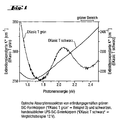
- the optical extinction spectra are Sintered body from example 3 ("EKasic T green") and comparative example 12 V (“EKasic T black”) shown. How through Comparison of the two spectra can be seen is for the Green coloring of the sintered body according to the invention characteristic absorption band in the red-yellow area 1.8 to 2.2 eV responsible. Furthermore, the spectrum shows of green silicon carbide a higher transmission in the green Spectral range. The dark green color offers one decorative effect and is especially for the application of the Sintered body according to the invention in decorative applications such as e.g. interesting as a hob in hobs.
- FIG. 2 shows the structure of the sintered body obtained by gas pressure sintering of alpha-SiC with 3% by volume of sintering additive based on Y 2 O 3 -AlN (example 3), with a sintered density of 3.23 g / cm 3 and a total porosity of 0. 1 vol .-%, a binder phase content of 2.8% by mass, a specific electrical resistance of 1.5 x 10 11 Ohm ⁇ cm and a fracture toughness of 4.3 MPa ⁇ m 1/2 .
- the SiC hard material grains (gray) contain 1.04% by mass of dissolved aluminum, 0.34% by mass of dissolved nitrogen and 0.10% by mass of dissolved oxygen.
- SiC primary grains cores
- Si-C-Al-ON mixed crystals shells
- the Al / N atomic ratio in SiCAlON is 1.6.
- the binding phase occurs in the grain boundaries as an amorphous thin film and for the most part in triple points between the SiC grains as crystalline Y-Al garnet.
- a grain size distribution of finer 5 ⁇ m and an average SiC grain size of 0.9 ⁇ m were determined by image analysis.
- Green alpha-SiC sinter powder with a specific surface area of 12.1 m 2 / g and an average particle size of 0.7 ⁇ m was used as the starting powder.
- the powder contains 0.30% free carbon and 0.45% residual oxygen.
- the sintering additives had a particle size distribution of fine 10 ⁇ m and average particle size in the range 1.2 to 1.5 ⁇ m.
- a 60% dispersion of the SiC powder in water was prepared with stirring, in which the sintering and pressing aids had previously been dissolved or slurried. After the dispersion had been homogenized, a defined liter weight of> 1500 g / l was established by dilution with water and the finished slip was dried using a spray dryer.
- the free-flowing press granules obtained (granulate diameter distribution 30-300 ⁇ m) with about 0.3% residual moisture were then isostatically under a pressure of 200 MPa to form cylinders d 35 x 50 mm (35 mm diameter x 50 mm height) with green densities of 62% TD pressed.
- the sealing sintering was carried out according to the following temperature / pressure scheme: 20 - 1200 ° C / 0.01 bar: 90 min 1200 - 1750 ° C / 5 bar: 90 min 1750 - 1960 ° C / 5 bar: 60 min 1960 ° C / 5 bar: 40 min 1960 ° C / 95 bar: 20 min
- the furnace was switched off and the sintered bodies in the furnace at a pressure of 85 - 90 bar Cooled to room temperature.
- the sintered bodies all had a density of> 99.5 % of the theoretically possible density and experienced during the Liquid phase sintering has a linear shrinkage of 18% as well a mass loss of around 2%.
- the shaped bodies were subjected to ceramic-graphical grinding for the structural and porosity investigations, by cylindrical and face grinding, tablet-shaped test specimens with dimensions d 26 x 5 mm for determining the specific electrical resistance and by cutting, Grinding and lapping prismatic bending rods 3 x 4 x 45 mm made for the determination of the fracture toughness.
- the highly polished sections of the sintered body consistently showed a dark green color.
- the volume percent porosity (P) for the calculation of the compression in percent of the theoretical density (% TD) according to 100 - P % TD was determined by light microscopy using an image analysis system from the Kontron company using polished sections with ten measuring fields each at 500x magnification .
- the average grain size was also determined by image analysis using scanning electron micrographs at a magnification of 2500 times by measuring 1000 - 1500 grains (equivalent circle diameter) after development of the structure using chemical plasma etching (CF 4 / O 2 gas mixture 1: 1, 3 min, 10 -5 bar). To characterize the dark green color, optical extinction measurements of thin sections (d ⁇ 50 ⁇ m) were carried out with a Perkin-Elmer grating spectrometer (type Lambda 19) in the spectral range 1.5 to 4.0 eV photon energy (corresponding to wavelengths from 310 to 820 nm). The specific electrical resistance was determined at room temperature using the three-wire measurement method.
- the measuring principle is based on measuring the current through the sample at a given DC voltage of 100 volts and deriving surface currents via a protective ring electrode against ground.
- the fracture toughness measurements were carried out using the plane parallel ground bending rods via crack extension using the bridge method (cf. KA Schwetz et al .: Journal of Solid State Chemistry 133, 68-76 (1997).
- the residual SiC was also subjected to a quantitative element analysis.
- the residue SiC no yttrium was found, but a strong substitution of silicon by aluminum and a weaker substitution of carbon by nitrogen and oxygen (Si-C-Al-ON formation).
- Table 5 compares the chemical analyzes of the sintered bodies of Examples 1, 2, 3 and 3V with those of the SiC residues after extraction of the binding phase by pressure digestion.
- Chemical analyzes (data in mass%)
- the chemical analyzes showed that the residual SiC depending on the selected amount of liquid phase in Sintered body still 0.4 to 1.4 mass% aluminum, 0.2 to 0.5 % By mass nitrogen and 0.1 to 0.2% by mass oxygen in contains solid solution.
- the atomic ratio Al / N in Si-C-Al-O-N Mixed crystal is in the range 1.0 to 2.0, preferably in Range 1.2 to 1.7.
- Table 6 shows the measured values of the sintered density, the specific electrical resistance and the fracture toughness as a function of the binder phase contents together with the C-free fractions of the sintered bodies produced.
- Table 7 shows the C, O and N analyzes of the powder mixtures from the comparative examples 5V, 6V, 11V and 12V together with those of the debindered green bodies.
- oxygen and C-free contents are increased by an average of approx. 0.25% by mass, while the nitrogen contents remain constant.
- all the green bodies consistently contain about 0.5% by mass of free carbon, roughly half of which comes from the SiC sinter powder and the pressing aids pyrolyzed during the debinding.
- the debindered green bodies were sintered under the same conditions as specified for Examples 1 to 4 and 1V to 4V.
- the SiC bodies according to the invention no longer become by gas pressure sintering of SiC green bodies which have been debinded without oxidation annealing, ie by the use of adhering free carbon in amounts of more than 0.1% by mass in the sintered body receive.
- the bodies are completely compressed from a binding phase content of 2.5% by mass, the values of the fracture toughness and the specific electrical resistance are clear compared to those of Examples 1 to 4 due to their high C-free content of greater than 0.1% by mass worsened.
- Examples 7V to 12V show only fracture toughnesses ⁇ 3.6 MPa ⁇ m 1/2 and specific electrical resistances in the range 1 x 10 7 to 8 x 10 despite complete densification with binder phase contents of 2.5 to 5.8 mass% 9 ohmcm.
- Examples 11V and 12V characterize the previously known state of the art (commercially available branded product EKasic T).
- Example 3 was repeated with the essential modifications that of an alpha-SiC sinter powder with a specific surface area of 8.0 m 2 / g, with 0.21% free carbon and 0.30% residual oxygen, of the rare earth metal oxides Yb 2 O. 3 and Nd 2 O 3 was assumed instead of Y 2 O 3 , the compacts were debindered in a single 6-hour heating step at 450 ° C. in flowing air (1 liter per minute) before sintering and to contents ⁇ 0.1 mass % C were decarburized and finally 1980 ° C was chosen as the final temperature for gas pressure sintering.
- the results of these examples are summarized in Table 10.
- the almost pore-free compacted sintered bodies again showed a dark green color and after plasma etching an SiC structure with average grain sizes of 1.5 to 1.8 ⁇ m and a continuous binding phase, ie enveloping all SiC grains.
- the SiC grains had a globular grain shape with a core-shell structure.
- the crystalline aluminates Yb 4 Al 2 O 9 and Yb 3 Al 5 O 12 (Example 5) and NdAlO 3 (Example 6) were detectable by X-ray.
- the SiC molded articles according to the invention are clear also starting from other rare earth oxides and under Use a single preheat step to simultaneous debinding and decarburization of the compacts receive.
Landscapes
- Engineering & Computer Science (AREA)
- Chemical & Material Sciences (AREA)
- Ceramic Engineering (AREA)
- Manufacturing & Machinery (AREA)
- Materials Engineering (AREA)
- Structural Engineering (AREA)
- Organic Chemistry (AREA)
- Ceramic Products (AREA)
Abstract
Description
| Eigenschaftsvergleich von SSiC und LPSSiC | |||||
| SiC-Materialvariante | Sinter-Mechanismus | Sinteradditivgehalte Masse-% | Farbe (polierte Oberfläche) | Spez. elektr. Widerstand Ohm.cm | Brüchzähigkeit MPa · m1/2 |
| EKasic BM (SSiC) | Festphase | <1,5(B+C) | schwarz | 103-104 | 2,2 |
| EKasic D (SSiC) | Festphase | <1,5(Al+C) | schwarz | 10-2-101 | 2,5 |
| Ekasic T (LPSSiC) | Flüssigphase | 5-6(AlN+ YAG) | schwarz | > 107 | 3,5 |
In Anspruch 28 werden dichte SiC-Sinterkörper hoher Bruchzähigkeit beansprucht, mit einem Gefüge gekennzeichnet durch Feinkörnigkeit, Homogenität, überwiegend äquiaxiale Kornform und Anwesenheit einer diskontinuierlichen kristallinen Begleitphase (bevorzugt Yttriumaluminat) in den Zwickeln (Tripelpunkten) der SiC-Körner.
In den Ansprüchen 35 und 38 werden spezifische elektrische Widerstände kleiner 103 Ohm · cm, überwiegend saubere SiC-SiC-Korngrenzen und Bruchzähigkeiten von mindestens 7 MPa · m1/2 gemessen nach der SENB-Methode mit Kerbweiten von 0,5 mm beansprucht.
In den SiC-Körnern sind Anreicherungen der Elemente Aluminium und Stickstoff nachweisbar, jedoch nicht in Mischkristallmengen (im Zehntel-% bis Prozentbereich) sondern in deutlich geringeren Mengen (200-300 ppm). Gemäß Verfahrensbeschreibung liegt keine reine Flüssigphasensinterung sondern ein Mischsintermechanismus ("mixed mode sintering") vor, wonach in der Anfangsphase eine Flüssigphasensinterung über Teilchenumordnung und darauf folgend eine Festphasensinterung ("solid state diffusion sintering") abläuft.
Wie aus Spalte 17, Zeile 3-68 der US 5298470 entnommen werden kann, zieht sich die Flüssigphase - bis auf geringe diskontinuierliche Reste - auf die Tripelpunkte zurück und das zweite Sinterstadium, die Festphasensinterung, schließt sich an, wodurch Verbesserungen in den Sinterkörpereigenschaften erzielt werden können.
Gemäß Spalte 11, Zeilen 12ff kann das "mixed mode Sinterverfahren" in einer Stufe, im Temperaturbereich zwischen 1900 und 2050°C für 3 Stunden oder in zwei Stufen, z.B. eine Stunde bei 1900°C plus eine Stunde bei 2050°C, durchgeführt werden.
Bei dem drucklosen "mixed-mode-Sinterverfahren" wurde offenbar davon ausgegangen, feinkörnige SiC-Sinterkörper mit hoher Bruchzähigkeit aber ohne eine kontinuierliche Bindephase herzustellen, da offensichtlich die Meinung vorherrschend war, daß nur mit sauberen SiC-SiC-Korngrenzen die besten Eigenschaften des Endproduktes garantiert werden können.
Aus der Ansatzzusammensetzung von 84,4 SiC - 10,3 Y2O3 - 3,0 AlN - 2,3 SiO2 (Masse-%) und dem Masseverlust beim Sintern von < 3% kann auf mindestens 10 Masse-% Bindephase in den Sinterkörpern geschlossen werden. Das Gefüge ist feinkörnig und zeigt globulare SiC-Körner und eine kontinuierliche, die SiC-Körner umhüllende Bindephase. Durch Röntgenbeugungsanalyse wurden in diesen Körpern als kristalline Bindephasenbestandteile Y2O3 und Yttrium-Aluminium-Silicium-Oxinitrid nachgewiesen. Diese Sinterkörper sind nicht nur wegen der großen Menge an Bindephase sondern wegen ihrer makroskopischen Inhomogenitäten (poröse Randzonen und Entmischungskanäle) noch stark verbesserungsbedürftig. Mit den Sinteradditiven auf Basis Al2O3 - Y2O3 anstelle AlN - Y2O3 muß infolge sehr hoher Massenverluste im Pulverbett gesintert werden.
| Charakterisierung des handelsüblichen EKasic T, getemperter Ekasic T - Sinterkörper sowie des Alpha-SiC-Sinterpulvers hinsichtlich ihrer SiC-Polytypenzusammensetzung | |||
| SiC-Polytyp (Masse-%) | α-SiC-Sinterpulver (grün) | EKasic T Globulares Gefüge (Sinterzustand) | EKasic T Platelet-Gefüge (getempert) |
| 15R | 7 | 4 | - |
| 6H | 89 | 88 | 27 |
| 4H | 4 | 8 | 73 |
wobei die Hartstoffphase in Form globularer Körner einer mittleren Korngröße < 4 µm vorliegt, wobei mindestens drei Körner einen Tripelpunkt umschließen
wobei die globularen Körner eine Struktur mit einem Kern und einem den Kern umgebenden Mantel aufweisen, wobei der Kern aus SiC und der Mantel aus einem Si-C-Al-O-N Mischkristall besteht, wobei der Mischkristall ein Al / N Atomverhältnis von 1,0 bis 2,0 aufweist und
die teilkristalline Bindephase aus kristallinen und amorphen Phasen des quaternären Systems Seltenerdmetall - Al - Si - O gebildet wird, wobei die amorphe Phase in Form eines die globularen Körner umgebenden Korngrenzenfilms vorliegt und die kristalline Phase in Form von Ansammlungen an den Tripelpunkten enthaltend Seltenerdmetall-Aluminat vorliegt.
- E
- Photonenenergie in eV
- λ
- Wellenlänge in µm (1 µm = 1000 nm)
| Zusammensetzung der Pulveransätze | ||||||
| Bsp Nr. | SiC Masse-% | Y2O3 Masse-% | YAG Masse-% | AlN Masse-% | Sinteradditive total | |
| Masse-% | Vol.-% | |||||
| 1 | 98,24 | 0,56 | - | 1,20 | 1,76 | 1,5 |
| 2 | 98,08 | - | 1,30 | 0,62 | 1,92 | 1,5 |
| 3 | 96,48 | 1,12 | - | 2,40 | 3,52 | 3,0 |
| 4 | 96,18 | - | 2,59 | 1,23 | 3,82 | 3,0 |
| 1V | 94,72 | 1,68 | - | 3,60 | 5,28 | 4,5 |
| 2V | 94,26 | - | 3,89 | 1,85 | 5,74 | 4,5 |
| 3V | 92,96 | 2,24 | - | 4,80 | 7,04 | 6,0 |
| 4V | 92,35 | - | 5,19 | 2,46 | 7,65 | 6,0 |
- 20 - 650 °C
- 20 Stunden
- Halten bei 650 °C
- 5 Stunden
- 20 - 450 °C
- 4,5 Stunden
- Halten bei 450 °C
- 3,0 Stunden
| Chemische Analysen von im technischen Argon entbinderten (EB) sowie anschließend durch Glühen an Luft entkohlten (EK) SiC-Grünkörpern | ||||||||
| Elemente Masse-% | Beispiel 1 | Beispiel 2 | Beispiel 3V | Beispiel 4V | ||||
| EB | EK | EB | EK | EB | EK | EB | EK | |
| C-frei | 0,50 | 0,10 | 0,50 | 0,10 | 0,50 | 0,10 | 0,40 | 0,10 |
| O | 0,91 | 1,50 | 1,00 | 1,60 | 1,30 | 1,90 | 2,30 | 2,90 |
| N | 0,33 | 0,34 | 0,16 | 0,17 | 1,30 | 1,30 | 0,70 | 0,71 |
| C-frei Analyse nach DIN 51079-3; O- und N-Analyse über Trägergasheißextraktion |
| 20 - 1200 °C / | 0,01 bar: 90 min |
| 1200 - 1750 °C / | 5 bar: 90 min |
| 1750 - 1960 °C / | 5 bar: 60 min |
| 1960 °C / | 5 bar: 40 min |
| 1960 °C / | 95 bar: 20 min |
| Chemische Analysen (Angaben in Masse-%) | |||||||
| Beispiel Nr./Material | Al | Y | O | N | C | Si | Atomverh. Al/N im SiCAlON |
| 1/SK | 0,80 | 0,40 | 0,42 | 0,17 | 28,91 | 69,3 | |
| 1/R | 0,60 | - | 0,14 | 0,22 | 29,70 | 69,3 | 1,4 |
| 2/SK | 0,77 | 0,43 | 0,32 | 0,19 | 29,03 | 69,3 | |
| 2/R | 0,36 | - | 0,08 | 0,19 | 29,57 | 69,8 | 1,0 |
| 3/SK | 1,50 | 0,82 | 0,86 | 0.31 | 28,53 | 68,0 | |
| 3/R | 1,04 | - | 0,10 | 0,34 | 29,51 | 69,0 | 1,6 |
| 3V/SK | 2,82 | 1,62 | 1,72 | 0.52 | 27,62 | 65,7 | |
| 3V/R | 1,41 | - | 0,13 | 0,50 | 29,70 | 68,3 | 1,5 |
- Y =
- Masse-% Y, emissionsspektralanalytisch (ICP-OES) nach alkalischem Aufschluß der Sinterkörper
- YAG =
- Masse-% Y3Al5O12
- 2,225 =
- stoichiometrischer Faktor zu Umrechnung von Yttrium auf YAG
| Sinterkörpereigenschaften | |||||||
| Beispiel Nr. | SD g/cm3 | P Vol.-% | Verdichtung % TD | Bindephasen- Gehalt Masse-% | C-frei Gehalt Masse-% | Spez. Elektr. Widerstand Ohm · cm | Bruchzähigkeit MPa · m 1/2 |
| 1 | 3,18 | 0,3 | 99,7 | 1,6 | 0,07 | 1,8 · 109 | 4,0 |
| 2 | 3,19 | 0,3 | 99,7 | 2,0 | 0,10 | 1,8 · 107 | 4,2 |
| 3 | 3,23 | 0,1 | 99,9 | 2,8 | 0,08 | 1,5 · 1011 | 4,3 |
| 4 | 3,23 | 0,2 | 99,8 | 3,5 | 0,08 | 2,3 · 1011 | 4,5 |
| 1V | 3,23 | 0,2 | 99,8 | 4,2 | 0,08 | 1,0 · 1010 | 3,7 |
| 2V | 3,24 | 0,2 | 99,8 | 4,8 | 0,07 | 1,1 · 1011 | 3,8 |
| 3V | 3,24 | 0,3 | 99,7 | 5,3 | 0,08 | 7,9 · 107 | 3,8 |
| 4V | 3,25 | 0,3 | 99,7 | 6,0 | 0,09 | 1,8 · 1011 | 3,8 |
| SD...Sinterdichte, P...Porosität, % TD...% der theoretischen Dichte |
- 20 - 650 °C:
- 20 Stunden
- Halten bei 650 °C:
- 5 Stunden.
| Analysenvergleich Sinterpulver / Grünkörper | ||||||||
| Elemente Masse-% | Beispiel 5V | Beispiel 6V | Beispiel 11V | Beispiel 12V | ||||
| SP | EB | SP | EB | SP | EB | SP | EB | |
| C-frei | 0,27 | 0,52 | 0,27 | 0,50 | 0,26 | 0,55 | 0,26 | 0,45 |
| O | 0,60 | 0,91 | 0,98 | 1,00 | 0,92 | 1,30 | 2,10 | 2,30 |
| N | 0,36 | 0,33 | 0,18 | 0,16 | 1,40 | 1,30 | 0,72 | 0,70 |
| SP...Sinterpulver mit Sinterhilfsmitteln dotiert EB...entbinderter Grünkörper |
| Sinterkörpereigenschaften | |||||||
| Beispiel Nr. | SD g/cm3 | P Vol.-% | Verdichtung % TD | Bindephasen-Gehalt Masse-% | C-frei Gehalt Masse-% | Spez. elektr. Widerstand Ohm · cm | Bruchzähigkeit MPa · m1/2 |
| 5V | 2,73 | 13,6 | 86,4 | 1,4 | 0,31 | 1,2 · 107 | 2,8 |
| 6V | 2,91 | 8,7 | 91,3 | 1,6 | 0,15 | 4,8 · 105 | 3,1 |
| 7V | 3,21 | 0,2 | 99,8 | 2,5 | 0,28 | 7,8 · 109 | 3,3 |
| 8V | 3,24 | 0,1 | 99,9 | 3,1 | 0,20 | 3,2 · 109 | 3,5 |
| 9V | 3,22 | 0,2 | 99,8 | 4,0 | 0,40 | 5,0 · 109 | 3,6 |
| 10V | 3,24 | 0,2 | 99,8 | 4,5 | 0,30 | 3,0 · 109 | 3,5 |
| 11V | 3,22 | 0,5 | 99,5 | 5,2 | 0,49 | 1,0 · 107 | 3,6 |
| 12V | 3,25 | 0,3 | 99,7 | 5,8 | 0,23 | 3,4 · 109 | 3,5 |
| SD...Sinterdichte, P...Porosität, % TD...% der theoretischen Dichte |
| Beispiel Nr. | Korrosionsbeständigkeit (Korrosionstiefe) | Oxidationsbeständigkeit (Massezunahme) |
| 2 | 2 µm | 0,7 mg/cm2 |
| 10V | 30 µm | 2,5 mg/cm2 |
| 12V | 60 µm | 3,1 mg/cm2 |
| Bedingungen: Hydrothermale Korrosion bei 150 °C, 70 Stunden, in 0,1 n HCl-Lösung, Oxidation bei 1400 °C, 100 Stunden, an Luft |
| Sinterkörpereigenschaften | ||||||
| Beispiel Nr. | Sinteradditivzusatz Masse-% | Verdichtung % TD | Bindephasen-gehalt Masse-% | C-frei Gehalt Masse-% | Spez. Elektr. Widerstand Ohm · cm | Bruchzähigkeit MPa·m1/2 |
| 5 | 2 Yb2O3- 1 AlN | 99,7 | 3,0 | 0,04 | 1,0 · 1012 | 4,5 |
| 6 | 1,5 Nd2O3 - 1,5 AlN | 99,8 | 2,5 | 0,07 | 5,2 · 1011 | 4,3 |
Claims (10)
- Polykristalliner SiC-Formkörper, der aus 96 Masse-% bis 99,5 Masse-% einer Hartstoffphase, 0 bis 0,1 Masse-% freiem Kohlenstoff und zum Rest aus einer teilkristallinen Bindephase besteht, wobei die Hartstoffphase aus SiC und einem Si-C-Al-O-N Mischkristall besteht und 0,2 bis 1,5 Masse-% gelöstes Aluminium, 0,1 bis 0,5 Masse-% gelösten Stickstoff, 0,01 bis 0,2 Masse-% gelösten Sauerstoff enthält
wobei die Hartstoffphase in Form globularer Körner einer mittleren Korngröße < 4 µm vorliegt, wobei mindestens drei Körner einen Tripelpunkt umschließen
wobei die globularen Körner eine Struktur mit einem Kern und einem den Kern umgebenden Mantel aufweisen, wobei der Kern aus SiC und der Mantel aus einem Si-C-Al-O-N Mischkristall besteht, wobei der Mischkristall ein Al / N Atomverhältnis von 1,0 bis 2,0 aufweist unddie teilkristalline Bindephase aus kristallinen und amorphen Phasen des quaternären Systems Seltenerdmetall - Al - Si - O gebildet wird, wobei die amorphe Phase in Form eines die globularen Körner umgebenden Korngrenzenfilms vorliegt und die kristalline Phase in Form von Ansammlungen an den Tripelpunkten enthaltend Seltenerdmetall-Aluminat vorliegt. - SiC-Formkörper nach Anspruch 1, dadurch gekennzeichnet, daß er folgende Eigenschaften hat :Dichte mindestens 99,5% der theoretisch möglichen Dichte; dunkelgrüne Färbung von Anschliffen bzw. polierten Oberflächen durch charakteristische Lichtabsorption im rotgelben Spektralbereich zwischen 1,8 bis 2,2 eV, spezifischer elektrischer Widerstand von mindestens 107 Ohm cm undBruchzähigkeit gemessen nach der Brückenmethode von mindestens 4,0 MPa · m1/2.
- Verfahren zur Herstellung von Formkörpern gemäß Anspruch 1 oder 2, dadurch gekennzeichnet, daß ein bis auf einen Restgehalt von maximal 0,1 Masse-% freiem Kohlenstoff entkohlter und unter Bildung von 1,0-1,5 Masse-% SiO2 aufoxidierter poröser Vorkörper bestehend aus sinterbarem SiC-Pulver, das bis zu 4-Masse-% Sinterhilfsmittel auf Basis eines Gemischs von Seltenerdmetallsesquioxid (SE2O3) oder Seltenerdmetallaluminat (SE-Aluminat) mit Aluminiumnitrid enthält in einer Sinter-HIP-Anlage unter Verwendung von Argon als inertem Schutzgas und Druckübertragungsmedium bei einer Temperatur von 1900-2000°C und einem Druck von 3 bis 100 bar dichtgesintert wird.
- Verfahren zur Herstellung eines polykristallinen SiC-Formkörpers gemäß Anspruch 1 oder 2 aus einem Pulverpreßling bestehend aus SiC, einem organischen Preßhilfsmittel und einem Sinterhilfsmittel durch eine Hitzebehandlung zur Erhöhung des Sauerstoffgehaltes sowie Erniedrigung des freien Kohlenstoffgehaltes im SiC und eine anschließende Sinterverdichtung, dadurch gekennzeichnet, daß der Pulverpreßling bestehend aus SiC, bis zu 6 Masse-% organischem Preßhilfsmittel und bis zu maximal 4 Masse % eines Gemisches von SE2O3 oder SE-Aluminat mit Aluminiumnitrid als Sinterhilfsmittel unter Bildung eines vorgeformten Grünkörpers kompaktiert, diesen vorgeformten Grünkörper einer ersten Vorerhitzung zur Entbinderung bei 650 °C unter strömender Argonatmosphäre und einer zweiten Vorerhitzung in sauerstoffhaltiger Atmosphäre bei 400 - 500 °C unterzieht bis zur Bildung eines porösen, auf einen Restgehalt von maximal 0,1 Masse-% C-frei entkohlten und unter Bildung von 1,0 bis 1,5 Masse-% SiO2 aufoxidierten Vorkörpers und dieser entkohlte und aufoxidierte Vorkörper in eine SinterHIP-Anlage eingebracht und unter einem Argondruck von 2 bis 10 bar bei Masseverlusten von maximal 2,5 Masse-% auf 1900 - 2000 °C bis zur Bildung eines gasdichten SiC-Sinterkörpers mit maximal 4 Masse-% Bindephase gesintert und schließlich dieser Sinterkörper isotherm unter Erhöhung des Gasdruckes auf bis zu 100 bar durch das als Druckübertragungsmedium verwendete Argongas bis zur Bildung des endgültigen SiC-Formkörpers mit einer Dichte von mindestens 99,5 % TD nachverdichtet wird.
- Verfahren nach Anspruch 4, dadurch gekennzeichnet, daß die Entbinderung und Vorerhitzung des Grünkörpers durch Hitzebehandlung in einem Verfahrensschritt an strömender Luft bei 450 °C durchgeführt wird.
- Strukturkeramik für Gasdichtungsringe bestehend aus einem polykristallinen SiC-Formkörper gemäß Anspruch 1.
- Funktionskeramik für Herdplatten oder Topfböden bestehend aus einem polykristallinen SiC-Formkörper gemäß Anspruch 1.
- Wälzlagerkomponente bestehend aus einem polykristallinen SiC-Formkörper gemäß Anspruch 1.
- Substratplatten für Schreib- und Leseköpfe bestehend aus einem polykristallinen SiC-Formkörper gemäß Anspruch 1.
- Panzerplatten gegen den Einschlag von Geschossen bestehend aus einem polykristallinen SiC-Formkörper gemäß Anspruch 1.
Applications Claiming Priority (2)
| Application Number | Priority Date | Filing Date | Title |
|---|---|---|---|
| DE19933194 | 1999-07-15 | ||
| DE19933194A DE19933194A1 (de) | 1999-07-15 | 1999-07-15 | Flüssigphasengesinterte SiC-Formkörper mit verbesserter Bruchzähigkeit sowie hohem elektrischen Widerstand und Verfahren zu ihrer Herstellung |
Publications (2)
| Publication Number | Publication Date |
|---|---|
| EP1070686A1 true EP1070686A1 (de) | 2001-01-24 |
| EP1070686B1 EP1070686B1 (de) | 2001-11-21 |
Family
ID=7914904
Family Applications (1)
| Application Number | Title | Priority Date | Filing Date |
|---|---|---|---|
| EP00113040A Expired - Lifetime EP1070686B1 (de) | 1999-07-15 | 2000-06-23 | Flüssigphasengesinterte Siliciumcarbid-Formkörper mit verbesserter Bruchzähigkeit sowie hohem elektrischen Widerstand und Verfahren zu ihrer Herstellung |
Country Status (5)
| Country | Link |
|---|---|
| US (1) | US6531423B1 (de) |
| EP (1) | EP1070686B1 (de) |
| JP (1) | JP3624219B2 (de) |
| AT (1) | ATE209170T1 (de) |
| DE (2) | DE19933194A1 (de) |
Cited By (2)
| Publication number | Priority date | Publication date | Assignee | Title |
|---|---|---|---|---|
| EP1595624A4 (de) * | 2002-12-27 | 2007-05-16 | Nat Inst Of Advanced Ind Scien | Zentrifugalsintersystem |
| US20150111718A1 (en) * | 2012-04-27 | 2015-04-23 | Saint-Gobain Centre De Recherches Et D'etudes Europeen | Product made of dense silicon carbide |
Families Citing this family (55)
| Publication number | Priority date | Publication date | Assignee | Title |
|---|---|---|---|---|
| US6762140B2 (en) | 2001-08-20 | 2004-07-13 | Saint-Gobain Ceramics & Plastics, Inc. | Silicon carbide ceramic composition and method of making |
| US6680267B2 (en) * | 2001-08-20 | 2004-01-20 | Saint-Gobain Ceramics & Plastics, Inc. | Silicon carbide ceramic composition and method of making |
| DE102005024623B4 (de) * | 2005-05-30 | 2007-08-23 | Beru Ag | Verfahren zum Herstellen eines keramischen Glühstiftes für eine Glühkerze |
| US8003042B2 (en) * | 2006-03-29 | 2011-08-23 | Ceramatec, Inc. | Toughened silicon carbide and method for making the same |
| US7989380B2 (en) * | 2008-11-26 | 2011-08-02 | Ceradyne, Inc. | High resistivity SiC material with B, N and O as the only additions |
| EP2459500A4 (de) * | 2009-07-24 | 2012-12-26 | Saint Gobain Ceramics | Keramikverbundstoffe von hoher festigkeit |
| US8580593B2 (en) * | 2009-09-10 | 2013-11-12 | Micron Technology, Inc. | Epitaxial formation structures and associated methods of manufacturing solid state lighting devices |
| EP2487144A4 (de) * | 2009-10-09 | 2014-07-16 | Shinetsu Chemical Co | Verfahren zur herstellung eines siliciumcarbidformartikels |
| WO2012092590A2 (en) | 2010-12-31 | 2012-07-05 | Saint-Gobain Ceramics & Plastics, Inc. | Abrasive particles having particular shapes and methods of forming such particles |
| CN103764349B (zh) | 2011-06-30 | 2017-06-09 | 圣戈本陶瓷及塑料股份有限公司 | 液相烧结碳化硅研磨颗粒 |
| CN108262695A (zh) | 2011-06-30 | 2018-07-10 | 圣戈本陶瓷及塑料股份有限公司 | 包括氮化硅磨粒的磨料制品 |
| DE102012012227B4 (de) | 2011-06-30 | 2024-07-18 | QSIL Ingenieurkeramik GmbH | Herstellung dichter Siliziumcarbid-Sinterkörper mit gezielt einstellbarem elektrischem Widerstand und so erhältliche Siliciumcarbid-Sinterkörper |
| EP2758621A4 (de) * | 2011-09-19 | 2015-12-30 | Baker Hughes Inc | Verfahren zur bildung von polykristallinen diamantpresskörpern sowie daraus resultierende polykristalline diamantpresskörper und schneideelemente damit |
| EP2760639B1 (de) | 2011-09-26 | 2021-01-13 | Saint-Gobain Ceramics & Plastics, Inc. | Schleifartikel mit abrasiven teilchen, beschichtetes schleifmittel mit abrasiven teilchen und herstellungsverfahren dafür |
| KR102074138B1 (ko) | 2011-12-30 | 2020-02-07 | 생-고뱅 세라믹스 앤드 플라스틱스, 인코포레이티드 | 형상화 연마입자 및 이의 형성방법 |
| EP2797716B1 (de) | 2011-12-30 | 2021-02-17 | Saint-Gobain Ceramics & Plastics, Inc. | Zusammengesetzte geformte schleifpartikel und verfahren zu ihrer herstellung |
| BR112014016159A8 (pt) | 2011-12-30 | 2017-07-04 | Saint Gobain Ceramics | formação de partículas abrasivas moldadas |
| WO2013106602A1 (en) | 2012-01-10 | 2013-07-18 | Saint-Gobain Ceramics & Plastics, Inc. | Abrasive particles having particular shapes and methods of forming such particles |
| EP3705177A1 (de) | 2012-01-10 | 2020-09-09 | Saint-Gobain Ceramics & Plastics Inc. | Schleifpartikel mit komplexen formen und verfahren diese zu formen |
| WO2013149209A1 (en) | 2012-03-30 | 2013-10-03 | Saint-Gobain Abrasives, Inc. | Abrasive products having fibrillated fibers |
| KR102534897B1 (ko) | 2012-05-23 | 2023-05-30 | 생-고뱅 세라믹스 앤드 플라스틱스, 인코포레이티드 | 형상화 연마입자들 및 이의 형성방법 |
| FR2991981A1 (fr) * | 2012-06-15 | 2013-12-20 | Saint Gobain Ct Recherches | Produit en carbure de silicium pour blindage |
| US10106714B2 (en) | 2012-06-29 | 2018-10-23 | Saint-Gobain Ceramics & Plastics, Inc. | Abrasive particles having particular shapes and methods of forming such particles |
| KR101736085B1 (ko) | 2012-10-15 | 2017-05-16 | 생-고뱅 어브레이시브즈, 인코포레이티드 | 특정한 형태들을 가진 연마 입자들 및 이러한 입자들을 형성하는 방법들 |
| US9074119B2 (en) | 2012-12-31 | 2015-07-07 | Saint-Gobain Ceramics & Plastics, Inc. | Particulate materials and methods of forming same |
| CN105073343B (zh) | 2013-03-29 | 2017-11-03 | 圣戈班磨料磨具有限公司 | 具有特定形状的磨粒、形成这种粒子的方法及其用途 |
| TW201502263A (zh) | 2013-06-28 | 2015-01-16 | Saint Gobain Ceramics | 包含成形研磨粒子之研磨物品 |
| CN105764653B (zh) | 2013-09-30 | 2020-09-11 | 圣戈本陶瓷及塑料股份有限公司 | 成形磨粒及其形成方法 |
| EP3089851B1 (de) | 2013-12-31 | 2019-02-06 | Saint-Gobain Abrasives, Inc. | Schleifartikel mit geformten schleifpartikeln |
| US9771507B2 (en) | 2014-01-31 | 2017-09-26 | Saint-Gobain Ceramics & Plastics, Inc. | Shaped abrasive particle including dopant material and method of forming same |
| MX394114B (es) | 2014-04-14 | 2025-03-24 | Saint Gobain Ceramics | Articulo abrasivo que incluye particulas abrasivas conformadas. |
| WO2015160855A1 (en) | 2014-04-14 | 2015-10-22 | Saint-Gobain Ceramics & Plastics, Inc. | Abrasive article including shaped abrasive particles |
| US9902045B2 (en) | 2014-05-30 | 2018-02-27 | Saint-Gobain Abrasives, Inc. | Method of using an abrasive article including shaped abrasive particles |
| US9707529B2 (en) | 2014-12-23 | 2017-07-18 | Saint-Gobain Ceramics & Plastics, Inc. | Composite shaped abrasive particles and method of forming same |
| US9914864B2 (en) | 2014-12-23 | 2018-03-13 | Saint-Gobain Ceramics & Plastics, Inc. | Shaped abrasive particles and method of forming same |
| US9676981B2 (en) | 2014-12-24 | 2017-06-13 | Saint-Gobain Ceramics & Plastics, Inc. | Shaped abrasive particle fractions and method of forming same |
| CN116967949A (zh) | 2015-03-31 | 2023-10-31 | 圣戈班磨料磨具有限公司 | 固定磨料制品和其形成方法 |
| TWI634200B (zh) | 2015-03-31 | 2018-09-01 | 聖高拜磨料有限公司 | 固定磨料物品及其形成方法 |
| US10711171B2 (en) | 2015-06-11 | 2020-07-14 | Saint-Gobain Ceramics & Plastics, Inc. | Abrasive article including shaped abrasive particles |
| DE102015016129A1 (de) | 2015-12-14 | 2017-06-14 | Fct Ingenieurkeramik Gmbh | Verfahren zur Herstellung eines keramischen Kompositwerkstoffes, keramischer Kompositwerkstoff und aus diesem bestehender keramischer Sinterkörper |
| US11718774B2 (en) | 2016-05-10 | 2023-08-08 | Saint-Gobain Ceramics & Plastics, Inc. | Abrasive particles and methods of forming same |
| CN121249321A (zh) | 2016-05-10 | 2026-01-02 | 圣戈本陶瓷及塑料股份有限公司 | 磨料颗粒及其形成方法 |
| US11230653B2 (en) | 2016-09-29 | 2022-01-25 | Saint-Gobain Abrasives, Inc. | Fixed abrasive articles and methods of forming same |
| US10563105B2 (en) | 2017-01-31 | 2020-02-18 | Saint-Gobain Ceramics & Plastics, Inc. | Abrasive article including shaped abrasive particles |
| US10759024B2 (en) | 2017-01-31 | 2020-09-01 | Saint-Gobain Ceramics & Plastics, Inc. | Abrasive article including shaped abrasive particles |
| WO2018236989A1 (en) | 2017-06-21 | 2018-12-27 | Saint-Gobain Ceramics & Plastics, Inc. | Particulate materials and methods of forming same |
| JP6988473B2 (ja) * | 2017-12-28 | 2022-01-05 | トヨタ自動車株式会社 | 電池用セパレータ、及び、リチウム電池、並びに、これらの製造方法 |
| JP2022550186A (ja) | 2019-09-30 | 2022-11-30 | コーニング インコーポレイテッド | フローリアクタモジュールの製造及び製造されるモジュール |
| US11926019B2 (en) | 2019-12-27 | 2024-03-12 | Saint-Gobain Ceramics & Plastics, Inc. | Abrasive articles and methods of forming same |
| WO2021133876A1 (en) | 2019-12-27 | 2021-07-01 | Saint-Gobain Ceramics & Plastics, Inc. | Abrasive articles and methods of forming same |
| WO2021133888A1 (en) | 2019-12-27 | 2021-07-01 | Saint-Gobain Ceramics & Plastics, Inc. | Abrasive articles and methods of forming same |
| KR20240148817A (ko) | 2021-12-30 | 2024-10-11 | 세인트-고바인 아브라시브즈 인크. | 연마 물품 및 이의 형성 방법 |
| US12508688B2 (en) | 2021-12-30 | 2025-12-30 | Saint-Gobain Abrasives, Inc. | Abrasive articles and methods of forming same |
| CN118541241A (zh) | 2021-12-30 | 2024-08-23 | 圣戈班磨料磨具有限公司 | 磨料制品及其形成方法 |
| JP7799894B1 (ja) * | 2025-06-03 | 2026-01-15 | 株式会社Maruwa | 炭化ケイ素焼結体および放熱部材 |
Citations (5)
| Publication number | Priority date | Publication date | Assignee | Title |
|---|---|---|---|---|
| FR2502612A1 (fr) * | 1981-03-27 | 1982-10-01 | Japan Metals & Chem Co Ltd | Formes frittees du carbure de silicium et procede de fabrication de celles-ci |
| FR2537568A1 (fr) * | 1982-12-08 | 1984-06-15 | Asahi Glass Co Ltd | Article fritte a base de carbure de silicium et procede pour le fabriquer |
| EP0251218A2 (de) * | 1986-06-26 | 1988-01-07 | Elektroschmelzwerk Kempten GmbH | Elektrisch isolierende Substratwerkstoffe aus polykristallinem Siliciumcarbid und Verfahren zu ihrer Herstellung durch isostatisches Heisspressen |
| US4829027A (en) * | 1987-01-12 | 1989-05-09 | Ceramatec, Inc. | Liquid phase sintering of silicon carbide |
| EP0419271A2 (de) * | 1989-09-22 | 1991-03-27 | The Carborundum Company | Siliciumcarbidkörper mit grosser Zähigkeit und Bruchfestigkeit und Verfahren zu seiner Herstellung |
Family Cites Families (9)
| Publication number | Priority date | Publication date | Assignee | Title |
|---|---|---|---|---|
| US4502983A (en) * | 1983-06-28 | 1985-03-05 | Mamoru Omori | Composite silicon carbide sintered shapes and its manufacture |
| JPS5951384A (ja) | 1983-07-28 | 1984-03-24 | Seikosha Co Ltd | 表示装置 |
| JPS60195057A (ja) * | 1984-03-16 | 1985-10-03 | 京セラ株式会社 | 炭化珪素質焼結体及びその製法 |
| US5298470A (en) * | 1989-09-22 | 1994-03-29 | The Carborundum Company | Silicon carbide bodies having high toughness and fracture resistance and method of making same |
| JP3147977B2 (ja) * | 1991-12-19 | 2001-03-19 | 新日本製鐵株式会社 | 炭化珪素焼結体製反射ミラー用基板とその製造方法 |
| JP2671945B2 (ja) * | 1995-03-03 | 1997-11-05 | 科学技術庁無機材質研究所長 | 超塑性炭化ケイ素焼結体とその製造方法 |
| US5656218A (en) * | 1995-05-19 | 1997-08-12 | Industrial Technology Research Institute | Method for making high performance self-reinforced silicon carbide using a pressureless sintering process |
| JPH11508868A (ja) * | 1995-07-13 | 1999-08-03 | ネガバット、ゲゼルシャフト、ミット、ベシュレンクテル、ハフツング | 電気絶縁性炭化ケイ素の製法 |
| DE19730770C2 (de) * | 1996-08-06 | 2001-05-10 | Wacker Chemie Gmbh | Porenfreie Sinterkörper auf Basis von Siliciumcarbid, Verfahren zu ihrer Herstellung und ihre Verwendung als Substrate für Festplattenspeicher |
-
1999
- 1999-07-15 DE DE19933194A patent/DE19933194A1/de not_active Withdrawn
-
2000
- 2000-06-23 DE DE50000085T patent/DE50000085D1/de not_active Expired - Lifetime
- 2000-06-23 EP EP00113040A patent/EP1070686B1/de not_active Expired - Lifetime
- 2000-06-23 AT AT00113040T patent/ATE209170T1/de active
- 2000-07-08 US US09/612,168 patent/US6531423B1/en not_active Expired - Lifetime
- 2000-07-12 JP JP2000211643A patent/JP3624219B2/ja not_active Expired - Fee Related
Patent Citations (5)
| Publication number | Priority date | Publication date | Assignee | Title |
|---|---|---|---|---|
| FR2502612A1 (fr) * | 1981-03-27 | 1982-10-01 | Japan Metals & Chem Co Ltd | Formes frittees du carbure de silicium et procede de fabrication de celles-ci |
| FR2537568A1 (fr) * | 1982-12-08 | 1984-06-15 | Asahi Glass Co Ltd | Article fritte a base de carbure de silicium et procede pour le fabriquer |
| EP0251218A2 (de) * | 1986-06-26 | 1988-01-07 | Elektroschmelzwerk Kempten GmbH | Elektrisch isolierende Substratwerkstoffe aus polykristallinem Siliciumcarbid und Verfahren zu ihrer Herstellung durch isostatisches Heisspressen |
| US4829027A (en) * | 1987-01-12 | 1989-05-09 | Ceramatec, Inc. | Liquid phase sintering of silicon carbide |
| EP0419271A2 (de) * | 1989-09-22 | 1991-03-27 | The Carborundum Company | Siliciumcarbidkörper mit grosser Zähigkeit und Bruchfestigkeit und Verfahren zu seiner Herstellung |
Cited By (3)
| Publication number | Priority date | Publication date | Assignee | Title |
|---|---|---|---|---|
| EP1595624A4 (de) * | 2002-12-27 | 2007-05-16 | Nat Inst Of Advanced Ind Scien | Zentrifugalsintersystem |
| US20150111718A1 (en) * | 2012-04-27 | 2015-04-23 | Saint-Gobain Centre De Recherches Et D'etudes Europeen | Product made of dense silicon carbide |
| US9388084B2 (en) * | 2012-04-27 | 2016-07-12 | Saint-Gobain Centre De Recherches Et D'etudes Europeen | Product made of dense silicon carbide |
Also Published As
| Publication number | Publication date |
|---|---|
| DE50000085D1 (de) | 2002-02-21 |
| ATE209170T1 (de) | 2001-12-15 |
| EP1070686B1 (de) | 2001-11-21 |
| US6531423B1 (en) | 2003-03-11 |
| JP3624219B2 (ja) | 2005-03-02 |
| DE19933194A1 (de) | 2001-01-18 |
| JP2001080964A (ja) | 2001-03-27 |
Similar Documents
| Publication | Publication Date | Title |
|---|---|---|
| EP1070686B1 (de) | Flüssigphasengesinterte Siliciumcarbid-Formkörper mit verbesserter Bruchzähigkeit sowie hohem elektrischen Widerstand und Verfahren zu ihrer Herstellung | |
| DE3610041C2 (de) | Keramik auf Zirkoniumdioxidbasis mit Aluminiumoxid, Spinell, Mullit oder Spinell und Mullit und mit verbesserter hydrothermaler und thermischer Stabilität | |
| DE69022045T2 (de) | Keramiken mit hoher zähigkeit, festigkeit und härte. | |
| DE68913847T2 (de) | Selbstarmierte siliciumnitridkeramik hoher bruchzähigkeit und verfahren zu deren herstellung. | |
| DE112004001567B4 (de) | Auf Siliciumnitrid basierendes Sintermaterial und Verfahren zur Erzeugung desselben und ein schmelzfestes Bauteil und ein verschleissfestes Bauteil unter Verwendung desselben | |
| DE3877566T2 (de) | Keramisches verbundmaterial und daraus hergestellte gegenstaende. | |
| KR900007078B1 (ko) | 고강도 · 고내마모성 슬라이딩부재와 그의 제조방법 | |
| DE69005664T2 (de) | Verfahren zur Erzeugung keramischer Verbundwerkstoffe. | |
| DE69307444T2 (de) | Siliciumnitrid-Sinterkörper und Verfahren zu seiner Herstellung | |
| EP0094591A1 (de) | Polykristalline, praktisch porenfreie Sinterkörper aus Alpha-Siliciumcarbid, Borcarbid und freiem Kohlenstoff und Verfahren zu ihrer Herstellung | |
| EP0412975B1 (de) | Pulvermetallurgisch erzeugter keramikformkörper, seine verwendung und herstellung | |
| DE3608326A1 (de) | Praktisch porenfreie formkoerper aus polykristallinem aluminiumnitrid und verfahren zu ihrer herstellung ohne mitverwendung von sinterhilfsmitteln | |
| EP0021239B1 (de) | Verfahren zur Herstellung von dichten Formkörpern aus polykristallinem alpha-Siliciumcarbid durch Heisspressen und so hergestellte Formkörper | |
| DE69309664T2 (de) | Sialon-verbundwerkstoffe und verfahren zu ihrer herstellung | |
| DE69703999T2 (de) | Gleitwerkstoff aus Siliciumnitridkeramik und Herstellung desselben | |
| DE69427722T2 (de) | Sinterkörper aus Aluminiumnitriol und Verfahren zu seiner Herstellung | |
| DE69317254T2 (de) | Siliciumnitrid-Sinterkörper | |
| DE69201910T2 (de) | Siliciumnitrid-Sinterkörper und Verfahren zu seiner Herstellung. | |
| DE68914598T2 (de) | Keramischer Verbundwerkstoff und Verfahren zu seiner Herstellung. | |
| DE102012012227A1 (de) | Herstellung dichter Siliziumcarbid-Sinterkörper mit gezielt einstellbarem elektrischem Widerstand und so erhältliche Siliciumcarbid-Sinterkörper | |
| EP0247528B1 (de) | Polykristalline Sinterkörper auf Basis von Siliciumnitrid mit hoher Bruchzähigkeit und Härte | |
| DE3840573C2 (de) | Whisker-verstärkte Keramik | |
| DE69122167T2 (de) | Temperaturwechselbeständiges Sintermaterial aus Siliciumnitrid und Verfahren zu seiner Herstellung | |
| DE3873767T2 (de) | Verfahren zur herstellung keramischer verbundwerkstoffe, enthaltend siliziumoxynitrid und zirkoniumoxid. | |
| DE19704910C2 (de) | Flüssigphasengesinterter elektrisch leitfähiger und oxidationsresistenter keramischer Werkstoff, ein Verfahren zu seiner Herstellung und dessen Verwendung |
Legal Events
| Date | Code | Title | Description |
|---|---|---|---|
| GRAG | Despatch of communication of intention to grant |
Free format text: ORIGINAL CODE: EPIDOS AGRA |
|
| PUAI | Public reference made under article 153(3) epc to a published international application that has entered the european phase |
Free format text: ORIGINAL CODE: 0009012 |
|
| 17P | Request for examination filed |
Effective date: 20000623 |
|
| AK | Designated contracting states |
Kind code of ref document: A1 Designated state(s): AT DE FI FR GB |
|
| AX | Request for extension of the european patent |
Free format text: AL;LT;LV;MK;RO;SI |
|
| GRAG | Despatch of communication of intention to grant |
Free format text: ORIGINAL CODE: EPIDOS AGRA |
|
| GRAH | Despatch of communication of intention to grant a patent |
Free format text: ORIGINAL CODE: EPIDOS IGRA |
|
| GRAH | Despatch of communication of intention to grant a patent |
Free format text: ORIGINAL CODE: EPIDOS IGRA |
|
| RAP1 | Party data changed (applicant data changed or rights of an application transferred) |
Owner name: WACKER-CHEMIE GMBH |
|
| GRAA | (expected) grant |
Free format text: ORIGINAL CODE: 0009210 |
|
| AKX | Designation fees paid |
Free format text: AT DE FI FR GB |
|
| AK | Designated contracting states |
Kind code of ref document: B1 Designated state(s): AT DE FI FR GB |
|
| REF | Corresponds to: |
Ref document number: 209170 Country of ref document: AT Date of ref document: 20011215 Kind code of ref document: T |
|
| REG | Reference to a national code |
Ref country code: GB Ref legal event code: IF02 |
|
| REF | Corresponds to: |
Ref document number: 50000085 Country of ref document: DE Date of ref document: 20020221 |
|
| GBT | Gb: translation of ep patent filed (gb section 77(6)(a)/1977) |
Effective date: 20020201 |
|
| ET | Fr: translation filed | ||
| PLBE | No opposition filed within time limit |
Free format text: ORIGINAL CODE: 0009261 |
|
| STAA | Information on the status of an ep patent application or granted ep patent |
Free format text: STATUS: NO OPPOSITION FILED WITHIN TIME LIMIT |
|
| 26N | No opposition filed | ||
| REG | Reference to a national code |
Ref country code: GB Ref legal event code: 732E |
|
| REG | Reference to a national code |
Ref country code: FR Ref legal event code: TP |
|
| PGFP | Annual fee paid to national office [announced via postgrant information from national office to epo] |
Ref country code: FI Payment date: 20080604 Year of fee payment: 9 |
|
| PGFP | Annual fee paid to national office [announced via postgrant information from national office to epo] |
Ref country code: FR Payment date: 20080528 Year of fee payment: 9 |
|
| PG25 | Lapsed in a contracting state [announced via postgrant information from national office to epo] |
Ref country code: FI Free format text: LAPSE BECAUSE OF NON-PAYMENT OF DUE FEES Effective date: 20090623 |
|
| REG | Reference to a national code |
Ref country code: FR Ref legal event code: ST Effective date: 20100226 |
|
| PG25 | Lapsed in a contracting state [announced via postgrant information from national office to epo] |
Ref country code: FR Free format text: LAPSE BECAUSE OF NON-PAYMENT OF DUE FEES Effective date: 20090630 |
|
| REG | Reference to a national code |
Ref country code: GB Ref legal event code: 732E Free format text: REGISTERED BETWEEN 20150212 AND 20150219 |
|
| REG | Reference to a national code |
Ref country code: DE Ref legal event code: R082 Ref document number: 50000085 Country of ref document: DE Representative=s name: TER MEER STEINMEISTER & PARTNER PATENTANWAELTE, DE Ref country code: DE Ref legal event code: R081 Ref document number: 50000085 Country of ref document: DE Owner name: 3M INNOVATIVE PROPERTIES COMPANY, ST. PAUL, US Free format text: FORMER OWNER: ESK CERAMICS GMBH & CO. KG, 87437 KEMPTEN, DE |
|
| REG | Reference to a national code |
Ref country code: AT Ref legal event code: PC Ref document number: 209170 Country of ref document: AT Kind code of ref document: T Owner name: 3M INNOVATIVE PROPERTIES COMPANY, US Effective date: 20160105 |
|
| PGFP | Annual fee paid to national office [announced via postgrant information from national office to epo] |
Ref country code: DE Payment date: 20190612 Year of fee payment: 20 |
|
| PGFP | Annual fee paid to national office [announced via postgrant information from national office to epo] |
Ref country code: GB Payment date: 20190619 Year of fee payment: 20 Ref country code: AT Payment date: 20190528 Year of fee payment: 20 |
|
| REG | Reference to a national code |
Ref country code: DE Ref legal event code: R071 Ref document number: 50000085 Country of ref document: DE |
|
| REG | Reference to a national code |
Ref country code: GB Ref legal event code: PE20 Expiry date: 20200622 |
|
| REG | Reference to a national code |
Ref country code: AT Ref legal event code: MK07 Ref document number: 209170 Country of ref document: AT Kind code of ref document: T Effective date: 20200623 |
|
| PG25 | Lapsed in a contracting state [announced via postgrant information from national office to epo] |
Ref country code: GB Free format text: LAPSE BECAUSE OF EXPIRATION OF PROTECTION Effective date: 20200622 |