EP1070698A2 - Verfahren zur Hydrierung von Aceton - Google Patents
Verfahren zur Hydrierung von Aceton Download PDFInfo
- Publication number
- EP1070698A2 EP1070698A2 EP00110808A EP00110808A EP1070698A2 EP 1070698 A2 EP1070698 A2 EP 1070698A2 EP 00110808 A EP00110808 A EP 00110808A EP 00110808 A EP00110808 A EP 00110808A EP 1070698 A2 EP1070698 A2 EP 1070698A2
- Authority
- EP
- European Patent Office
- Prior art keywords
- acetone
- hydrogenation
- isopropanol
- reactor
- temperature
- Prior art date
- Legal status (The legal status is an assumption and is not a legal conclusion. Google has not performed a legal analysis and makes no representation as to the accuracy of the status listed.)
- Granted
Links
- CSCPPACGZOOCGX-UHFFFAOYSA-N Acetone Chemical compound CC(C)=O CSCPPACGZOOCGX-UHFFFAOYSA-N 0.000 title claims abstract description 56
- 238000005984 hydrogenation reaction Methods 0.000 title claims abstract description 24
- 238000000034 method Methods 0.000 title claims description 40
- KFZMGEQAYNKOFK-UHFFFAOYSA-N Isopropanol Chemical compound CC(C)O KFZMGEQAYNKOFK-UHFFFAOYSA-N 0.000 claims abstract description 50
- 239000007791 liquid phase Substances 0.000 claims abstract description 8
- PXHVJJICTQNCMI-UHFFFAOYSA-N Nickel Chemical compound [Ni] PXHVJJICTQNCMI-UHFFFAOYSA-N 0.000 claims description 15
- 239000003054 catalyst Substances 0.000 claims description 14
- 239000006227 byproduct Substances 0.000 claims description 10
- XLYOFNOQVPJJNP-UHFFFAOYSA-N water Substances O XLYOFNOQVPJJNP-UHFFFAOYSA-N 0.000 claims description 10
- 229910052759 nickel Inorganic materials 0.000 claims description 8
- 229910018072 Al 2 O 3 Inorganic materials 0.000 claims description 5
- 230000007935 neutral effect Effects 0.000 claims description 5
- 239000000047 product Substances 0.000 description 11
- 238000006243 chemical reaction Methods 0.000 description 9
- SVTBMSDMJJWYQN-UHFFFAOYSA-N 2-methylpentane-2,4-diol Chemical compound CC(O)CC(C)(C)O SVTBMSDMJJWYQN-UHFFFAOYSA-N 0.000 description 8
- SWXVUIWOUIDPGS-UHFFFAOYSA-N diacetone alcohol Chemical compound CC(=O)CC(C)(C)O SWXVUIWOUIDPGS-UHFFFAOYSA-N 0.000 description 8
- ZAFNJMIOTHYJRJ-UHFFFAOYSA-N Diisopropyl ether Chemical compound CC(C)OC(C)C ZAFNJMIOTHYJRJ-UHFFFAOYSA-N 0.000 description 7
- 230000015572 biosynthetic process Effects 0.000 description 6
- SHOJXDKTYKFBRD-UHFFFAOYSA-N 4-Methyl-3-penten-2-one, 9CI Chemical compound CC(C)=CC(C)=O SHOJXDKTYKFBRD-UHFFFAOYSA-N 0.000 description 5
- WVYWICLMDOOCFB-UHFFFAOYSA-N 4-methyl-2-pentanol Chemical compound CC(C)CC(C)O WVYWICLMDOOCFB-UHFFFAOYSA-N 0.000 description 4
- UFHFLCQGNIYNRP-UHFFFAOYSA-N Hydrogen Chemical compound [H][H] UFHFLCQGNIYNRP-UHFFFAOYSA-N 0.000 description 4
- NTIZESTWPVYFNL-UHFFFAOYSA-N Methyl isobutyl ketone Chemical compound CC(C)CC(C)=O NTIZESTWPVYFNL-UHFFFAOYSA-N 0.000 description 4
- ISWSIDIOOBJBQZ-UHFFFAOYSA-N Phenol Chemical compound OC1=CC=CC=C1 ISWSIDIOOBJBQZ-UHFFFAOYSA-N 0.000 description 4
- 229940051250 hexylene glycol Drugs 0.000 description 4
- 229910052739 hydrogen Inorganic materials 0.000 description 4
- 239000001257 hydrogen Substances 0.000 description 4
- 238000004519 manufacturing process Methods 0.000 description 4
- 230000008030 elimination Effects 0.000 description 3
- 238000003379 elimination reaction Methods 0.000 description 3
- 239000007788 liquid Substances 0.000 description 3
- 238000007086 side reaction Methods 0.000 description 3
- 238000003786 synthesis reaction Methods 0.000 description 3
- 238000012360 testing method Methods 0.000 description 3
- OKTJSMMVPCPJKN-UHFFFAOYSA-N Carbon Chemical compound [C] OKTJSMMVPCPJKN-UHFFFAOYSA-N 0.000 description 2
- UIHCLUNTQKBZGK-UHFFFAOYSA-N Methyl isobutyl ketone Natural products CCC(C)C(C)=O UIHCLUNTQKBZGK-UHFFFAOYSA-N 0.000 description 2
- QQONPFPTGQHPMA-UHFFFAOYSA-N Propene Chemical compound CC=C QQONPFPTGQHPMA-UHFFFAOYSA-N 0.000 description 2
- 229910010413 TiO 2 Inorganic materials 0.000 description 2
- GEIAQOFPUVMAGM-UHFFFAOYSA-N ZrO Inorganic materials [Zr]=O GEIAQOFPUVMAGM-UHFFFAOYSA-N 0.000 description 2
- 238000009903 catalytic hydrogenation reaction Methods 0.000 description 2
- 229910052802 copper Inorganic materials 0.000 description 2
- 239000010949 copper Substances 0.000 description 2
- 239000002537 cosmetic Substances 0.000 description 2
- 238000006266 etherification reaction Methods 0.000 description 2
- 239000007789 gas Substances 0.000 description 2
- 239000000463 material Substances 0.000 description 2
- 239000000203 mixture Substances 0.000 description 2
- OZXIZRZFGJZWBF-UHFFFAOYSA-N 1,3,5-trimethyl-2-(2,4,6-trimethylphenoxy)benzene Chemical compound CC1=CC(C)=CC(C)=C1OC1=C(C)C=C(C)C=C1C OZXIZRZFGJZWBF-UHFFFAOYSA-N 0.000 description 1
- HNFSPSWQNZVCTB-UHFFFAOYSA-N 2-methyl-2-propan-2-yloxypropane Chemical compound CC(C)OC(C)(C)C HNFSPSWQNZVCTB-UHFFFAOYSA-N 0.000 description 1
- PBEHQFUSQJKBAS-UHFFFAOYSA-N 4-[2-(4-hydroxyphenyl)propan-2-yl]phenol;phenol Chemical compound OC1=CC=CC=C1.C=1C=C(O)C=CC=1C(C)(C)C1=CC=C(O)C=C1 PBEHQFUSQJKBAS-UHFFFAOYSA-N 0.000 description 1
- RYGMFSIKBFXOCR-UHFFFAOYSA-N Copper Chemical compound [Cu] RYGMFSIKBFXOCR-UHFFFAOYSA-N 0.000 description 1
- SZPSEPZTPITHRZ-UHFFFAOYSA-N [S].CC=C Chemical compound [S].CC=C SZPSEPZTPITHRZ-UHFFFAOYSA-N 0.000 description 1
- 230000002378 acidificating effect Effects 0.000 description 1
- 238000005882 aldol condensation reaction Methods 0.000 description 1
- 239000012876 carrier material Substances 0.000 description 1
- 229910052804 chromium Inorganic materials 0.000 description 1
- 238000004140 cleaning Methods 0.000 description 1
- 150000001875 compounds Chemical class 0.000 description 1
- 238000001816 cooling Methods 0.000 description 1
- 230000018044 dehydration Effects 0.000 description 1
- 238000006297 dehydration reaction Methods 0.000 description 1
- 238000010586 diagram Methods 0.000 description 1
- KZHJGOXRZJKJNY-UHFFFAOYSA-N dioxosilane;oxo(oxoalumanyloxy)alumane Chemical compound O=[Si]=O.O=[Si]=O.O=[Al]O[Al]=O.O=[Al]O[Al]=O.O=[Al]O[Al]=O KZHJGOXRZJKJNY-UHFFFAOYSA-N 0.000 description 1
- 238000009826 distribution Methods 0.000 description 1
- 230000000694 effects Effects 0.000 description 1
- 238000005516 engineering process Methods 0.000 description 1
- 150000002170 ethers Chemical class 0.000 description 1
- 238000011156 evaluation Methods 0.000 description 1
- 238000002474 experimental method Methods 0.000 description 1
- 238000009776 industrial production Methods 0.000 description 1
- 230000000977 initiatory effect Effects 0.000 description 1
- 238000002955 isolation Methods 0.000 description 1
- -1 isopropanol ethers Chemical class 0.000 description 1
- 229910052751 metal Inorganic materials 0.000 description 1
- 239000002184 metal Substances 0.000 description 1
- 150000002739 metals Chemical class 0.000 description 1
- 229910052863 mullite Inorganic materials 0.000 description 1
- 230000003647 oxidation Effects 0.000 description 1
- 238000007254 oxidation reaction Methods 0.000 description 1
- 239000012071 phase Substances 0.000 description 1
- 238000002360 preparation method Methods 0.000 description 1
- 238000012545 processing Methods 0.000 description 1
- 238000005086 pumping Methods 0.000 description 1
- 229910052707 ruthenium Inorganic materials 0.000 description 1
- 238000005070 sampling Methods 0.000 description 1
- 238000000926 separation method Methods 0.000 description 1
- 239000002904 solvent Substances 0.000 description 1
- 238000001228 spectrum Methods 0.000 description 1
- 238000012546 transfer Methods 0.000 description 1
- 238000011144 upstream manufacturing Methods 0.000 description 1
Images

Classifications
-
- C—CHEMISTRY; METALLURGY
- C07—ORGANIC CHEMISTRY
- C07C—ACYCLIC OR CARBOCYCLIC COMPOUNDS
- C07C29/00—Preparation of compounds having hydroxy or O-metal groups bound to a carbon atom not belonging to a six-membered aromatic ring
- C07C29/132—Preparation of compounds having hydroxy or O-metal groups bound to a carbon atom not belonging to a six-membered aromatic ring by reduction of an oxygen containing functional group
- C07C29/136—Preparation of compounds having hydroxy or O-metal groups bound to a carbon atom not belonging to a six-membered aromatic ring by reduction of an oxygen containing functional group of >C=O containing groups, e.g. —COOH
- C07C29/143—Preparation of compounds having hydroxy or O-metal groups bound to a carbon atom not belonging to a six-membered aromatic ring by reduction of an oxygen containing functional group of >C=O containing groups, e.g. —COOH of ketones
-
- C—CHEMISTRY; METALLURGY
- C07—ORGANIC CHEMISTRY
- C07C—ACYCLIC OR CARBOCYCLIC COMPOUNDS
- C07C29/00—Preparation of compounds having hydroxy or O-metal groups bound to a carbon atom not belonging to a six-membered aromatic ring
- C07C29/132—Preparation of compounds having hydroxy or O-metal groups bound to a carbon atom not belonging to a six-membered aromatic ring by reduction of an oxygen containing functional group
- C07C29/136—Preparation of compounds having hydroxy or O-metal groups bound to a carbon atom not belonging to a six-membered aromatic ring by reduction of an oxygen containing functional group of >C=O containing groups, e.g. —COOH
- C07C29/143—Preparation of compounds having hydroxy or O-metal groups bound to a carbon atom not belonging to a six-membered aromatic ring by reduction of an oxygen containing functional group of >C=O containing groups, e.g. —COOH of ketones
- C07C29/145—Preparation of compounds having hydroxy or O-metal groups bound to a carbon atom not belonging to a six-membered aromatic ring by reduction of an oxygen containing functional group of >C=O containing groups, e.g. —COOH of ketones with hydrogen or hydrogen-containing gases
Definitions
- the invention relates to a process for the hydrogenation of acetone to isopropanol.
- Acetone is a large-scale product and can be targeted, e.g. B. by oxidation of Propene or obtained as a co-product in Hook's phenol synthesis become.
- isopropanol A possible by-product of acetone is isopropanol, which is a much wider one Has application spectrum.
- isopropanol A fairly significant proportion of isopropanol is used processed to ethers, especially diisopropyl ether and tert-butyl isopropyl ether.
- Process steps a) and b) are carried out in immediate succession, i.e. H. without Working up of the product mixture obtained from a) is carried out.
- EP 0 665 207 also teaches a 1-step process in which a) and b) carried out a suitable combination catalyst in a single reactor become.
- Isolation of the isopropanol after reaction step a) is due to the By-product formation (the processes are based on the production of isopropyl ether designed) very complex.
- isopropanol from acetone is that described in EP 0 379 323 Procedure more appropriate.
- acetone at a temperature of 20 to 200 ° C and Pressures from 1 to 80 bar catalytically hydrogenated, whereby a trickle reactor is mandatory is used.
- Trickle reactors are used to create a large mass transfer area to create between liquid and gas. You therefore need a trickle area have a large surface area. The quality of the isopropanol obtained or Share of by-products is not discussed.
- isopropanol must not contain any by-products such as isopropyl ether or traces of solvents from the hydrogenation.
- medical or cosmetic applications or secondary products of isopropanol require a very high degree of purity.
- high levels of purity can only be achieved with complex cleaning steps.
- So z. B. in the production of isopropanol by water addition to propene sulfur-containing compounds prevent use in the cosmetic or pharmaceutical industry.
- These components can only be removed by post-treating the isopropanol with activated carbon, Al 2 O 3 or metals such as copper or nickel.
- the process according to the invention can be used for industrial production (> 100 kt / a) of isopropanol from acetone can be used.
- the formation of by-products is almost completely avoided, so there is no need for time-consuming processing.
- the present invention therefore relates to a process for the hydrogenation of Acetone to isopropanol, with a liquid phase hydrogenation with at least two Process stages is carried out.
- a suitable catalyst should react as neutrally as possible so as not to unwanted side reaction of the IPA, the aldol condensation and subsequent Dehydration, to catalyze.
- the present invention enables the hydrogenation of acetone with a very low water content. This is all the more surprising since in the aforementioned Literature an addition of water in the educt stream to increase selectivity or Reduction of by-product formation is necessary.
- acetone with a water content of less than or equal to 1.0, preferably less than or equal to 0.5, very particularly preferred 0.2% by weight are hydrogenated to isopropanol.
- the high sales targeted in large-scale processes can be achieved in in the present case either by circulation reactors or in series, cascading reactors can be achieved.
- the multistage process according to the invention can convert acetone to isopropanol high purity can be hydrogenated.
- the individual, parallel and / or cascaded arranged process stages can be carried out as cycle or tubular reactors his.
- the reaction conditions can be varied within wide limits; the Liquid phase hydrogenation can be carried out at a temperature of 60 to 140, preferably 70 to 130 ° C and a pressure of 20 to 50, preferably 25 to 35 bar become.
- the temperature and pressure conditions can vary in the different Differentiate process stages.
- the molar ratio of hydrogen to acetone can be 1.5 to 1 to 1 to 1.
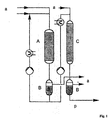
- two Process stages used the reactor of the 1st process stage as a circulation reactor and the reactor of the second stage of the process can be designed as a tubular reactor can.
- FIG. 1 A simplified flow diagram of the method according to the invention with some optional components is outlined in Fig. 1.
- the starting temperature of the 1st process stage is 50 to 90 ° C, the Total pressure 10 to 30 bar. Should a higher initial activity of the catalyst are present, either the starting temperature can be reduced or the cycle ratio increased in the first reactor and thus the desired outlet temperature, which the Input temperature of the second reactor can be adjusted.
- the reactor of the 1st process stage can be used as a cycle reactor with a cycle ratio operated from 6 to 10.
- the proportion of acetone in the recycle stream drops by 8 up to 20 wt .-%, while the isopropanol proportion increases by the corresponding proportion.
- the hydrogenation process is exothermic, so that one in or after the circulation reactor Cooling should be provided.
- the liquid phase hydrogenation of the 1st process stage can at a temperature of 60 to 130 ° C, preferably 80 to 120 ° C and a Pressure of 20 to 50, preferably 25 to 35 bar can be carried out.
- the second stage of the process which is operated with a tubular reactor characteristic, can be used for a Temperature from 60 to 140 ° C, preferably 70 to 130 ° C and a pressure of 20 to 50 bar can be carried out.
- the same hydrogenation catalysts can be used in the process stages.
- Commercially available hydrogenation catalysts with Cu, Cr, Ru or Ni as active components on Al 2 O 3 , TiO 2 or ZrO 2 support materials are available.
- nickel-containing catalysts e.g. B. proven with about 10 wt .-% nickel on a neutral support.
- the catalyst support material should always be neutral.
- Neutral carrier materials are e.g. B. ⁇ -Al 2 O 3 , TiO 2 , ZrO 2 or mullite.
- the process according to the invention provides isopropanol of high purity.
- the Total concentration of the by-products formed by the hydrogenation such as 4-methyl-3-penten-2-one, 4-methyl-2-pentanol, diacetone alcohol, hexylene glycol and Diisopropyl ether can be below 300, preferably below 200, very particularly preferred are below 100 ppm.
- the multi-stage reactor concept offers further advantages due to its high flexibility. Circulation ratio, pressure and temperature can be independent in the reactors from each other. Should the catalyst activity in a reactor abate, so z. B. a correspondingly higher temperature in the subsequent reactor be allowed.
- a good liquid distribution or a large gas exchange area should be ensured. This can be done using a suitable liquid distributor such as e.g. B. Raschig rings, wire mesh or Sulzer mixer and a sufficiently high cross-sectional load of at least 30 m 3 / (m 2 ⁇ h) can be ensured.
- a suitable liquid distributor such as e.g. B. Raschig rings, wire mesh or Sulzer mixer and a sufficiently high cross-sectional load of at least 30 m 3 / (m 2 ⁇ h) can be ensured.
- a test facility according to FIG. 2 was used.
- the educt F is in the Separation container A submitted and pumped in circulation in handling. Then will brought the apparatus to the desired reaction conditions.
- the circuit is switched to reactor R. After about 5 minutes constant temperature and pressure values are set, and it becomes the first Product samples taken.
- the hydrogen is supplied and removed via the lines G or H.
- isothermal operation is guaranteed which simplifies the kinetic evaluation of the experiments. By sampling too A concentration contact time course can be recorded at different trial times become.
- Such attempts correspond to the reaction technology model a discontinuously operated stirred tank or a tubular reactor.
- a nickel-containing catalyst (10% by weight of nickel) on a neutral ⁇ -Al 2 O 3 support was used.
- Input weight% Output% by weight acetone 12.5 00:54 isopropanol 87.5 99.45 by-products ⁇ 100 ppm
- By-products are: methyl isobutyketone, 4-methyl-2-pentanol, hexylene glycol and other, not certain high boilers.
Landscapes
- Chemical & Material Sciences (AREA)
- Organic Chemistry (AREA)
- Organic Low-Molecular-Weight Compounds And Preparation Thereof (AREA)
- Low-Molecular Organic Synthesis Reactions Using Catalysts (AREA)
Abstract
Description

- Eingangstemperatur
- 70 °C
- Ausgangstemperatur
- 115 °C
- Kreislaufverhältnis
- 1 : 8
- Querschnittbelastung
- 220 m/h
| Eingang Gew.-% | Ausgang Gew.-% | |
| Aceton | 22.2 | 12.5 |
| Isoproanol | 77.8 | 87.5 |
- Eingangstemperatur
- 70 °C
- Ausgangstemperatur
- 126 °C
- Querschnittsbelastung
- 38 m/h
| Eingang Gew.-% | Ausgang Gew.-% | |
| Aceton | 12.5 | 0.54 |
| Isopropanol | 87.5 | 99.45 |
| Nebenprodukte | < 100 ppm |
Claims (6)
- Verfahren zur Hydrierung von Aceton zu Isopropanol,
dadurch gekennzeichnet,
daß eine Flüssigphasenhydrierung von Aceton mit mindestens zwei Verfahrensstufen durchgeführt wird. - Verfahren nach Anspruch 1,
dadurch gekennzeichnet,
daß die Flüssigphasenhydrierung bei einer Temperatur von 60 bis 140 °C und einem Druck von 20 bis 50 bar durchgeführt wird. - Verfahren nach Anspruch 1 oder 2,
dadurch gekennzeichnet,
daß die Gesamtkonzentration der durch die Hydrierung gebildeten Nebenprodukte 300 ppm nicht überschreitet. - Verfahren nach einem der Ansprüche 1 bis 3,
dadurch gekennzeichnet,
das Aceton mit einem Wassergehalt unter 1.0 Gew.-% hydriert wird. - Verfahren nach einem der Ansprüche 1 bis 4,
dadurch gekennzeichnet,
daß zur Flüssigphasenhydrierung ein nickelhaltiger Katalysator auf einem neutralen Träger eingesetzt wird. - Verfahren nach Anspruch 5,
dadurch gekennzeichnet,
daß ein nickelhaltiger Katalysator auf einem α-Al2O3-Träger eingesetzt wird.
Applications Claiming Priority (2)
| Application Number | Priority Date | Filing Date | Title |
|---|---|---|---|
| DE19933691A DE19933691A1 (de) | 1999-07-17 | 1999-07-17 | Verfahren zur Hydrierung von Aceton |
| DE19933691 | 1999-07-17 |
Publications (3)
| Publication Number | Publication Date |
|---|---|
| EP1070698A2 true EP1070698A2 (de) | 2001-01-24 |
| EP1070698A3 EP1070698A3 (de) | 2004-01-14 |
| EP1070698B1 EP1070698B1 (de) | 2007-06-20 |
Family
ID=7915217
Family Applications (1)
| Application Number | Title | Priority Date | Filing Date |
|---|---|---|---|
| EP00110808A Expired - Lifetime EP1070698B1 (de) | 1999-07-17 | 2000-05-22 | Verfahren zur Hydrierung von Aceton |
Country Status (14)
| Country | Link |
|---|---|
| US (1) | US6930213B1 (de) |
| EP (1) | EP1070698B1 (de) |
| JP (1) | JP4571732B2 (de) |
| KR (1) | KR20060076791A (de) |
| CN (1) | CN1174949C (de) |
| BG (1) | BG104590A (de) |
| BR (1) | BR0002919A (de) |
| DE (2) | DE19933691A1 (de) |
| ES (1) | ES2288460T3 (de) |
| MX (1) | MXPA00006916A (de) |
| PL (1) | PL341473A1 (de) |
| RU (1) | RU2245320C2 (de) |
| SK (1) | SK10192000A3 (de) |
| TW (1) | TW572877B (de) |
Cited By (6)
| Publication number | Priority date | Publication date | Assignee | Title |
|---|---|---|---|---|
| RU2205818C1 (ru) * | 2002-04-26 | 2003-06-10 | Закрытое акционерное общество "Химтэк Инжиниринг" | Способ получения изопропанола |
| EP2045232A1 (de) * | 2007-10-04 | 2009-04-08 | INEOS Phenol GmbH & Co. KG | Verfahren zur Herstellung von Isopropanol durch Flüssigphasenhydrierung |
| US7799958B2 (en) | 2007-10-04 | 2010-09-21 | Barclays Bank Plc | Process for the production of iso-propanol by liquid phase hydrogenation |
| EP2243762A4 (de) * | 2008-02-21 | 2013-12-11 | Mitsui Chemicals Inc | Verfahren zur herstellung von 2-propanol |
| IT202200025110A1 (it) | 2022-12-06 | 2024-06-06 | Versalis Spa | Procedimento per la preparazione di isopropanolo in alte rese e con un elevato grado di purezza. |
| EP4549622A1 (de) | 2023-10-31 | 2025-05-07 | Basf Se | Hydrierung von carbonylverbindungen unter verwendung von wasserstoff mit niedrigem deuteriumgehalt |
Families Citing this family (13)
| Publication number | Priority date | Publication date | Assignee | Title |
|---|---|---|---|---|
| DE102005035816A1 (de) * | 2005-07-30 | 2007-02-01 | Oxeno Olefinchemie Gmbh | Verfahren zur Hydrierung von Oxo-Aldehyden mit hohen Estergehalten |
| DE102005049568A1 (de) * | 2005-10-17 | 2007-04-19 | Basf Ag | Verfahren zur kontinuierlichen Hydrierung oder hydrierenden Aminierung |
| CN101481433B (zh) * | 2008-01-08 | 2011-04-20 | 李长荣化学工业股份有限公司 | 共轭二烯类聚合物的加氢反应系统 |
| JP5300392B2 (ja) * | 2008-09-25 | 2013-09-25 | 三井化学株式会社 | イソプロパノールの製造方法 |
| CN102516027B (zh) * | 2011-11-14 | 2014-12-17 | 中国海洋石油总公司 | 一种丙酮加氢法联产醇和酮的催化剂级配方法 |
| KR101950063B1 (ko) * | 2012-08-14 | 2019-02-19 | 바져 라이센싱 엘엘씨 | 큐멘을 생성하고 아이소프로판올을 정제하는 통합된 방법 |
| CN104507897A (zh) * | 2012-09-06 | 2015-04-08 | Lg化学株式会社 | 用于制备异丙醇的方法和设备 |
| WO2015124442A1 (de) * | 2014-02-18 | 2015-08-27 | Basf Se | Verfahren zur herstellung von n-ethyl-diisopropylamin |
| US11543328B2 (en) | 2017-04-06 | 2023-01-03 | Kyutaek Cho | Automated functional testing systems and methods of making and using the same |
| CN110871076B (zh) * | 2018-08-30 | 2022-09-20 | 中国石油化工股份有限公司 | 一种制备甲基异丁基醇的催化剂、制备方法及应用 |
| FR3111914B1 (fr) | 2020-06-29 | 2022-07-15 | Ifp Energies Now | Procede de fermentation ibe optimise pour valoriser l’acetone |
| FR3111916B1 (fr) | 2020-06-29 | 2022-07-15 | Ifp Energies Now | Valorisation de l’acetone par procede de fermentation ibe impliquant des microorganismes genetiquement modifies |
| WO2024194205A1 (en) | 2023-03-17 | 2024-09-26 | Basf Se | Process for producing 2-propanol |
Citations (1)
| Publication number | Priority date | Publication date | Assignee | Title |
|---|---|---|---|---|
| SU1460920A1 (ru) | 1986-06-02 | 1988-10-22 | НЕПРЕРЫВНЫЙ СЛОСОб ЖИДКОФАЗНОГО КАТАЛИТИЧЕСКОГО ГИДРИРОВАНИЯ ОРГАНИЧЕСКИХ СОЕДИНЕНИЙ |
Family Cites Families (18)
| Publication number | Priority date | Publication date | Assignee | Title |
|---|---|---|---|---|
| US2983734A (en) * | 1961-05-09 | Catalytic hydrogenation | ||
| US3978149A (en) * | 1974-08-22 | 1976-08-31 | Exxon Research And Engineering Company | Hydrogenation of organic compounds |
| JPS6212729A (ja) * | 1985-07-11 | 1987-01-21 | Mitsui Petrochem Ind Ltd | イソプロピルアルコ−ルの製造法 |
| US4626604A (en) * | 1985-09-11 | 1986-12-02 | Davy Mckee (London) Limited | Hydrogenation process |
| JPH0692334B2 (ja) * | 1985-09-30 | 1994-11-16 | 石川島播磨重工業株式会社 | イソプロパノ−ルの製造装置 |
| JP2724001B2 (ja) * | 1989-01-17 | 1998-03-09 | 三井化学株式会社 | イソプロパノールの製造方法 |
| DE3932331A1 (de) * | 1989-09-28 | 1991-04-11 | Hoechst Ag | Verfahren zur herstellung von alkoholen (zweistufig) |
| DE3932332A1 (de) * | 1989-09-28 | 1991-04-11 | Hoechst Ag | Verfahren zur herstellung von alkoholen (einstufig) |
| JP2834495B2 (ja) * | 1989-10-20 | 1998-12-09 | 三井化学株式会社 | イソプロパノールの製造方法及び装置 |
| JP2786272B2 (ja) * | 1989-10-24 | 1998-08-13 | 三井化学株式会社 | イソプロパノールの製造方法 |
| RU2047590C1 (ru) * | 1993-05-26 | 1995-11-10 | Российский научный центр "Прикладная химия" | Способ получения пропанола-2 |
| US5430198A (en) | 1993-11-08 | 1995-07-04 | Texaco Chemical Inc. | Diisopropyl ehter/MTBE cogeneration from crude by-product acetone |
| US5449838A (en) | 1993-12-30 | 1995-09-12 | Texaco Chemical Inc. | Isopropyl t-butyl ether (IPTBE) generation from crude acetone |
| US5476972A (en) | 1994-01-28 | 1995-12-19 | Texaco Chemical Inc. | Isopropyl alcohol and ether production from crude by-product acetone |
| US5583266A (en) | 1994-05-02 | 1996-12-10 | Texaco Inc. | Integrated process for the production of isopropyl alcohol and diisopropyl ethers |
| US5495055A (en) * | 1994-08-12 | 1996-02-27 | Arco Chemical Technology, L.P. | Acetone hydrogenation using a supported ruthenium catalyst |
| DE19730939A1 (de) * | 1997-07-18 | 1999-01-21 | Basf Ag | Verfahren zur Hydrierung von Carbonylverbindungen |
| DE10008924A1 (de) * | 2000-02-25 | 2001-09-06 | Phenolchemie Gmbh & Co Kg | Verfahren zur Herstellung von Phenol |
-
1999
- 1999-07-17 DE DE19933691A patent/DE19933691A1/de not_active Withdrawn
-
2000
- 2000-05-22 DE DE50014421T patent/DE50014421D1/de not_active Expired - Lifetime
- 2000-05-22 ES ES00110808T patent/ES2288460T3/es not_active Expired - Lifetime
- 2000-05-22 EP EP00110808A patent/EP1070698B1/de not_active Expired - Lifetime
- 2000-06-20 TW TW89112083A patent/TW572877B/zh not_active IP Right Cessation
- 2000-07-04 SK SK1019-2000A patent/SK10192000A3/sk unknown
- 2000-07-11 BG BG104590A patent/BG104590A/xx unknown
- 2000-07-14 PL PL00341473A patent/PL341473A1/xx unknown
- 2000-07-14 KR KR1020000040603A patent/KR20060076791A/ko not_active Ceased
- 2000-07-14 MX MXPA00006916A patent/MXPA00006916A/es unknown
- 2000-07-14 JP JP2000214423A patent/JP4571732B2/ja not_active Expired - Lifetime
- 2000-07-14 RU RU2000118562/04A patent/RU2245320C2/ru active
- 2000-07-14 CN CNB001202359A patent/CN1174949C/zh not_active Expired - Lifetime
- 2000-07-17 BR BR0002919-0A patent/BR0002919A/pt not_active IP Right Cessation
- 2000-07-17 US US09/618,044 patent/US6930213B1/en not_active Expired - Lifetime
Patent Citations (1)
| Publication number | Priority date | Publication date | Assignee | Title |
|---|---|---|---|---|
| SU1460920A1 (ru) | 1986-06-02 | 1988-10-22 | НЕПРЕРЫВНЫЙ СЛОСОб ЖИДКОФАЗНОГО КАТАЛИТИЧЕСКОГО ГИДРИРОВАНИЯ ОРГАНИЧЕСКИХ СОЕДИНЕНИЙ |
Cited By (8)
| Publication number | Priority date | Publication date | Assignee | Title |
|---|---|---|---|---|
| RU2205818C1 (ru) * | 2002-04-26 | 2003-06-10 | Закрытое акционерное общество "Химтэк Инжиниринг" | Способ получения изопропанола |
| EP2045232A1 (de) * | 2007-10-04 | 2009-04-08 | INEOS Phenol GmbH & Co. KG | Verfahren zur Herstellung von Isopropanol durch Flüssigphasenhydrierung |
| WO2009043574A1 (en) * | 2007-10-04 | 2009-04-09 | Ineos Phenol Gmbh & Co. Kg | Process for the production of iso-propanol by liquid phase hydrogenation |
| US7799958B2 (en) | 2007-10-04 | 2010-09-21 | Barclays Bank Plc | Process for the production of iso-propanol by liquid phase hydrogenation |
| EP2243762A4 (de) * | 2008-02-21 | 2013-12-11 | Mitsui Chemicals Inc | Verfahren zur herstellung von 2-propanol |
| IT202200025110A1 (it) | 2022-12-06 | 2024-06-06 | Versalis Spa | Procedimento per la preparazione di isopropanolo in alte rese e con un elevato grado di purezza. |
| WO2024121714A1 (en) | 2022-12-06 | 2024-06-13 | Versalis S.P.A. | Process for preparing isopropanol in high yields and with a high degree of purity |
| EP4549622A1 (de) | 2023-10-31 | 2025-05-07 | Basf Se | Hydrierung von carbonylverbindungen unter verwendung von wasserstoff mit niedrigem deuteriumgehalt |
Also Published As
| Publication number | Publication date |
|---|---|
| EP1070698A3 (de) | 2004-01-14 |
| BG104590A (en) | 2001-09-28 |
| TW572877B (en) | 2004-01-21 |
| SK10192000A3 (sk) | 2001-04-09 |
| CN1174949C (zh) | 2004-11-10 |
| DE19933691A1 (de) | 2001-01-18 |
| US6930213B1 (en) | 2005-08-16 |
| JP4571732B2 (ja) | 2010-10-27 |
| MXPA00006916A (es) | 2002-06-04 |
| BR0002919A (pt) | 2001-04-03 |
| CN1281842A (zh) | 2001-01-31 |
| JP2001039910A (ja) | 2001-02-13 |
| DE50014421D1 (de) | 2007-08-02 |
| KR20060076791A (ko) | 2006-07-05 |
| PL341473A1 (en) | 2001-01-29 |
| ES2288460T3 (es) | 2008-01-16 |
| RU2245320C2 (ru) | 2005-01-27 |
| EP1070698B1 (de) | 2007-06-20 |
Similar Documents
| Publication | Publication Date | Title |
|---|---|---|
| EP1070698B1 (de) | Verfahren zur Hydrierung von Aceton | |
| EP1193239B1 (de) | Stabilisierung von Rhodiumkatalysatoren für die Hydroformylierung von Olefinen | |
| EP0262389B1 (de) | Verfahren zur Herstellung von medizinischen Weissölen und medizinischen Paraffinen | |
| EP3429982B1 (de) | Verfahren zur herstellung von prenol und prenal aus isoprenol | |
| EP2244996B2 (de) | Verfahren zur herstellung von 6-hydroxycapronsäureestern | |
| EP1231198B1 (de) | Hydroformylierung | |
| DE3401343A1 (de) | Verfahren zur herstellung von 2- und 4-tert.-butylcyclohexanol mit hohen anteilen an cis-isomeren durch katalytische hydrierung der entsprechenden tert.-butylphenole | |
| DE2538364B2 (de) | Verfahren zur herstellung von butandiolen | |
| EP0470098B1 (de) | Verfahren zur katalytischen hydrierung von flüssigen fettsäure-methylestern | |
| EP0557821A1 (de) | Verfahren zur Reinigung von Cyclohexanon | |
| EP0776887B1 (de) | Kontinuierliches Verfahren zur Herstellung von 4-Amino-2,2,6,6-tetramethylpiperidin | |
| EP1572610A1 (de) | Verfahren zur herstellung von 1,6-hexandiol | |
| EP0691338B1 (de) | Verfahren zur Herstellung von Trioxan | |
| DE69817978T2 (de) | Verfahren zur Oxidation von aromatischen Verbindungen zu aromatischen Hydroxyverbindungen | |
| EP0002781B1 (de) | Verfahren zur Herstellung von aliphatischen, mit aliphatischen Gruppen verätherten hydroxysubstituierten Carbonylverbindungen | |
| EP3672932B1 (de) | Verfahren zur herstellung von terpenaldehyden und -ketonen | |
| EP0316761A2 (de) | Verfahren zur Herstellung von N,N-Dimethyldiaminopropan | |
| EP4234528A1 (de) | Verfahren zur hydrierung von c13-aldehyden in mindestens zwei hydrierstufen | |
| DE902853C (de) | Kontinuierliches Verfahren zur Herstellung alkylierter aromatischer Amine | |
| EP1456162B1 (de) | Verfahren zur herstellung von aldehyden | |
| EP4234525B1 (de) | Verfahren zur hydrierung von aldehyden in mindestens zwei hydrierstufen | |
| DE2645770C3 (de) | Verfahren zur Herstellung von o-Kresol durch Transmethylierung von kernmethylierten Phenolen | |
| EP4234527B1 (de) | Verfahren zur hydrierung von c9-aldehyden in mindestens zwei hydrierstufen | |
| DE19936208A1 (de) | Kontinuierliches Verfahren zur Herstellung von 2-Phenylethanol aus Styroloxid | |
| EP3116845B1 (de) | Verfahren zum abbau von formiaten |
Legal Events
| Date | Code | Title | Description |
|---|---|---|---|
| PUAI | Public reference made under article 153(3) epc to a published international application that has entered the european phase |
Free format text: ORIGINAL CODE: 0009012 |
|
| 17P | Request for examination filed |
Effective date: 20000522 |
|
| AK | Designated contracting states |
Kind code of ref document: A2 Designated state(s): AT BE CH CY DE DK ES FI FR GB GR IE IT LI LU MC NL PT SE |
|
| AX | Request for extension of the european patent |
Free format text: AL;LT;LV;MK;RO;SI |
|
| RAP1 | Party data changed (applicant data changed or rights of an application transferred) |
Owner name: INEOS PHENOL GMBH & CO. KG |
|
| TPAD | Observations filed by third parties |
Free format text: ORIGINAL CODE: EPIDOS TIPA |
|
| PUAL | Search report despatched |
Free format text: ORIGINAL CODE: 0009013 |
|
| AK | Designated contracting states |
Kind code of ref document: A3 Designated state(s): AT BE CH CY DE DK ES FI FR GB GR IE IT LI LU MC NL PT SE |
|
| AX | Request for extension of the european patent |
Extension state: AL LT LV MK RO SI |
|
| AKX | Designation fees paid |
Designated state(s): BE DE ES FI FR IT |
|
| 17Q | First examination report despatched |
Effective date: 20041014 |
|
| GRAP | Despatch of communication of intention to grant a patent |
Free format text: ORIGINAL CODE: EPIDOSNIGR1 |
|
| GRAS | Grant fee paid |
Free format text: ORIGINAL CODE: EPIDOSNIGR3 |
|
| GRAA | (expected) grant |
Free format text: ORIGINAL CODE: 0009210 |
|
| AK | Designated contracting states |
Kind code of ref document: B1 Designated state(s): BE DE ES FI FR IT |
|
| REF | Corresponds to: |
Ref document number: 50014421 Country of ref document: DE Date of ref document: 20070802 Kind code of ref document: P |
|
| ET | Fr: translation filed | ||
| REG | Reference to a national code |
Ref country code: ES Ref legal event code: FG2A Ref document number: 2288460 Country of ref document: ES Kind code of ref document: T3 |
|
| PLBE | No opposition filed within time limit |
Free format text: ORIGINAL CODE: 0009261 |
|
| STAA | Information on the status of an ep patent application or granted ep patent |
Free format text: STATUS: NO OPPOSITION FILED WITHIN TIME LIMIT |
|
| 26N | No opposition filed |
Effective date: 20080325 |
|
| REG | Reference to a national code |
Ref country code: DE Ref legal event code: R082 Ref document number: 50014421 Country of ref document: DE Representative=s name: FLEISCHER, ENGELS & PARTNER MBB, PATENTANWAELT, DE |
|
| REG | Reference to a national code |
Ref country code: FR Ref legal event code: PLFP Year of fee payment: 16 |
|
| REG | Reference to a national code |
Ref country code: FR Ref legal event code: PLFP Year of fee payment: 17 |
|
| REG | Reference to a national code |
Ref country code: FR Ref legal event code: PLFP Year of fee payment: 18 |
|
| REG | Reference to a national code |
Ref country code: FR Ref legal event code: PLFP Year of fee payment: 19 |
|
| PGFP | Annual fee paid to national office [announced via postgrant information from national office to epo] |
Ref country code: IT Payment date: 20190527 Year of fee payment: 20 Ref country code: FI Payment date: 20190522 Year of fee payment: 20 Ref country code: DE Payment date: 20190425 Year of fee payment: 20 Ref country code: ES Payment date: 20190620 Year of fee payment: 20 |
|
| PGFP | Annual fee paid to national office [announced via postgrant information from national office to epo] |
Ref country code: FR Payment date: 20190522 Year of fee payment: 20 Ref country code: BE Payment date: 20190521 Year of fee payment: 20 |
|
| REG | Reference to a national code |
Ref country code: DE Ref legal event code: R071 Ref document number: 50014421 Country of ref document: DE |
|
| REG | Reference to a national code |
Ref country code: FI Ref legal event code: MAE |
|
| REG | Reference to a national code |
Ref country code: BE Ref legal event code: MK Effective date: 20200522 |
|
| REG | Reference to a national code |
Ref country code: ES Ref legal event code: FD2A Effective date: 20220103 |
|
| PG25 | Lapsed in a contracting state [announced via postgrant information from national office to epo] |
Ref country code: ES Free format text: LAPSE BECAUSE OF EXPIRATION OF PROTECTION Effective date: 20200523 |