EP1071073A2 - Verfahren zum Aufbau des Wortschatzes für die Sprachsynthese mit variablen Kontext - Google Patents
Verfahren zum Aufbau des Wortschatzes für die Sprachsynthese mit variablen Kontext Download PDFInfo
- Publication number
- EP1071073A2 EP1071073A2 EP00115589A EP00115589A EP1071073A2 EP 1071073 A2 EP1071073 A2 EP 1071073A2 EP 00115589 A EP00115589 A EP 00115589A EP 00115589 A EP00115589 A EP 00115589A EP 1071073 A2 EP1071073 A2 EP 1071073A2
- Authority
- EP
- European Patent Office
- Prior art keywords
- dictionary
- prosody
- word
- speech
- waveform
- Prior art date
- Legal status (The legal status is an assumption and is not a legal conclusion. Google has not performed a legal analysis and makes no representation as to the accuracy of the status listed.)
- Withdrawn
Links
- 238000000034 method Methods 0.000 title claims abstract description 103
- 230000015572 biosynthetic process Effects 0.000 title claims description 50
- 238000003786 synthesis reaction Methods 0.000 title claims description 39
- 230000002194 synthesizing effect Effects 0.000 claims abstract description 76
- 230000008451 emotion Effects 0.000 claims abstract description 46
- 241001417093 Moridae Species 0.000 description 12
- 230000006870 function Effects 0.000 description 5
- 238000010586 diagram Methods 0.000 description 2
- 238000007796 conventional method Methods 0.000 description 1
- 230000000694 effects Effects 0.000 description 1
- 230000002996 emotional effect Effects 0.000 description 1
- 230000014509 gene expression Effects 0.000 description 1
- 230000008520 organization Effects 0.000 description 1
- 238000003672 processing method Methods 0.000 description 1
Images


Classifications
-
- G—PHYSICS
- G10—MUSICAL INSTRUMENTS; ACOUSTICS
- G10L—SPEECH ANALYSIS TECHNIQUES OR SPEECH SYNTHESIS; SPEECH RECOGNITION; SPEECH OR VOICE PROCESSING TECHNIQUES; SPEECH OR AUDIO CODING OR DECODING
- G10L13/00—Speech synthesis; Text to speech systems
- G10L13/02—Methods for producing synthetic speech; Speech synthesisers
- G10L13/04—Details of speech synthesis systems, e.g. synthesiser structure or memory management
- G10L13/047—Architecture of speech synthesisers
-
- G—PHYSICS
- G10—MUSICAL INSTRUMENTS; ACOUSTICS
- G10L—SPEECH ANALYSIS TECHNIQUES OR SPEECH SYNTHESIS; SPEECH RECOGNITION; SPEECH OR VOICE PROCESSING TECHNIQUES; SPEECH OR AUDIO CODING OR DECODING
- G10L13/00—Speech synthesis; Text to speech systems
- G10L13/08—Text analysis or generation of parameters for speech synthesis out of text, e.g. grapheme to phoneme translation, prosody generation or stress or intonation determination
-
- A—HUMAN NECESSITIES
- A63—SPORTS; GAMES; AMUSEMENTS
- A63F—CARD, BOARD, OR ROULETTE GAMES; INDOOR GAMES USING SMALL MOVING PLAYING BODIES; VIDEO GAMES; GAMES NOT OTHERWISE PROVIDED FOR
- A63F2300/00—Features of games using an electronically generated display having two or more dimensions, e.g. on a television screen, showing representations related to the game
- A63F2300/60—Methods for processing data by generating or executing the game program
- A63F2300/6063—Methods for processing data by generating or executing the game program for sound processing
Definitions
- the present invention relates to a speech synthesizing method, a dictionary organizing method for speech synthesis, a speech synthesis apparatus, and a computer-readable medium recording a speech synthesis program for video games, etc.
- a living person speaks preliminarily determined words and sentences, which are stored in a storage device, and the stored data is reproduced and output as it is at need (hereinafter referred to as a recording and reproducting method).
- a method of outputting a speech message that is, a speech synthesizing method, in which speech data corresponding to various words forming a speech message is stored in a storage device, and the speech data is combined according to an optionally input character string (text).
- a speech message corresponding to an optionally input character string that is, an optional word
- a necessary storage capacity is smaller than that required in the above mentioned recording and reproducting method.
- speech messages do not sound natural for some character strings.
- a product having an element of entertainment such as a video game is requested to output speech messages in different voices for respective game characters, and to output a speech message reflecting the emotion or situation at the time when the speech is made.
- a demand to output the name (utterance) of a player character optionally input/set by a player as the utterance from a game character.
- the speech synthesizing method it is relatively easy to utter the name of an optionally input/set player character.
- the conventional speech synthesizing method since the conventional speech synthesizing method only aims at generating a clear and natural speech massage, it is quite impossible to synthesize a speech message depending on the personality of a speaker, the emotion and the situation at the tine when a speech is made, that is, to output speech messages different in voice quality for each game character, or to output speech messages reflecting the emotion and the situation of a game character.
- the present invention aims at providing a speech synthesizing method, a dictionary organizing method for speech synthesis, a speech synthesis apparatus, and a computer-readable medium recording a speech synthesis program which are capable of generating a speech message depending on the personality of a speaker, the emotion, the situation or various contents of a speech, and are applicable to a highly entertaining use such as a video game.
- a plurality of operation units (hereinafter referred to as tasks) of a speech synthesizing process in which at least one of speakers, the emotion or situation at the time when speeches are made, and the contents of the speeches is different are set, at least prosody dictionaries and waveform dictionaries corresponding to respective tasks are organized, and when a character string whose speech is to be synthesized is input with the task specified, a speech synthesizing process is performed by using the word dictionary, the prosody dictionary, and the waveform dictionary corresponding to the task.
- the speech synthesizing process is performed by dividing the process into tasks such as plural speakers, plural types of emotion or situation at the time when speeches are made, plural contents of the speeches, etc., and by organizing dictionaries for respective tasks. Therefore, a speech message can be easily generated depending on the personality of a speaker, the emotion or situation at the time when a speech is made, and the contents of the speech.
- each of the above mentioned dictionaries for respective tasks is organized by generating a word dictionary corresponding to each task, generating a speech recording scenario by selecting a character string which can be a model from all words in the word dictionary, recording the speech of a speaker based on the speech recording scenario, generating a prosody dictionary and a waveform dictionary from the recorded speech, and performing these operations on each task.
- Each of the above mentioned dictionaries for respective tasks is organized by generating a word dictionary and word variation rules corresponding to each task, varying all words contained in the word dictionary corresponding each task according to the word variation rules corresponding each task, generating a speech recording scenario by selecting a character string which can be a model from all varied words in the word dictionary, recording the speech of a speaker based on the speech recording scenario, generating a prosody dictionary and a waveform dictionary from the recorded speech, and performing these operations on each task.
- Each of the above mentioned dictionaries for respective tasks is organized by generating word variation rules corresponding to each task, varying all words contained in the word dictionary according to the word variation rules corresponding each task, generating a speech recording scenario by selecting a character string which can be a model from all varied words in the word dictionary, recording the speech of a speaker based on the speech recording scenario, generating a prosody dictionary and a waveform dictionary from the recorded speech, and performing these operations on each task.
- a speech recording scenario can be easily generated corresponding to each task, each dictionary can be organized by recording a speech based on the speech recording scenario, and a speech message containing various contents can be easily generated without increasing the capacity of a dictionary by performing a character string varying process.
- a speech synthesizing method using the dictionaries is realized by switching a word dictionary, a prosody dictionary, and a waveform dictionary according to the designation of a task to be input together with a character string to be synthesized, and by synthesizing a speech message corresponding to a character string to be synthesized by using the switched word dictionary, prosody dictionary, and waveform dictionary.
- the speech synthesizing process can be performed by determining the accent type of a character string to be synthesized from the word dictionary, selecting the prosody model data from the prosody dictionary based on the character string to be synthesized and the accent type, selecting waveform data corresponding to each character of the character string to be synthesized from the waveform dictionary based on the selected prosody model data, and connecting selected pieces of waveform data with each other.
- Another speech synthesizing method using the dictionaries is realized by switching a word dictionary, a prosody dictionary, a waveform dictionary, and word variation rules according to the designation of a task to be input together with a character string to be synthesized, varying the character string to be synthesized based on the word variation rules, and synthesizing a speech message corresponding to the varied character string by using the switched word dictionary, prosody dictionary, and waveform dictionary.
- a further speech synthesizing method using the dictionaries is realized by switching a prosody dictionary, a waveform dictionary, and word variation rules according to the designation of a task to be input together with a character string to be synthesized, varying the character string to be synthesized based on the word variation rules, and synthesizing a speech message corresponding to the varied character string by using a word dictionary, and the switched prosody dictionary and waveform dictionary.
- each dictionary is a word dictionary containing a number of words, each containing at least one character, together with respective accent types, a prosody dictionary containing a typical prosody model data in the prosody model data indicating the prosody of words contained in the word dictionary, a waveform dictionary containing recorded speeches as speech data in synthesis units, and the word variation rules recording the variation rules of character strings
- the speech synthesizing process can be performed by determining the accent type of a character string to be synthesized from the word dictionary or the word variation rules, selecting the prosody model data from the prosody dictionary based on the character string to be synthesized and the accent type, selecting waveform data corresponding to each character of the character string to be synthesized from the waveform dictionary based on the selected prosody model data, and connecting selected pieces of waveform data with each other.
- a speech synthesis apparatus using the dictionaries comprises means for switching a word dictionary, a prosody dictionary, and a waveform dictionary according to the designation of a task input together with a character string to be synthesized, and means for synthesizing a speech message corresponding to the character string to be synthesized using the switched word dictionary, prosody dictionary, and waveform dictionary.
- Another speech synthesis apparatus using the dictionaries comprises means for switching a word dictionary, a prosody dictionary, a waveform dictionary, and word variation rules according to the designation of a task input together with a character string to be synthesized, means for varying the character string to be synthesized according to the word variation rules, and means for synthesizing a speech message corresponding to the varied character string using the switched word dictionary, prosody dictionary, and waveform dictionary.
- a further speech synthesis apparatus using the dictionaries comprises means for switching a prosody dictionary, a waveform dictionary, and word variation rules according to the designation of a task input together with a character string to be synthesized, means for varying the character string to be synthesized according to the word variation rules, and means for synthesizing a speech message corresponding to the varied character string using a word dictionary, and the switched prosody dictionary and waveform dictionary.
- the above mentioned speech synthesis apparatus can be realized by a computer-readable storage medium storing a speech synthesis program used to direct a computer to perform the functions of a word dictionary, a prosody dictionary, and a waveform dictionary corresponding to each of the plurality of tasks of a speech synthesizing process in which at least one of speakers, emotion or situation at the time when speeches are made, and the contents of the speeches is different, means for switching the word dictionary, the prosody dictionary, and the waveform dictionary according to the designation of a task input together with a character string to be synthesized, and means for synthesizing a speech message corresponding to the character string to be synthesized using the switched word dictionary, prosody dictionary, and waveform dictionary.
- the above mentioned speech synthesis apparatus can be realized by a computer-readable storage medium storing a speech synthesis program used to direct a computer to perform the functions of a word dictionary, a prosody dictionary, a waveform dictionary, and word variation rules corresponding to each of the plurality of tasks of a speech synthesizing process in which at least one of speakers, emotion or situation at the time when speeches are made, and the contents of the speeches is different, means for switching the word dictionary, the prosody dictionary, the waveform dictionary, and the word variation rules according to the designation of a task input together with a character string to be synthesized, means for varying the character string to be synthesized according to the word variation rules, and means for synthesizing a speech message corresponding to the varied character string using the switched word dictionary, prosody dictionary, and waveform dictionary.
- the above mentioned speech synthesis apparatus can be realized by a computer-readable storage medium storing a speech synthesis program used to direct a computer to perform the function of a word dictionary and the function of prosody dictionaries, waveform dictionaries, and word variation rules corresponding to each of the plurality of tasks of a speech synthesizing process in which any of speakers, emotion at the time when speeches are made, and situation at the time when speeches are made are different from each other, means for switching the prosody dictionary, the waveform dictionary, and the word variation rules according to the designation of a task input together with a character string to be synthesized, means for varying the character string to be synthesized according to the word variation rules, and means for synthesizing a speech message corresponding to the varied character string using the word dictionary, the switched prosody dictionary and waveform dictionary.
- FIG. 1 shows the flow of the speech synthesizing method according to the present invention, that is, the entire flow of the speech synthesizing method in a broad sense including the organization of a dictionary for a speech synthesis.
- a plurality of tasks of the speech synthesizing process in which at least one of speakers, emotion or situation at the time when speeches are made, and the contents of the speeches are different are set (s1). This operation is manually performed depending on the purpose of the speech synthesis.
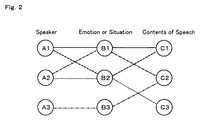
- FIG. 2 is an explanatory view of tasks.
- reference numerals A1, A2, and A3 denote a plurality of different speakers
- reference numerals B1, B2, and B3 denote plural settings of different emotion or situation
- reference numerals C1, C2, arid C3 denote plural settings of different contents of speeches.
- the contents of speeches do not refer to a single word, but refer to a set of words according to predetermined definitions such as words of call, joy, etc.
- a case (A1 - B1 - C1) in which a speaker A1 makes a speech whose contents are C1 in emotion or situation B1 is a task
- a case (A1 - B2 - C1) in which a speaker A1 makes a speech whose contents are C1 in emotion or situation B2 is another task.
- a case (A2 - B1 - C2) in which a speaker A2 makes a speech whose contents are C2 in extotion or situation B1 a case (A2 - B2 - C3) in which a speaker A2 makes a speech whose contents are C3 in emotion or situation B2, and a case (A3 - B3 - C2) in which a speaker A3 makes a speech whose contents are C2 in emotion or situation B3 are all other tasks.
- a task covering all of a plurality of speakers, plural settings of emotion or situation, and plural settings of contents of speeches is not always set. That is, for the speaker A1, the emotion or situation B1, B2, and B3 are set. For the emotion or situation B1, B2, and B3, the contents of speeches C1, C2, and C3 are respectively set. Thus, even if a total of 9 tasks are set, only the emotion or situation B1 and B2 are set for the speaker A2, only the contents of speeches C1 and C2 are set for the emotion or situation B1, and only the contents of speeches C3 is set for the emotion or situation B2. As a result, in this case, a total of only 3 tasks are set. What task is to be set depends on the purpose of a speech synthesis.
- a task can be set with any one or two of speakers, emotion or situation, and contents limited to one type only.
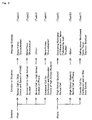
- FIG. 3 shows an example of a concrete task in which a speech message of a game character in a video game is to be synthesized, and specifically an example of the contents of a speech limited to a call to a player character.
- FIG. 3 four types of emotion or situation, that is, a 'normal call to a small child,' a 'normal call to a high school student,' a 'normal call to a high school student on a phone,' and a 'emotional call for confession or encounter,' are set for the speaker (game character) named 'Hikari' They are set as individual tasks 1, 2, 3, and 4.
- a speaker named 'Akane ' three types of emotion or situation, that is, a 'normal call,' a 'normal call on a phone,' and a 'friendly call for confession or on a way from school' are set as individual tasks 5, 6, and 7.
- dictionaries that is, a word dictionary, a prosody dictionary, and a waveform dictionary, are organized (s2).
- a word dictionary refers to a dictionary storing a large number of words, each containing at least one character together with their accent types. For example, in the task shown in FIG. 3, a number of words indicating the names of a player character expected to be input are stored with their accent types.
- a prosody dictionary refers to a dictionary storing a number of pieces of typical prosody model data in the prosody model data indicating the prosody of the words stored in the word dictionary.
- a waveform dictionary refers to a dictionary storing a number of recorded speeches as speech data (pieces of phoneme) in synthesis units.
- the word dictionary can be shared among the tasks different in speaker or emotion or situation. Especially, if the contents of speeches are limited to one type, only one word dictionary will do.
- the speech synthesizing process is performed using the word dictionary, the prosody dictionary, and the waveform dictionary corresponding to the task (s3).
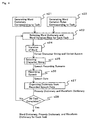
- FIG. 4 shows a flow of the dictionary organizing method for the speech synthesis according to the present invention.
- word dictionaries corresponding to speakers, emotion or situation at the time when speeches are made, and the contents of speeches of a plurality of the set tasks are manually generated (s21).
- word variation rules are generated at need (s22).
- Word variation rules are rules for converting words contained in the word dictionary into words corresponding to tasks different in speaker, emotion or situation.
- a word dictionary can be virtually used as a plurality of word dictionaries respectively corresponding to the tasks different in speakers, emotion or situation as described above.
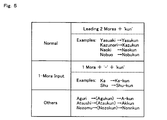
- FIG. 5 shows an example of the word variation rules. Practically, FIG. 5 shows an example of the variation rules corresponding to the task 5 referring to FIG. 3, that is, the rules used when nicknames of 2 moras are generated from a name (name of a player character) as a call to the player character.
- a word dictionary, or a word dictionary and word variation rules corresponding a task is selected (s23). If there are word variation rules, a word variation process is performed (s24).
- the word variation process is performed by varying all words contained in a word dictionary corresponding to a task according to the word variation rules corresponding to the task.
- the name of a player character is retrieved one by one.
- a normal name of 2 or more moras is detected, the characters of the leading 2 moras are followed by 'kun.
- the detected name is a name of one mora, the characters corresponding to the one mora are followed by a '- (long sound)' and 'kun.
- the detected name is a particular name, it is varied by being followed by '-' or other variations such as log sound, double consonant and syllabic nasal to make an appropriate nickname.
- a nickname is generated, a variation in accent in which heading is accented can be considered.
- a character string is selected according to character string selection rules to generate a speech recording scenario (s25).
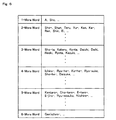
- Character string selection rules refer to rules defined for selection of character strings which can be models from all words contained in the word dictionary or all words processed in the above mentioned word variation process. For example, when a character string which can be a model, that is, a name, is selected from a word dictionary storing a large number of the above mentioned names of player characters, 1) names of 1 mora to 6 moras, 2)selecting at least one word for each accent type which is different for each mora, etc. are defined.
- FIG. 6 shows an example of a character string selected according to the rules.
- a word contained in a word dictionary is the more strictly limited in its pattern when the contents of speeches are defined in the narrower sense, and there are the more words when the similarity level becomes the higher.
- each word is assigned information indicating an importance level and an occurrence probability (frequency), and the selection standard of the information is included in the character string selection rules together with the number of moras and the designation of an accent type, thereby improving the probability that a character string input as a character string to be synthesized, or a similar character string in the actual speech synthesis can be contained in the speech recording scenario.
- the quality of the actual speech synthesis can be enhanced.
- a speaker's speech is recorded according to the speech recording scenario corresponding to the task generated as described above (s26). It is a normal process in which a speaker corresponding to a task is invited to a studio, etc. speeches made according to a scenario are recorded through a microphone, and the speeches are recorded by a tape-recorder, etc.
- a prosody dictionary and a waveform dictionary are organized from the recorded speeches (s27).
- the process of organizing a dictionary according to the recorded voice is not an object of the present invention, and a well-known algorithm and process method can be used as is. Therefore, the detailed explanation is omitted here.
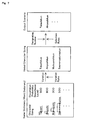
- FIG. 7 shows an example of varying the words stored in the word dictionary corresponding to a predetermined task according to the word variation rules corresponding the task, and generating a speech recording scenario corresponding to a predetermined task by selecting words according to the character string selection rules.
- the word variation rules are the variation rules corresponding the task 2 described by referring to FIG. 3, that is, the rules used when a name (name of a player character) is followed by 'kun' when the player character is addressed.
- the character string selection rules are represented by 1) varied words of 3 moras to 8 moras, 2) at least one word having different accent types for all moras, 3) a word having high occurrence probability is prioritized, and 4) number of character strings stored in a scenario is preliminarily determined (selection is completed when a specified value is exceeded).
- both 'Akiyoshikun' and 'Mutsuyoshikun' are 6 moras, and have high tone at the center (indicated by solid line in FIG. 7. Since 'Akiyoshi' has a higher occurrence probability, 'Akiyoshikun' is selected and output to the scenario. Since Saemonzaburoukun' is 10 moras, it is not output to the scenario.
- the dictionary organizing method for the speech synthesis described above contains a manual dictionary generating operation and a field operation such as a speech recording operation, etc. Therefore, all processes cannot be realized by an apparatus or a program, but a word varying process and a character string selecting process can be realized by an apparatus or a program which perform a process according to respective rules.
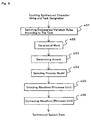
- FIG. 8 shows a flow of the speech synthesizing method in a narrow sense in which an actual speech synthesizing process is performed using a word dictionary, prosody dictionary, and waveform dictionary for each task generated as described above.
- the word dictionary, the prosody dictionary, and the waveform dictionary are switched according to the designation of the task.
- the word variation rules are switched additionally (s31).
- the word variation process is performed at the stage of organizing a dictionary
- the word variation process is performed on a character string to be synthesized according to the switched word variation rules (s32).
- the word variation rules used in the present embodiment are basically the rules used at the stage of organizing a dictionary as is.
- the accent type of the character string to be synthesized is determined based on the word dictionary or the word variation rules (s33). Practically, the character string to be synthesized is compared with the word stored in the word dictionary. If the same words are detected, the accent type is adopted. If they are not detected, the accent type of the word having a similar character string is adopted in the words having the same values of moras. When the same words are not detected, it can be organized such that a word can be optionally selected by an operator (game player) from all accent types probable for the words having the same value of moras as that of the character string to be synthesized through input means not shown in the attached drawings.
- the accent type is adopted according to the word variation rules.
- the prosody model data is selected from the prosody dictionary based on the character string to be synthesized and the accent type (S34), the waveform data corresponding to each character in the character string to be synthesized is selected from the waveform dictionary according to the selected prosody model data (s35), the selected pieces of waveform data are connected to each other (s36), and the speech data is synthesized.
- FIG. 9 is a block diagram of the functions of the speech synthesis apparatus according to the present invention.
- reference numerals 11-1, 11-2, ..., 11-n denote dictionaries for task 1, task 2, ..., and task n
- reference numerals 12-1, 12-2, ..., 12-n denote variation rules for task 1, task 2, ..., and task n
- a reference numeral 13 denotes dictionary/word variation rule switch means
- a reference numeral 14 denotes word variation means
- a reference numeral 15 denotes accent type determination means
- a reference numeral 16 denotes prosody model selection means
- a reference numeral 17 denotes waveform selection means
- a reference numeral 18 denotes waveform connection means.
- the dictionaries 11-1 to 11-n for tasks 1 to n are (the storage units of) the word dictionaries, the prosody dictionaries, and the waveform dictionaries respectively for the tasks 1 to n.
- the variation rules 12-1 to 12-n for tasks 1 to n are (the storage units of) the word variation rules respectively for the tasks 1 to n.
- the dictionary/variation rule switch means 13 switches and selects one of the dictionaries 11-1 to 11-n for tasks 1 to n, and one of the variation rules 12-1 to 12-n for tasks 1 to n available based on the designation of a task input together with a character string to be synthesized, and provides the selected dictionaries and rules to each unit.
- the word variation means 14 varies the character string to be synthesized according to the selected word variation rules.
- the accent type determination means 15 determines the accent type of the character string to be synthesized based on the selected word dictionary or word variation rules.
- the prosody model selection means 16 selects prosody model data from the selected prosody dictionary according to the character string to be synthesized and the accent type.
- the waveform selection means 17 selects the waveform data corresponding to each character in the character string to be synthesized based on the selected prosody model data from the selected waveform dictionary.
- the waveform connection means 18 connects the selected pieces of waveform data to each other, and synthesizes speech data.
Landscapes
- Engineering & Computer Science (AREA)
- Computational Linguistics (AREA)
- Health & Medical Sciences (AREA)
- Audiology, Speech & Language Pathology (AREA)
- Human Computer Interaction (AREA)
- Physics & Mathematics (AREA)
- Acoustics & Sound (AREA)
- Multimedia (AREA)
- Machine Translation (AREA)
- Document Processing Apparatus (AREA)
Applications Claiming Priority (2)
| Application Number | Priority Date | Filing Date | Title |
|---|---|---|---|
| JP11205945A JP2001034282A (ja) | 1999-07-21 | 1999-07-21 | 音声合成方法、音声合成のための辞書構築方法、音声合成装置、並びに音声合成プログラムを記録したコンピュータ読み取り可能な媒体 |
| JP20594599 | 1999-07-21 |
Publications (2)
| Publication Number | Publication Date |
|---|---|
| EP1071073A2 true EP1071073A2 (de) | 2001-01-24 |
| EP1071073A3 EP1071073A3 (de) | 2001-02-14 |
Family
ID=16515324
Family Applications (1)
| Application Number | Title | Priority Date | Filing Date |
|---|---|---|---|
| EP00115589A Withdrawn EP1071073A3 (de) | 1999-07-21 | 2000-07-19 | Verfahren zum Aufbau des Wortschatzes für die Sprachsynthese mit variablen Kontext |
Country Status (6)
| Country | Link |
|---|---|
| US (1) | US6826530B1 (de) |
| EP (1) | EP1071073A3 (de) |
| JP (1) | JP2001034282A (de) |
| KR (1) | KR100522889B1 (de) |
| CN (1) | CN1117344C (de) |
| TW (1) | TW523734B (de) |
Cited By (7)
| Publication number | Priority date | Publication date | Assignee | Title |
|---|---|---|---|---|
| EP1345207A1 (de) * | 2002-03-15 | 2003-09-17 | Sony Corporation | Verfahren und Vorrichtung zum Sprachsyntheseprogramm, Aufzeichnungsmedium, Verfahren und Vorrichtung zur Erzeugung einer Zwangsinformation und Robotereinrichtung |
| EP1367563A4 (de) * | 2001-03-09 | 2006-08-30 | Sony Corp | Sprachsyntheseeinrichtung |
| GB2427109A (en) * | 2005-05-30 | 2006-12-13 | Kyocera Corp | Associating emotion type with a word in a speech synthesis system |
| GB2447263A (en) * | 2007-03-05 | 2008-09-10 | Cereproc Ltd | Adding and controlling emotion within synthesised speech |
| GB2501067A (en) * | 2012-03-30 | 2013-10-16 | Toshiba Kk | A text-to-speech system having speaker voice related parameters and speaker attribute related parameters |
| WO2015111818A1 (en) * | 2014-01-21 | 2015-07-30 | Lg Electronics Inc. | Emotional-speech synthesizing device, method of operating the same and mobile terminal including the same |
| US9361722B2 (en) | 2013-08-08 | 2016-06-07 | Kabushiki Kaisha Toshiba | Synthetic audiovisual storyteller |
Families Citing this family (24)
| Publication number | Priority date | Publication date | Assignee | Title |
|---|---|---|---|---|
| JP2002282543A (ja) * | 2000-12-28 | 2002-10-02 | Sony Computer Entertainment Inc | オブジェクトの音声処理プログラム、オブジェクトの音声処理プログラムを記録したコンピュータ読み取り可能な記録媒体、プログラム実行装置、及びオブジェクトの音声処理方法 |
| GB2380847A (en) * | 2001-10-10 | 2003-04-16 | Ncr Int Inc | Self-service terminal having a personality controller |
| CN1813285B (zh) * | 2003-06-05 | 2010-06-16 | 株式会社建伍 | 语音合成设备和方法 |
| KR100644814B1 (ko) * | 2005-11-08 | 2006-11-14 | 한국전자통신연구원 | 발화 스타일 조절을 위한 운율모델 생성 방법 및 이를이용한 대화체 음성합성 장치 및 방법 |
| US20070150281A1 (en) * | 2005-12-22 | 2007-06-28 | Hoff Todd M | Method and system for utilizing emotion to search content |
| JP2007264466A (ja) | 2006-03-29 | 2007-10-11 | Canon Inc | 音声合成装置 |
| KR100789223B1 (ko) * | 2006-06-02 | 2008-01-02 | 박상철 | 문자열 대응 사운드 발생 시스템 |
| GB2443027B (en) | 2006-10-19 | 2009-04-01 | Sony Comp Entertainment Europe | Apparatus and method of audio processing |
| KR100859532B1 (ko) * | 2006-11-06 | 2008-09-24 | 한국전자통신연구원 | 대응 문형 패턴 기반 자동통역 방법 및 장치 |
| JP5198046B2 (ja) | 2007-12-07 | 2013-05-15 | 株式会社東芝 | 音声処理装置及びそのプログラム |
| CN101727904B (zh) * | 2008-10-31 | 2013-04-24 | 国际商业机器公司 | 语音翻译方法和装置 |
| US8321225B1 (en) | 2008-11-14 | 2012-11-27 | Google Inc. | Generating prosodic contours for synthesized speech |
| US8364488B2 (en) * | 2009-01-15 | 2013-01-29 | K-Nfb Reading Technology, Inc. | Voice models for document narration |
| WO2012088403A2 (en) | 2010-12-22 | 2012-06-28 | Seyyer, Inc. | Video transmission and sharing over ultra-low bitrate wireless communication channel |
| KR101203188B1 (ko) | 2011-04-14 | 2012-11-22 | 한국과학기술원 | 개인 운율 모델에 기반하여 감정 음성을 합성하기 위한 방법 및 장치 및 기록 매체 |
| WO2012154618A2 (en) * | 2011-05-06 | 2012-11-15 | Seyyer, Inc. | Video generation based on text |
| JP2013072903A (ja) * | 2011-09-26 | 2013-04-22 | Toshiba Corp | 合成辞書作成装置および合成辞書作成方法 |
| US9368104B2 (en) * | 2012-04-30 | 2016-06-14 | Src, Inc. | System and method for synthesizing human speech using multiple speakers and context |
| US9311913B2 (en) * | 2013-02-05 | 2016-04-12 | Nuance Communications, Inc. | Accuracy of text-to-speech synthesis |
| US10803850B2 (en) * | 2014-09-08 | 2020-10-13 | Microsoft Technology Licensing, Llc | Voice generation with predetermined emotion type |
| JP2018155774A (ja) * | 2017-03-15 | 2018-10-04 | 株式会社東芝 | 音声合成装置、音声合成方法およびプログラム |
| US10671251B2 (en) | 2017-12-22 | 2020-06-02 | Arbordale Publishing, LLC | Interactive eReader interface generation based on synchronization of textual and audial descriptors |
| US11443646B2 (en) | 2017-12-22 | 2022-09-13 | Fathom Technologies, LLC | E-Reader interface system with audio and highlighting synchronization for digital books |
| CN113920983B (zh) * | 2021-10-25 | 2025-07-25 | 网易(杭州)网络有限公司 | 数据处理方法、装置、存储介质和电子装置 |
Family Cites Families (27)
| Publication number | Priority date | Publication date | Assignee | Title |
|---|---|---|---|---|
| US4692941A (en) * | 1984-04-10 | 1987-09-08 | First Byte | Real-time text-to-speech conversion system |
| FR2636163B1 (fr) * | 1988-09-02 | 1991-07-05 | Hamon Christian | Procede et dispositif de synthese de la parole par addition-recouvrement de formes d'onde |
| JPH04350699A (ja) * | 1991-05-28 | 1992-12-04 | Sharp Corp | テキスト音声合成装置 |
| US5384893A (en) * | 1992-09-23 | 1995-01-24 | Emerson & Stern Associates, Inc. | Method and apparatus for speech synthesis based on prosodic analysis |
| SE9301596L (sv) * | 1993-05-10 | 1994-05-24 | Televerket | Anordning för att öka talförståelsen vid översätttning av tal från ett första språk till ett andra språk |
| US5860064A (en) * | 1993-05-13 | 1999-01-12 | Apple Computer, Inc. | Method and apparatus for automatic generation of vocal emotion in a synthetic text-to-speech system |
| JP3397406B2 (ja) * | 1993-11-15 | 2003-04-14 | ソニー株式会社 | 音声合成装置及び音声合成方法 |
| JP2770747B2 (ja) * | 1994-08-18 | 1998-07-02 | 日本電気株式会社 | 音声合成装置 |
| JPH08328590A (ja) * | 1995-05-29 | 1996-12-13 | Sanyo Electric Co Ltd | 音声合成装置 |
| JPH09171396A (ja) * | 1995-10-18 | 1997-06-30 | Baisera:Kk | 音声発生システム |
| US5913193A (en) * | 1996-04-30 | 1999-06-15 | Microsoft Corporation | Method and system of runtime acoustic unit selection for speech synthesis |
| JPH1097290A (ja) * | 1996-09-24 | 1998-04-14 | Sanyo Electric Co Ltd | 音声合成装置 |
| JPH10153998A (ja) * | 1996-09-24 | 1998-06-09 | Nippon Telegr & Teleph Corp <Ntt> | 補助情報利用型音声合成方法、この方法を実施する手順を記録した記録媒体、およびこの方法を実施する装置 |
| US5905972A (en) | 1996-09-30 | 1999-05-18 | Microsoft Corporation | Prosodic databases holding fundamental frequency templates for use in speech synthesis |
| US5966691A (en) * | 1997-04-29 | 1999-10-12 | Matsushita Electric Industrial Co., Ltd. | Message assembler using pseudo randomly chosen words in finite state slots |
| JP3667950B2 (ja) * | 1997-09-16 | 2005-07-06 | 株式会社東芝 | ピッチパターン生成方法 |
| JPH11231885A (ja) * | 1998-02-19 | 1999-08-27 | Fujitsu Ten Ltd | 音声合成装置 |
| US6101470A (en) * | 1998-05-26 | 2000-08-08 | International Business Machines Corporation | Methods for generating pitch and duration contours in a text to speech system |
| WO2000030069A2 (en) * | 1998-11-13 | 2000-05-25 | Lernout & Hauspie Speech Products N.V. | Speech synthesis using concatenation of speech waveforms |
| JP2000155594A (ja) * | 1998-11-19 | 2000-06-06 | Fujitsu Ten Ltd | 音声案内装置 |
| US6144939A (en) * | 1998-11-25 | 2000-11-07 | Matsushita Electric Industrial Co., Ltd. | Formant-based speech synthesizer employing demi-syllable concatenation with independent cross fade in the filter parameter and source domains |
| JP2000206982A (ja) * | 1999-01-12 | 2000-07-28 | Toshiba Corp | 音声合成装置及び文音声変換プログラムを記録した機械読み取り可能な記録媒体 |
| US6202049B1 (en) * | 1999-03-09 | 2001-03-13 | Matsushita Electric Industrial Co., Ltd. | Identification of unit overlap regions for concatenative speech synthesis system |
| US6185533B1 (en) * | 1999-03-15 | 2001-02-06 | Matsushita Electric Industrial Co., Ltd. | Generation and synthesis of prosody templates |
| US6697780B1 (en) * | 1999-04-30 | 2004-02-24 | At&T Corp. | Method and apparatus for rapid acoustic unit selection from a large speech corpus |
| US6505152B1 (en) * | 1999-09-03 | 2003-01-07 | Microsoft Corporation | Method and apparatus for using formant models in speech systems |
| GB2376394B (en) * | 2001-06-04 | 2005-10-26 | Hewlett Packard Co | Speech synthesis apparatus and selection method |
-
1999
- 1999-07-21 JP JP11205945A patent/JP2001034282A/ja active Pending
-
2000
- 2000-06-30 TW TW089113028A patent/TW523734B/zh not_active IP Right Cessation
- 2000-07-19 KR KR10-2000-0041301A patent/KR100522889B1/ko not_active Expired - Fee Related
- 2000-07-19 EP EP00115589A patent/EP1071073A3/de not_active Withdrawn
- 2000-07-21 US US09/621,544 patent/US6826530B1/en not_active Expired - Fee Related
- 2000-07-21 CN CN00120198A patent/CN1117344C/zh not_active Expired - Fee Related
Non-Patent Citations (3)
| Title |
|---|
| LOPEZ-GONZALO ET AL.: "IEEE International Conference on acoustics, speech, and signal processing (ICASSP)", 21 April 1997, IEEE COMP., SOC., PRESS, article "Automatic prosodic modelling for speaker and task adaptation in text-to-speech", pages: 927 - 930 |
| MIZUNO O.; NAKAJIMA S.: "A NEW SYNTHETIC SPEECH/SOUND CONTROL LANGUAGE", CSLP 98 : 5TH INTERNATIONAL CONFERENCE ON SPOKEN LANGUAGE PROCESSING.(INCORPORATING 7TH AUSTRALIAN INTERNATIONAL SPEECH SCIENCE AND TECHNOLOGY CONFERENCE), vol. CD-ROM, 30 November 1998 (1998-11-30), SYDNEY, AUSTRALIA, pages P1015, XP002229337 * |
| O. MIZUNO; S. NAKAJIMA: "A new synthetic speech/sound control language", INTERNATIONAL CONFERENCE ON SPOKEN LANGUAGE PROCESSING, 30 November 1998 (1998-11-30), pages 1015 |
Cited By (13)
| Publication number | Priority date | Publication date | Assignee | Title |
|---|---|---|---|---|
| EP1367563A4 (de) * | 2001-03-09 | 2006-08-30 | Sony Corp | Sprachsyntheseeinrichtung |
| EP1345207A1 (de) * | 2002-03-15 | 2003-09-17 | Sony Corporation | Verfahren und Vorrichtung zum Sprachsyntheseprogramm, Aufzeichnungsmedium, Verfahren und Vorrichtung zur Erzeugung einer Zwangsinformation und Robotereinrichtung |
| US8065157B2 (en) | 2005-05-30 | 2011-11-22 | Kyocera Corporation | Audio output apparatus, document reading method, and mobile terminal |
| GB2427109B (en) * | 2005-05-30 | 2007-08-01 | Kyocera Corp | Audio output apparatus, document reading method, and mobile terminal |
| GB2427109A (en) * | 2005-05-30 | 2006-12-13 | Kyocera Corp | Associating emotion type with a word in a speech synthesis system |
| GB2447263A (en) * | 2007-03-05 | 2008-09-10 | Cereproc Ltd | Adding and controlling emotion within synthesised speech |
| GB2447263B (en) * | 2007-03-05 | 2011-10-05 | Cereproc Ltd | Emotional speech synthesis |
| GB2501067A (en) * | 2012-03-30 | 2013-10-16 | Toshiba Kk | A text-to-speech system having speaker voice related parameters and speaker attribute related parameters |
| GB2501067B (en) * | 2012-03-30 | 2014-12-03 | Toshiba Kk | A text to speech system |
| US9269347B2 (en) | 2012-03-30 | 2016-02-23 | Kabushiki Kaisha Toshiba | Text to speech system |
| US9361722B2 (en) | 2013-08-08 | 2016-06-07 | Kabushiki Kaisha Toshiba | Synthetic audiovisual storyteller |
| WO2015111818A1 (en) * | 2014-01-21 | 2015-07-30 | Lg Electronics Inc. | Emotional-speech synthesizing device, method of operating the same and mobile terminal including the same |
| US9881603B2 (en) | 2014-01-21 | 2018-01-30 | Lg Electronics Inc. | Emotional-speech synthesizing device, method of operating the same and mobile terminal including the same |
Also Published As
| Publication number | Publication date |
|---|---|
| EP1071073A3 (de) | 2001-02-14 |
| US6826530B1 (en) | 2004-11-30 |
| KR20010021104A (ko) | 2001-03-15 |
| KR100522889B1 (ko) | 2005-10-19 |
| CN1282017A (zh) | 2001-01-31 |
| CN1117344C (zh) | 2003-08-06 |
| HK1034129A1 (en) | 2001-11-09 |
| JP2001034282A (ja) | 2001-02-09 |
| TW523734B (en) | 2003-03-11 |
Similar Documents
| Publication | Publication Date | Title |
|---|---|---|
| US6826530B1 (en) | Speech synthesis for tasks with word and prosody dictionaries | |
| JP4296231B2 (ja) | 声質編集装置および声質編集方法 | |
| US5704007A (en) | Utilization of multiple voice sources in a speech synthesizer | |
| US7739113B2 (en) | Voice synthesizer, voice synthesizing method, and computer program | |
| US20090024393A1 (en) | Speech synthesizer and speech synthesis system | |
| JP2006501509A (ja) | 個人適応音声セグメントを備える音声合成装置 | |
| JP2005070430A (ja) | 音声出力装置および方法 | |
| JP4277697B2 (ja) | 歌声生成装置、そのプログラム並びに歌声生成機能を有する携帯通信端末 | |
| JP3513071B2 (ja) | 音声合成方法及び音声合成装置 | |
| JP6474518B1 (ja) | 簡易操作声質変換システム | |
| JPH0419799A (ja) | 音声合成装置 | |
| JP2002304186A (ja) | 音声合成装置、音声合成方法および音声合成プログラム | |
| JPH09179576A (ja) | 音声合成方法 | |
| JP4260071B2 (ja) | 音声合成方法、音声合成プログラム及び音声合成装置 | |
| JPH11249679A (ja) | 音声合成装置 | |
| JP4758931B2 (ja) | 音声合成装置、方法、プログラム及びその記録媒体 | |
| JP2840234B2 (ja) | 規則による音声合成装置 | |
| JP2809769B2 (ja) | 音声合成装置 | |
| JP4366918B2 (ja) | 携帯端末 | |
| JP6922306B2 (ja) | 音声再生装置、および音声再生プログラム | |
| JPH03145698A (ja) | 音声合成装置 | |
| JP2573585B2 (ja) | 音声スペクトルパタン生成装置 | |
| JPH08328575A (ja) | 音声合成装置 | |
| JPH08171395A (ja) | 音声合成装置 | |
| JP2584236B2 (ja) | 規則音声合成装置 |
Legal Events
| Date | Code | Title | Description |
|---|---|---|---|
| PUAI | Public reference made under article 153(3) epc to a published international application that has entered the european phase |
Free format text: ORIGINAL CODE: 0009012 |
|
| PUAL | Search report despatched |
Free format text: ORIGINAL CODE: 0009013 |
|
| AK | Designated contracting states |
Kind code of ref document: A2 Designated state(s): DE FR GB |
|
| AX | Request for extension of the european patent |
Free format text: AL;LT;LV;MK;RO;SI |
|
| AK | Designated contracting states |
Kind code of ref document: A3 Designated state(s): AT BE CH CY DE DK ES FI FR GB GR IE IT LI LU MC NL PT SE |
|
| AX | Request for extension of the european patent |
Free format text: AL;LT;LV;MK;RO;SI |
|
| 17P | Request for examination filed |
Effective date: 20010122 |
|
| AKX | Designation fees paid |
Free format text: DE FR GB |
|
| 17Q | First examination report despatched |
Effective date: 20060829 |
|
| RAP1 | Party data changed (applicant data changed or rights of an application transferred) |
Owner name: KONAMI COMPUTER ENTERTAINMENT TOKYO CO., LTD. Owner name: KONAMI DIGITAL ENTERTAINMENT CO., LTD. |
|
| STAA | Information on the status of an ep patent application or granted ep patent |
Free format text: STATUS: THE APPLICATION IS DEEMED TO BE WITHDRAWN |
|
| 18D | Application deemed to be withdrawn |
Effective date: 20110201 |