EP1072724A2 - Verfahren zur Herstellung eines Papiermacherfilzes - Google Patents
Verfahren zur Herstellung eines Papiermacherfilzes Download PDFInfo
- Publication number
- EP1072724A2 EP1072724A2 EP00115744A EP00115744A EP1072724A2 EP 1072724 A2 EP1072724 A2 EP 1072724A2 EP 00115744 A EP00115744 A EP 00115744A EP 00115744 A EP00115744 A EP 00115744A EP 1072724 A2 EP1072724 A2 EP 1072724A2
- Authority
- EP
- European Patent Office
- Prior art keywords
- base fabric
- batt
- needle
- machine direction
- needles
- Prior art date
- Legal status (The legal status is an assumption and is not a legal conclusion. Google has not performed a legal analysis and makes no representation as to the accuracy of the status listed.)
- Withdrawn
Links
- 238000000034 method Methods 0.000 title claims abstract description 62
- 239000004744 fabric Substances 0.000 claims abstract description 197
- 239000000835 fiber Substances 0.000 claims abstract description 58
- 230000033001 locomotion Effects 0.000 claims abstract description 28
- 238000003780 insertion Methods 0.000 claims description 12
- 230000037431 insertion Effects 0.000 claims description 12
- 239000003550 marker Substances 0.000 claims description 6
- 239000004952 Polyamide Substances 0.000 claims description 5
- 229920002647 polyamide Polymers 0.000 claims description 5
- 230000035515 penetration Effects 0.000 claims description 3
- 230000001360 synchronised effect Effects 0.000 claims description 2
- 230000000694 effects Effects 0.000 abstract description 11
- 239000010410 layer Substances 0.000 description 41
- 235000004879 dioscorea Nutrition 0.000 description 9
- 230000008569 process Effects 0.000 description 7
- 239000000463 material Substances 0.000 description 5
- 238000010276 construction Methods 0.000 description 4
- 230000003993 interaction Effects 0.000 description 4
- 238000004519 manufacturing process Methods 0.000 description 4
- 230000002829 reductive effect Effects 0.000 description 4
- 239000004760 aramid Substances 0.000 description 3
- 229920003235 aromatic polyamide Polymers 0.000 description 3
- 229920000728 polyester Polymers 0.000 description 3
- 230000009467 reduction Effects 0.000 description 3
- 239000002356 single layer Substances 0.000 description 3
- 229920002994 synthetic fiber Polymers 0.000 description 3
- 230000007704 transition Effects 0.000 description 3
- -1 wool Polymers 0.000 description 3
- 210000002268 wool Anatomy 0.000 description 3
- 230000002411 adverse Effects 0.000 description 2
- 239000012736 aqueous medium Substances 0.000 description 2
- 230000008901 benefit Effects 0.000 description 2
- 238000010586 diagram Methods 0.000 description 2
- 230000008030 elimination Effects 0.000 description 2
- 238000003379 elimination reaction Methods 0.000 description 2
- 230000007246 mechanism Effects 0.000 description 2
- 239000000203 mixture Substances 0.000 description 2
- 238000012986 modification Methods 0.000 description 2
- 230000004048 modification Effects 0.000 description 2
- 230000036961 partial effect Effects 0.000 description 2
- 239000012209 synthetic fiber Substances 0.000 description 2
- XLYOFNOQVPJJNP-UHFFFAOYSA-N water Substances O XLYOFNOQVPJJNP-UHFFFAOYSA-N 0.000 description 2
- 238000009941 weaving Methods 0.000 description 2
- 229920000742 Cotton Polymers 0.000 description 1
- 239000004677 Nylon Substances 0.000 description 1
- 239000004743 Polypropylene Substances 0.000 description 1
- 238000005299 abrasion Methods 0.000 description 1
- NIXOWILDQLNWCW-UHFFFAOYSA-N acrylic acid group Chemical group C(C=C)(=O)O NIXOWILDQLNWCW-UHFFFAOYSA-N 0.000 description 1
- 230000009471 action Effects 0.000 description 1
- 238000004873 anchoring Methods 0.000 description 1
- 238000013459 approach Methods 0.000 description 1
- 238000005452 bending Methods 0.000 description 1
- 230000008859 change Effects 0.000 description 1
- 125000004122 cyclic group Chemical group 0.000 description 1
- 230000002939 deleterious effect Effects 0.000 description 1
- 238000001035 drying Methods 0.000 description 1
- 230000005484 gravity Effects 0.000 description 1
- 238000009998 heat setting Methods 0.000 description 1
- 230000002427 irreversible effect Effects 0.000 description 1
- 230000000670 limiting effect Effects 0.000 description 1
- 229920001778 nylon Polymers 0.000 description 1
- 238000004806 packaging method and process Methods 0.000 description 1
- 229920006149 polyester-amide block copolymer Polymers 0.000 description 1
- 229920001155 polypropylene Polymers 0.000 description 1
- 238000012545 processing Methods 0.000 description 1
- 230000000717 retained effect Effects 0.000 description 1
- 238000009999 singeing Methods 0.000 description 1
- 239000002002 slurry Substances 0.000 description 1
- 239000000725 suspension Substances 0.000 description 1
- 238000011282 treatment Methods 0.000 description 1
- 230000000007 visual effect Effects 0.000 description 1
- 239000011800 void material Substances 0.000 description 1
- 238000005406 washing Methods 0.000 description 1
Images




Classifications
-
- D—TEXTILES; PAPER
- D04—BRAIDING; LACE-MAKING; KNITTING; TRIMMINGS; NON-WOVEN FABRICS
- D04H—MAKING TEXTILE FABRICS, e.g. FROM FIBRES OR FILAMENTARY MATERIAL; FABRICS MADE BY SUCH PROCESSES OR APPARATUS, e.g. FELTS, NON-WOVEN FABRICS; COTTON-WOOL; WADDING ; NON-WOVEN FABRICS FROM STAPLE FIBRES, FILAMENTS OR YARNS, BONDED WITH AT LEAST ONE WEB-LIKE MATERIAL DURING THEIR CONSOLIDATION
- D04H18/00—Needling machines
- D04H18/02—Needling machines with needles
-
- D—TEXTILES; PAPER
- D21—PAPER-MAKING; PRODUCTION OF CELLULOSE
- D21F—PAPER-MAKING MACHINES; METHODS OF PRODUCING PAPER THEREON
- D21F7/00—Other details of machines for making continuous webs of paper
- D21F7/08—Felts
- D21F7/083—Multi-layer felts
Definitions
- the present invention relates generally to papermakers' fabrics and more specifically to methods of manufacturing papermakers' felts.
- a water slurry, or suspension, of cellulosic fibers (known as the paper "stock") is fed onto the top of the upper run of an endless belt of woven wire and/or synthetic material that travels between two or more rollers.
- the belt often referred to as a "forming fabric,” provides a papermaking surface on the upper surface of its upper run which operates as a filter to separate the cellulosic fibers of the paper stock from the aqueous medium, thereby forming a wet paper web.
- the aqueous medium drains through mesh openings of the forming fabric, known as drainage holes, by gravity alone or with assistance from one or more suction boxes located on the lower surface ( i.e. , the "machine side") of the upper run of the fabric.
- the paper web After leaving the forming section, the paper web is transferred to a press section of the paper machine, in which it is passed through the nips of one or more pairs of pressure rollers covered with another fabric, typically referred to as a "press felt.” Pressure from the rollers removes additional moisture from the web; the moisture removal is often enhanced by the presence of a "batt" layer on the press felt.
- the paper is then conveyed to a drier section for further moisture removal. After drying, the paper is ready for secondary processing and packaging.
- Press felts typically include two components: a base fabric and one or more batt layers.
- the base fabric is typically a woven construction that includes cabled or single monofilaments, plied multifilaments, or spun yarns.
- the base fabric may be a single layer fabric, an interwoven multilayer fabric, or a laminated construction comprising two or more distinct and separate fabric layers.
- the weave pattern(s) and yarn sizes and configurations employed in the base fabric are selected for the desired performance of the fabric; in particular, the fabric is designed for a desired balance of properties that include pressure uniformity, flow resistance, void volume, and compressibility.
- the batt layer(s) of a fabric typically comprise staple fibers (usually synthetic fibers, such as nylon or polyester) that are applied in overlying layers to the base fabric.
- staple fibers usually synthetic fibers, such as nylon or polyester
- the thickness, denier and material of the batt fibers are typically selected for their contribution to the desired performance properties of the overall press felt.
- batt fibers are "carded” to form a uniform web, then needled from this web into the base fabric.
- the batt web and base fabric are fed into a needle loom, where many needles (often on the order of 1,000-4,000 needles per lineal meter) are employed to insert the batt fibers into the base fabric.
- the needles are mounted in an industry standard "random" pattern on a needle board.
- the needle board is mounted on a needle beam, which in turn is mounted on the loom so that it can move in a reciprocating path in a direction normal to the batt web and fabric.
- the needles are of a "reverse-barb" configuration which snags batt fibers when moving in a direction toward the batt web and base fabric ( i.e. , during insertion segment of the needle stroke) but falls to snag fibers when moving away from the batt and fabric ( i.e. , during the retraction segment of the needle stroke).
- the barbs of the needles engage the fibers of the batt web and thread them into the interstices of the base fabric.
- the needles can be retracted from the base fabric and batt web without the barbs snagging the batt fibers.
- a press felt undergoes multiple passes through a needling loom, some of which may be conducted with different needle penetration depths, needle configurations, and fabric advance rates, and some of which simply involve the insertion of the needles into the base fabric without the addition of more batt fibers (when no additional batt fiber is applied, the needling typically serves to further engage batt fiber already present on the base fabric arid reduce the thickness of the batt layer).
- the press felt is usually then subjected to some post-needling steps, such as heat setting, washing and singeing.
- the needle board upon which the needles are mounted reciprocates along a path normal to the batt and fabric.
- the fabric and batt are advanced between needle strokes, either continuously (which is preferred for manufacturing efficiency) or intermittently, into position for subsequent needling.
- the present invention is directed to a method of forming a papermakers' felt that reduces the risk of damaging the base fabric and batt thereof.
- the method first comprises providing a needle loom having a needle board, a plurality of needles mounted on the needle board, and a needle motion unit.
- the needle motion unit moves the needle board such that the needles mounted thereon travel on a predetermined path that includes upward and downward segments, wherein each of the upward and downward segments includes both forward and rearward motion.
- the method then comprises the step of continuously conveying a base fabric and a batt web overlying the base fabric in a first direction past the needle board.
- the base fabric includes a first set of machine direction yarns and a first set of cross machine direction yarns interwoven with the first set of machine direction yarns in a predetermined repeating pattern, and the batt web comprises batt fibers.
- the next step of the method is inserting batt fibers from the batt web into the base fabric with the plurality of needles as the base fabric is conveyed past the needle board and as the needle board travels along the predetermined path to form a batt layer attached to and overlying the base fabric. This method can reduce or eliminate the negative effects on press felts discussed hereinabove.
- the method is particularly well-suited for press felts in which the base fabric includes fine yarns.
- the base fabric includes cabled, plied machine and cross machine direction yarns formed of individual monofilaments having a diameter of between about 0.1 and 0.3 mm.
- the method can also be practiced by determining the positions of the yarns within the base fabric, performing the step of inserting the yarns as described above responsive to the positions of the yarns then performing a second inserting step responsive to the positions of the yarns. Because the method has the effect of reducing the degree to which yarns are displaced during needling, more precise and accurate needling is possible.
- the method of the present invention can also be practiced by inserting batt fiber at an oblique angle to the base fabric. This may be carried out by passing the base fabric and batt web over a needle bed that is obliquely disposed relative to the general direction of needle travel. Under this method, the batt fibers of the batt layer can become anchored more firmly within the base fabric than in prior art press felts thereby improving the performance and durability of the press felt.
- machine direction (MD) and “cross machine direction” (CMD) refer, respectively, to a direction aligned with the direction of travel of the papermakers' fabric on a papermaking machine, and a direction parallel to the fabric surface and transverse to the direction of travel.
- MD machine direction
- CMD cross machine direction
- both flat weaving and endless weaving methods are well known in the art for the production of a base fabric for a papermakers' felt
- endless belt refers to fabrics and press felts made by either method.
- Figure 1 illustrates an enlarged section of a press felt 10 ; the entirety of the press felt 10 , which is in an endless belt configuration, follows the pattern illustrated in Figure 1 and need not be illustrated herein for those skilled in this art to understand its configuration.
- the illustrated press felt 10 includes a single layer plain weave base fabric 12 which comprises CMD yarns 14 and MD yams 16 .
- the base fabric 12 can comprise a so-called 'laminated" or "stratified” structure that includes separate layers of fabrics. Virtually any weave pattern known to those skilled in this art, such as plain weaves, twills, satins, and the like, can be used for the base fabric 12 .
- a press felt 60 includes a woven duplex base fabric 61 that comprises upper and lower sets of machine direction yarns 62, 64 interwoven with cross machine direction yarns 66 . These are interwoven in a conventional 6 harness weave pattern in which each CMD yarn 66 passes over one upper MD 62 yam and under one lower MD yam 66 for each consecutive set of six upper and lower MD yarns 62, 64 .
- the base fabric 61 is covered by a batt layer 68 .
- a press felt 70 includes a laminated duplex base fabric 71 that comprises an upper layer 72 formed of interwoven MD yams 74 and CMD yarns 76 and a lower layer 78 formed of interwoven MD yarns 80 and CMD yams 82 .
- Each of the upper and lower layers 72, 78 follow a weave pattern in which the CMD yarns 76, 82 pass over one of each six of their respective MD yams 74, 80 .
- the upper and lower layers 72, 78 are secured with a batt layer 84 that covers the upper layer 72 .
- Other exemplary weave patterns for the layer(s) of the base fabric are illustrated and/or described in U.S. Patent Nos.
- the form of the yarns employed in the base fabrics 12, 61, 71 can vary, depending upon the desired properties of the final press felt.
- the yarns may be multifilament yarns, monofilament yarns, twisted or cabled multifilament or monofilament yarns, spun yarns, or any combination thereof.
- the materials from which the yarns employed in the fabric layers are formed may be those commonly used in press felts, such as polyamide, cotton, wool, polypropylene, polyester, aramid, or the like, and blends and combinations thereof.
- the diameters of the filaments of the yams may vary from between about 0.02mm to 0.6mm (a range of 0.1mm and 0.5mm is preferred for CMD filaments and a range of 0.1mm to 0.6mm is preferred for MD filaments), and these filaments may be included either individually or in plies, which can then be used in twists or cables.
- the selected base fabric may vary from between about 8 to 150 machine direction yams and 12 to 100 cross machine direction yarns per inch; the higher numbers of these ranges may include the yams of multiple layers and laminates.
- the present invention can be particularly effective when used with fabrics having plied, cabled yarns having one or two plies of two or three twisted filaments, wherein the filaments have a diameter of between about 0.1 and 0.3 mm.
- an upper batt layer 18 overlies the base fabric 12
- a lower batt layer 20 underlies the base fabric layer 12 .
- These batt layers 18, 20 are attached to the base fabric 12 through the needling process as described below.
- the batt layers 18, 20 should be formed of material, such as a synthetic fiber like acrylic, aramid, polyester, or polyamide, or a natural fiber such as wool, that assists in wicking water away from the base fabric 12 .
- Preferred materials for the batt layers 18, 20 include polyamide, aramid, wool, polyester and blends thereof. Fibers sized between 1.5 and 60 denier are preferred.
- the weight and thickness of the batt layers 18, 20 can vary, although it is preferable that the ratio of batt weight to total press felt weight is about between about 20 and 80 percent. Also, in some embodiments, it may be desirable to have additional batt layers (such as a batt layer between the layers of a stratified fabric) or to omit either of the batt layers 18, 20 . Of course, the discussion of the batt layers 18, 20 is equally applicable to the batt layers 68, 84 of the press felts 60, 70 .
- the needle loom 40 includes four needling zones 42a, 42b, 42c, 42d, wherein batt material from a batt web, such as the batt layers 18, 20 described hereinabove, is added to a base fabric, such as the base fabric 12 (the discussion is equally applicable to the base fabrics 61, 71 and other base fabrics suitable for use in a press felt).
- the needling zones 42a, 42b, 42c, 42d are essentially identical with the exceptions of their locations on the needle loom 40 and their orientation relative to the loom 40 ( i.e.
- the needling zone 42d is oriented "upside down" relative to the other needling zones in order to needle the opposite side of the fabric); thus, the discussion hereinbelow directed to needling zone 42a is equally applicable to the other needling zones 42b, 42c, 42d .
- Figure 3 illustrates the needling zone 42a , which includes a needle board 44 upon which a plurality of needles 46 are mounted.
- the needle board 44 is substantially flat and is mounted on a needle beam 43 that is in turn mounted to the frame of the loom 40 via a reciprocating needle motion unit 41 .
- a needle bed 50 is fixed beneath the needle board 44 and includes a plurality of apertures (not shown) that are sized and positioned to receive the needles 46 .
- the needle motion unit 41 moves the needle beam 43 and the needle board 44 in a reciprocating vertical motion relative to the needle bed 48 such that the needles 46 are able to enter and exit the apertures in the needle bed 50 .
- each needle 46 includes one or more barbs 47 that are configured such that a downwardly-moving needle 46 tends to snag and retain batt fiber within the barb 47 as the needle passes through a batt web 52 , but an upwardly-moving needle 46 tends to pass through the batt web 52 without snagging or retaining fiber.
- the needles 46 are between about 2.5 and 4.0 inches in length and 32 to 40 wire gauge in cross-section; most commonly, the needles 46 are triangular in cross-section, with equal sides.
- the barbs 47 typically have a throat length of about 0.5 to 0.8mm and a throat depth of between about 0.06 and 0.15mm.
- the barbs 47 are included on only one longitudinal edge of the needles 46 , although other configurations may also be employed.
- the needles 46 are typically included in a density of between about 1,000 and 4,000 needles per lineal meter, with densities of 1,340 and 2,680 needles per lineal meter being preferred.
- FIGs 4A through 4C illustrate the insertion of batt fiber into the base fabric 12 within the needling zone 42a .
- the barbs 47 have no batt fiber retained therein.
- the needle 46 continues moving downwardly such that its point penetrates and passes through the base fabric 12 ( Figure 4B )
- the needle 46 snags batt fiber of the batt web 52 and forces it into and, in some instances, below the base fabric 12 .
- the batt fiber has been driven into the base fabric 12 , it tends to become entangled and ensnared therein.
- the batt fibers tend to remain with the base fabric 12 and, eventually, form the batt layer 18 ; they tend not to be drawn from the base fabric 12 by the upward movement of the needle 46 because of the orientation of the barbs 47 and the absence of any "kick-up" associated with the barb 47 .
- the movement of the needle 46 shown in Figures 4A through 4C is repeated numerous times as the base fabric 12 and the batt web 52 are conveyed through the needling zone 42a .
- the movement of the base fabric 12 and the batt web 52 is continuous.
- the base fabric 12 and batt web 52 can be needled in any or all of the needling zones 42a, 42b, 42c, 42d, any of which can have different needle configurations or stroke rates.
- the needling process is repeated multiple times; in some needling passes, the fibers from additional batt webs may be needled into the base fabric 12 , and in other passes there may be no additional batt fiber applied, as the needling pass is carried out to increase the entanglement and/or reduce the thickness of the batt layer 18 already formed on the fabric.
- This process may have several shortcomings when needling is carried out with a continuously moving base fabric.
- the barbs 47 of the needles 46 face rearwardly, the barbs 47 can contact the CMD yarns 14 and have a "sawing" effect on them as they enter and retract from the base fabric 12 , which of course can weaken the yarns for subsequent operation.
- the needles 46 are mounted so that the barbs 47 do not face rearwardly ( i.e. , not in the manner shown in Figure 4 ) so that the sawing effect can be reduced.
- the interaction of the needle 46 with the base fabric 12 and batt web 52 can cause the base fabric 12 to stretch in a localized region just forward of the needle 46 and to compress just rearward of the needle 46 .
- This action can shift the positions of the yarns (particularly the CMD yarns 14 ), which can reduce the uniformity of the weave of the base fabric 12 .
- shifting of the yarns can render subsequent needlings very unpredictable, as once the yarns have shifted position, there is no technique for realigning them prior to subsequent needling passes.
- any attempt to needle precisely based on the assumed positions of the yarns would likely be futile.
- the interaction of the needles 46 with the base fabric 12 and batt web 52 can also have the effect of causing the batt web 52 to "thin" forwardly of the needle 46 and "bunch up” rearwardly of the needle 46 .
- the uniformity of the surface of the batt layer 18 can be adversely impacted, particularly if this effect is magnified through multiple needling passes.
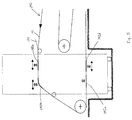
- the needle loom 140 includes four needling zones 142a, 142b, 142c and 142d, each of which includes a needle board 144 upon which needles 146 are mounted. Each needle board 144 is mounted on a needle beam 143 that is, in turn, mounted to the loom 140 .
- each needle beam 143 is mounted via a needle motion unit 141 such that, rather than undergoing reciprocating motion that is strictly vertical, the needle beam 143 follows a continuous predetermined path that defines an oval (see Figures 6A through 6D ).
- an "oval" path is intended to be a path that is continuous and largely curvilinear; it includes elliptical and non-elliptical paths as well as continuous reciprocating curvilinear paths that are asymmetric.
- the oval path should include both upward and downward segments, each of which has both forward and rearward motion.
- the path should be selected such that, as the needles 146 enter the batt web 152 and continue into the base fabric 112 to insert batt fibers, the horizontal rate of travel of the needles 146 is substantially synchronized with the substantially constant horizontal rate of travel of the base fabric 112 and the batt web 152 (typically the base fabric 112 and the batt layer 152 travel at a rate of between about 0.05 and 0.75 inches per needle stroke, with a rate of 0.085 and 0.35 inches per needle stroke being preferred).
- the needles 146 are inserted into the fabric at similar stroke rates as is the case for the prior art loom 40 .
- the needle stroke rate is 1,000 strokes/minute
- the vertical needle stroke length is 2.4 inches (which could, for example, correspond to a needle insertion depth of 0.5 inches into the needle bed)
- the resulting oval path would be approximately 2.4 inches by 0.12 inches.
- This ratio of long axis to short axis is typical; a range of between about 15 and 30 is preferred; as is a needle stroke length of between about 1.5 and 4 inches.
- Dilo describes a needle loom that has sets of eccentrically-mounted connecting rods that are also connected to a needle bar. At least one connecting rod is mounted vertically and induces vertical motion in the needle bar, and at least one connecting rod is mounted horizontally and induces forward and rearward motion in the needle bar. The connecting rods are coupled to produce a desired path for the needles.
- needle loom configurations that may be suitable for the present invention include other eccentrically-mounted connecting rod configurations, slider-crank mechanisms four bar-linkages and their mechanical equivalents, intermittent magnetically-driven mechanisms, hydraulically- and pneumatically-driven systems, cam follower-type systems, and the like.
- the needle loom 140 can be operated on the press felt of Figure 1 and any of the press felts described hereinabove.
- the loom 140 is particularly suitable for press felts having fine yarns, as the discussion that follows demonstrates It is preferred that the finished press felt be subjected to repeated needling steps such that the batt layer is needled with between about 600 and 2,000 needle penetrations per square centimeter.
- the oval path followed by the needles 146 can address the shortcomings noted above for prior art needle looms.
- the ability of the needles 146 to move horizontally with the base fabric 112 can reduce the tendency of the needles 146 to stretch the MD yarns of the base fabric 112 forward of the needle 146 and to compress the MD yarns to the rear of the needle 146 .
- the base fabric 112 can remain more uniform, which in turn can improve performance of the press felt.
- the reduction of interaction between the needles 146 and the yarns of the base fabric 112 can enable fabrics with very fine yarns to be needled with less concern for yarn shifting or damage.
- a related advantage to the reduction or elimination of stretching/compressive force applied to the fabric is that the force experienced by the needle 146 is also reduced.
- finer needles and/or elevated needle density levels can be employed (for example, as many as 10,000 needles per lineal meter, using needles having a cross-section of 46 wire gauge).
- the use of higher densities and/or finer needles 146 can enable the press felt to be formed with fewer needling passes; also, the batt layer can be created with a smoother surface.
- the tendency of the batt web 152 to thin in front of and bunch to the rear of the inserted needles 146 is also reduced. As described above for the base fabric 112 , this effect can improve the consistency of the density and surface smoothness of the batt layer, which can positively impact the performance of the press felt.
- the "sawing" effect of the barbs of the needles 146 on the CMD yarns can be significantly reduced or eliminated, as the barbs are not forced against the CMD yarns by relative horizontal movement of the base fabric 112 .
- the needles 146 may be oriented in the needle board 144 in a manner that is considered to be most desirable for the insertion of batt fibers without the fear of sawing CMD yarns, including facing rearwardly if such an orientation is desirable.
- needles with larger barb "kick-up" may also be employed if desirable. The reduction or elimination of "sawing" of the yarns enhances the opportunities for needling fabrics with fine yarns.
- the yarns of the base fabric 112 will tend to remain in their original positions during insertion of batt fiber rather than being displaced by the needles 146 .
- the positions of those yarns should be more predictable.
- the positions of the yarns can be considered in planning the insertion of batt fiber in subsequent needling passes, such as to avoid the "spearing" of yarns described above. Again, this can be very advantageous when fabrics having very fine yarns are employed, as the spearing of a fine yarn is likely to cause irreversible damage.
- One relatively direct method for determining the positions of the yarns is to include a marker, such as a CMD wire woven into the fabric or a visual marker imprinted on the fabric, that can be detected by a sensor associated with the loom. With the position of the marker known, the loom can then calculate or otherwise determine the positions of other yarns of the fabric, then perform the needling operation accordingly.
- a marker such as a CMD wire woven into the fabric or a visual marker imprinted on the fabric
- needling zone 142b includes a biplanar needling board 144b and needling bed 150b ( Figures 5 and 7 ).
- the profiles of the lower surface of the needle board 144b and the upper surface of the needle bed 150b substantially match one another; each slopes downwardly at an angle of approximately 15 degrees to horizontal initially, then increases to an angle of 45 degrees to horizontal after a curved transition region, although these angles can be varied and still fail within the scope of the present invention.
- the base fabric 112 and batt web 152 follow the profile of the needle bed 150b , with the curved transition region 154 of the needle bed 152 providing a smooth transition surface for the base fabric 112 to change its travel direction.
- the general direction of needle insertion is vertical (like that for the needles 146 of needle zone 142a ); i.e. , the long axis of the oval of the needle path is substantially aligned with the longitudinal axis of each needle 146 .
- the disposition of the base fabric 112 and batt web 152 at an oblique angle to the long axis of the oval path causes the needles 146 to enter the base fabric 112 and the batt web 152 at an oblique angle.
- the insertion of batt fibers at an oblique angle can be particularly advantageous for improving the anchoring of batt fibers within the base fabric 112 (as much as a 40 percent increase) due to the increased length of fiber in frictional contact with the yarns of the base fabric 112 and adjacent fibers.
- This can improve the abrasion resistance of the press felt and decrease the risk of fiber shedding without the use of fusable fibers or other adhesion-enhancing treatments.
- the oblique entry angle of the batt fiber can also reduce the compressibility of the batt layer on the finished press felt.
Landscapes
- Engineering & Computer Science (AREA)
- Textile Engineering (AREA)
- Paper (AREA)
Applications Claiming Priority (2)
| Application Number | Priority Date | Filing Date | Title |
|---|---|---|---|
| US359213 | 1999-07-22 | ||
| US09/359,213 US6175996B1 (en) | 1999-07-22 | 1999-07-22 | Method of forming a papermakers' felt |
Publications (2)
| Publication Number | Publication Date |
|---|---|
| EP1072724A2 true EP1072724A2 (de) | 2001-01-31 |
| EP1072724A3 EP1072724A3 (de) | 2006-06-28 |
Family
ID=23412821
Family Applications (1)
| Application Number | Title | Priority Date | Filing Date |
|---|---|---|---|
| EP00115744A Withdrawn EP1072724A3 (de) | 1999-07-22 | 2000-07-21 | Verfahren zur Herstellung eines Papiermacherfilzes |
Country Status (2)
| Country | Link |
|---|---|
| US (1) | US6175996B1 (de) |
| EP (1) | EP1072724A3 (de) |
Cited By (3)
| Publication number | Priority date | Publication date | Assignee | Title |
|---|---|---|---|---|
| FR2862987A1 (fr) * | 2003-11-28 | 2005-06-03 | Saint Gobain Vetrotex | Mat de verre aiguillette |
| EP1624099A1 (de) * | 2004-08-04 | 2006-02-08 | Groz-Beckert KG | Nadel zur Vernadelung von textilen Flächengebilden |
| EP1560701A4 (de) * | 2002-11-01 | 2006-11-22 | Bell Helicopter Textron Inc | VERFAHREN UND VORRICHTUNG FÜR Z-RICHTUNGSVERSTûRKUNG VON VERBUNDLAMINATEN |
Families Citing this family (16)
| Publication number | Priority date | Publication date | Assignee | Title |
|---|---|---|---|---|
| US7117655B2 (en) * | 1999-09-15 | 2006-10-10 | L&P Property Management Company | Method of applying at least one web of insulator material to multiple spring assemblies |
| AT410105B (de) * | 2000-06-13 | 2003-02-25 | Fehrer Monika Mag | Verfahren und vorrichtung zum herstellen eines mopbesatzes |
| AT410680B (de) * | 2000-11-22 | 2003-06-25 | Fehrer Monika Mag | Verfahren und vorrichtung zum verfestigen einer textilen warenbahn |
| US6374469B1 (en) * | 2001-06-13 | 2002-04-23 | Messier-Bugatti | Needling machine provided with a device for measuring penetration |
| DE10144307A1 (de) * | 2001-09-10 | 2003-03-27 | Bayer Faser Gmbh | Trägergewebe für Papiermaschinenbespannungen |
| US20040117958A1 (en) * | 2002-12-19 | 2004-06-24 | Abraham Turkson | High temperature needle-felts with woven basalt scrims |
| US20050085148A1 (en) * | 2003-10-17 | 2005-04-21 | Thomas Baumgartner | Felt for forming fiber cement articles with multiplex base fabric |
| US20060219313A1 (en) * | 2005-03-31 | 2006-10-05 | Hippolit Gstrein | Papermaker's press felt with long machine direction floats in base fabric |
| FR2887564B1 (fr) * | 2005-06-22 | 2007-10-26 | Asselin Soc Par Actions Simpli | Appareil d'aiguilletage pour consolider une nappe de fibres |
| US7641768B2 (en) * | 2005-08-26 | 2010-01-05 | Voith Patent Gmbh | Method and joining assembly for joining ends of a fabric in a paper machine |
| US20070155272A1 (en) * | 2005-12-30 | 2007-07-05 | Thomas Baumgartner | Felt for forming fiber cement articles having stretch-resistant yarns |
| US20090220729A1 (en) * | 2006-03-24 | 2009-09-03 | Francois Roederer | Needle-Punched Glass Mat |
| US20090183795A1 (en) * | 2008-01-23 | 2009-07-23 | Kevin John Ward | Multi-Layer Papermaker's Forming Fabric With Long Machine Side MD Floats |
| CN106012312A (zh) * | 2016-08-08 | 2016-10-12 | 郑州纺机工程技术有限公司 | 一种适用于针刺生产线的预刺喂入装置 |
| FR3109587B1 (fr) * | 2020-04-23 | 2022-05-20 | Andritz Asselin Thibeau | Dispositif de commande du mouvement des aiguilles d’une aiguilleteuse, notamment elliptique, et aiguilleteuse comportant un tel dispositif |
| CN117488485B (zh) * | 2023-11-14 | 2024-06-07 | 甘肃郝氏碳素新材料有限公司 | 用于碳毡的针刺机 |
Family Cites Families (19)
| Publication number | Priority date | Publication date | Assignee | Title |
|---|---|---|---|---|
| US2377564A (en) * | 1942-09-18 | 1945-06-05 | Thomas A Unsworth | Interlacing needle loom |
| GB790118A (en) * | 1954-10-28 | 1958-02-05 | H A Howard Ltd | Improvements in and relating to the preparation of hair or other fibres for upholstery or other purposes |
| US2896303A (en) * | 1958-04-16 | 1959-07-28 | Hunter James Machine Co | Needle loom |
| CA1061621A (en) * | 1976-11-03 | 1979-09-04 | Eugene Z. Fekete | Papermakers' felts |
| US4283454A (en) * | 1980-02-08 | 1981-08-11 | Porritts & Spencer Inc. | Papermakers wet felt with ribbed and smooth surface textures |
| JPS5887392A (ja) * | 1981-10-08 | 1983-05-25 | 日本フエルト株式会社 | 製紙用フエルト及びその製造方法 |
| US4357386A (en) * | 1981-11-16 | 1982-11-02 | Albany International Corp. | Papermakers felt and method of manufacture |
| AT384834B (de) * | 1985-06-21 | 1988-01-11 | Fehrer Textilmasch | Vorrichtung zum herstellen von genadelten papiermaschinenfilzen |
| US4878278A (en) * | 1987-08-05 | 1989-11-07 | Wangner Systems Corporation | Method for manufacture of paper making fabrics |
| US4856192A (en) * | 1988-01-28 | 1989-08-15 | Wenoka Seastyle | Adapter for knife and sheath assembly |
| FR2647125B1 (fr) * | 1989-05-19 | 1991-06-28 | Chomarat & Cie | Armature textile utilisable pour la realisation de complexes divers et procede pour sa fabrication |
| US5200260A (en) * | 1992-02-14 | 1993-04-06 | Wangner Systems Corporation | Needled papermaking felt |
| US6029327A (en) * | 1994-07-25 | 2000-02-29 | The B.F. Goodrich Company | Process for forming fibrous structures with predetermined Z-fiber distributions |
| DE19529654A1 (de) | 1995-08-11 | 1997-02-13 | Schlafhorst & Co W | Kreuzspulen herstellende Offenend-Spinnmaschine |
| US5732453A (en) * | 1995-09-15 | 1998-03-31 | Oskar Dilo Maschinenfabrik Kg | Needle bar driving apparatus of a needle loom |
| DE19640750B4 (de) | 1995-10-16 | 2004-01-15 | Fehrer, Ernst, Dr. | Vorrichtung zum Nadeln eines Vlieses |
| DE19819733A1 (de) * | 1997-05-15 | 1998-11-19 | Fehrer Ernst | Vorrichtung zum Nadeln eines Vlieses |
| DE19730532A1 (de) | 1997-07-16 | 1999-01-21 | Dilo Kg Maschf Oskar | Nadelmaschine |
| AT406390B (de) * | 1998-03-31 | 2000-04-25 | Fehrer Textilmasch | Vorrichtung zum nadeln eines vlieses |
-
1999
- 1999-07-22 US US09/359,213 patent/US6175996B1/en not_active Expired - Fee Related
-
2000
- 2000-07-21 EP EP00115744A patent/EP1072724A3/de not_active Withdrawn
Cited By (5)
| Publication number | Priority date | Publication date | Assignee | Title |
|---|---|---|---|---|
| EP1560701A4 (de) * | 2002-11-01 | 2006-11-22 | Bell Helicopter Textron Inc | VERFAHREN UND VORRICHTUNG FÜR Z-RICHTUNGSVERSTûRKUNG VON VERBUNDLAMINATEN |
| US7993477B2 (en) | 2002-11-01 | 2011-08-09 | Bell Helicopter Textron Inc. | Method and apparatus for Z-direction fiber insertion of discrete fibers for reinforcement of composite laminates |
| FR2862987A1 (fr) * | 2003-11-28 | 2005-06-03 | Saint Gobain Vetrotex | Mat de verre aiguillette |
| EP1624099A1 (de) * | 2004-08-04 | 2006-02-08 | Groz-Beckert KG | Nadel zur Vernadelung von textilen Flächengebilden |
| US7114226B2 (en) | 2004-08-04 | 2006-10-03 | Groz-Beckert Kg | Needle for needling flat textile fabrics |
Also Published As
| Publication number | Publication date |
|---|---|
| US6175996B1 (en) | 2001-01-23 |
| EP1072724A3 (de) | 2006-06-28 |
Similar Documents
| Publication | Publication Date | Title |
|---|---|---|
| US6175996B1 (en) | Method of forming a papermakers' felt | |
| US6265048B1 (en) | Laminated clothing, as well as method and blank for manufacturing the same | |
| JPH0335436B2 (de) | ||
| US4948658A (en) | Strip of material and its manufacturing method | |
| JPH0121276B2 (de) | ||
| US7980275B2 (en) | Papermaker's press felt with long machine direction floats in base fabric | |
| CA1290181C (en) | Sixteen harness dual layer weave | |
| KR20020071034A (ko) | 동반 방적사를 가진 제지기의 성형 직물 | |
| US8815055B2 (en) | Press felt for papermaking | |
| JP3793408B2 (ja) | パルプマシン用プレスファブリック | |
| KR100624836B1 (ko) | 솔기 루프에서 드레허 조직으로 제직된 교차기계방향사를구비한 핀 솔기의 제지기용 프레스 펠트 | |
| US6223781B1 (en) | Joining loop for joining industrial belt and joining part of industrial belt using the loop | |
| JP6192945B2 (ja) | 抄紙用プレスフェルト | |
| US20170037573A1 (en) | Pin seamed press felt with base fabric with monofilament and cabled md yarns | |
| JP3765195B2 (ja) | トランスファーファブリック及びこれを使用する製紙機械 | |
| CA3058201C (en) | Pin seamed press felt and method of making same | |
| JP2007516365A (ja) | 製紙機械及びこれのためのプレスフェルトのプレスセクションにおけるペーパーウェブの脱水の改良 | |
| JP3765168B2 (ja) | トランスファーファブリック及びこれを使用する製紙機械 | |
| MX2009000877A (es) | Tela para secadora. | |
| TWI834911B (zh) | 用於紋理產品的壓製織物及賦予紋理至纖維素產品的方法 | |
| JP7365214B2 (ja) | 製紙用シームフェルト | |
| KR101121186B1 (ko) | 평평한 필라멘트를 구비한 직물을 이용한 하이드로인탱글링 | |
| RU2820592C1 (ru) | Прессовая ткань для текстурированного продукта | |
| CN100580177C (zh) | 透明缝合螺旋物 | |
| JP3916766B2 (ja) | 建材製造用プレス網 |
Legal Events
| Date | Code | Title | Description |
|---|---|---|---|
| PUAI | Public reference made under article 153(3) epc to a published international application that has entered the european phase |
Free format text: ORIGINAL CODE: 0009012 |
|
| AK | Designated contracting states |
Kind code of ref document: A2 Designated state(s): AT BE CH CY DE DK ES FI FR GB GR IE IT LI LU MC NL PT SE |
|
| AX | Request for extension of the european patent |
Free format text: AL;LT;LV;MK;RO;SI |
|
| RIN1 | Information on inventor provided before grant (corrected) |
Inventor name: GULYA, THOMAS G. Inventor name: GSTREIN, HIPPOLIT |
|
| RAP1 | Party data changed (applicant data changed or rights of an application transferred) |
Owner name: OSKAR DILO MASCHINENFABRIK KG |
|
| PUAL | Search report despatched |
Free format text: ORIGINAL CODE: 0009013 |
|
| AK | Designated contracting states |
Kind code of ref document: A3 Designated state(s): AT BE CH CY DE DK ES FI FR GB GR IE IT LI LU MC NL PT SE |
|
| AX | Request for extension of the european patent |
Extension state: AL LT LV MK RO SI |
|
| 17P | Request for examination filed |
Effective date: 20060719 |
|
| 17Q | First examination report despatched |
Effective date: 20060904 |
|
| AKX | Designation fees paid | ||
| STAA | Information on the status of an ep patent application or granted ep patent |
Free format text: STATUS: THE APPLICATION IS DEEMED TO BE WITHDRAWN |
|
| 18D | Application deemed to be withdrawn |
Effective date: 20070116 |
|
| REG | Reference to a national code |
Ref country code: DE Ref legal event code: 8566 |