EP1073091A2 - Electrode pour la production de plasma, appareil de traitement par plasma utilisant une telle électrode, et traitement par plasma à l'aide de cet appareil - Google Patents
Electrode pour la production de plasma, appareil de traitement par plasma utilisant une telle électrode, et traitement par plasma à l'aide de cet appareil Download PDFInfo
- Publication number
- EP1073091A2 EP1073091A2 EP00116050A EP00116050A EP1073091A2 EP 1073091 A2 EP1073091 A2 EP 1073091A2 EP 00116050 A EP00116050 A EP 00116050A EP 00116050 A EP00116050 A EP 00116050A EP 1073091 A2 EP1073091 A2 EP 1073091A2
- Authority
- EP
- European Patent Office
- Prior art keywords
- plasma
- electrode
- electrodes
- protection layer
- set forth
- Prior art date
- Legal status (The legal status is an assumption and is not a legal conclusion. Google has not performed a legal analysis and makes no representation as to the accuracy of the status listed.)
- Withdrawn
Links
Images




Classifications
-
- H—ELECTRICITY
- H01—ELECTRIC ELEMENTS
- H01J—ELECTRIC DISCHARGE TUBES OR DISCHARGE LAMPS
- H01J37/00—Discharge tubes with provision for introducing objects or material to be exposed to the discharge, e.g. for the purpose of examination or processing thereof
- H01J37/32—Gas-filled discharge tubes
- H01J37/32009—Arrangements for generation of plasma specially adapted for examination or treatment of objects, e.g. plasma sources
-
- H—ELECTRICITY
- H01—ELECTRIC ELEMENTS
- H01J—ELECTRIC DISCHARGE TUBES OR DISCHARGE LAMPS
- H01J37/00—Discharge tubes with provision for introducing objects or material to be exposed to the discharge, e.g. for the purpose of examination or processing thereof
- H01J37/32—Gas-filled discharge tubes
- H01J37/32431—Constructional details of the reactor
- H01J37/32532—Electrodes
- H01J37/32559—Protection means, e.g. coatings
-
- H—ELECTRICITY
- H01—ELECTRIC ELEMENTS
- H01J—ELECTRIC DISCHARGE TUBES OR DISCHARGE LAMPS
- H01J37/00—Discharge tubes with provision for introducing objects or material to be exposed to the discharge, e.g. for the purpose of examination or processing thereof
- H01J37/32—Gas-filled discharge tubes
- H01J37/32009—Arrangements for generation of plasma specially adapted for examination or treatment of objects, e.g. plasma sources
- H01J37/32348—Dielectric barrier discharge
-
- H—ELECTRICITY
- H01—ELECTRIC ELEMENTS
- H01J—ELECTRIC DISCHARGE TUBES OR DISCHARGE LAMPS
- H01J37/00—Discharge tubes with provision for introducing objects or material to be exposed to the discharge, e.g. for the purpose of examination or processing thereof
- H01J37/32—Gas-filled discharge tubes
- H01J37/32431—Constructional details of the reactor
- H01J37/32532—Electrodes
- H01J37/32541—Shape
-
- H—ELECTRICITY
- H01—ELECTRIC ELEMENTS
- H01J—ELECTRIC DISCHARGE TUBES OR DISCHARGE LAMPS
- H01J37/00—Discharge tubes with provision for introducing objects or material to be exposed to the discharge, e.g. for the purpose of examination or processing thereof
- H01J37/32—Gas-filled discharge tubes
- H01J37/32431—Constructional details of the reactor
- H01J37/32458—Vessel
- H01J37/32522—Temperature
Definitions
- the present invention relates to an electrode for plasma generation having the capability of stably providing uniform plasma without unusual discharge and an increased durability of electrode, plasma treatment apparatus using the electrode, and a plasma treatment with the apparatus, which is particularly suitable for surface-cleaning glass substrates for liquid crystal display (LCD), electronic parts and so on.
- LCD liquid crystal display
- plasma surface treatments are performed to objects to be treated by use of plasma generated by applying an AC voltage between electrodes in a plasma-generation gas atmosphere such as argon and helium to modify or improve surface conditions of the objects.
- a plasma-generation gas atmosphere such as argon and helium
- Japanese Patent Early Publication [KOKAI] No. 6-96718 discloses an electrode for glow-discharge plasma generated under atmospheric pressure, which is characterized in that a plurality of metal pipes each having a ceramic-sprayed coating on its outer surface are arranged parallel with each other at a required interval between adjacent metal pipes.
- the ceramic-sprayed coating provides an increased electrode life and reduced contamination of the objects.
- pinholes easily occur in the ceramic-sprayed coating.
- the pinholes become a cause of poor withstand voltage of the ceramic-sprayed coating. That is, an unusual discharge such as spark discharge easily occurs in the vicinity of the pinholes. In such a case, a serious breakage of the ceramic-sprayed coating is often caused. In addition, since uniform discharge can not be stably obtained, the efficiency of plasma treatment lowers. Moreover, when some of the objects are heated at a high temperature by the unusual discharge, they may become defective pieces. Thus, the ceramic-sprayed coating still has the above problems to be improved.
- Japanese Patent Early Publication [KOKAI] No. 11-191500 discloses an electrode for glow-discharge plasma, and a surface treatment with the glow-discharge plasma.
- the electrode comprises an electrode substrate and an alumina-based sintered ceramic having a purity greater than 99.6 % coated on the electrode substrate.
- This electrode is suitable to generate stable glow discharge under atmospheric pressure.
- the sintered ceramic is produced by means of powder metallurgy, and then is bonded to the electrode substrate by use of an adhesive, there is a problem that the adhesion between the sintered ceramic and the electrode substrate is poor.
- the electrodes for plasma generation of the past still have plenty of room for improvement.
- the electrode of the present invention comprises an electrode substrate and a protection layer formed by heat-fusion coating a glass-based material on at least a surface exposed to plasma of the electrode substrate.
- a withstand voltage of the protection layer is within a range of 1 to 50 kV.
- the protection layer contains silica, alumina and titania (titanium oxide) as main ingredients. Moreover, it is preferred that the protection layer contains 30 wt% or less of at least one of alkali and alkaline earth metals.
- the electrode substrate is of a tubular structure, and the protection layer is formed on an outer surface of the tubular structure.
- the electrode substrate has a corrosion resistance layer on an inner surface of the tubular structure.
- the electrode substrate is a seamless pipe of an electrode material, and the protection layer is formed on an outer surface of the seamless pipe, or the electrode substrate is of a tubular structure, which is formed by preparing a rectangular plate of an electrode material, and densely welding a side of the rectangular plate to the opposite side by means of voidless welding, while preventing the occurrence of voids at a welded portion.
- the apparatus comprises at least one pair of electrodes for plasma generation, a treatment chamber for accommodating the electrodes therein, gas supply unit for supplying a plasma-generation gas to the discharge space defined between the electrodes, and a power supply for applying a voltage between the electrodes to generate the dielectric barrier discharge plasma of the plasma-generation gas in the discharge space.
- the apparatus of the present invention is characterized in that at least one of the electrodes comprises an electrode substrate and a protection layer formed by heat-fusion coating a glass-based material on at least a surface exposed to plasma of the electrode substrate.
- the electrode is provided with the electrode substrate having a tubular structure, the protection layer on an outer surface of the tubular structure, and a corrosion resistance layer on an inner surface thereof.
- a distance between the electrodes is within a range of 1 to 20 mm.
- a further concern of the present invention is to provide a plasma treatment with the plasma treatment apparatus described above.
- the plasma treatment is characterized in that the object is treated by the dielectric barrier discharge plasma of rare gas or a mixture of the rare gas and a reactive gas generated in the vicinity of atmospheric pressure.
- the electrode comprises an electrode substrate 10 and a protection layer 12 formed by heat-fusion coating a glass-based material on at least a surface exposed to plasma of the electrode substrate.
- the electrode substrate 10 can be made of a metal material having electrical conductivity. For example, it is possible to use a conventional stainless steel. It is preferred that the electrode substrate 10 is of a tubular (pipe) structure. In this case, a coolant can be provided through the interior of the tubular structure during the plasma generation.
- the electrode substrate having the tubular structure it is particularly preferred to use a seamless pipe.
- the seamless pipe can be produced by means of extrusion.
- the tubular electrode can be produced by welding one or more metal sheets.
- small voids easily occur at welded joints of the tubular electrode produced by the conventional welding.
- a protection film is formed on the electrode having the voids at the welded joints, and the electrode is used for a plasma treatment apparatus, there is a possibility that a trapped gas in the voids is volume-expanded by heat generated during the plasma generation, and the protection layer receives a serious damage by a jet of the trapped gas issuing from the voids. Therefore, using the seamless pipe as the electrode substrate is particularly preferred to avoid the occurrence of accidental breakage of the protection layer.
- tubular electrode substrate produced by preparing a rectangular plate of an electrode material, and densely welding a side of the rectangular plate to the opposite side by means of voidless welding, e.g., radio-frequency (resistance) welding, while preventing the occurrence of voids at the welded joint.
- voidless welding e.g., radio-frequency (resistance) welding
- the electrode substrate When using an electrode substrate having a rectangular tubular (pipe) structure, it is preferred that the electrode substrate has rounded corners to enhance the uniformity of plasma, as shown in FIGS. 1A and 1B.
- the rounded corner may have a radius of curvature of about 1 to 10 mm.
- the protection layer 12 is formed by heat-fusion coating a glass-based material on the surface of the electrode substrate.
- a glass-based material it is possible to use a mixture of inorganic powders such as silica, alumina, tin oxide, titania and zirconia.
- the glass-based material includes silica, alumina and titania as main ingredients.
- the protection layer contains 30 wt% or less, and more preferably 2 to 20 wt% of at least one of alkali metals such as Na and K, and/or at least one of alkaline earth metals such as Mg and Ca.
- the withstand voltage of the protection layer may reduce.
- the glass-based material may comprise cobalt oxide (CoO), nickel oxide (NiO), or manganese dioxide (MnO 2 ).
- the protection layer can be formed by the heat-fusion coating comprising the following steps. That is, a mixture of the inorganic powders described above and a solvent such as water is used as the glass-based material. For example, the inorganic powder and the alkali/alkaline earth metal, if necessary, are mixed with the solvent, and then the resultant mixture is milled to obtain the glass-based material.
- the glass-based material is applied to the surface exposed to plasma of the electrode substrate.
- this applying step can be performed by spraying the glass-based material on the electrode substrate with use of a spray gun, or dipping the electrode substrate in a bath filled with the glass-based material.
- a slurry prepared by milling the mixture for a required time period and then allowing the milled mixture to pass a 200 mesh sieve (aperture size: 74 ⁇ m) or a 325 mesh sieve (aperture size: 44 ⁇ m).
- a slurry prepared by milling the mixture for a required time period, and then allowing the milled mixture to pass a 200 mesh sieve (aperture size: 74 ⁇ m) or a 325 mesh sieve (aperture size: 44 ⁇ m).
- the electrode substrate is of the tubular structure, it is preferred to apply the glass-based material on the entire outer surface of the tubular structure.
- a surface roughing treatment is performed to the surface of the electrode substrate before the applying step to improve adhesion between the electrode substrate and the protection layer.
- the roughing treatment can be performed by use of an air blast including glass beads or sand.
- the applied film of the glass-based material is heated at a temperature of 400 to 1000 °C for about 1 to 15 minutes.
- a thick protection layer can be readily obtained by repeating the above-described applying and heating steps a given number of times.
- the protection layer 12 produced by the beat-fusion coating has some advantages as compared with that prepared by means of a conventional ceramic spraying. That is, pinholes easily occur in the ceramic-sprayed layer, as described before. On the contrary, when producing the protection layer by the heat-fusion coating, it is possible to remarkably reduce the frequency of occurrence of pinholes. In addition, there is an advantage that the cost of producing the protection layer by the heat-fusion coating is smaller than that of producing the ceramic sprayed layer.
- the withstand voltage of the protection layer is within a range of 1 to 50 kV.
- the withstand voltage is less than 1 kV, it becomes a cause of the occurrence of cracks or peeling of the protection layer.
- the withstand voltage is more than 50 kV, the protection layer needs a larger thickness, so that the durability of the protection layer decreases. In such a case, it becomes difficult to provide uniform dielectric barrier discharge plasma.
- the dielectric barrier discharge plasma is defined as plasma generated between electrodes, at least one of which has a dielectric layer, i.e., protection layer on the surface exposed to the plasma of the electrode substrate.
- the withstand voltage of the above range of the protection layer can be achieved by controlling the thickness and the composition of the protection layer. For example, it is preferred that a thickness of the protection layer is within a range of 0.1 to 2 mm.
- undesired oxides may occurs on the inner surface of the electrode substrate.
- a coolant is circulated through the tubular electrodes having the undesired oxides by use of an electrode cooling unit during the plasma generation, there is a possibility that clogging of the electrode cooling unit or a coolant pump is caused by contamination of the coolant with flakes of the undesired oxides from the inner surface of the electrode substrate.
- the durability of the electrode may reduce. The reduction in durability of the electrode becomes a cause of the generation of unstable plasma.
- the corrosion resistance layer 14 can be formed by a chromate treatment.
- the surface polishing is useful to reduce variations in electrostatic capacity of the protection layer.
- the electrode for plasma generation of the present invention can provide the following advantages.
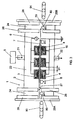
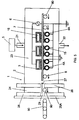
- the plasma treatment apparatus treats an object placed in a discharge space between the electrodes with dielectric barrier discharge plasma. That is, as shown in FIGS. 3 to 8, the apparatus 1 has a treatment chamber 2 having a gas inlet 21 for a plasma-generation gas and a gas outlet 22 for spent gas, at least one pair of upper and lower electrodes ( 3 , 4 , 4A ) for plasma generation, gas supply unit 5 for supplying the plasma-generation gas into the chamber, and a power supply 6 for applying a voltage between the upper and lower electrodes to generate the dielectric barrier discharge plasma of the plasma-generation gas in the discharge space.
- the apparatus 1 has a treatment chamber 2 having a gas inlet 21 for a plasma-generation gas and a gas outlet 22 for spent gas, at least one pair of upper and lower electrodes ( 3 , 4 , 4A ) for plasma generation, gas supply unit 5 for supplying the plasma-generation gas into the chamber, and a power supply 6 for applying a voltage between the upper and lower electrodes to generate the dielectric barrier discharge plasma of the plasma-generation
- the treatment chamber 2 can be made of a synthetic resin such as acrylic resins or a metal material such as stainless steels. To prevent the power loss, improve the discharge efficiency, and stably provide uniform plasma, it is preferred that an insulation layer 19 is formed on the entire inner surface of the chamber 2 , as shown in FIG. 4.
- the insulation layer As a material for the insulation layer, it is possible to use a dielectric compound such as quartz, yttrium partially-stabilized zirconia (Y-PSZ), titania (TiO 2 ), silica (SiO 2 ), alumina (Al 2 O 3 ), aluminum nitride (AlN), silicon carbide (SiC), diamond-like carbon (DLC), barium titanate, lead zirconate titanate (PZT), a resin material such as Teflon®, or a glass-based material that can be used to produce the protection layer of the present invention.
- the insulation layer may be formed on the outer surface of the chamber 2 .
- the insulation layer can be formed by plasma-spraying an inorganic powder such as alumina, barium titanate, tin oxide, PZT or a mixture thereof, to the inner surface of the chamber 2 , or dipping the chamber in a bath filled with molten Teflon®.
- an inorganic powder such as alumina, barium titanate, tin oxide, PZT or a mixture thereof
- a mixture prepared by dispersing the inorganic powders of silica, tin oxide, titania, zirconia and alumina in a solvent is sprayed on the inner surface of the chamber. Then, the sprayed film is heated at 600 °C or more to obtain the insulation layer.
- the insulation layer can be formed by means of chemical vapor deposition (CVD) or physical vapor deposition (PVD).
- the upper and lower electrodes ( 3 , 4 ) are accommodated in the chamber 2 .
- three electrode pairs, each of which is composed of upper and lower electrodes ( 3 , 4 ) each having a rectangular pipe structure, can be arranged parallel with each other such that each of the electrode pairs is spaced from the adjacent electrode pair by a required interval.
- three electrode sets, each of which is composed of a single upper electrode 3 having the rectangular pipe structure and two lower electrodes 4A each having a cylindrical structure can be arranged parallel with each other such that each of the electrode sets is spaced from the adjacent electrode set by a required interval.
- FIG. 2A and 3 three electrode sets, each of which is composed of a single upper electrode 3 having the rectangular pipe structure and two lower electrodes 4A each having a cylindrical structure, can be arranged parallel with each other such that each of the electrode sets is spaced from the adjacent electrode set by a required interval.
- only one set of the single upper electrode 3 and two lower electrodes 4A may be disposed in the chamber 2 .
- at least one electrode pair which is composed of upper and lower electrodes each having a cylindrical structure.
- the upper electrode is arranged parallel with the lower electrode through a required distance.
- Each of the upper and lower electrodes ( 3 , 4 , 4A ) can be supported by use of an electrode holder (not shown) in the chamber 2 .
- a distance ( D ) between the upper electrode 3 and the lower electrode ( 4 , 4A ) is within a range of 1 to 20 mm, and more preferably 3 to 5 mm.
- the distance ( D ) is less than 1 mm, there is a possibility that a short circuit happens.
- the distance ( D ) is more than 20 mm, it may become difficult to stably provide uniform plasma.
- the gas supply unit 5 controls a flow amount of the plasma-generation gas.
- the power supply 6 provides an AC or pulse-like voltage between the upper and lower electrodes. Concretely, it is preferred that a frequency of the AC or pulse-like voltage is within a range of 1 kHz to 200 MHz according to reasons described later.
- the plasma treatment apparatus 1 comprises the electrode cooling unit for circulating a coolant 15 through the tubular electrodes to maintain the electrode temperature constant during the plasma generation.
- the electrode temperature may excessively increase, so that streamer discharge (arc discharge) easily occurs between the electrode and the object 7 .
- the occurrence of streamer discharge becomes a cause of thermal damage of the object. Therefore, in such a case, the electrode cooling unit is effective to stably provide the plasma treatment without the streamer discharge.
- the coolant 15 it is possible to use ion-exchange water or pure water.
- the coolant is a liquid having antifreeze property at 0 °C as well as electrical insulation.
- the electrical insulation it is preferred that the coolant has a withstand voltage of at least 10 kV under 0. 1 mm interval.
- the coolant having the electrical insulation of the above range is suitable to prevent the occurrence of a leakage current when a high voltage is applied between the upper and lower electrodes.
- a coolant for example, it is possible to use perfluorocarbon, hydrofluoro ether or a mixture obtained by adding 5 to 60 wt% of ethylene glycol to pure water.
- the plasma treatment apparatus comprises a conveying unit 8 for feeding an object 7 to be treated into the discharge space between the upper and lower electrodes ( 3 , 4 or 4A ) and removing a plasma-treated object from the discharge space.
- a conveying unit 8 for feeding an object 7 to be treated into the discharge space between the upper and lower electrodes ( 3 , 4 or 4A ) and removing a plasma-treated object from the discharge space.
- a plurality of rollers 80 are arranged at a space other than the discharge space in the chamber. It is preferred that each of the rollers 80 is made of a synthetic resin having excellent heat resistance such as Teflon®.
- the rollers can be rotated by a drive unit (not shown) to feed the object 7 in a direction shown by the arrows in FIG. 3.
- the numerals 90 , 91 designate belt conveyers disposed at the incoming and outgoing sides of the chamber 2 , respectively.
- each of the lower electrodes 4A is rotatably supported about its axis in the chamber 2 , and can be rotated by a drive unit 50 through a power transfer belt 52 such as a rubber belt. Therefore, the lower electrodes 4A act as the rollers 80 as well as the electrodes for plasma-generation.
- a brush 70 contacts a side surface of a round bar 86 projecting on one end of the lower electrode 4A .
- the brush 70 has a concave end 71 having a radius of curvature, which is substantially the same as the radius of the round bar 86 . Therefore, the concave end 71 of the brush slidably fits the side surface of the round bar 86 .
- the brush 70 is slidably supported in a guide cylinder 74 .
- a spring 76 is disposed in the guide cylinder 74 such that a spring bias is given to the brush 70 in a direction of pressing the brush against the round bar 86 . Therefore, the brush 70 always contacts the round bar 86 during the rotation of the lower electrode 4A . Thus, the electric wire 72 is connected to the lower electrode 4A through the round bar 86 and the brush 70 . In this case, it is possible to reduce the dimensions of the chamber 2 by minimizing the number of the rollers 80 of the conveying unit 8 .
- the chamber 2 has a treatment room 23 , in which the electrodes ( 3 , 4, 4A ) are arranged, and the object 7 is treated with the dielectric barrier discharge plasma, and at least one relaxation room 24 disposed adjacent to the treatment room.
- the relaxation room 24 is suitable to prevent the entry of the outside air into the treatment room 23 and a leakage of the plasma-generation gas from the chamber 2 to the outside.
- incoming and outgoing gates 25A , 25B are disposed at the opposite sides of the chamber 2 , as shown in FIG. 3 or 7.
- the plasma treatment apparatus 1 becomes an inline-type structure.
- a single gate 25A can be disposed at one side of the chamber 2 , as shown in FIG. 5.
- the plasma treatment apparatus 1 becomes a shuttle-type structure.
- the gate ( 25A , 25B ) it is possible to use a conventional shutter that can be moved up or down by use of air or oil pressure.
- the gate when using a sensor for detecting the approach of the object 7 to the gate ( 25A , 25B ), the gate can be automatically opened and closed according to a signal detected by the sensor. Therefore, the sensor is useful to realize an automated plasma-treatment line.
- the object 7 is treated by the dielectric barrier discharge plasma of the plasma-generation gas generated between the upper and lower electrodes ( 3 , 4 or 4A ) in the vicinity of atmospheric pressure.
- the plasma-generation gas comprises rare gas and a mixture of the rare gas and a reactive gas.
- the rare gas it is possible to use helium, argon, neon and krypton, and more preferably helium, argon or a mixture thereof.
- the reactive gas for example, it is possible to use an oxidation gas such as oxygen, air, CO 2 , water vapor or N 2 O, fluorine-contained gas such as CF 4 , and a reduction gas such as hydrogen and ammonium.
- an oxidation gas such as oxygen, air, CO 2 , water vapor or N 2 O
- fluorine-contained gas such as CF 4
- a reduction gas such as hydrogen and ammonium.
- an additive amount of the reactive gas is 10 wt% or less and more preferably within a range of 0.1 to 5 wt%, with regard to the amount of the rare gas.
- the plasma-treatment effect may be insufficient.
- the additive amount is more than 10 wt%, the dielectric barrier discharge plasma generated under atmospheric pressure may become unstable.
- the frequency of the AC or pulse-like voltage is within the range of 1 kHz to 200 MHz.
- the frequency is less than 1 kHz, it may become difficult to stably maintain the atmospheric pressure plasma during the plasma treatment.
- the frequency is more than 200 MHz, the temperature of the atmospheric-pressure plasma increases, so that the electrode life may decrease. In addition, it may become difficult to provide uniform plasma treatment.
- a plasma treatment apparatus 1 of the present invention used in Example 1 is shown in FIG. 3.
- the apparatus 1 comprises a treatment chamber 2 having a gas inlet 21 for a plasma-generation gas and a gas outlet 22 for spent gas, three pairs of upper and lower electrodes ( 3 , 4 ) accommodated in the chamber, gas supply unit 5 for supplying the plasma-generation gas into the chamber, and an power supply 6 .
- the chamber 2 is made of a stainless steel (JIS (Japanese Industrial Standard): SUS 304) and has dimensions of 860 mm width x 116 mm height x 800 mm length.
- Each of the upper and lower electrodes 3 , 4 is provided with an electrode substrate 10 , which is of a rectangular pipe structure having the dimensions of 32 mm width x 16 mm height x 911 mm length, protection layer 12 on an outer surface of the electrode substrate, and a corrosion resistance layer 14 on an inner surface of the electrode substrate, as shown in FIG. 1B.
- the electrode substrate 10 was produced by preparing a rectangular plate of a stainless steel (JIS: SUS 304) having a thickness of 1.5 mm, and densely welding a side of the rectangular plate to the opposite side by means of radio-frequency welding, while preventing the occurrence of remaining voids at the welded joint.
- a radius of curvature of the respective corner portion of the electrode substrate 10 is about 1.5 mm.
- the protection layer 12 was formed on the outer surface of the electrode substrate by repeating a heat-fusion coating explained below three times. That is, the heat-fusion coating comprises the steps of applying about 300 to 500 g of a glass-based material on the outer surface of the electrode substrate by use of a spray gun to obtain an applied film, drying the applied film at about 100 °C, and heating the applied film at about 850 °C for 10 minutes.
- the glass-based material for the spray coating was prepared by the following steps.
- a frit including alumina, silica and titania as main ingredients was prepared by melting and then rapid cooling these inorganic powders.
- a mixture was obtained by adding sodium aluminate and potassium carbonate to the frit in the presence of water as a solvent. After the mixture was milled for a required time period, it was allowed to pass a 200 mesh sieve (aperture size: 74 ⁇ m) to obtain a slurry as the glass-based material.
- the protection layer 12 having the thickness of about 0.5 mm and the withstand voltage of 20 kV was obtained on the electrode substrate 10 .
- the composition of the protection layer 12 is shown in Table 1.
- a by-product (rust) that occurs on the inner surface of the electrode substrate 10 during the heat-fusion coating was removed by keeping the electrode substrate in an acid cleaning fluid for 180 minutes to obtain a fresh inner surface thereof.
- a chromate treatment was performed by keeping the electrode substrate in a chromate solution for 120 minutes, to obtain the corrosion resistance layer 14 on the fresh inner surface of the electrode substrate 10 .
- the upper and lower electrodes 3 , 4 produced by the above procedure are arranged parallel with each other in the chamber 2 , as shown in FIG. 3, such that the distance ( D ) between the upper and lower electrodes 3 , 4 of each electrode pair is 3 mm, and a pitch ( P ) between adjacent electrode pairs is 40 mm.
- the treatment chamber 2 has a plasma-treatment room 23 , in which an object 7 is treated with dielectric barrier discharge plasma, and two relaxation rooms 24 at the both sides of the treatment room for preventing the entry of the outside air into the plasma-treatment room and a leakage of the plasma-generation gas from the chamber to the outside.
- the plasma-treatment room 23 is isolated from each of the relaxation rooms 24 by an inner side-wall 26 having a slit 27 used to feed the object 7 into the treatment room 23 .
- the relaxation rooms 24 are respectively isolated from the outside by the incoming and outgoing gates 25A , 25B each having an air-pressure open/close mechanism through an outer side-wall 28 having a slit 29 used to feed the object 7 into the relaxation room 24 .
- the apparatus 1 of Example 1 has an inline-type structure that the object is fed from the incoming gate 25A into the chamber 2 , and a plasma-treated object is removed from the chamber through the outgoing gate 25B .
- the plasma treatment apparatus 1 also comprises a conveying unit 8 for feeding the object 7 into the treatment room 23 and removing the plasma-treated object from the treatment room through the outgoing gate 25B .
- the conveying unit 8 has a plurality of rollers 80 and a drive unit (not shown) for rotating the rollers.
- the apparatus 1 has an electrode cooling unit for circulating a coolant 15 through the respective electrodes.
- Example 1 By use of the above apparatus 1 of Example 1, the following plasma treatment was performed.
- a glass plate for liquid crystal display (LCD) was used, which has the dimensions of 750 mm x 600 mm x 0.7 mm.
- the plasma-generation gas helium was supplied with a flow amount of 8 liter/min into the chamber 2 through the gas inlet 21 .
- Ion exchange water of the coolant 15 was circulated through the electrodes 3 , 4 during the plasma treatment. The temperature of ion exchange water was maintained at about 20 °C by the electrode cooling unit.
- All of the lower electrodes 4 are grounded, and all of the upper electrodes 3 are connected to the power supply 6 .
- 2 kV of AC voltage was applied between the upper and lower electrodes 3 , 4 to generate the dielectric barrier discharge plasma of helium therebetween under atmospheric pressure.
- the applied electric power is 1600 W.
- a frequency of the AC voltage is 100 kHz.
- the glass plate of the object 7 was conveyed in front of the incoming gate 25A by a first belt conveyer 90 . Then, the incoming gate 25A was opened to feed the glass plate 7 into the chamber 2 . After the entry of the glass plate into the chamber was finished, the incoming gate 25A was closed. The glass plate was treated with the plasma, while being fed at a speed of 200 mm/sec by the conveying unit 8 .
- the plasma-treated object was fed to the relaxation room 24 adjacent to the outgoing gate 25B .
- the outgoing gate 25B was opened, and then the plasma-treated object was removed from the chamber 2 by a second belt conveyer 91 . Since a mirror reflective-type sensor detects the approach of the object 7 to the gate ( 25A, 25B ), the gate can be automatically opened and closed according to a signal detected by the sensor.
- a contact angle of water with the glass plate was measured before and after the plasma treatment. That is, the contact angle of water with the untreated glass plate is 45 degrees. On the other hand, the contact angle of water with the plasma-treated glass plate is 5 degrees. Thus, the contact angle of water can be remarkably reduced by the plasma treatment. In addition, variations in contact angle of water with the plasma-treated glass plate narrow to a range of 5 degrees ⁇ 4 degrees.
- the plasma treatment apparatus 1 could stably provide uniform plasma without the occurrence of unusual discharge and a serious damage of the protection layer.
- each of the upper and lower electrodes 3 , 4 has the corrosion resistance layer 14 , there was no contamination of ion exchange water even after the elapse of the six months of the plasma treatment.
- the distance ( D ) between the upper and lower electrodes 3 , 4 of each electrode pair is 5 mm, similar results were obtained.
- an insulation layer 19 was formed on the entire inner surface of the chamber 2 by the following method. That is, a glass-based material, which is the same as one used to produce the protection layer 12 of the electrodes 3 , 4 was sprayed on the entire inner surface of the chamber. Then, the sprayed film was heated at about 850 °C for 10 minutes to obtain the insulation layer 19 .
- the thickness and withstand voltage of the insulation layer 19 are about 0. 1 mm and about 2 kV, respectively.
- the distance ( D ) between the upper and lower electrodes 3 , 4 is 10 mm
- a distance between the lower electrode 4 and the insulation layer 19 on an inner bottom surface of the chamber 2 of FIG. 4 is 10 mm.
- a distance between the lower electrode 4 and an inner bottom surface having no insulation layer of the chamber 2 of FIG. 3 is 40 mm.
- the plasma treatment was performed under the same conditions as the above. No unusual discharge occurred during the experiment even though the distance between the lower electrode 4 and the inner bottom surface of the chamber 2 is reduced. Thus, the formation of the Insulation layer 19 is useful to minimize the dimensions of the chamber, while preventing the occurrence of the unusual discharge.
- FIG. 5 A plasma treatment apparatus 1 of the present invention of Example 2 is shown in FIG. 5.
- the apparatus 1 of FIG. 5 is substantially the same as that of FIG. 3 except for the following features. Details of electrodes 3 , 4A and conditions of the plasma treatment of Example 2 are shown in Tables 1 and 2.
- the apparatus 1 of Example 2 is characterized in that three electrode sets, each of which is composed of a single upper electrode 3 having a rectangular pipe structure and two lower electrodes 4A each having a cylindrical structure, are arranged parallel with each other such that a distance ( D ) between the upper and lower electrodes is 3 mm, as shown in FIG. 2B.
- Each of the upper and lower electrodes 3 , 4A is formed with an electrode substrate 10 , which is a seamless pipe of a stainless steel (JIS: SUS304) produced by extrusion, and a protection layer 12 on an outer surface of the seamless pipe 10 .
- the protection layer 12 was formed under the same conditions of the heat-fusion coating as Example 1 except that the glass-based material for the spray coating was prepared by the following steps.
- a frit including alumina, silica and titania as main ingredients was prepared by melting and then rapid cooling these inorganic powders.
- a mixture was obtained by adding sodium aluminate, potassium carbonate and magnesium carbonate to the frit in the presence of water as a solvent. After the mixture was milled for a required time period, it was allowed to pass a 325 mesh sieve (aperture size: 44 ⁇ m) to obtain a slurry as the glass-based material.
- the protection layer 12 has the thickness of about 1 mm and the withstand voltage of 50 kV.
- the composition of the protection layer 12 is shown in Table 1. After the protection layer was formed, a by-product (rust) that occurs on the inner surface of the seamless pipe by the heat-fusion coating was removed by keeping the seamless pipe in an acid cleaning fluid for 120 minutes to obtain a fresh inner surface of seamless pipe.
- the three electrode sets of the electrodes 3, 4A produced by the above procedure are arranged parallel with each other in the chamber 2 , as shown in FIG. 5, such that a pitch ( P ) between adjacent electrode sets is 40 mm.
- Example 2 a glass plate for LCD having the dimensions of 750 mm x 600 mm x 0.7 mm was used as an object to be treated.
- a mixture gas of helium and oxygen was supplied as the plasma-generation gas into the chamber 2 through the gas inlet 21 .
- a flow amount of helium is 8 liter/min.
- a flow amount of oxygen is 100 cc/min.
- All of the lower electrodes 4A are grounded, and all of the upper electrodes 3 are connected to the power supply 6 .
- 2 kV of AC voltage was applied between the upper and lower electrodes to generate the dielectric barrier discharge plasma of the mixture gas in a discharge space therebetween under atmospheric pressure.
- the applied electric power is 1600 W.
- a frequency of the AC voltage is 100 kHz.
- the glass plate was conveyed in front of a gate 25A by a belt conveyer 90 . Then, the gate 25A was opened to feed the glass plate 7 into the chamber 2 . After the entry of the glass plate into the chamber was finished, the gate 25A was closed. The glass plate was treated with the plasma, while being fed at a speed of 74 mm/sec by the conveying unit 8 . After the plasma treatment was finished, the plasma-treated object was conveyed toward the gate 25A from the treatment room 23 . Then, the gate 25A was opened again, and the plasma-treated object was removed from the chamber 2 by the belt conveyer 90 .
- the plasma treatment apparatus 1 of Example 2 has a shuttle type structure that the object 7 is conveyed from the gate 25A into the chamber 2 and the plasma-treated object is removed from the chamber through the same gate.
- a contact angle of water with the glass plate was measured before and after the plasma treatment. That is, the contact angle of water with the untreated glass plate is 45 degrees. On the other hand, the contact angle of water with the plasma-treated glass plate is 7 degrees. Thus, the contact angle of water can be remarkably reduced by the plasma treatment. In addition, variations in contact angle of water with the plasma-treated glass plate narrows to a range of 7 degrees ⁇ 3 degrees.
- the plasma treatment apparatus could stably provide uniform plasma without the occurrence of unusual discharge and a damage of the protection layer. In addition, there was no contamination of the plasma-treated object during the six months of the plasma treatment.
- the distance ( D ) between the upper and lower electrodes 3 , 4 of each electrode pair is 5 mm, similar results were obtained.
- FIG. 6 A plasma treatment apparatus 1 of the present invention of Example 3 is shown in FIG. 6.
- the apparatus 1 of FIG. 6 is substantially the same as that of FIG. 5 except for the following features. Details of electrodes 3 , 4A and conditions of the plasma treatment of Example 3 are shown in Tables 1 and 2.
- the apparatus 1 of Example 3 is characterized in that a single electrode pair, which is composed of one upper electrode 3 having a rectangular pipe structure and two lower electrodes 4A having a cylindrical structure, is arranged in the chamber 2 .
- Each of the upper and lower electrodes 3 , 4A is formed with an electrode substrate 10 , which is a seamless pipe of a stainless steel (JIS: SUS304) produced by extrusion, and a protection layer 12 on an outer surface of the seamless pipe.
- JIS: SUS304 stainless steel
- the protection layer was formed on the seamless pipe by repeating a heat-fusion coating described below three times. That is, the heat-fusion coating comprises the steps of applying about 150 g of a glass-based material on the outer surface of the seamless pipe by use of a spray gun to obtain an applied film, drying the applied film at about 100 °C and heating the applied film at about 850 °C for 10 minutes.
- the glass-based material for the spray coating was prepared by the following steps.
- a frit including alumina, silica and titania as main ingredients was prepared by melting and then rapid cooling these inorganic powders.
- a mixture was obtained by adding sodium aluminate and potassium carbonate to the frit in the presence of water as a solvent. After the mixture was milled for a required time period, it was allowed to pass a 200 mesh sieve (aperture size: 74 ⁇ m) to obtain a slurry as the glass-based material.
- the protection layer 12 having the thickness of about 0.5 mm and the withstand voltage of 20 kV was obtained on the electrode substrate 10 .
- the composition of the protection layer 12 is shown in Table 1.
- the upper and lower electrodes 3 , 4A are arranged parallel with each other in the chamber 2 such that a distance ( D ) between the upper and lower electrodes is 5 mm.
- the apparatus 1 of Example 3 is of a batch-type structure not having the relaxation room and the conveying unit.
- the chamber 2 is made of an acrylic resin.
- the numeral 60 designates a sample stage disposed in the chamber 2 .
- Example 3 a silicon substrate having a 1- ⁇ m thickness film of a negative-type resist material was used as an object to be treated, and placed on the sample stage 60 .
- a mixture gas of helium, argon and oxygen was supplied as the plasma-generation gas into the chamber 2 through a gas inlet 21 .
- a flow amount of helium is 1 liter/min.
- a flow amount of oxygen is 60 cc/min.
- a flow amount of argon is 3 liter/min.
- Ion exchange water of the coolant maintained at about 20 °C was circulated through the respective electrodes during the plasma treatment.
- the lower electrodes 4A are grounded, and the upper electrode 3 is connected to the power supply 6 .
- 2 kV of AC voltage was applied between the upper and lower electrodes to generate the dielectric barrier discharge plasma of the mixture gas in a discharge space therebetween under atmospheric pressure.
- the applied electric power is 250 W.
- a frequency of the AC voltage is 100 kHz.
- the plasma treatment apparatus By performing the plasma treatment to the silicon substrate for about 20 seconds, the resist film was etched uniformly. In addition, no impurity other than the resist ingredients was substantially detected by XPS (X-ray photoelectron spectroscopy) analysis. Even after the plasma treatment was continuously performed for about six months, the plasma treatment apparatus could stably provide uniform plasma without the occurrence of unusual discharge and a damage of the protection layer.
- XPS X-ray photoelectron spectroscopy
- Example 4 A plasma treatment of the present invention of Example 4 was performed by use of the apparatus 1 of Example 3.
- an object to be treated was prepared by screen-printing a silver-palladium paste on a sintered alumina substrate, and baking a resultant product to obtain a circuit board having a bonding-pad portion thereon.
- a mixture gas of helium, argon and oxygen was supplied as the plasma-generation gas into the chamber 2 .
- a flow amount of helium is 1 liter/min.
- a flow amount of hydrogen is 30 cc/min.
- a flow amount of argon is 3 liter/min.
- Conditions of the plasma treatment of Example 4 are shown in Table 3.
- the plasma treatment was performed to the object for about 5 seconds. From results of the XPS analysis, a peak of silver oxide was detected from the object before the plasma treatment. However, after the plasma treatment, the peak of silver oxide disappeared, and a peak of metal silver was detected. This means reduction of silver oxide of the bonding-pad portion to metal silver. Even after the plasma treatment was continuously performed for about six months, the plasma treatment apparatus could stably provide uniform plasma without the occurrence of unusual discharge and a damage of the protection layer.
- FIG. 7 A plasma treatment apparatus 1 of Example 5 of the present invention is shown in FIG. 7.
- the apparatus 1 of FIG. 7 is substantially the same as that of FIG. 5 except for the following features. Details of electrodes 3 , 4A and conditions of the plasma treatment are shown in Tables 1 and 3.
- the plasma treatment apparatus of Example 5 is characterized in that a roller 80 of Teflon® for conveying an object 7 to be treated is disposed in a space between adjacent electrode pairs of three electrode pairs, each of which is composed of a single upper electrode 3 having a rectangular pipe structure and two lower electrodes 4A each having a cylindrical structure.
- the diameter and length of the roller 80 are 20 mm and 400 mm, respectively.
- Each of the rollers 80 can be rotated by a drive unit (not shown) disposed outside of the chamber 2 .
- one end of the roller 80 is projected outside from a rear wall of the chamber 2 through an airtight seal member.
- the projected ends of the rollers 80 are coupled to the drive unit by use of a power transfer belt (not shown).
- the apparatus 1 of this Example has no relaxation room. Therefore, the dimensions of the chamber 2 can be reduced by the proper locations of the rollers 80 in the chamber and the omission of the relaxation room.
- Incoming and outgoing gates 25A , 25B each having an air-pressure open/close mechanism are disposed adjacent to opposite side walls 26 of the chamber 2 .
- Each of the side walls 26 has a slit 27 for feeding the object into the chamber 2 .
- An object to be treated was prepared by placing three silicon substrates each having a 1- ⁇ m thickness film of a negative-type resist material on a glass plate having the dimensions of 300 mm x 300 mm x 2 mm.
- a mixture gas of helium, argon and oxygen was supplied as the plasma-generation gas into the chamber.
- a flow amount of helium is 1 liter/min.
- a flow amount of oxygen is 60 cc/min.
- a flow amount of argon is 3 liter/min.
- the chamber 2 is made of an acrylic resin and has the dimensions of 520 mm length x 352 mm width x 200 mm height.
- All of the lower electrodes 4A are grounded, and all of the upper electrodes 3 are connected to the power supply 6 .
- 2 kV of AC voltage was applied between the upper and lower electrodes to generate the dielectric barrier discharge plasma of the mixture gas in the discharge space therebetween under atmospheric pressure.
- the applied electric power is 250 W.
- a frequency of the AC voltage is 100 kHz.
- a conveying speed of the object is 2 mm/sec in the discharge space.
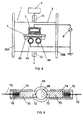
- FIG. 8 A plasma treatment apparatus 1 of Example 6 of the present invention is shown in FIG. 8.
- the apparatus of FIG. 8 is substantially the same as that of FIG. 5 except for the following features. Therefore, no duplicate explanation is deemed necessary. Details of electrodes 3 , 4A and conditions of the plasma treatment are shown in Tables 1 and 3.
- the apparatus 1 three electrode pairs, each of which is composed of a single upper electrode 3 having a rectangular pipe structure and two lower electrodes 4A having a cylindrical structure, are arranged according to the same manner as the apparatus of FIG. 5.
- a distance ( D ) between the upper and lower electrodes of each electrode pair is 5 mm.
- the chamber 2 is made of an acrylic resin and has the dimensions of 520 mm length x 352 mm width x 200 mm height.
- Each of the lower electrodes 4A is rotatably supported about its axis in the chamber 2 , and has a round bar 86 extending from its one end in an axial direction thereof.
- the round bar 86 is projected from a rear wall of the chamber through an airtight seal member, and coupled to a drive unit 50 through a rubber belt 52 .
- an object 7 on the lower electrodes moves horizontally in the discharge space, as shown by the arrows in FIG. 8.
- each of the lower electrodes 4A also acts as a roller 80 for conveying the object 7 .
- the following plasma treatment was performed.
- a silicon wafer each having a 1- ⁇ m thickness film of a negative-type resist material was used as an object 7 to be treated.
- the diameter of the silicon wafer is 100 mm.
- a mixture gas of helium, argon and oxygen was supplied as the plasma-generation gas into the chamber 2 through a gas inlet 21 .
- a flow amount of helium is 3 liter/min.
- a flow amount of oxygen is 80 cc/min.
- a flow amount of argon is 1 liter/min.
- All of the lower electrodes 4A are grounded, and all of the upper electrodes 3 are connected to the power supply 6 .
- 5 kV of AC voltage was applied between the upper and lower electrodes to generate the dielectric barrier discharge plasma of the mixture gas in a discharge space therebetween under atmospheric pressure.
- the applied electric power is 350 W.
- a frequency of the AC voltage is 13.56 MHz.
- the silicon wafer was conveyed at a speed of 3 mm/sec by rotation of the lower electrodes 4A acting as the rollers 80 .
- a plasma treatment apparatus of Comparative Example 1 is substantially the same as that of Example 1 except that each of upper and lower electrodes has a ceramic-sprayed layer produced by a conventional ceramic spraying method in place of the protection layer of Example 1.
- the ceramic-sprayed layer is an alumina-sprayed film having the thickness of about 0.5 mm.
- Example 1 By use of the apparatus of Comparative Example 1, a plasma treatment was performed under the same conditions as Example 1. In the plasma treatment, the occurrence of spark discharge was observed. It is presumed that the presence of pinholes in the ceramic-prayed film is a cause of the spark discharge. In addition, a serious damage of the ceramic-sprayed film occurred after the plasma treatment was continuously performed for about two months.
- a plasma treatment apparatus of Comparative Example 2 is substantially the same as that of Example 2 except that each of upper and lower electrodes has a ceramic-sprayed layer produced by a conventional ceramic spraying method in place of the protection layer of Example 2.
- the protection layer is an alumina-sprayed film having the thickness of about 0.5 mm.
- the electrodes for plasma generation of the present invention exhibit the outstanding performance in the plasma treatments of Examples 1-6.
- the electrodes of the present invention can be also used in a plasma-treatment apparatus for removing foreign substances such as organic substances from objects to be treated, improving adhesion of organic films, surface modification, film formation, or reducing metal oxides.
- the plasma treatment apparatus with the electrodes of the present invention is suitable to efficiently treat objects with atmospheric pressure plasma of rare gas or a mixture of the rare gas and a reactive gas.
Landscapes
- Physics & Mathematics (AREA)
- Engineering & Computer Science (AREA)
- Plasma & Fusion (AREA)
- Chemical & Material Sciences (AREA)
- Analytical Chemistry (AREA)
- Plasma Technology (AREA)
- Treatments Of Macromolecular Shaped Articles (AREA)
Applications Claiming Priority (4)
| Application Number | Priority Date | Filing Date | Title |
|---|---|---|---|
| JP21287299 | 1999-07-27 | ||
| JP21287199 | 1999-07-27 | ||
| JP21287199A JP4306033B2 (ja) | 1999-07-27 | 1999-07-27 | プラズマ処理装置及びプラズマ処理方法 |
| JP21287299 | 1999-07-27 |
Publications (2)
| Publication Number | Publication Date |
|---|---|
| EP1073091A2 true EP1073091A2 (fr) | 2001-01-31 |
| EP1073091A3 EP1073091A3 (fr) | 2004-10-06 |
Family
ID=26519473
Family Applications (1)
| Application Number | Title | Priority Date | Filing Date |
|---|---|---|---|
| EP00116050A Withdrawn EP1073091A3 (fr) | 1999-07-27 | 2000-07-26 | Electrode pour la production de plasma, appareil de traitement par plasma utilisant une telle électrode, et traitement par plasma à l'aide de cet appareil |
Country Status (5)
| Country | Link |
|---|---|
| US (1) | US6489585B1 (fr) |
| EP (1) | EP1073091A3 (fr) |
| KR (1) | KR100368200B1 (fr) |
| CN (1) | CN100393182C (fr) |
| TW (1) | TW494709B (fr) |
Cited By (18)
| Publication number | Priority date | Publication date | Assignee | Title |
|---|---|---|---|---|
| WO2003092039A1 (fr) * | 2002-04-24 | 2003-11-06 | Apit Corp. S.A. | Dispositif pour le traitement de surface de recipients par plasma |
| NL1023072C2 (nl) * | 2003-04-01 | 2004-10-04 | Tno | Werkwijze en systeem voor het opwekken van een plasma. |
| WO2004090931A3 (fr) * | 2003-04-10 | 2005-04-28 | Bae Systems Plc | Procede et dispositif pour le traitement d'une surface par decharge de plasma |
| WO2005095007A1 (fr) * | 2004-03-31 | 2005-10-13 | Vlaamse Instelling Voor Technologisch Onderzoek (Vito ) | Procede et dispositif de revetement d'un substrat au moyen d'une decharge controlee par barriere dielectrique |
| EP1650326A2 (fr) | 2004-10-22 | 2006-04-26 | Sharp Kabushiki Kaisha | Dispositif de traitement par plasma |
| WO2007104512A1 (fr) * | 2006-03-11 | 2007-09-20 | Fachhochschule Hildesheim/Holzminden/Göttingen | Dispositif de traitement au plasma sous pression atmosphérique |
| WO2007142612A1 (fr) * | 2006-06-08 | 2007-12-13 | Faculty Of Mathematics, Physics And Informatics Of Comenius University | Appareil et procédé pour le nettoyage, l'attaque chimique, l'activation et traitement subséquent de surfaces de verre, surfaces de verre revêtues d'oxydes métalliques, et surfaces d'autres matériaux revêtus de sio2 |
| FR2912256A1 (fr) * | 2007-02-06 | 2008-08-08 | Air Liquide | Appareil pour traitement de surface au moyen d'une decharge a barriere dielectrique dans un gaz |
| US7666478B2 (en) * | 2004-04-30 | 2010-02-23 | Vlaamse Instelling Voor Technologisch Onderzoek (Vito) | Biomolecule immobilisation using atmospheric plasma technology |
| WO2011157425A1 (fr) * | 2010-06-17 | 2011-12-22 | WPNLB UG (haftungsbeschränkt) & Co. KG | Dispositif de traitement au plasma et/ou de revêtement au plasma en continu d'un morceau de matière |
| CN103298234A (zh) * | 2013-06-21 | 2013-09-11 | 东南大学 | 一种低温等离子体射流产生装置 |
| WO2014009883A3 (fr) * | 2012-07-11 | 2014-03-06 | Asahi Glass Company, Limited | Dispositif et processus pour empêcher des dommages de substrat dans une installation de plasma dbd |
| CN103813609A (zh) * | 2013-04-16 | 2014-05-21 | 杜志刚 | 等离子二氧化碳高压气体发热装置方法 |
| CN103813606A (zh) * | 2013-04-16 | 2014-05-21 | 杜志刚 | 等离子高压气体发热装置 |
| CN103813608A (zh) * | 2013-04-16 | 2014-05-21 | 杜志刚 | 等离子高压气体发热方法 |
| CN103841741A (zh) * | 2014-03-12 | 2014-06-04 | 中国科学院电工研究所 | 基于介质阻挡放电的大气压等离子体发生装置 |
| EP2915901A1 (fr) * | 2014-03-07 | 2015-09-09 | Roth & Rau AG | Dispositif de traitement par plasma avec recirculation de gaz de processus dans de multiples plasmas |
| JP2016531436A (ja) * | 2013-08-07 | 2016-10-06 | 北京北方微▲電▼子基地▲設▼▲備▼工▲芸▼研究中心有限▲責▼任公司 | プレクリーニングチャンバおよび半導体処理装置 |
Families Citing this family (94)
| Publication number | Priority date | Publication date | Assignee | Title |
|---|---|---|---|---|
| AU2002210861A1 (en) * | 2000-10-26 | 2002-05-06 | Dow Corning S.A. | An atmospheric pressure plasma assembly |
| CN1322556C (zh) * | 2001-02-15 | 2007-06-20 | 东京毅力科创株式会社 | 被处理件的处理方法及处理装置 |
| US20030168009A1 (en) * | 2002-03-08 | 2003-09-11 | Denes Ferencz S. | Plasma processing within low-dimension cavities |
| US20040076543A1 (en) * | 2002-03-18 | 2004-04-22 | Sokolowski Asaf Zeev | System and method for decontamination and sterilization of harmful chemical and biological materials |
| US6981767B2 (en) * | 2003-01-15 | 2006-01-03 | Ssgii, Inc. | Printed item having an image with a high durability and/or resolution |
| US20040135828A1 (en) * | 2003-01-15 | 2004-07-15 | Schmitt Stephen E. | Printer and method for printing an item with a high durability and/or resolution image |
| EP1588592B1 (fr) * | 2003-01-31 | 2009-12-09 | Dow Corning Ireland Limited | Ensemble d'electrodes pour la generation de plasma |
| US7303789B2 (en) * | 2003-02-17 | 2007-12-04 | Ngk Insulators, Ltd. | Methods for producing thin films on substrates by plasma CVD |
| KR20050116833A (ko) * | 2003-03-31 | 2005-12-13 | 코니카 미노루따 호르딩구스 가부시끼가이샤 | 박막 형성 장치 및 박막 형성 방법 |
| DE10320472A1 (de) * | 2003-05-08 | 2004-12-02 | Kolektor D.O.O. | Plasmabehandlung zur Reinigung von Kupfer oder Nickel |
| JP2004332081A (ja) * | 2003-05-12 | 2004-11-25 | Shin Etsu Chem Co Ltd | 耐プラズマ部材及びその製造方法 |
| JP2005097018A (ja) * | 2003-09-22 | 2005-04-14 | Air Water Inc | 難帯電ガラス基板の製法およびそれによって得られた難帯電ガラス基板 |
| US7737382B2 (en) * | 2004-04-01 | 2010-06-15 | Lincoln Global, Inc. | Device for processing welding wire |
| DE102004019741B4 (de) * | 2004-04-20 | 2006-04-27 | Centrotherm Photovoltaics Gmbh + Co. Kg | Plasmareaktor zur Oberflächenmodifikation von Gegenständen |
| DE102004043967B4 (de) * | 2004-09-11 | 2010-01-07 | Roth & Rau Ag | Anordnung und Verfahren zur Plasmabehandlung eines Substrates |
| JP2006100031A (ja) * | 2004-09-28 | 2006-04-13 | Nittetsu Mining Co Ltd | 絶縁体被膜層担持電極を有する気体励起装置、及び気体励起方法 |
| KR100587691B1 (ko) * | 2004-10-28 | 2006-06-08 | 삼성전자주식회사 | 반도체 장치 제조용 확산설비 |
| US20060175291A1 (en) * | 2005-02-10 | 2006-08-10 | Hunt John A | Control of process gases in specimen surface treatment system |
| US20060175013A1 (en) * | 2005-02-10 | 2006-08-10 | Michael Cox | Specimen surface treatment system |
| US20060175014A1 (en) * | 2005-02-10 | 2006-08-10 | Michael Cox | Specimen surface treatment system |
| CN101218723A (zh) * | 2005-05-31 | 2008-07-09 | 日铁矿业株式会社 | 具有悬挂电极的气体激励装置及气体激励方法 |
| DE102005029360B4 (de) * | 2005-06-24 | 2011-11-10 | Softal Corona & Plasma Gmbh | Zwei Verfahren zur kontinuierlichen Atmosphärendruck Plasmabehandlung von Werkstücken, insbesondere Materialplatten oder -bahnen |
| EP1741826A1 (fr) * | 2005-07-08 | 2007-01-10 | Nederlandse Organisatie voor Toegepast-Natuuurwetenschappelijk Onderzoek TNO | Méthode pour déposer une couche de polymère contenant un nano-materiau sur un substrat et appareil pour celà |
| WO2007015445A1 (fr) * | 2005-08-02 | 2007-02-08 | Dialight Japan Co., Ltd. | Générateur de plasma et procédé de fabrication de pellicule l’employant |
| KR100735868B1 (ko) * | 2005-08-04 | 2007-07-06 | 주식회사 누리테크 | 패럴린 코팅 전처리용 플라즈마 발생장치 |
| US20070037408A1 (en) * | 2005-08-10 | 2007-02-15 | Hitachi Metals, Ltd. | Method and apparatus for plasma processing |
| CN100374396C (zh) * | 2005-12-31 | 2008-03-12 | 大连海事大学 | 常压冷等离子体纳米陶瓷粉体制备设备和方法 |
| KR100723242B1 (ko) * | 2006-02-03 | 2007-05-29 | 엘에스전선 주식회사 | 액면 유도 전극을 이용한 대기압 플라즈마 발생 장치 |
| JPWO2007091412A1 (ja) * | 2006-02-08 | 2009-07-02 | コニカミノルタホールディングス株式会社 | パターン膜形成方法及びパターン膜形成装置 |
| KR100723378B1 (ko) * | 2006-02-09 | 2007-05-30 | 주식회사 래디언테크 | 플라즈마 처리 장치 |
| DE102006009822B4 (de) * | 2006-03-01 | 2013-04-18 | Schott Ag | Verfahren zur Plasmabehandlung von Glasoberflächen, dessen Verwendung sowie Glassubstrat und dessen Verwendung |
| US20080136887A1 (en) * | 2006-12-11 | 2008-06-12 | Schmitt Stephen E | Printed item having an image with a high durability and/or resolution |
| CN102892248B (zh) * | 2006-12-28 | 2016-08-10 | 荷兰应用科学研究会(Tno) | 表面介质阻挡放电等离子体单元和产生表面等离子体的方法 |
| ITMI20070350A1 (it) * | 2007-02-23 | 2008-08-24 | Univ Milano Bicocca | Metodo di lavorazine a plasma atmosferico per il trattamento dei materiali |
| US20080315689A1 (en) * | 2007-06-15 | 2008-12-25 | Dmirty Medvedev | Ultra short high voltage pulse generator based on single or double spark gap |
| CN101442479B (zh) | 2007-11-22 | 2011-03-30 | 华为技术有限公司 | P2p对等网络中节点失效后的路由更新方法、设备及系统 |
| US8361276B2 (en) * | 2008-02-11 | 2013-01-29 | Apjet, Inc. | Large area, atmospheric pressure plasma for downstream processing |
| EP2107133A1 (fr) * | 2008-04-04 | 2009-10-07 | Nederlandse Organisatie voor toegepast- natuurwetenschappelijk onderzoek TNO | Procédé pour le traitement d'un couche d'oxyde métallique |
| KR100908603B1 (ko) * | 2008-04-22 | 2009-07-22 | 타포스주식회사 | 전자가속기를 이용한 다중제품의 가공안내장치 |
| US20090320755A1 (en) * | 2008-06-25 | 2009-12-31 | Jian Liu | Arrangement for coating a crystalline silicon solar cell with an antireflection/passivation layer |
| EP2180768A1 (fr) * | 2008-10-23 | 2010-04-28 | TNO Nederlandse Organisatie voor Toegepast Wetenschappelijk Onderzoek | Appareil et procédé pour traiter un objet |
| US8627783B2 (en) | 2008-12-19 | 2014-01-14 | Lam Research Corporation | Combined wafer area pressure control and plasma confinement assembly |
| US8540844B2 (en) | 2008-12-19 | 2013-09-24 | Lam Research Corporation | Plasma confinement structures in plasma processing systems |
| DE102009006484A1 (de) * | 2009-01-28 | 2010-07-29 | Ahlbrandt System Gmbh | Vorrichtung zum Modifizieren der Oberflächen von Bahn-, Platten- und Bogenware mit einer Einrichtung zur Erzeugung eines Plasmas |
| KR101075842B1 (ko) * | 2009-06-04 | 2011-10-25 | 주식회사 에스에프에이 | 인라인 방식의 태양전지 제조용 플라즈마 처리장치 |
| US9120073B2 (en) * | 2009-06-05 | 2015-09-01 | Eon Labs, Llc | Distributed dielectric barrier discharge reactor |
| KR101842675B1 (ko) * | 2009-07-08 | 2018-03-27 | 플라즈마시, 인크. | 플라즈마 처리를 위한 장치 및 방법 |
| US20110033638A1 (en) * | 2009-08-10 | 2011-02-10 | Applied Materials, Inc. | Method and apparatus for deposition on large area substrates having reduced gas usage |
| CN102056390B (zh) * | 2009-10-28 | 2012-10-03 | 中国科学院微电子研究所 | 一种组合等离子体放电装置 |
| EP2326151A1 (fr) * | 2009-11-24 | 2011-05-25 | AGC Glass Europe | Procédé et dispositif de polarisation d'une électrode DBD |
| US9255330B2 (en) * | 2010-07-09 | 2016-02-09 | Vito Nv | Method and device for atmospheric pressure plasma treatment |
| TW201205666A (en) * | 2010-07-21 | 2012-02-01 | Zhou Ye Invest Co Ltd | Reaction tank device for etching equipment |
| US9048135B2 (en) * | 2010-07-26 | 2015-06-02 | Taiwan Semiconductor Manufacturing Company, Ltd. | Copper pillar bump with cobalt-containing sidewall protection |
| JP5626899B2 (ja) * | 2011-05-17 | 2014-11-19 | 株式会社日立製作所 | 大気圧プラズマ処理装置 |
| US9605376B2 (en) * | 2011-06-28 | 2017-03-28 | Mtix Ltd. | Treating materials with combined energy sources |
| US20130033671A1 (en) * | 2011-08-04 | 2013-02-07 | Endicott Interconnect Technologies, Inc. | Liquid crystal polymer (lcp) surface layer adhesion enhancement |
| CN102970812A (zh) * | 2011-09-01 | 2013-03-13 | 亚树科技股份有限公司 | 改善电浆均匀性的方法 |
| JP5617817B2 (ja) * | 2011-10-27 | 2014-11-05 | パナソニック株式会社 | 誘導結合型プラズマ処理装置及び誘導結合型プラズマ処理方法 |
| CN102659071B (zh) * | 2012-05-16 | 2015-07-15 | 苏州大学 | 复合阳极键合方法 |
| WO2014010979A1 (fr) * | 2012-07-13 | 2014-01-16 | 주식회사 지아이티 | Appareil de traitement par plasma avec électrode de décharge de surface à compression de champ électrique |
| CN102905455A (zh) * | 2012-10-17 | 2013-01-30 | 浙江理工大学 | 对织物或聚合物薄膜连续聚合改性的大气压等离子体系统 |
| CN103807454B (zh) * | 2012-11-14 | 2016-04-27 | 北京北方微电子基地设备工艺研究中心有限责任公司 | 阀板连接组件、门阀装置及等离子体加工设备 |
| CN106797698B (zh) * | 2014-07-25 | 2019-11-15 | 东芝三菱电机产业系统株式会社 | 原子团气体产生系统 |
| CN107079575B (zh) | 2014-10-29 | 2020-08-04 | 东芝三菱电机产业系统株式会社 | 放电发生装置 |
| CN105990080B (zh) * | 2015-02-02 | 2019-02-22 | 苏州爱特维电子科技有限公司 | 等离子体处理装置 |
| KR101604433B1 (ko) * | 2015-02-05 | 2016-03-17 | 박창제 | 대기압 플라즈마를 이용한 일회용 불판의 표면처리장치 |
| KR101682903B1 (ko) * | 2015-05-20 | 2016-12-20 | 주식회사 플라즈맵 | 표면 처리용 선형 유전체 장벽 방전 플라즈마 발생장치 |
| US10882021B2 (en) | 2015-10-01 | 2021-01-05 | Ion Inject Technology Llc | Plasma reactor for liquid and gas and method of use |
| US12296313B2 (en) | 2015-10-01 | 2025-05-13 | Milton Roy, Llc | System and method for formulating medical treatment effluents |
| US11452982B2 (en) | 2015-10-01 | 2022-09-27 | Milton Roy, Llc | Reactor for liquid and gas and method of use |
| EP4226999A3 (fr) | 2015-10-01 | 2023-09-06 | Milton Roy, LLC | Réacteur à plasma pour liquide et gaz et procédés associés |
| US10187968B2 (en) | 2015-10-08 | 2019-01-22 | Ion Inject Technology Llc | Quasi-resonant plasma voltage generator |
| US10046300B2 (en) | 2015-12-09 | 2018-08-14 | Ion Inject Technology Llc | Membrane plasma reactor |
| EP3251751B1 (fr) | 2016-06-02 | 2019-06-05 | Panasonic Corporation | Appareil de démontage d'objet |
| CN107694588A (zh) * | 2016-08-08 | 2018-02-16 | 松下电器产业株式会社 | 光半导体的制造方法、光半导体和制氢装置 |
| JP6775141B2 (ja) * | 2016-09-08 | 2020-10-28 | 株式会社島津製作所 | 誘電体バリア放電イオン化検出器 |
| JP6675709B2 (ja) | 2016-09-08 | 2020-04-01 | 株式会社島津製作所 | 誘電体バリア放電イオン化検出器 |
| JP6743599B2 (ja) | 2016-09-08 | 2020-08-19 | 株式会社島津製作所 | 誘電体バリア放電イオン化検出器 |
| JP6747198B2 (ja) | 2016-09-08 | 2020-08-26 | 株式会社島津製作所 | 誘電体バリア放電イオン化検出器 |
| CN107172796A (zh) * | 2017-05-31 | 2017-09-15 | 江南大学 | 一种圆角矩形轮廓‑球形曲面电极的低温等离子体杀菌处理腔 |
| CN108529898B (zh) * | 2018-06-25 | 2023-10-13 | 苏州大学 | 宽幅等离子体处理玻璃的装置 |
| CN109462930A (zh) * | 2018-12-26 | 2019-03-12 | 哈尔滨工业大学 | 一种气体流动环境下利用双地电极强化等离子体放电的方法 |
| CN109526131A (zh) * | 2018-12-26 | 2019-03-26 | 哈尔滨工业大学 | 一种气体流动环境下利用多地电极强化等离子体放电的方法 |
| WO2023052124A1 (fr) | 2021-09-28 | 2023-04-06 | Unilever Ip Holdings B.V. | Composition de nettoyage |
| CN112531173A (zh) * | 2019-09-17 | 2021-03-19 | 宁德新能源科技有限公司 | 金属箔处理工艺、电极极片及电化学装置 |
| CN110731368A (zh) * | 2019-10-28 | 2020-01-31 | 江苏经贸职业技术学院 | 一种肉食品等离子体冷杀菌装置 |
| CN114071850A (zh) * | 2020-07-29 | 2022-02-18 | 陕西青朗万城环保科技有限公司 | 一种等离子放电电极的制作方法 |
| CN114071854A (zh) * | 2020-07-30 | 2022-02-18 | 陕西青朗万城环保科技有限公司 | 一种双介质放电电极及其制作方法 |
| CN112888130B (zh) * | 2021-01-19 | 2022-04-19 | 西安交通大学 | 一种用于果蔬保鲜的低温等离子体发生装置及方法 |
| US12601621B2 (en) * | 2022-03-30 | 2026-04-14 | Applied Materials, Inc. | Methods of manufacturing plasma generating cells for a plasma source |
| KR102688234B1 (ko) * | 2022-07-15 | 2024-07-24 | 김해동 | 플라즈마 세정기용 전극 어셈블리, 플라즈마 세정기용 전극 어셈블리 제조 방법 및 플라즈마 세정기용 전극 어셈블리를 포함하는 플라즈마 세정기 |
| CN115475589B (zh) * | 2022-08-25 | 2024-12-06 | 大连海事大学 | 一种液态电极介质阻挡放电反应器 |
| CN115446061B (zh) * | 2022-09-05 | 2023-11-24 | 乐金显示光电科技(中国)有限公司 | Oled模块的处理方法、装置、电子设备及存储介质 |
| CN117862132A (zh) * | 2024-01-16 | 2024-04-12 | 北京化工大学 | 一种物品表面干式等离子体洗消装置及方法 |
Family Cites Families (27)
| Publication number | Priority date | Publication date | Assignee | Title |
|---|---|---|---|---|
| US4203810A (en) * | 1970-03-25 | 1980-05-20 | Imi Marston Limited | Electrolytic process employing electrodes having coatings which comprise platinum |
| JPS5982466A (ja) * | 1982-10-27 | 1984-05-12 | 信越化学工業株式会社 | カ−ボン繊維の表面改質方法 |
| DE3521318A1 (de) * | 1985-06-14 | 1986-12-18 | Leybold-Heraeus GmbH, 5000 Köln | Verfahren und vorrichtung zum behandeln, insbesondere zum beschichten, von substraten mittels einer plasmaentladung |
| DE3821207A1 (de) * | 1988-06-23 | 1989-12-28 | Leybold Ag | Anordnung zum beschichten eines substrats mit dielektrika |
| JPH07110991B2 (ja) * | 1989-10-02 | 1995-11-29 | 株式会社日立製作所 | プラズマ処理装置およびプラズマ処理方法 |
| US5185132A (en) * | 1989-12-07 | 1993-02-09 | Research Development Corporation Of Japan | Atomspheric plasma reaction method and apparatus therefor |
| JPH05235520A (ja) | 1992-02-20 | 1993-09-10 | Matsushita Electric Works Ltd | 回路用基板のプラズマ処理方法 |
| JP2888026B2 (ja) * | 1992-04-30 | 1999-05-10 | 松下電器産業株式会社 | プラズマcvd装置 |
| JP2837993B2 (ja) | 1992-06-19 | 1998-12-16 | 松下電工株式会社 | プラズマ処理方法およびその装置 |
| JP3104047B2 (ja) | 1992-08-07 | 2000-10-30 | イーシー化学株式会社 | 大気圧グロ−放電プラズマ用電極 |
| JP3062393B2 (ja) | 1994-04-28 | 2000-07-10 | 東京エレクトロン株式会社 | プラズマ処理装置 |
| JPH07230899A (ja) * | 1994-02-18 | 1995-08-29 | Kokusai Electric Co Ltd | プラズマ処理装置 |
| JP3162245B2 (ja) | 1994-04-20 | 2001-04-25 | 東京エレクトロン株式会社 | プラズマ処理方法及びプラズマ処理装置 |
| JP3208008B2 (ja) | 1994-05-24 | 2001-09-10 | 東京エレクトロン株式会社 | 処理装置 |
| JPH07331445A (ja) | 1994-06-01 | 1995-12-19 | Tokyo Electron Ltd | 処理装置及び該処理装置に用いられるカバー体の洗浄方法 |
| JP3061346B2 (ja) | 1994-03-07 | 2000-07-10 | 東京エレクトロン株式会社 | 処理装置 |
| JP3004165B2 (ja) | 1994-03-25 | 2000-01-31 | 東京エレクトロン株式会社 | 処理装置 |
| JPH0896987A (ja) | 1994-09-21 | 1996-04-12 | Mitsubishi Electric Corp | プラズマ処理装置 |
| JPH08115903A (ja) * | 1994-10-14 | 1996-05-07 | Fujitsu Ltd | 半導体装置の製造方法およびプラズマエッチング装置 |
| US6025094A (en) * | 1994-11-23 | 2000-02-15 | Polyplus Battery Company, Inc. | Protective coatings for negative electrodes |
| EP0801809A2 (fr) * | 1995-06-19 | 1997-10-22 | The University Of Tennessee Research Corporation | Procedes et electrodes de decharge pour la generation de plasmas sous pression d'une atmosphere et materiaux traites selon ces procedes |
| JPH0945756A (ja) * | 1995-07-26 | 1997-02-14 | Hitachi Ltd | 半導体製造装置および製造方法 |
| JPH09296535A (ja) | 1996-05-01 | 1997-11-18 | Yamaha Corp | 吸音板およびその製法 |
| DE19717698A1 (de) * | 1997-04-26 | 1998-10-29 | Fraunhofer Ges Forschung | Verfahren und Vorrichtung zur Reinigung von Aktivierung von elektrischen Leiterbahnen und Platinenoberflächen |
| CN1084360C (zh) * | 1997-09-02 | 2002-05-08 | 王卫中 | 玻璃质热喷涂成膜材料及其制造方法 |
| TW503263B (en) * | 1997-12-03 | 2002-09-21 | Matsushita Electric Works Ltd | Plasma processing apparatus and method |
| JPH11191500A (ja) * | 1997-12-25 | 1999-07-13 | Konica Corp | グロー放電用電極、及びグロー放電プラズマによる処理方法 |
-
2000
- 2000-07-26 EP EP00116050A patent/EP1073091A3/fr not_active Withdrawn
- 2000-07-27 KR KR10-2000-0043328A patent/KR100368200B1/ko not_active Expired - Fee Related
- 2000-07-27 TW TW089114999A patent/TW494709B/zh not_active IP Right Cessation
- 2000-07-27 US US09/627,405 patent/US6489585B1/en not_active Expired - Fee Related
- 2000-07-27 CN CNB001213962A patent/CN100393182C/zh not_active Expired - Fee Related
Cited By (23)
| Publication number | Priority date | Publication date | Assignee | Title |
|---|---|---|---|---|
| WO2003092039A1 (fr) * | 2002-04-24 | 2003-11-06 | Apit Corp. S.A. | Dispositif pour le traitement de surface de recipients par plasma |
| NL1023072C2 (nl) * | 2003-04-01 | 2004-10-04 | Tno | Werkwijze en systeem voor het opwekken van een plasma. |
| WO2004088711A3 (fr) * | 2003-04-01 | 2005-11-17 | Tno | Procede et systeme permettant de generer un plasma |
| WO2004090931A3 (fr) * | 2003-04-10 | 2005-04-28 | Bae Systems Plc | Procede et dispositif pour le traitement d'une surface par decharge de plasma |
| WO2005095007A1 (fr) * | 2004-03-31 | 2005-10-13 | Vlaamse Instelling Voor Technologisch Onderzoek (Vito ) | Procede et dispositif de revetement d'un substrat au moyen d'une decharge controlee par barriere dielectrique |
| US7666478B2 (en) * | 2004-04-30 | 2010-02-23 | Vlaamse Instelling Voor Technologisch Onderzoek (Vito) | Biomolecule immobilisation using atmospheric plasma technology |
| EP1650326A2 (fr) | 2004-10-22 | 2006-04-26 | Sharp Kabushiki Kaisha | Dispositif de traitement par plasma |
| US8136481B2 (en) | 2006-03-11 | 2012-03-20 | Fachhochschule Hildesheim/Holzminden/Goettingen | Device for plasma treatment at atmospheric pressure |
| WO2007104512A1 (fr) * | 2006-03-11 | 2007-09-20 | Fachhochschule Hildesheim/Holzminden/Göttingen | Dispositif de traitement au plasma sous pression atmosphérique |
| WO2007142612A1 (fr) * | 2006-06-08 | 2007-12-13 | Faculty Of Mathematics, Physics And Informatics Of Comenius University | Appareil et procédé pour le nettoyage, l'attaque chimique, l'activation et traitement subséquent de surfaces de verre, surfaces de verre revêtues d'oxydes métalliques, et surfaces d'autres matériaux revêtus de sio2 |
| FR2912256A1 (fr) * | 2007-02-06 | 2008-08-08 | Air Liquide | Appareil pour traitement de surface au moyen d'une decharge a barriere dielectrique dans un gaz |
| WO2011157425A1 (fr) * | 2010-06-17 | 2011-12-22 | WPNLB UG (haftungsbeschränkt) & Co. KG | Dispositif de traitement au plasma et/ou de revêtement au plasma en continu d'un morceau de matière |
| WO2014009883A3 (fr) * | 2012-07-11 | 2014-03-06 | Asahi Glass Company, Limited | Dispositif et processus pour empêcher des dommages de substrat dans une installation de plasma dbd |
| US9378932B2 (en) | 2012-07-11 | 2016-06-28 | Asahi Glass Company, Limited | Device and process for preventing substrate damages in a DBD plasma installation |
| EA028986B1 (ru) * | 2012-07-11 | 2018-01-31 | Асахи Гласс Компани, Лимитед | Устройство и способ предотвращения повреждения подложки в плазменной установке, в которой применяют dbd |
| CN103813609A (zh) * | 2013-04-16 | 2014-05-21 | 杜志刚 | 等离子二氧化碳高压气体发热装置方法 |
| CN103813606A (zh) * | 2013-04-16 | 2014-05-21 | 杜志刚 | 等离子高压气体发热装置 |
| CN103813608A (zh) * | 2013-04-16 | 2014-05-21 | 杜志刚 | 等离子高压气体发热方法 |
| CN103298234A (zh) * | 2013-06-21 | 2013-09-11 | 东南大学 | 一种低温等离子体射流产生装置 |
| JP2016531436A (ja) * | 2013-08-07 | 2016-10-06 | 北京北方微▲電▼子基地▲設▼▲備▼工▲芸▼研究中心有限▲責▼任公司 | プレクリーニングチャンバおよび半導体処理装置 |
| EP2915901A1 (fr) * | 2014-03-07 | 2015-09-09 | Roth & Rau AG | Dispositif de traitement par plasma avec recirculation de gaz de processus dans de multiples plasmas |
| WO2015132214A1 (fr) * | 2014-03-07 | 2015-09-11 | Roth & Rau Ag | Dispositif de traitement au plasma à circulation de gaz de traitement dans de multiples plasmas |
| CN103841741A (zh) * | 2014-03-12 | 2014-06-04 | 中国科学院电工研究所 | 基于介质阻挡放电的大气压等离子体发生装置 |
Also Published As
| Publication number | Publication date |
|---|---|
| CN100393182C (zh) | 2008-06-04 |
| KR20010049903A (ko) | 2001-06-15 |
| EP1073091A3 (fr) | 2004-10-06 |
| TW494709B (en) | 2002-07-11 |
| CN1283076A (zh) | 2001-02-07 |
| KR100368200B1 (ko) | 2003-01-24 |
| US6489585B1 (en) | 2002-12-03 |
Similar Documents
| Publication | Publication Date | Title |
|---|---|---|
| US6489585B1 (en) | Electrode for plasma generation, plasma treatment apparatus using the electrode, and plasma treatment with the apparatus | |
| US20250263838A1 (en) | Surface coating for plasma processing chamber components | |
| KR100320574B1 (ko) | 플라즈마 가공 장치 및 이 가공 장치를 사용하여 수행되는 플라즈마 가공 방법 | |
| JP4532479B2 (ja) | 処理部材のためのバリア層およびそれと同じものを形成する方法。 | |
| CN100386467C (zh) | 等离子体处理容器的再生方法、等离子体处理容器内部部件、等离子体处理容器内部部件的制造方法以及等离子体处理装置 | |
| JP4168676B2 (ja) | 製膜方法 | |
| US7605086B2 (en) | Corrosion resistant component of semiconductor processing equipment and method of manufacture thereof | |
| US5494713A (en) | Method for treating surface of aluminum material and plasma treating apparatus | |
| JP3982153B2 (ja) | プラズマ処理装置及びプラズマ処理方法 | |
| US20070182327A1 (en) | Manufacturing method of electrode for atmospheric pressure plasma, electrode structure, and atmospheric pressure plasma apparatus using the same | |
| JP2007332462A (ja) | プラズマ処理装置の再生方法,プラズマ処理容器内部材,プラズマ処理容器内部材の製造方法及びプラズマ処理装置 | |
| JP4306033B2 (ja) | プラズマ処理装置及びプラズマ処理方法 | |
| JP2002058995A (ja) | プラズマ処理装置及びプラズマ処理方法 | |
| KR100988291B1 (ko) | 평행 평판형 전극 구조를 구비하는 대기압 플라즈마 표면처리 장치 | |
| HK1031038A (en) | Electrode for plasma generation, plasma treatment apparatus using the electrode, and plasma treatment with the apparatus | |
| JP2006045633A (ja) | 薄膜形成装置 | |
| JP4442053B2 (ja) | プラズマ処理装置及びプラズマ処理方法 | |
| JP2004292887A (ja) | プラズマ処理容器内部材の製造方法、およびそれにより製造されたプラズマ処理容器内部材 | |
| JP3994596B2 (ja) | プラズマ処理装置及びプラズマ処理方法 | |
| JP2002353000A (ja) | プラズマ処理装置及びプラズマ処理方法 | |
| JP2007073333A (ja) | プラズマ放電処理装置、プラズマ放電処理方法 | |
| JP2003201568A (ja) | プラズマ放電処理装置及びプラズマ放電処理方法 | |
| KR100483063B1 (ko) | 상압 플라즈마 세정장치 | |
| KR20090081827A (ko) | 평행 평판형 전극 구조를 구비하는 대기압 플라즈마표면처리 장치 | |
| JP2003268549A (ja) | 製膜方法及び基材 |
Legal Events
| Date | Code | Title | Description |
|---|---|---|---|
| PUAI | Public reference made under article 153(3) epc to a published international application that has entered the european phase |
Free format text: ORIGINAL CODE: 0009012 |
|
| AK | Designated contracting states |
Kind code of ref document: A2 Designated state(s): AT BE CH CY DE DK ES FI FR GB GR IE IT LI LU MC NL PT SE |
|
| AX | Request for extension of the european patent |
Free format text: AL;LT;LV;MK;RO;SI |
|
| PUAL | Search report despatched |
Free format text: ORIGINAL CODE: 0009013 |
|
| AK | Designated contracting states |
Kind code of ref document: A3 Designated state(s): AT BE CH CY DE DK ES FI FR GB GR IE IT LI LU MC NL PT SE |
|
| AX | Request for extension of the european patent |
Extension state: AL LT LV MK RO SI |
|
| 17P | Request for examination filed |
Effective date: 20050330 |
|
| AKX | Designation fees paid |
Designated state(s): DE FR GB |
|
| RAP1 | Party data changed (applicant data changed or rights of an application transferred) |
Owner name: PANASONIC ELECTRIC WORKS CO., LTD. |
|
| STAA | Information on the status of an ep patent application or granted ep patent |
Free format text: STATUS: THE APPLICATION HAS BEEN WITHDRAWN |
|
| 18W | Application withdrawn |
Effective date: 20090619 |
|
| REG | Reference to a national code |
Ref country code: HK Ref legal event code: WD Ref document number: 1031038 Country of ref document: HK |