EP1073276A2 - Méthodes d'estimation de mouvement à précision adaptive du mouvement - Google Patents
Méthodes d'estimation de mouvement à précision adaptive du mouvement Download PDFInfo
- Publication number
- EP1073276A2 EP1073276A2 EP00116033A EP00116033A EP1073276A2 EP 1073276 A2 EP1073276 A2 EP 1073276A2 EP 00116033 A EP00116033 A EP 00116033A EP 00116033 A EP00116033 A EP 00116033A EP 1073276 A2 EP1073276 A2 EP 1073276A2
- Authority
- EP
- European Patent Office
- Prior art keywords
- motion vector
- searching
- motion
- accuracy
- filter
- Prior art date
- Legal status (The legal status is an assumption and is not a legal conclusion. Google has not performed a legal analysis and makes no representation as to the accuracy of the status listed.)
- Withdrawn
Links
Images





Classifications
-
- H—ELECTRICITY
- H04—ELECTRIC COMMUNICATION TECHNIQUE
- H04N—PICTORIAL COMMUNICATION, e.g. TELEVISION
- H04N19/00—Methods or arrangements for coding, decoding, compressing or decompressing digital video signals
- H04N19/50—Methods or arrangements for coding, decoding, compressing or decompressing digital video signals using predictive coding
- H04N19/503—Methods or arrangements for coding, decoding, compressing or decompressing digital video signals using predictive coding involving temporal prediction
- H04N19/51—Motion estimation or motion compensation
- H04N19/513—Processing of motion vectors
- H04N19/517—Processing of motion vectors by encoding
-
- H—ELECTRICITY
- H04—ELECTRIC COMMUNICATION TECHNIQUE
- H04N—PICTORIAL COMMUNICATION, e.g. TELEVISION
- H04N19/00—Methods or arrangements for coding, decoding, compressing or decompressing digital video signals
- H04N19/10—Methods or arrangements for coding, decoding, compressing or decompressing digital video signals using adaptive coding
- H04N19/102—Methods or arrangements for coding, decoding, compressing or decompressing digital video signals using adaptive coding characterised by the element, parameter or selection affected or controlled by the adaptive coding
- H04N19/117—Filters, e.g. for pre-processing or post-processing
-
- H—ELECTRICITY
- H04—ELECTRIC COMMUNICATION TECHNIQUE
- H04N—PICTORIAL COMMUNICATION, e.g. TELEVISION
- H04N19/00—Methods or arrangements for coding, decoding, compressing or decompressing digital video signals
- H04N19/10—Methods or arrangements for coding, decoding, compressing or decompressing digital video signals using adaptive coding
- H04N19/134—Methods or arrangements for coding, decoding, compressing or decompressing digital video signals using adaptive coding characterised by the element, parameter or criterion affecting or controlling the adaptive coding
- H04N19/146—Data rate or code amount at the encoder output
- H04N19/147—Data rate or code amount at the encoder output according to rate distortion criteria
-
- H—ELECTRICITY
- H04—ELECTRIC COMMUNICATION TECHNIQUE
- H04N—PICTORIAL COMMUNICATION, e.g. TELEVISION
- H04N19/00—Methods or arrangements for coding, decoding, compressing or decompressing digital video signals
- H04N19/10—Methods or arrangements for coding, decoding, compressing or decompressing digital video signals using adaptive coding
- H04N19/134—Methods or arrangements for coding, decoding, compressing or decompressing digital video signals using adaptive coding characterised by the element, parameter or criterion affecting or controlling the adaptive coding
- H04N19/146—Data rate or code amount at the encoder output
- H04N19/149—Data rate or code amount at the encoder output by estimating the code amount by means of a model, e.g. mathematical model or statistical model
-
- H—ELECTRICITY
- H04—ELECTRIC COMMUNICATION TECHNIQUE
- H04N—PICTORIAL COMMUNICATION, e.g. TELEVISION
- H04N19/00—Methods or arrangements for coding, decoding, compressing or decompressing digital video signals
- H04N19/10—Methods or arrangements for coding, decoding, compressing or decompressing digital video signals using adaptive coding
- H04N19/169—Methods or arrangements for coding, decoding, compressing or decompressing digital video signals using adaptive coding characterised by the coding unit, i.e. the structural portion or semantic portion of the video signal being the object or the subject of the adaptive coding
- H04N19/17—Methods or arrangements for coding, decoding, compressing or decompressing digital video signals using adaptive coding characterised by the coding unit, i.e. the structural portion or semantic portion of the video signal being the object or the subject of the adaptive coding the unit being an image region, e.g. an object
- H04N19/172—Methods or arrangements for coding, decoding, compressing or decompressing digital video signals using adaptive coding characterised by the coding unit, i.e. the structural portion or semantic portion of the video signal being the object or the subject of the adaptive coding the unit being an image region, e.g. an object the region being a picture, frame or field
-
- H—ELECTRICITY
- H04—ELECTRIC COMMUNICATION TECHNIQUE
- H04N—PICTORIAL COMMUNICATION, e.g. TELEVISION
- H04N19/00—Methods or arrangements for coding, decoding, compressing or decompressing digital video signals
- H04N19/46—Embedding additional information in the video signal during the compression process
-
- H—ELECTRICITY
- H04—ELECTRIC COMMUNICATION TECHNIQUE
- H04N—PICTORIAL COMMUNICATION, e.g. TELEVISION
- H04N19/00—Methods or arrangements for coding, decoding, compressing or decompressing digital video signals
- H04N19/50—Methods or arrangements for coding, decoding, compressing or decompressing digital video signals using predictive coding
- H04N19/503—Methods or arrangements for coding, decoding, compressing or decompressing digital video signals using predictive coding involving temporal prediction
- H04N19/51—Motion estimation or motion compensation
- H04N19/523—Motion estimation or motion compensation with sub-pixel accuracy
-
- H—ELECTRICITY
- H04—ELECTRIC COMMUNICATION TECHNIQUE
- H04N—PICTORIAL COMMUNICATION, e.g. TELEVISION
- H04N19/00—Methods or arrangements for coding, decoding, compressing or decompressing digital video signals
- H04N19/50—Methods or arrangements for coding, decoding, compressing or decompressing digital video signals using predictive coding
- H04N19/503—Methods or arrangements for coding, decoding, compressing or decompressing digital video signals using predictive coding involving temporal prediction
- H04N19/51—Motion estimation or motion compensation
- H04N19/533—Motion estimation using multistep search, e.g. two-dimensional [2D]-log search or one-at-a-time search [OTS]
-
- H—ELECTRICITY
- H04—ELECTRIC COMMUNICATION TECHNIQUE
- H04N—PICTORIAL COMMUNICATION, e.g. TELEVISION
- H04N19/00—Methods or arrangements for coding, decoding, compressing or decompressing digital video signals
- H04N19/50—Methods or arrangements for coding, decoding, compressing or decompressing digital video signals using predictive coding
- H04N19/503—Methods or arrangements for coding, decoding, compressing or decompressing digital video signals using predictive coding involving temporal prediction
- H04N19/51—Motion estimation or motion compensation
- H04N19/56—Motion estimation with initialisation of the vector search, e.g. estimating a good candidate to initiate a search
-
- H—ELECTRICITY
- H04—ELECTRIC COMMUNICATION TECHNIQUE
- H04N—PICTORIAL COMMUNICATION, e.g. TELEVISION
- H04N19/00—Methods or arrangements for coding, decoding, compressing or decompressing digital video signals
- H04N19/50—Methods or arrangements for coding, decoding, compressing or decompressing digital video signals using predictive coding
- H04N19/503—Methods or arrangements for coding, decoding, compressing or decompressing digital video signals using predictive coding involving temporal prediction
- H04N19/51—Motion estimation or motion compensation
- H04N19/567—Motion estimation based on rate distortion criteria
-
- H—ELECTRICITY
- H04—ELECTRIC COMMUNICATION TECHNIQUE
- H04N—PICTORIAL COMMUNICATION, e.g. TELEVISION
- H04N19/00—Methods or arrangements for coding, decoding, compressing or decompressing digital video signals
- H04N19/60—Methods or arrangements for coding, decoding, compressing or decompressing digital video signals using transform coding
- H04N19/61—Methods or arrangements for coding, decoding, compressing or decompressing digital video signals using transform coding in combination with predictive coding
Definitions
- the present invention relates generally to a method of compressing or coding digital video with bits and, specifically, to an effective method for estimating and encoding motion vectors in motion-compensated video coding.
- the current frame to be encoded is decomposed into image blocks of the same size, typically blocks of 16x16 pixels, called “macroblocks.”
- the encoder searches for the block in a previously encoded frame (the “reference frame") that best matches the current macroblock.
- the coordinate shift between a current macroblock and its best match in the reference frame is represented by a two-dimensional vector (the "motion vector") of the macroblock.
- Each component of the motion vector is measured in pixel units.
- the motion vector for the current macroblock is (0,0). If the best match is found two pixels to the right and three pixels up from the coordinates of the current macroblock, the motion vector is (2,3).
- Such motion vectors are said to have integer pixel (or "integer-pel” or “full-pel") accuracy, since their horizontal X and vertical Y components are integer pixel values.
- Moving objects in a video scene do not move in integer pixel increments from frame to frame.
- True motion can take any real value along the X and Y directions. Consequently, a better match for a current macroblock can often be found by interpolating the previous frame by a factor NxN and then searching for the best match in the interpolated frame.
- the motion vectors can then take values in increments of 1/N pixel along X and Y and are said to have 1/N pixel (or "1/N-pel") accuracy.
- the Telenor encoder estimates the best motion vector in two steps: the encoder first searches for the best integer-pel vector and then the Telenor encoder searches for the best 1/3-pixel accurate vector V 1/3 near V 1 .
- the Telenor encoder has several problems. First, it uses a sub-optimal fast-search strategy and a complex cubic filter (at all stages) to compute the 1/3-pel accurate motion vectors.
- the Telenor encoder uses an accuracy of the effective rate-distortion criteria that is fixed at 1/3-pixel and, therefore, does not adapt to select better motion accuracies.
- the Telenor encoder variable-length code (“VLC”) table has an accuracy fixed at 1/3-pixel and, therefore, is not adapted and interpreted differently for different accuracies.
- Girod work is the first fundamental analysis on the benefits of using sub-pixel motion accuracy for video coding.
- Girod used a simple, hierarchical strategy to search for the best motion vector in sub-pixel space.
- He also used simple mean absolute difference (“MAD") criteria to select the best motion vector for a given accuracy.
- the best accuracy was selected using a formula that is not useful in practice since it is based on idealized assumptions, is very complex, and restricts all motion vectors to have the same accuracy within a frame.
- Girod focused only on prediction error energy and did not address how to use bits to encode the motion vectors.
- the Gupta work presented a method for computing, selecting, and encoding motion vectors with sub-pixel accuracy for video compression.
- the Gupta work disclosed a formula based on mean squared error (“MSE”) and bilinear interpolation, used this formula to find an ideal motion vector, and then quantized such vector to the desired motion accuracy.
- MSE mean squared error
- the best motion vector for a given accuracy was found using the sub-optimal MSE criteria and the best accuracy was selected using the largest decrease in difference energy per distortion bit, which is a greedy (sub-optimal) criteria.
- a given motion vector was coded by first encoding that vector with 1/2-pel accuracy and then encoding the higher accuracy with refinement bits. Course-to-fine coding tends to require significant bit overhead.
- Benzler did consider different interpolation filters, but proposed a complex filter at the first stage and a simpler filter at the second stage and interpolated one macroblock at a time. This approach does not require much cache memory, but it is computationally expensive because of its complexity arid because all motion vectors are computed with 1/4-pel accuracy for all the possible modes in a macroblock (e.g., 16x16, four-8x8, sixteen-4x4, etc.) and then the best mode is determined. Benzler used the MAD criteria to find the best motion vector which was fixed to 1/4-pel accuracy for the whole sequence, and hence he did not address how to select the best motion accuracy. Finally, Benzler encoded the motion vectors with a variable-length code (“VLC”) table that could be used for encoding 1/2 and 1/4 pixel accurate vectors.
- VLC variable-length code
- references discussed above do not estimate the motion vectors using optimized rate-distortion criteria and do not exploit the convexity properties of such criteria to reduce computational complexity. Further, these references do not use effective strategies to encode motion vectors and their accuracies.
- One preferred embodiment of the present invention addresses the problems of the prior art by computing motion vectors of high pixel accuracy (also denoted as “fractional” or “sub-pixel” accuracy) with a minor increase in computation.
- a video encoder can achieve significant compression gains (e.g., up to thirty percent in bit rate savings over the classical choices of motion accuracy) using similar levels of computation. Since the motion accuracies are adaptively computed and selected, the present invention may be described as adaptive motion accuracy ("AMA").
- AMA adaptive motion accuracy
- One preferred embodiment of the present invention uses fast-search strategies in sub-pixel space that smartly searches for the best motion vectors.
- This technique estimates motion vectors in motion-compensated video coding by finding a best motion vector for a macroblock.
- the first step is searching a first set of motion vector candidates in a grid of sub-pixel resolution of a predetermined square radius centered on V 1 to find a best motion vector V 2 .
- a second set of motion vector candidates in a grid of sub-pixel resolution of a predetermined square radius centered on V 2 is searched to find a best motion vector V 3 .
- a third set of motion vector candidates in a grid of sub-pixel resolution of a predetermined square radius centered on V 3 is searched to find the best motion vector of the macroblock.
- a technique for estimating high-accurate motion vectors may use different interpolation filters at different stages in order to reduce computational complexity.
- Another alternate preferred embodiment of the present invention selects the best vectors and accuracies in a rate-distortion ("RD") sense.
- This embodiment uses rate-distortion criteria that adapts according to the different motion accuracies to determine both the best motion vectors and the best motion accuracies.
- another alternate preferred embodiment of the present invention encodes the motion vector and accuracies with an effective VLC approach.
- This technique uses a VLC table that is interpreted differently at different coding units, according to the associated motion vector accuracy.
- the methods of the present invention are described herein in terms of the motion accuracy being modified at each image block. These methods, however, may be applied when the accuracy is fixed for the whole sequence or modified on a frame-by-frame basis.
- the present invention is also described as using Telenor's video encoders (and particularly the Telenor encoder) as described in the Background of the Invention. Although described in terms of Telenor's video encoders, the techniques described herein are applicable to any other motion-compensated video coder.
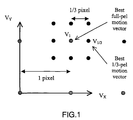
- Telenor's estimates the best motion vector in two steps shown in FIG. 2. First, the Telenor encoder searches for the best integer-pel vector V 1 (FIG. 1)100. Second, the Telenor encoder searches for the best 1/3-pixel accurate vector V 1/3 (FIG. 1) near V 1 102. This second step is shown graphically in FIG.
- the technology of the present invention allows the encoder to choose between any set of motion accuracies (for example, 1/2, 1/3, and 1/6-pel accurate motion vectors) using either a full search strategy or a fast search strategy.
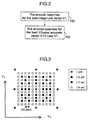
- the encoder searches all the motion vector candidates in a grid of 1/6-pixel resolution and a "square radius" (defined herein as a square block defined by a number of pixels up, a number of pixels down, and a number of pixels to both sides) of five pixels as shown in FIG. 3.
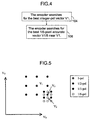
- FIG. 4 shows that the first step of the full-search AMA is to search for the best integer-pel vector V 1 (FIG. 1)104.
- the encoder searches for the best 1/6-pixel accurate vector V 1/6 (FIG. 3) near V 1 106.
- the full-search AMA modifies the second step of the Telenor's process so that the encoder also searches for motion vector candidates in other sub-pixel locations in the velocity space.
- the objective is to find the best motion vector in the grid, i.e., the vector that points to the block (in the interpolated reference frame) that best matches the current macroblock.
- the full-search strategy is computationally complex since it searches 120 sub-pixel candidates, it shows the full potential of this preferred method of the present invention.
- MSE mean squared error
- MAD mean absolute difference
- typical video coders find the best match for a macroblock by selecting the motion vector that produces either the smallest MSE or the smallest MAD.
- the block associated to the best motion vector is the one closest to the given macroblock in an MSE or MAD sense.
- MSE and MAD distortion measures do not take into account the cost in bits of actually encoding the vector. For example, a given motion vector may minimize the MSE, but it may be very costly to encode with bits, so it may not be the best choice from an coding standpoint.
- RD Telenor use rate-distortion
- L is a constant that depends on the compression level (i.e., the quantization step size)
- Bits is the number of bits required to code the motion vector.
- any RD criteria of this type would work with the present invention.
- "Bits” include the bits needed for encoding the vector and those for encoding the accuracy of the vector.
- some candidates can have several "Bits” values, because they can have several accuracy modes. For example, the candidate at location (1/2, -1/2) can be thought of having 1/2 or 1/6 pixel accuracy.
- the encoder checks only a small set of the motion vector candidates.
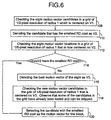
- the encoder checks the eight motion vector candidates in a grid of 1/2-pixel resolution of square radius 1, which is centered on V 1 108.
- V 2 is then set to denote the candidate that has the smallest RD cost (i.e., the best of the eight previous vectors and V 1 ) 110.
- the encoder checks the eight motion vector locations in a grid of 1/6-pixel resolution of square radius 1 that is now centered on V 2 112. If V 2 has the smallest RD cost 114, the encoder stops its search and selects V 2 as the motion vector for the block.
- V 3 is set to denote the best motion vector of the eight 116.
- the encoder searches for a new motion vector candidates in the grid of 1/6-pixel resolution of square radius 1 that is centered on V 3 118. It should be noted that some of the candidates in this grid have already been tested and can be skipped. The candidate with the smallest RD cost in this last step is selected as the motion vector for the block 120.
- Alternate embodiments of the invention replace one or more of the steps 108-120. These embodiments have also been effective and have further reduced the number of motion vector candidates to check in the sub-pixel velocity space.
- step 112 is replaced by one of three possible scenarios. First, if the best motion vector candidate from step 110 is at the center of V 1 (the "integer-pel vector") 130, then the encoder checks three candidates of 1/3-pel accuracy between the center vector and the 1/2-pel location with the next lowest RD cost 132. Second, if the best motion vector candidate from step 110 is a corner vector 134, then, the encoder checks the four vector candidates of 1/3-pel accuracy that are closest to such corner 136.
- step 138 the encoder determines which of these two corners has lower RD cost and checks the four vector candidates of 1/3-pel accuracy that are closest to the line between such corner and the best candidate from step 110 140. It should be noted that in implementing this process step 138 may be unnecessary because if V2 is neither at the center or a corner vector, then it would necessarily be between two corners. If the encoder is set to find motion vectors with 1/3-pixel accuracy, FIG. 7 could be modified to end rather than continuing with step 114.
- step 108 checks only motion vector candidates of 1/2-pixel accuracy, the computation and memory requirements for the hardware or software implementation are significantly reduced.
- the reference frame is interpolated by 2x2 in order to obtain the RD costs for the 1/2-pel vector candidates.
- a significant amount of fast (or cache) memory for a hardware or software encoder is saved as compared to Telenor's approach that needed to interpolate the reference frame by 3x3. In comparison to the Telenor encoder, this is a cache memory savings of 9/4 or a factor of 2.25. The few additional interpolations can be done later on a block-by-block basis.
- step 108 since the interpolations in step 108 are used to direct the search towards the lower values of the RD cost function, a complex filter is not needed for these interpolations. Accordingly, computation power may be saved by using a simple bilinear filter for step 108.
- the encoder encodes both the motion vector and accuracy values with bits.
- One approach is to encode the motion vector with a given accuracy (e.g., half-pixel accuracy) and then add some extra bits for refining the vector to the higher motion accuracy. This is the strategy suggested by B. Girod, but it is sub-optimal in a rate-distortion sense.
- the accuracy of the motion vector for a macroblock is first encoded using a simple code such as the one given in Table 1. Any other table with code lengths ⁇ 1, 2, 2 ⁇ could be used as well. The bit rate could be further reduced using a typical DPCM approach.
- the method of the present invention can be used for encoding vectors of any motion accuracy and the table can be interpreted differently at each frame and macroblock. Further, the general method of the present invention can be used for any motion accuracy, not necessarily those that are multiples of each other or those that are of the type 1/n (with n an integer). The number of increments in the given sub-pixel space is simply counted and the bits in the associated entry of the table is used as the code.
- VLC variable length code
- the motion vector can also be easily decoded.
- the associated block in the previous frame is reconstructed using a typical 4-tap cubic interpolator. There is a different 4-tap filter for each motion accuracy.
- the AMA does not increase decoding complexity, because the number of operations needed to reconstruct the predicted block are the same, regardless of the motion accuracy.
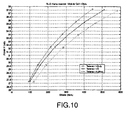
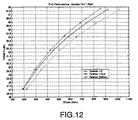
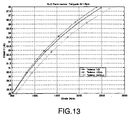
- FIGS. 8-18 show test results of the Telenor encoder codec with and without AMA in a variety of video sequences, resolutions, and frame rates, as described in Table 2. These figures show rate-distortion ("RD") plots for each case.
- the “Anchor” curve shows RD points from optimized H.263+ (FIGS. 8 and 9 only).
- the “Telenor 1/2+b” curve shows Telenor with 1/2-pel vectors and bilinear interpolation (the “classical case”).
- the “Telenor 1/3” curve shows the current Telenor proposal (the “Telenor encoder”).
- the “Telenor+AMA+c” curve shows the Telenor encoder with the full-search strategy of the present invention.
- The" Telenor +FSAMA+c shows the current Telenor encoder with the fast-search strategy. (Unless otherwise specified, the full-search version of AMA was the encoder strategy used in the experiments.) All of the test results were cross-checked at the encoder and decoder. These results show that with AMA the gains in peak signal-to-noise ratio (“PSNR”) can be as high as 1 dB over H26L, and even higher over the classical case.
- PSNR peak signal-to-noise ratio
- the video sequences are commonly used by the video coding community, except for "Paris Shaked.”
- the latter is a synthetic sequence obtained by shifting the well-known sequence "Paris” by a motion vector whose X and Y components take a random value within [-1,1]. This synthetic sequence simulates small movements caused by a hand-held camera in a typical video phone scene.
- the experiments show that the gains with AMA add to those obtained using multiple reference frames.
- the gain from AMA in the one-reference case can be measured by comparing the green and pink curves, and the gain in the five-reference case can be measured between the blue and red curves.
- the present invention may be implemented at the frame level so that different frames could use different motion accuracies, but within a frame all motion vectors would use the same accuracy. Preferably in this embodiment the motion vector accuracy would then be signaled only once at the frame layer. Experiments have shown that using the best, fixed motion accuracy for the whole frame should also produce compression gains as those presented here for the macroblock-adaptive case.
- the encoder could do motion compensation on the entire frame with the different vector accuracies and then select the best accuracy according to the RD criteria.
- This approach is not suitable for pipeline, one-pass encoders, but it could be appropriate for software-based or more complex encoders.
- the encoder could use previous statistics and/or formulas to predict what will be the best accuracy for a given frame (e.g., the formulas in set forth in the Ribas work or a variation thereof can be used). This approach would be well-suited for one-pass encoders, although the performance gains would depend on the precision of the formulas used for the prediction.
Landscapes
- Engineering & Computer Science (AREA)
- Multimedia (AREA)
- Signal Processing (AREA)
- Physics & Mathematics (AREA)
- Algebra (AREA)
- General Physics & Mathematics (AREA)
- Mathematical Analysis (AREA)
- Mathematical Optimization (AREA)
- Pure & Applied Mathematics (AREA)
- Compression Or Coding Systems Of Tv Signals (AREA)
- Compression, Expansion, Code Conversion, And Decoders (AREA)
Priority Applications (3)
| Application Number | Priority Date | Filing Date | Title |
|---|---|---|---|
| EP08017967A EP2026582A3 (fr) | 1999-07-27 | 2000-07-26 | Procédés pour l'évaluation de mouvement avec une précision de mouvement adaptatif |
| EP10013511A EP2373036B1 (fr) | 1999-07-27 | 2000-07-26 | Procédés pour l'évaluation de mouvement avec une précision de mouvement adaptatif |
| EP09001688A EP2051531A1 (fr) | 1999-07-27 | 2000-07-26 | Procédés pour l'évaluation de mouvement avec une précision de mouvement adaptatif |
Applications Claiming Priority (4)
| Application Number | Priority Date | Filing Date | Title |
|---|---|---|---|
| US14610299P | 1999-07-27 | 1999-07-27 | |
| US146102P | 1999-07-27 | ||
| US615791 | 2000-07-13 | ||
| US09/615,791 US6968008B1 (en) | 1999-07-27 | 2000-07-13 | Methods for motion estimation with adaptive motion accuracy |
Related Child Applications (2)
| Application Number | Title | Priority Date | Filing Date |
|---|---|---|---|
| EP08017967A Division EP2026582A3 (fr) | 1999-07-27 | 2000-07-26 | Procédés pour l'évaluation de mouvement avec une précision de mouvement adaptatif |
| EP09001688A Division EP2051531A1 (fr) | 1999-07-27 | 2000-07-26 | Procédés pour l'évaluation de mouvement avec une précision de mouvement adaptatif |
Publications (2)
| Publication Number | Publication Date |
|---|---|
| EP1073276A2 true EP1073276A2 (fr) | 2001-01-31 |
| EP1073276A3 EP1073276A3 (fr) | 2007-03-14 |
Family
ID=26843579
Family Applications (4)
| Application Number | Title | Priority Date | Filing Date |
|---|---|---|---|
| EP00116033A Withdrawn EP1073276A3 (fr) | 1999-07-27 | 2000-07-26 | Méthodes d'estimation de mouvement à précision adaptive du mouvement |
| EP10013511A Expired - Lifetime EP2373036B1 (fr) | 1999-07-27 | 2000-07-26 | Procédés pour l'évaluation de mouvement avec une précision de mouvement adaptatif |
| EP09001688A Withdrawn EP2051531A1 (fr) | 1999-07-27 | 2000-07-26 | Procédés pour l'évaluation de mouvement avec une précision de mouvement adaptatif |
| EP08017967A Withdrawn EP2026582A3 (fr) | 1999-07-27 | 2000-07-26 | Procédés pour l'évaluation de mouvement avec une précision de mouvement adaptatif |
Family Applications After (3)
| Application Number | Title | Priority Date | Filing Date |
|---|---|---|---|
| EP10013511A Expired - Lifetime EP2373036B1 (fr) | 1999-07-27 | 2000-07-26 | Procédés pour l'évaluation de mouvement avec une précision de mouvement adaptatif |
| EP09001688A Withdrawn EP2051531A1 (fr) | 1999-07-27 | 2000-07-26 | Procédés pour l'évaluation de mouvement avec une précision de mouvement adaptatif |
| EP08017967A Withdrawn EP2026582A3 (fr) | 1999-07-27 | 2000-07-26 | Procédés pour l'évaluation de mouvement avec une précision de mouvement adaptatif |
Country Status (3)
| Country | Link |
|---|---|
| US (4) | US6968008B1 (fr) |
| EP (4) | EP1073276A3 (fr) |
| JP (4) | JP4614512B2 (fr) |
Cited By (14)
| Publication number | Priority date | Publication date | Assignee | Title |
|---|---|---|---|---|
| EP1359766A2 (fr) * | 1997-02-14 | 2003-11-05 | AT&T Corp. | Méthode de génération d'un coefficient déquantifié DC de luminance ou de chrominance |
| WO2005104559A1 (fr) * | 2004-04-21 | 2005-11-03 | Siemens Aktiengesellschaft | Methode de prediction et methode correspondante de decodage d'une methode de prediction, dispositifs correspondants de codage et de decodage |
| EP0914636A4 (fr) * | 1997-04-07 | 2008-07-30 | At & T Corp | Systeme et procede de traitement d'informations audiovisuelles oriente objets |
| CN100455022C (zh) * | 2001-09-18 | 2009-01-21 | 松下电器产业株式会社 | 图像的编码方法和图像的译码方法 |
| EP2026582A2 (fr) * | 1999-07-27 | 2009-02-18 | Sharp Kabushiki Kaisha | Procédés pour l'évaluation de mouvement avec une précision de mouvement adaptatif |
| CN100574448C (zh) * | 2002-01-23 | 2009-12-23 | 索尼株式会社 | 图像信息编码装置和方法、图像信息解码装置和方法 |
| EP2141929A3 (fr) * | 2008-06-30 | 2010-11-10 | Intel Corporation | Evaluation sélective de mouvement vidéo fractionnel ou bidirectionnel |
| EP1431917A3 (fr) * | 2002-12-20 | 2010-11-10 | LSI Logic Corporation | Dispositif pour l'estimation du mouvement avec une plate-forme parallèle pour l'interpolation et recherche |
| WO2011090783A1 (fr) * | 2010-01-19 | 2011-07-28 | Thomson Licensing | Procédés et appareil de prédiction de mise en correspondance de modèles à complexité réduite pour codage et décodage vidéo |
| US8279940B2 (en) | 1997-02-14 | 2012-10-02 | At&T Intellectual Property Ii, L.P. | System, method and computer-readable medium for encoding a signal into macroblocks |
| WO2012166600A1 (fr) * | 2011-05-27 | 2012-12-06 | Cisco Technology, Inc. | Procédé, appareil et produit programme d'ordinateur pour une prédiction de mouvement d'image |
| US10560714B2 (en) | 2015-07-03 | 2020-02-11 | Huawei Technologies Co., Ltd. | Picture prediction method and picture prediction apparatus |
| CN110944210A (zh) * | 2012-05-14 | 2020-03-31 | 卢卡·罗萨托 | 利用连续坐标系的运动补偿和运动估计 |
| US11082714B2 (en) | 2017-06-30 | 2021-08-03 | Huawei Technologies Co., Ltd. | Search region for motion vector refinement |
Families Citing this family (66)
| Publication number | Priority date | Publication date | Assignee | Title |
|---|---|---|---|---|
| US6983018B1 (en) | 1998-11-30 | 2006-01-03 | Microsoft Corporation | Efficient motion vector coding for video compression |
| US6876705B2 (en) * | 2001-03-05 | 2005-04-05 | Intervideo, Inc. | Systems and methods for decoding of partially corrupted reversible variable length code (RVLC) intra-coded macroblocks and partial block decoding of corrupted macroblocks in a video decoder |
| US8284844B2 (en) | 2002-04-01 | 2012-10-09 | Broadcom Corporation | Video decoding system supporting multiple standards |
| KR100474285B1 (ko) * | 2002-04-08 | 2005-03-08 | 엘지전자 주식회사 | 모션벡터결정방법 |
| US7305034B2 (en) * | 2002-04-10 | 2007-12-04 | Microsoft Corporation | Rounding control for multi-stage interpolation |
| US7620109B2 (en) * | 2002-04-10 | 2009-11-17 | Microsoft Corporation | Sub-pixel interpolation in motion estimation and compensation |
| US7224731B2 (en) * | 2002-06-28 | 2007-05-29 | Microsoft Corporation | Motion estimation/compensation for screen capture video |
| JP4724351B2 (ja) | 2002-07-15 | 2011-07-13 | 三菱電機株式会社 | 画像符号化装置、画像符号化方法、画像復号装置、画像復号方法、および通信装置 |
| JP4841101B2 (ja) * | 2002-12-02 | 2011-12-21 | ソニー株式会社 | 動き予測補償方法及び動き予測補償装置 |
| US7499495B2 (en) | 2003-07-18 | 2009-03-03 | Microsoft Corporation | Extended range motion vectors |
| US20050013498A1 (en) | 2003-07-18 | 2005-01-20 | Microsoft Corporation | Coding of motion vector information |
| US7599438B2 (en) | 2003-09-07 | 2009-10-06 | Microsoft Corporation | Motion vector block pattern coding and decoding |
| US7577200B2 (en) | 2003-09-07 | 2009-08-18 | Microsoft Corporation | Extended range variable length coding/decoding of differential motion vector information |
| US7567617B2 (en) | 2003-09-07 | 2009-07-28 | Microsoft Corporation | Predicting motion vectors for fields of forward-predicted interlaced video frames |
| US7724827B2 (en) | 2003-09-07 | 2010-05-25 | Microsoft Corporation | Multi-layer run level encoding and decoding |
| US7616692B2 (en) | 2003-09-07 | 2009-11-10 | Microsoft Corporation | Hybrid motion vector prediction for interlaced forward-predicted fields |
| US7620106B2 (en) | 2003-09-07 | 2009-11-17 | Microsoft Corporation | Joint coding and decoding of a reference field selection and differential motion vector information |
| US7317839B2 (en) | 2003-09-07 | 2008-01-08 | Microsoft Corporation | Chroma motion vector derivation for interlaced forward-predicted fields |
| US8064520B2 (en) | 2003-09-07 | 2011-11-22 | Microsoft Corporation | Advanced bi-directional predictive coding of interlaced video |
| US7623574B2 (en) | 2003-09-07 | 2009-11-24 | Microsoft Corporation | Selecting between dominant and non-dominant motion vector predictor polarities |
| US7253374B2 (en) * | 2003-09-15 | 2007-08-07 | General Motors Corporation | Sheet-to-tube welded structure and method |
| US7983835B2 (en) | 2004-11-03 | 2011-07-19 | Lagassey Paul J | Modular intelligent transportation system |
| US8130825B2 (en) * | 2004-05-10 | 2012-03-06 | Nvidia Corporation | Processor for video data encoding/decoding |
| US8018463B2 (en) * | 2004-05-10 | 2011-09-13 | Nvidia Corporation | Processor for video data |
| EP1617672A1 (fr) * | 2004-07-13 | 2006-01-18 | Matsushita Electric Industrial Co., Ltd. | Estimateur/compensateur de mouvement comportant un 16-bit 1/8 pel filtre d'interpolation |
| TWI256844B (en) * | 2004-11-16 | 2006-06-11 | Univ Nat Kaohsiung Applied Sci | Flat hexagon-based search method for fast block moving detection |
| JP4736456B2 (ja) * | 2005-02-15 | 2011-07-27 | 株式会社日立製作所 | 走査線補間装置、映像表示装置、映像信号処理装置 |
| JP2008536414A (ja) * | 2005-04-13 | 2008-09-04 | ゴットフリート・ヴィルヘルム・ライプニッツ・ウニヴェルジテート・ハノーヴァー | ビデオの拡張された符号化方法及び装置 |
| US20060233258A1 (en) * | 2005-04-15 | 2006-10-19 | Microsoft Corporation | Scalable motion estimation |
| TWI280805B (en) * | 2005-07-20 | 2007-05-01 | Novatek Microelectronics Corp | Method and apparatus for cost calculation in decimal motion estimation |
| US8165205B2 (en) * | 2005-09-16 | 2012-04-24 | Sony Corporation | Natural shaped regions for motion compensation |
| US8208548B2 (en) | 2006-02-09 | 2012-06-26 | Qualcomm Incorporated | Video encoding |
| US8155195B2 (en) * | 2006-04-07 | 2012-04-10 | Microsoft Corporation | Switching distortion metrics during motion estimation |
| US8494052B2 (en) * | 2006-04-07 | 2013-07-23 | Microsoft Corporation | Dynamic selection of motion estimation search ranges and extended motion vector ranges |
| US20070268964A1 (en) * | 2006-05-22 | 2007-11-22 | Microsoft Corporation | Unit co-location-based motion estimation |
| US9307122B2 (en) * | 2006-09-27 | 2016-04-05 | Core Wireless Licensing S.A.R.L. | Method, apparatus, and computer program product for providing motion estimation for video encoding |
| US20080111923A1 (en) * | 2006-11-09 | 2008-05-15 | Scheuermann W James | Processor for video data |
| KR101369746B1 (ko) | 2007-01-22 | 2014-03-07 | 삼성전자주식회사 | 적응적 보간 필터를 이용한 영상 부호화, 복호화 방법 및장치 |
| US8358699B2 (en) * | 2007-04-09 | 2013-01-22 | Cavium, Inc. | Method and system for selection of reference picture and mode decision |
| US9118927B2 (en) * | 2007-06-13 | 2015-08-25 | Nvidia Corporation | Sub-pixel interpolation and its application in motion compensated encoding of a video signal |
| US8213515B2 (en) * | 2008-01-11 | 2012-07-03 | Texas Instruments Incorporated | Interpolated skip mode decision in video compression |
| JP4824712B2 (ja) * | 2008-02-29 | 2011-11-30 | 日本電信電話株式会社 | 動き推定精度推定方法、動き推定精度推定装置、動き推定精度推定プログラムおよびそのプログラムを記録したコンピュータ読み取り可能な記録媒体 |
| US8345996B2 (en) * | 2008-07-07 | 2013-01-01 | Texas Instruments Incorporated | Determination of a field referencing pattern |
| JP4793424B2 (ja) * | 2008-11-04 | 2011-10-12 | 三菱電機株式会社 | 画像符号化装置、画像符号化方法、画像復号装置、画像復号方法、および通信装置 |
| US20120201293A1 (en) * | 2009-10-14 | 2012-08-09 | Guo Liwei | Methods and apparatus for adaptive coding of motion information |
| WO2011097199A2 (fr) * | 2010-02-04 | 2011-08-11 | Sony Corporation | Filtres d'interpolation adaptatifs récursifs (raif) |
| US9237355B2 (en) * | 2010-02-19 | 2016-01-12 | Qualcomm Incorporated | Adaptive motion resolution for video coding |
| JP2012004615A (ja) * | 2010-06-14 | 2012-01-05 | Nippon Telegr & Teleph Corp <Ntt> | 動きベクトル探索方法,動きベクトル探索装置およびそのプログラム |
| TWI521950B (zh) | 2010-07-21 | 2016-02-11 | 財團法人工業技術研究院 | 用於視訊處理之移動估計之方法及裝置 |
| US10327008B2 (en) | 2010-10-13 | 2019-06-18 | Qualcomm Incorporated | Adaptive motion vector resolution signaling for video coding |
| CN102710934B (zh) | 2011-01-22 | 2015-05-06 | 华为技术有限公司 | 一种运动预测或补偿方法 |
| US9319716B2 (en) * | 2011-01-27 | 2016-04-19 | Qualcomm Incorporated | Performing motion vector prediction for video coding |
| US9131239B2 (en) * | 2011-06-20 | 2015-09-08 | Qualcomm Incorporated | Unified merge mode and adaptive motion vector prediction mode candidates selection |
| JP5649524B2 (ja) | 2011-06-27 | 2015-01-07 | 日本電信電話株式会社 | 映像符号化方法,装置,映像復号方法,装置およびそれらのプログラム |
| CN103413217A (zh) * | 2013-08-30 | 2013-11-27 | 国家电网公司 | 预付费系统的控制方法及控制装置 |
| US9774881B2 (en) | 2014-01-08 | 2017-09-26 | Microsoft Technology Licensing, Llc | Representing motion vectors in an encoded bitstream |
| US9942560B2 (en) | 2014-01-08 | 2018-04-10 | Microsoft Technology Licensing, Llc | Encoding screen capture data |
| US9749642B2 (en) | 2014-01-08 | 2017-08-29 | Microsoft Technology Licensing, Llc | Selection of motion vector precision |
| CN106331703B (zh) | 2015-07-03 | 2020-09-08 | 华为技术有限公司 | 视频编码和解码方法、视频编码和解码装置 |
| US10715818B2 (en) * | 2016-08-04 | 2020-07-14 | Intel Corporation | Techniques for hardware video encoding |
| US10602174B2 (en) | 2016-08-04 | 2020-03-24 | Intel Corporation | Lossless pixel compression for random video memory access |
| US10291925B2 (en) | 2017-07-28 | 2019-05-14 | Intel Corporation | Techniques for hardware video encoding |
| US11025913B2 (en) | 2019-03-01 | 2021-06-01 | Intel Corporation | Encoding video using palette prediction and intra-block copy |
| CN118945340A (zh) * | 2019-03-12 | 2024-11-12 | 弗劳恩霍夫应用研究促进协会 | 用于混合视频编码的编码器、解码器、方法及视频比特流以及计算机程序 |
| US10855983B2 (en) | 2019-06-13 | 2020-12-01 | Intel Corporation | Encoding video using two-stage intra search |
| GB2609708B (en) | 2021-05-25 | 2023-10-25 | Samsung Electronics Co Ltd | Method and apparatus for video recognition |
Family Cites Families (30)
| Publication number | Priority date | Publication date | Assignee | Title |
|---|---|---|---|---|
| EP0294962B1 (fr) | 1987-06-09 | 1995-07-19 | Sony Corporation | Evaluation des vecteurs de mouvement dans des images de télévision |
| JPS6442295A (en) | 1987-08-10 | 1989-02-14 | Seiko Epson Corp | Memory card mounting structure |
| JPH03117991A (ja) * | 1989-09-29 | 1991-05-20 | Victor Co Of Japan Ltd | 動きベクトル符号化装置及び復号化装置 |
| US4937666A (en) | 1989-12-04 | 1990-06-26 | Bell Communications Research, Inc. | Circuit implementation of block matching algorithm with fractional precision |
| JP2937247B2 (ja) * | 1991-02-19 | 1999-08-23 | 日本ビクター株式会社 | 動き補償フレーム間符号化装置 |
| KR950014862B1 (ko) | 1992-02-08 | 1995-12-16 | 삼성전자주식회사 | 움직임추정방법 및 그 장치 |
| JPH05336514A (ja) | 1992-05-29 | 1993-12-17 | Sony Corp | 画像符号化装置 |
| US5614952A (en) * | 1994-10-11 | 1997-03-25 | Hitachi America, Ltd. | Digital video decoder for decoding digital high definition and/or digital standard definition television signals |
| CN1052840C (zh) | 1993-06-01 | 2000-05-24 | 汤姆森多媒体公司 | 用于对数字视频信号进行插值的方法及装置 |
| JP3309519B2 (ja) * | 1993-09-17 | 2002-07-29 | ソニー株式会社 | 動きベクトル検出装置 |
| JP3846642B2 (ja) | 1994-01-31 | 2006-11-15 | ソニー株式会社 | 動き量検出方法及び動き量検出装置 |
| EP0697788A3 (fr) * | 1994-08-19 | 1997-03-26 | Eastman Kodak Co | Désentrelacement adaptatif compensé en mouvement global de trames vidéo séquentielles avec un traitement postérieur |
| JP2894958B2 (ja) * | 1994-10-14 | 1999-05-24 | 株式会社グラフィックス・コミュニケーション・ラボラトリーズ | 画像復号化方式および装置 |
| US5694179A (en) | 1994-12-23 | 1997-12-02 | Electronics And Telecommunications Research Institute | Apparatus for estimating a half-pel motion in a video compression method |
| EP2129133A3 (fr) * | 1995-08-29 | 2012-02-15 | Sharp Kabushiki Kaisha | Dispositif de codage vidéo et dispositif de décodage vidéo avec prédiction indépendante compensée à mouvement |
| GB2305569B (en) | 1995-09-21 | 1999-07-21 | Innovision Res Ltd | Motion compensated interpolation |
| US5623313A (en) | 1995-09-22 | 1997-04-22 | Tektronix, Inc. | Fractional pixel motion estimation of video signals |
| JPH09102954A (ja) | 1995-10-04 | 1997-04-15 | Matsushita Electric Ind Co Ltd | 1つまたは2つの予測ブロックからブロックの画素値を計算する方法 |
| US5987181A (en) | 1995-10-12 | 1999-11-16 | Sharp Kabushiki Kaisha | Coding and decoding apparatus which transmits and receives tool information for constructing decoding scheme |
| JP3263582B2 (ja) * | 1995-11-29 | 2002-03-04 | シャープ株式会社 | 符号化/復号化装置 |
| JPH1042295A (ja) * | 1996-07-19 | 1998-02-13 | Sony Corp | 映像信号符号化方法および映像信号符号化装置 |
| WO1998041029A1 (fr) * | 1997-03-12 | 1998-09-17 | Matsushita Electric Industrial Co., Ltd. | Filtre de sur-echantillonnage et generateur demi-pixels pour systeme tvhd par abaissement de frequence |
| DE19730306C2 (de) | 1997-07-15 | 1999-05-20 | Deutsch Zentr Luft & Raumfahrt | Verfahren zur Synchronisation von Navigationsmeßdaten mit SAR-Radardaten und Einrichtung zur Durchführung dieses Verfahrens |
| DE19730305A1 (de) | 1997-07-15 | 1999-01-21 | Bosch Gmbh Robert | Verfahren zur Erzeugung eines verbesserten Bildsignals bei der Bewegungsschätzung von Bildsequenzen, insbesondere eines Prädiktionssignals für Bewegtbilder mit bewegungskompensierender Prädiktion |
| JP2897763B2 (ja) | 1997-07-28 | 1999-05-31 | 日本ビクター株式会社 | 動き補償符号化装置、復号化装置、符号化方法及び復号化方法 |
| JPH1155673A (ja) * | 1997-07-31 | 1999-02-26 | Victor Co Of Japan Ltd | 動きベクトル符号化装置、復号化装置、符号化方法、及び復号化方法 |
| US6249318B1 (en) * | 1997-09-12 | 2001-06-19 | 8×8, Inc. | Video coding/decoding arrangement and method therefor |
| DE19746214A1 (de) * | 1997-10-21 | 1999-04-22 | Bosch Gmbh Robert | Verfahren zur bewegungskompensierenden Prädiktion von Bewegtbildfolgen |
| US6269174B1 (en) * | 1997-10-28 | 2001-07-31 | Ligos Corporation | Apparatus and method for fast motion estimation |
| US6968008B1 (en) * | 1999-07-27 | 2005-11-22 | Sharp Laboratories Of America, Inc. | Methods for motion estimation with adaptive motion accuracy |
-
2000
- 2000-07-13 US US09/615,791 patent/US6968008B1/en not_active Ceased
- 2000-07-24 JP JP2000256484A patent/JP4614512B2/ja not_active Expired - Fee Related
- 2000-07-26 EP EP00116033A patent/EP1073276A3/fr not_active Withdrawn
- 2000-07-26 EP EP10013511A patent/EP2373036B1/fr not_active Expired - Lifetime
- 2000-07-26 EP EP09001688A patent/EP2051531A1/fr not_active Withdrawn
- 2000-07-26 EP EP08017967A patent/EP2026582A3/fr not_active Withdrawn
-
2007
- 2007-11-20 US US11/984,661 patent/USRE45014E1/en not_active Expired - Lifetime
-
2009
- 2009-08-18 JP JP2009189322A patent/JP2009273157A/ja active Pending
-
2010
- 2010-09-28 JP JP2010217117A patent/JP5269023B2/ja not_active Expired - Lifetime
-
2011
- 2011-11-04 US US13/289,902 patent/USRE44012E1/en not_active Expired - Lifetime
- 2011-12-05 JP JP2011265393A patent/JP2012075175A/ja not_active Withdrawn
-
2014
- 2014-01-31 US US14/170,134 patent/USRE46468E1/en not_active Expired - Lifetime
Cited By (32)
| Publication number | Priority date | Publication date | Assignee | Title |
|---|---|---|---|---|
| US8279940B2 (en) | 1997-02-14 | 2012-10-02 | At&T Intellectual Property Ii, L.P. | System, method and computer-readable medium for encoding a signal into macroblocks |
| US9392271B2 (en) | 1997-02-14 | 2016-07-12 | At&T Intellectual Property Ii, L.P. | System, method and computer-readable medium for encoding a signal into macroblocks |
| EP1359766A2 (fr) * | 1997-02-14 | 2003-11-05 | AT&T Corp. | Méthode de génération d'un coefficient déquantifié DC de luminance ou de chrominance |
| US10027962B2 (en) | 1997-02-14 | 2018-07-17 | At&T Intellectual Property Ii, L.P. | System, method and computer-readable medium for encoding a signal into macroblocks |
| US8665965B2 (en) | 1997-02-14 | 2014-03-04 | At&T Intellectual Property Ii, L.P. | System, method and computer-readable medium for encoding a signal into macroblocks |
| EP0914636A4 (fr) * | 1997-04-07 | 2008-07-30 | At & T Corp | Systeme et procede de traitement d'informations audiovisuelles oriente objets |
| USRE45014E1 (en) | 1999-07-27 | 2014-07-15 | Sharp Kabushiki Kaisha | Methods for motion estimation with adaptive motion accuracy |
| USRE44012E1 (en) | 1999-07-27 | 2013-02-19 | Sharp Kabushiki Kaisha | Methods for motion estimation with adaptive motion accuracy |
| USRE46468E1 (en) | 1999-07-27 | 2017-07-04 | Sharp Kabushiki Kaisha | Methods for motion estimation with adaptive motion accuracy |
| EP2026582A2 (fr) * | 1999-07-27 | 2009-02-18 | Sharp Kabushiki Kaisha | Procédés pour l'évaluation de mouvement avec une précision de mouvement adaptatif |
| EP2051531A1 (fr) * | 1999-07-27 | 2009-04-22 | Sharp Kabushiki Kaisha | Procédés pour l'évaluation de mouvement avec une précision de mouvement adaptatif |
| EP2026582A3 (fr) * | 1999-07-27 | 2009-10-21 | Sharp Kabushiki Kaisha | Procédés pour l'évaluation de mouvement avec une précision de mouvement adaptatif |
| CN100455022C (zh) * | 2001-09-18 | 2009-01-21 | 松下电器产业株式会社 | 图像的编码方法和图像的译码方法 |
| CN100574448C (zh) * | 2002-01-23 | 2009-12-23 | 索尼株式会社 | 图像信息编码装置和方法、图像信息解码装置和方法 |
| EP1431917A3 (fr) * | 2002-12-20 | 2010-11-10 | LSI Logic Corporation | Dispositif pour l'estimation du mouvement avec une plate-forme parallèle pour l'interpolation et recherche |
| WO2005104559A1 (fr) * | 2004-04-21 | 2005-11-03 | Siemens Aktiengesellschaft | Methode de prediction et methode correspondante de decodage d'une methode de prediction, dispositifs correspondants de codage et de decodage |
| CN101621696B (zh) * | 2008-06-30 | 2016-02-17 | 英特尔公司 | 允许分数视频运动估计和双向视频运动估计的选择性使用方法和编码器 |
| EP2141929A3 (fr) * | 2008-06-30 | 2010-11-10 | Intel Corporation | Evaluation sélective de mouvement vidéo fractionnel ou bidirectionnel |
| US10349080B2 (en) | 2010-01-19 | 2019-07-09 | Interdigital Madison Patent Holdings | Methods and apparatus for reduced complexity template matching prediction for video encoding and decoding |
| WO2011090783A1 (fr) * | 2010-01-19 | 2011-07-28 | Thomson Licensing | Procédés et appareil de prédiction de mise en correspondance de modèles à complexité réduite pour codage et décodage vidéo |
| US9516341B2 (en) | 2010-01-19 | 2016-12-06 | Thomson Licensing | Methods and apparatus for reduced complexity template matching prediction for video encoding and decoding |
| US9143799B2 (en) | 2011-05-27 | 2015-09-22 | Cisco Technology, Inc. | Method, apparatus and computer program product for image motion prediction |
| WO2012166600A1 (fr) * | 2011-05-27 | 2012-12-06 | Cisco Technology, Inc. | Procédé, appareil et produit programme d'ordinateur pour une prédiction de mouvement d'image |
| CN110944210A (zh) * | 2012-05-14 | 2020-03-31 | 卢卡·罗萨托 | 利用连续坐标系的运动补偿和运动估计 |
| CN110944210B (zh) * | 2012-05-14 | 2022-03-01 | 卢卡·罗萨托 | 利用连续坐标系的运动补偿和运动估计系统 |
| US10560714B2 (en) | 2015-07-03 | 2020-02-11 | Huawei Technologies Co., Ltd. | Picture prediction method and picture prediction apparatus |
| US10771809B2 (en) | 2015-07-03 | 2020-09-08 | Huawei Technologies Co., Ltd. | Picture prediction method and picture prediction apparatus |
| US11240529B2 (en) | 2015-07-03 | 2022-02-01 | Huawei Technologies Co., Ltd. | Picture prediction method and picture prediction apparatus |
| US11831902B2 (en) | 2015-07-03 | 2023-11-28 | Huawei Technologies Co., Ltd. | Picture prediction method and picture prediction apparatus |
| US12341989B2 (en) | 2015-07-03 | 2025-06-24 | Huawei Technologies Co., Ltd. | Picture prediction method and picture prediction apparatus |
| US11082714B2 (en) | 2017-06-30 | 2021-08-03 | Huawei Technologies Co., Ltd. | Search region for motion vector refinement |
| US11736718B2 (en) | 2017-06-30 | 2023-08-22 | Huawei Technologies Co., Ltd. | Search region for motion vector refinement |
Also Published As
| Publication number | Publication date |
|---|---|
| JP2009273157A (ja) | 2009-11-19 |
| USRE46468E1 (en) | 2017-07-04 |
| EP2373036B1 (fr) | 2013-01-09 |
| JP2011035928A (ja) | 2011-02-17 |
| EP1073276A3 (fr) | 2007-03-14 |
| EP2373036A1 (fr) | 2011-10-05 |
| EP2051531A1 (fr) | 2009-04-22 |
| JP4614512B2 (ja) | 2011-01-19 |
| JP2001189934A (ja) | 2001-07-10 |
| USRE45014E1 (en) | 2014-07-15 |
| USRE44012E1 (en) | 2013-02-19 |
| EP2026582A3 (fr) | 2009-10-21 |
| US6968008B1 (en) | 2005-11-22 |
| JP2012075175A (ja) | 2012-04-12 |
| JP5269023B2 (ja) | 2013-08-21 |
| HK1161948A1 (en) | 2012-08-10 |
| EP2026582A2 (fr) | 2009-02-18 |
Similar Documents
| Publication | Publication Date | Title |
|---|---|---|
| USRE46468E1 (en) | Methods for motion estimation with adaptive motion accuracy | |
| KR101403343B1 (ko) | 부화소 움직임 추정을 이용한 인터 예측 부호화, 복호화방법 및 장치 | |
| US9078007B2 (en) | Digital video coding with interpolation filters and offsets | |
| US6711211B1 (en) | Method for encoding and decoding video information, a motion compensated video encoder and a corresponding decoder | |
| US20070268964A1 (en) | Unit co-location-based motion estimation | |
| US20030156646A1 (en) | Multi-resolution motion estimation and compensation | |
| US20040076333A1 (en) | Adaptive interpolation filter system for motion compensated predictive video coding | |
| US20060233258A1 (en) | Scalable motion estimation | |
| JP5021712B2 (ja) | 並列補間及びサーチ・ハードウェアを備えた運動評価エンジン | |
| US20050190977A1 (en) | Method and apparatus for video encoding | |
| CN101416524A (zh) | 运动估计搜索范围和扩展的运动矢量范围的动态选择 | |
| CA2449048A1 (fr) | Procedes et dispositif d'estimation de mouvement de sous-pixel | |
| US20020034250A1 (en) | Motion vector coding method | |
| US7433407B2 (en) | Method for hierarchical motion estimation | |
| US20050123039A1 (en) | Motion estimation method for motion picture encoding and recording medium having program recorded thereon to implement the motion estimation method | |
| KR20040070490A (ko) | 비월 주사 방식의 동영상 부호화/복호화 방법 및 그 장치 | |
| Suzuki et al. | Block-based reduced resolution inter frame coding with template matching prediction | |
| Pientka et al. | Deep video coding with gradient-descent optimized motion compensation and Lanczos filtering | |
| HK1161948B (en) | Methods for motion estimation with adaptive motion accuracy | |
| Shen et al. | Benefits of adaptive motion accuracy in H. 26L video coding | |
| KR100617177B1 (ko) | 움직임 추정 방법 | |
| Kim et al. | Multilevel Residual Motion Compensation for High Efficiency Video Coding | |
| KR20190004247A (ko) | 인트라 모드를 이용한 쿼터 픽셀 해상도를 갖는 영상 보간 방법 및 장치 |
Legal Events
| Date | Code | Title | Description |
|---|---|---|---|
| PUAI | Public reference made under article 153(3) epc to a published international application that has entered the european phase |
Free format text: ORIGINAL CODE: 0009012 |
|
| AK | Designated contracting states |
Kind code of ref document: A2 Designated state(s): AT BE CH CY DE DK ES FI FR GB GR IE IT LI LU MC NL PT SE |
|
| AX | Request for extension of the european patent |
Free format text: AL;LT;LV;MK;RO;SI |
|
| PUAL | Search report despatched |
Free format text: ORIGINAL CODE: 0009013 |
|
| AK | Designated contracting states |
Kind code of ref document: A3 Designated state(s): AT BE CH CY DE DK ES FI FR GB GR IE IT LI LU MC NL PT SE |
|
| AX | Request for extension of the european patent |
Extension state: AL LT LV MK RO SI |
|
| 17P | Request for examination filed |
Effective date: 20070702 |
|
| AKX | Designation fees paid |
Designated state(s): DE FR GB |
|
| 17Q | First examination report despatched |
Effective date: 20081016 |
|
| STAA | Information on the status of an ep patent application or granted ep patent |
Free format text: STATUS: THE APPLICATION HAS BEEN WITHDRAWN |
|
| 18W | Application withdrawn |
Effective date: 20090212 |