EP1076334A1 - Optisches Aufzeichnungsmedium - Google Patents
Optisches Aufzeichnungsmedium Download PDFInfo
- Publication number
- EP1076334A1 EP1076334A1 EP00117014A EP00117014A EP1076334A1 EP 1076334 A1 EP1076334 A1 EP 1076334A1 EP 00117014 A EP00117014 A EP 00117014A EP 00117014 A EP00117014 A EP 00117014A EP 1076334 A1 EP1076334 A1 EP 1076334A1
- Authority
- EP
- European Patent Office
- Prior art keywords
- pigment
- recording
- organic pigment
- recording medium
- recording layer
- Prior art date
- Legal status (The legal status is an assumption and is not a legal conclusion. Google has not performed a legal analysis and makes no representation as to the accuracy of the status listed.)
- Withdrawn
Links
Images
Classifications
-
- G—PHYSICS
- G11—INFORMATION STORAGE
- G11B—INFORMATION STORAGE BASED ON RELATIVE MOVEMENT BETWEEN RECORD CARRIER AND TRANSDUCER
- G11B7/00—Recording or reproducing by optical means, e.g. recording using a thermal beam of optical radiation by modifying optical properties or the physical structure, reproducing using an optical beam at lower power by sensing optical properties; Record carriers therefor
- G11B7/24—Record carriers characterised by shape, structure or physical properties, or by the selection of the material
- G11B7/241—Record carriers characterised by shape, structure or physical properties, or by the selection of the material characterised by the selection of the material
- G11B7/242—Record carriers characterised by shape, structure or physical properties, or by the selection of the material characterised by the selection of the material of recording layers
- G11B7/244—Record carriers characterised by shape, structure or physical properties, or by the selection of the material characterised by the selection of the material of recording layers comprising organic materials only
- G11B7/246—Record carriers characterised by shape, structure or physical properties, or by the selection of the material characterised by the selection of the material of recording layers comprising organic materials only containing dyes
- G11B7/247—Record carriers characterised by shape, structure or physical properties, or by the selection of the material characterised by the selection of the material of recording layers comprising organic materials only containing dyes methine or polymethine dyes
- G11B7/2472—Record carriers characterised by shape, structure or physical properties, or by the selection of the material characterised by the selection of the material of recording layers comprising organic materials only containing dyes methine or polymethine dyes cyanine
-
- G—PHYSICS
- G11—INFORMATION STORAGE
- G11B—INFORMATION STORAGE BASED ON RELATIVE MOVEMENT BETWEEN RECORD CARRIER AND TRANSDUCER
- G11B7/00—Recording or reproducing by optical means, e.g. recording using a thermal beam of optical radiation by modifying optical properties or the physical structure, reproducing using an optical beam at lower power by sensing optical properties; Record carriers therefor
- G11B7/24—Record carriers characterised by shape, structure or physical properties, or by the selection of the material
- G11B7/241—Record carriers characterised by shape, structure or physical properties, or by the selection of the material characterised by the selection of the material
- G11B7/242—Record carriers characterised by shape, structure or physical properties, or by the selection of the material characterised by the selection of the material of recording layers
- G11B7/244—Record carriers characterised by shape, structure or physical properties, or by the selection of the material characterised by the selection of the material of recording layers comprising organic materials only
- G11B7/246—Record carriers characterised by shape, structure or physical properties, or by the selection of the material characterised by the selection of the material of recording layers comprising organic materials only containing dyes
-
- G—PHYSICS
- G11—INFORMATION STORAGE
- G11B—INFORMATION STORAGE BASED ON RELATIVE MOVEMENT BETWEEN RECORD CARRIER AND TRANSDUCER
- G11B7/00—Recording or reproducing by optical means, e.g. recording using a thermal beam of optical radiation by modifying optical properties or the physical structure, reproducing using an optical beam at lower power by sensing optical properties; Record carriers therefor
- G11B7/004—Recording, reproducing or erasing methods; Read, write or erase circuits therefor
- G11B7/0045—Recording
- G11B7/00451—Recording involving ablation of the recording layer
-
- G—PHYSICS
- G11—INFORMATION STORAGE
- G11B—INFORMATION STORAGE BASED ON RELATIVE MOVEMENT BETWEEN RECORD CARRIER AND TRANSDUCER
- G11B7/00—Recording or reproducing by optical means, e.g. recording using a thermal beam of optical radiation by modifying optical properties or the physical structure, reproducing using an optical beam at lower power by sensing optical properties; Record carriers therefor
- G11B7/004—Recording, reproducing or erasing methods; Read, write or erase circuits therefor
- G11B7/0045—Recording
- G11B7/00452—Recording involving bubble or bump forming
-
- G—PHYSICS
- G11—INFORMATION STORAGE
- G11B—INFORMATION STORAGE BASED ON RELATIVE MOVEMENT BETWEEN RECORD CARRIER AND TRANSDUCER
- G11B7/00—Recording or reproducing by optical means, e.g. recording using a thermal beam of optical radiation by modifying optical properties or the physical structure, reproducing using an optical beam at lower power by sensing optical properties; Record carriers therefor
- G11B7/24—Record carriers characterised by shape, structure or physical properties, or by the selection of the material
- G11B7/241—Record carriers characterised by shape, structure or physical properties, or by the selection of the material characterised by the selection of the material
- G11B7/252—Record carriers characterised by shape, structure or physical properties, or by the selection of the material characterised by the selection of the material of layers other than recording layers
- G11B7/254—Record carriers characterised by shape, structure or physical properties, or by the selection of the material characterised by the selection of the material of layers other than recording layers of protective topcoat layers
- G11B7/2542—Record carriers characterised by shape, structure or physical properties, or by the selection of the material characterised by the selection of the material of layers other than recording layers of protective topcoat layers consisting essentially of organic resins
-
- G—PHYSICS
- G11—INFORMATION STORAGE
- G11B—INFORMATION STORAGE BASED ON RELATIVE MOVEMENT BETWEEN RECORD CARRIER AND TRANSDUCER
- G11B7/00—Recording or reproducing by optical means, e.g. recording using a thermal beam of optical radiation by modifying optical properties or the physical structure, reproducing using an optical beam at lower power by sensing optical properties; Record carriers therefor
- G11B7/24—Record carriers characterised by shape, structure or physical properties, or by the selection of the material
- G11B7/241—Record carriers characterised by shape, structure or physical properties, or by the selection of the material characterised by the selection of the material
- G11B7/252—Record carriers characterised by shape, structure or physical properties, or by the selection of the material characterised by the selection of the material of layers other than recording layers
- G11B7/258—Record carriers characterised by shape, structure or physical properties, or by the selection of the material characterised by the selection of the material of layers other than recording layers of reflective layers
- G11B7/259—Record carriers characterised by shape, structure or physical properties, or by the selection of the material characterised by the selection of the material of layers other than recording layers of reflective layers based on silver
-
- G—PHYSICS
- G11—INFORMATION STORAGE
- G11B—INFORMATION STORAGE BASED ON RELATIVE MOVEMENT BETWEEN RECORD CARRIER AND TRANSDUCER
- G11B7/00—Recording or reproducing by optical means, e.g. recording using a thermal beam of optical radiation by modifying optical properties or the physical structure, reproducing using an optical beam at lower power by sensing optical properties; Record carriers therefor
- G11B7/24—Record carriers characterised by shape, structure or physical properties, or by the selection of the material
- G11B7/241—Record carriers characterised by shape, structure or physical properties, or by the selection of the material characterised by the selection of the material
- G11B7/252—Record carriers characterised by shape, structure or physical properties, or by the selection of the material characterised by the selection of the material of layers other than recording layers
- G11B7/258—Record carriers characterised by shape, structure or physical properties, or by the selection of the material characterised by the selection of the material of layers other than recording layers of reflective layers
- G11B7/2595—Record carriers characterised by shape, structure or physical properties, or by the selection of the material characterised by the selection of the material of layers other than recording layers of reflective layers based on gold
Definitions
- the present invention relates to an optical recording medium and in particular, to an optical recording medium including a recording layer formed from an organic pigment.
- optical disc a disc-shaped optical recording medium (hereinafter, referred to as an optical disc) capable of recording a large amount of information.
- the recording is performed in a so-called heat mode.
- a laser beam is applied onto the recording layer and an organic pigment portion subjected to the laser beam absorbs the laser beam and is heated. This heat dissolves and deforms the organic pigment.
- the portion where the organic pigment is dissolved has a reflection factor different from the other portion of the recording layer. Thus, a pit is formed in the recording layer.
- a laser beam weaker than that used for recording is applied and reading is performed by detecting an optical change such as a reflection factor and a permeability between a portion where a pit is formed and a portion where is not formed.
- the reflection factor characteristic and the recording sensitivity characteristic of the recording layer are important characteristics.
- the reflection factor characteristic and the recording sensitivity characteristic are important characteristics.
- the mechanism for storing heat in the recording layer in the process of recording an information on a recording layer formed from an organic pigment, the mechanism for storing heat in the recording layer.
- the heat required for dissolving the organic pigment in the recording layer depends on the light absorbing characteristic of the organic pigment. That is, the heat applied to the recording layer by the laser beam is determined by the laser power and the light absorption spectrum of the organic pigment in the recording layer.
- the recording sensitivity characteristic of the optical recording medium assuming that the optical recording medium is operated within a wide range of drive, and considering the laser deterioration, it is necessary to maintain a recording sensitivity sufficient if the laser power is below an appropriate value.
- consideration is taken on its light absorption characteristic so as to maintain a sufficient recording sensitivity even in recording with a laser power below an appropriate value.
- the organic pigment constituting the recording layer should have a high reflection factor and a high sensitivity.
- a spot light is put on a phthalocyanine pigment and cyanine pigment having comparatively high reflection factors among the organic pigments.
- the cyanine pigment is especially hopeful as a recording layer material for it exhibits a high absorption and reflection in a range 700 nm to 900 nm which is the semiconductor laser light wavelength range.
- the optical recording medium having a recording layer formed from a cyanine pigment absorption is reduced when the wavelength indicating the maximum reflection factor is matched with the recording laser wavelength.
- the reflection factor is reduced when the wavelength indicating the maximum absorption ratio is matched with recording laser wavelength.
- the conventionally used method is to increase the light absorption characteristic of the recording layer within a range of 700 nm to 900 nm. More specifically, the light absorption characteristic of the recording layer is increased by increasing the absorption wavelength peak within the aforementioned range or by using a recording laser beam having a wavelength range wherein an organic pigment exhibits the maximum absorption.
- the aforementioned method for increasing the light absorption characteristic of the recording layer it is possible to enlarge the recording enabled power range into the low power side, but the reflection factor is lowered while the light absorption characteristic of the recording layer is increased. On the contrary, when the reflection factor is increased, the light absorption ratio is lowered. Thus, it has been difficult to obtain a stable recording with an appropriate laser power. In order to form a stable recording mark to realize a stable recording, it is important to obtain a stable heat supply.
- the optical recording medium includes a recording layer formed by an organic pigment film containing an organic pigment, a reflection layer, and a protection layer which are successively formed on a disc substrate, wherein the organic pigment film contains as the pigment a compound exhibiting a heat generating reaction.
- the organic pigment film contains as an organic pigment a compound exhibiting a heat generating reaction.
- the heat generated at a chemical reaction of the compound is supplied to the recording layer and accordingly, it is possible to realize a stable recording even with a low-power laser beam.
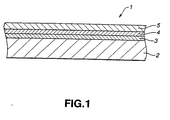
- Fig. 1 is a cross sectional view of a configuration example of an optical disc according to the present invention.
- This optical disc 1 includes a disc-shaped substrate 2, a recording layer 3 formed on one surface of the substrate 2, a reflection layer 4 formed on the recording layer 3, and a protection layer 5 formed on the reflection layer 4.
- the substrate 2 is formed from a glass or a resin optically transparent to a recording laser beam or a reproduction laser beam.
- the recording layer 3 contains an organic pigment. According to the present invention, as will be detailed later, the recording layer is formed from an organic pigment which generates a heat when dissolved.
- the reflection layer 4 is formed using a thin film formation technique including sputtering of a metal such as Au and Ag.
- the protection layer 5 is formed from an ultraviolet ray hardening resin or the like.
- a laser beam is applied from the side of the substrate 2 to the recording layer 3 and the organic pigment portion subjected to the laser beam absorbs the laser beam and has a heat. This heat dissolves and deforms the organic pigment subjected to the laser beam. The portion where the organic pigment has been dissolved has a reflection factor different from the other portion. Thus, a pit is formed in the recording layer 3.
- the laser used in order to form a pit by applying a laser beam to the recording layer 3 containing an organic pigment, the laser used should have a power above a certain value. In order to enable recording using a low-power laser beam, the recording layer 3 should have a high light absorption ratio.
- the absorption characteristic and the reflection factor characteristic as the important characteristics of the recording layer 3 are incompatible with each other.
- the light absorption ratio of the recording layer 3 is increased, the light reflection ratio of the recording layer is lowered.
- the recording layer 3 contains an organic pigment whose decomposition reaction is a heat generating reaction.
- the recording layer 3 contains an organic pigment whose decomposition reaction is a heat generating reaction, there is no need of increasing the light absorption of the organic pigment in order to store a sufficient heat in the recording layer 3 and it is possible to maintain a high reflection ratio of the organic pigment.
- an organic pigment having a high reflection factor it is possible to realize a stable recording with a low-power laser beam.
- the organic pigment generating a heat during decomposition may be a direct dye, an acid dye, a basic dye, a vat dye, an oil soluble dye, or a sulfide dye, and is not limited to particular dyes.
- the organic generating a heat at decomposition may be, as the direct dye, cyanine pigment, merocyamne pigment, triphenylmethane pigment, naphthoquinone pigment, xanthene pigment, squalium pigment, azulene pigment, methine pigment, pyrylium pigment, azo pigment, stilbene pigment, phthalocyariine pigment, or the like.
- the acid dye there can be exemplified azo pigment, anthraquinone pigment, triphenylmethane pigment, xanthene pigment, azine pigment, or the like.
- the basic dye there can be exemplified cyanine pigment, azo pigment, azine pigment, triphenylmethane pigment, azulene pigment, methine pigment, pyrylium pigment, or the like.
- the vat pigment may be azo pigment, anthraquinone pigment xanthene pigment, triphenylmethane mordant dye, acid mordant dye, anthraquinone pigment, indigoid pigment, or the like.
- the oil soluble dye may be azo pigment, anthraquinone pigment, phthalocyanine pigment, triphenylmethane pigment, or the like.
- dithiol metal complex in addition to the aforementioned pigments, there can also be exemplified dithiol metal complex.
- organic pigments may be used solely or in combination with the others.
- the recording layer 3 containing the aforementioned organic pigments generates a heat at decomposition of the organic pigments so as to compensate the insufficient power and can form a pit with a high sensitivity even when recording is performed with a low-power laser beam.
- the organic pigment generating a heat at decomposition can have any light absorption ratio and accordingly, it is possible to use an organic pigment having a high reflection factor.
- organic pigments especially preferable those that generates a heat exceeding 500 J/g at decomposition. It is further preferable to use an organic pigment generating a heat exceeding 1000 J/g at decomposition. By using an organic pigment generating a high heat at decomposition, even when using a low-power laser beam, it is possible to obtain a sufficient heat required for recording and realize a stable recording.
- Table 1 shows the quantity of heat generated at decomposition by organic pigments widely used.
- Produced by Trade name Heat generated (J/g) Nippon Kanko Shikiso Co., Ltd. NK-3219 740 NK-3251 -80 NK-3383 840 NK-3820 -100 NK-4274 120 NK-4419 65 NK-4496 100 Q-02 450 Fuji Photo Film Co., Ltd. OM-57 760 OM-65 940 OM-69 970 OM-72 1000 Nippon Kayaku Co., Ltd.
- IRG-002 400 IRG-003 700 IRG-022 450 IRG-023 930 IR-820b 24000
- the IR-820b (trade name) produced by Nippon Kayaku Co., Ltd. generates as high as 24000 J/g at decomposition and is especially preferable as an organic pigment to be used in the recording layer 3 of the optical disc according to the present invention.
- the IR-820b has a chemical formula (1) shown below.
- the optical disc 1 of the present embodiment as has been described above can be constructed in the same way as the conventional this type of optical discs except for that an organic pigment generating a heat at decomposition is used.
- an optical disc having the aforementioned configuration has been actually prepared for evaluating its recording characteristics.
- a substrate used is a disc-shaped substrate formed from polycarbonate and having a diameter of 200 mm. It should be noted that this substrate has a 20-mm hole at its center portion.
- a cyanine pigment having a chemical formula (A) shown below and the IR-820b (produced by Nippon Kayaku Co., Ltd.) having a chemical formula (1) shown below were solved in tetrafluoropropanol as a paint solvent so as to prepare a paint solution.
- the compound (1) used in this example generates a very high heat exceeding 1000 J/g at decomposition.
- this paint solution was applied onto the substrate by spin coat and dried so as to form a recording layer on the substrate.
- an Au film was formed by sputtering on this recording layer, so as to form a reflection layer. Furthermore, this reflection layer was covered by an ultraviolet ray hardening resin by spin coat. The ultraviolet ray hardening resin spin-coated was then subjected to ultraviolet rays so that the ultraviolet ray hardening resin was hardened so as to form a protection layer, thus completing an optical disc.
- Optical discs were prepared while changing the content of the compound (1) in the organic pigment: 2 wt%, 3 wt%, 4 wt%, 6 wt%, and 10 wt%.
- test signals were recording using a recording layer having a wavelength of 780 nm while changing the laser power.
- the asymmetry of pits formed was measured and the power at which the asymmetry was almost 0 was determined as an appropriate power.
- the recording and reproduction at the appropriate power were performed at a speed four times higher than the normal speed.
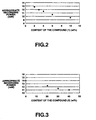
- Fig. 2 shows relationships between the content of the compound (1) in the organic pigment of the recording layer and the corresponding appropriate recording power values.
- the organic pigment generating a heat at decomposition even when a low-power laser beam is used, it is possible to obtain a sufficient heat quantity for recording and realize a stable recording. Furthermore, it has been confirmed that by changing the content of the organic pigment generating a heat at decomposition, it is possible to thermally control the recording sensitivity of the recording layer.
- a substrate used is a disc-shaped substrate formed from polycarbonate and having a diameter of 200 mm. It should be noted that this substrate has a 20-mm hole at its center portion.
- a cyanine pigment having a chemical formula (A) shown below and the OM-57 (produced by Fuji Photo Film Co., Ltd.) having a chemical formula (2) shown below were solved in tetrafluoropropanol as a paint solvent so as to prepare a paint solution.
- the compound (2) used in this example generates a heat in the order of 500 J/g at decomposition.
- this paint solution was applied onto the substrate by spin coat and dried so as to form a recording layer on the substrate.
- an Au film was formed by sputtering on this recording layer, so as to form a reflection layer. Furthermore, this reflection layer was covered by an ultraviolet ray hardening resin by spin coat. The ultraviolet ray hardening resin spin-coated was then subjected to ultraviolet rays so that the ultraviolet ray hardening resin was hardened so as to form a protection layer, thus completing an optical disc.
- Optical discs were prepared while changing the content of the compound (2) in the organic pigment: 0 wt%, 20 wt%, 30 wt%, and 40 wt%.
- test signals were recording using a recording layer having a wavelength of 780 nm while changing the laser power.
- the asymmetiy of pits formed was measured and the power at which the asymmetry was almost 0 was determined as an appropriate power.
- the recording and reproduction at the appropriate power were performed at a speed four times higher than the normal speed.
- Fig. 3 shows relationships between the content of the compound (2) in the organic pigment of the recording layer and the corresponding appropriate recording power values.
- the aforementioned compound (2) generates a small heat quantity compared to the compound (1) used in Example 1.
- the appropriate recording power is lowered.
- the present invention by using a compound generating a heat at reaction as an organic pigment constituting the recording layer, it is possible to realize an excellent optical recording medium capable of stable recording even when a low-power laser beam is used.
Landscapes
- Optical Record Carriers And Manufacture Thereof (AREA)
- Thermal Transfer Or Thermal Recording In General (AREA)
Applications Claiming Priority (2)
| Application Number | Priority Date | Filing Date | Title |
|---|---|---|---|
| JP22931799 | 1999-08-13 | ||
| JP11229317A JP2001047746A (ja) | 1999-08-13 | 1999-08-13 | 光記録媒体 |
Publications (1)
| Publication Number | Publication Date |
|---|---|
| EP1076334A1 true EP1076334A1 (de) | 2001-02-14 |
Family
ID=16890253
Family Applications (1)
| Application Number | Title | Priority Date | Filing Date |
|---|---|---|---|
| EP00117014A Withdrawn EP1076334A1 (de) | 1999-08-13 | 2000-08-08 | Optisches Aufzeichnungsmedium |
Country Status (7)
| Country | Link |
|---|---|
| US (1) | US20030207070A1 (de) |
| EP (1) | EP1076334A1 (de) |
| JP (1) | JP2001047746A (de) |
| KR (1) | KR20010021282A (de) |
| CN (3) | CN1201308C (de) |
| AU (1) | AU764433B2 (de) |
| TW (1) | TW556182B (de) |
Families Citing this family (1)
| Publication number | Priority date | Publication date | Assignee | Title |
|---|---|---|---|---|
| WO2002017314A1 (en) * | 2000-08-25 | 2002-02-28 | Mitsubishi Chemical Corporation | Optical recording medium |
Citations (6)
| Publication number | Priority date | Publication date | Assignee | Title |
|---|---|---|---|---|
| JPS5586787A (en) * | 1978-12-22 | 1980-06-30 | Nec Corp | Laser recording film |
| JPS62174193A (ja) * | 1986-01-29 | 1987-07-30 | Canon Inc | 光記録方法 |
| JPH04337531A (ja) * | 1991-05-13 | 1992-11-25 | Mitsui Toatsu Chem Inc | 光記録媒体 |
| US5185233A (en) * | 1986-04-11 | 1993-02-09 | Canon Kabushiki Kaisha | Method of optical recording employing free radicals |
| US5503957A (en) * | 1994-02-28 | 1996-04-02 | Cheil Synthetics Inc. | Organic optical recording medium and method for the prevention of rewrite therein |
| EP0895231A2 (de) * | 1997-08-01 | 1999-02-03 | Taiyo Yuden Co., Ltd. | Medium für optische Datenaufzeichnung |
Family Cites Families (15)
| Publication number | Priority date | Publication date | Assignee | Title |
|---|---|---|---|---|
| JPS5856239A (ja) * | 1981-09-28 | 1983-04-02 | Tdk Corp | 光記録媒体 |
| JPS5978341A (ja) * | 1982-10-28 | 1984-05-07 | Ricoh Co Ltd | 光学的情報記録媒体 |
| JPH0613238B2 (ja) * | 1982-11-08 | 1994-02-23 | 株式会社リコー | 光学的情報記録媒体 |
| US4908294A (en) * | 1986-02-13 | 1990-03-13 | Olympus Optical Co., Ltd. | Optical information recording medium |
| US4923390A (en) * | 1986-10-14 | 1990-05-08 | Canon Kabushiki Kaisha | Optical recording medium IR-ray absorptive compound and optical recording medium by use thereof |
| US5021276A (en) * | 1988-06-20 | 1991-06-04 | Hitachi Maxell, Ltd. | Optical data recording medium and manufacturing method thereof |
| JPH0827983B2 (ja) * | 1989-05-02 | 1996-03-21 | 太陽誘電株式会社 | 光情報記録媒体 |
| US5171731A (en) * | 1990-06-29 | 1992-12-15 | Fuji Photo Film Co., Ltd. | Information recording medium |
| US5492792A (en) * | 1992-05-12 | 1996-02-20 | Canon Kabushiki Kaisha | Optical recording medium using a polymethine dye |
| US5978348A (en) * | 1995-12-20 | 1999-11-02 | Canon Kabushiki Kaisha | Optical recording medium and process for production thereof |
| JPH1173679A (ja) * | 1997-06-19 | 1999-03-16 | Taiyo Yuden Co Ltd | 光情報記録媒体 |
| TW490666B (en) * | 1999-04-22 | 2002-06-11 | Tdk Corp | Method of manufacturing a photo-recording medium and said photo-recording medium |
| CN1213419C (zh) * | 1999-05-26 | 2005-08-03 | 富士摄影胶片株式会社 | 光信息记录盘和染料溶液的制备 |
| DE60031919T8 (de) * | 1999-07-28 | 2007-08-02 | Tdk Corp. | Fluorinierter Alkohol zur Herstellung eines optischen Aufzeichnungsmediums und optisches Aufzeichnungsmedium zu dessen Herstellung dieser fluorinierte Alkohol eingesetzt wurde |
| TW575877B (en) * | 2000-02-10 | 2004-02-11 | Sony Corp | Optical recording medium |
-
1999
- 1999-08-13 JP JP11229317A patent/JP2001047746A/ja not_active Withdrawn
-
2000
- 2000-08-04 AU AU51820/00A patent/AU764433B2/en not_active Ceased
- 2000-08-08 EP EP00117014A patent/EP1076334A1/de not_active Withdrawn
- 2000-08-11 CN CNB00131694XA patent/CN1201308C/zh not_active Expired - Fee Related
- 2000-08-11 CN CNA2004100818543A patent/CN1645495A/zh active Pending
- 2000-08-11 TW TW089116275A patent/TW556182B/zh not_active IP Right Cessation
- 2000-08-11 CN CNA2004100638451A patent/CN1558411A/zh active Pending
- 2000-08-12 KR KR1020000046752A patent/KR20010021282A/ko not_active Ceased
-
2003
- 2003-04-18 US US10/420,120 patent/US20030207070A1/en not_active Abandoned
Patent Citations (6)
| Publication number | Priority date | Publication date | Assignee | Title |
|---|---|---|---|---|
| JPS5586787A (en) * | 1978-12-22 | 1980-06-30 | Nec Corp | Laser recording film |
| JPS62174193A (ja) * | 1986-01-29 | 1987-07-30 | Canon Inc | 光記録方法 |
| US5185233A (en) * | 1986-04-11 | 1993-02-09 | Canon Kabushiki Kaisha | Method of optical recording employing free radicals |
| JPH04337531A (ja) * | 1991-05-13 | 1992-11-25 | Mitsui Toatsu Chem Inc | 光記録媒体 |
| US5503957A (en) * | 1994-02-28 | 1996-04-02 | Cheil Synthetics Inc. | Organic optical recording medium and method for the prevention of rewrite therein |
| EP0895231A2 (de) * | 1997-08-01 | 1999-02-03 | Taiyo Yuden Co., Ltd. | Medium für optische Datenaufzeichnung |
Non-Patent Citations (3)
| Title |
|---|
| DATABASE WPI Section Ch Week 199302, Derwent World Patents Index; Class A12, AN 1993-011725, XP002151210 * |
| PATENT ABSTRACTS OF JAPAN vol. 12, no. 14 16 January 1988 (1988-01-16) * |
| PATENT ABSTRACTS OF JAPAN vol. 4, no. 128 9 September 1980 (1980-09-09) * |
Also Published As
| Publication number | Publication date |
|---|---|
| TW556182B (en) | 2003-10-01 |
| CN1289118A (zh) | 2001-03-28 |
| CN1201308C (zh) | 2005-05-11 |
| US20030207070A1 (en) | 2003-11-06 |
| CN1645495A (zh) | 2005-07-27 |
| KR20010021282A (ko) | 2001-03-15 |
| CN1558411A (zh) | 2004-12-29 |
| AU5182000A (en) | 2001-02-15 |
| JP2001047746A (ja) | 2001-02-20 |
| AU764433B2 (en) | 2003-08-21 |
Similar Documents
| Publication | Publication Date | Title |
|---|---|---|
| EP0919998A1 (de) | Optisches Aufzeichnungselement | |
| US6319581B1 (en) | Optical recording medium | |
| EP0836179B1 (de) | Optisches Aufzeichnungsmedium | |
| EP0949612B1 (de) | Optisches Aufzeichnungsmedium | |
| US20030190448A1 (en) | Optical recording medium | |
| EP0408271B1 (de) | Optisches Speichermedium | |
| US5441848A (en) | Optical recording/reproducing method | |
| EP0642124B1 (de) | Optisches Informationsaufzeichnungsmedium | |
| AU764433B2 (en) | Optical recording medium | |
| US20020004119A1 (en) | Optical recording medium | |
| US7542406B2 (en) | Optical information recording medium | |
| JPH0255189A (ja) | 光記録媒体 | |
| US20010008669A1 (en) | Optical information recording medium | |
| JP3236951B2 (ja) | 光情報記録媒体 | |
| KR100276556B1 (ko) | 광기록매체 | |
| JP2002083423A (ja) | 光記録再生方法及び光記録媒体 | |
| JP2004087070A (ja) | 追記型光記録媒体 | |
| JP2002113949A (ja) | 光記録媒体 | |
| JP2002123974A (ja) | 光記録媒体及び光記録再生方法 | |
| KR19990077868A (ko) | 광기록매체 | |
| JP2002123975A (ja) | 光記録媒体及び光記録再生方法 | |
| JPH04301495A (ja) | 光情報記録媒体 | |
| JPH05159359A (ja) | 光記録媒体における基板反射層用材料 | |
| KR19980023229A (ko) | 기록 가능한 광기록 매체 | |
| KR20010009503A (ko) | 광기록매체 |
Legal Events
| Date | Code | Title | Description |
|---|---|---|---|
| PUAI | Public reference made under article 153(3) epc to a published international application that has entered the european phase |
Free format text: ORIGINAL CODE: 0009012 |
|
| AK | Designated contracting states |
Kind code of ref document: A1 Designated state(s): DE FR GB |
|
| AX | Request for extension of the european patent |
Free format text: AL;LT;LV;MK;RO;SI |
|
| 17P | Request for examination filed |
Effective date: 20010716 |
|
| AKX | Designation fees paid |
Free format text: DE FR GB |
|
| STAA | Information on the status of an ep patent application or granted ep patent |
Free format text: STATUS: THE APPLICATION HAS BEEN WITHDRAWN |
|
| 18W | Application withdrawn |
Effective date: 20060113 |