EP1077059A2 - Kosmetische oder dermatologische Zubereitungen von Typ Öl-in-Wasser - Google Patents
Kosmetische oder dermatologische Zubereitungen von Typ Öl-in-Wasser Download PDFInfo
- Publication number
- EP1077059A2 EP1077059A2 EP00116483A EP00116483A EP1077059A2 EP 1077059 A2 EP1077059 A2 EP 1077059A2 EP 00116483 A EP00116483 A EP 00116483A EP 00116483 A EP00116483 A EP 00116483A EP 1077059 A2 EP1077059 A2 EP 1077059A2
- Authority
- EP
- European Patent Office
- Prior art keywords
- oil
- advantageous
- acid
- cosmetic
- preparations
- Prior art date
- Legal status (The legal status is an assumption and is not a legal conclusion. Google has not performed a legal analysis and makes no representation as to the accuracy of the status listed.)
- Withdrawn
Links
Classifications
-
- A—HUMAN NECESSITIES
- A61—MEDICAL OR VETERINARY SCIENCE; HYGIENE
- A61K—PREPARATIONS FOR MEDICAL, DENTAL OR TOILETRY PURPOSES
- A61K8/00—Cosmetics or similar toiletry preparations
- A61K8/02—Cosmetics or similar toiletry preparations characterised by special physical form
- A61K8/04—Dispersions; Emulsions
- A61K8/06—Emulsions
- A61K8/062—Oil-in-water emulsions
-
- A—HUMAN NECESSITIES
- A61—MEDICAL OR VETERINARY SCIENCE; HYGIENE
- A61K—PREPARATIONS FOR MEDICAL, DENTAL OR TOILETRY PURPOSES
- A61K8/00—Cosmetics or similar toiletry preparations
- A61K8/02—Cosmetics or similar toiletry preparations characterised by special physical form
- A61K8/04—Dispersions; Emulsions
- A61K8/046—Aerosols; Foams
-
- A—HUMAN NECESSITIES
- A61—MEDICAL OR VETERINARY SCIENCE; HYGIENE
- A61K—PREPARATIONS FOR MEDICAL, DENTAL OR TOILETRY PURPOSES
- A61K8/00—Cosmetics or similar toiletry preparations
- A61K8/02—Cosmetics or similar toiletry preparations characterised by special physical form
- A61K8/04—Dispersions; Emulsions
- A61K8/06—Emulsions
-
- A—HUMAN NECESSITIES
- A61—MEDICAL OR VETERINARY SCIENCE; HYGIENE
- A61K—PREPARATIONS FOR MEDICAL, DENTAL OR TOILETRY PURPOSES
- A61K8/00—Cosmetics or similar toiletry preparations
- A61K8/18—Cosmetics or similar toiletry preparations characterised by the composition
- A61K8/19—Cosmetics or similar toiletry preparations characterised by the composition containing inorganic ingredients
- A61K8/25—Silicon; Compounds thereof
-
- A—HUMAN NECESSITIES
- A61—MEDICAL OR VETERINARY SCIENCE; HYGIENE
- A61K—PREPARATIONS FOR MEDICAL, DENTAL OR TOILETRY PURPOSES
- A61K8/00—Cosmetics or similar toiletry preparations
- A61K8/18—Cosmetics or similar toiletry preparations characterised by the composition
- A61K8/19—Cosmetics or similar toiletry preparations characterised by the composition containing inorganic ingredients
- A61K8/27—Zinc; Compounds thereof
-
- A—HUMAN NECESSITIES
- A61—MEDICAL OR VETERINARY SCIENCE; HYGIENE
- A61K—PREPARATIONS FOR MEDICAL, DENTAL OR TOILETRY PURPOSES
- A61K8/00—Cosmetics or similar toiletry preparations
- A61K8/18—Cosmetics or similar toiletry preparations characterised by the composition
- A61K8/19—Cosmetics or similar toiletry preparations characterised by the composition containing inorganic ingredients
- A61K8/29—Titanium; Compounds thereof
-
- A—HUMAN NECESSITIES
- A61—MEDICAL OR VETERINARY SCIENCE; HYGIENE
- A61K—PREPARATIONS FOR MEDICAL, DENTAL OR TOILETRY PURPOSES
- A61K8/00—Cosmetics or similar toiletry preparations
- A61K8/18—Cosmetics or similar toiletry preparations characterised by the composition
- A61K8/30—Cosmetics or similar toiletry preparations characterised by the composition containing organic compounds
- A61K8/33—Cosmetics or similar toiletry preparations characterised by the composition containing organic compounds containing oxygen
- A61K8/35—Ketones, e.g. benzophenone
-
- A—HUMAN NECESSITIES
- A61—MEDICAL OR VETERINARY SCIENCE; HYGIENE
- A61K—PREPARATIONS FOR MEDICAL, DENTAL OR TOILETRY PURPOSES
- A61K8/00—Cosmetics or similar toiletry preparations
- A61K8/18—Cosmetics or similar toiletry preparations characterised by the composition
- A61K8/30—Cosmetics or similar toiletry preparations characterised by the composition containing organic compounds
- A61K8/33—Cosmetics or similar toiletry preparations characterised by the composition containing organic compounds containing oxygen
- A61K8/37—Esters of carboxylic acids
-
- A—HUMAN NECESSITIES
- A61—MEDICAL OR VETERINARY SCIENCE; HYGIENE
- A61K—PREPARATIONS FOR MEDICAL, DENTAL OR TOILETRY PURPOSES
- A61K8/00—Cosmetics or similar toiletry preparations
- A61K8/18—Cosmetics or similar toiletry preparations characterised by the composition
- A61K8/30—Cosmetics or similar toiletry preparations characterised by the composition containing organic compounds
- A61K8/49—Cosmetics or similar toiletry preparations characterised by the composition containing organic compounds containing heterocyclic compounds
- A61K8/494—Cosmetics or similar toiletry preparations characterised by the composition containing organic compounds containing heterocyclic compounds with more than one nitrogen as the only hetero atom
- A61K8/4966—Triazines or their condensed derivatives
-
- A—HUMAN NECESSITIES
- A61—MEDICAL OR VETERINARY SCIENCE; HYGIENE
- A61Q—SPECIFIC USE OF COSMETICS OR SIMILAR TOILETRY PREPARATIONS
- A61Q17/00—Barrier preparations; Preparations brought into direct contact with the skin for affording protection against external influences, e.g. sunlight, X-rays or other harmful rays, corrosive materials, bacteria or insect stings
- A61Q17/04—Topical preparations for affording protection against sunlight or other radiation; Topical sun tanning preparations
Definitions
- the present invention relates to cosmetic and dermatological preparations from Type oil-in-water, especially sprayable O / W emulsions, which have a viscosity of less than 2000 mPa ⁇ s, and a method for stabilizing O / W formulations by adjusting the density of the phases.
- Cosmetic preparations are mainly used to care for the skin.
- the human skin performs numerous vital functions. With an average surface area of around 2 m 2 in adults, it has an outstanding role as a protective and sensory organ. Among its many functions (for example for heat regulation), the barrier function that prevents the skin (and ultimately the entire organism) from drying out is probably the most important.
- the skin acts as a protective device against the penetration and absorption of external substances (e.g. dirt, chemicals, microorganisms). It also has an important role as a regulatory and target organ in human metabolism.
- Cosmetic skin care primarily serves the natural function of the skin as a barrier against environmental influences and against the loss of the body's own substances (in addition to water also to strengthen or restore natural fats, electrolytes etc.).
- the aim of skin care is also to reduce the fat and fat caused by daily washing Compensate for skin water loss. This is especially important when the natural Regeneration capacity is not sufficient.
- skin care products are said to exist Protect environmental influences, especially from the sun and wind, and skin aging delay.
- UV-C radiation with a Wavelength that is less than 290 nm is from the ozone layer in the earth's atmosphere absorbed and has no physiological meaning.
- UV-B range rays in the Range between 290 nm and 320 nm, the so-called UV-B range, an erythema, a simple sunburn or even more or less severe burns.
- UV-A radiation (320 to 400 nm) is photodynamic, especially phototoxic reactions and chronic skin changes far more dangerous than UV-B radiation. So even the UV-A radiation is enough normal everyday conditions to quickly remove the collagen and elastin fibers to harm.
- the damaging influence of UV-B radiation can also be caused by UV-A radiation to be reinforced.
- Medical topical compositions typically contain one or more Medicines in effective concentration.
- Cosmetic and medical application typically contain one or more Medicines in effective concentration.
- Products on the legal provisions of the Federal Republic of Germany referenced (e.g. cosmetics regulation, food and drug law).
- Emulsions are by far the most important product type in the area of skin care products emulsions are disperse two- or multi-phase systems, with cosmetic Emulsions from at least one fat phase (fats and mineral oils, fatty acid esters, Fatty alcohols etc.) and at least one water phase (water, glycerin, glycols etc.) consist of each other with the help of emulsifiers in the form of very fine droplets be distributed.
- the oil phase is finely distributed in the water phase, it acts an oil-in-water emulsion (O / W emulsion, e.g. milk).
- O / W emulsion oil-in-water emulsion
- the basic character an O / W emulsion is characterized by the water, i. H. it is less greasy the skin, is rather matting and is absorbed into the skin faster than a W / O emulsion.
- emulsions are considered to be unstable systems from a thermodynamic point of view are able to produce cosmetic emulsions that have been stable for years.
- An engagement is said to be stable if it lasts for a given period of time no measurable temporal and local changes in the droplet size distribution have it determined.
- the stability or instability of emulsions depends on various factors.
- the water phase of a W / O emulsion tends because water and Oil phase have different densities for sedimentation.
- the oil phase of an O / W emulsion accordingly has a tendency to cream.
- the disperse phase come to a drop aggregation, whereby the individual droplets of an aggregate first through a thin film of continuous phase from each other stay separated.
- the original drop size distribution changes only seemingly and in this case can be restored by stirring or shaking become.
- Aids are required that prevent the two phases from separating, but at least delay until the emulsion has fulfilled its purpose.
- these tools are intended to stabilize the interface by preventing that the droplets of the disperse phase flow together. Ideally, this will have an effect Substances also a repulsion of the droplets, which prevents them approximate so that agglomeration (aggregate formation) can be avoided.
- auxiliaries are used for creaming or sedimentation to counteract the phases.
- Emulsifiers are surface-active substances that are able to control the interfacial tension to decrease between oil and water phase by preferring deposit at the interface between these two. This is due to their amphipile Molecular structure enables: emulsifiers have at least one polar (hydrophilic) Group and at least one non-polar (lipophilic) group. So that they are both in the hydrophilic as well as soluble in the lipophilic phase. The one in the appropriate phase the more soluble part protrudes into it and thereby lowers the interfacial tension between the two phases.
- emulsifiers also stabilize through the formation of interfacial films and thus physical "barriers, which prevents aggregation and coalescence of the emulsified particles.
- the droplets are either charged so that they repel each other, or a stable, often highly viscous or even solid protective layer is formed the droplets formed.
- the emulsifier system must therefore usually be in addition to the actual emulsifier contain another component as a co-emulsifier, stabilizer or depending Mechanism of action also as a consistency agent, thickener or protective colloid etc. referred to as.
- Stabilizers do not have to be surface-active but be amphiphilic connections.
- the viscosity of the outer phase can be increased, for example, by adding thickeners increase which z. B. form gels and / or lamellar liquid crystals.
- emulsifiers are also able to form emulsifier gel networks to increase the viscosity of a liquid.
- Breaking of an emulsion can also be done by choosing an appropriate phase volume ratio prevent.
- one Emulsion as a system of metal balls of the same diameter (inner phase) and one Liquid (outer phase). Sedimentation or creaming can - in this simple model - then no longer take place when all the liquid with Metal balls are filled. This is - if you take a densest packing of balls as a distribution on - the case especially at a ratio of 1: 2, d. H. if the emulsion is too 2/3 consists of an inner phase. It is obvious that the viscosity of an emulsion increases with increasing proportion of the inner phase, since this increases the mobility of the dispersed droplets is restricted.
- O / W emulsions are usually thickened by viscosity increase the aqueous phase, stabilized.
- Polyacrylates for example, are suitable for this (Carbomer) and other organic thickeners.
- a disadvantage of this method of Improving stability is the sensitivity of these formulations to electrolytes. Furthermore, in this way, naturally, predominantly higher-viscosity formulations (like creams or ointments). Also the stabilization of O / W emulsions The phase volume ratio usually leads to viscous formulations.
- the stability of Flowable emulsions deserve special attention, as the significantly greater mobility of the particles promotes faster coalescence.
- the disadvantages mentioned can be, for example, that they are comparatively large amounts of one or more emulsifiers are required (e.g. 3% by weight or more). But since emulsifiers - like ultimately every chemical substance - in the Individual allergic or hypersensitivity reactions can cause (although the use of the usual cosmetic emulsifiers i. a. is of course completely harmless) it is desirable to check the emulsifier content to keep a cosmetic or dermatological formulation as small as possible.
- Emulsions with a very low viscosity (low viscosity or sprayable emulsions) According to the above, they have so far been very expensive, if at all formulate. Accordingly, the range of such formulations is enormous low. Nonetheless, such formulations could not previously be known to the consumer offer cosmetic services.
- European Patent Specification 667 144 describes cosmetic sunscreens, which are oil-in-water emulsions and inorganic nanopigments contain the base of metal oxides as light stabilizers, the formulations can also be sprayable. These preparations are so-called PIT emulsions which are produced by phase reversal and are therefore particularly finely dispersed are. However, this document could not show the way to the present invention.
- low-viscosity preparations of the prior art often have the Disadvantage that they have a narrow application or a limited choice of raw materials are limited.
- the incorporation of higher concentrations of polar Oil components often cause difficulties.
- An object of the present invention was to prepare preparations of the oil-in-water type to produce, which have a very low viscosity and not the disadvantages of Have state of the art.
- Another object of the invention was to find solutions to discover cosmetic or dermatological, as thin as possible O / W emulsions, which are stable to increased electrolyte concentrations and into which large amounts of polar oil components can be incorporated. It was also a task the invention to find a method for stabilizing O / W formulations.
- the invention is also a Process for the stabilization of O / W formulations, characterized in that the density of the oil phase is adjusted by adding hydrophobic and / or amphiphilic solids to the density of the water phase in such a way that the density difference of the two phases does not exceed 0.01 g ⁇ cm -3 is.
- O / W formulations obtainable by this process are also the subject of the present Invention.
- the preparations according to the invention are extremely satisfactory in every respect Preparations that are not limited to a limited selection of raw materials are. Accordingly, they are particularly suitable as a basis for preparation forms to serve with a variety of applications.
- the invention Preparations have excellent stability against decay in oil and Water phases and show very good sensory properties, such as the Spreadability on the skin or the ability to draw into the skin.
- the preparations according to the invention are an enrichment of the State of the art in relation to low viscosity O / W emulsions.
- the method according to the invention is surprisingly simple very stable O / W formulations, for example sprayable formulations with a high sun protection factor available.
- the preparations are significantly less than 1% by weight (based on the total weight of the preparations) of one or contain several emulsifiers.
- the invention is very particularly preferred Preparations which - based on the total weight of the preparations - are less than 0.5% by weight of one or more emulsifiers or even some are completely free of emulsifiers.
- the average diameter of the oil droplets of the formulations according to the invention is less than 50 ⁇ m.
- the O / W formulations of the invention may also be advantageous if the O / W formulations of the invention, though it is not necessary to also contain stabilizers, which are advantageous from the Group of thickeners can be selected. It is advantageous to the content of the or to choose the thickeners from the range 0.05% by weight to 0.15% by weight, based on the total weight of the preparations.
- amphiphilic solids for the purposes of the present invention are, for example modified layered silicates.
- Silicates are salts and esters (silicic acid esters) of orthosilicic acid [Si (OH) 4 ] and their condensation products.
- the silicates are not only the most species-rich class of minerals, but also extremely important geologically and technically. Over 80% of the earth's crust consists of silicates.
- Layered silicates (phyllosilicates, leaf silicates) are (ideally) silicate structures with two-dimensionally infinite layers of [SiO 4 ] 4 tetrahedra, each tetrahedron being connected to neighboring tetrahedra via 3 bridging oxygen.
- Chemical formulas can only be approximated for layered silicates because they have a large ion exchange capacity and silicon can be exchanged for aluminum and this in turn for magnesium, Fe 2+ , Fe 3+ , Zn and the like.
- the resulting negative charge on the layers is generally compensated for by cations, in particular by Na + and Ca 2+ in interlayer positions.
- Layered silicates can be made by reversible storage of water (in the 2- to 7-fold Amount) and other substances such.
- Advantageous sheet silicates for the purposes of the present invention are, for example, their greatest direction of expansion in the unmodified and unswollen state has an average length of less than 10 ⁇ m.
- the effective size of the modified layered silicate particles in a cosmetic or dermatological formulation depends of course depends on the amount of substances stored.
- modified layered silicates in the sense of the present invention are, for example, modified smectites (smectites).
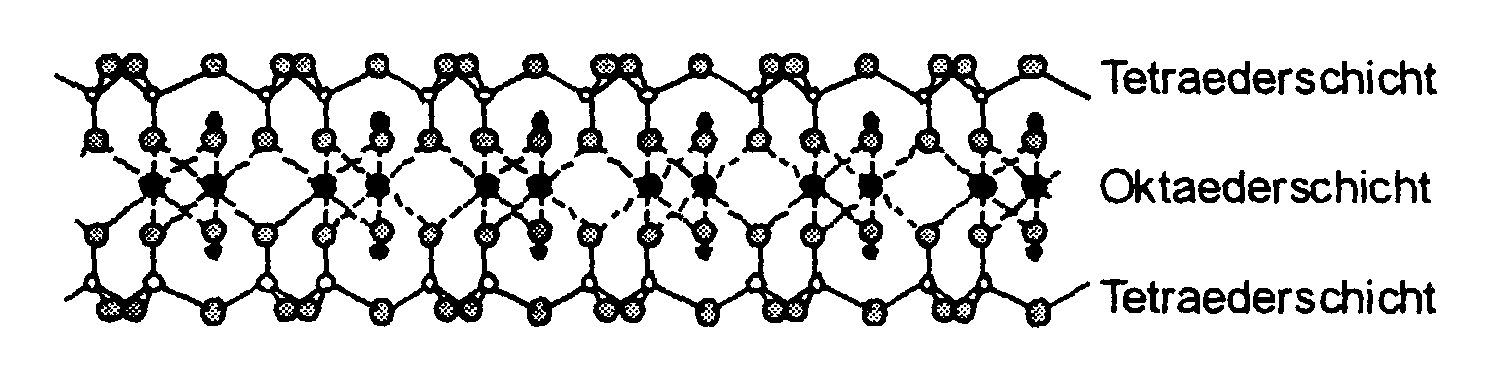
- Smectites are always very fine-grained (mostly ⁇ 2 mm), predominantly lamellar, moss-like or spherical aggregates three-layer clay minerals (2: 1 layer silicates), in which a central layer of octahedrally coordinated cations sandwiched by 2 layers of [(Si, Al) O 4 ] tetrahedra is surrounded.
- Smectites are idealized by the following structural formula, in which white circles filled with silicon and / or aluminum atoms, light gray circles filled with oxygen atoms, dark gray circles filled with hydrogen atoms and black circles filled with aluminum, magnesium, iron atoms and / or other exchange cations:
- modified smectites are e.g. B. modified Montmorillonite.
- Montmorillonites are described by the approximate chemical formula Al 2 [(OH) 2 / Si 4 O 10 ] ⁇ n H 2 O or Al 2 O 3 ⁇ 4 SiO 2 ⁇ H 2 O ⁇ n H 2 O and are dioctahedral Clay minerals belonging to smectites.
- Hectorites are smectites and have the approximate chemical formula M + 0.3 (Mg 2.7 Li 0.3 ) [Si 4 O 10 (OH) 2 ], in which M + mostly represents Na + .
- Bentonites are clays and rocks that contain smectites, especially montmorillonite, as the main minerals.
- the Raw "bentonites are either calcium bentonites (referred to as Fuller earths in Great Britain) or sodium bentonites (also: Wyoming bentonites).
- Modified layered silicates in the sense of the present invention are layered silicates, in particular the sheet silicate types already mentioned, their organophilia (also: lipophilia) - For example, by reaction with quaternary ammonium compounds - was increased. Layered silicates of this type are also referred to as organophilic layered silicates.
- bentones are particularly advantageous for the purposes of the present invention, d. H. organic derivatives of montmorillonites (or bentonites) and / or hectorites, which are produced by ion exchange reactions with alkylammonium bases.
- Advantageously modified layered silicates in the sense of the present invention can be obtained, for example, by reacting layered silicates with Quatemium-18.
- Quaternium-18 is a mixture of quaternary ammonium chloride salts, which are described by the following structural formula: wherein the radicals R 1 are selected independently of one another from the group methyl and hydrogenated valley residues with a chain length of 12 to 20 carbon atoms.
- stearalkonium hectorite a reaction product
- hectorite and stearalkonium chloride benzyldimethylstearylammonium chloride
- quaternium-18 hectorite a reaction product of hectorite and quaternium-18, which z. B. under the trade names Bentone 27 and Bentone 38 at Nordmann & Rassmann are available.
- X-ray amorphous Oxide pigments are metal oxides or semimetal oxides, which have no or no recognizable crystal structure in X-ray diffraction experiments reveal. Such pigments are often obtainable by flame reaction, for example in that a metal or semimetal halide with hydrogen and air (or pure oxygen) is reacted in a flame.
- Preferred X-ray amorphous oxide pigments are silicon oxides of the type Aerosil® (CAS no. 7631-86-9).
- Draw Aerosile® which are available from DEGUSSA AG / Frankfurt is characterized by a small particle size (e.g. between 5 and 40 nm), the particles are to be regarded as spherical particles of very uniform dimensions. Macroscopic Aerosile® are recognizable as loose, white powder.
- Aerosil® types are, for example, Aerosil® OX50, Aerosil® 130, Aerosil® 150, Aerosil® 200, Aerosil® 300, Aerosil® 380, Aerosil® MOX 80, Aerosil® MOX 170, Aerosil® COK 84, Aerosil® R 202, Aerosil® R 805, Aerosil® R 812, Aerosil® R 974, Aerosil® R976.
- hydrophobic and / or amphiphilic solids are, for example micronized, inorganic pigments selected from the group of amphiphiles and / or hydrophobic metal oxides, in particular from the group titanium dioxide, Zinc oxide and silicon dioxide, the metal oxides both individually and in a mixture can be present. It is essentially irrelevant in which of the, if applicable naturally occurring modifications the amphiphilic metal oxides used available.
- the cosmetic and dermatological preparations can also Contain hydrophobic inorganic micropigments that are commonly used in cosmetics to protect the skin from UV rays. It refers to Oxides of titanium, zinc, iron, zirconium, silicon, manganese, aluminum, cerium and Mixtures of these, as well as modifications in which the oxides are the active agents are. It is particularly preferred to use pigments based on titanium dioxide.
- boron nitrides listed below: Trade name Available at Boron nitride powder Advanced Ceramics Boron nitride powder Sintec ceramics Ceram Blanche Kawasaki HCST Boron Nitride Strong réelle BN® Carborundum Wacker boron nitride BNP Wacker chemistry
- the average particle diameter of the boron nitride particles used is advantageous to be smaller than 20 ⁇ m, particularly advantageously to be smaller than 15 ⁇ m.
- Solids which are surface-water-repellent are also advantageous according to the invention ( coated "), whereby a hydrophobic and / or amphiphilic character of these solids is to be formed or retained.
- This surface treatment can consist in that the solids are provided with a thin hydrophobic layer by methods known per se.
- Such a method which is described below using the example of titanium dioxide, consists, for example, in that the hydrophobic surface layer according to a reaction n TiO 2 + m (RO) 3rd Si-R ' ⁇ n TiO 2 (surface) is produced.
- n and m are stoichiometric parameters to be used at will, R and R 'are the desired organic radicals.
- TiO 2 pigments for example those coated with aluminum stearate and available under the trade name MT 100 T from TAYCA, are particularly advantageous.
- Another advantageous coating consists of aluminum hydroxide or aluminum oxide hydrate (also: Alumina, CAS No .: 1333-84-2), followed by stearic acid is applied. It is also preferred to use other hydrophobic coatings to apply to metal oxide particles pretreated with alumina, such as e.g. B. polyorganosiloxanes.
- Advantageous, hydrophobic coated with alumina and stearic acid Titanium dioxide pigments are, for example, under the trade name UV Titan M160 available from Kemira.
- Another advantageous coating of the solids according to the invention consists of Dimethylpolysiloxane (also: Dimethicone), a mixture of fully methylated, linear siloxane polymers, which are terminally blocked with trimethylsiloxy units.
- Dimethylpolysiloxane also: Dimethicone
- a mixture of fully methylated, linear siloxane polymers which are terminally blocked with trimethylsiloxy units.
- zinc oxide pigments and boron nitride particles which are coated in this way. For example, those at available from Carborundum under the trade name réelle BN® UHP 1106, Boron nitride particles treated with Dimethicone.
- a coating with polymethylhydrogensiloxane, a linear one, is also advantageous Polysiloxane, which is also called Methicone.
- Methicone beneficial, with Methicone Treated boron nitride particles are, for example, those from Carborundum the trade name réelle BN® UHP 1107 available.
- the solids according to the invention are composed of a mixture Dimethylpolysiloxane, especially dimethylpolysiloxane with an average Chain length of 200 to 350 dimethylsiloxane units, and silica gel are coated, which is also called Simethicone.
- the inorganic pigments additionally with aluminum hydroxide or aluminum oxide hydrate also: Alumina, CAS No .: 1333-84-2
- the coating can also contain water.
- An example of this is that under the trade name Eusolex Titanium dioxide available from Merck.
- titanium dioxide pigments Octylsilanol are coated, and / or silicon dioxide particles, which are water-repellent on the surface are treated.
- spherical polyalkylsilsesquioxane particles are preferred as mentioned in European Patent Application 0 686 391.
- Such polyalkylsilsesquioxane particles are, for example, under the trade names Aerosil R972 and Aerosil 200V available from Degussa.
- mixtures are also advantageous for the purposes of the present invention inorganic, amphiphilic pigment types both within a crystal, for example as mixed iron oxide or talc (magnesium silicate), as well as by mixing several types of metal oxide within one preparation.
- Magnesium silicates are particularly advantageous, for example, under the trade name Talkum Micron available from Grolmann.
- dispersions of ultrafine titanium dioxide in oils or oily titanium dioxide suspensions e.g. B. Titanium dioxide in Caprylic- / Capric triglyceride, a mixture of triglycerides mainly of caprylic acid [CH 3 (CH 2 ) 6 COOH] and capric acid [CH 3 (CH 2 ) 8 COOH].
- Preferred, for example, are the oily titanium dioxide suspensions available from Solaveil under the trade name Tioveil TG.
- gloss or pearl pigments in particular also so-called silver and gold gloss pigments.
- Powdery pigments or castor oil dispersions of bismuth oxychloride and / or titanium dioxide and bismuth oxychloride and / or titanium dioxide on mica are preferred.
- Such bismuth oxychlorides are offered in different qualities by Merck Rona under the trade name Biron.
- Biron LF 2000 is advantageous, for example.
- the pearl pigments available under the trade name Mica from Merck KGaA in particular Mica Black, which is a mixture of iron oxide (Fe 3 O 4 ), mica and titanium dioxide, and Mica M.
- Advantageous solids for the purposes of the present invention are also pigments which have a coloring effect, for example those listed below (in brackets, the Color Index numbers according to the Rowe Color Index, 3rd edition, Society of Dyers and Colorists, Bradford, England, 1971 and the color): Pigment Green (10006, green), Pigment Yellow 1 (11680, yellow), Pigment Yellow 3 (11710, yellow), Pigment Orange 1 (11725, orange), Pigment Red 3 (12120, red), Pigment Red 112 (12370, red), Pigment Red 7 (12420, red), Pigment Brown 1 (12480, brown), Pigment Yellow 16 (20040, yellow), Pigment Yellow 13 (21100, yellow), Pigment Yellow 83 (21108, yellow), Pigment Violet 23 (51319, violet), Pigment Red 122 (73915, red), Pigment Blue 16 (74100, blue), aluminum (77000, white), alumina hydrate (77002, white), Pigment Red 101 and 102 (77015, red), Barium sulfate (77120, white), carbon (77266, black
- hydrophobic and / or amphiphilic solids are microfine polymer particles, which are present in the preparation in the form of solids.
- microfine polyamide particles are advantageous, especially those under the Trade name SP-500 available from TORAY.
- Polyamide 6 also: Nylon 6
- polyamide 12 also: Nylon 12
- polyamide 12 is a poly ( ⁇ -laurine lactam) made of ⁇ -laurine lactam.
- Orgasol® are advantageous in the sense of the present invention 1002 (polyamide 6) and Orgasol® 2002 (polyamide 12) from ELF ATOCHEM.
- microfine polymer particles are microfine polymethacrylates.
- Particles are, for example, under the trade name POLYTRAP® DOW CHEMICAL available.
- microfine polymer particles are coated on the surface.
- This surface treatment can then consist in that the polymer particles are provided with a thin hydrophilic layer by methods known per se.
- Advantageous coatings consist, for example, of titanium dioxide (TiO 2 ), zirconium dioxide (ZrO 2 ) or other polymers, such as, for example, polymethyl methacrylate.
- Particularly advantageous microfine polymer particles for the purposes of the present invention are, for example, those obtainable by the process for hydrophilic coating of hydrophobic polymer particles described in US Pat. No. 4,898,913.
- the average particle diameter of the microfine polymer particles used is preferred selected less than 100 microns, particularly advantageously less than 50 microns. It is it is essentially irrelevant in what form (platelets, chopsticks, beads etc.) the polymer particles used are present.
- hydrophobic and / or amphiphilic solids are amphiphilic modified Polysaccharides that show no thickening properties.
- amphiphilic polysaccharides are, for example, by reacting starch largely with mono-, bi- or polyfunctional reagents or oxidizing agents polymer-analogous reactions available.
- starch ethers e.g. 8. those caused by etherification of starch with tetramethylolacetylene diurea are available and which as Amylum non mucilaginosum (non-swelling starch).
- Starch esters and / or their salts for example sodium and / or aluminum salts of low-substituted half-esters of starch, in particular sodium starch n-octenyl succinate of structural formula I, in which R is distinguished by the following structure, are particularly advantageous and which z. B. is available under the trade name Amiogum® 23 from CERESTAR and aluminum starch octenyl succinate, especially those available under the trade names Dry Flo® Elite LL and Dry Flo® PC from CERESTAR.
- distarch phosphate (INCI: Distarch Phosphate), which is obtained by cross-linking Starch is produced with sodium metaphosphate and under the trade name Corn OP is available from chemag.
- the average particle diameter of the modified polysaccharides is advantageous to be smaller than 20 ⁇ m, particularly advantageously to be smaller than 15 ⁇ m.
- Modified Polysaccharides which are advantageous solids for the purposes of the present invention represent, are numerous, known ways, both chemical and physical nature available. There are also new ones for the production of such polysaccharides In principle, possible paths. It is essential that the modified polysaccharides Show hydrophobic and / or amphiphilic properties and that they are not thickening Act.
- the total concentration of all pigments is to be greater than 0.05% by weight, particularly advantageously between 0.05% by weight and 30% by weight, based on the total weight of the preparations, the total content on one or more hydrophobic and / or amphiphilic solids is to be chosen so that the density difference between the oil phase and the water phase (determinable with a computing digital density meter of the type DMA 45 from chempro / PA at 25 ° C) is not greater than 0, 01 gcm -3 .
- hydrophobic and / or amphiphilic solids are in the oil phase of the formulations incorporated.
- the amount of solids to be used can depend on by the type of the respective product by a person skilled in the art without inventive step can be easily determined by simply trying them out.
- the oil phase of the O / W emulsions according to the invention is advantageously chosen from the Group of polar oils, for example from the group of lecithins and fatty acid triglycerides, namely the triglycerol esters saturated and / or unsaturated, branched and / or unbranched alkane carboxylic acids with a chain length of 8 to 24, especially 12 to 18 carbon atoms.
- the Group of polar oils for example from the group of lecithins and fatty acid triglycerides, namely the triglycerol esters saturated and / or unsaturated, branched and / or unbranched alkane carboxylic acids with a chain length of 8 to 24, especially 12 to 18 carbon atoms.
- the fatty acid triglycerides can, for example can be advantageously selected from the group of synthetic, semi-synthetic and natural oils, such as Caprylic / Caprictriglyceride, Cocoglyceride, Olive Oil, Sunflower Oil, Soybean oil, peanut oil, rapeseed oil, almond oil, palm oil, coconut oil, castor oil, wheat germ oil, Grape seed oil, safflower oil, evening primrose oil, macadamia nut oil and the like.
- synthetic, semi-synthetic and natural oils such as Caprylic / Caprictriglyceride, Cocoglyceride, Olive Oil, Sunflower Oil, Soybean oil, peanut oil, rapeseed oil, almond oil, palm oil, coconut oil, castor oil, wheat germ oil, Grape seed oil, safflower oil, evening primrose oil, macadamia nut oil and the like.
- polar oil components can be used for the purposes of the present invention furthermore selected from the group of the esters from saturated and / or unsaturated, branched and / or unbranched alkane carboxylic acids with a chain length of 3 up to 30 carbon atoms and saturated and / or unsaturated, branched and / or unbranched Alcohols with a chain length of 3 to 30 carbon atoms and from the group of Esters of aromatic carboxylic acids and saturated and / or unsaturated, branched and / or unbranched alcohols with a chain length of 3 to 30 carbon atoms.
- ester oils can then advantageously be selected from the group octyl palmitate, Octyl cocoate, octyl isostearate, octyl dodecyl myristate, cetearyl isononanoate, isopropyl myristate, Isopropyl palmitate, isopropyl stearate, isopropyl oleate, n-butyl stearate, n-hexyl laurate, ri-decyl oleate, isooctyl stearate, isononyl stearate, isononyl isononanoate, 2-ethylhexyl palmitate, 2-ethylhexyl laurate, 2-hexyldecyl stearate, 2-octyldodecyl palmitate, stearylheptanoate, Oleyl oleate, olerterucate, e
- oil phase can advantageously be selected from the group of dialkyl ethers, z. B. Dicaprylyl ether.
- the oil component from the group consisting of isoeicosane, neopentyl glycol, propylene glycol dicaprylate / dicaprate, caprylic / capric / diglyceryl succinate, butylene CaprylatiCaprat, C 12-13 alkyl lactate, di-C 12/13 -Atkyltartrat, triisostearin, Dipentaerythrityl Hexacaprylat / Hexacaprate, propylene glycol monoisostearate, tricaprylin, dimethyl isosorbide to choose. It is particularly advantageous if the oil phase of the O / W emulsions according to the invention has a content of C 12-15 alkyl benzoate or consists entirely of this.
- oil phase of the O / W emulsions according to the invention can also be advantageous also contain non-polar oils, for example those which are selected from the Group of branched and unbranched hydrocarbons and waxes, in particular Mineral oil, petroleum jelly (petrolatum), paraffin oil, squalane and squalene, polyolefins, hydrogenated polyisobutenes and isohexadecane.
- non-polar oils for example those which are selected from the Group of branched and unbranched hydrocarbons and waxes, in particular Mineral oil, petroleum jelly (petrolatum), paraffin oil, squalane and squalene, polyolefins, hydrogenated polyisobutenes and isohexadecane.
- Polydecenes are among the polyolefins the preferred substances.
- the oil phase can also advantageously contain cyclic or linear silicone oils have or consist entirely of such oils, although it is preferred in addition to the silicone oil or the silicone oils, an additional content of other oil phase components to use.
- Cyclomethicone (octamethylcyclotetrasiloxane) is advantageous as according to the invention using silicone oil.
- silicone oils are also beneficial in the sense to use the present invention, for example cetyldimethicone, hexamethylcyclotrisiloxane, Polydimethylsiloxane, poly (methylphenylsiloxane).
- z. B. natural animal and vegetable waxes Origin such as beeswax, china wax, bumblebee wax and other insect waxes, especially those mentioned below.
- Beeswax z. B. is an excretion product from glands of honey bees, the use them to build honeycombs. Yellow (Cera flava), brown or red So-called raw wax can be obtained, for example, by using honey Removing freed honeycombs melts, the melt of solid impurities separates and solidifies the raw wax thus obtained.
- the raw wax can be treated be bleached completely white with oxidizing agents (Gera alba).
- Beeswax consists of cerin, which is readily soluble in alcohol, a mixture of cerotinic acid CH 3 (CH 2 ) 24 COOH and melissic acid CH 3 (CH 2 ) 28 COOH as well as an ester mixture called myricin from approx. 70 esters from C 16 - to C 36 acids and C 24 to C 36 alcohols.
- Myricyl palmitate, myricylcerotinate and paraffin are found as essential components of beeswax.
- China wax z. B. is grown in China and Japan by the wax scale insect living on the Chinese ash (Coccus ceriferus) and the scale insects Ceroplastes ceriferus and Encerus pela or generated. It is scraped off the trees and remelted cleaned in boiling water.
- the main component of China wax is the cerotinic acid ester of ceryl alcohol.
- Shellac wax is obtained from Lac, the secretion of the female lacquer scale (Kerria lacca), which is found in huge colonies (Lac is derived from the Hindhi word Lakh "for 100,000) live on trees and shrubs in South Asia (India, Burma, South China).
- Shellac wax which is accessible by means of solvent extraction, contains essential components of myricylic alcohol, melissic acid and other wax alcohols and acids or their esters.
- Plant waxes are also advantageous for the purposes of the present invention.
- Cuticular waxes of lower and higher plants, algae, lichens, Mosses and mushrooms such as candelilla wax, carnauba wax, Japanese wax, Esparto grass wax, cork wax, rice wax, sugar cane wax, fruit waxes, e.g. B. apple wax, flower waxes, leaf waxes of conifers, coffee wax, flax wax, Sesame wax, jojoba oil and the like.
- Candelilla waxes e.g. B. are brownish to yellowish brown, hard waxy masses, which are soluble in lipophilic solvents.
- Candelilla wax contains odd-numbered ahphatic Hydrocarbons (approx. 42%) esters (approx. 39%), wax acids and wax alcohols. It can be obtained, for example, from the shredded, meaty ones Leaves a spikeless milkweed (Euphorbia cerifera) by boiling with aqueous sulfuric acid.
- Camauba wax is a yellowish, greenish or dark gray mass, which in different qualities obtained through selection from the leaves of the Brazilian Fan palm Copernicia prunifera or Carnauba palm (Carnauba cerifera) won can be, for example, by brushing the wax dust from the withered fronds, melted, filtered and broken into pieces after solidification.
- Carnauba wax can be lightened with bleach. It contains about 85% ester, each about 2-3% free wax acids (camauba, behen, lignocerin, melissin and Cerotic acid), long chain alcohols, diols and saturated hydrocarbons.
- Japanese wax also: Japanese tallow or Cera japonica
- the main components of the Japanese wax are palmitic acid glycerol esters and esters of japanese acid (heneicosanedioic acid, C 21 H 40 O 4 ), phellogenic acid (docosanedioic acid, C 22 H 42 O 4 ) and tricosanedioic acid (C 23 H 44 O 4 ).
- Esparto wax falls out as a by-product in pulp and paper manufacture Espartogras (Graminaceae) native to Mediterranean countries. It consists of approx. 15 to 17% from wax acids (e.g. cerotinic and melissic acid), 20 to 22% Alcohols and hydrocarbons as well as 63 to 65% from esters.
- wax acids e.g. cerotinic and melissic acid
- Alcohols and hydrocarbons as well as 63 to 65% from esters.
- Particularly advantageous in the sense of the present invention are, for example under the trade names Permulgin 1550 and Permulgin 4002 from KOSTER KEUNEN and the shellac wax 7302 L and candellila under the trade names Wax 2039 L natural waxes available from the KAHL wax refinery.
- modified waxes and synthetic are also advantageous according to the invention Waxes.
- Preferred modified waxes are, for example, beeswax esters, especially those under the trade names BW Ester BW 67, BW Ester BW 80 bei KOSTER KEUNEN available alkyl beeswax.
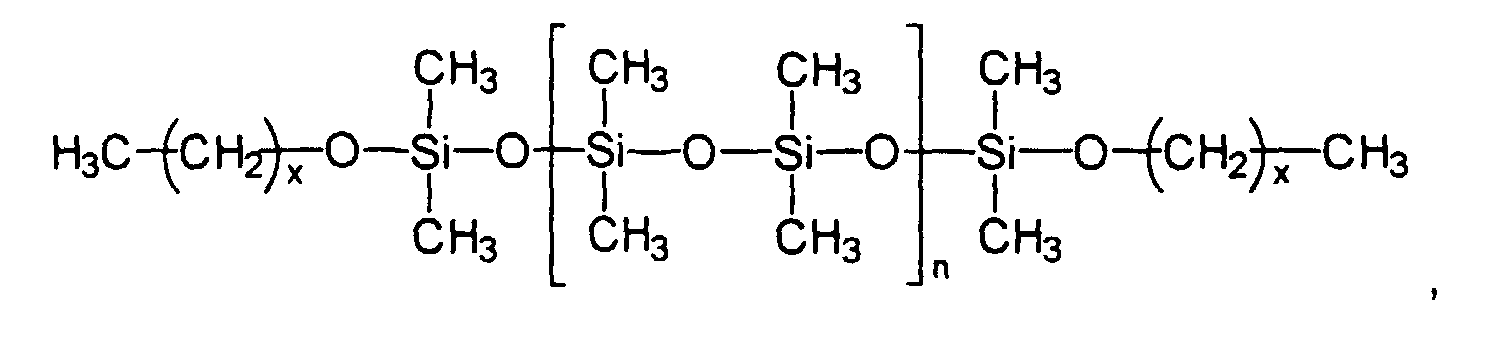
- Preferred synthetic waxes are, for example, the beeswax component B 85 available from SCHLICKUM and silicone-based waxes such as B. Dialkoxydimethylpolysiloxane, which are characterized by the following structure where x is a number between 18 and 24.
- the behenoxy dimethicone is particularly advantageous, for which x from the above structural formula means 21 and which is available under the trade name Abil® Wax 2440 from Th. Goldschmidt AG.
- a silicone-based wax which is available under the trade name Siliconyl Beeswax from KOSTER KEUNEN.
- fatty acids and / or fatty acid mixtures for example C 16-36 fatty acids, in particular those which are available under the trade name Syncrowax AW1C from Croda GmbH.
- esters of glycol in particular glycol esters of lignoceric acid (CH 3 (CH 2 ) 22 COOH), cerotic acid (CH 3 (CH 2 ) 24 COOH) and / or montanic acid (CH 3 (CH 2 ) 26 COOH).
- Glycol esters of montanic acid (CH 3 (CH 2 ) 26 COOH) are particularly advantageous for the purposes of the present invention.
- An advantageous glycol montanate is available, for example, from Clariant in a mixture with butylene glycol montanate under the trade name Wax E Pharma.
- glycerides and triglycerides listed below are particularly advantageous: Glyceride Trade name Available at C 16-18 triglyceride Cremeol HF-52-SPC Aarhus oil factory Glyceryl hydroxystearate Naturally GMHS Rahn Hydrogenated coco glycerides Softisan 100 Huls AG Caprylic / Capric / Isostearic / Adipic triglyceride Softisan 649 Dynamite Nobel C 18-36 triglyceride Syncrowax HGLC Croda GmbH Glyceryl tribehenate Syncrowax HRC Croda GmbH Glyceryl tri- (12-hydroxystearate) Thixcin R Rheox / NRC Hydrogenated castor oil Cutina HR Henkel KGaA C 16-24 triglyceride Cremeol HF-62-SPC A
- Shea butter is also particularly preferred for the purposes of the present invention, too Called shea fat or galambutter (CAS No. 68920-03-6). Shea butter is the fat of the Seeds or kernels of the family of the Sapotaceae plant Butyrospermum Parkii, which is about 34 to 45 wt .-% of solid fatty acids (mainly stearic acid) and about 50 to 60% by weight of liquid fatty acids (primarily oleic acid containing) exists.
- O / W formulations according to the present invention are to contain emulsifiers, it is advantageous to use those emulsifiers which are used for the preparation O / W emulsions are suitable, both individually and in any Combinations with each other can exist.
- the emulsifier or emulsifiers are advantageously selected from the group comprising the following compounds: Polyglyceryl-2-dipolyhydroxystearate, PEG-30 dipolyhydroxystearate, cetyl dimethicone copolyol, glycol distearate, Glykoldilaurat, Diethylenglykoldilaurat, sorbitan trioleate, Glykololeat, glyceryl dilaurate, sorbitan tristearate, propylene glycol stearate, propylene glycol laurate, Propylenglykoldistearat, sucrose distearate, PEG-3 castor oil, Pentaerythritylmonostearat, Pentaerythritylsesquioleat, glyceryl oleate, glyceryl stearate, Glyceryl diisostearate, pentaerythrityl monooleate, sorbitan sesquioleate, isoste
- Sorbitan stearate PEG-7 Hydrogenated Castor Oil, Steareth-2, Oleth-2, Cetyl Alcohol and Ceteareth-30 (Emulsifier E 2209 from Th. Goldschmidt), PEG-5- Soyasterol, PEG-6 Sorbitan Beeswax, Ceteth-2, Glyceryl stearate SE, methyl glucose sesquistearate, PEG-10 hydrogenated castor oil, Oleth-3, sorbitan palmitate, PEG-22 / dodecyl glycol copolymer, polyglyceryl-2-PEG-4 stearate, Laneth-5, Ceteth-3, Laureth-3, stearyl alcohol and Steareth-7 and Steareth-10 (emulsifier E-2155 from Th.
- the emulsifier or emulsifiers are particularly preferably selected from the group of the fatty acids, which are wholly or partly with common alkalis (such as sodium and Potassium hydroxide, sodium and potassium carbonate and mono- and triethanolamine) neutralized are.
- alkalis such as sodium and Potassium hydroxide, sodium and potassium carbonate and mono- and triethanolamine
- stearic acid and stearates are particularly advantageous. Isostearic acid and isostearates, palmitic acid and palmitates as well as myristic acid and Myristate.
- the emulsifiers are further preferably selected from the group of saturated and / or unsaturated, branched and / or unbranched fatty alcohols having 10 to 40 carbon atoms, butyl octanol, butyl decanol, hexyl octanol, hexyl decanol, octyl dodecanol, behenyl alcohol (C 22 H 45 OH) are particularly preferred , Cetearyl alcohol [a mixture of cetyl alcohol (C 16 H 33 OH) and stearyl alcohol (C 18 H 37 OH)], cetylarachidol [2-hexadecyl-1-eicosanol (C 36 H 73 OH),], lanolin alcohols (wool wax alcohols which are the represent unsaponifiable alcohol fraction of the wool wax, which is obtained after the saponification of wool wax) and / or 2-tetradecyloctadecanol (C 32
- compositions according to the invention can advantageously also have one or more hydrocolloids contain.
- Hydrocolloids are macromolecules that have a largely linear shape and over intermolecular interaction forces have side and main valence bonds between the individual molecules and thus the formation of a network-like Enable formation. They are partially water-soluble natural or synthetic Polymers that form gels or viscous solutions in aqueous systems. You raise the viscosity of the water by either binding water molecules (hydration) or take up the water in their intertwined macromolecules and envelop, while at the same time restricting the mobility of the water.
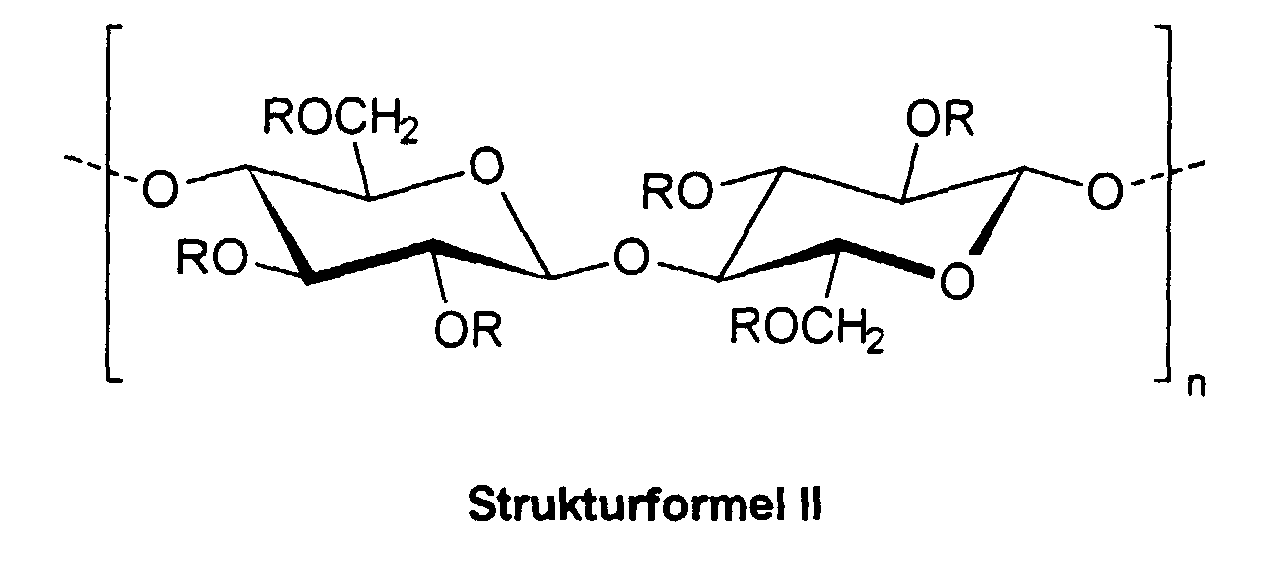
- Hydrocolloids preferred according to the invention are, for example, methyl celluloses, as the methyl ethers of cellulose are referred to. They are characterized by the following structural formula in which R can represent a hydrogen or a methyl group.
- methyl celluloses mixed cellulose ethers which in addition to a dominant Content of methyl additionally 2-hydroxyethyl, 2-hydroxypropyl or 2-hydroxybutyl groups contain.
- (Hydroxypropyl) methyl celluloses are particularly preferred, for example, under the trade name Methocel E4M at Dow Chemical Comp. available.
- sodium carboxymethyl cellulose the sodium salt of the glycolic acid ether of cellulose, for which R in structural formula II can be a hydrogen and / or CH 2 -COONa.
- R in structural formula II can be a hydrogen and / or CH 2 -COONa.
- Particularly preferred is the sodium carboxymethyl cellulose available under the trade name Natrosol Plus 330 CS from Aqualon, also known as cellulose gum.
- xanthan (CAS No. 11138-66-2), also known as xanthan gum, which is an anionic heteropolysaccharide which is generally formed from corn sugar by fermentation and is isolated as the potassium salt. It is produced by Xanthomonas campestris and some other species under aerobic conditions with a molecular weight of 2 ⁇ 10 6 to 24 ⁇ 10 6 .
- Xanthan is formed from a chain with ⁇ -1,4-bound glucose (cellulose) with side chains. The structure of the subgroups ( repeated units ”) consists of glucose, mannose, glucuronic acid, acetate and pyruvate.
- Hydrocolloids which are advantageous according to the invention are also polymers of acrylic acid, in particular those selected from the group of the so-called carbomers or carbopoles (Carbopol® is actually a registered trademark of the BF Goodrich Company). Carbopols are compounds of the general structural formula whose molecular weight can be between approximately 400,000 and more than 4,000,000.
- the carbopole group also includes acrylate-alkyl acrylate copolymers, for example those which are distinguished by the following structure:
- R ' represents a long-chain alkyl radical and x and y numbers which correspond to the respective symbolize the stoichiometric proportion of the respective comonomers. This too Carbopols are advantageous for the purposes of the present invention.
- Examples of advantageous carbopoles are types 907, 910, 934, 940, 941, 951, 954, 980, 981, 1342, 1382, 2984 and 5984, these compounds individually or in any Combinations can exist.
- Carbopol are particularly preferred 981, 1382 and 5984 (both individually and in combination with other hydrocolloids).
- the INCI name for such connections is Acrylates / C 10-30 Alkyl Acrylate Crosspolymer ".
- Particularly advantageous are those available under the trade names Pemulen TR1 and Pemulen TR2 from the BF Goodrich Company.
- the total amount of one or more hydrocolloids is in the finished cosmetic or dermatological preparations advantageously less than 1.0% by weight, preferably between 0.01 and 0.5% by weight, based on the total weight of the preparations chosen.
- the aqueous phase of the preparations according to the invention optionally advantageously contains Alcohols, diols or polyols of low C number, and their ethers, preferably Ethanol, isopropanol, propylene glycol, glycerin, ethylene glycol, ethylene glycol monoethyl or monobutyl ether, propylene glycol monomethyl, monoethyl or monobutyl ether, Diethylene glycol monomethyl or monoethyl ether and analog products, also alcohols low C number, e.g. Ethanol, isopropanol, 1,2-propanediol and glycerin.
- Alcohols, diols or polyols of low C number, and their ethers preferably Ethanol, isopropanol, propylene glycol, glycerin, ethylene glycol, ethylene glycol monoethyl or monobutyl ether, propylene glycol monomethyl, monoethyl
- compositions are also obtained when added or Active ingredients antioxidants are used.
- the preparations contain advantageously one or more antioxidants.
- Antioxidants to be used can all be for cosmetic and / or dermatological Suitable or customary antioxidants are used.
- the antioxidants are advantageously selected from the group consisting of amino acids (eg glycine, histidine, tyrosine, tryptophan) and their derivatives, imidazoles (eg urocanic acid) and their derivatives, peptides such as D, L-carnosine, D-carnosine, L-carnosine and their derivatives (e.g. anserine), carotenoids, carotenes (e.g. ⁇ -carotene, ⁇ -carotene, lycopene) and their derivatives, lipoic acid and their derivatives (e.g. dihydroliponic acid), aurothioglucose, propylthiouracil and other thiols (e.g.
- amino acids eg glycine, histidine, tyrosine, tryptophan
- imidazoles eg urocanic acid
- peptides such as D, L-carnosine, D-carnosine, L
- thioredoxin glutathione, cysteine, cystine , Cystamine and their glycosyl, N-acetyl, methyl, ethyl, propyl, amyl, butyl and lauryl, palmitoyl, oleyl, ⁇ -linoleyl, cholesteryl and glyceryl esters) and their salts, Dilauryl thiodipropionate, distearyl thiodipropionate, thiodipropionic acid and its derivatives (esters, ethers, peptides, lipids, nucleotides, nucleosides and salts) as well as sulfoximine compounds (e.g.
- buthioninsulfoximines homocysteine sulfoximine, buthioninsulfones, penta-, hexa-, heptathioninsulfox wrestle compatible doses (e.g. pmol to ⁇ mol / kg), (metal) chelators (e.g. ⁇ -hydroxy fatty acids, palmitic acid, phytic acid, lactoferrin), ⁇ -hydroxy acids (e.g. citric acid, lactic acid, malic acid), humic acid, bile acid, bile extracts, bilirubin , Biliverdin, EDTA, EGTA and their derivatives, unsaturated fatty acids and their derivatives (e.g.
- Oil-soluble antioxidants can be particularly advantageous for the purposes of the present invention be used.
- the amount of antioxidants (one or more compounds) in the preparations is preferably 0.001 to 30% by weight, particularly preferably 0.05 to 20% by weight, in particular 0.1 to 10 wt .-%, based on the total weight of the preparation.
- vitamin E and / or its derivatives are the antioxidant (s) advantageous, their respective concentrations in the range from 0.001 to 10% by weight, based on the total weight of the formulation.
- vitamin A or vitamin A derivatives or carotenes or their derivatives are advantageous, their respective concentrations from the Range from 0.001 to 10% by weight, based on the total weight of the formulation, to choose.
- the cosmetic according to the invention and dermatological preparations can accordingly also be cosmetic Contain auxiliary substances, as they are usually used in such preparations for example, consistency agents, fillers, preservatives, perfumes, Anti-foaming substances, dyes, other surface active Substances, softening, moisturizing and / or moisturizing substances, anti-inflammatory Substances, additional active substances such as vitamins or proteins, Sunscreen, insect repellents, bactericides, virucides, water, salts, antimicrobial, proteolytically or keratolytically active substances, drugs or others usual components of a cosmetic or dermatological formulation such as alcohols, Polyols, polymers, foam stabilizers, organic solvents or Electrolytes.
- auxiliary substances as they are usually used in such preparations for example, consistency agents, fillers, preservatives, perfumes, Anti-foaming substances, dyes, other surface active Substances, softening, moisturizing and / or moisturizing substances, anti-inflammatory Substances, additional active substances
- the O / W emulsions according to the invention can be used as the basis for cosmetic or serve dermatological formulations. These can be composed as usual be and for example for the treatment and care of the skin and / or hair, as a lip care product, as a demo product and as a make-up or make-up removal product in serve as decorative cosmetics or as a sunscreen preparation. Be applied the cosmetic and dermatological preparations according to the invention in the for Cosmetics or dermatics usual way on the skin and / or the hair in sufficient Amount applied ..
- Cosmetic or topical dermatological compositions can accordingly used in the sense of the present invention, depending on its structure, for example are used as skin protection cream, cleansing milk, sun protection lotion, nutrient cream, Day or night cream, etc. It may be possible and advantageous that Compositions according to the invention as the basis for pharmaceutical formulations to use.
- the low viscosity cosmetic or dermatological agents according to the invention can, for example, as from aerosol containers, squeeze bottles or through a Pumpable sprayable preparations are present or in the form of a roll-on device Applicable liquid composition, but also in the form of a emulsion that can be applied from normal bottles and containers.
- propellant for cosmetic or dermatological sprayable from aerosol containers Preparations in the sense of the present invention are the usual known ones volatile, liquefied propellants, e.g. hydrocarbons (propane, Butane, isobutane) are suitable, which are used alone or in a mixture with one another can. Compressed air can also be used advantageously.
- volatile propellants e.g. hydrocarbons (propane, Butane, isobutane) are suitable, which are used alone or in a mixture with one another can. Compressed air can also be used advantageously.
- Those cosmetic and dermatological preparations which are in the Form of a sunscreen.
- these additionally contain at least one UV-A filter substance and / or at least one UV-B filter substance.
- UV protection substances as well as antioxidants and, if desired, Preservatives, an effective protection of the preparations themselves against spoilage represents.
- Preparations according to the invention advantageously contain substances which contain UV radiation absorb in the UV-A and / or UV-B range, with the total amount of filter substances e.g. B. 0.1 wt .-% to 30 wt .-%, preferably 0.5 to 20 wt .-%, in particular Is 1.0 to 15.0% by weight, based on the total weight of the preparations to provide cosmetic preparations that cover the hair or skin protect the entire range of ultraviolet radiation. You can also use it as a sunscreen serve for hair or skin.
- filter substances e.g. B. 0.1 wt .-% to 30 wt .-%, preferably 0.5 to 20 wt .-%, in particular Is 1.0 to 15.0% by weight, based on the total weight of the preparations to provide cosmetic preparations that cover the hair or skin protect the entire range of ultraviolet radiation.
- UV-A filter substances for the purposes of the present invention are dibenzoylmethane derivatives, especially the 4- (tert-butyl) -4'-methoxydibenzoylmethane (CAS no. 70356-09-1), which is available from Givaudan under the Parsol® 1789 brand and from Merck under the trade name Eusolex® 9020 is sold.
- dibenzoylmethane derivatives especially the 4- (tert-butyl) -4'-methoxydibenzoylmethane (CAS no. 70356-09-1), which is available from Givaudan under the Parsol® 1789 brand and from Merck under the trade name Eusolex® 9020 is sold.
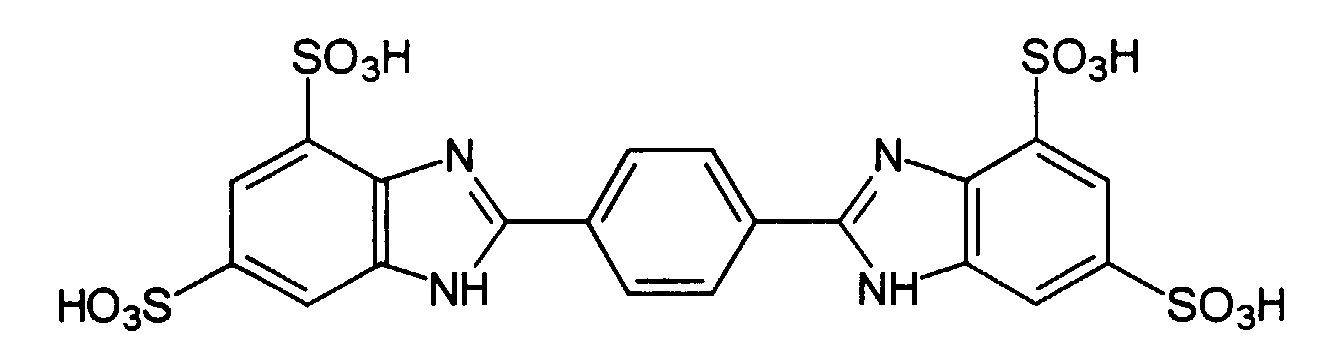
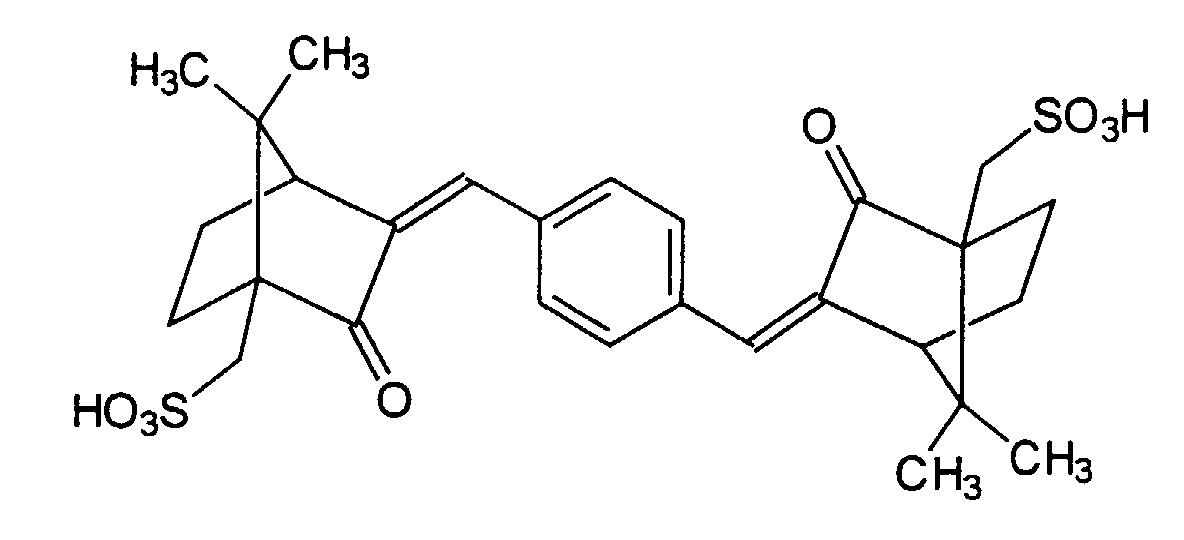
- UV-A filter substances are phenylene-1,4-bis (2-benzimidazyl) -3,3'-5,5'-tetrasulfonic acid: and their salts, especially the corresponding sodium, potassium or triethanolammonium salts, in particular the phenylene-1,4-bis (2-benzimidazyl) -3,3'-5,5'-tetrasulfonic acid bis-sodium salt: and the 1,4-di (2-oxo-10-sulfo-3-bornylidenemethyl) benzene and its salts (especially the corresponding 10-sulfato compounds, especially the corresponding sodium, potassium or triethanolammonium salt), the is also called benzene-1,4-di (2-oxo-3-bornylidenemethyl-10-sulfonic acid) and is characterized by the following structure:
- Advantageous UV filter substances in the sense of the present invention are also so-called broadband filters, ie filter substances that absorb both UV-A and UV-B radiation
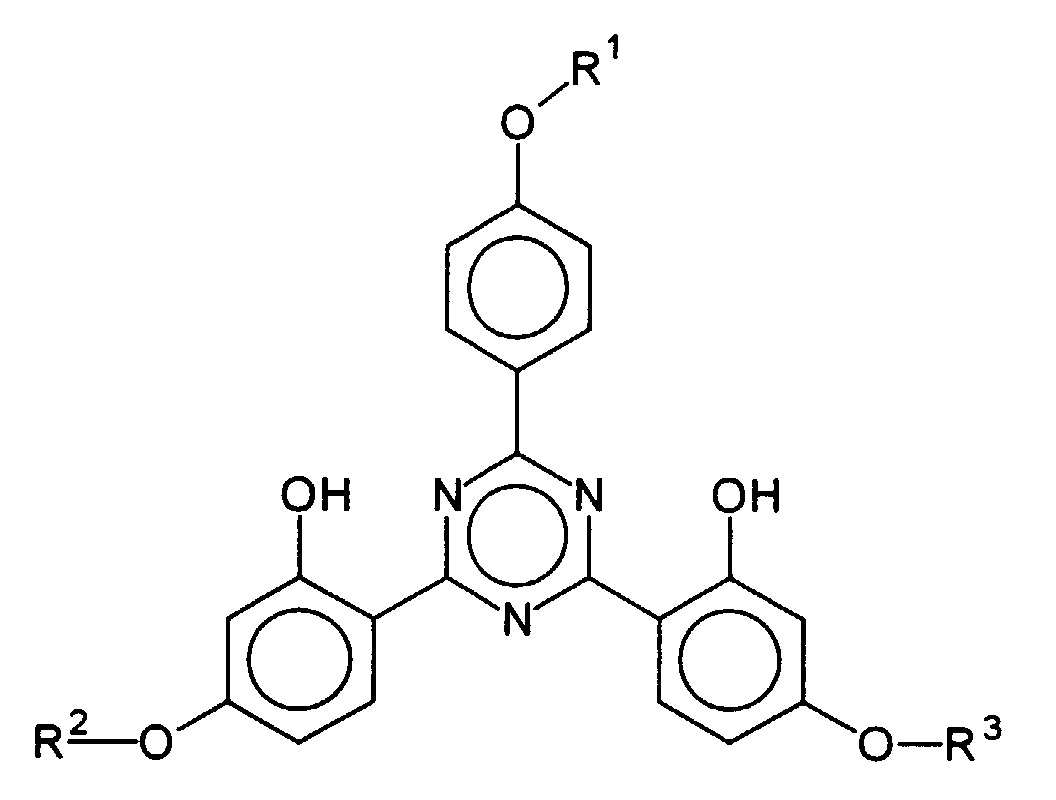
- Advantageous broadband filters or UV-B filter substances are, for example, bis-resorcinyltriazine derivatives with the following structure: where R 1 , R 2 and R 3 are independently selected from the group of branched and unbranched alkyl groups having 1 to 10 carbon atoms or a single hydrogen atom.
- 2,4-bis - ⁇ [4- (2-ethylhexyloxy) -2-hydroxy] phenyl ⁇ -6- (4-methoxyphenyl) -1,3,5-triazine (INCI: Aniso triazine ), which is available under the trade name Tinosorb® S from CIBA-Chemicals GmbH, and the 4,4 ', 4''- (1,3,5-triazine-2,4,6-triyltriimino) -tris-benzoic acid -tris (2-ethylhexyl ester), synonymous: 2,4,6-tris [anilino- (p-carbo-2'-ethyl-1'-hexyloxy)] - 1,3,5-triazine (INCI: octyl triazone ), which is sold by BASF Aktiengesellschaft under the trade name UVINUL® T 150.
- a particularly preferred UV filter substance in the sense of the present invention is also an asymmetrically substituted s-triazine, the chemical structure of which is represented by the formula is reproduced and which is also referred to below as dioctylbutylamidotriazon.
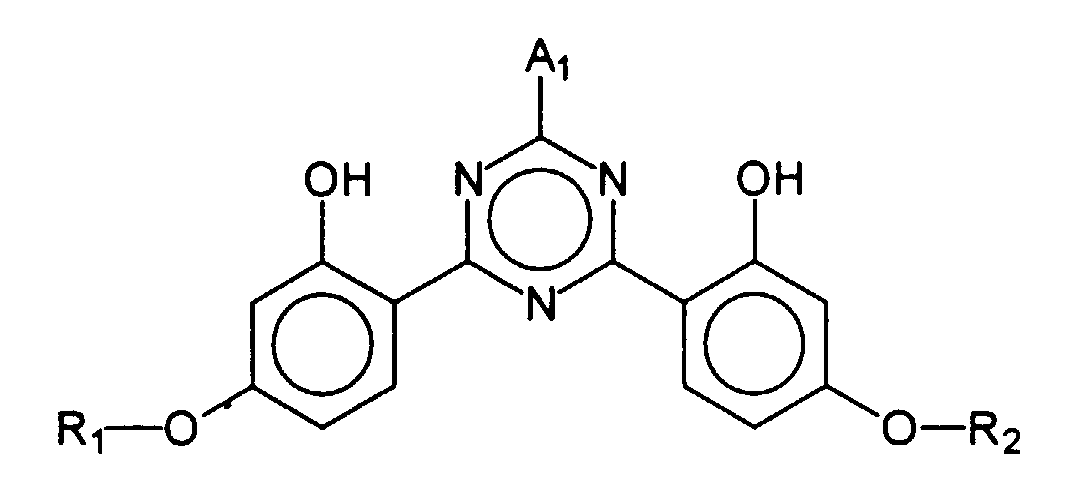
- European laid-open specification 775 698 also describes bis-resorcinyltriazine derivatives which are preferably to be used and whose chemical structure is represented by the generic formula is reproduced, wherein R 1 , R 2 and A 1 represent a wide variety of organic radicals.
- Also advantageous for the purposes of the present invention are 2,4-bis - ⁇ [4- (3-sulfonato) -2-hydroxypropyloxy) -2-hydroxy] phenyl ⁇ -6- (4-methoxyphenyl) -1, 3,5-triazine Sodium salt, the 2,4-bis - ⁇ [4- (3- (2-propyloxy) -2-hydroxypropyloxy) -2-hydroxy] phenyl ⁇ -6- (4-methoxyphenyl) -1,3,5-triazine , the 2,4-bis - ⁇ [4- (2-ethylhexyloxy) -2-hydroxy] phenyl ⁇ -6- [4- (2-methoxyethylcarboxyl) phenylamino] -1,3,5-triazine , the 2,4-bis - ⁇ (4- (3- (2-propyloxy) -2-hydroxypropyloxy) -2-hydroxy] phenyl ⁇ -6-
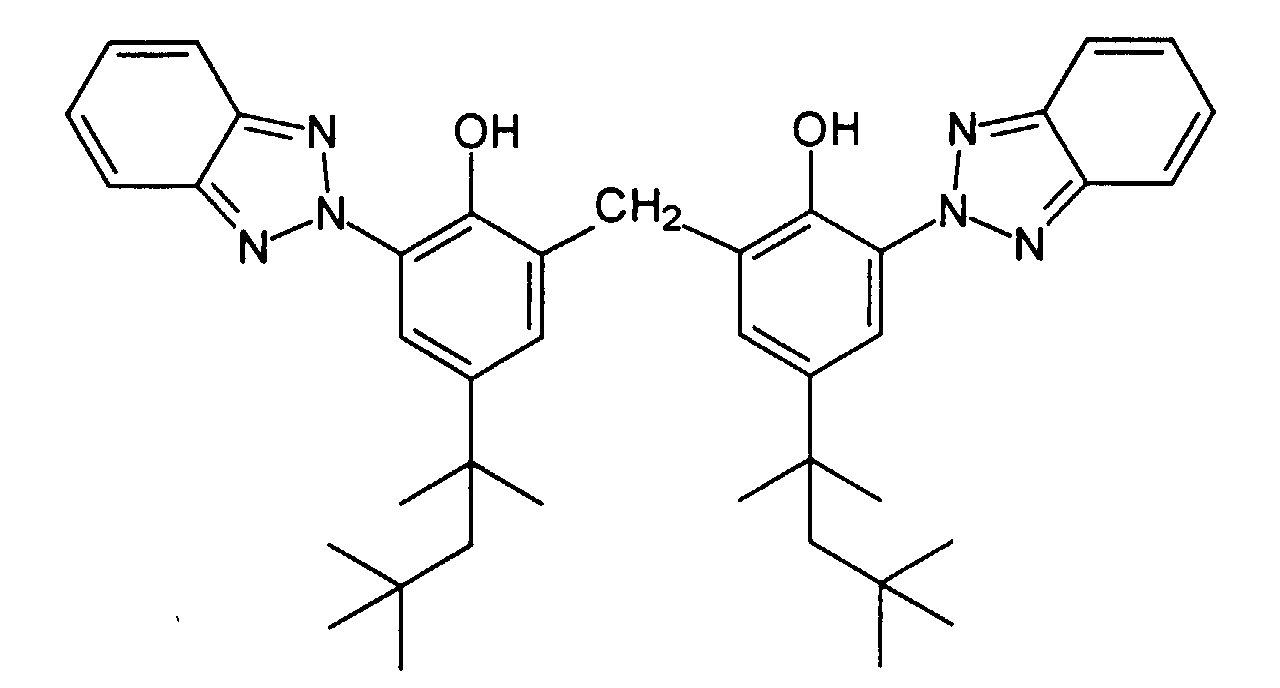
- An advantageous broadband filter in the sense of the present invention is 2,2'-methylene-bis- (6- (2H-benzotriazol-2-yl) -4- (1,1,3,3-tetramethylbutyl) phenol), which through the chemical structural formula is marked and is available under the trade name Tinosorb® M from CIBA-Chemicals GmbH.
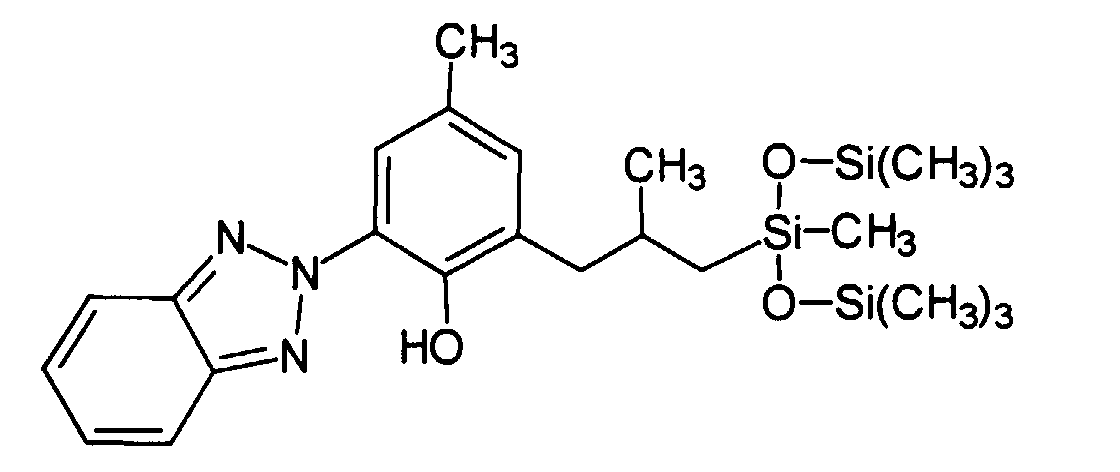
- Another advantageous broadband filter for the purposes of the present invention is 2- (2H-benzotriazol-2-yl) -4-methyl-6- [2-methyl-3- [1,3,3,3-tetramethyl-1 - [( trimethylsilyl) oxy] disiloxanyl] propyl] phenol (CAS no .: 155633-54-8) with the INCI name Drometrizole Trisiloxane, which is characterized by the chemical structural formula is marked.
- a further light protection filter substance to be used advantageously according to the invention is ethylhexyl-2-cyano-3,3-diphenylacrylate (octocrylene), which is available from BASF under the name Uvinul® N 539 and is characterized by the following structure:
- UV filters mentioned used in the sense of the present invention of course, should not be limiting.
Landscapes
- Health & Medical Sciences (AREA)
- Life Sciences & Earth Sciences (AREA)
- Public Health (AREA)
- Animal Behavior & Ethology (AREA)
- General Health & Medical Sciences (AREA)
- Veterinary Medicine (AREA)
- Birds (AREA)
- Epidemiology (AREA)
- Chemical & Material Sciences (AREA)
- Dispersion Chemistry (AREA)
- Inorganic Chemistry (AREA)
- Emergency Medicine (AREA)
- Oil, Petroleum & Natural Gas (AREA)
- Dermatology (AREA)
- Cosmetics (AREA)
Abstract
Description

- feinste Verteilung der beiden Phasen ineinander Je kleiner die dispergierten Teilchen sind, um so stabiler ist die Emulsion.
- hohe Viskosität der äußeren Phase
- ein stabiler Grenzflächenfilm
- ein ausgewogenes Phasenvolumenverhältnis
dünnflüssige kosmetische oder dermatologische Zubereitungen vom Typ Öl-in-Wasser, welche eine Ölphase, in welche hydrophobe und/oder amphiphile Feststoffe eingearbeitet sind, und eine Wasserphase enthalten, wobei die Dichtedifferenz zwischen der Ölphase und der Wasserphase (bestimmbar mit einem rechnenden digitalen Dichtemesser vom Typ DMA 45 der Firma chempro/PA bei 25 °C) nicht größer als 0,01 g·cm-3 ist
sowie gewünschtenfalls übliche kosmetische oder dermatologische Hilfs-, Zusatz- und/oder Wirkstoffe enthaltend.
Verfahren zur Stabilisierung von O/W-Formulierungen, dadurch gekennzeichnet, daß die Dichte der Ölphase durch Zugabe von hydrophoben und/oder amphiphilen Feststoffen der Dichte der Wasserphase derart angeglichen wird, daß die Dichtedifferenz der beiden Phasen nicht größer als 0,01 g·cm-3 ist.
Smektite sind stets sehr feinkörnige (meist < 2 mm), überwiegend als lamellenförmige, moosartige oder kugelförmige Aggregate vorkommende Dreischicht-Tonminerale (2:1-Schichtsilikate), in denen eine zentrale Schicht aus oktaedrisch koordinierten Kationen sandwichartig von 2 Schichten aus [(Si,Al)O4]-Tetraedern umgeben ist. Smektite werden idealisiert durch die folgende Strukturformel beschrieben, worin weiß ausgefüllte Kreise Silizium- und/oder Aluminiumatome, hellgrau ausgefüllte Kreise Sauerstoffatome, dunkelgrau ausgefüllte Kreise Wasserstoffatome und schwarz ausgefüllte Kreise Aluminium-, Magnesium-, Eisenatome und/oder weitere Austauschkationen darstellen:

die Reste R1 unabhängig voneinander gewählt werden aus der Gruppe Methyl und hydrierte Talgreste mit einer Kettenlänge von 12 bis 20 Kohlenstoffatomen.
| Handelsname | erhältlich bei |
| Boron Nitride Powder | Advanced Ceramics |
| Boron Nitride Powder | Sintec Keramik |
| Ceram Blanche | Kawasaki |
| HCST Boron Nitride | Stark |
| Très BN® | Carborundum |
| Wacker-Bornitrid BNP | Wacker-Chemie |
Pigment Green (10006, grün), Pigment Yellow 1 (11680, gelb), Pigment Yellow 3 (11710, gelb), Pigment Orange 1 (11725, orange), Pigment Red 3 (12120, rot), Pigment Red 112 (12370, rot), Pigment Red 7 (12420, rot), Pigment Brown 1 (12480, braun), Pigment Yellow 16 (20040, gelb), Pigment Yellow 13 (21100, gelb), Pigment Yellow 83 (21108, gelb), Pigment Violet 23 (51319, violett), Pigment Red 122 (73915, rot), Pigment Blue 16 (74100, blau), Aluminium (77000, weiß), Tonerdehydrat (77002, weiß), Pigment Red 101 und 102 (77015, rot), Bariumsulfat (77120, weiß), Kohlenstoff (77266, schwarz), Pigment Black 9 (77267, schwarz), Carbo medicinalis vegetabilis (77268:1, schwarz), Pigment Blue 28 und Pigment Green 14 (77346, grün), Pigment Metal 2 (77400, braun), Gold (77480, braun), Eisenoxide und -hydroxide (77489, orange), Eisenoxid (77491, rot), Eisenoxidhydrat (77492, gelb), Eisenoxid (77499, schwarz), Mischungen aus Eisen(II)- und Eisen(III)-hexacyanoferrat (77510, blau), Pigment White 18 (77713, weiß) und Silber (77820, weiß).


| Esterwachs | Handelsname | erhältlich bei |
| Myristylmyristat | Cetiol MM | Henkel KGaA |
| Cetylpalmitat | Cutina CP | Henkel KGaA |
| C14-34 Alkylstearat | Kesterwachs K 76 H | KOSTER KEUNEN |
| C20-40 Dialkyldimerat | Kesterwachs K 80 D | KOSTER KEUNEN |
| Ditetracosanyldimerat | Kesterwachs K70D | KOSTER KEUNEN |
| C16-38 Alkylhydroxystearoylstearat | Kesterwachs K80P | KOSTER KEUNEN |
| C20-40 Alkylstearat | Kesterwachs K 82 | KOSTER KEUNEN |
| Hydroxystearylhydroxystearat | Elfacos C26 | AKZO NOBEL |
| Glycerid | Handelsname | erhältlich bei |
| C16-18 Triglycerid | Cremeol HF-52-SPC | Aarhus Oliefabrik |
| Glycerylhydroxystearat | Naturchem GMHS | Rahn |
| Hydrierte Coco-Glyceride | Softisan 100 | Hüls AG |
| Caprylic/Capric/Isostearic/Adipic Triglycerid | Softisan 649 | Dynamit Nobel |
| C18-36 Triglycerid | Syncrowax HGLC | Croda GmbH |
| Glyceryltribehenat | Syncrowax HRC | Croda GmbH |
| Glyceryl-tri-(12-hydroxystearat) | Thixcin R | Rheox / NRC |
| Hydriertes Ricinusöl | Cutina HR | Henkel KGaA |
| C16-24 Triglycerid | Cremeol HF-62-SPC | Aarhus Oliefabrik |
Polyglyceryl-2-Dipolyhydroxystearat, PEG-30-Dipolyhydroxystearat, Cetyldimethiconcopolyol, Glykoldistearat, Glykoldilaurat, Diethylenglykoldilaurat, Sorbitantrioleat, Glykololeat, Glyceryldilaurat, Sorbitantristearat, Propylenglykolstearat, Propylenglykollaurat, Propylenglykoldistearat, Sucrosedistearat, PEG-3 Castor Oil, Pentaerythritylmonostearat, Pentaerythritylsesquioleat, Glyceryloleat, Glycerylstearat, Glyceryldiisostearat, Pentaerythritylmonooleat, Sorbitansesquioleat, Isostearyldiglycerylsuccinat, Glycerylcaprat, Palm Glycerides, Cholesterol, Lanolin, Glyceryloleat (mit 40 % Monoester), Polyglyceryl-2-Sesquiisostearat, Polyglyceryl-2-Sesquioleat, PEG-20 Sorbitan Beeswax, Sorbitanoleat, Sorbitanisostearat, Trioleylphosphat, Glyceryl Stearate und Ceteareth-20 (Teginacid von Th. Goldschmidt), Sorbitanstearat, PEG-7 Hydrogenated Castor Oil, Steareth-2, Oleth-2, Cetyl Alcohol und Ceteareth-30 (Emulgator E 2209 von Th. Goldschmidt), PEG-5-Soyasterol, PEG-6 Sorbitan Beeswax, Ceteth-2, Glycerylstearat SE, Methylglucosesesquistearate, PEG-10 Hydrogenated Castor Oil, Oleth-3, Sorbitanpalmitat, PEG-22/Dodecylglykol Copolymer, Polyglyceryl-2-PEG-4-Stearat, Laneth-5, Ceteth-3, Laureth-3, Stearyl Alcohol und Steareth-7 und Steareth- 10 (Emulgator E-2155 von Th. Goldschmidt), Oleth-5, Sorbitanlaurat, Laureth-4, PEG-4-Laurat, Polysorbat 61, Polysorbat 81, Beheneth-10, Polysorbat 65, Polysorbat 80, Laneth-10, Triceteareth-4-Phosphat, Triceteareth-4 Phosphate und Sodium C14-17 Alkyl Sec Sulfonat (Hostacerin CG von Hoechst), PEG-8 Stearat, Glycerylstearat und PEG-100 Stearate (Arlacel 165 von ICI), Polysorbat 85, Trilaureth-4-Phosphat, PEG-25-Glyceryltnoleat, Oleth-10, Steareth-10, Ceteth-10, PEG-35 Castor Oil, Sucrosestearat, PEG-8-Oleat, Trioleth-8-Phosphat, PEG-40-Sorbitanlanolat, PEG-15-Glycerylricinoleat, Choleth-24 und Ceteth-24 (Solulan C-24 von Amerchol), C12-15 Pareth-12, PEG-20-Glycerylisostearat, PEG-40 Hydrogenated Castor Oil, PEG-16 Soya Sterol, PEG-20-Glyceryloleat, PEG-20-Stearat, Polysorbat 80, PEG-20-Methylglucosesesquistearat, PEG-30-Glycerylisostearat, PEG-20-Glyceryllaurat, Ceteth-20, Ceteareth-25, PEG-30-Stearat, PEG-30-Glycerylstearat, Polysorbat 20, Laureth-23, PEG-40-Stearat, PEG-30-Glyceryllaurat, PEG-50-Stearat, PEG-100-Stearat, PEG-150-Laurat, Polyglyceryl-3-methylglucose Distearat, Ceteareth-12, Ceteareth-20 und Steareth-21, Ceteareth-6, PEG-40 Castor Oil, Natriumcetearylsulfat, Lecithin, Laureth-4-Phosphat, Propylenglykolstearat SE, PEG-25 Hydrogenated Castor Oil, PEG-54 Hydrogenated Castor Oil, Glycerylstearat SE, PEG-6 Caprylic/Capric Glycerides, Glyceryloleat und Propylenglykol, PEG-9-Stearat, Glyceryllanolat, Ceteth-2, Polysorbat 60, Glycerylmyristat, Glycerylisostearat und Polyglyceryl-3 Oleat, Glyceryllaurat, PEG-40-Sorbitanperoleat, Laureth-4, Glycerinmonostearat, Ceteareth-3, Lanolinsäure, Isostearylglycerylether, Cetearyl Alcohol und Natriumcetearylsulfat, Steareth-2, PEG-22-Dodecylglykolcopolymer, Polyglyceryl-2-PEG-4-Stearat, Pentaerythrithylisostearat, Polyglyceryl-3-Diisostearat, Sorbitanoleat und Hydrogenated Castor Oil und Cera alba und Stearinsäure, Natriumdihydroxycetylphosphat und Isopropylhydroxycetylether, Methylglucosesesquistearat, Steareth-2 und PEG-8-Distearat, Steareth-20, Isosteareth-20, Methylglucosedioleat, Sorbitanoleat und PEG-2 Hydrogenated Castor Oil und Ozokerit und Hydrogenated Castor Oil, PEG-2 Hydrogenated Castor Oil, PEG-45-/Dodecylglykolcopolymer, Methoxy PEG-22-/Dodecylglykolcopolymer, Hydrogenated Coco Glycerides, Polyglyceryl-4-Isostearat, PEG-40-Sorbitanperoleat, PEG-40-Sorbitanperisostearat, PEG-20-Glycerylstearat, PEG-8-Beeswax, Laurylmethiconcopolyol, Polyglyceryl-2-Laurat, Stearamidopropyl-PG-dimoniumchloridphosphat, PEG-7 Hydrogenated Castor Oil, Triethylcitrat, PEG-20 Methylglucosesesquistearat, Glycerylstearatcitrat, Cetylphosphat, Polyglycerolmethylglucosedistearat, Poloxamer 101, Kaliumcetylphosphat, Isosteareth-10, Oleth-20, Isoceteth-20, Glycerylisostearat, Polyglyceryl-3-Diisostearate, Cetearylalkohol und PEG-20-Stearat.
- organische, natürliche Verbindungen, wie beispielsweise Agar-Agar, Carrageen, Tragant, Gummi arabicum, Alginate, Pektine, Polyosen, Guar-Mehl, Johannisbrotbaumkemmehl, Stärke, Dextrine, Gelatine, Casein,
- organische, abgewandelte Naturstoffe, wie z. B. Carboxymethylcellulose und andere Celluloseether, Hydroxyethyl- und -propylcellulose und dergleichen,
- organische, vollsynthetische Verbindungen, wie z. B. Polyacryl- und Polymethacryl-Verbindungen, Vinylpolymere, Polycarbonsäuren, Polyether, Polyimine, Polyamide,
- anorganische Verbindungen, wie z. B. Polykieselsäuren, Tonmineralien wie Montmorillonite, Zeolithe, Kieselsäuren.





- R
- einen verzweigten oder unverzweigten C1-C18-Alkylrest, einen C5-C12-Cycloalkylrest, gegebenenfalls substituiert mit einer oder mehreren C1-C4- Alkylgruppen, darstellt,
- X
- ein Sauerstoffatom oder eine NH-Gruppe darstellt,
- R1
- einen verzweigten oder unverzweigten C1-C18-Alkylrest, einen C5-C12-Cycloalkylrest,
gegebenenfalls substituiert mit einer oder mehreren C1-C4- Alkylgruppen,
oder ein Wasserstoffatom, ein Alkalimetallatom, eine Ammoniumgruppe oder eine
Gruppe der Formel
bedeutet, in welcher

- A
- einen verzweigten oder unverzweigten C1-C18-Alkylrest, einen C5-C12-Cycloalkyl- oder Arylrest darstellt, gegebenenfalls substituiert mit einer oder mehreren C1-C4- Alkylgruppen,
- R3
- ein Wasserstoffatom oder eine Methylgruppe darstellt,
- n
- eine Zahl von 1 bis 10 darstellt,
- R2
- einen verzweigten oder unverzweigten C1-C18-Alkylrest, einen C5-C12-Cycloalkylrest,
gegebenenfalls substituiert mit einer oder mehreren C1-C4- Alkylgruppen, darstellt,
wenn X die NH-Gruppe darstellt, und
einen verzweigten oder unverzweigten C1-C18-Alkylrest, einen C5-C12-Cycloalkylrest, gegebenenfalls substituiert mit einer oder mehreren C1-C4- Alkylgruppen, oder ein Wasserstoffatom, ein Alkalimetallatom, eine Ammoniumgruppe oder eine Gruppe der Formelbedeutet, in welcher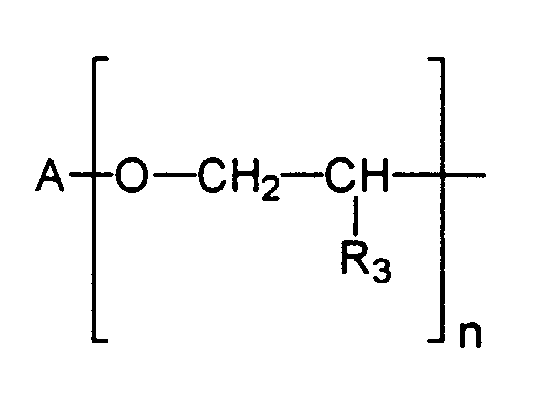
- A
- einen verzweigten oder unverzweigten C1-C18-Alkylrest, einen C5-C12-Cycloalkyl- oder Arylrest darstellt, gegebenenfalls substituiert mit einer oder mehreren C1-C4- Alkylgruppen,
- R3
- ein Wasserstoffatom oder eine Methylgruppe darstellt,
- n
- eine Zahl von 1 bis 10 darstellt,
wenn X ein Sauerstoffatom darstellt.

- 3-Benzylidencampher-Derivate, vorzugsweise 3-(4-Methylbenzyliden)campher, 3-Benzylidencampher;
- 4-Aminobenzoesäure-Derivate, vorzugsweise 4-(Dimethylamino)-benzoesäure(2-ethylhexyl)ester, 4-(Dimethylamino)benzoesäureamylester;
- 2,4,6-Trianilino-(p-carbo-2'-ethyl-1'-hexyloxy)-1,3,5-triazin;
- Ester der Benzalmalonsäure, vorzugsweise 4-Methoxybenzalmalonsäuredi(2-ethylhexyl)ester;
- Ester der Zimtsäure, vorzugsweise 4-Methoxyzimtsäure(2-ethylhexyl)ester, 4-Methoxyzimtsäureisopentylester;
- Derivate des Benzophenons, vorzugsweise 2-Hydroxy-4-methoxybenzophenon, 2-Hydroxy-4-methoxy-4'-methylbenzophenon, 2,2'-Dihydroxy-4-methoxybenzophenon
- sowie an Polymere gebundene UV-Filter.
- Salze der 2-Phenylbenzimidazol-5-sulfonsäure, wie ihr Natrium-, Kalium- oder ihr Triethanolammonium-Salz, sowie die Sulfonsäure selbst;
- Sulfonsäure-Derivate des 3-Benzylidencamphers, wie z. B. 4-(2-Oxo-3-bornylidenmethyl)benzolsulfonsäure, 2-Methyl-5-(2-oxo-3-bornylidenmethyl)sulfonsäure und deren Salze.

| 1 | 2 | 3 | 4 | 5 | |
| Stearinsäure | 0,3 | ||||
| Cetyldimethiconcopolyol | 0,1 | ||||
| Glycerylstearatcitrat | 0,5 | 0,3 | |||
| Dimethicon | 2 | 2,5 | 2 | ||
| Phenyltrimethicon | 2 | 3 | |||
| Caprylic/Caprictriglycerid | 5 | 5 | 5 | 5 | |
| C12-15 Alkylbenzoat | 5 | 5 | 5 | ||
| Dicaprylylether | 5 | 5 | 5 | 5 | |
| Butylenglykoldicaprylat/Caprat | 5 | 2 | |||
| Mineralöl | 4 | ||||
| Cetylpalmitat | 0,5 | ||||
| Vitamin E-Acetat | 0,5 | 0,5 | 0,5 | ||
| Dioctylbutamidotriazon | 1 | ||||
| Anisotriazin | 2 | ||||
| Octylmethoxycinnamat | 8 | ||||
| Octyltriazon | 1 | ||||
| Methylbenzylidencampher | 2 | ||||
| Butylmethoxydibenzoylmethan | 1 | ||||
| Eusolex T2000 ® | 2,8 | 2,0 | 2,0 | ||
| Aerosil 380 ® | 0,6 | 0,6 | 0,4 | ||
| Zinkoxid | 2,5 | ||||
| Distärkephosphat | 8,5 | ||||
| Konservierung | 0,5 | 0,5 | 0,5 | 0,5 | 0,5 |
| Glycerin | 3 | 6 | 10 | 6 | 10 |
| Xanthan Gummi | 0,1 | 0,1 | |||
| Pemulen TR1 ® | 0,1 | ||||
| Phenylbenzimidazolsulfonsäure | 2 | ||||
| Natronlauge 45% | 1,2 | ||||
| Wasser | ad 100 | ad 100 | ad 100 | ad 100 | ad 100 |
Claims (11)
- Dünnflüssige kosmetische oder dermatologische Zubereitungen vom Typ Öl-in-Wasser, welche eine Ölphase, in welche hydrophobe und/oder amphiphile Feststoffe eingearbeitet sind, und eine Wasserphase enthalten, wobei die Dichtedifferenz zwischen der Ölphase und der Wasserphase (bestimmbar mit einem rechnenden digitalen Dichtemesser vom Typ DMA 45 der Firma chempro/PA bei 25 °C) nicht größer als 0,01 g·cm-3 ist.
- Zubereitung nach Anspruch 1, dadurch gekennzeichnet, daß zusätzlich weitere kosmetische oder pharmazeutische Hufs-, Zusatz- und/oder Wirkstoffe enthalten sind.
- Zubereitung nach einem der vorhergehenden Ansprüche, dadurch gekennzeichnet, daß die Viskosität dieser Zubereitung kleiner als 2.000 mPa·s, insbesondere kleiner als 1.500 mPa·s (bestimmbar mit einem Haake Viskotester VT-02 bei 25 °C) ist.
- Zubereitung nach einem der vorhergehenden Ansprüche, dadurch gekennzeichnet, daß die Zubereitung sprühbar ist.
- Zubereitung nach einem der vorhergehenden Ansprüche, dadurch gekennzeichnet, daß der Durchmesser der Öltröpfchen im Durchschnitt kleiner als 50 µm ist.
- Zubereitung nach einem der vorhergehenden Ansprüche, dadurch gekennzeichnet, daß die Dichte der Gesamtformulierung größer als 0,9 g·cm-3, insbesondere größer als 0,95 g·cm-3 ist.
- Zubereitung nach einem der vorhergehenden Ansprüche, dadurch gekennzeichnet, daß der Gehalt an einem oder mehreren Emulgatoren kleiner als 1 Gew.-%, insbesondere kleiner als 0,5 Gew.-% ist, jeweils bezogen auf das Gesamtgewicht der Zubereitung.
- Zubereitung nach einem der vorhergehenden Ansprüche, dadurch gekennzeichnet, daß sie emulgatorfrei ist.
- Zubereitung nach einem der vorhergehenden Ansprüche, dadurch gekennzeichnet, daß der Gehalt an einem oder mehreren Verdickungsmitteln zwischen 0,05 Gew.-% und 0,15 Gew.-% ist, bezogen auf das Gesamtgewicht der Formulierung.
- Verwendung von Zubereitungen nach einem der vorhergehenden Ansprüche als kosmetisches oder dermatologisches Lichtschutzmittel.
- Verfahren zur Stabilisierung von O/W-Formulierungen, dadurch gekennzeichnet, daß die Dichte der Ölphase durch Zugabe von hydrophoben und/oder amphiphilen Feststoffen der Dichte der Wasserphase derart angeglichen wird, daß die Dichtedifferenz der beiden Phasen (bestimmbar mit einem rechnenden digitalen Dichtemesser vom Typ DMA 45 der Firma chempro/PA bei 25 °C) nicht größer als 0,01 g·cm-3 ist.
Applications Claiming Priority (2)
| Application Number | Priority Date | Filing Date | Title |
|---|---|---|---|
| DE19938757 | 1999-08-16 | ||
| DE19938757A DE19938757A1 (de) | 1999-08-16 | 1999-08-16 | Kosmetische oder dermatologische Zubereitungen vom Typ Öl-in-Wasser |
Publications (2)
| Publication Number | Publication Date |
|---|---|
| EP1077059A2 true EP1077059A2 (de) | 2001-02-21 |
| EP1077059A3 EP1077059A3 (de) | 2003-10-29 |
Family
ID=7918528
Family Applications (1)
| Application Number | Title | Priority Date | Filing Date |
|---|---|---|---|
| EP00116483A Withdrawn EP1077059A3 (de) | 1999-08-16 | 2000-07-29 | Kosmetische oder dermatologische Zubereitungen von Typ Öl-in-Wasser |
Country Status (4)
| Country | Link |
|---|---|
| US (1) | US6511655B1 (de) |
| EP (1) | EP1077059A3 (de) |
| JP (1) | JP2001064156A (de) |
| DE (1) | DE19938757A1 (de) |
Cited By (10)
| Publication number | Priority date | Publication date | Assignee | Title |
|---|---|---|---|---|
| WO2001049253A3 (de) * | 2000-01-05 | 2001-12-20 | Beiersdorf Ag | Kosmetische oder dermatologische zubereitungen vom typ öl-in-wasser |
| WO2001049252A3 (de) * | 2000-01-05 | 2002-02-14 | Beiersdorf Ag | Kosmetische oder dermatologische zubereitungen vom typ öl-in-wasser |
| EP1247519A1 (de) * | 2001-04-06 | 2002-10-09 | Cognis Deutschland GmbH & Co. KG | Sprühbare Emulsionen |
| WO2002024165A3 (en) * | 2000-09-20 | 2002-12-27 | Nycomed Pharma As | Preparation of vitamin emulsions and concentrates thereof |
| DE10230060A1 (de) * | 2002-07-04 | 2004-01-22 | Beiersdorf Ag | Kosmetische oder dermatologische Formulierungen zur Pflege der Gesichtshaut |
| DE10230061A1 (de) * | 2002-07-04 | 2004-01-22 | Beiersdorf Ag | Kosmetische oder dermatologische Formulierungen zur Pflege der Gesichtshaut |
| WO2004062631A1 (ja) | 2002-12-26 | 2004-07-29 | Shiseido Co., Ltd. | 水中油型乳化化粧料 |
| EP1935394A1 (de) | 2006-12-22 | 2008-06-25 | Beiersdorf Aktiengesellschaft | Leichte Lotion |
| WO2009018975A1 (de) * | 2007-08-09 | 2009-02-12 | Beiersdorf Ag | Kosmetische emulgatorkombination |
| EP1803435A3 (de) * | 2005-12-30 | 2015-03-04 | Henkel AG & Co. KGaA | Kosmetische Lichtschutzzusammensetzungen auf der Basis lamellarer Emulsionen |
Families Citing this family (83)
| Publication number | Priority date | Publication date | Assignee | Title |
|---|---|---|---|---|
| US8512718B2 (en) | 2000-07-03 | 2013-08-20 | Foamix Ltd. | Pharmaceutical composition for topical application |
| DE10044313A1 (de) * | 2000-09-07 | 2002-03-21 | Beiersdorf Ag | Lipidarme kosmetische und dermatologische Zubereitungen in Form von O/W-Emulsionen mit einem Gehalt an Fettsäuren |
| US7261878B2 (en) * | 2001-08-10 | 2007-08-28 | The Gillette Company | Reduction of hair growth |
| DE10141258B4 (de) * | 2001-08-23 | 2004-09-23 | Beiersdorf Ag | Kosmetische und dermatologische Zubereitung und ihre Verwendung |
| DE10153686A1 (de) * | 2001-10-31 | 2003-05-15 | Wella Ag | Mittel zum Entfärben oder Blondieren von Haaren |
| DE10226352A1 (de) * | 2002-06-13 | 2003-12-24 | Beiersdorf Ag | Kosmetische und dermatologische Lichtschutzzubereitungen enthaltend eine synergetische Kombination aus UV-Absorbern und synthetischen organischen Polymeren als Füllstoffe |
| DE10226351A1 (de) * | 2002-06-13 | 2003-12-24 | Beiersdorf Ag | Kosmetische und dermatologische Lichtschutzzubereitungen enthaltend eine synergistische Kombination aus UV-Absorbern und in Wasser nicht quellbaren Schichtsilikaten als Füllstoffen |
| AU2003281185A1 (en) * | 2002-07-16 | 2004-02-02 | Shiseido Company, Ltd. | Oil-in-water emulsion composition containing particles |
| FR2844185B1 (fr) * | 2002-09-06 | 2006-08-18 | Oreal | Composition de maquillage des fibres keratiniques presentant un extrait sec en solides eleve combine a un profil adhesif particulier |
| FR2844194B1 (fr) * | 2002-09-06 | 2006-11-03 | Oreal | Composition cosmetique de maquillage ou de soin des fibres keratiniques |
| FR2844193A1 (fr) * | 2002-09-06 | 2004-03-12 | Oreal | Composition de maquillage des fibres keratiniques a extrait sec eleve combine a un profil rheologique particulier |
| US7923002B2 (en) | 2002-09-06 | 2011-04-12 | L'oreal S.A. | Composition for coating keratin fibres comprising a tacky wax |
| FR2844184B1 (fr) * | 2002-09-06 | 2006-05-26 | Oreal | Composition cosmetique de maquillage ou de soin des fibres keratiniques sans cire |
| ATE367142T1 (de) * | 2002-09-06 | 2007-08-15 | Oreal | Verfahren zur dekorativen behandlung der wimpern mit einem überzugsmittel, das ein klebriges wachs enthält |
| IL152486A0 (en) | 2002-10-25 | 2003-05-29 | Meir Eini | Alcohol-free cosmetic and pharmaceutical foam carrier |
| US7700076B2 (en) * | 2002-10-25 | 2010-04-20 | Foamix, Ltd. | Penetrating pharmaceutical foam |
| US20080206161A1 (en) * | 2002-10-25 | 2008-08-28 | Dov Tamarkin | Quiescent foamable compositions, steroids, kits and uses thereof |
| US9211259B2 (en) * | 2002-11-29 | 2015-12-15 | Foamix Pharmaceuticals Ltd. | Antibiotic kit and composition and uses thereof |
| US9265725B2 (en) * | 2002-10-25 | 2016-02-23 | Foamix Pharmaceuticals Ltd. | Dicarboxylic acid foamable vehicle and pharmaceutical compositions thereof |
| US20070292355A1 (en) * | 2002-10-25 | 2007-12-20 | Foamix Ltd. | Anti-infection augmentation foamable compositions and kit and uses thereof |
| US20080317679A1 (en) * | 2002-10-25 | 2008-12-25 | Foamix Ltd. | Foamable compositions and kits comprising one or more of a channel agent, a cholinergic agent, a nitric oxide donor, and related agents and their uses |
| US20050205086A1 (en) * | 2002-10-25 | 2005-09-22 | Foamix Ltd. | Retinoid immunomodulating kit and composition and uses thereof |
| US20080138296A1 (en) * | 2002-10-25 | 2008-06-12 | Foamix Ltd. | Foam prepared from nanoemulsions and uses |
| US20070292359A1 (en) * | 2002-10-25 | 2007-12-20 | Foamix Ltd. | Polypropylene glycol foamable vehicle and pharmaceutical compositions thereof |
| US20060193789A1 (en) * | 2002-10-25 | 2006-08-31 | Foamix Ltd. | Film forming foamable composition |
| US7820145B2 (en) * | 2003-08-04 | 2010-10-26 | Foamix Ltd. | Oleaginous pharmaceutical and cosmetic foam |
| US20050186142A1 (en) * | 2002-10-25 | 2005-08-25 | Foamix Ltd. | Kit and composition of imidazole with enhanced bioavailability |
| US8900554B2 (en) | 2002-10-25 | 2014-12-02 | Foamix Pharmaceuticals Ltd. | Foamable composition and uses thereof |
| US7704518B2 (en) | 2003-08-04 | 2010-04-27 | Foamix, Ltd. | Foamable vehicle and pharmaceutical compositions thereof |
| US8486376B2 (en) * | 2002-10-25 | 2013-07-16 | Foamix Ltd. | Moisturizing foam containing lanolin |
| US9668972B2 (en) | 2002-10-25 | 2017-06-06 | Foamix Pharmaceuticals Ltd. | Nonsteroidal immunomodulating kit and composition and uses thereof |
| ES2532906T5 (es) * | 2002-10-25 | 2022-03-23 | Foamix Pharmaceuticals Ltd | Espuma cosmética y farmacéutica |
| US20050271596A1 (en) * | 2002-10-25 | 2005-12-08 | Foamix Ltd. | Vasoactive kit and composition and uses thereof |
| US10117812B2 (en) * | 2002-10-25 | 2018-11-06 | Foamix Pharmaceuticals Ltd. | Foamable composition combining a polar solvent and a hydrophobic carrier |
| US8119150B2 (en) | 2002-10-25 | 2012-02-21 | Foamix Ltd. | Non-flammable insecticide composition and uses thereof |
| US8119109B2 (en) | 2002-10-25 | 2012-02-21 | Foamix Ltd. | Foamable compositions, kits and methods for hyperhidrosis |
| US20070292461A1 (en) * | 2003-08-04 | 2007-12-20 | Foamix Ltd. | Oleaginous pharmaceutical and cosmetic foam |
| DE10258868A1 (de) * | 2002-12-17 | 2004-07-01 | Beiersdorf Ag | Dünnflüssige kosmetische oder dermatologische Zubereitungen vom Typ Öl-in-Wasser |
| US20040141935A1 (en) * | 2003-01-21 | 2004-07-22 | Peter Styczynski | Reduction of hair growth |
| US7575739B2 (en) * | 2003-04-28 | 2009-08-18 | Foamix Ltd. | Foamable iodine composition |
| GB2403410B (en) * | 2003-07-01 | 2005-10-26 | Hb Hygienic Ltd | A cosmetic or pharmaceutical formulation comprising a silicone compound and water emulsion |
| DE10336044A1 (de) * | 2003-08-01 | 2005-02-17 | Beiersdorf Ag | Tensidfreie Rasierhilfszubereitung |
| MXPA06001381A (es) * | 2003-08-04 | 2006-05-19 | Foamix Ltd | Vehiculo de espuma que contiene un gelificante copolimerico anfifilico. |
| US20080069779A1 (en) * | 2003-08-04 | 2008-03-20 | Foamix Ltd. | Foamable vehicle and vitamin and flavonoid pharmaceutical compositions thereof |
| US8795693B2 (en) | 2003-08-04 | 2014-08-05 | Foamix Ltd. | Compositions with modulating agents |
| US8486374B2 (en) * | 2003-08-04 | 2013-07-16 | Foamix Ltd. | Hydrophilic, non-aqueous pharmaceutical carriers and compositions and uses |
| EP2977043A3 (de) * | 2003-08-25 | 2016-04-06 | Foamix Pharmaceuticals Ltd. | Eindringender pharmazeutischer schaum |
| DE102004003000A1 (de) * | 2004-01-19 | 2005-08-04 | Beiersdorf Ag | Kosmetische und dermatologische Lichtschutzformulierungen |
| DE602005020912D1 (de) * | 2004-03-18 | 2010-06-10 | Galderma Sa | Ivermectin enthaltende creme |
| US7500841B2 (en) * | 2004-06-28 | 2009-03-10 | Cryovac, Inc. | Apparatus for pumping gases in a film |
| US9044393B2 (en) * | 2004-07-16 | 2015-06-02 | L'oreal | Oil-rich O/W emulsion |
| WO2006008252A1 (en) * | 2004-07-20 | 2006-01-26 | Ciba Specialty Chemicals Holding Inc. | Light protecting-effective cosmetic or dermatological preparations |
| US20060159716A1 (en) * | 2004-12-17 | 2006-07-20 | Agnes Themens | Cosmetic emulsion comprising solid particles, method for preparing cosmetic emulsion, and method of using cosmetic emulsion |
| US20070189989A1 (en) * | 2006-02-16 | 2007-08-16 | Cantwell Maggie Y | Cosmetic compositions and methods of making and using the compositions |
| DE202006007976U1 (de) | 2006-05-15 | 2006-07-20 | Beiersdorf Ag | Sprühbares Sonnenschutzmittel |
| US20080166303A1 (en) * | 2006-09-08 | 2008-07-10 | Dov Tamarkin | Colored or colorable foamable composition and foam |
| WO2009007785A2 (en) * | 2006-11-14 | 2009-01-15 | Foamix Ltd. | Stable non-alcoholic foamable pharmaceutical emulsion compositions with an unctuous emollient and their uses |
| US20080260655A1 (en) | 2006-11-14 | 2008-10-23 | Dov Tamarkin | Substantially non-aqueous foamable petrolatum based pharmaceutical and cosmetic compositions and their uses |
| EP1930500A1 (de) * | 2006-12-08 | 2008-06-11 | Cognis IP Management GmbH | Emulsionen zur Avivage von Textilien und Papier |
| US20080292560A1 (en) * | 2007-01-12 | 2008-11-27 | Dov Tamarkin | Silicone in glycol pharmaceutical and cosmetic compositions with accommodating agent |
| DE102007005333A1 (de) * | 2007-02-01 | 2008-08-07 | Beiersdorf Ag | Organische Mikropigmente in kosmetischen Lichtschutzemulsionen |
| US8029771B2 (en) | 2007-06-29 | 2011-10-04 | Mary Kay Inc. | Guar gum containing compounds |
| US8636982B2 (en) | 2007-08-07 | 2014-01-28 | Foamix Ltd. | Wax foamable vehicle and pharmaceutical compositions thereof |
| US20090130029A1 (en) * | 2007-11-21 | 2009-05-21 | Foamix Ltd. | Glycerol ethers vehicle and pharmaceutical compositions thereof |
| US9439857B2 (en) | 2007-11-30 | 2016-09-13 | Foamix Pharmaceuticals Ltd. | Foam containing benzoyl peroxide |
| US8518376B2 (en) | 2007-12-07 | 2013-08-27 | Foamix Ltd. | Oil-based foamable carriers and formulations |
| WO2009072007A2 (en) | 2007-12-07 | 2009-06-11 | Foamix Ltd. | Carriers, formulations, methods for formulating unstable active agents for external application and uses thereof |
| US20090180978A1 (en) * | 2007-12-27 | 2009-07-16 | Nathalie Schlemer | Cosmetic composition |
| EP2242476A2 (de) * | 2008-01-14 | 2010-10-27 | Foamix Ltd. | Aufschäumbare pharmazeutische poloxamer-zusammensetzungen mit wirkstoffen und/oder therapeutischen zellen und verwendungen |
| CN101554358B (zh) * | 2008-04-11 | 2013-01-02 | 拜埃尔斯多尔夫股份公司 | 淡型乳液 |
| PT2400951T (pt) * | 2009-02-25 | 2018-11-26 | Mayne Pharma Llc | Composições de espuma tópica |
| WO2010125470A2 (en) | 2009-04-28 | 2010-11-04 | Foamix Ltd. | Foamable vehicle and pharmaceutical compositions comprising aprotic polar solvents and uses thereof |
| WO2011013009A2 (en) | 2009-07-29 | 2011-02-03 | Foamix Ltd. | Non surfactant hydro-alcoholic foamable compositions, breakable foams and their uses |
| CA2769677A1 (en) | 2009-07-29 | 2011-02-03 | Foamix Ltd. | Non surface active agent non polymeric agent hydro-alcoholic foamable compositions, breakable foams and their uses |
| US9849142B2 (en) | 2009-10-02 | 2017-12-26 | Foamix Pharmaceuticals Ltd. | Methods for accelerated return of skin integrity and for the treatment of impetigo |
| WO2011064631A1 (en) | 2009-10-02 | 2011-06-03 | Foamix Ltd. | Surfactant-free, water-free, foamable compositions and breakable foams and their uses |
| US8174881B2 (en) | 2009-11-24 | 2012-05-08 | Micron Technology, Inc. | Techniques for reducing disturbance in a semiconductor device |
| ITPV20110016A1 (it) * | 2011-08-10 | 2013-02-11 | Paola Brunoldi | Crema dermatologica protettiva con effetto barriera |
| FR3030227B1 (fr) * | 2014-12-17 | 2018-01-26 | L'oreal | Emulsion stabilisees par des particules composites amphiphiles |
| US10398641B2 (en) | 2016-09-08 | 2019-09-03 | Foamix Pharmaceuticals Ltd. | Compositions and methods for treating rosacea and acne |
| CN111939089A (zh) * | 2019-05-17 | 2020-11-17 | 株式会社资生堂 | 水包油组合物 |
| JP7755481B2 (ja) * | 2021-12-23 | 2025-10-16 | デクセリアルズ株式会社 | 接着剤組成物、異方性導電フィルム、接続構造体および接続構造体の製造方法 |
| JP2026034883A (ja) * | 2024-08-19 | 2026-03-04 | ジェイオーコスメティックス株式会社 | 水中油型乳化化粧料 |
Family Cites Families (20)
| Publication number | Priority date | Publication date | Assignee | Title |
|---|---|---|---|---|
| FR2680684B1 (fr) * | 1991-08-29 | 1993-11-12 | Oreal | Composition cosmetique filtrante comprenant un nanopigment d'oxyde metallique et un polymere filtre. |
| WO1994017780A1 (de) * | 1993-02-11 | 1994-08-18 | Beiersdorf Ag | Wasserfeste kosmetische oder dermatologische lichtschutzzubereitungen |
| DE4303983C2 (de) * | 1993-02-11 | 1998-01-22 | Beiersdorf Ag | Kosmetische und dermatologische Lichtschutzformulierungen mit einem Gehalt an anorganischen Mikropigmenten |
| DE4342719A1 (de) * | 1993-12-15 | 1995-06-22 | Beiersdorf Ag | Kosmetische oder dermatologische O/W-Emulsionen, enthaltend Aminosäure und anorganische Pigmente |
| FR2715843B1 (fr) * | 1994-02-09 | 1996-04-12 | Oreal | Compositions cosmétiques antisolaires, procédé de préparation et utilisation. |
| FR2720641B1 (fr) * | 1994-06-03 | 1996-07-26 | Oreal | Compositions cosmétiques antisolaires comprenant de la 2,4,6-tris[p-(2'-éthylhexyl-1'-oxycarbonyl)anilino]-1,3,5-triazine et du malate de dioctyle et utilisations. |
| DE4425268C2 (de) * | 1994-07-16 | 1998-05-28 | Beiersdorf Ag | Emulgatorfreie, feindisperse kosmetische oder dermatologische Zubereitungen vom Typ Öl-in-Wasser |
| DE4429468C2 (de) * | 1994-08-19 | 1998-07-09 | Beiersdorf Ag | Verwendung hydrophobierter anroganischer Pigmente zum Erhalt der Urocaninsäurestatus der Haut beim Baden |
| FR2739555B1 (fr) * | 1995-10-04 | 1998-01-02 | Oreal | Compositions cosmetiques photoprotectrices contenant des nanopigments de tio2 et un acylaminoacide |
| DE19545789C2 (de) * | 1995-12-08 | 1998-07-02 | Beiersdorf Ag | Verwendung von Isoalkansäuren |
| FR2751542B1 (fr) * | 1996-07-29 | 1998-09-11 | Oreal | Composition de protection de la peau ou des cheveux contenant des nanopigments et un organopolysiloxane solide elastomere associe a une phase grasse |
| DE19631219A1 (de) * | 1996-08-02 | 1998-02-12 | Beiersdorf Ag | Wasserfeste Lichtschutzzubereitungen mit einem Gehalt an anorganischen Mikropigmenten und wasserlöslichen UV-Filtersubstanzen |
| DE19633012A1 (de) * | 1996-08-16 | 1998-02-19 | Beiersdorf Ag | Verwendung von Campherderivaten zur Erzielung oder Erhöhung der Löslichkeit von Triazinderivaten in Ölkomponenten |
| DE19635057A1 (de) | 1996-08-30 | 1998-03-05 | Beiersdorf Ag | Verwendung von Dibenzoylmethanderivaten zur Erzielung oder Erhöhung der Löslichkeit von Triazinderivaten in Ölkomponenten |
| FR2753625B1 (fr) * | 1996-09-20 | 1998-10-23 | Composition cosmetique comprenant un copolymere particulier et utilisation dudit copolymere en cosmetique | |
| WO1998042301A1 (de) * | 1997-03-25 | 1998-10-01 | Beiersdorf Ag | Emulgatorfreie feindisperse systeme vom typ wasser-in-öl |
| DE19723778A1 (de) | 1997-06-06 | 1998-12-10 | Beiersdorf Ag | Kosmetische und dermatologische Lichtschutzformulierungen mit einem Gehalt an Triazinderivaten und Mono-Di- und/oder Trialkylestern der Phosphorsäure |
| DE19725087A1 (de) * | 1997-06-13 | 1998-12-17 | Beiersdorf Ag | Kosmetische und dermatologische Lichtschutzformulierungen in Form von O/W-Emulsionen mit einem Gehalt an hydrophoben anorganischen Mikropigmenten und hydrophilen Tensiden |
| DE19732954A1 (de) * | 1997-07-31 | 1999-02-18 | Beiersdorf Ag | Lichtschutzzubereitungen mit einem Gehalt an anorganischen Pigmenten, welche oberflächlich mit UV-Filtersubstanzen beschichtet sind |
| DE19735900A1 (de) * | 1997-08-19 | 1999-02-25 | Beiersdorf Ag | Kosmetische oder dermatologische Lichtschutzmittel, welche gelöste Triazinderivate und polymere UV-Filtersubstanzen auf Siliconbasis enthalten |
-
1999
- 1999-08-16 DE DE19938757A patent/DE19938757A1/de not_active Withdrawn
-
2000
- 2000-07-29 EP EP00116483A patent/EP1077059A3/de not_active Withdrawn
- 2000-08-09 JP JP2000241120A patent/JP2001064156A/ja active Pending
- 2000-08-11 US US09/636,780 patent/US6511655B1/en not_active Expired - Fee Related
Cited By (12)
| Publication number | Priority date | Publication date | Assignee | Title |
|---|---|---|---|---|
| WO2001049253A3 (de) * | 2000-01-05 | 2001-12-20 | Beiersdorf Ag | Kosmetische oder dermatologische zubereitungen vom typ öl-in-wasser |
| WO2001049252A3 (de) * | 2000-01-05 | 2002-02-14 | Beiersdorf Ag | Kosmetische oder dermatologische zubereitungen vom typ öl-in-wasser |
| WO2002024165A3 (en) * | 2000-09-20 | 2002-12-27 | Nycomed Pharma As | Preparation of vitamin emulsions and concentrates thereof |
| EP1247519A1 (de) * | 2001-04-06 | 2002-10-09 | Cognis Deutschland GmbH & Co. KG | Sprühbare Emulsionen |
| DE10230060A1 (de) * | 2002-07-04 | 2004-01-22 | Beiersdorf Ag | Kosmetische oder dermatologische Formulierungen zur Pflege der Gesichtshaut |
| DE10230061A1 (de) * | 2002-07-04 | 2004-01-22 | Beiersdorf Ag | Kosmetische oder dermatologische Formulierungen zur Pflege der Gesichtshaut |
| WO2004062631A1 (ja) | 2002-12-26 | 2004-07-29 | Shiseido Co., Ltd. | 水中油型乳化化粧料 |
| EP1576943A4 (de) * | 2002-12-26 | 2006-06-28 | Shiseido Co Ltd | Kosmetische zubereitung in form einer öl-in-wasser-emulsion |
| KR101102647B1 (ko) * | 2002-12-26 | 2012-01-04 | 가부시키가이샤 시세이도 | 수중 유형 유화 화장료 |
| EP1803435A3 (de) * | 2005-12-30 | 2015-03-04 | Henkel AG & Co. KGaA | Kosmetische Lichtschutzzusammensetzungen auf der Basis lamellarer Emulsionen |
| EP1935394A1 (de) | 2006-12-22 | 2008-06-25 | Beiersdorf Aktiengesellschaft | Leichte Lotion |
| WO2009018975A1 (de) * | 2007-08-09 | 2009-02-12 | Beiersdorf Ag | Kosmetische emulgatorkombination |
Also Published As
| Publication number | Publication date |
|---|---|
| JP2001064156A (ja) | 2001-03-13 |
| DE19938757A1 (de) | 2001-02-22 |
| EP1077059A3 (de) | 2003-10-29 |
| US6511655B1 (en) | 2003-01-28 |
Similar Documents
| Publication | Publication Date | Title |
|---|---|---|
| EP1077059A2 (de) | Kosmetische oder dermatologische Zubereitungen von Typ Öl-in-Wasser | |
| EP0987006B1 (de) | Emulgatorfreie feindisperse Systeme vom Typ Wasser-in-Öl | |
| EP0987002B1 (de) | Emulgatorfreie feindisperse Systeme vom Typ Öl-in-Wasser und Wasser-in-Öl | |
| WO2005009404A1 (de) | Kosmetische, dermatologische oder pharmazeutische zubereitungen auf basis von gase enthaltenden lipid/wachs-gemischen | |
| EP0987001A2 (de) | Emulgatorfreie feindisperse Systeme vom Type Öl-in-Wasser und Wasser-in-Öl | |
| EP0992233A2 (de) | Emulgatorfreie feindisperse Systeme vom Typ Öl-in-Wasser und Wasser-in-Öl | |
| EP1080712A2 (de) | Wasserhaltige kosmetische oder pharmazeutische Stifte | |
| EP1641904B1 (de) | O/w-emulgator, o/w-emulsion und deren verwendungen | |
| EP1077058A2 (de) | Emulgatorfreie feindisperse Systeme vom Typ Wasser-in-Öl | |
| DE19651478A1 (de) | Lichtschutzzubereitungen mit einem Gehalt an oberflächenaktiven Mono- bzw. Oligoglycerylverbindungen, wasselöslichen UV-Filtersubstanzen und ggf. anorganischen Mikropigmenten | |
| DE10155966A1 (de) | Emulgatorfreie kosmetische und dermatologische Lichtschutzformulierungen mit einem Gehalt an Hydroxybenzophenonen | |
| EP1192937A2 (de) | Emulgatorarme feindisperse Systeme vom Typ Wasser-in-Öl mit einem Gehalt an Ethylcellulose | |
| EP1094889A1 (de) | Fliessfähige zubereitungen vom emulsionstyp w/o mit erhöhtem wassergehalt | |
| EP2485806B1 (de) | Verwendung von cetearylsulfosuccinaten in sonnenschutzmitteln | |
| WO2003020224A1 (de) | Stabilisierung oxidations-und/oder uv-empfindlicher wirkstoffe | |
| EP1013262A2 (de) | Kosmetische und dermatoligische O/W-Emulsionen mit einem Gehalt an Bornitrid | |
| DE19548015A1 (de) | Kosmetische und dermatologische Lichtschutzformulierungen mit einem Gehalt an hydrophoben anorganischen Mikropigmenten | |
| DE10000211A1 (de) | Ölfreie kosmetische oder dermatologische Zubereitungen mit einem Gehalt an festen und flüssigen UV-Filtersubstanzen | |
| EP1093795A1 (de) | Kosmetische und dermatologische Lichtschutzformulierungen in Form von O/W-Makroemulsionen oder O/W-Mikroemulsionen, mit einem Gehalt an einem oder mehreren Filmbildnern, welche aus der Gruppe der Copolymere des Polyvinylpyrrolidons gewählt werden | |
| EP0987004A2 (de) | Emulgatorfreie feindisperse Systeme vom Typ Öl-in-Wasser und Wasser-in-Öl | |
| EP1075834A2 (de) | Kosmetische und dermatologische W/O-Emulsionen mit einem Gehalt an modifizierte Schichtsilikaten | |
| EP2496309B1 (de) | Cetearylsulfosuccinate enthaltende kosmetische zubereitung mit flüssigen uv-filtern | |
| EP1074241A2 (de) | Ölfreie kosmetische oder dermatologische Zubereitungen mit einem Gehalt an unsymmetrisch substituierten Triazinderivaten und flüssigen UV-Filtersubstanzen | |
| DE10325767A1 (de) | Verfahren zur Herstellung feindisperser, aber nicht transparenter Zubereitungen | |
| EP1244418B1 (de) | Kosmetische oder dermatologische zubereitungen vom typ öl-in-wasser |
Legal Events
| Date | Code | Title | Description |
|---|---|---|---|
| PUAI | Public reference made under article 153(3) epc to a published international application that has entered the european phase |
Free format text: ORIGINAL CODE: 0009012 |
|
| AK | Designated contracting states |
Kind code of ref document: A2 Designated state(s): AT BE CH CY DE DK ES FI FR GB GR IE IT LI LU MC NL PT SE |
|
| AX | Request for extension of the european patent |
Free format text: AL;LT;LV;MK;RO;SI |
|
| PUAL | Search report despatched |
Free format text: ORIGINAL CODE: 0009013 |
|
| AK | Designated contracting states |
Kind code of ref document: A3 Designated state(s): AT BE CH CY DE DK ES FI FR GB GR IE IT LI LU MC NL PT SE |
|
| AX | Request for extension of the european patent |
Extension state: AL LT LV MK RO SI |
|
| RIC1 | Information provided on ipc code assigned before grant |
Ipc: 7A 61K 7/48 B Ipc: 7A 61K 7/42 B Ipc: 7A 61K 7/00 A |
|
| 17P | Request for examination filed |
Effective date: 20040429 |
|
| AKX | Designation fees paid |
Designated state(s): AT BE CH CY DE DK ES FI FR GB GR IE IT LI LU MC NL PT SE |
|
| 17Q | First examination report despatched |
Effective date: 20040617 |
|
| STAA | Information on the status of an ep patent application or granted ep patent |
Free format text: STATUS: THE APPLICATION IS DEEMED TO BE WITHDRAWN |
|
| 18D | Application deemed to be withdrawn |
Effective date: 20041228 |