EP1077227B1 - Mélange de stabilisateurs - Google Patents
Mélange de stabilisateurs Download PDFInfo
- Publication number
- EP1077227B1 EP1077227B1 EP00810708A EP00810708A EP1077227B1 EP 1077227 B1 EP1077227 B1 EP 1077227B1 EP 00810708 A EP00810708 A EP 00810708A EP 00810708 A EP00810708 A EP 00810708A EP 1077227 B1 EP1077227 B1 EP 1077227B1
- Authority
- EP
- European Patent Office
- Prior art keywords
- tetramethylpiperidin
- tert
- butyl
- formula
- compound
- Prior art date
- Legal status (The legal status is an assumption and is not a legal conclusion. Google has not performed a legal analysis and makes no representation as to the accuracy of the status listed.)
- Expired - Lifetime
Links
- 0 C[*-]N(C(N(C)C(N1[*-])=O)=O)C1=O Chemical compound C[*-]N(C(N(C)C(N1[*-])=O)=O)C1=O 0.000 description 21
- FUQQGBULEKZXIH-UHFFFAOYSA-N CC(C)(CN1CCN(CC(C)(C)NC2(C)C)C2=O)NC(C)(C)C1O Chemical compound CC(C)(CN1CCN(CC(C)(C)NC2(C)C)C2=O)NC(C)(C)C1O FUQQGBULEKZXIH-UHFFFAOYSA-N 0.000 description 1
- ILBWXWVIPFEFNF-UHFFFAOYSA-N CCC(C)(C1)NC(C)(C)CC1N(C)C Chemical compound CCC(C)(C1)NC(C)(C)CC1N(C)C ILBWXWVIPFEFNF-UHFFFAOYSA-N 0.000 description 1
- JEQUIBRTYXGKAO-UHFFFAOYSA-N CCC(C)(CC)C(CC(C(CC(OCC(C)(C)C(OC1)OCC11COC(C(C)(COC(C)(CC)CC)CI)OC1)=O)C(OC1CC(C)(C)NC(C)(C)C1)=O)C(OC1CC(C)(C)NC(C)(C)C1)=O)=O Chemical compound CCC(C)(CC)C(CC(C(CC(OCC(C)(C)C(OC1)OCC11COC(C(C)(COC(C)(CC)CC)CI)OC1)=O)C(OC1CC(C)(C)NC(C)(C)C1)=O)C(OC1CC(C)(C)NC(C)(C)C1)=O)=O JEQUIBRTYXGKAO-UHFFFAOYSA-N 0.000 description 1
- LJBGFGQCPFWDEX-UHFFFAOYSA-N CCC(C)(CC)C(CN(C(C)(C)OC12CC(C)(C)NC(C)(C)C1)C2=O)COC(C)(CC)CC Chemical compound CCC(C)(CC)C(CN(C(C)(C)OC12CC(C)(C)NC(C)(C)C1)C2=O)COC(C)(CC)CC LJBGFGQCPFWDEX-UHFFFAOYSA-N 0.000 description 1
- NNRXWFCUIISIBY-LICLKQGHSA-N CCCCCCN(C1CC(C)(C)N(C)C(C)(C)C1)C(/C(/C)=C/C)=O Chemical compound CCCCCCN(C1CC(C)(C)N(C)C(C)(C)C1)C(/C(/C)=C/C)=O NNRXWFCUIISIBY-LICLKQGHSA-N 0.000 description 1
- PQIIPSXVIUDTCW-UHFFFAOYSA-N Cc1nc(Cl)nc(N2CCOCC2)n1 Chemical compound Cc1nc(Cl)nc(N2CCOCC2)n1 PQIIPSXVIUDTCW-UHFFFAOYSA-N 0.000 description 1
Classifications
-
- C—CHEMISTRY; METALLURGY
- C08—ORGANIC MACROMOLECULAR COMPOUNDS; THEIR PREPARATION OR CHEMICAL WORKING-UP; COMPOSITIONS BASED THEREON
- C08K—Use of inorganic or non-macromolecular organic substances as compounding ingredients
- C08K3/00—Use of inorganic substances as compounding ingredients
- C08K3/18—Oxygen-containing compounds, e.g. metal carbonyls
- C08K3/20—Oxides; Hydroxides
- C08K3/22—Oxides; Hydroxides of metals
-
- C—CHEMISTRY; METALLURGY
- C08—ORGANIC MACROMOLECULAR COMPOUNDS; THEIR PREPARATION OR CHEMICAL WORKING-UP; COMPOSITIONS BASED THEREON
- C08K—Use of inorganic or non-macromolecular organic substances as compounding ingredients
- C08K5/00—Use of organic ingredients
- C08K5/16—Nitrogen-containing compounds
- C08K5/34—Heterocyclic compounds having nitrogen in the ring
-
- C—CHEMISTRY; METALLURGY
- C08—ORGANIC MACROMOLECULAR COMPOUNDS; THEIR PREPARATION OR CHEMICAL WORKING-UP; COMPOSITIONS BASED THEREON
- C08K—Use of inorganic or non-macromolecular organic substances as compounding ingredients
- C08K3/00—Use of inorganic substances as compounding ingredients
- C08K3/18—Oxygen-containing compounds, e.g. metal carbonyls
- C08K3/20—Oxides; Hydroxides
- C08K3/22—Oxides; Hydroxides of metals
- C08K2003/2237—Oxides; Hydroxides of metals of titanium
- C08K2003/2241—Titanium dioxide
Definitions
- the present invention relates to stabilizer mixtures containing one specific sterically hindered amine compound, a further hindered amine compound and anatase (TiO 2 ), the use of this mixture for stabilizing an organic material, in particular a synthetic polymer such as a pololefin, against degradation induced by light, heat or oxidation and the organic material thus stabilized.
- a synthetic polymer such as a pololefin
- a stabilizer mixture containing two specific sterically hindered amine compounds and rutile (TiO 2 ) is for example known from US-A-4,863,981. Stabilizer interactions in the thermal and photooxidation of titanium dioxide pigmented polypropylene films are described by N. S. Allen et al. in Polymer Degradation and Stability 61 (1998), 139-149.
- the present invention relates in particular to a stabilizer mixture containing
- alkyl containing not more than 8 carbon atoms examples include methyl, ethyl, propyl, butyl, pentyl, hexyl, heptyl and octyl.
- alkylene straight-chain or branched
- alkylene straight-chain or branched
- R 2 is preferably C 2 -C 5 alkylene.
- n 1 , n 2 and n 2 * are preferably a number from 2 to 25, in particular 2 to 20 or 2 to 10.
- n 2 ** is preferably a number from 1 to 25, in particular 1 to 20 or 1 to 10.
- terminal groups which saturate the free valences in the compounds of the formulae (A-I), (A-II-a) and (A-II-b) depend on the processes used for their preparation.
- the terminal groups can also be modified after the preparation of the compounds.
- the terminal group bonded to the 2,2,6,6-tetramethyl-4-oxy-1-piperidyl radical is for example hydrogen or -CO-R 2 -COOQ with Q being e.g. methyl, ethyl or propyl, and the terminal group bonded to the diacyl radical is for example -OQ or a group
- the terminal group bonded to the nitrogen can be, for example, hydrogen and the terminal group bonded to the 2-hydroxypropylene radical can be, for example, a group.
- the terminal group bonded to the dimethylene radical can be, for example, -OH, and the terminal group bonded to the oxygen can be, for example, hydrogen.
- the terminal groups can also be polyether radicals.
- the component (A) is preferably a compound of the formula (A-I) with R 1 being hydrogen, R 2 being ethylene and n 1 being a number from 2 to 20; or at least one compound of the formulae (A-II-a) and (A-II-b) with n 2 and n 2 * being a number from 2 to 20; or a compound of the formula (A-III) with the radicals R 3 and R 4 together forming undecamethylene and the variables n 2 ** independently of one another being a number from 1 to 20.
- the component (A) is in particular a compound of the formula (A-I) with R 1 being hydrogen, R 2 being ethylene and n 1 being a number from 2 to 20.
- Component (A) is in particular the commercially available product ® TINUVIN 622 or ® HOSTAVIN N 30.
- Compounds of the formula (A-III) are described in detail in WO-A-98/51690.
- n 1 is a number from 1 to 4
- G and G 1 independently of one another, are hydrogen or methyl
- G 11 is hydrogen, O - , hydroxyl, C 1 -C 18 alkyl, C 3 -C 8 alkenyl, C 3 -C 8 alkynyl, C 7 -C 12 aralkyl, C 1 -C 18 alkoxy, C 5 -C 8 cycloalkoxy, C 7 -C 9 phenylalkoxy, C 1 -C 8 alkanoyl, C 3 -C 5 alkenoyl, C 1 -C 18 alkanoyloxy, glycidyl or a group of the formula -CH 2 CH(OH)-Z, in which Z is hydrogen, methyl or phenyl, G 11 preferably being H, C 1 -C 4 alkyl, allyl, benzyl, acetyl or acryloyl, and G 12 , if n 1 is 1, is hydrogen, C
- carboxylic acid radicals mentioned above are in each case taken to mean radicals of the formula (-CO) x R, where x is as defined above for n 1 , and the meaning of R arises from the definition given above.
- Alkyl with up to 20 carbon atoms is, for example, methyl, ethyl, n-propyl, n-butyl, sec-butyl, tert-butyl, n-hexyl, n-octyl, 2-ethylhexyl, n-nonyl, n-decyl, n-undecyl, n-dodecyl, n-tridecyl, n-tetradecyl, n-hexadecyl or n-octadecyl.
- C 3 -C 8 alkenyl G 11 can be, for example, 1-propenyl, allyl, methallyl, 2-butenyl, 2-pentenyl, 2-hexenyl, 2-octenyl, or 4-tert-butyl-2-butenyl.
- C 3 -C 8 alkynyl G 11 is preferably propargyl.
- C 7 -C 12 aralkyl G 11 is, in particular, phenethyl, especially benzyl.
- C 1 -C 18 alkoxy G 11 is, for example, methoxy, ethoxy, propoxy, isopropoxy, butoxy, isobutoxy, pentoxy, isopentoxy, hexoxy, heptoxy, octoxy, decyloxy, dodecyloxy, tetradecyloxy, hexadecyloxy and octadecyloxy.
- C 5 -C 8 cycloalkoxy G 11 is, for example, cyclopentoxy, cyclohexoxy, cycloheptoxy, cyclooctoxy, cyclodecyloxy and cyclododecyloxy.
- C 7 -C 9 phenylalkoxy is, for example, benzyloxy.
- C 1 -C 8 alkanoyl G 11 is, for example, formyl, propionyl, butyryl, octanoyl, but preferably acetyl and C 3 -C 5 alkenoyl G 11 is in particular acryloyl.
- C 1 -C 18 alkanoyloxy G 11 is, for example, formyloxy, acetyloxy, propionyloxy, butyryloxy, valeryloxy, lauroyloxy, palmitoyloxy and stearoyloxy.
- G 12 is a monovalent radical of a carboxylic acid, it is, for example, an acetyl, caproyl, stearoyl, acryloyl, methacryloyl, benzoyl or ⁇ -(3,5-di-tert-butyl-4-hydroxyphenyl)propionyl radical.
- G 12 is a monovalent silyl radical, it is, for example, a radical of the formula -(C j H 2j )-Si(Z') 2 Z", in which j is an integer in the range from 2 to 5, and Z' and Z", independently of one another, are C 1 -C 4 alkyl or C 1 -C 4 alkoxy.
- G 12 is a divalent radical of a dicarboxylic acid, it is, for example, a malonyl, succinyl, glutaryl, adipoyl, suberoyl, sebacoyl, maleoyl, itaconyl, phthaloyl, dibutylmalonyl, dibenzylmalonyl, butyl(3,5-di-tert-butyl-4-hydroxybenzyl)malonyl or bicycloheptenedicarbonyl radical or a group of the formula
- G 12 is a trivalent radical of a tricarboxylic acid, it is, for example, a trimellitoyl, citryl or nitrilotriacetyl radical.
- G 12 is a tetravalent radical of a tetracarboxylic acid, it is, for example, the tetravalent radical of butane-1,2,3,4-tetracarboxylic acid or of pyromellitic acid.
- G 12 is a divalent radical of a dicarbamic acid, it is, for example, hexamethylenedicarbamoyl or 2,4-toluylenedicarbamoyl radical.
- G and G 1 are hydrogen, G 11 is hydrogen or methyl, n 1 is 2 and G 12 is the diacyl radical of an aliphatic dicarboxylic acid having 4-12 carbon atoms.
- polyalkylpiperidine compounds from this class are the following compounds:
- n 2 is the number 1, 2 or 3
- G, G 1 and G 11 are as defined under (a')
- G 13 is hydrogen, C 1 -C 12 alkyl, C 2 -C 5 hydroxyalkyl, C 5 -C 7 cycloalkyl, C 7 -C 8 aralkyl, C 1 -C 18 alkanoyl, C 3 -C 5 alkenoyl, benzoyl or a group of the formula
- G 14 if n 2 is 1, is hydrogen, C 1 -C 18 alkyl, C 3 -C 8 alkenyl, C 5 -C 7 cycloalkyl, C 1 -C 4 alkyl which is substituted by a hydroxyl, cyano, alkoxycarbonyl or carbamide group, glycidyl, a group of the formula -CH 2 -CH(OH)-Z or of the formula -CONH-Z, in which Z is hydrogen, methyl or phenyl; G 14 ,
- Any C 5 -C 7 cycloalkyl substituents are, in particular, cyclohexyl.
- C 7 -C 8 aralkyl G 13 is, in particular, phenylethyl or especially benzyl.
- C 2 -C 5 hydroxyalkyl G 13 is, in particular, 2-hydroxyethyl or 2-hydroxypropyl.
- C 1 -C 18 alkanoyl G 13 is, for example, formyl, acetyl, propionyl, butyryl, octanoyl, dodecanoyl, hexadecanoyl, octadecanoyl, but preferably acetyl, and C 3 -C 5 alkenoyl G 13 is, in particular, acryloyl.
- C 2 -C 8 alkenyl G 14 is, for example, allyl, methallyl, 2-butenyl, 2-pentenyl, 2-hexenyl or 2-octenyl.
- G 14 as a hydroxyl-, cyano-, alkoxycarbonyl- or carbamide-substituted C 1 -C 4 alkyl can be, for example, 2-hydroxyethyl, 2-hydroxypropyl, 2-cyanoethyl, methoxycarbonylmethyl, 2-ethoxycarbonylethyl, 2-aminocarbonylpropyl or 2-(dimethylaminocarbonyl)ethyl.
- Any C 2 -C 12 alkylene radicals are, for example, ethylene, propylene, 2,2-dimethylpropylene, tetramethylene, hexamethylene, octamethylene, decamethylene or dodecamethylene.
- Any C 6 -C 15 arylene substituents are, for example, o-, m- or p-phenylene, 1,4-naphthylene or 4,4'-diphenylene.
- C 6 -C 12 cycloalkylene is, in particular, cyclohexylene.
- G 14 as 1-oxo-C 2 -C 12 alkylene is preferably a group
- n 2 is 1 or 2
- G and G 1 are hydrogen
- G 11 is hydrogen or methyl
- G 13 is hydrogen
- polyalkylpiperidine compounds from this class are the following compounds:
- n 3 is the number 1 or 2
- G, G 1 and G 11 are as defined under (a')
- G 15 if n 3 is 1, is C 2 -C 8 alkylene, C 2 -C 8 hydroxyalkylene or C 4 -C 22 acyloxyalkylene, and if n 3 is 2, G 15 is the (-CH 2 ) 2 C(CH 2 -) 2 group.
- C 2 -C 8 alkylene or C 2 -C 8 hydroxyalkylene G 15 is, for example, ethylene, 1-methylethylene, propylene, 2-ethylpropylene or 2-ethyl-2-hydroxymethylpropylene.
- C 4 -C 22 acyloxyalkylene G 15 is, for example, 2-ethyl-2-acetoxymethylpropylene.
- polyalkylpiperidine compounds from this class are the following compounds:
- n 4 is the number 1 or 2
- G, G 1 and G 11 are as defined under (a')
- G 16 is hydrogen, C 1 -C 12 alkyl, allyl, benzyl, glycidyl or C 2 -C 6 alkoxyalkyl
- G 17 if n 4 is 1, is hydrogen, C 1 -C 12 alkyl, C 3 -C 5 alkenyl, C 7 -C 9 aralkyl, C 5 -C 7 cycloalkyl, C 2 -C 4 hydroxyalkyl, C 2 -C 6 alkoxyalkyl, C 6 -C 10 aryl, glycidyl or a group of the formula -(CH 2 ) p -COO-Q or -(CH 2 ) p -O-CO-Q, in which p is 1 or 2, and Q is C 1 -C 4 alkyl or phenyl, and G 17 , if n 4 is 2, is C 2
- a compound of the formula (Id-3) is preferred.
- Any C 1 -C 12 alkyl substituents are, for example, methyl, ethyl, n-propyl, n-butyl, sec-butyl, tert-butyl, n-hexyl, n-octyl, 2-ethylhexyl, n-nonyl, n-decyl, n-undecyl or n-dodecyl.
- Any C 1 -C 18 alkyl substituents can be, for example, the abovementioned groups and in addition, for example, n-tridecyl, n-tetradecyl, n-hexadecyl or n-octadecyl.
- Any C 2 -C 6 alkoxyalkyl substituents are, for example, methoxymethyl, ethoxymethyl, propoxymethyl, tert-butoxymethyl, ethoxyethyl, ethoxypropyl, n-butoxyethyl, tert-butoxyethyl, isopropoxyethyl or propoxypropyl.
- C 3 -C 5 alkenyl G 17 is, for example, 1-propenyl, allyl, methallyl, 2-butenyl or 2-pentenyl.
- T 1 and T 2 are, in particular, phenethyl or especially benzyl. If T 1 and T 2 together with the carbon atom form a cycloalkane ring, this can be, for example, a cyclopentane, cyclohexane, cyclooctane or cyclododecane ring.
- C 2 -C 4 hydroxyalkyl G 17 is, for example, 2-hydroxyethyl, 2-hydroxypropyl, 2-hydroxybutyl or 4-hydroxybutyl.
- C 6 -C 10 aryl G 17 , T 1 and T 2 are, in particular, phenyl or ⁇ - or ⁇ -naphthyl, which are unsubstituted or substituted by halogen or C 1 -C 4 alkyl.
- C 2 -C 12 alkylene G 17 is, for example, ethylene, propylene, 2,2-dimethylpropylene, tetramethylene, hexamethylene, octamethylene, decamethylene or dodecamethylene.
- C 4 -C 12 alkenylene G 17 is, in particular, 2-butenylene, 2-pentenylene or 3-hexenylene.
- C 6 -C 12 arylene G 17 is, for example, o-, m- or p-phenylene, 1,4-naphthylene or 4,4'-diphenylene.
- C 2 -C 12 alkanoyl D is, for example, propionyl, butyryl, octanoyl, dodecanoyl, but preferably acetyl.
- C 2 -C 10 alkylene, C 6 -C 15 arylene or C 6 -C 12 cycloalkylene D' have, for example, one of the definitions given for D under (b').
- polyalkylpiperidine compounds from this class are the following compounds:
- Any C 1 -C 12 alkyl substituents are, for example, methyl, ethyl, n-propyl, n-butyl, sec-butyl, tert-butyl, n-hexyl, n-octyl, 2-ethylhexyl, n-nonyl, n-decyl, n-undecyl or n-dodecyl.
- Any hydroxyalkyl substituents are, for example, 2-hydroxyethyl, 2-hydroxypropyl, 3-hydroxypropyl, 2-hydroxybutyl or 4-hydroxybutyl.
- Any C 5 -C 7 cycloalkyl substituents are, for example, cyclopentyl, cyclohexyl or cycloheptyl. Cyclohexyl is preferred.
- C 2 -C 6 alkylene A is, for example, ethylene, propylene, 2,2-dimethylpropylene, tetramethylene or hexamethylene.
- G 21 and G 22 together are C 4 -C 5 alkylene or oxaalkylene, they are, for example, tetramethylene, pentamethylene or 3-oxapentamethylene.
- polyalkylpiperidine compounds from this class are the compounds of the following formulae:
- G 11 is as defined under (a').
- a preferred example from this class is the following compound:
- Oligomeric or polymeric compounds whose recurring structural unit contains a 2,2,6,6-tetraalkylpiperidinyl radical, in particular polyesters, polyethers, polyamides, polyamines, polyurethanes, polyureas, polyaminotriazines, poly(meth)acrylates, poly(meth)acrylamides and copolymers thereof which contain such radicals.
- 2,2,6,6-polyalkylpiperidine compounds from this class are the compounds of the following formulae, m 3 to m 14 is a number from 2 to about 200, preferably 2 to 100, for example 2 to 50, 2 to 40, 3 to 40 or 4 to 10.
- the end group bonded to the amino residue can be, for example, a group and the end group bonded to the diacyl residue can be, for example, Cl. 84-1-a) 84-1-b) 84-2)
- the end group bonded to the triazine residue can be, for example, chlorine or a group and the end group bonded to the diamino group can be, for example, hydrogen or a group
- Suitable amino groups are typically: pyrrolidin-1-yl, morpholino, -NH 2 , -N(C 1 -C 8 alkyl) 2 and -NY'(C 1 -C 8 alkyl) wherein Y' is hydrogen or a group of the formula 85)
- the end group bonded to the 2,2,6,6-tetramethylpiperidin-4-ylamino residue can be, for example, hydrogen and the end group bonded to the 2-hydroxypropylene residue can be, for example, 86)
- the end group bonded to the -O- can be, for example, hydrogen or and the end group bonded to the diacyl residue can be, for example, -OCH 3 or Cl. 87)
- the end group bonded to the -O- can be, for example, hydrogen or and the end group bonded to the diacyl radical can be, for example, -OCH 3 or Cl.
- the end group bonded to the -O- can be, for example, hydrogen or and the end group bonded to the diacyl radical can be, for example, -OCH 3 or Cl.
- the end group bonded to the -CH 2 - can be, for example, hydrogen and the end group bonded to the ester residue can be, for example, 90)
- the end group bonded to the -CH 2 - can be, for example, hydrogen and the end group bonded to the ester residue can be, for example, 91)
- the end group bonded to the -CH 2 - can be, for example, hydrogen and the end group bonded to the amide residue can be, for example, 91-1) wherein m 11 * is as defined for m 11 , the radicals R* independently of one another are ethyl or 2,2,6,6-tetramethylpiperidin-4-yl, with the proviso that at least 50 % of the radicals R* are 2,2,6,6-tetramethylpiperidin-4-yl and the remaining radicals R* are ethyl.
- the terminal groups are for example hydrogen.
- the end group bonded to the triazine residue can be, for example, chlorine or a group in the compound 92, and a group in the compound 93, and the end group bonded to the diamino residue can be, for example, hydrogen or a group
- Suitable amino groups are typically: pyrrolidin-1-yl, morpholino, -NH 2 , -N(C 1 -C 8 alkyl) 2 and -NY'(C 1 -C 8 alkyl) wherein Y' is hydrogen or a group of the formula 94)
- the end group bonded to the diamino residue can be, for example, hydrogen and the end group bonded to the -CH 2 CH 2 - residue can be, for example, 95)
- the end group bonded to the diamino residue can be, for example, hydrogen and the end group bonded to the diacyl residue can be, for example, Cl. 96) in which R" is a group of the formula or the chain branching R"' is a group of the formula (96-I), and m' 15 and m" 15 are each a number from 0 to 200, preferably 0 to 100, in particular 0 to 50, with the proviso that m' 15 + m" 15 is a number from 2 to 200, preferably 2 to 100, in particular 2 to 50.
- the end group bonded to the diamino residue can be, for example, hydrogen and the end group bonded to the -CH 2 CH 2 - group can be, for example, halogen, in particular Cl or Br.
- polymeric compounds are:
- G 24 , G 25 , G 26 , G 27 and G 28 independently of one another, are a direct bond or C 1 -C 10 alkylene, G 11 is as defined under (a') and m 17 is a number from 1 to 50.
- m 18 is a number in the range from 2 to 200, preferably 2 to 100, in particular 2 to 50.
- G 11 is as defined under (a')
- G 29 and G 32 independently of one another, are a direct bond or a -N(X 1 )-CO-X 2 -CO-N(X 3 )- group
- X 1 and X 3 independently of one another, are hydrogen, C 1 -C 8 alkyl, C 5 -C 12 cycloalkyl, phenyl, C 7 -C 9 phenylalkyl or a group of the formula (99-1)
- X 2 is a direct bond or C 1 -C 4 alkylene
- G 30 , G 31 , G 34 and G 35 independently of one another, are hydrogen, C 1 -C 30 alkyl, C 5 -C 12 cycloalkyl or phenyl
- G 33 is hydrogen, C 1 -C 30 alkyl, C 5 -C 12 cycloalkyl, C 7 -C 9 phenylalkyl, phenyl or a group of the formula (99-1
- the end group bonded to the 2,5-dioxopyrrolidine ring can be, for example, hydrogen
- the end group bonded to the -C(G 34 )(G 35 )- radical can be, for example,
- Examples of the compounds of the formula (99) are: wherein G 11 is hydrogen or methyl, and m 19 is a number from 1 to 25.
- m' 20 , m" 20 and m"' 20 are a number from 2 to 12
- G 36 is hydrogen, C 1 -C 12 alkyl, C 5 -C 12 cycloalkyl, phenyl or C 7 -C 9 phenylalkyl
- G 11 is as defined under (a').
- a preferred product has the Chemical Abstracts-CAS No. 136 504-96-6 (Compound 100-A).
- reaction product can be represented for example by a compound of the formula 100-1, 100-2 or 100-3. It can also be in the form of a mixture of these three compounds.
- m 20 is preferably 2 to 20, in particular 2 to 10.
- G 11 is as defined under (a')
- G 37 is C 1 -C 10 alkyl, C 5 -C 12 cycloalkyl, C 1 -C 4 alkylsubstituted C 5 -C 12 cycloalkyl, phenyl or C 1 -C 10 alkyl-substituted phenyl
- G 38 is C 3 -C 10 alkylene and m 21 is a number from 1 to 50.
- the terminal group bonded to the silicon atom can be, for example, (G 37 ) 3 Si-O-, and the terminal group bonded to the oxygen can be, for example, -Si(G 37 ) 3 .
- the compounds of the formula (101) can also be in the form of cyclic compounds if m 21 is a number from 3 to 10, i.e. the free valences shown in the structural formula then form a direct bond.
- m 21 being a number from 1 to 20, for example 2 to 20.
- alkyl examples are methyl, ethyl, propyl, isopropyl, n-butyl, sec-butyl, isobutyl, tert-butyl, 2-ethylbutyl, n-pentyl, isopentyl, 1-methylpentyl, 1,3-dimethylbutyl, n-hexyl, 1-methylhexyl, n-heptyl, isoheptyl, 1,1,3,3-tetramethylbutyl, 1-methylheptyl, 3-methylheptyl, n-octyl, 2-ethylhexyl, 1,1,3-trimethylhexyl, 1,1,3,3-tetramethylpentyl, nonyl, decyl, undecyl, 1-methylundecyl, dodecyl, 1,1,3,3,5,5-hexamethylhexyl, tridecyl
- n 6 is the number 1 or 2
- G and G 11 are as defined under (a')
- G 14 is as defined under (b')
- G 14 cannot be -CONH-Z and -CH 2 -CH(OH)-CH 2 -O-D-O-.
- radicals G 39 are a group of the formula (Ii-1) in which G 40 is C 1 -C 12 alkyl or C 5 -C 12 cycloalkyl, G 41 is C 2 -C 12 alkylene and G 42 is hydrogen, C 1 -C 8 alkyl, -O - , -CH 2 CN, C 3 -C 6 alkenyl, C 7 -C 9 phenylalkyl, C 7 -C 9 phenylalkyl which is substituted on the phenyl radical by C 1 -C 4 alkyl; or C 1 -C 8 acyl.
- G 40 is C 1 -C 12 alkyl or C 5 -C 12 cycloalkyl
- G 41 is C 2 -C 12 alkylene
- G 42 is hydrogen, C 1 -C 8 alkyl, -O - , -CH 2 CN, C 3 -C 6 alkenyl, C 7 -C 9 phenylalkyl,
- Alkyl is for example C 1 -C 4 alkyl, in particular methyl, ethyl, propyl or butyl.
- Cycloalkyl is preferably cyclohexyl.
- Alkylene is for example ethylene, propylene, trimethylene, tetramethylene, pentamethylene, 2,2-dimethyltrimethylene or hexamethylene.
- Alkenyl is preferably allyl.
- Phenylalkyl is preferably benzyl.
- Acyl is preferably acetyl.
- the compound 5), 13), 14), 49-a-1), 49-a-2), 49-d), 63), 76), 84-1-a), 84-1-b), 84-2), 91-1), 92), 93), 97-I), 97-II), 99-I), 100-A), 105), 106) or 101-I) correspond to a preferred example of component B).
- the component (C) of the stabilizer mixture according to this invention is anatase which is a specific crystalline form of TiO 2 .
- anatase which is a specific crystalline form of TiO 2 . Examples of commercially available anatase are:
- the component (B) of the present stabilizer mixture is preferably di(2,2,6,6-tetramethylpiperidin-4-yl) sebacate, di(1-octyloxy-2,2,6,6-tetramethylpiperidin-4-yl) sebacate, di(1,2,2,6,6-pentamethylpiperidin-4-yl) sebacate, 8-acetyl-3-dodecyl-1,3,8-triaza-7,7,9,9-tetramethylspiro[4.5]decane-2,4-dione, di(1,2,2,6,6-pentamethylpiperidin-4-yl) butyl(3,5-di-tert-butyl-4-hydroxybenzyl) malonate, 4-stearoyloxy-2,2,6,6-tetramethylpiperidine, 1-(2,2,6,6-tetramethylpiperidin-4-ylamino)-2-(2,2,6,6-tetramethylpiperidin-4-ylaminocarbony
- Component (B) is in particular the commercially available product ® TINUVIN 770, ® TINUVIN 123, ® TINUVIN 765, ® TINUVIN 440, ® TINUVIN 144, ® CHIMASSORB 966, ® DASTIB 845, ® DIACETAM 5, ® GOODRITE UV 3034, ® GOODRITE UV 3150, ® GOODRITE UV 3159, ® CYASORB UV 3581, ® CYASORB UV 3604, ® HOSTAVIN N 20, ® HOSTAVIN N 24, ® MARK LA 52, ® MARK LA 57, ® MARK LA 62, ® MARK LA 67, ® SUMISORB TM 61, ® UVINUL 4049, ® UVINUL 4050 H, ® SANDUVOR 3050, ® SANDUVOR PR-31, ® UVASIL 299 LM, ® UVASIL 2000 LM, ® CHIMASSORB 944,
- the component (B) is di(2,2,6,6-tetramethylpiperidin-4-yl) sebacate, di(1,2,2,6,6-pentamethylpiperidin-4-yl) sebacate, with m 4 being a number from 2 to 50, with m 4 being a number from 2 to 50, with m 12 being a number from 2 to 50, or with m 12 being a number from 2 to 50.
- a particularly preferred embodiment of this invention relates to a stabilizer mixture wherein the component (A) is with n 1 being a number from 2 to 20, and the component (B) is di(2,2,6,6-tetramethylpiperidin-4-yl) sebacate; with m 4 being a number from 2 to 50; with m 12 being a number from 2 to 50; with R' being or a product obtainable by reacting an intermediate product, obtained by reaction of a polyamine of the formula (100a-1) with cyanuric chloride, with a compound of the formula (100b-1). H 2 N-(CH 2 ) 3 -NH-(CH 2 ) 2 -NH-(CH 2 ) 3 -NH 2 (100a-1)
- a further particularly preferred embodiment of this invention relates to a stabilizer mixture wherein the component (A) is with n 1 being a number from 2 to 20, and the component (B) is di(2,2,6,6-tetramethylpiperidin-4-yl) sebacate or with m 4 being a number from 2 to 50.
- stabilizer mixtures according to the present invention are:
- the above stabilizer mixtures 1, 27, 29, 30 and 82 are particularly preferred.
- the above stabilizer mixture 42 is particularly useful for stabilizing high density polyethylene.
- the stabilizer mixture according to this invention is suitable for stabilizing organic materials against degradation induced by light, heat or oxidation.
- organic materials are the following:
- This invention therefore additionally relates to a composition
- a composition comprising an organic material subject to degradation induced by light, heat or oxidation and the stabilizer mixture described herein above.
- a further embodiment of the present invention is a method for stabilizing an organic material against degradation induced by light, heat or oxidation, which comprises incorporating into the organic material the stabilizer mixture described herein above.
- the organic material is preferably a synthetic polymer, in particular from one of the above groups.
- Polyolefins are preferred and polyethylene, polypropylene, a polyethylene copolymer and a polypropylene copolymer are particularly preferred.
- the stabilizer mixture according to the present invention is also particularly useful for stabilizing polyamides, for example those listed above under item 16.
- the components (A), (B) and (C) may be added to the organic material to be stabilized either individually or mixed with one another.
- Each of the components (A) and (B) may be present in the organic material in an amount of preferably 0.01 to 5 %, in particular 0.01 to 1 % or 0.05 to 1 %, relative to the weight of the organic material.
- the component (C) may be present in the organic material in an amount of preferably 0.01 to 10 %, in particular 0.05 to 1 %, for example 0.1 to 1 %, relative to the weight of the organic material.
- the weight ratio of the components (A):(B) is preferably 5:1 to 1:20, in particular 5:1 to 1:10, for example 2:1 to 1:2.
- the weight ratio of the components (A):(C) is preferably 10:1 to 1:10, in particular 5:1 to 1:5, for example 3:1 to 1:3 or 2:1 to 1:2.
- the above components can be incorporated into the organic material to be stabilized by known methods, for example before or during shaping or by applying the dissolved or dispersed compounds to the organic material, if necessary with subsequent evaporation of the solvent.
- the components can be added to the organic material in the form of a powder, granules or a masterbatch, which contains these components in, for example, a concentration of from 2.5 to 25% by weight.
- the components (A), (B) and (C) can be blended with each other before incorporation in the organic material. They can be added to a polymer before or during the polymerization or before the crosslinking.
- the materials stabilized according to this invention can be used in a wide variety of forms, for example as films, fibres, tapes, moulding compositions, profiles or as binders for paints, adhesives or putties.
- the stabilized material may additionally also contain various conventional additives, for example:
- the weight ratio of the total amount of components (A), (B) and (C) to the total amount of the conventional additives can be, for example, 100:1 to 1:100 or 10:1 to 1:10.
- n 1 The mean value of n 1 is 5.1.
- the mean value of m 4 is 4.5.
- the mean value of m 12 is 3.5.
- m 17 The mean value of m 17 is 2.5.
- m 17 The mean value of m 17 is 2.5.
- the mean value of m 19 is 3.2.
- m 21 The mean value of m 21 is 5.8.
- EXAMPLE 1 Light stabilization of polypropylene homopolymer films.
- the material thus obtained is compression molded in a laboratory press between two aluminum foils for 6 min at 260°C to a 0.5 mm thick film which is cooled immediately to room temperature in a water-cooled press. Samples of 60 mm x 25 mm are cut out of these 0.5 mm films and are exposed in a WEATHER-OMETER Ci 65 (black panel temperature 63 ⁇ 2°C, without water-spraying).
- Table 1a Stabilizer mixture Time in hours until 0.1 carbonyl absorbance 0.1 % of (A-I-1) + 0.1 % of (B-84-1-a) + 0.25 % of anatase 3140
- Table 1b Stabilizer mixture Time in hours until 0.1 carbonyl absorbance 0.1 % of (A-I-1) + 0.1 % of (B-13) + 0.25 % of anatase 4775 0.1 % of (A-II-1) + 0.1 % (B-13) + 0.25 % of anatase 4455 0.1 % of (A-I-1) + 0.1 % of (B-14) + 0.25 % of anatase 4365 0.1 % of (A-II-1) + 0.1 % of (B-14) + 0.25 % of anatase 4860 0.1 % of (A-I-1) + 0.1 % of (B-5-1) + 0.25 % of anatase 3380 0.1 % of (
- EXAMPLE 2 Light stabilization of polypropylene homopolymer films.
- the material thus obtained is compression molded in a laboratory press between two aluminum foils for 6 min at 260°C to a 0.5 mm thick film which is cooled immediately to room temperature in a water-cooled press. Samples of 60 mm x 25 mm are cut out of these 0.5 mm films and are exposed in a WEATHER-OMETER Ci 65 (black panel temperature 63 ⁇ 2°C, without water-spraying).
- EXAMPLE 3 Light stabilization of polypropylene copolymer films.
- the material thus obtained is compression molded in a laboratory press between two aluminum foils for 6 min at 260°C to a 0.5 mm thick film which is cooled immediately to room temperature in a water-cooled press. Samples of 60 mm x 25 mm are cut out of these 0.5 mm films and are exposed in a WEATHER-OMETER Ci 65 (black panel temperature 63 ⁇ 2°C, without water-spraying).
- Table 3 Stabilizer mixture Time in hours until 0.1 carbonyl absorbance 0.1 % of (A-I-1) + 0.1 % of (B-13) + 0.25 % of anatase 2715 0.1 % of (A-II-1) + 0.1 % of (B-13) + 0.25 % of anatase 3215 0.1 % of (A-I-1) + 0.1 % of (B-14) + 0.25 % of anatase 2755 0.1 % of (A-II-1) + 0.1 % of (B-14) + 0.25 % of anatase 3025 0.1 % of (A-I-1) + 0.1 % of (B-84-1-a) + 0.25 % of anatase 3035
- EXAMPLE 4 Light stabilization of polyethylene HD films.
- Table 4 Stabilizer mixture Time in hours until 0.1 carbonyl absorbance 0.1 % of (A-II-1) + 0.1 % of (B-5-1) + 0.25 % of anatase 2995 0.1 % of (A-II-1) + 0.1 % of (B-97-II) + 0.25 % of anatase 2685 0.1 % of (A-II-1) + 0.1 % of (B-97-I) + 0.25 % of anatase 2265
Landscapes
- Chemical & Material Sciences (AREA)
- Chemical Kinetics & Catalysis (AREA)
- Medicinal Chemistry (AREA)
- Polymers & Plastics (AREA)
- Organic Chemistry (AREA)
- Health & Medical Sciences (AREA)
- Hydrogenated Pyridines (AREA)
- Compositions Of Macromolecular Compounds (AREA)
- Plural Heterocyclic Compounds (AREA)
- Heterocyclic Carbon Compounds Containing A Hetero Ring Having Oxygen Or Sulfur (AREA)
- Nitrogen And Oxygen Or Sulfur-Condensed Heterocyclic Ring Systems (AREA)
- Anti-Oxidant Or Stabilizer Compositions (AREA)
- Organic Low-Molecular-Weight Compounds And Preparation Thereof (AREA)
Claims (12)
- Mélange de stabilisants contenant(A) un composé de formule (A-I)

au moins un composé de formule (A-II-a) et (A-II-b)

 (B) un composé amine à encombrement stérique ; et(C) une anatase ;à condition que le composant (B) soit différent d'un composé de formule (A-I), (A-II-a), (A-II-b) et (A-III).
 - Mélange de stabilisants selon la revendication 1, dans lequel le composant (A) est- un composé de formule (A-I), R1 représentant un atome d'hydrogène, R2 représentant un groupe éthylène et n1 représentant un nombre de 2 à 20 ; ou- au moins un composé de formules (A-II-a) et (A-II-b), n2 et n2* représentant un nombre de 2 à 20 ; ou- un composé de formule (A-III), les radicaux R3 et R4 formant ensemble un groupe undécaméthylène et les variables n2** représentant, indépendamment l'une de l'autre, un nombre de 1 à 20.
- Mélange de stabilisants selon la revendication 1, dans lequel le composant (A) est un composé de formule (A-I), R1 représentant un atome d'hydrogène, R2 représentant un groupe éthylène et n1 représentant un nombre de 2 à 20.
- Mélange de stabilisants selon la revendication 1, dans lequel le composant (B) est
le sébacate de di(2,2,6,6-tétraméthylpipéridin-4-yle),
le sébacate de di(1-octyloxy-2,2,6,6-tétraméthylpipéridin-4-yle),
le sébacate de di(1,2,2,6,6-pentaméthylpipéridin-4-yle),
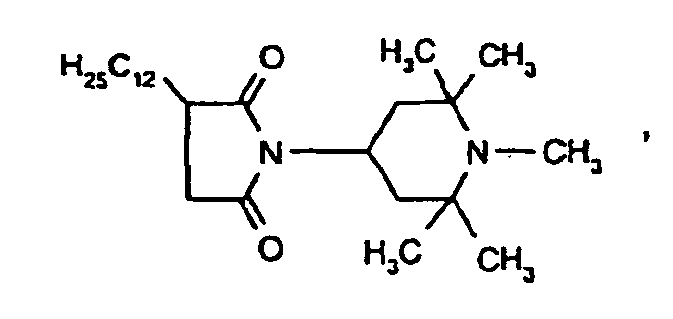
la 8-acétyl-3-dodécyl-1,3,8-triaza-7,7,9,9-tétraméthylspiro[4.5]décane-2,4-dione,
le butyl(3,5-di-tert-butyl-4-hydroxybenzyl)malonate de di(1,2,2,6,6-pentaméthylpipéridin-4-yle),
le 1-(2,2,6,6-tétraméthylpipéridin-4-ylamino)-2-(2,2,6,6-tétraméthylpipéridin-4-ylaminocarbonyl)éthane,


le 1,2,3,4-tétrakis [1,2,2,6,6-pentaméthylpipéridin-4-yloxycarbonyl]butane,
le 1,2,3,4-tétrakis[2,2,6,6-tétraméthylpipéridin-4-yloxycarbonyl]butane,
le bis [1,2,2,6,6-pentaméthylpipéridin-4-yloxycarbonyl]-bis [tridécyloxycarbonyl] butane,
le bis [2,2,6,6-tétraméthylpipéridin-4-yloxycarbonyl]-bis-[tridécyloxycarbonyl] butane,
le 2-(2,2,6,6-tétraméthylpipéridin-4-ylamino)-2-(2,2,6,6-tétraméthylpipéridin-4-ylaminocarbonyl)propane,


ou
un produit pouvant être obtenu en faisant réagir un produit intermédiaire, obtenu par la réaction d'une polyamine de formule (100a) avec du chlorure cyanurique, avec un composé de formule (100b)

- Mélange de stabilisants selon la revendication 1, dans lequel le composant (B) est
le sébacate de di(2,2,6,6-tétraméthylpipéridin-4-yle),
le sébacate de di(1,2,2,6,6-pentaméthylpipéridin-4-yle),


ou
- Mélange de stabilisants selon la revendication 1, dans lequel le composant (A) est

le composant (B) est
le sébacate de di(2,2,6,6-tétraméthylpipéridin-4-yle) ;



un produit pouvant être obtenu en faisant réagir un produit intermédiaire, obtenu par la réaction d'une polyamine de formule (100a-1) avec du chlorure cyanurique, avec un composé de formule (100b-1)

- Mélange de stabilisants selon la revendication 1, dans lequel le composant (A) est

le composant (B) est
le sébacate de di(2,2,6,6-tétraméthylpipéridin-4-yle) ou
- Composition comprenant une matière organique soumise à une dégradation induite par la lumière, la chaleur ou l'oxydation et un mélange de stabilisants selon la revendication 1.
- Composition selon la revendication 8, dans laquelle la matière organique est un polymère synthétique.
- Composition selon la revendication 8, dans laquelle la matière organique est une polyoléfine.
- Composition selon la revendication 8, dans laquelle la matière organique est le polyéthylène, le polypropylène, un copolymère de polyéthylène ou un copolymère de polypropylène.
- Procédé de stabilisation d'une matière organique contre une dégradation induite par la lumière, la chaleur ou l'oxydation, qui comprend l'incorporation dans la matière organique d'un mélange de stabilisants selon la revendication 1.
Priority Applications (1)
| Application Number | Priority Date | Filing Date | Title |
|---|---|---|---|
| EP00810708A EP1077227B1 (fr) | 1999-08-17 | 2000-08-08 | Mélange de stabilisateurs |
Applications Claiming Priority (3)
| Application Number | Priority Date | Filing Date | Title |
|---|---|---|---|
| EP99810737 | 1999-08-17 | ||
| EP99810737 | 1999-08-17 | ||
| EP00810708A EP1077227B1 (fr) | 1999-08-17 | 2000-08-08 | Mélange de stabilisateurs |
Publications (2)
| Publication Number | Publication Date |
|---|---|
| EP1077227A1 EP1077227A1 (fr) | 2001-02-21 |
| EP1077227B1 true EP1077227B1 (fr) | 2006-06-07 |
Family
ID=8242979
Family Applications (1)
| Application Number | Title | Priority Date | Filing Date |
|---|---|---|---|
| EP00810708A Expired - Lifetime EP1077227B1 (fr) | 1999-08-17 | 2000-08-08 | Mélange de stabilisateurs |
Country Status (6)
| Country | Link |
|---|---|
| EP (1) | EP1077227B1 (fr) |
| JP (1) | JP4883831B2 (fr) |
| AT (1) | ATE328954T1 (fr) |
| CA (1) | CA2316474C (fr) |
| DE (1) | DE60028475T2 (fr) |
| ES (1) | ES2264663T3 (fr) |
Families Citing this family (8)
| Publication number | Priority date | Publication date | Assignee | Title |
|---|---|---|---|---|
| US6946517B2 (en) | 1999-08-17 | 2005-09-20 | Ciba Specialty Chemicals Corporation | Stabilizer mixtures |
| ATE274374T1 (de) * | 2001-01-23 | 2004-09-15 | Ciba Sc Holding Ag | Stabile freie nitroxylradikale als oxidationskatalysatoren und oxidationsverfahren |
| DE10123732A1 (de) * | 2001-05-15 | 2002-11-21 | Basf Ag | Stabilisierte Metallocen-Polyolefine |
| EP1338622A3 (fr) * | 2003-03-14 | 2003-09-10 | Ciba SC Holding AG | Melanges stabilisants |
| JP5073277B2 (ja) * | 2006-12-07 | 2012-11-14 | 電気化学工業株式会社 | フィルム基材及び粘着テープ |
| CN101600822B (zh) | 2006-12-27 | 2016-05-25 | 西巴控股有限公司 | 复丝,单丝,无纺织物或条带 |
| WO2009082019A1 (fr) * | 2007-12-21 | 2009-07-02 | Sumitomo Chemical Company, Limited | Composition et moulages de résine de polypropylène |
| KR20210144771A (ko) * | 2019-03-29 | 2021-11-30 | 가부시키가이샤 아데카 | 난연제 조성물 및 난연성 합성 수지 조성물 |
Family Cites Families (9)
| Publication number | Priority date | Publication date | Assignee | Title |
|---|---|---|---|---|
| DE2500314A1 (de) * | 1974-01-10 | 1975-07-17 | Ciba Geigy Ag | Stabilisierung von polyolefinen, die anorganische pigmente enthalten, gegen lichtabbau |
| US4863981A (en) * | 1986-06-30 | 1989-09-05 | Ciba-Geigy Corporation | Synergistic mixture of stabilizers |
| JPH075763B2 (ja) * | 1987-02-05 | 1995-01-25 | ダイアホイルヘキスト株式会社 | 白色ポリエステルフイルム |
| DE59508533D1 (de) * | 1994-10-28 | 2000-08-10 | Ciba Sc Holding Ag | Synergistisches Stabilisatorgemisch |
| TW358820B (en) * | 1995-04-11 | 1999-05-21 | Ciba Sc Holding Ag | Synergistic stabilizer mixture |
| JPH08283453A (ja) * | 1995-04-14 | 1996-10-29 | Sekisui Chem Co Ltd | 抗菌性樹脂組成物 |
| US5618909A (en) * | 1995-07-27 | 1997-04-08 | Alliedsignal Inc. | Light stabilized polyamide substrate and process for making |
| TW464670B (en) * | 1996-08-07 | 2001-11-21 | Ciba Sc Holding Ag | Stabilizer mixtures containing a hindered amine |
| GB9617163D0 (en) * | 1996-08-15 | 1996-09-25 | Tioxide Group Services Ltd | Treated titanium dioxide |
-
2000
- 2000-08-08 AT AT00810708T patent/ATE328954T1/de not_active IP Right Cessation
- 2000-08-08 ES ES00810708T patent/ES2264663T3/es not_active Expired - Lifetime
- 2000-08-08 DE DE60028475T patent/DE60028475T2/de not_active Expired - Lifetime
- 2000-08-08 EP EP00810708A patent/EP1077227B1/fr not_active Expired - Lifetime
- 2000-08-15 CA CA002316474A patent/CA2316474C/fr not_active Expired - Fee Related
- 2000-08-16 JP JP2000246832A patent/JP4883831B2/ja not_active Expired - Fee Related
Also Published As
| Publication number | Publication date |
|---|---|
| CA2316474C (fr) | 2009-02-17 |
| JP4883831B2 (ja) | 2012-02-22 |
| ES2264663T3 (es) | 2007-01-16 |
| EP1077227A1 (fr) | 2001-02-21 |
| JP2001098168A (ja) | 2001-04-10 |
| DE60028475D1 (de) | 2006-07-20 |
| CA2316474A1 (fr) | 2001-02-17 |
| ATE328954T1 (de) | 2006-06-15 |
| DE60028475T2 (de) | 2006-11-30 |
Similar Documents
| Publication | Publication Date | Title |
|---|---|---|
| EP1263855B1 (fr) | Melanges de stabilisation de polyolefines | |
| US7169835B2 (en) | Stabilizer mixture | |
| US5948836A (en) | Stabilizer combination for synthetic organic polymers | |
| US6020406A (en) | Synergistic stabilizer mixture | |
| US6015849A (en) | Synergistic stabilizer mixture | |
| US6881772B2 (en) | Stabilizer mixtures | |
| US5977221A (en) | Synergistic stabilizer mixture | |
| US20090312464A1 (en) | Stabilizer mixtures | |
| US20030191239A1 (en) | Stabilizer mixtures | |
| US5772921A (en) | Synergistic mixture consisting of a 2,4-dimethyl-6-S-alkylphenol and a sterically hindered phenol | |
| EP1077227B1 (fr) | Mélange de stabilisateurs | |
| EP0911362A1 (fr) | Polyoléfine stabilisée | |
| US5965641A (en) | Ozone-resistant long-term stabilisers | |
| EP0916698A1 (fr) | Polyoléfine stabilisée | |
| GB2347427A (en) | Stabilizing polyolefins with a mixture comprising a sterically hindered amine |
Legal Events
| Date | Code | Title | Description |
|---|---|---|---|
| PUAI | Public reference made under article 153(3) epc to a published international application that has entered the european phase |
Free format text: ORIGINAL CODE: 0009012 |
|
| AK | Designated contracting states |
Kind code of ref document: A1 Designated state(s): AT BE CH CY DE DK ES FI FR GB GR IE IT LI LU MC NL PT SE |
|
| AX | Request for extension of the european patent |
Free format text: AL;LT;LV;MK;RO;SI |
|
| 17P | Request for examination filed |
Effective date: 20010723 |
|
| AKX | Designation fees paid |
Free format text: AT BE CH CY DE DK ES FI FR GB GR IE IT LI LU MC NL PT SE |
|
| 17Q | First examination report despatched |
Effective date: 20050513 |
|
| GRAP | Despatch of communication of intention to grant a patent |
Free format text: ORIGINAL CODE: EPIDOSNIGR1 |
|
| GRAS | Grant fee paid |
Free format text: ORIGINAL CODE: EPIDOSNIGR3 |
|
| GRAA | (expected) grant |
Free format text: ORIGINAL CODE: 0009210 |
|
| AK | Designated contracting states |
Kind code of ref document: B1 Designated state(s): AT BE CH CY DE DK ES FI FR GB GR IE IT LI LU MC NL PT SE |
|
| PG25 | Lapsed in a contracting state [announced via postgrant information from national office to epo] |
Ref country code: CH Free format text: LAPSE BECAUSE OF FAILURE TO SUBMIT A TRANSLATION OF THE DESCRIPTION OR TO PAY THE FEE WITHIN THE PRESCRIBED TIME-LIMIT Effective date: 20060607 Ref country code: LI Free format text: LAPSE BECAUSE OF FAILURE TO SUBMIT A TRANSLATION OF THE DESCRIPTION OR TO PAY THE FEE WITHIN THE PRESCRIBED TIME-LIMIT Effective date: 20060607 Ref country code: AT Free format text: LAPSE BECAUSE OF FAILURE TO SUBMIT A TRANSLATION OF THE DESCRIPTION OR TO PAY THE FEE WITHIN THE PRESCRIBED TIME-LIMIT Effective date: 20060607 Ref country code: FI Free format text: LAPSE BECAUSE OF FAILURE TO SUBMIT A TRANSLATION OF THE DESCRIPTION OR TO PAY THE FEE WITHIN THE PRESCRIBED TIME-LIMIT Effective date: 20060607 |
|
| REG | Reference to a national code |
Ref country code: GB Ref legal event code: FG4D |
|
| REG | Reference to a national code |
Ref country code: CH Ref legal event code: EP |
|
| REG | Reference to a national code |
Ref country code: IE Ref legal event code: FG4D |
|
| REF | Corresponds to: |
Ref document number: 60028475 Country of ref document: DE Date of ref document: 20060720 Kind code of ref document: P |
|
| PG25 | Lapsed in a contracting state [announced via postgrant information from national office to epo] |
Ref country code: IE Free format text: LAPSE BECAUSE OF NON-PAYMENT OF DUE FEES Effective date: 20060808 |
|
| PG25 | Lapsed in a contracting state [announced via postgrant information from national office to epo] |
Ref country code: MC Free format text: LAPSE BECAUSE OF NON-PAYMENT OF DUE FEES Effective date: 20060831 |
|
| PG25 | Lapsed in a contracting state [announced via postgrant information from national office to epo] |
Ref country code: SE Free format text: LAPSE BECAUSE OF FAILURE TO SUBMIT A TRANSLATION OF THE DESCRIPTION OR TO PAY THE FEE WITHIN THE PRESCRIBED TIME-LIMIT Effective date: 20060907 Ref country code: DK Free format text: LAPSE BECAUSE OF FAILURE TO SUBMIT A TRANSLATION OF THE DESCRIPTION OR TO PAY THE FEE WITHIN THE PRESCRIBED TIME-LIMIT Effective date: 20060907 |
|
| PG25 | Lapsed in a contracting state [announced via postgrant information from national office to epo] |
Ref country code: PT Free format text: LAPSE BECAUSE OF FAILURE TO SUBMIT A TRANSLATION OF THE DESCRIPTION OR TO PAY THE FEE WITHIN THE PRESCRIBED TIME-LIMIT Effective date: 20061107 |
|
| ET | Fr: translation filed | ||
| REG | Reference to a national code |
Ref country code: CH Ref legal event code: PL |
|
| REG | Reference to a national code |
Ref country code: ES Ref legal event code: FG2A Ref document number: 2264663 Country of ref document: ES Kind code of ref document: T3 |
|
| PLBE | No opposition filed within time limit |
Free format text: ORIGINAL CODE: 0009261 |
|
| STAA | Information on the status of an ep patent application or granted ep patent |
Free format text: STATUS: NO OPPOSITION FILED WITHIN TIME LIMIT |
|
| 26N | No opposition filed |
Effective date: 20070308 |
|
| PG25 | Lapsed in a contracting state [announced via postgrant information from national office to epo] |
Ref country code: GR Free format text: LAPSE BECAUSE OF FAILURE TO SUBMIT A TRANSLATION OF THE DESCRIPTION OR TO PAY THE FEE WITHIN THE PRESCRIBED TIME-LIMIT Effective date: 20060908 |
|
| PG25 | Lapsed in a contracting state [announced via postgrant information from national office to epo] |
Ref country code: LU Free format text: LAPSE BECAUSE OF NON-PAYMENT OF DUE FEES Effective date: 20060808 |
|
| PG25 | Lapsed in a contracting state [announced via postgrant information from national office to epo] |
Ref country code: CY Free format text: LAPSE BECAUSE OF FAILURE TO SUBMIT A TRANSLATION OF THE DESCRIPTION OR TO PAY THE FEE WITHIN THE PRESCRIBED TIME-LIMIT Effective date: 20060607 |
|
| REG | Reference to a national code |
Ref country code: FR Ref legal event code: PLFP Year of fee payment: 16 |
|
| PGFP | Annual fee paid to national office [announced via postgrant information from national office to epo] |
Ref country code: NL Payment date: 20150825 Year of fee payment: 16 |
|
| PGFP | Annual fee paid to national office [announced via postgrant information from national office to epo] |
Ref country code: ES Payment date: 20150923 Year of fee payment: 16 Ref country code: GB Payment date: 20150901 Year of fee payment: 16 |
|
| PGFP | Annual fee paid to national office [announced via postgrant information from national office to epo] |
Ref country code: BE Payment date: 20150828 Year of fee payment: 16 Ref country code: FR Payment date: 20150831 Year of fee payment: 16 |
|
| PGFP | Annual fee paid to national office [announced via postgrant information from national office to epo] |
Ref country code: IT Payment date: 20150825 Year of fee payment: 16 |
|
| PGFP | Annual fee paid to national office [announced via postgrant information from national office to epo] |
Ref country code: DE Payment date: 20151029 Year of fee payment: 16 |
|
| PG25 | Lapsed in a contracting state [announced via postgrant information from national office to epo] |
Ref country code: BE Free format text: LAPSE BECAUSE OF NON-PAYMENT OF DUE FEES Effective date: 20160831 |
|
| REG | Reference to a national code |
Ref country code: DE Ref legal event code: R119 Ref document number: 60028475 Country of ref document: DE |
|
| REG | Reference to a national code |
Ref country code: NL Ref legal event code: MM Effective date: 20160901 |
|
| GBPC | Gb: european patent ceased through non-payment of renewal fee |
Effective date: 20160808 |
|
| REG | Reference to a national code |
Ref country code: FR Ref legal event code: ST Effective date: 20170428 |
|
| PG25 | Lapsed in a contracting state [announced via postgrant information from national office to epo] |
Ref country code: NL Free format text: LAPSE BECAUSE OF NON-PAYMENT OF DUE FEES Effective date: 20160901 |
|
| PG25 | Lapsed in a contracting state [announced via postgrant information from national office to epo] |
Ref country code: GB Free format text: LAPSE BECAUSE OF NON-PAYMENT OF DUE FEES Effective date: 20160808 Ref country code: FR Free format text: LAPSE BECAUSE OF NON-PAYMENT OF DUE FEES Effective date: 20160831 Ref country code: DE Free format text: LAPSE BECAUSE OF NON-PAYMENT OF DUE FEES Effective date: 20170301 |
|
| PG25 | Lapsed in a contracting state [announced via postgrant information from national office to epo] |
Ref country code: IT Free format text: LAPSE BECAUSE OF NON-PAYMENT OF DUE FEES Effective date: 20160808 |
|
| PG25 | Lapsed in a contracting state [announced via postgrant information from national office to epo] |
Ref country code: ES Free format text: LAPSE BECAUSE OF NON-PAYMENT OF DUE FEES Effective date: 20160809 |
|
| REG | Reference to a national code |
Ref country code: ES Ref legal event code: FD2A Effective date: 20181123 |