EP1077940B1 - 4-phenylpiperidine zur behandlung von prutitischen hauterkrankungen - Google Patents
4-phenylpiperidine zur behandlung von prutitischen hauterkrankungen Download PDFInfo
- Publication number
- EP1077940B1 EP1077940B1 EP99917038A EP99917038A EP1077940B1 EP 1077940 B1 EP1077940 B1 EP 1077940B1 EP 99917038 A EP99917038 A EP 99917038A EP 99917038 A EP99917038 A EP 99917038A EP 1077940 B1 EP1077940 B1 EP 1077940B1
- Authority
- EP
- European Patent Office
- Prior art keywords
- general formula
- alkyl
- mmol
- trans
- compound
- Prior art date
- Legal status (The legal status is an assumption and is not a legal conclusion. Google has not performed a legal analysis and makes no representation as to the accuracy of the status listed.)
- Expired - Lifetime
Links
- 0 CC(c1cc(*)ccc1)=O Chemical compound CC(c1cc(*)ccc1)=O 0.000 description 4
- CCXFCCFQVJYLTM-CMDGGOBGSA-N C/C(/CO)=C(/C)\c1cccc(I)c1 Chemical compound C/C(/CO)=C(/C)\c1cccc(I)c1 CCXFCCFQVJYLTM-CMDGGOBGSA-N 0.000 description 1
- DEHRHOYLGNEZOO-UHFFFAOYSA-N CC(C1)(C(C)=[O](C)C1=O)c1cccc(I)c1 Chemical compound CC(C1)(C(C)=[O](C)C1=O)c1cccc(I)c1 DEHRHOYLGNEZOO-UHFFFAOYSA-N 0.000 description 1
- YENGBKVNZAPAOA-MDZDMXLPSA-N CCOC(/C(/C)=C(\C)/c1cccc(I)c1)=O Chemical compound CCOC(/C(/C)=C(\C)/c1cccc(I)c1)=O YENGBKVNZAPAOA-MDZDMXLPSA-N 0.000 description 1
Classifications
-
- C—CHEMISTRY; METALLURGY
- C07—ORGANIC CHEMISTRY
- C07D—HETEROCYCLIC COMPOUNDS
- C07D211/00—Heterocyclic compounds containing hydrogenated pyridine rings, not condensed with other rings
- C07D211/04—Heterocyclic compounds containing hydrogenated pyridine rings, not condensed with other rings with only hydrogen or carbon atoms directly attached to the ring nitrogen atom
- C07D211/06—Heterocyclic compounds containing hydrogenated pyridine rings, not condensed with other rings with only hydrogen or carbon atoms directly attached to the ring nitrogen atom having no double bonds between ring members or between ring members and non-ring members
- C07D211/08—Heterocyclic compounds containing hydrogenated pyridine rings, not condensed with other rings with only hydrogen or carbon atoms directly attached to the ring nitrogen atom having no double bonds between ring members or between ring members and non-ring members with hydrocarbon or substituted hydrocarbon radicals directly attached to ring carbon atoms
- C07D211/18—Heterocyclic compounds containing hydrogenated pyridine rings, not condensed with other rings with only hydrogen or carbon atoms directly attached to the ring nitrogen atom having no double bonds between ring members or between ring members and non-ring members with hydrocarbon or substituted hydrocarbon radicals directly attached to ring carbon atoms with substituted hydrocarbon radicals attached to ring carbon atoms
- C07D211/26—Heterocyclic compounds containing hydrogenated pyridine rings, not condensed with other rings with only hydrogen or carbon atoms directly attached to the ring nitrogen atom having no double bonds between ring members or between ring members and non-ring members with hydrocarbon or substituted hydrocarbon radicals directly attached to ring carbon atoms with substituted hydrocarbon radicals attached to ring carbon atoms with hydrocarbon radicals, substituted by nitrogen atoms
-
- A—HUMAN NECESSITIES
- A61—MEDICAL OR VETERINARY SCIENCE; HYGIENE
- A61P—SPECIFIC THERAPEUTIC ACTIVITY OF CHEMICAL COMPOUNDS OR MEDICINAL PREPARATIONS
- A61P17/00—Drugs for dermatological disorders
-
- A—HUMAN NECESSITIES
- A61—MEDICAL OR VETERINARY SCIENCE; HYGIENE
- A61P—SPECIFIC THERAPEUTIC ACTIVITY OF CHEMICAL COMPOUNDS OR MEDICINAL PREPARATIONS
- A61P17/00—Drugs for dermatological disorders
- A61P17/04—Antipruritics
-
- A—HUMAN NECESSITIES
- A61—MEDICAL OR VETERINARY SCIENCE; HYGIENE
- A61P—SPECIFIC THERAPEUTIC ACTIVITY OF CHEMICAL COMPOUNDS OR MEDICINAL PREPARATIONS
- A61P37/00—Drugs for immunological or allergic disorders
- A61P37/08—Antiallergic agents
-
- C—CHEMISTRY; METALLURGY
- C07—ORGANIC CHEMISTRY
- C07D—HETEROCYCLIC COMPOUNDS
- C07D211/00—Heterocyclic compounds containing hydrogenated pyridine rings, not condensed with other rings
- C07D211/04—Heterocyclic compounds containing hydrogenated pyridine rings, not condensed with other rings with only hydrogen or carbon atoms directly attached to the ring nitrogen atom
- C07D211/06—Heterocyclic compounds containing hydrogenated pyridine rings, not condensed with other rings with only hydrogen or carbon atoms directly attached to the ring nitrogen atom having no double bonds between ring members or between ring members and non-ring members
- C07D211/08—Heterocyclic compounds containing hydrogenated pyridine rings, not condensed with other rings with only hydrogen or carbon atoms directly attached to the ring nitrogen atom having no double bonds between ring members or between ring members and non-ring members with hydrocarbon or substituted hydrocarbon radicals directly attached to ring carbon atoms
- C07D211/18—Heterocyclic compounds containing hydrogenated pyridine rings, not condensed with other rings with only hydrogen or carbon atoms directly attached to the ring nitrogen atom having no double bonds between ring members or between ring members and non-ring members with hydrocarbon or substituted hydrocarbon radicals directly attached to ring carbon atoms with substituted hydrocarbon radicals attached to ring carbon atoms
- C07D211/26—Heterocyclic compounds containing hydrogenated pyridine rings, not condensed with other rings with only hydrogen or carbon atoms directly attached to the ring nitrogen atom having no double bonds between ring members or between ring members and non-ring members with hydrocarbon or substituted hydrocarbon radicals directly attached to ring carbon atoms with substituted hydrocarbon radicals attached to ring carbon atoms with hydrocarbon radicals, substituted by nitrogen atoms
- C07D211/28—Heterocyclic compounds containing hydrogenated pyridine rings, not condensed with other rings with only hydrogen or carbon atoms directly attached to the ring nitrogen atom having no double bonds between ring members or between ring members and non-ring members with hydrocarbon or substituted hydrocarbon radicals directly attached to ring carbon atoms with substituted hydrocarbon radicals attached to ring carbon atoms with hydrocarbon radicals, substituted by nitrogen atoms to which a second hetero atom is attached
-
- C—CHEMISTRY; METALLURGY
- C07—ORGANIC CHEMISTRY
- C07D—HETEROCYCLIC COMPOUNDS
- C07D211/00—Heterocyclic compounds containing hydrogenated pyridine rings, not condensed with other rings
- C07D211/92—Heterocyclic compounds containing hydrogenated pyridine rings, not condensed with other rings with a hetero atom directly attached to the ring nitrogen atom
- C07D211/94—Oxygen atom, e.g. piperidine N-oxide
Definitions
- This invention relates to novel 4-phenylpiperidines having utility in the treatment of pruritic dermatoses including allergic dermatitis and atopy in animals and humans, and processes for the preparation of and intermediates used in the preparation of such compounds.
- Itching or pruritus is a common dermatological symptom which can give rise to considerable distress, in both humans and animals.
- Pruritus is often associated with inflammatory skin disease which can commonly be caused by hypersensitivity reactions, such as reaction to insect bites e.g. flea bites, or to environmental allergens such as house dust mite or pollen; or by bacterial and fungal infections of the skin or ectoparasite infections.
- EP-B-0287339 opioid antagonists which block the effect of agonists at the mu or kappa receptors having potential utility in treating a variety of disorders associated with these receptors such as eating disorders, opiate overdose, depression, smoking, alcoholism, sexual dysfunction, shock, stroke, spinal damage and head trauma; utility as an appetite suppressant for weight loss has also been suggested.
- Further related 1-N-substituted-4-aryl piperidines are disclosed in EP-A-0506468 and EP-A-0506478. Potential utility is suggested in preventing peripherally mediated undesired opiate effects and in relieving the symptoms of idiopathic constipation and irritable bowel syndrome
- alkyl, alkenyl and alkynyl groups may be straight or branched-chain and halo means fluoro, chloro, bromo or iodo.
- haloalkyl and haloalkoxy mean substituted by one or more halo atoms.
- Aryl and aryloxy means a phenyl, naphthyl, phenoxy or naphthyloxy group respectively which may optionally be substituted with from one to three substituents, each independently selected from OH, C 1 -C 4 alkyl, C 1 -C 4 alkoxy, C 1 -C 4 haloalkyl, C 1 -C 4 haloalkoxy, C 2 -C 5 alkanoyl, halo, CN, CH 2 CN, and CONH 2 .
- heteroaryl groups include pyrrolyl, imidazolyl, isoxazolyl, tetrazolyl, pyridyl, indolyl, benzofuranyl and quinolinyl, each optionally substituted as defined above.
- saturated heterocyclic groups is meant a 3 to 8 membered saturated heterocyclic group which contains as heteroatoms one or more oxygen, sulphur or nitrogen atoms, wherein the nitrogen atoms may optionally be substituted by C 1 -C 4 alkyl and wherein the ring may optionally be benzo-fused.
- Particular examples include tetrahydropyranyl, 1,4-dioxanyl, piperidinyl, N-methyl-piperidinyl, piperazinyl, morpholinyl and 2,3-dihydro-1-benzofuranyl.
- the piperidines of this invention form pharmaceutically or veterinarily acceptable acid addition salts with a wide variety of inorganic and organic acids.
- the particular acid used in salt formation is not critical; however, the corresponding salt that is formed must be substantially non-toxic to animals.
- Typical acids generally used include sulfuric, hydrochloric, hydrobromic, phosphoric, hydroiodic, sulfamic, citric, acetic, maleic, malic, succinic, tartaric, cinamic, benzoic, ascorbic and related acids.
- the piperidines additionally form quaternary ammonium salts, for example, with a variety of organic esters of sulfuric, hydrohalic and aromatic sulfonic acids, such as, for example camphorsulfonic acid.
- the compounds of the invention contain one or more asymmetric centres and thus they can exist as enantiomers and diasteromers.
- the invention includes the use of both the separated individual isomers as well as mixtures of isomers.
- Preferred Y 1 groups for use herein include: methane, ethane, propane, 1-methylethane, butane, 3-pyridine, 1-methyl-1 H -imidazol-4-yl, N-isopropylamino, 2-methoxyethane, N,N-dimethylamino, benzene and ⁇ -toluene.
- More preferred Y 1 groups for use herein are : methane, ethane, propane, 1-methylethane, butane, 3-pyridine, 1-methyl-1 H -imidazol-4-yl, N-isopropylamino and 2-methoxyethane.
- R 3 groups for use herein include: N-(N-cyclohexylamino carbonylmethyl), N-(3-(4,4-dimethylcyclohexyl)propyl), N-(2-butoxyethyl), N-(3-phenoxypropyl), N-(3-(4-fluorophenoxy)propyl), N-(2-(2-chlorophenoxy)ethyl), N-(2-cyclohexyloxyethyl), N-(2-(4-fluorophenoxy)ethyl), N-(2-(2-chlorophenyl)ethyl), N-(1-(4-cyanomethylphenyl)methyl), N-(2-phenylethyl), N-(2-(5-[2,3-dihydro-1-benzofuranyl])ethyl), N-(3-(2,6-dimethylphenoxy)propyl), N-(2-(3-indolyl)ethyl),
- R 3 groups for use herein are : N-(2-(2-methylphenoxy)ethyl), N-(2-benzyloxyethyl), N-(2-cycloheyxlideneethyl), N-hexyl, N-(5-methylhexyl), N-(3-cyclohexylpropyl), N-benzyl, N-(3-phenylpropyl), N-(3-cyclohexyl-3-oxopropyl), N-(2-(3-methylphenyl)ethyl), N-(1-(4-ethylphenyl)methyl), N-(2-(2-methylphenyl)ethyl), N-(3-(2-methylphenyl)propyl), N-(3-(tetrahydropyran-2-yl)propyl), N-((S)-3-cyclohexyl-3-hydroxypropyl), N-((E)-3-cyclohexylprop-2-en
- Y 2 is hydrogen and wherein Y 1 is methane, ethane, propane, 1-methylethane, butane, 3-pyridine, 1-methyl-1 H -imidazol-4-yl or N-isopropylamino and wherein R 3 is selected from: hexyl; methyl-hexyl, preferably 5-methylhexyl; or ethyl or propyl substituted by: cyclohexyl; cyclohexanoyl; 2-tetrahydropyranyl or methyl, ethyl or propyl, substituted by: phenyl, optionally substituted by methyl or ethyl; or 3-cyclohexyl-3-hydroxypropyl; or prop-2-enyl substituted by cycl
- Y 1 groups for use herein are : methane, ethane, propane, 1-methylethane, butane, 3-pyridine, 1-methyl-1 H -imidazol-4-yl and N-isopropylamino.
- R 3 groups for use herein are : N-hexyl, N-(5-methylhexyl), N-(3-cyclohexylpropyl), N-benzyl, N-(3-phenylpropyl), N-(3-cyclohexyl-3-oxopropyl), N-(2-(3-methylphenyl)ethyl), N-(1-(4-ethylphenyl)methyl), N-(2-(2-methylphenyl) ethyl), N-(3-(2-methylphenyl)propyl), N-(3-(tetrahydropyran-2-yl)propyl), N-((S)-3-cyclohexyl-3-hydroxypropyl), N-((E)-3-cyclohexylprop-2-enyl) and N-cinnamyl.
- Highly preferred compounds according to the present invention include:
- Y 2 is hydrogen and wherein Y 1 is methane, ethane, propane and wherein R 3 is selected from: hexyl or 5-methylhexyl; or methyl or ethyl substituted by phenyl, substituted methyl or ethyl; or propyl substituted by phenyl, optionally substituted by methyl.
- Y 1 groups for use herein are : methane, ethane and propane.
- R 3 groups for use herein are : N-hexyl, N-(5-methylhexyl), N-benzyl, N-(3-phenylpropyl), N-(2-(3-methylphenyl)ethyl), N-(2-(2-methylphenyl)ethyl) and N-(3-(2-methylphenyl)propyl).
- the compounds of the invention may be prepared by a number of different processes.
- the compounds of formula may be prepared from an amine of the formula II: wherein R 1 , R 2 , R 3 , X, Y 2 and n are as defined for formula (I), by reaction with a group of the formula Q-W-Y 1 , wherein W and Y 1 are as defined for formula I and wherein Q is a suitable leaving group and is preferably a halogen atom, generally chloro, or with an anhydride of the formula (Y 1 W) 2 O.
- the reaction is typically performed using a sulfonylchloride e.g.
- reaction with an arylsubstituted bromo-alkane is achieved in a reaction inert organic solvent such as N,N-dimethylformamide in the presence of an acid acceptor such as sodium hydrogen carbonate by heating at between 80°C and 120°C, preferably at about 100°C, for 3 or 4 hours.
- an acid acceptor such as sodium hydrogen carbonate
- the route may also be adapted using an acid chloride or using an acid of formula R 9 CO 2 H with a coupling agent such as dicyclohexylcarbodiimide, to give the corresponding compound wherein the piperidine N-substituent is COR 9 (where R 9 is as defined for R 3 but lacking a CH 2 attachment group) and subsequent reduction yields the corresponding compound of formula (I).
- a coupling agent such as dicyclohexylcarbodiimide
- the starting materials of formula (II) are prepared from the corresponding 3-hydroxyphenyl piperidine (IV) by conventional synthetic procedures.
- the procedure shown in Scheme 1 may be used to prepare the compounds of formula II wherein R 1 , R 2 , R 3 and (X) n are as defined for formula I above.
- (X) n is H, and R 1 and R 2 are both methyl, having the trans -configuration, the process starts with ( ⁇ )-4-(3-hydroxyphenyl)- trans -3,4-dimethylpiperidine.
- the 3-hydroxyphenyl derivative (V) may be reacted with N-phenylbis(trifluoromethanesulfonimide) in dichloromethane in the presence of triethylamine to yield the corresponding 3-trifluoromethanesulfonyloxy derivative.
- the compounds of formula (IV) are either available by literature methods or are prepared by analogous procedures from readily available starting materials. Such as, for example, preparation of the 4-methyl or 4-n-propyl substituted phenols having the general formula (IV) from 1-bromo-3-(1-methylethoxy)benzene and N-ethyl-4-piperidone as described in Preparations 43, 44 and then, either Preparations 51, 52 and the intermediate compound from Preparation 53 to provide the 4-methyl analogue or, Preparations 65 to 67 to provide the 4-n-propyl analogue herein.
- compounds of general formula (IV) wherein (X) n is hydrogen and R 1 and R 3 are hydrogen or C 1 -C 4 alkyl such as methyl or propyl and R 2 is hydrogen can be made from 1-bromo-3-(1-methylethoxy)benzene and N-ethyl-4-piperidone as described in Preparations 43 to 47 herein.
- Compounds of general formula (V) wherein (X) n is hydrogen can be converted to compounds of general formula (V) wherein (X) n is C 1 -C 4 alkyl such as methyl by, for example the process outlined in Preparations 71 to 73 herein.
- the compounds of formula (III) are typically prepared from the corresponding compound of formula (I) wherein R 3 is benzyl. This is removed by conventional catalytic hydrogenation to yield the N-unsubstituted piperidine (III).
- chlorination of a compound of the formula (I) wherein (X) n is H may be performed by reaction with a solution of chlorine in acetic acid to yield the corresponding compound where (X) n is a chlorine substituent. This process yields both the 4- and 6-substituted and the 4,6-disubstituted products.
- Y 1 is a C 1 - C 10 alkyl, preferably a C 1 - C 3 alkyl group substituted by a C 1 - C 4 alkoxy group such as for example methoxy, or, a phthalimido group, or, a C 2 - C 6 alkanoyloxy group such as ethoxycarbonylmethane to the corresponding alcohol, alkylamine or aminocarbonyl compounds
- W is SO 2 and Y 1 is a C 1 - C 10 alkyl, preferably a C 1 - C 3 alkyl group substituted by a C 1 - C 4 alkoxy group such as for example methoxy, or, a phthalimido group, or, a C 2 - C 6 alkanoyloxy group such as ethoxycarbonylmethane to the corresponding alcohol, alkylamine or aminocarbonyl compounds
- a C 1 - C 10 alkyl preferably a C 1 - C 3 alkyl group substituted
- compounds of formula (I) may be converted to the corresponding N-oxides via treatment with a suitable oxidising agent, such as aqueous hydrogen peroxide solution, as illustrated in Examples 168 and 169 herein.
- a suitable oxidising agent such as aqueous hydrogen peroxide solution
- R 3 groups having the general formula ZBNR 4 R 5 may be converted to form different groups of the general formula ZBNR 4 R 5 , such as for example reduction of an amide of an amide group to an amine group, as illustrated hereinafter in Example 51.
- the cis- and trans -isomers of compounds having the general formula (VII) can either be isolated, purified and/or separated at this stage or, as is preferred herein, isolated without purification and reduced with a suitable metal hydride reducing agent, preferably an aluminium hydride reducing agent, and especially diisobutylaluminium hydride in the presence of a suitable inert solvent such as toluene, THF, a THF/heptane mixture or preferably a THF/hexane mixture at low temperatures, in the range of from -78°C to +70°C, preferably -78°C- +20°C, to furnish a mixture of cis- and trans -isomers of alcohols having the general formula (VIII).
- a suitable metal hydride reducing agent preferably an aluminium hydride reducing agent, and especially diisobutylaluminium hydride in the presence of a suitable inert solvent such as toluene, THF,
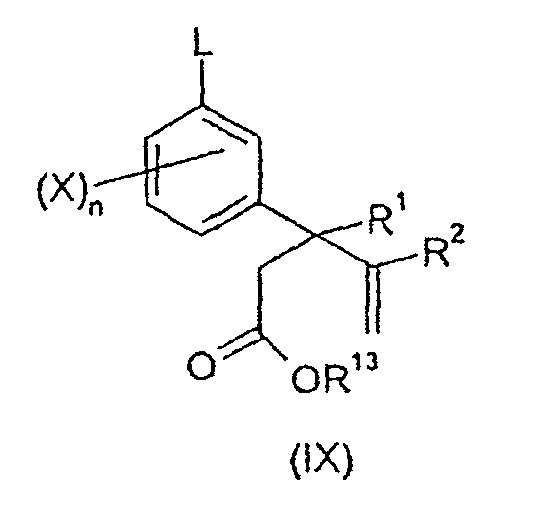
- ester compounds having the general formula (IX) is converted via alkaline hydrolysis with a suitable base such as lithium hydroxide, potassium hydroxide or preferably sodium hydroxide in an aqueous alcoholic solvent such as aqueous methanol, ethanol or preferably aqueous isopropyl alcohol followed by an acidic work-up.
- a suitable base such as lithium hydroxide, potassium hydroxide or preferably sodium hydroxide in an aqueous alcoholic solvent such as aqueous methanol, ethanol or preferably aqueous isopropyl alcohol
- the racemic mixture of (R) - and (S) - enantiomers of acids having the general formula (X) may either be resolved at this stage, as detailed herein after, or further reacted as a racemic mixture.
- Hydroboration of the double bond and concomitant reduction of the acid group followed by oxidative work up of compounds having general formula (X) provides a mixture of diols having the general formula (XI).
- Suitable hydroborating and reducing agents include borane/tetrahydropyran, borane/diethyl ether, borane/dioxan, borane/toluene and preferably a diborane/tetrahydofuran complex generated in situ from sodium borohydride and boron trifluoride/tetrahydofuran complex.
- the oxidative work-up may be performed using sodium hydroxide in the presence of hydrogen peroxide, sodium perborate or, preferably, aqueous sodium percarbonate.
- Separation of the diastereomeric mixture of diols having general formula (XI) may be achieved by either recrystallisation techniques or flash column chromatography on silica gel with a suitable solvent, such as ethyl acetate in toluene.
- a suitable solvent such as ethyl acetate in toluene.
- the ratio of solvents utilised will be dependant upon the particular diol mixture and the silica type and such determination is within the ordinary means of the skilled chemist.
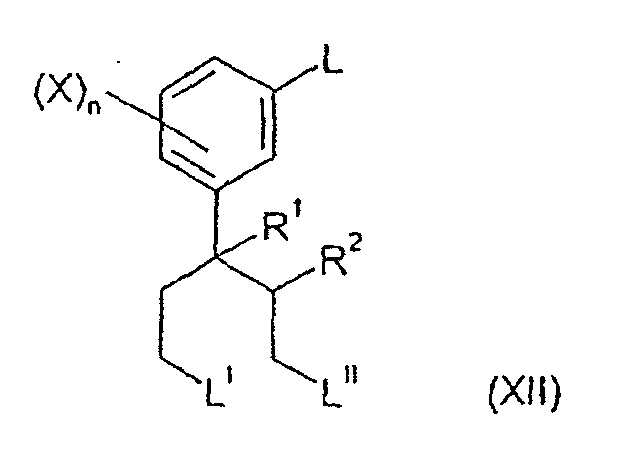
- hydroxyl groups on compounds having the general formula (XI) are activated to afford suitable leaving groups (L' and L") to provide a compound having general formula (XII) via treatment with an alkyl, or aryl sulfonylhalide or anhydride of formula R 14 SO 2 Hal wherein R 14 is phenyl, 4-methylphenyl, C 1 -C 4 alkyl, preferably ethyl or methyl, and wherein Hal is chlorine, iodine, fluorine or bromine, preferably chlorine, in the presence of one or more equivalents of an amine base such as pyridine, trimethylamine, tripropyl amine or preferably triethylamine and a suitable solvent such as dichloromethane, tetrahydrfuran, dioxan, ethyl acetate or preferably toluene or wherein L' and L" are each independently selected from a halogen such as chlorine, bromine or iodine and wherein such dihalo derivatives
- Cyclisation of compound (XII) to form a compound having the general formula (XIII) is achieved via treatment with a primary amine of the formula R 3 NH 2 wherein R 3 is C 1 -C 10 alkyl, wherein said C 1 -C 10 alkyl may be substituted by one or more substitutents selected from: aryl, preferably phenyl; C 3 -C 8 cycloalkyl, preferably cyclohexyl; and wherein R 3 NH 2 is most preferably n-hexylamine.
- the reaction can be performed as a single phase reaction with an excess of R 3 NH 2 in an inert organic solvent such as toluene, or, more preferably, as a 2-phase reaction system with base, which is preferably inorganic, and, optionally aqueous, such as sodium carbonate, and an inert organic solvent (other than R 3 NH 2 ) such as toluene and wherein said base is preferably present at a molar equivalent level of at least 2:1 to the compound having the general formula (XII).
- an inert organic solvent such as toluene
- base which is preferably inorganic, and, optionally aqueous, such as sodium carbonate, and an inert organic solvent (other than R 3 NH 2 ) such as toluene and wherein said base is preferably present at a molar equivalent level of at least 2:1 to the compound having the general formula (XII).
- Conversion of compounds having the general formula (XIII) wherein L is bromo or iodo to compounds having the general formula (II) can be achieved via reaction with benzophenone imine and a suitable source of palladium such as palladium diacetate and a ligand, for the palladium, such as (R)-(+)-2,2'-bis(diphenyl phosphino)-1,1'-binaphthyl ((R)-(+)-BINAP)), or (S)-(-)-BINAP or a mixture of (R)-(+)- and (S)-(-)-BINAP in the presence of a base of formula MOR (wherein M is an alkali metal and R is a tertiary alkyl) such as sodium tertiary butoxide and a suitable solvent such as THF or toluene.
- a suitable source of palladium such as palladium diacetate and a ligand, for
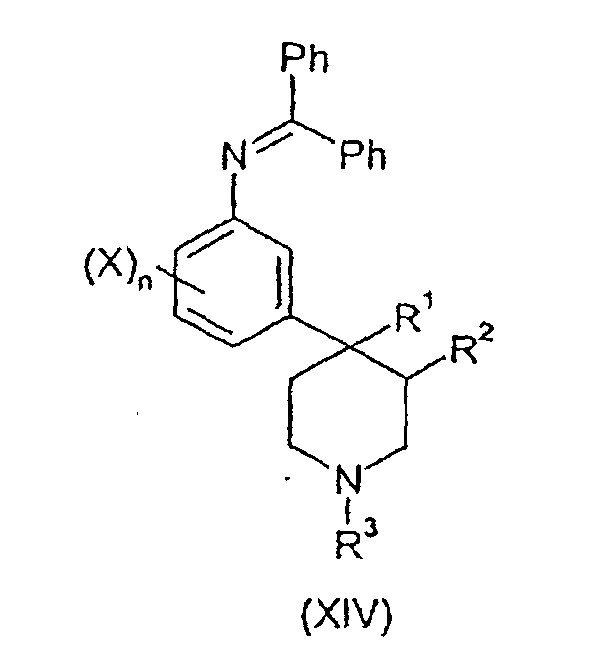
- reaction furnishes an intermediate compound of general formula (XIV) which is treated with mineral acid, such as dilute hydrochloric acid, and optionally, heat, to provide an amine of general formula (II).
- mineral acid such as dilute hydrochloric acid
- Conversion of compounds having the general formula (XIII) wherein L is -NO 2 to compounds of the general formula (II) can be achieved either via hydrogenation with a suitable catalyst such as 10% palladium on charcoal, or, using elemental iron or iron powder and calcium chloride in aqueous ethanol.
- Conversion of compounds having the general formula (XIII) wherein L is -OR 15 wherein R 15 is a C 1 -C 4 alkyl group, preferably isopropyl to compounds of the general formula (II) can be achieved via firstly conversion to the alcohol via acidic hydrolysis followed by conversion to the trifluromethylsulfonate of the general formula (XXV) as detailed hereinbefore, and subsequent treatment with benzophenone imine, a suitable source of palladium and a ligand, followed by acid hydrolysis of the imine of general formula (XIV) to furnish a compound of general formula (II) as detailed hereinbefore.
- Conversion of compounds having the general formula (II) to the desired compounds of the general formula (I) may be achieved by any of the methods detailed herein.
- R 1 , R 2 and R 13 are methyl, L is bromo or iodo, Y 1 is methane, ethane or propane and R 3 is selected from: N-hexyl, N-(5-methylhexyl), N-benzyl, N-(3-phenylpropyl), N-(2-(3-methylphenyl)ethyl), N-(2-(2-methylphenyl) ethyl) or N-(3-(2-methylphenyl)propyl) and R 12 is ethyl and (X) n is hydrogen is illustrated in Scheme 3.
- the desired product (XXI) is then refluxed with hexylamine, aqueous sodium carbonate and toluene to provide the N-hexyl 4-substituted piperidine compound (XXII).
- This material (XXII) is subsequently converted to an amine via, firstly, treatment with benzophenone imine, sodium tertiary butoxide, BINAP and palladium diacetate to provide the intermediate imine (XXIIa) which is subsequently converted in situ to amine (XXIII) by acid hydrolysis with aqueous hydrochloric acid.
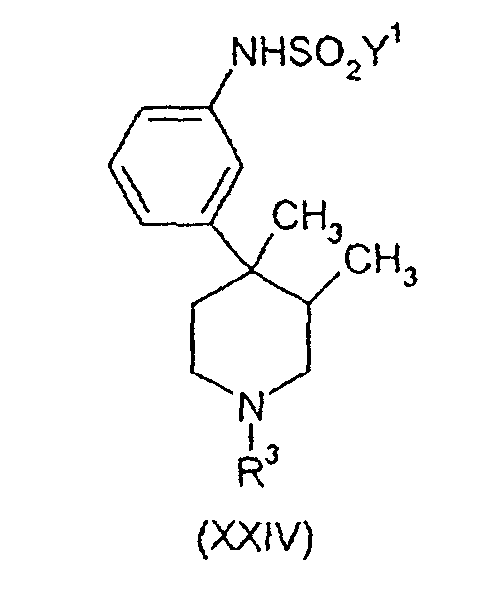
- the desired material (XXIV) may then be formed either as the free base via treatment of amine (XXIII) with methane sulfonylchloride, triethylamine in toluene or as a salt via subsequent treatment with a suitable acid such as (+) or (-) camphor sulfonic acid.
- a suitable acid such as (+) or (-) camphor sulfonic acid.
- This final conversion may be carried out either at room temperature over an extended period (up to several days) or in a shorter time at elevated temperatures.
- the compounds of the invention contain one or more chiral centres and thus can exist as enantiomers and diastereoisomers. Separation of individual isomers from mixtures of isomers can occur either at the end of the process or at relevant stages throughout the process as desired by the individual chemist.
- Such separation may be effected using standard techniques as are known in the art. For example, in the reaction sequences illustrated in schemes 2, 3 and 4 separation of the mixture of cis and trans geometric isomers of the compounds having the general formulae (VII), (VIII), (XV) and (XVI) during the synthesis is not necessary. However, such separation can be effected using standard chromatographic techniques. The mixture of enantiomers having the general formula (X) or (XIX) may be resolved using a chiral amine.
- Suitable chiral amines include: cinchonidine, cinchonine, (S)-(-)-(1-naphthyl)ethyl amine, (R)-(+)-(1-naphthyl)ethyl amine or preferably (S)-(+)-cyclohexylethyl amine.
- the compounds are resolved via formation of a diastereomeric mixture of amine salts which can be separated via recrystallisation in a suitable solvent such as butanone, isopropanol and preferably acetone.
- the thus separated amine salts may then be further purified by recrystallisation and/or treated with acid, such as hydrochloric acid, to furnish the separated (+) and (-) forms of the acid having the general formulae (X) and (XIX).
- acid such as hydrochloric acid
- This material may be converted to the corresponding ester of general formula (VII) and then to a piperidine of general formula (XIII), wherein L is -OR 15 , as detailed in schemes 2 and 3. Conversion to the alcohol via acidic hydrolysis followed by conversion to the trifluromethylsulfonate (triflate) of the general formula (XXVI) as hereinbefore detailed.
- R 1 , R 2 and R 3 are as defined for the compounds of general formula (I).
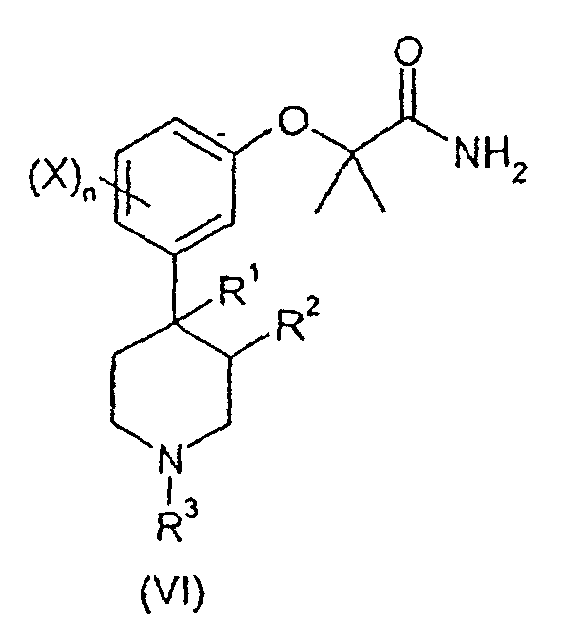
- intermediate compounds having the general formulae (II), (IIa), (III), (IIIa), (VI), (VIa), (VII), (VIII), (VIIIa), (IX), (X), (XI), (XII), (XIII), (XIV), (XV), (XVI), (XVII), (XVIII), (XIX), (XX), (XXI), (XXII), (XXIIa) and (XXIII) as illustrated in schemes 1, 2 and 3 and as described and defined hereinbefore.
- certain compounds of formula (I) may act as prodrugs of other compounds of formula (I). It will further be appreciated by those skilled in the art, that certain moieties, known to those skilled in the art as "pro-moieties", for example as described in 'Design of Prodrugs' by H. Bundgaard, Elsevier, 1985, may be placed on appropriate functionalities when such functionalities are present within compounds of formula (I). All protected derivatives, and prodrugs, of compounds of formulae (I), (II), (XXIII) and (XXIV) are included within the scope of the invention.
- the compounds are preferably employed in the form of a pharmaceutical or veterinary formulation comprising a pharmaceutically or veterinarily acceptable carrier, diluent or excipient and a compound of the invention.
- a pharmaceutical or veterinary formulation comprising a pharmaceutically or veterinarily acceptable carrier, diluent or excipient and a compound of the invention.
- Such compositions will contain from 0.1 percent by weight to 90.0 percent by weight of the active ingredient.
- the methods by which the compounds may be administered for veterinary use include oral administration by capsule, bolus, tablet or drench, topical administration as an ointment, a pour-on, spot-on, dip, spray, mousse, shampoo, collar or powder formulation or, alternatively, they can be administered by injection (e.g. subcutaneously, intramuscularly or intravenously), or as an implant.
- Such formulations are prepared in a conventional manner in accordance with standard veterinary practice
- capsules, boluses or tablets may be prepared by mixing the active ingredient with a suitable finely divided diluent or carrier additionally containing a disintegrating agent and/or binder such as starch, lactose, talc or magnesium stearate, etc.
- Oral drenches are prepared by dissolving or suspending the active ingredient in a suitable medium.
- Pour-on or spot-on formulations may be prepared by dissolving the active ingredient in an acceptable liquid carrier vehicle such as butyl digol, liquid paraffin or a non-volatile ester, optionally with the addition of a volatile component such as propan-2-ol.
- pour-on, spot-on or spray formulations can be prepared by encapsulation, to leave a residue of active agent on the surface of the animal.
- Injectable formulations may be prepared in the form of a sterile solution which may contain other substances, for example enough salts or glucose to make the solution isotonic with blood.
- Acceptable liquid carriers include vegetable oils such as sesame oil, glycerides such as triacetin, esters such as benzyl benzoate, isopropyl myristrate and fatty acid derivatives of propylene glycol, as well as organic solvents such as pyrrolidin-2-one and glycerol formal.
- the formulations are prepared by dissolving or suspending the active ingredient in the liquid carrier such that the final formulation contains from 0.1 to 10% by weight of the active ingredient.
- compositions will vary with regard to the weight of active compound contained therein, depending on the species of animal to be treated, the severity and type of infection and the body weight of the animal.
- typical dose ranges of the active ingredient are 0.01 to 100 mg per kg of body weight of the animal.
- Preferably the range is 0.1 to 10 mg per kg.
- compositions are preferably formulated in a unit dosage form, each dosage containing from about 1 to about 500 mg, more usually about 5 to about 300 mg, of the active ingredient.
- unit dosage form refers to physically discreet units suitable as unitary dosages for human subjects and other mammals, each unit containing a predetermined quantity of active material calculated to produce the desired therapeutic effect, in association with a suitable pharmaceutical carrier.
- the compounds of the invention are of particular value for treating pruritus in domestic animals such as cats and dogs and in horses.
- a veterinary formulation comprising a compound of the formula (I), as defined above, together with a veterinarily acceptable diluent or carrier.
- Such formulations include in particular tablets (including palatable tablets), ointments, pour-on formulations. spot-on formulations, dips, sprays, mousse, shampoo, collar and powder formulations.
- Further acceptable dosage forms include, for example, capsules, boluses or drenches.
- the compounds may be administered with the animal feedstuff and for this purpose a concentrated feed additive or premix may be prepared for mixing with the normal animal feed.
- compositions for human use the compounds are administered as a pharmaceutical formulation containing the active ingredient together with a pharmaceutically acceptable diluent or carrier.
- a pharmaceutically acceptable diluent or carrier include conventional tablets, capsule and ointment preparations which are formulated in accordance with standard pharmaceutical practice.
- Compounds of the invention may be administered either alone or in combination with one or more agents used in the treatment or prophylaxis of disease or in the reduction or suppression of symptoms.
- agents which are provided by way of illustration and should not be construed as limiting
- antiparastics e.g. fipronil, lufenuron, imidacloprid, avermectins (e.g. abamectin, ivermectin, doramectin), milbemycins, organophosphates, pyrethroids; antihistamines e.g. chlorpheniramine, trimeprazine, diphenhydramine, doxylamine; antifungals e.g.
- antibacterials e.g. enrofloxacin, marbofloxacin, ampicillin, amoxycillin
- antiinflammatories e.g. prednisolone, betamethasone, dexamethasone, carprofen, ketoprofen
- dietary supplements e.g. gamma-linoleic acid
- emollients e.g. gamma-linoleic acid
- the invention also provides for a method of treating pruritus, in a human or animal which comprises administering a therapeutically or prophylactically effective amount of a compound of the formula 1, as defined above, or a pharmaceutically or veterinarily acceptable salt thereof.
- NMR Nuclear magnetic resonance
- Mass spectral (MS) data were obtained on a Finnigan Mat. TSQ 7000, Finnigan Navigator Fisons Instruments Trio 1000 or Micromass Platform LC spectrometer. The calculated and observed ions quoted refer to the isotopic composition of lowest mass.
- HPLC means high performance liquid chromatography.
- Room temperature means 20 to 25 oC.
- the compounds of the invention are evaluated for their activity as antipruritic agents by measuring their ability to inhibit the hind leg scratching behaviour induced in rats by the administration of a known pruritogenic agent. These studies are based on the procedure described by Berendsen and Broekkamp in the European Journal of Pharmacology, 1991, 194 , 201. The test is performed as follows:
- the test compound is administered to the test animals by subcutaneous injection in an aqueous micelle formulation.
- the test compound is prepared in the following manner.
- the compound is dissolved in a vehicle (composition v/v%: glycerol formal, 24; tween 80, 17; benzyl alcohol, 1.5 and purified water to 100) then seven parts purified water is added to three parts of the above vehicle to give the aqueous micelle formulation.
- the compounds can be administered pre- or post-challenge or may be administered at the same time as the pruritogenic challenge.
- hindleg scratching is scored for each animal by recording the presence or absence of scratching during each 30 second interval as 1 or 0 scored respectively. The score for each animal is totalled after 25 minutes (maximum score 50). The efficacy of compounds is assessed by their ability to significantly reduce the score in treated groups compared to the control group
- Antipruritic activity was also demonstrated in dogs suffering from flea induced pruritus.
- Administration by subcutaneous injection or gavage at dose levels of 1-10mg/kg led to a rapid and sustained reduction in pruritic behaviour such as scratching, rubbing and licking.
- reaction mixture was extracted with dichloromethane (2 x 10 ml) and the combined extracts were dried (Na 2 SO 4 ), filtered and concentrated in vacuo at 80 °C to give the crude product which was purified by silica (6 g) column chromatography eluting with ethyl acetate : hexane : 0.880 ammonia (50 : 50 : 1) to give the title compound as a pale yellow oil (39 mg, 73%).
- reaction mixture was extracted with dichloromethane (2 x 10 ml) and the combined extracts were dried (Na 2 SO 4 ), filtered and concentrated in vacuo at 80 °C to give the crude product which was purified by silica (6 g) column chromatography eluting with ethyl acetate : hexane : 0.880 ammonia (60 : 40 : 1) to give the title compound as a pale yellow oil (51 mg, 95%).
- reaction mixture was extracted with dichloromethane (2 x 10 ml) and the combined extracts were dried (Na 2 SO 4 ), filtered and concentrated in vacuo at 80 °C to give the crude product which was purified by silica (6 g) column chromatography eluting with ethyl acetate : hexane : 0.880 ammonia (80 : 20 : 1) to give the title compound as a pale yellow oil (15 mg, 27%).
- the reaction mixture was concentrated in vacuo at 80 °C and the residue was taken up in dichloromethane (20 ml), washed with saturated aqueous sodium hydrogen carbonate solution (10 ml), dried (Na 2 SO 4 ), filtered and concentrated in vacuo.
- the residue was purified by silica (5 g) column chromatography eluting with dichloromethane then dichloromethane : methanol : 0.880 ammonia (90 : 10 : 1).
- the residue further was purified by silica (5 g) column chromatography eluting with ethyl acetate then ethyl acetate : 2N ammonia in methanol (90 : 10) to give a yellow solid.
- Example 36 ( ⁇ )-N-Hexyl- trans -3,4-dimethyl-4-(3-(3,5-dimethyl-4-isoxazolesulfonylamino)phenyl)piperidine
- Example 56 ( ⁇ )-N-4-(3-Methanesulfonylaminophenyl)- trans -3,4-dimethyl-(3-(4,4-dimethylcyclohexyl)propyl)piperidine
- the combined extracts were concentrated by a steady stream of nitrogen gas over a hot plate at 50 °C to give the crude product.
- the residue was purified by preparative HPLC on a Phenomenex MagellanTM column, 15 cm x 2.1 cm; flow 10.0 ml min -1 ; employing U.V. detection at 230 nm; eluant gradient of acetonitrile : 0.1 M aqueous ammonium acetate solution (50 : 50 to 95 : 5) to afford the title compound as its acetate salt.
- Example 62 ( ⁇ )-4-(3-Methanesulfonylaminophenyl)- trans -3,4-dimethyl-N-(3-(2-methylphenyl)propyl)piperidine
- Example 65 ( ⁇ )-4-(3-Methanesulfonylaminophenyl)-N-(2-(3-methoxyphenyl)-ethyl)- trans -3,4-dimethylpiperidine
- Example 70 ( ⁇ )-N-(2-(2,6-Dichlorophenoxy)ethyl)-4-(3-methanesulfonylaminophenyl)- trans -3,4-dimethylpiperidine
- Example 69 Further elution as described in Example 69 provided the title compound as a colourless oil (10 mg, 12%).
- MS (thermospray) M/Z[MH + ] 471.0; C 22 H 29 Cl 2 N 2 O 3 S + H requires 471.1.
- Example 72 ( ⁇ )-4-(3-Methanesulfonylaminophenyl)- trans -3,4-dimethyl-N-(3-(tetrahydropyran-2-yl)propyl)piperidine
- Example 78 Further elution as described in Example 78 provided the title compound as a tan gum (14 mg, 29%).
- NMR (CDCl 3 , selected data for the free base) 0.8 (d, 3H), 1.35 (s, 3H), 1.65 (m, 1 H), 2.0 (m, 1 H), 2.2-2.5 (m, 2H), 2.5-2.65 (m, 2H), 2.85-3.0 (m, 4H), 3.0-3.3 (m, 2H), 4.4 (d, 2H), 6.2 (m, 2H), 6.4 (d, 1 H), 6.5 (d, 1H), 7.0-7.4 (m, 14H).
- MS (APCI) M/Z [MH + ] 515.6; C 32 H 38 N 2 O 2 S + H requires 515.3.
- N-alkyl ( ⁇ )-4-(3-methanesulfonylaminophenyl)- trans -3,4-dimethyl piperidines were prepared by employing one each of the following methods for synthesis and purification.
- the alkyl bromide employed was either commercially available or prepared via the specific literature preparation referenced at the end of the table unless otherwise stated.
- the alkyl bromide of Example 89 was prepared via the preparation disclosed in D. C. Taylor et al, Bioorg. Chem ., 1987, 15 , 335.
- the alkyl bromide of Example 90 was prepared via the preparation disclosed in E. Laurent, B. Marquet and R. Tardivel, Tetrahedron, 1991, 47 , 3969.
- the alkyl bromide of Example 93 was prepared via the preparation disclosed in C. M. Suter and A. W. Weston, J. Am. Chem . Soc ., 1941, 63 , 602.
- the alkyl bromide of Example 94 was prepared via the preparation disclosed in G. Wagner and H. Vieweg, Pharmazie, 1982, 37 , 13.
- the alkyl bromides of Example 95 and 97 were prepared via the preparation disclosed in J. H. Speer and A. J. Hill, J. Org. Chem ., 1937, 2 , 139.
- the alkyl bromide of Example 96 was prepared via the preparation disclosed in M. Dukat et al, J. Med. Chem ., 1996, 39 , 4017.
- the alkyl bromide of Example 97 was prepared via the preparation disclosed in B. Elpern, L. N. Gardner and L. Grumbach, J. Am. Chem. Soc ., 1957, 79 , 1951.
- the alkyl bromide of Example 100 was prepared via the preparation disclosed in R. G. Jones et al, J. Am. Chem.
- the alkyl bromide of Example 101 was prepared via the preparation disclosed in A. Mitra and S. Ghoshe, Ind. J. Chem., Sect. B , 1996, 35B , 785.
- the alkyl bromide of Example 102 was prepared via the preparation disclosed in R. A. Glennon et al, J. Med. Chem ., 1981, 24 , 678,
- the alkyl bromide of Example 104 was prepared via the preparation disclosed in T. H. Fisher, S. M. Dershem and M. L. Prewitt, J. Org. Chem., 1990, 55 , 1040.
- the alkyl bromide of Example 105 was prepared via the preparation disclosed in J.
- the alkyl bromide of Example 107 was prepared via the preparation disclosed in J. D. Genzer, C. P. Huttrer and G. C. van Wessem, J. Am. Chem. Soc ., 1951, 73 , 3159.
- the alkyl bromide of Example 108 was prepared via the preparation disclosed in C. J. Paterson-Jones, A. le Roux and T. A. Modro, S. Afr. J. Chem ., 1984, 37 , 161
- the alkyl bromide of Example 112 was prepared via the preparation disclosed in A. J. Blake et al, J. Chem.
- the alkyl bromide of Example 113 was prepared via the preparation disclosed in J. Augstein et al, J. Med Chem ., 1965, 8 , 356
- the alkyl bromides of Examples 114, 117 and 118 were prepared via the preparation disclosed in E. Reinholz et al, Synthesis, 1990, 1069.
- the alkyl bromides of Examples 120 and 121 were prepared via the preparation disclosed in P. E. Cross et al, J. Med. Chem ., 1986, 29, 1643.
- the alkyl bromide of Example 122 was prepared via the preparation disclosed in P. T. Sullivan and S. J. Norton, J. Med. Chem ., 1971, 14, 557.
- the alkyl bromide of Example 124 was prepared via the preparation disclosed in C. A. R. Baxter and H. C. Richards, J. Med. Chem ., 1971, 14, 1033.
- the alkyl bromide of Example 129 was prepared via the preparation disclosed in F. C. Nelson and G. A. Schiehser in US patent US 5,385,908.
- the alkyl bromide of Example 132 was prepared via the preparation disclosed in D. Alker et al , in EP-A-365093.
- Example 150 ( ⁇ )- trans -3,4-Dimethyl-N-(3-phenylpropyl)-4-(3-propanesulfonylaminophenyl)piperidine
- Example 151 ( ⁇ )- trans -3,4-Dimethyl-N-(5-methylhexyl)-4-(3-(1-methyl-1 H -imidazole-4-sulfonylamino)phenyl)piperidine
- Example 152 ( ⁇ )-N-(3-Cyclohexylpropyl)- trans -3,4-dimethyl-4-(3-(1-methyl-1 H -imidazole-4-sulfonylamino)phenyl)piperidine
- Example 153 ( ⁇ )- trans -3,4-Dimethyl-4-(3-(1-methyl-1 H -imidazole-4-sulfonylamino)phenyl)-N-(3-phenylpropyl)piperidine
- Example 154 ( ⁇ )-N-Hexyl- trans -3,4-dimethyl-4-(3-(N-methyl-methanesulfonylamino)phenyl)piperidine
- Example 155 Further elution as described in Example 155 provided the title compound as a colourless oil (29 mg, 41%).
- NMR (CDCl 3 , selected data for the free base) 0.75 (d, 3H), 0.9 (m, 3H), 2.2-2.4 (m, 5H), 2.6 (d, 1 H), 2.9 (m, 1 H), 3.0 (s, 3H), 7.0-7.35 (m, 3H).
- MS (thermospray) M/Z [MH + ] 401.3; C 20 H 33 CIN 2 O 2 S + H requires 401.2.
- (+)-N-hexyl-4-(3-methanesulfonylaminophenyl)- trans -3,4-dimethylpiperidine (Example 5, 230 mg, 0.625 mmol) in acetone (10 ml) was added 30% w : w aqueous hydrogen peroxide solution (2 ml) using a glass pipette, and the reaction mixture was stirred at room temperature overnight. Using a stream of nitrogen, the mixture was concentrated to approximately 3 ml in volume, and the more concentrated solution was stirred at room temperature for 3 d.
- Example 168 Further elution as described in Example 168 provided the title compound as a colourless oil (9.5 mg).
- NMR (CDCl 3 , selected data) 0.85 (m, 3H), 1.1 (d, 1 H), 1.8 (m, 2H), 2.6 (m, 1 H), 2.8 (m, 1 H), 3.0 (s, 3H), 3.0-3.3 (m, 2H), 3.4-3.55 (m, 3H), 3.7 (m, 1H), 7.05-7.2 (m, 2H), 7.25-7.4 (m, 2H).
- MS (electrospray) M/Z [MH + ] 383.1 ; C 20 H 34 N 2 O 3 S + H requires 383.2.
- the resultant slurry was diluted with ethyl acetate (150 ml), and the phases were separated.
- the organic phase was concentrated in vacuo to give an orange gum which was dissolved in toluene (30 ml).
- Water (10 ml) and 2M aqueous sodium hydroxide solution (15 ml, 30 mmol) were added, and the resultant mixture was heated under reflux for 18 h.
- the reaction mixture was cooled to 0 °C and the pH was adjusted to 8 by the addition of concentrated hydrochloric acid.
- Saturated aqueous sodium hydrogen carbonate solution (20 ml) was added and the mixture was stirred for 15 min.
- the layers were separated and the aqueous phase was extracted with toluene (30 ml).
- Example 173 Formulation of (+)-N-Hexyl-4-(3-methanesulfonylaminophenyl)- trans -3,4-dimethylpiperidine
- composition suitable for oral gavage administration is as follows:- (+)-N-Hexyl-4-(3-methanesulfonylaminophenyl)- trans -3,4-dimethylpiperidine hydrochloride salt (Example 5a) 220 mg Propylene glycol 200 ml
- composition suitable for oral gavage administration is as follows:- (+)-N-Hexyl-4-(3-methanesulfonylaminophenyl)- trans -3,4-dimethylpiperidine hydrochloride salt (Example 5a) 440 mg Sesame oil 400 ml
- Example 175 Formulation of ( ⁇ )-N-Hexyl-4-(3-methanesulfonylaminophenyl)- trans -3,4-dimethylpiperidine
- composition suitable for oral capsule administration is as follows:- ( ⁇ )-N-Hexyl-4-(3-methanesulfonylaminophenyl)-trans-3,4-dimethylpiperidine hydrochloride salt (Example 4) 0.0966 g Glycerol 1.9030 g
- Example 176 Formulation of ( ⁇ )-N-Hexyl-4-(3-methanesulfonylaminophenyl)- trans -3,4-dimethylpiperidine
- composition suitable for parenteral administration is as follows:- ( ⁇ )-N-Hexyl-4-(3-methanesulfonylaminophenyl)- trans -3,4-dimethylpiperidine hydrochloride salt (Example 4) 132 mg Dimethylsulfoxide 5.4 ml Water 114.6 ml
- Example 177 Formulation of ( ⁇ )-N-Hexyl-4-(3-methanesulfonylaminophenyl)- trans -3,4-dimethylpiperidine
- composition suitable for parenteral administration is as follows:- ( ⁇ )-N-Hexyl-4-(3-methanesulfonylaminophenyl)- trans -3,4-dimethylpiperidine hydrochloride salt (Example 4) 4.93 mg 0.9% w : v Aqueous sodium chloride solution 4.49 ml
- Method B To a solution of crude ( ⁇ )-N-hexyl- trans -3,4-dimethyl-4-(3-N-diphenylmethylideneaminophenyl)piperidine (Preparation 4, 5.0 g) in tetrahydrofuran (40 ml) was added 2N aqueous hydrochloric acid (10 ml) and the mixture was stirred at room temperature for 1 h. The mixture was diluted with 2N aqueous hydrochloric acid (40 ml), hexane (50 ml) was added and the mixture was stirred vigorously for 10 min. The layers were separated and the aqueous phase was basified to pH 9 with 10N aqueous sodium hydroxide solution.
- N-Ethyl-1,2,3,6-tetrahydro-4-(3-(1-methylethoxy)phenyl)pyridine (Preparation 44, 2.0 g, 8.16 mmol) was dissolved in ethanol (20 ml) and 5% palladium on carbon (0.2 g) was added. The suspension was heated at 60 °C under hydrogen (20 psi) for 5 h. The mixture was cooled and the solid was removed by filtration through ArbocelTM, washing the resultant cake with ethyl acetate. The filtrate was concentrated in vacuo to give the title compound as an oil (2.0 g, 99%) which was used without further purification.
- NMR (CDCl 3 , selected data for the free base) : 1.1 (t. 3H), 1.3 (d, 6H). 1.65 (s, 1H), 1.7-2.1 (m, 6H), 2.45 (m, 3H), 3 1 (m, 2H), 4 5 (m, 1 H), 6.7-7.2 (m, 4
- reaction mixture was again cooled to -10 °C and water (2 ml) was added cautiously, followed by ethyl acetate (40 ml) and then it was allowed to warm to room temperature. Solid sodium bicarbonate was added until the aluminium residues became a fine precipitate and the mixture was stirred at room temperature overnight.
- the reaction mixture was filtered and concentrated in vacuo, and the residue was partitioned between dichloromethane (75 ml) and water (75 ml). The phases were separated and the extract was dried (MgSO 4 ), filtered and concentrated in vacuo to give a 2 :1 ratio of geometric isomers of the title compound as an oil which was used without further purification (1.5 g, 90%).
- the aqueous layer was basified with 10M aqueous sodium hydroxide solution At approximately pH 4, a biphasic solution developed as more methyl tert -butyl ether came out of solution. The layers were separated, and the aqueous layer was further diluted with water (10 ml) to solubilise a red oily deposit. The pH was adjusted to 10.3-10.5 with 10M aqueous sodium hydroxide and the precipitate was filtered and dried in vacuo at 50 °C to give the title compound as a pale brown solid (1.87 g, 48%).
- the resultant mixture was stirred with cooling for a further 1 h 30 min, and was then cannulated into a solution of citric acid (300 g) in water (1 I) at 0 °C at such a rate that the temperature did not rise above 20 °C.
- the resultant mixture was stirred at room temperature for 1 h 30 min after which time the layers were separated and the aqueous phase was extracted with ethyl acetate (1 x 250 ml).
- (+)-3-(3-bromophenyl)-3,4-dimethyl-4-pentenoic acid (Preparation 80, 122.3 g, 0.432 mol) in dry tetrahydrofuran (2 I) under an atmosphere of nitrogen was added sodium borohydride (24.51 g, 0.648 mol) in portions over 10 min. The resultant mixture was then cooled to 0 °C, and boron trifluoride-tetrahydrofuran complex (121 g, 0.864 mol) was cautiously added over 15 min. The resultant mixture was stirred at 0 °C for 1 h and then at room temperature for 18 h.
- the reaction mixture was cooled to room temperature and a solution of concentrated hydrochloric acid (26 ml) in water (120 ml) was added.
- the resultant biphasic mixture was heated under reflux for 4 h, before allowing to cool to room temperature.
- the layers were separated and the aqueous phase was washed with toluene (2 x 75 ml).
- the aqueous phase was cooled to 0 °C, dichloromethane (75 ml) was added and the pH of the resultant mixture was adjusted to 12 by the addition of 40% w : v aqueous sodium hydroxide solution.
- the layers were separated, and the aqueous layer was extracted with dichloromethane (75 ml).
Landscapes
- Organic Chemistry (AREA)
- Chemical & Material Sciences (AREA)
- Health & Medical Sciences (AREA)
- Pharmacology & Pharmacy (AREA)
- Engineering & Computer Science (AREA)
- Bioinformatics & Cheminformatics (AREA)
- Chemical Kinetics & Catalysis (AREA)
- General Chemical & Material Sciences (AREA)
- Medicinal Chemistry (AREA)
- Nuclear Medicine, Radiotherapy & Molecular Imaging (AREA)
- Veterinary Medicine (AREA)
- Life Sciences & Earth Sciences (AREA)
- Public Health (AREA)
- Animal Behavior & Ethology (AREA)
- General Health & Medical Sciences (AREA)
- Dermatology (AREA)
- Immunology (AREA)
- Pulmonology (AREA)
- Pharmaceuticals Containing Other Organic And Inorganic Compounds (AREA)
- Hydrogenated Pyridines (AREA)
- Plural Heterocyclic Compounds (AREA)
Claims (50)
- Verbindung mit der allgemeinen Formel:und pharmazeutisch und veterinärmedizinisch annehmbare Salze von ihr, wobei:
 mit Heteroaryl ist eine 5- oder 6-gliedrige aromatische heterocyclische Gruppe gemeint, die als Heteroatom ein oder mehrere Sauerstoff-, Schwefel- oder Stickstoffatom(e) enthält, und die gegebenenfalls mit einem Benzolring fusioniert sein kann, und die gegebenenfalls im Heteroaryl oder fusionierten Benzolring mit einem oder mehreren Substituenten substituiert sein kann, die unabhängig voneinander ausgewählt sind aus C1-C4-Alkyl, C1-C4-Alkoxy, C1-C4-Halogenalkyl, C1-C4-Halogenalkoxy, OH, =O, Halogen, Aryl und CN; undR1 C1-C4-Alkyl ist, R2 H oder C1-C4-Alkyl ist, R3 C1-C10-Alkyl, C3-C10-Alkenyl oder C3-C10-Alkynyl ist, wobei die genannte Alkyl-, Alkenyl- oder Alkynylgruppe gegebenenfalls mit einem oder mehreren Substituenten substituiert sein kann, die unabhangig voneinander ausgewählt sind aus:OH; CN; einem oder mehreren Halogenatom(en); C1-C6-Alkoxy, C1-C6-Alkoxycarbonyl; C2-C6-Alkanoyl; C2-C6-Alkanoyloxy; C3-C8-Cycloalkyl; C3-C8-Cycloalkoxy; C4-C9-Cycloalkanoyl; Aryl; Aryloxy; Aryl(C1-C4)alkoxy; Heteroaryl; einer gesättigten heterocyclischen Gruppe; Adamantyl oder ZBNR4R5, wobei Z eine direkte Bindung, CO oder S(O)p ist, wobei p = 0, 1, 2 und wobei B = (CH2)m, wobei m = von 0 bis 10 und wobei R4 und R5 unabhängig voneinander ausgewählt sind aus H, C1-C10-Alkyl, C3-C10-Alkenyl, C3-C10-Alkynyl, C3-C8-Cycloalkyl, Aryl oder Heteroaryl oder wobei R4 und R5 unverzweigte C2-C6-Alkylengruppen repräsentieren, die, wenn sie mit dem N, an das sie gebunden sind, zusammen genommen werden, einen 4- bis 7-gliedrigen gesättigten heterocyclischen Ring bilden, der gegebenenfalls O, S oder N-R6 enthält, wobei der genannte heterocyclische Ring mit einer oder mehreren C1-C4-Alkylgruppe(n) substituiert sein kann, und wobei R6 H, C1-C6-Alkyl, C3-C8-Cycloalkyl, -(C1-C6-Alkylen)(C3-C8-Cycloalkyl) oder -(C1-C6-Alkylen)aryl ist und wobei, wenn Z eine direkte Bindung ist und m = 0, dann R3 kein terminales Alkenyl oder Alkynyl ist;W ist SO2, C = O, P(Y1) = O oder P(Y1) = S;X ist ein Substituent oder mehrere Substituenten, die unabhängig voneinander ausgewählt sind aus H, Halogen, C1-C4-Alkyl, C1-C4-Alkoxy, Halogen(C1-C4)alkyl oder Halogen(C1-C4)alkoxy;Y1 ist C1-C10-Alkyl, das gegebenenfalls substituiert sein kann mit einem oder mehreren Halogenatom(en) oder mit OH, C1-C4-Alkoxy, C2-C6-Alkanoyloxy, CONH2, NH2 oder Aryl; oder Y1 ist NH2, Mono- oder Di-(C1-C4)-Alkylamino, C3-C8-Cycloalkyl, Aryl, Phthalimidyl oder Heteroaryl;Y2 ist H, C1-C4-Alkyl oder C3-C6-Alkenyl, wobei die genannten Alkyl- oder Alkenylgruppen gegebenenfalls mit Aryl, Aryloxy oder Heteroaryl substituiert sein können;n ist 0,1 oder 2;y ist 0 oder 1;Aryl und Aryloxy bedeutet eine Phenyl-, Naphthyl-, Phenoxy- bzw. Naphthyloxygruppe, die gegebenenfalls mit einem bis drei Substituenten substituiert sein kann, die jeweils unabhängig voneinander ausgewählt sind aus OH, C1-C4-Alkyl, C1-C4-Alkoxy, C1-C4-Halogenalkyl, C1-C4-Halogenalkoxy, C2-C5-Alkanoyl, Halogen, CN, CH2CN und CONH2;
mit gesättigte heterocyclische Gruppen ist eine 3- bis 8-gliedrige gesättigte heterocyclische Gruppe gemeint, die als Heteroatom(e) ein oder mehrere Sauerstoff-, Schwefel- oder Stickstoffatom(e) enthält, wobei die Stickstoffatome gegebenenfalls mit C1-C4-Alkyl substituiert sein können und wobei der Ring gegebenenfalls Benzolringfusioniert sein kann. - Verbindungen gemäß Anspruch 1, wobei N(Y2)(WY1) in der meta-Position ist, y = 0, W = SO2, R1 und R2 C1-C4-Alkylgruppen mit einer relativen trans-Stereochemie sind, oder R1 ist eine C1-C4-Alkylgruppe und R2 ist Wasserstoff; Y2 ist Wasserstoff, und wobei:Y1 ist C1-C10-Alkyl; Imidazolyl oder Pyridyl; Mono- oder Di-C1-C3-Alkyl; Phenyl; oder C1-C10-Alkyl, substituiert mit C1-C2-Alkoxy oder Phenyl, und wobeiR3 ausgewählt ist aus: linearem oder verzweigtem C4-C10-Alkyl; oderC1-C10-Alkyl, substituiert mit: C5-C6-Cycloalkyl, gegebenenfalls substituiert mit einer oder mehreren C1-C4-Alkylgruppe(n); C3-C4-Alkoxy; C5-C6-Cycloalkyloxy; Aryloxy, gegebenenfalls monosubstituiert in der ortho-Position mit Chlor, oder in den ortho- oder para-Positionen für Fluor, Brom, lod, oder in der ortho-Position für C1-C2-Alkyl; Aryl(C1-C2)alkoxy; C5-C6-Cycloalkanoyl; einen gesättigten 5- oder 6-gliedrigen heterocyclischen Ring, wobei das Heteroatom oder die Heteroatom in den 2- oder 4-Positionen liegt bzw liegen; oder Heteroaryl, ausgewählt aus Isoxazolyl oder Indolyl, oderC1-C10-Alkyl substituiert mit Aryl, gegebenenfalls substituiert mit einem oder mehreren C1-C4-Alkyl- oder Halogengruppen oder CH2CN; ZNR4R5, wobei Z Carbonyl ist oder eine direkte Verknüpfung, R4 Wasserstoff ist und R5 C5-C6-Cycloalkyl ist; oderC2-C10-Alkyl, substituiert mit Hydroxy und C5-C6-Cycloalkyl; oderC3-C10-Alkenyl; oder C3-C4-Alkenyl, substituiert mit: C5-C6-Cycloalkyl; Aryl; oderC3-C10-Alkynyl
- Verbindungen gemäß den Ansprüchen 1 und 2, wobei R1 und R2 Methylgruppen mit relativer trans-Stereochemie sind.
- Verbindungen gemäß den Ansprüchen 1 und 2, wobei R1 Propyl ist und R2 Wasserstoff ist.
- Verbindungen nach einem beliebigen der Ansprüche 1 bis 3, wobei N(Y2)(WY1) in der meta-Position ist, y Null ist, n Null ist, W = SO2, R1 und R2 Methylgruppen mit relativer trans-Stereochemie sind; Y2 ist Wasserstoff, und wobei Y1 Methyl, Ethyl, Propyl, 1-Methylethyl oder Butyl ist; Imidazolyl oder Pyridinyl oder N-Isopropylamino, und wobei R3 ausgewählt ist aus: Hexyl; Methylhexyl; oder Ethyl oder Propyl substituiert mit: Cyclohexyl; Cyclohexanoyl; 2-Tetrahydropyranyl oder Methyl, Ethyl oder Propyl, substituiert mit: Phenyl; oder 3-Cyclohexyl-3-hydroxypropyl; oder Prop-2-enyl substituiert mit Cyclohexyl oder Phenyl.
- Verbindungen gemäß Anspruch 5, wobei Y1 ausgewählt ist aus: Methyl, Ethyl, Propyl, 1-Methylethyl, Butyl, 3-Pyridinyl, 1-Methyl-1H-imidazol-4-yl und N-Isopropylamino.
- Verbindungen gemäß Anspruch 5, wobei R3 ausgewählt ist aus: N-Hexyl, N-(5-Methylhexyl), N-(3-Cyclohexylpropyl), N-Benzyl, N-(3-Phenylpropyl), N-(3-Cyclohexyl-3-oxopropyl), N-(2-(3-Methylphenyl)ethyl), N-(1-(4-Ethylphenyl)methyl), N-(2-(2-Methylphenyl)ethyl), N-(3-(2-Methylphenyl)propyl), N-(3-(Tetrahydropyran-2-yl)propyl), N-((S)-3-Cyclohexyl-3-hydroxypropyl), N-((E)-3-Cyclohexylprop-2-enyl) und N-Cinnamyl.
- Verbindungen gemäß Anspruch 5, wobei Y1 ausgewählt ist aus Methyl, Ethyl, Propyl, und wobei R3 ist: Hexyl oder 5-Methylhexyl; oder Methyl oder Ethyl substituiert mit Phenyl, substituiert mit Methyl oder Ethyl; oder Propyl substituiert mit Phenyl.
- Verbindungen nach einem beliebigen der vorhergehenden Ansprüche, wobei Y1 aus Methyl, Ethyl oder Propyl ausgewählt ist.
- Verbindungen nach einem beliebigen der vorhergehenden Ansprüche, wobei R3 ausgewählt ist aus: N-Hexyl, N-(5-Methylhexyl), N-Benzyl, N-(3-Phenylpropyl), N-(2-(3-Methylphenyl)ethyl), N-(2-(2-Methylphenyl)ethyl) und N-(3-(2-Methylphenyl)propyl).
- Verbindungen nach einem beliebigen der vorhergehenden Ansprüche, die ausgewählt sind aus:(±)-4-(3-Ethansulfonylaminophenyl)-N-hexyl-trans-3,4-dimethylpiperidin,(+)-4-(3-Ethansulfonylaminophenyl)-N-hexyl-trans-3,4-dimethylpiperidin,(±)-4-(3-Ethansulfonylaminophenyl)-trans -3,4-dimethyl-N-(5-methylhexyl)piperidin,(±)-trans-3,4-Dimethyl-N-(5-methylhexyl)-4-(3-propansulfonylaminophenyl)piperidin,(±)-N-Hexyl-trans-3,4-dimethyl-4-(3-propansulfonylaminophenyl)piperidin,(±)-N-Benzyl-trans-3,4-dimethyl-4-(3-propansulfonylaminophenyl)piperidin,(±)-trans-3,4-Dimethyl-N-(3-phenylpropyl)-4-(3-propansulfonylaminophenyl)piperidin,(±)-4-(3-Methansulfonylaminophenyl)-trans-3,4-dimethyl-N-(5-methylhexyl)piperidin,(+)-N-Hexyl-4-(3-methansulfonylaminophenyl)-trans-3,4-dimethylpiperidin,(±)-4-(3-Methansulfonylaminophenyl)-trans-3,4-dimethyl-N-(2-(3-methylphenyl)-ethyl)piperidin,(±)-4-(3-Methansulfonylaminophenyl)-trans-3,4-dimethyl-N-(3-phenylpropyl)piperidin,(±)-4-(3-Methansulfonylaminophenyl)-trans-3,4-dimethyl-N-(2-(2-methyl phenyl)ethyl)piperidin und(±)-4-(3-Methansulfonylaminophenyl)-trans-3,4-dimethyl-N-(3-(2-methylphenyl)propyl)piperidin und pharmazeutische Salz davon.
- Verfahren zur Herstellung von Verbindungen und Salzen mit der allgemeinen Formel (I):wobei: R1 C1-C4-Alkyl ist, R2 H oder C1-C4-Alkyl ist, R3 C1-C10-Alkyl, C3-C10-Alkenyl oder C3-C10-Alkynyl ist, wobei die genannte Alkyl-, Alkenyl- oder Alkynylgruppe gegebenenfalls mit einem oder mehreren Substituenten substituiert sein kann, die unabhängig voneinander ausgewählt sind aus:
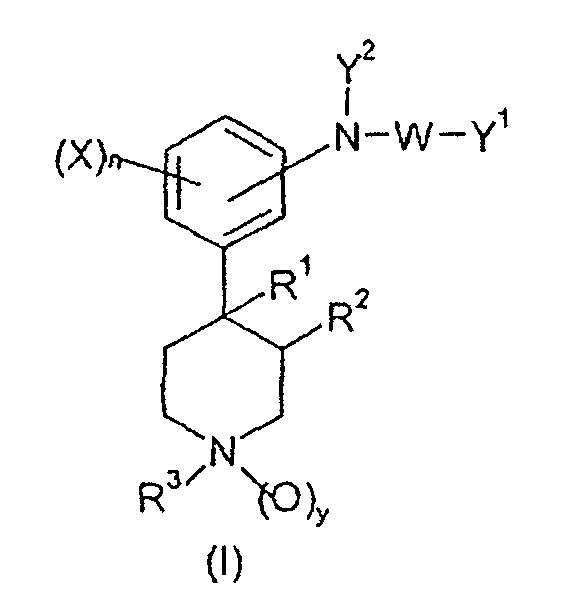 wobei das genannte Verfahren das Umsetzen einer Verbindung mit der allgemeinen Formel (lla) umfasst:OH; CN; einem oder mehreren Halogenatom(en); C1-C6-Alkoxy; C1-C6-Alkoxycarbonyl; C2-C6-Alkanoyl; C2-C6-Alkanoyloxy; C3-C8-Cycloalkyl; C3-C8-Cycloalkoxy; C4-C9-Cycloalkanoyl; Aryl; Aryloxy; Aryl(C1-C4)alkoxy; Heteroaryl; einer gesättigten heterocyclischen Gruppe; Adamantyl oder ZBNR4R5, wobei Z eine direkte Bindung, CO oder S(O)p ist, wobei p = 0, 1, 2 und wobei B = (CH2)m, wobei m = von 0 bis 10 und wobei R4 und R5 unabhängig voneinander ausgewählt sind aus H, C1-C10-Alkyl, C3-C10-Alkenyl, C3-C10-Alkynyl, C3-C8-Cycloalkyl, Aryl oder Heteroaryl oder wobei R4 und R5 unverzweigte C2-C6-Alkylengruppen repräsentieren, die, wenn sie mit dem N, an das sie gebunden sind, zusammen genommen werden, einen 4- bis 7-gliedrigen gesättigten heterocyclischen Ring bilden, der gegebenenfalls O, S oder N-R6 enthält, wobei der genannte heterocyclische Ring mit einer oder mehreren C1-C4-Alkylgruppe(n) substituiert sein kann, und wobei R6 H, C1-C6-Alkyl, C3-C8-Cycloalkyl, -(C1-C6-Alkylen)(C3-C8-Cycloalkyl) oder -(C1-C6-Alkylen)aryl ist und wobei, wenn Z eine direkte Bindung ist und m = 0, dann R3 kein terminales Alkenyl oder Alkynyl ist;W ist SO2, C = O, P(Y1) = O oder P(Y1) = S;X ist ein Substituent oder mehrere Substituenten, die unabhängig voneinander ausgewählt sind aus H, Halogen, C1-C4-Alkyl, C1-C4-Alkoxy, Halogen(C1-C4)alkyl oder Halogen(C1-C4)alkoxy;Y1 ist C1-C10-Alkyl, das gegebenenfalls substituiert sein kann mit einem oder mehreren Halogenatom(en) oder mit OH, C1-C4-Alkoxy, C2-C6-Alkanoyloxy, CONH2, NH2 oder Aryl; oder Y1 ist NH2, Mono- oder Di-(C1-C4)-Alkylamino, C3-C8-Cycloalkyl, Aryl, Phthalimidyl oder Heteroaryl;Y2 ist H, C1-C4-Alkyl oder C3-C6-Alkenyl, wobei die genannten Alkyl- oder Alkenylgruppen gegebenenfalls mit Aryl, Aryloxy oder Heteroaryl substituiert sein können;n ist 0,1 oder 2;y ist 0 oder 1;wobei R1, R2, R3, X, Y2 und n wie oben definiert sind, über die Reaktion mit entweder einer Gruppe mit der Formel Q-W-Y1 in Gegenwart einer Base, wobei W und Y1 wie oben definiert sind und Q eine Abgangsgruppe ist; oder mit einem Anhydrid mit der Formel (Y1W)2O in Gegenwart einer Base.
- Verfahren zur Herstellung von Verbindungen und Salzen mit der allgemeinen Formel (I):wobei: R1 C1-C4-Alkyl ist, R2 H oder C1-C4-Alkyl ist, R3 C1-C10-Alkyl, C3-C10-Alkenyl oder C3-C10-Alkynyl ist, wobei die genannte Alkyl-, Alkenyl- oder Alkynylgruppe gegebenenfalls mit einem oder mehreren Substituenten substituiert sein kann, die unabhängig voneinander ausgewählt sind aus:
 wobei das genannte Verfahren das Umsetzen einer Verbindung mit der allgemeinen Formel (IIIa) umfasst:OH; CN; einem oder mehreren Halogenatom(en); C1-C6-Alkoxy; C1-C6-Alkoxycarbonyl; C2-C6-Alkanoyl; C2-C6-Alkanoyloxy; C3-C8-Cycloalkyl; C3-C8-Cycloalkoxy; C4-C9-Cycloalkanoyl; Aryl; Aryloxy; Aryl(C1-C4)alkoxy; Heteroaryl; einer gesättigten heterocyclischen Gruppe; Adamantyl oder ZBNR4R5, wobei Z eine direkte Bindung, CO oder S(O)p ist, wobei p = 0, 1, 2 und wobei B = (CH2)m, wobei m = von 0 bis 10 und wobei R4 und R5 unabhängig voneinander ausgewählt sind aus H, C1-C10-Alkyl, C3-C10-Alkenyl, C3-C10-Alkynyl, C3-C8-Cycloalkyl, Aryl oder Heteroaryl oder wobei R4 und R5 unverzweigte C2-C6-Alkylengruppen repräsentieren, die, wenn sie mit dem N, an das sie gebunden sind, zusammen genommen werden, einen 4- bis 7-gliedrigen gesättigten heterocyclischen Ring bilden, der gegebenenfalls O, S oder N-R6 enthält, wobei der genannte heterocyclische Ring mit einer oder mehreren C1-C4-Alkylgruppe(n) substituiert sein kann, und wobei R6 H, C1-C6-Alkyl, C3-C8-Cycloalkyl, -(C1-C6-Alkylen)(C3-C8-Cycloalkyl) oder -(C1-C6-Alkylen)aryl ist und wobei, wenn Z eine direkte Bindung ist und m = 0, dann R3 kein terminales Alkenyl oder Alkynyl ist;W ist SO2, C = O, P(Y1) = O oder P(Y1) = S;X ist ein Substituent oder mehrere Substituenten, die unabhängig voneinander ausgewählt sind aus H, Halogen, C1-C4-Alkyl, C1-C4-Alkoxy, Halogen(C1-C4)alkyl oder Halogen(C1-C4)alkoxy;Y1 ist C1-C10-Alkyl, das gegebenenfalls substituiert sein kann mit einem oder mehreren Halogenatom(en) oder mit OH, C1-C4-Alkoxy, C2-C6-Alkanoyloxy, CONH2, NH2 oder Aryl; oder Y1 ist NH2, Mono- oder Di-(C1-C4)-Alkylamino, C3-C8-Cycloalkyl, Aryl, Phthalimidyl oder Heteroaryl;Y2 ist H, C1-C4-Alkyl oder C3-C6-Alkenyl, wobei die genannten Alkyl- oder Alkenylgruppen gegebenenfalls mit Aryl, Aryloxy oder Heteroaryl substituiert sein können;n ist 0,1 oder 2;y ist 0 oder 1;wobei R1, R2, Y1, Y2, W, X und n wie oben definiert sind, mit einer Verbindung mit der Formel R3-X, wobei R3 wie oben definiert ist, und wobei X Chlor, Brom, lod oder eine geeignete Abgangsgruppe ist.
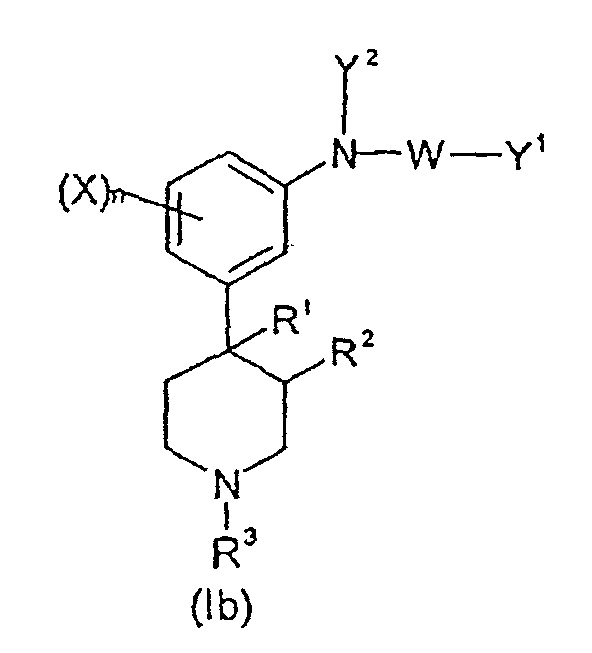
- Verfahren gemäß Anspruch 12 oder 13 für die Herstellung einer Verbindung mit der allgemeinen Formel (Ib):wobei N(Y2)(WY1) in der meta-Position ist und y Null ist.
- Verfahren gemäß Anspruch 14, wobei die Verbindung mit der allgemeinen Formel (I) eine Verbindung mit der allgemeinen Formel (XXIV) ist:wobei Y1 Methyl, Ethyl oder Propyl ist und R3 ausgewählt ist aus: N-Hexyl, N-(5-Methylhexyl), N-Benzyl, N-(3-Phenylpropyl), N-(2-(3-Methylphenyl)ethyl), N-(2-(2-Methylphenyl)ethyl) oder N-(3-(2-Methylphenyl)propyl), und wobei die Verbindung mit der allgemeinen Formel (Ila) eine Verbindung mit der allgemeinen Formel (XXIII) ist:
 wobei die Reagenzien (Y1SO2)2O oder Y1SO2Cl sind.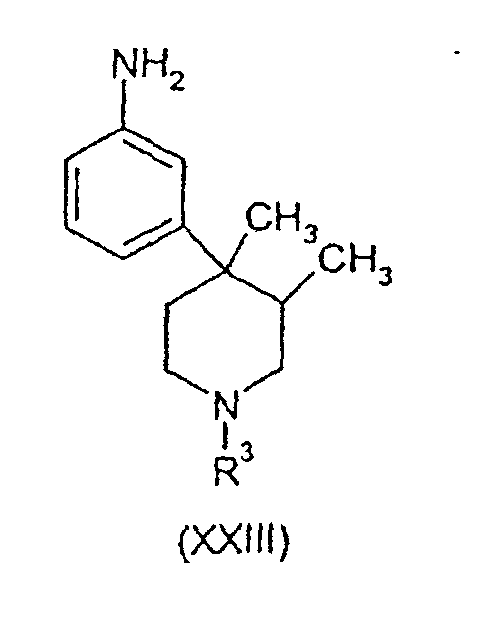
- Verfahren nach Anspruch 15, wobei das Molverhältnis von (Y1SO2)2O oder Y1SO2Cl zur Verbindung (XXIII) wenigstens 2:1 ist, und wobei auf die Reaktion der Verbindung (XXIII) mit (Y1SO2)2O oder Y1SO2Cl eine alkalische Hydrolyse folgt.
- Verfahren nach einem beliebigen der Ansprüche 12 bis 16, wobei Verbindungen mit der allgemeinen Formel (I) anschließend in ein Salz überführt und umkristallisiert werden.
- Verfahren gemäß Anspruch 17, wobei die Verbindung mit der allgemeinen Formel (I) eine Verbindung mit der allgemeinen Formel (XXIV) ist, wie sie im Anspruch 15 definiert ist, und wobei das gebildete Salz das (+)- oder (-)-Camphersulfonsäure-Salz ist.
- Verfahren zur Herstellung von Verbindungen mit der allgemeinen Formel (II),wobei R1, R2 und R3 wie in Anspruch 12 definiert sind,

das das Hydrolysieren von Verbindungen mit der allgemeinen Formel (XIV) umfasst:wobei R1, R2, R3, X und n wie für die Verbindung mit der Formel (I) im Anspruch 12 definiert sind, mit der Maßgabe, dass die Gruppe R3 nicht mit CN oder C1-C6-Alkoxycarbonyl substituiert ist.
- Verfahren zur Herstellung von Verbindungen mit der allgemeinen Formel (XIV), wie sie im Anspruch 19 definiert wurde, umfassend die Reaktion einer Verbindung mit der allgemeinen Formel (XIII):wobei L eine Brom-, lod- oder OSO2CF3-Gruppe ist, und wobei R1, R2, R3, X und n wie für eine Verbindung mit der Formel (I) im Anspruch 12 definiert sind, mit der Maßgabe, dass die Gruppe R3 nicht mit CN oder C1-C6-Alkoxycarbonyl substituiert ist und (X)n keine Brom- oder lodgruppe ist,

wobei die genannte Reaktion das Umsetzen einer Verbindung mit der allgemeinen Formel (XIII) mit Benzophenonimin in Gegenwart eines Palladiumkatalysators und einer Base umfasst. - Verfahren gemäß den Ansprüchen 19 und 20, wobei die Verbindungen mit der allgemeinen Formel (II) aus Verbindungen mit der allgemeinen Formel (XIII) gebildet werden durch:wobei das Zwischenprodukt mit der allgemeinen Formel (XIV) nicht isoliert wird.a) Reaktion mit Benzophenonimin in Gegenwart eines Palladiumkatalysators, eines Liganden und einer Base, um eine Verbindung mit der allgemeinen Formel (XIV) zu bilden; gefolgt vonb) einer sauren Hydrolyse; und
- Verfahren gemäß Anspruch 21, wobei die Base Natrium-tert-butoxid oder Caesiumcarbonat ist.
- Verfahren nach einem beliebigen der Ansprüche 19 bis 22, wobei die Verbindung mit der allgemeinen Formel (XIII) eine Verbindung mit der allgemeinen Formel (XXII) ist:wobei L eine Brom- oder lodgruppe ist und R3 wie im Anspruch 12 definiert ist, und

wobei die Reaktion mit Palladiumdiacetat, (R) - (+) -2, 2'- Bis(diphenylphosphino)-1,1'binaphthyl, Benzophenonimin und Natrium-tert-butoxid in Toluol durchgeführt wird, gefolgt von einer sauren Hydrolyse zur Erzeugung einer Verbindung mit der allgemeinen Formel (XXIII), wie sie im Anspruch 15 definiert ist. - Verfahren gemäß Anspruch 19 zur Herstellung von Verbindungen mit der allgemeinen Formel (IIa), wie sie im Anspruch 12 definiert ist, wobei y Null ist und wobei sich die NHY2-Gruppe in der meta-Position von Verbindungen mit der allgemeinen Formel (XXV) befindet, über Verbindungen mit der allgemeinen Formel (XIV), wie sie im Anspruch 19 definiert ist:wobei R1, R2, R3, X und n wie für die Verbindungen mit der allgemeinen Formel (I) im Anspruch 12 definiert sind, mit der Maßgabe, dass die Gruppe R3 nicht mit CN oder C1-C6-Alkoxycarbonyl substituiert ist, die wiederum aus den entsprechenden Alkoholen mit der allgemeinen Formel (V) hergestellt wurden,
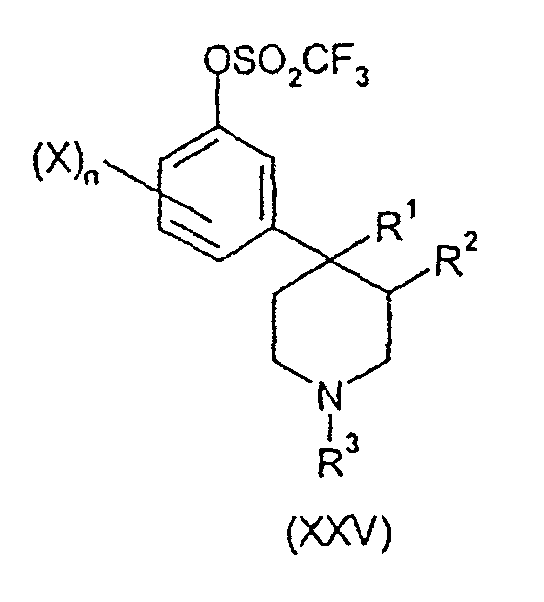 wobei R1, R2, R3, X und n wie im Anspruch 12 definiert sind.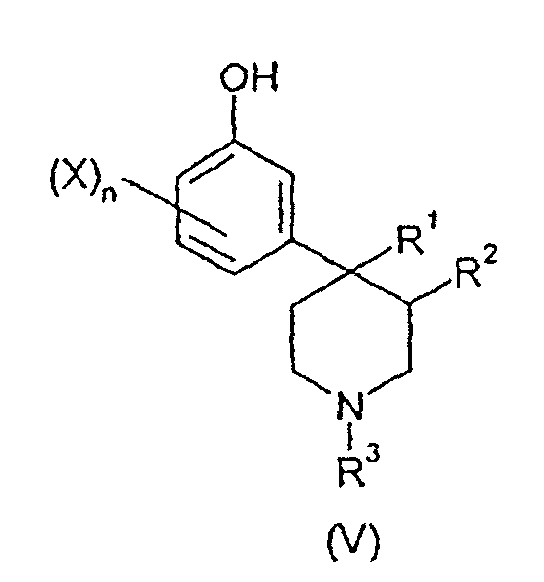
- Verfahren zur Herstellung von Verbindungen mit der allgemeinen Formel (II), wie sie im Anspruch 12 definiert ist, wobei y Null ist, über die Reduktion von Verbindungen mit der allgemeinen Formel (XIII), wobei L -NO2 ist.
- Verfahren zur Herstellung von Verbindungen mit der allgemeinen Formel (XIII), wie sie im Anspruch 20 definiert ist, aus Verbindungen mit der allgemeinen Formel (XII):wobei L eine Brom-, lod-, -NO2- oder -OR15-Gruppe ist, und wobei R1, R2, R3, X und n wie für eine Verbindung mit der allgemeinen Formel (I) im Anspruch 12 definiert sind, mit der Maßgabe, dass: die Gruppe R3 nicht mit C1-C6-Alkoxycarbonyl, C2-C6-Alkanoyl oder C2-C6-Alkanoyloxy substituiert ist, oder mit ZBNR4R5, wobei Z CO ist; wenn L Brom oder lod ist, (X)n nicht ein Brom oder lod ist; wenn L -OR15 ist, (X)n nicht eine Brom-, lod- oder Alkoxygruppe ist, und wobei L' und L" Abgangsgruppen sind, die vom Alkohol stammen und durch ein Amin ersetzt werden können, und die aus Alkyl oder Arylsulfonat oder Halogen ausgewählt sind, und wobei R15 eine C1-C4-Alkylgruppe ist;

wobei die genannte Reaktion die Reaktion einer Verbindung mit der allgemeinen Formel (XII) mit einem Amin mit der Formel NH2R3 oder NH3 umfasst, wobei R3 wie im Anspruch12 definiert ist. - Verfahren gemäß Anspruch 26, wobei L' und L" jeweils unabhängig voneinander ausgewählt sind aus Alkylsulfonyloxy, Arylsulfonyloxy oder Halogen.
- Verfahren gemäß den Ansprüchen 26 und 27, wobei die Verbindung mit der Formel (XII) eine Verbindung mit der allgemeinen Formel (XXI) ist:wobei L eine Brom- oder lodgruppe ist, und wobei L' und L" wie im Anspruch 26 definiert sind, und wobei die Reaktion mit n-Hexylamin, wässrigem Natriumcarbonat und Toluol durchgeführt wird, um Verbindungen mit der allgemeinen Formel (XXII), wie sie im Anspruch 23 definiert ist, bereit zu stellen.

- Verfahren zur Herstellung einer Verbindung mit der allgemeinen Formel (XII), wie sie im Anspruch 26 oder Anspruch 27 definiert ist, das umfasst das Umsetzen einer Verbindung mit der allgemeinen Formel (XI):wobei R1, R2, L, X und n wie im Anspruch 26 definiert sind; mit
 a) einem Alkyl oder Arylsulfonylhalogenid oder Anhydrid in Gegenwart einer Base in einem inerten Lösemittel; und, gegebenenfalls,b) Umwandlung des Diols (XI) in sein entsprechendes Dihalogenderivat.
 - Verfahren zur Herstellung eines Diols mit der allgemeinen Formel (XI), wie sie im Anspruch 29 definiert ist, aus einer γ,δ-ungesättigten Säure mit der allgemeinen Formel (X):wobei R1, R2, L, X und n wie im Anspruch 26 definiert sind;

wobei das genannte Verfahren, das die Reduktion der Säuregruppe und die gleichzeitige Hydroborierung der Alkengruppe gefolgt von einer sich anschließenden oxidativen Aufarbeitung umfasst, das Diol (XI) liefert. - Verfahren gemäß Anspruch 30, wobei die Säure mit der allgemeinen Formel (X) eine Verbindung mit der allgemeinen Formel (XIX) ist:wobei L eine Brom- oder lodgruppe ist, und wobei die Hydroborierung von (XIX) mit Diboran in Tetrahydrofuran gefolgt von einer Behandlung mit wässrigem Natriumpercarbonat Verbindungen mit der allgemeinen Formel (XX) liefert:
 wobei L wie oben definiert ist.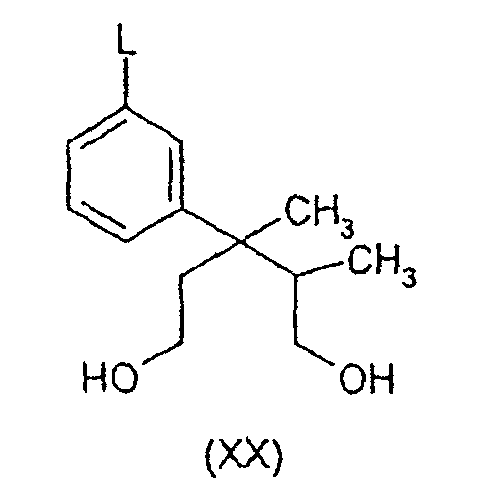
- Verfahren zur Herstellung von Verbindungen mit der allgemeinen Formel (X), wie sie in den Ansprüchen 30 und 31 definiert ist, durch die alkalische Hydrolyse von Verbindungen mit der allgemeinen Formel (IX):wobei L eine Brom- oder lodgruppe ist, und wobei R1, R2, L, X und n wie im Anspruch 26 definiert sind, und wobei R13 eine C1-C4-Alkylgruppe ist.
- Verfahren zur Herstellung einer Verbindung mit der allgemeinen Formel (IX), wie sie im Anspruch 32 definiert ist, aus einer Verbindung mit der allgemeinen Formel (VIII):wobei R1, R2, L, X und n wie im Anspruch 26 definiert sind;

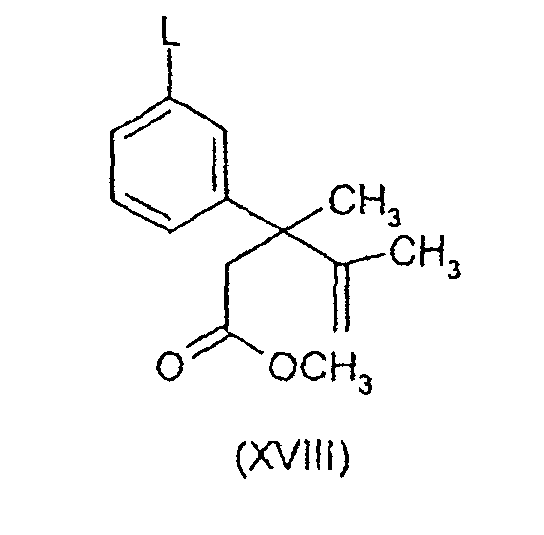
wobei das genannte Verfahren das Umsetzen von (VIII) mit einer Verbindung mit der Formel MeC(OR13)3 umfasst, wobei R13 C1-C4-Alkyl oder Aryl ist, mit einer sich anschließenden thermischen Umlagerung zur Bereitstellung von Verbindungen mit der allgemeinen Formel (IX). - Verfahren gemäß Anspruch 33, wobei die Verbindung mit der allgemeinen Formel (VIII) eine Verbindung mit der allgemeinen Formel (XVI) ist:wobei L eine Brom- oder lodgruppe ist, und wobei die genannte Verbindung (XVI) mit CH3C(OCH3)3 umgesetzt wird, um ein Zwischenprodukt mit der allgemeinen Formel (XVII) zu liefern:
 wobei L eine Brom- oder lodgruppe ist, und wobei sich die Verbindung (XVII) bei einer Wärmbehandlung umlagert und eine Verbindung mit der allgemeinen Formel (XVIII) liefert.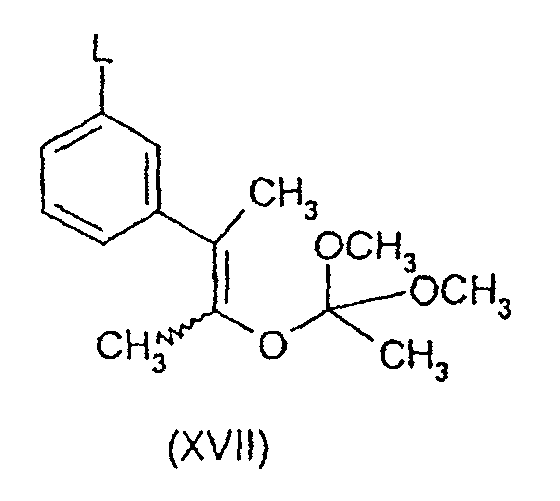
- Verfahren zur Herstellung von Verbindungen mit der allgemeinen Formel (VIII), wie sie in den Ansprüchen 33 und 34 definiert ist, aus Verbindungen mit der allgemeinen Formel (VII):wobei R1, R2, L, X und n wie im Anspruch 26 definiert sind, und wobei R12 eine C1-C4-Alkylgruppe ist;

umfassend eine Reduktion der α,β-ungesättigten Estergruppe über eine Reaktion mit einem Metallhydrid in einem inerten Lösemittel. - Verfahren gemäß Anspruch 35, wobei die Verbindung mit der allgemeinen Formel (VII) eine Verbindung mit der allgemeinen Formel (XV) ist:wobei L eine Brom- oder lodgruppe ist.

- Verfahren nach einem beliebigen der Ansprüche 12 bis 36, wobei eine optionale Trennung der geometrischen cis- und trans-Isomere von Verbindungen mit den allgemeinen Formeln (VII), (VIII), (XV) oder (XVI) mittels chromatographischer Techniken durchgeführt wird, und wobei eine optionale optische Trennung der (R)- und (S)-Isomeren von Verbindungen mit den allgemeinen Formeln (X) oder (XIX) über eine Behandlung mit einem chiralen Amin, gefolgt von einer Umkristallisation, durchgeführt wird; und wobei eine optionale Trennung der cis- und trans-Diastereoisomere der Diole mit der allgemeinen Formel (XI) oder (XX) über eine Umkristallisation oder mittels chromatographischer Techniken durchgeführt wird; und wobei eine optionale Trennung der razemischen Mischung von Verbindungen mit der allgemeinen Formel (I) mit der Maßgabe, dass y Null ist, oder (XXIV) über eine Umkristallisation oder mittels chromatographischer Techniken durchgeführt wird.
- Verfahren gemäß den Ansprüchen 12, 14 und 15, wobei Verbindungen mit der allgemeinen Formel (I) oder (XXIV) mit (+)- oder (-)-Camphersulfonsäure (CSA) behandelt werden, gefolgt von einer Trennung der resultierenden diastereomeren (+)-und (-)-CSA-Salze.
- Verfahren nach einem beliebigen der Ansprüche 12 bis 36, wobei keinerlei Auftrennung durchgeführt wird, und wobei die Trennung der enantiomeren Diastereoisomere mit der Formel (I) über eine HPLC mit chiraler Phase durchgeführt wird.
- Verbindung mit der allgemeinen Formel (IIa):wobei R1, R2, R3, X, Y2 und n wie im Anspruch 12 definiert sind, und wobei y Null ist.
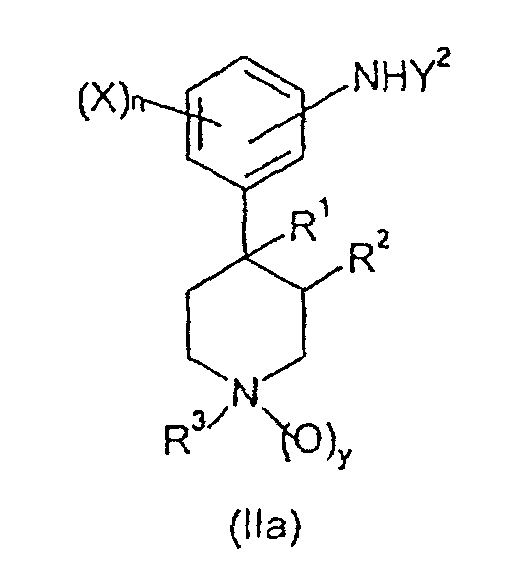
- Verbindung mit der allgemeinen Formel (IIIa):wobei R1, R2, Y1, Y2, W, X und n wie im Anspruch 13 definiert sind.
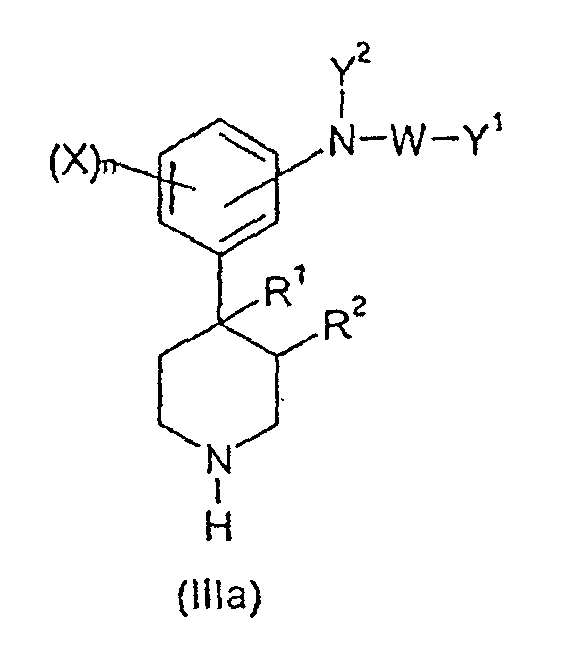
- Verbindung mit der allgemeinen Formel (VI):wobei R1, R2, R3, X und n wie im Anspruch 12 definiert sind.
- Verbindung mit der allgemeinen Formel (XIV):wobei R1, R2, R3, X und n wie im Anspruch 19 definiert sind.
- Verbindung mit der allgemeinen Formel (XIII):wobei L eine Brom-, lod- oder OSC2CF3-Gruppe ist, und wobei R1, R2, R3, X und n wie für eine Verbindung mit der Formel (I) im Anspruch 12 definiert sind, mit der Maßgabe, dass die Gruppe R3 nicht mit CN oder (C1-C6)-Alkoxycarbonyl substituiert ist, und wobei y Null ist, mit der Maßgabe, dass (X)n keine Brom- oder lodgruppe ist.

- Verbindung mit der allgemeinen Formel (XII):wobei L eine Brom-, lod-, -NO2- oder -OR15-Gruppe ist, und wobei R1, R2, R3, X und n wie für eine Verbindung mit der allgemeinen Formel (I) im Anspruch 12 definiert sind, mit der Maßgabe, dass: die Gruppe R3 nicht mit C1-C6-Alkoxycarbonyl, C2-C6-Alkanoyl oder C2-C6-Alkanoyloxy substituiert ist, oder mit ZBNR4R5, wobei Z CO ist; wenn L Brom oder lod ist, (X)n nicht ein Brom oder lod ist, wenn L -OR15 ist, (X)n nicht eine Brom-, lod- oder Alkoxygruppe ist, und wobei L' und L" Abgangsgruppen sind, die vom Alkohol stammen und durch ein Amin ersetzt werden können, und die ausgewählt sind aus Alkyl oder Arylsulfonat oder Halogen, und wobei R15 eine C1-C4-Alkylgruppe ist.
- Verbindung mit der allgemeinen Formel (X):wobei R1, R2, L, X und n wie im Anspruch 45 definiert sind.

- Pharmazeutische Zusammensetzung, die eine Verbindung mit der Formel (I) umfasst, oder ein pharmazeutisch annehmbares Salz von ihr, zusammen mit einem pharmazeutisch annehmbaren Verdünnungsmittel oder Träger.
- Veterinärmedizinische Formulierung, die eine Verbindung mit der Formel (I) umfasst, oder ein veterinärmedizinisch annehmbares Salz von ihr, zusammen mit einem veterinärmedizinisch annehmbaren Verdünnungsmittel oder Träger.
- Verbindung mit der Formel (I), oder ein pharmazeutisch oder veterinärmedizinisch annehmbares Salz von ihr, zur Verwendung für ein Medikament für den Menschen oder ein Tier.
- Verwendung einer Verbindung mit der Formel (I), oder eines pharmazeutisch oder veterinärmedizinisch annehmbaren Salzes von ihr, für die Herstellung eines Medikaments zur kurativen oder prophylaktischen Behandlung des Pruritus bei einem Menschen oder einem Tier.
Priority Applications (1)
| Application Number | Priority Date | Filing Date | Title |
|---|---|---|---|
| DK99917038T DK1077940T3 (da) | 1998-05-18 | 1999-05-17 | 4-Phenylpiperidiner til behandling af pruritiske dermatoser |
Applications Claiming Priority (3)
| Application Number | Priority Date | Filing Date | Title |
|---|---|---|---|
| GBGB9810671.9A GB9810671D0 (en) | 1998-05-18 | 1998-05-18 | Anti-pruritic agents |
| GB9810671 | 1998-05-18 | ||
| PCT/IB1999/000886 WO1999059971A1 (en) | 1998-05-18 | 1999-05-17 | Novel 4-phenylpiperidines for the treatment of pruritic dermatoses |
Publications (2)
| Publication Number | Publication Date |
|---|---|
| EP1077940A1 EP1077940A1 (de) | 2001-02-28 |
| EP1077940B1 true EP1077940B1 (de) | 2004-07-14 |
Family
ID=10832267
Family Applications (1)
| Application Number | Title | Priority Date | Filing Date |
|---|---|---|---|
| EP99917038A Expired - Lifetime EP1077940B1 (de) | 1998-05-18 | 1999-05-17 | 4-phenylpiperidine zur behandlung von prutitischen hauterkrankungen |
Country Status (18)
| Country | Link |
|---|---|
| US (1) | US6610711B2 (de) |
| EP (1) | EP1077940B1 (de) |
| JP (1) | JP2002515486A (de) |
| AP (1) | AP9901535A0 (de) |
| AT (1) | ATE271038T1 (de) |
| AU (1) | AU3531299A (de) |
| BR (1) | BR9910609A (de) |
| CA (1) | CA2332538C (de) |
| DE (1) | DE69918687T2 (de) |
| DK (1) | DK1077940T3 (de) |
| ES (1) | ES2230846T3 (de) |
| GB (1) | GB9810671D0 (de) |
| GT (1) | GT199900067A (de) |
| MA (1) | MA26630A1 (de) |
| PT (1) | PT1077940E (de) |
| TN (1) | TNSN99095A1 (de) |
| WO (1) | WO1999059971A1 (de) |
| ZA (1) | ZA993364B (de) |
Families Citing this family (35)
| Publication number | Priority date | Publication date | Assignee | Title |
|---|---|---|---|---|
| GB9912415D0 (en) | 1999-05-28 | 1999-07-28 | Pfizer Ltd | Compounds useful in therapy |
| GB9912411D0 (en) | 1999-05-28 | 1999-07-28 | Pfizer Ltd | Compounds useful in therapy |
| GB9912410D0 (en) * | 1999-05-28 | 1999-07-28 | Pfizer Ltd | Compounds useful in therapy |
| GB9912417D0 (en) | 1999-05-28 | 1999-07-28 | Pfizer Ltd | Compounds useful in therapy |
| GB9912413D0 (en) | 1999-05-28 | 1999-07-28 | Pfizer Ltd | Compounds useful in therapy |
| GB9912416D0 (en) | 1999-05-28 | 1999-07-28 | Pfizer Ltd | Compounds useful in therapy |
| IL159697A0 (en) * | 2001-07-05 | 2004-06-20 | Synaptic Pharma Corp | Substituted anilinic piperidines as mch selective antagonists |
| US6727264B1 (en) | 2001-07-05 | 2004-04-27 | Synaptic Pharmaceutical Corporation | Substituted anilinic piperidines as MCH selective antagonists |
| DE60226161T2 (de) * | 2001-10-22 | 2009-07-02 | Pfizer Products Inc., Groton | 3-azabicyclo[3.1.0]hexan derivative als antagonisten der opioid rezeptoren |
| JP2005514362A (ja) * | 2001-11-19 | 2005-05-19 | イーラン ファーマスーティカルズ、インコーポレイテッド | 3,4二置換、3,5二置換、及び3,4,5置換ピペリジン及びピペラジン |
| ES2201908B1 (es) * | 2002-05-29 | 2005-02-16 | Laboratorios Del Dr. Esteve, S.A. | Pienso suplementado con ketoprofeno y su empleo en el tratamiento de procesos que cursan con fiebre, inflamacion y/o dolor, en un colectivo de animales, de forma simultanea. |
| MXPA05011070A (es) * | 2003-04-14 | 2005-12-12 | Pfizer Prod Inc | Derivados de 3-azabiciclo [3.2.1] octano. |
| FR2872416B1 (fr) * | 2004-07-01 | 2006-09-22 | Oreal | Utilisation de derives de piperidine pour lutter contre les rides |
| ES2490595T3 (es) * | 2005-02-17 | 2014-09-04 | Abbott Laboratories | Administración transmucosal de composiciones de fármacos para tratar y prevenir trastornos en animales |
| EP1966132A2 (de) * | 2005-12-15 | 2008-09-10 | Boehringer Ingelheim International Gmbh | Den cb2-rezeptor modulierende verbindungen |
| MY145633A (en) | 2006-03-01 | 2012-03-15 | Theravance Inc | 8-azabicyclo[3.2.1]octane compounds as mu opioid receptor antagonists |
| JP5448164B2 (ja) * | 2006-07-28 | 2014-03-19 | ベーリンガー インゲルハイム インターナショナル ゲゼルシャフト ミット ベシュレンクテル ハフツング | Cb2受容体を変調する化合物 |
| JP5030114B2 (ja) * | 2006-09-25 | 2012-09-19 | ベーリンガー インゲルハイム インターナショナル ゲゼルシャフト ミット ベシュレンクテル ハフツング | Cb2受容体をモジュレートする化合物 |
| TWI409067B (zh) * | 2007-02-28 | 2013-09-21 | Theravance Inc | 8-氮雜雙環〔3.2.1〕辛烷化合物之結晶型 |
| US7947710B2 (en) * | 2007-08-27 | 2011-05-24 | Theravance, Inc. | Disubstituted alkyl-8-azabicyclo[3.2.1]octane compounds as mu opioid receptor antagonists |
| WO2009029253A1 (en) * | 2007-08-27 | 2009-03-05 | Theravance, Inc. | Heteroarylalkyl-8-azabicyclo[3.2.1]octane compounds as mu opioid receptor antagonists |
| TWI423801B (zh) * | 2007-08-27 | 2014-01-21 | Theravance Inc | 作為μ類鴉片受體拮抗劑之8-氮雜雙環〔3.2.1〕辛基-2-羥基苯甲醯胺化合物 |
| ES2390195T3 (es) * | 2007-08-27 | 2012-11-07 | Theravance, Inc. | Compuestos de amidoalquil-8-azabiciclo(3,2,1)octano, como antagonistas del receptor opioide mu |
| JP5492092B2 (ja) * | 2007-11-07 | 2014-05-14 | ベーリンガー インゲルハイム インターナショナル ゲゼルシャフト ミット ベシュレンクテル ハフツング | Cb2受容体を調節する化合物 |
| US8178568B2 (en) * | 2008-07-10 | 2012-05-15 | Boehringer Ingelheim International Gmbh | Sulfone compounds which modulate the CB2 receptor |
| US8048899B2 (en) | 2008-09-25 | 2011-11-01 | Boehringer Ingelheim International Gmbh | Compounds which selectively modulate the CB2 receptor |
| US8299103B2 (en) | 2009-06-15 | 2012-10-30 | Boehringer Ingelheim International Gmbh | Compounds which selectively modulate the CB2 receptor |
| US8383615B2 (en) | 2009-06-16 | 2013-02-26 | Boehringer Ingelheim International Gmbh | Azetidine 2-carboxamide derivatives which modulate the CB2 receptor |
| EP2480544A1 (de) * | 2009-09-22 | 2012-08-01 | Boehringer Ingelheim International GmbH | Verbindungen für selektive cb2-rezeptormodulation |
| JP2013517271A (ja) | 2010-01-15 | 2013-05-16 | ベーリンガー インゲルハイム インターナショナル ゲゼルシャフト ミット ベシュレンクテル ハフツング | Cb2受容体を調節する化合物 |
| US8329735B2 (en) | 2010-03-05 | 2012-12-11 | Boehringer Ingelheim International Gmbh | Tetrazole compounds which selectively modulate the CB2 receptor |
| EP2595959B1 (de) | 2010-07-22 | 2015-11-04 | Boehringer Ingelheim International GmbH | Sulfonylverbindungen zur modulierung des cb2-rezeptors |
| EP2803668A1 (de) | 2013-05-17 | 2014-11-19 | Boehringer Ingelheim International Gmbh | Neuartige (Cyano-dimethyl-methyl)-isoxazole und -[1,3,4]-thiadiazole |
| CN106278914B (zh) * | 2016-08-19 | 2018-04-13 | 四川福思达生物技术开发有限责任公司 | 一种增产胺的合成工艺 |
| CN116440882B (zh) * | 2023-01-16 | 2024-09-20 | 浙江纽龙合成材料制造有限公司 | 一种基于端烯基活化的疏水分离层析介质及其制备方法 |
Citations (2)
| Publication number | Priority date | Publication date | Assignee | Title |
|---|---|---|---|---|
| WO1998027081A1 (en) * | 1996-12-19 | 1998-06-25 | Smithkline Beecham Plc | Sulphonamide derivatives, process for their preparation, and their use as medicaments |
| WO1998047885A1 (en) * | 1997-04-18 | 1998-10-29 | Smithkline Beecham Plc | A bicyclic aryl or a bicyclic heterocyclic ring containing compounds having a combined 5ht1a, 5ht1b and 5ht1d receptor antagonistic activity |
Family Cites Families (5)
| Publication number | Priority date | Publication date | Assignee | Title |
|---|---|---|---|---|
| AR206937A1 (es) | 1974-09-06 | 1976-08-31 | Lilly Co Eli | Procedimiento para preparar compuestos de 1-sustituido-4-alquil-4-fenil-piperidina |
| ATE110057T1 (de) | 1987-04-16 | 1994-09-15 | Lilly Co Eli | Piperidine als opioid-antagoniste. |
| US5159081A (en) * | 1991-03-29 | 1992-10-27 | Eli Lilly And Company | Intermediates of peripherally selective n-carbonyl-3,4,4-trisubstituted piperidine opioid antagonists |
| ZA922180B (en) | 1991-03-29 | 1993-09-27 | Lilly Co Eli | Piperidine derivatives |
| GB9507203D0 (en) * | 1995-04-07 | 1995-05-31 | Smithkline Beecham Plc | Novel compounds |
-
1998
- 1998-05-18 GB GBGB9810671.9A patent/GB9810671D0/en not_active Ceased
-
1999
- 1999-05-13 AP APAP/P/1999/001535A patent/AP9901535A0/en unknown
- 1999-05-14 GT GT199900067A patent/GT199900067A/es unknown
- 1999-05-17 WO PCT/IB1999/000886 patent/WO1999059971A1/en not_active Ceased
- 1999-05-17 ZA ZA9903364A patent/ZA993364B/xx unknown
- 1999-05-17 CA CA002332538A patent/CA2332538C/en not_active Expired - Fee Related
- 1999-05-17 DE DE69918687T patent/DE69918687T2/de not_active Expired - Fee Related
- 1999-05-17 DK DK99917038T patent/DK1077940T3/da active
- 1999-05-17 MA MA25582A patent/MA26630A1/fr unknown
- 1999-05-17 JP JP2000549590A patent/JP2002515486A/ja active Pending
- 1999-05-17 EP EP99917038A patent/EP1077940B1/de not_active Expired - Lifetime
- 1999-05-17 PT PT99917038T patent/PT1077940E/pt unknown
- 1999-05-17 US US09/646,255 patent/US6610711B2/en not_active Expired - Fee Related
- 1999-05-17 ES ES99917038T patent/ES2230846T3/es not_active Expired - Lifetime
- 1999-05-17 BR BR9910609-4A patent/BR9910609A/pt not_active IP Right Cessation
- 1999-05-17 TN TNTNSN99095A patent/TNSN99095A1/fr unknown
- 1999-05-17 AT AT99917038T patent/ATE271038T1/de not_active IP Right Cessation
- 1999-05-17 AU AU35312/99A patent/AU3531299A/en not_active Abandoned
Patent Citations (2)
| Publication number | Priority date | Publication date | Assignee | Title |
|---|---|---|---|---|
| WO1998027081A1 (en) * | 1996-12-19 | 1998-06-25 | Smithkline Beecham Plc | Sulphonamide derivatives, process for their preparation, and their use as medicaments |
| WO1998047885A1 (en) * | 1997-04-18 | 1998-10-29 | Smithkline Beecham Plc | A bicyclic aryl or a bicyclic heterocyclic ring containing compounds having a combined 5ht1a, 5ht1b and 5ht1d receptor antagonistic activity |
Also Published As
| Publication number | Publication date |
|---|---|
| DE69918687T2 (de) | 2005-07-28 |
| MA26630A1 (fr) | 2004-12-20 |
| PT1077940E (pt) | 2004-10-29 |
| GT199900067A (es) | 2000-11-04 |
| JP2002515486A (ja) | 2002-05-28 |
| ES2230846T3 (es) | 2005-05-01 |
| US20030078282A1 (en) | 2003-04-24 |
| WO1999059971A1 (en) | 1999-11-25 |
| CA2332538A1 (en) | 1999-11-25 |
| ATE271038T1 (de) | 2004-07-15 |
| AU3531299A (en) | 1999-12-06 |
| ZA993364B (en) | 2000-12-01 |
| DK1077940T3 (da) | 2004-11-01 |
| AP9901535A0 (en) | 1999-06-30 |
| BR9910609A (pt) | 2001-01-09 |
| GB9810671D0 (en) | 1998-07-15 |
| EP1077940A1 (de) | 2001-02-28 |
| US6610711B2 (en) | 2003-08-26 |
| CA2332538C (en) | 2005-08-02 |
| TNSN99095A1 (fr) | 2005-11-10 |
| DE69918687D1 (de) | 2004-08-19 |
Similar Documents
| Publication | Publication Date | Title |
|---|---|---|
| US6610711B2 (en) | 4-phenylpiperidines for the treatment of pruritic dermatoses | |
| JP2786480B2 (ja) | 1―インドリルアルキル―4―(置換ピリジニル)ピペラジン | |
| US5116846A (en) | N-aralkyl piperidine derivatives as psychotropic drugs | |
| NO973117L (no) | 1-acylpiperidinforbindelser | |
| JP2003528046A (ja) | フェノキシプロパノールアミン類、それらの製造および治療的使用 | |
| EP1870405A1 (de) | Carbonylierte (Aza)cyclohexane als Dopamin D3 Rezeptorliganden | |
| JPH05230059A (ja) | ベンゾジオキサン誘導体 | |
| MXPA04007502A (es) | Derivados de quinolina como antagonistas de neuropeptido y (npy). | |
| US7060836B2 (en) | Lactams as tachykinin antagonists | |
| JP2003517013A (ja) | フェノキシプロパノールアミン類、それらの製造方法およびそれらを含む医薬組成物 | |
| JP2004339080A (ja) | ピラゾ−ル誘導体を含有する高血圧治療剤 | |
| US6518284B2 (en) | 4-substituted piperidines | |
| HU186523B (en) | Process for producing quinoline derivatives | |
| AU644296B2 (en) | 2-(1-piperidyl)ethanol derivatives, their preparation and their therapeutic application | |
| JPH06500076A (ja) | ピペリジン化合物、その合成およびその使用方法 | |
| HU185422B (en) | Process for producing phenyl-azacycloalkanes | |
| US6479516B1 (en) | 4-arylpiperidine derivatives for the treatment of pruritus | |
| EP1002794B1 (de) | 4-¬(Aryl)(aryloxy)methyl piperidinderivate und ihre Verwendung als Serotonin und/oder Noradrenalin Reuptake Inhibitoren | |
| JPH0699420B2 (ja) | 水素添加された1−ベンゾオキサシクロアルキルピリジンカルボン酸化合物,その製造方法及び該化合物を含む医薬製剤 | |
| JP2002535365A (ja) | 抗うつ性複素環化合物 | |
| EP1613594B1 (de) | 4-(2-phenylsulfanyl-phenyl)-1,2,3,6-tetrahydropyridinderivaten zur verwendung als serotonin-wiederaufnahmehemmer | |
| JPS62198680A (ja) | 1,6−ナフチリジン誘導体、その製造方法およびそれを含有する薬剤組成物 | |
| MXPA00011393A (en) | Novel 4-phenylpiperidines for the treatment of pruritic dermatoses | |
| EP0745591A1 (de) | Indanylpiperidine als melatonerge Wirkstoffe | |
| JP2004514658A (ja) | 新規なニューロキニン拮抗剤、その製法及び医薬組成物 |
Legal Events
| Date | Code | Title | Description |
|---|---|---|---|
| PUAI | Public reference made under article 153(3) epc to a published international application that has entered the european phase |
Free format text: ORIGINAL CODE: 0009012 |
|
| 17P | Request for examination filed |
Effective date: 20000811 |
|
| AK | Designated contracting states |
Kind code of ref document: A1 Designated state(s): AT BE CH CY DE DK ES FI FR GB GR IE IT LI LU NL PT SE |
|
| 17Q | First examination report despatched |
Effective date: 20021227 |
|
| GRAP | Despatch of communication of intention to grant a patent |
Free format text: ORIGINAL CODE: EPIDOSNIGR1 |
|
| GRAS | Grant fee paid |
Free format text: ORIGINAL CODE: EPIDOSNIGR3 |
|
| GRAA | (expected) grant |
Free format text: ORIGINAL CODE: 0009210 |
|
| AK | Designated contracting states |
Kind code of ref document: B1 Designated state(s): AT BE CH CY DE DK ES FI FR GB GR IE IT LI LU NL PT SE |
|
| REG | Reference to a national code |
Ref country code: GB Ref legal event code: FG4D |
|
| REG | Reference to a national code |
Ref country code: CH Ref legal event code: EP |
|
| REG | Reference to a national code |
Ref country code: SE Ref legal event code: TRGR |
|
| REF | Corresponds to: |
Ref document number: 69918687 Country of ref document: DE Date of ref document: 20040819 Kind code of ref document: P |
|
| REG | Reference to a national code |
Ref country code: IE Ref legal event code: FG4D |
|
| REG | Reference to a national code |
Ref country code: CH Ref legal event code: NV Representative=s name: KIRKER & CIE SA |
|
| REG | Reference to a national code |
Ref country code: GR Ref legal event code: EP Ref document number: 20040402659 Country of ref document: GR |
|
| REG | Reference to a national code |
Ref country code: PT Ref legal event code: SC4A Free format text: AVAILABILITY OF NATIONAL TRANSLATION Effective date: 20040823 |
|
| REG | Reference to a national code |
Ref country code: DK Ref legal event code: T3 |
|
| ET | Fr: translation filed | ||
| PGFP | Annual fee paid to national office [announced via postgrant information from national office to epo] |
Ref country code: GB Payment date: 20050406 Year of fee payment: 7 Ref country code: AT Payment date: 20050406 Year of fee payment: 7 |
|
| PGFP | Annual fee paid to national office [announced via postgrant information from national office to epo] |
Ref country code: PT Payment date: 20050407 Year of fee payment: 7 Ref country code: NL Payment date: 20050407 Year of fee payment: 7 Ref country code: DK Payment date: 20050407 Year of fee payment: 7 |
|
| PGFP | Annual fee paid to national office [announced via postgrant information from national office to epo] |
Ref country code: IE Payment date: 20050414 Year of fee payment: 7 |
|
| PGFP | Annual fee paid to national office [announced via postgrant information from national office to epo] |
Ref country code: GR Payment date: 20050421 Year of fee payment: 7 |
|
| REG | Reference to a national code |
Ref country code: ES Ref legal event code: FG2A Ref document number: 2230846 Country of ref document: ES Kind code of ref document: T3 |
|
| PGFP | Annual fee paid to national office [announced via postgrant information from national office to epo] |
Ref country code: SE Payment date: 20050503 Year of fee payment: 7 |
|
| PGFP | Annual fee paid to national office [announced via postgrant information from national office to epo] |
Ref country code: FI Payment date: 20050516 Year of fee payment: 7 |
|
| PGFP | Annual fee paid to national office [announced via postgrant information from national office to epo] |
Ref country code: FR Payment date: 20050517 Year of fee payment: 7 |
|
| PGFP | Annual fee paid to national office [announced via postgrant information from national office to epo] |
Ref country code: ES Payment date: 20050520 Year of fee payment: 7 |
|
| PLBE | No opposition filed within time limit |
Free format text: ORIGINAL CODE: 0009261 |
|
| STAA | Information on the status of an ep patent application or granted ep patent |
Free format text: STATUS: NO OPPOSITION FILED WITHIN TIME LIMIT |
|
| PGFP | Annual fee paid to national office [announced via postgrant information from national office to epo] |
Ref country code: BE Payment date: 20050527 Year of fee payment: 7 |
|
| PGFP | Annual fee paid to national office [announced via postgrant information from national office to epo] |
Ref country code: DE Payment date: 20050531 Year of fee payment: 7 |
|
| PGFP | Annual fee paid to national office [announced via postgrant information from national office to epo] |
Ref country code: LU Payment date: 20050603 Year of fee payment: 7 |
|
| PGFP | Annual fee paid to national office [announced via postgrant information from national office to epo] |
Ref country code: CH Payment date: 20050613 Year of fee payment: 7 |
|
| PGFP | Annual fee paid to national office [announced via postgrant information from national office to epo] |
Ref country code: CY Payment date: 20050617 Year of fee payment: 7 |
|
| 26N | No opposition filed |
Effective date: 20050415 |
|
| PG25 | Lapsed in a contracting state [announced via postgrant information from national office to epo] |
Ref country code: IE Free format text: LAPSE BECAUSE OF NON-PAYMENT OF DUE FEES Effective date: 20060517 Ref country code: GB Free format text: LAPSE BECAUSE OF NON-PAYMENT OF DUE FEES Effective date: 20060517 Ref country code: FI Free format text: LAPSE BECAUSE OF NON-PAYMENT OF DUE FEES Effective date: 20060517 Ref country code: CY Free format text: LAPSE BECAUSE OF NON-PAYMENT OF DUE FEES Effective date: 20060517 Ref country code: AT Free format text: LAPSE BECAUSE OF NON-PAYMENT OF DUE FEES Effective date: 20060517 |
|
| PG25 | Lapsed in a contracting state [announced via postgrant information from national office to epo] |
Ref country code: SE Free format text: LAPSE BECAUSE OF NON-PAYMENT OF DUE FEES Effective date: 20060518 Ref country code: ES Free format text: LAPSE BECAUSE OF NON-PAYMENT OF DUE FEES Effective date: 20060518 |
|
| PG25 | Lapsed in a contracting state [announced via postgrant information from national office to epo] |
Ref country code: LI Free format text: LAPSE BECAUSE OF NON-PAYMENT OF DUE FEES Effective date: 20060531 Ref country code: DK Free format text: LAPSE BECAUSE OF NON-PAYMENT OF DUE FEES Effective date: 20060531 Ref country code: CH Free format text: LAPSE BECAUSE OF NON-PAYMENT OF DUE FEES Effective date: 20060531 Ref country code: BE Free format text: LAPSE BECAUSE OF NON-PAYMENT OF DUE FEES Effective date: 20060531 |
|
| PGFP | Annual fee paid to national office [announced via postgrant information from national office to epo] |
Ref country code: IT Payment date: 20060531 Year of fee payment: 8 |
|
| PG25 | Lapsed in a contracting state [announced via postgrant information from national office to epo] |
Ref country code: PT Free format text: LAPSE BECAUSE OF NON-PAYMENT OF DUE FEES Effective date: 20061117 |
|
| PG25 | Lapsed in a contracting state [announced via postgrant information from national office to epo] |
Ref country code: NL Free format text: LAPSE BECAUSE OF NON-PAYMENT OF DUE FEES Effective date: 20061201 Ref country code: DE Free format text: LAPSE BECAUSE OF NON-PAYMENT OF DUE FEES Effective date: 20061201 |
|
| REG | Reference to a national code |
Ref country code: CH Ref legal event code: PL Ref country code: DK Ref legal event code: EBP |
|
| EUG | Se: european patent has lapsed | ||
| GBPC | Gb: european patent ceased through non-payment of renewal fee |
Effective date: 20060517 |
|
| REG | Reference to a national code |
Ref country code: PT Ref legal event code: MM4A Free format text: LAPSE DUE TO NON-PAYMENT OF FEES Effective date: 20061117 |
|
| NLV4 | Nl: lapsed or anulled due to non-payment of the annual fee |
Effective date: 20061201 |
|
| REG | Reference to a national code |
Ref country code: IE Ref legal event code: MM4A |
|
| REG | Reference to a national code |
Ref country code: FR Ref legal event code: ST Effective date: 20070131 |
|
| REG | Reference to a national code |
Ref country code: ES Ref legal event code: FD2A Effective date: 20060518 |
|
| BERE | Be: lapsed |
Owner name: *PFIZER INC. Effective date: 20060531 |
|
| PG25 | Lapsed in a contracting state [announced via postgrant information from national office to epo] |
Ref country code: FR Free format text: LAPSE BECAUSE OF NON-PAYMENT OF DUE FEES Effective date: 20060531 |
|
| PG25 | Lapsed in a contracting state [announced via postgrant information from national office to epo] |
Ref country code: LU Free format text: LAPSE BECAUSE OF NON-PAYMENT OF DUE FEES Effective date: 20060517 |
|
| PG25 | Lapsed in a contracting state [announced via postgrant information from national office to epo] |
Ref country code: GR Free format text: LAPSE BECAUSE OF NON-PAYMENT OF DUE FEES Effective date: 20061205 |
|
| PG25 | Lapsed in a contracting state [announced via postgrant information from national office to epo] |
Ref country code: IT Free format text: LAPSE BECAUSE OF NON-PAYMENT OF DUE FEES Effective date: 20070517 |