EP1078023B1 - Lumineszierende verbindungen - Google Patents
Lumineszierende verbindungen Download PDFInfo
- Publication number
- EP1078023B1 EP1078023B1 EP99915319A EP99915319A EP1078023B1 EP 1078023 B1 EP1078023 B1 EP 1078023B1 EP 99915319 A EP99915319 A EP 99915319A EP 99915319 A EP99915319 A EP 99915319A EP 1078023 B1 EP1078023 B1 EP 1078023B1
- Authority
- EP
- European Patent Office
- Prior art keywords
- compounds
- group
- dyes
- groups
- squaraine
- Prior art date
- Legal status (The legal status is an assumption and is not a legal conclusion. Google has not performed a legal analysis and makes no representation as to the accuracy of the status listed.)
- Expired - Lifetime
Links
- RHGRFBQQHXCGHK-UHFFFAOYSA-M BC1C([O-])=C([CH2-])C1=C(C#N)C#N Chemical compound BC1C([O-])=C([CH2-])C1=C(C#N)C#N RHGRFBQQHXCGHK-UHFFFAOYSA-M 0.000 description 1
Images
Classifications
-
- G—PHYSICS
- G01—MEASURING; TESTING
- G01N—INVESTIGATING OR ANALYSING MATERIALS BY DETERMINING THEIR CHEMICAL OR PHYSICAL PROPERTIES
- G01N33/00—Investigating or analysing materials by specific methods not covered by groups G01N1/00 - G01N31/00
- G01N33/48—Biological material, e.g. blood, urine; Haemocytometers
- G01N33/50—Chemical analysis of biological material, e.g. blood, urine; Testing involving biospecific ligand binding methods; Immunological testing
- G01N33/58—Chemical analysis of biological material, e.g. blood, urine; Testing involving biospecific ligand binding methods; Immunological testing involving labelled substances
- G01N33/582—Chemical analysis of biological material, e.g. blood, urine; Testing involving biospecific ligand binding methods; Immunological testing involving labelled substances with fluorescent label
-
- C—CHEMISTRY; METALLURGY
- C09—DYES; PAINTS; POLISHES; NATURAL RESINS; ADHESIVES; COMPOSITIONS NOT OTHERWISE PROVIDED FOR; APPLICATIONS OF MATERIALS NOT OTHERWISE PROVIDED FOR
- C09B—ORGANIC DYES OR CLOSELY-RELATED COMPOUNDS FOR PRODUCING DYES, e.g. PIGMENTS; MORDANTS; LAKES
- C09B23/00—Methine or polymethine dyes, e.g. cyanine dyes
- C09B23/0066—Methine or polymethine dyes, e.g. cyanine dyes the polymethine chain being part of a carbocyclic ring,(e.g. benzene, naphtalene, cyclohexene, cyclobutenene-quadratic acid)
-
- C—CHEMISTRY; METALLURGY
- C09—DYES; PAINTS; POLISHES; NATURAL RESINS; ADHESIVES; COMPOSITIONS NOT OTHERWISE PROVIDED FOR; APPLICATIONS OF MATERIALS NOT OTHERWISE PROVIDED FOR
- C09K—MATERIALS FOR MISCELLANEOUS APPLICATIONS, NOT PROVIDED FOR ELSEWHERE
- C09K11/00—Luminescent materials, e.g. electroluminescent or chemiluminescent
- C09K11/06—Luminescent materials, e.g. electroluminescent or chemiluminescent containing organic luminescent materials
Definitions
- the invention relates to luminescent compounds based on squaric acid.
- a luminescent compound, or luminophore is a compound that emits light.
- a luminescence method is a method that involves detecting light emitted by a luminophore, and using properties of that light to understand properties of the luminophore and its environment.
- Luminescence methods may be based on chemiluminescence and/or photoluminescence, among others, and may be used in spectroscopy, microscopy, immunoassays, and hybridization assays, among others.
- Photoluminescence is a particular type of luminescence that involves the absorption and subsequent re-emission of light.
- a luminophore In photoluminescence, a luminophore is excited from a low-energy ground state into a higher-energy excited state by the absorption of a photon of light. The energy associated with this transition is subsequently lost through one or more of several mechanisms, including production of a photon through fluorescence or phosphorescence.
- Photoluminescence may be characterized by a number of parameters, including extinction coefficient, excitation and emission spectrum, Stokes' shift, luminescence lifetime, and quantum yield.
- An extinction coefficient is a wavelength-dependent measure of the absorbing power of a luminophore.
- An excitation spectrum is the dependence of emission intensity upon the excitation wavelength, measured at a single constant emission wavelength.
- An emission spectrum is the wavelength distribution of the emission, measured after excitation with a single constant excitation wavelength.
- a Stokes' shift is the difference in wavelengths between the maximum of the emission spectrum and the maximum of the absorption spectrum.
- a luminescence lifetime is the average time that a luminophore spends in the excited state prior to returning to the ground state.
- a quantum yield is the ratio of the number of photons emitted to the number of photons absorbed by a luminophore.
- Luminescence methods may be influenced by extinction coefficient, excitation and emission spectra, Stokes' shift, and quantum yield, among others, and may involve characterizing fluorescence intensity, fluorescence polarization (FP), fluorescence resonance energy transfer (FRET), fluorescence lifetime (FLT), total internal reflection fluorescence (TIRF), fluorescence correlation spectroscopy (FCS), fluorescence recovery after photobleaching (FRAP), and their phosphorescence analogs, among others.
- FP fluorescence polarization
- FRET fluorescence resonance energy transfer
- FLT fluorescence lifetime
- TIRF total internal reflection fluorescence
- FCS fluorescence correlation spectroscopy
- FRAP fluorescence recovery after photobleaching
- Luminescence methods have several significant potential strengths. First, luminescence methods may be very sensitive, because modem detectors, such as photomultiplier tubes (PMTs) and charge-coupled devices (CCDs), can detect very low levels of light. Second, luminescence methods may be very selective, because the luminescence signal may come almost exclusively from the luminophore.
- modem detectors such as photomultiplier tubes (PMTs) and charge-coupled devices (CCDs
- the luminophore may have an extinction coefficient and/or quantum yield that is too low to permit detection of an adequate amount of light.
- the luminophore also may have a Stokes' shift that is too small to permit detection of emission light without significant detection of excitation light.
- the luminophore also may have an excitation spectrum that does not permit it to be excited by wavelength-limited light sources, such as common lasers and arc lamps.
- the luminophore also may be unstable, so that it is readily bleached and rendered nonluminescent.
- the luminophore also may have an excitation and/or emission spectrum that overlaps with the well-known autoluminescence of biological and other samples; such autoluminescence is particularly significant at wavelengths below about 600 nm.
- the luminophore also may be expensive, especially if it is difficult to manufacture.
- WO 96/41144 describes marker components that comprise a fluorophore moiety coupled to one or more polyoxyhydrocarbyl moieties.
- Squarylium dyes are mentioned as possible fluorophores and one squarylium compound is exemplified in Fig. 7v.
- the invention provides photoluminescent compounds and methods of synthesizing and using photoluminescent compounds, among others.
- the compound includes at least one S. In other embodiments, the compound includes at least one heteroatom in X 1 through X 4 of W 1 or W 2 . In yet other embodiments, the compound includes a carrier.
- the methods relate generally to the use of photoluminescent compounds, as described above.
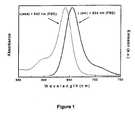
- Figure 1 is a graph showing excitation (dotted line) and emission (solid line) spectra for (13)-HSA in phosphate-buffered saline (PBS).
- the invention relates generally to photoluminescent compounds and to methods of using such compounds.
- These photoluminescent compounds may be useful in both free and conjugated forms, as probes, labels, and/or indicators. This usefulness may reflect in part enhancement of one or more of the following: quantum yield, Stokes' shift, extinction coefficients, and photostability. This usefulness also may reflect excitation and emission spectra in relatively inaccessible regions of the spectrum, including the red and near infrared.
- the photoluminescent compounds and their synthetic precursors generally comprise the following structure:
- Photoluminescent compounds In the photoluminescent compounds, B and C are chosen from W 1 and W 2 , one of B and C is W 1 , and one of B and C is W 2 .
- the photoluminescent compounds of the invention are covalently or noncovalently associated with a carrier that is a bead. Covalent association may occur through various mechanisms, including a reactive group, and may involve a spacer for separating the photoluminescent compound or precursor from the carrier. Noncovalent association also may occur through various mechanisms, including incorporation of the photoluminescent compound or precursor into or onto a matrix, such as a bead, or by nonspecific interactions, such as hydrogen bonding, ionic bonding, or hydrophobic interactions.
- Alicyclic groups include groups of organic compounds characterized by arrangement of the carbon atoms in closed ring structures sometimes resembling boats, chairs, or even bird cages. These compounds have properties resembling those of aliphatics and should not be confused with aromatic compounds having the hexagonal benzene ring. Alicyclics comprise three subgroups: (1) cycloparaffins (saturated), (2) cycloolefins (unsaturated with two or more double bonds), and (3) cycloacetylenes (cyclynes) with a triple bond.
- cycloparaffins sometimes called naphthenes
- cyclopropane cyclohexane
- cyclopentane typical of the cycloolefins are cyclopentadiene and cyclooctatetraene.
- Most alicyclics are derived from petroleum or coal tar, and many can be synthesized by various methods.
- Aliphatic groups include groups of organic compounds characterized by straight- or branched-chain arrangement of the constituent carbon atoms.
- Aliphatic hydrocarbons comprise three subgroups: (1) paraffins (alkanes), which are saturated and comparatively unreactive; (2) olefins (alkenes or alkadienes), which are unsaturated and quite reactive; and (3) acetylenes (alkynes), which contain a triple bond and are highly reactive. In complex structures, the chains may be branched or cross-linked.
- Aromatic groups include groups of unsaturated cyclic hydrocarbons containing one or more rings.
- a typical aromatic group is benzene, which has a 6-carbon ring containing three double bonds.
- Most aromatics are highly reactive and chemically versatile.
- Most aromatics are derived from petroleum and coal tar.
- Some 5-membered cyclic compounds, such as the furan group (heterocyclic), are analogous to aromatic compounds.
- Heterocyclic rings include closed-ring structures, usually of either 5 or 6 members, in which one or more of the atoms in the ring is an element other than carbon, e.g., sulfur, nitrogen, etc. Examples include pyridine, pyrole, furan, thiophene, and purine.
- the synthesis of photoluminescent compounds according to the invention typically is achieved in a multi-step reaction, starting with the synthesis of a methylene base.
- the synthesis of suitable bases may proceed based on literature or novel methods.
- the spectral properties of the photoluminescent compounds, including excitation and emission wavelength are strongly dependent on the type of methylene base used.
- Typical starting materials include benzindoles, benzoselenzoles, benzoxazoles, benzimidazoles, etc., and squaric acid.
- Squaric acid is a dibasic acid that undergoes a series of nucleophilic substitution reactions with various reagents, including amines, phenols, and CH-acidic compounds such as 1,2,3,3-tetramethl-benzindole.
- the squaraine bridge in the resulting compounds stabilizes the conjugated chain and shifts the excitation and emission wavelength of these dyes to the red as compared to cyanine-based dyes.
- squaraine dyes may include a cyanine-type chromophore and a squarate bridge.
- sulfonic acid or other groups may be introduced into the heterocyclic ring systems, and to permit covalent attachment to proteins, reactive N-hydroxysuccinimide ester (NHS ester) or other forms may be synthesized.
- NHS ester reactive N-hydroxysuccinimide ester
- dicyanomethylen-substituted versions of the squaraines were synthesized and tested for their potential use for labeling of biopolymers.
- the absorption and emission wavelengths can be tuned by substitution of the squaraine ring or by introducing heteroatoms into the heterocyclic moiety.
- the indolenine-squaraines absorb around 635 to 640 in water and at approximately 645 to 650 nm when bound to proteins.
- the absorption and emission spectra of benzothiazolium and benzoselenzolium squaraines on the other hand are shifted towards longer wavelengths.
- Typical emission wavelengths for such squaraine dyes are around 680 nm to 690 nm for benzothiazole dyes and beyond 700 nm for benzoselenzole derivatives. Importantly, the Stokes' shift increases in these longer wavelength-emitting dyes, which ultimately increases the sensitivity of a fluorescent measurement.
- the resulting dyes show absorption and emission maxima beyond 600 nm and their wavelength can be tuned by changing the heterocyclic moiety and/or the substitution on the squaraine ring system.
- the Stokes' shift of the methylene derivatives of symmetric squaraines (15) is increased more than 2.5 times relative to the Stokes' shift of the analogous oxygen-containing squaraines (8) and (3b).
- a further increase of the Stokes' shift can be achieved by introducing asymmetry into the molecule.
- the asymmetric versions (15) are expected to have even higher Stokes' shifts.
- Example 8 describes synthetic pathways to unsymmetrical thiosquaraine and methylenesquaraine dyes.
- the thiosquaraine compounds of this example do not form part of the invention as claimed.
- the key intermediates for this subgroup of squaraine dyes are mono-substituted thiosquaraine and methylenesquaraine derivatives, which are synthesized by reacting the 1,3-dithiosquaric acid disodium salt (2c) or 4-dicyanomethylene-2,3-dibutyl squarate (2d) with 1 equivalent of indolenine (1a). Subsequently the intermediate is reacted with one equivalent of a different methylene base.
- the synthesis of unsymmetrical squaraine dyes allows access to mono-functional reactive squaraine dyes (Scheme 1). Such dyes show improved labelling performance because of reduced crosslinking with proteins.
- Example 9 shows structures of thiosquaraine and methylenesquaraine based dyes which should further demonstrate the variety of structures which can be synthesized from this invention. Only the dicyanomethylene-squaraine compounds of this example form part of the invention as claimed. Most of the representative structures are based on reactive water soluble dyes showing different substitution patterns on the central bridge. Two of the structures contain phosphoramidite linkages for direct coupling used in solid support DNA or RNA synthesis. Sulfonated and non-sulfonated versions of squaraine dyes can be used for the synthesis of phosphoramidites.
- the phosphoramidite linkage can either be incorporated in the heterocyclic bases or can be attached to the central squarate ring via activation of a carboxyl-cyano methylene function to an NHS ester and reacting it with an amino-alcohol spacer group.
- the introduced hydroxyl function is then converted by standard procedures into a phosphoramidite.
- 1,3-dithiosquaric acid disodium salt (2c) and dicyanomethylenedimethylsquarate (2d) were synthesized according to G. Seitz et al., Chem. Ber. 112, 990-999 (1979 ), and B. Gerecht et al., Chem. Ber. 117, 2714-2729 (1984 ), respectively.
- the wet diazo-compound was added under stirring and cooling (5°C) to a solution of 170 g of sodium sulfite in 500 mL of water. The solution, which turned orange, was stirred under cooling for 1 h, and then heated to reflux. Finally, 400 mL of concentrated hydrochloric acid were added. The solution turned yellow, and the product precipitated as a white solid. For complete decoloration, 1-2 g of powdered zinc were added. The reaction mixture was cooled overnight, and the precipitate was filtered, washed with water, and dried in an oven at 100°C.
- the precipitate was dissolved in methanol, and a concentrated solution of potassium hydroxide in 2-propanol was added until a yellow solid completely precipitated.
- the precipitate was filtered, washed with ether, and dried in a desiccator over P 2 O 5 .
- thiosquaraine compounds of this example do not form part of the invention as claimed, but are retained as useful background information.
- the mono-ester is then reacted with the amine or an amino acid derivative to give the amino derivative.
- This mechanism offers a convenient way of converting a nonreactive squaraine dye into a reactive analog.
- Protein labeling reactions were carried out using a 50 mM bicarbonate buffer (pH 9.1). A stock solution of 1 mg of dye in 100 ⁇ L of anhydrous DMF was prepared. 10 mg of protein were dissolved in 1 mL of 100 mM bicarbonate buffer (pH 9.1). Dye from the stock solution was added, and the mixture was stirred for 24 h at room temperature.
- Unconjugated dye was separated from labeled proteins using gel permeation chromatography with Sephadex G50 (0.5 cm x 20 cm column) and a 22 mM phosphate buffer solution (pH 7.3) as the eluent.
- the first colored band contained the dye-protein conjugate.
- a later blue band with a much higher retention time contained the separated free dye.
- a series of labeling reactions as described above were set up to obtain different dye-to-protein ratios. Compared to the free forms, the protein-bound forms of the dyes show distinct changes in their spectral properties.
- the following table shows fluorescence decay times of various dyes and their conjugates.
- the experimental conditions included (1) excitation at 600 nm, using a rhodamine B dye laser, (2) emission observed at 660 nm, using an interference filter having a 10 nm band pass, and (3) temperature of 20°C.
- Figure 1 shows absorption (excitation) and emission spectra for ( 13 )-HSA in PBS.
- the following table summarizes data for ( 13 )-HSA and various other reactive squaraine dyes and their conjugates in PBS. Squaraine ⁇ max (abs) [nm] ⁇ max (em) [nm] ⁇ [L(mol*cm)] Q.Y.
- the invention provides also a number of methods for utilizing these compounds in various assay formats.
- the assay may be a competitive assay that includes a recognition moiety, a binding partner, and an analyte. Binding partners and analytes may be selected from the group consisting of biomolecules, drugs, and polymers.
- binding partners and analytes may be selected from the group consisting of biomolecules, drugs, and polymers.
- one or more components are labeled with photoluminescent compounds in accordance with the invention.
- the binding partner may be labeled with such a photoluminescent compound, and the displacement of the compound from an immobilized recognition moiety may be detected by the appearance of fluorescence in a liquid phase of the assay.
- an immobilized enzyme may be used to form a complex with the fluorophore-conjugated substrate.
- the binding of antagonists to a receptor can be assayed by a competitive binding method in so called ligand/receptor assays.
- a labeled antagonist competes with an unlabelled ligand for the receptor binding site.
- One of the binding partner can be, but not necessarily does has to be immobilized.
- Such assays can also be performed in microplates. Immobilization can be achieved via covalent attachment to the well wall or to the surface of beads.
- immunological assays There are several types assay formats.
- Competitive binding assays in which labeled and unlabeled antigens compete for the binding sites on the surface of an antibody (binding material). Typically, there are incubation times required to provide sufficient time for equilibration. Such assays can be performed in a heterogeneous or homogeneous fashion.
- Sandwich assays use secondary antibodies and access binding material is removed from the analyte by a washing step.
- reactions include binding between avidin and biotin, protein A and immunoglobulins, lectins and sugars (e.g., concanavalin A and glucose).
- Photoluminescent compounds described here also may be used to sequence nucleic acids and peptides.
- fluorescently labeled oligonucleotides may be used to trace DNA fragments.
- FISH fluorescence in-situ hybridization methods
- SNPs single nucleotide polymorphisms
- Multicolor labeling experiments allow different biochemical parameters to be monitored simultaneously.
- two or more fluorophores are introduced into the biological system to report on different biochemical functions.
- the technique can be applied to fluorescence in-situ hybridization (FISH), DNA sequencing, fluorescence microscopy, and flow cytometry.
- FISH fluorescence in-situ hybridization
- One way to achieve multicolor analysis is to label biomolecules such as nucleotides, proteins or DNA primers with different fluorescent markers and distinct fluorescence properties.
- Fluorophores with narrow emission bandwidths are preferred for multicolor labeling, because they have only a small overlap with the other dyes and hence increase the number of dyes possible in a multicolor experiment.
- the emission maxima have to be well separated from each other to allow sufficient resolution of the signal.
- a suitable multicolor triplet of fluorophores would include Cy3, TRITC, and a photoluminescent compound as described herein, among others.
- FISH fluorescence in-situ hybridization
- probes can be visualized by the distinct spectra of the three fluorescent markers, while four others will appear as fluorophore mixtures, e.g. probe 4 (fluorescein and rhodamine); probe 5 (fluorescein and Cascade Blue); probe 6 (rhodamine and cascade Blue); and probe 7 (fluorescein, rhodamine and Cascade Blue).
- probe 4 fluorescein and rhodamine
- probe 5 fluorescein and Cascade Blue
- probe 6 rhodamine and cascade Blue
- probe 7 fluorescein, rhodamine and Cascade Blue
- the second way is to label each nucleic acid probe with a fluorophore with distinct spectral properties. Similar conjugates can be synthesized from this invention and used in a multicolor multisequence analysis approach.
- the luminescent compounds of the invention can also be used for screening assays for a combinatorial library of compounds.
- the compounds can be screened for a number of characteristics, including their specificity and avidity for a particular recognition moiety.
- a screening assay is used to determine compounds that bind to a target molecule, and thereby create a signal change which is generated by a labeled ligand bound to the target molecule.
- Such assays allow screening of compounds that act as agonists or antagonists of a receptor, or that disrupt a protein-protein interaction. It also can be used to detect hybridization pr binding of DNA and/or RNA.
- nonfluorescent enzyme substrates of the invention could be used to trace the interaction with the substrate.
- fluorescent substrates can be used for such assays.
- the cleavage of the fluorescent substrate leads to a change in the spectral properties such as the excitation and emission maximum, which allows to distinguish between the free and the bound fluorophore.
- the invention can be used to detect an analyte that interacts with a recognition moiety in a detectable manner.
- the invention can be attached to a recognition moiety which is known to those of skill in the art.
- recognition moieties allow the detection of specific analytes. Examples are pH-, or potassium sensing molecules, e.g., synthesized by introduction of potassium chelators such as crown-ethers (aza crowns, thia crowns etc).
- Calcium-sensors based on BAPTA (1,2- B is(2- a mino p henoxy)ethan-N,N,N',N'-tetra-aceticacic) as the chelating species are frequently used to trace the intracellular ion concentrations.
- the squaraine dyes are known to have lifetimes in the range of hundreds of ps to a few ns (see Table). The nanosecond lifetime and long-wavelength absorption and emission of these dyes when bound to proteins would allow them to be measured with inexpensive instrumentation using laser diodes for excitation and avalanche photodiodes for detection.
- Typical assay based on the measurement of the fluorescence lifetime as a parameter are FRET (fluorescence resonance energy transfer) assays.
- FRET fluorescence resonance energy transfer
- the binding between a fluorescent donor labeled species (typically an antigen) and a fluorescent acceptor labeled species are accompanied by a change in the intensity and the fluorescence lifetime.
- the lifetime can be measured using intensity- or phase-modulation-based methods ( J.R. LAKOWICZ, PRINCIPLES OF FLUORESCENCE SPECTROSCOPY (1983 )).
- Fluorescence polarization immunoassays are widely applied to quantify low molecular weight antigens.
- the assays are based on polarization measurements of antigens labeled with fluorescent probes.
- the requirement for polarization probes used in FPls is that emission from the unbound labeled antigen be depolarized and increase upon binding to the antibody.
- Low molecular weight species labeled with the compounds of the invention can be used in such binding assays, and the unknown analyte concentration can determined by the change in polarized emission from the fluorescent tracer molecule.
- Squaraines which are 1,3-disubstituted squaric acid derivatives, show high absorption coefficients ( ⁇ > 200.000 l mol -1 cm -1 ) in the red region, display a high photostability, and allow the introduction of reactive functional groups such as NHS esters. These dyes exhibit good quantum yields on binding to proteins.
- the hydrophilic character of the dyes can be improved by introducing sulfonic acid groups.
- the advantages of fluorescence detection at long wavelength excitation are the decreased autofluorescence from cells and tissues and the use of inexpensive laser light sources such as diode lasers operating at 635, 645, and 650 nm.
- the autofluorescence of biological samples decreases with increasing wavelength, particularly beyond 600 nm.
- Amine-reactive functionalities such as isothiocyanate and N-hydroxysuccinimide esters and thiol-reactive iodoacetamide and maleimide groups can be used to covalently attach marker molecules to drugs, DNA, antibodies or synthetic polymers.
Landscapes
- Chemical & Material Sciences (AREA)
- Life Sciences & Earth Sciences (AREA)
- Engineering & Computer Science (AREA)
- Health & Medical Sciences (AREA)
- Urology & Nephrology (AREA)
- Biomedical Technology (AREA)
- Organic Chemistry (AREA)
- Hematology (AREA)
- Immunology (AREA)
- Molecular Biology (AREA)
- Food Science & Technology (AREA)
- General Health & Medical Sciences (AREA)
- Cell Biology (AREA)
- Medicinal Chemistry (AREA)
- Physics & Mathematics (AREA)
- Analytical Chemistry (AREA)
- Biochemistry (AREA)
- Microbiology (AREA)
- General Physics & Mathematics (AREA)
- Pathology (AREA)
- Materials Engineering (AREA)
- Biotechnology (AREA)
- Plural Heterocyclic Compounds (AREA)
- Investigating Or Analysing Materials By The Use Of Chemical Reactions (AREA)
Claims (5)
- Stoffzusammensetzung, welche eine photolumineszente Verbindung umfasst, wobei die photolumineszente Verbindung die folgende Struktur aufweist:
 (a)
(a)
B und C jeweils aus der aus W1 und W2 bestehenden Gruppe ausgewählt werden, wobei W1 und W2 gegeben sind durch
 (b) B oder C W1 ist und der jeweils andere Bestandteil W2 ist;(c) n für Bunt C jeweils unabhängig aus der Gruppe ausgewählt wird, die aus 0, 1 und 2 besteht;(d) Y für B und C jeweils unabhängig aus der Gruppe ausgewählt wird, die aus O S, Se, Te, N-Rh und C(Ri)(Rj) besteht, wobei Rh aus der Gruppe ausgewählt wird, die aus H, aliphatischen Gruppen, alizyklischen Gruppen und aromatischen Gruppen besteht, und wobei Ri und RJ jeweils aus der Gruppe der aliphatischen Gruppen ausgewäh!t wird;(e) R für B und C jeweils unabhängig aus der Gruppe ausgewählt wird, die aus H, aliphatischen Gruppen, alizyklischen Gruppen und aromatischen Gruppen besteht; und(f) jeweils X1, X2, X3 und X4 für B und C jeweils unabhängig aus der Gruppe ausgewählt wird, die aus N, O, S und C-Rk besteht, wobei Rk aus der Gruppe ausgewählt wird, die aus H, F, Cl, Br, l, aliphatischen Gruppen, alizyklischen Gruppen, aromatischen Gruppen und Teilen eines substituierten kondensierten aromatischen oder heterocyklischen Rings besteht:wobei die photolumineszente Verbindung kovalent oder non-kovalent an einen Träger gebunden ist, welcher eine Perle ist
 - Zusammensetzung nach Anspruch 1, wobei die photolumineszente Verbindung symmetrisch ist.
- Zusammensetzung nach Anspruch 1, wobei die photolumineszente Verbindung asymmetrisch ist.
- Zusammensetzung nach Anspruch 1, wobei n gleich 1 ist.
- Verfahren zur Durchführung einer Photolumineszenz-Bestimmung, wobei das Verfahren Folgendes umfasst:Anregen einer photolumineszenten Verbindung, wie sie in einem beliebigen der Ansprüche 1 bis 4 definiert ist, mit Anregungslicht; undErfassen von durch die photolumineszente Verbindung emittiertem Licht.
Priority Applications (1)
| Application Number | Priority Date | Filing Date | Title |
|---|---|---|---|
| EP07102880A EP1849837A3 (de) | 1998-04-08 | 1999-04-07 | Lumineszierende Verbindungen |
Applications Claiming Priority (5)
| Application Number | Priority Date | Filing Date | Title |
|---|---|---|---|
| DE19815659A DE19815659A1 (de) | 1998-04-08 | 1998-04-08 | Reaktive Quadratsäure- und Croconsäure-Farbstoffe als Marker für Biomoleküle und Arzneistoffe |
| DE19815659 | 1998-04-08 | ||
| US8382098P | 1998-05-01 | 1998-05-01 | |
| US83820P | 1998-05-01 | ||
| PCT/US1999/007627 WO1999051702A1 (en) | 1998-04-08 | 1999-04-07 | Luminescent compounds |
Related Child Applications (2)
| Application Number | Title | Priority Date | Filing Date |
|---|---|---|---|
| EP07102880A Division EP1849837A3 (de) | 1998-04-08 | 1999-04-07 | Lumineszierende Verbindungen |
| EP07102880.7 Division-Into | 2007-02-22 |
Publications (3)
| Publication Number | Publication Date |
|---|---|
| EP1078023A1 EP1078023A1 (de) | 2001-02-28 |
| EP1078023A4 EP1078023A4 (de) | 2003-03-26 |
| EP1078023B1 true EP1078023B1 (de) | 2011-01-05 |
Family
ID=26045346
Family Applications (1)
| Application Number | Title | Priority Date | Filing Date |
|---|---|---|---|
| EP99915319A Expired - Lifetime EP1078023B1 (de) | 1998-04-08 | 1999-04-07 | Lumineszierende verbindungen |
Country Status (3)
| Country | Link |
|---|---|
| EP (1) | EP1078023B1 (de) |
| AU (1) | AU3386399A (de) |
| WO (1) | WO1999051702A1 (de) |
Families Citing this family (56)
| Publication number | Priority date | Publication date | Assignee | Title |
|---|---|---|---|---|
| EP1770129B1 (de) | 2000-09-29 | 2012-07-25 | Life Technologies Corporation | Modifizierte Carbocyaninfarbstoffe und deren Konjugate |
| ATE352586T2 (de) | 2000-09-29 | 2007-02-15 | Molecular Probes Inc | Modifizierte carbocyaninfarbstoffe und deren konjugate |
| US8323903B2 (en) | 2001-10-12 | 2012-12-04 | Life Technologies Corporation | Antibody complexes and methods for immunolabeling |
| AU2003207438A1 (en) | 2002-01-02 | 2003-07-24 | Visen Medical, Inc. | Amine functionalized superparamagnetic nanoparticles for the synthesis of bioconjugates and uses therefor |
| WO2005050206A2 (en) | 2003-09-17 | 2005-06-02 | Molecular Probes, Inc. | Competitive immunoassay |
| GB0323171D0 (en) * | 2003-10-03 | 2003-11-05 | Univ Coventry | Fluorescent compound |
| US7767834B2 (en) * | 2004-08-13 | 2010-08-03 | Elitech Holding B.V. | Phosphonylated fluorescent dyes and conjugates |
| EP1781675B1 (de) | 2004-08-13 | 2014-03-26 | Epoch Biosciences, Inc. | Fluoreszierende phosphonatfarbstoffe und konjugate |
| CN101296927A (zh) | 2005-09-02 | 2008-10-29 | Visen医药公司 | 生物相容的含n,n-二取代磺酰胺的荧光染料标记 |
| DK1937676T3 (en) | 2005-09-02 | 2017-03-06 | Visen Medical Inc | Biocompatible fluorescent imaging compounds |
| WO2007028118A2 (en) | 2005-09-02 | 2007-03-08 | Visen Medical, Inc. | Nicotinic acid and picolinic acid derived near-infrared fluorophores |
| US8093012B2 (en) | 2005-10-13 | 2012-01-10 | Aureon Laboratories, Inc. | Multiplex in situ immunohistochemical analysis |
| WO2007111669A2 (en) | 2005-12-22 | 2007-10-04 | Visen Medical, Inc. | Combined x-ray and optical tomographic imaging system |
| EP1973575B1 (de) | 2005-12-22 | 2019-07-24 | Visen Medical, Inc. | Biokompatibele fluoreszierende metalloxide nanopartikel |
| JP2009524832A (ja) | 2006-01-24 | 2009-07-02 | ライフ テクノロジーズ コーポレーション | 検体を定量するためのデバイスおよび方法 |
| US8114636B2 (en) | 2006-02-10 | 2012-02-14 | Life Technologies Corporation | Labeling and detection of nucleic acids |
| WO2008029281A2 (en) | 2006-02-10 | 2008-03-13 | Invitrogen Corporation | Labeling and detection of post translationally modified proteins |
| US8562802B1 (en) | 2006-02-13 | 2013-10-22 | Life Technologies Corporation | Transilluminator base and scanner for imaging fluorescent gels, charging devices and portable electrophoresis systems |
| SG171598A1 (en) | 2006-03-23 | 2011-06-29 | Absorber Ab | Blood group antigens of different types for diagnostic and therapeutic applications |
| JP5337691B2 (ja) | 2006-04-20 | 2013-11-06 | ベクトン・ディキンソン・アンド・カンパニー | 熱安定性タンパク質ならびにその作製方法および使用方法 |
| US8906354B2 (en) | 2007-02-28 | 2014-12-09 | Bruker Biospin Corporation | Loaded latex optical molecular imaging probes containing lipophilic large stokes shift dyes |
| US8017104B2 (en) | 2007-02-28 | 2011-09-13 | Carestream Health, Inc. | Large stoke shift dye used for optical imaging |
| WO2009055095A1 (en) | 2007-10-19 | 2009-04-30 | Visen Medical, Inc. | Imaging systems featuring waveguiding compensation |
| EP2732826B1 (de) | 2008-01-18 | 2017-11-08 | Visen Medical, Inc. | Fluoreszierende Bildgebungsmittel |
| WO2009114776A2 (en) | 2008-03-14 | 2009-09-17 | Visen Medical, Inc. | Integrin targeting agents and methods of using same |
| CN104263816B (zh) | 2008-05-16 | 2018-10-19 | 生命技术公司 | 用于测量细胞增殖的双标记法 |
| US8864821B2 (en) | 2008-11-26 | 2014-10-21 | Visen Medical, Inc. | Methods and compositions for identifying subjects at risk of developing stent thrombosis |
| AU2010286592B2 (en) | 2009-08-28 | 2015-08-13 | Visen Medical, Inc. | Systems and methods for tomographic imaging in diffuse media using a hybrid inversion technique |
| JP5730311B2 (ja) | 2009-08-31 | 2015-06-10 | プロメガ コーポレイションPromega Corporation | 反応性シアニン化合物 |
| JP5945226B2 (ja) | 2009-09-22 | 2016-07-05 | ビセン メディカル, インコーポレイテッド | 拡散媒質の仮想屈折率整合のためのシステムおよび方法 |
| WO2012022734A2 (en) | 2010-08-16 | 2012-02-23 | Medimmune Limited | Anti-icam-1 antibodies and methods of use |
| CA2835286C (en) | 2011-05-09 | 2021-03-23 | Visen Medical, Inc. | Carbonic anhydrase targeting agents and methods of using same |
| CN104245954A (zh) | 2012-03-30 | 2014-12-24 | 文森医学公司 | 细菌成像剂及其使用方法 |
| WO2014028057A1 (en) | 2012-08-15 | 2014-02-20 | Visen Medical, Inc. | Prostate specific antigen agents and methods of using same for prostate cancer imaging |
| CN104853669B (zh) | 2012-10-15 | 2017-07-21 | 文森医学公司 | 具有荧光及生物发光源的交叉形态加权特征的漫射介质成像的系统、方法及设备 |
| US20150246146A1 (en) | 2012-10-25 | 2015-09-03 | Life Technologies Corporation | Methods and compositions for enzyme-mediated site-specific radiolabeling of glycoproteins |
| WO2015050959A1 (en) | 2013-10-01 | 2015-04-09 | Yale University | Anti-kit antibodies and methods of use thereof |
| PT3052192T (pt) | 2013-10-02 | 2020-09-24 | Medimmune Llc | Anticorpos neutralizantes anti-influenza a e suas utilizações |
| US9504405B2 (en) | 2013-10-23 | 2016-11-29 | Verily Life Sciences Llc | Spatial modulation of magnetic particles in vasculature by external magnetic field |
| US10542918B2 (en) | 2013-10-23 | 2020-01-28 | Verily Life Sciences Llc | Modulation of a response signal to distinguish between analyte and background signals |
| CN106455979A (zh) | 2013-12-31 | 2017-02-22 | 纪念斯隆-凯特琳癌症中心 | 用于荧光源实时多通道成像的系统、方法和设备 |
| CA2954780A1 (en) | 2014-07-15 | 2016-01-21 | Medimmune, Llc | Neutralizing anti-influenza b antibodies and uses thereof |
| KR20170094268A (ko) | 2014-12-15 | 2017-08-17 | 메모리얼 슬로안-케터링 캔서 센터 | 향상된 신경-결합 선택성을 갖는 고리형 펩티드, 상기 고리형 펩티드와 결합된 나노입자, 및 실시간 생체내 신경 조직 영상화를 위한 이들의 용도 |
| US9861710B1 (en) | 2015-01-16 | 2018-01-09 | Verily Life Sciences Llc | Composite particles, methods, and in vivo diagnostic system |
| US10028659B2 (en) | 2015-03-26 | 2018-07-24 | Verily Life Sciences Llc | Aptamer-based sensors, implantable devices and detection system |
| BR112018011868A2 (pt) | 2015-12-15 | 2018-12-04 | Univ Cornell | sistemas de imagem e métodos para diferenciação de tecidos, por exemplo, para visualização intraoperatória |
| JP6605039B2 (ja) * | 2015-12-17 | 2019-11-13 | 富士フイルム株式会社 | 近赤外線吸収性組成物、膜、赤外線カットフィルタ、固体撮像素子、赤外線吸収剤および化合物 |
| EP3443126B1 (de) | 2016-04-15 | 2023-11-15 | Icahn School of Medicine at Mount Sinai | Gewebeprofilierung unter verwendung von multiplexierten immunhistochemischen aufeinanderfolgenden färbungen |
| BR112019010947A2 (pt) | 2016-11-30 | 2019-10-01 | Memorial Sloan Kettering Cancer Center | nanopartículas ultrapequenas funcionalizadas por inibidores e métodos das mesmas |
| EP3601608A1 (de) | 2017-03-30 | 2020-02-05 | Life Technologies Corporation | Quantifizierung von ngs-dna durch adaptersequenz |
| US11989803B2 (en) | 2018-03-30 | 2024-05-21 | Perkinelmer Health Sciences, Inc. | Systems and methods for 3D reconstruction of anatomical organs and inclusions using short-wave infrared (SWIR) projection tomography |
| CN114560789B (zh) * | 2018-10-09 | 2023-12-19 | 宁波卢米蓝新材料有限公司 | 一种含有多元环的化合物、应用及有机电致发光器件 |
| WO2022006368A2 (en) | 2020-07-02 | 2022-01-06 | Life Technologies Corporation | Trinucleotide cap analogs, preparation and uses thereof |
| CN112557589B (zh) * | 2020-11-02 | 2022-02-25 | 北京理工大学 | 一种评估活性破片耦合能量时空域释放特性的方法及系统 |
| EP4015004A1 (de) | 2020-12-18 | 2022-06-22 | Phi Pharma SA | Proteoglykanspezifische verzweigte peptide |
| CN112851650B (zh) * | 2020-12-31 | 2022-05-31 | 山西大学 | 一种超快速检测生物硫醇荧光探针的制备方法及其应用 |
Family Cites Families (5)
| Publication number | Priority date | Publication date | Assignee | Title |
|---|---|---|---|---|
| US3998943A (en) * | 1973-10-02 | 1976-12-21 | Syva Company | Double receptor fluorescent immunoassay |
| US3996345A (en) * | 1974-08-12 | 1976-12-07 | Syva Company | Fluorescence quenching with immunological pairs in immunoassays |
| US4883867A (en) * | 1985-11-01 | 1989-11-28 | Becton, Dickinson And Company | Detection of reticulocytes, RNA or DNA |
| US5101015A (en) * | 1989-04-10 | 1992-03-31 | Abbott Laboratories | Reagents for an amphetamine-class fluorescence polarization immunoassay |
| US5880287A (en) * | 1990-05-15 | 1999-03-09 | Hyperion, Inc. | Polyoxyhydrocarbyl related products and methods for fluorescence assays |
-
1999
- 1999-04-07 WO PCT/US1999/007627 patent/WO1999051702A1/en not_active Ceased
- 1999-04-07 AU AU33863/99A patent/AU3386399A/en not_active Abandoned
- 1999-04-07 EP EP99915319A patent/EP1078023B1/de not_active Expired - Lifetime
Non-Patent Citations (1)
| Title |
|---|
| E. TERPETSCHNIG ET AL.: "Synthesis, spectral properties and photostabilities of symmetrical and unsymmetrical squaraines; a new class of fluorophores with long-wavelength excitation and emission", ANALYTICA CHIMICA ACTA, vol. 282, 1993, pages 633 - 641 * |
Also Published As
| Publication number | Publication date |
|---|---|
| EP1078023A1 (de) | 2001-02-28 |
| AU3386399A (en) | 1999-10-25 |
| EP1078023A4 (de) | 2003-03-26 |
| WO1999051702A1 (en) | 1999-10-14 |
Similar Documents
| Publication | Publication Date | Title |
|---|---|---|
| WO1999051702A1 (en) | Luminescent compounds | |
| US7250517B2 (en) | Luminescent compounds | |
| JP4790598B2 (ja) | メソ置換シアニン色素標識化試薬 | |
| EP2129788B1 (de) | Lumineszente verbindungen | |
| Tatarets et al. | Synthesis of water-soluble, ring-substituted squaraine dyes and their evaluation as fluorescent probes and labels | |
| US8642014B2 (en) | Luminescent compounds | |
| US20040162423A1 (en) | Benzopyrylo-polymethine-based hydrophilic markers | |
| US20030224391A1 (en) | Rigidized trimethine cyanine dyes | |
| EP1042407A1 (de) | Versteifte trimethin-cyaninfarbstoffe | |
| JP2003532745A (ja) | エネルギー伝達アッセイ法および試薬 | |
| US6538129B1 (en) | Luminescent compounds | |
| JP4659213B2 (ja) | エネルギー転移色素 | |
| US7411068B2 (en) | Luminescent compounds | |
| US11091646B2 (en) | Luminescent squaraine rotaxane compounds | |
| US7351829B2 (en) | Compounds on the basis of 2- and 4-chromenylidene-merocyanines respectively, and their use | |
| US20010021514A1 (en) | Luminescent metal-ligand complexes | |
| US6706879B2 (en) | Fluorescent dye | |
| EP1810998B1 (de) | Fluoreszierender Cyaninfarbstoff | |
| US20030235846A1 (en) | Luminescent compounds | |
| Terpetschnig et al. | Luminescent probes for NIR sensing applications | |
| US6335450B1 (en) | Efficient cyclic-bridged cyanine dyes | |
| EP1849837A2 (de) | Lumineszente Verbindungen | |
| WO2003087052A2 (en) | Dyes and fluorescent compounds | |
| WO2001046209A1 (en) | Fluorescent probes | |
| ES2357989T3 (es) | Compuestos luminiscentes. |
Legal Events
| Date | Code | Title | Description |
|---|---|---|---|
| PUAI | Public reference made under article 153(3) epc to a published international application that has entered the european phase |
Free format text: ORIGINAL CODE: 0009012 |
|
| 17P | Request for examination filed |
Effective date: 20001107 |
|
| AK | Designated contracting states |
Kind code of ref document: A1 Designated state(s): AT BE CH DE DK ES FI FR GB IE IT LI LU NL SE |
|
| A4 | Supplementary search report drawn up and despatched |
Effective date: 20030206 |
|
| RIC1 | Information provided on ipc code assigned before grant |
Ipc: 7C 09B 23/00 B Ipc: 7G 01N 21/64 B Ipc: 7C 09K 11/06 A |
|
| GRAP | Despatch of communication of intention to grant a patent |
Free format text: ORIGINAL CODE: EPIDOSNIGR1 |
|
| GRAS | Grant fee paid |
Free format text: ORIGINAL CODE: EPIDOSNIGR3 |
|
| GRAA | (expected) grant |
Free format text: ORIGINAL CODE: 0009210 |
|
| RAP1 | Party data changed (applicant data changed or rights of an application transferred) |
Owner name: LUMINEX CORPORATION |
|
| RIN1 | Information on inventor provided before grant (corrected) |
Inventor name: LUMINEX CORPORATION |
|
| AK | Designated contracting states |
Kind code of ref document: B1 Designated state(s): AT BE CH DE DK ES FI FR GB IE IT LI LU NL SE |
|
| REG | Reference to a national code |
Ref country code: GB Ref legal event code: FG4D |
|
| REG | Reference to a national code |
Ref country code: CH Ref legal event code: EP |
|
| REG | Reference to a national code |
Ref country code: IE Ref legal event code: FG4D |
|
| REF | Corresponds to: |
Ref document number: 69943106 Country of ref document: DE Date of ref document: 20110217 Kind code of ref document: P |
|
| REG | Reference to a national code |
Ref country code: DE Ref legal event code: R096 Ref document number: 69943106 Country of ref document: DE Effective date: 20110217 |
|
| REG | Reference to a national code |
Ref country code: NL Ref legal event code: T3 |
|
| REG | Reference to a national code |
Ref country code: ES Ref legal event code: FG2A Ref document number: 2357989 Country of ref document: ES Kind code of ref document: T3 Effective date: 20110504 |
|
| PG25 | Lapsed in a contracting state [announced via postgrant information from national office to epo] |
Ref country code: SE Free format text: LAPSE BECAUSE OF FAILURE TO SUBMIT A TRANSLATION OF THE DESCRIPTION OR TO PAY THE FEE WITHIN THE PRESCRIBED TIME-LIMIT Effective date: 20110105 |
|
| PG25 | Lapsed in a contracting state [announced via postgrant information from national office to epo] |
Ref country code: FI Free format text: LAPSE BECAUSE OF FAILURE TO SUBMIT A TRANSLATION OF THE DESCRIPTION OR TO PAY THE FEE WITHIN THE PRESCRIBED TIME-LIMIT Effective date: 20110105 Ref country code: AT Free format text: LAPSE BECAUSE OF FAILURE TO SUBMIT A TRANSLATION OF THE DESCRIPTION OR TO PAY THE FEE WITHIN THE PRESCRIBED TIME-LIMIT Effective date: 20110105 |
|
| PG25 | Lapsed in a contracting state [announced via postgrant information from national office to epo] |
Ref country code: DK Free format text: LAPSE BECAUSE OF FAILURE TO SUBMIT A TRANSLATION OF THE DESCRIPTION OR TO PAY THE FEE WITHIN THE PRESCRIBED TIME-LIMIT Effective date: 20110105 |
|
| PLBE | No opposition filed within time limit |
Free format text: ORIGINAL CODE: 0009261 |
|
| STAA | Information on the status of an ep patent application or granted ep patent |
Free format text: STATUS: NO OPPOSITION FILED WITHIN TIME LIMIT |
|
| REG | Reference to a national code |
Ref country code: CH Ref legal event code: PL |
|
| 26N | No opposition filed |
Effective date: 20111006 |
|
| PG25 | Lapsed in a contracting state [announced via postgrant information from national office to epo] |
Ref country code: IT Free format text: LAPSE BECAUSE OF FAILURE TO SUBMIT A TRANSLATION OF THE DESCRIPTION OR TO PAY THE FEE WITHIN THE PRESCRIBED TIME-LIMIT Effective date: 20110105 |
|
| PG25 | Lapsed in a contracting state [announced via postgrant information from national office to epo] |
Ref country code: CH Free format text: LAPSE BECAUSE OF NON-PAYMENT OF DUE FEES Effective date: 20110430 Ref country code: LI Free format text: LAPSE BECAUSE OF NON-PAYMENT OF DUE FEES Effective date: 20110430 |
|
| REG | Reference to a national code |
Ref country code: IE Ref legal event code: MM4A |
|
| REG | Reference to a national code |
Ref country code: DE Ref legal event code: R097 Ref document number: 69943106 Country of ref document: DE Effective date: 20111006 |
|
| PG25 | Lapsed in a contracting state [announced via postgrant information from national office to epo] |
Ref country code: IE Free format text: LAPSE BECAUSE OF NON-PAYMENT OF DUE FEES Effective date: 20110407 |
|
| PG25 | Lapsed in a contracting state [announced via postgrant information from national office to epo] |
Ref country code: LU Free format text: LAPSE BECAUSE OF NON-PAYMENT OF DUE FEES Effective date: 20110407 |
|
| REG | Reference to a national code |
Ref country code: DE Ref legal event code: R082 Ref document number: 69943106 Country of ref document: DE Representative=s name: D YOUNG & CO LLP, GB Ref country code: DE Ref legal event code: R082 Ref document number: 69943106 Country of ref document: DE |
|
| REG | Reference to a national code |
Ref country code: FR Ref legal event code: PLFP Year of fee payment: 18 |
|
| REG | Reference to a national code |
Ref country code: FR Ref legal event code: PLFP Year of fee payment: 19 |
|
| REG | Reference to a national code |
Ref country code: FR Ref legal event code: PLFP Year of fee payment: 20 |
|
| PGFP | Annual fee paid to national office [announced via postgrant information from national office to epo] |
Ref country code: NL Payment date: 20180426 Year of fee payment: 20 |
|
| PGFP | Annual fee paid to national office [announced via postgrant information from national office to epo] |
Ref country code: ES Payment date: 20180503 Year of fee payment: 20 Ref country code: DE Payment date: 20180427 Year of fee payment: 20 |
|
| PGFP | Annual fee paid to national office [announced via postgrant information from national office to epo] |
Ref country code: FR Payment date: 20180425 Year of fee payment: 20 Ref country code: BE Payment date: 20180427 Year of fee payment: 20 |
|
| PGFP | Annual fee paid to national office [announced via postgrant information from national office to epo] |
Ref country code: GB Payment date: 20180427 Year of fee payment: 20 |
|
| REG | Reference to a national code |
Ref country code: DE Ref legal event code: R071 Ref document number: 69943106 Country of ref document: DE |
|
| REG | Reference to a national code |
Ref country code: NL Ref legal event code: MK Effective date: 20190406 |
|
| REG | Reference to a national code |
Ref country code: GB Ref legal event code: PE20 Expiry date: 20190406 |
|
| REG | Reference to a national code |
Ref country code: BE Ref legal event code: MK Effective date: 20190407 |
|
| PG25 | Lapsed in a contracting state [announced via postgrant information from national office to epo] |
Ref country code: GB Free format text: LAPSE BECAUSE OF EXPIRATION OF PROTECTION Effective date: 20190406 |
|
| REG | Reference to a national code |
Ref country code: ES Ref legal event code: FD2A Effective date: 20201204 |
|
| PG25 | Lapsed in a contracting state [announced via postgrant information from national office to epo] |
Ref country code: ES Free format text: LAPSE BECAUSE OF EXPIRATION OF PROTECTION Effective date: 20190408 |