EP1781675B1 - Fluoreszierende phosphonatfarbstoffe und konjugate - Google Patents
Fluoreszierende phosphonatfarbstoffe und konjugate Download PDFInfo
- Publication number
- EP1781675B1 EP1781675B1 EP05786453.0A EP05786453A EP1781675B1 EP 1781675 B1 EP1781675 B1 EP 1781675B1 EP 05786453 A EP05786453 A EP 05786453A EP 1781675 B1 EP1781675 B1 EP 1781675B1
- Authority
- EP
- European Patent Office
- Prior art keywords
- group
- alkyl
- fluorescent dye
- dyes
- aryl
- Prior art date
- Legal status (The legal status is an assumption and is not a legal conclusion. Google has not performed a legal analysis and makes no representation as to the accuracy of the status listed.)
- Expired - Lifetime
Links
- 0 CC(C)(C=CI)C=C(CCC1)C(*)=C1C(C)=CN Chemical compound CC(C)(C=CI)C=C(CCC1)C(*)=C1C(C)=CN 0.000 description 12
- NEGYBGJFKJNETL-UHFFFAOYSA-O CC(C(N1)=O)=CN(C(C2)OC(COP(C)(O)[OH2+])C2O)[IH]1=O Chemical compound CC(C(N1)=O)=CN(C(C2)OC(COP(C)(O)[OH2+])C2O)[IH]1=O NEGYBGJFKJNETL-UHFFFAOYSA-O 0.000 description 1
Images


Classifications
-
- C—CHEMISTRY; METALLURGY
- C07—ORGANIC CHEMISTRY
- C07F—ACYCLIC, CARBOCYCLIC OR HETEROCYCLIC COMPOUNDS CONTAINING ELEMENTS OTHER THAN CARBON, HYDROGEN, HALOGEN, OXYGEN, NITROGEN, SULFUR, SELENIUM OR TELLURIUM
- C07F9/00—Compounds containing elements of Groups 5 or 15 of the Periodic Table
- C07F9/02—Phosphorus compounds
- C07F9/547—Heterocyclic compounds, e.g. containing phosphorus as a ring hetero atom
- C07F9/6558—Heterocyclic compounds, e.g. containing phosphorus as a ring hetero atom containing at least two different or differently substituted hetero rings neither condensed among themselves nor condensed with a common carbocyclic ring or ring system
- C07F9/65586—Heterocyclic compounds, e.g. containing phosphorus as a ring hetero atom containing at least two different or differently substituted hetero rings neither condensed among themselves nor condensed with a common carbocyclic ring or ring system at least one of the hetero rings does not contain nitrogen as ring hetero atom
-
- C—CHEMISTRY; METALLURGY
- C07—ORGANIC CHEMISTRY
- C07F—ACYCLIC, CARBOCYCLIC OR HETEROCYCLIC COMPOUNDS CONTAINING ELEMENTS OTHER THAN CARBON, HYDROGEN, HALOGEN, OXYGEN, NITROGEN, SULFUR, SELENIUM OR TELLURIUM
- C07F9/00—Compounds containing elements of Groups 5 or 15 of the Periodic Table
- C07F9/02—Phosphorus compounds
- C07F9/06—Phosphorus compounds without P—C bonds
- C07F9/08—Esters of oxyacids of phosphorus
- C07F9/141—Esters of phosphorous acids
- C07F9/1411—Esters of phosphorous acids with hydroxyalkyl compounds with further substituents on alkyl
-
- C—CHEMISTRY; METALLURGY
- C07—ORGANIC CHEMISTRY
- C07F—ACYCLIC, CARBOCYCLIC OR HETEROCYCLIC COMPOUNDS CONTAINING ELEMENTS OTHER THAN CARBON, HYDROGEN, HALOGEN, OXYGEN, NITROGEN, SULFUR, SELENIUM OR TELLURIUM
- C07F9/00—Compounds containing elements of Groups 5 or 15 of the Periodic Table
- C07F9/02—Phosphorus compounds
- C07F9/547—Heterocyclic compounds, e.g. containing phosphorus as a ring hetero atom
- C07F9/553—Heterocyclic compounds, e.g. containing phosphorus as a ring hetero atom having one nitrogen atom as the only ring hetero atom
- C07F9/572—Five-membered rings
- C07F9/5728—Five-membered rings condensed with carbocyclic rings or carbocyclic ring systems
-
- C—CHEMISTRY; METALLURGY
- C07—ORGANIC CHEMISTRY
- C07F—ACYCLIC, CARBOCYCLIC OR HETEROCYCLIC COMPOUNDS CONTAINING ELEMENTS OTHER THAN CARBON, HYDROGEN, HALOGEN, OXYGEN, NITROGEN, SULFUR, SELENIUM OR TELLURIUM
- C07F9/00—Compounds containing elements of Groups 5 or 15 of the Periodic Table
- C07F9/02—Phosphorus compounds
- C07F9/547—Heterocyclic compounds, e.g. containing phosphorus as a ring hetero atom
- C07F9/6527—Heterocyclic compounds, e.g. containing phosphorus as a ring hetero atom having nitrogen and oxygen atoms as the only ring hetero atoms
- C07F9/6533—Six-membered rings
-
- C—CHEMISTRY; METALLURGY
- C07—ORGANIC CHEMISTRY
- C07F—ACYCLIC, CARBOCYCLIC OR HETEROCYCLIC COMPOUNDS CONTAINING ELEMENTS OTHER THAN CARBON, HYDROGEN, HALOGEN, OXYGEN, NITROGEN, SULFUR, SELENIUM OR TELLURIUM
- C07F9/00—Compounds containing elements of Groups 5 or 15 of the Periodic Table
- C07F9/02—Phosphorus compounds
- C07F9/547—Heterocyclic compounds, e.g. containing phosphorus as a ring hetero atom
- C07F9/6536—Heterocyclic compounds, e.g. containing phosphorus as a ring hetero atom having nitrogen and sulfur atoms with or without oxygen atoms, as the only ring hetero atoms
- C07F9/6544—Six-membered rings
- C07F9/6547—Six-membered rings condensed with carbocyclic rings or carbocyclic ring systems
-
- C—CHEMISTRY; METALLURGY
- C07—ORGANIC CHEMISTRY
- C07F—ACYCLIC, CARBOCYCLIC OR HETEROCYCLIC COMPOUNDS CONTAINING ELEMENTS OTHER THAN CARBON, HYDROGEN, HALOGEN, OXYGEN, NITROGEN, SULFUR, SELENIUM OR TELLURIUM
- C07F9/00—Compounds containing elements of Groups 5 or 15 of the Periodic Table
- C07F9/02—Phosphorus compounds
- C07F9/547—Heterocyclic compounds, e.g. containing phosphorus as a ring hetero atom
- C07F9/655—Heterocyclic compounds, e.g. containing phosphorus as a ring hetero atom having oxygen atoms, with or without sulfur, selenium, or tellurium atoms, as the only ring hetero atoms
- C07F9/6552—Heterocyclic compounds, e.g. containing phosphorus as a ring hetero atom having oxygen atoms, with or without sulfur, selenium, or tellurium atoms, as the only ring hetero atoms the oxygen atom being part of a six-membered ring
- C07F9/65522—Heterocyclic compounds, e.g. containing phosphorus as a ring hetero atom having oxygen atoms, with or without sulfur, selenium, or tellurium atoms, as the only ring hetero atoms the oxygen atom being part of a six-membered ring condensed with carbocyclic rings or carbocyclic ring systems
-
- C—CHEMISTRY; METALLURGY
- C07—ORGANIC CHEMISTRY
- C07F—ACYCLIC, CARBOCYCLIC OR HETEROCYCLIC COMPOUNDS CONTAINING ELEMENTS OTHER THAN CARBON, HYDROGEN, HALOGEN, OXYGEN, NITROGEN, SULFUR, SELENIUM OR TELLURIUM
- C07F9/00—Compounds containing elements of Groups 5 or 15 of the Periodic Table
- C07F9/02—Phosphorus compounds
- C07F9/547—Heterocyclic compounds, e.g. containing phosphorus as a ring hetero atom
- C07F9/6558—Heterocyclic compounds, e.g. containing phosphorus as a ring hetero atom containing at least two different or differently substituted hetero rings neither condensed among themselves nor condensed with a common carbocyclic ring or ring system
- C07F9/65583—Heterocyclic compounds, e.g. containing phosphorus as a ring hetero atom containing at least two different or differently substituted hetero rings neither condensed among themselves nor condensed with a common carbocyclic ring or ring system each of the hetero rings containing nitrogen as ring hetero atom
-
- C—CHEMISTRY; METALLURGY
- C07—ORGANIC CHEMISTRY
- C07F—ACYCLIC, CARBOCYCLIC OR HETEROCYCLIC COMPOUNDS CONTAINING ELEMENTS OTHER THAN CARBON, HYDROGEN, HALOGEN, OXYGEN, NITROGEN, SULFUR, SELENIUM OR TELLURIUM
- C07F9/00—Compounds containing elements of Groups 5 or 15 of the Periodic Table
- C07F9/02—Phosphorus compounds
- C07F9/547—Heterocyclic compounds, e.g. containing phosphorus as a ring hetero atom
- C07F9/6561—Heterocyclic compounds, e.g. containing phosphorus as a ring hetero atom containing systems of two or more relevant hetero rings condensed among themselves or condensed with a common carbocyclic ring or ring system, with or without other non-condensed hetero rings
-
- C—CHEMISTRY; METALLURGY
- C07—ORGANIC CHEMISTRY
- C07F—ACYCLIC, CARBOCYCLIC OR HETEROCYCLIC COMPOUNDS CONTAINING ELEMENTS OTHER THAN CARBON, HYDROGEN, HALOGEN, OXYGEN, NITROGEN, SULFUR, SELENIUM OR TELLURIUM
- C07F9/00—Compounds containing elements of Groups 5 or 15 of the Periodic Table
- C07F9/02—Phosphorus compounds
- C07F9/547—Heterocyclic compounds, e.g. containing phosphorus as a ring hetero atom
- C07F9/6564—Heterocyclic compounds, e.g. containing phosphorus as a ring hetero atom having phosphorus atoms, with or without nitrogen, oxygen, sulfur, selenium or tellurium atoms, as ring hetero atoms
- C07F9/6581—Heterocyclic compounds, e.g. containing phosphorus as a ring hetero atom having phosphorus atoms, with or without nitrogen, oxygen, sulfur, selenium or tellurium atoms, as ring hetero atoms having phosphorus and nitrogen atoms with or without oxygen or sulfur atoms, as ring hetero atoms
- C07F9/6584—Heterocyclic compounds, e.g. containing phosphorus as a ring hetero atom having phosphorus atoms, with or without nitrogen, oxygen, sulfur, selenium or tellurium atoms, as ring hetero atoms having phosphorus and nitrogen atoms with or without oxygen or sulfur atoms, as ring hetero atoms having one phosphorus atom as ring hetero atom
- C07F9/65842—Cyclic amide derivatives of acids of phosphorus, in which one nitrogen atom belongs to the ring
-
- C—CHEMISTRY; METALLURGY
- C09—DYES; PAINTS; POLISHES; NATURAL RESINS; ADHESIVES; COMPOSITIONS NOT OTHERWISE PROVIDED FOR; APPLICATIONS OF MATERIALS NOT OTHERWISE PROVIDED FOR
- C09B—ORGANIC DYES OR CLOSELY-RELATED COMPOUNDS FOR PRODUCING DYES, e.g. PIGMENTS; MORDANTS; LAKES
- C09B11/00—Diaryl- or thriarylmethane dyes
- C09B11/04—Diaryl- or thriarylmethane dyes derived from triarylmethanes, i.e. central C-atom is substituted by amino, cyano, alkyl
- C09B11/06—Hydroxy derivatives of triarylmethanes in which at least one OH group is bound to an aryl nucleus and their ethers or esters
- C09B11/08—Phthaleins; Phenolphthaleins; Fluorescein
-
- C—CHEMISTRY; METALLURGY
- C09—DYES; PAINTS; POLISHES; NATURAL RESINS; ADHESIVES; COMPOSITIONS NOT OTHERWISE PROVIDED FOR; APPLICATIONS OF MATERIALS NOT OTHERWISE PROVIDED FOR
- C09B—ORGANIC DYES OR CLOSELY-RELATED COMPOUNDS FOR PRODUCING DYES, e.g. PIGMENTS; MORDANTS; LAKES
- C09B11/00—Diaryl- or thriarylmethane dyes
- C09B11/04—Diaryl- or thriarylmethane dyes derived from triarylmethanes, i.e. central C-atom is substituted by amino, cyano, alkyl
- C09B11/10—Amino derivatives of triarylmethanes
- C09B11/24—Phthaleins containing amino groups ; Phthalanes; Fluoranes; Phthalides; Rhodamine dyes; Phthaleins having heterocyclic aryl rings; Lactone or lactame forms of triarylmethane dyes
-
- C—CHEMISTRY; METALLURGY
- C09—DYES; PAINTS; POLISHES; NATURAL RESINS; ADHESIVES; COMPOSITIONS NOT OTHERWISE PROVIDED FOR; APPLICATIONS OF MATERIALS NOT OTHERWISE PROVIDED FOR
- C09B—ORGANIC DYES OR CLOSELY-RELATED COMPOUNDS FOR PRODUCING DYES, e.g. PIGMENTS; MORDANTS; LAKES
- C09B23/00—Methine or polymethine dyes, e.g. cyanine dyes
- C09B23/02—Methine or polymethine dyes, e.g. cyanine dyes the polymethine chain containing an odd number of >CH- or >C[alkyl]- groups
- C09B23/08—Methine or polymethine dyes, e.g. cyanine dyes the polymethine chain containing an odd number of >CH- or >C[alkyl]- groups more than three >CH- groups, e.g. polycarbocyanines
- C09B23/083—Methine or polymethine dyes, e.g. cyanine dyes the polymethine chain containing an odd number of >CH- or >C[alkyl]- groups more than three >CH- groups, e.g. polycarbocyanines five >CH- groups
Definitions
- the present invention provides a number of modified dyes, such as xanthene dyes, including rhodamines, rhodols and fluoresceins that are substituted with one or two protected zwitterionic phosphonate groups.
- modified dyes such as xanthene dyes, including rhodamines, rhodols and fluoresceins that are substituted with one or two protected zwitterionic phosphonate groups.
- the dyes of the invention including chemically reactive dyes and dye-conjugates are useful as fluorescent probes, particularly in biological samples.
- Fluorescent dyes are known to be particularly useful in biological applications where a highly sensitive detection reagent is required. Fluorescent dyes are used to label both visible color and fluorescence to other materials.
- the dyes of this invention are phosphonate derivatives of xanthene-based dyes that are typically fluorescein, rhodamine or rhodol derivatives
- “Fluorescein” dyes include derivatives of 3H-xanthen-6-ol-3-one that are typically substituted at the 9-position by a 2-carboxyphenyl group.
- “Rhodamine” dyes include derivatives of 6-amino-3H-xanthen-3-imine that are typically substituted at the 9-position by a 2-carboxyphenyl group.
- “Rhodol” dyes include derivatives of 6-amino-3H-xanthen-3-one that are typically substituted at the 9-position by a 2-carboxyphenyl group.
- Fluoresceins, rhodamines and rhodols are typically substituted by a derivative capable of forming a 5- or 6-membered lactone or lactam ring.
- a derivative capable of forming a 5- or 6-membered lactone or lactam ring for example in the case of fluorescein the spirolactone form of the dye has the following structure:
- One method to overcome this problem is to improve the hydrophilic character of the dye by, for example, introducing a sulfonate substituent into the dye molecule (sulfonated carbocyanine dyes are disclosed in U.S. Patent 5,268,486 and sulfonated xanthene dyes are disclosed in U.S. Patent 6,130,10
- 3,809,694 describes dihydrophenanthridine phosphonates.
- US Patent No. 5,916,877 describes fluorescent 1-peptidylaminoalkanephosphonate derivatives, and their use in detecting and studying the distribution of serine proteases in cells and biological systems.
- WO 03/023357 describes a method for preparing a fluorescent dye-labelled biological agent, the method comprising contacting the unlabelled biological agent with a fluorescent dye-fused lactone derivative.
- WO 2004/101579 describes substituted phosphonate fluorescent sensors and use thereof. Yang et al (2005) Chem. Eur. J. 11, 4191-4198 describes two-photon absorption properties of 2,6-bis(styryl)anthracene derivatives.
- the present invention describes dyes, including fluorescein, rhodol and rhodamine dyes that are substituted by at least one protected zwitterionic phosphonate moiety.
- the phosphonate-substituted dyes of the invention possess considerable advantages over their unsubstituted hydrophobic analogs. Being ionized, the protected the phosphonate group brings additional hydrophilicity to the dye molecules, increasing their solubility in aqueous solutions. Importantly, the quantum yield of the new dyes is not decreased by introduction of a phosphonate moiety.
- the dyes of the invention are compatible with the synthetic conditions used on commercial oligonucleotide synthesizers.
- the present invention provides a fluorescent dye reagent having the formula: wherein Fl is a fluorescent dye component; L f is a linking group having an attached member selected from the group consisting of a protected or unprotected functional group, a reactive group, a polyfunctional linking moiety, a phosphoramidite moiety and a solid support; the subscript m is an integer of from 0 to 1; P z is a protected phosphonate group having formula (a) or (b): wherein the wavy line indicates the direct attachment to a sp 2 carbon of said fluorescent dye component; L is a linking group; each of R A and R B is independently selected from the group consisting of H, (C 1 -C 8 )alkyl and a labile protecting group, subscript n is an integer of from 1 to 2; R c is H, (C 1 -C 8 )alkyl, aryl, aryl(C 1 -C 4 )alkyl, a labile protecting group or
- the present invention provides methods of preparing phosphonate fluorescent dye reagents as well as methods of using probes (e.g., oligonucleotide probes) having attached phosphonate fluorescent dyes as provided herein.
- probes e.g., oligonucleotide probes
- alkylene means a linear saturated divalent hydrocarbon radical or a branched saturated divalent hydrocarbon radical having the number of carbon atoms indicated in the prefix.
- (C 1 -C 6 )alkylene is meant to include methylene, ethylene, propylene, 2-methylpropylene, pentylene, and the like.
- alkenyl refers to a linear monovalent hydrocarbon radical or a branched monovalent hydrocarbon radical having the number of carbon atoms indicated in the prefix and containing at least one double bond.
- (C 2 -C 6 )alkenyl is meant to include, ethenyl, propenyl, and the like.
- alkynyl refers to a linear monovalent hydrocarbon radical or a branched monovalent hydrocarbon radical containing at least one triple bond and having the number of carbon atoms indicated in the prefix.
- (C 2 -C 6 )alkynyl is meant to include ethynyl, propynyl, and the like.
- alkoxy alkylamino and “alkylthio” (or thioalkoxy) are used in their conventional sense, and refer to those alkyl groups attached to the remainder of the molecule via an oxygen atom, an amino group, or a sulfur atom, respectively.
- dialkylamino refers to an amino group having two attached alkyl groups that can be the same or different.
- aryl means a monovalent monocyclic or bicyclic aromatic hydrocarbon radical of 6 to 10 ring atoms which is unsubstituted or substituted independently with one to four substituents, preferably one, two, or three substituents selected from alkyl, cycloalkyl, cycloalkyl-alkyl, halo, cyano, hydroxy, alkoxy, amino, acylamino, mono-alkylamino, di-alkylamino, haloalkyl, haloalkoxy, heteroalkyl, COR (where R is hydrogen, alkyl, cycloalkyl, cycloalkyl-alkyl cut, phenyl or phenylalkyl, aryl or arylalkyl), -(CR'R") n COOR (where n is an integer from 0 to 5, R' and R" are independently hydrogen or alkyl, and R is hydrogen, alkyl, cycloalkyl, cycloalkyl
- aryl includes, but is not limited to, phenyl, biphenyl, 1-naphthyl, and 2-naphthyl, and the substituted forms thereof.
- heteroaryl refers to those aryl groups wherein one or more heteroatoms or heteroatom functional groups have replaced a ring carbon, while retaining aromatic properties, e.g., pyridyl, quinolinyl, quinazolinyl, thienyl, and the like.
- aryl when used in combination with other radicals (e.g., aryloxy, arylalkyl) is meant to include both aryl groups and heteroaryl groups as described above.
- arylalkyl refers to a radical -R a R b where R a is an alkylene group (having the indicated number of carbon atoms, or if unspecified having six or fewer main chain carbon atoms) and R b is an aryl group as defined herein.
- R a is an alkylene group (having the indicated number of carbon atoms, or if unspecified having six or fewer main chain carbon atoms) and R b is an aryl group as defined herein.
- arylalkyl groups include benzyl, phenylethyl, 3-(3-chlorophenyl)-2-methylpentyl, and the like.
- arylalkenyl means a radical -R a R b where R a is an alkenylene group and R b is an aryl group as defined herein, e.g ., 3-phenyl-2-propenyl, and the like.
- Arylheteroalkyl means a radical -R a R b where R a is an heteroalkylene group (having the indicated number of carbon atoms) and R b is an aryl group as defined herein, e.g., 2-hydroxy-2-phenyl-ethyl, 2-hydroxy-1-hydroxymethyl-2-phenyl-ethyl, and the like.
- aryloxy refers to a radical -OR where R is an aryl group, e.g., phenoxy, naphthyloxy and the like.
- halo and the term “halogen” when used to describe a substituent, refer to -F, -Cl, -Br and -I.
- heteroalkyl refers to an alkyl radical as defined herein with one, two or three substituents independently selected from cyano, -OR a , -NR b R c , and -S(O) n R d (where n is an integer from 0 to 2), with the understanding that the point of attachment of the heteroalkyl radical is through a carbon atom of the heteroalkyl radical.
- R a is hydrogen, alkyl, aryl, arylalkyl, alkoxycarbonyl, aryloxycarbonyl, carboxamido, or mono- or dialkylcarbamoyl.
- R b is hydrogen, alkyl, aryl or arylalkyl.
- R c is hydrogen, alkyl, aryl, arylalkyl, alkoxycarbonyl, aryloxycarbonyl, carboxamido, mono- or di-alkylcarbamoyl or alkylsulfonyl.
- R d is hydrogen (provided that n is 0), alkyl, aryl, arylalkyl, amino, mono-alkylamino, di-alkylamino, or hydroxyalkyl. Representative examples include, for example, 2-hydroxyethyl, 2,3-dihydroxypropyl, 2-methoxyethyl, benzyloxymethyl, 2-cyanoethyl, and 2-methylsulfonyl-ethyl.
- R a , R b ,R c , and R d can be further substituted by NH 2 , fluorine, alkylamino, di-alkylamino, OH or alkoxy.
- the prefix indicating the number of carbon atoms refers to the total number of carbon atoms in the portion of the heteroalkyl group exclusive of the cyano, -OR a , -NR b R c , or -S(O) n R d portions.
- heterocyclic refers to a saturated or unsaturated non-aromatic cyclic radical of 3 to 8 ring atoms in which one or two ring atoms are heteroatoms selected from O, NR (where R is independently hydrogen or alkyl) or S(O) n (where n is an integer from 0 to 2), the remaining ring atoms being C, where one or two C atoms may optionally be replaced by a carbonyl group.
- the heterocyclic ring may be optionally substituted independently with one, two, or three substituents selected from alkyl, halo, cyano, hydroxy, alkoxy, amino, mono-alkylamino, di-alkylamino, haloalkyl, haloalkoxy, -COR (where R is hydrogen, alkyl, cycloalkyl, cycloalkyl-alkyl, phenyl or phenylalkyl), -(CR'R") n -COOR (n is an integer from 0 to 5, R' and R" are independently hydrogen or alkyl, and R is hydrogen, alkyl, cycloalkyl, cycloalkyl-alkyl, phenyl or phenylalkyl), or -(CR'R") n -CONR a R b (where n is an integer from 0 to 5, R' and R" are independently hydrogen or alkyl, and R a and R b are, independently of each
- heterocyclic includes, but is not limited to, tetrahydropyranyl, piperidino, N-methylpiperidin-3-yl, piperazino, N-methylpyrrolidin-3-yl, 3-pyrrolidino, 2-pyrrolidon-1-yl, morpholino, thiomorpholino, thiomorpholino-1-oxide, thiomorpholino-1,1-dioxide, pyrrolidinyl, and the derivatives thereof.
- the prefix indicating the number of carbon atoms e.g., C 3 -C 10
- heteroalkylene means a linear saturated divalent hydrocarbon radical of one to six carbons or a branched saturated hydrocarbon radical of three to six carbon atoms with one, two or three substituents independently selected from -OR a , -NR b R c , and -S(O) n R d (where n is an integer from 0 to 2) where, R a , R b , R c and R d are as defined herein for a heteroalkyl radical. Examples include, 2-hydroxyethan-1,2-diyl, 2-hydroxypropan-1,3-diyl and the like.
- alkyl e.g ., "alkyl,” “heteroalkyl,” and “aryl” are meant to include both substituted and unsubstituted forms of the indicated radical.
- Preferred substituents for each type of radical are provided below.
- R', R" and R"' each independently refer to hydrogen, unsubstituted (C 1 -C 8 )alkyl and heteroalkyl, unsubstituted aryl, aryl substituted with 1-3 halogens, unsubstituted alkyl, alkoxy or thioalkoxy groups, or aryl-(C 1 -C 4 )alkyl groups.
- R' and R" are attached to the same nitrogen atom, they can be combined with the nitrogen atom to form a 5-, 6-, or 7-membered ring.
- -NR'R is meant to include 1-pyrrolidinyl and 4-morpholinyl.
- alkyl in its broadest sense is meant to include groups such as haloalkyl (e.g., -CF 3 and -CH 2 CF 3 ) and acyl (e.g., -C(O)CH 3 , -C(O)CF 3 , -C(O)CH 2 OCH 3 , and the like).
- haloalkyl e.g., -CF 3 and -CH 2 CF 3
- acyl e.g., -C(O)CH 3 , -C(O)CF 3 , -C(O)CH 2 OCH 3 , and the like.
- the alkyl groups will have from 0-3 substituents, more preferably 0, 1, or 2 substituents, unless otherwise specified.
- Two of the substituents on adjacent atoms of the aryl or heteroaryl ring may optionally be replaced with a substituent of the formula -T-C(O)-(CH 2 ) q -U-, wherein T and U are independently -NH-, -O-, -CH 2 - or a single bond, and q is an integer of from 0 to 2.
- two of the substituents on adjacent atoms of the aryl or heteroaryl ring may optionally be replaced with a substituent of the formula -A-(CH 2 ) r -B-, wherein A and B are independently -CH 2 -, -O-, -NH-, -S-, -S(O)-, -S(O) 2 -, -S(O) 2 NR'- or a single bond, and r is an integer of from 1 to 3.
- One of the single bonds of the new ring so formed may optionally be replaced with a double bond.
- two of the substituents on adjacent atoms of the aryl or heteroaryl ring may optionally be replaced with a substituent of the formula -(CH 2 ) s - X-(CH 2 ) t -, where s and t are independently integers of from 0 to 3, and X is -O-, -NR'-, -S-, - S(O)-, -S(O) 2 -, or -S(O) 2 NR'-.
- the substituent R' in -NR'- and -S(O) 2 NR'- is selected from hydrogen or unsubstituted (C 1 -C 6 )alkyl.
- Certain compounds or oligonucleotides of the present invention may exist in a salt form.
- Such salts include base addition salts such as sodium, potassium, calcium, ammonium, organic amino, or magnesium salt, or a similar salt.
- acid addition salts can be obtained by contacting the neutral form of such compounds with a sufficient amount of the desired acid, either neat or in a suitable inert solvent.
- acceptable acid addition salts include those derived from inorganic acids like hydrochloric, hydrobromic, nitric, carbonic, monohydrogencarbonic, phosphoric, monohydrogenphosphoric, dihydrogenphosphoric, sulfuric, monohydrogensulfuric, hydriodic, or phosphorous acids and the like, as well as the salts derived from organic acids like acetic, propionic, isobutyric, maleic, malonic, lactic, benzoic, succinic, suberic, fumaric, mandelic, phthalic, benzenesulfonic, p-tolylsulfonic, citric, tartaric, methanesulfonic, and the like.
- salts of amino acids such as arginate and the like, and salts of organic acids like glucuronic or galactunoric acids and the like (see, for example, Berge, S.M., et al, "Pharmaceutical Salts", Journal of Pharmaceutical Science, 1977, 66, 1-19 ).
- Certain specific compounds of the present invention contain both basic and acidic functionalities that allow the compounds to be converted into either base or acid addition salts.
- the neutral forms of the compounds may be regenerated by contacting the salt with a base or acid and isolating the parent compound in the conventional manner.
- the parent form of the compound differs from the various salt forms in certain physical properties, such as solubility in polar solvents, but otherwise the salts are equivalent to the parent form of the compound for the purposes of the present invention.
- Certain compounds of the present invention can exist in unsolvated forms as well as solvated forms, including hydrated forms. In general, the solvated forms are equivalent to unsolvated forms and are intended to be encompassed within the scope of the present invention. Certain compounds of the present invention may exist in multiple crystalline or amorphous forms. In general, all physical forms are equivalent for the uses contemplated by the present invention and are intended to be within the scope of the present invention.
- Certain compounds of the present invention possess asymmetric carbon atoms (optical centers) or double bonds; the racemates, diastereomers, geometric isomers and individual isomers are all intended to be encompassed within the scope of the present invention.
- the methods for the determination of stereochemistry and the separation of isomers are well-known in the art (see discussion in Chapter 4 of ADVANCED ORGANIC CHEMISTRY, 4th edition J. March, John Wiley and Sons, New York, 1992 ).
- the compounds of the present invention may also contain unnatural proportions of atomic isotopes at one or more of the atoms that constitute such compounds.
- the compounds may be radiolabeled with radioactive isotopes, such as for example tritium ( 3 H), iodine-125 ( 125 I) or carbon-14 ( 14 C). All isotopic variations of the compounds of the present invention, whether radioactive or not (e.g, 2 H), are intended to be encompassed within the scope of the present invention.
- Protected group refers to a grouping of atoms that when attached to a reactive group in a molecule masks, reduces or prevents that reactivity. Examples of protecting groups can be found in T.W. Greene and P.G. Wuts, PROTECTIVE GROUPS IN ORGANIC CHEMISTRY, (Wiley, 2nd ed. 1991 ), Beaucage and Iyer, Tetrahedron 48:2223-2311 (1992 ), and Harrison and Harrison et al., COMPENDIUM OF SYNTHETIC ORGANIC METHODS, Vols. 1-8 (John Wiley and Sons. 1971-1996 ).
- Representative amino protecting groups include formyl, acetyl, trifluoroacetyl, benzyl, benzyloxycarbonyl (CBZ), tert-butoxycarbonyl (Boc), trimethyl silyl (TMS), 2-trimethylsilyl-ethanesulfonyl (SES), trityl and substituted trityl groups, allyloxycarbonyl, 9-fluorenylmethyloxycarbonyl (FMOC), nitro-veratryloxycarbonyl (NVOC) and the like (see also, Boyle, A. L. (Editor), CURRENT PROTOCOLS IN NUCLEIC ACID CHEMISTRY, John Wiley and Sons, New York,Volume 1, 2000 ).
- hydroxy protecting groups include those where the hydroxy group is either acylated or alkylated such as benzyl and trityl ethers as well as alkyl ethers, tetrahydropyranyl ethers, trialkylsilyl ethers and allyl ethers. Additionally, hydroxy groups can be protected by photoremovable groups such as ⁇ -methyl-6-nitropiperonyloxycarbonyl ( McGall, G.H. and Fidanza, J. A., Photolithographic synthesis of high-density oligonucleotide arrays, in DNA ARRAYS METHODS AND PROTOCOLS, Edited by Rampal J.
- labile protecting group refers to those protecting groups that are removeable under mild conditions that do not significantly impact the remainder of the molecule.
- reactive group refers to an electrophilic group or a nucleophilic group that can be used to form a covalent linkage with another component.
- the electrophilic groups can be activated esters, acrylamides, acyl azides, acyl halides, aldehyde or ketones, alkyl halides, alkyl sulfonates, anhydrides, aryl halides, aziridines, boranates, carboxylic acids, carbodiimides, diazoalkanes, epoxides, haloacetamides, halotriazines, imidoesters, isocyanates, isothiocyanates, maleimides,phophoramidites, silyl halides, sulfonate ester and sulfonyl halides.
- a spacer can include hetero atoms in linear or acyclic portions, cyclic portions, aromatic rings or combinations thereof.
- an "activated ester group” refers to a carboxylic acid ester which is more reactive than an alkyl ester (e.g., methyl ester) in reactions in which the carbonyl moiety is an electrophilic center toward, for example, amide formation.
- alkyl ester e.g., methyl ester
- activated esters include pentafluorophenyl (PFP) esters, N-hydroxysuccinimide esters, and the like.
- a "polyfunctional linking moiety” is a linking group having two or more functional groups that can be used to attach or conjugate two or more components that can be the same or different.
- Polyfunctional linking moieties include, for example, trivalent linking groups and tetravalenet linking groups (see, for example, U.S. Patent Nos. 5,512,677 ; 5,419,966 ; 5,585,481 ; 5,942,610 and 5,736,626 ).
- a "phosphoramidite” is a term of art used to refer to a trivalent phosphorus group typically used in oligonucleotide synthesis. Detailed descriptions of the chemistry used to form oligonucleotides by the phosphoramidite method are provided in Caruthers et al., U.S. Pat. Nos. 4,458,066 and 4,415,732 ; Caruthers et al., Genetic Engineering, 4:1-17 (1982 ); Users Manual Model 392 and 394 Polynucleotide Synthesizers, pages 6-1 through 6-22 , Applied Biosystems, Part No. 901237 (1991 ), each of which are incorporated by reference in their entirety.
- Labeled oligonucleotides can be synthesized enzymatically, e.g., using a DNA polymerase or ligase, e.g., Stryer, Biochemistry, Chapter 24, W. H. Freeman and Company (1981 ), or by chemical synthesis, e.g., by a phosphoramidite method, a phosphite-triester method, and the like, e.g., Gait, OLIGONUCLEOTIDE SYNTHESIS, IRL Press (1990 ).
- a DNA polymerase or ligase e.g., Stryer, Biochemistry, Chapter 24, W. H. Freeman and Company (1981
- chemical synthesis e.g., by a phosphoramidite method, a phosphite-triester method, and the like, e.g., Gait, OLIGONUCLEOTIDE SYNTHESIS, IRL Press (1990 ).
- Labels can be introduced during enzymatic synthesis utilizing labeled nucleoside triphosphate monomers, or introduced during chemical synthesis using labeled non-nucleotide or nucleotide phosphoramidites, or may be introduced subsequent to synthesis.
- a typical phosphoramidite reagent used in oligonucleotide synthesis is represented by the structure below: wherein the wavy line indicates the attachment to the remainder of the reagent and the substituents "a” and “b” are each independently isopropyl amino, diisopropylamino, 2-cyanoethyloxy, methoxy or morpholino; and "a” and “b” are not the same.
- heterocyclo group optionally mono- or di- substituted with an alkyl group means that the alkyl may but need not be present, and the description includes situations where the heterocyclo group is mono- or disubstituted with an alkyl group and situations where the heterocyclo group is not substituted with the alkyl group.
- biological agent refers to essentially any nucleoside, oligonucleotide, peptide, protein, aminocarbohydrate or ligand, as well as analogs thereof (e.g., oligonucleotides having modified or non-natural bases).
- conjugate refers to a molecule formed by the covalent attachment of two or more components such as oligonucleotides, fluorophores, quenchers, minor groove binders, and the like.
- oligonucleotide and “polynucleotide” are used interchangeably and refers to a polymer of nucleotides, either natural or synthetic including, but not limited to those nucleotides having modified bases, sugar analogs, and the like.
- an oligonucleotide conjugate will refer to an oligonucleotide as defined, having at least one covalently attached fluorophore, quencher, minor groove binder (MGB) or other useful fragments, as well as combinations of the recited components.
- MGB minor groove binder
- solid support refers to essentially any solid or semisolid matrix that is useful for, and compatible with, automated oligonucleotide techniques and includes, glass, polystyrene, nylon, plastic, combinations and the like. Examples of useful solid supports have been described in, for example, U.S. Patent Nos. 5,262,530 , 5,419,966 , 5,512,667 and 5,589,586 .
- the present invention resides in the discovery that a wide variety of fluorescent dyes (or fluorophores) can be prepared having a protected zwitterionic phosphonate group, providing reagents that are shelf-stable and that can be used to label essentially any biological agent (e.g., oligonucleotides, peptides, proteins, probes, and the like). Accordingly, the invention provides new "phosphonate dyes" as well as methods of labeling biological agents using these "phosphonate dyes". The invention further provides reagents such as phosphoramidite-derivatized dyes that can be prepared from the phosphonate dyes described herein. Additionally, support-bound dyes, similarly prepared from the phosphonate dyes are also described.
- the "phosphonate dyes”, i.e., dyes having a protected zwitterionic phosphonate group f
- reagents incorporating those dyes e.g., support-bound dyes and phosphoramidites
- coumarin dyes benzocoumarin dyes
- fluorescein dyes rhodol dyes
- phenoxazine dyes benzophenoxazine dyes
- xanthene dyes benzoxanthene dyes
- cyanine dyes cyanine dyes.
- the present invention provides fluorescent dye reagents having the general formula (A): wherein Fl is a fluorescent dye component; L f is a linking group having an attached member selected from the group consisting of a protected or unprotected functional group, a reactive group, a polyfunctional linking moiety, a phosphoramidite moiety and a solid support; the subscript m is an integer of from 0 to 1; P z is a protected zwitterionic phosphonate group having formula (a) or (b): wherein the wavy line indicates the direct attachment to a sp 2 carbon of said fluorescent dye component; L is a linking group; each of R A and R B is independently selected from the group consisting of H, (C 1 -C 8 )alkyl and a labile protecting group; the subscript n is an integer of from 1 to 2; R C is H, (C 1 -C 8 )alkyl, aryl, aryl(C 1 -C 4 )alkyl,
- any fluorescent dye can be modified to include either of L f and P z .
- P z is attached to an sp 2 -hybridized carbon atom on an aromatic ring of the fluorescent dye using synthetic methods as described below.
- L f can be attached to an existing functional group on the dye or can be a vestige of, for example, a lactone dye (see co-pending application Ser. No. 10/026,374 ).
- Suitable dyes can be selected from, for example, coumarins, benzocoumarins, xanthenes, benzo[a]xanthenes, benzo[b]xanthenes, benzo[c]xanthenes, cyanines, acridines, dipyrrometheneboron difluorides, phenoxazines, benzo[a]phenoxazines, benzo[b]phenoxazines and benzo[c]phenoxazines.
- Still other types of useful dyes are ruthenium bipyridyl dyes, energy transfer dyes, thiazole orange dyes, N-aryl-1,8-naphthalimide dyes, and other dyes shown in the present application.
- the fluorescent dye reagents are those in which the subscript m is 1 and the subscript n is 1.
- P z can have formula (a).
- the fluorescent dye reagents are those in which the subscript m is 0 and the subscript n is 1.
- P z can have formula (a).
- the fluorescent dye reagents are those in which the subscript m is 0 and the subscript n is 2.
- each of the P z groups can be the same or different and can have formula (a) or (b).
- L is C 2 -C 8 alkylene.
- N a is an ammonium ion group having the formula -N + (R D ) 3 wherein each R D is independently selected from H, C 1 -C 8 alkyl, aryl and arylC 1 -C 4 alkyl. Still more preferably, each R D is independently selected from H or C 1 -C 8 alkyl.
- L f can be a variety of linking groups known to those skilled in the art. Many linking groups are available from commercial sources and can be utilized in the reagents above by coupling one end of the linker to the fluorescent dye and the other end of the linker to a protecting group.
- L f is a (C 2 -C 20 )alkylene group, terminating in a functional group such as hydroxy, protected hydroxy, amino, protected amino, carboxy, carboxylate ester, carboxamide, urea, and the like.
- L f is an alkylene group having an attached phosphoramidite moiety, preferably 2-cyanoethyl-N,N-diisopropylphosphoramidite.
- the linking group L can be selected from a variety of linking groups having from 2 to 50 main chain atoms (e.g., alkylene linking groups, heteroalkylene linking groups, polyether linking groups and the like).
- Fl is selected from the family of xanthene dyes, including benzoxanthenes, and more specifically, fluorescein dyes, rhodamine dyes and rhodol dyes.
- the fluorescent dye reagent has formula (I): wherein
- the fluorescent dye reagents utilize a fluorescent dye which is a protected fluorescent dye.
- protected fluorescent dyes are well known to those of skill in the art, and will be apparent from the description of particular embodiments below.
- the fluorescent dye is a protected xanthene dye having formula (Ia) or (Ib):
- the present invention provides compounds wherein FL is a benzoxanthene dye such as, for example, a benzo[a]xanthene, a benzo[b]xanthene or a benzo[c]xanthene (see formulae II, IIa, III, IIIa, IV and IVa in Figure 1 wherein the substituents have the meanings provided above, and in addition subscript n in each of the formulae is an integer of from 0 to 3 and each X 0 is selected from the group consisting of halogen, cyano, CF 3 , (C 1 -C 8 )alkyl, (C 1 -C 8 )alkoxy, (C 1 -C 8 )alkylthio, (C 2 -C 8 )alkenyl, (C 2 -C 8 )alkynyl, aryl, heteroaryl, SO 3 H, PO 3 H 2 , CO 2 H, L f and P z and any aryl or heteroaryl,
- the fluorescent dye reagent has the formula: wherein R', R 1' , R 1" , R 1"' , R 2 and R 3 are each independently selected from the group consisting of H, halogen, cyano, CF 3 , (C 1 -C 8 )alkyl, (C 1 -C 8 )alkylthio, (C 1 -C 8 )alkoxy, aryl, heteroaryl, L f and P z ; wherein the alkyl portions of any of R 1' , R 1" , R 1"' and R 1 through R 3 are optionally substituted with halogen, carboxy, sulfo, amino, mono- or dialkylamino, alkoxy, cyano, haloacetyl or hydroxy, and the alkyl portions of the substituents have from 1 to 6 carbon atoms; and the aryl and heteroaryl portions of any of R 1' , R 1" , R 1"' and
- the benzocoumarin series (VI) of dyes are those of formula V in which R 2 and R 3 are combined to form a fused benzene ring, optionally substituted with one to four substituents selected from halogen cyano, carboxy, sulfo, hydroxy, amino, mono- or di(C 1 -C 6 )alkylamino, (C 1 -C 6 )alkyl, (C 1 -C 6 )alkylthio and (C 1 -C 6 )alkoxy.
- the present invention provides cyanine dye reagents having the general formula above wherein Fl is a cyanine dye component.
- cyanine dyes are useful in the present invention and generally have the a formula as provided below.
- the rings A x and A y independently represent condensed substituted or unsubstituted aryl or heteroaryl rings, wherein the aryl or heteroaryl rings are optionally substituted.
- the letter Q represents a conjugated linking system optionally substituted with L f . Suitable aryl and heteroaryl rings are shown in Table 1 below. These may be substituted as provided in formula (I) above. Suitable conjugated linking systems are those below (wherein R is H, lower alkyl or L f ) as well as the conjugated systems provided in the table of cyanine dyes.
- R G and R G' are independently selected from H, C 1 -C 8 alkyl, heteroalkyl, alkylene sulfonic acid, alkylene carboxylic acid, L f and P z and wherein one or two P z groups and zero to one L f groups are present in said reagent.
- a linker moiety present in R a , R b , R, A X or A Y contains a functional group such as a N, O or S nucleophile, or contains a functionality capable of reacting with N, O or S nucleophiles.
- cyanine dyes or "cyanines” refers to any of the cyanine dyes that are well known in the art. Synthetic approaches have been disclosed in EP 1,065,250 ; WO 05/014723 ; WO 99/31181 ; U.S. Patent Nos.
- Phosphonate dipyrrometheneboron difluoride dyes are provided as shown in the formula: wherein X 1 , X 2 , X 3 , and X 4 , are each independently selected from the group consisting of H, halogen, cyano, CF 3 , (C 1 -C 8 )alkyl, (C 1 -C 8 )alkoxy, (C 1 -C 8 )alkylthio, (C 2 -C 8 )alkenyl, (C 2 -C 8 )alkynyl, SO 3 H, PO 3 H 2 , CO 2 H, L f and P z and optionally, any two adjacent X 1 through X 4 are combined to form a non-aromatic, aromatic or heteroaromatic five or six-membered ring that is optionally further substituted with from one to four substituents selected from halogen, cyano, carboxy, sulfo, hydroxy, amino, mono- or di(C 1 -
- the fluorescent dye reagents have the formula: wherein A 1 represents O or N-Z in which Z is H or (C 1 -C 8 )alkyl, or is optionally combined with R 2 or R 4 to form a 5- or 6-membered ring or is combined with each of R 2 and R 4 to form two fused 6-membered rings; A 2 represents OR or N(Z) 2 in which each Z is H or (C 1 -C 8 )alkyl, or is optionally combined with R 1 or R 1" to form a 5- or 6-membered ring, and R is selected from the group consisting of H, (C or is combined with each of R 1 and R 1" to form two fused 6-membered rings, and R is selected from the group consisting of H, (C 1 -C 8 ) alkyl, aryl, aryl(C 1 -C 4 )alkyl and L f .
- R 1' , R 1" , R', R 2 , R 3 and R 4 are each independently selected from H, halogen, cyano, CF 3 , (C 1 -C 8 )alkyl, (C 1 -C 8 )alkylthio, (C 1 -C 8 )alkoxy, aryl, heteroaryl, L f and P z ; wherein the alkyl portions of any of R 1' , R 1" and R 1 through R 4 are optionally substituted with halogen, carboxy, sulfo, amino, mono- or dialkylamino, alkoxy, cyano, haloacetyl or hydroxy, and the alkyl portions of the substituents have from 1 to 6 carbon atoms; and the aryl or heteroaryl portions of any of R 1' , R 1" and R 1 through R 4 are optionally substituted with from one to four substituents selected from the group consisting of halogen, cyano, carboxy,
- Fl is a phenoxazine dye such as, for example, a benzo[a]phenoxazine dye, a benzo[b]phenoxazine dye, or a benzo[c]phenoxazine dye (see formula X, XI and XII in Figure 2 wherein the substituents have the meanings provided above, and in addition the subscript n in each of the formulae is an integer of from 0 to 3 and each X 0 is selected from the group consisting of halogen, cyano, CF 3 , (C 1 -C 8 )alkyl, (C 1 -C 8 )alkoxy, (C 1 -C 8 )alkylthio, (C 2 -C 8 )alkenyl, (C 2 -C 8 )alkynyl, aryl, heteroaryl, SO 3 H, PO 3 H 2 , CO 2 H, L f and P z and any ary
- Phosphonate metal complexes such as 2,2'-dipyryl-based ruthenium (II) complexed dyes are provided as shown in the formula: wherein each of X 1 , X 2 , X 3 and X 4 is independently selected from H, OH, halogen, cyano, CF 3 , (C 1 -C 8 )alkyl, (C 1 -C 8 )alkylthio, (C 1 -C 8 )alkoxy, aryl, heteroaryl, L f and P z ; wherein the alkyl portions of any of X 1 , X 2 , X 3 and X 4 are optionally substituted with halogen, carboxy, carboxy esters, sulfo, amino, mono- or dialkylamino, alkoxy, cyano, haloacetyl or hydroxy, and the alkyl portions of the substituents have from 1 to 6 carbon atoms; and the aryl or heteroaryl portions of
- one of X 1-4 is L f or P z and the remainder of X 1-4 are hydrogen.
- M is selected from ruthenium, rhenium or osmium.
- the metal ion complex is stable to nucleic acid synthesis conditions, as well as nucleic acid deprotection and cleavage reagents.
- the dye can be prepared by, a) halogenation to allow introduction of the phosphonate group and b) be made reactive to various functional groups on biological agents or material proteins, peptides, oligonucleotides, substrates and the like (see Table 2).
- Table 2 Known fluorescent dye structures are shown in Table 2 in the left column.
- An example of a halogenated dye precursor based on the dye structure in the left column is shown in the right column of Table 2.
- the phosphonate group can be introduced into any of the halogenated rings or where halogenation is possible.
- groups to attach the phosphonate dyes to biological materials can be introduced in various positions in dyes of Table 2. It will further be appreciated that the proposed dyes of Table 2 not only contain one or more phosphonate group, a group for the attachment of the dye to a biological or other substrate, but can optionally contain one or more substituents on any of the rings to modulate the fluorescence emission properties.
- Table 2 Structure and Physical Properties of Known Dyes and the Structure of Halogenated Dyes Known Dye Halogenated Dye Precursor
- the excitation and emission wavelengths were taken from the chemical spectra from the PhotochemCAD package by Jonathan Lindsey . (http://omlc.ogi.edu/spectra/PhotochemCAD/html/).
- the emission wavelengths were estimated from the emission spectra.
- halogenated dye intermediates shown in Table 2 can be converted to the phosphonate dyes by the methods of the invention. It will be apparent to those skilled in the art that fluorescent dyes reported in the art can be converted to the corresponding halogenated dye by a variety of methods. One such method is to start with a halogenated dye intermediate or in some instances it will be possible to introduce a halogen substituent into one of its aromatic rings. It will be further apparent that a linker moiety can be introduced into the dye molecule by methods known in the art or those taught by this invention.
- Halogenation of aromatic rings with chlorine and bromine is well known in the art, for a review see Breandlin and McBee, in Olah, "FRIEDEL-CRAFTS AND RELATED REACTIONS” Vol 3, pp 1517-1593, Interscience Publishers, Inc. NY, 1964 and Ralph, J. Chem. Educ. 43:124-132 (1966 )).
- the halide group can be introduced into a aromatic ring via diazotization of an amino group using the Sandmeyer reaction ( Hodgson, Chem. Rev., 40:251-277(1947 )). It will further be apparent to those skilled in the art that aryl and heteroaryl moieties present in the dyes of Table 2 can be substituted.
- Phosphonate energy transfer dyes are another example of the dye reagents of the present invention.
- One example of such energy transfer dyes is the electron-donating and electron-accepting xanthene dye couple shown below.
- One of skill in the art will appreciate that other dye combinations are also part of the present invention.
- the electron transfer dyes employing xanthene moieties can include essentially any of the xanthene dyes (e.g. those provided above in Formulae I, Ia and Ib) or the benzoxanthene dyes.
- the linker portion can be a variety of linkers, generally having from about 3 to 50 main atoms selected from C, N, O, P and S which is either cyclic, acyclic, aromatic or a combination thereof, and having additional hydrogen atoms to fill available valences. Examples of energy transfer dyes have been disclosed in U.S. Patent No. 5,800,996 ; 5,863,727 and 5,565,554 ; and in European Patent No. 0 747 700 .
- Table 4 illustrates a few examples of energy transfer dyes that can be modified according to the methods described herein to attach a phosphonate moiety (and optionally a further linking group as provided in the general formula above).
- phosphonate thiazole orange fluorescent dye reagents are provided as shown in the formula wherein X 2 , X 3 , X 4 , X 5 , X 6 , X 7 , X 8 , X 9 , X 10 and X 11 are each independently selected from H, halogen, cyano, CF 3 , (C 1 -C 8 )alkyl, (C 1 -C 8 )alkylthio, (C 1 -C 8 )alkoxy, aryl, heteroaryl, L f and P z ; or optionally two adjacent members of X 2 through X 11 are combined to form a five or six membered fused ring that is aromatic, non-aromatic or heteroaromatic and with is optionally substituted with P z ; and X 1 and X 12 are each independently H, (C 1 -C 6 )alkyl, aryl and substituted aryl; wherein the alkyl portions
- Phosphonate-Aryl-1,8-naphthalimides analogs are provided as shown in the formula XV wherein X 1 , X 2 , X 3 , X 4 , X 5 , X 6 are each independently selected from H, halogen, cyano, CF 3 , (C 1 -C 8 )alkyl, (C 1 -C 8 )alkylthio, (C 1 -C 8 )alkoxy, aryl, heteroaryl, L f and P z ; or optionally two adjacent members of X 1 through X 6 are combined to form a five or six membered fused ring that is aromatic, non-aromatic or heteroaromatic and with is optionally substituted with P z ; and X 7 is aryl or heteroaryl; wherein the alkyl portions of any of X 1 through X 6 are optionally substituted with halogen, carboxy, sulfo, amino, mono- or dialkylamino, al
- the present invention provides fluorescent dye reagents having the general formula (B): F1-P 1 (B) wherein Fl is a fluorescent dye component; and P 1 is functionalized phosphonate group having the formula: wherein the wavy line indicates the direct attachment to a sp 2 carbon of the fluorescent dye component; L 1 is a linking group; R is selected from H, (C 1 -C 8 ) alkyl, aryl, aryl(C 1 -C 4 )alkyl, -L a -N a , and -L a -NR A R B ; wherein L a is an alkylene linking group, N a is an ammonium ion group, and each of R A and R B is independently selected from the group consisting of H, (C 1 -C 8 )alkyl and a labile protecting group, such as C(O)CF 3 , FMOC, C(O)t-Butyl, phthalimide and monomethoxytr
- this aspect of the invention includes a variety of fluorescent dye components (F1) that are typically selected from coumarins, benzocoumarins, xanthenes, benzo[a]xanthenes, benzo[b]xanthenes, benzo[c]xanthenes, cyanines, acridines, dipyrrometheneboron difluorides, phenoxazines, benzo[a]phenoxazines, benzo[b]phenoxazines and benzo[c]phenoxazines.
- fluorescent dye components F1 that are typically selected from coumarins, benzocoumarins, xanthenes, benzo[a]xanthenes, benzo[b]xanthenes, benzo[c]xanthenes, cyanines, acridines, dipyrrometheneboron difluorides, phenoxazines, benzo[a]phenoxazines, benzo[b]phenoxazines and benzo[c]
- the fluorescent dye component is selected from coumarin dyes, resorufin dyes, dipyrrometheneboron difluoride dyes, ruthenium bipyridyl dyes, energy transfer dyes, thiazole orange dyes, N-aryl-1,8-naphthalimide dyes, merocyanines, stilbenes, styryl-based dyes and dipyrrins.
- the fluorescent dye component is selected from fluorescein dyes, rhodamine dyes and rhodol dyes.
- the fluorescent dye can be any of the dyes provides in formulae I, Ia, Ib, II, IIa, III, IIIa, IV, IVa, V, VI, VII, VIII, IX, X, XI, XII, XIII or the dyes of Tables 1 or 2, wherein P 1 is attached to an sp 2 -hybridized carbon atom at a position as described above for P z .
- the phosphonate moiety can be attached to the dye component using methods described herein (e.g., via phosphonylation of a halogen-dye component intermediate) followed by suitable synthesis steps in which the phosphonate is provided with a linkage to a terminal group (e.g., P a ).
- the present invention provides a method of preparing a phosphonate-fluorescent dye derivative, the method comprising contacting a halo-fluorescent dye substrate having at least one halogen atom attached to an aromatic ring carbon atom, with a phosphite reagent under conditions sufficient to remove the halogen atom and covalently attach a phosphonate group to the aromatic ring carbon atom to form the phosphonate-fluorescent dye derivative.
- the halo-fluorescent dye substrate is selected from halo coumarins, halo benzocoumarins, halo xanthenes, halo benzo[a]xanthenes, halo benzo[b]xanthenes, halo benzo[c]xanthenes, halo cyanines, halo acridines, halo dipyrrometheneboron difluorides, halo phenoxazines, halo benzo[a]phenoxazines, halo benzo[b]phenoxazines and halo benzo[c]phenoxazines.
- the phosphite reagents of the invention can be symmetric or unsymmetric.
- protecting groups are C(O)CF 3 , phthalimide, C(O)Ot-Bu, C(O)OBn, monomethoxytrityl, FMOC, and the like.
- L a is an alkylene linking group
- each of R A and R B is independently selected from the group consisting of H, (C 1 -C 8 )alkyl and a labile protecting group; and at least one of R A and R B is a protecting group.
- R' ester groups are t-butyl, benzyl, phenyl, and the like.
- R is also -L a -NR A R B ; wherein each of R A and R B is independently H, (C 1 -C 8 )alkyl or a labile protecting group; and at least one of R A and R B is a protecting group
- examples of such protecting groups are C(O)CF 3 , phthalimide, C(O)Ot-Bu, C(O)OBn, monomethoxytrityl, Fmoc and the like.
- R A or R B is a protecting group
- R' group is an ester (or protecting group)
- R A or R B groups are orthogonal protecting groups (i.e., protecting groups that can be selectively removed in the presence of the other protecting group).
- the present invention provides compound having the formula: wherein L is a member selected from the group consisting of a (C 1 -C 20 )alkylene and (C 1 -C 20 )heteroalkylene linking group;
- X is a member selected from the group consisting of a functional group and a protected functional group wherein said functional group is hydroxy diol, carboxy, formyl, carbonyl, thio, aminoxy, azide, carbazoyl, hydrazine or amino having the formula NR A R B ;
- R is a member selected from the group consisting of a labile protecting group and -L-NR A R B ; and each of R A and R B is independently selected from H, (C 1 -C 8 )alkyl and a labile protecting group and at least one of R A and R B is other than H or (C 1 -C 8 )alkyl.
- R is tertiary butyl.
- R is -L-NR A R B
- X is -NR A R B .
- each R A is H and each R B is a protecting group, selected from -C(O)CF 3 , -C(O)OtBu, FMOC, phthalimide and -C(O)O-benzyl.
- X is -O-dimethoxytrityl.
- the compound is selected from: While the above structures are provided in a single tautomeric form, one of skill in the art will appreciate the recitation is further meant to include all forms, including the commonly used trivalent phosphite form.
- Reaction Scheme 1 illustrates the synthesis of a symmetric phosphite reagent bis(4-(2,2,2-trifluoroacetamido)butyl) phosphite (3).
- 2,2,2-Trifluoro-N-(4-hydroxybutyl)acetamide (1) was reacted with diphenyl phosphite (2) in pyridine to yield (3).
- This reagent was used to prepare aromatic bis-trifluoroacetamidophosphonate dyes of the invention. Deprotection of the diester in concentrated NH 4 OH generates the zwitter ionic 4-aminobutylphosphonate group.
- Reaction Scheme 2 illustrates the synthesis of a pentachlorophosphonate fluorescein phosphoramidite ( 11 ) reagent.
- the methyl ester ( 4 ) was reacted with 4-bromobenzene-1,3-diol in the presence of methylsulfonic acid to yield the 3'-hydroxyl-2'-propionic acid fluoroscein ( 5 ) intermediate which was converted with trifluoroacetic acid/trifluoroacetic acid anhydride to the lactone ( 6 ).
- the lactone was then reacted with 6-aminohexanol and dimethoxytrityl to form the DMT-intermdiate ( 7 ) which was then reacted with the phosphite reagent ( 3 ) to yield the phosphonate ester ( 8 ).
- the ester ( 8 ) was treated with trimethylacetic anhydride to protect the hydroxyl groups and after SiO 2 purification yielded the fully protected analog ( 9 ).
- Removal of the DMT-protecting group with TFA treatment yielded the alcohol ( 10 ) which on treatment with 2-cyanoethyl N,N, N',N'-tetraisopropylphosphordiamidite (Aldrich, St. Louis, MO) resulted in the desired phosphoramidite ( 11 ).
- Reaction Scheme 3 illustrates the synthesis of a fully protected 4'-chloro-6-phosphonatefluorescein analog ( 19 ).
- 4-Bromophthalic anhydride and methyl-3-(3-chloro-2,4-dihydroxyphenyl)propionate in the presence of AlCl 3 yielded the benzophenone ( 12 ) which was reacted to with 1,3-dihydroxynaphthalene to form two isomers of the fluorescein analog ( 13 ).
- Intermediate ( 13 ) converted with trifluoroacetic acid/trifluoroacetic acid anhydride to the lactone ( 14 ).
- the lactone was then reacted with O-dimethoxytrityl-6-aminohexanol ( Tetrahedron Letters, 2004, 45(2):317-320 ) to form the DMT-intermediate isomers which were separated on silica gel to yield the pure major 6-isomer ( 15 ).
- the 6-isomer was then reacted with trimethyl acetic anhydride to yield the fully protected analog ( 16 ) which was reacted with the phosphite reagent ( 3 ) to yield the phosphonate ester ( 17 ).
- Reaction Scheme 4 illustrates the synthesis of a fully protected 6-phosphonyl rhodol ( 27 ).
- the reaction of 4-bromophthalic anhydride and 8-hydroxyjulolidine yielded the benzophenone ( 20 ) which was reacted with methyl 3-(3-chloro-2,4-dihydroxyphenyl)propionate to form the rhodol analog ( 21 ) which was converted with trifluoroacetic acid/trifluoroacetic acid anhydride to the lactone ( 22 ).
- the lactone was then reacted with O-dimethoxytrityl-6-aminohexanol to form the DMT-intermdiate ( 23 ) which was then reacted with trimethylacetic anhydride to yield the fully protected analog ( 24 ).
- Isomers were separated on silica gel and the 6-isomer was carried on. This analog was reacted with the phosphite reagent ( 3 ) to yield the phosphonate ester ( 25 ).
- Reaction Scheme 5 illustrates the synthesis of 4-(4-Iodophenyl)resorcinol ( 31 ).
- 2,4-Dimethoxyphenylboronic acid and 1-bromo-4-nitrobenzene in the presence of tetrakis(triphenylphosphine) palladium yielded 4-(4-nitrophenyl)-2,4-methoxybenzene ( 28 ).
- Hydrogenation of 28 in the presence of a palladium catalyst yielded the crude amine ( 29 ) which without purification was diazotized and treated with KI solution to yield the desired 4-(4-iodophenyl)-2,4-dimethoxybenzene ( 30 ).
- the dimethoxy analog 30 was treated with boron tribromide to yield the desired 4-(4-iodophenyl)resorcinol ( 31 ).
- Reaction Scheme 6 illustrates the synthesis of phosphoramidite ( 39 ).
- This isomer was reacted with 31 to yield the 7'-(4-iodophenyl) substituted fluorescein analog ( 33 ) which was treated with trimethyl acetic anhydride and N-methylimidazole to give the lactone ( 34 ).
- the lactone was then reacted with O-dimethoxytrityl-6-aminohexanol to form the DMT-intermdiate ( 35 ) which was then reacted with trimethylacetic anhydride to yield the fully protected analog ( 36 ).
- This analog was reacted with the phosphite reagent ( 3 ) to yield the phosphonate ester ( 37 ).
- Removal of the DMT-protecting group with TFA treatment yielded the alcohol ( 38 ) which on treatment with 2-cyanoethyl N,N,N',N'-tetraisopropylphosphordiamidite resulted in the desired phosphoramidite ( 39 ).
- Reagent 41 allows introduction of reactive linking groups such as phosphoramidite through the phosphonate moiety.
- phosphite 41 was used for the preparation of a fluorescein phosphoramidite ( 46 ) as shown in Reaction Scheme 8 .
- Reaction Scheme 8 illustrates the synthesis of phosphoramidite ( 46 ).
- the reaction of 4-bromophthalic anhydride and resorcinol in the presence of methanesulfonic acid yielded a mixture of 5- and 6-isomers of bromofluorescein ( 42 ) which was treated with trimethylacetic anhydride and N-methylimidazole to give after silica gel chromatography, the pure 6-isomer of the blocked diester ( 43 ).
- Intermediate ( 43 ) was reacted with intermediate 41 to yield the phosphonate ( 44 ) which was then treated trifluoroacetic acid to yield the alcohol ( 45 ).
- the alcohol on treatment with 2-cyanoethyl N,N,N',N'-tetraisopropylphosphordiamidite resulted in the desired phosphoramidite ( 46 ).
- Reaction Scheme 9 illustrates the synthesis of a phosphonate cyanine phosphoramidite ( 53 ).
- Reaction Scheme 10 shows the preparation of a solid support-bound dye reagent of the present invention.
- Reaction Scheme 10 illustrates the synthesis of the cyanine solid support ( 59 ).
- the reaction of 5-iodo-2,3,3-trimethyl-3H-indole with 1,3-propanesultone provided the desired indolinum salt ( 54 ), which reacted with N,N'-diphenylformamidine to afford cyanine intermediate ( 55 ).
- Intermediate ( 55 ) was reacted with the phosphite 41 to yield the dimethoxytritlyl-phosphonate ( 56 ) which was then treated with trifluoroacetic acid to yield the monomethoxytritylphosphonate intermediate ( 57 ).
- Reaction Scheme 11 shows the preparation of an activated ester-phosphonate cyanine dye reagent of the present invention.
- Reaction Scheme 13 illustrates the deprotection of the protected phosphonate dyes in a synthesized oligonucleotide.
- the protected oligonucleotide-dye-phosphonate conjugate ( 71 and 74 ) can be synthesized with any of the phosphoramidites of the invention.
- Ammonium hydroxide deprotection yields the oligonucleotide-zwitterionic phophonate-dye conjugates ( 73 and 76 ).
- the structures of conjugates 73 and 76 were confirmed by mass spectrometry. Structures 72 and 74 are postulated intermediates with a suggested mechanism for hydrolysis.
- novel bis(4-(2,2,2-trifluoroacetamido)butyl) phosphite ( 3 ) reagent can be used in the synthesis of other dyes of the present invention.
- 6-Substituted phosphonate coumarin dyes can be synthesized starting from the protected 6-bromo-7-hydroxy-2-oxo-2H-chromene-3-carboxylic acid ( 1 ) ((for synthesis see Baker, et al., Chem. Soc. 170-173 (1970 )) as shown in Reaction Scheme 14 .
- Compound ( 1 ) is reacted with 5-(bis(4-methoxyphenyl)(phenyl)methoxy)pentan-1-amine to yield DMT-amide analog 2 .
- Reaction of ( 2 ) with bis(4-(2,2,2-trifluoroacetamido)butyl) phosphite ( 3 ) provides the protected phophonate dye ( 4 ).
- the dimethoxytrityl protecting group is removed to yield the alcohol ( 5 ) which can be converted to the protected phosphoramidite ( 6 ).
- dipyrrometheneboron difluoride parent heterocyclic compounds with a reactive group for attachment to biological materials were first disclosed in U.S. Patent No. 4,774,339 .
- Dipyrrometheneboron difluoride products were reported to be modifiable in a subsequent reaction by chemical techniques known to one skilled in the art including but not limited to sulfonation, nitration, alkylation, acylation, and halogenation. It was further reported that the substituents can in some cases be further modified to introduce chemically reactive functional groups. Briefly these substituted dipyrrometheneboron difluorides are prepared as shown in Reaction Scheme 16 .
- a substituted pyrrole-5-carboxaldehyde was reacted with a substituted pyrrole in the presence of hydrobromic acid to yield the substituted dipyromethene intermediate ( 14 ) which was converted to substituted dipyrrometheneboron difluoride dye ( 15 ).
- the symbols X 1 , X 2 , X 3 , and X 4 have the same definition as described previously for this class of dyes.
- Dipyrometheneboron difluoride phosphonate dyes of interest can be synthesized as shown in Reaction Scheme 17 .
- the reaction starting from 4-bromopyrrole-2-carboxaldehye and 3-(2,4-dimethyl-1H-pyrrol-3-yl)propanoic acid yields the bromo-intermediate 14 , which with BF 3 base yields the bromodipyrrometheneboron difluoride 15 .
- Dye 15 can further be converted via a phosphonate intermediate to the phosphonate dipyrometheneboron difluoride intermediate ( 16 ) where R* can be a solid support or a phosphoramidite.
- carboxylic group in intermediate 15c can be converted in to a reactive moiety such as a pentafluorophenyl- or a succinimidyl esters.
- Pyrrole-2-carboxaldehydes needed for the synthesis of pyrrolomethenes are either commercially available or readily prepared from the corresponding pyrroles by the Vilsmeyer Haak formylation (R. M. Silverstein, E. E. Ryskiewicz and C. Willard. ORG. SYNTH. COLL VOL IV, page 831).
- pyrrole derivatives are either commercially available or may be synthesized by methods known in the art, for example as described ( R. Elderfield, HETEROCYCLIC COMPOUNDS, vol. 1, ch. 6, THE CHEMISTRY OF PYRROLE AND ITS DERIVATIVES, by Corwin (1950 ); Silverstein, Ryskiewicz and Willard. ORG. SYNTH. COLL VOL IV, page 831 and Korostova et al., Russ. J. Org. Chem. 34, 1691 (1998 )).
- Pyrrole fatty acids are most conveniently prepared by the Wittig reaction (see, Wittig & Schollkopf, Ber. 87: 1318 (1954 )) of pyrrole aldehydes with carboxy or protected-carboxy terminated phosphonium or phosphonate derivatives.
- carboxylic group in compound 19 can be converted in to a reactive moiety such as a pentafluorophenyl- or a succinimidyl esters instead of the phosphoramidite group.
- the phosphonate polymethine-based dyes can be synthesized by the basic method disclosed in US 2004/0260093 . The approach is briefly outlined in Reaction Scheme 19 .
- carboxylic group in intermediate 23 can be converted to a reactive moiety such as a pentafluorophenyl- or a succinimidyl esters instead of the phosphoramidite group.
- the halogen can be substituted with the phosphonate group in any one of the sp 2 -hybridized carbon positions.
- the present invention provides an oligonucleotide probe having an attached fluorescent dye reagent, wherein the fluorescent dye reagent has the formula: wherein
- nucleic acids including nucleotides, nucleosides, DNA, RNA, PNA, locked nucleic acids, oligonucleotides and the like
- nucleic acids can include modified bases (e.g., 5-substituted pyrimidines, 3-substituted purines, substituted deazapurines, substituted pyrazolo[3,4-d]pyrimidines, and the like).
- modified bases e.g., 5-substituted pyrimidines, 3-substituted purines, substituted deazapurines, substituted pyrazolo[3,4-d]pyrimidines, and the like.
- the invention also finds utility in labeling of oligonucleotides and modified oligonucleotides having attached groups such as minor groove binders, quenching agents or quenchers, intercalators, crosslinking groups, and the like.
- the phosphonate dyes contain at least one group -L-R X where R X is the reactive group that is attached to the fluorophore by a covalent linkage L.
- the covalent linkage attaching the phosphonate dye to R X contains multiple intervening atoms that serve as a spacer.
- the dyes with a reactive R X group fluorescently label a wide variety of organic or inorganic substances that contain or are modified to contain functional groups with suitable reactivity, resulting in chemical attachment of the conjugated substance (R Y ), represented by -L-R Y .
- the reactive group and functional group are typically an electrophile and a nucleophile that can generate a covalent linkage.
- the conjugation reaction between the reactive dye and the substance to be conjugated results in one or more atoms of the reactive group R X to be incorporated into a new linkage L attaching the phosphonate dye to the conjugated substance R Y .
- the electrophilic groups are activated esters, acrylamides, acyl azides, acyl halides, aldehyde or ketones, alkyl halides, alkyl sulfonates, anhydrides, aryl halides, aziridines, boranates, carboxylic acids, carbodiimides, diazoalkanes, epoxides, haloacetamides, halotriazines, imidoesters, isocyanates, isothiocyanates, maleimides,phophoramidites, silyl halides, sulfonate ester and sulfonyl halides.
- a spacer can include hetero atoms in linear or acyclic portions, cyclic portions, aromatic rings or
- Conjugated substances include nucleic acids, oligonucleotides, oligonucleotide conjugates, proteins, peptides, drugs, immunoglobulins, receptors, toxins, organic small molecule ligands, enzyme substrates, vitamins, carbohydrates, biotin, streptavidin, solid substrate, and a solid support for oligonucleotide synthesis) described and used herein.
- conjugates of biological polymers such as peptides, proteins, oligonucleotides, nucleic acid polymers are also labeled with a second fluorescent or non-fluorescent dye, including an additional dye of the present invention, to form an energy-transfer pair.
- conjugates of biological polymers such as peptides, proteins, oligonucleotides, nucleic acid polymers are also labeled with a second fluorescent or non-fluorescent dye, in addition to the dye of the present invention, to form an energy-transfer pair where the fluorescence of the latter is quenched. Binding of these conjugated to their natural receptor or complement result in conformational change or cleavage of bond with an increase in fluorescence.
- Preferred selected examples of dual labeled oligonucleotide probes are 5'-(MB) n y -F1 A -oligonucleotide-F1 B -3',5'-F1 A -oligonucleotide-F1 B -MB-3' where F1 A and F1 B are either a fluorophore or a quencher with the proviso that a probe can contain only one quencher and one fluorophore, MB is a minor groove binder and n y is 0 or 1. In one embodiment the quencher is non-fluorescent.
- the preferred conjugate probes are used in amplification methods to detect nucleic acid targets, nucleic acid polymorphisms and gene expression analysis. These methods are disclosed in US 6,312,894 , WO 2004/018626 , Livak, KJ and Schmittgen, TD. Methods 25: 402-408 (2001 ).)
- the conjugated substance is a nucleic acid base, nucleoside, nucleotide or a nucleic acid polymer, including those that were modified to possess an additional linker or spacer for attachment of the dyes of the invention, such as an alkynyl linkage ( U.S. 5,047,519 ; US RE 38,416 ), an aminoallyl linkage ( U.S. Pat. No. 4,711,955 ) or other linkage.
- an alkynyl linkage U.S. 5,047,519 ; US RE 38,416
- an aminoallyl linkage U.S. Pat. No. 4,711,955
- a xanthenephosphonate is attached to a solid support through a cleavable linker.
- the linker molecule also contains a hydroxyl group protected with DMTr (or like) blocking group.
- DMTr or like
- an oligonucleotide is synthesized on an automated oligonucleotide synthesizer by step-wise attachment of nucleotide units to the hydroxyl group.
- a quencher is introduced at the 5'-end with the appropriate phosphoramidite, or post-synthetically with a quencher containing a reactive group, to yield an ODN having an attached xanthenephosphonate moiety (XP) and a quencher (Q).
- a solid support compatible with oligonucleotide synthesis includes controlled pore glass, polystyrene, plastic, nylon, gold and the like.
- a xanthenephosphonate is attached to a solid support through a cleavable linker.
- the linker molecule also contains a hydroxyl group protected with DMTr (or like) blocking group. After removal of the DMTr group, an oligonucleotide is synthesized on an automated oligonucleotide synthesizer by step-wise attachment of nucleotide units to the hydroxyl group.
- a X P fluorophore is introduced at the 3'-end with the appropriate phosphoramidite, or post-synthetically with a X P fluorophore containing a reactive group, to yield an ODN having an attached X P moiety, or alternatively a X P and a quencher (Q) or in addition to the X P and Q also a MB (MB-Q-ODN-L-F1).
- MB-Q-ODN-L-F1 MB-Q-ODN-L-F1
- Triethylamine (4.2 mL, 3.03 g, 30.0 mmol) was added followed by dimethoxytrityl chloride (13.47 g, 9.625 mmol. Reaction mixture was stirred overnight, diluted with ethyl acetate (300 mL) and washed with 10% citric acid (100 mL) and water (4x30 mL). The organic phase was separated, dried over Na 2 SO 4 , filtered and concentrated in vacuo. Residue was chromatographed on silica eluting with ethyl acetate to afford 2.2 g (91 %) of desired product 7 as a red solid.
- 1,3-Dihydroxynaphthalene (4.0 g, 25 mmol), benzophenone 12 (7.5 g, 16.3 mmol) and trifluoroacetic acid (20 mL) were combined and stirred until a solution was formed.
- methanesulfonic acid (20 mL) and the reaction was heated at 80°C for 7 h.
- the reaction was cooled and poured into a mixture of ice and water. Precipitated solid was collected by filtration and washed with water. Drying in vacuo afforded 9.0 g (97%) of dye 13 (mixture of two isomers).
- 2-Cyanoethyl tetraisopropylphosphorodiamidite (0.57 g, 1.9 mmol) was added dropwise to a solution of compound 18 (1.4 g, 1.2 mmol) and diisopropylammonium tetrazolide (0.27 g, 1.56 mmol) in 20 mL of anhydrous CH 2 Cl 2 . After being kept at room temperature overnight, the reaction was diluted with ethyl acetate and washed with saturated NaHCO 3 . The organic phase was washed with brine, dried over Na 2 SO 4 and concentrated to oil.
- This example illustrates the synthesis of a rotected 6-phosphonate rhodol analog ( 27 ) as outlined in Reaction Scheme 4 .
- 2-Cyanoethyl tetraisopropylphosphorodiamidite (0.21 g, 0.7 mmol) was added dropwise to a solution of compound 26 (0.45 g, 0.45 mmol) and diisopropylammonium tetrazolide (90 mg, 1.56 mmol) in 10 mL of anhydrous CH 2 Cl 2 . After being kept at room temperature for 3 h, the reaction was diluted with ethyl acetate and washed with saturated NaHCO 3 . The organic phase was washed with brine, dried over Na 2 SO 4 and concentrated to oil.
- This example illustrates the preparation of rescorcinol 31 and dye reagent 39 as provided in Reaction Schemes 5 and 6 .
- the resultant material was partitioned between ethyl acetate and water. The organic layer was washed with saturated NaHCO 3 , brine, dried over MgSO 4 and concentrated. The resultant solid material was re-crystallized from hexane-ethyl acetate to afford 23.56 g of the desired product 28 as yellow crystals.
- 6-Chloro-2-( ⁇ 3-chloro-2,4-dihydroxy-5-[2-(methoxycarbonyl)ethyl]phenyl ⁇ carbonyl)benzoic acid ( 32 ).
- 3-chlorophthalic anhydride (3.7 g, 20 mmol) (( J. Org. Chem., 1987, 52, 129-134 ) in 60 mL of anhydrous 1,2-dichloroethane was added 6.6 g (50 mmol) of AlCl 3 followed by 4.6 g (20 mmol) of methyl 3-(3-chloro-2,4-dihydroxyphenyl)propanoate ( WO 03/023357 ).
- the reaction was heated at reflux for 30 min, cooled and concentrated.
- the resultant gelatinous material was partitioned between cold 2 N HCl (100 mL) and ethyl acetate (100 mL).
- the organic layer was washed with 1 N HCl, brine, dried over Na 2 SO 4 and concentrated to afford an oily material (mixture of 6- and 2-chloroisomers).
- the oil was dissolved in dichloromethane ( ⁇ 40 mL) and briefly sonicated (ultrasound bath) to initiate crystallization.
- the mixture was cooled (ice/water bath) and allowed to crystallize for 30 min (extended crystallization time will result in co-crystallization of undesired 2-chloro isomer).
- Diisopropylammonium tetrazolide (0.26 g, 1.5 mmol) was added to a solution of 38 (1.79 g, 1.46 mmol) in 20 mL of anhydrous dichloromethane. The reaction was stirred for 5 min to dissolve the tetrazolide. To the resultant solution was added 0.7 g (2.3 mmol) of 2-cyanoethyl N,N,N',N'-tetraisopropylphosphordiamidite. After being stirred for 5 h, the reaction was diluted with ethyl acetate (100 mL), washed with saturated NaHCO 3 , brine and dried over Na 2 SO 4 .
- This example illustrates the preparation of an asymmetric mono-DMT-mono-trifluoroacetamidobutyl phosphite reagent ( 41 ) as an example of alternative phosphonylation reagent.
- a schematic representation of the reactions is provided in Reaction Scheme 7 .
- This example illustrates the preparation of a hydroxyhexyl-6-phosphonofluorescein and its phosphoramidite ( 36 ) according to methods outlined in Reaction Scheme 8 .
- 2-Cyanoethyl N,N,N'N'-tetraisopropylphosphorodiamidite (0.57 g, 1.9 mmol) was added dropwise to a solution of compound 45 (1.0 g, 1.18 mmol) and diisopropylammonium tetrazolide (0.2 g, 1.17 mmol) in 20 mL of anhydrous CH 2 Cl 2 . After being kept at room temperature overnight, the reaction was diluted with ethyl acetate and washed with saturated NaHCO 3 . The organic phase was washed with brine, dried over Na 2 SO 4 and concentrated.
- This example illustrates the synthesis of phosphonate cyanine phosphoramidite ( 53 ) using methods outlined in Reaction Scheme 9 .
- This example illustrates the preparation of a phosphonate Cy5 CPG reagent 59 as outlined in Reaction Scheme 10 .
- This example illustrates the preparation of a phosphonate Cy5 PFP ester reagent 66 as outlined in Reaction Scheme 11 .
- Pentafluorophenyl trifluoroacetate (0.18 g, 0.64 mmol) was added to a mixture of 65 (0.20 g, 0.14 mmol), DMF (3 ml), and N,N-diisopropylethylamine (0.082 g, 0.64 mmol). The resultant mixture was magnetically stirred at room temperature for 10 min. The reaction mixture was then concentrated under reduced pressure and the residue was dissolved in acetonitrile and diluted with ether. The resultant solution was decanted from the oily residue. The operation was repeated, and the oily residue was then rinsed with ether and dried under high vacuum to give desired product (0.15 g, 56%) as purple solid.
- This example demonstrates a) the oligonucleotide synthesis with a protected xanthene phosphonate phosphoramidite b) the deblocking of the oligonucleotide conjugate and c) the increased polarity of the xanthene phosphonate oligonucleotide conjugate.
- Oligonucleotide synthesis was performed on a AB 3900 DNA Synthesizer (Applied Biosystems, Foster City, CA).
- the protected oligonucleotide conjugates was treated under standard conditions (10% ethanol in concentrated NH 4 OH for 2 hours at 70°C) to yield the pure unprotected oligonucleotide conjugates.
- the purified oligonucleotide conjugates in Table 4 were analyzed by C18 reverse phase chromatography.
- HPLC conditions were: C18 reverse phase, Luna, 4.6x100 mm column, gradient of acetonitrile (0-45%) in 30 min, 0.1 M triethylammonium acetate, pH 7.5 with a flow/rate of 1 mL/min.
- This example demonstrates a) the synthesis of a MB-Q-oligonucleotide-XP conjugate, b) the removal of protecting groups and c) the purification of the conjugate.
- Figure 3 shows a example of oligonucleotide synthesis of 5'-minor groove binder-quencher DNA probes labeled at the 3' end with a phosphonate xanthene dye using phosphoramidite reagent 22 .
- This example demonstrates the successful and reproducible phosphoramidite coupling chemistry and efficient removal of protecting groups during the deprotection.
- the oligonucleotide was synthesized as described in Kutyavin et al, Nucl. Acids Res., 28:655-661 (2000 ).
- the conjugate was purified on a Wave System, Transgenomic, Inc., Omaha, Kansas. The retention time of the conjugate corresponded to a position observed for similar fully deprotected conjugates.
- This example demonstrates the use of a phosphonate-lableled MGB Eclipse probe in a multiplexed hybridization-based detection assay, where the HSV 1,2 probe is labeled with FAM and the internal control is labeled with a phosphonate dye ( 14 ).
- Figure 4 illustrates the titration of a HSV 1,2 MGB Eclipse probe assay wherein the FAM-labeled probe is multiplexed with either an internal control (IC) probe labeled with PY.
- IC internal control
- the titration real-time data for the multiplexed FAM and PY probes is shown in a).
- the titration is performed with cloned HSV 1,2 plasmid target with 10 fold concentrations from 10° to 10 6 copies. 1000 copies of IC were used in all HSV dilutions, while the IC primer concentrations were 0.3 ⁇ M in all HSV dilutions.
- the sequences for HSV 1,2 assay are MGB-Q-CCCAGGTTZ*TCCTCGCT-FAM (probe), MGB -Q-GCAAAGTCCCATCGTT-( 14 ) (internal control probe), CCGTCCAGTCGTTTATCTTC (limiting primer) and CGAACGCAGCCCCGCTGGA (excess primer).
- MGB ligand is DPI 3 ; Q is the Eclipse Dark Quencher and Z is a universal base.
Landscapes
- Chemical & Material Sciences (AREA)
- Organic Chemistry (AREA)
- Health & Medical Sciences (AREA)
- Life Sciences & Earth Sciences (AREA)
- Biochemistry (AREA)
- General Health & Medical Sciences (AREA)
- Molecular Biology (AREA)
- Measuring Or Testing Involving Enzymes Or Micro-Organisms (AREA)
- Investigating Or Analysing Biological Materials (AREA)
Claims (39)
- Fluoreszenzfarbstoffreagenz mit der Formel:
 Fl eine Fluoreszenzfarbstoffkomponente ist;Lf ein Bindungsrest mit einem gebundenen Bestandteil, der aus der Gruppe ausgewählt ist, die aus einer geschützten oder nicht geschützten funktionellen Gruppe, einem reaktiven Rest, einer polyfunktionellen Bindungseinheit, einer Phosphoramiditeinheit und einem festen Träger besteht, ist;der tiefgestellte Index m eine ganze Zahl von 0 bis 1 ist;Pz ein geschützter zwitterionischer Phosphonatrest mit der Formel (a) oder (b) ist:und ein Salz davon.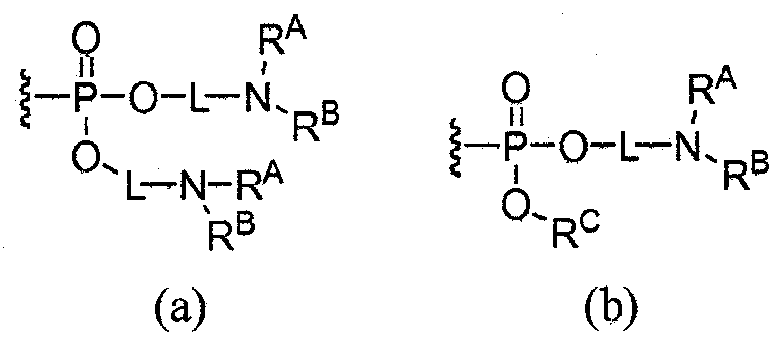
- Fluoreszenzfarbstoffreagenz nach Anspruch 1, wobei die Fluoreszenzfarbstoffkomponente aus der Gruppe ausgewählt ist, die aus Coumarinen, Benzocoumarinen, Xanthenen, Benzo[a]xanthenen, Benzo[b]xanthenen, Benzo[c]xanthenen, Cyaninen, Acridinen, Dipyrromethenbordifluoriden, Phenoxazinen, Benzo[a]phenoxazinen, Benzo[b]phenoxazinen und Benzo[c]phenoxazinen besteht.
- Fluoreszenzfarbstoffreagenz nach Anspruch 1, wobei die Fluoreszenzfarbstoffkomponente aus der Gruppe ausgewählt ist, die aus Coumarin-Farbstoffen, Resorufin-Farbstoffen, Dipyrromethenbordifluorid-Farbstoffen, Rutheniumbipyridyl-Farbstoffen, Energietransfer-Farbstoffen, Thiazo lorange-Farbstoffen und N-Aryl-1,8-naphthalimid-Farbstoffen besteht.
- Fluoreszenzfarbstoffreagenz nach Anspruch 1, wobei L C2-C8-Alkylen ist;
- Fluoreszenzfarbstoffreagenz nach Anspruch 1, wobei Pz die Formel (a) aufweist, L ein Alkylen-Bindungsrest ist und mindestens einer von RA und RB eine labile Schutzgruppe ist.
- Fluoreszenzfarbstoffreagenz nach Anspruch 1, wobei m 0 ist und n 1 ist.
- Fluoreszenzfarbstoffreagenz nach Anspruch 1, wobei m 0 ist und n 2 ist.
- Fluoreszenzfarbstoffreagenz nach Anspruch 1, wobei m 1 ist und n 1 ist.
- Fluoreszenzfarbstoffreagenz nach Anspruch 2, wobei die Fluoreszenzfarbstoffkomponente ein Xanthen- oder Benzoxanthen-Farbstoff ist, der aus der Gruppe ausgewählt ist, die aus Fluorescein-Farbstoffen, Rhodamin-Farbstoffen und Rhodol-Farbstoffen besteht.
- Fluoreszenzfarbstoffreagenz nach Anspruch 9 mit der Formel I:
 A1 O, N-Z oder N+(Z)2 darstellt, wobei jedes Z H oder (C1-C8)-Alkyl ist, oder gegebenenfalls mit R2 oder R4 kombiniert ist, um einen 5- oder 6-gliedrigen Ring zu bilden, oder mit jedem von R2 und R4 kombiniert ist, um zwei kondensierte 6-gliedrige Ringe zu bilden;A2 OR oder N(Z)2 darstellt, wobei jedes Z H oder (C1-C8)-Alkyl ist, oder gegebenenfalls mit R1 oder R1" kombiniert ist, um einen 5- oder 6-gliedrigen Ring zu bilden,oder mit jedem von R1 und R1" kombiniert ist, um zwei kondensierte 6-gliedrige Ringe zu bilden, und R aus der Gruppe ausgewählt ist, die aus H, (C1-C8)-Alkyl, Aryl, Aryl-(C1-C4)-alkyl und Lf besteht;R1', R1", R1, R2, R3 und R4 jeweils unabhängig voneinander aus H, Halogen, Cyano, CF3, (C1-C8)-Alkyl, (C1-C8)-Alkylthio, (C1-C8)-Alkoxy, Aryl, Heteroaryl, Lf und Pz ausgewählt sind; oder gegebenenfalls zwei benachbarte Bestandteile von R1', R1", R2 und R3 kombiniert sind, um einen fünf- oder sechsgliedrigen kondensierten Ring zu bilden, der aromatisch, nicht-aromatisch oder heteroaromatisch ist und der gegebenenfalls mit Pz substituiert ist;wobei die Alkylanteile von jedwedem von R1', R1" und R1 bis R4 gegebenenfalls substituiert sind mit Halogen, Carboxy, Sulfo, Amino, Mono- oder Dialkylamino, Alkoxy, Cyano, Halogenacetyl oder Hydroxy und die Alkylanteile der Substituenten 1 bis 6 Kohlenstoffatome aufweisen; und die Aryl- oder Heteroarylanteile von jedwedem von R1', R1" und R1 bis R4 gegebenenfalls substituiert sind mit einem bis vier Substituenten, die aus der Gruppe ausgewählt sind, die aus Halogen, Cyano, Carboxy, Sulfo, Hydroxy, Amino, Mono- oder Di-(C1-C6)-alkylamino, (C1-C6)-Alkyl, (C1-C6)-Alkylthio, (C1-C6)-Alkoxy, Lf und Pz besteht;R0 Halogen, Cyano, CF3, (C1-C8)-Alkyl, (C2-C8)-Alkenyl, (C2-C8)-Alkinyl, substituiertes oder nicht substituiertes Heteroaryl oder Aryl mit der Formel
wobei X1, X2, X3, X4 und X5 jeweils unabhängig voneinander aus der Gruppe ausgewählt sind, die aus H, Halogen, Cyano, CF3, (C1-C8)-Alkyl, (C1-C8)-Alkoxy, (C1-C8)-Alkylthio, (C2-C8)-Alkenyl, (C2-C8)-Alkinyl, Aryl, Heteroaryl, SO3H, PO3H, CO2H, Lf und Pz besteht, und gegebenenfalls jedwede zwei benachbarte X1 bis X5 kombiniert sind, um einen aromatischen oder heteroaromatischen Ring zu bilden; und wobei in den Verbindungen der Formel 1 0 bis 1 Rest Lf und 1 bis 2 Reste Pz vorhanden sind. - Fluoreszenzfarbstoffreagenz nach Anspruch 9 mit der Formel I(a) oder I(b):
 jedes A Hydroxy, Amino, geschütztes Hydroxy oder geschütztes Amino ist;R1', R1", R1, R2, R3 und R4 jeweils unabhängig voneinander aus H, Halogen, Cyano, Aryl, Heteroaryl, CF3, (C1-C8)-Alkyl, (C1-C8)-Alkylthio, (C1-C8)-Alkoxy, Lf und Pz ausgewählt sind, oder gegebenenfalls zwei benachbarte Bestandteile von R1', R1", R2 und R3 kombiniert sind, um einen fünf- oder sechsgliedrigen kondensierten Ring zu bilden, der aromatisch, nicht-aromatisch oder heteroaromatisch ist und der gegebenenfalls mit Pz substituiert ist, wobei die Alkylanteile von jedwedem von R1', R1" und R1 bis R4 gegebenenfalls substituiert sind mit Halogen, Carboxy, Sulfo, Amino, Mono- oder Dialkylamino, Alkoxy, Cyano, Halogenacetyl oder Hydroxy und die Alkylanteile der Substituenten 1 bis 6 Kohlenstoffatome aufweisen, und die Aryl- oder Heteroarylanteile von jedwedem von R1, R1" und R1 bis R4 gegebenenfalls substituiert sind mit einem bis vier Substituenten, die aus der Gruppe ausgewählt sind, die aus Halogen, Cyano, Carboxy, Sulfo, Hydroxy, Amino, Mono- oder Di-(C1-C6)-alkylamino, (C1-C6)-Alkyl, (C1-C6)-Alkylthio, (C1-C6)-Alkoxy, Lf und Pz besteht;X1, X2, X3 und X4 jeweils unabhängig voneinander aus der Gruppe ausgewählt sind, die aus H, Halogen, Cyano, CF3, (C1-C8)-Alkyl, (C1-C8)-Alkoxy, (C1-C8)-Alkylthio, (C1-C8)-Alkenyl, (C1-C8)-Alkinyl, SO3H, PO3H, CO2H, Lf und Pz besteht, und gegebenenfalls jedwede zwei benachbarte X1 bis X4 kombiniert sind, um einen aromatischen oder heteroaromatischen Ring zu bilden, der gegebenenfalls ferner mit einem bis vier Substituenten substituiert ist, die aus Halogen, Cyano, Carboxy, Sulfo, Hydroxy, Amino, Mono- oder Di-(C1-C6)-alkylamino, (C1-C6)-Alkyl, (C1-C6)-Alkylthio, (C1-C6)-Alkoxy, Lf und Pz ausgewählt sind; undwobei in den Verbindungen der Formeln (Ia) und (Ib) 0 bis 1 Rest Lf und 1 bis 2 Reste Pz vorhanden sind.
 - Fluoreszenzfarbstoffreagenz nach Anspruch 1 mit der Formel:
 A1 O oder N-Z darstellt, wobei Z H oder (C1-C8)-Alkyl ist, oder gegebenenfalls mit R2 oder R4 kombiniert ist, um einen 5- oder 6-gliedrigen Ring zu bilden, oder mit jedem von R2 und R4 kombiniert ist, um zwei kondensierte 6-gliedrige Ringe zu bilden;A2 OR oder N(Z)2 darstellt, wobei jedes Z H oder (C1-C8)-Alkyl ist, oder gegebenenfalls mit R1 oder R1" kombiniert ist, um einen 5- oder 6-gliedrigen Ring zu bilden,oder mit jedem von R1 und R1" kombiniert ist, um zwei kondensierte 6-gliedrige Ringe zu bilden, und R aus der Gruppe ausgewählt ist, die aus H, (C1-C8)-Alkyl, Aryl, Aryl-(C1-C4)-alkyl und Lf besteht;R1', R1", R1, R2, R3 und R4 jeweils unabhängig voneinander aus H, Halogen, Cyano, CF3, (C1-C8)-Alkyl, (C1-C8)-Alkylthio, (C1-C8)-Alkoxy, Aryl, Heteroaryl, Lf und Pz ausgewählt sind;wobei in den Verbindungen der Formel (IX) 0 bis 1 Rest Lf und 1 bis 2 Reste Pz vorhanden sind.
wobei die Alkylanteile von jedwedem von R1', R1" und R1 bis R4 gegebenenfalls substituiert sind mit Halogen, Carboxy, Sulfo, Amino, Mono- oder Dialkylamino, Alkoxy, Cyano, Halogenacetyl oder Hydroxy und die Alkylanteile der Substituenten 1 bis 6 Kohlenstoffatome aufweisen; und die Aryl- oder Heteroarylanteile von jedwedem von R1', R1" und R1 bis R4 gegebenenfalls substituiert sind mit einem bis vier Substituenten, die aus der Gruppe ausgewählt sind, die aus Halogen, Cyano, Carboxy, Sulfo, Hydroxy, Amino, Mono- oder Di-(C1-C6)-alkylamino, (C1-C6)-Alkyl, (C1-C6)-Alkylthio, (C1-C6)-Alkoxy, Lf und Pz besteht; und - Fluoreszenzfarbstoffreagenz nach Anspruch 1 mit der Formel:
 R1, R1', R1", R1"', R2 und R3 jeweils unabhängig voneinander aus der Gruppe ausgewählt sind, die aus H, Halogen, Cyano, CF3, (C1-C8)-Alkyl, (C1-C8)-Alkylthio, (C1-C8)-Alkoxy, Aryl, Heteroaryl, Lf und Pz besteht;wobei die Alkylanteile von jedwedem von R1', R1", R1"' und R1 bis R4 gegebenenfalls substituiert sind mit Halogen, Carboxy, Sulfo, Amino, Mono- oder Dialkylamino, Alkoxy, Cyano, Halogenacetyl oder Hydroxy und die Alkylanteile der Substituenten 1 bis 6 Kohlenstoffatome aufweisen; und die Aryl- oder Heteroarylanteile von jedwedem von R1', R1", R1"' und R1 bis R4 gegebenenfalls substituiert sind mit einem bis vier Substituenten, welche aus der Gruppe ausgewählt sind, die aus Halogen, Cyano, Carboxy, Sulfo, Hydroxy, Amino, Mono- oder Di-(C1-C6)-alkylamino, (C1-C6)-Alkyl, (C1-C6)-Alkylthio, (C1-C6)-Alkoxy, Lf und Pz besteht;A1 O oder N-Z darstellt, wobei Z H oder (C1-C8)-Alkyl ist; undwobei in den Verbindungen der Formel (V) 0 bis 1 Rest Lf und 1 bis 2 Reste Pz vorhanden sind.
 - Fluoreszenzfarbstoffreagenz nach Anspruch 1 mit der Formel:
 jedes von Q1 und Q2 unabhängig voneinander aus O, S, N und CRaRb oder -C(=CH2)-ausgewählt ist, wobei Ra und Rb unabhängig voneinander aus der Gruppe ausgewählt sind, die aus H, Methyl, Ethyl und Lf besteht;die Ringe Ax und Ay jeweils unabhängig voneinander kondensierte substituierte oder nicht substituierte Aryl- oder Heteroarylringe darstellen;Q ein konjugiertes Bindungssystem, das gegebenenfalls mit Lf substituiert ist, ist; undRG und RG' unabhängig voneinander aus der Gruppe ausgewählt sind, die aus H, C1-C8-Alkyl, Heteroalkyl, Alkylensulfonsäure, Alkylencarbonsäure, Lf und Pz besteht; wobei in dem Reagenz ein oder zwei Reste Pz und null bis ein Rest Lf vorhanden sind.
 - Fluoreszenzfarbstoffreagenz nach Anspruch 14, wobei Q ein konjugiertes Bindungssystem ist, das aus der Gruppe ausgewählt ist, die besteht aus:


- Fluoreszenzfarbstoffreagenz nach Anspruch 1 mit der Formel:

- Fluoreszenzfarbstoffreagenz nach Anspruch 1, welches aus Verbindungen 8, 9, 10, 11, 17, 18, 19, 25, 26, 27, 37, 38, 39, 64, 65 und 66 ausgewählt ist:

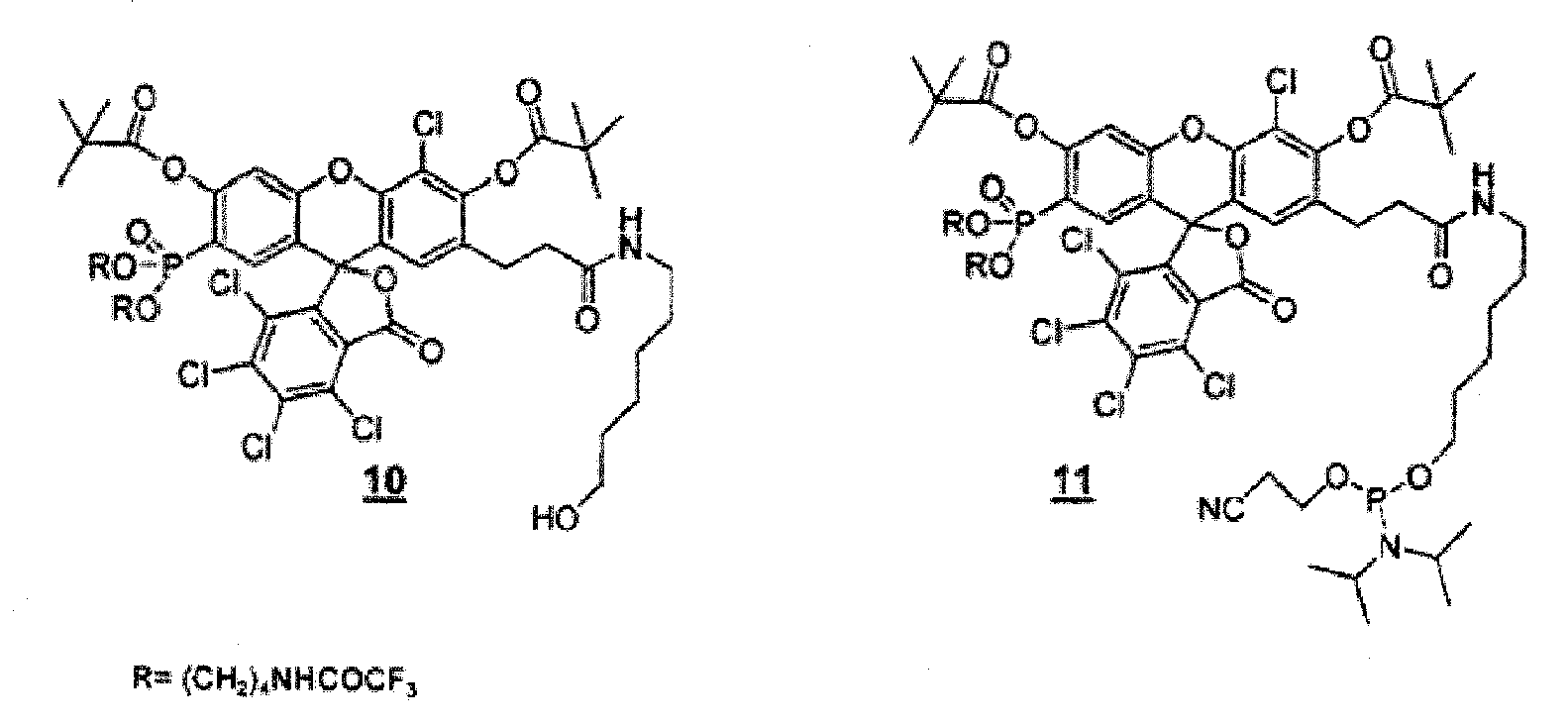
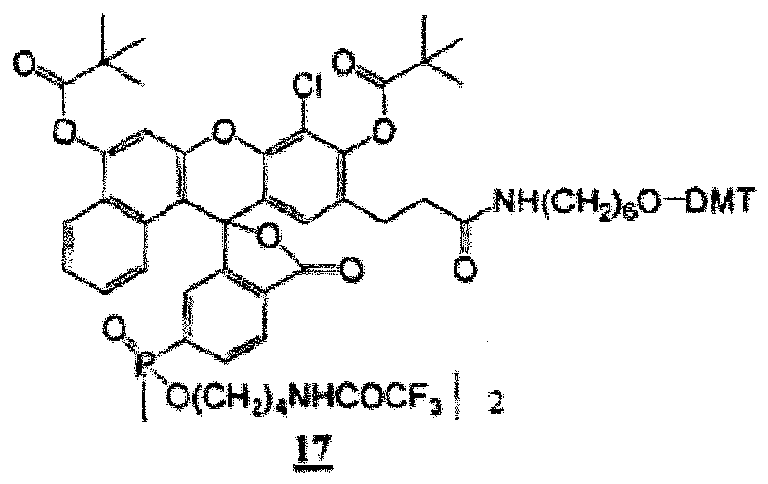


- Fluoreszenzfarbstoffreagenz mit der Formel:
Fl-P1
wobeiFl eine Fluoreszenzfarbstoffkomponente ist; undP1 ein funktionalisierter Phosphonatrest mit der Formel
wobei die Wellenlinie die direkte Bindung an einen sp2-Kohlenstoff der Fluoreszenzfarbstoffkomponente zeigt;L1 ein Bindungsrest ist;R ein Bestandteil ist, der aus der Gruppe ausgewählt ist, die aus H, C1-C8-Alkyl, Aryl, Aryl-C1-C4-alkyl, -La-Na und -La-NRARB besteht;wobei La ein Alkylen-Bindungsrest ist, Na eine Ammoniumionengruppe ist und jeder von RA und RB unabhängig voneinander aus der Gruppe ausgewählt ist, die aus H, (C1-C8)-Alkyl und einer labilen Schutzgruppe besteht; undPa eine funktionelle Gruppe-Komponente ist, die aus der Gruppe ausgewählt ist, die aus Phosphoramiditeinheit, einem mono-, di- oder trifunktionellen Bindungsrest mit mindestens einer terminalen funktionellen Gruppe oder geschützten funktionellen Gruppe, einem festen Träger und einem reaktiven Rest besteht;und ein Salz davon. - Fluoreszenzfarbstoffreagenz nach Anspruch 18, wobei die Fluoreszenzfarbstoffkomponente aus der Gruppe ausgewählt ist, die aus Coumarinen, Benzocoumarinen, Xanthenen, Benzo[a]xanthenen, Benzo[b]xanthenen, Benzo[c]xanthenen, Cyaninen, Acridinen, Dipyrromethenbordifluoriden, Phenoxazinen, Benzo[a]phenoxazinen, Benzo[b]phenoxazinen und Benzo[c]phenoxazinen besteht.
- Fluoreszenzfarbstoffreagenz nach Anspruch 18, wobei die Fluoreszenzfarbstoffkomponente aus der Gruppe ausgewählt ist, die aus Coumarin-Farbstoffen, Resorufin-Farbstoffen, Dipyrromethenbordifluorid-Farbstoffen, Rutheniumbipyridyl-Farbstoffen, Energietransfer-Farbstoffen, Thiazo lorange-Farbstoffen und N-Aryl-1,8-naphthalimid-Farbstoffen besteht.
- Fluoreszenzfarbstoffreagenz nach Anspruch 18, wobei die Fluoreszenzfarbstoffkomponente ein Xanthen- oder Benzoxanthenfarbstoff ist, der aus der Gruppe ausgewählt ist, die aus Fluorescein-Farbstoffen, Rhodamin-Farbstoffen und Rhodol-Farbstoffen besteht.
- Fluoreszenzfarbstoffreagenz nach Anspruch 21, das aus der Gruppe ausgewählt ist, die aus Verbindungen 44, 45 und 46 wie in Reaktionsschema 8 gezeigt; Verbindungen 51, 52 und 53 wie in Reaktionsschema 9 gezeigt; und Verbindungen 56, 57, 58 und 59 wie in Reaktionsschema 10 gezeigt besteht.
- Verfahren zur Herstellung eines Phosphonat-Fluoreszenzfarbstoffderivats, wobei das Verfahren das Inkontaktbringen eines Halogen-Fluoreszenzfarbstoffsubstrats mit mindestens einem Halogenatom, welches an ein aromatisches Ringkohlenstoffatom gebunden ist, mit einem Phosphit-Reagenz unter Bedingungen, die zum Entfernen des Halogenatoms und kovalenten Binden eines Phosphonatrests an das aromatische Ringkohlenstoffatom ausreichend sind, um das Phosphonat-Fluoreszenzfarbstoffderivat zu bilden, umfasst.
- Verfahren gemäß Anspruch 23, wobei das Halogen-Fluoreszenzfarbstoffsubstrat aus der Gruppe ausgewählt ist, die aus einem Halogencoumarin, einem Halogenbenzocoumarin, einem Halogenxanthen, einem Halogenbenzo[a]xanthen, einem Halogenbenzo[b]xanthen, einem Halogenbenzo[c]xanthen, einem Halogencyanin, einem Halogenacridin, einem Halogendipyrromethenbordifluorid, einem Halogenphenoxazin, einem Halogenbenzo[a]phenoxazin, einem Halogenbenzo[b]phenoxazin und einem Halogenbenzo[c]phenoxazin besteht.
- Verfahren gemäß Anspruch 23, wobei das Phosphit-Reagenz ein Bestandteil ist, der aus der Gruppe ausgewählt ist, die aus Diphenylphosphit, Diethylphosphit und Bis(4-(2,2,2-trifluoracetamido)butyl)phosphit besteht.
- Verfahren gemäß Anspruch 23, wobei das Phosphit-Reagenz Bis(4-(2,2,2-trifluoracetamido)butyl)phosphit oder Verbindung 41 wie in Reaktionsschema 7 gezeigt ist.
- Phosphonat-Fluoreszenzfarbstoffderivat, welches gemäß dem Verfahren nach Anspruch 26 hergestellt wird.
- Oligonukleotidsonde mit einem gebundenen Fluoreszenzfarbstoffreagenz, wobei das Fluoreszenzfarbstoffreagenz die Formel
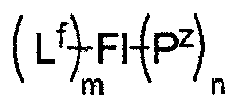
wobeiFl eine Fluoreszenzfarbstoffkomponente ist;Lf ein Bindungsrest mit einem gebundenen Bestandteil, der aus der Gruppe ausgewählt ist, die aus einer geschützten oder nicht geschützten funktionellen Gruppe, einem reaktiven Rest, einer polyfunktionellen Bindungseinheit, einer Phosphoramiditeinheit und einem festen Träger besteht, ist;Pz ein zwitterionischer Phosphonatrest mit der Formel (a) oder ein geschützter Phosphonatrest mit der Formel (b) oder (c) ist: der tiefgestellte Index n eine ganze Zahl von 1 bis 2 ist;m 1 ist;und ein Salz davon; und
wobei die Bindung des Fluoreszenzfarbstoffreagenzes an das Oligonukleotid über eine an Lf vorhandene funktionelle Gruppe stattfindet. - Oligonukleotidsonde gemäß Anspruch 28 mit einem gebundenen Quencher.
- Oligonukleotidsonde gemäß Anspruch 29 mit einem gebundenen an eine kleine Furche bindenden Mittel.
- Oligonukleotidsonde mit einem gebundenen Fluoreszenzfarbstoffreagenz nach Anspruch 18, wobei die Bindung des Fluoreszenzfarbstoffreagenzes an das Oligonukleotid über eine an Pa vorhandene funktionelle Gruppe stattfindet.
- Oligonukleotidsonde gemäß Anspruch 31 mit einem gebundenen Quencher.
- Oligonukleotidsonde gemäß Anspruch 32 mit einem gebundenen an eine kleine Furche bindenden Mittel.
- Verbindung mit der Formel:
 L ein Bestandteil ist, der aus der Gruppe ausgewählt ist, die aus einem (C1-C20)-Alkylen- und (C1-C20)-Heteroalkylen-Bindungsrest besteht;X ein Bestandteil ist, der aus der Gruppe ausgewählt ist, die aus einer funktionellen Gruppe und einer geschützten funktionellen Gruppe besteht, wobei die funktionelle Gruppe Hydroxy, Diol, Carboxy, Formyl, Carbonyl, Thio, Aminooxy, Azido, Carbazoyl, Hydrazin oder Amino mit der Formel NRARB ist;R ein Bestandteil ist, der aus der Gruppe ausgewählt ist, die aus einer labilen Schutzgruppe und -L-NRARB besteht;
und jeder von RA und RB unabhängig voneinander aus H, (C1-C8)-Alkyl und einer labilen Schutzgruppe ausgewählt ist und mindestens einer von RA und RB verschieden von H oder (C1-C8)-Alkyl ist. - Verbindung nach Anspruch 34, wobei R eine tertiär-Butylgruppe ist.
- Verbindung nach Anspruch 34, wobei R -L-NRARB ist und X -NRARB ist.
- Verbindung nach Anspruch 36, wobei jeder RA H ist und jeder RB eine Schutzgruppe ist, die aus der Gruppe ausgewählt ist, die aus -C(O)CF3, -C(O)OtBu, FMOC, Phthalimid, Monomethoxytrityl und -C(O)O-Benzy besteht.
- Verbindung nach Anspruch 34, wobei X -O-Dimethoxytrityl ist.
- Verbindung nach Anspruch 34, die aus der Gruppe ausgewählt ist, die besteht aus

Applications Claiming Priority (2)
| Application Number | Priority Date | Filing Date | Title |
|---|---|---|---|
| US60159904P | 2004-08-13 | 2004-08-13 | |
| PCT/US2005/028892 WO2006020947A2 (en) | 2004-08-13 | 2005-08-12 | Phosphonate fluorescent dyes and conjugates |
Publications (3)
| Publication Number | Publication Date |
|---|---|
| EP1781675A2 EP1781675A2 (de) | 2007-05-09 |
| EP1781675A4 EP1781675A4 (de) | 2010-04-14 |
| EP1781675B1 true EP1781675B1 (de) | 2014-03-26 |
Family
ID=35908220
Family Applications (1)
| Application Number | Title | Priority Date | Filing Date |
|---|---|---|---|
| EP05786453.0A Expired - Lifetime EP1781675B1 (de) | 2004-08-13 | 2005-08-12 | Fluoreszierende phosphonatfarbstoffe und konjugate |
Country Status (6)
| Country | Link |
|---|---|
| US (3) | US7671218B2 (de) |
| EP (1) | EP1781675B1 (de) |
| JP (1) | JP5214967B2 (de) |
| CA (1) | CA2577053A1 (de) |
| ES (1) | ES2461858T3 (de) |
| WO (1) | WO2006020947A2 (de) |
Families Citing this family (58)
| Publication number | Priority date | Publication date | Assignee | Title |
|---|---|---|---|---|
| US7767834B2 (en) * | 2004-08-13 | 2010-08-03 | Elitech Holding B.V. | Phosphonylated fluorescent dyes and conjugates |
| EP1781675B1 (de) * | 2004-08-13 | 2014-03-26 | Epoch Biosciences, Inc. | Fluoreszierende phosphonatfarbstoffe und konjugate |
| US7776567B2 (en) | 2005-03-17 | 2010-08-17 | Biotium, Inc. | Dimeric and trimeric nucleic acid dyes, and associated systems and methods |
| US7601498B2 (en) | 2005-03-17 | 2009-10-13 | Biotium, Inc. | Methods of using dyes in association with nucleic acid staining or detection and associated technology |
| US8357801B2 (en) * | 2005-05-24 | 2013-01-22 | Enzo Life Sciences, Inc. | Labeling of target molecules, identification of organelles and other applications, novel compositions, methods and kits |
| US8295562B2 (en) * | 2006-01-13 | 2012-10-23 | Carl Zeiss Microimaging Ais, Inc. | Medical image modification to simulate characteristics |
| WO2007115265A2 (en) * | 2006-03-31 | 2007-10-11 | Applied Biosystems Inc. | Reagents useful for synthesizing rhodamine-labeled oligonucleotides |
| US8163910B2 (en) * | 2007-10-03 | 2012-04-24 | Elitech Holding B.V. | Amide-substituted xanthene dyes |
| US8552027B2 (en) * | 2009-01-15 | 2013-10-08 | Seta Biomedicals, Llc | Luminescent compounds |
| US9023611B2 (en) * | 2009-02-06 | 2015-05-05 | Beth Israel Deaconess Medical Center | Charged-balanced imaging agents |
| US10493169B2 (en) | 2009-02-06 | 2019-12-03 | Beth Israel Deaconess Medical Center | Use of charge-balanced imaging agents for determining renal function |
| US8877437B1 (en) | 2009-12-23 | 2014-11-04 | Biotium, Inc. | Methods of using dyes in association with nucleic acid staining or detection |
| US8519153B2 (en) | 2010-09-22 | 2013-08-27 | Brock University | Compounds for fluorescent labeling |
| WO2012088007A1 (en) | 2010-12-21 | 2012-06-28 | Pierce Biotechnology, Inc. | Fluorescent compounds |
| DK2714939T3 (en) | 2011-05-24 | 2015-06-29 | Elitech Holding Bv | DETECTION OF METHICILLIN-RESISTENT STAPHYLOCOCCUS AUREUS |
| US8889884B1 (en) | 2011-07-14 | 2014-11-18 | Pierce Biotechnology, Inc. | Phosphine derivatives of fluorescent compounds |
| EP2734645A4 (de) * | 2011-07-18 | 2014-12-17 | Univ Georgia State Res Found | Carbocyanine zur g-quadruplex-dna-stabilisierung und telomerase-hemmung |
| JP6182529B2 (ja) | 2011-07-26 | 2017-08-16 | エリテックグループ・ベスローテン・フェンノートシャップElitechgroup B.V. | 副溝結合剤ホスホラミダイトおよび使用方法 |
| US9249307B2 (en) | 2011-08-16 | 2016-02-02 | Pierce Biotechnology, Inc. | Benzocyanine compounds |
| US9751868B2 (en) | 2012-02-28 | 2017-09-05 | Pierce Biotechnology, Inc. | Benzocyanine compounds |
| US20140072515A9 (en) | 2012-03-02 | 2014-03-13 | Greg Hermanson | Cyanine compounds |
| WO2014035712A1 (en) | 2012-08-28 | 2014-03-06 | Pierce Biotechnology, Inc. | Benzopyrylium compounds |
| CN102942457B (zh) * | 2012-11-10 | 2015-04-29 | 吉林大学 | 4-碘苯基对苯二酚单体及其制备方法和应用 |
| WO2014164479A1 (en) | 2013-03-11 | 2014-10-09 | Elitech Holding B.V. | Methods for true isothermal strand displacement amplification |
| US9328384B2 (en) | 2013-05-13 | 2016-05-03 | Elitechgroup B.V. | Droplet digital PCR with short minor groove probes |
| JP6190534B2 (ja) * | 2013-08-22 | 2017-08-30 | ソニー株式会社 | 水溶性蛍光染料又は有色染料及びその使用方法 |
| EP3094687B1 (de) | 2014-01-16 | 2020-02-12 | Sony Corporation | Wasserlösliche fluoreszierende oder gefärbte farbstoffe |
| EP3230467A1 (de) | 2014-12-12 | 2017-10-18 | ELITechGroup B.V. | Verfahren und zusammensetzungen zum nachweis von antibiotikaresistenten bakterien |
| EP3230468B1 (de) | 2014-12-12 | 2020-09-16 | ELITechGroup, Inc. | Verfahren und kits zum nachweis von antibiotikaresistenten bakterien |
| KR102676814B1 (ko) * | 2015-02-26 | 2024-06-21 | 소니그룹주식회사 | 접합 그룹을 포함하는 수용성 형광 또는 착색 염료 |
| JP6982500B2 (ja) | 2015-02-26 | 2021-12-17 | ソニーグループ株式会社 | フェニルエチニルナフタレン染料およびそれらの使用方法 |
| US10865310B2 (en) | 2015-05-11 | 2020-12-15 | Sony Corporation Of America | Ultra bright dimeric or polymeric dyes |
| WO2017011686A1 (en) * | 2015-07-14 | 2017-01-19 | University Of Iowa Research Foundation | Fluorescent prodrugs |
| CN109415574B (zh) | 2016-04-01 | 2021-05-28 | 索尼公司 | 具有刚性间隔基团的超亮二聚体或聚合物染料 |
| CN107580618A (zh) | 2016-04-01 | 2018-01-12 | 索尼公司 | 超亮二聚或多聚染料 |
| JP7069033B2 (ja) | 2016-04-06 | 2022-05-17 | ソニーグループ株式会社 | スペーシングリンカー基を有する超明色ダイマーまたはポリマー染料 |
| WO2017197014A2 (en) | 2016-05-10 | 2017-11-16 | Sony Corporation | Compositions comprising a polymeric dye and a cyclodextrin and uses thereof |
| JP7527537B2 (ja) | 2016-05-10 | 2024-08-05 | ソニーグループ株式会社 | ペプチド骨格を有する超明色ポリマー染料 |
| AU2017264861B2 (en) | 2016-05-11 | 2021-09-23 | Sony Group Corporation | Ultra bright dimeric or polymeric dyes |
| WO2017214165A1 (en) | 2016-06-06 | 2017-12-14 | Sony Corporation | Ionic polymers comprising fluorescent or colored reporter groups |
| US12018159B2 (en) | 2016-07-29 | 2024-06-25 | Sony Group Corporation | Ultra bright dimeric or polymeric dyes and methods for preparation of the same |
| US10738346B2 (en) | 2017-03-09 | 2020-08-11 | Elitechgroup, Inc. | Nitrodiarylethenes as fluorescence quenchers for nucleic acid probes |
| EP3668884B1 (de) | 2017-08-17 | 2022-03-09 | ELITechGroup Inc. | Duplex stabilisierende fluorescenz quencher für nuklein säure sonden. |
| JP7551056B2 (ja) | 2017-10-05 | 2024-09-17 | ソニーグループ株式会社 | プログラマブルなポリマー薬物 |
| EP3691689A1 (de) | 2017-10-05 | 2020-08-12 | Sony Corporation | Programmierbare dendritische arzneimittel |
| JP2021503450A (ja) | 2017-11-16 | 2021-02-12 | ソニー株式会社 | プログラム可能なポリマー薬 |
| JP7813098B2 (ja) | 2018-01-12 | 2026-02-12 | ソニーグループ株式会社 | 生物学的に活性な化合物を含む剛性間隔基を有するポリマー |
| JP2021510698A (ja) | 2018-01-12 | 2021-04-30 | ソニー株式会社 | 生物学的に活性な化合物を含むホスホアルキルリボースポリマー |
| CN111565757A (zh) | 2018-01-12 | 2020-08-21 | 索尼公司 | 包含生物活性化合物的磷酸烷基聚合物 |
| KR102742386B1 (ko) | 2018-03-19 | 2024-12-16 | 소니그룹주식회사 | 형광 신호 향상을 위한 2가 금속의 사용 |
| WO2019182766A1 (en) | 2018-03-21 | 2019-09-26 | Sony Corporation | Polymeric tandem dyes with linker groups |
| KR102854332B1 (ko) | 2018-06-27 | 2025-09-03 | 소니그룹주식회사 | 디옥시리보오스를 포함하는 링커 군을 갖는 중합체성 염료 |
| EP3820944A1 (de) | 2018-07-13 | 2021-05-19 | Sony Corporation | Polymere farbstoffe mit einem gerüst mit organophosphateinheiten |
| WO2021062176A2 (en) | 2019-09-26 | 2021-04-01 | Sony Corporation | Polymeric tandem dyes with linker groups |
| JP7816141B2 (ja) | 2019-09-30 | 2026-02-18 | ソニーグループ株式会社 | ヌクレオチドプローブ |
| WO2021080629A1 (en) | 2019-10-23 | 2021-04-29 | Elitechgroup, Inc. | Methods for true isothermal strand displacement amplification |
| KR102280948B1 (ko) * | 2019-11-28 | 2021-07-23 | 한국과학기술연구원 | 단백질 아세틸화 검출을 위한 형광 프로브 |
| EP4256078A1 (de) | 2020-12-07 | 2023-10-11 | Sony Group Corporation | Abstandslinkergruppendesign zur helligkeitsverstärkung in dimeren oder polymeren farbstoffen |
Family Cites Families (82)
| Publication number | Priority date | Publication date | Assignee | Title |
|---|---|---|---|---|
| US613010A (en) | 1898-10-25 | William h | ||
| US2637401A (en) | 1950-11-30 | 1953-05-05 | Standard Oil Dev Co | Drill stem packer with deflating means |
| US3194805A (en) | 1960-09-02 | 1965-07-13 | Eastman Kodak Co | Merocyanine and holopolar dyes containing arylene-chain substitution |
| US3128179A (en) | 1960-09-02 | 1964-04-07 | Eastman Kodak Co | Cyanine dye-sensitized photoconductive compositions comprising zinc oxide |
| US3809694A (en) * | 1968-05-31 | 1974-05-07 | Petrolite Corp | Dihydrophenanthridine phosphonates |
| DE3526565A1 (de) | 1985-07-25 | 1987-02-05 | Boehringer Mannheim Gmbh | Resorufin-derivate, verfahren zu deren herstellung sowie deren verwendung in fluoreszenzimmunoassays |
| US5268486A (en) | 1986-04-18 | 1993-12-07 | Carnegie-Mellon Unversity | Method for labeling and detecting materials employing arylsulfonate cyanine dyes |
| US6225050B1 (en) | 1986-04-18 | 2001-05-01 | Carnegie Mellon University | Cyanine dyes as labeling reagents for detection of biological and other materials by luminescence methods |
| SE8703682L (sv) | 1987-09-24 | 1989-03-25 | Wallac Oy | Homogen bestaemningsmetod som utnyttjar affinitetsreaktioner |
| US5231191A (en) * | 1987-12-24 | 1993-07-27 | Applied Biosystems, Inc. | Rhodamine phosphoramidite compounds |
| US5262530A (en) | 1988-12-21 | 1993-11-16 | Applied Biosystems, Inc. | Automated system for polynucleotide synthesis and purification |
| US4937198A (en) | 1989-07-28 | 1990-06-26 | Becton, Dickinson And Company | Novel fluorescent dye |
| US5366860A (en) | 1989-09-29 | 1994-11-22 | Applied Biosystems, Inc. | Spectrally resolvable rhodamine dyes for nucleic acid sequence determination |
| US5188934A (en) | 1989-11-14 | 1993-02-23 | Applied Biosystems, Inc. | 4,7-dichlorofluorescein dyes as molecular probes |
| US5227487A (en) | 1990-04-16 | 1993-07-13 | Molecular Probes, Inc. | Certain tricyclic and pentacyclic-hetero nitrogen rhodol dyes |
| US5433896A (en) | 1994-05-20 | 1995-07-18 | Molecular Probes, Inc. | Dibenzopyrrometheneboron difluoride dyes |
| US5106762A (en) * | 1990-04-20 | 1992-04-21 | Georgetown University | Ligand-label conjugates which contain polyoxoanions of sulfur or phosphorus |
| US5512667A (en) | 1990-08-28 | 1996-04-30 | Reed; Michael W. | Trifunctional intermediates for preparing 3'-tailed oligonucleotides |
| JP3133314B2 (ja) * | 1990-08-29 | 2001-02-05 | 株式会社リコー | 画像形成装置 |
| SE9003743D0 (sv) | 1990-11-26 | 1990-11-26 | Pharmacia Ab | Method and means for oligonucleotide synthesis |
| US5248782A (en) | 1990-12-18 | 1993-09-28 | Molecular Probes, Inc. | Long wavelength heteroaryl-substituted dipyrrometheneboron difluoride dyes |
| US5187288A (en) | 1991-05-22 | 1993-02-16 | Molecular Probes, Inc. | Ethenyl-substituted dipyrrometheneboron difluoride dyes and their synthesis |
| US5419966A (en) | 1991-06-10 | 1995-05-30 | Microprobe Corporation | Solid support for synthesis of 3'-tailed oligonucleotides |
| US5371241A (en) | 1991-07-19 | 1994-12-06 | Pharmacia P-L Biochemicals Inc. | Fluorescein labelled phosphoramidites |
| US5750409A (en) | 1991-11-18 | 1998-05-12 | Boehringer Mannheim Gmbh | Pentacyclic compounds and their use as absorption or fluorescent dyes |
| US5556959A (en) | 1993-01-22 | 1996-09-17 | Pharmacia P-L Biochemicals Inc. | Indocarbocyanine-linked phosphoramidites |
| US5808044A (en) | 1993-01-22 | 1998-09-15 | Pharmacia Biotech Inc. | Indocarbocyanine and benzindocarbocyanine phosphoramidites |
| US5658751A (en) | 1993-04-13 | 1997-08-19 | Molecular Probes, Inc. | Substituted unsymmetrical cyanine dyes with selected permeability |
| US5916877A (en) * | 1994-10-18 | 1999-06-29 | Georgia Tech Research Corporation | Fluorescent 1-peptidylaminoalkanephosphonate derivatives |
| US5756771A (en) * | 1995-04-13 | 1998-05-26 | Abbott Laboratories | 5(6)-methyl substituted fluorescein derivatives |
| US6008373A (en) | 1995-06-07 | 1999-12-28 | Carnegie Mellon University | Fluorescent labeling complexes with large stokes shift formed by coupling together cyanine and other fluorochromes capable of resonance energy transfer |
| US5852191A (en) | 1995-06-07 | 1998-12-22 | Carnegie Mellon University | Rigidized monomethine cyanines |
| US5986093A (en) | 1995-06-07 | 1999-11-16 | Carnegie Mellon University | Monomethine cyanines rigidized by a two-carbon chain |
| US6020481A (en) | 1996-04-01 | 2000-02-01 | The Perkin-Elmer Corporation | Asymmetric benzoxanthene dyes |
| US6162931A (en) | 1996-04-12 | 2000-12-19 | Molecular Probes, Inc. | Fluorinated xanthene derivatives |
| US5986086A (en) | 1997-06-20 | 1999-11-16 | Amersham Pharmacia Biotech Inc. | Non-sulfonated cyanine dyes for labeling nucleosides and nucleotides |
| US6130101A (en) * | 1997-09-23 | 2000-10-10 | Molecular Probes, Inc. | Sulfonated xanthene derivatives |
| US6008379A (en) | 1997-10-01 | 1999-12-28 | The Perkin-Elmer Corporation | Aromatic-substituted xanthene dyes |
| US6583168B1 (en) | 1997-11-25 | 2003-06-24 | Applera Corporation | Sulfonated diarylrhodamine dyes |
| JP4927253B2 (ja) | 1997-12-17 | 2012-05-09 | カーネギー メロン ユニヴァーシティ | 硬化トリメチンシアニン色素 |
| CN1285001A (zh) * | 1997-12-18 | 2001-02-21 | 塞普拉科有限公司 | 同时鉴定新型生物靶和用于药物开发的引导结构的方法 |
| US6080868A (en) | 1998-01-23 | 2000-06-27 | The Perkin-Elmer Corporation | Nitro-substituted non-fluorescent asymmetric cyanine dye compounds |
| WO1999051702A1 (en) | 1998-04-08 | 1999-10-14 | Terpetschnig Ewald A | Luminescent compounds |
| DE19824535A1 (de) | 1998-06-03 | 1999-12-09 | Roche Diagnostics Gmbh | Neue Rhodamin-Derivate und deren Verwendung |
| US6110630A (en) | 1998-06-18 | 2000-08-29 | Beckman Coulter, Inc. | Efficient activated cyanine dyes |
| DE19834745A1 (de) | 1998-08-01 | 2000-02-03 | Agfa Gevaert Ag | Strahlungsempfindliches Gemisch mit IR-absorbierenden, anionischen Cyaninfarbstoffen und damit hergestelltes Aufzeichnungsmaterial |
| US6180295B1 (en) | 1998-09-11 | 2001-01-30 | Eastman Kodak Company | Liquid crystalline filter dyes for imaging elements |
| US6432642B1 (en) | 1999-01-15 | 2002-08-13 | Pe Corporation (Ny) | Binary probe and clamp composition and methods for a target hybridization detection |
| US6673550B2 (en) * | 1999-04-30 | 2004-01-06 | Aclara Biosciences, Inc. | Electrophoretic tag reagents comprising fluorescent compounds |
| US6248884B1 (en) | 1999-06-03 | 2001-06-19 | The Perkin-Elmer Corporation | Extended rhodamine compounds useful as fluorescent labels |
| ATE435262T1 (de) | 1999-07-02 | 2009-07-15 | Visen Medical Inc | Fluoreszierende cyaninlabels mit einem sulphamidobrückenglied |
| US6372907B1 (en) | 1999-11-03 | 2002-04-16 | Apptera Corporation | Water-soluble rhodamine dye peptide conjugates |
| US6191278B1 (en) | 1999-11-03 | 2001-02-20 | Pe Corporation | Water-soluble rhodamine dyes and conjugates thereof |
| US6716994B1 (en) | 2000-01-04 | 2004-04-06 | Applera Corporation | Mobility-Modifying Cyanine Dyes |
| GB0002261D0 (en) | 2000-02-02 | 2000-03-22 | Amersham Pharm Biotech Uk Ltd | Fluorescent detection method & reagent |
| US6221604B1 (en) | 2000-02-07 | 2001-04-24 | Pe Corporation | Electron-deficient nitrogen heterocycle-substituted fluorescein dyes |
| US6465644B1 (en) | 2000-05-02 | 2002-10-15 | Applera Corporation | Sulfonated [8,9] benzophenoxazine dyes and the use of their labelled conjugates |
| CA2425663C (en) | 2000-10-11 | 2009-12-29 | Applera Corporation | Fluorescent nucleobase conjugates having anionic linkers |
| US6448407B1 (en) * | 2000-11-01 | 2002-09-10 | Pe Corporation (Ny) | Atropisomers of asymmetric xanthene fluorescent dyes and methods of DNA sequencing and fragment analysis |
| GB0030920D0 (en) | 2000-12-19 | 2001-01-31 | Amersham Pharm Biotech Uk Ltd | Fluorescent dye complexes |
| WO2002068537A2 (en) * | 2001-02-28 | 2002-09-06 | Stratagene | Fluorescent dye |
| US7018840B2 (en) * | 2001-04-17 | 2006-03-28 | Massachusetts Institute Of Technology | Fluorescent metal sensors, and methods of making and using the same |
| GB0113435D0 (en) | 2001-06-04 | 2001-07-25 | Amersham Pharm Biotech Uk Ltd | Acridone derivatives as labels for fluorescence detection of target materials |
| WO2003004569A1 (en) * | 2001-07-02 | 2003-01-16 | Arctic Diagnostics Oy | Method for increasing hydrophilicity of fluorescent label compounds |
| JP2003034695A (ja) | 2001-07-19 | 2003-02-07 | Fuji Photo Film Co Ltd | 蛍光ヌクレオチド及びそれを用いた標識法 |
| JP4676654B2 (ja) | 2001-07-19 | 2011-04-27 | 富士フイルム株式会社 | 蛍光ヌクレオチド及びそれを用いた標識法 |
| US6972339B2 (en) * | 2001-09-07 | 2005-12-06 | Epoch Biosciences, Inc. | Compounds and methods for fluorescent labeling |
| US20030196214A1 (en) | 2002-03-27 | 2003-10-16 | Priti Sharma | Novel genes from drought stress tolerant tea plant and a method of introducing water-stress tolerance |
| US6897036B2 (en) * | 2002-06-06 | 2005-05-24 | Lumigen, Inc. | Fluorescent detection of peroxidase enzymes |
| US20040146959A1 (en) | 2002-09-09 | 2004-07-29 | Graham Ronald J. | Fluorescent enzyme assay methods and compositions |
| US7432036B2 (en) | 2002-10-07 | 2008-10-07 | Fujifilm Corporation | Non-resonant two-photon absorbing material, non-resonant two-photon emitting material, and method for inducing absorption or generating emission of non-resonant two photons by using the material |
| AU2003286595A1 (en) | 2002-10-21 | 2004-05-13 | Biosearch Technologies, Inc. | Luminescent metal ion complexes |
| US7563907B2 (en) * | 2002-12-05 | 2009-07-21 | Dyomics Gmbh | Compounds based on polymethines |
| GB0311406D0 (en) * | 2003-05-17 | 2003-06-25 | Queen Mary & Westfield College | Substituted phosphonate fluorescent sensors,and use thereof |
| WO2005005977A2 (en) | 2003-06-30 | 2005-01-20 | Applera Corporation | Fluorescent phospholipase assays and compositions |
| ITPZ20030002A1 (it) | 2003-08-12 | 2005-02-13 | Giuseppe Caputo | Composti del tipo cianina aventi un braccio di legame alchinilico |
| WO2005044923A1 (en) | 2003-10-31 | 2005-05-19 | Ge Healthcare Limited | Cyanine dye labelling reagents |
| US7705150B2 (en) | 2004-02-04 | 2010-04-27 | Biosearch Technologies, Inc. | Cyanine dyes |
| US7288121B2 (en) | 2004-02-27 | 2007-10-30 | L'oreal S.A. | Composition comprising at least one mixed dye comprising at least one chromophore chosen from compounds of the methine family and/or the carbonyl family, dyeing process and kit, and mixed dyes |
| GB0411993D0 (en) | 2004-05-28 | 2004-06-30 | Amersham Biosciences Uk Ltd | Method and reagent for measuring nitroreductase enzyme activity |
| US7767834B2 (en) * | 2004-08-13 | 2010-08-03 | Elitech Holding B.V. | Phosphonylated fluorescent dyes and conjugates |
| EP1781675B1 (de) * | 2004-08-13 | 2014-03-26 | Epoch Biosciences, Inc. | Fluoreszierende phosphonatfarbstoffe und konjugate |
-
2005
- 2005-08-12 EP EP05786453.0A patent/EP1781675B1/de not_active Expired - Lifetime
- 2005-08-12 WO PCT/US2005/028892 patent/WO2006020947A2/en not_active Ceased
- 2005-08-12 US US11/202,635 patent/US7671218B2/en active Active
- 2005-08-12 CA CA002577053A patent/CA2577053A1/en not_active Abandoned
- 2005-08-12 JP JP2007525859A patent/JP5214967B2/ja not_active Expired - Fee Related
- 2005-08-12 ES ES05786453.0T patent/ES2461858T3/es not_active Expired - Lifetime
-
2010
- 2010-01-06 US US12/683,305 patent/US8008522B2/en not_active Expired - Lifetime
-
2011
- 2011-08-29 US US13/220,467 patent/US8389745B2/en not_active Expired - Lifetime
Also Published As
| Publication number | Publication date |
|---|---|
| WO2006020947A3 (en) | 2008-08-21 |
| US20100261903A1 (en) | 2010-10-14 |
| ES2461858T3 (es) | 2014-05-21 |
| US8008522B2 (en) | 2011-08-30 |
| US7671218B2 (en) | 2010-03-02 |
| US20120116079A1 (en) | 2012-05-10 |
| JP2008510041A (ja) | 2008-04-03 |
| WO2006020947A9 (en) | 2009-01-15 |
| US20070172832A1 (en) | 2007-07-26 |
| US8389745B2 (en) | 2013-03-05 |
| EP1781675A4 (de) | 2010-04-14 |
| WO2006020947A2 (en) | 2006-02-23 |
| CA2577053A1 (en) | 2006-02-23 |
| JP5214967B2 (ja) | 2013-06-19 |
| EP1781675A2 (de) | 2007-05-09 |
Similar Documents
| Publication | Publication Date | Title |
|---|---|---|
| US8008522B2 (en) | Phosphonate fluorescent dyes and conjugates | |
| US20080207887A1 (en) | Phosphonylated fluorescent dyes and conjugates | |
| US8163910B2 (en) | Amide-substituted xanthene dyes | |
| KR0156095B1 (ko) | 적외선 염료로 표지화된 포스포르아미다이트 및 그의 핵산검출에 있어서의 사용방법 | |
| US7795423B2 (en) | Polynucleotide labeling reagent | |
| JP2009108098A (ja) | 蛍光標識としてのスルホン化ジアリールローダミン色素 | |
| CN101454315A (zh) | 用于合成罗丹明-标记的寡核苷酸的试剂 | |
| US6949639B1 (en) | Oligonucleotide labeling reactants and their use | |
| AU2019266218B2 (en) | Sulforhodamine phosphoramidite dyes | |
| JP2021020903A (ja) | クマリン系化合物及び関連する方法 | |
| PT1538154E (pt) | Composições de agentes de extinção com porções de antraquinona | |
| US7282581B2 (en) | Oligonucleotide labeling reactants based on acyclonucleosides and conjugates derived thereof | |
| EP4674845A1 (de) | Neuartige verbindung und verwendung davon | |
| KR20240159776A (ko) | 신규한 화합물 및 이의 용도 | |
| HK1239658A1 (en) | Coumarin-based compounds and related methods | |
| HK1239658B (en) | Coumarin-based compounds and related methods |
Legal Events
| Date | Code | Title | Description |
|---|---|---|---|
| PUAI | Public reference made under article 153(3) epc to a published international application that has entered the european phase |
Free format text: ORIGINAL CODE: 0009012 |
|
| 17P | Request for examination filed |
Effective date: 20070309 |
|
| AK | Designated contracting states |
Kind code of ref document: A2 Designated state(s): AT BE BG CH CY CZ DE DK EE ES FI FR GB GR HU IE IS IT LI LT LU LV MC NL PL PT RO SE SI SK TR |
|
| AX | Request for extension of the european patent |
Extension state: AL BA HR MK YU |
|
| RIN1 | Information on inventor provided before grant (corrected) |
Inventor name: LUKHTANOV, EUGENY Inventor name: VOROBIEV, ALEXEI |
|
| R17D | Deferred search report published (corrected) |
Effective date: 20080821 |
|
| RIC1 | Information provided on ipc code assigned before grant |
Ipc: C07F 9/22 20060101ALI20080904BHEP Ipc: C07F 9/40 20060101AFI20080904BHEP |
|
| A4 | Supplementary search report drawn up and despatched |
Effective date: 20100311 |
|
| 17Q | First examination report despatched |
Effective date: 20111115 |
|
| GRAP | Despatch of communication of intention to grant a patent |
Free format text: ORIGINAL CODE: EPIDOSNIGR1 |
|
| INTG | Intention to grant announced |
Effective date: 20131007 |
|
| RIN1 | Information on inventor provided before grant (corrected) |
Inventor name: VOROBIEV, ALEXEI Inventor name: LUKHTANOV, EUGENY |
|
| GRAS | Grant fee paid |
Free format text: ORIGINAL CODE: EPIDOSNIGR3 |
|
| GRAA | (expected) grant |
Free format text: ORIGINAL CODE: 0009210 |
|
| AK | Designated contracting states |
Kind code of ref document: B1 Designated state(s): AT BE BG CH CY CZ DE DK EE ES FI FR GB GR HU IE IS IT LI LT LU LV MC NL PL PT RO SE SI SK TR |
|
| AX | Request for extension of the european patent |
Extension state: AL BA HR MK YU |
|
| REG | Reference to a national code |
Ref country code: GB Ref legal event code: FG4D |
|
| REG | Reference to a national code |
Ref country code: CH Ref legal event code: EP |
|
| REG | Reference to a national code |
Ref country code: AT Ref legal event code: REF Ref document number: 658948 Country of ref document: AT Kind code of ref document: T Effective date: 20140415 |
|
| REG | Reference to a national code |
Ref country code: DE Ref legal event code: R096 Ref document number: 602005043109 Country of ref document: DE Effective date: 20140430 |
|
| REG | Reference to a national code |
Ref country code: IE Ref legal event code: FG4D |
|
| REG | Reference to a national code |
Ref country code: ES Ref legal event code: FG2A Ref document number: 2461858 Country of ref document: ES Kind code of ref document: T3 Effective date: 20140521 |
|
| PG25 | Lapsed in a contracting state [announced via postgrant information from national office to epo] |
Ref country code: LT Free format text: LAPSE BECAUSE OF FAILURE TO SUBMIT A TRANSLATION OF THE DESCRIPTION OR TO PAY THE FEE WITHIN THE PRESCRIBED TIME-LIMIT Effective date: 20140326 |
|
| REG | Reference to a national code |
Ref country code: AT Ref legal event code: MK05 Ref document number: 658948 Country of ref document: AT Kind code of ref document: T Effective date: 20140326 |
|
| REG | Reference to a national code |
Ref country code: NL Ref legal event code: VDEP Effective date: 20140326 |
|
| REG | Reference to a national code |
Ref country code: LT Ref legal event code: MG4D |
|
| PG25 | Lapsed in a contracting state [announced via postgrant information from national office to epo] |
Ref country code: SE Free format text: LAPSE BECAUSE OF FAILURE TO SUBMIT A TRANSLATION OF THE DESCRIPTION OR TO PAY THE FEE WITHIN THE PRESCRIBED TIME-LIMIT Effective date: 20140326 Ref country code: FI Free format text: LAPSE BECAUSE OF FAILURE TO SUBMIT A TRANSLATION OF THE DESCRIPTION OR TO PAY THE FEE WITHIN THE PRESCRIBED TIME-LIMIT Effective date: 20140326 |
|
| PG25 | Lapsed in a contracting state [announced via postgrant information from national office to epo] |
Ref country code: LV Free format text: LAPSE BECAUSE OF FAILURE TO SUBMIT A TRANSLATION OF THE DESCRIPTION OR TO PAY THE FEE WITHIN THE PRESCRIBED TIME-LIMIT Effective date: 20140326 |
|
| PG25 | Lapsed in a contracting state [announced via postgrant information from national office to epo] |
Ref country code: EE Free format text: LAPSE BECAUSE OF FAILURE TO SUBMIT A TRANSLATION OF THE DESCRIPTION OR TO PAY THE FEE WITHIN THE PRESCRIBED TIME-LIMIT Effective date: 20140326 Ref country code: CZ Free format text: LAPSE BECAUSE OF FAILURE TO SUBMIT A TRANSLATION OF THE DESCRIPTION OR TO PAY THE FEE WITHIN THE PRESCRIBED TIME-LIMIT Effective date: 20140326 Ref country code: BE Free format text: LAPSE BECAUSE OF FAILURE TO SUBMIT A TRANSLATION OF THE DESCRIPTION OR TO PAY THE FEE WITHIN THE PRESCRIBED TIME-LIMIT Effective date: 20140326 Ref country code: IS Free format text: LAPSE BECAUSE OF FAILURE TO SUBMIT A TRANSLATION OF THE DESCRIPTION OR TO PAY THE FEE WITHIN THE PRESCRIBED TIME-LIMIT Effective date: 20140726 Ref country code: BG Free format text: LAPSE BECAUSE OF FAILURE TO SUBMIT A TRANSLATION OF THE DESCRIPTION OR TO PAY THE FEE WITHIN THE PRESCRIBED TIME-LIMIT Effective date: 20140626 Ref country code: RO Free format text: LAPSE BECAUSE OF FAILURE TO SUBMIT A TRANSLATION OF THE DESCRIPTION OR TO PAY THE FEE WITHIN THE PRESCRIBED TIME-LIMIT Effective date: 20140326 Ref country code: CY Free format text: LAPSE BECAUSE OF FAILURE TO SUBMIT A TRANSLATION OF THE DESCRIPTION OR TO PAY THE FEE WITHIN THE PRESCRIBED TIME-LIMIT Effective date: 20140326 Ref country code: NL Free format text: LAPSE BECAUSE OF FAILURE TO SUBMIT A TRANSLATION OF THE DESCRIPTION OR TO PAY THE FEE WITHIN THE PRESCRIBED TIME-LIMIT Effective date: 20140326 |
|
| PG25 | Lapsed in a contracting state [announced via postgrant information from national office to epo] |
Ref country code: SK Free format text: LAPSE BECAUSE OF FAILURE TO SUBMIT A TRANSLATION OF THE DESCRIPTION OR TO PAY THE FEE WITHIN THE PRESCRIBED TIME-LIMIT Effective date: 20140326 Ref country code: PL Free format text: LAPSE BECAUSE OF FAILURE TO SUBMIT A TRANSLATION OF THE DESCRIPTION OR TO PAY THE FEE WITHIN THE PRESCRIBED TIME-LIMIT Effective date: 20140326 Ref country code: AT Free format text: LAPSE BECAUSE OF FAILURE TO SUBMIT A TRANSLATION OF THE DESCRIPTION OR TO PAY THE FEE WITHIN THE PRESCRIBED TIME-LIMIT Effective date: 20140326 |
|
| PG25 | Lapsed in a contracting state [announced via postgrant information from national office to epo] |
Ref country code: PT Free format text: LAPSE BECAUSE OF FAILURE TO SUBMIT A TRANSLATION OF THE DESCRIPTION OR TO PAY THE FEE WITHIN THE PRESCRIBED TIME-LIMIT Effective date: 20140728 |
|
| REG | Reference to a national code |
Ref country code: DE Ref legal event code: R097 Ref document number: 602005043109 Country of ref document: DE |
|
| PG25 | Lapsed in a contracting state [announced via postgrant information from national office to epo] |
Ref country code: DK Free format text: LAPSE BECAUSE OF FAILURE TO SUBMIT A TRANSLATION OF THE DESCRIPTION OR TO PAY THE FEE WITHIN THE PRESCRIBED TIME-LIMIT Effective date: 20140326 |
|
| PLBE | No opposition filed within time limit |
Free format text: ORIGINAL CODE: 0009261 |
|
| STAA | Information on the status of an ep patent application or granted ep patent |
Free format text: STATUS: NO OPPOSITION FILED WITHIN TIME LIMIT |
|
| 26N | No opposition filed |
Effective date: 20150106 |
|
| PG25 | Lapsed in a contracting state [announced via postgrant information from national office to epo] |
Ref country code: LU Free format text: LAPSE BECAUSE OF FAILURE TO SUBMIT A TRANSLATION OF THE DESCRIPTION OR TO PAY THE FEE WITHIN THE PRESCRIBED TIME-LIMIT Effective date: 20140812 Ref country code: MC Free format text: LAPSE BECAUSE OF FAILURE TO SUBMIT A TRANSLATION OF THE DESCRIPTION OR TO PAY THE FEE WITHIN THE PRESCRIBED TIME-LIMIT Effective date: 20140326 |
|
| REG | Reference to a national code |
Ref country code: CH Ref legal event code: PL |
|
| REG | Reference to a national code |
Ref country code: DE Ref legal event code: R097 Ref document number: 602005043109 Country of ref document: DE Effective date: 20150106 |
|
| PG25 | Lapsed in a contracting state [announced via postgrant information from national office to epo] |
Ref country code: LI Free format text: LAPSE BECAUSE OF NON-PAYMENT OF DUE FEES Effective date: 20140831 Ref country code: CH Free format text: LAPSE BECAUSE OF NON-PAYMENT OF DUE FEES Effective date: 20140831 |
|
| REG | Reference to a national code |
Ref country code: IE Ref legal event code: MM4A |
|
| PG25 | Lapsed in a contracting state [announced via postgrant information from national office to epo] |
Ref country code: SI Free format text: LAPSE BECAUSE OF FAILURE TO SUBMIT A TRANSLATION OF THE DESCRIPTION OR TO PAY THE FEE WITHIN THE PRESCRIBED TIME-LIMIT Effective date: 20140326 |
|
| PG25 | Lapsed in a contracting state [announced via postgrant information from national office to epo] |
Ref country code: IE Free format text: LAPSE BECAUSE OF NON-PAYMENT OF DUE FEES Effective date: 20140812 |
|
| PG25 | Lapsed in a contracting state [announced via postgrant information from national office to epo] |
Ref country code: GR Free format text: LAPSE BECAUSE OF FAILURE TO SUBMIT A TRANSLATION OF THE DESCRIPTION OR TO PAY THE FEE WITHIN THE PRESCRIBED TIME-LIMIT Effective date: 20140627 |
|
| REG | Reference to a national code |
Ref country code: FR Ref legal event code: PLFP Year of fee payment: 12 |
|
| PG25 | Lapsed in a contracting state [announced via postgrant information from national office to epo] |
Ref country code: TR Free format text: LAPSE BECAUSE OF FAILURE TO SUBMIT A TRANSLATION OF THE DESCRIPTION OR TO PAY THE FEE WITHIN THE PRESCRIBED TIME-LIMIT Effective date: 20140326 Ref country code: HU Free format text: LAPSE BECAUSE OF FAILURE TO SUBMIT A TRANSLATION OF THE DESCRIPTION OR TO PAY THE FEE WITHIN THE PRESCRIBED TIME-LIMIT; INVALID AB INITIO Effective date: 20050812 |
|
| REG | Reference to a national code |
Ref country code: FR Ref legal event code: PLFP Year of fee payment: 13 |
|
| REG | Reference to a national code |
Ref country code: FR Ref legal event code: PLFP Year of fee payment: 14 |
|
| PGFP | Annual fee paid to national office [announced via postgrant information from national office to epo] |
Ref country code: DE Payment date: 20240717 Year of fee payment: 20 |
|
| PGFP | Annual fee paid to national office [announced via postgrant information from national office to epo] |
Ref country code: GB Payment date: 20240718 Year of fee payment: 20 |
|
| PGFP | Annual fee paid to national office [announced via postgrant information from national office to epo] |
Ref country code: FR Payment date: 20240726 Year of fee payment: 20 |
|
| PGFP | Annual fee paid to national office [announced via postgrant information from national office to epo] |
Ref country code: ES Payment date: 20240909 Year of fee payment: 20 |
|
| PGFP | Annual fee paid to national office [announced via postgrant information from national office to epo] |
Ref country code: IT Payment date: 20240726 Year of fee payment: 20 |
|
| REG | Reference to a national code |
Ref country code: DE Ref legal event code: R071 Ref document number: 602005043109 Country of ref document: DE |
|
| REG | Reference to a national code |
Ref country code: GB Ref legal event code: PE20 Expiry date: 20250811 |
|
| REG | Reference to a national code |
Ref country code: ES Ref legal event code: FD2A Effective date: 20251003 |
|
| PG25 | Lapsed in a contracting state [announced via postgrant information from national office to epo] |
Ref country code: ES Free format text: LAPSE BECAUSE OF EXPIRATION OF PROTECTION Effective date: 20250813 |