EP1081664A2 - System und Verfahren zum Anbieten von WWW Inhalten, zentralisierte Steuerung sowie Lokal- und Fernverwaltung an globalen finanziellen Selbstbedienungstransaktionsterminals - Google Patents
System und Verfahren zum Anbieten von WWW Inhalten, zentralisierte Steuerung sowie Lokal- und Fernverwaltung an globalen finanziellen Selbstbedienungstransaktionsterminals Download PDFInfo
- Publication number
- EP1081664A2 EP1081664A2 EP00203034A EP00203034A EP1081664A2 EP 1081664 A2 EP1081664 A2 EP 1081664A2 EP 00203034 A EP00203034 A EP 00203034A EP 00203034 A EP00203034 A EP 00203034A EP 1081664 A2 EP1081664 A2 EP 1081664A2
- Authority
- EP
- European Patent Office
- Prior art keywords
- transaction terminal
- starting
- manager
- screen
- group
- Prior art date
- Legal status (The legal status is an assumption and is not a legal conclusion. Google has not performed a legal analysis and makes no representation as to the accuracy of the status listed.)
- Granted
Links
Images










Classifications
-
- G—PHYSICS
- G07—CHECKING-DEVICES
- G07F—COIN-FREED OR LIKE APPARATUS
- G07F19/00—Complete banking systems; Coded card-freed arrangements adapted for dispensing or receiving monies or the like and posting such transactions to existing accounts, e.g. automatic teller machines
- G07F19/20—Automatic teller machines [ATMs]
- G07F19/201—Accessories of ATMs
-
- G—PHYSICS
- G07—CHECKING-DEVICES
- G07F—COIN-FREED OR LIKE APPARATUS
- G07F19/00—Complete banking systems; Coded card-freed arrangements adapted for dispensing or receiving monies or the like and posting such transactions to existing accounts, e.g. automatic teller machines
- G07F19/20—Automatic teller machines [ATMs]
-
- G—PHYSICS
- G07—CHECKING-DEVICES
- G07F—COIN-FREED OR LIKE APPARATUS
- G07F19/00—Complete banking systems; Coded card-freed arrangements adapted for dispensing or receiving monies or the like and posting such transactions to existing accounts, e.g. automatic teller machines
- G07F19/20—Automatic teller machines [ATMs]
- G07F19/206—Software aspects at ATMs
-
- G—PHYSICS
- G07—CHECKING-DEVICES
- G07F—COIN-FREED OR LIKE APPARATUS
- G07F19/00—Complete banking systems; Coded card-freed arrangements adapted for dispensing or receiving monies or the like and posting such transactions to existing accounts, e.g. automatic teller machines
- G07F19/20—Automatic teller machines [ATMs]
- G07F19/211—Software architecture within ATMs or in relation to the ATM network
Definitions
- the present invention relates generally to the field of self-service financial transaction terminals, such as automatic teller machines (ATMs), and more particularly to a system and method for providing global self-service financial transaction terminals (ATMs) with worldwide web content to self-service ATM customers, including access for visually impaired customers, centralized management for ATM operators, and local and remote administration for ATM field service personnel.
- ATMs automatic teller machines
- ATM machines have limited support for display of web content, for remote management of the ATM, for remote software distribution, and for diagnostic troubleshooting.
- ATM machines include computer applications or software running on computer hardware within the ATM machine which, for example, interfaces with a host computer and other remote computers connected to the ATM machine over a network.
- a financial institution such as a bank
- supervisors and operators there are a set of functions that are used by supervisors and operators in the branch. These operator and supervisor functions are outside of the customer applications and need to be performed on a routine basis to maintain the service to administer those ATM machines.
- the ATM is essentially a machine that has a computer within it that runs an operating system, such as Windows NT, and other software components that are running within the infrastructure software that supports global ATM applications.
- an operating system such as Windows NT
- Different types of activities occur at the ATM, one of the most critical of which is customer transaction session type activity.
- there are other types of activities that go on at the ATM such as administration of the ATM when it is necessary to perform a settlement between the ATM and the host for the transactions that have occurred since the last time a settlement was performed.
- a financial institution such as a bank
- Implementation of systems from other makers can be difficult because, for example, of difficulty in interfacing and reusing present application resources.
- ATMs contain special devices, such as cash dispensers, card readers, and printers, which require a specialized interface for control from applications.
- hardware makers' interfaces were proprietary, and the Windows Open Services Architecture Extensions for Financial Services (WOSA/XFS) were developed to define a standard for application control of specialized ATM peripherals.
- ATM machines include computer applications or software running on computer hardware within the ATM machine which, for example, displays on the ATM touch screen and interfaces with a host computer and other remote computers connected to the ATM over a network.
- the software Before an ATM machine is deployed, the software must be installed on the processor or computer hardware of the ATM machine, and from time to time, it may be necessary to upgrade the software on the ATM machine.
- ATM machines are typically located, for example, at local branches of the financial institution, which may require the technical representative to travel a considerable distance.
- the financial institution such as the bank, which has a global ATM product, requires software that runs on the ATMs that is designed to run in a global environment throughout the world and across many different hardware vendors. In that situation, the financial institution also wants to have one common release of the software for the product. However, in order to have a common software release for each particular financial terminal on which the product is loaded, each financial terminal must be tailored with specific information that is peculiar to it, and putting that site specific information on the terminal is problematic.
- the navigation is in a large area of the screen, such as quadrants or quarters of the screen, on the principle that even a totally unsighted person should be able to fairly accurately touch a quarter of the screen without being any more precise than that in order to make a selection.
- the visually impaired person is entering information, such as a number in order to withdraw money
- the visually impaired person enters a number by touching the touch screen a certain number of times, such as two times for the number two or three times for the number three.
- a limited number of ATMs intended to support visually impaired persons currently provide audio feedback, such as a scripted audio functionality via a built-in loudspeaker to supplement the touchscreen/keypad interface for visually impaired persons.
- such ATMs have not provided a particularly satisfactory solution for visually impaired persons, for example, because the scripted prompts are audible to passers-by, which compromises both the privacy and the security of the visually impaired person's ATM transaction.
- an embodiment of the present invention provides a method and system for providing global self-service transaction terminals (ATMs) that affords worldwide web content to self-service ATM customers, centralized management for ATM operators, and supports local and remote administration for ATM field service personnel.
- ATMs global self-service transaction terminals
- the system includes multiple self-service ATMs coupled over a network to a host, and the ATM terminals are provided with a touch screen interface and an interface for visually impaired persons.
- the terminals enable both local and remote administration of terminal operations by bank personnel.
- the terminals for an embodiment of the present invention are web-enabled, and terminal communications are performed over a communications network.
- the operations software for the global ATM for an embodiment of the present invention is built on self-service architecture, referred to herein as NTDS, in cooperation with Windows Open Systems Architecture/Extensions for Financial Services (WOSA/XFS) software.
- NTDS self-service architecture
- WOSA/XFS Windows Open Systems Architecture/Extensions for Financial Services
- a startup request is received by a process controller of a transaction terminal to start one or more transaction terminal processes, such as a system monitor, an audio application for visually impaired customers, a screen reader application for visually impaired customers, a session manager, a device manager, a system manager, a diagnostics application, an intelligent maintenance panel, a log manager, an installation framework, and/or a configuration framework.
- the process controller starts the requested process, and the process that is started up performs one or more pre-defined transaction terminal functions. If a shutdown command is received, the process controller also coordinates an orderly shutdown of the transaction terminal.
- the startup request can be received by the process controller from either an integrated network control over a network (to which a number of other transaction terminals are also coupled) or an operator interface touchpoint, such as a front screen of the transaction terminal, a personal computer on a network, a video screen, or a personal data assistant.
- the process controller In addition to starting one or more processes, for each started process, the process controller also monitors the process, restarts the process if necessary, reboots the transaction terminal system if necessary, and maintains a registry of the started process.
- the system monitor performs one of more system monitor functions, including blanking a screen display, unblanking the screen display, resetting a hardware watchdog timer, resetting a hardware watchdog timeout value, or sending a system reset notification to an integrated network control.
- the audio application performs one or more audio application functions consisting of controlling routing of an audio amplifier output or controlling an audio amplifier board, diagnostic testing of the amplifier board.
- the screen reader application performs one or more screen reader functions, including converting text-to-speech or providing a screen layout with navigation selections exclusively by touchscreen.
- the session manager can perform one or more session manager functions consisting of bringing up a browser, coordinating a customer session, an operator session, and/or a hardware diagnostics session, supporting a transaction terminal start function and/or a transaction terminal stop function, displaying an out-of-service transaction terminal screen, recovering from an out-of-service condition of the transaction terminal, reporting pre-selected transaction terminal status information, reporting one of an out-of-service and a back-in-service condition of the transaction terminal, and/or reporting a state of the transaction terminal as one of in use, idle, diagnostics running, and back administration utility running.
- session manager functions consisting of bringing up a browser, coordinating a customer session, an operator session, and/or a hardware diagnostics session, supporting a transaction terminal start function and/or a transaction terminal stop function, displaying an out-of-service transaction terminal screen, recovering from an out-of-service condition of the transaction terminal, reporting pre-selected transaction terminal status information, reporting one of an out-of-service and a back-in-service condition
- the device manager may perform one or more device manager functions, including coordinating and allocating a cash dispensing module, a depositor, a dynamic reader, a touchscreen, a printer, a switch, and/or an indicator. If the process controller starts up the system manager, the system manager can perform one or more system manager functions consisting of transaction terminal status monitoring, inquiry and control commands, file transfer and remote command execution, software distribution, remote peruse, log upload, auto configuration, load balancing support, device MIS, customer MIS, or time synchronization.
- the diagnostics application may perform one or more diagnostics application functions including diagnostics requests, communicating with a physical device handler, diagnostic testing of a peripheral device, or providing a list of devices to a client.
- the intelligent maintenance panel may perform one of more intelligent maintenance panel functions including obtaining status of one of a session and a device, performing a shutdown and/or a reboot through an operator request, performing an operator interface log on via an operator selection, allowing a service mode entry, or requesting a diagnostic test.
- the log manager can perform one or more log manager functions consisting of maintaining a business log or maintaining a runtime log.
- the installation framework may perform one or more installation framework functions consisting of distribution of software release packages, activation of software release packages, cutover of software release packages, fallback to a previously running version of software, backing out of a last distributed software release package or reinstalling a previous software versions.
- the configuration framework may perform one or more configuration framework functions including installing and configuring software or configuring the transaction terminal.
- an embodiment of the present invention provides a method and system for providing global self-service transaction terminals or automatic teller machines (ATMs) that affords worldwide web content to ATM customers, centralized management for ATM operators, and supports local and remote administration for ATM field service personnel.
- the system includes multiple ATMs coupled over a network to a host, and the ATMs are provided with a touch screen interface and an interface for visually impaired persons.
- the ATMs enable both local and remote administration of ATM operations by bank personnel.
- the ATMs are web-enabled, and ATM communications are performed over a communications network.
- CAT is an acronym used by a particular financial institution for its ATMs, which are known as customer activated terminals. The CAT is the latest generation of an ATM for the particular financial institution worldwide. "CAT” is also an acronym for the set of software that runs on ATMs operated by the particular financial institution. "Global CAT” is a collection of software that can reside on a CAT or any other brand of ATM which is to be deployed worldwide. In the worldwide deployment of ATMs, each region supports its own languages and business rules, so the Global CAT supports multiple languages and country-specific business rules.
- the Global CAT allows a customer to perform certain banking transactions, such as transfers of money between accounts, a balance inquiry to find out the balance on individual accounts, cash withdrawals to get money out of the machine, and deposits by placing either checks or cash into envelopes and putting them into the machine via a depositor, which is a component piece of equipment on the CAT.
- the customer approaches the CAT with a transaction card issued by the bank and dips or swipes the card into a card reader of the CAT.
- the card reader reads the card and recognizes the customer.
- Software on the processor of the CAT executes certain code, which is sent out over a network to a host computer that contains the account information of the person, and the host verifies the customer's personal identification number (PIN).
- PIN personal identification number
- a "Hello” or "Welcome” screen is displayed on a video monitor by the Global CAT, and he or she enters the PIN in response to prompts on the screen. That information is sent off as a message to the host for verification that it is indeed the PIN of the person who has dipped the card, and the host retrieves a certain account information for the person.
- certain screens are presented to the customer on the video monitor of the CAT for the customer to navigate through different choices.
- the interface for the customer at the Global CAT is known as a touch screen, and the customer interfaces with the Global CAT by touching an area on the video monitor of the Global CAT. The customer's touch is read and then translated into a choice displayed on the screen.
- the choices displayed on the screen include choices, such as "Do you want to do transfer?", "Balance inquiry", “Withdrawal", or "Deposit".
- the customer who wishes to make a withdrawal presses an area on the screen that is a rectangle with the word "Withdrawal” on it. That leads to another screen displayed on the video monitor asking, for example, "From what account?", and thereafter, "What amount?".
- the customer continues to read the screens and touch different areas on the video monitor to accomplish what the customer wants to do. For example, if the customer wishes to withdraw cash, cash is dispensed out of a mechanism of the CAT called a cash dispensing mechanism. Following a withdrawal, the customer removes the cash and ends the CAT session by indicating to the CAT that the customer is finished by exiting.
- Another choice which can be offered to the customer at the Global CAT is to make a purchase at the Global CAT, such as purchasing airline tickets or stamps.
- the customer uses the same mechanism of dipping his or her card and entering his or her PIN.
- the customer's identification is authenticated via the host, and the customer is then presented a set of screens that allows the customer to navigate for such functionality.
- the Global CAT supports both sighted people and non-sighted people.
- the VIP Global CAT has special provisions to support visually impaired persons in a totally non-sighted category, as well as a partially sighted category.
- the VIP Global CAT is conveniently located in various places for use by a visually impaired customer, such as in bank branches, grocery stores, or department stores. A larger font on the touch screen to make it easier for partially sighted persons to see.
- the VIP Global CAT makes use of screen reader technology that reads text presented on the touch screen and converts the text to audio form for the visually impaired person.
- special hardware and software in the VIP Global CAT diverts the audio to a headphone jack for visually impaired customers.
- the VIP Global CAT includes a standard touch screen format that allows visually impaired customers to easily navigate through a session at the CAT and receive audio instruction feedback through the headphone jack.
- the VIP Global CAT for an embodiment of the present invention includes, for example, specific functionality within the VIP Global CAT to accommodate both partially sighted and non-sighted persons. For partially sighted persons, the VIP Global CAT makes provisions, such as use of large fonts, and certain aspects of the screen are larger than they are for sighted persons to make it easier for partially sighted persons to see.
- the VIP Global CAT also incorporates the screen reader technology, such that when the text that a fully sighted person sees is presented on the screen, the screen reader software reads the text and converts the text to audio form for the visually impaired person.
- the VIP Global CAT makes use of special hardware and software to allow the audio to be diverted to a headphone jack.
- a non-sighted customer approaches the VIP Global CAT for an embodiment of the present invention in a similar way as a sighted customer, except the non-sighted customer is provided with a headphone.
- the non-sighted customer inserts a headphone jack into a socket for the headphone, and all of the screen information is translated into audio for the non-sighted customer.
- the non-sighted customer is able to hear the translated screen information through the headphone, along with instructions that are given to the non-sighted customer on how to navigate.
- a non-sighted person enters information at the VIP Global CAT in a way that is similar to the way in which a sighted person enters information, in the sense that the interface is with the touch screen that covers the surface area of the monitor. Both sighted and non-sighted persons enter information by touching the screen in certain zones. However, the zones on the touch screen are laid out somewhat differently for a non-sighted person than for a sighted person.
- a standard format is used to allow the non-sighted person to navigate to a next screen or previous screen or to exit.
- the screen reader software gives the non-sighted person audio instructions.
- the non-sighted person is able to navigate through a session at the VIP Global CAT by touching the touch screen and receiving feedback through the audio instructions.
- the Global CAT for an embodiment of the present invention has, for example, two different clients, one of which is the bank customer and the other of which is the bank's personnel.
- the bank's personnel must perform certain operations on the Global CAT, referred to as back administration, such as proofing or verifying and balancing the cash in the CAT against what the CAT processor believes should be in the machine and cash replenishment as the CAT dispenses cash from time to time.
- Another operation performed by the bank's personnel is a diagnostic function. If there is a malfunction at the Global CAT, software on the Global CAT can be executed by the bank's personnel to diagnose the hardware and let them know whether there is a problem, for example, with the cash dispensing mechanism, the depositor mechanism, or any of the other hardware on the machine.
- the Global CAT is part of a network of CATs within a region for which there is a single point of administration performed remotely by a machine referred to as an integrated network control (INC).
- the INC can communicate with hundreds or thousands of the Global CATs and includes features, such as log retrieval for auditing purposes.
- each Global CAT stores transactional information, and periodically, the INC uploads these files and performs a reconciliation.
- software is distributed from the central point of the INC and downloaded at the Global CATs from time to time to upgrade the software or to add new functionality in the CAT software.
- the Global CAT software for an embodiment of the present invention is built around the software referred to as NTDS, also known as self-service architecture.
- the NTDS software provides the basic infrastructure for the internal Global CAT software, such as process and session control, logging, and the software functionality that is needed, for example, to communicate with devices to display the screens and to operate the cash dispensing mechanism as well as the other hardware of the Global CAT.
- the inside software which runs on the Global CAT processor also makes use of Windows Open Systems Architecture/Extensions for Financial Services software (WOSA/XFS), which is a standard or model that is used to control ATM devices, to control specific financial devices, such as cash dispensing mechanisms of the Global CAT.
- WOSA/XFS Windows Open Systems Architecture/Extensions for Financial Services software
- the Global CAT makes use of additional software, such as a device manager, which is a component of the Global CAT architecture that is used to coordinate and allocate the Global CAT devices.
- a device manager which is a component of the Global CAT architecture that is used to coordinate and allocate the Global CAT devices.
- Another feature of the inside software for the Global CAT is referred to as the WOSA/XFS device wrapper, which is used to interface the NTDS system with the WOSA/XFS system.
- the Global CAT architecture for an embodiment of the present invention includes local administration, which relates to operator interface and makes use of software running on the Global CAT processor into which the bank's personnel can log, using identification and authentication, such as a password and a name, to perform different types of operations. These operations include, for example, the back administration, such as replenishment of cash.
- the Global CAT architecture also includes remote administration, which makes use of software running on the Global CAT processor for what is referred to as systems management that communicates with an external aspect of the system which is the INC.
- the Global CAT architecture also includes software installation and configuration, which relates to software that is used to install the software and then to configure both the software and the hardware to run the Global CAT.
- Global CAT architecture Other components of the Global CAT architecture include, for example, diagnostics and an ATM session manager that is used to coordinate the sessions, for example, for a customer as screens are presented to the bank customer.
- the ATM session manager actually coordinates the presentation by the operator interface of a set of screens interfacing to the bank's personnel.
- the software architecture for the Global CAT for an embodiment of the present invention includes a number of software components which can be presented in a layered approach for a top down understanding of the architecture, including an overall view of all of the software components at a high level and a reduction on a major functionality basis.
- Fig. 1 is a schematic diagram with illustrates a high level overview of the software architecture of the Global CAT for an embodiment of the present invention. Referring to Fig. 1, the typical three-layered approach includes, for example, applications 10, infrastructure 12, and operating system 14, each of which contains high level functionality for that particular layer.
- NTDS self-service architecture
- WOSA/XFS Windows Open Systems Architecture/Extensions for Financial Services
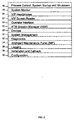
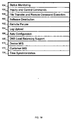
- Fig. 2 is a table which shows examples of significant components of the global ATM architecture for an embodiment of the present invention. Referring to Fig. 2, these components include, for example, process control 16, system monitor 18, visually impaired person (VIP) headphones 20, VIP screen reader 22, operator interface 24, ATM session manager 26, devices 28, system management 30, diagnostics 32, intelligent maintenance panel 34, logging 36, installation and fallback 38, and configuration 40.
- VIP visually impaired person
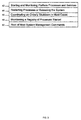
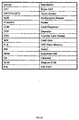
- Fig. 3 is a table which shows examples of the major functionality of process control 16 for an embodiment of the present invention.
- significant functionality of process control 16 includes, for example, starting and monitoring platform processes and services 42, restarting processes or rebooting the system 44, coordinating an orderly shutdown 46 in most cases, maintaining a registry of processes started 48, and serving as the root of most system management commands 50.
- Startup can be automatic via NT service control or manual via NTDS operator utility.
- the Global CAT is started via "net start” in a startup.bat file.
- Shutdown occurs on systems management shutdown or reboot commands.
- Shutdown can be manual via NTDS operator utility or via an NT "net stop” command.
- Inter process communications (IPC) for process control 16 utilizes a component object model (COM) interface to all NTDS components.
- Process control interfaces include, for example [default] IComponentRegistrar, IComponentldentification, ImanagedComponent, IManagedComponent2, lProcessLifecycle, lEventRegistration, IObjectDirectory.
- the ATM Session Manager (ASM) is dependent on IIS.
- the process controller 16 must start IIS before the NTDS processes.
- the process controller 16 is a COM local server. It is an NT process housing a single COM object running in an single threaded apartment (STA).
- STA single threaded apartment
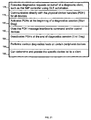
- FIG. 4 is a schematic diagram which illustrates an example of the scope and control of processes and service brought up by the process controller 16 for an embodiment of the present invention.
- Start Cat and Stop Cat commands put the CAT into particular states. These commands can be initiated from the INC, the operator interface (OI) 24, or the intelligent maintenance panel (IMP) 34.
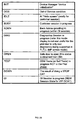
- Fig. 5 is a table which shows examples of operator commands that include Start Cat 52 and Stop Cat 54 for an embodiment of the present invention. The possible initiators and semantics of each operation are noted.
- the ATM Session Manager (ASM) 26 is the controlling entity for allocating and determining which type of session to run as well as handling the state of the CAT, managing an out of service screen (OOSS), and notifying the INC of changes in CAT status. For this reason the process controller 16 is designed to process the Stop and Start commands specifically addressing the Global CAT architecture instead of generically propagating the commands.
- the process controller 16 uses an IATMSessionManager interface supported by the ASM 26 using StopATMSession(stopmode) and StartATMSession(startmode) methods.
- the initiators such as IMP 34, OI 24, and INC are adapted to use an Execute method implemented by the process controller 16 on a IManagedComponent2 interface and pass the appropriate mode.
- an interface is defined to support the loading and unloading of devices. This interface, referred to as IDevicesLifecycle, has a load and unload method.
- Stopmode the ASM 26 puts up the out of service screen, stops the customer session as is appropriate, sends the CAT status to the INC, and notifies the device manager to unload its devices 28.
- startmode On the "StartATMSession (startmode),” the ASM 26 notifies the device manager to load its devices 26, starts the customer session which puts up the "Hello” screen, and notifies the INC.
- Fig. 6 is a table with shows examples of the major functionality of the system monitor for an embodiment of the present invention.
- significant functionality of the system monitor 18 includes, for example, blanking and unblanking a front screen display during system shutdown and startup 56, resetting a hardware watchdog timer periodically 58, resetting the hardware watchdog timeout value for system operation and reboot 60, and sending notification to INC when the system has been reset due to the watchdog timer (WDT) 62.
- the system monitor 18 is one of the first processes started, since it must start resetting the hardware watchdog timer in order to prevent the timeout from expiring while the system is starting up.
- the system monitor 18 remains up until a system shutdown (reboot) is issued.
- the system monitor 18 uses a COM interface to communicate with systems management 30.
- the ASM 26 uses a COM interface to notify the system monitor 18 when to unblank and blank the video display of the CAT.
- the system monitor 18 uses IOCTL calls, defined in a video blanking and driver functional specification as the communication with the kernel driver (vbat.sys) that interfaces to the video blanking and timer device.
- TCP/IP Transmission Control Protocol/Internet Protocol
- the system monitor 18 for an embodiment of the present invention is designed to come up using the NTDS process startup model.
- the system monitor 18 interfaces with systems management 30 to send a notification to the INC if it detects that the system has been reset due to expiration of the hardware watchdog timeout.
- the notification cannot be sent to systems management 30 until a StartProcess has been executed.
- the ASM 26 interfaces with the system monitor 18 to control the video blanking and unblanking via a system monitor interface. When a SHUTDOWN is executed, the video is blanked and the hardware watchdog timeout is set to a configured value, such as 5 minutes.
- the system monitor 18 depends on the systems management component 30 being up and operational to send a notification to the INC if it detects that the system has been restarted due to the hardware watchdog timeout expiring.
- the system monitor 18 cannot send the notification to systems management 30 until a StartProcess has been executed.
- the system monitor 18 depends on the ASM 26 sending a notification that the video can be unblanked.
- the system monitor 18 depends on the process controller 16 sending a SHUTDOWN notification in order to blank the video and reset the hardware watchdog timeout value.
- the system monitor 18 depends on the kernel driver (vbat.sys) that provides the interface to the hardware watchdog timer and video blanking device.
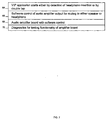
- Fig. 7 is a table which shows examples of the major functionality of VIP headphones for an embodiment of the present invention.
- such major functionality includes, for example, the VIP application starting either by detection of headphone insertion or by double tap 64 in top right hand corner, depending on the configuration parameter, software control of audio amplifier output for routing to either speaker or headphone 66 via COM8 port pins to provide more security during the VIP transaction, an audio amplifier board with software control 68 with the ability to detect the physical presence of the amplifier board, and diagnostics required for testing functionality of the amplifier board 70 involving headphone insertion to verify audio routing.
- a "Switches" COM object handles all software control of the amplifier board
- the VIP application 20 for an embodiment of the present invention accesses the "Switches” COM object.
- the amplifier board is set to manual mode and the speaker is activated for audio output.
- a "headphone detected” event is generated to the "Hello” screen, and on the "headphone detected” event, the application 20 issues commands through the "Switches” object to route audio to the headphone.
- the application 20 issues a command to route audio to the speaker for the next customer.
- the VIP Global CAT for an embodiment of the present invention makes use of a new audio amplifier board having software control of the amplifier board. Headphone insertion triggers the VIP application 20 from the "Hello" screen, and double touch triggering of the VIP application 20 is disabled. The VIP application 20 controls audio output, and audio is not routed to the speaker until a VIP session is complete or times out. Diagnostics 32 is available for testing audio routing.
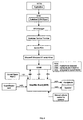
- Fig. 8 is a schematic flow chart with illustrates an example outline of the interfaces in a VIP aspect of an embodiment of the present invention.
- Fig. 9 is a table which shows examples of the major functionality of VIP screen reader 22 for an embodiment of the present invention.
- Significant functionality of the VIP screen reader 22 includes, for example, allowing visually impaired customers to perform all the transactions that sighted customers are able to do. This is done by providing a text-to-speech capability 72 and a screen layout and navigational method that allows visually impaired customers to sequence through screens and make selections 74 using only the touchscreen without using the keypad.
- Fig. 10 is a schematic diagram which illustrates an example of a VIP screen layout for an embodiment of the present invention.
- customers can sequence through all the choices or information boxes 80, 82, 84, 86 on the screen, one-at-a-time. As each item is reached, it is voiced. When the desired choice is heard, "SELECT" 88 is touched and the action is performed, which is typically a transition to a new screen.
- "SELECT" 88 is touched and the action is performed, which is typically a transition to a new screen.
- By constantly touching "NEXT" 76 all the items can be heard. When the bottom of the screen is reached, it wraps to the top.
- HTML anchors that are sequenced through by "NEXT” 76 or “PREVIOUS” 78 and executed by "SELECT” 88. Touching the items directly will cause a BOOP. Items must be accessed via the navigation zones.
- Screen reader software for an embodiment of the present invention includes a number of aspects.
- a commercially available screen reader product such as a JAWS executable, is started up by process controller 16 at system initialization. Permanently running but voicing is enabled only for the VIP application 22.
- Another aspect of the screen reader 22 is an OCX control that is the sole method for invoking voice.
- An additional aspect of the screen reader 22 are JAWS Internet Explorer scripts including interpretive language that is used to control voicing and that are passed to JAWS by OCX, interpreted and executed by JAWS.
- a further aspect of the screen reader 22 is a JFWVid.dll kernel display driver that is part of the video driver chain, which is started up by Windows NT at system startup and runs permanently. It is used by JAWS to construct a text map of the entire display area when voicing is enabled.
- Still another aspect of the screen reader 22 are JAWS utilities which must be run if a new display type is installed on the system
- the navigation shell including "NEXT” 76, "PREVIOUS” 78, and "SELECT” 88 communicates voicing commands to JAWS via an OLE custom control (OCX ).
- OLE custom control OCX
- the OCX methods used include, for example, EnableVoice which enables the voicing capability whenever the VIP application 22 is entered and turns on the screen layout construction by the video driver.
- Another OCX method includes DisableVoice which disables the voicing capability at initialization and end-of-session and turns off the screen layout construction by the video driver.
- Other OCX methods include, for example, SayString which voices the passed string argument and ReadCurrentOption which voices the field that currently has the focus in the browser.
- Fig. 11 is a schematic diagram which shows an example overview of VIP Global CAT screen presentation interfaces for an embodiment of the present invention.
- the VIP screens and normal sighted screens use different "device-specific template” files and phrase definitions but the underlying mini-app and "canonical template” files are the same.
- the JAWS kernel display driver is inserted into the video driver chain and maintains an image of display memory for use by the JAWS executable when voicing.
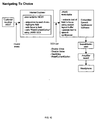
- Fig. 12 is a schematic flow chart which illustrates an example of the process of navigating to a VIP screen choice for an embodiment of the present invention.
- Fig. 13 is a schematic flow chart which illustrates an example of the process of selecting a VIP screen choice for an embodiment of the present invention.
- the method for entering a PIN by the visually impaired customer is a special case, such as tap mode, which is necessary for security reasons.
- Fig. 14 is a table which shows examples of major operator functionalities of the operator interface (OI) 24 for an embodiment of the present invention.
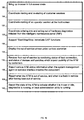
- significant operator interface functionality includes orderly shut down or reboot system 90, start ATM 92, stop ATM 94, Stop ATM immediate 96, view status of ATM 98, view activity/MIS log 100, view NT event logs 102, view software release information 104, and configure ATM 106.
- Additional major functionality of the OI 24 includes view ATM configuration 108, view TTM status 110, load keys 112, start back administration 114, start diagnostics 116, start command shell 118, and user account administration 120.
- the OI navigation shell is an integral part of the OI 24, and is responsible for logging on users, supporting user entitlements, providing high-level menu selections and navigation, with multi-lingual support, and launch OI dialog/applet selected by the user.
- Fig. 15 is a schematic diagram which illustrates an overview example of the ATM components for an embodiment of the present invention while the ATM is in operator session.
- One session bubble is configured for the operator session.
- the OI session bubble is recreated after each time the user exits OI 24.
- An OI session is available until the system is shut down.
- Session components "warm-started" in the OI session bubble include, for example, DeliveryCapability, RuleBroker, PresentationManager, LanguageMan, ApplicationManager, and OI.
- the OI shell and all OI dialogs/applets support the ISessionComponentLifecycle2 interface.
- the OI 24 for an embodiment of the present invention supports some or all of a number of touch points, such as a front screen, client personal computer (PC) on a local network, a video terminal, such as VTIOO, personal digital assistants (PDAs), and a dual monitor.
- a full set of OI dialogs/applets is implemented once which run on all different touch points.
- Interfaces implemented by all OI dialogs/applets include, for example, ISessionComponentLifecycle2, IcomponentIdentification, IstreamIn, and IDialog2.
- Interfaces implemented by OI shell include, for example, ISessionComponentLifecycle2, IComponentIdentification IstreamIn, and ApplicationListener.
- the OI shell for an embodiment of the present invention depends on NTDS components, such as ApplicationManager, Collection, ComponentFactory, ComponentRegistrar, Configuration, DeliveryCapability, LanguageMan, Language, Logger, ObjectDirectory, PathRegistry, PresentationManager, ScreenObject, Session, and TemplateStream.
- OI dialogs/applets depend on some or all NTDS components, including Collection, ComponentFactory, ComponentRegistrar, BackDoor, LanguageMan, Language, Logger, PathRegistry, ScreenObject, and TemplateStream
- the OI Shell and OI dialogs often collaborate with other NTDS components.
- Security measures for the OI 24 for an embodiment of the present invention include, for example, user log on validated by NT, user account administration dialog providing local administration of user accounts, update of user passwords from INC, inactivity timeout in the OI shell and all OI dialogs, IIS configured to allow restricted remote access from a client PC on a local network, secure communication link between an ATM and a client PC via secure sockets layer (SSL), authenticating a client with a digital certificate, and configuring a client PC to be CISO security compliant
- the ASM 26 for an embodiment of the present invention is a NTDS component that provides various functionality on Global CAT applications.
- Fig. 16 is a table which shows examples of significant functionality of the ASM 26 for an embodiment of the present invention.
- the major functionality of the ASM 26 includes, for example, bringing up a browser in full-screen mode 122, coordinating starting and re-starting of customer sessions 124, coordinating starting of an operator session at the front screen 126, coordinating entering into and exiting out of hardware diagnostics initiated from the intelligent maintenance panel (IMP) 128, and supporting "Start/Stop/Stop immediate CAT" functions 130.
- IMP intelligent maintenance panel
- ASM 26 for an embodiment of the present invention consists, for example, of displaying the out-of-service screen under various scenarios 132, which includes system startup and shutdown, a critical device failure, host is down, and the like. Additional functionality of the ASM 26 includes, for example, recovering from out-of-service by monitoring status of host connection, and status of devices and switches which impact the usability of the ATM by customers 134, reporting various ATM status information when the system management agent or operator interface inquires the component 136, reporting when the ATM is out-of-service, and when it is back in service after having been out-of-service 138, and reporting the state of the ATM to indicate whether it is in use or idle, diagnostics is running, or back administration utility is running 140.
- the ASM 26 for an embodiment of the present invention is a generic component that can be used on all ATM platforms. However, there are differences across platforms with which the ASM 26 must deal.
- the ASM 26 is a process component brought up by the process controller 16. It stays around at all times until the system is shut down.
- the ASM 26 brings up the web browser at initialization. It terminates the browser when the system is shut down. All inter-process and intra-process communication by the ASM 26 are COM based.
- the ASM 26 can be configured to manage some or all of the critical devices on all ATM platforms, such as card readers, cash dispensers, depositors, pin pads, printers, and switches.
- a 'critical device' is one, which if its status is 'down', causes the ATM to be out-of-service.
- the ASM 26 supports bring-up of OI sessions and diagnostics on all ATM platforms, in both front-service and rear-service configurations.
- Interfaces implemented by the ASM 26 for an embodiment of the present invention include, for example, IcomponentIdentification, IprocessLifecycle, IManagedComponent2, IATMSessionManager, lEventNotification, and lEventRegistration.
- the ASM 26 uses NTDS components, such as BackDoorManager, ComponentFactory, ComponentRegistrar, DebugLogger, DeviceManager, EventLogger, EventNotifier, Instrument, InstrumentManager, PathRegistry, Session, and SessionController. To accomplish certain functions, the ASM 26 collaborates with other NTDS components.
- Fig. 17 is a table which summarizes examples of the relationships between the ASM 26 and its collaborators for an embodiment of the present invention.
- ATM device services 28 for an embodiment of the present invention are provided through WOSA compliant XFS Service Providers for various devices.
- Fig. 18 is a table which shows examples of devices for which device services 28 are provided through service providers for an embodiment of the present invention.
- Such devices include, for example, cash dispensing modules 142, depositors 144, dynamic readers 146, secure touchscreens 148, printers150, and switches and indicators 152.
- These service providers are packaged as individual DLL's.
- a service provider is loaded when the device manager issues a WFSOpen for the device associated with that service provider.
- a service provider is unloaded when the device manager issues a WFSClose for the device 28 associated with that service provider.
- the service providers listed above are packaged as a DLL and an executable. STS service provider performs encryption key management and PIN encryption.
- Fig. 19 is a table which illustrates examples of the major functionality of system management 30 for an embodiment of the present invention.
- significant functionality of system management 30 includes status monitoring 154, inquiry and control commands 156, file transfer and remote command execution 158, software distribution 160, remote peruse 162, log upload 164, auto configuration 166, DNS load balancing support 168, device MIS 170, customer MIS 172, and time synchronization 174.
- the INC is configured to support a number of devices on the Global CAT for an embodiment of the present invention.
- Fig. 20 is a table which illustrates examples of devices on the ATM for which INC is configured to support for an embodiment of the present invention.
- System management 30 is started by the process controller 16 and remains active until the system is shutdown or rebooted. Inter process communications (IPC) are by COM and TTM, and external communications are by TCP/IP or X.25 to INC. Systems management 30 is platform independent. Platform dependent INC codes are supplied by the platform specific release. System management 30 implements, for example, IStatusMonitor (SMA), EqPADisplay, IprotocolTranslator (MBA), and ICommandDispatch (CDA). SKIP is used for encryption between the INC and the Global CAT, and arbitrary scripts can be downloaded and executed from the INC.
- SMA IStatusMonitor
- MAA IprotocolTranslator
- CDA ICommandDispatch
- Fig. 21 is a table which shows examples of significant functionality of diagnostics 32 for an embodiment of the present invention.
- diagnostics 32 executes diagnostics requests on behalf of a diagnostic client, such as the IMP controller using OLE automation 176.
- diagnostics 32 communicates directly with the physical device handlers (PDH) for all devices 178, activates PDHs at the beginning of a diagnostics session (Start Diag) 180, uses the PDH message interface to command and/or control devices 182, and deactivates PDHs at the end of diagnostics session (End Diag) 184.
- diagnostics 32 performs various diagnostics tests on certain peripheral devices 186, and can determine and provide the specific device list to a client 188.
- the Diagserver 32 is started by the process controller 16 as a non-OLE component during the Global CAT startup.
- the order in which it is brought up in relation to the other components is not critical. The only requirement is that the Diagserver 32 should be available when a diagnostic client, such as ElvfP Controller, becomes available to the operator.
- the Diagserver 32 is terminated when the process controller 16 performs a shutdown. OLE automation is used between the Diagserver 32 and the Diagnostic client to make diagnostic requests and receive diagnostic test results.
- the physical device handlers (PDH) DLLs are loaded by the Diagserver 32. These DLLs provide a set of command and control APIs to the physical devices.
- Fig. 22 is a table which shows examples of significant functionality of the intelligent maintenance panel (IMP) 34 for an embodiment of the present invention.
- the major functionality of the IMP 34 is a result of IMP component areas, such as IMP controller executable (IC) 190 as a primary collaborator with NTDS components, IMP physical device handler (IMP PDH) 192 used only by IC and outside the XFS manager, and IMP device (IMP) 194 as internal firmware managing Startup/Shutdown status.
- Primary areas of functionality of the IC 190 include CAT status, command and/or control, and general. For CAT status, the IC 190 registers for events from the ASM to obtain session status.
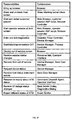
- Fig. 23 is a table which shows examples of session states for an embodiment of the present invention.
- the IC 190 performs a front OI 24 logon via IMP operator selection and allows IMP service mode entry by selecting an "ENTER DIAG" button.
- the IC 190 performs diagnostics by making requests to the Diagserver 32.
- the IC 190 communicates directly with the IMP physical device handler (PDH) and performs various diagnostics tests using the Diagserver 32 on certain peripheral devices.
- PDH physical device handler
- the process controller 16 for an embodiment of the present invention starts the IC 190.
- the IC 190 is terminated when the process controller 16 performs a shutdown.
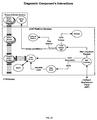
- Fig. 24 is a schematic diagram which illustrates examples of the diagnostic components and their interactions with their collaborators for an embodiment of the present invention.
- Fig. 25 is a table which illustrates examples of the primary functionality of logging 36 for an embodiment of the present invention.
- the major functionality of logging 36 for the Global CAT is divided, for example, into business log 196 and runtime logs 198.
- the business log 196 records customer transactions for auditing and future investigation purposes.
- the transaction journal is viewed via the "Peruse" utility. Access to the Peruse utility is granted based on the user account entitlement.
- the runtime logs 198 include an extended logging mechanism or the XFS service providers to track detail debugging information.
- the logging manager 36 handles all the tasks required for proper filtering and routing of log messages. All runtime software logs through this manager. All kernel mode drivers and certain utilities use the native NT logging service facilities.
- Three interfaces provided to the logging manager 36 for an embodiment of the present invention include LogEvent, LogText and ClntAppLog.
- the ClntAppLog is maintained for backward compatibility. All new or modified software uses either LogEvent or LogText.
- Log messages are consolidated and formatted for viewing on a client.
- the logging manager 36 is a dynamic link library (DLL) and is activated when the system is up. It is deactivated when the system is being shut down.
- DLL dynamic link library
- the logging mechanism is generic across Global CAT platforms. It is imperative to protect information contained in the customer transaction journal and runtime log files while those files are being uploaded from the CAT to the INC, and an end-to-end encryption (SKIP) mechanism is used for that purpose.
- SSLIP end-to-end encryption
- Fig. 26 is a table which shows examples of the major functionality for installation and fallback 38 for an embodiment of the present invention.
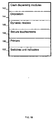
- the major functionality of installation and fallback 38 includes, for example, upgrading versions of software currently running on the Global CAT and falling back to previously running versions if the upgrade versions fail and local and remote distribution of software upgrades. Referring to Fig. 26, this functionality involves distribution and release of software packages 200, activation of release packages 202, cutover of release packages 204, fallback to previously running versions of the software 206, backing out of the last distributed release package208, and reinstalling the previous software versions 210.
- Distribution of release packages 200 for an embodiment of the present invention involves distributing one or more sub-system releases in a release package to a hard disk to a fully functional CAT.
- Activation of release packages 202 involves preparation for release cutovers and invoking generic installation scripts provided by each sub-system in the release package for the fully functional CAT.
- Cutover to the release package 204 involves reboot of the CAT, invoking upgrade/configuration scripts provided by each sub-system in the release package, and the CAT is fully functional after the software upgrade and configuration of the release package is complete
- Backing out the last distributed release package 208 for an embodiment of the present invention involves deactivating versions of the software in the latest release package so they are longer accessible or re-installable.
- Reinstalling previous software versions 210 involves carrying out activation and cutover steps for the previously running versions of the affected sub-systems, and the CAT is restored to the same state as just prior to introducing the release package. If an error occurs during cutover to one of the subsystem releases, the INC initiates a fallback to the previously running version of each affected subsystem in the correct fallback order.
- the framework both executables and scripts, is invoked as a result of initiating a distribution of a release package, initiating an activation of a release package, initiating a cutover to a release package and reboot after an activation, and initiating a fallback.
- the framework becomes inactive once its current function completes, and stays inactive until invoked again.
- Inter process communications (IPC) communications in the installation and fallback framework 38 for an embodiment of the present invention includes one component, executable or script, invoking a second component and one component creating file content for a second component to read.
- TCP/IP is used between the INC and the CAT.
- the installation and fallback framework 38 relies on the NTDS system management and LCserver components to handle all communications with the INC.
- the software upgrade and fallback framework 38 is generic across Global CAT platforms. Local interface to the software upgrade framework 38 is via CATinstall.ksh. Remote interface to the software upgrade framework 38 is via INC and LCserver.
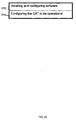
- Fig. 27 is a table which illustrates the primary functionality of configuration 40 for an embodiment of the present invention.
- a major functionality of configuration 40 is installing and configuring software 212 which involves, for example, running rif or.reg files to set up required registry entries, copying kernel driver and other files to their required locations, and installing vendor drivers.
- Another major functionality of configuration is configuring the CAT to be operational 214 which involves, after configuration parameters such as IP and/or X 1 21 address for the CAT, router IP address, host IP or X 1 21 address, time zone, and the like have been entered, propagating these values to the registry locations where NT and vendor software expect them and updating CAT input files, such as nic.in, wipc.ini, hosts, and the like.
- Configuration 40 for a embodiment of the present invention makes use of an OI interface for configuring the CAT.
- This interface has no manual configuration option.
- the parameters entered are, for example, Nodeid, IP address of the node, IP address of the router, and IP subnet mask. After these parameters are entered, the remaining configuration values come from the INC via oautoconfig (confboc.exe).
- the release is up with two sets of INC parameters, the production INC pair and the UAT test pair.
- the INC parameters that the CAT uses are determined from the login that is used to configure the CAT. If logged in as the 'field' login, the production pair is used. If logged in as the 'UATtest' login, the UATtest pair is used.
- the nodeid parameter cannot be changed on a subsequent configuration of the CAT. Prefix tables and other customization files can be downloaded as part of the auto configuration.
- the configuration interface 40 for an embodiment of the present invention also provides, for example, an option for manual or auto configuration from the INC.
- the option to select the host communication mode (X.25 or TCP/IP) is provided.
- the appropriate host parameters (IP or X.25) are prompted for and displayed based upon the host communication mode.
- the appropriate normalizer (nic.exe for X.25 and nitcp.exe for TCP/IP) is brought up.
- the option to select the GATEWAY type SF, or SFC
- the appropriate GATEWAY configuration is run, and the appropriate GATEWAY executable is brought up.
Landscapes
- Business, Economics & Management (AREA)
- Accounting & Taxation (AREA)
- Finance (AREA)
- Physics & Mathematics (AREA)
- General Physics & Mathematics (AREA)
- Engineering & Computer Science (AREA)
- Software Systems (AREA)
- Financial Or Insurance-Related Operations Such As Payment And Settlement (AREA)
Applications Claiming Priority (2)
| Application Number | Priority Date | Filing Date | Title |
|---|---|---|---|
| US15218399P | 1999-09-02 | 1999-09-02 | |
| US152183P | 1999-09-02 |
Publications (3)
| Publication Number | Publication Date |
|---|---|
| EP1081664A2 true EP1081664A2 (de) | 2001-03-07 |
| EP1081664A3 EP1081664A3 (de) | 2004-01-07 |
| EP1081664B1 EP1081664B1 (de) | 2007-03-14 |
Family
ID=22541842
Family Applications (1)
| Application Number | Title | Priority Date | Filing Date |
|---|---|---|---|
| EP00203034A Expired - Lifetime EP1081664B1 (de) | 1999-09-02 | 2000-09-01 | System und Verfahren zum Anbieten von WWW Inhalten, zentralisierte Steuerung sowie Lokal- und Fernverwaltung an globalen finanziellen Selbstbedienungstransaktionsterminals |
Country Status (4)
| Country | Link |
|---|---|
| EP (1) | EP1081664B1 (de) |
| CN (1) | CN1295296A (de) |
| AT (1) | ATE357034T1 (de) |
| DE (1) | DE60033895T2 (de) |
Cited By (9)
| Publication number | Priority date | Publication date | Assignee | Title |
|---|---|---|---|---|
| EP1669956A1 (de) * | 2004-12-10 | 2006-06-14 | Wincor Nixdorf AG | Geldautomat und Geldautomatensteuerung |
| EP1659548A3 (de) * | 2004-11-10 | 2008-08-20 | NCR International, Inc. | Überwachungsprogramm |
| EP1959407A3 (de) * | 2006-11-27 | 2008-09-03 | Aristocrat Technologies Australia PTY Ltd | Spielgerät mit Berührungsbildschirm |
| US7451134B2 (en) | 2004-08-02 | 2008-11-11 | Wells Fargo Bank, N.A. | Method and apparatus for facilitating data management over a network |
| EP2043064A3 (de) * | 2007-09-26 | 2010-06-02 | NCR Corporation | Selbstbedienungskasse |
| US8170932B1 (en) | 2007-11-28 | 2012-05-01 | Wells Fargo Bank, N.A. | System and method for data management and financial transaction categorization |
| US8639622B1 (en) | 2009-08-31 | 2014-01-28 | Wells Fargo Bank, N.A. | Budget management system and method |
| US10460376B1 (en) | 2007-11-28 | 2019-10-29 | Wells Fargo Bank, N.A. | System and method for data management and financial budgeting |
| CN110851837A (zh) * | 2019-11-04 | 2020-02-28 | 中电长城(长沙)信息技术有限公司 | 一种基于可信计算的自助设备、其安全管理系统及方法 |
Families Citing this family (7)
| Publication number | Priority date | Publication date | Assignee | Title |
|---|---|---|---|---|
| CN1338695A (zh) * | 2001-07-17 | 2002-03-06 | 天津南开戈德集团有限公司 | 网络自助服务系统及其运作方法 |
| EP1746502A1 (de) * | 2005-07-06 | 2007-01-24 | Ubs Ag | Technik zur Migration einer Host-Umgebung auf eine neue Systemplattform |
| US8522069B2 (en) | 2010-01-21 | 2013-08-27 | Wincor Nixdorf International Gmbh | Process for secure backspacing to a first data center after failover through a second data center and a network architecture working accordingly |
| DE102010005331A1 (de) | 2010-01-21 | 2011-07-28 | WINCOR NIXDORF International GmbH, 33106 | Verfahren zum sicheren Zurückschalten auf ein erstes Rechenzentrum nach Ausfallsicherung durch ein zweites Rechenzentrum und danach arbeitende Netzwerkstruktur |
| US9003080B2 (en) | 2012-09-26 | 2015-04-07 | International Business Machines Corporation | Managed access to peripherals of a service terminal |
| CN108010225A (zh) * | 2017-12-14 | 2018-05-08 | 四川晓维科技有限公司 | 用于自动存取款设备的信号接收电路及自动存取款设备 |
| CN115631576A (zh) * | 2022-09-23 | 2023-01-20 | 益逻触控系统公司 | 用于公共场所装置的osd系统及自助服务装置 |
Family Cites Families (5)
| Publication number | Priority date | Publication date | Assignee | Title |
|---|---|---|---|---|
| JPH0652398A (ja) * | 1992-07-28 | 1994-02-25 | Fujitsu Ltd | 現金自動取引機 |
| US5860012A (en) * | 1993-09-30 | 1999-01-12 | Intel Corporation | Installation of application software through a network from a source computer system on to a target computer system |
| US5933816A (en) * | 1996-10-31 | 1999-08-03 | Citicorp Development Center, Inc. | System and method for delivering financial services |
| JPH10255112A (ja) * | 1997-03-12 | 1998-09-25 | Oki Electric Ind Co Ltd | 自動取引装置の監視方法と監視システム |
| GB2319102B (en) * | 1998-01-30 | 1998-12-23 | Ibm | A security system for a transaction processing system |
-
2000
- 2000-09-01 EP EP00203034A patent/EP1081664B1/de not_active Expired - Lifetime
- 2000-09-01 DE DE60033895T patent/DE60033895T2/de not_active Expired - Lifetime
- 2000-09-01 AT AT00203034T patent/ATE357034T1/de not_active IP Right Cessation
- 2000-09-04 CN CN00126988.7A patent/CN1295296A/zh active Pending
Non-Patent Citations (1)
| Title |
|---|
| None |
Cited By (24)
| Publication number | Priority date | Publication date | Assignee | Title |
|---|---|---|---|---|
| US10936679B1 (en) | 2004-08-02 | 2021-03-02 | Wells Fargo Bank, N.A. | Method and apparatus for facilitating data management |
| US7451134B2 (en) | 2004-08-02 | 2008-11-11 | Wells Fargo Bank, N.A. | Method and apparatus for facilitating data management over a network |
| US10204161B1 (en) | 2004-08-02 | 2019-02-12 | Wells Fargo Bank, N.A. | Method and apparatus for facilitating data management |
| US8708226B2 (en) | 2004-11-10 | 2014-04-29 | Ncr Corporation | Supervisor program |
| EP1659548A3 (de) * | 2004-11-10 | 2008-08-20 | NCR International, Inc. | Überwachungsprogramm |
| EP1669956A1 (de) * | 2004-12-10 | 2006-06-14 | Wincor Nixdorf AG | Geldautomat und Geldautomatensteuerung |
| EP1959407A3 (de) * | 2006-11-27 | 2008-09-03 | Aristocrat Technologies Australia PTY Ltd | Spielgerät mit Berührungsbildschirm |
| EP2043064A3 (de) * | 2007-09-26 | 2010-06-02 | NCR Corporation | Selbstbedienungskasse |
| US10096071B1 (en) | 2007-11-28 | 2018-10-09 | Wells Fargo Bank, N.A. | System and method for data management and financial transaction categorization |
| US8170932B1 (en) | 2007-11-28 | 2012-05-01 | Wells Fargo Bank, N.A. | System and method for data management and financial transaction categorization |
| US11861689B1 (en) | 2007-11-28 | 2024-01-02 | Wells Fargo Bank, N.A. | Systems for data management and financial budgeting |
| US8620780B2 (en) | 2007-11-28 | 2013-12-31 | Wells Fargo Bank, N.A. | System and method for data management and financial transaction categorization |
| US10810684B1 (en) | 2007-11-28 | 2020-10-20 | Wells Fargo Bank, N.A. | System and method for data management and financial transaction categorization |
| US8700503B2 (en) | 2007-11-28 | 2014-04-15 | Wells Fargo Bank, N.A. | System and method for data management and financial transaction categorization |
| US10460376B1 (en) | 2007-11-28 | 2019-10-29 | Wells Fargo Bank, N.A. | System and method for data management and financial budgeting |
| US8719132B1 (en) | 2009-08-31 | 2014-05-06 | Wells Fargo Bank, N.A. | Financial management system and method with debt management |
| US10810660B1 (en) | 2009-08-31 | 2020-10-20 | Wells Fargo Bank, N.A. | Financial management system and method with retirement planning |
| US10460379B1 (en) | 2009-08-31 | 2019-10-29 | Wells Fargo Bank, N.A. | Financial management system and method with customizable user interface |
| US11250390B1 (en) | 2009-08-31 | 2022-02-15 | Wells Fargo Bank, N.A. | Financial management system and method with customizable user interface |
| US8639622B1 (en) | 2009-08-31 | 2014-01-28 | Wells Fargo Bank, N.A. | Budget management system and method |
| US12008521B1 (en) | 2009-08-31 | 2024-06-11 | Wells Fargo Bank, Na | Financial management system and method with customizable user interface |
| US12387181B2 (en) | 2009-08-31 | 2025-08-12 | Wells Fargo Bank, Na | Financial management system and method with customizable user interface |
| CN110851837A (zh) * | 2019-11-04 | 2020-02-28 | 中电长城(长沙)信息技术有限公司 | 一种基于可信计算的自助设备、其安全管理系统及方法 |
| CN110851837B (zh) * | 2019-11-04 | 2023-04-11 | 中电长城(长沙)信息技术有限公司 | 一种基于可信计算的自助设备、其安全管理系统及方法 |
Also Published As
| Publication number | Publication date |
|---|---|
| DE60033895T2 (de) | 2007-12-06 |
| ATE357034T1 (de) | 2007-04-15 |
| CN1295296A (zh) | 2001-05-16 |
| DE60033895D1 (de) | 2007-04-26 |
| EP1081664B1 (de) | 2007-03-14 |
| EP1081664A3 (de) | 2004-01-07 |
Similar Documents
| Publication | Publication Date | Title |
|---|---|---|
| US7051096B1 (en) | System and method for providing global self-service financial transaction terminals with worldwide web content, centralized management, and local and remote administration | |
| EP1081664B1 (de) | System und Verfahren zum Anbieten von WWW Inhalten, zentralisierte Steuerung sowie Lokal- und Fernverwaltung an globalen finanziellen Selbstbedienungstransaktionsterminals | |
| US7747527B1 (en) | Apparatus and method for providing transaction services | |
| US7912914B2 (en) | Transaction processing systems | |
| US8123120B2 (en) | Automated banking machine that operates responsive to data bearing records | |
| US8429077B2 (en) | Web enabled bank teller machine | |
| US8042733B2 (en) | Automated banking machine that operates responsive to data bearing records | |
| US8543506B2 (en) | System and method for delivering financial services | |
| US6968321B1 (en) | Method and system for remote operator interface with a self-service financial transactions terminal | |
| US7716096B2 (en) | Application service provider and automated transaction machine system and method | |
| US9338167B2 (en) | Self-service terminal (SST) thin client | |
| US20030120597A1 (en) | Application service provider and automated transaction machine system and method | |
| US20140089538A1 (en) | Managed access to peripherals of a service terminal | |
| US7025255B1 (en) | Application service provider and automated transaction machine system and method | |
| CZ20031173A3 (cs) | Systém a způsob poskytování bezpečnosti pro finanční obslužné terminály s dokumentově ovládaným rozhraním | |
| US6275785B1 (en) | Hardware simulator for a transaction processing system | |
| RU2251730C2 (ru) | Автоматизированная система и способ для выполнения финансовых операций | |
| US20050131822A1 (en) | Self-service terminal | |
| JP5187958B2 (ja) | 自動取引装置制御システム | |
| CA2478552C (en) | Automated banking machine system and development method | |
| EP1669957A1 (de) | Ein Geldautomat | |
| JP5667313B2 (ja) | 自動取引装置制御システム | |
| KR101638100B1 (ko) | 금융자동화기기 및 화면 표시 제어 방법 | |
| EP3007144A1 (de) | Dynamisches ersetzen der statusflüsse eines selbstbedienungsterminals (sbt) und bildschirmhandhabung |
Legal Events
| Date | Code | Title | Description |
|---|---|---|---|
| PUAI | Public reference made under article 153(3) epc to a published international application that has entered the european phase |
Free format text: ORIGINAL CODE: 0009012 |
|
| AK | Designated contracting states |
Kind code of ref document: A2 Designated state(s): AT BE CH CY DE DK ES FI FR GB GR IE IT LI LU MC NL PT SE |
|
| AX | Request for extension of the european patent |
Free format text: AL;LT;LV;MK;RO;SI |
|
| PUAL | Search report despatched |
Free format text: ORIGINAL CODE: 0009013 |
|
| AK | Designated contracting states |
Kind code of ref document: A3 Designated state(s): AT BE CH CY DE DK ES FI FR GB GR IE IT LI LU MC NL PT SE |
|
| AX | Request for extension of the european patent |
Extension state: AL LT LV MK RO SI |
|
| 17P | Request for examination filed |
Effective date: 20040706 |
|
| AKX | Designation fees paid |
Designated state(s): AT BE CH CY DE DK ES FI FR GB GR IE IT LI LU MC NL PT SE |
|
| AXX | Extension fees paid |
Extension state: AL Payment date: 20040706 Extension state: SI Payment date: 20040706 Extension state: LT Payment date: 20040706 Extension state: MK Payment date: 20040706 Extension state: RO Payment date: 20040706 Extension state: LV Payment date: 20040706 |
|
| 17Q | First examination report despatched |
Effective date: 20041014 |
|
| 17Q | First examination report despatched |
Effective date: 20041014 |
|
| GRAP | Despatch of communication of intention to grant a patent |
Free format text: ORIGINAL CODE: EPIDOSNIGR1 |
|
| GRAS | Grant fee paid |
Free format text: ORIGINAL CODE: EPIDOSNIGR3 |
|
| GRAA | (expected) grant |
Free format text: ORIGINAL CODE: 0009210 |
|
| AK | Designated contracting states |
Kind code of ref document: B1 Designated state(s): AT BE CH CY DE DK ES FI FR GB GR IE IT LI LU MC NL PT SE |
|
| AX | Request for extension of the european patent |
Extension state: AL LT LV MK RO SI |
|
| PG25 | Lapsed in a contracting state [announced via postgrant information from national office to epo] |
Ref country code: AT Free format text: LAPSE BECAUSE OF FAILURE TO SUBMIT A TRANSLATION OF THE DESCRIPTION OR TO PAY THE FEE WITHIN THE PRESCRIBED TIME-LIMIT Effective date: 20070314 Ref country code: CH Free format text: LAPSE BECAUSE OF FAILURE TO SUBMIT A TRANSLATION OF THE DESCRIPTION OR TO PAY THE FEE WITHIN THE PRESCRIBED TIME-LIMIT Effective date: 20070314 Ref country code: FI Free format text: LAPSE BECAUSE OF FAILURE TO SUBMIT A TRANSLATION OF THE DESCRIPTION OR TO PAY THE FEE WITHIN THE PRESCRIBED TIME-LIMIT Effective date: 20070314 Ref country code: NL Free format text: LAPSE BECAUSE OF FAILURE TO SUBMIT A TRANSLATION OF THE DESCRIPTION OR TO PAY THE FEE WITHIN THE PRESCRIBED TIME-LIMIT Effective date: 20070314 Ref country code: BE Free format text: LAPSE BECAUSE OF FAILURE TO SUBMIT A TRANSLATION OF THE DESCRIPTION OR TO PAY THE FEE WITHIN THE PRESCRIBED TIME-LIMIT Effective date: 20070314 Ref country code: LI Free format text: LAPSE BECAUSE OF FAILURE TO SUBMIT A TRANSLATION OF THE DESCRIPTION OR TO PAY THE FEE WITHIN THE PRESCRIBED TIME-LIMIT Effective date: 20070314 |
|
| REG | Reference to a national code |
Ref country code: GB Ref legal event code: FG4D |
|
| REG | Reference to a national code |
Ref country code: CH Ref legal event code: EP |
|
| REF | Corresponds to: |
Ref document number: 60033895 Country of ref document: DE Date of ref document: 20070426 Kind code of ref document: P |
|
| REG | Reference to a national code |
Ref country code: IE Ref legal event code: FG4D |
|
| PG25 | Lapsed in a contracting state [announced via postgrant information from national office to epo] |
Ref country code: SE Free format text: LAPSE BECAUSE OF FAILURE TO SUBMIT A TRANSLATION OF THE DESCRIPTION OR TO PAY THE FEE WITHIN THE PRESCRIBED TIME-LIMIT Effective date: 20070614 |
|
| PG25 | Lapsed in a contracting state [announced via postgrant information from national office to epo] |
Ref country code: ES Free format text: LAPSE BECAUSE OF FAILURE TO SUBMIT A TRANSLATION OF THE DESCRIPTION OR TO PAY THE FEE WITHIN THE PRESCRIBED TIME-LIMIT Effective date: 20070625 |
|
| PG25 | Lapsed in a contracting state [announced via postgrant information from national office to epo] |
Ref country code: PT Free format text: LAPSE BECAUSE OF FAILURE TO SUBMIT A TRANSLATION OF THE DESCRIPTION OR TO PAY THE FEE WITHIN THE PRESCRIBED TIME-LIMIT Effective date: 20070814 |
|
| LTIE | Lt: invalidation of european patent or patent extension |
Effective date: 20070314 |
|
| NLV1 | Nl: lapsed or annulled due to failure to fulfill the requirements of art. 29p and 29m of the patents act | ||
| REG | Reference to a national code |
Ref country code: CH Ref legal event code: PL |
|
| EN | Fr: translation not filed | ||
| EN | Fr: translation not filed | ||
| PLBE | No opposition filed within time limit |
Free format text: ORIGINAL CODE: 0009261 |
|
| STAA | Information on the status of an ep patent application or granted ep patent |
Free format text: STATUS: NO OPPOSITION FILED WITHIN TIME LIMIT |
|
| PG25 | Lapsed in a contracting state [announced via postgrant information from national office to epo] |
Ref country code: DK Free format text: LAPSE BECAUSE OF FAILURE TO SUBMIT A TRANSLATION OF THE DESCRIPTION OR TO PAY THE FEE WITHIN THE PRESCRIBED TIME-LIMIT Effective date: 20070314 |
|
| 26N | No opposition filed |
Effective date: 20071217 |
|
| PG25 | Lapsed in a contracting state [announced via postgrant information from national office to epo] |
Ref country code: IT Free format text: LAPSE BECAUSE OF FAILURE TO SUBMIT A TRANSLATION OF THE DESCRIPTION OR TO PAY THE FEE WITHIN THE PRESCRIBED TIME-LIMIT Effective date: 20070314 Ref country code: MC Free format text: LAPSE BECAUSE OF NON-PAYMENT OF DUE FEES Effective date: 20070930 Ref country code: GR Free format text: LAPSE BECAUSE OF FAILURE TO SUBMIT A TRANSLATION OF THE DESCRIPTION OR TO PAY THE FEE WITHIN THE PRESCRIBED TIME-LIMIT Effective date: 20070615 Ref country code: FR Free format text: LAPSE BECAUSE OF FAILURE TO SUBMIT A TRANSLATION OF THE DESCRIPTION OR TO PAY THE FEE WITHIN THE PRESCRIBED TIME-LIMIT Effective date: 20071102 |
|
| PG25 | Lapsed in a contracting state [announced via postgrant information from national office to epo] |
Ref country code: IE Free format text: LAPSE BECAUSE OF NON-PAYMENT OF DUE FEES Effective date: 20070903 |
|
| PG25 | Lapsed in a contracting state [announced via postgrant information from national office to epo] |
Ref country code: FR Free format text: LAPSE BECAUSE OF FAILURE TO SUBMIT A TRANSLATION OF THE DESCRIPTION OR TO PAY THE FEE WITHIN THE PRESCRIBED TIME-LIMIT Effective date: 20070314 |
|
| PG25 | Lapsed in a contracting state [announced via postgrant information from national office to epo] |
Ref country code: CY Free format text: LAPSE BECAUSE OF FAILURE TO SUBMIT A TRANSLATION OF THE DESCRIPTION OR TO PAY THE FEE WITHIN THE PRESCRIBED TIME-LIMIT Effective date: 20070314 |
|
| PG25 | Lapsed in a contracting state [announced via postgrant information from national office to epo] |
Ref country code: LU Free format text: LAPSE BECAUSE OF NON-PAYMENT OF DUE FEES Effective date: 20070901 |
|
| REG | Reference to a national code |
Ref country code: DE Ref legal event code: R082 Ref document number: 60033895 Country of ref document: DE Representative=s name: BECKER, KURIG, STRAUS, DE |
|
| REG | Reference to a national code |
Ref country code: GB Ref legal event code: 732E Free format text: REGISTERED BETWEEN 20150305 AND 20150311 |
|
| REG | Reference to a national code |
Ref country code: DE Ref legal event code: R082 Ref document number: 60033895 Country of ref document: DE Representative=s name: BECKER, KURIG, STRAUS, DE Effective date: 20150226 Ref country code: DE Ref legal event code: R081 Ref document number: 60033895 Country of ref document: DE Owner name: CITICORP CREDIT SERVICES, INC. (N.D.GES. DES S, US Free format text: FORMER OWNER: CITICORP DEVELOPMENT CENTER, INC., LOS ANGELES, CALIF., US Effective date: 20150226 |
|
| PGFP | Annual fee paid to national office [announced via postgrant information from national office to epo] |
Ref country code: DE Payment date: 20190919 Year of fee payment: 20 |
|
| PGFP | Annual fee paid to national office [announced via postgrant information from national office to epo] |
Ref country code: GB Payment date: 20190918 Year of fee payment: 20 |
|
| REG | Reference to a national code |
Ref country code: DE Ref legal event code: R071 Ref document number: 60033895 Country of ref document: DE |
|
| REG | Reference to a national code |
Ref country code: GB Ref legal event code: PE20 Expiry date: 20200831 |
|
| PG25 | Lapsed in a contracting state [announced via postgrant information from national office to epo] |
Ref country code: GB Free format text: LAPSE BECAUSE OF EXPIRATION OF PROTECTION Effective date: 20200831 |