EP1087294B1 - Verfahren und Gerät zur Fernaktualisierung der Firmware eines Kommunikationsgerät - Google Patents
Verfahren und Gerät zur Fernaktualisierung der Firmware eines Kommunikationsgerät Download PDFInfo
- Publication number
- EP1087294B1 EP1087294B1 EP00308451.4A EP00308451A EP1087294B1 EP 1087294 B1 EP1087294 B1 EP 1087294B1 EP 00308451 A EP00308451 A EP 00308451A EP 1087294 B1 EP1087294 B1 EP 1087294B1
- Authority
- EP
- European Patent Office
- Prior art keywords
- page
- load
- communication device
- firmware
- firmware load
- Prior art date
- Legal status (The legal status is an assumption and is not a legal conclusion. Google has not performed a legal analysis and makes no representation as to the accuracy of the status listed.)
- Expired - Lifetime
Links
Images






Classifications
-
- G—PHYSICS
- G06—COMPUTING OR CALCULATING; COUNTING
- G06F—ELECTRIC DIGITAL DATA PROCESSING
- G06F9/00—Arrangements for program control, e.g. control units
- G06F9/06—Arrangements for program control, e.g. control units using stored programs, i.e. using an internal store of processing equipment to receive or retain programs
- G06F9/44—Arrangements for executing specific programs
- G06F9/4401—Bootstrapping
-
- G—PHYSICS
- G06—COMPUTING OR CALCULATING; COUNTING
- G06F—ELECTRIC DIGITAL DATA PROCESSING
- G06F8/00—Arrangements for software engineering
- G06F8/60—Software deployment
- G06F8/65—Updates
Definitions
- the present invention relates to data communication devices, and in particular to a method of remotely downloading firmware to a communication device (e.g. a modem) through a communication network, and a computer program element relating thereto.
- the computer program element can be embodied on a computer readable medium.
- the provision of data communication services necessarily requires the installation of a communication device (e.g. a modem connected to a host personal computer - PC) at an end-user site.
- a communication device e.g. a modem connected to a host personal computer - PC
- GUI graphical user interface
- the communications application interacts with the installed communication device using a high level Application Program Interface (API) to access firmware governing the low-level functionality of the communication device.
- API Application Program Interface
- firmware is commonly saved in a FLASH memory during manufacture of the communication device, and is run from the FLASH memory.
- firmware applications are not static. Rather, development is an on-going process of improving algorithms and code to enhance the reliability and functionality of the communication device.
- updated firmware applications can easily be loaded into new communication devices at the factory, it is difficult to provide upgrade loads to communication devices which have been already sold and delivered to the customer.
- United States Patent No. 5,268,928 (Herh , et. al.) teaches a data modem with remote firmware update capabilities.
- the data modem is provided with a read only memory (ROM), and a battery-backed random access memory (RAM).
- the firmware is divided into a boot-logic which is saved in the ROM, and application logic which is stored in the battery-backed RAM. Update loads of the application logic can be downloaded to the modem during normal operation of the device and stored in the battery-backed RAM.
- Herh et al. require that the modem be provided with two separate memories, and further require that the data modem have additional circuitry (including a built-in battery) to ensure that the application logic is not lost when the modem is turned off.
- a FLASH memory which is a non-volatile form of programmable memory.
- One of the advantages of saving the firmware in FLASH memory is that no special equipment is required to write data to the FLASH memory.
- the circuitry already provided on the device for normal read/write operations is sufficient.
- the FLASH memory can be used for both read and write operations, is it convenient to run the firmware from the FLASH-memory, which minimizes the requirement for RAM.
- the FLASH memory retains its information after loss of power, so battery-backup circuits are not required.
- FLASH memory is readily available in standard sizes (e.g. 128 kb), and, depending on the addressing limitations of the microprocessor of the communication device, may be logically divided into frames or pages (e.g. of 32kb each).
- each page can be enabled (i.e. accessed for reading or writing data) individually by the microprocessor by means of an appropriate page-select signal applied to one or more page-select input pins on the FLASH memory chip.
- Each page is further subdivided into individually accessible blocks, which can be accessed by the microprocessor by applying appropriate address-select signals to address-select input pins on the FLASH memory chip.
- corresponding blocks of every page can be accessed using a common address-select signal, so that any desired block on any page of the FLASH memory can be uniquely accessed by applying appropriate page-select and address-select signals (in combination) to the page-select and address-select input pins of the FLASH memory chip.
- the microprocessor During operation of the communication device, the microprocessor holds one page in enabled condition (by holding the page select signal constant), and then reads firmware application logic from blocks of the enabled page by changing the address-select signal (either incrementally or in response to jump commands embedded in application logic). Since a single address-select signal can access a corresponding block of memory on each page, changing the page-select signal (thereby enabling another page) during execution of the application logic will very likely cause erroneous operation of the communication device as the microprocessor attempts to execute the contents of a block of FLASH memory which is located on a page other than the page containing the application logic. As a safety measure to prevent this occurrence, firmware applications are typically written in such a way as to prevent the microprocessor from enabling any other page of the FLASH memory while any portion of the application logic is being run.
- Published PCT Patent Application No. 98/54642 is directed to a method and device which allow for the failsafe downloading of system software from a network server, without requiring additional memory.
- the system software is structured to consist of a primary partition and a secondary partition.
- the primary partition contains the software required to download the secondary partition, as well as the software to download a new primary partition.
- a verified copy of either an old or a new primary partition is present in memory, thereby allowing for a reexecution of the downloading process, in the event that the download process is interrupted or the received partition is corrupted.
- an aspect of the present invention provides a method of remotely updating firmware saved in a FLASH memory of a communication device connected to a network, the FLASH memory being partitioned into at least a first and a second portion, a first firmware load being stored in the first portion.
- a first firmware load being stored in the first portion.
- the transmitted portion of the updated firmware load is temporarily stored in a buffer of the communication device.
- At least a portion of the first firmware load is copied into a random access memory (RAM) of the communication device, and execution of the copied portion of the first firmware load from the RAM is triggered. Under control of the copied portion of the first firmware load, the transmitted portion of the updated firmware load is saved to the second portion of the FLASH memory.
- RAM random access memory
- Another aspect of the present invention provides an apparatus for remotely updating firmware saved in a FLASH memory of a communication device connected to a network, the FLASH memory being partitioned into at least a first and a second portion, a first firmware load being stored in the first portion, and at least a portion of an updated firmware load being transmitted through the network to the communication device.
- the apparatus comprises a microprocessor operative under control of the first firmware load to: copy at least a portion of the first firmware load into a random access memory (RAM) of the communication device; trigger execution of the copied portion of the first firmware load from the RAM; and save the transmitted portion of the updated firmware load to the second portion of the FLASH memory under control of the copied portion of the first firmware load.
- RAM random access memory
- the communication device may include a buffer for temporarily storing the transmitted portion of the updated firmware load.
- the portion of an updated firmware load may be transmitted through the network to the communication device by a server operatively connected to the network.
- the first portion may comprise a boot page
- the first firmware load may be saved in the boot page during manufacture of the communication device.
- the first firmware load may include a boot logic adapted to control operation of the communication device during a start-up of the communication device.
- an entire updated firmware load may be transmitted in a single download operation using a data channel of the communication device, and temporarily stored in an upstream buffer of the communication device.
- the communication device may be placed into a loop-back mode prior to transmitting the updated firmware load.
- Some embodiments of the invention further comprise preliminarily dividing the updated firmware load into a plurality of predetermined load portions.
- Each load portion may be transmitted in a respective download operation using a message channel of the communication device, and temporarily stored in a message buffer of the communication device.
- Each download operation may comprise transmitting a DnldData command including an address and the load portion as arguments.
- the load portion may be saved in the FLASH memory starting at an address of the FLASH memory corresponding to the address included in the DnldData command.
- a step of determining whether or not the load portion has been correctly saved in the FLASH memory can then be performed. When the load portion has been correctly saved in the FLASH memory, another load portion can be transmitted to the communication device, and when the load portion has not been correctly saved in the FLASH memory, the load portion can be re-transmitted to the communication device.
- Some embodiments of the invention include monitoring a download status of the updated firmware load to the communication device.
- monitoring the download status may comprise maintaining a database including a sequence number of a load portion correctly saved in the FLASH memory and incrementing the sequence number as each successive load portion is correctly saved in the FLASH memory.
- the second portion comprises a first Update Page and a second Update Page, the updated firmware load being stored in a selected one of the first and second Update Pages.
- successive updated firmware loads are alternately saved in the first and second Update Pages.
- An active page flag may be defined and adapted to point to a selected one of the first and second Update Pages, the selected one of the first and second Update Pages being an active page, and the other one of the first and second Update Pages being an inactive page.
- the updated firmware load may be saved in the inactive page.
- Some embodiments of the invention comprise the further step of determining whether or not a complete updated firmware load has been successfully saved in the inactive page.
- the active page flag may be modified to point to the inactive page, whereby the inactive page will become the active page upon a subsequent re-boot of the communication device.
- a re-boot of the communication device may be performed.
- the step of performing a re-boot of the communication device may comprise accessing the active page to determine the presence of a valid firmware load. If a valid firmware load is located in the active page, operation of the communication device continues under control of the firmware load in the active page. If a valid firmware load is not located in the active page, the inactive page is accessed to determine the presence of a valid firmware load. If a valid firmware load is located in the inactive page, operation of the communication device continues under control of the firmware load in the inactive page, and the active page flag is modified to point to the inactive page, whereby the inactive page will become the active page upon a subsequent re-boot of the communication device. If a valid firmware load is not located in the inactive page, operation of the communication device continues under control of the first firmware load in the first portion.
- the active page flag may be saved at a predetermined address in the second portion of the FLASH memory.
- the predetermined address is preferably not in either the first or the second Update Pages.
- the firmware includes program code responsive to commands received from the manufacturer to begin an update procedure.
- the update procedure controls the communication device to perform the above-noted steps, substantially without interrupting user-initiated communication sessions.
- the FLASH memory is divided into a Boot Page, and at least a First and a Second Update Pages.
- a "boot" version of the firmware may be installed in the Boot Page at the factory, and is never updated. Updated firmware loads are preferably saved only in the First and Second Update Pages. Accordingly, if a subsequent attempt to update the firmware fails, at least the "boot" version of the firmware will remain in uncorrupted condition, and can be used for operation of the communication device. Similarly, successive updates of the firmware may be alternately saved in the first and second Update Pages, so that if an attempted update of the firmware fails, the next most recently updated version of the firmware remains uncorrupted and is available for use.
- An Active Page Flag may be stored in the FLASH memory to identify which of the First and Second Update Pages contains the most up-to-date version of the firmware.
- the updated version of the firmware may become active upon a subsequent reboot of the communication device.
- this may be accomplished by the user during their normal use of the communication device: that is, by powering down and later re-booting their PC.
- communication device reboot may be accomplished automatically as a final step in the update procedure.
- Automatic reboot is particularly suitable with xDSL communication devices, because the reboot will generally take less that one or two seconds, and the communication device can automatically re-establish its connection with the CO. The CO will detect the brief interruption in the connection, but will not disconnect any ongoing communication sessions (due to its short duration).
- the communication device can be rebooted with the updated firmware without disrupting any communication sessions of the user.
- the user may not even be aware that the reboot has taken place.
- a preferred embodiment of present invention includes a system for remotely updating firmware saved in a FLASH memory of a communication device connected to a network, the FLASH memory being partitioned into at least a first and a second portion, a first firmware load being stored in the first portion.
- the system comprises: a server operatively connected to the network and adapted for transmitting at least a portion of an updated firmware load through the network to the communication device; a buffer for temporarily storing the transmitted portion of the updated firmware load; and a microprocessor operative under control of the first firmware load to: copy at least a portion of the first firmware load into a random access memory (RAM) of the communication device; trigger execution of the copied portion of the first firmware load from the RAM; and save the transmitted portion of the updated firmware load to the second portion of the FLASH memory under control of the copied portion of the first firmware load.
- RAM random access memory
- Another preferred embodiment of the present invention includes a communications device connected to a network and operative in accordance with firmware saved in a FLASH memory of a communication device, the FLASH memory being partitioned into at least a first and a second portion, a first firmware load being stored in the first portion.
- the communication device is adapted to enable remote update of the firmware through the network, and comprises: a buffer for temporarily storing a received portion of an updated firmware load; and a microprocessor operative under control of the first firmware load to: copy at least a portion of the first firmware load into a random access memory (RAM) of the communication device; trigger execution of the copied portion of the first firmware load from the RAM; and save the received portion of the updated firmware load to the second portion of the FLASH memory under control of the copied portion of the first firmware load.
- RAM random access memory
- a communication device 1 usable with the present invention comprises a network interface 2 for interfacing with the network 4, a microprocessor 6 for controlling the operation of the communication device 1; a FLASH memory 8 for storing firmware; and RAM 10 used for storing run-time data as well as up-stream and down stream communication buffers (not shown) .
- the communication device 1 is operatively connected to a host computer 12 via the network interface 2.
- the microprocessor 6 operates in accordance with the firmware to provide the functionality of the communication device 1 (e.g. to transport information between the host computer 12 and the network 4).
- the communication device 1 is operatively connected to a central office (CO) 14 providing access to the network 4 in a conventional manner. Communications sessions can therefore be established between the communication device 1 and other devices connected to the network 4 (with the communication device 1 initiating or terminating communication sessions), again in a conventional manner.
- CO central office
- an update server 16 at a manufacturer's site 18 is connected to the network 4 (in a conventional manner) and is capable of initiating a communication session with the communication device 1 as will be described in greater detail below.
- Fig. 2 schematically illustrates an exemplary firmware load 20 which is conveniently separated into a boot logic 22 and an application logic 24.
- the boot logic 22 comprises instructions which are executed upon initial start-up of the communication device 1, including low-level operating parameters of the communication device 1.
- the boot logic 22 is arranged so that its start address 24 is at a predetermined fixed start address 26, so that at start-up, it can be directly accessed by the microprocessor 6.
- Execution of the boot logic 22 provides the microprocessor 6 with the necessary address information for continued operation.
- the application logic 24 comprises a plurality of programmed procedures, accessible using a high level Application Program Interface (API), for controlling the functionality of the communication device 1.
- API Application Program Interface
- the host computer 12; the CO 14; etc. can interact with the communication device 1 by means of the API.
- a communications application e.g. a web browser
- the CO 14 can interact with the communication device 1 to negotiate transmission power settings, establish communication sessions, verify transmission of data packets, etc.
- the above-noted descriptions of the communication device 1 and firmware 20 are known, and their implementation is well understood by those skilled in the art.
- the FLASH memory 8 is divided into a plurality (preferably four) of pages 28-34, which are conveniently of equal size.
- a 128kb FLASH memory 8 is divided into four 32 kb pages 28-34, as shown in Fig. 3 .
- Each page is capable of storing a complete firmware load 20, and is utilized as follows: Page Description Boot Page (28) Contains an original version of the firmware.
- First Update Page (30) Used to store an updated version of the firmware
- Second Update Page (32) Used to store an updated version of the firmware Spare Page (34) Used to store an Active Page flag
- the Boot Page 28 contains a complete original firmware load 20a, including boot logic 22a and application logic 24a.
- This original firmware load 20a is installed and verified at the factory during manufacture of the communication device 1, and is never modified thereafter. Accordingly, if subsequent attempts to load updated versions of the firmware fail (and also prior to receipt of any updated versions), then the communication device 1 can operate using the original firmware load 20a stored in the Boot Page 28.
- the start address 26a for the original boot logic 22a is predetermined, so that the microprocessor 6 can access the original boot logic 22a stored in the Boot Page 28 upon start-up. Thus start-up of the communication device 1 is always executed on the basis of the original boot logic 22a installed by the factory.
- the First and Second Update Pages 30, 32 are used to store updated firmware loads 20b, 20c. As shown in Fig. 3 , the First and Second Update Pages 30, 32 are the same size as the boot page 30, and thus each page 30, 32 is capable of storing a complete firmware load (boot logic 22 and application logic 24). However, as noted above, only the original boot logic 22a (stored in the Boot Page 28) is used during start-up of the communication device 1. Accordingly, updated firmware loads 20b, 20c, which are subsequently downloaded and saved into the Update Pages 30, 32, may or may not contain a boot logic 22 section, as desired.
- the Spare Page 34 is preferably not used for storing firmware loads 20. Instead, the Spare Page 34 is preferably used to store an Active Page Flag 36 which acts as a pointer to the active page.
- the term "active page” refers to the Update Page (either one of the First or Second Update Pages) 30, 32 of the FLASH memory 8 which contains the application logic 24 used during run-time of the communication device 1. Normally, the active page will contain the most recently updated firmware load 20.
- the term "inactive page” refers to the other Update Page 30, 32 which is not pointed to by the Active Page Flag.
- the inactive page may be empty; contain an incomplete or corrupted firmware load 20; or may contain an obsolete firmware load 20 that has been superseded by a more recently updated firmware load 20 saved in the active page.
- the Active Page Flag 36 is a conditional value which allows firmware logic to enable (or access) the active page. For example: if the Active Page Flag 36 is set to a value of "1", then the firmware logic determines that the active page is the first Update Page 30; otherwise (i.e. if the Active Page Flag 36 is set to any other value) the firmware logic determines that the active page is the second Update Page 32.
- the value of the Active Page Flag 36 could be a pointer to the active page (e.g. containing the page-select signal used by the microprocessor 6 to enable the desired page of the FLASH memory).
- each firmware load 20 is provided with a check-sum value 38 and a jump-code 40, in addition to the boot logic 22 and application logic 24 (See Fig. 2 ). Both of the check-sum value 38 and the jump-code 40 are stored at respective predetermined addresses, which preferably remain unchanged in all subsequent update versions of the firmware load 20.
- the check-sum value 38 is used to determine the integrity of the respective firmware load 20, as will be described in greater detail below.
- the jump code 40 is a pointer to the start address 42 of the respective application logic 24, and will normally be unique for each version of the firmware load 20.
- the purpose of the jump code 40 is that, because its location is predetermined, the original version boot logic 22a can access the jump code 40 in the active page and thereby determine a start address 42 for the respective application logic 24, irrespective of changes to the start address 42 effected by an update of the application logic 24.
- Fig. 4 illustrates the method by which the original version boot logic 22a uses the Active Page Flag 36, check-sum 38 and jump code 40 to access, verify and begin execution of the appropriate application logic 24.
- the steps in the process are as follows:
- the application logic 24 in accordance with the invention includes procedures for managing the FLASH memory 8, and for writing data to the FLASH memory 8. Accessed using the API, these procedures permit the firmware 20 to be updated under the control of either the host computer 12 or through the network 4 by an update server 16 at the manufacturer's site 18 ( Fig. 1 ). Exemplary API commands for accessing this functionality are shown in Table 1 below. It should be understood that Table 1 below is exemplary only, and is not necessarily comprehensive. Table 1 Code Data Argument Description Dnld Clr - - clears the inactive page of the FLASH memory 8.
- DnldData addr/data sequence # Writes data to the FLASH memory 8 starting at an address specified by addr DnldEth - cmd Controls In-band download of firmware using the data channel (see detailed description below).
- the microprocessor 6 can only execute one command at a time, execution of any command automatically causes any other concurrent processes to be temporarily held, and process-specific state-variables stored in a buffer (conventionally provided in the microprocessor 6 for that purpose) pending completion of the command currently being executed.
- this (conventional) operation of the microprocessor 6 is exploited to enable manipulation and writing of data to the FLASH memory 8 during run-time of the application logic 24 from the FLASH memory 8. Accordingly, the invention provides a layered operational structure described below with reference to Figs. 5a and 5b . In the embodiment illustrated in Fig.
- a block of application logic 24 is copied to RAM and executed by a shell routine.
- a block of application logic 24 is copied to RAM 10 during start-up of the communication device 1, and remains resident in RAM 10 pending execution under control of the shell routine.
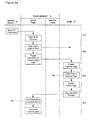
- both layer structures are illustrated in Figs. 5a and 5b by way of example algorithms which save data to the inactive page of the FLASH memory 8. It will be understood, however, that other operations can also be performed, as desired, using the layered structure of the invention. Referring now to Fig. 5a , saving data to the inactive page of the FLASH memory 8 proceeds as follows:
- the shell routine can copy the entire application logic 24 to RAM 10, or only that portion required to execute the functionality accessed by the respective API command, as desired.
- Fig 5b illustrates an alternative layered structure.
- a block of application logic 24 is copied into RAM 10 during start-up of the communication device 1, rather than by the shell routine.
- the copied block of application logic 24 remains resident in RAM 10, and is triggered by a command (possibly including one or more arguments) from the shell routine.
- the copied block of application logic 24 completes a single operation step (i.e. it does not contain decision or process control logic) so that process control remains with the shell routine. This minimizes the size and run-time of the copied block of application logic 24, so that disruption of other concurrent processes (which are interrupted while the copied block of application logic 24 is running from RAM 10) is also minimized.
- the copied block of application logic 24 is a "Copy-address" function which receives a target address of the FLASH memory 8 as an argument, and copies a block of data from a buffer to the inactive page of the FLASH memory 8 starting at the target address.
- the copied block of data may be as small as a single byte, or larger, as desired.
- saving data to the FLASH memory 8 proceeds as follows:
- updated firmware loads 20 can be downloaded and to the communication device 1 and saved in the inactive page of the FLASH memory 8 according to two modes, as described below.
- the layered structure of Fig. 5a is used. It will be understood, however, that the same modes of operation can equally be implemented using the layered structure of Fig. 5b .
- In-band download utilises a data-channel of the communication device 1 to receive the updated firmware load 20.
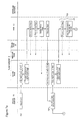
- the updated firmware load 20 is stored in a buffer of the communication device 1 pending copying of the updated firmware load 20 to the FLASH memory. Referring to Figs. 6a-6b , In-band download proceeds as follows:
- In-Band download facilitates a very rapid transmission of an updated firmware load to the communication device 1.
- a 20kb firmware load can be transmitted to the communication device 1 in as little as 0.17 sec. This makes transmitting an updated firmware load 20 rapid and convenient for the manufacturer.
- copying the updated firmware load 20 to FLASH memory 8 is expected to take significantly longer (a 32kb load can require as much as 15 seconds to copy).
- the communication device 1 must first enter a loop-back mode, which necessarily interrupts other data traffic. The communication device 1 cannot be returned to normal operation until the copy operation is completed, so an associated interruption in communications may be experienced by the user.
- Out of Band download utilises the communication device 1's message-channel and buffers to download the updated firmware load. Referring to Figs. 7a-7c , Out of band download proceeds as follows:
- Out of-Band download is significantly slower than In-band download, because an updated firmware load 20 must be broken up into small blocks which are transmitted individually. This is due to limitations in the size of the message channel buffer in the communication device 1 (typically 512 bytes). This slows down and complicates the transmission of the updated firmware load 20, because the update server must continuously monitor the status of the download. Additionally, the risk of an incomplete download is increased because it is possible that a user of the host computer 12 may power down the communication device 1 before the download is complete. However, because the message channel is used for the download, this process can be conducted simultaneously with data traffic of user-initiated communication sessions, and thus it is possible for the entire download operation to be completed without inconveniencing the user.
- the risk of partial downloads can be managed by maintaining a database of each communication device 1 and a respective current download status. If such a database is maintained, each block of the updated firmware load 20 is assigned a unique sequence number used for the respective "DnldData" command, so that the download status for each communication device 1 may be tracked by the sequence number of the latest successfully completed "DnldData” command. As each acknowledgement message is received by the update server 16 (step 703), the database is updated with the sequence number of the latest successfully completed "DnldData” command. If the communication device 1 goes "off-line” or is powered down before the download is complete, then transmission of "DnldData" commands to the communication device 1 is terminated. When the communication device 1 becomes available at a later time, transmission of "DnldData” commands to the communication device 1 is resumed starting at the sequence number indicated in the database.
- the present invention provides a method and apparatus for remotely updating firmware saved in a FLASH memory of a communication device connected to a network.
- the FLASH memory is partitioned into at least a first and a second portion.
- a first firmware load is stored in the first portion.
- At least a portion of an updated firmware load is transmitted through the network to the communication device.
- the transmitted portion of the updated firmware load is temporarily stored in a buffer of the communication device.
- At least a portion of the first firmware load is copied into a random access memory (RAM) of the communication device. Execution, from the RAM, of the copied portion of the first firmware load is triggered. Under control of the copied portion of the first firmware load, the transmitted portion of the updated firmware load is saved to the second portion of the FLASH memory.
- RAM random access memory
Landscapes
- Engineering & Computer Science (AREA)
- Software Systems (AREA)
- Theoretical Computer Science (AREA)
- General Engineering & Computer Science (AREA)
- Computer Security & Cryptography (AREA)
- Physics & Mathematics (AREA)
- General Physics & Mathematics (AREA)
- Stored Programmes (AREA)
- Information Transfer Between Computers (AREA)
Claims (31)
- Verfahren zur Fernaktualisierung von Firmware, die in einem FLASH-Speicher (8) eines Kommunikationsgeräts (1) gespeichert ist, das mit einem Netzwerk (4) verbunden ist, wobei das Verfahren folgende Schritte umfasst:a) Bereitstellen einer Startseite (28) des FLASH-Speichers (8) zum Speichern eines ersten Firmware-Loads;b) Bereitstellen eines Paars Aktualisierungsseiten (30, 32) des FLASH-Speichers (8), wobei jede Aktualisierungsseite dazu angepasst ist, einen jeweiligen Firmware-Load zu speichern;c) Festlegen einer der Aktualisierungsseiten als eine aktive Aktualisierungsseite und die andere der Aktualisierungsseiten als eine inaktive Aktualisierungsseite; Bereitstellen eines Flags "Aktive Seite" (36), das auf die festgelegte aktive Aktualisierungsseite verweist;d) Übertragen eines aktualisierten Firmware-Loads durch das Netzwerk (4) an das Kommunikationsgerät;e) Speichern, unter Steuerung des ersten Firmware-Loads, des aktualisierten Firmware-Loads auf der inaktiven Aktualisierungsseite des FLASH-Speichers (8); Modifizieren des Flags "Aktive Seite" (36), damit es auf die inaktive Aktualisierungsseite verweist, wodurch die inaktive Aktualisierungsseite bei einem anschließenden Neustart des Kommunikationsgeräts (1) zur aktiven Aktualisierungsseite wird, undf) Neustarten des Kommunikationsgeräts (1) unter Steuerung des ersten Firmware-Loads, folgende Schritte einschließend:i) Identifizieren, unter den im FLASH-Speicher (8) gespeicherten Firmware-Loads, eines zuletzt aktualisierten gültigen Firmware-Loads; undii) Fortsetzen des Betriebs des Kommunikationsgeräts (1) unter Steuerung des identifizierten zuletzt aktualisierten gültigen Firmware-Loads,
wobei der zuletzt aktualisierte gültige Firmware-Load der Firmware-Load auf der aktiven Seite ist, wenn er gültig ist und wenn der Firmware-Load zur Aktualisierung auf der aktiven Seite ungültig ist, der zuletzt aktualisierte gültige Firmware-Load der Firmware-Load auf der inaktiven Seite ist. - Verfahren nach Anspruch 1, wobei ein gesamter aktualisierter Firmware-Load in einem einzelnen Download-Vorgang unter Verwendung eines Datenkanals des Kommunikationsgeräts (1) übertragen wird und vorübergehend in einem vorgeschalteten Puffer des Kommunikationsgeräts (1) gespeichert wird.
- Verfahren nach Anspruch 2, ferner umfassend einen Schritt des Versetzens des Kommunikationsgeräts (1) in einen Prüfschleifenmodus vor dem Übertragen des aktualisierten Firmware-Loads.
- Verfahren nach Anspruch 1, ferner umfassend vorbereitendes Teilen des aktualisierten Firmware-Load in eine Mehrzahl im Voraus festgelegter Loadanteile.
- Verfahren nach Anspruch 4, wobei jeder Loadanteil in einem jeweiligen Download-Vorgang unter Verwendung eines Nachrichtenkanals des Kommunikationsgeräts (1) übertragen wird.
- Verfahren nach Anspruch 5, wobei in jedem Download-Vorgang das Übertragen eines Download-Datenbefehls mit einer Adresse und dem Loadanteil als Argumente umfasst.
- Verfahren nach Anspruch 6, ferner umfassend Speichern des Load-Abschnitts im FLASH-Speicher (8) beginnend an einer Adresse des FLASH-Speichers (8), die der Adresse in dem Download-Datenbefehl entspricht.
- Verfahren nach Anspruch 4, ferner umfassend einen Schritt des Bestimmens, ob der Loadanteil richtig im FLASH-Speicher (8) gespeichert wurde.
- Verfahren nach Anspruch 8, wobei dann, wenn der Loadanteil richtig im FLASH-Speicher (8) gespeichert wurde, ein weiterer Loadanteil an das Kommunikationsgerät (1) übertragen wird, und wenn der Loadanteil nicht richtig im FLASH-Speicher (8) gespeichert wurde, der Loadanteil erneut an das Kommunikationsgerät (1) übertragen wird.
- Verfahren nach Anspruch 4, ferner umfassend Überwachen eines Download-Status des aktualisierten Firmware-Load auf das Kommunikationsgerät (1).
- Verfahren nach Anspruch 10, wobei das Überwachen des Download-Status das Verwalten einer Datenbank mit einer Laufnummer eines Loadanteils umfasst, der richtig im FLASH-Speicher (8) gespeichert wurde und das Erhöhen der Laufnummer mit jedem weiteren richtigen Speichern nachfolgender Loadanteile im FLASH-Speicher (8).
- Verfahren nach Anspruch 10, wobei der Schritt des Speicherns des aktualisierten Firmware-Load auf der inaktiven Aktualisierungsseite einen Schritt des Bestimmens umfasst, ob ein vollständiger aktualisierter Firmware-Load erfolgreich in der inaktiven Seite gespeichert wurde.
- Verfahren nach Anspruch 12, ferner umfassend, wenn der aktualisierte Firmware-Load erfolgreich auf der inaktiven Seite gespeichert wurde, Modifizieren des Flags "Aktive Seite", damit es auf die inaktive Seite verweist, derart, dass die inaktive Seite nach einem anschließenden Neustart des Kommunikationsgeräts (1) die aktive Seite wird.
- Verfahren nach Anspruch 1, wobei, wenn ein gültiger Firmware-Load auf der aktiven Aktualisierungsseite vorhanden ist, der Schritt des Fortsetzens des Betriebs des Kommunikationsgeräts (1) unter Steuerung des identifizierten zuletzt aktualisierten gültigen Firmware-Loads einen Schritt des Fortsetzens des Betriebs des Kommunikationsgeräts unter Steuerung des Firmware-Loads in der aktiven Aktualisierungsseite umfasst.
- Verfahren nach Anspruch 1, wobei, wenn ein gültiger Firmware-Load auf der inaktiven Aktualisierungsseite vorhanden ist, der Schritt des Fortsetzens des Betriebs des Kommunikationsgeräts (1) unter Steuerung des identifizierten zuletzt aktualisierten gültigen Firmware-Loads folgende Schritte umfasst: a) Fortsetzen des Betriebs des Kommunikationsgeräts unter Steuerung des Firmware-Loads in der inaktiven Aktualisierungsseite; b) Modifizieren eines Flags "Aktive Seite", damit es auf die inaktive Aktualisierungsseite verweist, wobei die inaktive Aktualisierungsseite nach einem anschließenden Neustart des Kommunikationsgeräts (1) die aktive Aktualisierungsseite wird.
- Verfahren nach Anspruch 1, wobei, wenn kein gültiger Firmware-Load auf der aktiven oder inaktiven Aktualisierungsseite vorhanden ist, der Schritt des Fortsetzens des Betriebs des Kommunikationsgeräts unter Steuerung des identifizierten zuletzt aktualisierten gültigen Firmware-Loads einen Schritt des Fortsetzens des Betriebs des Kommunikationsgeräts (1) unter Steuerung des ersten Firmware-Loads auf der Startseite umfasst.
- Gerät zur Fernaktualisierung von Firmware, die in einem FLASH-Speicher (8) eines Kommunikationsgeräts (1) gespeichert ist, das mit einem Netzwerk verbunden ist, wobei:a) der FLASH-Speicher in eine Startseite zum Speichern eines ersten Firmware-Loads und ein Paar Aktualisierungsseiten des FLASH-Speichers (8) unterteilt ist, wobei jede Aktualisierungsseite dazu angepasst ist, einen jeweiligen Firmware-Load zu speichern,b) ein Mikroprozessor unter Steuerung des ersten Firmware-Load betriebsfähig ist zum:c)i) Festlegen einer der Aktualisierungsseiten als eine aktive Aktualisierungsseite und die andere der Aktualisierungsseiten als eine inaktive Aktualisierungsseite; Bereitstellen eines Flags "Aktive Seite", das auf die festgelegte Aktualisierungsseite verweist;ii) Empfangen eines aktualisierten Firmware-Loads durch das Netzwerk (4);iii) Speichern des aktualisierten Firmware-Loads auf der inaktiven Aktualisierungsseite des FLASH-Speichers (8); Modifizieren des Flags "Aktive Seite", damit es auf die inaktive Aktualisierungsseite verweist, wodurch die inaktive Aktualisierungsseite bei einem anschließenden Neustart des Kommunikationsgeräts zur aktiven Aktualisierungsseite wird undiv) Neustarten des Kommunikationsgeräts, folgende Schritte umfassend: Identifizieren, unter den im FLASH-Speicher (8) gespeicherten Firmware-Loads, eines zuletzt aktualisierten gültigen Firmware-Loads und Fortsetzen des Betriebs des Kommunikationsgeräts unter Steuerung des identifizierten zuletzt aktualisierten gültigen Firmware-Loads,
wobei der zuletzt aktualisierte gültige Firmware-Load der Firmware-Load auf der aktiven Seite ist, wenn er gültig ist und wenn der Firmware-Load zur Aktualisierung auf der aktiven Seite ungültig ist, der zuletzt aktualisierte gültige Firmware-Load der Firmware-Load auf der inaktiven Seite ist. - Gerät nach Anspruch 17, wobei das Kommunikationsgerät einen Puffer zum vorübergehenden Speichern des übertragenen Abschnitts des aktualisierten Firmware-Loads umfasst.
- Gerät nach Anspruch 17, wobei der Anteil eines aktualisierten Firmware-Loads von einem Server, der wirksam mit dem Netzwerk verbunden ist, über das Netzwerk an das Kommunikationsgerät übertragen wird.
- Gerät nach Anspruch 19, wobei der Server (16) dazu angepasst ist, einen gesamten aktualisierten Firmware-Load in einem einzelnen Download-Vorgang unter Verwendung eines Datenkanals des Kommunikationsgeräts (1) zu übertragen.
- Gerät nach Anspruch 20, wobei der Mikroprozessor unter Steuerung des ersten Firmware-Loads dazu betriebsfähig ist, das Kommunikationsgerät (1) in Reaktion auf eine vom Server (16) übertragene Nachricht in einen Prüfschleifenmodus zu versetzen.
- Gerät nach Anspruch 19, wobei der Server (16) dazu angepasst ist, den aktualisierten Firmware-Load vorbereitend in eine Mehrzahl von im Voraus festgelegten Loadanteile zu unterteilen.
- Gerät nach Anspruch 22, wobei der Server (16) dazu angepasst ist, jeden Loadanteil in einem jeweiligen Download-Vorgang unter Verwendung eines Nachrichtenkanals des Kommunikationsgeräts zu übertragen.
- Gerät nach Anspruch 23, wobei der Server (16) dazu angepasst ist, während jedes Download-Vorgangs einen Download-Datenbefehl mit einer Adresse und dem Loadanteil als Argumente zu übertragen.
- Gerät nach Anspruch 24, wobei der Mikroprozessor (6) unter Steuerung des kopierten Anteils des ersten Firmware-Loads dazu betriebsfähig ist, den Loadanteil im FLASH-Speicher (8) beginnend an einer Adresse des FLASH-Speichers (8) zu speichern, die der Adresse in dem Download-Datenbefehl entspricht.
- Gerät nach Anspruch 22, ferner umfassend ein Mittel zum Überwachen eines Download-Status des aktualisierten Firmware-Loads auf das Kommunikationsgerät.
- Gerät nach Anspruch 26, wobei das Mittel zum Überwachen eines Download-Status des aktualisierten Firmware-Loads auf das Kommunikationsgerät Folgendes umfasst:a) eine jeweilige Laufnummer, die jedem vom Server übertragenen Loadanteil zugeordnet ist;b) eine Datenbank, die in Bezug auf das Kommunikationsgerät die Laufnummer enthält, die einem Loadanteil entspricht, der richtig im FLASH-Speicher gespeichert wurde;c) ein Mittel zum Bestimmen, ob der vom Server übertragene Loadanteil richtig im FLASH-Speicher gespeichert wurde;d) ein Mittel zum Aktualisieren der Datenbank bei jedem richtigen Speichern aufeinanderfolgender Loadanteile im FLASH-Speicher.
- Gerät nach Anspruch 27, wobei die Datenbank auf dem Server gespeichert ist.
- Gerät nach Anspruch 17, ferner umfassend ein Flag "Aktive Seite", das dazu angepasst ist, auf die aktive Seite zu verweisen.
- Gerät nach Anspruch 17, wobei der Mikroprozessor unter Steuerung des ersten Firmware-Loads dazu betriebsfähig ist, in Reaktion auf eine vom Server übertragene Nachricht das Flag "Aktive Seite" zu modifizieren, damit es auf die inaktive Seite verweist, derart, dass die inaktive Seite nach einem anschließenden Neustart des Kommunikationsgeräts die aktive Seite wird.
- Gerät nach Anspruch 17, wobei während des Startens des Kommunikationsgeräts der Mikroprozessor angepasst ist, Folgendes zu tun:a) Zugreifen auf die aktive Seite, um das Vorhandensein eines gültigen Firmware-Loads zu bestimmen;b) wenn ein gültiger Firmware-Load auf der aktiven Seite vorhanden ist, Fortsetzen des Betriebs des Kommunikationsgeräts unter Steuerung des Firmware-Loads auf der aktiven Seite;c) wenn kein gültiger Firmware-Load auf der aktiven Seite vorhanden ist, Zugreifen auf die inaktive Seite, um das Vorhandensein eines gültigen Firmware-Loads zu bestimmen;d) wenn ein gültiger Firmware-Load auf der inaktiven Seite vorhanden ist:i) Fortsetzen des Betriebs des Kommunikationsgeräts unter Steuerung des Firmware-Loads, der auf der inaktiven Seite vorhanden ist undii) Modifizieren des Flags "Aktive Seite", damit es auf die inaktive Seite verweist, wodurch die inaktive Seite bei einem anschließenden Neustart des Kommunikationsgeräts die aktive Seite wird unde) wenn kein gültiger Firmware-Load auf der inaktiven Seite vorhanden ist, Fortsetzen des Betriebs des Kommunikationsgeräts unter Steuerung des ersten Firmware-Loads im ersten Anteil.
Priority Applications (1)
| Application Number | Priority Date | Filing Date | Title |
|---|---|---|---|
| EP10181519A EP2299359A1 (de) | 1999-09-27 | 2000-09-27 | Verfahren und Gerät zur Fernaktualisierung der Firmware eines Kommunikationsgerät |
Applications Claiming Priority (2)
| Application Number | Priority Date | Filing Date | Title |
|---|---|---|---|
| US405095 | 1999-09-27 | ||
| US09/405,095 US6640334B1 (en) | 1999-09-27 | 1999-09-27 | Method and apparatus of remotely updating firmware of a communication device |
Related Child Applications (1)
| Application Number | Title | Priority Date | Filing Date |
|---|---|---|---|
| EP10181519A Division-Into EP2299359A1 (de) | 1999-09-27 | 2000-09-27 | Verfahren und Gerät zur Fernaktualisierung der Firmware eines Kommunikationsgerät |
Publications (3)
| Publication Number | Publication Date |
|---|---|
| EP1087294A2 EP1087294A2 (de) | 2001-03-28 |
| EP1087294A3 EP1087294A3 (de) | 2006-01-25 |
| EP1087294B1 true EP1087294B1 (de) | 2015-01-21 |
Family
ID=23602259
Family Applications (2)
| Application Number | Title | Priority Date | Filing Date |
|---|---|---|---|
| EP00308451.4A Expired - Lifetime EP1087294B1 (de) | 1999-09-27 | 2000-09-27 | Verfahren und Gerät zur Fernaktualisierung der Firmware eines Kommunikationsgerät |
| EP10181519A Withdrawn EP2299359A1 (de) | 1999-09-27 | 2000-09-27 | Verfahren und Gerät zur Fernaktualisierung der Firmware eines Kommunikationsgerät |
Family Applications After (1)
| Application Number | Title | Priority Date | Filing Date |
|---|---|---|---|
| EP10181519A Withdrawn EP2299359A1 (de) | 1999-09-27 | 2000-09-27 | Verfahren und Gerät zur Fernaktualisierung der Firmware eines Kommunikationsgerät |
Country Status (3)
| Country | Link |
|---|---|
| US (1) | US6640334B1 (de) |
| EP (2) | EP1087294B1 (de) |
| CA (1) | CA2320374A1 (de) |
Families Citing this family (211)
| Publication number | Priority date | Publication date | Assignee | Title |
|---|---|---|---|---|
| US6854055B1 (en) * | 1999-10-18 | 2005-02-08 | Endress + Hauser Flowtec Ag | Method and system for switching active configuration memory during on-line operation of programmable field mounted device |
| US6854009B1 (en) * | 1999-12-22 | 2005-02-08 | Tacit Networks, Inc. | Networked computer system |
| US7013482B1 (en) | 2000-07-07 | 2006-03-14 | 802 Systems Llc | Methods for packet filtering including packet invalidation if packet validity determination not timely made |
| US7031267B2 (en) * | 2000-12-21 | 2006-04-18 | 802 Systems Llc | PLD-based packet filtering methods with PLD configuration data update of filtering rules |
| DE10043499A1 (de) * | 2000-09-01 | 2002-03-14 | Bosch Gmbh Robert | Verfahren zur Datenübertragung |
| GB2370894B (en) * | 2000-10-24 | 2005-02-02 | Hewlett Packard Co | Workflow-friendly firmware upgrades for network devices |
| US6954850B1 (en) * | 2000-10-30 | 2005-10-11 | Matsushita Electric Works, Ltd. | Electronic device that uses a pager network for remote reprogramming of the device |
| DE10053744A1 (de) * | 2000-10-30 | 2002-05-02 | Wincor Nixdorf Gmbh & Co Kg | Verfahren zum Übertragen von gerätespezifischen Programmdaten über eine zusätzliche Schnittstelle |
| US8479189B2 (en) | 2000-11-17 | 2013-07-02 | Hewlett-Packard Development Company, L.P. | Pattern detection preprocessor in an electronic device update generation system |
| US7409685B2 (en) | 2002-04-12 | 2008-08-05 | Hewlett-Packard Development Company, L.P. | Initialization and update of software and/or firmware in electronic devices |
| US6944854B2 (en) * | 2000-11-30 | 2005-09-13 | International Business Machines Corporation | Method and apparatus for updating new versions of firmware in the background |
| US7055148B2 (en) * | 2000-12-07 | 2006-05-30 | Hewlett-Packard Development Company, L.P. | System and method for updating firmware |
| US20020080784A1 (en) * | 2000-12-21 | 2002-06-27 | 802 Systems, Inc. | Methods and systems using PLD-based network communication protocols |
| US6948165B1 (en) * | 2001-02-28 | 2005-09-20 | Western Digital Ventures, Inc. | Method for installing an application program, to be executed during each bootload of a computer system for presenting a user with content options prior to conventional system startup presentation, without requiring a user's participation to install the program |
| US6834384B2 (en) * | 2001-03-14 | 2004-12-21 | General Instrument Corporation | Methods and apparatus for upgrading firmware in an embedded system |
| US6804798B2 (en) * | 2001-03-30 | 2004-10-12 | Hewlett-Packard Development Company, L.P. | System and method for setting new values for configuration parameters on a device |
| JP2002318666A (ja) * | 2001-04-20 | 2002-10-31 | Hitachi Ltd | ディスクアレイ装置に実装されたハードディスクユニットのファームウエアの更新方法およびこの更新方法を実行する機能を備えたディスクアレイ装置 |
| KR100400458B1 (ko) * | 2001-05-14 | 2003-10-01 | 엘지전자 주식회사 | 네트워크 가능한 가전기기의 프로토콜 업그레이드 방법 |
| US7103641B2 (en) * | 2001-06-18 | 2006-09-05 | Intel Corporation | Method and apparatus for distributing computer platform firmware across a network |
| US7155560B2 (en) * | 2001-06-27 | 2006-12-26 | Intel Corporation | Method and apparatus for storing data in flash memory |
| US6928579B2 (en) * | 2001-06-27 | 2005-08-09 | Nokia Corporation | Crash recovery system |
| KR100440950B1 (ko) | 2001-06-30 | 2004-07-21 | 삼성전자주식회사 | 네트워크 환경에 있어서 소프트웨어 업그레이드 방법 및그에 따른 네트워크 디바이스 |
| CN1529847A (zh) * | 2001-07-16 | 2004-09-15 | 任宇清 | 内嵌软件更新系统 |
| DE10137505B4 (de) | 2001-07-16 | 2005-06-23 | Francotyp-Postalia Ag & Co. Kg | Anordnung und Verfahren zum Ändern der Funktionalität eines Sicherheitsmoduls |
| JP2003058436A (ja) * | 2001-08-17 | 2003-02-28 | Minolta Co Ltd | 画像処理装置、プログラム及び管理ユニット |
| JP2003067208A (ja) * | 2001-08-23 | 2003-03-07 | Sony Corp | 情報処理装置および方法、記録媒体、並びにプログラム |
| CA2357382A1 (en) * | 2001-09-17 | 2003-03-17 | Soma Networks, Inc. | Software update method, apparatus and system |
| US7614048B1 (en) * | 2001-09-28 | 2009-11-03 | At&T Intellectual Property I, L.P. | System and method for automated software distribution in a fiber optic network |
| US7299463B2 (en) * | 2001-09-28 | 2007-11-20 | Intel Corporation | Method for atomically updating a plurality of files |
| KR20030032257A (ko) * | 2001-10-17 | 2003-04-26 | 삼성전자주식회사 | 프로그램 갱신 방법 및 이에 적합한 장치 |
| US20030159025A1 (en) * | 2002-02-19 | 2003-08-21 | Intel Corporation | Run-time compression/decompression of a boot image |
| US7392518B1 (en) * | 2002-02-21 | 2008-06-24 | 3Com Corporation | Robust remote flash ROM upgrade system and method |
| US7409435B1 (en) * | 2002-02-28 | 2008-08-05 | Sprint Communications Company L.P. | Integrated services hub binary file trial run process |
| US7174547B2 (en) * | 2002-03-25 | 2007-02-06 | Ciena Corporation | Method for updating and restoring operating software in an active region of a network element |
| US7793283B2 (en) * | 2002-04-01 | 2010-09-07 | Ntt Docomo, Inc. | Communication terminal software updating method, communication terminal, and software updating method |
| US7039796B2 (en) * | 2002-06-04 | 2006-05-02 | Hewlett-Packard Development Company, L.P. | Method and system of locating a position in memory at which to store incoming firmware image |
| KR100442884B1 (ko) * | 2002-09-14 | 2004-08-02 | 삼성전자주식회사 | 펌웨어 업데이트 방법 |
| TWI227441B (en) * | 2002-10-11 | 2005-02-01 | Ambit Microsystems Corp | Firmware upgrade method for digital subscriber line device |
| WO2004042538A2 (en) * | 2002-11-05 | 2004-05-21 | Bitfone Corporation | Firmware update system for facilitating firmware update in mobile handset related applications |
| US7565533B2 (en) * | 2002-11-05 | 2009-07-21 | Sun Microsystems, Inc. | Systems and methods for providing object integrity and dynamic permission grants |
| US20040093592A1 (en) * | 2002-11-13 | 2004-05-13 | Rao Bindu Rama | Firmware update in electronic devices employing SIM card for saving metadata information |
| DE10255540A1 (de) * | 2002-11-28 | 2004-06-24 | Abb Patent Gmbh | Verfahren zur Aktualisierung des Betriebssystems einer Mikrorechnerschaltung |
| US7461373B2 (en) * | 2002-12-05 | 2008-12-02 | Samsung Electronics Co., Ltd. | Apparatus and method for upgrading software of a wireless mobile station |
| US7222258B2 (en) * | 2002-12-18 | 2007-05-22 | Intel Corporation | Compressing a firmware image |
| US7673301B1 (en) | 2003-02-26 | 2010-03-02 | American Megatrends, Inc. | Methods and systems for updating and recovering firmware within a computing device over a distributed network |
| US7293169B1 (en) * | 2003-02-26 | 2007-11-06 | American Megatrends, Inc. | Methods and systems for remotely updating the firmware of multiple computers over a distributed network |
| KR100971320B1 (ko) * | 2003-03-25 | 2010-07-20 | 트랜스퍼시픽 소닉, 엘엘씨 | 플래시롬의 응용 프로그램 저장/실행 방법 |
| US20040230963A1 (en) * | 2003-05-12 | 2004-11-18 | Rothman Michael A. | Method for updating firmware in an operating system agnostic manner |
| US6901072B1 (en) | 2003-05-15 | 2005-05-31 | Foundry Networks, Inc. | System and method for high speed packet transmission implementing dual transmit and receive pipelines |
| US7146541B2 (en) * | 2003-05-20 | 2006-12-05 | Lucent Technologies Inc. | Back out provision for failed programmable hardware update |
| US7222339B2 (en) * | 2003-06-13 | 2007-05-22 | Intel Corporation | Method for distributed update of firmware across a clustered platform infrastructure |
| US8572597B2 (en) * | 2003-06-20 | 2013-10-29 | Samsung Electronics Co., Ltd. | Apparatus and method for performing an over-the-air software update in a dual processor mobile station |
| US8555273B1 (en) | 2003-09-17 | 2013-10-08 | Palm. Inc. | Network for updating electronic devices |
| DE10358019A1 (de) * | 2003-12-11 | 2005-07-14 | Siemens Ag | Verfahren zur Aktualisierung eines Automatisierungssystems |
| US7103687B2 (en) * | 2003-12-22 | 2006-09-05 | Hewlett-Packard Development Company, L.P. | System and method for providing an image file in a computer system |
| US7197634B2 (en) * | 2004-01-16 | 2007-03-27 | Dell Products L.P. | System and method for updating device firmware |
| EP1723498A2 (de) * | 2004-03-11 | 2006-11-22 | Preh KeyTec GmbH | Tastatur, insbesondere kassentastatur, und verfahren zur inbetriebnahme sowie zum austausch und update von firmware der tastatur |
| US20050223291A1 (en) * | 2004-03-24 | 2005-10-06 | Zimmer Vincent J | Methods and apparatus to provide an execution mode transition |
| US7817659B2 (en) | 2004-03-26 | 2010-10-19 | Foundry Networks, Llc | Method and apparatus for aggregating input data streams |
| US7546596B2 (en) * | 2004-03-29 | 2009-06-09 | International Business Machines Corporation | Non-disruptive method, system and program product for overlaying a first software module with a second software module |
| US7904895B1 (en) | 2004-04-21 | 2011-03-08 | Hewlett-Packard Develpment Company, L.P. | Firmware update in electronic devices employing update agent in a flash memory card |
| US7185191B2 (en) * | 2004-05-05 | 2007-02-27 | International Business Machines Corporation | Updatable firmware having boot and/or communication redundancy |
| JP4419690B2 (ja) * | 2004-06-02 | 2010-02-24 | 船井電機株式会社 | Dvdプレイヤおよび電子機器 |
| FR2872603B1 (fr) | 2004-07-03 | 2007-02-09 | Samsung Electronics Co Ltd | Procede et dispositif pour executer le code d'amorcage de systemes integres |
| US7269829B2 (en) * | 2004-07-30 | 2007-09-11 | Signature Control Systems, Inc. | Method and system for remote update of microprocessor code for irrigation controllers |
| US8526940B1 (en) | 2004-08-17 | 2013-09-03 | Palm, Inc. | Centralized rules repository for smart phone customer care |
| US7506149B2 (en) * | 2004-08-27 | 2009-03-17 | Intel Corporation | Method, program and system to update files in a computer system |
| US20060069825A1 (en) * | 2004-09-24 | 2006-03-30 | Hodder Leonard B | Method and system of transferring firmware from a host device to a printing device |
| US7376870B2 (en) * | 2004-09-30 | 2008-05-20 | Intel Corporation | Self-monitoring and updating of firmware over a network |
| JP4617816B2 (ja) * | 2004-10-12 | 2011-01-26 | 株式会社デンソー | 車両制御装置、および書き換えプログラム受信・起動プログラム |
| US7522732B2 (en) * | 2004-11-09 | 2009-04-21 | Lexmark International, Inc. | Method for controlling the distribution of software code updates |
| US8347285B2 (en) * | 2004-12-16 | 2013-01-01 | Intel Corporation | Embedded agent for self-healing software |
| US7243841B1 (en) | 2005-03-01 | 2007-07-17 | Ba-Bing! Llc | Enterprise polling system for electronic cash registers |
| JP2006268172A (ja) * | 2005-03-22 | 2006-10-05 | Nec Corp | サーバシステムおよびオンラインソフトウェア更新方法 |
| US7788731B2 (en) | 2005-03-25 | 2010-08-31 | Schweitzer Engineering Laboratories, Inc. | Method and apparatus for customization |
| US20060259207A1 (en) * | 2005-04-20 | 2006-11-16 | Denso Corporation | Electronic control system for automobile |
| US7426633B2 (en) * | 2005-05-12 | 2008-09-16 | Hewlett-Packard Development Company, L.P. | System and method for reflashing disk drive firmware |
| TWI264896B (en) * | 2005-06-29 | 2006-10-21 | Inventec Corp | System and method for remotely switching backup system program modules of a computer platform |
| US8561049B2 (en) * | 2005-08-23 | 2013-10-15 | Red Bend Ltd. | Method and system for updating content stored in a storage device |
| US20070061813A1 (en) * | 2005-08-30 | 2007-03-15 | Mcdata Corporation | Distributed embedded software for a switch |
| US7660088B2 (en) | 2005-09-07 | 2010-02-09 | Schweitzer Engineering Laboratories, Inc. | System, apparatus and method for compensating the sensitivity of a sequence element in a line current differential relay in a power system |
| US7870373B2 (en) * | 2005-12-23 | 2011-01-11 | Intel Corporation | System and method for automatic update of embedded data |
| US8448162B2 (en) * | 2005-12-28 | 2013-05-21 | Foundry Networks, Llc | Hitless software upgrades |
| WO2007104899A1 (fr) * | 2006-03-16 | 2007-09-20 | Thomson Licensing | Procede de mise a jour robuste de logiciel |
| US7818740B2 (en) * | 2006-05-05 | 2010-10-19 | Microsoft Corporation | Techniques to perform gradual upgrades |
| US8209676B2 (en) | 2006-06-08 | 2012-06-26 | Hewlett-Packard Development Company, L.P. | Device management in a network |
| US7797696B1 (en) | 2006-06-30 | 2010-09-14 | American Megatrends, Inc. | Dynamically updating a computer system and firmware image utilizing an option read only memory (OPROM) data structure |
| US9395968B1 (en) | 2006-06-30 | 2016-07-19 | American Megatrends, Inc. | Uniquely identifying and validating computer system firmware |
| US7590835B1 (en) | 2006-06-30 | 2009-09-15 | American Megatrends, Inc. | Dynamically updating a computer system firmware image |
| DE102006030979A1 (de) * | 2006-07-03 | 2008-01-10 | Francotyp-Postalia Gmbh | Anordnung und Verfahren zum Laden von Daten in einen Speicher |
| EP2047420A4 (de) | 2006-07-27 | 2009-11-18 | Hewlett Packard Development Co | Benutzererfahrungs- und abhängigkeitsverwaltung bei einer mobilen vorrichtung |
| US7770165B2 (en) * | 2006-08-25 | 2010-08-03 | Microsoft Corporation | Providing firmware updates to portable media devices |
| US8024724B2 (en) | 2006-08-31 | 2011-09-20 | Itron, Inc. | Firmware download |
| US20100268867A1 (en) * | 2006-09-29 | 2010-10-21 | Nokia Corporation | Method and apparatus for updating firmware as a background task |
| US8010959B2 (en) * | 2006-11-29 | 2011-08-30 | Sony Ericsson Mobile Communications Ab | System and method for updating device drivers |
| US7925711B1 (en) * | 2006-12-15 | 2011-04-12 | The Research Foundation Of State University Of New York | Centralized adaptive network memory engine |
| JP2008181228A (ja) * | 2007-01-23 | 2008-08-07 | Sony Corp | 管理システムおよび管理方法、端末装置、管理サーバ、並びにプログラム |
| JP4940967B2 (ja) * | 2007-01-30 | 2012-05-30 | 富士通株式会社 | ストレージシステム、ストレージ装置、ファームウェアの活性交換方法、ファームウェアの活性交換プログラム |
| US9348730B2 (en) * | 2007-01-31 | 2016-05-24 | Standard Microsystems Corporation | Firmware ROM patch method |
| US7971200B2 (en) * | 2007-02-06 | 2011-06-28 | International Business Machines Corporation | Transparent recovery of self-sustained code-upgrade |
| CN101247258B (zh) | 2007-02-12 | 2011-02-09 | 华为技术有限公司 | 一种业务发放方法及系统 |
| KR100891390B1 (ko) * | 2007-03-15 | 2009-04-02 | 주식회사 하이닉스반도체 | 마이크로 컨트롤러 및 업데이트 방법 |
| JP5132765B2 (ja) * | 2007-05-21 | 2013-01-30 | トムソン ライセンシング | ネットワーク端末でのロバストなファームウェア・アップグレード |
| US20090019435A1 (en) * | 2007-07-12 | 2009-01-15 | Sauer-Danfoss Inc. | System and method for over the air programming |
| US8209678B2 (en) * | 2007-09-17 | 2012-06-26 | Sony Corporation | System, apparatus, and method for an upgrader module |
| TWI389029B (zh) * | 2008-02-27 | 2013-03-11 | Mstar Semiconductor Inc | 韌體更新裝置及方法 |
| TWI363298B (en) * | 2008-02-29 | 2012-05-01 | Hon Hai Prec Ind Co Ltd | Communication device and firmware update method thereof |
| US8626115B2 (en) | 2009-01-28 | 2014-01-07 | Headwater Partners I Llc | Wireless network service interfaces |
| US8589541B2 (en) | 2009-01-28 | 2013-11-19 | Headwater Partners I Llc | Device-assisted services for protecting network capacity |
| US8346225B2 (en) | 2009-01-28 | 2013-01-01 | Headwater Partners I, Llc | Quality of service for device assisted services |
| US8406748B2 (en) | 2009-01-28 | 2013-03-26 | Headwater Partners I Llc | Adaptive ambient services |
| US8391834B2 (en) | 2009-01-28 | 2013-03-05 | Headwater Partners I Llc | Security techniques for device assisted services |
| US8340634B2 (en) | 2009-01-28 | 2012-12-25 | Headwater Partners I, Llc | Enhanced roaming services and converged carrier networks with device assisted services and a proxy |
| US8832777B2 (en) | 2009-03-02 | 2014-09-09 | Headwater Partners I Llc | Adapting network policies based on device service processor configuration |
| US8402111B2 (en) | 2009-01-28 | 2013-03-19 | Headwater Partners I, Llc | Device assisted services install |
| US8023425B2 (en) | 2009-01-28 | 2011-09-20 | Headwater Partners I | Verifiable service billing for intermediate networking devices |
| US8548428B2 (en) | 2009-01-28 | 2013-10-01 | Headwater Partners I Llc | Device group partitions and settlement platform |
| US8275830B2 (en) | 2009-01-28 | 2012-09-25 | Headwater Partners I Llc | Device assisted CDR creation, aggregation, mediation and billing |
| US8635335B2 (en) | 2009-01-28 | 2014-01-21 | Headwater Partners I Llc | System and method for wireless network offloading |
| US8943491B2 (en) * | 2008-06-26 | 2015-01-27 | Lenovo Enterprise Solutions (Singapore) Pte. Ltd. | Systems and methods for maintaining CRTM code |
| US9069965B2 (en) | 2008-08-26 | 2015-06-30 | Dell Products L.P. | System and method for secure information handling system flash memory access |
| JP5113700B2 (ja) * | 2008-09-24 | 2013-01-09 | 株式会社日立ソリューションズ | ファームウェア更新装置及び方法 |
| US8631186B2 (en) * | 2008-09-30 | 2014-01-14 | Intel Corporation | Hardware and file system agnostic mechanism for achieving capsule support |
| US11985155B2 (en) | 2009-01-28 | 2024-05-14 | Headwater Research Llc | Communications device with secure data path processing agents |
| US11973804B2 (en) | 2009-01-28 | 2024-04-30 | Headwater Research Llc | Network service plan design |
| US10057775B2 (en) | 2009-01-28 | 2018-08-21 | Headwater Research Llc | Virtualized policy and charging system |
| US9557889B2 (en) | 2009-01-28 | 2017-01-31 | Headwater Partners I Llc | Service plan design, user interfaces, application programming interfaces, and device management |
| US9270559B2 (en) | 2009-01-28 | 2016-02-23 | Headwater Partners I Llc | Service policy implementation for an end-user device having a control application or a proxy agent for routing an application traffic flow |
| US9572019B2 (en) | 2009-01-28 | 2017-02-14 | Headwater Partners LLC | Service selection set published to device agent with on-device service selection |
| US10264138B2 (en) | 2009-01-28 | 2019-04-16 | Headwater Research Llc | Mobile device and service management |
| US9954975B2 (en) | 2009-01-28 | 2018-04-24 | Headwater Research Llc | Enhanced curfew and protection associated with a device group |
| US9578182B2 (en) | 2009-01-28 | 2017-02-21 | Headwater Partners I Llc | Mobile device and service management |
| US12166596B2 (en) | 2009-01-28 | 2024-12-10 | Disney Enterprises, Inc. | Device-assisted services for protecting network capacity |
| US10783581B2 (en) | 2009-01-28 | 2020-09-22 | Headwater Research Llc | Wireless end-user device providing ambient or sponsored services |
| US10492102B2 (en) | 2009-01-28 | 2019-11-26 | Headwater Research Llc | Intermediate networking devices |
| US9647918B2 (en) | 2009-01-28 | 2017-05-09 | Headwater Research Llc | Mobile device and method attributing media services network usage to requesting application |
| US9858559B2 (en) | 2009-01-28 | 2018-01-02 | Headwater Research Llc | Network service plan design |
| US10248996B2 (en) | 2009-01-28 | 2019-04-02 | Headwater Research Llc | Method for operating a wireless end-user device mobile payment agent |
| US9565707B2 (en) | 2009-01-28 | 2017-02-07 | Headwater Partners I Llc | Wireless end-user device with wireless data attribution to multiple personas |
| US12389218B2 (en) | 2009-01-28 | 2025-08-12 | Headwater Research Llc | Service selection set publishing to device agent with on-device service selection |
| US8793758B2 (en) | 2009-01-28 | 2014-07-29 | Headwater Partners I Llc | Security, fraud detection, and fraud mitigation in device-assisted services systems |
| US10715342B2 (en) | 2009-01-28 | 2020-07-14 | Headwater Research Llc | Managing service user discovery and service launch object placement on a device |
| US20140075567A1 (en) * | 2009-01-28 | 2014-03-13 | Headwater Partners I Llc | Service Processor Configurations for Enhancing or Augmenting System Software of a Mobile Communications Device |
| US9955332B2 (en) | 2009-01-28 | 2018-04-24 | Headwater Research Llc | Method for child wireless device activation to subscriber account of a master wireless device |
| US8745191B2 (en) | 2009-01-28 | 2014-06-03 | Headwater Partners I Llc | System and method for providing user notifications |
| US11218854B2 (en) | 2009-01-28 | 2022-01-04 | Headwater Research Llc | Service plan design, user interfaces, application programming interfaces, and device management |
| US10237757B2 (en) | 2009-01-28 | 2019-03-19 | Headwater Research Llc | System and method for wireless network offloading |
| US10841839B2 (en) | 2009-01-28 | 2020-11-17 | Headwater Research Llc | Security, fraud detection, and fraud mitigation in device-assisted services systems |
| US9253663B2 (en) | 2009-01-28 | 2016-02-02 | Headwater Partners I Llc | Controlling mobile device communications on a roaming network based on device state |
| US12432130B2 (en) | 2009-01-28 | 2025-09-30 | Headwater Research Llc | Flow tagging for service policy implementation |
| US12388810B2 (en) | 2009-01-28 | 2025-08-12 | Headwater Research Llc | End user device that secures an association of application to service policy with an application certificate check |
| US9980146B2 (en) | 2009-01-28 | 2018-05-22 | Headwater Research Llc | Communications device with secure data path processing agents |
| US12452377B2 (en) | 2009-01-28 | 2025-10-21 | Headwater Research Llc | Service design center for device assisted services |
| US10326800B2 (en) | 2009-01-28 | 2019-06-18 | Headwater Research Llc | Wireless network service interfaces |
| US9571559B2 (en) | 2009-01-28 | 2017-02-14 | Headwater Partners I Llc | Enhanced curfew and protection associated with a device group |
| US9392462B2 (en) | 2009-01-28 | 2016-07-12 | Headwater Partners I Llc | Mobile end-user device with agent limiting wireless data communication for specified background applications based on a stored policy |
| US10779177B2 (en) | 2009-01-28 | 2020-09-15 | Headwater Research Llc | Device group partitions and settlement platform |
| US10200541B2 (en) | 2009-01-28 | 2019-02-05 | Headwater Research Llc | Wireless end-user device with divided user space/kernel space traffic policy system |
| US10484858B2 (en) | 2009-01-28 | 2019-11-19 | Headwater Research Llc | Enhanced roaming services and converged carrier networks with device assisted services and a proxy |
| US10064055B2 (en) | 2009-01-28 | 2018-08-28 | Headwater Research Llc | Security, fraud detection, and fraud mitigation in device-assisted services systems |
| US9755842B2 (en) | 2009-01-28 | 2017-09-05 | Headwater Research Llc | Managing service user discovery and service launch object placement on a device |
| US10798252B2 (en) | 2009-01-28 | 2020-10-06 | Headwater Research Llc | System and method for providing user notifications |
| US12543031B2 (en) | 2009-01-28 | 2026-02-03 | Headwater Research Llc | Adapting network policies based on device service processor configuration |
| US9351193B2 (en) | 2009-01-28 | 2016-05-24 | Headwater Partners I Llc | Intermediate networking devices |
| US9706061B2 (en) | 2009-01-28 | 2017-07-11 | Headwater Partners I Llc | Service design center for device assisted services |
| US8856776B2 (en) * | 2009-02-05 | 2014-10-07 | International Business Machines Corporation | Updating firmware without disrupting service |
| WO2011031675A1 (en) * | 2009-09-08 | 2011-03-17 | Abbott Diabetes Care Inc. | Methods and articles of manufacture for hosting a safety critical application on an uncontrolled data processing device |
| TWI496085B (zh) * | 2009-10-19 | 2015-08-11 | Wistron Corp | 更新電腦系統之識別資料之方法及其相關電腦系統 |
| TW201118731A (en) * | 2009-11-18 | 2011-06-01 | Inventec Corp | Method for upadating firmware of embedded system |
| TWM381231U (en) * | 2009-12-01 | 2010-05-21 | Inxtron Inc | Network device for remote firmware update |
| US8626927B2 (en) * | 2010-05-06 | 2014-01-07 | Verizon Patent And Licensing Inc. | System for and method of distributing files |
| EP2503459B1 (de) * | 2011-03-23 | 2021-01-20 | Volvo Car Corporation | Komplett und kompatibel-Funktion |
| US8595716B2 (en) | 2011-04-06 | 2013-11-26 | Robert Bosch Gmbh | Failsafe firmware updates |
| US9154826B2 (en) | 2011-04-06 | 2015-10-06 | Headwater Partners Ii Llc | Distributing content and service launch objects to mobile devices |
| US8683457B1 (en) | 2011-06-17 | 2014-03-25 | Western Digital Technologies, Inc. | Updating firmware of an electronic device by storing a version identifier in a separate header |
| TW201327389A (zh) * | 2011-12-22 | 2013-07-01 | Hon Hai Prec Ind Co Ltd | 具有韌體更新功能的系統、電子裝置及其韌體更新方法 |
| GB2499003B (en) * | 2012-02-02 | 2014-01-01 | Renesas Mobile Corp | Updating modem baseband firmware |
| CN103823664B (zh) * | 2012-11-19 | 2017-12-15 | 中兴通讯股份有限公司 | 一种二进制合一Boot程序及内核程序的设计方法 |
| WO2014159862A1 (en) | 2013-03-14 | 2014-10-02 | Headwater Partners I Llc | Automated credential porting for mobile devices |
| GB2515364B (en) * | 2013-12-20 | 2015-06-17 | Nordic Semiconductor Asa | Updatable integrated-circuit radio |
| CN105814545B (zh) * | 2013-12-27 | 2019-08-27 | 京瓷办公信息系统株式会社 | 电子设备 |
| US9479393B2 (en) | 2014-08-04 | 2016-10-25 | Schweitzer Engineering Laboratories, Inc. | Relay configuration systems and methods |
| US9594699B2 (en) * | 2015-03-20 | 2017-03-14 | Intel Corporation | Additional security in flashless modem |
| US20170010885A1 (en) * | 2015-07-07 | 2017-01-12 | Yi-Che Chen | Wireless Data Update System and Method |
| US10712792B2 (en) * | 2015-11-09 | 2020-07-14 | Dell Products, L.P. | System and method for provisioning a powered off server in a data center |
| US9965267B2 (en) | 2015-11-19 | 2018-05-08 | Raytheon Company | Dynamic interface for firmware updates |
| US10025583B2 (en) | 2016-02-17 | 2018-07-17 | International Business Machines Corporation | Managing firmware upgrade failures |
| US9866905B1 (en) | 2016-02-23 | 2018-01-09 | CSC Holdings, LLC | Set-top box reboot and polling tool |
| US10473758B2 (en) | 2016-04-06 | 2019-11-12 | Raytheon Company | Universal coherent technique generator |
| CN105912340A (zh) * | 2016-04-26 | 2016-08-31 | 江苏惠通集团有限责任公司 | 一种主设备、遥控器及对其空中升级的方法 |
| WO2018054537A1 (en) * | 2016-09-24 | 2018-03-29 | Giesecke+Devrient Mobile Security Gmbh | Method and system for downloading operating systems on smart cards having low random access memory |
| US10051462B2 (en) * | 2016-12-16 | 2018-08-14 | T-Mobile Usa, Inc. | Hybrid transport for installed service updates |
| US10495680B2 (en) | 2017-06-14 | 2019-12-03 | Schweitzer Engineering Laboratories, Inc. | Systems and methods for detecting current transformer ultrasaturation to enhance relay security and dependability |
| WO2019046933A1 (en) * | 2017-09-06 | 2019-03-14 | Absolute Software Corporation | SECURE FIRMWARE INTERFACE |
| US10922070B2 (en) * | 2017-09-21 | 2021-02-16 | Western Digital Technologies, Inc. | Hardware assisted firmware download syncing |
| DE102018122830A1 (de) * | 2017-09-21 | 2019-03-21 | Western Digital Technologies, Inc. | Hardwareunterstützte Firmwaredownloadsynchronisierung |
| DE102018123494A1 (de) * | 2017-11-17 | 2019-05-23 | Samsung Electronics Co., Ltd. | Speichervorrichtung, die zum aktualisieren einesfeldprogrammierbaren gate-arrays ausgestaltetist, und betriebsverfahren dafür |
| KR102686745B1 (ko) * | 2017-11-17 | 2024-07-22 | 삼성전자주식회사 | 필드 프로그래머블 게이트 어레이를 업데이트하도록 구성된 스토리지 장치 및 그것의 동작 방법 |
| US11537389B2 (en) * | 2017-12-12 | 2022-12-27 | Infineon Technologies LLC | Memory devices, systems, and methods for updating firmware with single memory device |
| DE112019000179T5 (de) * | 2018-02-16 | 2020-07-16 | Hitachi Automotive Systems, Ltd. | Fahrzeugsteuervorrichtung und programmaktualisierungssystem |
| US11055087B2 (en) | 2018-03-16 | 2021-07-06 | Google Llc | Leveraging previously installed application elements to install an application |
| DE102018208096A1 (de) * | 2018-05-23 | 2019-11-28 | Robert Bosch Gmbh | Verfahren zum Austauschen eines ersten ausführbaren Programm-Codes und eines zweiten ausführbaren Programm-Codes und Steuergerät |
| US10838711B2 (en) * | 2018-09-20 | 2020-11-17 | Mellanox Technologies Tlv Ltd. | In-service software/firmware update |
| KR102686380B1 (ko) * | 2018-12-20 | 2024-07-19 | 에스케이하이닉스 주식회사 | 메모리 장치, 이를 포함하는 메모리 시스템 및 그것의 동작 방법 |
| CN109710292B (zh) * | 2018-12-28 | 2024-01-05 | Tcl移动通信科技(宁波)有限公司 | 移动终端刷机控制处理方法、移动终端及存储介质 |
| CN111399888B (zh) * | 2020-03-11 | 2023-06-16 | 北京百度网讯科技有限公司 | 音频处理芯片的处理方法、装置及电子设备 |
| CN111459528B (zh) * | 2020-04-01 | 2024-01-09 | Tcl移动通信科技(宁波)有限公司 | 频段升级方法、系统、存储介质及移动终端 |
| US11741232B2 (en) | 2021-02-01 | 2023-08-29 | Mellanox Technologies, Ltd. | Secure in-service firmware update |
| CN113220323A (zh) * | 2021-04-23 | 2021-08-06 | 山东英信计算机技术有限公司 | 一种增进产线cpld固件更新效率的方法、系统及介质 |
| US12079619B2 (en) | 2022-07-27 | 2024-09-03 | T-Mobile Usa, Inc. | Firmware-over-the-air (FOTA) update for wireless devices in an internet of things (IoT) network |
| US12289311B2 (en) | 2023-09-26 | 2025-04-29 | Mellanox Technologies, Ltd | In-service software update managed by network controller |
Family Cites Families (17)
| Publication number | Priority date | Publication date | Assignee | Title |
|---|---|---|---|---|
| US5003591A (en) * | 1989-05-25 | 1991-03-26 | General Instrument Corporation | Functionally modifiable cable television converter system |
| EP0489204B1 (de) * | 1990-12-04 | 1995-08-16 | Hewlett-Packard Limited | Wiederprogrammierbare Datenspeicherungsanlage |
| JPH04345332A (ja) | 1991-05-23 | 1992-12-01 | Sony Corp | 携帯電話装置 |
| US5268928A (en) | 1991-10-15 | 1993-12-07 | Racal-Datacom, Inc. | Data modem with remote firmware update |
| US5878256A (en) * | 1991-10-16 | 1999-03-02 | International Business Machine Corp. | Method and apparatus for providing updated firmware in a data processing system |
| US5302947A (en) | 1992-07-31 | 1994-04-12 | Motorola, Inc. | Method and apparatus for loading a software program from a radio modem into an external computer |
| JP3187624B2 (ja) * | 1993-11-19 | 2001-07-11 | 京セラミタ株式会社 | 通信機能を備えた機器の内蔵プログラム更新方法 |
| WO1995018491A2 (en) | 1993-12-29 | 1995-07-06 | Novalink Tech Inc | Data communication device |
| US5781921A (en) | 1996-05-06 | 1998-07-14 | Ohmeda Inc. | Method and apparatus to effect firmware upgrades using a removable memory device under software control |
| US5812857A (en) * | 1996-08-28 | 1998-09-22 | Extended Systems, Inc. | Field configurable embedded computer system |
| JP3773607B2 (ja) * | 1996-11-28 | 2006-05-10 | Necエレクトロニクス株式会社 | フラッシュeeprom内蔵マイクロコンピュータ |
| DE19652628A1 (de) * | 1996-12-18 | 1998-06-25 | Philips Patentverwaltung | Kommunikationssystem |
| JP2000515286A (ja) * | 1997-05-30 | 2000-11-14 | コーニンクレッカ、フィリップス、エレクトロニクス、エヌ、ヴィ | セットトップのシステムソフトウエアをネットワークサーバからアップグレードするためのフェイルセーフ方法 |
| GB9713094D0 (en) * | 1997-06-21 | 1997-08-27 | Philips Electronics Nv | Optical disc drive |
| US6055632A (en) * | 1997-09-25 | 2000-04-25 | Allen-Bradley Company, Llc | Method and apparatus for transferring firmware to a non-volatile memory of a programmable controller system |
| US6360362B1 (en) * | 1998-02-20 | 2002-03-19 | Intel Corporation | Automatic update of camera firmware |
| US6275931B1 (en) * | 1998-06-22 | 2001-08-14 | Elsag International N.V. | Method and apparatus for upgrading firmware boot and main codes in a programmable memory |
-
1999
- 1999-09-27 US US09/405,095 patent/US6640334B1/en not_active Expired - Lifetime
-
2000
- 2000-09-21 CA CA002320374A patent/CA2320374A1/en not_active Abandoned
- 2000-09-27 EP EP00308451.4A patent/EP1087294B1/de not_active Expired - Lifetime
- 2000-09-27 EP EP10181519A patent/EP2299359A1/de not_active Withdrawn
Also Published As
| Publication number | Publication date |
|---|---|
| EP1087294A2 (de) | 2001-03-28 |
| EP2299359A1 (de) | 2011-03-23 |
| US6640334B1 (en) | 2003-10-28 |
| EP1087294A3 (de) | 2006-01-25 |
| CA2320374A1 (en) | 2001-03-27 |
Similar Documents
| Publication | Publication Date | Title |
|---|---|---|
| EP1087294B1 (de) | Verfahren und Gerät zur Fernaktualisierung der Firmware eines Kommunikationsgerät | |
| US6681390B2 (en) | Upgrade of a program | |
| US5701492A (en) | Fail-safe flashing of EPROM | |
| US7286908B2 (en) | Communication system for communication between in-vehicle terminals and center, and in-vehicle terminal employed in communication system | |
| US6816964B1 (en) | System, method and medium storing a program controlling a computer, to install a program remotely and automatically into a client by pre-downloaded agent using managing record recording an install execution state of the client and execution control information | |
| US5689640A (en) | Method and system for downloading data to network nodes | |
| US6615404B1 (en) | Method and apparatus for downloading software into an embedded-system | |
| US6289510B1 (en) | Online program-updating system and computer-readable recording medium storing a program-updating program | |
| US5925140A (en) | Apparatus and method for error free loading of a programmable non-volatile memory over a datalink | |
| EP1887759B1 (de) | Verfahren und system zur automatischen wiederherstellung nach einem geräteausfall | |
| US20030106051A1 (en) | System and method for high availability firmware load | |
| KR100440950B1 (ko) | 네트워크 환경에 있어서 소프트웨어 업그레이드 방법 및그에 따른 네트워크 디바이스 | |
| US20100058316A1 (en) | Updating Firmware with Multiple Processors | |
| JP2008117405A (ja) | ネットワーク上でソフトウェアを遠隔操作でアップグレードする方法 | |
| CN109828769B (zh) | 一种基于tcp/ip的嵌入式程序远程更新系统及方法 | |
| JP2003288226A (ja) | 遠隔家電機器アップデート方法及びシステム | |
| CN100525206C (zh) | 自动恢复设备故障的实现方法及系统 | |
| US20040024878A1 (en) | Network device and automatic program update technique | |
| JPH05197559A (ja) | リモートソフトウェアダウンロード方式 | |
| JPH113213A (ja) | 情報処理システム | |
| JP2002189609A (ja) | アクシデントに適応したソフトウェア更新方式および方法 | |
| JPH1063497A (ja) | プログラム更新方法 | |
| JPH05158703A (ja) | リモートソフトウェアダウンロード方式 | |
| KR100429903B1 (ko) | 홈 게이트웨이 시스템의 이미지 업데이트 방법 | |
| JPH07255080A (ja) | 無線基地局装置 |
Legal Events
| Date | Code | Title | Description |
|---|---|---|---|
| PUAI | Public reference made under article 153(3) epc to a published international application that has entered the european phase |
Free format text: ORIGINAL CODE: 0009012 |
|
| 17P | Request for examination filed |
Effective date: 20001025 |
|
| AK | Designated contracting states |
Kind code of ref document: A2 Designated state(s): AT BE CH CY DE DK ES FI FR GB GR IE IT LI LU MC NL PT SE |
|
| AX | Request for extension of the european patent |
Free format text: AL;LT;LV;MK;RO;SI |
|
| RAP1 | Party data changed (applicant data changed or rights of an application transferred) |
Owner name: NORTEL NETWORKS LIMITED |
|
| PUAL | Search report despatched |
Free format text: ORIGINAL CODE: 0009013 |
|
| AK | Designated contracting states |
Kind code of ref document: A3 Designated state(s): AT BE CH CY DE DK ES FI FR GB GR IE IT LI LU MC NL PT SE |
|
| AX | Request for extension of the european patent |
Extension state: AL LT LV MK RO SI |
|
| AKX | Designation fees paid |
Designated state(s): DE FR GB |
|
| RAP1 | Party data changed (applicant data changed or rights of an application transferred) |
Owner name: ROCKSTAR CONSORTIUM US LP |
|
| GRAP | Despatch of communication of intention to grant a patent |
Free format text: ORIGINAL CODE: EPIDOSNIGR1 |
|
| INTG | Intention to grant announced |
Effective date: 20140812 |
|
| GRAS | Grant fee paid |
Free format text: ORIGINAL CODE: EPIDOSNIGR3 |
|
| GRAA | (expected) grant |
Free format text: ORIGINAL CODE: 0009210 |
|
| AK | Designated contracting states |
Kind code of ref document: B1 Designated state(s): DE FR GB |
|
| REG | Reference to a national code |
Ref country code: GB Ref legal event code: FG4D |
|
| REG | Reference to a national code |
Ref country code: DE Ref legal event code: R096 Ref document number: 60048850 Country of ref document: DE Effective date: 20150305 |
|
| REG | Reference to a national code |
Ref country code: DE Ref legal event code: R097 Ref document number: 60048850 Country of ref document: DE |
|
| PLBE | No opposition filed within time limit |
Free format text: ORIGINAL CODE: 0009261 |
|
| STAA | Information on the status of an ep patent application or granted ep patent |
Free format text: STATUS: NO OPPOSITION FILED WITHIN TIME LIMIT |
|
| 26N | No opposition filed |
Effective date: 20151022 |
|
| REG | Reference to a national code |
Ref country code: DE Ref legal event code: R119 Ref document number: 60048850 Country of ref document: DE |
|
| GBPC | Gb: european patent ceased through non-payment of renewal fee |
Effective date: 20150927 |
|
| REG | Reference to a national code |
Ref country code: FR Ref legal event code: ST Effective date: 20160531 |
|
| PG25 | Lapsed in a contracting state [announced via postgrant information from national office to epo] |
Ref country code: DE Free format text: LAPSE BECAUSE OF NON-PAYMENT OF DUE FEES Effective date: 20160401 Ref country code: GB Free format text: LAPSE BECAUSE OF NON-PAYMENT OF DUE FEES Effective date: 20150927 |
|
| PG25 | Lapsed in a contracting state [announced via postgrant information from national office to epo] |
Ref country code: FR Free format text: LAPSE BECAUSE OF NON-PAYMENT OF DUE FEES Effective date: 20150930 |