EP1087316A2 - Appareil et méthode pour la présentation d'informations concernant un planning selon une situation donnée - Google Patents
Appareil et méthode pour la présentation d'informations concernant un planning selon une situation donnée Download PDFInfo
- Publication number
- EP1087316A2 EP1087316A2 EP00307924A EP00307924A EP1087316A2 EP 1087316 A2 EP1087316 A2 EP 1087316A2 EP 00307924 A EP00307924 A EP 00307924A EP 00307924 A EP00307924 A EP 00307924A EP 1087316 A2 EP1087316 A2 EP 1087316A2
- Authority
- EP
- European Patent Office
- Prior art keywords
- schedule
- place
- information
- time
- situation
- Prior art date
- Legal status (The legal status is an assumption and is not a legal conclusion. Google has not performed a legal analysis and makes no representation as to the accuracy of the status listed.)
- Ceased
Links
Images








Classifications
-
- G—PHYSICS
- G06—COMPUTING OR CALCULATING; COUNTING
- G06Q—INFORMATION AND COMMUNICATION TECHNOLOGY [ICT] SPECIALLY ADAPTED FOR ADMINISTRATIVE, COMMERCIAL, FINANCIAL, MANAGERIAL OR SUPERVISORY PURPOSES; SYSTEMS OR METHODS SPECIALLY ADAPTED FOR ADMINISTRATIVE, COMMERCIAL, FINANCIAL, MANAGERIAL OR SUPERVISORY PURPOSES, NOT OTHERWISE PROVIDED FOR
- G06Q10/00—Administration; Management
- G06Q10/10—Office automation; Time management
- G06Q10/109—Time management, e.g. calendars, reminders, meetings or time accounting
-
- Y—GENERAL TAGGING OF NEW TECHNOLOGICAL DEVELOPMENTS; GENERAL TAGGING OF CROSS-SECTIONAL TECHNOLOGIES SPANNING OVER SEVERAL SECTIONS OF THE IPC; TECHNICAL SUBJECTS COVERED BY FORMER USPC CROSS-REFERENCE ART COLLECTIONS [XRACs] AND DIGESTS
- Y10—TECHNICAL SUBJECTS COVERED BY FORMER USPC
- Y10S—TECHNICAL SUBJECTS COVERED BY FORMER USPC CROSS-REFERENCE ART COLLECTIONS [XRACs] AND DIGESTS
- Y10S715/00—Data processing: presentation processing of document, operator interface processing, and screen saver display processing
- Y10S715/961—Operator interface with visual structure or function dictated by intended use
- Y10S715/963—Calendar or scheduling
Definitions
- the present invention relates to an apparatus and a method of presenting a schedule, suggesting and performing an action depending on the schedule, a program (which may be stored on a storage medium) implementing the apparatus and the method, a schedule storage medium, and an automatic schedule generation apparatus, and provides a method of presenting a user with information and action according to a scheduling method and the schedule.
- the present invention relates to a technology of applying to a car navigation system, a personal computer (hereinafter referred to as a PC), a PDA (personal digital assistant), a cellular phone, etc. for use in managing a schedule and supporting actions, etc.
- a schedule is managed based on time.
- a portable terminal system for notifying whether or not there is an action to be taken by a user by managing a schedule of the user for each place, not based on time.
- Japanese Patent Application Publication No.9-113599 Japanese Patent Application Publication No.9-113599.
- the current positional information about the portable terminal system is obtained, the place-action information in which an action to be taken by a user is entered for each place is referred to, and the user is notified of the action to be taken at each place when he or she approaches or exits the place entered in the information.
- the present invention has been developed in view of the above mentioned problems, and aims at providing an apparatus capable of managing a schedule based not only on time, but also on a combination of time and place, presenting information for the schedule management of a user, and suggesting/performing an action at an appropriate time and place.
- the present invention aims at providing an apparatus capable of describing a schedule in time and place in a common format, specifying a timing and a presenting method for issuing a schedule, and sharing schedule information among various systems.
- the present invention aims at providing an apparatus capable of automatically generating a schedule depending on the action of a user.
- the schedule presentation apparatus includes an input device, a process device, a situation device, and an execution device, and provides a user with information corresponding to a schedule.
- the input device inputs data containing a sequence of predetermined specifications described by a combination of a place condition, a time condition, and a schedule to be performed based on the place condition and the time condition.
- the process device processes the schedule described in the input data depending on the ranges of place information and time information presented to a user.
- the input device inputs data containing a sequence of predetermined specifications described by a combination of a place condition, a time condition, a schedule to be performed based on the place condition and the time condition, presented information for the schedule to a user, and a method of presenting the information.
- the process device processes at least one of the schedule and the presented information for the schedule described in the input data depending on the ranges of place information and time information presented to the user.
- the input device inputs data containing a sequence of predetermined specifications described by a combination of a place condition, a time condition, a schedule to be performed based on the place condition and the time condition, presented information for the schedule to a user, and a method of presenting the information.
- the situation device either obtains a situation of the current place and the current time or generates a situation of a virtual current place and a virtual current time.
- the process device processes at least one of the schedule and the presented information for the schedule described in the input data depending on the current place and the current time obtained by either obtaining or generating the situation.
- the input device inputs data containing a sequence of predetermined specifications described by a combination of a place condition, a time condition, a schedule to be performed based on the place condition and the time condition, presented information for the schedule to a user, a method of presenting the information, and an action to be taken for the schedule.
- the situation device either obtains a situation of the current place and the current time or generates a situation of a virtual current place and a virtual current time.
- the process device processes at least one of the schedule and the presented information for the schedule described in the input data depending on the current place and the current time obtained by either obtaining or generating the situation.
- the execution device performs the action to be taken for the schedule described in the input data depending on the current place and the current time obtained by either obtaining or generating the situation.
- the schedule presentation apparatus can display a schedule with a place condition in the display range of a map, and control the presenting process by a combination of a time condition and a place condition.
- a user first describes his or her own schedule on a scheduler.
- the schedule containing not only a time, but also a combination of a time and a place can be described.
- the following schedule can be described.
- the scheduler stores the description, and presents schedule information when a condition is satisfied. That is, when a user comes near a camera shop, the message such as 'Buy a roll of film.' is issued to the user. Since the schedule information is described in a predetermined script language in which time information, the place information, the presented information, and the action execution information can be described, the information can be available without limiting the application to specific portable information appliances.
- the method of describing a schedule can be set in the same format for the data of a user's personal schedule, the data from an information service center, etc. such as event information, etc., the data generated by a friend, a colleague, etc.
- the data of a user's personal schedule can be combined with the data of a schedule such as an event, etc., the data of a friend, a colleague, etc. to easily generate a new schedule plan.
- a schedule containing a work schedule of a company and a private schedule is prepared as a personal schedule, and then the type, etc. of event information desired by a user such as 'movies', 'sports', etc. is specified.
- a scheduler automatically downloads the event information in the user-specified field in the event schedule stored in the server of the information service center, and automatically inserts the information to the user schedule script.
- the scheduler can present a schedule without missing a favorite sports program, and automatically suggest a place to be visited for fun (for example, a movie theater) when a user is free.
- a user downloads the model schedules, executes any of the schedules, and experiences the life pattern according to the schedule.
- model schedules a user can follow one of the model schedules, compare his or her own life with the life of his or her idol, share the feeling of the idol, and enjoy the pseudo experience.
- a schedule recommended by the Ministry of Welfare to check the daily life of a user and improve his or her own life to live a healthy life.
- These models can be a one-day model, a one-week model, a one-month model, a one-year model, or a life model.
- the present invention includes a method of describing a schedule at least about 'a time and a place', and a schedule management system which can process the schedule depending on 'a time and a place'.
- the schedule management system includes a device for inputting a schedule, a device for executing an instruction, and a device for suggesting a schedule and performing an action.
- the device for inputting a schedule inputs a schedule specified by a user by communicating the schedule with an external device which provides the schedule through a network, or by reading it from a computer-readable electronic medium.
- the device for executing an instruction analyzes an input schedule, converts it into a data structured in a hierarchical and group form for schedule management, and executes an instruction represented in a structured data format depending on a condition.
- the device for presenting a user with a schedule, or suggesting and performing a necessary action presents a corresponding schedule, suggests or performs a necessary action at each place or time, at a specific time and place, or depending on an external event such as a user input operation, a user specified action, etc. for all or a part of the schedule.
- a real mode or a simulation mode can be selected.
- an instruction is executed depending on the condition of the actual current time and the actual current place.
- the simulation mode it is executed depending on condition of the virtual current time and the virtual current place.
- a program for realizing each of the above mentioned process devices can be stored in an appropriate storage medium such as computer-readable portable medium memory, semiconductor memory, a hard disk, etc.
- a schedule can also be stored in portable medium memory such as a computer-readable magnetic disk, an optical disk, an IC card, and an appropriate storage medium such as a hard disk, etc., and can be recorded as a printed bar code.
- the schedule used in the present invention can be generated and edited by a normal text editor. In addition, it can be semi-automatically or automatically generated using the history of the time and the positional information obtained when an action is actually performed.
- the feature of the method of describing a schedule relating to the 'time and place' resides in that a sequence of instructions of a schedule depending on a time and a place is described in a language based on a designated specification, easily read and written by a user, generated, presented, and used in a common format by various devices, and easily copied.
- a schedule about a time and a place, the information to be presented to a user and the output format at the time so that a schedule can be presented to a user at a necessary time and place depending on the schedule, and a necessary action can be suggested and performed. Furthermore, a schedule can be communicated between a center and a client, or between terminal units to generate or edit a schedule suitable for a user.
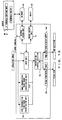
- FIG. 1 is a block diagram of an example of the configuration of the apparatus according to the present invention. According to the present invention, a sequence of instructions for each time and place recorded in various formats is described in a predetermined descriptive language comprehensible to a user and computer. FIG. 1 shows an example in which a markup language is used in describing a schedule.
- An instruction refers to a section of a process in which one of schedules about a time and a place is presented to a user, or a necessary action is suggested and performed. For example, it can be 'When a meeting is scheduled to be held at 10:00, it is announced 10 minutes before the start of the meeting', When a user has a schedule that he or she takes Shinkansen at 11:00, and when the user will be late for the train because the user is now on a local train, the user is suggested to transfer into an express train', etc. That is, it is a combination of a schedule and a description as to what action is to be taken by a user relating to the schedule.
- Such a sequence of instructions is described in a description format of a markup language such as an XML (eXtensible Markup Language), and is referred to as a schedule script or simply as a schedule.
- a markup language such as an XML (eXtensible Markup Language)
- XML eXtensible Markup Language
- a schedule script is stored and managed in a center 60, or stored in various media 50 such as a magnetic disk, CD-ROM, etc., and read from a user terminal 1.
- An input unit 11 of each user terminal 1 selects and reads information corresponding to an operation input such as a request from a user, from the schedule script stored in the center 60 through the network access unit 18, or from the schedule script stored in the media 50 through the media access unit 19, and passes it to a schedule conversion unit 12.
- an operation input such as a request from a user
- the schedule script stored in the center 60 through the network access unit 18, or from the schedule script stored in the media 50 through the media access unit 19, and passes it to a schedule conversion unit 12.
- the schedule conversion unit 12 When the schedule management is constantly performed, the schedule always exists in the schedule conversion unit 12.
- the schedule conversion unit 12 analyzes the syntax of the schedule script received from the input unit 11, and converts it into structured data for easy schedule management. There can be a function, provided in the schedule conversion unit 12, of checking whether or not an inconsistent schedule exists, and removing it if it actually exists. When an instruction process unit 13 directly reads and processes the corresponding portion of the schedule script, the schedule conversion unit 12 is not required.
- the instruction process unit 13 obtains the current situation (the current place, the current time, etc.) of the user, and executes an instruction for a corresponding schedule.
- the execution timing can be shifted by an attribute such as 'delay', etc.
- the type of instruction can refer to representing a schedule to a user by a schedule presentation unit 14, or suggesting or performing a necessary action by an action suggestion/execution unit 15.
- the current situation of the user can be obtained from a situation obtaining unit 16 in a real mode, and from a situation generation unit 17 in a simulation mode.
- a schedule script is obtained by describing a sequence of the instructions of a schedule corresponding to the time and the place using a tag in the description format of a markup language.
- a generated schedule script can be as easily read and written as the existing markup language, thereby easily retrieved and processed.
- a schedule script enables instructions to be rearranged, serialized, parallelized, and optimized, and data to be structured (in a hierarchical structure, in a group, etc.). Since schedules relating to various times and places can be described and corresponding processes can be set using the schedule script, schedules can be easily generated and managed.
- a schedule script is basically text data
- a schedule script obtained from the center 60, etc. can be processed depending on the user's terminal, and one schedule script can be processed in various devices and systems.
- the schedule of a day can be confirmed by a personal computer in the office of the user, and is processed by a car navigation system when the user moves in a car.
- schedule information is presented through a portable phone and a PDA. These processes are performed by transmitting and receiving one schedule file.
- the data of the schedule script can be downloaded from the center 60 each time an appliance for presenting a schedule is changed.
- the schedule management can continue only by transmitting and receiving the data of the schedule script through a storage medium, infrared communications, etc.
- a schedule can be managed according to instructions, the contents of a process is clearly indicated, and can be easily changed. Furthermore, a schedule can be presented and an action can be suggested and taken based on the situation at an appropriate timing.
- a user can virtually experience a schedule in a simulation mode. For example, a user can experience the schedule of talent with the time sped up, etc.
- a schedule script can be easily generated and edited using the existing text editor, etc., and the generated schedule script can be provided as a center service. Therefore, a user can obtain various schedule information at any location through a network.
- a schedule script can be described in a markup language, it can be edited by a normal text editor, and can also be easily generated and edited by generating the schedule script through a GUI (graphical user interface) using a map, a calendar, a time schedule table.
- GUI graphical user interface
- a method of generating and editing a schedule script can be realized using the technology disclosed by, for example, Japanese Patent Application No.11-113191 'GUIDANCE INFORMATION PRESENTATION APPARATUS, GUIDANCE INFORMATION PRESENTING METHOD, STORAGE MEDIUM STORING GUIDANCE INFORMATION PRESENTATION PROGRAM, STORAGE MEDIUM FOR GUIDING SCRIPT, GUIDING SCRIPT GENERATION APPARATUS, OPERATION MANAGEMENT APPARATUS, METHOD, AND STORAGE MEDIUM THEREFOR USING GUIDING SCRIPT, MOBILE TIME ADJUSTMENT APPARATUS, METHOD, AND PROGRAM STORAGE MEDIUM THEREFOR USING GUIDANCE SCRIPT, GUIDE PLAN GENERATION APPARATUS, METHOD, AND PROGRAM STORAGE MEDIUM THEREFOR, GUIDE INFORMATION PRESENTATION APPARATUS, METHOD, AND PROGRAMS STORAGE MED
- the information attached to map data, etc. can be schedule information instead of guide information.
- the information attached to map data, etc. can be schedule information instead of guide information.
- facility objects in a map such as buildings, roads, etc. on the display screen of a map are specified by a user using a pointing device such as a mouse, etc., and selected schedule information is attached to the pointed position with schedule information, a menu, etc. which are input with text on a small memo screen.
- a schedule table, etc. the time information about year/month/day, time, period, etc. is specified using a pointing device.
- candidates are retrieved from a database for the contents of the user input and presented to the user so that the user can select one of them and avoid obscure specification of a place.
- a device for automatically generating a schedule script can be provided.
- the schedule script language according to the present embodiment is a marked descriptive language for description of a schedule script newly defined as a subset of an extensible markup language prescribed in the W3C (World Wide Web Consortium).
- the tags not starting with ' ⁇ /' are referred to as starting tags, and those starting with ' ⁇ /' are referred to as end tags.
- the combination is referred to as a tag set.
- 'inst-01' is a value of an attribute.
- a schedule script is described by the hierarchical structure of tag sets which are the above mentioned combinations. When there is no tag set in the portion inside a tag set, the portion indicates the contents of the tag set.
- a schedule script is formed by a tag, an attribute, and the contents of a schedule script language. Assume that there is the following schedule script
- the portion ( ⁇ ) enclosed by ⁇ time ⁇ and ⁇ /time ⁇ , the portion ( ⁇ ) enclosed by ⁇ schedule ⁇ and ⁇ /schedule ⁇ , and the portion ( ⁇ ) enclosed by ⁇ info ⁇ and ⁇ /info ⁇ indicate that 'there is a schedule ⁇ at the time ⁇ and the user is informed of the information described in ⁇ at that time'.
- the 'inst' indicates an instruction.
- ⁇ inst ⁇ and ⁇ /inst ⁇ in the schedule script above the portion ( ⁇ ) enclosed by ⁇ point ⁇ and ⁇ /point ⁇ between ⁇ inst ⁇ and ⁇ /inst ⁇ , the portion ( ⁇ ) enclosed by ⁇ schedule ⁇ and ⁇ /schedule ⁇ , and the portion ( ⁇ ) enclosed by ⁇ action ⁇ and ⁇ /action ⁇ indicate that 'there is a schedule ⁇ at the place ⁇ and an action described in ⁇ is taken at that place'.
- a schedule is described for a time condition, a place condition, or a combination of them. The schedule is described as to how the schedule is presented to the user, what action is suggested to the user, or what action is to be taken when the time condition and the place condition are satisfied.
- a week or a day can be specified instead of a time.
- a periodic time condition such as 'every third day' can also be specified.
- a schedule description describes a schedule performed when the condition is satisfied.
- ⁇ alarm/ ⁇ is short for the tags of ⁇ alarm ⁇ /alarm ⁇ . Such a short description is used when there are no contents between a start tag and an end tag.
- a practical action can be written using an ⁇ action ⁇ tag.
- text information is input, and the determination can be left to the application.
- the starting time for outputting information is specified.
- the information is output 5 minutes before the schedule is performed.
- the duration of outputting the information is specified.
- the information is presented for 1 minute.
- the times of outputting the information is specified.
- the information is presented 5 times.
- a schedule for a healthy life is described.
- a user can live a healthy life.
- the outline of the entire schedule such as the title, the version, etc. of the schedule script is described by ⁇ head ⁇ /head ⁇ .
- the instructions defined by the schedule script are specified by ⁇ body ⁇ /body ⁇ .
- a reference is used as an instruction, and the descriptions of and subsequent to ⁇ /body ⁇ specify the contents of each instruction.
- a schedule of 'Let's go to the barber's.' can be suggested and described.
- Such a periodical schedule is generated by the function of automatically generating a schedule script, and can be automatically added to a script upon detection of the cycle of an action.
- the above mentioned schedule script can be once converted into a form easily processed by an available terminal by the schedule conversion unit 12.
- a converting method can be, for example, representing a tree structure as is as a structure.
- the portion of the title of the schedule script of the above mentioned ⁇ Example 2 ⁇ can be represented as follows.
- time-processed schedules and place-processed schedules can be separately managed, or a schedule management can be performed by converting a schedule into an easily processed form.
- a schedule script there can be an action 'continue' to be continuously performed during a period and an action 'once' to be performed only once during the period even if a time condition is specified by ⁇ time ⁇ .
- the schedule is displayed if the condition of either 'continue' or 'once' is contained in the period.
- a schedule is presented and executed on the starting time of the time condition for 'continue'. For 'once', another schedule, etc. is considered under the time condition, and the priority of presenting and performing the schedule is lowered. As a result, for example, a schedule is displayed when the user is not busy during the period specified by the time condition.
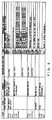
- FIG. 2 shows a table of structured data obtained by converting the schedule script.
- the presented contents are displayed in the method of a specified form under the presentation condition when the time and the place satisfy the conditions.
- the data can be stored, for example, in the following form using a structure.
- the input unit 11 obtains the schedule script stored in the center 60 and the media 50.
- FIG. 3 shows the process flow of the input unit 11.
- the center 60 When a user is requested to input an operation, or an automatic input of a schedule is requested, the center 60 is accessed by the network access unit 18 through a network 40, or the media 50 storing a schedule script is accessed by the media access unit 19, and a user-desired schedule script is read (S11).
- the read schedule script is passed to the schedule conversion unit 12 (S12).
- the body of the schedule script is received from the media 50.
- the external image file specified using the URL can be received from the network 40.
- the schedule conversion unit 12 converts a schedule script described in a markup language into structured data for schedule management for easier process by a computer, and for easier schedule management. This process is performed to improve the process efficiency of a computer, and is not required when the instruction process unit 13 directly refers to a schedule script.
- FIG. 4 shows the process flow of the schedule conversion unit 12.
- the schedule conversion unit 12 receives a schedule script from the input unit 11 (S21), converts the schedule script into the structured data for the schedule management (S22), and passes the structured data for the schedule management to the instruction process unit 13 (S23).
- the schedule conversion unit 12 converts a schedule into structured data referred to by the instruction process unit 13, and can have the function of converting it into various structured data for use in this system, other device, etc. Using the function, a script is converted into a form depending on the appliances, operating systems (OS), and applications. Thus, an entire schedule, or each instruction can be provided for each appliance, application, etc.
- OS operating systems
- a procedure database storing a procedure defined by a set of a condition about the environmental situation such as a time, a place, a situation, etc. and an action is prepared, the environmental situation is checked to detect the condition of retrieving a procedure database from the time, place, situation (including user-input information), etc., extract a corresponding procedure based on the condition, and pass the action of the procedure to an action suggestion and performing device.
- an action appropriate for the environmental situation can be automatically suggested or performed.
- schedule conversion units 12 exchange event schedules and personal schedules with other units (friends and groups belonging to a company), and adjust the obtained schedules and the user's schedule.
- the instruction process unit 13 supplements the information about an unspecified portion, an obscure portion, etc. for the structured data for schedule management received from the schedule conversion unit 12, and executes an instruction described in the schedule based on the situation virtually set for the user's current situation or a simulation.
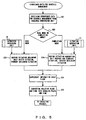
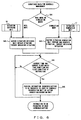
- the instruction process unit 13 performs the process shown in FIG. 5 as a preparatory process for the execution of an instruction, and performs the process as an executing process as shown in FIG. 6.
- the preparatory process for the instruction process unit 13 it is determined, upon receipt of the structured data for schedule management from the schedule conversion unit 12 (S31), whether the operation mode set by a user is a real mode or a simulation mode (S32) as shown in FIG. 5.
- the operation mode is a real mode
- the situation obtaining unit 16 obtains the situation (actual current time and current place) to obtain it for the system (S33).
- a request to prepare for the situation is issued to the situation generation unit 17.
- a request to generate the situation is issued to obtain the situation (virtual current time and current place) (S34).
- step S35 the information about the place in the structured data for schedule management is supplemented (S35).
- an attribute not described in the schedule script is retrieved from a database unit 30 using a described attribute as a key. If only an area is specified, the attribute of the typical place in the area is retrieved. For example, when only 'Shinjuku' or 'Mt.
- Fuji' is specified, the typical places such as 'Shinjuku Ward Hall', 'Shinjuku Station', ..., or 'the top of Mt.Fuji', 'the climbing base of Mt.Fuji', ... are respectively retrieved from the database unit 30.
- the user is requested to select one on the menu, or a retrieval result is selected using an appropriate evaluation index.
- the retrieved and selected attribute is inserted into a corresponding position in the structured data for schedule management.
- This function largely depends on the method of managing a system and a schedule, and providing a schedule. There can be a number of methods.
- the supplementing process is performed when a user generates his or her own schedule. When a model schedule is downloaded from the center 60, since it is assumed that a schedule script which can be completely processed has already been described, it is omitted.
- the instruction process unit 13 first determines whether the operation mode is a real mode or a simulation mode (S41) as shown in FIG. 6.
- the operation mode is a real mode
- the situation obtaining unit 16 is made to obtain the situation (actual current time and current place) to obtain it for the system (S42).
- the operation mode is a simulation mode
- a request to generate the situation is issued to the situation generation unit 17 to obtain it (S43).
- Each instruction can be deleted if it is once presented, but the settings are normally performed according to the specifications of the duration, the times, etc. which are the attributes of the tags of ⁇ info ⁇ and ⁇ action ⁇ .
- an instruction terminates after it is once presented it can be removed after it is presented.
- an instruction is to be presented plural times it is deleted after being presented the plural times.
- a normal time condition can be deleted after the specified time has passed because time never goes backwards, but a place condition remains unless the place disappears.
- the situation obtaining unit 16 obtains the situation such as the user's current time, current place, etc.
- FIG. 7 shows the process flow of the situation obtaining unit 16. As shown in FIG. 7, upon receipt of a request to obtain the situation from the instruction process unit 13, the situation obtaining unit 16 obtains the actual current time and current place from the GPS (global positioning system), etc., and passes them to the instruction process unit 13 (S51).
- GPS global positioning system
- the situation generation unit 17 prepares and generates necessary values in a simulation mode such as a virtual current time, a virtual current place, etc.
- FIG. 8 shows the process flow of the situation preparing process of the situation generation unit 17.
- FIG. 9 shows the process flow of the situation generating process of the situation generation unit 17.
- the situation generation unit 17 sets the virtual current time to the time selected by the user or the system from among the actual current time and the time separately set by the user (S61). Then, the virtual current place is set to the point selected by the user or the system from among the actual current place, a user-separately-set position (for example, home, office, etc.), and the point appearing in the structure data of the schedule (S62). Then, the virtual time passing speed is set to the virtual time passing speed selected by the user or the system from among the system-set default virtual time passing speed and the user-separately-set virtual time passing speed (S63). In this case, time can go not only forwards but also backwards.
- the situation generation unit 17 passes the virtual current time and the virtual current place to the instruction process unit 13 (S64), and updates the time according to the virtual current time and the virtual time passing speed (S65).
- the movement from a place to another is performed by updating the virtual current place (S66).
- the user can use a mouse, etc. to intentionally move a position, specify random walking, or specify an appropriate supplement to movement between schedules, etc.
- the schedule presentation unit 14 presents the user with a schedule based on a schedule script.
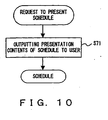
- FIG. 10 shows the process flow of the schedule presentation unit 14.
- the schedule presentation unit 14 Upon receipt of a request to present a schedule from the instruction process unit 13, the schedule presentation unit 14 outputs the information presented by the schedule to the user (S71).
- the presented information are text data, image data, speech data, etc.
- the action suggestion/execution unit 15 suggests and performs an action for a user.
- FIG. 11 shows the process flow of the action suggestion/execution unit 15. Upon receipt of a request to suggest or perform an action from the instruction process unit 13, the action suggestion/execution unit 15 performs an action suggesting/performing process (S72).
- the suggestion and performance of an action refers not only to present the information about a schedule, but also to have the function of performing a process to a certain extent. For example, if there is a schedule of 'asking the proceeding of the current project of Mr. A at 15:00', then not only the user is presented with the schedule, but also the system can automatically transmit to Mr. A the mail in formatted text asking the proceeding of the project at 15:00.
- the system can be designed such that not only the user is suggested to visit Company B, but also the route set in the car navigation system can be automatically edited into the route to approach Company B.
- the technology disclosed by the Japanese Patent Application No.10-345511 'Automation Level Adjustment Apparatus, Automation Level Adjusting Method, and Automation Level Adjustment Program Storage Medium' can be used. This technology is to select interactively with a user or automatically an automation level for performing an action based on the record of history information, etc. about a situation, user actions, etc. from among a plurality of selectable automation levels, and perform the action based on the selected automation level.
- advice such as 'Hurry up!', 'Slow down', etc. can be given, or a branch of a schedule can be specified depending on the situation, thereby suggesting and performing an action.
- the center 60 provides management and distribution services of schedule scripts. Upon receipt from a user, the center 60 distributes a corresponding schedule script.
- the center 60 comprises a schedule edition unit 61 for editing a schedule script, and comprises a maintaining function and a retrieving function to manage a large volume of scripts.
- the maintenance efficiency and the retrieval efficiency can be improved by storing schedule scripts with a unique number or name assigned for identification to a part or all of each schedule script, classifying and storing schedule scripts with specific items in the scripts, and storing only one body of a schedule script and the link to the body for each class.
- the retrieving method can be a method of not limiting targets, specifying the position to be searched using a tag, considering the structure, specifying the range of time and place, retrieving a script containing a plurality of specific schedule instructions, retrieving vague targets in association with a category, etc.
- FIG. 12 shows an example of the configuration of the automatic schedule generation unit.
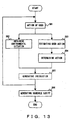
- FIG. 13 shows the process flow of the automatic schedule generation unit.
- a environmental situation detection unit 21 obtains the environmental situation associated with the user's action (S82). For example, time and place information is obtained from the GPS, and a time measurement unit 211, a place estimation unit 212, and a situation estimation unit 213 estimate the passage of time, the place of the user, and the situation.
- An action estimation unit 23 estimates the action of the user at the time (S83), and an action determination unit 24 determines an action to be performed at the time (necessary action to present a schedule and make the user follow the schedule) (S84). Then, an instruction generation unit 25 assigns a corresponding tag to a set of an environmental situation and an action, and generates an instruction (S85). The process is repeated and terminated when there is a termination sign from a user or a system, and a schedule script generation unit 26 groups instructions, and enters them as a schedule script (S86).
- An instruction can be generated: at a predetermined sampling time, when a corresponding action is detected in the action list stored in the action estimation unit 23, and when it is determined that a characteristic action has been detected based on any evaluation standard. Furthermore, a periodic action can be detected for a script. For example, if a user watches a drama during the same period of the week, it can be set as an instruction, and the TV is automatically turned on for the period and the channel. Furthermore, the process can be semiautomatically performed, and an instruction can be generated based on a set of the situation at a user-specified time and an action. Thus, a person not familiar with the markup language, etc. can easily generate a schedule script.
- a plurality of schedule scripts can be easily integrated into one schedule script.
- a personal schedule script described as a personal schedule is integrated with an event schedule script described as a schedule of an event (a sports match, a TV program, a concert, an event, etc.) published by a schedule server, etc. into one schedule script, and is presented with a user schedule as a schedule relating to an event. Thus, an associated action can be suggested and performed.
- an event schedule script described as a schedule of an event a sports match, a TV program, a concert, an event, etc.
- the user stores a personal schedule in the media 50.
- the personal schedule script is read from the media 50 to the schedule conversion unit 12 through the media access unit 19, and simultaneously an event schedule is read from the center 60 storing event schedules to the schedule conversion unit 12 through the network 40 and the network access unit 18.
- the schedule conversion unit 12 selects an instruction from the two read schedule scripts, and the selected instruction is integrated into the schedule script of the user. Since schedule scripts are simple text data, they can be easily selected and integrated by arranging them for each instruction. When a plurality of schedules are integrated, there can be schedules overlapping each other. In this case, one of the overlapping schedules is selected, or the user is asked to select one according to the personal schedule priority rule, etc. set by the user or the system.
- the center 60 or the user terminal 1 on the client side can be filtered by the center 60 or the user terminal 1 on the client side according to the taste of the user. For example, if the user likes sports, but does not like music as the taste of the user, only the schedule script relating to sports event information is read, and the schedule script relating to music is omitted.
- the schedule presentation unit 14 presents a schedule to a user, or the action suggestion/execution unit 15 suggests and performs an action corresponding to a schedule with the time and place taken into account.
- schedule scripts can be appropriately arranged, and a provider of event information can use the information as an advertisement.
- a schedule for each instruction can be transmitted to a target user.
- schedules of colleagues and friends can be adjusted.
- the PDA is a small information terminal capable of efficiently managing personal information, such as a schedule notebook, an address notebook, a ToDo list, etc., which has been conventionally managed on a personal notebook, and is a convenient and portable terminal for a user.
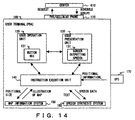
- FIG. 14 shows an example of the system configuration in which the present invention is applied to the PDA.
- a center 610 corresponds to the center 60 shown in FIG. 1
- a user terminal 100 corresponds to the user terminal 1 shown in FIG. 1
- a PHS/cellular phone 110 corresponds to the network access unit 18 shown in FIG. 1
- a user operation unit 120 corresponds to the input unit 11 shown in FIG. 1
- a user presentation unit 130 corresponds to the schedule presentation unit 14 or the action suggestion/execution unit 15 shown in FIG. 1
- an instruction execution unit 140 corresponds to the instruction process unit 13 shown in FIG.
- a GPS 170 corresponds to the situation obtaining unit 16 shown in FIG. 1.
- a map information system 150 and a speech synthesis system 160 are not always required in the present invention, but are provided as effective and convenient units for use in presenting a schedule to a user.
- schedule script It can be entered in the user terminal 100 in advance, and can be obtained from the network when a communications device such as the PHS/cellular phone 110 shown in FIG. 14 is mounted.
- the instruction execution unit 140 analyzes and executes the schedule script, and outputs a schedule as necessary based on the positional information from the GPS 170, the current time, etc. To clearly indicate the current position, the position and the scale are transmitted to the map information system 150 to obtain a corresponding map and display the position on the map, or the speech reading text in the schedule script can be passed to the speech synthesis system 160 to obtain speech data, thereby presenting a schedule in voice to the user.
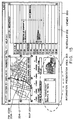
- FIG. 15 shows an example of a display screen of a viewer for a PC and PDA which displays the above mentioned schedule.
- a viewer 200 has a map 201 indicating a place, and a scheduler 202 indicating a time, and displays only the schedule corresponding to the displayed range.
- the 1/12500-scale map around Tokyo Station is displayed on the map 201 at the upper left of the viewer 200.
- a pin-shaped icon indicates that there is a schedule.
- the display range of the map 201 is specified such that the user position can be displayed in the center when the user is moving.
- the display scale of the map 201 can be automatically varied by a user's moving speed. For example, when the user is moving in a moving method such as a car at a high speed, the display range can be enlarged. When the user is moving in a moving method such as feet at a low speed, the display range can be reduced. Furthermore, the displayed place and scale can be manually changed by the user. In this case, a display range change icon, a radio button, etc. are arranged around the map 201 for selection.
- the information about a corresponding schedule is displayed in an information presentation area 203 as text and an image.
- Speech data can be presented in voice (i.e. output as audible speech sounds).
- the information about a schedule corresponding to the place can be displayed in text and image on the information presentation area 203, and speech data can be read in voice so that the schedule can be confirmed by clicking a mouse on a pin icon 204 on the map when the display range is to be changed, or when the schedule for the place is confirmed.
- a schedule table As displayed by the scheduler 202 on the right of the display screen of the viewer 200, There is a schedule table along a time axis, and a schedule in the range is displayed. In this example, since there is a schedule table from 8:00 in the morning on July 21 to 10:00 in the evening on the same day, the information in the time range is displayed. In the schedule script shown in the above mentioned ⁇ Example 3 ⁇ , 'meeting at Company A (in Shinjuku)' according to the third instruction and 'Conference (office)' according to the fourth instruction are displayed. Even if there are schedules for the day other than July 21, they are not displayed then.
- the time axis schedule table can be replaced with the schedule of the day or the schedule of the month. For example, if the calendar of July is put in the viewer 200 at the instruction of the user, all schedules in July are assigned. The ranges of the schedules continuing during the period are indicated by solid lines, and the ranges of the schedules to be performed only once are indicated by dotted lines.
- the information about a schedule is displayed in the information presentation area 203 in text and image according to the presentation condition.
- Speech data of a schedule can be read in voice.
- the information about a schedule can be displayed on the information presentation area 203 in text and image, and speech data can be read in voice so that the contents of the presented schedule can be confirmed at any time by clicking a mouse on a corresponding portion when it is checked what schedule guidance has been assigned to the schedule at the corresponding time.
- the time and the place are in the ranges of the map 201 and the time axis of the scheduler 202. Therefore, the information is displayed. If, for example, the place is specified by a date, and the date does not match the date on the time axis schedule table, the information is not displayed. Similarly, if the display range on the map 201 no longer contains the place condition, then the schedule disappears from the scheduler 202. In the case of the sixth instruction, the time is contained in the time axis schedule table of the scheduler 202. However, since the place in the place condition is not in the display range on the map 201, the schedule is not displayed on the map 201 or the scheduler 202.
- the system according to the present invention has the following characteristics.
- Described below is an example in which the present invention is applied to a cellular phone and a PHS (personal handyphone system).
- a cellular phone and a PHS personal handyphone system.
- PHS personal handyphone system
- FIG. 16 shows an example of the system configuration in which the present invention is applied to the cellular phone/PHS.
- a center 620 corresponds to the center 60 shown in FIG. 1
- the user terminal (cellular phone/PHS) 300 corresponds to the network access unit 18 shown in FIG. 1
- a user operation unit 310 corresponds to the input unit 11 shown in FIG. 1
- a user presentation unit 320 corresponds to the schedule presentation unit 14 and the action suggestion/execution unit 15 shown in FIG. 1
- an instruction execution unit 621 corresponds to the instruction process unit 13 shown in FIG. 1
- the GPS 330 corresponds to the situation obtaining unit 16 shown in FIG. 1.
- a schedule script is stored in the center 620.
- the center 620 can be informed of the position of a user terminal 300 from the base station for receiving radio waves output by the user terminal 300. Otherwise, when the user terminal 300 is provided with a device such as a GPS 330, the current position of the user terminal 300 is obtained by transmitting the positional information from the user terminal 300.
- the instruction execution unit 621 analyzes and executes the schedule script for the user terminal (cellular phone/PHS) 300, and when the positional condition and time condition match the received positional information and the time information, the text, image, and speech information for presentation of a schedule are transmitted to the user terminal 300.
- the user terminal 300 receives schedule information, and text/image/speech information can be presented by the user presentation unit 320.
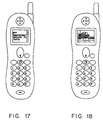
- FIGS. 17 and 18 show an example of the appearance of the user terminal 300.
- FIG. 17 shows an example of a display when the information presented by a schedule of the user presentation unit 320 is text information.
- FIG. 18 shows an example of a display when it is image information. These displays can be switched by a switch button provided as, for example, the user operation unit 310.
- the system of displaying a schedule depending on the current time and place is described, but there can be a system of displaying a schedule depending on the range of a user-specified time and place information.
- the range of time information refers to the display range of a time axis displayed when a user checks a schedule note by specifying the period of one month, one week, one day, etc.
- the range of place information normally refers to the display range of a map displayed to a user.
- FIG. 19 shows an example of the configuration of the system.
- the component also shown in FIG. 1 is assigned a common reference numeral.
- a user presentation time range specification unit 700 specifies the range (one hour, one day, one week, one month, etc.) of time information for display of a schedule based on the user operation input. Depending on the case, the range is automatically adjusted by the system.
- a user presentation place range specification unit 710 specifies the range of place information for display of a schedule based on the operation input of the user. In a normal operation, the scale of a map, the display size, place, etc. are changed. In the case where a user is moving, etc., the range can be automatically adjusted by the system.
- a presentation schedule selection unit 720 selects only schedules contained in the range specified by the user presentation time range specification unit 700 and the user presentation place range specification unit 710 from among the schedules input by the input unit 11, and passes the schedules to a place view display unit 730 and a time axis view display unit 740. As shown in FIG. 15, the place view display unit 730 and the time axis view display unit 740 display the received schedules on the map and the time axis schedule table, respectively.
- a schedule script can be easily read and written by realizing it using a standard markup language.
- a schedule script is basically text data, the capacity of a storage medium can be small, and the execution according to an instruction can be easily realized.
- a schedule script can be executed, converted, generated, edited, analyzed, coupled, changed, amended, copied, deleted, stored, and retrieved. It also can be stored as a database for reuse.
- a schedule script can be carried or transferred by appropriate electronic media and networks.
- a schedule script can be sold, purchased, issued, received, given, obtained, thrown away, picked up, value-added. Practically, a schedule script can be generated and provided by a schedule script center, a contents provider, a person, an organization, and any others.
- a schedule script generated by a personal computer (PC), a car navigation system, a PDA, a cellular phone, etc. can be written to an IC card and a prepaid card.
- the schedule script written onto an IC card and a prepaid card can be read to a PC, car navigation system, PDA, cellularphone, etc. to execute an instruction for a schedule management system.
- a schedule management received by a PC, car navigation system, PDA and the cellular phone can be switched to another PC, car navigation system, PDA, cellular phone, etc. to continuously receive schedule management. For example, even if a user who receives schedule management while moving on foot using a cellular phone transfers to a car, the same schedule management can be continuously received from the car navigation system by commonly using the same schedule script.
- a method of presenting a schedule to a user can be written.
- a schedule script can be shared among a number of users. Thus, an action can be performed based on the same schedule at a remote place.
- a user schedule can be referred to by a machine, a process such as performing an action beforehand, etc. can be executed.
- the present invention can be used in preventing daily operations from being forgotten, and in self-management.
Landscapes
- Business, Economics & Management (AREA)
- Human Resources & Organizations (AREA)
- Engineering & Computer Science (AREA)
- Strategic Management (AREA)
- Entrepreneurship & Innovation (AREA)
- Operations Research (AREA)
- Economics (AREA)
- Marketing (AREA)
- Data Mining & Analysis (AREA)
- Quality & Reliability (AREA)
- Tourism & Hospitality (AREA)
- Physics & Mathematics (AREA)
- General Business, Economics & Management (AREA)
- General Physics & Mathematics (AREA)
- Theoretical Computer Science (AREA)
- Management, Administration, Business Operations System, And Electronic Commerce (AREA)
- Calculators And Similar Devices (AREA)
- Information Retrieval, Db Structures And Fs Structures Therefor (AREA)
Applications Claiming Priority (2)
| Application Number | Priority Date | Filing Date | Title |
|---|---|---|---|
| JP27191699 | 1999-09-27 | ||
| JP27191699A JP2001092878A (ja) | 1999-09-27 | 1999-09-27 | スケジュール提示およびそれに応じたアクション提案・実行装置,その処理方法,その処理のためのプログラムを記録した記録媒体,スケジュール記録媒体,および自動スケジュール生成装置 |
Publications (2)
| Publication Number | Publication Date |
|---|---|
| EP1087316A2 true EP1087316A2 (fr) | 2001-03-28 |
| EP1087316A3 EP1087316A3 (fr) | 2005-03-09 |
Family
ID=17506668
Family Applications (1)
| Application Number | Title | Priority Date | Filing Date |
|---|---|---|---|
| EP00307924A Ceased EP1087316A3 (fr) | 1999-09-27 | 2000-09-13 | Appareil et méthode pour la présentation d'informations concernant un planning selon une situation donnée |
Country Status (3)
| Country | Link |
|---|---|
| US (1) | US6925603B1 (fr) |
| EP (1) | EP1087316A3 (fr) |
| JP (1) | JP2001092878A (fr) |
Cited By (11)
| Publication number | Priority date | Publication date | Assignee | Title |
|---|---|---|---|---|
| EP1267147A1 (fr) * | 2001-06-11 | 2002-12-18 | Pioneer Corporation | Dispositif et méthode d'élaboration de plan de route et appareil de navigation |
| EP1282054A1 (fr) * | 2001-08-01 | 2003-02-05 | Alcatel | Méthode pour implémenter un service d'organisation de réunions pour les membres d'un réseau de communication, processus de services et module de programme à cet effet |
| DE10144677A1 (de) * | 2001-09-11 | 2003-04-03 | Siemens Ag | Vorrichtung und Verfahren zur Ausgabe von Informationen |
| WO2003036232A1 (fr) * | 2001-10-25 | 2003-05-01 | Aisin Aw Co., Ltd. | Systeme d'affichage d'informations |
| ES2190337A1 (es) * | 2001-04-24 | 2003-07-16 | Serra Yolanda Pedreno | Sistema y procedimiento para la distribucion de informacion georeferenciada. |
| EP1345148A2 (fr) | 2002-03-11 | 2003-09-17 | Nokia Corporation | Méthode et système pour présenter des messages de rappel à la mémoire dans un objet portable |
| WO2004019054A1 (fr) * | 2002-04-30 | 2004-03-04 | Pedreno Serra Yolanda | Systeme et procede de distribution d'informations georeferencees |
| EP1162560A3 (fr) * | 2000-06-09 | 2004-09-01 | Nokia Corporation | Echéancier électronique de rendez-vous |
| DE10258161B4 (de) * | 2001-12-14 | 2014-12-24 | Denso Corporation | Fahrzeugnavigationssystem und diesbezügliches Verfahren |
| CN105913229A (zh) * | 2016-04-29 | 2016-08-31 | 乐视控股(北京)有限公司 | 一种日历提醒的生成方法和终端 |
| CN111723966A (zh) * | 2019-03-19 | 2020-09-29 | 丰田自动车株式会社 | 非暂时性存储介质、信息处理方法和信息处理设备 |
Families Citing this family (91)
| Publication number | Priority date | Publication date | Assignee | Title |
|---|---|---|---|---|
| DE10196695T1 (de) * | 2000-09-29 | 2003-08-21 | I2 Technologies Inc | Applikationsgesteuertes Zeitplansystem und Verfahren |
| JP2002149528A (ja) * | 2000-11-13 | 2002-05-24 | Sharp Corp | 情報提供システム、そのシステムに用いられるサーバ、情報提供方法およびその方法を実現する機械読取可能な記録媒体 |
| US7421489B2 (en) * | 2000-12-29 | 2008-09-02 | Nortel Network Limited | Network protocols for distributing functions within a network |
| US7370085B2 (en) * | 2001-05-03 | 2008-05-06 | International Business Machines Corporation | Method, system, and program for providing user location information with a personal information management program |
| US6629034B1 (en) * | 2001-06-06 | 2003-09-30 | Navigation Technologies Corp. | Driving profile method and system |
| US6798358B2 (en) | 2001-07-03 | 2004-09-28 | Nortel Networks Limited | Location-based content delivery |
| US7068189B2 (en) | 2001-07-03 | 2006-06-27 | Nortel Networks Limited | Location and event triggered notification services |
| US7333820B2 (en) | 2001-07-17 | 2008-02-19 | Networks In Motion, Inc. | System and method for providing routing, mapping, and relative position information to users of a communication network |
| WO2003009108A2 (fr) * | 2001-07-20 | 2003-01-30 | Compulaw, Llc | Procede et appareil de gestion des roles d'auditions |
| US7302433B2 (en) * | 2001-07-20 | 2007-11-27 | Compulaw, Llc. | Method and apparatus for updating rules and transmitting change notifications |
| US7082365B2 (en) * | 2001-08-16 | 2006-07-25 | Networks In Motion, Inc. | Point of interest spatial rating search method and system |
| JPWO2003021189A1 (ja) | 2001-08-31 | 2004-12-16 | アイシン・エィ・ダブリュ株式会社 | 情報表示システム |
| JP4577298B2 (ja) * | 2001-08-31 | 2010-11-10 | アイシン・エィ・ダブリュ株式会社 | 情報表示システム |
| US7486958B2 (en) * | 2001-09-05 | 2009-02-03 | Networks In Motion, Inc. | System and method for maintaining an online point-of-interest directory |
| US7562023B2 (en) * | 2001-09-05 | 2009-07-14 | Panasonic Corporation | Method and processing apparatus for settling purchase and providing information about subsequent act to be performed |
| JP2003130672A (ja) * | 2001-10-25 | 2003-05-08 | Aisin Aw Co Ltd | 情報表示システム |
| US20040260584A1 (en) * | 2001-11-07 | 2004-12-23 | Takafumi Terasawa | Schedule data distribution evaluating method |
| EP1481221B1 (fr) | 2002-03-01 | 2010-11-17 | TeleCommunication Systems, Inc. | Procede et appareil permettant d'envoyer, d'extraire et de planifier des informations de localisation |
| US8918073B2 (en) | 2002-03-28 | 2014-12-23 | Telecommunication Systems, Inc. | Wireless telecommunications location based services scheme selection |
| US8290505B2 (en) | 2006-08-29 | 2012-10-16 | Telecommunications Systems, Inc. | Consequential location derived information |
| JP2003296522A (ja) * | 2002-04-04 | 2003-10-17 | Nec Soft Ltd | 行動予定管理サーバ及びシステム並びにプログラム |
| US20030217073A1 (en) * | 2002-05-14 | 2003-11-20 | Walther Dan E. | Increasing the level of automation when scheduling and managing meetings |
| JPWO2004019225A1 (ja) | 2002-08-26 | 2005-12-15 | 富士通株式会社 | 状況付情報を処理する装置および方法 |
| US6988893B2 (en) * | 2002-09-13 | 2006-01-24 | Medical College Of Georgia Research Institute Inc. | Disposable photographic cheek retraction apparatus and method of using the same |
| WO2004074778A1 (fr) | 2003-02-14 | 2004-09-02 | Networks In Motion, Inc. | Procede et systeme d'enregistrement et d'extraction d'informations a caractere spatial |
| CN1784693A (zh) * | 2003-05-07 | 2006-06-07 | 寺泽孝文 | 进度表制作方法以及进度表生成系统、尚未经验进度表预测方法以及学习进度表评价显示方法 |
| KR100556873B1 (ko) * | 2003-07-25 | 2006-03-03 | 엘지전자 주식회사 | 이동 통신 단말기의 스케줄 브리핑 방법 |
| CA2535032A1 (fr) * | 2003-08-08 | 2005-02-17 | Networks In Motion, Inc. | Procede et systeme permettant de collecter des evenements d'appels de telecommunication et des informations liees au flux, de les synchroniser et d'en rendre compte |
| US7590553B2 (en) * | 2003-10-27 | 2009-09-15 | Microsoft Corporation | Integrated spatial view of time, location, and event schedule information |
| US20080126535A1 (en) | 2006-11-28 | 2008-05-29 | Yinjun Zhu | User plane location services over session initiation protocol (SIP) |
| US7084758B1 (en) * | 2004-03-19 | 2006-08-01 | Advanced Micro Devices, Inc. | Location-based reminders |
| WO2006039660A2 (fr) * | 2004-10-01 | 2006-04-13 | Networks In Motion, Inc. | Procede et systeme permettant une solution de navigation non transportee |
| JP4282591B2 (ja) | 2004-11-30 | 2009-06-24 | 株式会社東芝 | スケジュール管理装置、スケジュール管理方法及びプログラム |
| JP2006243827A (ja) * | 2005-02-28 | 2006-09-14 | Fujitsu Ltd | 待ち合わせシステム |
| US8019532B2 (en) * | 2005-03-07 | 2011-09-13 | Telecommunication Systems, Inc. | Method and system for identifying and defining geofences |
| US8065079B2 (en) * | 2005-03-31 | 2011-11-22 | Qualcomm Incorporated | System and method for indicating reminders via a portable computing device |
| JP4759304B2 (ja) | 2005-04-07 | 2011-08-31 | オリンパス株式会社 | 情報表示システム |
| US20070060328A1 (en) * | 2005-08-12 | 2007-03-15 | Zrike Kenneth L | Sports matchmaker systems |
| JP2007140758A (ja) * | 2005-11-16 | 2007-06-07 | Konica Minolta Business Technologies Inc | 操作手順最適化方法、機器及びプログラム |
| WO2007067754A2 (fr) * | 2005-12-07 | 2007-06-14 | Networks In Motion, Inc. | Méthode et système de solution d'entrée utilisateur pour un dispositif limité de télécommunication |
| US7757176B2 (en) * | 2006-05-03 | 2010-07-13 | Sanjay Vakil | Method and system for collective calendaring |
| US8208605B2 (en) | 2006-05-04 | 2012-06-26 | Telecommunication Systems, Inc. | Extended efficient usage of emergency services keys |
| US20070288279A1 (en) * | 2006-06-07 | 2007-12-13 | Microsoft Corporation | Entering And Using Time Ranges |
| JP2008077251A (ja) * | 2006-09-19 | 2008-04-03 | Ricoh Co Ltd | サービス提供選択システム、サービス提供選択方法、プログラム、及び記録媒体 |
| US7581188B2 (en) * | 2006-09-27 | 2009-08-25 | Hewlett-Packard Development Company, L.P. | Context-based user interface system |
| US20080091499A1 (en) * | 2006-10-02 | 2008-04-17 | International Business Machines Corporation | System and method to control caching for offline scheduling |
| US20080091500A1 (en) * | 2006-10-02 | 2008-04-17 | International Business Machines Corporation | System and method to cache calendar schedule for offline scheduling |
| US7756811B2 (en) * | 2006-12-14 | 2010-07-13 | International Business Machines Corporation | Agenda awareness in a communication client |
| US20080195475A1 (en) * | 2007-02-08 | 2008-08-14 | Matthew Cody Lambert | Advertiser portal interface |
| JP5003755B2 (ja) * | 2007-03-29 | 2012-08-15 | 富士通株式会社 | 情報配信システム、情報配信方法、および、情報配信プログラム |
| US20090055234A1 (en) * | 2007-08-22 | 2009-02-26 | International Business Machines Corporation | System and methods for scheduling meetings by matching a meeting profile with virtual resources |
| US20090070424A1 (en) * | 2007-09-06 | 2009-03-12 | Brillhart David C | System and method to provide a centralized alerting and awareness system through the use of an ear piece or other user interface |
| US20090106077A1 (en) * | 2007-10-17 | 2009-04-23 | International Business Machines Corporation | Facilitating in-transit meetings using location-aware scheduling |
| US8099238B2 (en) | 2007-11-14 | 2012-01-17 | Telecommunication Systems, Inc. | Stateful, double-buffered dynamic navigation voice prompting |
| US20090153353A1 (en) * | 2007-12-13 | 2009-06-18 | Neil Adams | Method and apparatus for generating a notification at a computing device |
| US8566728B2 (en) * | 2008-01-03 | 2013-10-22 | International Business Machines Corporation | Calendar entry display method |
| JP2009171160A (ja) * | 2008-01-15 | 2009-07-30 | Sharp Corp | 利用者の行動を学習し、事前に知らせる携帯端末装置 |
| US8060582B2 (en) | 2008-10-22 | 2011-11-15 | Google Inc. | Geocoding personal information |
| KR101532932B1 (ko) * | 2009-03-02 | 2015-07-01 | 엘지전자 주식회사 | 이동 단말기 및 이를 이용한 스케쥴 관리 방법 및 위치 정보 관리 방법 |
| KR20110002315A (ko) * | 2009-07-01 | 2011-01-07 | 삼성전자주식회사 | 변형 가능한 길이를 갖는 엘리먼트의 인터페이스 장치 및 방법 |
| US20120254804A1 (en) | 2010-05-21 | 2012-10-04 | Sheha Michael A | Personal wireless navigation system |
| US9009592B2 (en) | 2010-06-22 | 2015-04-14 | Microsoft Technology Licensing, Llc | Population of lists and tasks from captured voice and audio content |
| US8375320B2 (en) | 2010-06-22 | 2013-02-12 | Microsoft Corporation | Context-based task generation |
| WO2012087353A1 (fr) | 2010-12-22 | 2012-06-28 | Telecommunication Systems, Inc. | Gestion d'événements de zone quand un réseau actuel ne couvre pas une zone cible |
| US8682321B2 (en) | 2011-02-25 | 2014-03-25 | Telecommunication Systems, Inc. | Mobile internet protocol (IP) location |
| JP5225416B2 (ja) * | 2011-03-18 | 2013-07-03 | ヤフー株式会社 | 広告配信装置及びその方法 |
| KR101870773B1 (ko) * | 2011-08-31 | 2018-06-26 | 삼성전자 주식회사 | 광학식 문자 판독기를 이용한 스케줄 관리 방법 및 장치 |
| WO2013048551A1 (fr) | 2011-09-30 | 2013-04-04 | Telecommunication Systems, Inc. | Identificateur unique global permettant de minimiser les appels aux numéros d'urgence correspondant à un canular |
| US10192176B2 (en) | 2011-10-11 | 2019-01-29 | Microsoft Technology Licensing, Llc | Motivation of task completion and personalization of tasks and lists |
| JP2014518408A (ja) * | 2011-10-12 | 2014-07-28 | ▲華▼▲為▼終端有限公司 | スケジュール生成方法及びスケジュール生成方法に係る通信端末装置 |
| WO2013113010A1 (fr) | 2012-01-26 | 2013-08-01 | Telecommunication Systems, Inc. | Système de guidage de voie de navigation |
| US20130246526A1 (en) * | 2012-03-18 | 2013-09-19 | Nam Wu | Consensus and preference event scheduling |
| US9544260B2 (en) | 2012-03-26 | 2017-01-10 | Telecommunication Systems, Inc. | Rapid assignment dynamic ownership queue |
| US9307372B2 (en) | 2012-03-26 | 2016-04-05 | Telecommunication Systems, Inc. | No responders online |
| US8930139B2 (en) | 2012-06-21 | 2015-01-06 | Telecommunication Systems, Inc. | Dynamically varied map labeling |
| US20140013268A1 (en) * | 2012-07-09 | 2014-01-09 | Mobitude, LLC, a Delaware LLC | Method for creating a scripted exchange |
| WO2014028712A1 (fr) | 2012-08-15 | 2014-02-20 | Telecommunication Systems, Inc. | Accès, indépendant d'un dispositif, à des données d'un appelant pour des appels d'urgence |
| US9456301B2 (en) | 2012-12-11 | 2016-09-27 | Telecommunication Systems, Inc. | Efficient prisoner tracking |
| US8983047B2 (en) | 2013-03-20 | 2015-03-17 | Telecommunication Systems, Inc. | Index of suspicion determination for communications request |
| JP5815592B2 (ja) * | 2013-04-10 | 2015-11-17 | Necパーソナルコンピュータ株式会社 | 利用者端末及びプログラム |
| US9408034B2 (en) | 2013-09-09 | 2016-08-02 | Telecommunication Systems, Inc. | Extended area event for network based proximity discovery |
| US9516104B2 (en) | 2013-09-11 | 2016-12-06 | Telecommunication Systems, Inc. | Intelligent load balancer enhanced routing |
| US9479897B2 (en) | 2013-10-03 | 2016-10-25 | Telecommunication Systems, Inc. | SUPL-WiFi access point controller location based services for WiFi enabled mobile devices |
| JP5830706B2 (ja) * | 2014-01-29 | 2015-12-09 | パナソニックIpマネジメント株式会社 | 店員作業管理装置、店員作業管理システムおよび店員作業管理方法 |
| US20150278765A1 (en) * | 2014-04-01 | 2015-10-01 | Microsoft Corporation | Information collections |
| US10068256B2 (en) | 2014-10-08 | 2018-09-04 | Microsoft Technology Licensing, Llc | User directed information collections |
| JP2019070867A (ja) * | 2016-03-02 | 2019-05-09 | 株式会社リクルートホールディングス | 予約処理装置、予約処理方法および予約処理プログラム |
| US10579226B2 (en) * | 2017-09-19 | 2020-03-03 | Google Llc | Time proximity based map user interactions |
| WO2021231207A2 (fr) * | 2020-05-11 | 2021-11-18 | Apple Inc. | Fourniture d'éléments de données pertinents sur la base d'un contexte |
| US11061543B1 (en) | 2020-05-11 | 2021-07-13 | Apple Inc. | Providing relevant data items based on context |
| JP7424660B2 (ja) * | 2022-01-27 | 2024-01-30 | Necプラットフォームズ株式会社 | 情報処理システム、情報処理装置、情報処理方法及びプログラム |
Family Cites Families (13)
| Publication number | Priority date | Publication date | Assignee | Title |
|---|---|---|---|---|
| US4819191A (en) * | 1987-01-29 | 1989-04-04 | International Business Machines Corporation | Electronic calendaring method to establish calendar floating triggers for calendared events and processes |
| JPH07209451A (ja) | 1994-01-10 | 1995-08-11 | Hitachi Ltd | 小型電子機器 |
| US5541845A (en) | 1994-08-02 | 1996-07-30 | Trimble Navigation Limited | Monitoring of route and schedule adherence |
| US5610822A (en) | 1995-03-03 | 1997-03-11 | Trimble Navigation, Ltd. | Position-related multi-media presentation system |
| JP3527335B2 (ja) | 1995-10-19 | 2004-05-17 | 株式会社日立製作所 | 携帯端末システム及びスケジュール管理方法 |
| US5790974A (en) * | 1996-04-29 | 1998-08-04 | Sun Microsystems, Inc. | Portable calendaring device having perceptual agent managing calendar entries |
| US5842009A (en) * | 1996-09-30 | 1998-11-24 | Apple Computer, Inc. | System for automatically retrieving information relevant to a user's scheduled event |
| US5938721A (en) | 1996-10-24 | 1999-08-17 | Trimble Navigation Limited | Position based personal digital assistant |
| JPH10187852A (ja) | 1996-12-25 | 1998-07-21 | Tec Corp | データ処理装置 |
| US6064975A (en) * | 1997-10-22 | 2000-05-16 | Ericsson Inc. | Apparatus and method for highlighting holidays of a specified location in a calendar software application |
| US5960406A (en) | 1998-01-22 | 1999-09-28 | Ecal, Corp. | Scheduling system for use between users on the web |
| US6141005A (en) * | 1998-09-10 | 2000-10-31 | International Business Machines Corporation | Combined display of locale-sensitive calendars in a distributed computer enterprise environment |
| US6549939B1 (en) * | 1999-08-31 | 2003-04-15 | International Business Machines Corporation | Proactive calendar notification agent |
-
1999
- 1999-09-27 JP JP27191699A patent/JP2001092878A/ja active Pending
-
2000
- 2000-09-01 US US09/654,524 patent/US6925603B1/en not_active Expired - Fee Related
- 2000-09-13 EP EP00307924A patent/EP1087316A3/fr not_active Ceased
Cited By (19)
| Publication number | Priority date | Publication date | Assignee | Title |
|---|---|---|---|---|
| EP1162560A3 (fr) * | 2000-06-09 | 2004-09-01 | Nokia Corporation | Echéancier électronique de rendez-vous |
| US7085649B2 (en) | 2000-06-09 | 2006-08-01 | Nokia Mobile Phones, Ltd. | Electronic organizer |
| ES2190337A1 (es) * | 2001-04-24 | 2003-07-16 | Serra Yolanda Pedreno | Sistema y procedimiento para la distribucion de informacion georeferenciada. |
| ES2190337B1 (es) * | 2001-04-24 | 2004-11-16 | Yolanda Pedreño Serra | Sistema y procedimiento para la distribucion de informacion georeferenciada. |
| EP1267147A1 (fr) * | 2001-06-11 | 2002-12-18 | Pioneer Corporation | Dispositif et méthode d'élaboration de plan de route et appareil de navigation |
| US6975938B2 (en) | 2001-06-11 | 2005-12-13 | Pioneer Corporation | Driving plan producing device and method, and navigation apparatus |
| EP1282054A1 (fr) * | 2001-08-01 | 2003-02-05 | Alcatel | Méthode pour implémenter un service d'organisation de réunions pour les membres d'un réseau de communication, processus de services et module de programme à cet effet |
| DE10144677A1 (de) * | 2001-09-11 | 2003-04-03 | Siemens Ag | Vorrichtung und Verfahren zur Ausgabe von Informationen |
| WO2003036232A1 (fr) * | 2001-10-25 | 2003-05-01 | Aisin Aw Co., Ltd. | Systeme d'affichage d'informations |
| CN100353142C (zh) * | 2001-10-25 | 2007-12-05 | 爱信艾达株式会社 | 信息显示系统 |
| US6944539B2 (en) | 2001-10-25 | 2005-09-13 | Aisin Aw Co., Ltd. | Information display system for use with a navigation system |
| DE10258161B4 (de) * | 2001-12-14 | 2014-12-24 | Denso Corporation | Fahrzeugnavigationssystem und diesbezügliches Verfahren |
| CN101393622B (zh) * | 2002-03-11 | 2012-05-30 | 诺基亚有限公司 | 用于在便携式设备中呈现提示的方法和系统 |
| US7039420B2 (en) | 2002-03-11 | 2006-05-02 | Nokia Corporation | Method and a system for presenting reminders in a portable device |
| EP1345148A3 (fr) * | 2002-03-11 | 2003-11-26 | Nokia Corporation | Méthode et système pour présenter des messages de rappel à la mémoire dans un objet portable |
| EP1345148A2 (fr) | 2002-03-11 | 2003-09-17 | Nokia Corporation | Méthode et système pour présenter des messages de rappel à la mémoire dans un objet portable |
| WO2004019054A1 (fr) * | 2002-04-30 | 2004-03-04 | Pedreno Serra Yolanda | Systeme et procede de distribution d'informations georeferencees |
| CN105913229A (zh) * | 2016-04-29 | 2016-08-31 | 乐视控股(北京)有限公司 | 一种日历提醒的生成方法和终端 |
| CN111723966A (zh) * | 2019-03-19 | 2020-09-29 | 丰田自动车株式会社 | 非暂时性存储介质、信息处理方法和信息处理设备 |
Also Published As
| Publication number | Publication date |
|---|---|
| JP2001092878A (ja) | 2001-04-06 |
| US6925603B1 (en) | 2005-08-02 |
| EP1087316A3 (fr) | 2005-03-09 |
Similar Documents
| Publication | Publication Date | Title |
|---|---|---|
| US6925603B1 (en) | Apparatus and method for presenting schedule information depending on situation | |
| Rozier | Here&There: an augmented reality system of linked audio | |
| US10909474B2 (en) | Triggering an automatic creation of an event stamp | |
| JP3548459B2 (ja) | 案内情報提示装置,案内情報提示処理方法,案内情報提示プログラムを記録した記録媒体,案内用スクリプト生成装置,案内情報提供装置,案内情報提供方法および案内情報提供プログラム記録媒体 | |
| KR101687927B1 (ko) | 이벤트 리뷰들을 획득하는 방법 및 시스템 | |
| US12513254B2 (en) | Clickable augmented reality content manager, system, and network | |
| EP1569150A1 (fr) | Méthode et système pour stocker et présenter l'information personnelle | |
| US20030155413A1 (en) | System and method for authoring and providing information relevant to a physical world | |
| US20080320107A1 (en) | System and Method for Contents Upload Using a Mobile Terminal | |
| KR100821800B1 (ko) | 데이터 배신 제어 장치 | |
| KR20060059167A (ko) | 위치 인지 모바일 디바이스 소프트웨어 개발 | |
| García Crespo et al. | CESARSC: Framework for creating cultural entertainment systems with augmented reality in smart cities | |
| US12277180B2 (en) | Information processing apparatus and method | |
| US20170006101A1 (en) | Adding a card to a mash guide/proximity grid | |
| US20110035431A1 (en) | Dissemination of Information In an Intermittent Network Connectivity | |
| Batuwanthudawa et al. | Real-time location based augmented reality advertising platform | |
| JP2007061451A (ja) | インタラクティブコンテンツ配信サーバ、インタラクティブコンテンツ配信方法、およびインタラクティブコンテンツ配信プログラム | |
| JP2019185612A (ja) | 情報提供装置及び情報提供方法 | |
| KR20210060949A (ko) | 빅데이터와 사용자 취향 분석을 이용한 여행 스케쥴링 서비스 방법 | |
| US20200364621A1 (en) | Grid card (or geo tag) | |
| KR102505849B1 (ko) | 기준영역을 갖는 사이니지를 이용한 사진 공유 시스템 | |
| JP2008522167A (ja) | ナビゲーション方法 | |
| JP3455516B2 (ja) | ナビゲーションシステム | |
| JP4532809B2 (ja) | 情報処理サーバ、情報処理方法、情報処理プログラム、及び記憶媒体 | |
| WO2012155179A1 (fr) | Procédé dans un système informatique |
Legal Events
| Date | Code | Title | Description |
|---|---|---|---|
| PUAI | Public reference made under article 153(3) epc to a published international application that has entered the european phase |
Free format text: ORIGINAL CODE: 0009012 |
|
| AK | Designated contracting states |
Kind code of ref document: A2 Designated state(s): AT BE CH CY DE DK ES FI FR GB GR IE IT LI LU MC NL PT SE |
|
| AX | Request for extension of the european patent |
Free format text: AL;LT;LV;MK;RO;SI |
|
| PUAL | Search report despatched |
Free format text: ORIGINAL CODE: 0009013 |
|
| AK | Designated contracting states |
Kind code of ref document: A3 Designated state(s): AT BE CH CY DE DK ES FI FR GB GR IE IT LI LU MC NL PT SE |
|
| AX | Request for extension of the european patent |
Extension state: AL LT LV MK RO SI |
|
| 17P | Request for examination filed |
Effective date: 20050901 |
|
| AKX | Designation fees paid |
Designated state(s): DE FR GB |
|
| STAA | Information on the status of an ep patent application or granted ep patent |
Free format text: STATUS: THE APPLICATION HAS BEEN REFUSED |
|
| 18R | Application refused |
Effective date: 20071208 |