EP1089112A2 - Circuit intégré de commande d'un dispositif electro-optique - Google Patents
Circuit intégré de commande d'un dispositif electro-optique Download PDFInfo
- Publication number
- EP1089112A2 EP1089112A2 EP00120248A EP00120248A EP1089112A2 EP 1089112 A2 EP1089112 A2 EP 1089112A2 EP 00120248 A EP00120248 A EP 00120248A EP 00120248 A EP00120248 A EP 00120248A EP 1089112 A2 EP1089112 A2 EP 1089112A2
- Authority
- EP
- European Patent Office
- Prior art keywords
- display
- control signal
- display control
- driver
- input
- Prior art date
- Legal status (The legal status is an assumption and is not a legal conclusion. Google has not performed a legal analysis and makes no representation as to the accuracy of the status listed.)
- Withdrawn
Links
- 230000007274 generation of a signal involved in cell-cell signaling Effects 0.000 claims abstract description 25
- 230000007704 transition Effects 0.000 claims description 5
- 230000001934 delay Effects 0.000 claims description 3
- 239000004973 liquid crystal related substance Substances 0.000 abstract description 58
- 238000010586 diagram Methods 0.000 description 9
- 230000003247 decreasing effect Effects 0.000 description 7
- 230000005540 biological transmission Effects 0.000 description 6
- 230000007423 decrease Effects 0.000 description 4
- 230000006870 function Effects 0.000 description 4
- 239000011521 glass Substances 0.000 description 4
- 230000003111 delayed effect Effects 0.000 description 3
- 238000009413 insulation Methods 0.000 description 3
- 230000000630 rising effect Effects 0.000 description 3
- 201000004059 subependymal giant cell astrocytoma Diseases 0.000 description 3
- 239000000758 substrate Substances 0.000 description 3
- 239000010409 thin film Substances 0.000 description 3
- 101000885321 Homo sapiens Serine/threonine-protein kinase DCLK1 Proteins 0.000 description 2
- 102100039758 Serine/threonine-protein kinase DCLK1 Human genes 0.000 description 2
- 230000012447 hatching Effects 0.000 description 2
- 241000283070 Equus zebra Species 0.000 description 1
- 230000001419 dependent effect Effects 0.000 description 1
- 238000005401 electroluminescence Methods 0.000 description 1
- 239000007788 liquid Substances 0.000 description 1
- 239000000463 material Substances 0.000 description 1
- 239000002184 metal Substances 0.000 description 1
- 238000000034 method Methods 0.000 description 1
- 238000012986 modification Methods 0.000 description 1
- 230000004048 modification Effects 0.000 description 1
- 238000003825 pressing Methods 0.000 description 1
- 238000007789 sealing Methods 0.000 description 1
- 230000001360 synchronised effect Effects 0.000 description 1
- 238000002834 transmittance Methods 0.000 description 1
Images




Classifications
-
- G—PHYSICS
- G09—EDUCATION; CRYPTOGRAPHY; DISPLAY; ADVERTISING; SEALS
- G09G—ARRANGEMENTS OR CIRCUITS FOR CONTROL OF INDICATING DEVICES USING STATIC MEANS TO PRESENT VARIABLE INFORMATION
- G09G3/00—Control arrangements or circuits, of interest only in connection with visual indicators other than cathode-ray tubes
- G09G3/20—Control arrangements or circuits, of interest only in connection with visual indicators other than cathode-ray tubes for presentation of an assembly of a number of characters, e.g. a page, by composing the assembly by combination of individual elements arranged in a matrix no fixed position being assigned to or needed to be assigned to the individual characters or partial characters
- G09G3/34—Control arrangements or circuits, of interest only in connection with visual indicators other than cathode-ray tubes for presentation of an assembly of a number of characters, e.g. a page, by composing the assembly by combination of individual elements arranged in a matrix no fixed position being assigned to or needed to be assigned to the individual characters or partial characters by control of light from an independent source
- G09G3/36—Control arrangements or circuits, of interest only in connection with visual indicators other than cathode-ray tubes for presentation of an assembly of a number of characters, e.g. a page, by composing the assembly by combination of individual elements arranged in a matrix no fixed position being assigned to or needed to be assigned to the individual characters or partial characters by control of light from an independent source using liquid crystals
-
- G—PHYSICS
- G09—EDUCATION; CRYPTOGRAPHY; DISPLAY; ADVERTISING; SEALS
- G09G—ARRANGEMENTS OR CIRCUITS FOR CONTROL OF INDICATING DEVICES USING STATIC MEANS TO PRESENT VARIABLE INFORMATION
- G09G3/00—Control arrangements or circuits, of interest only in connection with visual indicators other than cathode-ray tubes
- G09G3/20—Control arrangements or circuits, of interest only in connection with visual indicators other than cathode-ray tubes for presentation of an assembly of a number of characters, e.g. a page, by composing the assembly by combination of individual elements arranged in a matrix no fixed position being assigned to or needed to be assigned to the individual characters or partial characters
- G09G3/34—Control arrangements or circuits, of interest only in connection with visual indicators other than cathode-ray tubes for presentation of an assembly of a number of characters, e.g. a page, by composing the assembly by combination of individual elements arranged in a matrix no fixed position being assigned to or needed to be assigned to the individual characters or partial characters by control of light from an independent source
- G09G3/36—Control arrangements or circuits, of interest only in connection with visual indicators other than cathode-ray tubes for presentation of an assembly of a number of characters, e.g. a page, by composing the assembly by combination of individual elements arranged in a matrix no fixed position being assigned to or needed to be assigned to the individual characters or partial characters by control of light from an independent source using liquid crystals
- G09G3/3611—Control of matrices with row and column drivers
- G09G3/3685—Details of drivers for data electrodes
-
- G—PHYSICS
- G09—EDUCATION; CRYPTOGRAPHY; DISPLAY; ADVERTISING; SEALS
- G09G—ARRANGEMENTS OR CIRCUITS FOR CONTROL OF INDICATING DEVICES USING STATIC MEANS TO PRESENT VARIABLE INFORMATION
- G09G3/00—Control arrangements or circuits, of interest only in connection with visual indicators other than cathode-ray tubes
- G09G3/20—Control arrangements or circuits, of interest only in connection with visual indicators other than cathode-ray tubes for presentation of an assembly of a number of characters, e.g. a page, by composing the assembly by combination of individual elements arranged in a matrix no fixed position being assigned to or needed to be assigned to the individual characters or partial characters
- G09G3/34—Control arrangements or circuits, of interest only in connection with visual indicators other than cathode-ray tubes for presentation of an assembly of a number of characters, e.g. a page, by composing the assembly by combination of individual elements arranged in a matrix no fixed position being assigned to or needed to be assigned to the individual characters or partial characters by control of light from an independent source
- G09G3/36—Control arrangements or circuits, of interest only in connection with visual indicators other than cathode-ray tubes for presentation of an assembly of a number of characters, e.g. a page, by composing the assembly by combination of individual elements arranged in a matrix no fixed position being assigned to or needed to be assigned to the individual characters or partial characters by control of light from an independent source using liquid crystals
- G09G3/3611—Control of matrices with row and column drivers
- G09G3/3648—Control of matrices with row and column drivers using an active matrix
- G09G3/3666—Control of matrices with row and column drivers using an active matrix with the matrix divided into sections
-
- G—PHYSICS
- G09—EDUCATION; CRYPTOGRAPHY; DISPLAY; ADVERTISING; SEALS
- G09G—ARRANGEMENTS OR CIRCUITS FOR CONTROL OF INDICATING DEVICES USING STATIC MEANS TO PRESENT VARIABLE INFORMATION
- G09G2310/00—Command of the display device
- G09G2310/02—Addressing, scanning or driving the display screen or processing steps related thereto
- G09G2310/0202—Addressing of scan or signal lines
- G09G2310/0221—Addressing of scan or signal lines with use of split matrices
-
- G—PHYSICS
- G09—EDUCATION; CRYPTOGRAPHY; DISPLAY; ADVERTISING; SEALS
- G09G—ARRANGEMENTS OR CIRCUITS FOR CONTROL OF INDICATING DEVICES USING STATIC MEANS TO PRESENT VARIABLE INFORMATION
- G09G2320/00—Control of display operating conditions
- G09G2320/02—Improving the quality of display appearance
- G09G2320/0233—Improving the luminance or brightness uniformity across the screen
-
- G—PHYSICS
- G09—EDUCATION; CRYPTOGRAPHY; DISPLAY; ADVERTISING; SEALS
- G09G—ARRANGEMENTS OR CIRCUITS FOR CONTROL OF INDICATING DEVICES USING STATIC MEANS TO PRESENT VARIABLE INFORMATION
- G09G3/00—Control arrangements or circuits, of interest only in connection with visual indicators other than cathode-ray tubes
- G09G3/20—Control arrangements or circuits, of interest only in connection with visual indicators other than cathode-ray tubes for presentation of an assembly of a number of characters, e.g. a page, by composing the assembly by combination of individual elements arranged in a matrix no fixed position being assigned to or needed to be assigned to the individual characters or partial characters
- G09G3/2007—Display of intermediate tones
- G09G3/2014—Display of intermediate tones by modulation of the duration of a single pulse during which the logic level remains constant
-
- G—PHYSICS
- G09—EDUCATION; CRYPTOGRAPHY; DISPLAY; ADVERTISING; SEALS
- G09G—ARRANGEMENTS OR CIRCUITS FOR CONTROL OF INDICATING DEVICES USING STATIC MEANS TO PRESENT VARIABLE INFORMATION
- G09G3/00—Control arrangements or circuits, of interest only in connection with visual indicators other than cathode-ray tubes
- G09G3/20—Control arrangements or circuits, of interest only in connection with visual indicators other than cathode-ray tubes for presentation of an assembly of a number of characters, e.g. a page, by composing the assembly by combination of individual elements arranged in a matrix no fixed position being assigned to or needed to be assigned to the individual characters or partial characters
- G09G3/34—Control arrangements or circuits, of interest only in connection with visual indicators other than cathode-ray tubes for presentation of an assembly of a number of characters, e.g. a page, by composing the assembly by combination of individual elements arranged in a matrix no fixed position being assigned to or needed to be assigned to the individual characters or partial characters by control of light from an independent source
- G09G3/36—Control arrangements or circuits, of interest only in connection with visual indicators other than cathode-ray tubes for presentation of an assembly of a number of characters, e.g. a page, by composing the assembly by combination of individual elements arranged in a matrix no fixed position being assigned to or needed to be assigned to the individual characters or partial characters by control of light from an independent source using liquid crystals
- G09G3/3611—Control of matrices with row and column drivers
- G09G3/3614—Control of polarity reversal in general
-
- G—PHYSICS
- G09—EDUCATION; CRYPTOGRAPHY; DISPLAY; ADVERTISING; SEALS
- G09G—ARRANGEMENTS OR CIRCUITS FOR CONTROL OF INDICATING DEVICES USING STATIC MEANS TO PRESENT VARIABLE INFORMATION
- G09G3/00—Control arrangements or circuits, of interest only in connection with visual indicators other than cathode-ray tubes
- G09G3/20—Control arrangements or circuits, of interest only in connection with visual indicators other than cathode-ray tubes for presentation of an assembly of a number of characters, e.g. a page, by composing the assembly by combination of individual elements arranged in a matrix no fixed position being assigned to or needed to be assigned to the individual characters or partial characters
- G09G3/34—Control arrangements or circuits, of interest only in connection with visual indicators other than cathode-ray tubes for presentation of an assembly of a number of characters, e.g. a page, by composing the assembly by combination of individual elements arranged in a matrix no fixed position being assigned to or needed to be assigned to the individual characters or partial characters by control of light from an independent source
- G09G3/36—Control arrangements or circuits, of interest only in connection with visual indicators other than cathode-ray tubes for presentation of an assembly of a number of characters, e.g. a page, by composing the assembly by combination of individual elements arranged in a matrix no fixed position being assigned to or needed to be assigned to the individual characters or partial characters by control of light from an independent source using liquid crystals
- G09G3/3611—Control of matrices with row and column drivers
- G09G3/3685—Details of drivers for data electrodes
- G09G3/3692—Details of drivers for data electrodes suitable for passive matrices only
Definitions
- the present invention relates to an electro-optical device using an electro-optical element such as a liquid crystal, and to an electronic apparatus and a display driver IC using the electro-optical device.
- a liquid crystal display displays a monochrome display or a gray scale display including halftone, for example.
- a liquid crystal element When a liquid crystal element is used as an electro-optical element and driven passively or actively, one of a plurality of row electrodes (Y electrodes) extending in a lateral direction is selected and data signals are supplied to a plurality of column electrodes (X electrodes) extending in a longitudinal direction simultaneously, thereby driving the liquid crystal for a line at a time.
- Y electrodes row electrodes
- X electrodes column electrodes
- the maximum number of external terminals of an IC chip is limited to the number calculated by dividing the maximum producible size (about 20 mm to 30 mm) of the IC chip by an allowable terminal pitch (about 50 ⁇ m in the case of a COG (chip on glass)).
- a liquid crystal display section 600 provided with 2N pieces of X electrodes is divided into two parts in a first direction, providing two X driver ICs 610 and 620 respectively driving N pieces of X electrodes.
- the X driver ICs 610 and 620 respectively supply data signals to N pieces of X electrodes based on commands and data from an MPU (microprocessor unit) (not shown). Display control signals are also generated in the X driver IC. It is sufficient that the display control signals are generated only in the X driver IC 610. In this time, the X driver 610 is called a master, and the X driver IC 620 to which the display control signals from the X driver IC 610 are input through wiring 640 is called a slave.
- Display control signals necessary for a Y driver 630 are also supplied from the master X driver IC 610 through wiring 650.
- luminance may differ between a left screen 600A driven by the X driver IC 610 and a right screen 600B driven by the X driver IC 620 in the liquid crystal display section 600.
- driving in the normally-white mode results in the right screen 600B being more whitish (pale) than the left screen 600A.
- an objective of the present invention is to provide an electro-optical device capable of decreasing the luminance difference in a screen even if a plurality of driver ICs are used to supply data signals electrodes, and an electronic apparatus and display driver IC using the electro-optical device.
- an electro-optical device comprising:
- the luminance difference in the conventional art is caused by a large difference in the delay of the display control signals between the master IC and the slave IC. This is because the master IC uses the display control signal generated therein, whereas the slave IC uses the display control signal input through an external wiring.
- the difference in the delay of the display control signals causes a difference between the voltages applied to the electrodes of the display sections of the left screen 600A and the right screen 600B in Figure 10, thereby causing the luminance difference.
- the display control signal supplied from the master IC is input to the master IC and at least one slave IC through an external wiring. Therefore, the luminance difference in a screen can be decreased by reducing the difference in the signal delay in the external wiring.
- each of the master IC and the at least one slave IC may comprise:
- the timing of reading out the display data from the display memory and the timing of the data signal generated by the driver are both dependent upon the timing of the display control signal.
- the present invention can reduce the difference in these timings between the master IC and the slave IC can be reduced.
- the present invention is particularly effective in the case of a gray scale display in the display section based on a pulse width modulation signal from the master IC and at least one slave IC.
- the display control signal generated in the display control signal generation section includes a gray scale control pulse for producing the pulse width modulation signal.
- the luminance difference in a screen can be reduced by decreasing the timing difference of the gray scale control pulses between the master IC and the slave IC.
- the display control signal generated in the master IC is delayed in an internal delay circuit whereas the display control signals delayed in an external wiring is used in the slave IC, thereby decreasing the difference in the delay between the display control signals used in the master IC and that used in the slave IC. This reduces the luminance difference in a screen.
- the delay in the internal delay circuit is variable, the delay can be adjusted in accordance with the signal delay depending on the external wiring to the slave IC.
- a display driver IC used for the X driver of the above electro-optical device.
- Figures 1 to 7 show a liquid crystal device according to a first embodiment of the present invention.
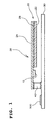
- FIG. 1 is a cross section schematically showing a liquid crystal device as a display unit of a portable telephone.
- the liquid crystal device has a liquid crystal module 20 provided with a liquid crystal display driver IC 10, a printed circuit board 30 provided with an MPU 300, and a connector such as an elastic connection member (zebra rubber) 40 with a conductive section and an insulation section being formed alternately which is used to electrically connect the liquid crystal module 20 and the printed circuit board 30.
- a conductive section and an insulation section are alternately laminated in the elastic connection member 40 in the longitudinal direction towards the surface from the rear face in Figure 1. Terminals of the liquid crystal module 20 and the printed circuit board 30 are electrically connected by uniformly applying pressure in the longitudinal direction of the elastic connection member 40.
- the liquid crystal module 20 has a liquid crystal display section 28 formed by sealing a liquid crystal 26 as an electro-optical element between two glass substrates 22 and 24.
- the liquid display driver IC 10 is provided on the substrate 24 as a COG (chip on glass).
- the first embodiment is an example in which the present invention is applied to a passive drive type liquid crystal device.
- a plurality of segment electrodes (X electrodes) and a plurality of common electrodes (Y electrodes) are formed on each surface of the glass substrates 22 and 24 in the directions crossing each other (see Figure 2).
- the liquid crystal display section 28 displays an image by controlling the transmittance of pixels formed on each cross portion of the X and Y electrodes using the voltage applied to the X and Y electrodes.
- the present invention is not limited to the passive drive type liquid crystal device.
- the present invention may also be applied to an active drive type liquid crystal device using a two-terminal element such as an MIM (metal-insulation layer-metal) or a TFD (thin film diode), or a three-terminal element such as a TFT (thin film transistor).
- a two-terminal element such as an MIM (metal-insulation layer-metal) or a TFD (thin film diode), or a three-terminal element such as a TFT (thin film transistor).
- the liquid crystal module 20 is arranged in a portable telephone 500 so that the liquid crystal display section 28 is exposed as shown in Figure 16.
- the portable telephone 500 has the liquid crystal display section 28, an earphone 510, a microphone 520, an operation means 530, an antenna 540, and the like.
- the MPU 300 outputs command data or display data to the liquid crystal module 20 based on the information received through the antenna 540 or the information input by operation on the operation means 530.
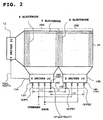
- Figure 2 shows the relationship between the liquid crystal display section 28 and the liquid crystal display driver IC 10.
- Two X driver ICs 10A and 10B as the liquid crystal driver IC 10 and one Y driver IC 12 are provided.
- the X driver IC 10A functions as a master IC and the X driver IC 10B functions as a slave IC by the external wiring.
- the X driver IC 10A drives the X electrode provided in a left screen 28A of the liquid crystal display section 28 shown in Figure 2, and the X driver IC 10B drives the X electrode provided in a right screen 28B.
- Command, data, and the like output from the MPU 300 are input to the X driver ICs 10A and 10B.
- the X driver IC 10A as the master outputs display control signals generated in a display control signal generation section (details will be described later) to an external wiring 200 through an output terminal 182.
- the display control signals are input to the X driver IC 10A through a first input terminal 130 and to the X driver IC 10B through the first and second input terminals 130 and 184.
- the X driver IC 10A as the master is designed to output display control signals for the Y driver IC 12 to the Y driver IC 12.
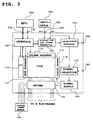
- Figure 3 shows a structure common to the X driver ICs 10A and 10B.
- the X driver ICs 10A and 10B have the following structure.
- Commands including write and read commands
- data including display data and address data
- the interface circuit 100 may have a command decoder, register, or the like.
- a display memory such as a RAM 110 has at least memory elements corresponding to the number of pixels provided in the screen 28A or 28B shown in Figure 2.
- the display data output from the MPU 300 through the interface circuit 100 and an I/O buffer 112 is written into the RAM 110 according to the address data output from a column address circuit 114 and a row address circuit 116 based on the write command from the MPU 300.
- the MPU 300 may read out the display data written into the RAM 110.
- the display data is read out from the RAM 110 according to the address data from the column address circuit 114 and the row address circuit 116 based on the read command from the MPU 300.
- the display When the display is driven based on the display data written into the RAM 110, the display data of one line in the RAM 110 is read out and supplied to a driver 120 based on the address signal assigning one line, and output from a display address circuit 118.
- the display control signals are needed in view of the operations of the display address circuit 118 and the driver 120.
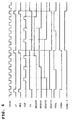
- a latch pulse LP, reset signal RES, gray scale control pulse GCP, and polar-inversion signal FR shown in Figure 4 can be given.
- These display control signals generated in a display control signal generation section 160 of the X driver 10A, as described later, are output to the outside through an input/output terminal 180 (output terminal 182 shown in Figure 6).
- the display control signals are then input to the X driver IC 10A through the wiring 200 and first input terminal 130 shown in Figure 2.
- the display control signals are input to the X driver IC 10B as the slave through the wiring 200, first input terminal 130, and input/output terminal 180 (input terminal 184 shown in Figure 7).
- the display address circuit 118 sequentially assigns one-line read-out addresses synchronously with the latch pulse LP.
- FIG. 5 is a block diagram showing the driver 120.
- the driver 120 has a latch circuit 121, a counter 122, a coincidence-detecting circuit 123, a level shifter 124, and an LCD driver 125.
- the latch circuit 121 latches the one-line display data read out according to the addresses output from the display address circuit 118 synchronously with the latch pulse LP shown in Figure 4.
- the counter 122 When determining four gray scale values as shown in Figure 4, the counter 122 is reset by the reset signal RES, and counts the reset signal RES as the first count value and the gray scale control pulse GCP as the second to fourth count values.
- the coincidence-detecting circuit 123 changes its output from “L” (low) to “H” (high) or from “H” to “L” based on the logic of the polar-inversion signal FR.
- Figure 4 shows segment data SEG (00) to SEG (11) corresponding to four gray scale values during positive polar driving and negative polar driving in the case of performing polar inversion for each line. Since the effective value of the voltage applied to the liquid crystal of the pixels driven based on the segment data SEG(00) becomes a minimum, the pixels are displayed as white in the normally-white mode driving. Similarly, the pixels are displayed as half tone in the case of the segment data SEG(01) and SEG (10), and as black in the case of the segment data SEG (11).
- the level shifter 124 shifts the output level of the coincidence-detecting circuit 123.
- the voltage required for driving the liquid crystal is supplied to the segment electrodes (X electrodes) by the LCD driver 125 based on the voltage supplied from a display power source 126.
- signals YSCL and YDATA are input to the Y driver IC 12 from the master X driver IC 10A.
- the signal YSCL is synchronized with one horizontal scanning period (selection period) shown in Figure 4, and the signal YDATA is data indicating the top of one line.
- COMn and COMn+1 shown in Figure 4 show the waveforms of the signals supplied to nth and (n+1)th common electrodes (Y electrodes) shown in Figure 2 through the Y driver IC 12.
- Figures 11 and 12 show a drive waveform SEG supplied to the X electrodes from the X driver IC 10A or 10B and a drive waveform COM supplied to the Y electrodes from the Y driver IC 12.
- Figure 11 shows the drive waveform SEG for the segment electrodes (X electrodes) and the drive waveform COM for the common electrodes (Y electrodes), which are used for principle driving in a passive drive type liquid crystal device.
- the drive waveforms SEG and COM have five values of positive and negative voltage levels including a middle voltage 0 V, and COM-SEG is a voltage applied to both ends of the liquid crystal.
- Figure 12 shows the drive waveform SEG for the segment electrodes (X electrodes) and the drive waveform COM for the common electrodes (Y electrodes) which are used in other driving methods in a passive drive type liquid crystal device.
- These drive waveforms SEG and COM have six values of positive voltage levels including a minimum voltage 0 V.
- the display control signals LP, RES, GCP, and FR are generated only in the display control signal generation section 160 of the X driver IC 10A.
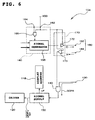
- Figure 6 shows part of the X driver IC 10A as the master.
- the display control signal generation section 160 has a NAND-gate 166 connected to an M/S selection terminal 162 and a dot clock input terminal 164.
- the X driver IC 10A is designed to function as the master IC by setting the M/S selection terminal 162 to "H" externally. Therefore, a dot clock DCLK input through an oscillator 163 and the dot clock input terminal 164 passes through the NAND-gate 166 and is input to a signal generator 168.
- the signal generator 168 generates the display control signals LP, RES, GCP, and FR based on the data (number of the duty sets, number of polar inversions, and the like) and command (write command) output from the interface circuit 100 and the dot clock DCLK.
- the X driver IC 10A as the master becomes equivalent to the case where the display control signal generation section 160 is enabled by setting the M/S selection terminal 162 to "H".
- the dot clock output from the dot clock input terminal 164 does not pass through the NAND-gate 166, as shown in Figure 7. Therefore, the display control signals LP, RES, GCP, and FR are not generated in the display control signal generation section 160 of the X driver IC 10B as the slave. Specifically, the X driver IC 10B as the slave becomes equivalent to the case where the display control signal generation section 160 is disabled by setting the M/S selection terminal 162 to "L".
- the input/output terminal 180 shown in Figure 3 has the output terminal 182 and the second input terminal 184 for convenience of explanation.
- An input/output-switching circuit 170 which switches the state of the input/output terminal 180 has a transmission gate 172 driven by the logic of the M/S selection terminal 162 and an OR-gate 173 which carries out the logical OR between the signal output from the second input terminal 184 and the signal output from the M/S selection terminal 162, as shown in Figures 6 and 7.
- the output terminal 182 is put in an output-possible state by the input/output-switching circuit 170, whereas the output of the OR-gate 173 is set to "H" regardless of the input from the second input terminal 184.
- the logic input from the second input terminal 184 is output as is from the OR gate 173 (specifically, the second input terminal 184 is put in an input-possible state), whereas the output terminal 182 is set to a high-impedance state (output-impossible state).
- the X driver IC 10A as the master generates the display signals LP, RES, GCP, and RF, and each signal is not used as is in the IC 10A but output through the output terminal 182.
- an AND-gate 140 shown in Figures 6 and 7 constitutes a signal selection circuit 140 shown in Figure 3.
- the AND-gate 140 carries out the logical AND between the display control signals input through the first input terminal 130 and the second input terminal 184.
- the second input terminal 184 is in an input-possible state, as shown in Figure 7. Therefore, the display control signals are supplied from the first and second input terminals 130 and 184 to the AND-gate 140, where the logical AND between the display control signals is carried out. The display control signals are then supplied to the display address circuit 118 and the driver 120 through the signal supply section 150.
- the delay of the display control signals in a X driver IC 610 as the master is caused by the resistance and capacity of the internal wiring
- the delay of the display control signal in a X driver IC 620 as the slave is caused by the resistance and capacity of an external wiring 640 in addition to those of the internal wiring.
- the delay of the display control signals used in the X driver IC 620 as the slave is larger than the delay of the display control signals used in the X driver IC 610 as the master.
- Figure 8 shows a gray scale control pulse GCP generated during one horizontal scanning period (selection period) and a signal SEG(00) obtained by the pulse GCP in each of the X driver ICs 610 and 620 of the liquid crystal device of the conventional art shown in Figure 10.
- the delay of a gray scale control pulse GCPA is small, whereas the delay of a gray scale control pulse GCPB is large in the X driver IC 620.
- the rising edges of the signals SEGA(00) and SEGB(00) generated in the X driver ICs 610 and 620 are determined by the fall timings t1 and t2 of the corresponding gray scale control pulses GCPA and GCPB, respectively. Therefore, the rise timing t2 of the signal SEGB(00) is later than the rise timing t1 of the signal SEGA(00).
- the length of one horizontal scanning period is determined by the signal COMn supplied to the nth Y electrode from the Y driver IC 630, for example.
- the signal COMn is used as a signal common to both signals SEG output from both X driver ICs 610 and 620. Therefore, the start time t0 and end time t3 of one horizontal scanning period (selection period) are common to both signals SEG.
- the gray scale value of the signal SEGA (00) generated in the X driver IC 610 is set based on the effective value defined by the product of the time from t1 to t3 by a voltage (area S1 shown by hatching).
- the gray scale value of the signal SEGB (00) generated in the X driver IC 620 is set based on the effective value defined by the product of the time from t2 to t3 by a voltage (area S2 shown by hatching).
- the luminance difference in the conventional art shown in Figure 10 can be decreased to such an extent that the difference is not significant visually. The reason will be described below.
- L1 L2 ⁇ L3 .
- the gray scale control pulses input to the first input terminal 130 of the X driver IC 10A and the first and second input terminals 130 and 184 of the X driver 10B are respectively referred to as GCPA, GCPB1, and GCPB2, as shown in Figure 9.
- the effective value of the voltage applied to the liquid crystal of the pixels depends on the rise timing of the gray scale control pulses GCPA, GCPB1, and GCPB2, as shown in Figure 9. Therefore, use of the gray scale control pulse GCPB1 having the same rise timing as that of the gray scale control pulse GCPA used in the X driver 10A is sufficient.
- the AND-gate 140 is used as the selection circuit 140 shown in Figure 3, where the logical AND between the gray scale control pulses GCPB1 and GCPB2 is carried out as shown in Figure 9, thereby selecting the rising edge of the gray scale control pulse GCPB1.
- the lengths L1 and L2 of the wiring 200 shown in Figure 3 may be equal or the difference between the two lengths may be decreased.
- the difference in wiring delay may be decreased by changing the width or materials of the wiring 200 in each region.
- the signal selection circuit 140 which selects the logic transition state of one of two display control signals differing in delay, which are respectively input from the first and second input terminals 130 and 184, is not limited to an AND-gate.
- the signal selection circuit 140 may be a switch which selects one of the gray scale control pulses GCPB1 and GCPB2 shown in Figure 9.
- An OR-gate may be used as the signal selection circuit in order to select the falling edge of the gray scale control pulse GCPB2 in Figure 9.
- the signal selection circuit may be structured so that the transition state of necessary logic can be selected.
- Figure 13 shows a second embodiment of the present invention in which the wiring 200 for the X driver ICs 10A and 10B differs from that in Figure 2.
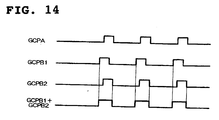
- the lengths of each region of the wiring 200 satisfy L2 ⁇ L1 ⁇ L3 and L3 - L1 ⁇ L1 - L2. Therefore, in the case of the wiring example shown in Figure 13, the gray scale control pulses GCPA, GCPB1, and GCPB2 become as shown in Figure 14.
- the gray scale control pulse GCPB2 having fall timing close to that of the gray scale control pulse GCPA used in the X driver 10A may be used.
- an OR-gate may be used as the selection circuit 140 shown in Figure 3, where the logical OR between the gray scale control pulses GCPB1 and GCPB2 is carried out, thereby selecting the falling edge of the gray scale control pulse GCPB2 as shown in Figure 14.
- Figure 15 shows an example in which three X driver ICs 10A, 10B, and 10C are connected.
- the center X driver IC 10A may be the master and both the X driver ICs 10B and 10C adjacent to the X driver IC 10A may be the slaves.
- the difference in the time of the falling edge between, for example, the gray scale control pulses GCP used in each of these X driver ICs 10A, 10B, and 10C becomes smaller by selecting the display control signal (including GCPB2) output from a second input terminal 184 for the X driver IC 10B and the display control signal (including GCPB1) output from the first input terminal 130 for the X driver IC 10C. This decreases the luminance difference in a screen.
- an AND-gate which carries out the logical AND between the display control signals differing in delay which are output from the first and second input terminals 130 and 184 may be used as the signal selection circuit 140 in the X driver IC 10B.
- an OR-gate may be used as the signal selection circuit 140.
- an AND-gate and an OR-gate may be provided to the signal selection circuit 140 so that either one of these gates or the outputs of the gates is selected by providing an external wiring.
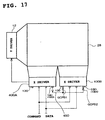
- Figure 17 shows a liquid crystal device according to a third embodiment of the present invention.
- display control signals output from an input/output terminal 180 (output terminal 182) of an X driver IC 400A as a master are input to an X driver IC 400B as a slave through a first input terminal 130 and a second input terminal 184 (input/output terminal 180) of the X driver 400B.
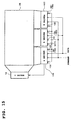
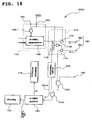
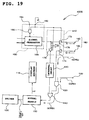
- Figures 18 and 19 show block diagrams of part of the X driver ICs 400A and 400B shown in Figure 17. Parts having the same function as those in the block diagrams shown in Figures 6 and 7 are represented by the same symbols, and description thereof will be omitted.
- the X driver IC 400A shown in Figure 18 and the X driver IC 400B shown in Figure 19 have the same structure, and differ in their function by the logic input to an M/S selection terminal 162.
- driver ICs 400A and 400B differ from those shown in Figures 6 and 7 in that the internal structure of an input/output-switching circuit 410 is different, an internal delay circuit 420 is provided, and an AND-gate 430 and an OR-gate 440 are provided as the signal selection circuits.
- the input/output-switching circuit 410 has a second transmission gate 174 which is in a state capable of inputting the input signal output from a second input terminal 184 based on an "H" output from an inverter 176, which inverses the input logic from the M/S selection terminal 162 when a transmission gate 172 to be connected to an output terminal 182 is designated as a first transmission gate.
- the input/output-switching circuit 410 has a path which serves to input the display control signal output from a signal generator 168 to the internal delay circuit 420, and a third transmission gate 178 which is turned on by "H" output from the M/S selection terminal 162 in the middle of the path.
- the display control signals from the signal generator 168 are input to the output terminal 182 and the internal delay circuit 420 in the X driver IC 400A as the master.
- the display control signals are input through the second input terminal 184 in the same manner as in the case shown in Figure 7.
- the internal delay circuit 420 serves to delay the display control signals to the same extent as or close to the wiring delay of wiring 450 extending from the output terminal 182 of the X driver IC 400A to the first input terminal 130 of the X driver IC 400B. Therefore, the display control signals (including GCPA) delayed by the internal delay circuit 420 are input to a signal supply section 150 of the X driver IC 400A as the master through the OR-gate 440.
- the display control signals (including GCPB1) with a small delay and the display control signals (including GCPB2) with a large delay are input to the X driver IC 400B as the slave through the first input terminal 130 and the second input terminal 184, respectively.
- the AND-gate 430 carries out the logical AND of between these signals. Therefore, taking the gray scale control pulse GCP as an example, the falling edge of the gray scale control pulse GCPB1 with a small delay is selected. Because the third transmission gate 178 is controlled so that the output of the internal delay circuit 420 is "L", signals from the AND-gate 430 are input to the signal supply section 150 through the OR-gate 440. This enables display control using a signal with almost the same delay as that of the gray scale control pulse GCPA used in the X driver IC 400A. Therefore, the problem of the luminance difference in a screen can be solved.
- the AND-gate 430 shown in Figures 18 and 19 may be changed to an OR-gate or to a switch corresponding to the signal to be selected in the same manner as the signal selection circuit 140 in the first embodiment.
- the signal delay in the internal delay circuit 420 is preferably variable.
- a type which can control the delay so that the luminance difference in a screen is minimized while displaying an image on the screen is still more preferable.
- the liquid crystal display when applying the present invention to a liquid crystal device, is not limited to a passive drive type liquid crystal device but may be an active drive type liquid crystal device.
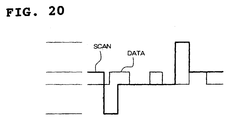
- Figure 20 shows a data signal (DATA) and a scanning signal (SCAN) used for gray scale display in the case of using a TFD as an active element.
- the electro-optical device of the present invention is not limited to those using a liquid crystal as the electro-optical element.
- the electro-optical device can be applied to those using an El (electroluminescence) or an MMD (micro-mirror device).
- the present invention is not limited to the above types which give gray scale display using an electro-optical device.
- the present invention can be applied to types which use a binary display such as a black and white display.
- the display control signals do not include the gray scale control pulse GCP.
- a luminance difference in a screen is likewise caused.
- the luminance difference can be eliminated by applying the present invention.
- the X driver ICs used in the above embodiments have the input/output terminal 180.
- the input/output terminal 180 may be an output terminal.
- the display control signals are eventually input from only the first input terminal 130.
- use of the input/output terminal 180 is preferable inasmuch as there is the freedom of selecting one of the display control signals which are input from the first and second input terminals and differ in delay in slave ICs 10B, 10C, and 400B.
- the present invention can be applied to various electronic apparatuses using an electro-optical device such as a liquid crystal device.
- electro-optical device such as a liquid crystal device.
- electronic apparatuses include personal computers, mobile computers, word processors, pagers, televisions, view finder type or monitor direct viewing type of recording devices, electronic notebooks, portable calculators, game machines, projectors, navigation devices, and terminals for point of sales (POS) system.
- POS point of sales
Landscapes
- Engineering & Computer Science (AREA)
- Chemical & Material Sciences (AREA)
- Crystallography & Structural Chemistry (AREA)
- Physics & Mathematics (AREA)
- Computer Hardware Design (AREA)
- General Physics & Mathematics (AREA)
- Theoretical Computer Science (AREA)
- Control Of Indicators Other Than Cathode Ray Tubes (AREA)
- Liquid Crystal Display Device Control (AREA)
- Liquid Crystal (AREA)
- Devices For Indicating Variable Information By Combining Individual Elements (AREA)
Priority Applications (1)
| Application Number | Priority Date | Filing Date | Title |
|---|---|---|---|
| EP08000581A EP1909132A1 (fr) | 1999-09-27 | 2000-09-27 | Dispositif électro-optique, et appareil électronique et lecteur d'affichage CI utilisant celui-ci |
Applications Claiming Priority (2)
| Application Number | Priority Date | Filing Date | Title |
|---|---|---|---|
| JP27207999A JP3666318B2 (ja) | 1999-09-27 | 1999-09-27 | 電気光学装置及びそれを用いた電子機器並びに表示駆動ic |
| JP27207999 | 1999-09-27 |
Related Child Applications (1)
| Application Number | Title | Priority Date | Filing Date |
|---|---|---|---|
| EP08000581A Division EP1909132A1 (fr) | 1999-09-27 | 2000-09-27 | Dispositif électro-optique, et appareil électronique et lecteur d'affichage CI utilisant celui-ci |
Publications (2)
| Publication Number | Publication Date |
|---|---|
| EP1089112A2 true EP1089112A2 (fr) | 2001-04-04 |
| EP1089112A3 EP1089112A3 (fr) | 2002-10-02 |
Family
ID=17508808
Family Applications (2)
| Application Number | Title | Priority Date | Filing Date |
|---|---|---|---|
| EP00120248A Withdrawn EP1089112A3 (fr) | 1999-09-27 | 2000-09-27 | Circuit intégré de commande d'un dispositif electro-optique |
| EP08000581A Withdrawn EP1909132A1 (fr) | 1999-09-27 | 2000-09-27 | Dispositif électro-optique, et appareil électronique et lecteur d'affichage CI utilisant celui-ci |
Family Applications After (1)
| Application Number | Title | Priority Date | Filing Date |
|---|---|---|---|
| EP08000581A Withdrawn EP1909132A1 (fr) | 1999-09-27 | 2000-09-27 | Dispositif électro-optique, et appareil électronique et lecteur d'affichage CI utilisant celui-ci |
Country Status (6)
| Country | Link |
|---|---|
| US (3) | US6937216B1 (fr) |
| EP (2) | EP1089112A3 (fr) |
| JP (1) | JP3666318B2 (fr) |
| KR (1) | KR100381829B1 (fr) |
| CN (1) | CN1175389C (fr) |
| TW (1) | TW480469B (fr) |
Cited By (1)
| Publication number | Priority date | Publication date | Assignee | Title |
|---|---|---|---|---|
| CN102034437A (zh) * | 2009-09-24 | 2011-04-27 | 精工爱普生株式会社 | 集成电路装置以及电子设备 |
Families Citing this family (29)
| Publication number | Priority date | Publication date | Assignee | Title |
|---|---|---|---|---|
| JP4575542B2 (ja) * | 2000-02-29 | 2010-11-04 | オプトレックス株式会社 | 液晶駆動回路 |
| JP3736622B2 (ja) * | 2001-06-15 | 2006-01-18 | セイコーエプソン株式会社 | ライン駆動回路、電気光学装置及び表示装置 |
| JP3750734B2 (ja) | 2001-07-27 | 2006-03-01 | セイコーエプソン株式会社 | 走査ライン駆動回路、電気光学装置、電子機器及び半導体装置 |
| JP5102418B2 (ja) * | 2001-08-22 | 2012-12-19 | 旭化成エレクトロニクス株式会社 | ディスプレイパネル駆動回路 |
| JP3895186B2 (ja) | 2002-01-25 | 2007-03-22 | シャープ株式会社 | 表示装置用駆動装置および表示装置の駆動方法 |
| JP2004264720A (ja) | 2003-03-04 | 2004-09-24 | Seiko Epson Corp | 表示ドライバ及び電気光学装置 |
| JP4059180B2 (ja) | 2003-09-26 | 2008-03-12 | セイコーエプソン株式会社 | 表示ドライバ、電気光学装置及び電気光学装置の駆動方法 |
| KR100992133B1 (ko) * | 2003-11-26 | 2010-11-04 | 삼성전자주식회사 | 신호 처리 장치 및 방법 |
| TWI331743B (en) * | 2005-03-11 | 2010-10-11 | Chimei Innolux Corp | Driving system in a liquid crystal display |
| JP5068433B2 (ja) * | 2004-06-22 | 2012-11-07 | ローム株式会社 | 有機el駆動回路および有機el表示装置 |
| JP4572128B2 (ja) * | 2005-03-04 | 2010-10-27 | Nec液晶テクノロジー株式会社 | 表示パネルの駆動方法及びその装置 |
| TWI304563B (en) * | 2005-03-11 | 2008-12-21 | Himax Tech Inc | Apparatus and method for generating gate control signals of lcd |
| WO2008041289A1 (fr) * | 2006-09-29 | 2008-04-10 | Fujitsu Limited | Élément d'affichage, papier électronique utilisant ledit élément, dispositif de terminal électronique utilisant ledit papier, système d'affichage utilisant ledit dispositif et procédé de traitement d'images de l'élément d'affichage |
| JP5043415B2 (ja) * | 2006-12-15 | 2012-10-10 | 株式会社ジャパンディスプレイイースト | 表示装置 |
| JP5285934B2 (ja) * | 2008-03-11 | 2013-09-11 | 株式会社ジャパンディスプレイ | 液晶表示装置 |
| US8325309B2 (en) * | 2008-09-23 | 2012-12-04 | Apple Inc. | Display having a plurality of driver integrated circuits |
| TWI408659B (zh) * | 2009-04-30 | 2013-09-11 | Mstar Semiconductor Inc | 液晶顯示面板上的驅動器以及相關控制方法 |
| JP5325684B2 (ja) * | 2009-07-15 | 2013-10-23 | ルネサスエレクトロニクス株式会社 | 半導体装置 |
| KR20110028124A (ko) * | 2009-09-11 | 2011-03-17 | 삼성전자주식회사 | 액정 표시장치 |
| JP5431907B2 (ja) | 2009-12-18 | 2014-03-05 | ラピスセミコンダクタ株式会社 | 同期処理システム及び半導体集積回路 |
| WO2012147703A1 (fr) * | 2011-04-28 | 2012-11-01 | シャープ株式会社 | Module d'affichage, dispositif d'affichage comprenant ledit module, et dispositif électronique |
| EP2756635B1 (fr) * | 2011-09-16 | 2018-11-07 | Cisco Technology, Inc. | Architecture et contrôle de dispositif dans le sens aval |
| JP6099311B2 (ja) * | 2012-02-10 | 2017-03-22 | 株式会社ジャパンディスプレイ | 表示装置 |
| KR102051664B1 (ko) * | 2012-11-06 | 2019-12-03 | 엘지디스플레이 주식회사 | 표시장치 및 이의 구동방법 |
| JP6161406B2 (ja) * | 2013-05-23 | 2017-07-12 | 三菱電機株式会社 | 表示装置 |
| CN204302615U (zh) * | 2015-01-04 | 2015-04-29 | 京东方科技集团股份有限公司 | 一种显示装置 |
| CN105015642B (zh) * | 2015-07-21 | 2017-03-08 | 重庆邮电大学 | 由单电机驱动的半被动行走器及其转向控制方法 |
| KR102446131B1 (ko) * | 2015-11-06 | 2022-09-23 | 삼성디스플레이 주식회사 | 표시장치 및 이의 제조 방법 |
| JP2020181040A (ja) | 2019-04-24 | 2020-11-05 | 三菱電機株式会社 | 表示装置 |
Citations (2)
| Publication number | Priority date | Publication date | Assignee | Title |
|---|---|---|---|---|
| US5420600A (en) * | 1989-08-31 | 1995-05-30 | Siemens Aktiengesellschaft | IC as a timed drive of a display matrix |
| US5801671A (en) * | 1995-04-12 | 1998-09-01 | Sharp Kabushiki Kaisha | Liquid crystal driving device |
Family Cites Families (13)
| Publication number | Priority date | Publication date | Assignee | Title |
|---|---|---|---|---|
| JPS5225318A (en) | 1975-08-14 | 1977-02-25 | Kubota Ltd | Main frame for construction vehicles |
| JPS603198B2 (ja) | 1976-08-23 | 1985-01-26 | 株式会社日立製作所 | 並列同期型タイミング発生装置 |
| JP2549378B2 (ja) | 1987-04-24 | 1996-10-30 | 株式会社日立製作所 | 同期制御装置 |
| JPH0419617A (ja) | 1990-05-14 | 1992-01-23 | Seiko Instr Inc | Lcdモジュールの実装構造 |
| GB9217336D0 (en) * | 1992-08-14 | 1992-09-30 | Philips Electronics Uk Ltd | Active matrix display devices and methods for driving such |
| US5488385A (en) * | 1994-03-03 | 1996-01-30 | Trident Microsystems, Inc. | Multiple concurrent display system |
| JPH07325551A (ja) | 1994-06-01 | 1995-12-12 | Sanyo Electric Co Ltd | 画素配列表示装置 |
| JPH0836373A (ja) | 1994-07-21 | 1996-02-06 | Ricoh Co Ltd | ディスプレイ用コントローラ |
| US5956014A (en) | 1994-10-19 | 1999-09-21 | Fujitsu Limited | Brightness control and power control of display device |
| JPH08263012A (ja) * | 1995-03-22 | 1996-10-11 | Toshiba Corp | 駆動装置及び表示装置 |
| CN1162736C (zh) | 1995-12-14 | 2004-08-18 | 精工爱普生株式会社 | 显示装置的驱动方法、显示装置及电子装置 |
| JPH09319342A (ja) | 1996-03-26 | 1997-12-12 | Sharp Corp | 液晶表示装置及び液晶表示装置の駆動方法 |
| JP3076272B2 (ja) | 1997-06-20 | 2000-08-14 | 日本電気アイシーマイコンシステム株式会社 | 液晶駆動回路及びその制御方法 |
-
1999
- 1999-09-27 JP JP27207999A patent/JP3666318B2/ja not_active Expired - Fee Related
-
2000
- 2000-09-25 TW TW089119773A patent/TW480469B/zh not_active IP Right Cessation
- 2000-09-26 US US09/669,354 patent/US6937216B1/en not_active Expired - Lifetime
- 2000-09-26 CN CNB001288636A patent/CN1175389C/zh not_active Expired - Fee Related
- 2000-09-26 KR KR10-2000-0056402A patent/KR100381829B1/ko not_active Expired - Fee Related
- 2000-09-27 EP EP00120248A patent/EP1089112A3/fr not_active Withdrawn
- 2000-09-27 EP EP08000581A patent/EP1909132A1/fr not_active Withdrawn
-
2004
- 2004-08-24 US US10/925,285 patent/US7312775B2/en not_active Expired - Lifetime
-
2007
- 2007-11-08 US US11/937,372 patent/US20080094328A1/en not_active Abandoned
Patent Citations (2)
| Publication number | Priority date | Publication date | Assignee | Title |
|---|---|---|---|---|
| US5420600A (en) * | 1989-08-31 | 1995-05-30 | Siemens Aktiengesellschaft | IC as a timed drive of a display matrix |
| US5801671A (en) * | 1995-04-12 | 1998-09-01 | Sharp Kabushiki Kaisha | Liquid crystal driving device |
Non-Patent Citations (1)
| Title |
|---|
| "SED1520/21 DOT MATRIX LCD DRIVER", October 1996, S-MOS SYSTEMS, INC., SAN JOSE, CA, USA * |
Cited By (2)
| Publication number | Priority date | Publication date | Assignee | Title |
|---|---|---|---|---|
| CN102034437A (zh) * | 2009-09-24 | 2011-04-27 | 精工爱普生株式会社 | 集成电路装置以及电子设备 |
| CN102034437B (zh) * | 2009-09-24 | 2013-06-26 | 精工爱普生株式会社 | 集成电路装置以及电子设备 |
Also Published As
| Publication number | Publication date |
|---|---|
| JP2001092424A (ja) | 2001-04-06 |
| US7312775B2 (en) | 2007-12-25 |
| JP3666318B2 (ja) | 2005-06-29 |
| EP1909132A1 (fr) | 2008-04-09 |
| KR100381829B1 (ko) | 2003-05-01 |
| TW480469B (en) | 2002-03-21 |
| US6937216B1 (en) | 2005-08-30 |
| CN1290002A (zh) | 2001-04-04 |
| US20050024308A1 (en) | 2005-02-03 |
| CN1175389C (zh) | 2004-11-10 |
| EP1089112A3 (fr) | 2002-10-02 |
| US20080094328A1 (en) | 2008-04-24 |
| KR20010050643A (ko) | 2001-06-15 |
Similar Documents
| Publication | Publication Date | Title |
|---|---|---|
| US6937216B1 (en) | Electro-optical device, and electronic apparatus and display driver IC using the same | |
| KR100391945B1 (ko) | 액정표시장치 | |
| EP0990940A1 (fr) | Procede d'excitation d'un dispositif electro-optique, circuit destine a exciter ledit dispositif, dispositif electro-optique et dispositif electronique | |
| KR100983575B1 (ko) | 액정 표시 장치 및 그의 구동방법 | |
| KR100949634B1 (ko) | 전기 광학 장치, 구동 회로 및 전자 기기 | |
| KR19990006775A (ko) | 액정표시장치 | |
| JP2004309669A (ja) | アクティブマトリクス型表示装置とその駆動方法 | |
| KR20080052468A (ko) | 전기 광학 장치, 주사선 구동 회로 및 전자기기 | |
| JP2008241976A (ja) | 液晶装置、その駆動方法および電子機器 | |
| JP2003044004A (ja) | 走査ライン駆動回路、電気光学装置、電子機器及び半導体装置 | |
| US7646369B2 (en) | Method of driving liquid crystal display device, liquid crystal display device,and electronic apparatus | |
| KR100426915B1 (ko) | 액정 표시 장치 | |
| JP2008224924A (ja) | 液晶装置、その駆動方法および電子機器 | |
| US7633592B2 (en) | Liquid crystal display device and electronic device | |
| JP3844668B2 (ja) | 液晶表示装置の駆動方法及び駆動回路 | |
| KR100389715B1 (ko) | 액정 표시 장치의 구동 회로 | |
| JP2003015608A (ja) | 画像表示装置、画像表示制御装置、表示制御方法、および信号供給方法 | |
| KR100933449B1 (ko) | 액정 표시 패널의 구동 방법 및 장치 | |
| JP4349446B2 (ja) | 電気光学装置、駆動回路および電子機器 | |
| JP7187862B2 (ja) | 電気光学装置および電子機器 | |
| JP2000276110A (ja) | 液晶表示装置 | |
| KR20030055845A (ko) | 쉬프트 레지스터 및 이를 갖는 액정표시장치 | |
| KR100619161B1 (ko) | 액정표시장치의 구동회로 | |
| JP2008096915A (ja) | 電気光学装置、走査線駆動回路および電子機器 | |
| JP2003223152A (ja) | アクティブマトリックス液晶表示装置及びそれを用いた画像表示応用装置 |
Legal Events
| Date | Code | Title | Description |
|---|---|---|---|
| PUAI | Public reference made under article 153(3) epc to a published international application that has entered the european phase |
Free format text: ORIGINAL CODE: 0009012 |
|
| AK | Designated contracting states |
Kind code of ref document: A2 Designated state(s): AT BE CH CY DE DK ES FI FR GB GR IE IT LI LU MC NL PT SE |
|
| AX | Request for extension of the european patent |
Free format text: AL;LT;LV;MK;RO;SI |
|
| PUAL | Search report despatched |
Free format text: ORIGINAL CODE: 0009013 |
|
| RIC1 | Information provided on ipc code assigned before grant |
Free format text: 7G 02F 1/133 A, 7G 09G 3/36 B, 7G 02F 1/1362 B |
|
| AK | Designated contracting states |
Kind code of ref document: A3 Designated state(s): AT BE CH CY DE DK ES FI FR GB GR IE IT LI LU MC NL PT SE |
|
| AX | Request for extension of the european patent |
Free format text: AL;LT;LV;MK;RO;SI |
|
| 17P | Request for examination filed |
Effective date: 20021024 |
|
| AKX | Designation fees paid |
Designated state(s): AT BE CH CY DE DK ES FI FR GB GR IE IT LI LU MC NL PT SE |
|
| 17Q | First examination report despatched |
Effective date: 20070827 |
|
| STAA | Information on the status of an ep patent application or granted ep patent |
Free format text: STATUS: THE APPLICATION IS DEEMED TO BE WITHDRAWN |
|
| 18D | Application deemed to be withdrawn |
Effective date: 20091208 |