EP1089529B1 - System zur Steuerung und Überwachung von an Nebenstellenanlagen angeschlossenen ersten oder von an Weitverkehrsnetze angekoppelten zweiten Telekommunikationsendgeräten - Google Patents
System zur Steuerung und Überwachung von an Nebenstellenanlagen angeschlossenen ersten oder von an Weitverkehrsnetze angekoppelten zweiten Telekommunikationsendgeräten Download PDFInfo
- Publication number
- EP1089529B1 EP1089529B1 EP00120876A EP00120876A EP1089529B1 EP 1089529 B1 EP1089529 B1 EP 1089529B1 EP 00120876 A EP00120876 A EP 00120876A EP 00120876 A EP00120876 A EP 00120876A EP 1089529 B1 EP1089529 B1 EP 1089529B1
- Authority
- EP
- European Patent Office
- Prior art keywords
- protocol
- service providers
- protocol service
- wide area
- api
- Prior art date
- Legal status (The legal status is an assumption and is not a legal conclusion. Google has not performed a legal analysis and makes no representation as to the accuracy of the status listed.)
- Expired - Lifetime
Links
- 238000012544 monitoring process Methods 0.000 title claims description 23
- 238000006243 chemical reaction Methods 0.000 claims description 27
- 102100024167 C-C chemokine receptor type 3 Human genes 0.000 claims description 15
- 101710149862 C-C chemokine receptor type 3 Proteins 0.000 claims description 15
- 238000004891 communication Methods 0.000 claims description 13
- 101000612657 Homo sapiens Paraspeckle component 1 Proteins 0.000 claims description 11
- 101001062098 Homo sapiens RNA-binding protein 14 Proteins 0.000 claims description 11
- 102100040974 Paraspeckle component 1 Human genes 0.000 claims description 11
- 102100029250 RNA-binding protein 14 Human genes 0.000 claims description 11
- 102100031237 Cystatin-A Human genes 0.000 claims description 9
- 101000921786 Homo sapiens Cystatin-A Proteins 0.000 claims description 9
- 102100040169 Pre-B-cell leukemia transcription factor 3 Human genes 0.000 claims description 6
- 108010051009 proto-oncogene protein Pbx3 Proteins 0.000 claims description 6
- 230000011664 signaling Effects 0.000 claims description 5
- 101000610107 Homo sapiens Pre-B-cell leukemia transcription factor 1 Proteins 0.000 claims description 4
- 101000610110 Homo sapiens Pre-B-cell leukemia transcription factor 2 Proteins 0.000 claims description 4
- 102100040171 Pre-B-cell leukemia transcription factor 1 Human genes 0.000 claims description 4
- 102100040168 Pre-B-cell leukemia transcription factor 2 Human genes 0.000 claims description 4
- 230000008878 coupling Effects 0.000 claims description 4
- 238000010168 coupling process Methods 0.000 claims description 4
- 238000005859 coupling reaction Methods 0.000 claims description 4
- 101100279566 Arabidopsis thaliana EMB514 gene Proteins 0.000 claims description 3
- 101100268514 Mus musculus Serpina1a gene Proteins 0.000 claims description 3
- 101100268515 Mus musculus Serpina1b gene Proteins 0.000 claims description 3
- ZACLXWTWERGCLX-MDUHGFIHSA-N dom-1 Chemical compound O([C@@H]1C=C(C([C@@H](O)[C@@]11CO)=O)C)[C@@H]2[C@H](O)C[C@@]1(C)C2=C ZACLXWTWERGCLX-MDUHGFIHSA-N 0.000 claims description 3
- 238000013475 authorization Methods 0.000 claims description 2
- 239000013589 supplement Substances 0.000 claims description 2
- 102100031172 C-C chemokine receptor type 1 Human genes 0.000 claims 3
- 101710149814 C-C chemokine receptor type 1 Proteins 0.000 claims 3
- -1 CCR2 Proteins 0.000 claims 3
- 238000013519 translation Methods 0.000 description 5
- 101100268516 Mus musculus Serpina1c gene Proteins 0.000 description 3
- 230000008901 benefit Effects 0.000 description 3
- 230000004044 response Effects 0.000 description 3
- 102100031151 C-C chemokine receptor type 2 Human genes 0.000 description 2
- 101710149815 C-C chemokine receptor type 2 Proteins 0.000 description 2
- 230000005540 biological transmission Effects 0.000 description 2
- 238000004883 computer application Methods 0.000 description 2
- 238000011156 evaluation Methods 0.000 description 2
- 230000009286 beneficial effect Effects 0.000 description 1
- 238000010276 construction Methods 0.000 description 1
- 230000001419 dependent effect Effects 0.000 description 1
- 238000011161 development Methods 0.000 description 1
- 230000018109 developmental process Effects 0.000 description 1
- 230000000694 effects Effects 0.000 description 1
- 238000012986 modification Methods 0.000 description 1
- 230000004048 modification Effects 0.000 description 1
- 238000012806 monitoring device Methods 0.000 description 1
- 238000012552 review Methods 0.000 description 1
Images



Classifications
-
- H—ELECTRICITY
- H04—ELECTRIC COMMUNICATION TECHNIQUE
- H04M—TELEPHONIC COMMUNICATION
- H04M3/00—Automatic or semi-automatic exchanges
- H04M3/42—Systems providing special services or facilities to subscribers
- H04M3/42314—Systems providing special services or facilities to subscribers in private branch exchanges
- H04M3/42323—PBX's with CTI arrangements
-
- H—ELECTRICITY
- H04—ELECTRIC COMMUNICATION TECHNIQUE
- H04M—TELEPHONIC COMMUNICATION
- H04M7/00—Arrangements for interconnection between switching centres
- H04M7/009—Arrangements for interconnection between switching centres in systems involving PBX or KTS networks
Definitions
- PBXs connected to a PBX of a communication system telecommunication terminals are controlled and monitored by a computer.
- suitable interfaces between PBXs and telecommunication terminals on the one hand and PBXs and computer equipment on the other hand are already established.
- PBXs via a CTI link C omputer T elephone ntegration I
- CSTA protocol omputer C S T upported elephone A pplication
- the invention has for its object to provide a system create the control and monitoring of PBXs a communication system connected Telecommunication terminals or on wide area networks coupled telecommunications terminals allowed.
- An advantage of the inventive solution is that applications running on a computer can use various application programming interfaces for control and monitoring.
- the control and monitoring functions are available for various applications at the same time.
- the basis for this is the introduction of a uniform system-internal data format, on whose model the various application programming interfaces are adapted.
- the applications can uniformly access different network types. This is achieved by adapting various domain-specific protocols (eg ACL, CSTA, H.323) to the system-internal data format.
- domain-specific protocols eg ACL, CSTA, H.323
- the protocol conversion facilities in addition to control facilities, the as a security feature for verifying user-specific Permissions to execute control and monitoring commands are provided.
- the uniform system-internal data format is preferably based on the CSTA III protocol.
- the first protocol conversion facilities also have translators to the ACL protocol or the CSTA protocol while the second protocol conversion devices, preferably converters to the H.323 protocol.
- the second protocol conversion devices preferably converters to the H.323 protocol.
- the telecommunication terminals connected to wide area networks are preferably based on computers. This makes possible the control and monitoring of multimedia terminals over Wide Area Networks, Intranet or the Internet.
- a Relief of the instances of the adjustment level can be achieved if the telecommunications terminals coupled to wide area networks with own application-related conversion devices are provided.
- the telecommunication terminal equipment coupled to wide area networks with own control information routers Relief can be realized at the network level. Especially at the transmission of time-critical data, in particular multimedia data, This offers decisive advantages.
- Translator from the uniform system-internal data format to the H.323 protocol are preferably in a separate terminal control unit arranged.
- This terminal control unit has an additional signaling aid on which the data flow from and to the telecommunication terminal controls.
- the advantage of such a structure exists especially in time-critical applications in the discharge the associated protocol translation facilities.
- the second Protocol implementers for their part, additional resources for controlling the data connection to the terminal control units exhibit.
- a particularly efficient information forwarding can be by providing the tax information router with registration facilities for the application-related conversion devices and with registration facilities for the protocol conversion facilities achieve. This will be the communication Accelerated with remote instances at the network level and locating appropriate protocol transformers simplified.
- Figure 1 the structure of a system according to the invention for controlling and monitoring telecommunication terminals and illustrates the coupling of its components.
- the System can be for better understanding in three Divide levels.
- An application layer AL (A pplication L ayer) are associated with multiple application-specific API converting means CONV1 and CONV2 API (API Conv erter) allowing a conversion of data supplied by application programs to a uniform system internal data format.
- Such conversion devices are implemented, for example, for JTAPI or TAPI applications under Windows NT.
- the system-internal data format is based on the CSTA III protocol, which provides internal communication objects such as calls, devices and connections.
- a control information router CCR1 (C all C ontrol R outer) is at least provided, which is assigned to a server WFS1 (W ork f low S erver) are deducted from which control or supervisory commands.
- the control information router CCR1 serves to receive commands from the application level AL and to decide in which domain DOM1, DOM2 or DOM3 the respective command is to be executed.
- Another function is to receive messages from a domain DOM1, DOM2 or DOM3 and forward them to a suitable instance API CONV1 or API CONV2 of the application level AL.
- the control information router In addition to receiving and forwarding commands and messages, the control information router also receives switch setup tasks to establish a call connection between terminals from different domains.
- Control information router CCR1, CCR3 on different servers WFS1, WFS2 communicate via permanently established connections together (see Figures 3 and 4). It may be necessary Commands from a local application-related conversion device through a local tax information router CCR1 transmitted to a remote control information router CCR3 become.
- Protocol conversion units PSP1, PSP2, PSP3 P rotocol S ervice P rovider prepared to which the implementation of the intra-system data format to domain-specific communication protocols (ACL, CSTA, H.323) make ( Figure 1). Furthermore, the protocol conversion facilities PSP1, PSP2, PSP3 have the function of checking user-specific authorizations for executing control and monitoring commands. These reviews take place in a special monitoring device FM (F eature M anagement). There are two different types of protocol translators. First protocol conversion devices PSP1, PSP2 serve to control and monitor telecommunication terminals TE1-TE6 connected to private branch exchanges PBX1, PBX2.
- Such protocol conversion devices PSP1, PSP2 have facilities for establishing communication links between the server WFS1 and the private branch exchanges PBX1, PBX2, wherein all connected to a common PBX telecommunications terminals are assigned to the same domain.
- Private branch exchanges PBX1, PBX2 are controlled via an ACL protocol or a CSTA protocol. In the latter case, there is a particularly low cost for the implementation of converters, since the system-internal model is already based on the CSTA III protocol.
- Second protocol translation facilities support the Control and monitoring of wide area networks Telecommunications terminal equipment.
- these are the ones connected to a wide area network WAN Telecommunication terminals MM1-MMn to multimedia terminals.
- the multimedia terminals MM1-MMn are within one Domain DOM3 of the wide area network WAN with a central Monitoring and connection signaling unit GK, the Gatekeeper, who at any time all registered Multimedia terminals MM1-MMn and their IP addresses registered.
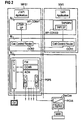
- a protocol structure means CCMB (C all C ontrol M odel B uilder) shown in Figure 2 is needed to supplement the structural additional information as that used in the observed wide area network WAN H.323 protocol, for example, does not have a control protocol features. This means that certain communication objects must be set up by second protocol conversion devices.
- the coupling device CPLU is the link between the gatekeeper GK and an administration unit ACM ( A ctive C lient M Manager) for the acquisition of registered multimedia terminals dar.
- ACM A ctive C lient M Manager
- the reaction is carried out by the intra-system data format to domain-specific communication protocol H.323 in a terminal control unit DevCon (Dev ice Con trol) for a dedicated multimedia terminal MMn.
- the terminal control unit DevCon also includes a signaling auxiliary device SigSup (Sig nalizing Sup port Unit) that controls the data link between the terminal control unit DevCon and the protocol level PL in cooperation with a included in the protocol conversion unit PSP5 controller TLMn.
- SigSup Sig nalizing Sup port Unit
- control and monitoring commands is also possible from a multimedia terminal MM1.
- Figure 3 illustrates the signal flow and activities when sending a control or monitoring command from a on an initial server WFS1 running application a private branch exchange PBX3, which by a remote second server WFS2 is controlled.
- the application-related Translators API CONV1, API CONV2 by the control information router CCR1 on the first server WFS1 registered. This will create a data connection between the first control information router CCR1 and a first one application-related conversion device API CONV1. Due to this, from the application level AL a service request will be issued. This service request is from the first control information router CCR1 on the established data connection received. The service request is evaluated by the first control information router CCR1 and to a suitable second control information router CCR3 which is assigned to the second server WFS2 is. Furthermore, the first control information router maps CCR1 the service request of the calling application for later tracing.
- the second Control Information Router CCR3 takes an evaluation of the Service request to provide a suitable protocol translation facility PSP4 to which the service request is to forward. Further, the second control information router maps CCR3 the service request logically the first Control information router CCR1 to because of this the Service request was submitted. This also serves the later retrace the service request.
- the Service request to the selected protocol translation facility PSP4 forwarded.
- PSP4 In the protocol translation facility PSP4 is first made a check whether the Service request or reject it. After that the service request is converted into a domain-protocol-specific one Report. The message is then sent to a passed PBX PBX3, whereupon the PBX PBX3 with a response message to the assigned Protocol Translator PSP4 responds. By this protocol converter PSP4 becomes the answer converted to the system-internal data format. After that will the converted response to the second control information router CCR3 sent.
- Trace information becomes the first control information router CCR1 as the instance at the network level NL determines from which the service request ran out of.
- the answer is now from the second control information router CCR3 sent to the first control information router CCR1.
- FIG. 4 illustrates the transmission of an event message from a private branch exchange PBX3 to an application.
- the private branch exchange PBX3 first sends the coded event message to the second server WFS2.
- the protocol converter PSP4 on the second server WFS2 receives and decodes the event message.
- the protocol converter PSP4 then generates an internal event and provides the information about it to the second control information router CCR3. In some cases it can happen that multiple copies of the event message to different Control information router must be sent.
- the event message is subsequently passed through the second control information router CCR3 evaluated. As a result of this evaluation the event message is sent to the first control information router CCR1 forwarded. Finally, the event message by the first control information router CCR1 one appropriate application assigned and transmitted to this.
Landscapes
- Engineering & Computer Science (AREA)
- Signal Processing (AREA)
- Telephonic Communication Services (AREA)
- Data Exchanges In Wide-Area Networks (AREA)
- Sub-Exchange Stations And Push- Button Telephones (AREA)
Description
Ein Vorteil der erfindungsgemäßen Lösung besteht darin, daß auf einem Computer ablaufende Applikationen verschiedene Anwendungsprogrammierschnittstellen zur Steuerung und Überwachung benutzen können. Dabei stehen die Steuerungs- und Überwachungsfunktionen ihrerseits für verschiedene Applikationen gleichzeitig zur Verfügung. Grundlage hierfür ist die Einführung eines einheitlichen systeminternen Datenformates, auf dessen Modell die verschiedenen Anwendungsprogrammierschnittstellen adaptiert werden. Außerdem können die Applikationen einheitlich auf verschiedene Netztypen zugreifen. Dies wird durch die Adaption verschiedener domänenspezifischer Protokolle (z.B. ACL, CSTA, H.323) auf das systeminterne Datenformat erreicht. Mit Hilfe der Steuerinformationsrouter wird ein netzwerkgrenzenübergreifender Zugriff auf Telekommunikationsendgeräte ermöglicht.
Claims (14)
- System zur Steuerung und Überwachung von ersten, an Nebenstellenanlagen oder von zweiten an Weitverkehrsnetze angekoppelten Telekommunikationsendgeräten mitwobei die Protokollumsetzungseinrichtungen zur Umsetzung des einheitlichen systeminternen Datenformates auf domänenspezifische Kommunikationsprotokolle vorgesehen sind,mindestens einer applikationsbezogenen Umsetzeinrichtung (API CONV1, API CONV2, API CONV 3) zur Protokollumwandlung von durch Anwendungsprogramme zugeführten Daten auf ein einheitliches systeminternes Datenformat undmindestens einem Steuerinformationsrouter (CCR1, CCR2, CCR3),der eine erste Empfangseinrichtung zur Entgegennahme von Befehlen von einer applikationsbezogenen Umsetzeinrichtung sowie deren Weiterleitung über eine Protokollumsetzungseinrichtung (PSP1, PSP2, PSP3, PSP4, PSP 5) an einander logisch zugeordnete, eine Domäne (DOM1, DOM2, DOM3) bildende Endgeräte (TE1-TE3; TE4-TE6; MM1-MMn) aufweist,und der eine zweite Empfangseinrichtung zur Entgegennahme von Meldungen aus einer Domäne sowie deren Weiterleitung über eine Protokollumsetzungseinrichtung an eine applikationsbezogene Umsetzeinrichtung aufweist,
und erste Protokollumsetzungseinrichtungen (PSP1, PSP2, PSP4) an Nebenstellenanlagen (PBX1, PBX2, PBX3)
und zweite Protokollumsetzungseinrichtungen (PSP3, PSP 5) an Weitverkehrsnetze gekoppelt sind
und die zweiten Protokollumsetzungseinrichtungen eine Protokollaufbaueinrichtung (CCMB) zur Ergänzung struktureller Zusatzinformationen im systeminternen Datenformat, eine Koppeleinrichtung (CPLU) zu einer zentralen Überwachungs- und Verbindungssignalisierungseinheit (GK) einer Domäne (DOM3) innerhalb eines Weitverkehrsnetzes und eine Verwaltungseinheit (ACM) zur Erfassung angemeldeter Endgeräte der Weitverkehrsnetze aufweisen. - System nach Anspruch 1,
dadurch gekennzeichnet, daß die Protokollumsetzungseinrichtungen (PSP1, PSP2, PSP3, PSP4, PSP 5) Kontrolleinrichtungen (FM) zur Überprüfung von benutzerspezifischen Berechtigungen zur Ausführung von Steuer- und Überwachungsbefehlen aufweisen. - System nach Anspruch 1 oder 2,
dadurch gekennzeichnet, daß die ersten Protokollumsetzungseinrichtungen (PSP1, PSP2, PSP4) Kommunikationseinrichtungen zum Aufbau von Kommunikationsverbindungen zwischen Computern und Nebenstellenanlagen aufweisen. - System nach einem der Ansprüche 1 bis 3,
dadurch gekennzeichnet, daß die zweiten Protokollumsetzungseinrichtungen (PSP3, PSP 5) Kommunikationseinrichtungen (TLM1-TLMn) zum Aufbau von Datenverbindungen aufweisen. - System nach einem der Ansprüche 1 bis 4,
dadurch gekennzeichnet, daß das einheitliche systeminterne Datenformat auf dem CSTA-III-Protokoll basiert. - System nach einem der Ansprüche 1 bis 5,
dadurch gekennzeichnet, daß die ersten Protokollumsetzungseinrichtungen (PSP1, PSP2, PSP4) Umsetzer (PCV2) vom einheitlichen systeminternen Datenformat auf das CSTA-Protokoll aufweisen. - System nach einem der Ansprüche 1 bis 6,
dadurch gekennzeichnet, daß die ersten Protokollumsetzungseinrichtungen (PSP1, PSP2, PSP4) Umsetzer (PCV1) vom einheitlichen systeminternen Datenformat auf das ACL-Protokoll aufweisen. - System nach einem der Ansprüche 1 bis 7,
dadurch gekennzeichnet, daß die zweiten Protokollumsetzungseinrichtungen (PSP3, PSP 5) Umsetzer (PCV3, PCV 4) vom einheitlichen systeminternen Datenformat auf das H.323-Protokoll aufweisen. - System nach Anspruch 8,
dadurch gekennzeichnet, daß die Umsetzer (PCV4) der zweiten Protokollumsetzungseinrichtungen (PSP3) zusammen mit einer zusätzlichen Signalisierungshilfseinrichtung (SigSup) in einer separaten Endgerätesteuerungseinheit (DevCon) angeordnet sind. - System nach einem der Ansprüche 1 bis 9,
dadurch gekennzeichnet, daß die an Weitverkehrsnetze angekoppelten Endgeräte (MM1-MMn) auf Computern basieren. - System nach Anspruch 10,
dadurch gekennzeichnet, daß die an Weitverkehrsnetze angekoppelten Endgeräte (MM1-MMn) über eigene applikationsbezogene Umsetzeinrichtungen (API CONV3) verfügen. - System nach Anspruch 10 oder 11,
dadurch gekennzeichnet, daß die an Weitverkehrsnetze angekoppelten Endgeräte (MM1-MMn) über eigene Steuerinformationsrouter (CCR2) verfügen. - System nach einem der Ansprüche 1 bis 12,
dadurch gekennzeichnet, daß die Steuerinformationsrouter (CCR1, CCR2, CCR3) Registrierungseinrichtungen für applikationsbezogene Umsetzeinrichtungen (API CONV1, API CONV2, API CONV 3) aufweisen. - System nach einem der Ansprüche 1 bis 13,
dadurch gekennzeichnet, daß die Steuerinformationsrouter (CCR1, CCR2, CCR3) Registrierungseinrichtungen für Protokollumsetzungseinrichtungen (PSP1, PSP2, PSP3, PSP4, PSP 5) aufweisen.
Applications Claiming Priority (2)
| Application Number | Priority Date | Filing Date | Title |
|---|---|---|---|
| DE19947032A DE19947032B4 (de) | 1999-09-30 | 1999-09-30 | System zur Steuerung und Überwachung von an Nebenstellenanlagen angekoppelten ersten oder von an Weitverkehrsnetze angekoppelten zweiten Telekommunikationsendgeräten |
| DE19947032 | 1999-09-30 |
Publications (3)
| Publication Number | Publication Date |
|---|---|
| EP1089529A2 EP1089529A2 (de) | 2001-04-04 |
| EP1089529A3 EP1089529A3 (de) | 2002-11-27 |
| EP1089529B1 true EP1089529B1 (de) | 2005-11-23 |
Family
ID=7923952
Family Applications (1)
| Application Number | Title | Priority Date | Filing Date |
|---|---|---|---|
| EP00120876A Expired - Lifetime EP1089529B1 (de) | 1999-09-30 | 2000-09-25 | System zur Steuerung und Überwachung von an Nebenstellenanlagen angeschlossenen ersten oder von an Weitverkehrsnetze angekoppelten zweiten Telekommunikationsendgeräten |
Country Status (3)
| Country | Link |
|---|---|
| US (1) | US6625168B1 (de) |
| EP (1) | EP1089529B1 (de) |
| DE (2) | DE19947032B4 (de) |
Families Citing this family (15)
| Publication number | Priority date | Publication date | Assignee | Title |
|---|---|---|---|---|
| US8180034B2 (en) * | 2001-07-27 | 2012-05-15 | Alcatel Lucent | Apparatus, and associated method, for a CTI-enabled SIP-phone |
| DE10143937B4 (de) * | 2001-09-07 | 2007-08-09 | Siemens Ag | Vorrichtung und Verfahren zum Datenaustausch |
| CA2357165A1 (en) * | 2001-09-10 | 2003-03-10 | Ibm Canada Limited-Ibm Canada Limitee | Configurable connector |
| DE10159636B4 (de) * | 2001-12-05 | 2005-10-20 | Siemens Ag | Verfahren zur Steuerung und/oder Überwachung von Ressourcen und Verbindungen |
| DE10160027A1 (de) * | 2001-12-06 | 2003-06-26 | Siemens Ag | Anordnung zur Steuerung und/oder Überwachung von mindestens zwei Kommunikationssystemen durch mindestens eine Anwendung |
| US7272211B2 (en) * | 2002-01-03 | 2007-09-18 | Intel Corporation | Property management system protocol auto-detection |
| US8296433B2 (en) * | 2002-05-22 | 2012-10-23 | International Business Machines Corporation | Virtualization method and apparatus for integrating enterprise applications |
| US7610404B2 (en) * | 2002-05-22 | 2009-10-27 | Cast Iron Systems, Inc. | Application network communication method and apparatus |
| US6920216B2 (en) * | 2002-08-19 | 2005-07-19 | Intel Corporation | Automatic call distribution with computer telephony interface enablement |
| US8321590B2 (en) * | 2003-05-22 | 2012-11-27 | International Business Machines Corporation | Application network communication |
| EP1569384B1 (de) * | 2004-02-25 | 2007-05-23 | Sony Deutschland GmbH | Verfahren zur drahtlosen Datenübertragung |
| US7499702B2 (en) * | 2004-12-27 | 2009-03-03 | Sbc Knowledge Ventures, L.P. | Methods and apparatus to perform wireless peering in communication systems |
| JP4410236B2 (ja) * | 2006-11-28 | 2010-02-03 | 株式会社東芝 | 電話システムとその呼制御方法 |
| US8139565B2 (en) * | 2009-02-09 | 2012-03-20 | Zoltes, Inc. | Telecommunications system and method for connecting a CSTA client to several PBXS |
| CN106911703B (zh) * | 2017-03-08 | 2020-01-07 | 北京中交创新投资发展有限公司 | 统一接口平台搭建方法及系统 |
Family Cites Families (12)
| Publication number | Priority date | Publication date | Assignee | Title |
|---|---|---|---|---|
| US4332982A (en) * | 1980-09-05 | 1982-06-01 | Ident-A-Call, Inc. | Telephone toll call security and logging device and method |
| JPH08163611A (ja) * | 1994-12-07 | 1996-06-21 | Toshiba Corp | 電子交換装置および交換機能を備えた汎用計算機 |
| US5799072A (en) * | 1995-07-21 | 1998-08-25 | Callmanage | Telecommunications call management system |
| US5875234A (en) * | 1996-02-14 | 1999-02-23 | Netphone, Inc. | Computer integrated PBX system |
| GB2320843A (en) * | 1996-12-24 | 1998-07-01 | Ibm | Establishing real time voice and/or video link via the Internet |
| US6081591A (en) * | 1997-04-16 | 2000-06-27 | Skoog; Frederick H. | Signaling network gateway device and method for use in a signaling network |
| US6094479A (en) * | 1997-05-06 | 2000-07-25 | Telefonaktiebolaget Lm Ericsson | Computer telephony integration gateway |
| US6452915B1 (en) * | 1998-07-10 | 2002-09-17 | Malibu Networks, Inc. | IP-flow classification in a wireless point to multi-point (PTMP) transmission system |
| US6389007B1 (en) * | 1998-09-24 | 2002-05-14 | Genesys Telecommunications Laboratories, Inc. | Method and apparatus for providing integrated routing for PSTN and IPNT calls in a call center |
| US5995607A (en) * | 1998-10-14 | 1999-11-30 | Siemens Information And Communication Networks, Inc. | Enhanced telephony trunk routing |
| US6442169B1 (en) * | 1998-11-20 | 2002-08-27 | Level 3 Communications, Inc. | System and method for bypassing data from egress facilities |
| US6396918B1 (en) * | 1999-01-19 | 2002-05-28 | Siemens Information And Communication Networks, Inc. | Method for forwarding a call to a telephone behind a key telephone system |
-
1999
- 1999-09-30 DE DE19947032A patent/DE19947032B4/de not_active Expired - Fee Related
-
2000
- 2000-09-25 EP EP00120876A patent/EP1089529B1/de not_active Expired - Lifetime
- 2000-09-25 DE DE50011678T patent/DE50011678D1/de not_active Expired - Fee Related
- 2000-09-29 US US09/676,242 patent/US6625168B1/en not_active Expired - Lifetime
Also Published As
| Publication number | Publication date |
|---|---|
| EP1089529A3 (de) | 2002-11-27 |
| EP1089529A2 (de) | 2001-04-04 |
| US6625168B1 (en) | 2003-09-23 |
| DE50011678D1 (de) | 2005-12-29 |
| DE19947032A1 (de) | 2001-04-12 |
| DE19947032B4 (de) | 2006-02-23 |
Similar Documents
| Publication | Publication Date | Title |
|---|---|---|
| DE19947032B4 (de) | System zur Steuerung und Überwachung von an Nebenstellenanlagen angekoppelten ersten oder von an Weitverkehrsnetze angekoppelten zweiten Telekommunikationsendgeräten | |
| DE19508081A1 (de) | Verfahren zum Steuern eines Zugangsnetzes sowie Vermittlungsstelle und Zugangsnetz damit | |
| EP1211878A2 (de) | Verfahren und Vorrichtung zur Anrufumleitung mittels eines Stellvertreter in einem Kommunikationssystem | |
| EP1492300A1 (de) | Verfahren und Anordnung zum Zugriff auf ein erstes Endgerät eines ersten Kommunikationsnetzwerkes durch einen Kommunikationsknoten in einem zweiten Kommunikationsnetzwerk | |
| EP1123622A1 (de) | Verfahren zur steuerung von netzelementen | |
| EP2875626A1 (de) | Verfahren und anordnung zum aufbau einer telekommunikationsverbindung | |
| EP1269766A1 (de) | Bereitstellen von ergänzenden diensten in einem paketvermittelnden kommunikationsnetz | |
| EP2875627B1 (de) | Verfahren und anordnung zum aufbau von telekommunikationsverbindungen | |
| WO2002103990A2 (de) | Zentrale administration eines callcenters | |
| EP1584176B1 (de) | Verfahren und anordnung zur steuerung und/oder überwachung eines an ein kommunikations-system angeschlossenen endgerätes | |
| EP0998090A2 (de) | Verfahren zum Übertragen von Daten | |
| DE10001417A1 (de) | Verfahren, Vermittlungsstelle, Diensterechner, Programm-Modul und Schnittstelleneinrichtung zur Übermittlung von Telekommunikationsdienst-Daten zwischen einer Vermittlungsstelle und einem Diensterechner | |
| DE102004012503B4 (de) | Kommunikationsserver und Verfahren zur Steuerung und Überwachung von Endgeräten, und Kombination aus einem Kommunikationsserver, einer Mehrzahl von Kommunikationsknoten und Endgeräten | |
| EP1285541B1 (de) | Übermittlung von dienstesteuerinformationen über wenigstens eine zwischenstation | |
| DE10159636A1 (de) | Verfahren zur Steuerung und/oder Überwachung von Ressourcen und Verbindungen | |
| DE60104672T2 (de) | System zur überwachung von terminals | |
| DE10145987A1 (de) | Verfahren zur Auswahl eines Leistungsmerkmals und zugehörige Einheiten | |
| EP1001589B1 (de) | Kommunikationsanlage | |
| DE60035493T2 (de) | Verfahren zur Dienstbereitsstellung in einem Kommunikationsnetzwerk und Programmmodulen und diesbezügliche Mittel | |
| EP1163805B1 (de) | Verfahren zum übertragen von daten an mitglieder eines operatorservices | |
| EP1443741B1 (de) | WEB-basierendes Multimediales Virtuelles Call Center | |
| EP0957645B1 (de) | Netzelement für ein intelligentes Telekommunikationsnetz | |
| EP1304855A2 (de) | Anordnung zur Steuerung und/oder Überwachung einer Kommunikationsanlage durch mindestens zwei Anwendungen | |
| DE10143937B4 (de) | Vorrichtung und Verfahren zum Datenaustausch | |
| WO2005020553A1 (de) | Kommunikationsendgerät mit zwei schnittstellenstrukturen |
Legal Events
| Date | Code | Title | Description |
|---|---|---|---|
| PUAI | Public reference made under article 153(3) epc to a published international application that has entered the european phase |
Free format text: ORIGINAL CODE: 0009012 |
|
| AK | Designated contracting states |
Kind code of ref document: A2 Designated state(s): AT BE CH CY DE DK ES FI FR GB GR IE IT LI LU MC NL PT SE |
|
| AX | Request for extension of the european patent |
Free format text: AL;LT;LV;MK;RO;SI |
|
| PUAL | Search report despatched |
Free format text: ORIGINAL CODE: 0009013 |
|
| AK | Designated contracting states |
Kind code of ref document: A3 Designated state(s): AT BE CH CY DE DK ES FI FR GB GR IE IT LI LU MC NL PT SE |
|
| AX | Request for extension of the european patent |
Free format text: AL;LT;LV;MK;RO;SI |
|
| RIC1 | Information provided on ipc code assigned before grant |
Free format text: 7H 04M 3/22 A, 7H 04M 3/42 B, 7H 04M 7/00 B, 7H 04Q 3/62 B |
|
| 17P | Request for examination filed |
Effective date: 20030526 |
|
| AKX | Designation fees paid |
Designated state(s): DE FR GB IT |
|
| GRAP | Despatch of communication of intention to grant a patent |
Free format text: ORIGINAL CODE: EPIDOSNIGR1 |
|
| GRAS | Grant fee paid |
Free format text: ORIGINAL CODE: EPIDOSNIGR3 |
|
| GRAA | (expected) grant |
Free format text: ORIGINAL CODE: 0009210 |
|
| AK | Designated contracting states |
Kind code of ref document: B1 Designated state(s): DE FR GB IT |
|
| REG | Reference to a national code |
Ref country code: GB Ref legal event code: FG4D Free format text: NOT ENGLISH |
|
| REF | Corresponds to: |
Ref document number: 50011678 Country of ref document: DE Date of ref document: 20051229 Kind code of ref document: P |
|
| GBT | Gb: translation of ep patent filed (gb section 77(6)(a)/1977) |
Effective date: 20051214 |
|
| ET | Fr: translation filed | ||
| PLBE | No opposition filed within time limit |
Free format text: ORIGINAL CODE: 0009261 |
|
| STAA | Information on the status of an ep patent application or granted ep patent |
Free format text: STATUS: NO OPPOSITION FILED WITHIN TIME LIMIT |
|
| 26N | No opposition filed |
Effective date: 20060824 |
|
| PG25 | Lapsed in a contracting state [announced via postgrant information from national office to epo] |
Ref country code: DE Free format text: LAPSE BECAUSE OF NON-PAYMENT OF DUE FEES Effective date: 20070403 |
|
| GBPC | Gb: european patent ceased through non-payment of renewal fee |
Effective date: 20060925 |
|
| REG | Reference to a national code |
Ref country code: FR Ref legal event code: ST Effective date: 20070531 |
|
| PG25 | Lapsed in a contracting state [announced via postgrant information from national office to epo] |
Ref country code: GB Free format text: LAPSE BECAUSE OF NON-PAYMENT OF DUE FEES Effective date: 20060925 |
|
| PGFP | Annual fee paid to national office [announced via postgrant information from national office to epo] |
Ref country code: IT Payment date: 20070925 Year of fee payment: 8 |
|
| PG25 | Lapsed in a contracting state [announced via postgrant information from national office to epo] |
Ref country code: FR Free format text: LAPSE BECAUSE OF NON-PAYMENT OF DUE FEES Effective date: 20061002 |
|
| PG25 | Lapsed in a contracting state [announced via postgrant information from national office to epo] |
Ref country code: IT Free format text: LAPSE BECAUSE OF NON-PAYMENT OF DUE FEES Effective date: 20080925 |