EP1089964B1 - Derives d'hydrazine - Google Patents
Derives d'hydrazine Download PDFInfo
- Publication number
- EP1089964B1 EP1089964B1 EP99931098A EP99931098A EP1089964B1 EP 1089964 B1 EP1089964 B1 EP 1089964B1 EP 99931098 A EP99931098 A EP 99931098A EP 99931098 A EP99931098 A EP 99931098A EP 1089964 B1 EP1089964 B1 EP 1089964B1
- Authority
- EP
- European Patent Office
- Prior art keywords
- solvent
- butenyl
- phenyl
- isobutyl
- methylvalerohydrazide
- Prior art date
- Legal status (The legal status is an assumption and is not a legal conclusion. Google has not performed a legal analysis and makes no representation as to the accuracy of the status listed.)
- Expired - Lifetime
Links
- 0 *[C@](C(*I)C(NO*)=O)C(NN(*)*)=O Chemical compound *[C@](C(*I)C(NO*)=O)C(NN(*)*)=O 0.000 description 1
Classifications
-
- C—CHEMISTRY; METALLURGY
- C07—ORGANIC CHEMISTRY
- C07D—HETEROCYCLIC COMPOUNDS
- C07D207/00—Heterocyclic compounds containing five-membered rings not condensed with other rings, with one nitrogen atom as the only ring hetero atom
- C07D207/02—Heterocyclic compounds containing five-membered rings not condensed with other rings, with one nitrogen atom as the only ring hetero atom with only hydrogen or carbon atoms directly attached to the ring nitrogen atom
- C07D207/30—Heterocyclic compounds containing five-membered rings not condensed with other rings, with one nitrogen atom as the only ring hetero atom with only hydrogen or carbon atoms directly attached to the ring nitrogen atom having two double bonds between ring members or between ring members and non-ring members
- C07D207/32—Heterocyclic compounds containing five-membered rings not condensed with other rings, with one nitrogen atom as the only ring hetero atom with only hydrogen or carbon atoms directly attached to the ring nitrogen atom having two double bonds between ring members or between ring members and non-ring members with only hydrogen atoms, hydrocarbon or substituted hydrocarbon radicals, directly attached to ring carbon atoms
- C07D207/325—Heterocyclic compounds containing five-membered rings not condensed with other rings, with one nitrogen atom as the only ring hetero atom with only hydrogen or carbon atoms directly attached to the ring nitrogen atom having two double bonds between ring members or between ring members and non-ring members with only hydrogen atoms, hydrocarbon or substituted hydrocarbon radicals, directly attached to ring carbon atoms with substituted hydrocarbon radicals directly attached to the ring nitrogen atom
- C07D207/327—Radicals substituted by carbon atoms having three bonds to hetero atoms with at the most one bond to halogen, e.g. ester or nitrile radicals
-
- A—HUMAN NECESSITIES
- A61—MEDICAL OR VETERINARY SCIENCE; HYGIENE
- A61P—SPECIFIC THERAPEUTIC ACTIVITY OF CHEMICAL COMPOUNDS OR MEDICINAL PREPARATIONS
- A61P11/00—Drugs for disorders of the respiratory system
-
- A—HUMAN NECESSITIES
- A61—MEDICAL OR VETERINARY SCIENCE; HYGIENE
- A61P—SPECIFIC THERAPEUTIC ACTIVITY OF CHEMICAL COMPOUNDS OR MEDICINAL PREPARATIONS
- A61P19/00—Drugs for skeletal disorders
-
- A—HUMAN NECESSITIES
- A61—MEDICAL OR VETERINARY SCIENCE; HYGIENE
- A61P—SPECIFIC THERAPEUTIC ACTIVITY OF CHEMICAL COMPOUNDS OR MEDICINAL PREPARATIONS
- A61P19/00—Drugs for skeletal disorders
- A61P19/02—Drugs for skeletal disorders for joint disorders, e.g. arthritis, arthrosis
-
- A—HUMAN NECESSITIES
- A61—MEDICAL OR VETERINARY SCIENCE; HYGIENE
- A61P—SPECIFIC THERAPEUTIC ACTIVITY OF CHEMICAL COMPOUNDS OR MEDICINAL PREPARATIONS
- A61P29/00—Non-central analgesic, antipyretic or antiinflammatory agents, e.g. antirheumatic agents; Non-steroidal antiinflammatory drugs [NSAID]
-
- A—HUMAN NECESSITIES
- A61—MEDICAL OR VETERINARY SCIENCE; HYGIENE
- A61P—SPECIFIC THERAPEUTIC ACTIVITY OF CHEMICAL COMPOUNDS OR MEDICINAL PREPARATIONS
- A61P35/00—Antineoplastic agents
-
- A—HUMAN NECESSITIES
- A61—MEDICAL OR VETERINARY SCIENCE; HYGIENE
- A61P—SPECIFIC THERAPEUTIC ACTIVITY OF CHEMICAL COMPOUNDS OR MEDICINAL PREPARATIONS
- A61P37/00—Drugs for immunological or allergic disorders
-
- A—HUMAN NECESSITIES
- A61—MEDICAL OR VETERINARY SCIENCE; HYGIENE
- A61P—SPECIFIC THERAPEUTIC ACTIVITY OF CHEMICAL COMPOUNDS OR MEDICINAL PREPARATIONS
- A61P37/00—Drugs for immunological or allergic disorders
- A61P37/02—Immunomodulators
- A61P37/06—Immunosuppressants, e.g. drugs for graft rejection
-
- A—HUMAN NECESSITIES
- A61—MEDICAL OR VETERINARY SCIENCE; HYGIENE
- A61P—SPECIFIC THERAPEUTIC ACTIVITY OF CHEMICAL COMPOUNDS OR MEDICINAL PREPARATIONS
- A61P7/00—Drugs for disorders of the blood or the extracellular fluid
-
- A—HUMAN NECESSITIES
- A61—MEDICAL OR VETERINARY SCIENCE; HYGIENE
- A61P—SPECIFIC THERAPEUTIC ACTIVITY OF CHEMICAL COMPOUNDS OR MEDICINAL PREPARATIONS
- A61P7/00—Drugs for disorders of the blood or the extracellular fluid
- A61P7/04—Antihaemorrhagics; Procoagulants; Haemostatic agents; Antifibrinolytic agents
-
- A—HUMAN NECESSITIES
- A61—MEDICAL OR VETERINARY SCIENCE; HYGIENE
- A61P—SPECIFIC THERAPEUTIC ACTIVITY OF CHEMICAL COMPOUNDS OR MEDICINAL PREPARATIONS
- A61P9/00—Drugs for disorders of the cardiovascular system
-
- A—HUMAN NECESSITIES
- A61—MEDICAL OR VETERINARY SCIENCE; HYGIENE
- A61P—SPECIFIC THERAPEUTIC ACTIVITY OF CHEMICAL COMPOUNDS OR MEDICINAL PREPARATIONS
- A61P9/00—Drugs for disorders of the cardiovascular system
- A61P9/02—Non-specific cardiovascular stimulants, e.g. drugs for syncope, antihypotensives
-
- C—CHEMISTRY; METALLURGY
- C07—ORGANIC CHEMISTRY
- C07C—ACYCLIC OR CARBOCYCLIC COMPOUNDS
- C07C259/00—Compounds containing carboxyl groups, an oxygen atom of a carboxyl group being replaced by a nitrogen atom, this nitrogen atom being further bound to an oxygen atom and not being part of nitro or nitroso groups
- C07C259/04—Compounds containing carboxyl groups, an oxygen atom of a carboxyl group being replaced by a nitrogen atom, this nitrogen atom being further bound to an oxygen atom and not being part of nitro or nitroso groups without replacement of the other oxygen atom of the carboxyl group, e.g. hydroxamic acids
- C07C259/06—Compounds containing carboxyl groups, an oxygen atom of a carboxyl group being replaced by a nitrogen atom, this nitrogen atom being further bound to an oxygen atom and not being part of nitro or nitroso groups without replacement of the other oxygen atom of the carboxyl group, e.g. hydroxamic acids having carbon atoms of hydroxamic groups bound to hydrogen atoms or to acyclic carbon atoms
-
- C—CHEMISTRY; METALLURGY
- C07—ORGANIC CHEMISTRY
- C07C—ACYCLIC OR CARBOCYCLIC COMPOUNDS
- C07C317/00—Sulfones; Sulfoxides
- C07C317/44—Sulfones; Sulfoxides having sulfone or sulfoxide groups and carboxyl groups bound to the same carbon skeleton
-
- C—CHEMISTRY; METALLURGY
- C07—ORGANIC CHEMISTRY
- C07C—ACYCLIC OR CARBOCYCLIC COMPOUNDS
- C07C323/00—Thiols, sulfides, hydropolysulfides or polysulfides substituted by halogen, oxygen or nitrogen atoms, or by sulfur atoms not being part of thio groups
- C07C323/50—Thiols, sulfides, hydropolysulfides or polysulfides substituted by halogen, oxygen or nitrogen atoms, or by sulfur atoms not being part of thio groups containing thio groups and carboxyl groups bound to the same carbon skeleton
- C07C323/51—Thiols, sulfides, hydropolysulfides or polysulfides substituted by halogen, oxygen or nitrogen atoms, or by sulfur atoms not being part of thio groups containing thio groups and carboxyl groups bound to the same carbon skeleton having the sulfur atoms of the thio groups bound to acyclic carbon atoms of the carbon skeleton
- C07C323/60—Thiols, sulfides, hydropolysulfides or polysulfides substituted by halogen, oxygen or nitrogen atoms, or by sulfur atoms not being part of thio groups containing thio groups and carboxyl groups bound to the same carbon skeleton having the sulfur atoms of the thio groups bound to acyclic carbon atoms of the carbon skeleton with the carbon atom of at least one of the carboxyl groups bound to nitrogen atoms
-
- C—CHEMISTRY; METALLURGY
- C07—ORGANIC CHEMISTRY
- C07D—HETEROCYCLIC COMPOUNDS
- C07D205/00—Heterocyclic compounds containing four-membered rings with one nitrogen atom as the only ring hetero atom
- C07D205/02—Heterocyclic compounds containing four-membered rings with one nitrogen atom as the only ring hetero atom not condensed with other rings
- C07D205/04—Heterocyclic compounds containing four-membered rings with one nitrogen atom as the only ring hetero atom not condensed with other rings having no double bonds between ring members or between ring members and non-ring members
-
- C—CHEMISTRY; METALLURGY
- C07—ORGANIC CHEMISTRY
- C07D—HETEROCYCLIC COMPOUNDS
- C07D207/00—Heterocyclic compounds containing five-membered rings not condensed with other rings, with one nitrogen atom as the only ring hetero atom
- C07D207/02—Heterocyclic compounds containing five-membered rings not condensed with other rings, with one nitrogen atom as the only ring hetero atom with only hydrogen or carbon atoms directly attached to the ring nitrogen atom
- C07D207/04—Heterocyclic compounds containing five-membered rings not condensed with other rings, with one nitrogen atom as the only ring hetero atom with only hydrogen or carbon atoms directly attached to the ring nitrogen atom having no double bonds between ring members or between ring members and non-ring members
- C07D207/10—Heterocyclic compounds containing five-membered rings not condensed with other rings, with one nitrogen atom as the only ring hetero atom with only hydrogen or carbon atoms directly attached to the ring nitrogen atom having no double bonds between ring members or between ring members and non-ring members with hetero atoms or with carbon atoms having three bonds to hetero atoms with at the most one bond to halogen, e.g. ester or nitrile radicals, directly attached to ring carbon atoms
- C07D207/16—Carbon atoms having three bonds to hetero atoms with at the most one bond to halogen, e.g. ester or nitrile radicals
-
- C—CHEMISTRY; METALLURGY
- C07—ORGANIC CHEMISTRY
- C07D—HETEROCYCLIC COMPOUNDS
- C07D207/00—Heterocyclic compounds containing five-membered rings not condensed with other rings, with one nitrogen atom as the only ring hetero atom
- C07D207/02—Heterocyclic compounds containing five-membered rings not condensed with other rings, with one nitrogen atom as the only ring hetero atom with only hydrogen or carbon atoms directly attached to the ring nitrogen atom
- C07D207/18—Heterocyclic compounds containing five-membered rings not condensed with other rings, with one nitrogen atom as the only ring hetero atom with only hydrogen or carbon atoms directly attached to the ring nitrogen atom having one double bond between ring members or between a ring member and a non-ring member
- C07D207/22—Heterocyclic compounds containing five-membered rings not condensed with other rings, with one nitrogen atom as the only ring hetero atom with only hydrogen or carbon atoms directly attached to the ring nitrogen atom having one double bond between ring members or between a ring member and a non-ring member with hetero atoms or with carbon atoms having three bonds to hetero atoms with at the most one bond to halogen, e.g. ester or nitrile radicals, directly attached to ring carbon atoms
- C07D207/24—Oxygen or sulfur atoms
- C07D207/26—2-Pyrrolidones
- C07D207/273—2-Pyrrolidones with hetero atoms or with carbon atoms having three bonds to hetero atoms with at the most one bond to halogen, e.g. ester or nitrile radicals, directly attached to other ring carbon atoms
- C07D207/277—Carbon atoms having three bonds to hetero atoms with at the most one bond to halogen, e.g. ester or nitrile radicals
- C07D207/28—2-Pyrrolidone-5- carboxylic acids; Functional derivatives thereof, e.g. esters, nitriles
-
- C—CHEMISTRY; METALLURGY
- C07—ORGANIC CHEMISTRY
- C07D—HETEROCYCLIC COMPOUNDS
- C07D207/00—Heterocyclic compounds containing five-membered rings not condensed with other rings, with one nitrogen atom as the only ring hetero atom
- C07D207/02—Heterocyclic compounds containing five-membered rings not condensed with other rings, with one nitrogen atom as the only ring hetero atom with only hydrogen or carbon atoms directly attached to the ring nitrogen atom
- C07D207/30—Heterocyclic compounds containing five-membered rings not condensed with other rings, with one nitrogen atom as the only ring hetero atom with only hydrogen or carbon atoms directly attached to the ring nitrogen atom having two double bonds between ring members or between ring members and non-ring members
- C07D207/34—Heterocyclic compounds containing five-membered rings not condensed with other rings, with one nitrogen atom as the only ring hetero atom with only hydrogen or carbon atoms directly attached to the ring nitrogen atom having two double bonds between ring members or between ring members and non-ring members with hetero atoms or with carbon atoms having three bonds to hetero atoms with at the most one bond to halogen, e.g. ester or nitrile radicals, directly attached to ring carbon atoms
-
- C—CHEMISTRY; METALLURGY
- C07—ORGANIC CHEMISTRY
- C07D—HETEROCYCLIC COMPOUNDS
- C07D209/00—Heterocyclic compounds containing five-membered rings, condensed with other rings, with one nitrogen atom as the only ring hetero atom
- C07D209/02—Heterocyclic compounds containing five-membered rings, condensed with other rings, with one nitrogen atom as the only ring hetero atom condensed with one carbocyclic ring
- C07D209/04—Indoles; Hydrogenated indoles
- C07D209/10—Indoles; Hydrogenated indoles with substituted hydrocarbon radicals attached to carbon atoms of the hetero ring
- C07D209/18—Radicals substituted by carbon atoms having three bonds to hetero atoms with at the most one bond to halogen, e.g. ester or nitrile radicals
-
- C—CHEMISTRY; METALLURGY
- C07—ORGANIC CHEMISTRY
- C07D—HETEROCYCLIC COMPOUNDS
- C07D209/00—Heterocyclic compounds containing five-membered rings, condensed with other rings, with one nitrogen atom as the only ring hetero atom
- C07D209/02—Heterocyclic compounds containing five-membered rings, condensed with other rings, with one nitrogen atom as the only ring hetero atom condensed with one carbocyclic ring
- C07D209/44—Iso-indoles; Hydrogenated iso-indoles
- C07D209/48—Iso-indoles; Hydrogenated iso-indoles with oxygen atoms in positions 1 and 3, e.g. phthalimide
-
- C—CHEMISTRY; METALLURGY
- C07—ORGANIC CHEMISTRY
- C07D—HETEROCYCLIC COMPOUNDS
- C07D211/00—Heterocyclic compounds containing hydrogenated pyridine rings, not condensed with other rings
- C07D211/04—Heterocyclic compounds containing hydrogenated pyridine rings, not condensed with other rings with only hydrogen or carbon atoms directly attached to the ring nitrogen atom
- C07D211/06—Heterocyclic compounds containing hydrogenated pyridine rings, not condensed with other rings with only hydrogen or carbon atoms directly attached to the ring nitrogen atom having no double bonds between ring members or between ring members and non-ring members
- C07D211/08—Heterocyclic compounds containing hydrogenated pyridine rings, not condensed with other rings with only hydrogen or carbon atoms directly attached to the ring nitrogen atom having no double bonds between ring members or between ring members and non-ring members with hydrocarbon or substituted hydrocarbon radicals directly attached to ring carbon atoms
- C07D211/18—Heterocyclic compounds containing hydrogenated pyridine rings, not condensed with other rings with only hydrogen or carbon atoms directly attached to the ring nitrogen atom having no double bonds between ring members or between ring members and non-ring members with hydrocarbon or substituted hydrocarbon radicals directly attached to ring carbon atoms with substituted hydrocarbon radicals attached to ring carbon atoms
- C07D211/34—Heterocyclic compounds containing hydrogenated pyridine rings, not condensed with other rings with only hydrogen or carbon atoms directly attached to the ring nitrogen atom having no double bonds between ring members or between ring members and non-ring members with hydrocarbon or substituted hydrocarbon radicals directly attached to ring carbon atoms with substituted hydrocarbon radicals attached to ring carbon atoms with hydrocarbon radicals, substituted by carbon atoms having three bonds to hetero atoms with at the most one bond to halogen, e.g. ester or nitrile radicals
-
- C—CHEMISTRY; METALLURGY
- C07—ORGANIC CHEMISTRY
- C07D—HETEROCYCLIC COMPOUNDS
- C07D211/00—Heterocyclic compounds containing hydrogenated pyridine rings, not condensed with other rings
- C07D211/04—Heterocyclic compounds containing hydrogenated pyridine rings, not condensed with other rings with only hydrogen or carbon atoms directly attached to the ring nitrogen atom
- C07D211/06—Heterocyclic compounds containing hydrogenated pyridine rings, not condensed with other rings with only hydrogen or carbon atoms directly attached to the ring nitrogen atom having no double bonds between ring members or between ring members and non-ring members
- C07D211/36—Heterocyclic compounds containing hydrogenated pyridine rings, not condensed with other rings with only hydrogen or carbon atoms directly attached to the ring nitrogen atom having no double bonds between ring members or between ring members and non-ring members with hetero atoms or with carbon atoms having three bonds to hetero atoms with at the most one bond to halogen, e.g. ester or nitrile radicals, directly attached to ring carbon atoms
- C07D211/60—Carbon atoms having three bonds to hetero atoms with at the most one bond to halogen, e.g. ester or nitrile radicals
- C07D211/62—Carbon atoms having three bonds to hetero atoms with at the most one bond to halogen, e.g. ester or nitrile radicals attached in position 4
-
- C—CHEMISTRY; METALLURGY
- C07—ORGANIC CHEMISTRY
- C07D—HETEROCYCLIC COMPOUNDS
- C07D213/00—Heterocyclic compounds containing six-membered rings, not condensed with other rings, with one nitrogen atom as the only ring hetero atom and three or more double bonds between ring members or between ring members and non-ring members
- C07D213/02—Heterocyclic compounds containing six-membered rings, not condensed with other rings, with one nitrogen atom as the only ring hetero atom and three or more double bonds between ring members or between ring members and non-ring members having three double bonds between ring members or between ring members and non-ring members
- C07D213/04—Heterocyclic compounds containing six-membered rings, not condensed with other rings, with one nitrogen atom as the only ring hetero atom and three or more double bonds between ring members or between ring members and non-ring members having three double bonds between ring members or between ring members and non-ring members having no bond between the ring nitrogen atom and a non-ring member or having only hydrogen or carbon atoms directly attached to the ring nitrogen atom
- C07D213/24—Heterocyclic compounds containing six-membered rings, not condensed with other rings, with one nitrogen atom as the only ring hetero atom and three or more double bonds between ring members or between ring members and non-ring members having three double bonds between ring members or between ring members and non-ring members having no bond between the ring nitrogen atom and a non-ring member or having only hydrogen or carbon atoms directly attached to the ring nitrogen atom with substituted hydrocarbon radicals attached to ring carbon atoms
- C07D213/54—Radicals substituted by carbon atoms having three bonds to hetero atoms with at the most one bond to halogen, e.g. ester or nitrile radicals
-
- C—CHEMISTRY; METALLURGY
- C07—ORGANIC CHEMISTRY
- C07D—HETEROCYCLIC COMPOUNDS
- C07D213/00—Heterocyclic compounds containing six-membered rings, not condensed with other rings, with one nitrogen atom as the only ring hetero atom and three or more double bonds between ring members or between ring members and non-ring members
- C07D213/02—Heterocyclic compounds containing six-membered rings, not condensed with other rings, with one nitrogen atom as the only ring hetero atom and three or more double bonds between ring members or between ring members and non-ring members having three double bonds between ring members or between ring members and non-ring members
- C07D213/04—Heterocyclic compounds containing six-membered rings, not condensed with other rings, with one nitrogen atom as the only ring hetero atom and three or more double bonds between ring members or between ring members and non-ring members having three double bonds between ring members or between ring members and non-ring members having no bond between the ring nitrogen atom and a non-ring member or having only hydrogen or carbon atoms directly attached to the ring nitrogen atom
- C07D213/60—Heterocyclic compounds containing six-membered rings, not condensed with other rings, with one nitrogen atom as the only ring hetero atom and three or more double bonds between ring members or between ring members and non-ring members having three double bonds between ring members or between ring members and non-ring members having no bond between the ring nitrogen atom and a non-ring member or having only hydrogen or carbon atoms directly attached to the ring nitrogen atom with hetero atoms or with carbon atoms having three bonds to hetero atoms with at the most one bond to halogen, e.g. ester or nitrile radicals, directly attached to ring carbon atoms
- C07D213/78—Carbon atoms having three bonds to hetero atoms, with at the most one bond to halogen, e.g. ester or nitrile radicals
- C07D213/86—Hydrazides; Thio or imino analogues thereof
- C07D213/87—Hydrazides; Thio or imino analogues thereof in position 3
-
- C—CHEMISTRY; METALLURGY
- C07—ORGANIC CHEMISTRY
- C07D—HETEROCYCLIC COMPOUNDS
- C07D231/00—Heterocyclic compounds containing 1,2-diazole or hydrogenated 1,2-diazole rings
- C07D231/02—Heterocyclic compounds containing 1,2-diazole or hydrogenated 1,2-diazole rings not condensed with other rings
- C07D231/04—Heterocyclic compounds containing 1,2-diazole or hydrogenated 1,2-diazole rings not condensed with other rings having no double bonds between ring members or between ring members and non-ring members
-
- C—CHEMISTRY; METALLURGY
- C07—ORGANIC CHEMISTRY
- C07D—HETEROCYCLIC COMPOUNDS
- C07D231/00—Heterocyclic compounds containing 1,2-diazole or hydrogenated 1,2-diazole rings
- C07D231/02—Heterocyclic compounds containing 1,2-diazole or hydrogenated 1,2-diazole rings not condensed with other rings
- C07D231/10—Heterocyclic compounds containing 1,2-diazole or hydrogenated 1,2-diazole rings not condensed with other rings having two or three double bonds between ring members or between ring members and non-ring members
- C07D231/12—Heterocyclic compounds containing 1,2-diazole or hydrogenated 1,2-diazole rings not condensed with other rings having two or three double bonds between ring members or between ring members and non-ring members with only hydrogen atoms, hydrocarbon or substituted hydrocarbon radicals, directly attached to ring carbon atoms
-
- C—CHEMISTRY; METALLURGY
- C07—ORGANIC CHEMISTRY
- C07D—HETEROCYCLIC COMPOUNDS
- C07D233/00—Heterocyclic compounds containing 1,3-diazole or hydrogenated 1,3-diazole rings, not condensed with other rings
- C07D233/04—Heterocyclic compounds containing 1,3-diazole or hydrogenated 1,3-diazole rings, not condensed with other rings having one double bond between ring members or between a ring member and a non-ring member
- C07D233/28—Heterocyclic compounds containing 1,3-diazole or hydrogenated 1,3-diazole rings, not condensed with other rings having one double bond between ring members or between a ring member and a non-ring member with hetero atoms or with carbon atoms having three bonds to hetero atoms with at the most one bond to halogen, e.g. ester or nitrile radicals, directly attached to ring carbon atoms
- C07D233/44—Nitrogen atoms not forming part of a nitro radical
- C07D233/46—Nitrogen atoms not forming part of a nitro radical with only hydrogen atoms attached to said nitrogen atoms
-
- C—CHEMISTRY; METALLURGY
- C07—ORGANIC CHEMISTRY
- C07D—HETEROCYCLIC COMPOUNDS
- C07D233/00—Heterocyclic compounds containing 1,3-diazole or hydrogenated 1,3-diazole rings, not condensed with other rings
- C07D233/54—Heterocyclic compounds containing 1,3-diazole or hydrogenated 1,3-diazole rings, not condensed with other rings having two double bonds between ring members or between ring members and non-ring members
- C07D233/56—Heterocyclic compounds containing 1,3-diazole or hydrogenated 1,3-diazole rings, not condensed with other rings having two double bonds between ring members or between ring members and non-ring members with only hydrogen atoms or radicals containing only hydrogen and carbon atoms, attached to ring carbon atoms
-
- C—CHEMISTRY; METALLURGY
- C07—ORGANIC CHEMISTRY
- C07D—HETEROCYCLIC COMPOUNDS
- C07D233/00—Heterocyclic compounds containing 1,3-diazole or hydrogenated 1,3-diazole rings, not condensed with other rings
- C07D233/54—Heterocyclic compounds containing 1,3-diazole or hydrogenated 1,3-diazole rings, not condensed with other rings having two double bonds between ring members or between ring members and non-ring members
- C07D233/64—Heterocyclic compounds containing 1,3-diazole or hydrogenated 1,3-diazole rings, not condensed with other rings having two double bonds between ring members or between ring members and non-ring members with substituted hydrocarbon radicals attached to ring carbon atoms, e.g. histidine
-
- C—CHEMISTRY; METALLURGY
- C07—ORGANIC CHEMISTRY
- C07D—HETEROCYCLIC COMPOUNDS
- C07D239/00—Heterocyclic compounds containing 1,3-diazine or hydrogenated 1,3-diazine rings
- C07D239/02—Heterocyclic compounds containing 1,3-diazine or hydrogenated 1,3-diazine rings not condensed with other rings
- C07D239/24—Heterocyclic compounds containing 1,3-diazine or hydrogenated 1,3-diazine rings not condensed with other rings having three or more double bonds between ring members or between ring members and non-ring members
- C07D239/28—Heterocyclic compounds containing 1,3-diazine or hydrogenated 1,3-diazine rings not condensed with other rings having three or more double bonds between ring members or between ring members and non-ring members with hetero atoms or with carbon atoms having three bonds to hetero atoms with at the most one bond to halogen, directly attached to ring carbon atoms
- C07D239/46—Two or more oxygen, sulphur or nitrogen atoms
- C07D239/52—Two oxygen atoms
- C07D239/54—Two oxygen atoms as doubly bound oxygen atoms or as unsubstituted hydroxy radicals
-
- C—CHEMISTRY; METALLURGY
- C07—ORGANIC CHEMISTRY
- C07D—HETEROCYCLIC COMPOUNDS
- C07D249/00—Heterocyclic compounds containing five-membered rings having three nitrogen atoms as the only ring hetero atoms
- C07D249/02—Heterocyclic compounds containing five-membered rings having three nitrogen atoms as the only ring hetero atoms not condensed with other rings
- C07D249/04—1,2,3-Triazoles; Hydrogenated 1,2,3-triazoles
-
- C—CHEMISTRY; METALLURGY
- C07—ORGANIC CHEMISTRY
- C07D—HETEROCYCLIC COMPOUNDS
- C07D249/00—Heterocyclic compounds containing five-membered rings having three nitrogen atoms as the only ring hetero atoms
- C07D249/02—Heterocyclic compounds containing five-membered rings having three nitrogen atoms as the only ring hetero atoms not condensed with other rings
- C07D249/08—1,2,4-Triazoles; Hydrogenated 1,2,4-triazoles
-
- C—CHEMISTRY; METALLURGY
- C07—ORGANIC CHEMISTRY
- C07D—HETEROCYCLIC COMPOUNDS
- C07D257/00—Heterocyclic compounds containing rings having four nitrogen atoms as the only ring hetero atoms
- C07D257/02—Heterocyclic compounds containing rings having four nitrogen atoms as the only ring hetero atoms not condensed with other rings
- C07D257/04—Five-membered rings
-
- C—CHEMISTRY; METALLURGY
- C07—ORGANIC CHEMISTRY
- C07D—HETEROCYCLIC COMPOUNDS
- C07D277/00—Heterocyclic compounds containing 1,3-thiazole or hydrogenated 1,3-thiazole rings
- C07D277/02—Heterocyclic compounds containing 1,3-thiazole or hydrogenated 1,3-thiazole rings not condensed with other rings
- C07D277/20—Heterocyclic compounds containing 1,3-thiazole or hydrogenated 1,3-thiazole rings not condensed with other rings having two or three double bonds between ring members or between ring members and non-ring members
- C07D277/32—Heterocyclic compounds containing 1,3-thiazole or hydrogenated 1,3-thiazole rings not condensed with other rings having two or three double bonds between ring members or between ring members and non-ring members with hetero atoms or with carbon atoms having three bonds to hetero atoms with at the most one bond to halogen, e.g. ester or nitrile radicals, directly attached to ring carbon atoms
- C07D277/36—Sulfur atoms
-
- C—CHEMISTRY; METALLURGY
- C07—ORGANIC CHEMISTRY
- C07D—HETEROCYCLIC COMPOUNDS
- C07D285/00—Heterocyclic compounds containing rings having nitrogen and sulfur atoms as the only ring hetero atoms, not provided for by groups C07D275/00 - C07D283/00
- C07D285/01—Five-membered rings
- C07D285/02—Thiadiazoles; Hydrogenated thiadiazoles
- C07D285/04—Thiadiazoles; Hydrogenated thiadiazoles not condensed with other rings
- C07D285/06—1,2,3-Thiadiazoles; Hydrogenated 1,2,3-thiadiazoles
-
- C—CHEMISTRY; METALLURGY
- C07—ORGANIC CHEMISTRY
- C07D—HETEROCYCLIC COMPOUNDS
- C07D295/00—Heterocyclic compounds containing polymethylene-imine rings with at least five ring members, 3-azabicyclo [3.2.2] nonane, piperazine, morpholine or thiomorpholine rings, having only hydrogen atoms directly attached to the ring carbon atoms
- C07D295/04—Heterocyclic compounds containing polymethylene-imine rings with at least five ring members, 3-azabicyclo [3.2.2] nonane, piperazine, morpholine or thiomorpholine rings, having only hydrogen atoms directly attached to the ring carbon atoms with substituted hydrocarbon radicals attached to ring nitrogen atoms
- C07D295/14—Heterocyclic compounds containing polymethylene-imine rings with at least five ring members, 3-azabicyclo [3.2.2] nonane, piperazine, morpholine or thiomorpholine rings, having only hydrogen atoms directly attached to the ring carbon atoms with substituted hydrocarbon radicals attached to ring nitrogen atoms substituted by carbon atoms having three bonds to hetero atoms with at the most one bond to halogen, e.g. ester or nitrile radicals
- C07D295/145—Heterocyclic compounds containing polymethylene-imine rings with at least five ring members, 3-azabicyclo [3.2.2] nonane, piperazine, morpholine or thiomorpholine rings, having only hydrogen atoms directly attached to the ring carbon atoms with substituted hydrocarbon radicals attached to ring nitrogen atoms substituted by carbon atoms having three bonds to hetero atoms with at the most one bond to halogen, e.g. ester or nitrile radicals with the ring nitrogen atoms and the carbon atoms with three bonds to hetero atoms attached to the same carbon chain, which is not interrupted by carbocyclic rings
- C07D295/15—Heterocyclic compounds containing polymethylene-imine rings with at least five ring members, 3-azabicyclo [3.2.2] nonane, piperazine, morpholine or thiomorpholine rings, having only hydrogen atoms directly attached to the ring carbon atoms with substituted hydrocarbon radicals attached to ring nitrogen atoms substituted by carbon atoms having three bonds to hetero atoms with at the most one bond to halogen, e.g. ester or nitrile radicals with the ring nitrogen atoms and the carbon atoms with three bonds to hetero atoms attached to the same carbon chain, which is not interrupted by carbocyclic rings to an acyclic saturated chain
-
- C—CHEMISTRY; METALLURGY
- C07—ORGANIC CHEMISTRY
- C07D—HETEROCYCLIC COMPOUNDS
- C07D295/00—Heterocyclic compounds containing polymethylene-imine rings with at least five ring members, 3-azabicyclo [3.2.2] nonane, piperazine, morpholine or thiomorpholine rings, having only hydrogen atoms directly attached to the ring carbon atoms
- C07D295/16—Heterocyclic compounds containing polymethylene-imine rings with at least five ring members, 3-azabicyclo [3.2.2] nonane, piperazine, morpholine or thiomorpholine rings, having only hydrogen atoms directly attached to the ring carbon atoms acylated on ring nitrogen atoms
- C07D295/20—Heterocyclic compounds containing polymethylene-imine rings with at least five ring members, 3-azabicyclo [3.2.2] nonane, piperazine, morpholine or thiomorpholine rings, having only hydrogen atoms directly attached to the ring carbon atoms acylated on ring nitrogen atoms by radicals derived from carbonic acid, or sulfur or nitrogen analogues thereof
- C07D295/215—Radicals derived from nitrogen analogues of carbonic acid
-
- C—CHEMISTRY; METALLURGY
- C07—ORGANIC CHEMISTRY
- C07D—HETEROCYCLIC COMPOUNDS
- C07D307/00—Heterocyclic compounds containing five-membered rings having one oxygen atom as the only ring hetero atom
- C07D307/02—Heterocyclic compounds containing five-membered rings having one oxygen atom as the only ring hetero atom not condensed with other rings
- C07D307/04—Heterocyclic compounds containing five-membered rings having one oxygen atom as the only ring hetero atom not condensed with other rings having no double bonds between ring members or between ring members and non-ring members
- C07D307/18—Heterocyclic compounds containing five-membered rings having one oxygen atom as the only ring hetero atom not condensed with other rings having no double bonds between ring members or between ring members and non-ring members with hetero atoms or with carbon atoms having three bonds to hetero atoms with at the most one bond to halogen, e.g. ester or nitrile radicals, directly attached to ring carbon atoms
- C07D307/24—Carbon atoms having three bonds to hetero atoms with at the most one bond to halogen
-
- C—CHEMISTRY; METALLURGY
- C07—ORGANIC CHEMISTRY
- C07D—HETEROCYCLIC COMPOUNDS
- C07D307/00—Heterocyclic compounds containing five-membered rings having one oxygen atom as the only ring hetero atom
- C07D307/02—Heterocyclic compounds containing five-membered rings having one oxygen atom as the only ring hetero atom not condensed with other rings
- C07D307/34—Heterocyclic compounds containing five-membered rings having one oxygen atom as the only ring hetero atom not condensed with other rings having two or three double bonds between ring members or between ring members and non-ring members
- C07D307/56—Heterocyclic compounds containing five-membered rings having one oxygen atom as the only ring hetero atom not condensed with other rings having two or three double bonds between ring members or between ring members and non-ring members with hetero atoms or with carbon atoms having three bonds to hetero atoms with at the most one bond to halogen, e.g. ester or nitrile radicals, directly attached to ring carbon atoms
- C07D307/68—Carbon atoms having three bonds to hetero atoms with at the most one bond to halogen
-
- C—CHEMISTRY; METALLURGY
- C07—ORGANIC CHEMISTRY
- C07D—HETEROCYCLIC COMPOUNDS
- C07D309/00—Heterocyclic compounds containing six-membered rings having one oxygen atom as the only ring hetero atom, not condensed with other rings
- C07D309/02—Heterocyclic compounds containing six-membered rings having one oxygen atom as the only ring hetero atom, not condensed with other rings having no double bonds between ring members or between ring members and non-ring members
- C07D309/04—Heterocyclic compounds containing six-membered rings having one oxygen atom as the only ring hetero atom, not condensed with other rings having no double bonds between ring members or between ring members and non-ring members with only hydrogen atoms, hydrocarbon or substituted hydrocarbon radicals, directly attached to ring carbon atoms
-
- C—CHEMISTRY; METALLURGY
- C07—ORGANIC CHEMISTRY
- C07D—HETEROCYCLIC COMPOUNDS
- C07D309/00—Heterocyclic compounds containing six-membered rings having one oxygen atom as the only ring hetero atom, not condensed with other rings
- C07D309/02—Heterocyclic compounds containing six-membered rings having one oxygen atom as the only ring hetero atom, not condensed with other rings having no double bonds between ring members or between ring members and non-ring members
- C07D309/08—Heterocyclic compounds containing six-membered rings having one oxygen atom as the only ring hetero atom, not condensed with other rings having no double bonds between ring members or between ring members and non-ring members with hetero atoms or with carbon atoms having three bonds to hetero atoms with at the most one bond to halogen, e.g. ester or nitrile radicals, directly attached to ring carbon atoms
- C07D309/10—Oxygen atoms
- C07D309/12—Oxygen atoms only hydrogen atoms and one oxygen atom directly attached to ring carbon atoms, e.g. tetrahydropyranyl ethers
-
- C—CHEMISTRY; METALLURGY
- C07—ORGANIC CHEMISTRY
- C07D—HETEROCYCLIC COMPOUNDS
- C07D309/00—Heterocyclic compounds containing six-membered rings having one oxygen atom as the only ring hetero atom, not condensed with other rings
- C07D309/02—Heterocyclic compounds containing six-membered rings having one oxygen atom as the only ring hetero atom, not condensed with other rings having no double bonds between ring members or between ring members and non-ring members
- C07D309/08—Heterocyclic compounds containing six-membered rings having one oxygen atom as the only ring hetero atom, not condensed with other rings having no double bonds between ring members or between ring members and non-ring members with hetero atoms or with carbon atoms having three bonds to hetero atoms with at the most one bond to halogen, e.g. ester or nitrile radicals, directly attached to ring carbon atoms
- C07D309/14—Nitrogen atoms not forming part of a nitro radical
-
- C—CHEMISTRY; METALLURGY
- C07—ORGANIC CHEMISTRY
- C07D—HETEROCYCLIC COMPOUNDS
- C07D333/00—Heterocyclic compounds containing five-membered rings having one sulfur atom as the only ring hetero atom
- C07D333/02—Heterocyclic compounds containing five-membered rings having one sulfur atom as the only ring hetero atom not condensed with other rings
- C07D333/04—Heterocyclic compounds containing five-membered rings having one sulfur atom as the only ring hetero atom not condensed with other rings not substituted on the ring sulphur atom
- C07D333/06—Heterocyclic compounds containing five-membered rings having one sulfur atom as the only ring hetero atom not condensed with other rings not substituted on the ring sulphur atom with only hydrogen atoms, hydrocarbon or substituted hydrocarbon radicals, directly attached to the ring carbon atoms
- C07D333/24—Radicals substituted by carbon atoms having three bonds to hetero atoms with at the most one bond to halogen, e.g. ester or nitrile radicals
-
- C—CHEMISTRY; METALLURGY
- C07—ORGANIC CHEMISTRY
- C07D—HETEROCYCLIC COMPOUNDS
- C07D333/00—Heterocyclic compounds containing five-membered rings having one sulfur atom as the only ring hetero atom
- C07D333/02—Heterocyclic compounds containing five-membered rings having one sulfur atom as the only ring hetero atom not condensed with other rings
- C07D333/04—Heterocyclic compounds containing five-membered rings having one sulfur atom as the only ring hetero atom not condensed with other rings not substituted on the ring sulphur atom
- C07D333/26—Heterocyclic compounds containing five-membered rings having one sulfur atom as the only ring hetero atom not condensed with other rings not substituted on the ring sulphur atom with hetero atoms or with carbon atoms having three bonds to hetero atoms with at the most one bond to halogen, e.g. ester or nitrile radicals, directly attached to ring carbon atoms
- C07D333/38—Carbon atoms having three bonds to hetero atoms with at the most one bond to halogen, e.g. ester or nitrile radicals
-
- C—CHEMISTRY; METALLURGY
- C07—ORGANIC CHEMISTRY
- C07D—HETEROCYCLIC COMPOUNDS
- C07D335/00—Heterocyclic compounds containing six-membered rings having one sulfur atom as the only ring hetero atom
- C07D335/02—Heterocyclic compounds containing six-membered rings having one sulfur atom as the only ring hetero atom not condensed with other rings
-
- C—CHEMISTRY; METALLURGY
- C07—ORGANIC CHEMISTRY
- C07D—HETEROCYCLIC COMPOUNDS
- C07D405/00—Heterocyclic compounds containing both one or more hetero rings having oxygen atoms as the only ring hetero atoms, and one or more rings having nitrogen as the only ring hetero atom
- C07D405/02—Heterocyclic compounds containing both one or more hetero rings having oxygen atoms as the only ring hetero atoms, and one or more rings having nitrogen as the only ring hetero atom containing two hetero rings
- C07D405/12—Heterocyclic compounds containing both one or more hetero rings having oxygen atoms as the only ring hetero atoms, and one or more rings having nitrogen as the only ring hetero atom containing two hetero rings linked by a chain containing hetero atoms as chain links
-
- C—CHEMISTRY; METALLURGY
- C07—ORGANIC CHEMISTRY
- C07D—HETEROCYCLIC COMPOUNDS
- C07D407/00—Heterocyclic compounds containing two or more hetero rings, at least one ring having oxygen atoms as the only ring hetero atoms, not provided for by group C07D405/00
- C07D407/02—Heterocyclic compounds containing two or more hetero rings, at least one ring having oxygen atoms as the only ring hetero atoms, not provided for by group C07D405/00 containing two hetero rings
- C07D407/12—Heterocyclic compounds containing two or more hetero rings, at least one ring having oxygen atoms as the only ring hetero atoms, not provided for by group C07D405/00 containing two hetero rings linked by a chain containing hetero atoms as chain links
-
- C—CHEMISTRY; METALLURGY
- C07—ORGANIC CHEMISTRY
- C07D—HETEROCYCLIC COMPOUNDS
- C07D409/00—Heterocyclic compounds containing two or more hetero rings, at least one ring having sulfur atoms as the only ring hetero atoms
- C07D409/02—Heterocyclic compounds containing two or more hetero rings, at least one ring having sulfur atoms as the only ring hetero atoms containing two hetero rings
- C07D409/12—Heterocyclic compounds containing two or more hetero rings, at least one ring having sulfur atoms as the only ring hetero atoms containing two hetero rings linked by a chain containing hetero atoms as chain links
-
- C—CHEMISTRY; METALLURGY
- C07—ORGANIC CHEMISTRY
- C07D—HETEROCYCLIC COMPOUNDS
- C07D417/00—Heterocyclic compounds containing two or more hetero rings, at least one ring having nitrogen and sulfur atoms as the only ring hetero atoms, not provided for by group C07D415/00
- C07D417/02—Heterocyclic compounds containing two or more hetero rings, at least one ring having nitrogen and sulfur atoms as the only ring hetero atoms, not provided for by group C07D415/00 containing two hetero rings
- C07D417/12—Heterocyclic compounds containing two or more hetero rings, at least one ring having nitrogen and sulfur atoms as the only ring hetero atoms, not provided for by group C07D415/00 containing two hetero rings linked by a chain containing hetero atoms as chain links
-
- C—CHEMISTRY; METALLURGY
- C07—ORGANIC CHEMISTRY
- C07C—ACYCLIC OR CARBOCYCLIC COMPOUNDS
- C07C2601/00—Systems containing only non-condensed rings
- C07C2601/02—Systems containing only non-condensed rings with a three-membered ring
-
- C—CHEMISTRY; METALLURGY
- C07—ORGANIC CHEMISTRY
- C07C—ACYCLIC OR CARBOCYCLIC COMPOUNDS
- C07C2601/00—Systems containing only non-condensed rings
- C07C2601/04—Systems containing only non-condensed rings with a four-membered ring
-
- C—CHEMISTRY; METALLURGY
- C07—ORGANIC CHEMISTRY
- C07C—ACYCLIC OR CARBOCYCLIC COMPOUNDS
- C07C2601/00—Systems containing only non-condensed rings
- C07C2601/06—Systems containing only non-condensed rings with a five-membered ring
- C07C2601/08—Systems containing only non-condensed rings with a five-membered ring the ring being saturated
-
- C—CHEMISTRY; METALLURGY
- C07—ORGANIC CHEMISTRY
- C07C—ACYCLIC OR CARBOCYCLIC COMPOUNDS
- C07C2601/00—Systems containing only non-condensed rings
- C07C2601/12—Systems containing only non-condensed rings with a six-membered ring
- C07C2601/14—The ring being saturated
Definitions
- the present invention is concerned with novel hydrazine derivatives, a process for their manufacture and medicaments containing them.
- the invention is also concerned with the use of these derivatives as medicaments and for the production of medicaments.
- hydrazine derivatives provided by the present invention are compounds of the general formula wherein
- the hydrazine derivatives provided by the present invention are inhibitors of tumour necrosis factor alpha (TNF- ⁇ ) release from cells. They can be used as medicaments, especially in the treatment of inflammatory and autoimmune diseases (e.g. rheumatoid arthritis, inflammatory bowel disease, multiple sclerosis and psoriasis), osteoarthritis, respiratory diseases (e.g. asthma and chronic obstructive pulmonary disease), tumours, cachexia, cardiovascular diseases (e.g. congestive heart failure), fever, haemorrhage and sepsis.
- inflammatory and autoimmune diseases e.g. rheumatoid arthritis, inflammatory bowel disease, multiple sclerosis and psoriasis
- respiratory diseases e.g. asthma and chronic obstructive pulmonary disease
- tumours e.g. congestive heart failure
- cachexia e.g. congestive heart failure
- cardiovascular diseases e.g. congestive heart failure
- fever haemorr
- the hydrazine derivatives provided by the present invention show only weak inhibitory activity against the matrix metalloproteinase (MMP) family of enzymes, such as collagenases, stromelysins and gelatinases.
- MMP matrix metalloproteinase
- lower alkyl alone or in combination as in, for example, “halo-lower alkyl”or “lower cycloalkyl-lower alkyl”, means a straight-chain or branched-chain alkyl group containing up to 8, preferably up to 4, carbon atoms, e.g. methyl, ethyl, n-propyl, isopropyl, n-butyl, isobutyl, sec.butyl, tert-butyl, n-pentyl and n-hexyl.
- halo-lower alkyl means a lower alkyl group as defined earlier which carries one or more halogen atoms.
- halo-lower alkyl groups are chloromethyl, trifluoromethyl and 2,2,2-trifluoroethyl.
- lower alkoxy alone or in combination as in “lower alkoxycarbonyl” means a lower alkyl group as defined above which is bonded via an oxygen atom, e.g. methoxy, ethoxy, n-propoxy, isopropoxy, n-butoxy, isobutoxy and tert-butoxy.
- Methoxycarbonyl, ethoxycarbonyl and the like are examples of lower alkoxycarbonyl groups.
- lower cycloalkyl alone or in combination as in “lower cycloalkyl-lower alkyl”, means a cycloalkyl group containing 3 to 7 carbon atoms, i.e. cyclopropyl, cyclobutyl, cyclopentyl, cyclohexyl and cycloheptyl. Cyclopropylmethyl, 2-cyclobutyl-ethyl and 3-cyclohexyl-propyl are examples of lower cycloalkyl-lower alkyl groups.
- lower alkenyl alone or in combination as in “aryl-lower alkenyl”, means an alkenyl group containing from 2 to 7 carbon atoms, e.g. allyl, vinyl and butenyl.
- lower alkylene means an alkylene group containing from 2 to 6 carbon atoms, e.g. dimethylene, trimethylene, tetramethylene etc.
- R 5 and R 6 together with the carbon atom to which they are attached can represent, for example, a cyclopentane or cyclohexane ring.
- One CH 2 group may optionally be replaced by a heteroatom.
- Such heteroatom can be selected from NH, S, or O wherein the hydrogen in the NH group may optionally be substituted by a lower alkyl group.
- R 5 and R 6 together with the carbon atom to which they are attached form a tetrahydropyrane ring.
- lower alkynyl means an alkynyl group containing from 2 to 7 carbon atoms, e.g. propanyl or butynyl.
- aryl alone or in combination as in “aryl-lower alkyl”, means phenyl or naphthyl optionally substituted by halogen, i.e. fluorine, chlorine, bromine or iodine, lower alkyl, lower alkoxy, trifluoromethyl, hydroxy, lower alkoxycarbonyl, nitro, phenyl or the like, e.g. phenyl, 1-naphthyl, 2-methylphenyl, 4-methoxyphenyl, 2,4-difluorophenyl, 4-nitrophenyl and 4-methoxycarbonylphenyl.
- halogen i.e. fluorine, chlorine, bromine or iodine
- lower alkyl lower alkoxy
- trifluoromethyl hydroxy, lower alkoxycarbonyl
- nitro phenyl or the like, e.g. phenyl, 1-naphthyl, 2-methylphenyl, 4-methoxyphenyl
- Benzyl, 4-chlorobenzyl, 4-bromobenzyl, 3-hydroxybenzyl, 4-methoxybenzyl, 4-nitrobenzyl, 2-phenylethyl, 3,4-dimethoxy-phenethyl and the like are typical examples of aryl-lower alkyl groups and benzyloxy, 4-chlorobenzyloxy and 4-nitrobenzyloxy are typical examples of aryl-lower alkoxy groups.
- 2-Phenylvinyl and 3-phenylallyl can be mentioned as examples of aryl-lower alkenyl groups.
- heterocyclyl alone or in combination as in “heterocyclyl-lower alkyl” means a 4-, 5-, 6- or 7-membered saturated or partially unsaturated or 5- or 6-membered aromatic heterocyclic ring which is bonded via a C atom or secondary N atom (i.e. -NH-), which contains one or more, preferably 1 to 4, hetero atoms selected from nitrogen, sulphur and oxygen and/or a SO or SO 2 group and which is optionally substituted by e.g. halogen, lower alkyl, lower alkoxy, imino, thioxo and/or oxo and/or optionally benz-fused.
- halogen lower alkyl, lower alkoxy, imino, thioxo and/or oxo and/or optionally benz-fused.
- heterocyclyl groups are pyrrolidinyl, pyrrolinyl, pyrazolinyl, piperidinyl, N-methylpiperidinyl, morpholinyl, thiamorpholinyl, thiamorpholinyl S,S-dioxide, tetrahydropyranyl, tetrahydrothiopyranyl, hexahydroazepinyl, furyl, thienyl, thiazolyl, oxazolyl, isoxazolyl, oxetanyl, imidazolidinyl, dioxolanyl, pyrrolyl, pyridyl, pyrimidinyl, benzofuranyl, benzothienyl, benzthiazolyl, 1,2,3,6-tetrahydro-2,6-dioxo-4-pyrimidinyl, 2-thioxo-4-oxo-5-thiazolidinyl, 1-methyl-3-pyr
- heterocyclylcarbonyl means a heterocyclyl group as previously defined which is bonded to C(O) via a secondary N atom. Morpholinocarbonyl is a typical example of such a heterocyclylcarbonyl group.
- heteroaryl means an aromatic heterocyclic group within the definition of “heterocyclyl”.
- halo means fluoro, chloro, bromo or iodo unless specifically indicated to the contrary.
- R 2 can be derived from a L-, D- or racemic amino-, hydroxy- or thiolcarboxylic acid when such an acid contains a chiral centre.
- R 2 can represent an acyl group derived from an ⁇ -aminocarboxylic acid such as glycine, L- or D-alanine, L- or D-valine, L- or D-leucine, L- or D-lysine, L- or D-serine, L- or D-phenylalanine, 2-amino-n-butanoic acid or 2-amino-n-pentanoic acid.
- ⁇ -Alanine, 3-aminobutanoic acid and 3-amino-2-methylpropanoic acid are examples of ⁇ -aminocarboxylic acids from which an acyl group R 2 can be derived.
- the amino moiety of an acyl group R 2 can be optionally mono- or di-lower alkylated as in the case of e.g. N-methylglycyl, N,N-dimethylglycyl, N,N-diethylglycyl, N-methyl-alanyl, or acylated as in the case of e.g. N-acetylglycyl or N-acetyl-alanyl, or amidated, e.g.
- R 2 represents an acyl group derived from an ⁇ -, ⁇ -, ⁇ - or ⁇ -hydroxycarboxylic acid
- the latter can be, for example, an ⁇ -, ⁇ -, ⁇ - or ⁇ -hydroxyalkanecarboxylic acid, such as e.g. hydroxyacetic acid, 2-hydroxypropionic acid and the like.
- the hydroxy group of an acyl group derived from an ⁇ -, ⁇ -, ⁇ - or ⁇ -hydroxycarboxylic acid can be lower alkylated as in the case of e.g. methoxyacetyl.
- R 2 represents an acyl group derived from an ⁇ -, ⁇ -, ⁇ - or ⁇ -thiolcarboxylic acid
- the latter can be, for example, an ⁇ -, ⁇ -, ⁇ - or ⁇ -thiolalkanecarboxylic acid, e.g. mercaptoacetic acid.
- the thiol group can be lower alkylated, e.g. in the case of methylthio-acetic acid.
- the acyl group R 2 can be derived from a carboxylic acid of the formula R a -COOH, wherein R a represents 3-7C cycloalkyl which is substituted by amino, hydroxy or thiol in the 1-, 2-, 3- or 4-position, preferably by amino in the 1 - position ( ⁇ -amino).
- carboxylic acids are 1-amino-1-cyclopropanecarboxylic acid, 1-amino-1-cyclopentanecarboxylic acid, 1-amino-1-cyclohexanecarboxylic acid, 4-aminocyclohexanecarboxylic acid.
- R 2 represents an acyl group derived from an ⁇ - or ⁇ -(amino, hydroxy or thiol)carboxylic acid in which the amino, hydroxy or thiol group is optionally lower alkylated or the amino group is optionally acylated, amidated or sulphonylated, preferably acylated or amidated, and in which any functional group present in a side-chain is optionally protected, or a group of the formula Het(CH 2 ) m CO in which m stands for 0, 1 or 2.
- R 2 represents an acyl group R8CO, wherein R 8 is an ⁇ -, ⁇ -, ⁇ - or ⁇ - (amino, hydroxy or thiol) substituted lower alkyl, lower cycloalkyl or side-chain of a natural amino acid, in which the amino, hydroxy or thiol group is optionally lower alkylated or the amino group is optionally acylated, sulphonylated or amidated and in which any functional group present in a side-chain is optionally protected, or a group of the formula Het(CH 2 ) m , in which m stands for 0, 1, 2, 3 or 4.
- R 8 represents an ⁇ - or ⁇ - (amino, hydroxy or thiol) substituted lower alkyl, lower cycloalkyl or side chain of a natural amino acid, in which the amino, hydroxy or thiol group is optionally lower alkylated or the amino group is optionally acylated, amidated or sulphonylated, preferably acylated or amidated, and in which any functional group present in a side-chain is optionally protected, or a group of the formula Het(CH 2 ) m in which m stands for 0, 1 or 2.
- R 8 represents a 3-7C cycloalkyl which is substituted by amino, hydroxy or thiol in the 1-, 2-, 3- or 4- position, preferably by amino in the 1- position ( ⁇ -amino).
- R 8 represents an ⁇ -amino-substituted lower alkyl, an ⁇ -amino-substituted side chain of a natural amino acid, an ⁇ -amino-substituted lower cycloalkyl, an ⁇ -hydroxy-substituted lower alkyl or an ⁇ -hydroxy-substituted side chain of a natural amino acid.
- Any functional (i.e. reactive) group present in a side-chain of an acyl group denoted by R 2 may be protected, with the protecting group being a group which is known per se in peptide chemistry.
- an amino group can be protected by a tert.-butoxycarbonyl, formyl, trityl, benzyloxycarbonyl, 9-fluorenylmethyloxycarbonyl (Fmoc), trifluoroacetyl, 2-(biphenylyl)isopropoxycarbonyl or isobornyloxycarbonyl group or in the form of a phthalimido group.
- a carboxy group can be protected in the form of, for example, an ester such as the methyl, ethyl, tert.-butyl or benzyl ester. Protection of a hydroxy group can be in the form of an ether, e.g. the methyl, tert.-butyl, benzyl or tetrahydropyranyl ether, or in the form of an ester, e.g. the acetate.
- a mercapto group can be protected, for example, by a tert.-butyl or benzyl group.
- Compounds of formula I which are acidic form pharmaceutically acceptable salts with bases such as alkali metal hydroxides, e.g. sodium hydroxide and potassium hydroxide, alkaline earth metal hydroxides, e.g. calcium hydroxide, barium hydroxide and magnesium hydroxide, and the like.
- bases such as alkali metal hydroxides, e.g. sodium hydroxide and potassium hydroxide, alkaline earth metal hydroxides, e.g. calcium hydroxide, barium hydroxide and magnesium hydroxide, and the like.
- Those compounds of formula I which are basic can form pharmaceutically acceptable salts with inorganic acids, e.g. with hydrohalic acids such as hydrochloric acid and hydrobromic acid, sulphuric acid, nitric acid and phosphoric acid, and with organic acids, e.g. with acetic acid, tartaric acid, succinic acid, fumaric acid, maleic acid, malic acid, salicylic acid, citric acid methane
- the 1(S) compound is the, preferred product or, in other terms, which are independent from the R or S terminology, it means that R 4 in a compound of formula (I) is "down" of the paper plane.
- R 4 in a compound of formula (I) is "down" of the paper plane.
- R 1 represents lower alkyl, especially isobutyl, or lower cycloalkyl-lower alkyl, especially cyclobutylmethyl or cyclopentylmethyl.
- R 2 preferably represents an acyl group derived from an ⁇ -aminocarboxylic acid or from an ⁇ -hydroxycarboxylic acid or a group of the formula Het(CH 2 ) m CO, especially where m stands for 0 or 1.
- R 3 preferably represents lower alkyl, especially isobutyl, halo-lower alkyl, lower cycloalkyl-lower alkyl, aryl-lower alkyl, aryl or heterocyclyl.
- Another preferrred compound of formula I is 2'-Benzyl-2(R)-[1(S)-(hydroxycarbamoyl)-4-phenylbutyl]-4-methyl-2-[2-(1H-1,2,3-triazol-1-yl)acetyl]valerohydrazide or the pharmaceutically acceptable salt thereof.
- the novel hydrazine derivatives defined earlier are manufactured by cleaving off the protecting group denoted by R 7 and, as required, any protecting group(s) present in R 20 and/or R 30 from a compound of the general formula wherein R 1 , and R 4 have the significances given earlier, R 7 represents a protecting group and R 20 has the same significance as R 2 hereinbefore, provided that in the case of an acyl group the amino, hydroxy or thiol group (when not lower alkylated, acylated, sulphonylated, or amidated as specified under R 2 ) is optionally protected and any functional group present in a side-chain is optionally protected and R 30 has the same significance as R 3 hereinbefore provided that any amino or hydroxy group present therein is optionally protected, and, if desired, converting a compound of formula I obtained into a pharmaceutically acceptable salt.
- the protecting group denoted by R 7 in a compound of formula II can be any conventional protecting group, preferably tetrahydropyranyl, benzyl, 4-methoxybenzyl or tri(lower alkyl)silyl, especially tert-butyldimethylsilyl.
- any protecting group present in R 20 can be a conventional protecting group; examples of such groups have been discosed earlier in connection with the protection of functional groups in R 2 .
- the cleavage of the protecting group denoted by R 7 from a compound of formula II is carried out according to methods known per se.
- the tetrahydropyranyl group can be cleaved off by treatment with acid, e.g. hydrogen chloride in dioxan or a sulphonic acid, e.g. a lower alkanesulphonic acid such as methanesulphonic acid or an aromatic sulphonic acid such as p-toluenesulphonic acid, in a lower alkanol, e.g. methanol.
- Cleavage of the benzyl group can be effected by hydrogenolysis in the presence of a catalyst, e.g. palladium, and in a lower alkanol, e.g. methanol.
- a tri(lower alkyl)silyl protecting group can be cleaved off by subjecting the respective protected compound to the action of water or low pH.
- Any protecting group(s) present in R 20 and/or R 30 can be cleaved off according to methods known per se for the cleavage of the respective protecting group.
- a tert-butoxycarbonyl group can be cleaved off by treatment with acid and a 9-fluorenylmethoxycarbonyl group can be cleaved off by treatment with piperidine.
- Cleavage of phthaloyl can be effected by treatment with hydrazine hydrate.
- the cleavage of such protecting group(s) can be carried out before, simultaneously with or after the cleavage of the protecting group denoted by R 7 .
- the protecting groups and cleavage conditions will be chosen such that the protecting group in the side-chain is retained while the protecting group denoted by R 7 and any protecting group(s) in R 20 and/or R 30 is/are cleaved off cleaved off.
- the compounds of formula II used as starting materials in the foregoing process are novel and form a further object of the invention. They can be prepared by a variety of routes as illustrated in the Reaction Schemes A, B, C and D hereinafter in which R 1 , R 4 , R 7 , R 20 and R 30 have the significances given earlier, t Bu represents tert-butyl, Me represents methyl and M represents an alkali metal, especially sodium.
- a compound of formula III is condensed with hydrazine or a substituted hydrazine of formula IV to give a hydrazide of formula V.
- This condensation is carried out under the known conditions of peptide coupling reactions using coupling reagents known per se for such couplings, e.g. 1-hydroxybenzotriazole in the presence of 1-ethyl-3-(3-dimethylaminopropyl)carbodiimide and N-methylmorpholine.
- a hydrazide of formula V is reacted in the second step with trifluoroacetic anhydride to give a compound of formula VI.
- This reaction is carried out in a known manner, e.g. in an organic solvent which is inert under the conditions of the reaction and in the presence of an organic base at about 0°C to about room temperature.
- Halogenated hydrocarbons e.g. dichloromethane
- tri(lower alkyl)amines e.g. triethylamine, pyridine, 4-dimethylaminopyridine etc. are suitable solvents.
- the base is a liquid under the reaction conditions, it may be used in excess and in this case it can serve both as the base and as the solvent.
- a compound of formula VI is deprotected using trifluoroacetic acid (TFA) to give a carboxylic acid of formula VII.
- TFA trifluoroacetic acid
- the deprotection is carried out in a manner known per se, e.g. in an organic solvent which is inert under the conditions of the reaction, such as a halogenated hydrocarbon, e.g. dichloromethane, at about room temperature.
- the trifluoroacetyl protecting group is cleaved off from a compound of formula IX by treatment with an alkali metal carbonate, e.g. sodium carbonate or potassium carbonate, to give a compound of formula X.
- an alkali metal carbonate e.g. sodium carbonate or potassium carbonate
- This treatment is conveniently carried out by dissolving the compound of formula IX in a lower alkanol, e.g. methanol, ethanol, etc., adding an aqueous alkali metal carbonate solution and holding the mixture at about room temperature until the cleavage is complete.
- a compound of formula X is acylated.
- the acylation can be carried out in a manner known per se.
- a compound of formula X can be reacted with an acid of the formula R 20 OH (XI), wherein R 20 has the significance given earlier, in the presence of a coupling reagent such as 1-ethyl-3-(3-dimethylaminopropyl)carbodiimide hydrochloride in an organic solvent which is inert under the reaction conditions, e.g. dimethylformamide, at about 0°C to about room temperature.
- a coupling reagent such as 1-ethyl-3-(3-dimethylaminopropyl)carbodiimide hydrochloride in an organic solvent which is inert under the reaction conditions, e.g. dimethylformamide, at about 0°C to about room temperature.
- An acid of formula XI can be converted into the corresponding acid fluoride or acid chloride and, in this case, the reaction is conveniently effected in an organic solvent which is inert under the conditions of the reaction, e.g. a halogenated hydrocarbon such as dichloromethane, and in the presence of a base, e.g. a tri(lower alkyl)amine such as triethylamine, pyridine, 4-dimethylaminopyridine etc., at about room temperature.
- an organic solvent which is inert under the conditions of the reaction, e.g. a halogenated hydrocarbon such as dichloromethane, and in the presence of a base, e.g. a tri(lower alkyl)amine such as triethylamine, pyridine, 4-dimethylaminopyridine etc.
- a compound of formula X can be acylated with a reactive derivative of an acid of formula XI in which R 20 represents a group of the formula Het(CH 2 ) m CO, wherein Het and m have the significances given earlier, in a conventional manner, e.g. in an organic solvent which is inert under the reaction conditions, such as a halogenated hydrocarbon, e.g. dichloromethane, and in the presence of a base such as a tri(lower alkyl)amine, e.g. triethylamine, at a low temperature, e.g. about 0-10°C.
- the protecting group(s) can be cleaved off in a manner analogous to that described earlier. Also, when R 30 in the acylation product contains a protected amino or protected hydroxy group, then the respective protecting group can be cleaved off as described earlier.
- Compounds of formula III can be prepared by methods disclosed in published patent applications EP-497 192-A, EP-574 758-A, EP-684 240-A and also using the methods described in Beckett et al, Synlett 1993, 137 and Pratt et al, Synlett 1998, 531.
- Compounds of formula IV were obtained from commercial suppliers or prepared by the method of Zwierzak, Synthesis 1987, 485.
- Compounds of formula VIII were obtained from commercial suppliers or prepared by the method of Teodozyl et al, Rocz. Chem 1976, 50(2), 367 (CAN 85:62908).
- the protecting group(s) can be cleaved off in a manner analogous to that described earlier.
- a compound of formula XII in which R 4 represents phthalimido-lower alkyl can be treated with hydrazine hydrate, conveniently in an organic solvent which is inert under the reaction conditions, e.g.
- R 4 represents amino-lower alkyl.
- the amino group can subsequently be substituted in a conventional manner to generate a desired group R 4 , e.g. by reaction with an appropriate (hetero)aromatic carboxylic acid or reactive derivative thereof, such as a corresponding carboxylic acid halide.
- the first step involves the conversion of a carboxylic acid of formula III into the corresponding methyl ester of formula XIV. This is carried out in a known manner, e.g. by reaction with methanol in the presence of a tertiary organic base such as 4-dimethylaminopyridine and a condensation agent such as 1-ethyl-3-(3-dimethylaminopropyl)carbodiimide.
- a tertiary organic base such as 4-dimethylaminopyridine
- a condensation agent such as 1-ethyl-3-(3-dimethylaminopropyl)carbodiimide.
- a resulting compound of formula XVI is converted into a compound of formula X by reaction with trimethylaluminium and hydrazine or a substituted hydrazine of formula IV.
- This reaction is suitably carried out in an organic solvent which is inert under the reaction conditions, e.g. a halogenated hydrocarbon such as dichloromethane, and at a temperature between about room temperature and about 60°C.
- a compound of formula X is acylated and, when the acylation product contains a protected acyl group R 20 and/or a protecting group in R 30 the protecting group(s) are optionally cleaved off.
- This acylation and optional deprotection are carried out in a manner analogous to that described earlier in connection with Reaction Scheme A.
- a carboxylic acid of formula XVII is activated, conveniently using oxalyl chloride, and then reacted with a substituted hydrazine of formula XVIII to give a compound of formula XIX.
- This reaction is expediently carried out in the presence of a base, e.g. a tertiary organic amine such as triethylamine, and in an organic solvent which is inert under the reaction conditions, e.g. a halogenated hydrocarbon such as dichloromethane, at about 0°C.
- the desired starting material of formula II is then obtained by reacting a compound of formula XIX with trimethylaluminium and an O-protected hydroxylamine of formula VIII followed by optional deprotection of any protected acyl group present in the reaction product.
- the reaction can be carried out in an organic solvent which is inert under the reaction conditions, e.g. a halogenated hydrocarbon such as dichloromethane, at about room temperature to about 60°C, while the deprotection can be carried out in a manner analogous to that described earlier.
- the carboxylic acids of formula XVII and the substituted hydrazines of formula XVIII used in Reaction Scheme D are known compounds or analogues of known compounds which can be prepared in an analogous manner to the known compounds.
- the hydrazine derivatives provided by the present invention inhibit the release of TNF- ⁇ from mammalian cells. This can be demonstrated using the in vitro test procedure described hereinafter:
- THP1 cells were cultivated in RPMI 1640 medium supplemented with antibiotics and 10% foetal calf serum, harvested by centrifugation and diluted to 5 x 10 5 cells/ml in the above medium supplemented with 20 mM HEPES buffer. Aliquots (200 ml) of the cell suspension were plated out on 96 well culture plates and incubated for 0.5 hour at 37°C prior to the addition of the test compounds. The latter were dissolved in dimethyl sulphoxide (DMSO) to a stock concentration of 1.2 mM which was diluted with phosphate buffered saline/10% DMSO solution to provide test compounds in final concentrations of 10 -9 to 10 -5 M, with each concentration being tested in duplicate.
- DMSO dimethyl sulphoxide
- the cells were incubated with the test compounds for 0.5 hour at 37°C, LPS (bacterial lipopolysaccharide) was then added to a concentration of 2 mg/ml and incubation was continued for 3 hours at 37°C in an atmosphere containing 5% CO 2 and at 95% relative humidity. After centrifugation at 260 g for 10 minutes an aliquot of each supernatant was removed and the amount of TNF- ⁇ was estimated by ELISA (R & D Systems Europe Ltd., Abingdon, England). The concentration of test compound which brings about 50% inhibition of LPS-induced TNF- ⁇ release (IC 50 ) was computed from the dose-response curve.
- LPS bacterial lipopolysaccharide
- C (E)-2(R)-[1(S)-(Hydroxycarbamoyl)-4-phenyl-3-butenyl]-2'-[2-(1-imidazolyl)acetyl]-2'-isobutyl-4-methylvalerohydrazide.
- D (E)-2(R)-[1(S)-(Hydroxycarbamoyl)-4-phenyl-3-butenyl]-2'-isobutyl-4-methyl-2'-[(4-piperidinyl)carbonyl]valerohydrazide.
- the hydrazine derivatives provided by the present invention can be used as medicaments, for example in the form of pharmaceutical preparations.
- the pharmaceutical preparations can be administered orally, e.g. in the form of tablets, coated tablets, dragées, hard and soft gelatine capsules, solutions, emulsions or suspensions. However, they can also be administered rectally, e.g. in the form of suppositories, or parenterally, e.g. in the form of injection solutions.
- the hydrazine derivatives can be formulated with therapeutically inert, inorganic or organic carriers.
- Lactose, corn starch or derivatives thereof, talc, stearic acid or its salts can be used, for example, as such carriers for tablets, coated tablets, dragées and hard gelatine capsules.
- Suitable carriers for soft gelatine capsules are, for example, vegetable oils, waxes, fats, semi-solid and liquid polyols and the like. Depending on the nature of the active ingredient no carriers are, however, generally required in the case of soft gelatine capsules.
- Suitable carriers for the manufacture of solutions and syrups are, for example, water, polyols, saccharose, invert sugar, glucose and the like.
- Suitable carriers for the manufacture of injection solutions are, for example, water, alcohols, polyols, glycerine, vegetable oils and the like. Natural and hardened oils, waxes, fats, semi-liquid polyols and the like are suitable carriers for the manufacture of suppositories.
- the pharmaceutical preparations can also contain preservatives, stabilizers, wetting agents, emulsifiers, sweeteners, colorants, flavorants, salts for adjustment of the osmotic pressure, buffers, masking agents or antioxidants. They may also contain other therapeutically active substances.
- Medicaments containing an aforementioned hydrazine derivative and a therapeutically acceptable carrier as well as a process for the manufacture of such medicaments are also objects of the present invention.
- This process comprises bringing a compound of formula I or a pharmaceutically acceptable salt thereof into a galenical administration form together with a therapeutically inert carrier material and, if desired, one or more additional therapeutically active substances.
- a further object of the invention comprises the use of the hydrazine derivatives provided by the invention in the treatment of illnesses, especially in the treatment of inflammatory and autoimmune diseases (e.g. rheumatoid arthritis, inflammatory bowel disease, multiple sclerosis and psoriasis), osteoarthritis, respiratory diseases (e.g. asthma and chronic obstructive pulmonary disease), tumours, cachexia, cardiovascular diseases (e.g. congestive heart failure), fever, haemorrhage and sepsis.
- inflammatory and autoimmune diseases e.g. rheumatoid arthritis, inflammatory bowel disease, multiple sclerosis and psoriasis
- osteoarthritis e.g. asthma and chronic obstructive pulmonary disease
- respiratory diseases e.g. asthma and chronic obstructive pulmonary disease
- tumours e.g. congestive heart failure
- cardiovascular diseases e.g. congestive heart failure
- fever haemorrhage and seps
- the daily dosage can be administered as a single dosage or in divided dosages.
- HPLC Gradient elution using solvent A containing 5% solvent B increasing to 95% solvent B over 15 minutes; flow rate 1 ml/minute. Retention time: 11.41 minutes.
- Solvent A H 2 O/0.1% TFA; solvent B: CH 3 CN/0.085% TFA.
- Column type HYPERPEP 300A.
- Solvent A H 2 O/0.1% TFA; solvent B: CH 3 CN/0.085% TFA.
- HPLC Elution using 22.5% CH 3 CN in water; flow rate 1 ml per minute. Retention time: 27.2 and 29.5 minutes.
- HPLC Gradient elution using solvent A containing 5% solvent B increasing to 95% solvent B over 15 minutes; flow rate 1 ml/minute. Retention time: 10.27 minutes.
- Solvent A H 2 O/0.1% TFA; solvent B: CH 3 CN/0.085% TFA.
- Column type HYPERPEP 300A.
- HPLC Gradient elution using solvent A containing 5% solvent B increasing to 95% solvent B over 15 minutes; flow rate 1 ml/minute. Retention time: 11.043 minutes.
- Solvent A H 2 O/0.1% TFA; solvent B: CH 3 CN/0.085% TFA.
- Column type HYPERPEP 300A.
- HPLC Gradient elution using solvent A containing 10% solvent B for 5 minutes increasing to 99% solvent B from 5 minutes to 15 minutes; flow rate 1 ml per minute. Retention time: 11.62 minutes.
- Solvent A H 2 O/0.1% TFA; solvent B: CH 3 CN/0.085% TFA.
- Column type HYPERPEP 300A.
- HPLC Gradient elution using solvent A containing 5% solvent B increasing to 95% solvent B over 15 minutes; flow rate 1 ml per minute. Retention time: 11.11 minutes.
- Solvent A H 2 O/0.1% TFA; solvent B: CH 3 CN/0.085% TFA.
- Column type HYPERPEP 300A.
- HPLC Gradient elution using solvent A containing 5% solvent B increasing to 95% solvent B over 15 minutes; flow rate 1 ml per minute. Retention time: 10.75 and 10.87 minutes.
- Solvent A H 2 O/0.1% TFA; solvent B: CH 3 CN/0.085% TFA.
- Column type HYPERPEP 300A.
- HPLC Gradient elution using solvent A containing 10% solvent B for 5 minutes increasing to 99% solvent B from 5 minutes to 15 minutes; flow rate 1 ml per minute. Retention time: 11.65 minutes.
- Solvent A H 2 O/0.1% TFA; solvent B: CH 3 CN/0.085% TFA.
- Column type HYPERPEP 300A.
- HPLC Gradient elution using solvent A containing 5% solvent B increasing to 95% solvent B over 15 minutes; flow rate 1 ml per minute. Retention time: 11.36 minutes.
- Solvent A H 2 O/0.1% TFA; solvent B: CH 3 CN/0.085% TFA.
- Column type HYPERPEP 300A.
- HPLC Gradient elution using solvent A containing 5% solvent B increasing to 95% solvent B over 15 minutes; flow rate 1 ml/minute. Retention time: 10.328 minutes.
- Solvent A H 2 O/0.1% TFA; solvent B: CH 3 CN /0.085% TFA.
- Column type HYPERPEP 300A.
- HPLC Gradient elution using solvent A containing 5% solvent B increasing to 95% solvent B over 15 minutes; flow rate 1 ml per minute. Retention time: 9.79 minutes.
- Solvent A H 2 O/0.1% TFA; solvent B: CH 3 CN/0.085% TFA.
- Column type HYPERPEP 300A.
- HPLC Gradient elution using solvent A containing 5% solvent B increasing to 95% solvent B over 15 minutes; flow rate 1 ml per minute. Retention time: 10.47 minutes.
- Solvent A H 2 O/0.1% TFA; solvent B: CH 3 CN/0.085% TFA.
- Column type HYPERPEP 300A.
- HPLC Gradient elution using solvent A containing 5% solvent B increasing to 95% solvent B over 15 minutes; flow rate 1 ml per minute. Retention time: 10.61 minutes.
- Solvent A H 2 O/0.1% TFA; solvent B: CH 3 CN/0.085% TFA.
- Column type HYPERPEP 300A.
- HPLC Gradient elution using solvent A containing 5% solvent B increasing to 95% solvent B over 15 minutes; flow rate 1 ml per minute. Retention time: 12.92 minutes.
- Solvent A H 2 O/0.1% TFA; solvent B: CH 3 CN/0.085% TFA.
- Column type HYPERPEP 300A.
- HPLC Gradient elution using solvent A containing 5% solvent B increasing to 95% solvent B over 15 minutes; flow rate 1 ml per minute. Retention time: 11.80 minutes.
- Solvent A H 2 O/0.1% TFA; solvent B: CH 3 CN/0.085% TFA.
- Column type HYPERPEP 300A.
- HPLC Gradient elution using solvent A containing 5% solvent B increasing to 95% solvent B over 15 minutes; flow rate 1 ml per minute. Retention time: 11.42 minutes.
- Solvent A H 2 O/0.1% TFA; solvent B: CH 3 CN/0.085% TFA.
- Column type HYPERPEP 300A.
- HPLC Gradient elution using solvent A containing 5% solvent B increasing to 95% solvent B over 15 minutes; flow rate 1 ml per minute. Retention time: 11.07 minutes.
- Solvent A H 2 O/0.1% TFA; solvent B: CH 3 CN/0.085% TFA.
- Column type HYPERPEP 300A.
- HPLC Gradient elution using solvent A containing 5% solvent B increasing to 95% solvent B over 15 minutes; flow rate 1 ml per minute. Retention time: 10.53 minutes.
- Solvent A H 2 O/0.1% TFA; solvent B: CH 3 CN/0.085% TFA.
- Column type HYPERPEP 300A.
- HPLC Gradient elution using solvent A containing 5% solvent B increasing to 95% solvent B over 15 minutes; flow rate 1 ml per minute. Retention time: 10.49 minutes.
- Solvent A H 2 O/0.1% TFA; solvent B: CH 3 CN/0.085% TFA.
- Column type HYPERPEP 300A.
- HPLC Gradient elution using solvent A containing 5% solvent B increasing to 95% solvent B over 15 minutes; flow rate 1 ml per minute. Retention time: 10.77 minutes.
- Solvent A H 2 O/0.1% TFA; solvent B: CH 3 CN/0.085% TFA.
- Column type HYPERPEP 300A.
- HPLC Gradient elution using solvent A containing 5% solvent B increasing to 95% solvent B over 15 minutes; flow rate 1 ml per minute. Retention time: 10.89 and 11.04 minutes.
- Solvent A H 2 O/0.1% TFA; solvent B: CH 3 CN/0.085% TFA.
- Column type HYPERPEP 300A.
- HPLC Gradient elution using solvent A containing 5% solvent B increasing to 95% solvent B over 15 minutes; flow rate 1 ml per minute. Retention time: 10.58 minutes.
- Solvent A H 2 O/0.1% TFA; solvent B: CH 3 CN/0.085% TFA.
- Column type HYPERPEP 300A.
- HPLC Gradient elution using solvent A containing 5% solvent B increasing to 90% solvent B over 15 minutes; flow rate 1 ml per minute. Retention time: 11.02 minutes.
- Solvent A H 2 O/0.1% TFA; solvent B: CH 3 CN/0.085% TFA.
- Column type HYPERPEP 300A.
- HPLC Gradient elution using solvent A containing 5% solvent B increasing to 95% solvent B over 15 minutes; flow rate 1 ml per minute. Retention time: 10.54 and 10.96 minutes.
- Solvent A H 2 O/0.1% TFA; solvent B: CH 3 CN/0.085% TFA.
- Column type HYPERPEP 300A.
- HPLC Gradient elution using solvent A containing 5% solvent B increasing to 95% solvent B over 15 minutes; flow rate 1 ml per minute. Retention time: 10.27 minutes.
- Solvent A H 2 O/0.1% TFA; solvent B: CH 3 CN/0.085% TFA.
- Column type HYPERPEP 300A.
- HPLC Gradient elution using solvent A containing 5% solvent B increasing to 95% solvent B over 15 minutes; flow rate 1 ml per minute. Retention time: 12.47 minutes.
- Solvent A H 2 O/0.1% TFA; solvent B: CH 3 CN/0.085% TFA.
- Column type HYPBDSC18.
- HPLC Gradient elution using solvent A containing 5% solvent B increasing to 95% solvent B over 15 minutes; flow rate 1 ml/minute. Retention time: 11.002 minutes.
- Solvent A H 2 O/0.1% TFA;
- Solvent B CH 3 CN/0.085% TFA.
- Column type HYPERPEP 300A.
Landscapes
- Chemical & Material Sciences (AREA)
- Organic Chemistry (AREA)
- Health & Medical Sciences (AREA)
- Veterinary Medicine (AREA)
- Animal Behavior & Ethology (AREA)
- Engineering & Computer Science (AREA)
- Chemical Kinetics & Catalysis (AREA)
- General Chemical & Material Sciences (AREA)
- Medicinal Chemistry (AREA)
- Nuclear Medicine, Radiotherapy & Molecular Imaging (AREA)
- Pharmacology & Pharmacy (AREA)
- Life Sciences & Earth Sciences (AREA)
- Bioinformatics & Cheminformatics (AREA)
- General Health & Medical Sciences (AREA)
- Public Health (AREA)
- Immunology (AREA)
- Heart & Thoracic Surgery (AREA)
- Cardiology (AREA)
- Diabetes (AREA)
- Physical Education & Sports Medicine (AREA)
- Rheumatology (AREA)
- Hematology (AREA)
- Orthopedic Medicine & Surgery (AREA)
- Transplantation (AREA)
- Pain & Pain Management (AREA)
- Pulmonology (AREA)
- Pharmaceuticals Containing Other Organic And Inorganic Compounds (AREA)
- Organic Low-Molecular-Weight Compounds And Preparation Thereof (AREA)
- Acyclic And Carbocyclic Compounds In Medicinal Compositions (AREA)
- Heterocyclic Compounds Containing Sulfur Atoms (AREA)
- Furan Compounds (AREA)
- Pyridine Compounds (AREA)
- Pyrane Compounds (AREA)
- Pyrrole Compounds (AREA)
- Thiazole And Isothizaole Compounds (AREA)
- Nitrogen- Or Sulfur-Containing Heterocyclic Ring Compounds With Rings Of Six Or More Members (AREA)
- Hydrogenated Pyridines (AREA)
- Indole Compounds (AREA)
Abstract
Claims (22)
- Composés de formule générale :dans laquelle :
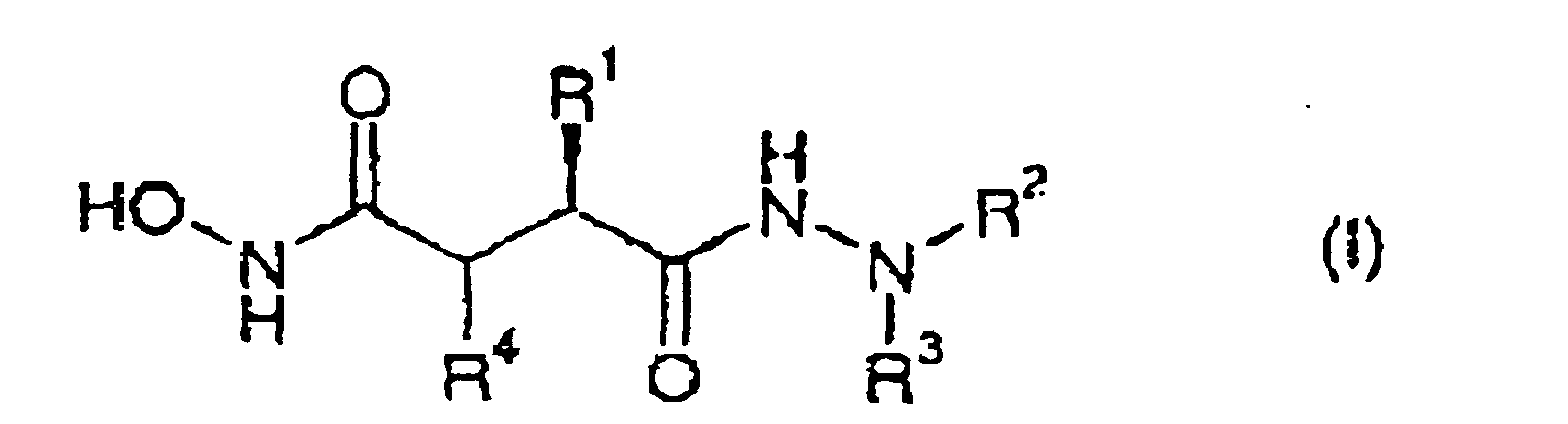
- R1
- représente un groupe alkyle en C1 à C8, alcényle en C2 à C7, un groupe cycloalkyle en C3 à C7, un groupe cycloalkyle en C3 à C7-alkyle en C1 à C8, un groupe aryle ou un groupe aryl(alkyle en C1 à C8) ;
- R2
- représente un groupe acyle dérivé d'un acide α-, β-, γ- ou δ-(amino, hydroxy ou thiol)carboxylique dans lequel le groupe amino, hydroxy ou thiol est éventuellement alkylé en C1 à C8 ou le groupe amino est éventuellement acylé, sulfonylé ou amidé et où tout groupe fonctionnel présent dans une chaíne latérale est éventuellement protégé, ou un groupe de formule Het(CH2)mCO ;
- R3
- représente l'hydrogène, un groupe alkyle en C1 à C8, un groupe halogénoalkyle en C1 à C8, un groupe cyanoalkyle en C1 à C8, un groupe aminoalkyle en C1 à C8, un groupe hydroxyalkyle en C1 à C8, un groupe alcoxy en C1 à C8-alkyle en C1 à C8, un groupe alcoxycarbonyle en C1 à C8-alkyle en C1 à C8, un groupe cycloalkyle en C3 à C7-alkyle en C1 à C8, un groupe aryl(alkyle en C1 à C8), un groupe hétérocyclyl(alkyle en C1 à C8), un groupe hétérocyclylcarbonyl(alkyle en C1 à C8), un groupe alcényle en C2 à C7, un groupe alcynyle en C2 à C7, un groupe cycloalkyle en C3 à C7, un groupe aryl(alcényle en C2 à C7), un groupe aryle ou un groupe hétérocyclyle ;
- R4
- représente un groupe alkyle en C1 à C8, un groupe alcényle en C2 à C7, un groupe cycloalkyle en C3 à C7, un groupe cycloalkyle en C3 à C7-alkyle en C1 à C8 ou un groupement de formule X-aryle, X-hétéroaryle ou -(CH2)n-CH=CR5R6 ;
- R5 et R6
- représentent ensemble un groupe alkylène en C1 à C8 dans lequel un groupe CH2 est éventuellement remplacé par un hétéroatome ;
- Het
- représente un groupe hétérocyclyle ;
- X
- représente un groupe de formule -(CH2)p-Y-(CH2)q- dans laquelle p et q valent chacun indépendamment 0, 1, 2, 3, 4 ou 5, et Y est absent ou représente -CH=CH-, -C≡C-, -S-, -O-, -NH-, -NHCO-, -CONH-, -SO2-, -NHSO2-, -SO2NH-, -NHCONH- ou -NHSO2NH- ;
- m
- vaut 0, 1, 2, 3 ou 4 ; et
- n
- vaut 1 ou 2 ;
- Composés selon la revendication 1, dans lesquels R2 représente un groupe acyle dérivé d'un acide α- ou β-(amino, hydroxy ou thiol)carboxylique dans lequel le groupe amino, hydroxy ou thiol est éventuellement alkylé en C1 à C8 ou le groupe amino est éventuellement acylé, amidé ou sulfonylé et où tout groupe fonctionnel présent dans une chaíne latérale est éventuellement protégé, ou un groupe de formule Het(CH2)mCO dans laquelle m vaut 0, 1 ou 2.
- Composés selon la revendication 1 ou la revendication 2, dans lesquels R1 représente un groupe alkyle en C1 à C8 ou un groupe cycloalkyle en C3 à C7-alkyle en C1 à C8.
- Composés selon la revendication 3, dans lesquels R1 représente un groupe isobutyle, un groupe cyclobutylméthyle ou un groupe cyclopentylméthyle.
- Composés selon l'une quelconque des revendications 1 à 4, dans lesquels R2 représente un groupe acyle dérivé d'un acide α-aminocarboxylique ou d'un acide α-hydroxycarboxylique.
- Composés selon l'une quelconque des revendications 1 à 4, dans lesquels R2 représente un groupe de formule Het(CH2)mCO, dans laquelle la signification de m est donnée à la revendication 1 ou à la revendication 2.
- Composés selon l'une quelconque des revendications 1 à 6, dans lesquels R3 représente un groupe alkyle en C1 à C8, un groupe halogénoalkyle en C1 à C8, un groupe cycloalkyle en C3 à C7-alkyle en C1 à C8, aryl(alkyle en C1 à C8), aryle ou hétérocyclyle.
- Composés selon la revendication 7, dans lesquels R3 représente un groupe alkyle en C1 à C8.
- Composés selon la revendication 8, dans lesquels R3 représente un groupe isobutyle.
- Composés selon l'une quelconque des revendications 1 à 9, dans lesquels X représente un groupement de formule -(CH2)p-, -CH2-CH=CH-, -CH2-C≡C-, -CH2NHCO-, -(CH2)nNHCONH-, -(CH2)p-S-, -S-, -CH2NHSO2-, -CH2NHCH2-, -(CH2)p-O- ou -O-(CH2)q-, dans lesquels n a la signification donnée à la revendication 1 et p et q sont un entier allant de 1 à 5.
- Composés aelon l'une quelconque des revendications 1 à 10, dans lesquels R4 représente un groupement de formule X-aryle, dans laquelle X a la signification donnée à la revendication 1.
- Composés selon la revendication 11, dans lesquels R4 représente un groupement de formule -CH2-CH=CH-Ph dans laquelle Ph représente un groupe phényle non substitué.
- Composé choisi dans le groupe constitué des éléments suivants :et des sels pharmaceutiquement acceptables de ceux-ci.(E)-2'-(D-alanyl)-2(R)-[1(S)-(hydroxycarbamoyl)-4-phényl-3-butényl]-2'-isobutyl-4-méthylvalérohydrazide,(E)-2(R)-[1(S)-(hydroxycarbamoyl)-4-phényl-3-butényl]-2'-(2(R)-hydroxypropionyl)-2'-isobutyl-4-méthylvalérohydrazide,(E) -2 (R)-[1(S)-(hydroxycarbamoyl)-4-phényl-3-butényl]-2'-(2-(1-imidazolyl)acétyl]-2'-isobutyl-4-méthylvalérohydrazide,(E)-2 (R) - [1(S) - (hydroxycarbamoyl) -4-phényl-3-butényl]-2'-isobutyl-4-méthyl-2'-[(4-pipéridinyl)carbonyl]valérohydrazide,
- 2'-benzyl-2(R)-[1(S)-(hydroxycarbamoyl)-4-phénylbutyl]-4-méthyl-2'-[2-(1H-1,2,3-triazol-1-yl)-acétyl]valérohydrazide ou sel pharmaceutiquement acceptable de celui-ci.
- Composé de formule générale :dans laquelle R1 et R4 ont la signification donnée à la revendication 1, R7 représente un groupe protecteur, R20 a la même signification que R2 à la revendication 1, à condition que dans le cas d'un groupe acyle, le groupe amino, hydroxy ou thiol (lorsqu'il n'est pas alkylé en C1 à C8, acylé, sulfonylé ou amidé comme spécifié en R2) soit éventuellement protégé et que tout groupe fonctionnel présent dans une chaíne latérale soit éventuellement protégé et R30 a la même signification que R3 à la revendication 1, à condition que tout groupe amino ou hydroxy présent dans celui-ci soit éventuellement protégé.
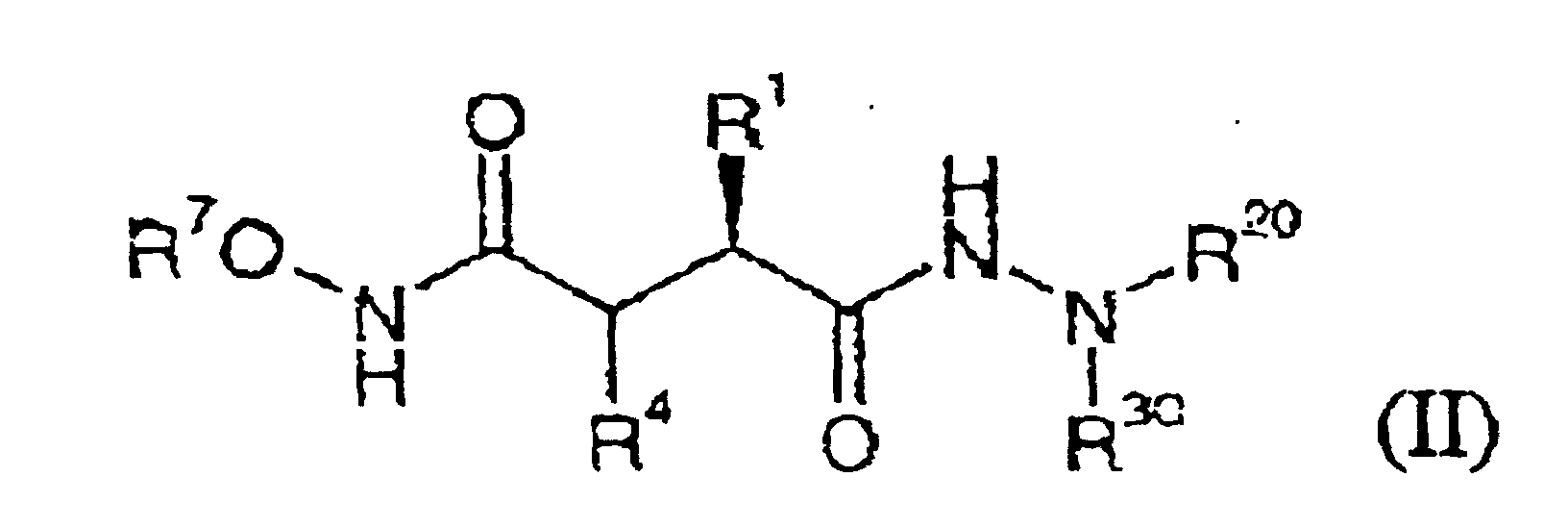
- Composés selon la revendication 15, dans lesquels R7 représente un groupe tétrahydropyranyle, un groupe benzyle, un groupe 4-méthoxybenzyle ou un groupe tri(alkyle en C1 à C8)silyle.
- Composé selon l'une quelconque des revendications 1 à 14, ou un sel pharmaceutiquement acceptable de celui-ci, destiné à être utilisé en tant que substance thérapeutiquement active, en particulier en tant que substance thérapeutiquement active dans le traitement des maladies inflammatoires et autoimmunes, de l'ostéoarthrite des maladies respiratoires, des tumeurs, de la cachexie, des maladies cardiovasculaires, de la fièvre, des hémorragies et de la sepsie.
- Procédé pour la préparation des composés selon l'une quelconque des revendications 1 à 14 et leurs sels pharmaceutiquement acceptables, lequel procédé comprend le clivage du groupe protecteur désigné par R7 et, si nécessaire, de tout(tous) groupe(s) protecteur(s) présent(s) en R20 et/ou R30 à partir d'un composé de formule générale :dans laquelle R1 et R4 ont la signification donnée dans la revendication 1, R7 représente un groupe protecteur, R20 a la même signification que R3 dans la revendication 1, à condition que, dans le cas d'un groupe acyle, le groupe amino, hydroxy ou thiol (lorsqu'il n'est pas alkylé en C1 à C8, acylé, sulfonylé ou amidé tel que spécifié en R2) soit éventuellement protégé et que R30 ait la même signification que R3 à la revendication 1, à condition que tout groupe amino ou hydroxy présent dans celui-ci soit éventuellement protégé, et, si souhaité, en transformant un composé de formule I obtenu en un sel pharmaceutiquement acceptable.
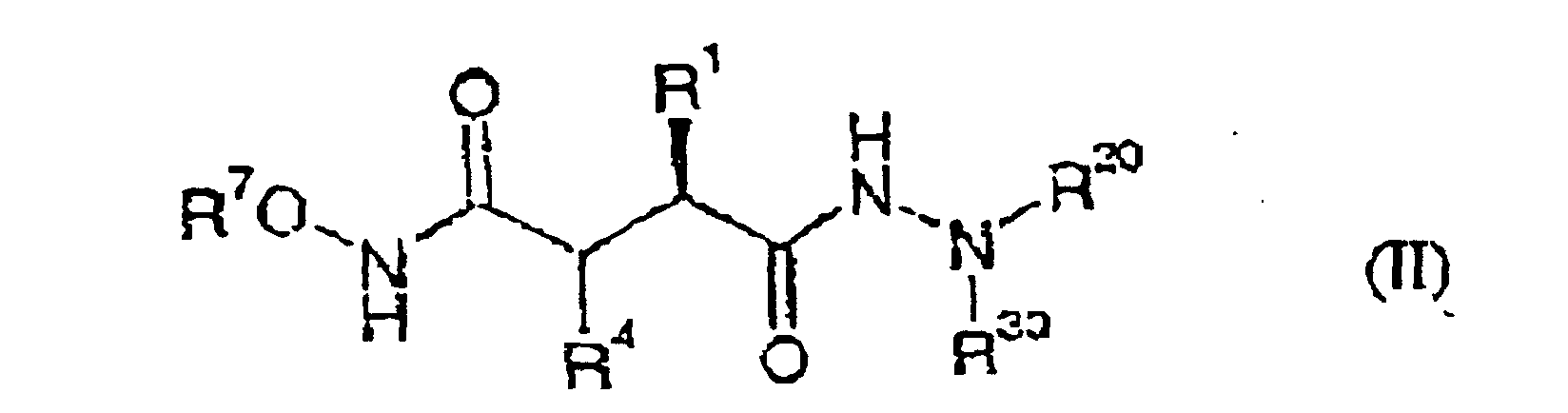
- Médicament contenant un composé selon l'une quelconque des revendications 1 à 14 ou un sel pharmaceutiquement acceptable de celui-ci et un excipient thérapeutiquement inerte.
- Médicament destiné au traitement des maladies inflammatoires et autoimmunes, de l'ostéoarthrite, des maladies respiratoires, des tumeurs, de la cachexie, des maladies cardiovasculaires, de la fièvre, des hémorragies et de la sepsie, contenant un composé selon l'une quelconque des revendications 1 à 14 ou un sel pharmaceutiquement acceptable de celui-ci et un excipient thérapeutiquement inerte.
- Procédé pour la production d'un médicament, en particulier d'un médicament destiné au traitement des maladies inflammatoires et autoimmunes, de l'ostéoarthrite, des maladies respiratoires, des tumeurs, de la cachexie, des maladies cardiovasculaires, de la fièvre, des hémorragies et de la sepsie, lequel procédé comprend le fait d'apporter un composé selon l'une quelconque des revendications 1 à 14 ou un sel pharmaceutiquement acceptable de celui-ci dans une forme d'administration galénique conjointement avec un excipient thérapeutiquement inerte et, si souhaité, une ou plusieurs substances supplémentaires thérapeutiquement actives.
- Utilisation d'un composé selon l'une quelconque des revendications 1 à 14, ou d'un sel pharmaceutiquement acceptable de celui-ci, pour la fabrication d'un médicament destiné à être utilisé dans le traitement de maladies, en particulier dans le traitement des maladies inflammatoires et autoimmunes, de l'ostéoarthrite, des maladies respiratoires, des tumeurs, de la cachexie, des maladies cardiovasculaires, de la fièvre, des hémorragies et de la sepsie.
Applications Claiming Priority (5)
| Application Number | Priority Date | Filing Date | Title |
|---|---|---|---|
| GBGB9813919.9A GB9813919D0 (en) | 1998-06-26 | 1998-06-26 | Hydrazine derivatives |
| GB9813919 | 1998-06-26 | ||
| GBGB9826491.4A GB9826491D0 (en) | 1998-06-26 | 1998-12-02 | Hydrazine derivatives |
| GB9826491 | 1998-12-02 | ||
| PCT/EP1999/004223 WO2000000465A1 (fr) | 1998-06-26 | 1999-06-17 | Derives d'hydrazine |
Publications (2)
| Publication Number | Publication Date |
|---|---|
| EP1089964A1 EP1089964A1 (fr) | 2001-04-11 |
| EP1089964B1 true EP1089964B1 (fr) | 2003-10-29 |
Family
ID=26313940
Family Applications (1)
| Application Number | Title | Priority Date | Filing Date |
|---|---|---|---|
| EP99931098A Expired - Lifetime EP1089964B1 (fr) | 1998-06-26 | 1999-06-17 | Derives d'hydrazine |
Country Status (16)
| Country | Link |
|---|---|
| US (1) | US6239151B1 (fr) |
| EP (1) | EP1089964B1 (fr) |
| JP (1) | JP3798245B2 (fr) |
| CN (1) | CN1148346C (fr) |
| AR (1) | AR029445A1 (fr) |
| AT (1) | ATE253043T1 (fr) |
| AU (1) | AU753660B2 (fr) |
| BR (1) | BR9911588A (fr) |
| CA (1) | CA2335245A1 (fr) |
| DE (1) | DE69912429T2 (fr) |
| DK (1) | DK1089964T3 (fr) |
| ES (1) | ES2209460T3 (fr) |
| MA (1) | MA26658A1 (fr) |
| PT (1) | PT1089964E (fr) |
| TR (1) | TR200003731T2 (fr) |
| WO (1) | WO2000000465A1 (fr) |
Families Citing this family (19)
| Publication number | Priority date | Publication date | Assignee | Title |
|---|---|---|---|---|
| GB9826153D0 (en) | 1998-11-27 | 1999-01-20 | Hoffmann La Roche | Hydrazine derivatives |
| CN1132819C (zh) | 1998-12-11 | 2003-12-31 | 霍夫曼-拉罗奇有限公司 | 作为TNF-α抑制剂的环状肼衍生物 |
| ATE325114T1 (de) | 1999-06-22 | 2006-06-15 | Takeda Pharmaceutical | Acylhydrazinderivate, verfahren zu ihrer herstellung und ihre verwendung |
| US20100282634A1 (en) * | 2000-11-17 | 2010-11-11 | Dror Harats | Promoters Exhibiting Endothelial Cell Specificity and Methods of Using Same for Regulation of Angiogenesis |
| AU2003222427B8 (en) | 2000-11-17 | 2010-04-29 | Vascular Biogenics Ltd. | Promoters exhibiting endothelial cell specificity and methods of using same |
| US20070286845A1 (en) * | 2000-11-17 | 2007-12-13 | Vascular Biogenics Ltd. | Promoters exhibiting endothelial cell specificity and methods of using same for regulation of angiogenesis |
| US8071740B2 (en) * | 2000-11-17 | 2011-12-06 | Vascular Biogenics Ltd. | Promoters exhibiting endothelial cell specificity and methods of using same for regulation of angiogenesis |
| US8039261B2 (en) * | 2000-11-17 | 2011-10-18 | Vascular Biogenics Ltd. | Promoters exhibiting endothelial cell specificity and methods of using same for regulation of angiogenesis |
| US6838452B2 (en) * | 2000-11-24 | 2005-01-04 | Vascular Biogenics Ltd. | Methods employing and compositions containing defined oxidized phospholipids for prevention and treatment of atherosclerosis |
| EP1436313B1 (fr) * | 2001-10-19 | 2010-09-22 | Vascular Biogenics Ltd. | Constructions de polynucleotides, compositions pharmaceutiques et procedes de regulation negative de l'angiogenese et de therapie anticancereuse |
| UY27813A1 (es) * | 2002-05-31 | 2003-12-31 | Smithkline Beecham Corp | Inhibidores de la peptido-desformilasa |
| WO2004007477A1 (fr) * | 2002-07-04 | 2004-01-22 | Aventis Pharma S.A. | Nouveaux derives acyl hydrazino du thiophene, leur procede de preparation, leur application a titre de medicaments, compositions pharmaceutiques et nouvelle utilisation |
| AU2009228649B2 (en) | 2008-03-25 | 2014-05-22 | Affectis Pharmaceuticals Ag | Novel P2X7R antagonists and their use |
| DK2243772T3 (da) | 2009-04-14 | 2012-02-13 | Affectis Pharmaceuticals Ag | Hidtil ukendte P2X7R-antagonister og deres anvendelse |
| WO2012110190A1 (fr) | 2011-02-17 | 2012-08-23 | Affectis Pharmaceuticals Ag | Nouveaux antagonistes p2x7r et leur utilisation |
| CN102746312A (zh) * | 2011-04-21 | 2012-10-24 | 上海药明康德新药开发有限公司 | 2-氧杂-6-氮杂-螺[3,3]庚烷草酸盐及其醋酸盐的制备方法 |
| WO2012163456A1 (fr) | 2011-05-27 | 2012-12-06 | Affectis Pharmaceuticals Ag | Nouveaux antagonistes de p2x7r et leur utilisation |
| WO2012163792A1 (fr) | 2011-05-27 | 2012-12-06 | Affectis Pharmaceuticals Ag | Nouveaux antagonistes de p2x7r et leur utilisation |
| CN113121426B (zh) * | 2021-03-12 | 2023-01-06 | 广西大学 | 一类具有抑制真菌活性的桃金娘烯醛基双酰肼化合物的合成方法 |
Family Cites Families (5)
| Publication number | Priority date | Publication date | Assignee | Title |
|---|---|---|---|---|
| CA2058797A1 (fr) | 1991-02-01 | 1992-08-02 | Michael John Broadhurst | Derives d'aminoacide |
| US5399589A (en) | 1992-12-17 | 1995-03-21 | Basf Aktiengesellschaft | Oxalyl hydrazide-hydroxamic acid derivatives, their preparation and their use as fungicides |
| GB9501737D0 (en) * | 1994-04-25 | 1995-03-22 | Hoffmann La Roche | Hydroxamic acid derivatives |
| US6235787B1 (en) | 1997-06-30 | 2001-05-22 | Hoffmann-La Roche Inc. | Hydrazine derivatives |
| AU2298399A (en) | 1998-02-06 | 1999-08-23 | Yoshitomi Pharmaceutical Industries, Ltd. | Novel azapeptide type hydroxamic acid derivatives |
-
1999
- 1999-06-14 US US09/332,809 patent/US6239151B1/en not_active Expired - Fee Related
- 1999-06-17 BR BR9911588-3A patent/BR9911588A/pt not_active Application Discontinuation
- 1999-06-17 TR TR2000/03731T patent/TR200003731T2/xx unknown
- 1999-06-17 AU AU47737/99A patent/AU753660B2/en not_active Ceased
- 1999-06-17 EP EP99931098A patent/EP1089964B1/fr not_active Expired - Lifetime
- 1999-06-17 AT AT99931098T patent/ATE253043T1/de not_active IP Right Cessation
- 1999-06-17 JP JP2000557226A patent/JP3798245B2/ja not_active Expired - Fee Related
- 1999-06-17 ES ES99931098T patent/ES2209460T3/es not_active Expired - Lifetime
- 1999-06-17 WO PCT/EP1999/004223 patent/WO2000000465A1/fr not_active Ceased
- 1999-06-17 PT PT99931098T patent/PT1089964E/pt unknown
- 1999-06-17 DK DK99931098T patent/DK1089964T3/da active
- 1999-06-17 CN CNB998086886A patent/CN1148346C/zh not_active Expired - Fee Related
- 1999-06-17 DE DE69912429T patent/DE69912429T2/de not_active Expired - Fee Related
- 1999-06-17 CA CA002335245A patent/CA2335245A1/fr not_active Abandoned
- 1999-06-24 AR ARP990103026A patent/AR029445A1/es active IP Right Grant
- 1999-06-25 MA MA25645A patent/MA26658A1/fr unknown
Also Published As
| Publication number | Publication date |
|---|---|
| PT1089964E (pt) | 2004-03-31 |
| JP3798245B2 (ja) | 2006-07-19 |
| WO2000000465A1 (fr) | 2000-01-06 |
| BR9911588A (pt) | 2001-03-20 |
| TR200003731T2 (tr) | 2001-06-21 |
| AU4773799A (en) | 2000-01-17 |
| CA2335245A1 (fr) | 2000-01-06 |
| JP2002519339A (ja) | 2002-07-02 |
| AR029445A1 (es) | 2003-07-02 |
| CN1148346C (zh) | 2004-05-05 |
| DK1089964T3 (da) | 2004-03-08 |
| EP1089964A1 (fr) | 2001-04-11 |
| DE69912429D1 (de) | 2003-12-04 |
| AU753660B2 (en) | 2002-10-24 |
| CN1309634A (zh) | 2001-08-22 |
| MA26658A1 (fr) | 2004-12-20 |
| DE69912429T2 (de) | 2004-08-05 |
| US6239151B1 (en) | 2001-05-29 |
| ATE253043T1 (de) | 2003-11-15 |
| ES2209460T3 (es) | 2004-06-16 |
Similar Documents
| Publication | Publication Date | Title |
|---|---|---|
| US6239151B1 (en) | Compounds as inhibitor of tumor necrosis factor alpha release | |
| EP0993442B1 (fr) | Derives hydrazine | |
| AU692553B2 (en) | Arylsulfonamido-substituted hydroxamic acids as matrix metalloproteinase inhibitors | |
| AU777735B2 (en) | Bradykinin B1 receptor antagonists | |
| US5273982A (en) | Acetic acid derivatives | |
| EP0821674B1 (fr) | Agents amidino cycliques utiles en tant qu'inhibiteurs de synthase de l'oxyde nitrique | |
| EP1137640B1 (fr) | Derives cycliques de l'hydrazine comme inhibiteurs tnf-alpha | |
| HUT52038A (en) | Process for producing alpha-cyano-beta-oxo-propion-amides | |
| KR100402561B1 (ko) | 하이드라진 유도체 | |
| WO1991013054A1 (fr) | Agents antihypertensifs au glutaramide substitue par cycloalkyle | |
| EP1133471B1 (fr) | Derives hydraziniques | |
| MXPA00012908A (en) | Hydrazine derivatives | |
| JPH03148246A (ja) | ペプチジルジフルオロジオールレニン阻害物質 | |
| WO2003031437A1 (fr) | Derives propylcarbamate utilises en tant qu'inhibiteurs des serine proteases et des cysteine proteases | |
| CZ462399A3 (cs) | Derivát hydrazinu, způsob jeho přípravy, jeho pOužitrafarmaceutický-prostředekykterý-ho---- obsahuje | |
| MXPA01005299A (en) | Hydrazine derivatives | |
| MXPA99005822A (en) | Piperazine compounds as inhibitors of mmp or tnf | |
| AU2315401A (en) | Oxamides as IMPDH inhibitors |
Legal Events
| Date | Code | Title | Description |
|---|---|---|---|
| PUAI | Public reference made under article 153(3) epc to a published international application that has entered the european phase |
Free format text: ORIGINAL CODE: 0009012 |
|
| 17P | Request for examination filed |
Effective date: 20010126 |
|
| AK | Designated contracting states |
Kind code of ref document: A1 Designated state(s): AT BE CH DE DK ES FI FR GB GR IE IT LI LU NL PT SE |
|
| 17Q | First examination report despatched |
Effective date: 20021016 |
|
| GRAH | Despatch of communication of intention to grant a patent |
Free format text: ORIGINAL CODE: EPIDOS IGRA |
|
| GRAS | Grant fee paid |
Free format text: ORIGINAL CODE: EPIDOSNIGR3 |
|
| GRAA | (expected) grant |
Free format text: ORIGINAL CODE: 0009210 |
|
| AK | Designated contracting states |
Kind code of ref document: B1 Designated state(s): AT BE CH DE DK ES FI FR GB GR IE IT LI LU NL PT SE |
|
| REG | Reference to a national code |
Ref country code: GB Ref legal event code: FG4D |
|
| REG | Reference to a national code |
Ref country code: CH Ref legal event code: EP |
|
| REG | Reference to a national code |
Ref country code: IE Ref legal event code: FG4D |
|
| REF | Corresponds to: |
Ref document number: 69912429 Country of ref document: DE Date of ref document: 20031204 Kind code of ref document: P |
|
| REG | Reference to a national code |
Ref country code: SE Ref legal event code: TRGR |
|
| REG | Reference to a national code |
Ref country code: GR Ref legal event code: EP Ref document number: 20040400366 Country of ref document: GR |
|
| REG | Reference to a national code |
Ref country code: DK Ref legal event code: T3 |
|
| REG | Reference to a national code |
Ref country code: PT Ref legal event code: SC4A Free format text: AVAILABILITY OF NATIONAL TRANSLATION Effective date: 20040112 |
|
| REG | Reference to a national code |
Ref country code: ES Ref legal event code: FG2A Ref document number: 2209460 Country of ref document: ES Kind code of ref document: T3 |
|
| ET | Fr: translation filed | ||
| PLBE | No opposition filed within time limit |
Free format text: ORIGINAL CODE: 0009261 |
|
| STAA | Information on the status of an ep patent application or granted ep patent |
Free format text: STATUS: NO OPPOSITION FILED WITHIN TIME LIMIT |
|
| 26N | No opposition filed |
Effective date: 20040730 |
|
| PGFP | Annual fee paid to national office [announced via postgrant information from national office to epo] |
Ref country code: LU Payment date: 20070323 Year of fee payment: 9 |
|
| PGFP | Annual fee paid to national office [announced via postgrant information from national office to epo] |
Ref country code: PT Payment date: 20070330 Year of fee payment: 9 |
|
| PGFP | Annual fee paid to national office [announced via postgrant information from national office to epo] |
Ref country code: IE Payment date: 20070425 Year of fee payment: 9 |
|
| PGFP | Annual fee paid to national office [announced via postgrant information from national office to epo] |
Ref country code: NL Payment date: 20070507 Year of fee payment: 9 Ref country code: AT Payment date: 20070507 Year of fee payment: 9 |
|
| PGFP | Annual fee paid to national office [announced via postgrant information from national office to epo] |
Ref country code: DK Payment date: 20070509 Year of fee payment: 9 |
|
| PGFP | Annual fee paid to national office [announced via postgrant information from national office to epo] |
Ref country code: FI Payment date: 20070511 Year of fee payment: 9 |
|
| PGFP | Annual fee paid to national office [announced via postgrant information from national office to epo] |
Ref country code: SE Payment date: 20070605 Year of fee payment: 9 |
|
| PGFP | Annual fee paid to national office [announced via postgrant information from national office to epo] |
Ref country code: BE Payment date: 20070628 Year of fee payment: 9 |
|
| PGFP | Annual fee paid to national office [announced via postgrant information from national office to epo] |
Ref country code: GR Payment date: 20070419 Year of fee payment: 9 |
|
| PGFP | Annual fee paid to national office [announced via postgrant information from national office to epo] |
Ref country code: ES Payment date: 20080612 Year of fee payment: 10 Ref country code: CH Payment date: 20080425 Year of fee payment: 10 |
|
| PGFP | Annual fee paid to national office [announced via postgrant information from national office to epo] |
Ref country code: DE Payment date: 20080630 Year of fee payment: 10 |
|
| PGFP | Annual fee paid to national office [announced via postgrant information from national office to epo] |
Ref country code: IT Payment date: 20080628 Year of fee payment: 10 |
|
| BERE | Be: lapsed |
Owner name: F. *HOFFMANN-LA ROCHE A.G. Effective date: 20080630 |
|
| PGFP | Annual fee paid to national office [announced via postgrant information from national office to epo] |
Ref country code: GB Payment date: 20080506 Year of fee payment: 10 |
|
| REG | Reference to a national code |
Ref country code: PT Ref legal event code: MM4A Free format text: LAPSE DUE TO NON-PAYMENT OF FEES Effective date: 20081217 |
|
| PG25 | Lapsed in a contracting state [announced via postgrant information from national office to epo] |
Ref country code: PT Free format text: LAPSE BECAUSE OF NON-PAYMENT OF DUE FEES Effective date: 20081217 |
|
| REG | Reference to a national code |
Ref country code: DK Ref legal event code: EBP |
|
| EUG | Se: european patent has lapsed | ||
| PG25 | Lapsed in a contracting state [announced via postgrant information from national office to epo] |
Ref country code: FI Free format text: LAPSE BECAUSE OF NON-PAYMENT OF DUE FEES Effective date: 20080617 |
|
| NLV4 | Nl: lapsed or anulled due to non-payment of the annual fee |
Effective date: 20090101 |
|
| PG25 | Lapsed in a contracting state [announced via postgrant information from national office to epo] |
Ref country code: BE Free format text: LAPSE BECAUSE OF NON-PAYMENT OF DUE FEES Effective date: 20080630 |
|
| REG | Reference to a national code |
Ref country code: IE Ref legal event code: MM4A |
|
| PG25 | Lapsed in a contracting state [announced via postgrant information from national office to epo] |
Ref country code: IE Free format text: LAPSE BECAUSE OF NON-PAYMENT OF DUE FEES Effective date: 20080617 Ref country code: AT Free format text: LAPSE BECAUSE OF NON-PAYMENT OF DUE FEES Effective date: 20080617 |
|
| PG25 | Lapsed in a contracting state [announced via postgrant information from national office to epo] |
Ref country code: NL Free format text: LAPSE BECAUSE OF NON-PAYMENT OF DUE FEES Effective date: 20090101 |
|
| PG25 | Lapsed in a contracting state [announced via postgrant information from national office to epo] |
Ref country code: GR Free format text: LAPSE BECAUSE OF NON-PAYMENT OF DUE FEES Effective date: 20090107 |
|
| PG25 | Lapsed in a contracting state [announced via postgrant information from national office to epo] |
Ref country code: DK Free format text: LAPSE BECAUSE OF NON-PAYMENT OF DUE FEES Effective date: 20090106 |
|
| REG | Reference to a national code |
Ref country code: CH Ref legal event code: PL |
|
| GBPC | Gb: european patent ceased through non-payment of renewal fee |
Effective date: 20090617 |
|
| REG | Reference to a national code |
Ref country code: FR Ref legal event code: ST Effective date: 20100226 |
|
| PG25 | Lapsed in a contracting state [announced via postgrant information from national office to epo] |
Ref country code: LI Free format text: LAPSE BECAUSE OF NON-PAYMENT OF DUE FEES Effective date: 20090630 Ref country code: FR Free format text: LAPSE BECAUSE OF NON-PAYMENT OF DUE FEES Effective date: 20090630 Ref country code: CH Free format text: LAPSE BECAUSE OF NON-PAYMENT OF DUE FEES Effective date: 20090630 |
|
| PGFP | Annual fee paid to national office [announced via postgrant information from national office to epo] |
Ref country code: FR Payment date: 20080424 Year of fee payment: 10 |
|
| PG25 | Lapsed in a contracting state [announced via postgrant information from national office to epo] |
Ref country code: GB Free format text: LAPSE BECAUSE OF NON-PAYMENT OF DUE FEES Effective date: 20090617 Ref country code: DK Free format text: LAPSE BECAUSE OF NON-PAYMENT OF DUE FEES Effective date: 20080630 |
|
| PG25 | Lapsed in a contracting state [announced via postgrant information from national office to epo] |
Ref country code: LU Free format text: LAPSE BECAUSE OF NON-PAYMENT OF DUE FEES Effective date: 20080617 Ref country code: DE Free format text: LAPSE BECAUSE OF NON-PAYMENT OF DUE FEES Effective date: 20100101 |
|
| PG25 | Lapsed in a contracting state [announced via postgrant information from national office to epo] |
Ref country code: SE Free format text: LAPSE BECAUSE OF NON-PAYMENT OF DUE FEES Effective date: 20080618 |
|
| REG | Reference to a national code |
Ref country code: ES Ref legal event code: FD2A Effective date: 20090618 |
|
| PG25 | Lapsed in a contracting state [announced via postgrant information from national office to epo] |
Ref country code: ES Free format text: LAPSE BECAUSE OF NON-PAYMENT OF DUE FEES Effective date: 20090618 |
|
| PG25 | Lapsed in a contracting state [announced via postgrant information from national office to epo] |
Ref country code: IT Free format text: LAPSE BECAUSE OF NON-PAYMENT OF DUE FEES Effective date: 20090617 |