EP1089994B9 - Nouvelle forme de l'irbesartan, procedes pour obtenir ladite forme et compositions pharmaceutiques en contenant - Google Patents
Nouvelle forme de l'irbesartan, procedes pour obtenir ladite forme et compositions pharmaceutiques en contenant Download PDFInfo
- Publication number
- EP1089994B9 EP1089994B9 EP99923712A EP99923712A EP1089994B9 EP 1089994 B9 EP1089994 B9 EP 1089994B9 EP 99923712 A EP99923712 A EP 99923712A EP 99923712 A EP99923712 A EP 99923712A EP 1089994 B9 EP1089994 B9 EP 1089994B9
- Authority
- EP
- European Patent Office
- Prior art keywords
- temperature
- process according
- irbesartan
- episode
- crystals
- Prior art date
- Legal status (The legal status is an assumption and is not a legal conclusion. Google has not performed a legal analysis and makes no representation as to the accuracy of the status listed.)
- Revoked
Links
- YCPOHTHPUREGFM-UHFFFAOYSA-N irbesartan Chemical compound O=C1N(CC=2C=CC(=CC=2)C=2C(=CC=CC=2)C=2[N]N=NN=2)C(CCCC)=NC21CCCC2 YCPOHTHPUREGFM-UHFFFAOYSA-N 0.000 title claims abstract description 66
- 239000002947 C09CA04 - Irbesartan Substances 0.000 title claims abstract description 56
- 229960002198 irbesartan Drugs 0.000 title claims abstract description 56
- 238000000034 method Methods 0.000 title claims abstract description 43
- 239000008194 pharmaceutical composition Substances 0.000 title claims abstract description 7
- 239000013078 crystal Substances 0.000 claims description 56
- 239000000725 suspension Substances 0.000 claims description 43
- 238000001816 cooling Methods 0.000 claims description 34
- 230000010355 oscillation Effects 0.000 claims description 28
- 238000000527 sonication Methods 0.000 claims description 28
- KFZMGEQAYNKOFK-UHFFFAOYSA-N Isopropanol Chemical compound CC(C)O KFZMGEQAYNKOFK-UHFFFAOYSA-N 0.000 claims description 27
- 239000011449 brick Substances 0.000 claims description 26
- 238000010438 heat treatment Methods 0.000 claims description 23
- 150000001875 compounds Chemical class 0.000 claims description 20
- 238000010008 shearing Methods 0.000 claims description 13
- LFQSCWFLJHTTHZ-UHFFFAOYSA-N Ethanol Chemical compound CCO LFQSCWFLJHTTHZ-UHFFFAOYSA-N 0.000 claims description 6
- JZUFKLXOESDKRF-UHFFFAOYSA-N Chlorothiazide Chemical group C1=C(Cl)C(S(=O)(=O)N)=CC2=C1NCNS2(=O)=O JZUFKLXOESDKRF-UHFFFAOYSA-N 0.000 claims description 4
- 239000010419 fine particle Substances 0.000 claims description 4
- 229960002003 hydrochlorothiazide Drugs 0.000 claims description 4
- 238000004519 manufacturing process Methods 0.000 claims description 4
- 238000010899 nucleation Methods 0.000 claims description 4
- 239000002934 diuretic Substances 0.000 claims description 3
- 238000001914 filtration Methods 0.000 claims description 3
- 239000000546 pharmaceutical excipient Substances 0.000 claims 1
- 208000024172 Cardiovascular disease Diseases 0.000 abstract description 2
- 239000012071 phase Substances 0.000 description 22
- XEKOWRVHYACXOJ-UHFFFAOYSA-N Ethyl acetate Chemical compound CCOC(C)=O XEKOWRVHYACXOJ-UHFFFAOYSA-N 0.000 description 21
- OKKJLVBELUTLKV-UHFFFAOYSA-N Methanol Chemical compound OC OKKJLVBELUTLKV-UHFFFAOYSA-N 0.000 description 18
- 239000000047 product Substances 0.000 description 17
- 230000007423 decrease Effects 0.000 description 12
- XLYOFNOQVPJJNP-UHFFFAOYSA-N water Substances O XLYOFNOQVPJJNP-UHFFFAOYSA-N 0.000 description 12
- 239000000203 mixture Substances 0.000 description 11
- 238000003756 stirring Methods 0.000 description 11
- YMWUJEATGCHHMB-UHFFFAOYSA-N Dichloromethane Chemical compound ClCCl YMWUJEATGCHHMB-UHFFFAOYSA-N 0.000 description 10
- QTBSBXVTEAMEQO-UHFFFAOYSA-N Acetic acid Chemical compound CC(O)=O QTBSBXVTEAMEQO-UHFFFAOYSA-N 0.000 description 9
- VEXZGXHMUGYJMC-UHFFFAOYSA-N Hydrochloric acid Chemical compound Cl VEXZGXHMUGYJMC-UHFFFAOYSA-N 0.000 description 9
- HEDRZPFGACZZDS-UHFFFAOYSA-N Chloroform Chemical compound ClC(Cl)Cl HEDRZPFGACZZDS-UHFFFAOYSA-N 0.000 description 8
- HQKMJHAJHXVSDF-UHFFFAOYSA-L magnesium stearate Chemical compound [Mg+2].CCCCCCCCCCCCCCCCCC([O-])=O.CCCCCCCCCCCCCCCCCC([O-])=O HQKMJHAJHXVSDF-UHFFFAOYSA-L 0.000 description 8
- 238000002425 crystallisation Methods 0.000 description 7
- 230000008025 crystallization Effects 0.000 description 7
- CSCPPACGZOOCGX-UHFFFAOYSA-N Acetone Chemical compound CC(C)=O CSCPPACGZOOCGX-UHFFFAOYSA-N 0.000 description 6
- VYPSYNLAJGMNEJ-UHFFFAOYSA-N Silicium dioxide Chemical compound O=[Si]=O VYPSYNLAJGMNEJ-UHFFFAOYSA-N 0.000 description 6
- HEMHJVSKTPXQMS-UHFFFAOYSA-M Sodium hydroxide Chemical compound [OH-].[Na+] HEMHJVSKTPXQMS-UHFFFAOYSA-M 0.000 description 6
- 238000002360 preparation method Methods 0.000 description 6
- PMZURENOXWZQFD-UHFFFAOYSA-L Sodium Sulfate Chemical compound [Na+].[Na+].[O-]S([O-])(=O)=O PMZURENOXWZQFD-UHFFFAOYSA-L 0.000 description 5
- 239000002245 particle Substances 0.000 description 5
- QGZKDVFQNNGYKY-UHFFFAOYSA-N Ammonia Chemical compound N QGZKDVFQNNGYKY-UHFFFAOYSA-N 0.000 description 4
- NLXLAEXVIDQMFP-UHFFFAOYSA-N Ammonia chloride Chemical compound [NH4+].[Cl-] NLXLAEXVIDQMFP-UHFFFAOYSA-N 0.000 description 4
- 229920002785 Croscarmellose sodium Polymers 0.000 description 4
- RTZKZFJDLAIYFH-UHFFFAOYSA-N Diethyl ether Chemical compound CCOCC RTZKZFJDLAIYFH-UHFFFAOYSA-N 0.000 description 4
- 229920000168 Microcrystalline cellulose Polymers 0.000 description 4
- CTQNGGLPUBDAKN-UHFFFAOYSA-N O-Xylene Chemical compound CC1=CC=CC=C1C CTQNGGLPUBDAKN-UHFFFAOYSA-N 0.000 description 4
- MUBZPKHOEPUJKR-UHFFFAOYSA-N Oxalic acid Chemical compound OC(=O)C(O)=O MUBZPKHOEPUJKR-UHFFFAOYSA-N 0.000 description 4
- DPXJVFZANSGRMM-UHFFFAOYSA-N acetic acid;2,3,4,5,6-pentahydroxyhexanal;sodium Chemical compound [Na].CC(O)=O.OCC(O)C(O)C(O)C(O)C=O DPXJVFZANSGRMM-UHFFFAOYSA-N 0.000 description 4
- 239000008119 colloidal silica Substances 0.000 description 4
- 229960001681 croscarmellose sodium Drugs 0.000 description 4
- 235000010947 crosslinked sodium carboxy methyl cellulose Nutrition 0.000 description 4
- BGTOWKSIORTVQH-UHFFFAOYSA-N cyclopentanone Chemical compound O=C1CCCC1 BGTOWKSIORTVQH-UHFFFAOYSA-N 0.000 description 4
- 235000019359 magnesium stearate Nutrition 0.000 description 4
- 235000019813 microcrystalline cellulose Nutrition 0.000 description 4
- 239000008108 microcrystalline cellulose Substances 0.000 description 4
- 229940016286 microcrystalline cellulose Drugs 0.000 description 4
- 239000012429 reaction media Substances 0.000 description 4
- 229910052938 sodium sulfate Inorganic materials 0.000 description 4
- 235000011152 sodium sulphate Nutrition 0.000 description 4
- 239000002904 solvent Substances 0.000 description 4
- 239000008096 xylene Substances 0.000 description 4
- KFPMRYNOEZCHDP-UHFFFAOYSA-N 1-aminocyclopentane-1-carbonitrile Chemical compound N#CC1(N)CCCC1 KFPMRYNOEZCHDP-UHFFFAOYSA-N 0.000 description 3
- UHOVQNZJYSORNB-UHFFFAOYSA-N Benzene Chemical compound C1=CC=CC=C1 UHOVQNZJYSORNB-UHFFFAOYSA-N 0.000 description 3
- YXFVVABEGXRONW-UHFFFAOYSA-N Toluene Chemical compound CC1=CC=CC=C1 YXFVVABEGXRONW-UHFFFAOYSA-N 0.000 description 3
- ZMANZCXQSJIPKH-UHFFFAOYSA-N Triethylamine Chemical compound CCN(CC)CC ZMANZCXQSJIPKH-UHFFFAOYSA-N 0.000 description 3
- 238000002441 X-ray diffraction Methods 0.000 description 3
- 239000008346 aqueous phase Substances 0.000 description 3
- 238000004090 dissolution Methods 0.000 description 3
- RAXXELZNTBOGNW-UHFFFAOYSA-N imidazole Natural products C1=CNC=N1 RAXXELZNTBOGNW-UHFFFAOYSA-N 0.000 description 3
- VLKZOEOYAKHREP-UHFFFAOYSA-N n-Hexane Chemical compound CCCCCC VLKZOEOYAKHREP-UHFFFAOYSA-N 0.000 description 3
- 238000000655 nuclear magnetic resonance spectrum Methods 0.000 description 3
- 239000012074 organic phase Substances 0.000 description 3
- BWHMMNNQKKPAPP-UHFFFAOYSA-L potassium carbonate Chemical compound [K+].[K+].[O-]C([O-])=O BWHMMNNQKKPAPP-UHFFFAOYSA-L 0.000 description 3
- 239000000843 powder Substances 0.000 description 3
- 239000000523 sample Substances 0.000 description 3
- 239000007787 solid Substances 0.000 description 3
- NILQLFBWTXNUOE-UHFFFAOYSA-N 1-aminocyclopentanecarboxylic acid Chemical compound OC(=O)C1(N)CCCC1 NILQLFBWTXNUOE-UHFFFAOYSA-N 0.000 description 2
- RGSFGYAAUTVSQA-UHFFFAOYSA-N Cyclopentane Chemical compound C1CCCC1 RGSFGYAAUTVSQA-UHFFFAOYSA-N 0.000 description 2
- 229910021529 ammonia Inorganic materials 0.000 description 2
- 235000019270 ammonium chloride Nutrition 0.000 description 2
- 230000003247 decreasing effect Effects 0.000 description 2
- 238000009826 distribution Methods 0.000 description 2
- 238000001035 drying Methods 0.000 description 2
- 230000000694 effects Effects 0.000 description 2
- 125000004494 ethyl ester group Chemical group 0.000 description 2
- YKSUEQRNXOAPPK-UHFFFAOYSA-N ethyl pentanimidate Chemical compound CCCCC(=N)OCC YKSUEQRNXOAPPK-UHFFFAOYSA-N 0.000 description 2
- 238000001704 evaporation Methods 0.000 description 2
- 230000008020 evaporation Effects 0.000 description 2
- 239000000706 filtrate Substances 0.000 description 2
- 238000009472 formulation Methods 0.000 description 2
- -1 isopropanol Chemical compound 0.000 description 2
- 238000010992 reflux Methods 0.000 description 2
- 239000000741 silica gel Substances 0.000 description 2
- 229910002027 silica gel Inorganic materials 0.000 description 2
- 239000002002 slurry Substances 0.000 description 2
- 238000002604 ultrasonography Methods 0.000 description 2
- RPGMTFLTDXLNQY-UHFFFAOYSA-N 1-amino-n-pentanoylcyclopentane-1-carboxamide Chemical compound CCCCC(=O)NC(=O)C1(N)CCCC1 RPGMTFLTDXLNQY-UHFFFAOYSA-N 0.000 description 1
- YFCHBVNKCHRCTM-UHFFFAOYSA-N 2-(1-aminocyclopentyl)acetamide Chemical compound NC(=O)CC1(N)CCCC1 YFCHBVNKCHRCTM-UHFFFAOYSA-N 0.000 description 1
- CAAMSDWKXXPUJR-UHFFFAOYSA-N 3,5-dihydro-4H-imidazol-4-one Chemical group O=C1CNC=N1 CAAMSDWKXXPUJR-UHFFFAOYSA-N 0.000 description 1
- LQPCAPMUDDPGHJ-UHFFFAOYSA-N 5-(bromomethyl)-2-phenylbenzonitrile Chemical group N#CC1=CC(CBr)=CC=C1C1=CC=CC=C1 LQPCAPMUDDPGHJ-UHFFFAOYSA-N 0.000 description 1
- IJIBRSFAXRFPPN-UHFFFAOYSA-N 5-bromo-2-methoxybenzaldehyde Chemical compound COC1=CC=C(Br)C=C1C=O IJIBRSFAXRFPPN-UHFFFAOYSA-N 0.000 description 1
- 229940123413 Angiotensin II antagonist Drugs 0.000 description 1
- 208000007342 Diabetic Nephropathies Diseases 0.000 description 1
- 206010012689 Diabetic retinopathy Diseases 0.000 description 1
- 208000010412 Glaucoma Diseases 0.000 description 1
- 206010019280 Heart failures Diseases 0.000 description 1
- 206010020772 Hypertension Diseases 0.000 description 1
- 239000002202 Polyethylene glycol Substances 0.000 description 1
- KWYUFKZDYYNOTN-UHFFFAOYSA-M Potassium hydroxide Chemical compound [OH-].[K+] KWYUFKZDYYNOTN-UHFFFAOYSA-M 0.000 description 1
- 208000001647 Renal Insufficiency Diseases 0.000 description 1
- KEAYESYHFKHZAL-UHFFFAOYSA-N Sodium Chemical compound [Na] KEAYESYHFKHZAL-UHFFFAOYSA-N 0.000 description 1
- 241001080024 Telles Species 0.000 description 1
- 239000004480 active ingredient Substances 0.000 description 1
- PNEYBMLMFCGWSK-UHFFFAOYSA-N aluminium oxide Inorganic materials [O-2].[O-2].[O-2].[Al+3].[Al+3] PNEYBMLMFCGWSK-UHFFFAOYSA-N 0.000 description 1
- 150000001408 amides Chemical class 0.000 description 1
- 238000004458 analytical method Methods 0.000 description 1
- 239000002333 angiotensin II receptor antagonist Substances 0.000 description 1
- 206010003119 arrhythmia Diseases 0.000 description 1
- 239000002775 capsule Substances 0.000 description 1
- 210000003169 central nervous system Anatomy 0.000 description 1
- KXZJHVJKXJLBKO-UHFFFAOYSA-N chembl1408157 Chemical compound N=1C2=CC=CC=C2C(C(=O)O)=CC=1C1=CC=C(O)C=C1 KXZJHVJKXJLBKO-UHFFFAOYSA-N 0.000 description 1
- 238000003889 chemical engineering Methods 0.000 description 1
- 238000006243 chemical reaction Methods 0.000 description 1
- 238000007906 compression Methods 0.000 description 1
- 230000006835 compression Effects 0.000 description 1
- 208000033679 diabetic kidney disease Diseases 0.000 description 1
- 150000004683 dihydrates Chemical class 0.000 description 1
- 230000003292 diminished effect Effects 0.000 description 1
- 238000007907 direct compression Methods 0.000 description 1
- 201000010099 disease Diseases 0.000 description 1
- 208000037265 diseases, disorders, signs and symptoms Diseases 0.000 description 1
- 230000001882 diuretic effect Effects 0.000 description 1
- 238000007908 dry granulation Methods 0.000 description 1
- 238000004880 explosion Methods 0.000 description 1
- 238000000605 extraction Methods 0.000 description 1
- 230000005484 gravity Effects 0.000 description 1
- DMEGYFMYUHOHGS-UHFFFAOYSA-N heptamethylene Natural products C1CCCCCC1 DMEGYFMYUHOHGS-UHFFFAOYSA-N 0.000 description 1
- 125000000623 heterocyclic group Chemical group 0.000 description 1
- 238000002329 infrared spectrum Methods 0.000 description 1
- 201000006370 kidney failure Diseases 0.000 description 1
- 238000001819 mass spectrum Methods 0.000 description 1
- 239000000155 melt Substances 0.000 description 1
- 229910052751 metal Inorganic materials 0.000 description 1
- 239000002184 metal Substances 0.000 description 1
- 150000002739 metals Chemical class 0.000 description 1
- 125000002496 methyl group Chemical group [H]C([H])([H])* 0.000 description 1
- 239000002480 mineral oil Substances 0.000 description 1
- 235000010446 mineral oil Nutrition 0.000 description 1
- 239000012299 nitrogen atmosphere Substances 0.000 description 1
- 239000003921 oil Substances 0.000 description 1
- 239000003960 organic solvent Substances 0.000 description 1
- 235000006408 oxalic acid Nutrition 0.000 description 1
- 239000008188 pellet Substances 0.000 description 1
- XGISHOFUAFNYQF-UHFFFAOYSA-N pentanoyl chloride Chemical compound CCCCC(Cl)=O XGISHOFUAFNYQF-UHFFFAOYSA-N 0.000 description 1
- 230000000704 physical effect Effects 0.000 description 1
- 229920001223 polyethylene glycol Polymers 0.000 description 1
- 229940072033 potash Drugs 0.000 description 1
- CHKVPAROMQMJNQ-UHFFFAOYSA-M potassium bisulfate Chemical compound [K+].OS([O-])(=O)=O CHKVPAROMQMJNQ-UHFFFAOYSA-M 0.000 description 1
- 229910000343 potassium bisulfate Inorganic materials 0.000 description 1
- 235000015320 potassium carbonate Nutrition 0.000 description 1
- 229910000027 potassium carbonate Inorganic materials 0.000 description 1
- 235000011181 potassium carbonates Nutrition 0.000 description 1
- 239000002244 precipitate Substances 0.000 description 1
- 230000002028 premature Effects 0.000 description 1
- 238000005086 pumping Methods 0.000 description 1
- 239000011734 sodium Substances 0.000 description 1
- 239000012312 sodium hydride Substances 0.000 description 1
- 229910000104 sodium hydride Inorganic materials 0.000 description 1
- 238000001228 spectrum Methods 0.000 description 1
- 239000007858 starting material Substances 0.000 description 1
- 239000000126 substance Substances 0.000 description 1
- 238000006467 substitution reaction Methods 0.000 description 1
- QAOWNCQODCNURD-UHFFFAOYSA-N sulfuric acid Substances OS(O)(=O)=O QAOWNCQODCNURD-UHFFFAOYSA-N 0.000 description 1
- JBWKIWSBJXDJDT-UHFFFAOYSA-N triphenylmethyl chloride Chemical compound C=1C=CC=CC=1C(C=1C=CC=CC=1)(Cl)C1=CC=CC=C1 JBWKIWSBJXDJDT-UHFFFAOYSA-N 0.000 description 1
- 238000005550 wet granulation Methods 0.000 description 1
- 238000001238 wet grinding Methods 0.000 description 1
Images
Classifications
-
- C—CHEMISTRY; METALLURGY
- C07—ORGANIC CHEMISTRY
- C07D—HETEROCYCLIC COMPOUNDS
- C07D403/00—Heterocyclic compounds containing two or more hetero rings, having nitrogen atoms as the only ring hetero atoms, not provided for by group C07D401/00
- C07D403/02—Heterocyclic compounds containing two or more hetero rings, having nitrogen atoms as the only ring hetero atoms, not provided for by group C07D401/00 containing two hetero rings
- C07D403/10—Heterocyclic compounds containing two or more hetero rings, having nitrogen atoms as the only ring hetero atoms, not provided for by group C07D401/00 containing two hetero rings linked by a carbon chain containing aromatic rings
-
- A—HUMAN NECESSITIES
- A61—MEDICAL OR VETERINARY SCIENCE; HYGIENE
- A61K—PREPARATIONS FOR MEDICAL, DENTAL OR TOILETRY PURPOSES
- A61K31/00—Medicinal preparations containing organic active ingredients
- A61K31/33—Heterocyclic compounds
- A61K31/395—Heterocyclic compounds having nitrogen as a ring hetero atom, e.g. guanethidine or rifamycins
- A61K31/41—Heterocyclic compounds having nitrogen as a ring hetero atom, e.g. guanethidine or rifamycins having five-membered rings with two or more ring hetero atoms, at least one of which being nitrogen, e.g. tetrazole
- A61K31/4164—1,3-Diazoles
- A61K31/4178—1,3-Diazoles not condensed 1,3-diazoles and containing further heterocyclic rings, e.g. pilocarpine, nitrofurantoin
-
- A—HUMAN NECESSITIES
- A61—MEDICAL OR VETERINARY SCIENCE; HYGIENE
- A61P—SPECIFIC THERAPEUTIC ACTIVITY OF CHEMICAL COMPOUNDS OR MEDICINAL PREPARATIONS
- A61P13/00—Drugs for disorders of the urinary system
- A61P13/12—Drugs for disorders of the urinary system of the kidneys
-
- A—HUMAN NECESSITIES
- A61—MEDICAL OR VETERINARY SCIENCE; HYGIENE
- A61P—SPECIFIC THERAPEUTIC ACTIVITY OF CHEMICAL COMPOUNDS OR MEDICINAL PREPARATIONS
- A61P25/00—Drugs for disorders of the nervous system
-
- A—HUMAN NECESSITIES
- A61—MEDICAL OR VETERINARY SCIENCE; HYGIENE
- A61P—SPECIFIC THERAPEUTIC ACTIVITY OF CHEMICAL COMPOUNDS OR MEDICINAL PREPARATIONS
- A61P25/00—Drugs for disorders of the nervous system
- A61P25/04—Centrally acting analgesics, e.g. opioids
-
- A—HUMAN NECESSITIES
- A61—MEDICAL OR VETERINARY SCIENCE; HYGIENE
- A61P—SPECIFIC THERAPEUTIC ACTIVITY OF CHEMICAL COMPOUNDS OR MEDICINAL PREPARATIONS
- A61P27/00—Drugs for disorders of the senses
- A61P27/02—Ophthalmic agents
-
- A—HUMAN NECESSITIES
- A61—MEDICAL OR VETERINARY SCIENCE; HYGIENE
- A61P—SPECIFIC THERAPEUTIC ACTIVITY OF CHEMICAL COMPOUNDS OR MEDICINAL PREPARATIONS
- A61P27/00—Drugs for disorders of the senses
- A61P27/02—Ophthalmic agents
- A61P27/06—Antiglaucoma agents or miotics
-
- A—HUMAN NECESSITIES
- A61—MEDICAL OR VETERINARY SCIENCE; HYGIENE
- A61P—SPECIFIC THERAPEUTIC ACTIVITY OF CHEMICAL COMPOUNDS OR MEDICINAL PREPARATIONS
- A61P43/00—Drugs for specific purposes, not provided for in groups A61P1/00-A61P41/00
-
- A—HUMAN NECESSITIES
- A61—MEDICAL OR VETERINARY SCIENCE; HYGIENE
- A61P—SPECIFIC THERAPEUTIC ACTIVITY OF CHEMICAL COMPOUNDS OR MEDICINAL PREPARATIONS
- A61P9/00—Drugs for disorders of the cardiovascular system
-
- A—HUMAN NECESSITIES
- A61—MEDICAL OR VETERINARY SCIENCE; HYGIENE
- A61P—SPECIFIC THERAPEUTIC ACTIVITY OF CHEMICAL COMPOUNDS OR MEDICINAL PREPARATIONS
- A61P9/00—Drugs for disorders of the cardiovascular system
- A61P9/04—Inotropic agents, i.e. stimulants of cardiac contraction; Drugs for heart failure
-
- A—HUMAN NECESSITIES
- A61—MEDICAL OR VETERINARY SCIENCE; HYGIENE
- A61P—SPECIFIC THERAPEUTIC ACTIVITY OF CHEMICAL COMPOUNDS OR MEDICINAL PREPARATIONS
- A61P9/00—Drugs for disorders of the cardiovascular system
- A61P9/06—Antiarrhythmics
-
- A—HUMAN NECESSITIES
- A61—MEDICAL OR VETERINARY SCIENCE; HYGIENE
- A61P—SPECIFIC THERAPEUTIC ACTIVITY OF CHEMICAL COMPOUNDS OR MEDICINAL PREPARATIONS
- A61P9/00—Drugs for disorders of the cardiovascular system
- A61P9/12—Antihypertensives
Definitions
- the present invention relates to a novel crystalline habitus of 2-n-butyl-4-spirocyclopentane-1 - [(2 '- (tetrazol-5-yl) biphenyl-4-yl) methyl] -2-imidazolin-5- one of formula:
- the compound of formula (I) is an angiotensin II antagonist useful in the treatment of cardiovascular diseases such as hypertension, heart failure, cardiac arrhythmia, in the treatment of diseases of the central nervous system, in the treatment of glaucoma, diabetic retinopathy and in the treatment of renal failure and diabetic nephropathy.
- the common name of the compound of formula (I) is irbesartan and the term irbesartan is used in this specification and in the claims to refer to the compound of formula (I).
- Each of these two forms is characterized by a particular X-ray diffraction pattern.
- form B is a tautomeric form; in addition the article of M. Bauer et al. in J.Chem. Soc. Perkin Trans. 2, 1998, 475-481 , study by NMR the desmotropy of ibersartan.
- irbesartan in Form A is in the form of stable, non-hygroscopic needles with high electrostatic activity.
- the term "habitus aiguille" refers to this crystalline habit of irbesartan form A.
- the subject of the present invention is also the processes for obtaining Irbesartan crystals of Form A having the new crystalline habitus according to which the ratio between the length and the width of the crystals is between 1: 1 and 10: 1, of preferably between 1: 1 and 5: 1.
- this ratio decreases in said ratio. It is preferred that this ratio decrease so that it is between 1: 1 and 10: 1, preferably between 1: 1 and 5: 1.
- Improving this ratio means that the crystals are less likely to break or agglomerate when wet, can be filtered and dried faster, and are easier to handle when dry.
- the methods according to the invention have no effect on polymorphism.
- the irbesartan crystals in the brick habit exhibit the physicochemical characteristics described below.
- Table 1 The X-ray diffraction profile of the powder (diffraction angle) was established with a Siemens D 500 TT diffractometer, the significant lines are shown in Table 1 below: Table I d I / I 0 11.22 100.00 7.90 12,02 7.52 13.79 7.23 18,60 6.27 20,14 6.09 6.47 5.86 7.42 5.60 98.76 5.41 19.45 5.05 24.67 4.97 20.36 4.91 12.92 4.61 15,90 4.49 14.73 4.36 9.86 4.17 62.84 4.07 15,39 3.97 30.34 3.88 14.32 3.83 13.56 3.75 37.28 3.53 26.48 3.46 12.42 3.40 27.88 3.27 11.03 3.18 10.42 3.15 7.28 3.12 6.11 3.05 15.50 3.01 9.49 2.81 7.11 2.78 9.40
- This diffraction pattern is that of the form A of irbesartan described in EP 708 103 .
- the chargeability of the powder is measured by tribogeneration: the powder is subjected to a strong vibration during which it is loaded on itself, it is then poured into a Faraday cage connected to a very sensitive electrometer. The measured chargeability varies between 0 and -10 nanocoulomb / g. By way of comparison, the irbesartan A-shaped crystals in needles exhibit chargeability, measured by the same process, of between -30 and -40 nanocoulomb / g.
- the subject of the present invention is a crystalline compound of formula: having a crystalline habitus such that the ratio between the length and the width of the crystals is between 1: 1 and 10: 1, preferably between 1: 1 and 5: 1 and whose chargeability measured by tribogeneration varies between 0 and -10 nanocoulomb /boy Wut.
- the subject of the invention is a new crystalline form of irbesartan form A characterized in that the ratio between the length and the width of the crystals is between 1: 1 and 5: 1 and whose chargeability measured by tribogegiration varies between 0 and -10 nanocoulomb / g.
- the packed density of irbesartan crystals with the new crystalline habitus (180 rounds) measured on a Hosokawa apparatus is about 0.5 kg / m 3 while that of the needle-shaped A crystals is about 0.35 kg / m 3 .
- the flowability index is calculated according to Carr's method ( R Carr: Chemical Engineering, January 18, 1965, page 163-168 ) and takes into account the results of four experimental values: compressibility, rest angle, spatula angle and cohesion. This index is about 30 for the crystals of brick habit while it is about 10 for needle crystals.
- irbesartan crystals of brick habit have decreased chargeability, ie a decreased tendency to store electrostatic charges, means that these crystals are easier and more safely handled.
- the 50% increase in the packed density and flowability index of the brick habitus vis-à-vis the needle habit represents an improvement which is reflected both in the chemical handling of the product and of their use for the preparation of pharmaceutical forms.
- the brick habit irbesartan can be prepared by using a method characterized in that a crystalline irbesartan suspension of needle-like form A is subjected to at least one episode of sonication and at least one episode of temperature oscillation.
- episode of sonication can be either followed or preceded by the episode of temperature oscillation.
- a sonication episode can also be conducted between two phases of temperature oscillation.
- episodes of sonication and / or temperature oscillation can be repeated independently of each other.
- a sonication episode is preceded by an episode of temperature oscillation and more particularly a sonication episode is conducted between two episodes of temperature oscillation.
- crystalline suspension refers to an irbesartan suspension prepared according to methods known to those skilled in the art.
- the crystalline suspension can be prepared by growing irbesartan crystals in an organic solvent, for example an alcohol such as isopropanol, to prepare a supersaturated solution of irbesartan and cooling to a temperature at which the supersaturation is between 0% and 50%.
- the supersaturated solution is then seeded with 1% to 10% crystalline seeds of irbesartan of brick habit, the crystalline seeds from a previous batch.
- seeds can also be generated by repeatedly subjecting the crystal suspension to episodes of temperature oscillation and sonication until crystals of brick habit are obtained.
- the seeded solution is then cooled to room temperature to form the crystalline suspension.
- Said crystalline suspension is then used according to the invention.
- a sonication episode consists in subjecting the crystalline suspension to a sonication energy whose frequency is about 16 kHz to 10 MHz. It seems that the sonication episode limits the growth according to the length of the needles by breaking them and modifies the character of the crystalline surfaces of such kinds that the zones capable of accumulating the electrostatic charges are diminished. Sonic methods can be used either batchwise, semi-continuously, or continuously.
- an ultrasonic probe is inserted into the crystalline suspension placed in a crystallizer.
- the sonication episode can also be conducted continuously or semi-continuously by pumping the irbesartan crystal suspension through a sonication cell with a flow rate of about 10 liters / min / KW to 20 liters / min / KW; with a pressure of about 0 psig to 100 psig; with an energy of about 10,000 Joules / liter to 30,000 Joules / liter and a frequency of about 16 kHz to 10 MHz.
- the flow rate is between 16 liter / min / KW and 18 liter / min / KW; the pressure is between 0 psig and 20 psig; the energy is between 16,000 and 25,000 joule / liter and the frequency is about 20 kHz.
- the temperature oscillation episode includes a heating phase and a cooling phase. According to the invention it comprises at least one heating phase and at least one cooling phase in any order. It is preferable for a heating phase to be associated with a cooling phase and even for said heating phase to precede said cooling phase. It is probable that the temperature oscillation contributes to the control of the good distribution of the particle size; in particular, it tends to dissolve the finest particles and to grow on larger particles.
- the temperature oscillation is conducted by heating and cooling a crystalline suspension at preset temperatures.
- the heating phase is conducted by heating to about 20 ° C to 100 ° C.
- the heating phase is conducted at a temperature such that approximately 15% to 25% is dissolved in 60 minutes, more particularly about 20% of the crystals dissolved in 60 minutes.
- the cooling phase of the temperature oscillation episode is generally conducted between 100 ° C and -20 ° C.
- the cooling phase is conducted at a temperature between -5 ° C and 20 ° C for about 0 to 60 minutes; more particularly between 0 and 5 ° C for about 0 to 60 minutes.
- the temperature chosen for the cooling phase of the temperature oscillation episode is lower than the temperature chosen for the corresponding heating phase.
- the heating and cooling phases can be repeated independently as many times as necessary and the specific parameters can be changed to obtain the desired product.
- the heating phase may be lengthened and the cooling phase may be shortened to generate smaller crystals or the heating phase may be shortened and the cooling phase extended to generate larger crystals.
- the number of heating and cooling phases also depends on the desired result. In general, if the number of heating and cooling phases increases, the appearance of the crystals improves and the ratio between the length and the width tends to 1: 1.
- Controlling the sonication and temperature oscillation parameters controls the particle size distribution and the ratio of the length and width of the final crystals.
- the ultrasound transmitter has an efficiency that decreases beyond a few centimeters of said transmitter; moreover, when working continuously, this efficiency decreases if the rate of passage of the treated crystalline suspension is increased.
- Another method for modifying the crystalline habitus of irbesartan form A uses wet grinding, ie the mechanical shearing of needle crystals to turn them into crystals of brick habit. This method has the advantage of being easily applicable to the treatment of industrial quantities of product.
- a solution of irbesartan in alcohol for example ethanol or, preferably, isopropanol is used.
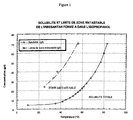
- the figure 1 indicates, for a solution of irbesartan form A in isopropanol, the conditions of total solubility, as a function of the concentration in g / liter and the temperature in ° C. It also indicates the limits of the metastable zone for a solution containing 25 g / liter to 70 g / liter of irbesartan.
- the seeding temperature varies from 45 ° C to 80 ° C so that the solution remains in the metastable zone.
- the irbesartan solution can be seeded with irbesartan crystals of brick habit at any time during the cooling of the solution when it is in the metastable zone.
- the seeding temperature is between 25 ° C and 80 ° C, depending on the concentration of the solution.
- the proportion of crystalline seed incorporated can be between 1% and 25%, preferably between 10% and 20%. After seeding, the temperature can be maintained constant for a period of between a few minutes and 2 hours, preferably for half an hour to one hour.
- steps b) and d) cooling is advantageously carried out at a uniform cooling rate of about 5 ° C. to 20 ° C. per hour, preferably close to 10 ° C. per hour.
- step e) the mechanical shear is preferably performed with a machine having a rotation speed of about 10,000 to 15,000 rpm.
- Machines having such characteristics are for example of the Turrax® type, sold by IKA-Werke (Germany). Some of these machines are suitable for the treatment of industrial quantities up to a flow rate of 100 m 3 / hour. For the process according to the invention and at an industrial stage, a flow rate of between approximately 500 liters / hour and 4 m 3 / hour is preferred in a 2m 3 reactor.
- the mechanical shearing of step e) can be conducted either by placing the shearing machine in the reactor containing the crystalline slurry, or by passing the crystalline slurry continuously into the shearing machine.
- the flow rate of the machine is adjusted according to the ratio between the length and the desired width for the formed brick habit crystals.
- steps e), f) and g) can be repeated before filtering the crystals of formed brick habit and drying them.
- the subject of the present invention is also the pharmaceutical compositions containing, as active ingredient, irbesartan of brick habit, ie irbesartan form A, having a new crystalline habitus.
- These pharmaceutical compositions can be prepared according to the description of the patent application. EP 747 050 .
- Formulations prepared with the brick habit can contain up to about 80% by weight of irbesartan or about 85% by weight of irbesartan associated with a diuretic, for example hydrochlorothiazide.
- These formulations can be prepared industrially, for example in the form of tablets or capsules, according to known methods, for example by wet granulation, by dry granulation, by direct compression.
- Irbesartan is prepared according to the procedure described in European patent EP 454 511 .
- the ethyl ester of amino-1-cyclopentane carboxylic acid is prepared according to Adkins and Billica (J. Amer Chem Soc., 1948, 70 , 3121).
- Ethyl valerimidate is prepared according to Mac Elvain (J. Amer Chem Soc., 1942, 64, 1825-1827 ) then released from its hydrochloride by the action of potassium carbonate and extraction with methylene chloride.
- the 2-n-butyl-4-spirocyclopentane-2-imidazolin-5-one prepared in step A can also be obtained according to another procedure described below, using cyclopentanone as starting material.
- This step is performed according to A. Strecker (Org Synth, 1955, 3 ).
- This compound is 1-aminocyclopentanenitrile hemioxalate.
- This step is carried out according to J. Zabicky, The Chemistry of Amides, Intersciences, New York, 1970, 119 ).
- This step is carried out according to H. Takenaka et al., Heterocycles, 1989, 29 (6), 1185-89 .
- the residue obtained is taken up in 40 ml of water and extracted with 10 ml of ethyl acetate and then twice with 5 ml of ethyl acetate.
- the combined organic phases are dried over sodium sulphate and filtered.
- the filtrate is concentrated to dryness. 4.85 g of the expected product are obtained.
- the NMR spectrum is similar to that described previously.
- the hydrochloride of this compound can be prepared by the addition of concentrated hydrochloric acid. The hydrochloride melts at 240 ° C. while sublimating.
- the crystals formed can be characterized by their X-ray diffraction spectrum (Table 1) and correspond to irbesartan form A.
- Table 1 X-ray diffraction spectrum
- d I / I 0 11.22 100.00 7.90 12,02 7.52 13.79 7.23 18,60 6.27 20,14 6.09 6.47 5.86 7.42 5.60 98.76 5.41 19.45 5.05 24.67 4.97 20.36 4.91 12.92 4.80 27.33 4.61 15,90 4.49 14.73 4.36 9.86 4.17 62.84 4.07 15,39 3.97 30.34 3.88 14.32 3.83 13.56 3.75 37.28 3.53 26.48 3.46 12.42 3.40 27.88 3.27 11.03 3.18 10.42 3.15 7.28 3.12 6.11 3.05 15.50 3.01 9.49 2.81 7.11 2.78 9.40
- the crystals thus obtained can be recrystallized in the following manner.
- the crystals subsequently used as seeds are prepared according to the following procedure.
- a three-necked flask equipped with a mechanical stirrer is charged with 200 ml of isopropyl alcohol and 9.40 g of the compound obtained in step A.
- the crystalline suspension is heated to 77.0 ° C., with stirring (approximately 100 rounds). / minutes) for complete dissolution.
- the solution is cooled to 73.0 ° C and additional 0.09 mg of the compound of Step A is added to initiate crystallization.
- the crystalline suspension is cooled to 20.0 ° C for 20 minutes.
- the suspension is sonicated for 600 seconds with a power of 10-15 watts using a 0,63 cm O.D sonication probe.
- the crystalline suspension is heated to 74.0 ° C, which dissolves about 93% of the crystals, leaving only the larger crystals for the next crystallization.
- the mixture is cooled to 20.0 ° C for 180 minutes following the cubic decrease in temperature described below: Time, minutes Temperature, ° C 0 74.0 30 73.8 60 72.0 90 67.3 120 58.0 150 42.8 180 20.0
- reaction medium When the temperature of 20.0 ° C. is reached, the reaction medium is subjected to sonication for 600 seconds with a power of 10-15 watts.
- the crystalline suspension is heated to 74.0 ° C. As in Cycle II, it is cooled to 20.0 ° C for 180 minutes following the cubic decrease in temperature described above. When the temperature of 20.0 ° C is reached, the crystalline suspension is sonicated for 600 seconds with a power of 10 to 15 watts.
- the crystalline suspension is heated to 74.0 ° C. As in Cycle II, it is cooled to 20.0 ° C for 180 minutes following the cubic decrease in temperature described above. When the temperature of 20.0 ° C is reached, the crystalline suspension is sonicated for 600 seconds with a power of 10 to 15 watts.
- the crystalline suspension is heated to 74.0 ° C. As in Cycle II, it is cooled to 20.0 ° C for 180 minutes following the cubic decrease in temperature described above. When the temperature of 20.0 ° C is reached, the crystalline suspension is sonicated for 600 seconds with a power of 10 to 15 watts.
- the crystalline suspension is heated to 74.0 ° C. As in Cycle II, it is cooled to 20.0 ° C for 180 minutes following the cubic decrease in temperature described above. The crystalline suspension is cooled to 5.0 ° C and the product is filtered through a Buchner and dried under vacuum at 70 ° C overnight to give the crystalline seeds.
- step A 515 g of the compound of step A are mixed with 10.95 liters of isopropanol to form the crystalline suspension. This is heated to 80 ° C to dissolve all the solid. The crystalline suspension is then cooled to 20 ° C by following the cubic decrease in temperature described above for 4 hours and adding at 73 ° C, 5.13 g of crystalline seeds, obtained in step B. introduced a 1.27 cm OD sonication probe for 10 minutes with a power of 125 W. The solution is heated again to 73 ° C to dissolve the small crystals, then cooled to 20 ° C for 4 hours according to the cubic decrease temperature described above.
- the solution is then sonicated for 10 minutes with a power of 125 W.
- the solution is again heated to 73 ° C to dissolve the small crystals.
- the solution is cooled to 2 ° C, using the cubic temperature decrease described above for 6 hours and then the solution is kept at 2 ° C for 1 hour.
- the reaction medium is filtered to form a wet filtrate. This is dried at 50 ° C under vacuum overnight. 513.4g of the dry product are obtained having a width: length relationship of 1: 2 to 1: 5.
- reaction is carried out according to the procedure described in Example 1, step A.
- a 2000 l reactor 116 kg of irbesartan and 1585 l of isopropanol are charged and then refluxed for 30 minutes to obtain complete dissolution. It is filtered hot to remove the insoluble particles to another reactor, by passing on a cartridge of 0.6 ⁇ m cut-off threshold. The filtered solution is heated again to reflux to dissolve the crystals of crystals possibly present and then it is cooled to 80 ° C. with stirring of approximately 50 revolutions per minute.
- the crystalline seeds are obtained in the laboratory by successive stages of heating and cooling a solution of irbesartan form A in isopropanol, the solution undergoing a passage in the shearing machine (Turrax®) after each cooling.
- centesimal formula Irbesartan of brick habit 70 microcrystalline cellulose 24.75 croscarmellose sodium 3.75 colloidal silica hydrate 0.75 magnesium stearate 0.75
- centesimal formula Irbesartan of brick habit 70 microcrystalline cellulose 12,375 croscarmellose sodium 3.75 polyethylene glycol 12,375 colloidal silica hydrate 0.75 magnesium stearate 0.75
- Compressed Irbesartan of brick habit 75 mg hydrochlorothiazide 12.50 mg microcrystalline cellulose 7.75 mg croscarmellose sodium 3.25mg colloidal silica hydrate 0.75 mg magnesium stearate for one tablet. 0.75 mg
- Compressed Irbesartan of brick habit 150 mg hydrochlorothiazide 12.50 mg microcrystalline cellulose 15.50 mg croscarmellose sodium 6.50 mg colloidal silica hydrate 1.50 mg magnesium stearate 1.50 mg for one tablet.
Landscapes
- Health & Medical Sciences (AREA)
- Chemical & Material Sciences (AREA)
- Organic Chemistry (AREA)
- Life Sciences & Earth Sciences (AREA)
- Engineering & Computer Science (AREA)
- Bioinformatics & Cheminformatics (AREA)
- Veterinary Medicine (AREA)
- Public Health (AREA)
- General Health & Medical Sciences (AREA)
- Medicinal Chemistry (AREA)
- Animal Behavior & Ethology (AREA)
- Pharmacology & Pharmacy (AREA)
- General Chemical & Material Sciences (AREA)
- Nuclear Medicine, Radiotherapy & Molecular Imaging (AREA)
- Chemical Kinetics & Catalysis (AREA)
- Cardiology (AREA)
- Heart & Thoracic Surgery (AREA)
- Ophthalmology & Optometry (AREA)
- Biomedical Technology (AREA)
- Neurology (AREA)
- Neurosurgery (AREA)
- Pain & Pain Management (AREA)
- Hospice & Palliative Care (AREA)
- Urology & Nephrology (AREA)
- Epidemiology (AREA)
- Pharmaceuticals Containing Other Organic And Inorganic Compounds (AREA)
- Plural Heterocyclic Compounds (AREA)
- Medicinal Preparation (AREA)
- Steroid Compounds (AREA)
Description
- La présente invention a pour objet un nouvel habitus cristallin du 2-n-butyl-4-spirocyclopentane-1-[(2'-(tétrazol-5-yl)biphényl-4-yl)méthyl]-2-imidazolin-5-one de formule:

- Ce composé et son mode de préparation ont été décrits pour la première fois dans le brevet européen
EP 454 511 - La dénomination commune du composé de formule (I) est irbesartan et le terme irbesartan est utilisé dans cette description et dans les revendications pour se référer au composés de formule (I).
- La demande de brevet européenne
EP 708103 - l'une appelée forme A est celle obtenue par cristallisation dans un solvant contenant moins d'environ 10% en volume d'eau,
- l'autre appelée forme B est obtenue par cristallisation dans un solvant miscible à l'eau contenant plus d'environ 10 % d'eau.
- Chacune de ces deux formes est caractérisée par un profil de diffraction des rayons X particulier.
- On décrit dans la demande de brevet
EP 708 103 - Il est indiqué dans la demande de brevet
EP 708 103 - On a également constaté que ces cristaux d'habitus aiguille sont difficiles à filtrer et à sécher et qu'ils pré- sentent une mauvaise coulabilité.
- On a maintenant trouvé un nouvel habitus cristallin de la forme A, caractérisé en ce que le rapport entre la longueur et la largeur des cristaux est compris entre 1:1 et 10:1, de préférence entre 1:1 et 5:1. Ce nouvel habitus cristallin de la forme A de l'irbesartan sera qualifié par le terme "habitus brique" de l'irbesartan dans la suite de la présente description.
- La présente invention a également pour objet les procédés permettant d'obtenir les cristaux d'irbesartan de forme A présentant le nouvel habitus cristallin selon lequel le rapport entre la longueur et la largeur des cristaux est compris entre 1:1 et 10:1, de préférence entre 1:1 et 5:1.
- Plus ce rapport est élevé, plus les aiguilles sont longues par rapport à leur largeur, ainsi une amélioration de ce rapport signifie une diminution dudit rapport. Il est préférable que ce rapport diminue de telle sorte qu'il soit compris entre 1:1 et 10: 1, préférentiellement entre 1:1 et 5:1.
- L'amélioration de ce rapport signifie que les cristaux ont moins tendance à se casser ou à s'agglomérer quand ils sont humides, qu'ils peuvent être filtrés et séchés plus vite, qu'ils sont plus facilement manipulables quand ils sont secs.
- Les procédés selon l'invention n'ont pas d'effet sur le polymorphisme.
- Les cristaux d'irbesartan dans l'habitus brique présentent les caractéristiques physico-chimiques décrites ci-après.
- Le profil de diffraction des rayons X de la poudre (angle de diffraction) a été établi avec un diffractomètre Siemens D 500 TT, les raies significatives sont consignées dans la Tableau 1 ci-après:
Tableau I d I/I0 11,22 100,00 7,90 12,02 7,52 13,79 7,23 18,60 6,27 20,14 6,09 6,47 5,86 7,42 5,60 98,76 5,41 19,45 5,05 24,67 4,97 20,36 4,91 12,92 4,61 15,90 4,49 14,73 4,36 9,86 4,17 62,84 4,07 15,39 3,97 30,34 3,88 14,32 3,83 13,56 3,75 37,28 3,53 26,48 3,46 12,42 3,40 27,88 3,27 11,03 3,18 10,42 3,15 7,28 3,12 6,11 3,05 15,50 3,01 9,49 2,81 7,11 2,78 9,40 - Ce profil de diffraction est celui de la forme A de l'irbesartan décrit dans
EP 708 103 - La chargeabilité de la poudre est mesurée par tribogénération : la poudre est soumise à une forte vibration pendant laquelle elle se charge sur elle-même, elle est ensuite versée dans une cage de Faraday reliée à un électromètre très sensible. La chargeabilité mesurée varie entre 0 et -10 nanocoulomb/g. A titre de comparaison, les cristaux d'irbesartan forme A en aiguilles présentent une chargeabilité, mesurée par le même procédé, comprise entre -30 et -40 nanocoulomb/g.
- Ainsi la présente invention a pour objet un composé cristallin de formule:

- Plus particulièrement, l'invention a pour objet une nouvelle forme cristalline d'irbesartan forme A caractérisée en ce que le rapport entre la longueur et la largeur des cristaux est compris entre 1:1 et 5:1 et dont la chargeabilité mesurée par tribogénération varie entre 0 et -10 nanocoulomb/g.
- La densité tassée des cristaux d'irbesartan présentant le nouvel habitus cristallin (180 coups) mesurée sur un appareil Hosokawa est d'environ 0,5 kg/m3 alors que celle des cristaux de forme A en aiguilles est d'environ 0,35 kg/m3.
- L'indice de coulabilité est calculé d'après la méthode de Carr (R Carr: Chemical Engineering, January 18, 1965, page 163-168) et prend en compte les résultats de quatre valeurs expérimentales: compressibilité, angle de repos, angle de spatule et cohésion. Cet indice est d'environ 30 pour les cristaux d'habitus brique alors qu'il est d'environ 10 pour les cristaux d'habitus aiguille.
- On constate que la résistivité, l'énergie minimum d'inflammation, la température minimum d'inflammation, les résultats du test de friction et la gravité de l'explosion, mesurés en sphère de 20 litres, sont proches pour les deux habitus cristallins de la forme A de l'irbesartan.
- Le fait que les cristaux d'irbesartan d'habitus brique aient une chargeabilité diminuée, c'est à dire une tendance diminuée à stocker les charges électrostatiques, signifie que ces cristaux sont manipulables plus facilement et de façon plus sûre.
- L'augmentation de 50 % de la densité tassée et de l'indice de coulabilité de l'habitus brique vis-à-vis de l'habitus aiguille représente une amélioration qui se traduit à la fois au niveau de la maniabilité chimique du produit et de leur utilisation pour la préparation de formes pharmaceutiques.
- Selon la présente invention, on peut préparer l'irbesartan d'habitus brique en utilisant un procédé caractérisé en ce que l'on soumet une suspension cristalline d'irbesartan forme A d'habitus aiguille à au moins un épisode de sonication et au moins un épisode d'oscillation de température.
- Ainsi l'épisode de sonication peut être soit suivi, soit précédé par l'épisode d'oscillation de température.
- On peut aussi concevoir que l'épisode de sonication soit conduit simultanément à l'épisode d'oscillation de température. Selon l'invention un épisode de sonication peut également être conduit entre 2 phases d'oscillation de température.
- De plus, les épisodes de sonication et/ou d'oscillation de température peuvent être répétés indépendamment les uns des autres.
- Préférentiellement, un épisode de sonication est précédé par un épisode d'oscillation de température et plus particulièrement un épisode de sonication est conduit entre 2 épisodes d'oscillation de température.
- Le terme "suspension cristalline" utilisé dans la présente description se réfère à une suspension d'irbesartan préparée selon des méthodes connues par l'homme du métier. Par exemple, la suspension cristalline peut être préparée en faisant croître des cristaux d'irbesartan dans un solvant organique par exemple un alcool tel que l'isopropanol, pour préparer une solution sursaturée d'irbesartan et en refroidissant à une température à laquelle la sursaturation est comprise entre 0 % et 50 %. La solution sursaturée est alors ensemencée avec 1 % à 10 % de semences cristallines d'irbesartan d'habitus brique, les semences cristallines provenant d'un lot précédent. Cependant les semences, peuvent également être engendrées en soumettant de façon répétée la suspension cristalline à des épisodes d'oscillation de température et de sonication jusqu'à ce que des cristaux d'habitus brique soient obtenus. La solution ensemencée est alors refroidie à température ambiante pour former la suspension cristalline. Ladite suspension cristalline est alors utilisée selon l'invention.
- Selon la présente invention, un épisode de sonication consiste à soumettre la suspension cristalline à une énergie de sonication dont la fréquence est d'environ 16 kHz à 10 MHz. Il semble que l'épisode de sonication limite la croissance selon la longueur des aiguilles en les cassant et modifie le caractère des surfaces cristallines de telles sortes que les zones capables d'accumuler les charges électrostatiques soient diminuées. On peut utiliser des méthodes de sonication soit par lots, soit de façon semi-continue, soit de façon continue.
- Pour la sonication par lots, on insère une sonde à ultrasons dans la suspension cristalline placée dans un cristalliseur.
- L'épisode de sonication peut aussi être conduit en continu ou en semi-continu en pompant la suspension cristalline d'irbesartan à travers une cellule de sonication avec un débit d'environ 10 litres/min/KW à 20 litres/min/KW ; avec une pression d'environ 0 psig à 100 psig ; avec une énergie d'environ 10 000 joule/litre à 30 000 joule/litre et à une fréquence d'environ 16 kHz à 10 MHz. De préférence, le débit est compris entre 16 litre/min/KW et 18 litre/min/KW ; la pression est comprise entre 0 psig et 20 psig ; l'énergie est comprise entre 16 000 et 25 000 joule/litre et la fréquence est d'environ 20 kHz.
- Les paramètres de sonication ci-dessus tels que le débit, la pression et la fréquence varient en fonction du résultat attendu en terme de rapport entre la longueur et la largeur des cristaux préparés.
- L'épisode d'oscillation de température comprend une phase de chauffage et une phase de refroidissement. Selon l'invention il comprend au moins une phase de chauffage et au moins une phase de refroidissement dans n'importe quel ordre. Il est préférable qu'une phase de chauffage soit associée à une phase de refroidissement et même que ladite phase de chauffage précède ladite phase de refroidissement. Il est probable que l'oscillation de température contribue au contrôle de la bonne distribution de la taille des particules ; en particulier il tend à dissoudre les particules les plus fines, et à faire de la croissance sur les plus grosses particules.
- L'oscillation de température est conduite en chauffant et en refroidissant une suspension cristalline à des températures préétablies. La phase de chauffage est menée en chauffant jusqu'à environ 20°C à 100°C. De façon préférentielle, la phase de chauffage est menée à une température telle qu'environ 15 % à 25 % soit dissous en 60 minutes, plus particulièrement environ 20 % des cristaux dissous en 60 minutes. La phase de refroidissement de l'épisode d'oscillation de température est généralement conduite entre 100°C et -20°C. Préférentiellement, la phase de refroidissement est conduite à une température comprise entre -5°C et 20°C pendant environ 0 à 60 minutes ; plus particulièrement entre 0 et 5°C pendant environ 0 à 60 minutes.
- Il faut noter que la température choisie pour la phase de refroidissement de l'épisode d'oscillation de température est inférieure à la température choisie pour la phase de chauffage correspondante. Les phases de chauffage et de refroidissement peuvent être répétées indépendamment, autant de fois que nécessaire et les paramètres spécifiques peuvent être modifiés pour obtenir le produit souhaité.
- Par exemple, on peut allonger la phase de chauffage et raccourcir la phase de refroidissement pour générer des cristaux plus petits ou bien on peut raccourcir la phase de chauffage et allonger la phase de refroidissement pour générer des cristaux plus larges. Le nombre de phases de chauffage et de refroidissement dépend également du résultat souhaité. D'une façon générale, si le nombre de phases de chauffage et de refroidissement augmente, l'aspect des cristaux s'améliore et le rapport entre la longueur et la largeur tend vers 1:1.
- Le contrôle des paramètres de sonication et d'oscillation de température permet de contrôler la distribution de la taille des particules et le rapport entre la longueur et la largeur des cristaux finaux.
- Le procédé décrit ci-dessus pour modifier l'habitus cristallin de l'irbesartan utilisant la sonication présente des difficultés de mise en oeuvre sur le plan industriel. En effet, l'émetteur d'ultrasons a une efficacité qui diminue au delà de quelques centimètres dudit émetteur ; de plus, lorsque l'on travaille en continu, cette efficacité diminue si l'on augmente la vitesse de passage de la suspension cristalline traitée.
- Aussi, pour traiter de grands volumes, le temps d'application est très long. Par ailleurs, les ultrasons à forte puissance provoquent une usure prématurée des métaux et des soudures des appareils utilisés.
- Un autre procédé pour modifier l'habitus cristallin de l'irbesartan forme A utilise le broyage en voie humide, c'est à dire le cisaillement mécanique des cristaux d'habitus aiguille pour les transformer en cristaux d'habitus brique. Ce procédé présente l'avantage d'être facilement applicable au traitement de quantités industrielles de produit.
- Ainsi, selon un autre de ses aspects, la présente invention est relative à un procédé de préparation de l'irbesartan d'habitus brique caractérisé en ce qu'il contient les étapes consistant à :
- a) préparer une solution d'irbesartan forme A dans un alcool, dans des conditions de concentration et de température permettant la solubilité totale de l'irbesartan ;
- b) refroidir ladite solution à une température choisie en fonction de la concentration de la solution de telle sorte que la solution soit dans la zone métastable ;
- c) ensemencer par des cristaux d'irbesartan d'habitus brique;
- d) refroidir la solution d'irbesartan à une température comprise environ entre 20°C et 5°C ;
- e) soumettre la suspension cristalline ainsi formée à un cisaillement mécanique par une machine à cisailler ;
- f) réchauffer la suspension cristalline à une température comprise environ entre 40°C et 60°C pour dissoudre les fines particules ;
- g) refroidir la suspension cristalline à une température comprise environ entre 20°C et 5°C;
- h) filtrer les cristaux d'habitus brique ainsi formés.
- Selon la présente invention, on utilise une solution d'irbesartan dans l'alcool, par exemple l'éthanol ou, de préférence, l'isopropanol.
- La
figure 1 indique, pour une solution d'irbesartan forme A dans l'isopropanol, les conditions de solubilité totale, en fonction de la concentration en g/litre et de la température en °C. Elle indique également les limites de la zone métastable pour une solution contenant 25 g/litre à 70 g/litre d'irbesartan. - Ainsi pour une solution d'irbesartan dans l'isopropanol contenant environ 50 g/litre à 70 g/litre la température d'ensemencement varie de 45°C à 80°C pour que la solution reste dans la zone métastable.
- On peut ensemencer la solution d'irbesartan par des cristaux d'irbesartan d'habitus brique à un moment quelconque du refroidissement de la solution, lorsque celle-ci est dans la zone métastable. La température d'ensemencement est comprise entre 25°C et 80°C, selon la concentration de la solution. La proportion de semence cristalline incorporée peut être comprise entre 1 % et 25 %, préférentiellement entre 10 % et 20 %. Après l'ensemencement, on peut maintenir la température constante pendant une durée comprise entre quelques minutes et 2 heures, préférentiellement pendant une demie-heure à une heure.
- Aux étapes b) et d) on procède avantageusement au refroidissement selon une vitesse de refroidissement régulière d'environ 5°C à 20°C par heure, préférentiellement voisine de 10°C par heure.
- A l'étape e) le cisaillement mécanique est effectué préférentiellement avec une machine ayant une vitesse de rotation d'environ 10 000 à 15 000 tours/minute.
- Des machines possédant de telles caractéristiques sont par exemple du type Turrax® , vendues par IKA-Werke (Allemagne). Certaines de ces machines sont adaptées au traitement de quantités industrielles allant jusqu'à permettre un débit de 100 m3/heure. Pour le procédé selon l'invention et à un stade industriel, un débit compris environ entre 500 litres/heure et 4 m3/heure est préféré, dans un réacteur de 2m3.
- Le cisaillement mécanique de l'étape e) peut être conduit soit en plaçant la machine à cisailler dans le réacteur contenant la suspension cristalline, soit en faisant passer la suspension cristalline en continu dans la machine à cisailler. Dans ce cas, le débit de la machine est ajusté en fonction du rapport entre la longueur et la largeur désiré pour les cristaux d'habitus brique formés.
- Eventuellement, afin d'améliorer le rendement en cristaux d'habitus brique, on peut répéter les étapes e), f) et g) avant de filtrer les cristaux d'habitus brique formés et de les sécher.
- La présente invention a également pour objet les compositions pharmaceutiques contenant en tant que principe actif l'irbesartan d'habitus brique, c'est à dire l'irbesartan forme A, présentant un nouvel habitus cristallin. Ces compositions pharmaceutiques peuvent être préparées selon la description de la demande de brevet
EP 747 050 - Les formulations préparées avec l'habitus brique peuvent contenir jusqu'à environ 80 % en poids d'irbesartan ou environ 85 % en poids d'irbesartan associé à un diurétique, par exemple l'hydrochlorothiazide. Ces formulations peuvent être préparées industriellement, par exemple sous forme de comprimés ou gélules, selon des procédés connus, par exemple par granulation voie humide, par granulation voie sèche, par compression directe.
- Par compression, on obtient des comprimés uniformes en poids et en contenu qui possèdent des propriétés physiques appropriées à un développement industriel.
- L'irbesartan est préparé selon le mode opératoire décrit dans le
brevet européen EP 454 511 - L'ester éthylique de l'acide amino-1-cyclopentane carboxylique est préparé selon Adkins et Billica (J. Amer. Chem. Soc., 1948, 70, 3121).
- Le valérimidate d'éthyle est préparé selon Mac Elvain (J. Amer. Chem. Soc., 1942, 64, 1825-1827) puis libéré de son chlorhydrate par action du carbonate de potassium et extraction par le chlorure de méthylène.
- L'ester éthylique de l'acide amino-1-cyclopentane carboxylique (1,57 g) et le valérimidate d'éthyle (1,56 g) sont dissous dans 12 ml de xylène contenant 6 gouttes d'acide acétique. Après 6 heures et demi de chauffage à reflux, le milieu réactionnel est concentré sous vide puis le résidu est chromatographié sur gel de silice en éluant par un mélange chloroforme/méthanol/acide acétique (94/4/2 ; v/v/v). La fraction contenant le produit attendu est évaporée plusieurs fois en présence de xylène puis de benzène pour éliminer l'acide acétique. On obtient 1,91 g de produit sous forme d'une huile épaisse.
IR (CHCl3) : 1720 cm-1 : C = O ; 1635 cm-1 : C = N. - Remarque : le fait de ne pas voir de bande entre 1500 et 1600 cm-1 indique que, dans la solution de chloroforme, le produit est une imidazoline-5-one.
Spectre RMN : 0,92 ppm : t : 3H : CH 3 (nBu) ; 1,35 ppm : sext : 2H : CH3CH2-. - 1,50-1,93 ppm : m : 10H : CH3-CH2-CH 2, et cyclopentane ;
2,33 ppm : t : 2H : CH3-CH2-CH2-CH 2- ; 10,7 ppm : m : NH.
Spectre de masse : MH+ : 195. - La 2-n-butyl-4-spirocyclopentane-2-imidazoline-5-one préparé à l'étape A, peut également être obtenue selon un autre mode opératoire décrit ci-dessous, en utilisant comme produit de départ la cyclopentanone.
- Cette étape est réalisée selon A. Strecker (Org. Synth., 1955, 3).
- Dans un ballon on dissout 1,97 g de cyanure de sodium dans 3,9 ml d'eau et on ajoute une solution contenant 2,33 g de chlorure d'ammonium dans 5,9 ml d'eau et 3,5 ml d'ammoniaque à 20 %, enfin on ajoute dans le ballon 3 g de cyclopentanone dans 3,8 ml de méthanol. Après 1 heure et demie sous agitation, on porte à 60°C pendant 45 minutes puis on arrête le chauffage, maintient l'agitation pendant 45 minutes puis refroidit à 25°C. On extrait plusieurs fois par du chlorure de méthylène. On sèche sur sulfate de sodium, filtre et concentre sous vide. On obtient 4 g du produit attendu sous forme huileuse.
- Le 1-aminocyclopentanenitrile obtenu est mis en solution dans 300 ml d'acétone et l'on ajoute, sous agitation, une solution de 2,25 g d'acide oxalique dihydraté dans 200 ml d'acétone. Le précipité formé est essoré, lavé avec de l'acétone puis séché.
m=4,71 g.
Fc = 220°C. - Ce composé est l'hemioxalate de 1-aminocyclopentanenitrile.
- Cette étape est réalisée selon J. Zabicky, (The Chemistry of Amides, Intersciences, New York, 1970, 119).
- 5,1 g de l'oxalate obtenu à l'étape précédente sont traités en 45 minutes et sous agitation par 7,65 ml d'acide sulfurique concentré (d = 1,84). On observe un dégagement gazeux, la température augmente jusqu'à 100°C. On refroidit vers 35°C et verse sur un mélange glace-ammoniaque concentrée, (10 g/2,8 ml). La suspension formée est extraite 6 fois de suite avec du chloroforme contenant 5 % de méthanol. On ajoute 3 ml d'ammoniaque (d = 0,92) à la phase aqueuse et extrait à nouveau par du chloroforme contenant du méthanol (1/0,5 ; v/v). Les phases organiques réunies sont séchées sur sulfate de sodium, on filtre et concentre. Le produit attendu est obtenu sous forme d'un solide blanc.
m = 3,79 g.
Fc = 95°C. - Les résultats de l'analyse et le spectre IR permettent de confirmer la structure.
- Cette étape est réalisée selon H. Takenaka et al., Heterocycles, 1989, 29 (6), 1185-89.
- 3 g du composé préparé à l'étape précédente sont placés dans 70 ml de THF anhydre et 3,3 ml de triéthylamine et l'on ajoute, sous agitation, 3 ml de chlorure de valéryle dans 10 ml de THF anhydre. Il se forme une suspension blanche. Le composé intermédiaire formé, mais non isolé, est le (N-valéryl)-1-aminocyclopentane carboxamide. On ajoute 6 g de potasse en pastille, 7 ml d'eau et 16 ml de méthanol. On chauffe à reflux pendant 2 heures et demie puis l'on ajoute 9 g de chlorure d'ammonium. Après 15 minutes d'agitation, on concentre sous vide. Le résidu obtenu est repris par 40 ml d'eau et extrait par 10 ml d'acétate d'éthyle puis 2 fois par 5 ml d'acétate d'éthyle. Les phases organiques réunies sont séchées sur sulfate de sodium et filtrées. Le filtrat est concentré à sec. On obtient 4,85 g du produit attendu. Le spectre de RMN est semblable à celui décrit précédemment. On peut préparer le chlorhydrate de ce composé par addition d'acide chlorhydrique concentré. Le chlorhydrate fond à 240°C en se sublimant.
- On prépare sous atmosphère d'azote un mélange contenant 250 mg d'hydrure de sodium (dispersé à 80 % dans l'huile minérale) et 5 ml de DMF et on ajoute goutte à goutte une solution contenant 0,97 g de 2-n-butyl-4-spirocyclopentane-2-imidazoline-5-one dans 10 ml de DMF. On agite 30 minutes à TA puis on ajoute une solution de 1,5 g de 4-bromométhyl-2-cyanobiphényle dans 10 ml de DMF. Après 1 heure d'agitation à TA, on évapore le DMF sous pression réduite puis on reprend le résidu par de l'acétate d'éthyle, lave la phase organique avec de l'eau puis sèche sur sulfate de sodium, filtre et évapore, le résidu est chromatographié sur gel de silice en éluant par un mélange DCM/acétate d'éthyle (9/1 ; v/v). On récupère 1,68 g du produit attendu. Fc = 92-93°C.
- 1,56 g du produit précédent, 2,6 g d'azide de tributylétain et 30 ml de xylène sont chauffés à reflux pendant 66 heures. Le xylène est ensuite évaporé et le résidu est dissous dans 20 ml de DCM et 5 ml de THF, en ajoutant 0,8 ml de soude 10N et, après 30 minutes d'agitation, 2,5 g de chlorure de trityle et on laisse sous agitation pendant 26 heures. Après évaporation des solvants, le résidu est repris par de l'acétate d'éthyle et lavé à l'eau par une solution de sulfate acide de potassium à 3 % et de d'eau. On sèche et évapore. Le résidu est chromatographié sur alumine en éluant sur le mélange hexane/acétate d'éthyle (9/1 : v/v). On obtient 1,97 g du produit attendu. Fc = 150-152°C.
- 1,96 g du produit préparé à l'étape précédente sont dissous dans 10 ml de méthanol et 10 ml de THF. Après refroidissement du milieu réactionnel à 5°C, on ajoute 1,5 ml d'acide chlorhydrique 4N et on agite pendant 3 heures à TA et 1 heure à 30°C. Après évaporation des solvants, le résidu est repris par de l'eau et l'on porte à pH 12 par addition de soude 10N. La phase aqueuse est extraite par de l'éther, du toluène et à nouveau de l'éther. On acidifie la phase aqueuse jusqu'à pH 2 par addition d'acide chlorhydrique 1N, puis on extrait à l'acétate d'éthyle, sèche sur Na2SO4 et évapore. Le solide blanc obtenu est séché à 50°C sous 0,05 mm de mercure. On obtient 840 mg du produit attendu. Fc = 180-181°C.
Spectre de RMN : 0,75 ppm : t : 3H : CH3 (nBu) ;
1,10 ppm : sext : 2H : CH3-CH 2- ; 1,20 ppm : quint : 2H : CH3-CH2-CH 2-;
1,5-2 ppm : m : 8H : -C5H8 ; 2,2 ppm : t : 2H : CH3-CH2-CH2-CH 2;
4,6 ppm : s : 2H : CH 2 -C6H4- ; 7 ppm : s : 4H : CH2-C6 H 4 - ;
7,35-7,7 ppm : m : 4H : H3', 4', 5', 6' aromatiques. - L'étude N.O.E. confirme la position de la substitution 5-one sur l'imidazole.
- Les cristaux formés peuvent être caractérisés par leur spectre de diffraction des rayons X (tableau 1) et correspondent à l'irbesartan forme A.
d I/I0 11,22 100,00 7,90 12,02 7,52 13,79 7,23 18,60 6,27 20,14 6,09 6,47 5,86 7,42 5,60 98,76 5,41 19,45 5,05 24,67 4,97 20,36 4,91 12,92 4,80 27,33 4,61 15,90 4,49 14,73 4,36 9,86 4,17 62,84 4,07 15,39 3,97 30,34 3,88 14,32 3,83 13,56 3,75 37,28 3,53 26,48 3,46 12,42 3,40 27,88 3,27 11,03 3,18 10,42 3,15 7,28 3,12 6,11 3,05 15,50 3,01 9,49 2,81 7,11 2,78 9,40 - Les cristaux ainsi obtenus peuvent être recristallisés de la façon suivante.
- A 840 mg de produit obtenu, on ajoute 15 ml d'isopropanol et on chauffe le mélange jusqu'à dissolution complète. On laisse revenir à température ambiante, puis on filtre les cristaux formés, on les lave à l'eau et on les sèche. On obtient 805 mg.d'irbesartan forme A.
- Les cristaux utilisés ensuite comme semences, sont préparés selon la procédure suivante.
- Un ballon tricol équipé d'un agitateur mécanique est chargé avec 200 ml d'alcool isopropylique et 9,40 g du composé obtenu à l'étape A. La suspension cristalline est chauffée à 77,0°C, sous agitation (environ 100 tours/minutes) pour une dissolution complète. La solution est refroidie à 73,0°C et on ajoute 0,09 mg supplémentaire du composé de l'étape A pour initier la cristallisation. La suspension cristalline est refroidie à 20,0°C pendant 20 minutes. La suspension est soumise à une sonication pendant 600 secondes avec une puissance de 10-15 watts en utilisant une sonde de sonication de 0,63 cm O.D.
- La suspension cristalline est chauffée à 74,0°C, ce qui dissout environ 93 % des cristaux, laissant seulement les cristaux les plus grands pour la prochaine cristallisation.
- Le mélange est refroidi à 20,0°C pendant 180 minutes suivant la diminution cubique de température décrite ci-après :
Temps, minutes Température, °C 0 74,0 30 73,8 60 72,0 90 67,3 120 58,0 150 42,8 180 20,0 - Quand la température de 20,0°C est atteinte, le milieu réactionnel est soumis à sonication pendant 600 secondes avec une puissance de 10-15 watts.
- La suspension cristalline est chauffée à 74,0°C. Comme dans le cycle II, elle est refroidie à 20,0°C pendant 180 minutes en suivant la diminution cubique de température décrite ci-dessus. Quand la température de 20,0°C est atteinte, la suspension cristalline est soumise à sonication pendant 600 secondes avec une puissance de 10 à 15 watts.
- La suspension cristalline est chauffée à 74,0°C. Comme dans le cycle II, elle est refroidie à 20,0°C pendant 180 minutes en suivant la diminution cubique de température décrite ci-dessus. Quand la température de 20,0°C est atteinte, la suspension cristalline est soumise à sonication pendant 600 secondes avec une puissance de 10 à 15 watts.
- La suspension cristalline est chauffée à 74,0°C. Comme dans le cycle II, elle est refroidie à 20,0°C pendant 180 minutes en suivant la diminution cubique de température décrite ci-dessus. Quand la température de 20,0°C est atteinte, la suspension cristalline est soumise à sonication pendant 600 secondes avec une puissance de 10 à 15 watts.
- La suspension cristalline est chauffée à 74,0°C. Comme dans le cycle II, elle est refroidie à 20,0°C pendant 180 minutes en suivant la diminution cubique de température décrite ci-dessus. La suspension cristalline est refroidie à 5,0°C et le produit est filtré dans un Buchner et séché sous vide à 70°C pendant une nuit pour donner les semences cristallines.
- 515 g du composé de l'étape A sont mélangés à 10,95 litres d'isopropanol pour former la suspension cristalline. Celle-ci est chauffée à 80°C pour dissoudre tout le solide. La suspension cristalline est alors refroidie jusqu'à 20°C en suivant la diminution cubique de température décrite ci-dessus pendant 4 heures et en ajoutant à 73°C, 5,13 g de semences cristallines, obtenues à l'étape B. On introduit une sonde de sonication de 1,27 cm O.D. pendant 10 minutes avec une puissance de 125 W. La solution est chauffée à nouveau à 73°C pour dissoudre les petits cristaux, puis refroidie à 20°C pendant 4 heures selon la diminution cubique de température décrite ci-dessus.
- La solution est alors soumise à sonication pendant 10 minutes avec une puissance de 125 W. La solution est à nouveau chauffée à 73°C pour dissoudre les petits cristaux. La solution est refroidie à 2°C, en utilisant la diminution cubique de température décrite ci-dessus pendant 6 heures puis la solution est maintenue à 2°C pendant 1heure. Le milieu réactionnel est filtré pour former un filtrat humide. Celui-ci est séché à 50°C sous vide pendant une nuit. 513,4g du produit sec sont obtenus présentant une relation largeur:longueur de 1:2 à 1:5.
- On procède selon le mode opératoire décrit à l'exemple 1, étape A. Dans un réacteur de 2000 l, on charge 116 kg d'irbesartan et 1585 l d'isopropanol puis on chauffe à reflux pendant 30 minutes pour obtenir une dissolution totale. On filtre à chaud pour éliminer les particules insolubles vers un autre réacteur, en passant sur une cartouche de 0,6 µm de seuil de coupure. La solution filtrée est à nouveau chauffée à reflux pour dissoudre les germes de cristaux éventuellement présents puis elle est refroidie à 80°C sous agitation d'environ 50 tours par minute.
- Les semences cristallines sont obtenues en laboratoire par des étapes successives de chauffage et de refroidissement d'une solution d'irbesartan forme A dans l'isopropanol, la solution subissant un passage dans la machine à cisaillement (Turrax® ) après chaque refroidissement.
-
- a) On prépare une suspension de semences cristallines contenant 17,4 kg dans 33 1 d'isopropanol et on l'introduit en une fois dans la solution préparée à l'étape A et maintenue à 80°C pendant 1 heure. On refroidit la température du réacteur jusqu'à 20°C selon une vitesse de refroidissement régulière de 10°C par heure. On obtient une population de cristaux dont la longueur est 300 µm à 500 µm et la largeur 20 µm à 50 µm en fin de cristallisation soit un rapport de 25: 1 à 6:1.
- b) La suspension cristalline est passée en 35 minutes (débit 4 m3/heure) dans une machine à cisailler Turrax® , référence IKA/DISPAX Reactor DRS 2/10, ayant une vitesse de rotation de 12 000 tours/minutes. On obtient des cristaux dont la longueur est 40 µm à 110 µm et la largeur 5 µm à 40 µm soit un rapport de 8:1 à 1:1. De nombreuses fines particules apparaissent également.
- c) On réchauffe la température du réacteur à 50°C et on maintient à cette température 1 heure pour dissoudre les fines particules.
- d) On refroidit la température du réacteur à 5°C selon une vitesse de refroidissement régulière de 10°C par heure puis on maintient une heure à cette température.
- e). Par filtration, on obtient une population de cristaux d'habitus brique (longueur moyenne 30 µm, largeur moyenne 5 µm, rapport 6:1). Après séchage, on obtient 121 kg de cristaux d'habitus brique dont la teneur en isopropanol est inférieure à 1000 ppm.
-
Comprimé : formule centésimale Irbesartan d'habitus brique 70 cellulose microcristalline 24,75 croscarmellose de sodium 3,75 silice colloïdale hydratée 0,75 stéarate de magnésium 0,75 -
Comprimé : formule centésimale Irbesartan d'habitus brique 70 cellulose microcristalline 12,375 croscarmellose de sodium 3,75 polyéthylène glycol 12,375 silice colloïdale hydratée 0,75 stéarate de magnésium 0,75 -
Comprimé Irbesartan d'habitus brique 75 mg hydrochlorothiazide 12,50 mg cellulose microcristalline 7,75 mg croscarmellose de sodium 3,25 mg silice colloïdale hydratée 0,75 mg stéarate de magnésium pour un comprimé. 0,75 mg -
Comprimé Irbesartan d'habitus brique 150 mg hydrochlorothiazide 12,50 mg cellulose microcristalline 15,50 mg croscarmellose de sodium 6,50 mg silice colloïdale hydratée 1,50 mg stéarate de magnésium 1,50 mg pour un comprimé.
Claims (30)
- Un composé cristallin de formule:

- Un composé cristallin selon la revendication 1 dans lequel le rapport entre la longueur et la largeur des cristaux est compris entre 1:1 et 5:1.
- Une nouvelle forme cristalline d'irbesartan forme A caractérisé en ce que le rapport entre la longueur et la largeur des cristaux est compris entre 1 : 1 et 5 :1 et dont la chargeabilité mesurée par tribogénération varie entre 0 et -10 nanocoulomb/g.
- Un procédé pour la préparation d'un composé selon l'une quelconque des revendications 1 à 3 caractérisé en ce que l'on soumet une suspension cristalline d'un composé de formule (I) à au moins un épisode de sonication et au moins un épisode d'oscillation de température.
- Un procédé pour la préparation d'un composé selon l'une quelconque des revendications 1 à 3 caractérisé en ce que l'on soumet une suspension cristalline d'irbesartan forme A d'habitus aiguille à au moins un épisode de sonication et au moins un épisode d'oscillation de température.
- Un procédé selon l'une quelconque des revendications 4 ou 5 dans lequel l'épisode d'oscillation de température comprend une phase de chauffage et une phase de refroidissement correspondante.
- Un procédé selon la revendication 6 dans lequel la phase de chauffage précède la phase de refroidissement.
- Un procédé selon la revendication 7 dans lequel l'épisode de sonication est suivi par un épisode d'oscillation de température.
- Un procédé selon l'une quelconque des revendications 4 ou 5 dans lequel l'épisode de sonication est précédé par un épisode d'oscillation de température.
- Un procédé selon l'une quelconque des revendications 4 ou 5 dans lequel l'épisode de sonication est conduit simultanément à l'épisode d'oscillation de température.
- Un procédé selon l'une quelconque des revendications 4 ou 5 dans lequel un épisode de sonication est conduit entre 2 épisodes d'oscillation de température.
- Un procédé selon l'une quelconque des revendications 4 ou 5 dans lequel les épisodes de sonication et/ou d'oscillation de température sont répétés indépendamment.
- Un procédé selon l'une quelconque des revendications 4 ou 5 dans lequel la sonication est effectuée soit par lots, soit de façon semi-continue, soit de façon continue.
- Un procédé selon la revendication 7 dans lequel la phase de chauffage de l'épisode d'oscillation de température est conduit à une température environ comprise entre 20°C et 100°C.
- Un procédé selon la revendication 7 dans lequel la phase de chauffage de l'épisode d'oscillation de température est conduite à une température telle qu'environ 15 % à 25 % des cristaux soient dissous en environ 60 minutes.
- Un procédé selon la revendication 7 dans lequel la phase de refroidissement de l'épisode d'oscillation de température est conduit à une température environ comprise entre 100°C et -20°C.
- Un procédé selon la revendication 7 dans lequel la phase de refroidissement de l'épisode d'oscillation de température est conduit à une température environ comprise entre -5°C et 20°C.
- Un procédé selon la revendication 7 dans lequel la température choisie pour la phase de refroidissement de l'épisode d'oscillation de température est inférieure à la température choisie pour la phase de chauffage correspondante de l'épisode d'oscillation de température.
- Un procédé selon la revendication 7 dans lequel la suspension critalline est ensemencée par des cristaux d'irbesartan dont le rapport entre la longueur et la largeur est compris entre 1:1 et 10:1.
- Un procédé pour la préparation d'un composé selon l'une quelconque des revendications 1 à 3 caractérisé en ce qu'il contient les étapes consistant à :a) préparer une solution d'irbesartan forme A d'habitus aiguille dans un alcool, dans des conditions de concentration et de température permettant la solubilité totale de l'irbesartan;b) refroidir ladite solution à une température choisie en fonction de la concentration de la solution de telle sorte que la solution soit dans la zone métastable ;c) ensemencer par des cristaux d'irbesartan d'habitus brique ;d) refroidir la solution d'irbesartan à une température comprise environ entre 20°C et 5°C ;e) soumettre la suspension cristalline ainsi formée à un cisaillement mécanique par une machine à cisailler ;f) réchauffer la suspension cristalline à une température comprise environ entre 40°C et 60°C pour dissoudre les fines particules ;g) refroidir la suspension cristalline à une température comprise environ entre 20°C et 5°C ;h) filtrer les cristaux d'habitus brique ainsi formés.
- Un procédé selon la revendication 20 dans lequel, à l'étape a), l'irbesartan est en solution dans l'isopropanol.
- Un procédé selon la revendication 20 dans lequel, à l'étape b), une solution contenant 50 g/litre à 70 g/litre d'irbesartan dans l'isopropanol est refroidie à une température variant entre 60°C et 80°C.
- Un procède selon la revendication 20 dans lequel, à l'étape c), la solution est ensemencée par des cristaux d'irbesartan dont la rapport entre la longueur et la largeur est compris entre 1:1 et 10:1.
- Un procédé selon la revendication 23 dans lequel la solution ensemencée est maintenue à une température comprise entre 80°C et 22°C pendant quelques minutes à environ 2 heures avant d'être refroidie.
- Un procédé selon la revendication 21 dans lequel, aux étape b) et d), la vitesse de refroidissement est d'environ 5°C à 20°C par heure.
- Un procédé selon la revendication 20 dans lequel, à l'étape e), le cisaillement mécanique s'effectue par une machine ayant une vitesse de rotation d'environ 10 000 tours/minutes à 15 000 tours/minutes.
- Procédé selon la revendication 26 dans lequel le cisaillement mécanique de l'étape e) s'effectue soit en plaçant la machine à cisailler directement dans le réacteur, sait en faisant passer la suspension cristalline dans la machine à cisailler.
- Composition pharmaceutique contenant un composé selon l'une quelconque des revendications 1 à 3 et des excipients pharmaceutiques convenables.
- Composition pharmaceutique selon la revendication 28 contenant un diurétique associé à un composé selon l'une quelconque des revendications 1 à 3.
- Composition pharmaceutique selon la revendication 29 dans laquelle le diurétique est l'hydrochlorothiazide.
Applications Claiming Priority (3)
| Application Number | Priority Date | Filing Date | Title |
|---|---|---|---|
| FR9808037A FR2780403B3 (fr) | 1998-06-24 | 1998-06-24 | Nouvelle forme de l'irbesartan, procedes pour obtenir ladite forme et compositions pharmaceutiques en contenant |
| FR9808037 | 1998-06-24 | ||
| PCT/FR1999/001372 WO1999067236A1 (fr) | 1998-06-24 | 1999-06-10 | Nouvelle forme de l'irbesartan, procedes pour obtenir ladite forme et compositions pharmaceutiques en contenant |
Publications (3)
| Publication Number | Publication Date |
|---|---|
| EP1089994A1 EP1089994A1 (fr) | 2001-04-11 |
| EP1089994B1 EP1089994B1 (fr) | 2004-09-08 |
| EP1089994B9 true EP1089994B9 (fr) | 2008-08-27 |
Family
ID=9527829
Family Applications (1)
| Application Number | Title | Priority Date | Filing Date |
|---|---|---|---|
| EP99923712A Revoked EP1089994B9 (fr) | 1998-06-24 | 1999-06-10 | Nouvelle forme de l'irbesartan, procedes pour obtenir ladite forme et compositions pharmaceutiques en contenant |
Country Status (25)
| Country | Link |
|---|---|
| US (2) | US6800761B1 (fr) |
| EP (1) | EP1089994B9 (fr) |
| JP (1) | JP2002518495A (fr) |
| KR (1) | KR20010034917A (fr) |
| CN (1) | CN1127499C (fr) |
| AT (1) | ATE275562T1 (fr) |
| AU (1) | AU747887B2 (fr) |
| BG (1) | BG105069A (fr) |
| BR (1) | BR9912198A (fr) |
| CA (1) | CA2335545A1 (fr) |
| CZ (1) | CZ292868B6 (fr) |
| DE (1) | DE69920017T2 (fr) |
| EA (1) | EA003410B1 (fr) |
| FR (1) | FR2780403B3 (fr) |
| HU (1) | HUP0103913A3 (fr) |
| ID (1) | ID27377A (fr) |
| IL (1) | IL140419A0 (fr) |
| NO (1) | NO317786B1 (fr) |
| NZ (1) | NZ508842A (fr) |
| PL (1) | PL345215A1 (fr) |
| SK (1) | SK20032000A3 (fr) |
| TR (1) | TR200003842T2 (fr) |
| UA (1) | UA55540C2 (fr) |
| WO (1) | WO1999067236A1 (fr) |
| ZA (1) | ZA200007588B (fr) |
Families Citing this family (31)
| Publication number | Priority date | Publication date | Assignee | Title |
|---|---|---|---|---|
| US20050176793A1 (en) * | 2001-12-10 | 2005-08-11 | Reddy Reguri B. | Amorphous form of 2-n-butyl-3-((2-(1h-tetrazol-5-yl)([1,1'-biphenyl)-4-yl)methyl)-1, 3-diazaspiro(4,4')non-1-en-4-one |
| WO2004065383A2 (fr) | 2003-01-16 | 2004-08-05 | Teva Pharmaceutical Industries Ltd. | Nouvelle synthese d'irbesartan |
| GB0301259D0 (en) * | 2003-01-20 | 2003-02-19 | Novartis Ag | Organic compounds |
| AU2007202693B2 (en) * | 2003-01-20 | 2009-12-10 | Novartis Ag | Process for modifying drug crystal formation |
| DE602004015071D1 (de) * | 2003-02-05 | 2008-08-28 | Teva Pharma | Synthese von 2-butyl-3-(2'-(1-trityl-1h-tetrazol-5-yl)biphenyl-4-yl)-1,3-diazaspiro-4,4 -nonen-4-on |
| EP1660435A2 (fr) * | 2003-08-27 | 2006-05-31 | Boehringer Ingelheim International GmbH | Composes a base d'acides cycloalkylamines, procedes de fabrication et d'utilisation correspondants |
| EP1751123A4 (fr) * | 2004-05-20 | 2010-06-30 | Reddys Lab Ltd Dr | Processus pour préparer de l'irbésartan |
| CA2568640C (fr) | 2004-06-04 | 2011-08-09 | Teva Pharmaceutical Industries Ltd. | Composition pharmaceutique contenant de l'irbesartan |
| SI21849A (sl) * | 2004-07-29 | 2006-02-28 | Krka, Tovarna Zdravil, D.D., Novo Mesto | Priprava hidrokloridnih soli tetrazolskega derivata |
| SI21848A (sl) * | 2004-07-29 | 2006-02-28 | Krka, Tovarna Zdravil, D.D., Novo Mesto | Priprava seskvihidratne hidrokloridne soli tetrazolskega derivata |
| TWI346108B (en) * | 2004-08-23 | 2011-08-01 | Bristol Myers Squibb Co | A method for preparing irbesartan and intermediates thereof |
| GB2419592A (en) | 2004-10-26 | 2006-05-03 | Cipla Ltd | Process for the preparation of irbesartan hydrochloride |
| WO2006050923A1 (fr) * | 2004-11-11 | 2006-05-18 | Lek Pharmaceuticals D.D. | Forme polymorphe d'irbesartan |
| PL1806130T3 (pl) | 2006-01-09 | 2010-08-31 | Krka D D Novo Mesto | Kompozycja farmaceutyczna w postaci stałej zawierająca irbesartan |
| WO2008041957A1 (fr) * | 2006-10-03 | 2008-04-10 | Ulkar Kimya Sanayi Ve Ticaret As | PROCÉDÉ SERVANT À PRODUIRE UNE FORME CRISTALLINE PURE DE LA 2-n-BUTYL-3-[(2-(1H-TÉTRAZOL-5-YL)(1,1'-BIPHÉNYL)-4-YL)MÉTHYL]-1,3-DIAZASPIRO-[4,4]-NON-1-ÉN-4-ONE |
| ES2315141B1 (es) * | 2006-11-23 | 2009-12-22 | Quimica Sintetica, S.A | Procedimiento para la preparacion de cardesartan cilexetilo en forma cristalina. |
| US20100104640A1 (en) * | 2007-04-17 | 2010-04-29 | Ratiopharm Gmbh | Pharmaceutical compositions comprising irbesartan |
| CN101801371B (zh) * | 2007-09-10 | 2012-11-28 | 詹森药业有限公司 | 可用作sglt抑制剂的化合物的制备方法 |
| PT2065035E (pt) | 2007-11-28 | 2010-10-04 | Lesvi Laboratorios Sl | Formulações farmacêuticas contendo irbesartan |
| EP2215083A2 (fr) * | 2007-12-07 | 2010-08-11 | Hetero Drugs Limited | Procédé de production d'irbésartan pur |
| US9056850B2 (en) * | 2008-10-17 | 2015-06-16 | Janssen Pharmaceutica N.V. | Process for the preparation of compounds useful as inhibitors of SGLT |
| CZ302407B6 (cs) * | 2009-03-12 | 2011-05-04 | Univerzita Pardubice | Zpusob prípravy 2-butyl-1,3-diazaspiro[4.4]non-1-en-4-onu |
| US20110009347A1 (en) | 2009-07-08 | 2011-01-13 | Yin Liang | Combination therapy for the treatment of diabetes |
| KR101532412B1 (ko) * | 2009-07-10 | 2015-06-29 | 얀센 파마슈티카 엔.브이. | 1-(β-D-글루코피라노실)-4-메틸-3-(5-(4-플루오로페닐)-2-티에닐메틸) 벤젠의 결정화 방법 |
| AR078107A1 (es) * | 2009-08-31 | 2011-10-12 | Sanofi Aventis | Uso de irbesartan para la preparacion de un medicamento para la prevencion de la hospitalizacion por insuficiencia cardiaca |
| SG10201500258WA (en) * | 2009-10-14 | 2015-03-30 | Janssen Pharmaceutica Nv | Process for the preparation of compounds useful as inhibitors of sglt2 |
| LT2568988T (lt) | 2010-05-11 | 2016-09-12 | Janssen Pharmaceutica, N.V. | Farmacinės kompozicijos, apimančios 1-(beta-d-gliukopiranozil)-2-tienilmetilbenzeno darinius kaip sglt inhibitorius |
| AU2012241897C1 (en) | 2011-04-13 | 2017-05-11 | Janssen Pharmaceutica Nv | Process for the preparation of compounds useful as inhibitors of SGLT2 |
| TWI542596B (zh) | 2011-05-09 | 2016-07-21 | 健生藥品公司 | (2s,3r,4r,5s,6r)-2-(3-((5-(4-氟苯基)噻吩-2-基)甲基)-4-甲基苯基)-6-(羥甲基)四氫-2h-哌喃-3,4,5-三醇之l-脯胺酸及檸檬酸共晶體 |
| US20170071970A1 (en) | 2015-09-15 | 2017-03-16 | Janssen Pharmaceutica Nv | Co-therapy comprising canagliflozin and phentermine for the treatment of obesity and obesity related disorders |
| HRP20200755T1 (hr) * | 2015-12-21 | 2020-07-24 | Janssen Pharmaceutica N.V. | Postupak kristalizacije za dobivanje kristala kanagliflozin hemihidrata |
Family Cites Families (3)
| Publication number | Priority date | Publication date | Assignee | Title |
|---|---|---|---|---|
| PT97078B (pt) * | 1990-03-20 | 1997-07-31 | Sanofi Sa | Processo para a preparacao de derivados heterociclicos n-substituidos e de composicoes farmaceuticas que os contem |
| US5270317A (en) | 1990-03-20 | 1993-12-14 | Elf Sanofi | N-substituted heterocyclic derivatives, their preparation and the pharmaceutical compositions in which they are present |
| FR2725987B1 (fr) | 1994-10-19 | 1997-01-10 | Sanofi Sa | Procede pour la preparation d'un derive de tetrazole sous deux formes cristallines et nouvelle forme cristalline de ce derive |
-
1998
- 1998-06-24 FR FR9808037A patent/FR2780403B3/fr not_active Expired - Lifetime
-
1999
- 1999-06-10 SK SK2003-2000A patent/SK20032000A3/sk unknown
- 1999-06-10 HU HU0103913A patent/HUP0103913A3/hu unknown
- 1999-06-10 AT AT99923712T patent/ATE275562T1/de not_active IP Right Cessation
- 1999-06-10 EA EA200001221A patent/EA003410B1/ru not_active IP Right Cessation
- 1999-06-10 CN CN99807707A patent/CN1127499C/zh not_active Expired - Fee Related
- 1999-06-10 KR KR1020007014640A patent/KR20010034917A/ko not_active Abandoned
- 1999-06-10 IL IL14041999A patent/IL140419A0/xx unknown
- 1999-06-10 JP JP2000555889A patent/JP2002518495A/ja active Pending
- 1999-06-10 EP EP99923712A patent/EP1089994B9/fr not_active Revoked
- 1999-06-10 CZ CZ20004771A patent/CZ292868B6/cs not_active IP Right Cessation
- 1999-06-10 CA CA002335545A patent/CA2335545A1/fr not_active Abandoned
- 1999-06-10 NZ NZ508842A patent/NZ508842A/xx unknown
- 1999-06-10 PL PL99345215A patent/PL345215A1/xx not_active Application Discontinuation
- 1999-06-10 AU AU40484/99A patent/AU747887B2/en not_active Ceased
- 1999-06-10 ID IDW20002738A patent/ID27377A/id unknown
- 1999-06-10 WO PCT/FR1999/001372 patent/WO1999067236A1/fr not_active Ceased
- 1999-06-10 TR TR2000/03842T patent/TR200003842T2/xx unknown
- 1999-06-10 DE DE69920017T patent/DE69920017T2/de not_active Revoked
- 1999-06-10 BR BR9912198-0A patent/BR9912198A/pt not_active IP Right Cessation
- 1999-06-10 US US09/720,017 patent/US6800761B1/en not_active Expired - Lifetime
- 1999-10-06 UA UA2000127044A patent/UA55540C2/uk unknown
-
2000
- 2000-12-18 ZA ZA200007588A patent/ZA200007588B/en unknown
- 2000-12-19 BG BG105069A patent/BG105069A/xx unknown
- 2000-12-22 NO NO20006645A patent/NO317786B1/no not_active IP Right Cessation
-
2004
- 2004-09-09 US US10/937,467 patent/US7008959B2/en not_active Expired - Lifetime
Also Published As
Similar Documents
| Publication | Publication Date | Title |
|---|---|---|
| EP1089994B1 (fr) | Nouvelle forme de l'irbesartan, procedes pour obtenir ladite forme et compositions pharmaceutiques en contenant | |
| JP4700813B2 (ja) | テルミサルタンの多形体、その調製方法及び医薬組成物の調製のためのその使用 | |
| CA2801089C (fr) | Procede de preparation du sel de l-arginine du perindopril | |
| EP1861389B1 (fr) | Sel besylate de la 7-(2-(4-(3-trifluoromethyl-phenyl)-1,2,3,6-tetrahydro-pyrid-1-yl)ethyl) isoquinoleine, sa preparation et son utilisation en therapeutique | |
| WO2005123720A1 (fr) | Fines particules d'un antagoniste de l'angiotensine ii a base de candesartan cilexetil et leur procede de production | |
| WO2003087039A1 (fr) | Nouveau cristal de nateglinide | |
| EP0635002B1 (fr) | Nouveaux derives de perhydroisoindole, et leur preparation | |
| TW202530224A (zh) | 製造巴洛沙韋瑪波西酯之方法 | |
| CN1073439A (zh) | 非晶形(喹啉-2-基甲氧基)吲哚 | |
| US5808088A (en) | Preparation of mibefradil via an acetamide anion | |
| JPH06192228A (ja) | 結晶性(r)−(−)−2−シクロヘプチル−n−メチルスルフオニル−[4−(2−キノリニルメトキシ)−フエニル]−アセトアミド | |
| US5811556A (en) | Preparation of mibefradil via a naphthalenylacetic acid | |
| JP2006151977A (ja) | (r)−3−[[(4−フルオロフェニル)スルホニル]アミノ]−1,2,3,4−テトラヒドロ−9h−カルバゾール−9−プロパン酸(ラマトロバン)の熱力学的に安定な形態の結晶の製造方法 | |
| MXPA00013024A (en) | Novel form of irbesartan, methods for obtaining said form and pharmaceutical compositions containing same | |
| WO2012131389A1 (fr) | Procédé pour la préparation de 1-(2-méthyl-4-(2,3,4,5-tétrahydro-1- benzazépin-1-ylcarbonyl)benzylcarbamoyl)-l-proline-n,n-diméthylamide | |
| WO2010131118A2 (fr) | Formes polymorphes d'étravirine et leurs procédés de préparation | |
| WO1999052935A1 (fr) | Formes cristallines du 1s-[1alpha (2s*,3r*),9alpha]-6, 10-dioxo-n- (2-ethoxy-5 -oxo-tetrahydro-3 -furanyl) -9-[[(1-isoquinolyl) carbonyl]-amino] octahydro-6h -piridazino[1, 2-a][1,2] diazepine-1- carboxamide | |
| FR2800373A1 (fr) | Procede de preparation d'oxazoles trisubstitues | |
| CN105777622A (zh) | 制备达比加群酯中间体环化物的杂质的方法 |
Legal Events
| Date | Code | Title | Description |
|---|---|---|---|
| PUAI | Public reference made under article 153(3) epc to a published international application that has entered the european phase |
Free format text: ORIGINAL CODE: 0009012 |
|
| 17P | Request for examination filed |
Effective date: 20010124 |
|
| AK | Designated contracting states |
Kind code of ref document: A1 Designated state(s): AT BE CH CY DE DK ES FI FR GB GR IE IT LI LU MC NL PT SE |
|
| AX | Request for extension of the european patent |
Free format text: AL PAYMENT 20010124;LT PAYMENT 20010124;LV PAYMENT 20010124;MK PAYMENT 20010124;RO PAYMENT 20010124;SI PAYMENT 20010124 |
|
| 17Q | First examination report despatched |
Effective date: 20030415 |
|
| GRAP | Despatch of communication of intention to grant a patent |
Free format text: ORIGINAL CODE: EPIDOSNIGR1 |
|
| GRAS | Grant fee paid |
Free format text: ORIGINAL CODE: EPIDOSNIGR3 |
|
| GRAA | (expected) grant |
Free format text: ORIGINAL CODE: 0009210 |
|
| AK | Designated contracting states |
Kind code of ref document: B1 Designated state(s): AT BE CH CY DE DK ES FI FR GB GR IE IT LI LU MC NL PT SE |
|
| AX | Request for extension of the european patent |
Extension state: AL LT LV MK RO SI |
|
| PG25 | Lapsed in a contracting state [announced via postgrant information from national office to epo] |
Ref country code: NL Free format text: LAPSE BECAUSE OF FAILURE TO SUBMIT A TRANSLATION OF THE DESCRIPTION OR TO PAY THE FEE WITHIN THE PRESCRIBED TIME-LIMIT Effective date: 20040908 Ref country code: IT Free format text: LAPSE BECAUSE OF FAILURE TO SUBMIT A TRANSLATION OF THE DESCRIPTION OR TO PAY THE FEE WITHIN THE PRESCRIBED TIME-LIMIT;WARNING: LAPSES OF ITALIAN PATENTS WITH EFFECTIVE DATE BEFORE 2007 MAY HAVE OCCURRED AT ANY TIME BEFORE 2007. THE CORRECT EFFECTIVE DATE MAY BE DIFFERENT FROM THE ONE RECORDED. Effective date: 20040908 Ref country code: IE Free format text: LAPSE BECAUSE OF FAILURE TO SUBMIT A TRANSLATION OF THE DESCRIPTION OR TO PAY THE FEE WITHIN THE PRESCRIBED TIME-LIMIT Effective date: 20040908 Ref country code: FI Free format text: LAPSE BECAUSE OF FAILURE TO SUBMIT A TRANSLATION OF THE DESCRIPTION OR TO PAY THE FEE WITHIN THE PRESCRIBED TIME-LIMIT Effective date: 20040908 Ref country code: AT Free format text: LAPSE BECAUSE OF FAILURE TO SUBMIT A TRANSLATION OF THE DESCRIPTION OR TO PAY THE FEE WITHIN THE PRESCRIBED TIME-LIMIT Effective date: 20040908 |
|
| REG | Reference to a national code |
Ref country code: GB Ref legal event code: FG4D Free format text: NOT ENGLISH |
|
| REG | Reference to a national code |
Ref country code: CH Ref legal event code: EP |
|
| REG | Reference to a national code |
Ref country code: IE Ref legal event code: FG4D Free format text: FRENCH |
|
| REF | Corresponds to: |
Ref document number: 69920017 Country of ref document: DE Date of ref document: 20041014 Kind code of ref document: P |
|
| RAP2 | Party data changed (patent owner data changed or rights of a patent transferred) |
Owner name: SANOFI-AVENTIS |
|
| PG25 | Lapsed in a contracting state [announced via postgrant information from national office to epo] |
Ref country code: SE Free format text: LAPSE BECAUSE OF FAILURE TO SUBMIT A TRANSLATION OF THE DESCRIPTION OR TO PAY THE FEE WITHIN THE PRESCRIBED TIME-LIMIT Effective date: 20041208 Ref country code: GR Free format text: LAPSE BECAUSE OF FAILURE TO SUBMIT A TRANSLATION OF THE DESCRIPTION OR TO PAY THE FEE WITHIN THE PRESCRIBED TIME-LIMIT Effective date: 20041208 Ref country code: DK Free format text: LAPSE BECAUSE OF FAILURE TO SUBMIT A TRANSLATION OF THE DESCRIPTION OR TO PAY THE FEE WITHIN THE PRESCRIBED TIME-LIMIT Effective date: 20041208 |
|
| PG25 | Lapsed in a contracting state [announced via postgrant information from national office to epo] |
Ref country code: ES Free format text: LAPSE BECAUSE OF FAILURE TO SUBMIT A TRANSLATION OF THE DESCRIPTION OR TO PAY THE FEE WITHIN THE PRESCRIBED TIME-LIMIT Effective date: 20041219 |
|
| NLT2 | Nl: modifications (of names), taken from the european patent patent bulletin |
Owner name: SANOFI-AVENTIS |
|
| GBT | Gb: translation of ep patent filed (gb section 77(6)(a)/1977) | ||
| LTIE | Lt: invalidation of european patent or patent extension |
Effective date: 20040908 |
|
| NLV1 | Nl: lapsed or annulled due to failure to fulfill the requirements of art. 29p and 29m of the patents act | ||
| REG | Reference to a national code |
Ref country code: IE Ref legal event code: FD4D |
|
| PLAQ | Examination of admissibility of opposition: information related to despatch of communication + time limit deleted |
Free format text: ORIGINAL CODE: EPIDOSDOPE2 |
|
| PLBQ | Unpublished change to opponent data |
Free format text: ORIGINAL CODE: EPIDOS OPPO |
|
| PG25 | Lapsed in a contracting state [announced via postgrant information from national office to epo] |
Ref country code: LU Free format text: LAPSE BECAUSE OF NON-PAYMENT OF DUE FEES Effective date: 20050610 Ref country code: CY Free format text: LAPSE BECAUSE OF FAILURE TO SUBMIT A TRANSLATION OF THE DESCRIPTION OR TO PAY THE FEE WITHIN THE PRESCRIBED TIME-LIMIT Effective date: 20050610 |
|
| PLBI | Opposition filed |
Free format text: ORIGINAL CODE: 0009260 |
|
| PLAQ | Examination of admissibility of opposition: information related to despatch of communication + time limit deleted |
Free format text: ORIGINAL CODE: EPIDOSDOPE2 |
|
| PLBQ | Unpublished change to opponent data |
Free format text: ORIGINAL CODE: EPIDOS OPPO |
|
| PLAB | Opposition data, opponent's data or that of the opponent's representative modified |
Free format text: ORIGINAL CODE: 0009299OPPO |
|
| PLAQ | Examination of admissibility of opposition: information related to despatch of communication + time limit deleted |
Free format text: ORIGINAL CODE: EPIDOSDOPE2 |
|
| PLAR | Examination of admissibility of opposition: information related to receipt of reply deleted |
Free format text: ORIGINAL CODE: EPIDOSDOPE4 |
|
| PLBI | Opposition filed |
Free format text: ORIGINAL CODE: 0009260 |
|
| PLBQ | Unpublished change to opponent data |
Free format text: ORIGINAL CODE: EPIDOS OPPO |
|
| PLAQ | Examination of admissibility of opposition: information related to despatch of communication + time limit deleted |
Free format text: ORIGINAL CODE: EPIDOSDOPE2 |
|
| PLAR | Examination of admissibility of opposition: information related to receipt of reply deleted |
Free format text: ORIGINAL CODE: EPIDOSDOPE4 |
|
| PLBQ | Unpublished change to opponent data |
Free format text: ORIGINAL CODE: EPIDOS OPPO |
|
| PLAB | Opposition data, opponent's data or that of the opponent's representative modified |
Free format text: ORIGINAL CODE: 0009299OPPO |
|
| PG25 | Lapsed in a contracting state [announced via postgrant information from national office to epo] |
Ref country code: MC Free format text: LAPSE BECAUSE OF NON-PAYMENT OF DUE FEES Effective date: 20050630 Ref country code: LI Free format text: LAPSE BECAUSE OF NON-PAYMENT OF DUE FEES Effective date: 20050630 Ref country code: CH Free format text: LAPSE BECAUSE OF NON-PAYMENT OF DUE FEES Effective date: 20050630 Ref country code: BE Free format text: LAPSE BECAUSE OF NON-PAYMENT OF DUE FEES Effective date: 20050630 |
|
| PLAX | Notice of opposition and request to file observation + time limit sent |
Free format text: ORIGINAL CODE: EPIDOSNOBS2 |
|
| 26 | Opposition filed |
Opponent name: TEVA PHARMACEUTICAL INDUSTRIES LTD. Effective date: 20050607 |
|
| R26 | Opposition filed (corrected) |
Opponent name: QUIMICA SINTETICA. S.A. Effective date: 20050608 Opponent name: TEVA PHARMACEUTICAL INDUSTRIES LTD. Effective date: 20050607 |
|
| R26 | Opposition filed (corrected) |
Opponent name: QUIMICA SINTETICA. S.A. Effective date: 20050608 Opponent name: TEVA PHARMACEUTICAL INDUSTRIES LTD. Effective date: 20050607 |
|
| REG | Reference to a national code |
Ref country code: FR Ref legal event code: CD |
|
| REG | Reference to a national code |
Ref country code: CH Ref legal event code: PL |
|
| PLAK | Information related to reply of patent proprietor to notice(s) of opposition modified |
Free format text: ORIGINAL CODE: EPIDOSCOBS3 |
|
| PLBB | Reply of patent proprietor to notice(s) of opposition received |
Free format text: ORIGINAL CODE: EPIDOSNOBS3 |
|
| BERE | Be: lapsed |
Owner name: *SANOFI-SYNTHELABO Effective date: 20050630 |
|
| PG25 | Lapsed in a contracting state [announced via postgrant information from national office to epo] |
Ref country code: PT Free format text: LAPSE BECAUSE OF NON-PAYMENT OF DUE FEES Effective date: 20050208 |
|
| REG | Reference to a national code |
Ref country code: HK Ref legal event code: WD Ref document number: 1033830 Country of ref document: HK |
|
| RDAF | Communication despatched that patent is revoked |
Free format text: ORIGINAL CODE: EPIDOSNREV1 |
|
| RDAG | Patent revoked |
Free format text: ORIGINAL CODE: 0009271 |
|
| 27W | Patent revoked |
Effective date: 20081105 |
|
| GBPR | Gb: patent revoked under art. 102 of the ep convention designating the uk as contracting state |
Effective date: 20081105 |
|
| APBM | Appeal reference recorded |
Free format text: ORIGINAL CODE: EPIDOSNREFNO |
|
| APBP | Date of receipt of notice of appeal recorded |
Free format text: ORIGINAL CODE: EPIDOSNNOA2O |
|
| APAH | Appeal reference modified |
Free format text: ORIGINAL CODE: EPIDOSCREFNO |
|
| APBQ | Date of receipt of statement of grounds of appeal recorded |
Free format text: ORIGINAL CODE: EPIDOSNNOA3O |
|
| RDAD | Information modified related to despatch of communication that patent is revoked |
Free format text: ORIGINAL CODE: EPIDOSCREV1 |
|
| RDAC | Information related to revocation of patent modified |
Free format text: ORIGINAL CODE: 0009299REVO |
|
| RDAE | Information deleted related to despatch of communication that patent is revoked |
Free format text: ORIGINAL CODE: EPIDOSDREV1 |
|
| RDAF | Communication despatched that patent is revoked |
Free format text: ORIGINAL CODE: EPIDOSNREV1 |
|
| D27W | Patent revoked (deleted) | ||
| APAH | Appeal reference modified |
Free format text: ORIGINAL CODE: EPIDOSCREFNO |
|
| APAW | Appeal reference deleted |
Free format text: ORIGINAL CODE: EPIDOSDREFNO |
|
| APAY | Date of receipt of notice of appeal deleted |
Free format text: ORIGINAL CODE: EPIDOSDNOA2O |
|
| APBA | Date of receipt of statement of grounds of appeal deleted |
Free format text: ORIGINAL CODE: EPIDOSDNOA3O |
|
| APBM | Appeal reference recorded |
Free format text: ORIGINAL CODE: EPIDOSNREFNO |
|
| APBP | Date of receipt of notice of appeal recorded |
Free format text: ORIGINAL CODE: EPIDOSNNOA2O |
|
| APBQ | Date of receipt of statement of grounds of appeal recorded |
Free format text: ORIGINAL CODE: EPIDOSNNOA3O |
|
| APAJ | Date of receipt of notice of appeal modified |
Free format text: ORIGINAL CODE: EPIDOSCNOA2O |
|
| REG | Reference to a national code |
Ref country code: GB Ref legal event code: RCOR Free format text: THE FOLLOWING ENTRY IN JOURNAL 6263 DATED 03.06.2009 WAS DONE SO IN ERROR: 'PATENT REVOKED BY THE EPO ON 05.11.2008' THE PATENT REMAINS IN FORCE. |
|
| APAL | Date of receipt of statement of grounds of an appeal modified |
Free format text: ORIGINAL CODE: EPIDOSCNOA3O |
|
| RAP2 | Party data changed (patent owner data changed or rights of a patent transferred) |
Owner name: SANOFI |
|
| RAP2 | Party data changed (patent owner data changed or rights of a patent transferred) |
Owner name: SANOFI |
|
| RAP2 | Party data changed (patent owner data changed or rights of a patent transferred) |
Owner name: SANOFI |
|
| PLAB | Opposition data, opponent's data or that of the opponent's representative modified |
Free format text: ORIGINAL CODE: 0009299OPPO |
|
| R26 | Opposition filed (corrected) |
Opponent name: TEVA PHARMACEUTICAL INDUSTRIES LTD. Effective date: 20050607 Opponent name: QUIMICA SINTETICA. S.A. Effective date: 20050608 |
|
| REG | Reference to a national code |
Ref country code: DE Ref legal event code: R082 Ref document number: 69920017 Country of ref document: DE Representative=s name: TER MEER STEINMEISTER & PARTNER GBR PATENTANWA, DE |
|
| APBU | Appeal procedure closed |
Free format text: ORIGINAL CODE: EPIDOSNNOA9O |
|
| REG | Reference to a national code |
Ref country code: DE Ref legal event code: R082 Ref document number: 69920017 Country of ref document: DE Representative=s name: TER MEER STEINMEISTER & PARTNER PATENTANWAELTE, DE Effective date: 20130205 Ref country code: DE Ref legal event code: R082 Ref document number: 69920017 Country of ref document: DE Representative=s name: TER MEER STEINMEISTER & PARTNER GBR PATENTANWA, DE Effective date: 20130205 Ref country code: DE Ref legal event code: R081 Ref document number: 69920017 Country of ref document: DE Owner name: SANOFI-AVENTIS, FR Free format text: FORMER OWNER: SANOFI-AVENTIS, PARIS, FR Effective date: 20130205 Ref country code: DE Ref legal event code: R081 Ref document number: 69920017 Country of ref document: DE Owner name: SANOFI, FR Free format text: FORMER OWNER: SANOFI-AVENTIS, PARIS, FR Effective date: 20130205 |
|
| REG | Reference to a national code |
Ref country code: FR Ref legal event code: PLFP Year of fee payment: 17 |
|
| PLAB | Opposition data, opponent's data or that of the opponent's representative modified |
Free format text: ORIGINAL CODE: 0009299OPPO |
|
| R26 | Opposition filed (corrected) |
Opponent name: TEVA PHARMACEUTICAL INDUSTRIES LTD. Effective date: 20050607 |
|
| PLAB | Opposition data, opponent's data or that of the opponent's representative modified |
Free format text: ORIGINAL CODE: 0009299OPPO |
|
| REG | Reference to a national code |
Ref country code: DE Ref legal event code: R103 Ref document number: 69920017 Country of ref document: DE Ref country code: DE Ref legal event code: R064 Ref document number: 69920017 Country of ref document: DE |
|
| R26 | Opposition filed (corrected) |
Opponent name: TEVA PHARMACEUTICAL INDUSTRIES LTD. Effective date: 20050607 |
|
| RDAD | Information modified related to despatch of communication that patent is revoked |
Free format text: ORIGINAL CODE: EPIDOSCREV1 |
|
| REG | Reference to a national code |
Ref country code: FR Ref legal event code: PLFP Year of fee payment: 18 |
|
| PGFP | Annual fee paid to national office [announced via postgrant information from national office to epo] |
Ref country code: GB Payment date: 20160608 Year of fee payment: 18 Ref country code: DE Payment date: 20160607 Year of fee payment: 18 |
|
| PGFP | Annual fee paid to national office [announced via postgrant information from national office to epo] |
Ref country code: FR Payment date: 20160516 Year of fee payment: 18 |
|
| RDAG | Patent revoked |
Free format text: ORIGINAL CODE: 0009271 |
|
| STAA | Information on the status of an ep patent application or granted ep patent |
Free format text: STATUS: PATENT REVOKED |
|
| 27W | Patent revoked |
Effective date: 20160204 |
|
| GBPR | Gb: patent revoked under art. 102 of the ep convention designating the uk as contracting state |
Effective date: 20160204 |