EP1090899A2 - Procédé de préparation de 1,3-dioles - Google Patents
Procédé de préparation de 1,3-dioles Download PDFInfo
- Publication number
- EP1090899A2 EP1090899A2 EP00121800A EP00121800A EP1090899A2 EP 1090899 A2 EP1090899 A2 EP 1090899A2 EP 00121800 A EP00121800 A EP 00121800A EP 00121800 A EP00121800 A EP 00121800A EP 1090899 A2 EP1090899 A2 EP 1090899A2
- Authority
- EP
- European Patent Office
- Prior art keywords
- butyraldehyde
- distillation
- mixture
- alkanal
- hydrogenation
- Prior art date
- Legal status (The legal status is an assumption and is not a legal conclusion. Google has not performed a legal analysis and makes no representation as to the accuracy of the status listed.)
- Granted
Links
Images

Classifications
-
- C—CHEMISTRY; METALLURGY
- C07—ORGANIC CHEMISTRY
- C07C—ACYCLIC OR CARBOCYCLIC COMPOUNDS
- C07C45/00—Preparation of compounds having >C = O groups bound only to carbon or hydrogen atoms; Preparation of chelates of such compounds
- C07C45/61—Preparation of compounds having >C = O groups bound only to carbon or hydrogen atoms; Preparation of chelates of such compounds by reactions not involving the formation of >C = O groups
- C07C45/67—Preparation of compounds having >C = O groups bound only to carbon or hydrogen atoms; Preparation of chelates of such compounds by reactions not involving the formation of >C = O groups by isomerisation; by change of size of the carbon skeleton
- C07C45/68—Preparation of compounds having >C = O groups bound only to carbon or hydrogen atoms; Preparation of chelates of such compounds by reactions not involving the formation of >C = O groups by isomerisation; by change of size of the carbon skeleton by increase in the number of carbon atoms
- C07C45/72—Preparation of compounds having >C = O groups bound only to carbon or hydrogen atoms; Preparation of chelates of such compounds by reactions not involving the formation of >C = O groups by isomerisation; by change of size of the carbon skeleton by increase in the number of carbon atoms by reaction of compounds containing >C = O groups with the same or other compounds containing >C = O groups
-
- C—CHEMISTRY; METALLURGY
- C07—ORGANIC CHEMISTRY
- C07C—ACYCLIC OR CARBOCYCLIC COMPOUNDS
- C07C29/00—Preparation of compounds having hydroxy or O-metal groups bound to a carbon atom not belonging to a six-membered aromatic ring
- C07C29/132—Preparation of compounds having hydroxy or O-metal groups bound to a carbon atom not belonging to a six-membered aromatic ring by reduction of an oxygen containing functional group
- C07C29/136—Preparation of compounds having hydroxy or O-metal groups bound to a carbon atom not belonging to a six-membered aromatic ring by reduction of an oxygen containing functional group of >C=O containing groups, e.g. —COOH
- C07C29/14—Preparation of compounds having hydroxy or O-metal groups bound to a carbon atom not belonging to a six-membered aromatic ring by reduction of an oxygen containing functional group of >C=O containing groups, e.g. —COOH of a —CHO group
- C07C29/141—Preparation of compounds having hydroxy or O-metal groups bound to a carbon atom not belonging to a six-membered aromatic ring by reduction of an oxygen containing functional group of >C=O containing groups, e.g. —COOH of a —CHO group with hydrogen or hydrogen-containing gases
-
- C—CHEMISTRY; METALLURGY
- C07—ORGANIC CHEMISTRY
- C07C—ACYCLIC OR CARBOCYCLIC COMPOUNDS
- C07C45/00—Preparation of compounds having >C = O groups bound only to carbon or hydrogen atoms; Preparation of chelates of such compounds
- C07C45/49—Preparation of compounds having >C = O groups bound only to carbon or hydrogen atoms; Preparation of chelates of such compounds by reaction with carbon monoxide
- C07C45/50—Preparation of compounds having >C = O groups bound only to carbon or hydrogen atoms; Preparation of chelates of such compounds by reaction with carbon monoxide by oxo-reactions
Definitions
- the invention relates to a process for the preparation of 1,3-diols with six or more carbon atoms by means of an aldol reaction.
- 1,3-diols with six or more carbon atoms in the basic structure are versatile materials used in the chemical industry. They are, for example, in the manufacture of polyesters, Polyurethanes, paint raw materials, dispersions and plasticizers useful.
- Such substances include 1,3-diols with eight carbon atoms, for example 2-ethylhexanediol-1,3 (EHD), 2,2-dimethylhexanediol-1,3 (DMHD), 2,2,4-trimethylpentanediol-1,3 (TMPD) and 2-ethyl-4-methylpentanediol-1,3 (EMPD). These substances are also found also used as an insect repellent.
- EHD 2-ethylhexanediol-1,3
- DMHD 2,2-dimethylhexanediol-1,3
- TMPD 2,2,4-trimethylpentanediol-1,3
- EMPD 2-ethyl-4-methylpentanediol-1,3
- WO 95/07254 describes a method for obtaining EHD by base-catalyzed conversion of n-butyraldehyde (n-BA) in Presence of a phase transfer catalyst.
- n-BA n-butyraldehyde
- N-BA is influenced by NaOH or KOH in butanol to a mixture of 2-ethyl-3-hydroxyhexanal, the resulting dehydration product 2-ethylhexenal and higher boiling aldol-like condensation products implemented.
- the selectivity of this aldol reaction is 86%, the sales achieved at about 58%.
- the mixture thus obtained is neutralized with acetic acid and then a catalytic Subjected to hydrogenation on a Raney nickel catalyst.
- JP-A 1299-240 describes a similar process in which sodium methylate in butanol serves as a catalyst.
- n-BA The incomplete conversion of n-BA causes hydrogenation n-Butanol as a not negligible by-product is obtained. n-BA could be separated before the hydrogenation be, but this is associated with further additional effort.
- the known processes also use catalysts for aldolization. If in the following steps, about one Hydrogenation or distillation, the aldolization catalyst still is present, the aldol addition product - in case of use from n-BA namely 2-ethyl-3-hydroxyhexanal - split again become; furthermore, 2-ethyl-3-hydroxyhexanal can also the yield-reducing subsequent reactions enter. With that is in in this case a cumbersome separation of the catalyst, for example through neutralization, washing and absorption, required to avoid loss of yield.
- the aldolization catalyst can also be used but also affect the efficiency of the hydrogenation or even poison the hydrogenation catalyst.
- the formation of the dehydration product mentioned can occur in the presence a catalyst can not be avoided and causes one additional loss of yield.
- the aldolization reaction continues to produce a number of By-products such as esters, ethers, aldoxanes, semi and full acetals of aldehyde, which after hydrogenation leads to a wide range of by-products to lead. This in turn complicates the extraction of the pure diol considerably by working up by distillation.
- By-products such as esters, ethers, aldoxanes, semi and full acetals of aldehyde
- the object of the invention is therefore a simple and inexpensive To provide processes for the preparation of 1,3-diols, this in particular the disadvantages of the usual mentioned above Avoids or at least reduces procedures.
- 1,3-diols have six or more Carbon atoms in a simple way, by thermal treatment of alkanals.
- the process according to the invention starts from at least one alkanal with three or more carbon atoms.
- these are n-butyraldehyde and i-butyraldehyde.
- the alkanal can be provided by customary processes for the preparation of alkanals.
- the alkanal is preferably provided by oxo synthesis, in particular starting from ethylene or propylene.
- the oxo process is known, see for example Ullmann's Encyclopedia of Industrial Chemistry, Vol. A18, 321, 5 th Edition.
- oxo synthesis the olefin is reacted with carbon monoxide and hydrogen in the presence of a transition metal catalyst - usually rhodium or cobalt - under pressure and at an elevated temperature.
- Oxo synthesis of olefins having 3 or more carbon atoms generally gives a mixture of isomers of the alkanal in question.
- a mixture of i-butyraldehyde (i-BA) and n-butyraldehyde (n-BA) is obtained.
- the ratio between i-BA and n-BA can vary from about 50/50 to 5/95.
- the process according to the invention can be carried out starting from an alkanal or a mixture of 2 or more alkanals of remaining composition, the alkanals preferably having 3 to 10 carbon atoms.
- stage b) the alkanal undergoes a thermal treatment in the absence a basic catalyst, as is usually used for aldol addition is used.
- thermal Treatment leads to a thermally induced aldol addition to form the corresponding aldol addition product.
- the thermal treatment is preferably carried out as part of a Distillation or hydrogenation of the alkanal. That with the deployment the crude product obtained from the alkanal can, for example be subjected to distillation to purify the alkanal or to separate an alkanal mixture. When distillation comes it, as mentioned, to a thermally induced aldol addition Formation of the corresponding aldol addition product.
- the high-boiling fraction In order to obtain the 1,3-diol, the high-boiling fraction must be one Be subjected to hydrogenation. This takes place under the for the hydrogenation of alkanals under normal conditions, ie in the presence a hydrogenation catalyst, such as in DE 12 69 605 described in the liquid or gas phase.
- a hydrogenation catalyst such as in DE 12 69 605 described in the liquid or gas phase.
- catalysts For example, copper chromite, supported Nickel, copper or cobalt catalysts, e.g. with Mon, Mn or Cr can be doped, the carrier materials being e.g. Silicic acid, diatomaceous earth, coal, zirconium oxide, silicon carbide and the like come into question.
- Precious metals such as Pd, Pt or Rh containing catalysts.
- the pressure at which the hydrogenation is preferably in the range from 1 to 250 bar, in particular 10 to 150 bar.
- the temperature is generally in the range from 50 to 250 ° C., in particular 100 up to 210 ° C.
- the high-boiling fraction with the aldol addition product is preferred hydrogenated together with the alkanal.
- the thermal treatment takes place as part of a hydrogenation of an alkanal.
- the hydrogenation takes place under the conditions specified above, whereby forms the aldol addition product.
- this aldol addition product reduced to 1,3-diol.
- the 1,3-diol is then obtained in the usual way.
- This is preferably done by distillation of the Hydrogenation and the product containing 1,3-diol.
- the low-boiling fractions namely that in the hydrogenation of the Alkanol formed as alkanol is distilled off, the 1,3-Diol enriched in the high-boiling fraction.
- the distillation can be continuous or discontinuous.
- the distillation conditions depend on the respective one 1,3-diol. A column is preferably used for this.
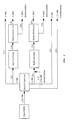
- Figures 1 and 2 each show is a schematic representation of an embodiment of the inventive Procedure.
- This is exemplified by i-butyraldehyde and n-butyraldehyde referred to as alkanals. That as Raw mixture of i-butyraldehyde and n-butyraldehyde, as is the case, for example, by oxo synthesis from propylene is obtained, according to Figure 1, first by distillation separated into the i- and n-butyraldehydes. Any one Part can be removed as pure aldehyde, see the Streams (1).
- the hydrogenation product is then fed to a distillation (see streams (3)) to the alcohol formed, namely n-butanol or i-butanol (n-Bol or i-Bol). this will illustrated by the streams (4).
- the distillation takes place in usually in one or more columns, for example with a packing column. Pressure and temperature depend on each other the alcohol in question.
- the 1,3-diol accumulates in the high-boiling part of the distillation on, when using a column in the swamp, see the streams (5). From these high-boiling fractions, the 1,3-diol can be used in the usual way Be obtained way, for example by distillation under the above conditions.
- the aldol addition product is formed starting from one single alkanal. You then get a single, corresponding one 1,3-diol, starting from n-butyraldehyde, the EHD and starting from i-butyraldehyde, the TMPD.
- the hydrogenation is preferably carried out together with carried out the hydrogenation of an alkanal, for example with the Hydrogenation of n-butyraldehyde, see stream (7).
- part of the crude alkanal mixture which is caused by Oxo synthesis was obtained from propylene, subjected to distillation, to obtain the pure aldehydes, see the streams (1), (2) and (3).
- the remaining part of the raw mixture becomes one Subject to hydrogenation under the above conditions. Analogously to the embodiment according to FIG. 1, this occurs Formation of the aldol addition product and its simultaneous Hydrogenation to the corresponding 1,3-diol, see stream (4).
- the Product of the hydrogenation is then subjected to distillation, for example distillation in one or more columns Columns as described above.
- n-butanol and i-butanol distilled off and separated and removed, see streams (6) and (7).
- the 1,3-diol accumulates in the high-boiling distillation Share in the distillation in a column in the Swamp.
- the high-boiling fraction is used to obtain the 1,3-diol in turn subjected to distillation, namely under the above conditions.
- the one obtained in the distillation of the aldehyde mixture high-boiling portion (see electricity (9)), which is also the Contains aldol addition product, a hydrogenation and distillation be subjected to the recovery of the 1,3-diol.
- the high-boiling fraction is hydrogenated simultaneously with the aldehyde mixture, see stream (10) and further worked up as described above.
- the amount of 1,3-diols formed is about 40 to 60% by weight of the high-boiling portion.
Landscapes
- Chemical & Material Sciences (AREA)
- Organic Chemistry (AREA)
- Chemical Kinetics & Catalysis (AREA)
- Organic Low-Molecular-Weight Compounds And Preparation Thereof (AREA)
- Low-Molecular Organic Synthesis Reactions Using Catalysts (AREA)
- Saccharide Compounds (AREA)
Applications Claiming Priority (2)
| Application Number | Priority Date | Filing Date | Title |
|---|---|---|---|
| DE19948112A DE19948112A1 (de) | 1999-10-06 | 1999-10-06 | Verfahren zur Herstellung von 1,3-Diolen |
| DE19948112 | 1999-10-06 |
Publications (3)
| Publication Number | Publication Date |
|---|---|
| EP1090899A2 true EP1090899A2 (fr) | 2001-04-11 |
| EP1090899A3 EP1090899A3 (fr) | 2003-10-15 |
| EP1090899B1 EP1090899B1 (fr) | 2006-06-21 |
Family
ID=7924669
Family Applications (1)
| Application Number | Title | Priority Date | Filing Date |
|---|---|---|---|
| EP00121800A Expired - Lifetime EP1090899B1 (fr) | 1999-10-06 | 2000-10-05 | Procédé de préparation de 1,3-dioles |
Country Status (5)
| Country | Link |
|---|---|
| US (1) | US6380443B1 (fr) |
| EP (1) | EP1090899B1 (fr) |
| JP (1) | JP2001114711A (fr) |
| AT (1) | ATE330926T1 (fr) |
| DE (2) | DE19948112A1 (fr) |
Cited By (1)
| Publication number | Priority date | Publication date | Assignee | Title |
|---|---|---|---|---|
| WO2003043963A1 (fr) * | 2001-11-15 | 2003-05-30 | Basf Aktiengesellschaft | Procede permettant de supprimer les acetals contenant de l'aldehyde formique d'alcools polyvalents par recuisson |
Families Citing this family (2)
| Publication number | Priority date | Publication date | Assignee | Title |
|---|---|---|---|---|
| DE102008033163B4 (de) * | 2008-07-15 | 2012-06-14 | Oxea Gmbh | Verfahren zur Gewinnung von Neopentylglykol durch Spaltung von im Herstellverfahren anfallenden Hochsiedern |
| TWI905687B (zh) * | 2023-04-13 | 2025-11-21 | 日商Dic股份有限公司 | 六亞甲基(甲基)丙烯酸酯組成物、活性能量線硬化型樹脂組成物、硬化物 |
Family Cites Families (10)
| Publication number | Priority date | Publication date | Assignee | Title |
|---|---|---|---|---|
| US4021497A (en) | 1966-06-25 | 1977-05-03 | Badische Anilin- & Soda-Fabrik Aktiengesellschaft | Production of 2-ethylhexanol-(1) by hydrogenation of 2-ethylhexen-(2)-al-(1) |
| US4225726A (en) * | 1979-05-23 | 1980-09-30 | Eastman Kodak Company | Catalytic condensation of aldehydes to 1,3-glycol monoesters |
| JP2525868B2 (ja) | 1988-05-25 | 1996-08-21 | 協和油化株式会社 | 2−エチル−1,3−ヘキサンジオ―ルの製法 |
| JPH085822B2 (ja) | 1988-07-29 | 1996-01-24 | 協和油化株式会社 | 2−エチル−1,3−ヘキサンジオールの製法 |
| WO1993010071A1 (fr) * | 1991-11-22 | 1993-05-27 | Catalytica, Inc. | Procede de production de carbonyles |
| FI95690C (fi) * | 1993-09-07 | 1996-03-11 | Neste Oy | Menetelmä 2-etyyli-1,3-heksaanidiolin valmistamiseksi |
| WO1997016401A1 (fr) | 1995-11-03 | 1997-05-09 | Union Carbide Chemicals & Plastics Technology Corporation | Melanges reactionnels contenant des diols d'hydrocarbures substitues et procedes de preparation |
| EP0935594B1 (fr) * | 1996-10-22 | 2002-01-23 | Lg Chemical Limited | Procede pour la production en continu de neopentylglycol |
| DE19757904C1 (de) * | 1997-12-24 | 1999-07-22 | Celanese Gmbh | Verfahren zum Reinigen von Abwässern aus einer Aldolisierungsreaktion mit nachfolgender Hydrierung |
| DE19809418A1 (de) * | 1998-03-05 | 1999-09-09 | Basf Ag | Verfahren zur Hydrierung von Carbonylverbindungen |
-
1999
- 1999-10-06 DE DE19948112A patent/DE19948112A1/de not_active Withdrawn
-
2000
- 2000-10-03 US US09/677,862 patent/US6380443B1/en not_active Expired - Fee Related
- 2000-10-05 EP EP00121800A patent/EP1090899B1/fr not_active Expired - Lifetime
- 2000-10-05 AT AT00121800T patent/ATE330926T1/de not_active IP Right Cessation
- 2000-10-05 DE DE50013032T patent/DE50013032D1/de not_active Expired - Lifetime
- 2000-10-06 JP JP2000307760A patent/JP2001114711A/ja active Pending
Cited By (1)
| Publication number | Priority date | Publication date | Assignee | Title |
|---|---|---|---|---|
| WO2003043963A1 (fr) * | 2001-11-15 | 2003-05-30 | Basf Aktiengesellschaft | Procede permettant de supprimer les acetals contenant de l'aldehyde formique d'alcools polyvalents par recuisson |
Also Published As
| Publication number | Publication date |
|---|---|
| EP1090899B1 (fr) | 2006-06-21 |
| DE19948112A1 (de) | 2001-04-12 |
| ATE330926T1 (de) | 2006-07-15 |
| US6380443B1 (en) | 2002-04-30 |
| EP1090899A3 (fr) | 2003-10-15 |
| JP2001114711A (ja) | 2001-04-24 |
| DE50013032D1 (de) | 2006-08-03 |
Similar Documents
| Publication | Publication Date | Title |
|---|---|---|
| DE1957591C3 (de) | Verfahren zur Herstellung von 2,2- Dimethylpropandiol-(1,3) | |
| EP0216151B1 (fr) | Procédé pour la préparation de 2-ethyl hexanol | |
| DE102010033844B4 (de) | Verfahren zur Gewinnung von Di-Trimethylolpropan und mit Trimethylolpropan angereicherten Produktströmen aus den Nebenströmen der Trimethylolpropanherstellung | |
| WO2005058786A1 (fr) | Procede de production de tricyclodecandialdehyde | |
| DE2827795A1 (de) | Verfahren zur gewinnung von reinem neopentylglykol | |
| DE2713434C3 (de) | Verfahren zur Herstellung von 2-Äthylhexanol | |
| DE2923949C2 (de) | Verfahren zur Herstellung von 1,4-Butandiol durch katalytische Hydrierung von 1,4-Butindiol | |
| DE2928944A1 (de) | Verbessertes verfahren zur herstellung von hoeheren ungesaettigten ketonen | |
| DE69906620T2 (de) | Verfahren zur Herstellung von Alkoholen | |
| EP1090899B1 (fr) | Procédé de préparation de 1,3-dioles | |
| DE1804984A1 (de) | Verfahren zur Herstellung von 2,2-Dimethyl-1,3-propandiol | |
| DE3744212A1 (de) | Verfahren zur herstellung von 2-methylbutanal | |
| DE2128965A1 (de) | Verfahren zur Herstellung von Olefinoxyden | |
| EP2780313B1 (fr) | Procédé d'obtention de di-triméthylolpropane par distillation | |
| EP0919532B1 (fr) | Procédé pour la préparation d'alcools saturés | |
| EP1999102B1 (fr) | Procede de fabrication de n,n-dimethylaminoethoxyethanol | |
| EP0435072A2 (fr) | Procédé pour la préparation de N,N-diméthylamines | |
| EP2780308B1 (fr) | Procédé d'obtention de di-triméthylolpropane et de flux de produits enrichis en triméthylolpropane à partir des flux de sous-produits de la préparation de triméthylolpropane | |
| DE10251311A1 (de) | Verfahren zur integrierten Herstellung von 2-Ethylhexanol, 2-Ethylhexan-1,3-diol und 2,4-Diethyloctan-1,5-diol | |
| DE10149349A1 (de) | Verfahren zur Herstellung von 6-Methylheptan-2-on und dessen Verwendung | |
| DE2740216B1 (de) | Verfahren zur Aufarbeitung von Destillationsrueckstaenden der Propen-Hydroformylierung | |
| EP1189859B1 (fr) | Procede de production d'hexanediol | |
| DE2045668C3 (de) | Verfahren zur Gewinnung von reinem 2,2-Dimethylpropandiol-(l,3) | |
| EP1889825A1 (fr) | Procédé pour la synthèse du 1,2-propanediol | |
| EP0927713B1 (fr) | Procédé de préparation d'esters d'acides 2-acétylcarboxyliques |
Legal Events
| Date | Code | Title | Description |
|---|---|---|---|
| PUAI | Public reference made under article 153(3) epc to a published international application that has entered the european phase |
Free format text: ORIGINAL CODE: 0009012 |
|
| AK | Designated contracting states |
Kind code of ref document: A2 Designated state(s): AT BE CH CY DE DK ES FI FR GB GR IE IT LI LU MC NL PT SE |
|
| AX | Request for extension of the european patent |
Free format text: AL;LT;LV;MK;RO;SI |
|
| PUAL | Search report despatched |
Free format text: ORIGINAL CODE: 0009013 |
|
| AK | Designated contracting states |
Kind code of ref document: A3 Designated state(s): AT BE CH CY DE DK ES FI FR GB GR IE IT LI LU MC NL PT SE |
|
| AX | Request for extension of the european patent |
Extension state: AL LT LV MK RO SI |
|
| 17P | Request for examination filed |
Effective date: 20040415 |
|
| AKX | Designation fees paid |
Designated state(s): AT BE CH CY DE DK ES FI FR GB GR IE IT LI LU MC NL PT SE |
|
| 17Q | First examination report despatched |
Effective date: 20040917 |
|
| GRAP | Despatch of communication of intention to grant a patent |
Free format text: ORIGINAL CODE: EPIDOSNIGR1 |
|
| GRAS | Grant fee paid |
Free format text: ORIGINAL CODE: EPIDOSNIGR3 |
|
| GRAA | (expected) grant |
Free format text: ORIGINAL CODE: 0009210 |
|
| AK | Designated contracting states |
Kind code of ref document: B1 Designated state(s): AT BE CH CY DE DK ES FI FR GB GR IE IT LI LU MC NL PT SE |
|
| PG25 | Lapsed in a contracting state [announced via postgrant information from national office to epo] |
Ref country code: IT Free format text: LAPSE BECAUSE OF FAILURE TO SUBMIT A TRANSLATION OF THE DESCRIPTION OR TO PAY THE FEE WITHIN THE PRESCRIBED TIME-LIMIT;WARNING: LAPSES OF ITALIAN PATENTS WITH EFFECTIVE DATE BEFORE 2007 MAY HAVE OCCURRED AT ANY TIME BEFORE 2007. THE CORRECT EFFECTIVE DATE MAY BE DIFFERENT FROM THE ONE RECORDED. Effective date: 20060621 Ref country code: GB Free format text: LAPSE BECAUSE OF FAILURE TO SUBMIT A TRANSLATION OF THE DESCRIPTION OR TO PAY THE FEE WITHIN THE PRESCRIBED TIME-LIMIT Effective date: 20060621 Ref country code: NL Free format text: LAPSE BECAUSE OF FAILURE TO SUBMIT A TRANSLATION OF THE DESCRIPTION OR TO PAY THE FEE WITHIN THE PRESCRIBED TIME-LIMIT Effective date: 20060621 Ref country code: IE Free format text: LAPSE BECAUSE OF FAILURE TO SUBMIT A TRANSLATION OF THE DESCRIPTION OR TO PAY THE FEE WITHIN THE PRESCRIBED TIME-LIMIT Effective date: 20060621 Ref country code: FI Free format text: LAPSE BECAUSE OF FAILURE TO SUBMIT A TRANSLATION OF THE DESCRIPTION OR TO PAY THE FEE WITHIN THE PRESCRIBED TIME-LIMIT Effective date: 20060621 |
|
| REG | Reference to a national code |
Ref country code: GB Ref legal event code: FG4D Free format text: NOT ENGLISH |
|
| REG | Reference to a national code |
Ref country code: CH Ref legal event code: EP |
|
| REG | Reference to a national code |
Ref country code: IE Ref legal event code: FG4D Free format text: LANGUAGE OF EP DOCUMENT: GERMAN |
|
| REF | Corresponds to: |
Ref document number: 50013032 Country of ref document: DE Date of ref document: 20060803 Kind code of ref document: P |
|
| PG25 | Lapsed in a contracting state [announced via postgrant information from national office to epo] |
Ref country code: SE Free format text: LAPSE BECAUSE OF FAILURE TO SUBMIT A TRANSLATION OF THE DESCRIPTION OR TO PAY THE FEE WITHIN THE PRESCRIBED TIME-LIMIT Effective date: 20060921 Ref country code: DK Free format text: LAPSE BECAUSE OF FAILURE TO SUBMIT A TRANSLATION OF THE DESCRIPTION OR TO PAY THE FEE WITHIN THE PRESCRIBED TIME-LIMIT Effective date: 20060921 |
|
| PG25 | Lapsed in a contracting state [announced via postgrant information from national office to epo] |
Ref country code: ES Free format text: LAPSE BECAUSE OF FAILURE TO SUBMIT A TRANSLATION OF THE DESCRIPTION OR TO PAY THE FEE WITHIN THE PRESCRIBED TIME-LIMIT Effective date: 20061002 |
|
| PG25 | Lapsed in a contracting state [announced via postgrant information from national office to epo] |
Ref country code: LI Free format text: LAPSE BECAUSE OF NON-PAYMENT OF DUE FEES Effective date: 20061031 Ref country code: CH Free format text: LAPSE BECAUSE OF NON-PAYMENT OF DUE FEES Effective date: 20061031 Ref country code: MC Free format text: LAPSE BECAUSE OF NON-PAYMENT OF DUE FEES Effective date: 20061031 |
|
| PG25 | Lapsed in a contracting state [announced via postgrant information from national office to epo] |
Ref country code: PT Free format text: LAPSE BECAUSE OF FAILURE TO SUBMIT A TRANSLATION OF THE DESCRIPTION OR TO PAY THE FEE WITHIN THE PRESCRIBED TIME-LIMIT Effective date: 20061121 |
|
| NLV1 | Nl: lapsed or annulled due to failure to fulfill the requirements of art. 29p and 29m of the patents act | ||
| GBV | Gb: ep patent (uk) treated as always having been void in accordance with gb section 77(7)/1977 [no translation filed] |
Effective date: 20060621 |
|
| REG | Reference to a national code |
Ref country code: IE Ref legal event code: FD4D |
|
| PLBE | No opposition filed within time limit |
Free format text: ORIGINAL CODE: 0009261 |
|
| STAA | Information on the status of an ep patent application or granted ep patent |
Free format text: STATUS: NO OPPOSITION FILED WITHIN TIME LIMIT |
|
| EN | Fr: translation not filed | ||
| 26N | No opposition filed |
Effective date: 20070322 |
|
| REG | Reference to a national code |
Ref country code: CH Ref legal event code: PL |
|
| BERE | Be: lapsed |
Owner name: BASF A.G. Effective date: 20061031 |
|
| PG25 | Lapsed in a contracting state [announced via postgrant information from national office to epo] |
Ref country code: AT Free format text: LAPSE BECAUSE OF NON-PAYMENT OF DUE FEES Effective date: 20061005 |
|
| PG25 | Lapsed in a contracting state [announced via postgrant information from national office to epo] |
Ref country code: FR Free format text: LAPSE BECAUSE OF FAILURE TO SUBMIT A TRANSLATION OF THE DESCRIPTION OR TO PAY THE FEE WITHIN THE PRESCRIBED TIME-LIMIT Effective date: 20070309 Ref country code: GR Free format text: LAPSE BECAUSE OF FAILURE TO SUBMIT A TRANSLATION OF THE DESCRIPTION OR TO PAY THE FEE WITHIN THE PRESCRIBED TIME-LIMIT Effective date: 20060922 |
|
| PG25 | Lapsed in a contracting state [announced via postgrant information from national office to epo] |
Ref country code: LU Free format text: LAPSE BECAUSE OF NON-PAYMENT OF DUE FEES Effective date: 20061005 |
|
| PG25 | Lapsed in a contracting state [announced via postgrant information from national office to epo] |
Ref country code: CY Free format text: LAPSE BECAUSE OF FAILURE TO SUBMIT A TRANSLATION OF THE DESCRIPTION OR TO PAY THE FEE WITHIN THE PRESCRIBED TIME-LIMIT Effective date: 20060621 Ref country code: FR Free format text: LAPSE BECAUSE OF FAILURE TO SUBMIT A TRANSLATION OF THE DESCRIPTION OR TO PAY THE FEE WITHIN THE PRESCRIBED TIME-LIMIT Effective date: 20060621 |
|
| PG25 | Lapsed in a contracting state [announced via postgrant information from national office to epo] |
Ref country code: BE Free format text: LAPSE BECAUSE OF FAILURE TO SUBMIT A TRANSLATION OF THE DESCRIPTION OR TO PAY THE FEE WITHIN THE PRESCRIBED TIME-LIMIT Effective date: 20061031 |
|
| PGFP | Annual fee paid to national office [announced via postgrant information from national office to epo] |
Ref country code: DE Payment date: 20091001 Year of fee payment: 10 |
|
| REG | Reference to a national code |
Ref country code: DE Ref legal event code: R119 Ref document number: 50013032 Country of ref document: DE Effective date: 20110502 |
|
| PG25 | Lapsed in a contracting state [announced via postgrant information from national office to epo] |
Ref country code: DE Free format text: LAPSE BECAUSE OF NON-PAYMENT OF DUE FEES Effective date: 20110502 |