EP1091932B1 - Chirale stationäre phasen für die trennung von enantiomeren und ihre herstellung - Google Patents
Chirale stationäre phasen für die trennung von enantiomeren und ihre herstellung Download PDFInfo
- Publication number
- EP1091932B1 EP1091932B1 EP99924833A EP99924833A EP1091932B1 EP 1091932 B1 EP1091932 B1 EP 1091932B1 EP 99924833 A EP99924833 A EP 99924833A EP 99924833 A EP99924833 A EP 99924833A EP 1091932 B1 EP1091932 B1 EP 1091932B1
- Authority
- EP
- European Patent Office
- Prior art keywords
- chiral
- dicyanobenzene
- nhcor
- amino
- mmol
- Prior art date
- Legal status (The legal status is an assumption and is not a legal conclusion. Google has not performed a legal analysis and makes no representation as to the accuracy of the status listed.)
- Expired - Lifetime
Links
- 230000005526 G1 to G0 transition Effects 0.000 title claims abstract description 95
- 238000000926 separation method Methods 0.000 title claims abstract description 14
- 238000002360 preparation method Methods 0.000 title claims abstract description 13
- HBAQYPYDRFILMT-UHFFFAOYSA-N 8-[3-(1-cyclopropylpyrazol-4-yl)-1H-pyrazolo[4,3-d]pyrimidin-5-yl]-3-methyl-3,8-diazabicyclo[3.2.1]octan-2-one Chemical class C1(CC1)N1N=CC(=C1)C1=NNC2=C1N=C(N=C2)N1C2C(N(CC1CC2)C)=O HBAQYPYDRFILMT-UHFFFAOYSA-N 0.000 title claims abstract description 12
- 125000006850 spacer group Chemical group 0.000 claims abstract description 32
- 229910052799 carbon Inorganic materials 0.000 claims abstract description 18
- 150000001875 compounds Chemical class 0.000 claims abstract description 16
- 125000004432 carbon atom Chemical group C* 0.000 claims abstract 7
- VYPSYNLAJGMNEJ-UHFFFAOYSA-N Silicium dioxide Chemical compound O=[Si]=O VYPSYNLAJGMNEJ-UHFFFAOYSA-N 0.000 claims description 32
- 229910052757 nitrogen Inorganic materials 0.000 claims description 30
- 239000000741 silica gel Substances 0.000 claims description 23
- 229910002027 silica gel Inorganic materials 0.000 claims description 23
- 239000000203 mixture Substances 0.000 claims description 20
- 125000000217 alkyl group Chemical group 0.000 claims description 18
- CRQQGFGUEAVUIL-UHFFFAOYSA-N chlorothalonil Chemical compound ClC1=C(Cl)C(C#N)=C(Cl)C(C#N)=C1Cl CRQQGFGUEAVUIL-UHFFFAOYSA-N 0.000 claims description 17
- 239000007787 solid Substances 0.000 claims description 17
- 125000003118 aryl group Chemical group 0.000 claims description 12
- 238000004587 chromatography analysis Methods 0.000 claims description 11
- 239000003153 chemical reaction reagent Substances 0.000 claims description 10
- 238000000034 method Methods 0.000 claims description 10
- 125000001309 chloro group Chemical group Cl* 0.000 claims description 9
- IJGRMHOSHXDMSA-UHFFFAOYSA-N Atomic nitrogen Chemical compound N#N IJGRMHOSHXDMSA-UHFFFAOYSA-N 0.000 claims description 8
- 230000015572 biosynthetic process Effects 0.000 claims description 8
- 238000006243 chemical reaction Methods 0.000 claims description 8
- 125000003710 aryl alkyl group Chemical group 0.000 claims description 7
- LAQPNDIUHRHNCV-UHFFFAOYSA-N isophthalonitrile Chemical group N#CC1=CC=CC(C#N)=C1 LAQPNDIUHRHNCV-UHFFFAOYSA-N 0.000 claims description 7
- MKARNSWMMBGSHX-UHFFFAOYSA-N 3,5-dimethylaniline Chemical compound CC1=CC(C)=CC(N)=C1 MKARNSWMMBGSHX-UHFFFAOYSA-N 0.000 claims description 6
- FSYKKLYZXJSNPZ-UHFFFAOYSA-N sarcosine Chemical compound C[NH2+]CC([O-])=O FSYKKLYZXJSNPZ-UHFFFAOYSA-N 0.000 claims description 4
- ZGUNAGUHMKGQNY-ZETCQYMHSA-N L-alpha-phenylglycine zwitterion Chemical compound OC(=O)[C@@H](N)C1=CC=CC=C1 ZGUNAGUHMKGQNY-ZETCQYMHSA-N 0.000 claims description 3
- 239000000377 silicon dioxide Substances 0.000 claims description 3
- 229920001059 synthetic polymer Polymers 0.000 claims description 3
- RQEUFEKYXDPUSK-UHFFFAOYSA-N 1-phenylethylamine Chemical compound CC(N)C1=CC=CC=C1 RQEUFEKYXDPUSK-UHFFFAOYSA-N 0.000 claims description 2
- RUJHATQMIMUYKD-UHFFFAOYSA-N 2-naphthalen-1-ylethanamine Chemical compound C1=CC=C2C(CCN)=CC=CC2=C1 RUJHATQMIMUYKD-UHFFFAOYSA-N 0.000 claims description 2
- 239000005995 Aluminium silicate Substances 0.000 claims description 2
- DCXYFEDJOCDNAF-UHFFFAOYSA-N Asparagine Natural products OC(=O)C(N)CC(N)=O DCXYFEDJOCDNAF-UHFFFAOYSA-N 0.000 claims description 2
- ONIBWKKTOPOVIA-BYPYZUCNSA-N L-Proline Chemical compound OC(=O)[C@@H]1CCCN1 ONIBWKKTOPOVIA-BYPYZUCNSA-N 0.000 claims description 2
- DCXYFEDJOCDNAF-REOHCLBHSA-N L-asparagine Chemical compound OC(=O)[C@@H](N)CC(N)=O DCXYFEDJOCDNAF-REOHCLBHSA-N 0.000 claims description 2
- COLNVLDHVKWLRT-QMMMGPOBSA-N L-phenylalanine Chemical compound OC(=O)[C@@H](N)CC1=CC=CC=C1 COLNVLDHVKWLRT-QMMMGPOBSA-N 0.000 claims description 2
- FYYHWMGAXLPEAU-UHFFFAOYSA-N Magnesium Chemical compound [Mg] FYYHWMGAXLPEAU-UHFFFAOYSA-N 0.000 claims description 2
- BPQQTUXANYXVAA-UHFFFAOYSA-N Orthosilicate Chemical compound [O-][Si]([O-])([O-])[O-] BPQQTUXANYXVAA-UHFFFAOYSA-N 0.000 claims description 2
- ONIBWKKTOPOVIA-UHFFFAOYSA-N Proline Natural products OC(=O)C1CCCN1 ONIBWKKTOPOVIA-UHFFFAOYSA-N 0.000 claims description 2
- 108010077895 Sarcosine Proteins 0.000 claims description 2
- GWEVSGVZZGPLCZ-UHFFFAOYSA-N Titan oxide Chemical compound O=[Ti]=O GWEVSGVZZGPLCZ-UHFFFAOYSA-N 0.000 claims description 2
- PNEYBMLMFCGWSK-UHFFFAOYSA-N aluminium oxide Inorganic materials [O-2].[O-2].[O-2].[Al+3].[Al+3] PNEYBMLMFCGWSK-UHFFFAOYSA-N 0.000 claims description 2
- 235000012211 aluminium silicate Nutrition 0.000 claims description 2
- 229960001230 asparagine Drugs 0.000 claims description 2
- 235000009582 asparagine Nutrition 0.000 claims description 2
- 125000004429 atom Chemical group 0.000 claims description 2
- HQABUPZFAYXKJW-UHFFFAOYSA-N butan-1-amine Chemical compound CCCCN HQABUPZFAYXKJW-UHFFFAOYSA-N 0.000 claims description 2
- 125000003178 carboxy group Chemical group [H]OC(*)=O 0.000 claims description 2
- 238000013375 chromatographic separation Methods 0.000 claims description 2
- 125000004122 cyclic group Chemical group 0.000 claims description 2
- 125000000753 cycloalkyl group Chemical group 0.000 claims description 2
- 125000005842 heteroatom Chemical group 0.000 claims description 2
- NLYAJNPCOHFWQQ-UHFFFAOYSA-N kaolin Chemical compound O.O.O=[Al]O[Si](=O)O[Si](=O)O[Al]=O NLYAJNPCOHFWQQ-UHFFFAOYSA-N 0.000 claims description 2
- 239000011777 magnesium Substances 0.000 claims description 2
- 229910052749 magnesium Inorganic materials 0.000 claims description 2
- 125000000956 methoxy group Chemical group [H]C([H])([H])O* 0.000 claims description 2
- AGVKXDPPPSLISR-UHFFFAOYSA-N n-ethylcyclohexanamine Chemical compound CCNC1CCCCC1 AGVKXDPPPSLISR-UHFFFAOYSA-N 0.000 claims description 2
- 229910052760 oxygen Inorganic materials 0.000 claims description 2
- COLNVLDHVKWLRT-UHFFFAOYSA-N phenylalanine Natural products OC(=O)C(N)CC1=CC=CC=C1 COLNVLDHVKWLRT-UHFFFAOYSA-N 0.000 claims description 2
- 229940043230 sarcosine Drugs 0.000 claims description 2
- OGIDPMRJRNCKJF-UHFFFAOYSA-N titanium oxide Inorganic materials [Ti]=O OGIDPMRJRNCKJF-UHFFFAOYSA-N 0.000 claims description 2
- QUSNBJAOOMFDIB-UHFFFAOYSA-N Ethylamine Chemical compound CCN QUSNBJAOOMFDIB-UHFFFAOYSA-N 0.000 claims 2
- 238000004128 high performance liquid chromatography Methods 0.000 claims 1
- 125000001424 substituent group Chemical group 0.000 abstract description 12
- YXFVVABEGXRONW-UHFFFAOYSA-N Toluene Chemical compound CC1=CC=CC=C1 YXFVVABEGXRONW-UHFFFAOYSA-N 0.000 description 60
- OKKJLVBELUTLKV-UHFFFAOYSA-N Methanol Chemical compound OC OKKJLVBELUTLKV-UHFFFAOYSA-N 0.000 description 57
- YMWUJEATGCHHMB-UHFFFAOYSA-N Dichloromethane Chemical compound ClCCl YMWUJEATGCHHMB-UHFFFAOYSA-N 0.000 description 39
- 239000000047 product Substances 0.000 description 31
- 239000000460 chlorine Substances 0.000 description 23
- 229910052739 hydrogen Inorganic materials 0.000 description 23
- 229960001866 silicon dioxide Drugs 0.000 description 22
- WYURNTSHIVDZCO-UHFFFAOYSA-N Tetrahydrofuran Chemical compound C1CCOC1 WYURNTSHIVDZCO-UHFFFAOYSA-N 0.000 description 21
- KFZMGEQAYNKOFK-UHFFFAOYSA-N Isopropanol Chemical compound CC(C)O KFZMGEQAYNKOFK-UHFFFAOYSA-N 0.000 description 18
- 239000000243 solution Substances 0.000 description 15
- ZMANZCXQSJIPKH-UHFFFAOYSA-N Triethylamine Chemical compound CCN(CC)CC ZMANZCXQSJIPKH-UHFFFAOYSA-N 0.000 description 12
- 238000010992 reflux Methods 0.000 description 11
- 125000000738 acetamido group Chemical group [H]C([H])([H])C(=O)N([H])[*] 0.000 description 10
- VLKZOEOYAKHREP-UHFFFAOYSA-N n-Hexane Chemical compound CCCCCC VLKZOEOYAKHREP-UHFFFAOYSA-N 0.000 description 10
- 239000011541 reaction mixture Substances 0.000 description 10
- GKQLYSROISKDLL-UHFFFAOYSA-N EEDQ Chemical compound C1=CC=C2N(C(=O)OCC)C(OCC)C=CC2=C1 GKQLYSROISKDLL-UHFFFAOYSA-N 0.000 description 9
- 150000001721 carbon Chemical group 0.000 description 9
- 238000003756 stirring Methods 0.000 description 9
- 150000001408 amides Chemical class 0.000 description 8
- 125000001495 ethyl group Chemical group [H]C([H])([H])C([H])([H])* 0.000 description 8
- XQZYPMVTSDWCCE-UHFFFAOYSA-N phthalonitrile Chemical group N#CC1=CC=CC=C1C#N XQZYPMVTSDWCCE-UHFFFAOYSA-N 0.000 description 8
- 239000003480 eluent Substances 0.000 description 7
- CSCPPACGZOOCGX-UHFFFAOYSA-N Acetone Chemical compound CC(C)=O CSCPPACGZOOCGX-UHFFFAOYSA-N 0.000 description 6
- WEVYAHXRMPXWCK-UHFFFAOYSA-N Acetonitrile Chemical compound CC#N WEVYAHXRMPXWCK-UHFFFAOYSA-N 0.000 description 6
- CDBYLPFSWZWCQE-UHFFFAOYSA-L Sodium Carbonate Chemical compound [Na+].[Na+].[O-]C([O-])=O CDBYLPFSWZWCQE-UHFFFAOYSA-L 0.000 description 6
- 238000004458 analytical method Methods 0.000 description 6
- 238000001704 evaporation Methods 0.000 description 6
- 230000008020 evaporation Effects 0.000 description 6
- -1 incompressible Substances 0.000 description 6
- 230000003993 interaction Effects 0.000 description 6
- 239000002904 solvent Substances 0.000 description 6
- 238000006467 substitution reaction Methods 0.000 description 6
- XLYOFNOQVPJJNP-UHFFFAOYSA-N water Substances O XLYOFNOQVPJJNP-UHFFFAOYSA-N 0.000 description 6
- WYTZZXDRDKSJID-UHFFFAOYSA-N (3-aminopropyl)triethoxysilane Chemical compound CCO[Si](OCC)(OCC)CCCN WYTZZXDRDKSJID-UHFFFAOYSA-N 0.000 description 5
- 125000003368 amide group Chemical group 0.000 description 5
- 239000012043 crude product Substances 0.000 description 5
- 238000001035 drying Methods 0.000 description 5
- 150000002148 esters Chemical class 0.000 description 5
- 125000002496 methyl group Chemical group [H]C([H])([H])* 0.000 description 5
- 239000000843 powder Substances 0.000 description 5
- 239000000725 suspension Substances 0.000 description 5
- 125000001637 1-naphthyl group Chemical group [H]C1=C([H])C([H])=C2C(*)=C([H])C([H])=C([H])C2=C1[H] 0.000 description 4
- 150000001412 amines Chemical class 0.000 description 4
- 229910052801 chlorine Inorganic materials 0.000 description 4
- 125000000113 cyclohexyl group Chemical group [H]C1([H])C([H])([H])C([H])([H])C([H])(*)C([H])([H])C1([H])[H] 0.000 description 4
- 238000000921 elemental analysis Methods 0.000 description 4
- 238000004811 liquid chromatography Methods 0.000 description 4
- SYSQUGFVNFXIIT-UHFFFAOYSA-N n-[4-(1,3-benzoxazol-2-yl)phenyl]-4-nitrobenzenesulfonamide Chemical class C1=CC([N+](=O)[O-])=CC=C1S(=O)(=O)NC1=CC=C(C=2OC3=CC=CC=C3N=2)C=C1 SYSQUGFVNFXIIT-UHFFFAOYSA-N 0.000 description 4
- 239000002253 acid Substances 0.000 description 3
- 235000008206 alpha-amino acids Nutrition 0.000 description 3
- 229940024606 amino acid Drugs 0.000 description 3
- 239000000706 filtrate Substances 0.000 description 3
- 238000001914 filtration Methods 0.000 description 3
- 238000010438 heat treatment Methods 0.000 description 3
- 229910052909 inorganic silicate Inorganic materials 0.000 description 3
- 229910000029 sodium carbonate Inorganic materials 0.000 description 3
- XBWOPGDJMAJJDG-SSDOTTSWSA-N (1r)-1-cyclohexylethanamine Chemical compound C[C@@H](N)C1CCCCC1 XBWOPGDJMAJJDG-SSDOTTSWSA-N 0.000 description 2
- XDHPCWLRPUJMLH-ZMFCMNQTSA-N (3r)-n'-[2,3-dichloro-4,6-dicyano-5-(3-triethoxysilylpropylamino)phenyl]-2-methyl-3-naphthalen-1-ylbutanehydrazide Chemical compound CCO[Si](OCC)(OCC)CCCNC1=C(C#N)C(Cl)=C(Cl)C(NNC(=O)C(C)[C@@H](C)C=2C3=CC=CC=C3C=CC=2)=C1C#N XDHPCWLRPUJMLH-ZMFCMNQTSA-N 0.000 description 2
- PAKUCVGIFIJNBQ-HXUWFJFHSA-N 2,5-dichloro-4-[[(1r)-1-naphthalen-1-ylethyl]amino]-6-(3-triethoxysilylpropylamino)benzene-1,3-dicarbonitrile Chemical compound ClC1=C(C#N)C(NCCC[Si](OCC)(OCC)OCC)=C(Cl)C(N[C@H](C)C=2C3=CC=CC=C3C=CC=2)=C1C#N PAKUCVGIFIJNBQ-HXUWFJFHSA-N 0.000 description 2
- RNPBWSAUXPRTFQ-HXUWFJFHSA-N 4,5-dichloro-6-[[(1r)-1-naphthalen-1-ylethyl]amino]-2-(3-triethoxysilylpropylamino)benzene-1,3-dicarbonitrile Chemical compound CCO[Si](OCC)(OCC)CCCNC1=C(C#N)C(Cl)=C(Cl)C(N[C@H](C)C=2C3=CC=CC=C3C=CC=2)=C1C#N RNPBWSAUXPRTFQ-HXUWFJFHSA-N 0.000 description 2
- MFVCEYPSFIYNNX-FQLXRVMXSA-N 5-chloro-4,6-bis[[(1r)-1-naphthalen-1-ylethyl]amino]-2-(3-triethoxysilylpropylamino)benzene-1,3-dicarbonitrile Chemical compound C1=CC=C2C([C@@H](C)NC=3C(Cl)=C(N[C@H](C)C=4C5=CC=CC=C5C=CC=4)C(C#N)=C(C=3C#N)NCCC[Si](OCC)(OCC)OCC)=CC=CC2=C1 MFVCEYPSFIYNNX-FQLXRVMXSA-N 0.000 description 2
- BVKZGUZCCUSVTD-UHFFFAOYSA-M Bicarbonate Chemical compound OC([O-])=O BVKZGUZCCUSVTD-UHFFFAOYSA-M 0.000 description 2
- LFQSCWFLJHTTHZ-UHFFFAOYSA-N Ethanol Chemical compound CCO LFQSCWFLJHTTHZ-UHFFFAOYSA-N 0.000 description 2
- PIICEJLVQHRZGT-UHFFFAOYSA-N Ethylenediamine Chemical compound NCCN PIICEJLVQHRZGT-UHFFFAOYSA-N 0.000 description 2
- LRHPLDYGYMQRHN-UHFFFAOYSA-N N-Butanol Chemical compound CCCCO LRHPLDYGYMQRHN-UHFFFAOYSA-N 0.000 description 2
- 229910020489 SiO3 Inorganic materials 0.000 description 2
- 150000001371 alpha-amino acids Chemical class 0.000 description 2
- 235000001014 amino acid Nutrition 0.000 description 2
- 150000001413 amino acids Chemical class 0.000 description 2
- 150000001735 carboxylic acids Chemical class 0.000 description 2
- 238000010828 elution Methods 0.000 description 2
- 238000003821 enantio-separation Methods 0.000 description 2
- RWSXRVCMGQZWBV-WDSKDSINSA-N glutathione Chemical compound OC(=O)[C@@H](N)CCC(=O)N[C@@H](CS)C(=O)NCC(O)=O RWSXRVCMGQZWBV-WDSKDSINSA-N 0.000 description 2
- 239000001257 hydrogen Substances 0.000 description 2
- 239000007788 liquid Substances 0.000 description 2
- 239000000463 material Substances 0.000 description 2
- YXBVXUSLYKBWQJ-BXXZMZEQSA-N n'-[2,3-dichloro-4,6-dicyano-5-(3-triethoxysilylpropylamino)phenyl]-2-[(1r)-1-naphthalen-1-ylethyl]hexanehydrazide Chemical compound CCCCC([C@@H](C)C=1C2=CC=CC=C2C=CC=1)C(=O)NNC1=C(Cl)C(Cl)=C(C#N)C(NCCC[Si](OCC)(OCC)OCC)=C1C#N YXBVXUSLYKBWQJ-BXXZMZEQSA-N 0.000 description 2
- PLTPZAMEUQYTTB-BXXZMZEQSA-N n'-[2,5-dichloro-4,6-dicyano-3-(3-triethoxysilylpropylamino)phenyl]-2-[(1r)-1-naphthalen-1-ylethyl]hexanehydrazide Chemical compound CCCCC([C@@H](C)C=1C2=CC=CC=C2C=CC=1)C(=O)NNC1=C(Cl)C(NCCC[Si](OCC)(OCC)OCC)=C(C#N)C(Cl)=C1C#N PLTPZAMEUQYTTB-BXXZMZEQSA-N 0.000 description 2
- 239000012074 organic phase Substances 0.000 description 2
- 239000012071 phase Substances 0.000 description 2
- 229960005190 phenylalanine Drugs 0.000 description 2
- XYKIUTSFQGXHOW-UHFFFAOYSA-N propan-2-one;toluene Chemical compound CC(C)=O.CC1=CC=CC=C1 XYKIUTSFQGXHOW-UHFFFAOYSA-N 0.000 description 2
- 238000000746 purification Methods 0.000 description 2
- 239000000126 substance Substances 0.000 description 2
- 238000003786 synthesis reaction Methods 0.000 description 2
- RBMGJIZCEWRQES-DKWTVANSSA-N (2s)-2,4-diamino-4-oxobutanoic acid;hydrate Chemical compound O.OC(=O)[C@@H](N)CC(N)=O RBMGJIZCEWRQES-DKWTVANSSA-N 0.000 description 1
- QVHJQCGUWFKTSE-YFKPBYRVSA-N (2s)-2-[(2-methylpropan-2-yl)oxycarbonylamino]propanoic acid Chemical compound OC(=O)[C@H](C)NC(=O)OC(C)(C)C QVHJQCGUWFKTSE-YFKPBYRVSA-N 0.000 description 1
- MIVUDAUOXJDARR-ZDUSSCGKSA-N (2s)-2-[(3,5-dinitrobenzoyl)amino]-2-phenylacetic acid Chemical compound N([C@H](C(=O)O)C=1C=CC=CC=1)C(=O)C1=CC([N+]([O-])=O)=CC([N+]([O-])=O)=C1 MIVUDAUOXJDARR-ZDUSSCGKSA-N 0.000 description 1
- CRQGZLHDANSGAO-ZMFCMNQTSA-N (3r)-n'-[2,5-dichloro-4,6-dicyano-3-(3-triethoxysilylpropylamino)phenyl]-2-methyl-3-naphthalen-1-ylbutanehydrazide Chemical compound ClC1=C(C#N)C(NCCC[Si](OCC)(OCC)OCC)=C(Cl)C(NNC(=O)C(C)[C@@H](C)C=2C3=CC=CC=C3C=CC=2)=C1C#N CRQGZLHDANSGAO-ZMFCMNQTSA-N 0.000 description 1
- XMWGTKZEDLCVIG-UHFFFAOYSA-N 1-(chloromethyl)naphthalene Chemical compound C1=CC=C2C(CCl)=CC=CC2=C1 XMWGTKZEDLCVIG-UHFFFAOYSA-N 0.000 description 1
- RTCUCQWIICFPOD-UHFFFAOYSA-N 1-naphthalen-1-ylethanamine Chemical compound C1=CC=C2C(C(N)C)=CC=CC2=C1 RTCUCQWIICFPOD-UHFFFAOYSA-N 0.000 description 1
- UCFCZJCSQWFDQL-WOJBJXKFSA-N 2,5-dichloro-4,6-bis[[(1r)-1-naphthalen-1-ylethyl]amino]benzene-1,3-dicarbonitrile Chemical compound C1=CC=C2C([C@H](NC=3C(=C(Cl)C(C#N)=C(N[C@H](C)C=4C5=CC=CC=C5C=CC=4)C=3Cl)C#N)C)=CC=CC2=C1 UCFCZJCSQWFDQL-WOJBJXKFSA-N 0.000 description 1
- CMWTZPSULFXXJA-UHFFFAOYSA-N 2-(6-methoxy-2-naphthalenyl)propanoic acid Chemical compound C1=C(C(C)C(O)=O)C=CC2=CC(OC)=CC=C21 CMWTZPSULFXXJA-UHFFFAOYSA-N 0.000 description 1
- OQHXZZGZASQSOB-UHFFFAOYSA-N 3,4,5,6-tetrachlorobenzene-1,2-dicarbonitrile Chemical compound ClC1=C(Cl)C(Cl)=C(C#N)C(C#N)=C1Cl OQHXZZGZASQSOB-UHFFFAOYSA-N 0.000 description 1
- IXJLVKLIFDJSNF-UHFFFAOYSA-N 4-[(2-aminocyclohexyl)amino]-2,5,6-trichlorobenzene-1,3-dicarbonitrile Chemical compound NC1CCCCC1NC1=C(Cl)C(Cl)=C(C#N)C(Cl)=C1C#N IXJLVKLIFDJSNF-UHFFFAOYSA-N 0.000 description 1
- OKTJSMMVPCPJKN-UHFFFAOYSA-N Carbon Chemical compound [C] OKTJSMMVPCPJKN-UHFFFAOYSA-N 0.000 description 1
- VEXZGXHMUGYJMC-UHFFFAOYSA-M Chloride anion Chemical compound [Cl-] VEXZGXHMUGYJMC-UHFFFAOYSA-M 0.000 description 1
- ZAMOUSCENKQFHK-UHFFFAOYSA-N Chlorine atom Chemical compound [Cl] ZAMOUSCENKQFHK-UHFFFAOYSA-N 0.000 description 1
- 229920000742 Cotton Polymers 0.000 description 1
- 108010024636 Glutathione Proteins 0.000 description 1
- 239000004395 L-leucine Substances 0.000 description 1
- VFRKPNCSRUVUKS-UHFFFAOYSA-N NC1=C(C#N)C=C(Cl)C(Cl)=C1C#N Chemical compound NC1=C(C#N)C=C(Cl)C(Cl)=C1C#N VFRKPNCSRUVUKS-UHFFFAOYSA-N 0.000 description 1
- UIIMBOGNXHQVGW-DEQYMQKBSA-M Sodium bicarbonate-14C Chemical compound [Na+].O[14C]([O-])=O UIIMBOGNXHQVGW-DEQYMQKBSA-M 0.000 description 1
- 239000003929 acidic solution Substances 0.000 description 1
- 229960003767 alanine Drugs 0.000 description 1
- 150000001298 alcohols Chemical class 0.000 description 1
- 125000003545 alkoxy group Chemical group 0.000 description 1
- 150000001370 alpha-amino acid derivatives Chemical class 0.000 description 1
- 150000003975 aryl alkyl amines Chemical class 0.000 description 1
- 150000001541 aziridines Chemical class 0.000 description 1
- 125000001797 benzyl group Chemical group [H]C1=C([H])C([H])=C(C([H])=C1[H])C([H])([H])* 0.000 description 1
- 239000004202 carbamide Substances 0.000 description 1
- 238000009833 condensation Methods 0.000 description 1
- 230000005494 condensation Effects 0.000 description 1
- 238000001816 cooling Methods 0.000 description 1
- 150000003983 crown ethers Chemical class 0.000 description 1
- 239000013078 crystal Substances 0.000 description 1
- 238000002425 crystallisation Methods 0.000 description 1
- 230000001186 cumulative effect Effects 0.000 description 1
- SSJXIUAHEKJCMH-UHFFFAOYSA-N cyclohexane-1,2-diamine Chemical compound NC1CCCCC1N SSJXIUAHEKJCMH-UHFFFAOYSA-N 0.000 description 1
- 150000002118 epoxides Chemical class 0.000 description 1
- 238000003818 flash chromatography Methods 0.000 description 1
- 125000000524 functional group Chemical group 0.000 description 1
- 230000000855 fungicidal effect Effects 0.000 description 1
- 239000000417 fungicide Substances 0.000 description 1
- 229960003180 glutathione Drugs 0.000 description 1
- 125000000623 heterocyclic group Chemical group 0.000 description 1
- XPXMKIXDFWLRAA-UHFFFAOYSA-N hydrazinide Chemical compound [NH-]N XPXMKIXDFWLRAA-UHFFFAOYSA-N 0.000 description 1
- 229960003136 leucine Drugs 0.000 description 1
- 230000014759 maintenance of location Effects 0.000 description 1
- 238000004519 manufacturing process Methods 0.000 description 1
- 239000011159 matrix material Substances 0.000 description 1
- MGJXBDMLVWIYOQ-UHFFFAOYSA-N methylazanide Chemical compound [NH-]C MGJXBDMLVWIYOQ-UHFFFAOYSA-N 0.000 description 1
- CSPULMIKIZSITD-CQSZACIVSA-N n-[(1r)-1-cyclohexylethyl]naphthalen-1-amine Chemical compound C1([C@H](NC=2C3=CC=CC=C3C=CC=2)C)CCCCC1 CSPULMIKIZSITD-CQSZACIVSA-N 0.000 description 1
- 125000001624 naphthyl group Chemical group 0.000 description 1
- 229920005615 natural polymer Polymers 0.000 description 1
- 239000003960 organic solvent Substances 0.000 description 1
- 125000004430 oxygen atom Chemical group O* 0.000 description 1
- 125000001997 phenyl group Chemical group [H]C1=C([H])C([H])=C(*)C([H])=C1[H] 0.000 description 1
- 239000002798 polar solvent Substances 0.000 description 1
- 239000002244 precipitate Substances 0.000 description 1
- 230000035484 reaction time Effects 0.000 description 1
- 230000002441 reversible effect Effects 0.000 description 1
- 150000003333 secondary alcohols Chemical class 0.000 description 1
- 239000002002 slurry Substances 0.000 description 1
- 239000011343 solid material Substances 0.000 description 1
- 239000012265 solid product Substances 0.000 description 1
- 238000003860 storage Methods 0.000 description 1
- 150000003573 thiols Chemical class 0.000 description 1
- 238000002604 ultrasonography Methods 0.000 description 1
- 238000005406 washing Methods 0.000 description 1
Images








Classifications
-
- B—PERFORMING OPERATIONS; TRANSPORTING
- B01—PHYSICAL OR CHEMICAL PROCESSES OR APPARATUS IN GENERAL
- B01D—SEPARATION
- B01D15/00—Separating processes involving the treatment of liquids with solid sorbents; Apparatus therefor
- B01D15/08—Selective adsorption, e.g. chromatography
- B01D15/26—Selective adsorption, e.g. chromatography characterised by the separation mechanism
- B01D15/38—Selective adsorption, e.g. chromatography characterised by the separation mechanism involving specific interaction not covered by one or more of groups B01D15/265 and B01D15/30 - B01D15/36, e.g. affinity, ligand exchange or chiral chromatography
- B01D15/3833—Chiral chromatography
-
- B—PERFORMING OPERATIONS; TRANSPORTING
- B01—PHYSICAL OR CHEMICAL PROCESSES OR APPARATUS IN GENERAL
- B01J—CHEMICAL OR PHYSICAL PROCESSES, e.g. CATALYSIS OR COLLOID CHEMISTRY; THEIR RELEVANT APPARATUS
- B01J20/00—Solid sorbent compositions or filter aid compositions; Sorbents for chromatography; Processes for preparing, regenerating or reactivating thereof
- B01J20/281—Sorbents specially adapted for preparative, analytical or investigative chromatography
- B01J20/286—Phases chemically bonded to a substrate, e.g. to silica or to polymers
- B01J20/288—Polar phases
-
- B—PERFORMING OPERATIONS; TRANSPORTING
- B01—PHYSICAL OR CHEMICAL PROCESSES OR APPARATUS IN GENERAL
- B01J—CHEMICAL OR PHYSICAL PROCESSES, e.g. CATALYSIS OR COLLOID CHEMISTRY; THEIR RELEVANT APPARATUS
- B01J20/00—Solid sorbent compositions or filter aid compositions; Sorbents for chromatography; Processes for preparing, regenerating or reactivating thereof
- B01J20/281—Sorbents specially adapted for preparative, analytical or investigative chromatography
- B01J20/29—Chiral phases
-
- B—PERFORMING OPERATIONS; TRANSPORTING
- B01—PHYSICAL OR CHEMICAL PROCESSES OR APPARATUS IN GENERAL
- B01J—CHEMICAL OR PHYSICAL PROCESSES, e.g. CATALYSIS OR COLLOID CHEMISTRY; THEIR RELEVANT APPARATUS
- B01J20/00—Solid sorbent compositions or filter aid compositions; Sorbents for chromatography; Processes for preparing, regenerating or reactivating thereof
- B01J20/30—Processes for preparing, regenerating, or reactivating
- B01J20/32—Impregnating or coating ; Solid sorbent compositions obtained from processes involving impregnating or coating
- B01J20/3202—Impregnating or coating ; Solid sorbent compositions obtained from processes involving impregnating or coating characterised by the carrier, support or substrate used for impregnation or coating
- B01J20/3204—Inorganic carriers, supports or substrates
-
- B—PERFORMING OPERATIONS; TRANSPORTING
- B01—PHYSICAL OR CHEMICAL PROCESSES OR APPARATUS IN GENERAL
- B01J—CHEMICAL OR PHYSICAL PROCESSES, e.g. CATALYSIS OR COLLOID CHEMISTRY; THEIR RELEVANT APPARATUS
- B01J20/00—Solid sorbent compositions or filter aid compositions; Sorbents for chromatography; Processes for preparing, regenerating or reactivating thereof
- B01J20/30—Processes for preparing, regenerating, or reactivating
- B01J20/32—Impregnating or coating ; Solid sorbent compositions obtained from processes involving impregnating or coating
- B01J20/3202—Impregnating or coating ; Solid sorbent compositions obtained from processes involving impregnating or coating characterised by the carrier, support or substrate used for impregnation or coating
- B01J20/3206—Organic carriers, supports or substrates
- B01J20/3208—Polymeric carriers, supports or substrates
-
- B—PERFORMING OPERATIONS; TRANSPORTING
- B01—PHYSICAL OR CHEMICAL PROCESSES OR APPARATUS IN GENERAL
- B01J—CHEMICAL OR PHYSICAL PROCESSES, e.g. CATALYSIS OR COLLOID CHEMISTRY; THEIR RELEVANT APPARATUS
- B01J20/00—Solid sorbent compositions or filter aid compositions; Sorbents for chromatography; Processes for preparing, regenerating or reactivating thereof
- B01J20/30—Processes for preparing, regenerating, or reactivating
- B01J20/32—Impregnating or coating ; Solid sorbent compositions obtained from processes involving impregnating or coating
- B01J20/3231—Impregnating or coating ; Solid sorbent compositions obtained from processes involving impregnating or coating characterised by the coating or impregnating layer
- B01J20/3242—Layers with a functional group, e.g. an affinity material, a ligand, a reactant or a complexing group
- B01J20/3244—Non-macromolecular compounds
- B01J20/3246—Non-macromolecular compounds having a well defined chemical structure
- B01J20/3257—Non-macromolecular compounds having a well defined chemical structure the functional group or the linking, spacer or anchoring group as a whole comprising at least one of the heteroatoms nitrogen, oxygen or sulfur together with at least one silicon atom, these atoms not being part of the carrier as such
- B01J20/3263—Non-macromolecular compounds having a well defined chemical structure the functional group or the linking, spacer or anchoring group as a whole comprising at least one of the heteroatoms nitrogen, oxygen or sulfur together with at least one silicon atom, these atoms not being part of the carrier as such comprising a cyclic structure containing at least one of the heteroatoms nitrogen, oxygen or sulfur, e.g. an heterocyclic or heteroaromatic structure
-
- C—CHEMISTRY; METALLURGY
- C07—ORGANIC CHEMISTRY
- C07B—GENERAL METHODS OF ORGANIC CHEMISTRY; APPARATUS THEREFOR
- C07B57/00—Separation of optically-active compounds
-
- C—CHEMISTRY; METALLURGY
- C07—ORGANIC CHEMISTRY
- C07C—ACYCLIC OR CARBOCYCLIC COMPOUNDS
- C07C255/00—Carboxylic acid nitriles
- C07C255/49—Carboxylic acid nitriles having cyano groups bound to carbon atoms of six-membered aromatic rings of a carbon skeleton
- C07C255/58—Carboxylic acid nitriles having cyano groups bound to carbon atoms of six-membered aromatic rings of a carbon skeleton containing cyano groups and singly-bound nitrogen atoms, not being further bound to other hetero atoms, bound to the carbon skeleton
-
- C—CHEMISTRY; METALLURGY
- C07—ORGANIC CHEMISTRY
- C07K—PEPTIDES
- C07K5/00—Peptides containing up to four amino acids in a fully defined sequence; Derivatives thereof
- C07K5/04—Peptides containing up to four amino acids in a fully defined sequence; Derivatives thereof containing only normal peptide links
- C07K5/06—Dipeptides
- C07K5/06139—Dipeptides with the first amino acid being heterocyclic
- C07K5/06165—Dipeptides with the first amino acid being heterocyclic and Pro-amino acid; Derivatives thereof
-
- B—PERFORMING OPERATIONS; TRANSPORTING
- B01—PHYSICAL OR CHEMICAL PROCESSES OR APPARATUS IN GENERAL
- B01J—CHEMICAL OR PHYSICAL PROCESSES, e.g. CATALYSIS OR COLLOID CHEMISTRY; THEIR RELEVANT APPARATUS
- B01J2220/00—Aspects relating to sorbent materials
- B01J2220/50—Aspects relating to the use of sorbent or filter aid materials
- B01J2220/54—Sorbents specially adapted for analytical or investigative chromatography
Definitions
- the chiral stationary phases for LC are normally classified on the basis of their general structures.
- One group is based on either synthetic or natural polymers and is totally or intrinsically chiral.
- Another group is made up of chiral selectors with a low molecular weight bound to a solid, incompressible, matrix, generally silica.
- the latter provides remarkable advantages with respect to the former since the chiral selectors can be designed rationally (K.B. Lipkowitz, Modelling Enantiodifferentiation in Chiral Chromatography, in "A Practical Approach to Chiral Separation by Liquid Chromatography", G. Subramanian Editor, VCH, Weinheim, 1994, pp. 19-55).
- 1,3-dicyano-2,4,5,6,-tetrachlorobenzene is a fungicide widely used in agriculture; some of its derivatives such as glutathione are described in Tetrahedron, 1995, 51: 2331. None of these derivatives is used in chromatography.
- This invention relates to new derivatives of 1,3-dicyanobenzene containing one or more chiral groups and one group acting as a spacer.
- the stationary phases obtained from these derivatives provide an efficient separation of enantiomers.
- the present invention describes new chiral stationary phases, and the optically active compounds therein contained.
- the optically active compounds contained in the stationary phases are represented by the formula of structure (I), which comprise at least one asymmetric carbon atom and a substituent acting as a spacer.
- the stationary phases of the present invention can be used in the preparation of chromatographic columns useful for the analytical and preparative separation of enantiomers.
- the present invention regards chiral stationary phases for chromatography based on new chiral derivatives, hereinafter referred to as "chiral selectors".
- the X group represents preferably an ⁇ -aminoacid, ester of aminoacid, amide of aminoacid, arylalkylalcohol, arylcarboxylic acid, arylcarboxylic acid ester, arylcarboxylic acid ester, aminoamide, arylalkylamine.
- arylalkyl groups quoted above are preferably represented by the benzyl group.
- the aryl groups are preferably represented by either phenyl or naphthyl.
- the derivatives of formula (I) always contain at least one chiral carbon atom. This carbon atom is always contained in the X group and is normally represented by the carbon C* of the C*HR 2 R 3 group or it is contained in the R 3 substituent.
- a first group of selectors preferred is represented by formula (I) where:
- a third group of preferred selectors is represented by formula (I) where:
- a fourth group of selectors preferred is represented by formula (I) where:
- Formula (I) entails the presence of at least one X chiral substituent bound in meta position with respect to the Z group.
- formula (I) can contain two chiral groups in meta position with respect to the Z group, by conferring thus specific symmetry characters: if the two X substituents are structurally and stereochemically different from one another, the molecule acquires C1 symmetry; on the other side if the two X substituents are structurally and stereochemically identical, the molecule acquires C2 symmetry.
- Formula (I) always contains one spacer group as above defined.
- Preferred spacer groups are those where R 6 represents ethyl and n is 3.
- a most preferred spacer is the (3-triethoxylsilylpropyl)amino group.
- the spacer group can be indifferently present as an Y, Z group or as a further substituent of the chiral group. In this latter case (i.e.
- the R 3 substituents are preferably chosen among: (CH 2 ) p -CONHR 4 , (CH 2 ) p -CON(R 4 R 5 ), CONHCH(R 4 ) CONHR 4 .
- the spacer group allows to bind the molecule of formula (I) to a solid support and to form chiral stationary phases for chromatography.
- the linkage that forms can be represented in this way:
- the solid support can be of either of organic or, preferably, inorganic type. Suitable examples of solid inorganic support are silica gel, alumina, kaolin, titanium oxide, magnesium, silicate, synthetic polymers. The preferred solid support is silica (e.g. silica gel).
- the present invention relates also to a process for the production of chiral stationary phases.
- This process entails the use of 1,3-dicyano-2,4,5,6-tetrachlorobenzene as a reagent; as mentioned above, this product is commercially available.
- the above described process comprises the following steps:
- the above described process comprises the following steps:
- the above described process comprises the following steps:
- the chiral X groups are introduced in the 1,3-dicyano-2,4,5,6-tetrachlorobenzene by substitution of one or more of the chlorine atoms in position 2,4,6, using suitable reagents containing the X group.
- Examples of these reagents are ⁇ -aminoacids, ⁇ -arylalkyl amine, secondary alcohols, amides or esters of chiral carboxylic acids.
- Examples of specific reagents are: 1-phenylethylamine, proline, (1-(naphth-1-yl)ethylamine, phenylalanine, phenylglycine, n-butylamine, naphthylethylamine, 3,5-dimethylaniline, cyclohexylethylamine, sarcosine, asparagine.
- the introduction of X, Y and Z groups is performed by heating the reagents in a suitable solvent, possibly in the presence of an excess of this solvent.
- the operational temperature ranges from 20°C to 150°C and the reaction time ranges from 60 minutes to 80 hours.
- the reaction is preferably performed in a polar solvent or in a mixture of solvents. Moreover the times are shorter, ranging from 1 to 5 hours.
- an excess of liquid reagent molar excess 50 - 100 times
- the X chiral groups that are present in the stationary phases that are the object of this invention are in an optically pure form, that is they have a specific stereochemical configuration.
- the synthesis of the products of formula (II) and (I) that are the object of the present invention are carried out by using the nucleophylic reagents containing the X group in an optically pure form.
- the covalent binding between the spacer group and the solid support is obtained according to known chemical reactions comprising heating at high temperature in the presence of an organic solvent.
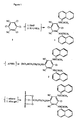
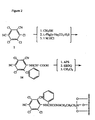
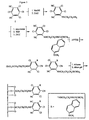
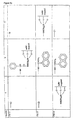
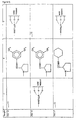
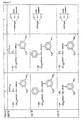
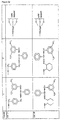
- FIG. 1 shows the preparation of stationary chiral phases called FSC 1, 5, 10, 20.
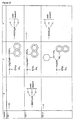
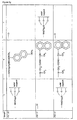
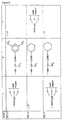
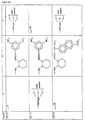
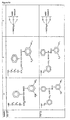
- the experimental part reports the preparation of stationary phases starting from a variety of chiral selectors of formula (I).
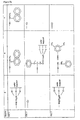
- the stationary phases (whose structures are illustrated in Figure 5) that are the object of the present invention allow the separation of several racemic mixtures of commercial interest.
- the use of these chiral stationary phases for the enantiomeric separation by chromatography, and in particular their use in the preparation of high performance liquid chromatographic columns (HPLC) constitutes a further aspect of the present invention.
- the present invention comprises a method of separation of enantiomeric mixtures by means of such chiral stationary phases. Examples of isomer separation by means of stationary phases object of the invention are reported in the experimental part.
- the stationary phases which are object of the present invention allow both the analytical and preparative separation of enantiomers of structurally different compounds and to determine the enantiomeric composition obtained by means of various asymmetric syntheses (V. Vinkovic et al., Tetrahedron, 1997, 53, 689; E. Ljubovic, et al. Tetrahedron: Asymm ., 1997, 8, 1).
- the separation process takes place by means of several efficient interactions for the enatioselection and also by means of new kinds of cumulative interaction that can be performed specifically and only by means of the selectors of formula (I) claimed in the present invention.
- the high electronegativity of the chlorine atom and the dipolar moment of the CN group of the chiral selector promotes the setting of polar interactions and the formation of hydrogen bonds with the enantiomers to be separated.
- the stationary phases claimed turned out to be effective in the separation of a wide number of enantiomers such as ⁇ -aminoacids and of their derivatives with N- and O-protection, carboxylic acids and their esters or heterocyclic or acyclic amides, amines, alcohols, thiols, epoxides and aziridines.
- enantiomers such as ⁇ -aminoacids and of their derivatives with N- and O-protection, carboxylic acids and their esters or heterocyclic or acyclic amides, amines, alcohols, thiols, epoxides and aziridines.
- This compound (3.28 g, 6.13 mmol) in excess of 3-aminopropyltriethoxysilane (10.0 ml, 42.5 mmol) is heated at 110°C for 24 hrs. The solution is cooled to room temperature, diluted with toluene, applied on to flash chromatography column with silica gel and eluted with toluene. The pure product (3.85 g, 87 %) is isolated as pale-yellow oil.
- IR (KBr): 3500, 3320, 2220, 1715, 1570, 1500, 1450, 1380, 1310, 1290, 1260, 1210, 1180, 1120, 1070, 1040, 1000, 960, 910, 860, 760, 720, 690 cm -1 .
- Example 6 4- ⁇ n-butyl-[R-1-(cyclohexyl)ethyl-N-R-(naphth-1-yl)methyl]acetamido ⁇ amino-6-(3-triethoxysiyspropyl)amino-2,5-trichioro-1,3-dicyanobenzene and 4- ⁇ n-butyl-[R-1-(cyclohexyl)ethyl-N-R-(naphth-1-yl)methyl]acetamido ⁇ amino-2-(3-triethoxysilylpropyl)amino-5,6-trichloro-1,3-dicyanobenzene
- the chiral selector (1.00 g, 1.63 mmol) prepared in the Example 5 and 3-aminopropyltriethoxysilane (APTES) (3.0 ml) are heated at 100°C for 1 hr.
- the crude product is purified by chromatography on silica gel column (30 g) using first toluene then toluene/acetone (30:1) as eluent. On evaporation of fractions containing the product, 0.99 g (76%) of pure product are obtained, as a mixture of title isomers (3:1).
- IR (KBr): 3400, 3340, 2960, 2920, 2720, 2200, 1650, 1570, 1510, 1460, 1440, 1410, 1390, 1360, 1340, 1300, 1260, 1220, 1200, 1160, 1100, 950, 890, 840, 790, 770, 680 cm -1 .
- Nucleosil 100-5 (2.03 g) are heated under reflux in dry toluene (5 ml) for 20 hr.
- the silica gel is filtered off, is washed with cold toluene, and dried in vacuo at 70°C for 4 hr. It is obtained 2.26 g of the chiral stationary phase FSC 8.
- Example 8 4- ⁇ 2-[2-(6-methoxy-naphth-2-yl)-propionylamido]ethyl ⁇ amino-2,5,6-trichloro-1,3-dicyanobenzene
- Example 9 4- ⁇ 2-[2-(6-methoxy-naphth-2-yl)-propionylamido]ethyl ⁇ amino-6-(3-triethoxysilylpropyl)amino-2,5-dichloro-1,3-dicyanobenzene and 4- ⁇ 2-[2-(6-methoxy-naphth-2-yl)-propionylamido]ethyl ⁇ amino-2-(3-triethoxysilylpropyl)amino-5,6-dichloro-1,3-dicyanobenzene
- Example 8 The compound prepared in Example 8 (0.7 g, 1.39 mmol) and 3-aminopropyltriethoxysilane (3.0 ml) are heated at 100°C bath temperature for 60 min. Purification by chromatography on silica gel column (35 g) with toluene as eluent afforded 0.92 g (96%) of the pure isomeric 1:1 product mixture.
- IR (KBr): 3340, 2950, 2200, 1650, 1570, 1510, 1450, 1390, 1350, 1260, 1200, 1150, 1060, 960, 850 i 760 cm -1 .
- Nucleosil 100-5 (1.69 g) are heated under reflux in dry toluene (5 ml) for 20 h.
- the modified silica gel is filtered off, washed with cold toluene, and dried in vacuo at 70°C for 4 hr. 2 g of the chiral stationary phase FSC 10 are obtained.
- Example 13 4-[L-prolinyl-L-alanilyl-(3,5-dimethylanilide)]-2,5,6-trichloro-1,3-dicyanobenzene
- N-Boc-L-alanine (2.77 g; 14.6 mmol) is transformed in 3,5-dimethylanilide by DCC (3.02 g, 14.6 mmol) promoted condensation with 3,5-dimethylaniline (1.77 g, 14.6 mmol), using dichloromethane as the solvent at ambient temperature. 1.78 g (63%) of the crude product are obtained.
- IR (KBr): 3380, 3300, 2980, 2920, 2880, 2220, 1660, 1610, 1550, 1520, 1440, 1350, 1260, 1210, 1170, 1140, 1060, 1000, 970, 920, 890, 840, 750, 730, 690 cm -1 .
- Example 14 4-[(L-prolinyl-L-alanilyl-(3,5-dimethylanilide)]-2,5-dichloro-6-(3-triethoxysilylpropyl)amino-1,3-dicyanobenzene, and 4-[L-prolinyl-L-alanilyl-(3,5-dimethylanilide)]-2,5-dichloro-2-(3-triethoxysilylpropyl)amino-1,3-dicyanobenzene
- IR (KBr): 3360, 2980, 2920, 2880, 2200, 1650, 1610, 1570, 1520, 1450, 1390, 1350, 1300, 1260, 1220, 1160, 1080, 950, 840, 780 i 690 cm -1 .
- a mixture of isomers from Example 14 (0.70 g, 1.0 mmol) and silica gel LiChrospher Si 100 (2.0 g, 10 mm) are heated under reflux of dry toluene for 20 h.
- the modified silica is collected on G-4 filter, is washed with toluene, then with 2-propanol, and n-hexane. On drying at 70°C for 4 h 1.94 g of FSC 18 are obtained.
- IR (KBr): 3340, 3300, 3120, 2960, 2920, 2860, 2220, 1600, 1580, 1480, 1450, 1400, 1360, 1350, 1270, 1240, 1220, 1190, 1100, 1070, 1040, 990, 930, 900, 870, 850, 840, 740, 730 i 610 cm -1 .
- IR (KBr): 3300, 3260, 3100, 2920, 2860, 2220, 1640, 1570, 1540, 1510, 1340, 1200, 1100, 1080, 920, 870, 850, 770, 750 i 720 cm -1 .
- Example 21 4- ⁇ [2-(3,5-dinitrobenzoyl)-cyclohexyl]amide ⁇ -2,5-dichloro-6-(3-triethoxysilylpropyl)amino-1,3-dicyanobenzene, and 4- ⁇ [2-(3,5-dinitrobenzoyl)-cyciohexyl]amide)amino-5,6-dichloro-2-(3-triethoxysilylpropyl)amino-1,3-dicyanobenzene
- IR (KBr): 3420, 3100, 2980, 2920, 2880, 2210, 2200, 1600, 1590, 1500, 1500, 1450, 1390, 1340, 1220, 1190, 1160, 1100, 1080, 950, 780, 730, 720, 680 cm -1 .
- Example 29 4-[(3,5-Dimethylanilido)-L-phenylalaninyl]-6-(3-triethoxysilyl)propylamino-2,5-dicloro-1,3-dicyanobenzene, and 4-[(3,5-dimethylanilido)-L-phenylalaninyl]-2-(3-triethoxysilyl)propylamino-5,6-dicloro, 1,3-dicyanobenzene
- IR (KBr): 3320, 3020, 2980, 2920, 2880, 2200, 1690, 1670, 1610, 1570, 1500, 1460, 1440, 1390,1360,1340, 1320, 1215, 1160, 1100, 950, 840, 790, 770, 740, 700,680 cm -1 .
- Example 30 4-[(Naphth-1-yl)amido)-L-phenylalaninyl]-2-(3-triethoxypropyl) amino-5,6-dichloro-1,3-dicyanobenzene and 4-[(Naphth-1-yl)amido)-L-phenylalaninyl]-6-(3-triethoxypropyl)amino-2,5-dichloro-1,3-dicyanobenzene
- IR (KBr): 3400, 3350, 3060, 3020, 2980, 2920, 2880, 2720, 2200, 2220, 1690, 1670, 1590, 1510, 1450, 1400, 1370, 1350, 1300, 1270, 1250, 1200, 1160, 1100, 1080, 950, 800, 770, 750, 700 cm -1 .
- Example 33 4-[R-1-(naphth-1-yl)ethyl]amino-2-(3-triethoxysilylpropyl)amino-5,6-dichloro-1,3-dicyanobenzene and 4-[R-1-(naphth-1-yl)ethyl]amino-6-(3-triethoxysilylpropyl)amino-2,5-dichloro-1,3-dicyanobenzene
- IR (KBr): 3390, 3370, 2980, 2920, 2880, 2200, 1580, 1510, 1500, 1440, 1390, 1360, 1300, 1270, 1220, 1190, 1160, 1100, 1070, 950, 760, 700 cm -1 .
- Example 35 4- ⁇ n-butyl-[R-1-(naphth-1-yl)ethyl]acetamido ⁇ amino-6-(3-triethoxysilylpropyl)amino-2,5-dichloro-1,3-dicyanobenzene, and 4- ⁇ n-butyl-[R-1 (naphth-1-yl)ethyl]acetamido ⁇ amino-2-(3-triethoxysilylpropyl)amino-5,6-dichloro-1,3-dicyanobenzene
- Example 37 4- ⁇ n-butyl-[N-R-1-(cyclohexyl)ethyl-N-3,5-dinitrobenzyl]acetamido ⁇ amino-6-(3-triethoxysilylpropyl)amino-2,5-dichloro-1,3-dicyanobenzene and 4- ⁇ n-butyl-[N-R-1-(cyclohexyl)ethyl-N-3,5-dinitrobenzyl]acetamido ⁇ amino-2-(3-triethoxysilylpropyl)amino-5,6-dichloro-1,3-dicyanobenzene
- Example 39 4- ⁇ methyl-[R-1-(naphth-1-yl)ethyl]acetamido ⁇ amino-2-(3-triethoxysilylpropyl)amino-5,6-dichloro-1,3-dicyanobenzene, and 4- ⁇ methyl-[R-1-(nephth-1-yl)ethyl]acetamido ⁇ amino-6-(3-Triethoxysilylpropyl)amino-2 , 5-dichloro-1,3-dicyanobenzene
- IR (KBr): 3380, 2980, 2920, 2880, 2200, 1670, 1580, 1510, 1450, 1390, 1360, 1300, 1220, 1160, 1100, 950, 780 cm- 1 .
- Example 42 4-[3,5-dimethylanilido)-L-alaninyl]-2,5-dichloro-6-(3-triethoxysilylpropyl)amino-1,3-dicyanobenzene, and 4-[3,5-dimethylanilido)-L-alaninyl]-5,6-dichloro-2-(3-triethoxysilylpropyl)amino-1,3-dicyanobenzene
- IR (KBr): 3325, 2980, 2920, 2880, 2200, 1680, 1610, 1590, 1510, 1450, 1390, 1200, 1160, 1100, 1080, 950, 840, 780, 690 cm -1 .
- Example 44 4-(cyclohexylamido-L-alaninyl)-2,5-dichloro-6-(3-triethoxysilylpropyl)amino-1,3-dicyanobenzene, and 4-(cyclohexylamido-L-alaninyl)-5,6-dichloro-2-(3-triethoxysilylpropyl)amino-1,3-dicyanobenzene
- Example 56 4-[(3,5-dimethylanilido)-prolinyl]-2,5-dichloro-6-(3-triethoxysilylpropyl)amino-1,3-dicyanobenzene, and 4-[(3,5-dimethylanilido)-prolinyl]-5,6-Dichloro-2-(3-triethoxysilylpropyl)amino1,3-dicyanobenzene
- IR (KBr): 3330, 2990, 2960, 2940, 2200, 1680, 1610, 1580, 1530, 1450, 1390, 1350, 1300, 1200, 1160, 1000, 950, 840, 780, 690 cm -1 .
- Example 48 4-(prolinyl-cyclohexylamide)-2,5-dichloro-6-(3-triethoxysilylpropyl)amino-1,3-dicyanobenzene, and 4-(prolinyl-cyclohexylamide)-5,6-dichloro-2-(3-triethoxysilylpropyl)amino-1,3-dicyanobenzene
- IR (KBr): 3440, 2990, 2960, 2940, 2200, 1660, 1580, 1520, 1470, 1450, 1390, 1350, 1300, 1200, 1190, 1160, 1100, 1080, 950, 780 cm -1 .
- Example 50 4 - ⁇ 2-[2-(6-methoxy-naphth-2-yl)-propionylamido]cyclohexyl ⁇ amino-6-(3-triethoxysilylpropyl)amino-2,5-dichloro-1,3-dicyanobenzene and 4- ⁇ 2-[2-(6-methoxy-naphth-2-yl)-propionylamido]cyclohexyl ⁇ amino-2-(3-triethoxysilylpropyl)amino-5,6-dichloro-1,3-dicyanobenzene
- IR (KBr): 3350, 2940, 2200, 1650, 1580, 1510, 1450, 1390, 1350, 1260, 1200, 1160, 1070, 950, 850 i 770 cm -1 .
Landscapes
- Chemical & Material Sciences (AREA)
- Organic Chemistry (AREA)
- Analytical Chemistry (AREA)
- Chemical Kinetics & Catalysis (AREA)
- Molecular Biology (AREA)
- Health & Medical Sciences (AREA)
- Life Sciences & Earth Sciences (AREA)
- Biochemistry (AREA)
- Biophysics (AREA)
- General Health & Medical Sciences (AREA)
- Genetics & Genomics (AREA)
- Medicinal Chemistry (AREA)
- Proteomics, Peptides & Aminoacids (AREA)
- Inorganic Chemistry (AREA)
- Organic Low-Molecular-Weight Compounds And Preparation Thereof (AREA)
- Solid-Sorbent Or Filter-Aiding Compositions (AREA)
- Preparation Of Compounds By Using Micro-Organisms (AREA)
Claims (11)
- Ein chiraler Selektor der Formel (I)wobei:
 unter der Bedingung, dass die Formel (I) enthält: (a) ein bis drei X-Gruppen mit mindestens einem chiralen Atom, und (b) nur eine wie oben beschriebene Abstandshaltergruppe (Spacer).X = NR1-CHR2R3R1 wird ausgewählt aus: H, linearen oder verzweigten C1-C6-Alkylgruppen,R2 wird ausgewählt aus: H, linearen oder verzweigten C1-C6-Alkylgruppen, Aryl- oder Arylalkylgruppen, gegebenenfalls mit einem Heteroatom, wobei die Aryl- oder Arylalkylgruppe mit -OH oder -CH2CONH2 substituiert sein kann,R3 wird ausgewählt aus: linearen oder verzweigten C1-C6-Alkylgruppen, (CH2)p-COOH, (CH2)p-CONH2, (CH2)p-CONHR4, (CH2)p-NHCOR4, (CH2)p-CON(R4R5), CONHCH(R4), CONHR4, (CH2)p-NHCOCH(R4)NHCOR4, C6H4-CH2-NHCOCH(R4)NHCOR4, CH2NH(CH2)p-NHCOCH(R4)NHCOR4, wobei p eine ganze Zahl zwischen 0 und 4 ist und R4 und R5 unabhängig voneinander ausgewählt werden aus:die Gruppen (a) und (b) können mit C1-C4-Alkyl-, Aryl-, C5-C6-Cycloalkyl-, NO2- oder OCH3-Gruppen substituiert sein;(a) linearen oder cyclischen C1-C6-Alkylgruppen(b) Arylgruppen(c) einer Abstandshaltergruppe (Spacer) der Formel -(CH2)n-Si-(OR6)3, wobei n zwischen 1 und 10 beträgt und R6 eine C1-C4-Alkylgruppe ist;
oder:(i) R1 bildet zusammen mit R2, mit dem an R2 gebundenen Kohlenstoffatom und mit dem Stickstoffatom einen 5- oder 6-gliedrigen Ring, oder(ii) R2 bildet mit R3 und mit dem an R2 und R3 gebundenen Kohlenstoffatom einen 5-oder 6-gliedrigen Ring, welcher durch -NHCOR4 substituiert ist oder durch -NHCO-CH(R4)NHCOR4, wobei R4 wie oben definiert ist;Y und Z werden unabhängig von einander ausgewählt aus: Chlor, der Gruppe X, wobei X die oben genannte Bedeutung hat, einer Abstandshaltergruppe (Spacer) der Formel - A(CH2)n-Si-(OR6)3, wobei A NH oder O darstellt und n und R6 die oben genannte Bedeutung haben; - Ein chiraler Selektor gemäß Anspruch 1, wobei
R1 ausgewählt wird aus H- oder linearen oder verzweigten C1-C6-Alkylgruppen, R2 ausgewählt wird aus H-, linearen oder verzweigten C1-C6-Alkylgruppen, Aryl- oder Arylalkylgruppen oder -CH2CONH2, oder R1 mit R2 und mit dem an R2 gebundenen Kohlenstoffatom und mit dem Stickstoffatom einen 5- oder 6-gliedrigen Ring bildet, und R3 ausgewählt wird aus linearen oder verzweigten C1-C6-Alkylgruppen, (CH2)p-CONHR4, (CH2)p-CON(R4R5), wobei p, R4 und R5 die oben genannte Bedeutung haben. - Ein chiraler Selektor gemäß Anspruch 1, wobei
R1 H ist, R2 H ist und R3 ausgewählt wird aus (CH2)p-NHCOR4, oder CH2-NHCOR4, wobei p und R4 die oben genannte Bedeutung haben; oder R2 mit R3 und mit dem an R2 und R3 gebundenen Kohlenstoffatom einen 5- oder 6-gliedrigen Ring bildet. - Ein chiraler Selektor gemäß Anspruch 1, wobei
R1 H ist, R2 H ist, oder R2 zusammen mit R1, mit dem an R2 gebundenen Kohlenstoffatom und mit dem Stickstoffatom einen 5- oder 6-gliedrigen Ring bildet; und R3 CONHCH(R4)CONHR4 ist, wobei p und R4 die oben genannte Bedeutung haben. - Ein chiraler Selektor gemäß Anspruch 1, wobei
R1 H ist, R2 H ist, und R3 ausgewählt wird aus(CH2)p-NHCOCH(R4)NHCOR4, C6H4-CH2-NHCOCH(R4)NHCOR4, CH2NH(CH2)p-NHCOCH(R4)NHCOR4, oder R2 mit R3 und mit dem an R2 und R3 gebundenen Kohlenstoffatom einen 5- oder 6-gliedrigen Ring bildet, der mit NHCOCH(R4)NHCOR4 substituiert ist, wobei p und R4 die oben genannte Bedeutung haben. - Eine chirale stationäre Phase für die Chromatographie, welche eine Verbindung der Formel (I) gemäß Anspruch 1 enthält.
- Eine chirale stationäre Phase gemäß Anspruch 6, wobei der feste Träger ausgewählt wird aus Siliciumdioxid, Silicagel, Aluminiumoxid, Kaolin, Titanoxid, Magnesium, Silikat oder synthetischen Polymeren.
- Verfahren zur Herstellung von chiralen stationären Phasen gemäß Anspruch 6, welcher die Verwendung von 1,3-Dicyano-2,4,5,6-tetrachlorbenzol als ein Reagenz beinhaltet und die folgenden getrennten Reaktionsschritte umfaßt, die in jedweder Reihenfolge ausgeführt werden können:Einführung einer oder mehrerer chiraler Gruppen X am 1,3-Dicyanobenzolring, wobei die X-Gruppe eine Struktur gemäß Anspruch 1 aufweist.Einführung der Abstandshaltergruppe (Spacer) entweder am 1,3-Dicyanobenzolring oder an einer chiralen, bereits am 1,3-Dicyanobenzolring befindlichen X-Gruppe, wobei die Abstandshaltergruppe (Spacer) eine Struktur gemäß Anspruch 1 aufweist.Bildung einer kovalenten Bindung zwischen der Abstandshaltergruppe (Spacer) und dem festen Träger.
- Verfahren gemäß Anspruch 8, wobei die X-Gruppen am 1,3-Dicyanobenzolring mittels eines Reagens eingeführt werden, welches ausgewählt wird aus 1-Phenylethylamin, Prolin, 1-1-(1-Napthyl)ethylamin, Phenylalanin, Phenylglycin, n-Butylamin, Naphtylethylamin, 3,5-Dimethylanilin, Cyclohexylethylamin, Sarkosin oder Asparagin.
- Verwendung der chiralen stationären Phase gemäß der Ansprüche 6 oder 7 in der analytischen oder präparativen chromatischen Trennung von Enantiomeren oder Racematmischungen.
- Verwendung gemäß Anspruch 10, wobei die Trennung mittels Hochleistungsflüssigkeitschromatographie (HPLC) ausgeführt wird.
Applications Claiming Priority (3)
| Application Number | Priority Date | Filing Date | Title |
|---|---|---|---|
| ITMI981502 | 1998-06-30 | ||
| IT98MI001502A ITMI981502A1 (it) | 1998-06-30 | 1998-06-30 | Fasi stazionarie chirali per la separazione di enantiomeri e loro preparazione |
| PCT/EP1999/002869 WO2000000464A1 (en) | 1998-06-30 | 1999-04-28 | Chiral stationary phases for enantiomers separation and their preparation |
Publications (2)
| Publication Number | Publication Date |
|---|---|
| EP1091932A1 EP1091932A1 (de) | 2001-04-18 |
| EP1091932B1 true EP1091932B1 (de) | 2003-06-25 |
Family
ID=11380355
Family Applications (1)
| Application Number | Title | Priority Date | Filing Date |
|---|---|---|---|
| EP99924833A Expired - Lifetime EP1091932B1 (de) | 1998-06-30 | 1999-04-28 | Chirale stationäre phasen für die trennung von enantiomeren und ihre herstellung |
Country Status (10)
| Country | Link |
|---|---|
| US (1) | US6437167B1 (de) |
| EP (1) | EP1091932B1 (de) |
| AT (1) | ATE243677T1 (de) |
| AU (1) | AU4135999A (de) |
| CA (1) | CA2336105A1 (de) |
| DE (1) | DE69909091T2 (de) |
| ES (1) | ES2201720T3 (de) |
| IL (1) | IL140240A0 (de) |
| IT (1) | ITMI981502A1 (de) |
| WO (1) | WO2000000464A1 (de) |
Families Citing this family (7)
| Publication number | Priority date | Publication date | Assignee | Title |
|---|---|---|---|---|
| US7160449B2 (en) * | 2003-04-28 | 2007-01-09 | Vanderbilt University | Proline chiral columns with broad chiral selectivity |
| US7378409B2 (en) | 2003-08-21 | 2008-05-27 | Bristol-Myers Squibb Company | Substituted cycloalkylamine derivatives as modulators of chemokine receptor activity |
| US8519158B2 (en) | 2004-03-12 | 2013-08-27 | Ligand Pharmaceuticals Incorporated | Androgen receptor modulator compounds and methods |
| EP1911743B8 (de) | 2005-08-01 | 2013-01-16 | Takeda Pharmaceutical Company Limited | Cyclische aminverbindung |
| KR100896233B1 (ko) * | 2007-10-25 | 2009-05-08 | 인하대학교 산학협력단 | 마이크로파를 이용한 아미노산 유도체와 알콕시기를 가진아미노알킬실란이 축합된 화합물의 제조방법 |
| HRP20080102A2 (hr) | 2008-03-07 | 2009-09-30 | Institut Ru�er Bo�kovi� | Nove kiralne nepokretne faze za kromatografiju temeljene na aromatskim alilnim aminima |
| AU2020257397B2 (en) | 2019-04-19 | 2026-02-26 | Ligand Pharmaceuticals Inc. | Crystalline forms and methods of producing crystalline forms of a compound |
Family Cites Families (3)
| Publication number | Priority date | Publication date | Assignee | Title |
|---|---|---|---|---|
| US5256293A (en) * | 1991-09-20 | 1993-10-26 | Research Corporation Technologies, Inc. | Separation of enantiomers of non-steroidal anti-inflammatory drugs and chiral selector therefor |
| US5674387A (en) * | 1991-09-20 | 1997-10-07 | Research Corporation Technologies, Inc. | Face-to-face/face-to-edge interactive chiral selectors and related apparatuses |
| US5290440A (en) * | 1992-06-23 | 1994-03-01 | Research Corporation Technologies, Inc. | High performance chiral selector |
-
1998
- 1998-06-30 IT IT98MI001502A patent/ITMI981502A1/it unknown
-
1999
- 1999-04-28 AU AU41359/99A patent/AU4135999A/en not_active Abandoned
- 1999-04-28 AT AT99924833T patent/ATE243677T1/de not_active IP Right Cessation
- 1999-04-28 EP EP99924833A patent/EP1091932B1/de not_active Expired - Lifetime
- 1999-04-28 WO PCT/EP1999/002869 patent/WO2000000464A1/en not_active Ceased
- 1999-04-28 CA CA002336105A patent/CA2336105A1/en not_active Abandoned
- 1999-04-28 IL IL14024099A patent/IL140240A0/xx unknown
- 1999-04-28 US US09/719,194 patent/US6437167B1/en not_active Expired - Fee Related
- 1999-04-28 DE DE69909091T patent/DE69909091T2/de not_active Expired - Fee Related
- 1999-04-28 ES ES99924833T patent/ES2201720T3/es not_active Expired - Lifetime
Also Published As
| Publication number | Publication date |
|---|---|
| AU4135999A (en) | 2000-01-17 |
| WO2000000464A1 (en) | 2000-01-06 |
| DE69909091T2 (de) | 2004-05-06 |
| DE69909091D1 (de) | 2003-07-31 |
| ITMI981502A1 (it) | 1999-12-30 |
| CA2336105A1 (en) | 2000-01-06 |
| US6437167B1 (en) | 2002-08-20 |
| EP1091932A1 (de) | 2001-04-18 |
| ES2201720T3 (es) | 2004-03-16 |
| IL140240A0 (en) | 2002-02-10 |
| ATE243677T1 (de) | 2003-07-15 |
Similar Documents
| Publication | Publication Date | Title |
|---|---|---|
| US4324681A (en) | Chiral supports for resolution of racemates | |
| US4322310A (en) | Chiral supports for resolution of racemates | |
| US4318819A (en) | Chiral supports for resolution of racemates | |
| JPH0356422B2 (de) | ||
| EP1091932B1 (de) | Chirale stationäre phasen für die trennung von enantiomeren und ihre herstellung | |
| US8158795B2 (en) | Process for the purification of neuromuscular blocking agents | |
| US5254258A (en) | Chiral selector useful for separation of enantiomers of β-amino alcohol compounds | |
| JP3212093B2 (ja) | 光学活性吸着剤及びその調製方法、網状ポリマー、酒石酸誘導体及びその調整方法 | |
| Pirkle et al. | α-Arylalkylamine-derived chiral stationary phases: evaluation of urea linkages | |
| US7018537B2 (en) | Chiral stationary phases based on derivatives of 4-amino-3,5-dinitrobenzoic acid | |
| EP0299793A2 (de) | Packungsmaterial zur Analyse von Enantiomer-Gemischen durch Flüssig-Chromatographie | |
| US20040073054A1 (en) | New fluorous tagging and scavenging reactants and methods of synthesis and use thereof | |
| US4627919A (en) | Resolving agent | |
| Lindner et al. | Tartaric acid derivatives as chiral sources for enantioseparation in liquid chromatography | |
| Kontrec et al. | Preparation and evaluation of chiral stationary phases based on N, N‐2, 4‐(or 4, 6)‐disubstituted 4, 5‐(or 2, 5)‐dichloro‐1, 3‐dicyanobenzene | |
| Dutton et al. | Synthesis of 17H-tetrabenzo [a, c, g, i] fluorene derivatives as chiral selectors for enantiomeric separation by HPLC on porous graphitised carbon | |
| CN101939642B (zh) | 用于色谱法的旋光异构体分离剂及其制备方法 | |
| JPH02231495A (ja) | 光学的対掌体シラン、それによる変性充填剤及びそれらの製造方法 | |
| Kontrec et al. | Solid‐phase synthesis of chiral stationary phases based on 2, 4, 5, 6‐tetrachloro‐1, 3‐dicyanobenzene derivatives spaced from N‐3, 5‐dinitrobenzoyl α‐amino acids: Comparative study of their resolution efficacy | |
| JP4008446B2 (ja) | ベンゼン環上に二置換基を有するβ−ベンジルオキシアスパラギン酸誘導体 | |
| WO1999033860A1 (en) | Method for binding albumin and means to be used in the method | |
| WO1996033162A1 (en) | Compounds containing a substantially planar, fused ring system with at least 4 aromatic rings and their use as a chiral stationary phase in enantiomeric separation | |
| KR20070002020A (ko) | 광학 활성 알파-할로-카르보닐 화합물의 접촉식 비대칭합성 | |
| Malyshev et al. | Convenient synthesis of π-acceptor chiral stationary phases for high-performance liquid chromatography from halogen-substituted 3, 5-dinitrobenzoylamides | |
| AU2002238566A1 (en) | Chiral stationary phases based on derivatives of 4-AMINO-3,5-DINITROBENZOIC acid |
Legal Events
| Date | Code | Title | Description |
|---|---|---|---|
| PUAI | Public reference made under article 153(3) epc to a published international application that has entered the european phase |
Free format text: ORIGINAL CODE: 0009012 |
|
| 17P | Request for examination filed |
Effective date: 20010126 |
|
| AK | Designated contracting states |
Kind code of ref document: A1 Designated state(s): AT BE CH DE DK ES FI FR GB GR IE IT LI MC NL PT SE |
|
| AX | Request for extension of the european patent |
Free format text: SI PAYMENT 20010126 |
|
| 17Q | First examination report despatched |
Effective date: 20010509 |
|
| GRAH | Despatch of communication of intention to grant a patent |
Free format text: ORIGINAL CODE: EPIDOS IGRA |
|
| GRAH | Despatch of communication of intention to grant a patent |
Free format text: ORIGINAL CODE: EPIDOS IGRA |
|
| RAP1 | Party data changed (applicant data changed or rights of an application transferred) |
Owner name: EURAND PHARMACEUTICALS LTD. |
|
| GRAA | (expected) grant |
Free format text: ORIGINAL CODE: 0009210 |
|
| AK | Designated contracting states |
Designated state(s): AT BE CH DE DK ES FI FR GB GR IE IT LI NL PT SE |
|
| AX | Request for extension of the european patent |
Extension state: SI |
|
| PG25 | Lapsed in a contracting state [announced via postgrant information from national office to epo] |
Ref country code: FI Free format text: LAPSE BECAUSE OF FAILURE TO SUBMIT A TRANSLATION OF THE DESCRIPTION OR TO PAY THE FEE WITHIN THE PRESCRIBED TIME-LIMIT Effective date: 20030625 |
|
| RBV | Designated contracting states (corrected) |
Designated state(s): AT BE CH DE DK ES FI FR GB GR IE IT LI NL PT SE |
|
| REG | Reference to a national code |
Ref country code: GB Ref legal event code: FG4D |
|
| REG | Reference to a national code |
Ref country code: CH Ref legal event code: EP |
|
| REG | Reference to a national code |
Ref country code: IE Ref legal event code: FG4D |
|
| REF | Corresponds to: |
Ref document number: 69909091 Country of ref document: DE Date of ref document: 20030731 Kind code of ref document: P |
|
| PG25 | Lapsed in a contracting state [announced via postgrant information from national office to epo] |
Ref country code: SE Free format text: LAPSE BECAUSE OF FAILURE TO SUBMIT A TRANSLATION OF THE DESCRIPTION OR TO PAY THE FEE WITHIN THE PRESCRIBED TIME-LIMIT Effective date: 20030925 Ref country code: PT Free format text: LAPSE BECAUSE OF FAILURE TO SUBMIT A TRANSLATION OF THE DESCRIPTION OR TO PAY THE FEE WITHIN THE PRESCRIBED TIME-LIMIT Effective date: 20030925 Ref country code: GR Free format text: LAPSE BECAUSE OF FAILURE TO SUBMIT A TRANSLATION OF THE DESCRIPTION OR TO PAY THE FEE WITHIN THE PRESCRIBED TIME-LIMIT Effective date: 20030925 Ref country code: DK Free format text: LAPSE BECAUSE OF FAILURE TO SUBMIT A TRANSLATION OF THE DESCRIPTION OR TO PAY THE FEE WITHIN THE PRESCRIBED TIME-LIMIT Effective date: 20030925 |
|
| REG | Reference to a national code |
Ref country code: CH Ref legal event code: NV Representative=s name: N&G PATENT SERVICES SA |
|
| REG | Reference to a national code |
Ref country code: ES Ref legal event code: FG2A Ref document number: 2201720 Country of ref document: ES Kind code of ref document: T3 |
|
| PLBE | No opposition filed within time limit |
Free format text: ORIGINAL CODE: 0009261 |
|
| STAA | Information on the status of an ep patent application or granted ep patent |
Free format text: STATUS: NO OPPOSITION FILED WITHIN TIME LIMIT |
|
| ET | Fr: translation filed | ||
| 26N | No opposition filed |
Effective date: 20040326 |
|
| PG25 | Lapsed in a contracting state [announced via postgrant information from national office to epo] |
Ref country code: IT Free format text: LAPSE BECAUSE OF NON-PAYMENT OF DUE FEES Effective date: 20050428 |
|
| PGFP | Annual fee paid to national office [announced via postgrant information from national office to epo] |
Ref country code: IE Payment date: 20070426 Year of fee payment: 9 |
|
| PGFP | Annual fee paid to national office [announced via postgrant information from national office to epo] |
Ref country code: NL Payment date: 20070430 Year of fee payment: 9 Ref country code: AT Payment date: 20070430 Year of fee payment: 9 |
|
| PGFP | Annual fee paid to national office [announced via postgrant information from national office to epo] |
Ref country code: ES Payment date: 20070511 Year of fee payment: 9 |
|
| PGFP | Annual fee paid to national office [announced via postgrant information from national office to epo] |
Ref country code: CH Payment date: 20070524 Year of fee payment: 9 |
|
| PGFP | Annual fee paid to national office [announced via postgrant information from national office to epo] |
Ref country code: DE Payment date: 20070525 Year of fee payment: 9 |
|
| PGFP | Annual fee paid to national office [announced via postgrant information from national office to epo] |
Ref country code: BE Payment date: 20070627 Year of fee payment: 9 |
|
| PGFP | Annual fee paid to national office [announced via postgrant information from national office to epo] |
Ref country code: GB Payment date: 20070425 Year of fee payment: 9 |
|
| PGFP | Annual fee paid to national office [announced via postgrant information from national office to epo] |
Ref country code: FR Payment date: 20070424 Year of fee payment: 9 |
|
| BERE | Be: lapsed |
Owner name: *EURAND PHARMACEUTICALS LTD Effective date: 20080430 |
|
| REG | Reference to a national code |
Ref country code: CH Ref legal event code: PL |
|
| GBPC | Gb: european patent ceased through non-payment of renewal fee |
Effective date: 20080428 |
|
| NLV4 | Nl: lapsed or anulled due to non-payment of the annual fee |
Effective date: 20081101 |
|
| PG25 | Lapsed in a contracting state [announced via postgrant information from national office to epo] |
Ref country code: NL Free format text: LAPSE BECAUSE OF NON-PAYMENT OF DUE FEES Effective date: 20081101 Ref country code: LI Free format text: LAPSE BECAUSE OF NON-PAYMENT OF DUE FEES Effective date: 20080430 Ref country code: DE Free format text: LAPSE BECAUSE OF NON-PAYMENT OF DUE FEES Effective date: 20081101 Ref country code: CH Free format text: LAPSE BECAUSE OF NON-PAYMENT OF DUE FEES Effective date: 20080430 |
|
| REG | Reference to a national code |
Ref country code: FR Ref legal event code: ST Effective date: 20081231 |
|
| REG | Reference to a national code |
Ref country code: IE Ref legal event code: MM4A |
|
| PG25 | Lapsed in a contracting state [announced via postgrant information from national office to epo] |
Ref country code: AT Free format text: LAPSE BECAUSE OF NON-PAYMENT OF DUE FEES Effective date: 20080428 |
|
| PG25 | Lapsed in a contracting state [announced via postgrant information from national office to epo] |
Ref country code: BE Free format text: LAPSE BECAUSE OF NON-PAYMENT OF DUE FEES Effective date: 20080430 |
|
| PG25 | Lapsed in a contracting state [announced via postgrant information from national office to epo] |
Ref country code: IE Free format text: LAPSE BECAUSE OF NON-PAYMENT OF DUE FEES Effective date: 20080428 Ref country code: FR Free format text: LAPSE BECAUSE OF NON-PAYMENT OF DUE FEES Effective date: 20080430 |
|
| REG | Reference to a national code |
Ref country code: ES Ref legal event code: FD2A Effective date: 20080429 |
|
| PG25 | Lapsed in a contracting state [announced via postgrant information from national office to epo] |
Ref country code: GB Free format text: LAPSE BECAUSE OF NON-PAYMENT OF DUE FEES Effective date: 20080428 |
|
| PG25 | Lapsed in a contracting state [announced via postgrant information from national office to epo] |
Ref country code: ES Free format text: LAPSE BECAUSE OF NON-PAYMENT OF DUE FEES Effective date: 20080429 |
|
| PGFP | Annual fee paid to national office [announced via postgrant information from national office to epo] |
Ref country code: IT Payment date: 20070627 Year of fee payment: 9 |
|
| PGRI | Patent reinstated in contracting state [announced from national office to epo] |
Ref country code: IT Effective date: 20110616 |
|
| PGRI | Patent reinstated in contracting state [announced from national office to epo] |
Ref country code: IT Effective date: 20110616 |