EP1092971A2 - Gasanalysator - Google Patents
Gasanalysator Download PDFInfo
- Publication number
- EP1092971A2 EP1092971A2 EP00307471A EP00307471A EP1092971A2 EP 1092971 A2 EP1092971 A2 EP 1092971A2 EP 00307471 A EP00307471 A EP 00307471A EP 00307471 A EP00307471 A EP 00307471A EP 1092971 A2 EP1092971 A2 EP 1092971A2
- Authority
- EP
- European Patent Office
- Prior art keywords
- gas
- cells
- disposed
- source
- light
- Prior art date
- Legal status (The legal status is an assumption and is not a legal conclusion. Google has not performed a legal analysis and makes no representation as to the accuracy of the status listed.)
- Withdrawn
Links
Images




Classifications
-
- G—PHYSICS
- G01—MEASURING; TESTING
- G01N—INVESTIGATING OR ANALYSING MATERIALS BY DETERMINING THEIR CHEMICAL OR PHYSICAL PROPERTIES
- G01N21/00—Investigating or analysing materials by the use of optical means, i.e. using sub-millimetre waves, infrared, visible or ultraviolet light
- G01N21/17—Systems in which incident light is modified in accordance with the properties of the material investigated
- G01N21/25—Colour; Spectral properties, i.e. comparison of effect of material on the light at two or more different wavelengths or wavelength bands
- G01N21/31—Investigating relative effect of material at wavelengths characteristic of specific elements or molecules, e.g. atomic absorption spectrometry
- G01N21/35—Investigating relative effect of material at wavelengths characteristic of specific elements or molecules, e.g. atomic absorption spectrometry using infrared light
- G01N21/3504—Investigating relative effect of material at wavelengths characteristic of specific elements or molecules, e.g. atomic absorption spectrometry using infrared light for analysing gases, e.g. multi-gas analysis
-
- G—PHYSICS
- G01—MEASURING; TESTING
- G01N—INVESTIGATING OR ANALYSING MATERIALS BY DETERMINING THEIR CHEMICAL OR PHYSICAL PROPERTIES
- G01N21/00—Investigating or analysing materials by the use of optical means, i.e. using sub-millimetre waves, infrared, visible or ultraviolet light
- G01N21/01—Arrangements or apparatus for facilitating the optical investigation
- G01N21/11—Filling or emptying of cuvettes
- G01N2021/115—Washing; Purging
-
- G—PHYSICS
- G01—MEASURING; TESTING
- G01N—INVESTIGATING OR ANALYSING MATERIALS BY DETERMINING THEIR CHEMICAL OR PHYSICAL PROPERTIES
- G01N21/00—Investigating or analysing materials by the use of optical means, i.e. using sub-millimetre waves, infrared, visible or ultraviolet light
- G01N21/01—Arrangements or apparatus for facilitating the optical investigation
- G01N21/15—Preventing contamination of the components of the optical system or obstruction of the light path
- G01N2021/151—Gas blown
-
- G—PHYSICS
- G01—MEASURING; TESTING
- G01N—INVESTIGATING OR ANALYSING MATERIALS BY DETERMINING THEIR CHEMICAL OR PHYSICAL PROPERTIES
- G01N21/00—Investigating or analysing materials by the use of optical means, i.e. using sub-millimetre waves, infrared, visible or ultraviolet light
- G01N21/01—Arrangements or apparatus for facilitating the optical investigation
- G01N21/13—Moving of cuvettes or solid samples to or from the investigating station
Definitions
- a gas analyzer can be used to analyze the transmittance of light in appropriate wavelength bands through a gas sample.
- a sample gas containing unknown gas concentrations of carbon dioxide and water vapor is placed in a sample cell, and a reference gas with zero or known concentrations of carbon dioxide and water vapor is placed in a reference cell.
- the analyzer measures the unknown gas concentrations in the sample cell from calibrated signals that are proportional to the difference between light transmitted through the sample cell and light transmitted through the reference cell.
- a gas analyzer that focuses light beams through gas cells without reflecting the light beams off the walls of the cells. By eliminating wall reflections, dirt or debris on the walls of the cells will not result in inaccurate gas concentration measurements.
- a gas analyzer is disclosed having removable gas cells, which allows a user to easily clean the cells instead of returning a contaminated gas analyzer to service personnel for disassembly, cleaning, and re-assembly.
- a gas analyzer with a purged gas flow channel is described.
- purged gas flows between source and detector sections of the analyzer, ensuring that the source and detector sections are free of contaminants that can result in inaccurate gas concentration measurements.
- a gas analyzer which has a heat exchanger to equilibrate the temperature of incoming air to the temperature of the analyzer's gas cells, thereby avoiding temperature-based errors in gas concentration measurements.
- the gas analyzer of the presently preferred embodiments generally comprises a light source, a sample cell, a reference cell, and two detectors.
- the gas analyzer can be used to measure a concentration of one or more gases that have a high absorbance at different wavelength bands.
- the gas analyzer can be used to measure a concentration of CO 2 and water vapor in a sample gas.
- the gas analyzer uses non-dispersive infrared (NDIR) absorption to measure concentration of a gas in a sample cell based on the difference between absorption of infrared radiation passing through the sample and reference cells.
- NDIR non-dispersive infrared
- the light source transmits light having a spectrum of wavelengths through the sample and reference cells.
- Gases present in the sample and reference cells absorb light at different wavelength bands.
- CO 2 has a high absorbance at 4.255 ⁇ m
- water vapor has a high absorbance at 2.595 ⁇ m.
- Light exiting the sample and reference cells is detected by the two detectors.
- One of the detectors is sensitive to wavelength bands absorbed by one of the gases (e.g. , CO 2 ), and the other detector is sensitive to wavelength bands absorbed by the other gas (e.g. , water vapor).
- the reference cell contains a known absorber-gas concentration
- the concentration of the gases in the sample cell can be determined by calculating the difference between absorption in the sample cell and the reference cell.
- the reference cell contains a non-absorber gas
- the signal detected in the sample cell is compared to the signal detected in the reference cell to provide an absolute measurement of gas concentration in the sample cell.
- FIG 1 is a diagram of a gas analyzer 10 of a presently preferred embodiment.
- the gas analyzer 10 comprises a light source 20, a light disrupter 25, a spatial filter 30, first and second lenses 40, 50, a first gas cell 60, a second gas cell 70, and first and second windows 80, 90 sealing the first and second gas cells 60, 70.
- the gas analyzer 10 also comprises a first and second mirror 100, 110, third and fourth lenses 120, 130, a beam splitter 140, and first and second detectors 150, 160 with first and second filters 170, 180 (see Figure 2).
- the light source 20 preferably comprises a one-filament twin-coil design with a 0.010 inch diameter tungsten wire.
- the filament is heated to emit infrared radiation over a wide spectral band including longer wavelengths and shorter wavelengths, which in this preferred embodiment are suitable for measuring carbon dioxide and water vapor.
- the filament is preferably maintained at a constant color temperature of 1250K by a light-sensing photodiode, which is part of a feedback circuit that controls the power used to heat the source.
- This design ensures a highly-stable source of radiation.
- the light source 20 is preferably vacuum-sealed with a sapphire window, which allows transmission of light at the wavelengths of interest.
- Light emitted from the light source 20 is transmitted to the light disrupter 25, which alternately transmits light through the first and second gas cells 60, 70.
- the term "light disrupter” is intended to broadly refer to any device that is operative to disrupt transmission of light from the light source 20 to the first and second gas cells 60, 70.
- a light disrupter can be a device that intermittently disposes an object between the light source 20 and one of the gas cells 60, 70.
- the light disrupter 25 takes the form of a chopping shutter disc rotated by a motor 28, which is preferably a brushless DC motor that rotates at 4,500 revolutions per minute.
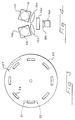
- the chopping shutter disc 25 is preferably a four-inch diameter wheel with eight major openings 26 and 512 minor openings 27, only some of which are shown in Figure 3.
- the minor openings 27 are used as timing slots to control the speed of the chopping shutter disc 25 using a conventional feedback loop.
- the minor openings 27 are also used to provide timing signals to a concentration calculating system (not shown) to identify relevant measurement signals.
- the major openings 26 are used to alternately transmit infrared radiation from the light source 20 to the first and second gas cells 60, 70. This modulates the transmitted light at a high chopping frequency, resulting in reduced sensitivity of the detectors 150, 160 to low frequency vibrations. Additionally, using a larger number of major openings 26 increases the motor's life by providing high chopping frequency at lower motor speeds.
- first and second apertures 31, 32 of the spatial filter 30 focus light transmitted though the apertures 31, 32 for transmission through the first and second gas cells 60, 70.
- first and second lenses 40, 50 focus light transmitted though the apertures 31, 32 for transmission through the first and second gas cells 60, 70.
- two lenses instead of a single lens covering both cells 60, 70 and by positioning and sizing the apertures 31, 32 to coincide with the focal point of the first and second lens 40, 50, light beams can be transmitted though the cells 60, 70 without contacting the interior surface of the cells 60, 70, as shown by the dashed lines in Figure 2. Since the light beams are focused at the opposite end of the cells 60, 70 and do not reflect off the walls of the cells 60, 70, dirt or debris on the walls of the cells 60, 70 will not result in inaccurate concentration measurements, unlike other gas analyzers.
- the apertures 31, 32 in the spatial filter 30 can be positioned and sized based on the focal length of the light beam, the desired diameter of the light beam, and the length of the first and second gas cells 60, 70 to define the light beam's field of view or "f-stop."
- the apertures 31, 32 are preferably 0.050 inch-diameter holes in a 0.005 inch-thick spatial filter 30.
- the spatial filter 30 is positioned between the light disrupter 25 and the first and second lenses 40, 50 in Figures 1 and 2, it should be noted that the spatial filter 30 can instead be positioned between the light source 20 and the light disrupter 25. Additionally, one or more than one spatial filter can be used. Further, the spatial filter 30 shown in Figure 1 can be considered a single spatial filter with two apertures or a first and second spatial filter, each with its own aperture.
- Gases present in the cells 60, 70 absorb light at different wavelength bands. For example, CO 2 absorbs light at about 4.25 ⁇ m, and water vapor absorbs light at about 2.59 ⁇ m.
- Light exiting the cells 60, 70 is reflected by the first and second mirrors 100, 110, respectively, and is focused by the third and fourth lenses 120, 130, respectively.
- the first and second mirrors 100, 110 be tilted at a 45-degree angle to bend the exiting light at a 90-degree angle and that the first and second mirrors 100, 110 and the third and fourth lenses 120, 130 be rotated at a 17-degree angle to lay the beams exiting the first and second gas cells 60, 70 on top of one another so that they intersect at the detectors 150, 160. In this way, the detectors 150, 160 can intercept the light exiting both cells 60, 70.
- the mirrors 100, 110 preferably have a gold surface protection that allows greater than 96% reflectance at 4 ⁇ m and preferably have the following dimensions: 1 inch x 0.75 inches x 0.02 inches. It is also preferred that the lenses 40, 50, 120, 130 be made from CaF 2 and have an effective focal length of 0.75 inches and a diameter of 0.5 inches.
- the beam splitter 140 transmits light of longer wavelengths and reflects light of shorter wavelengths.
- the beam splitter 140 is preferably a 0.02 inch thick, 0.75 inch diameter dichroic beam splitter with a greater than 70% transmission of 3.5 to 4.5 ⁇ m and a greater than 80% reflection of 2 to 2.7 ⁇ m at a 45-degree angle of incidence.
- the first and second filters 170, 180 are preferably infrared bandpass filters with the following dimensions: 0.25 inches x 0.25 inches x 0.02 inches.
- the first filter 170 preferably has a center wavelength of 2.595 ⁇ m and a bandwidth of 0.05 ⁇ m (for water vapor), and the second filter 180 preferably has a center wavelength of 4.255 ⁇ m and a bandwidth of 0.15 ⁇ m (for CO 2 ).
- the detectors 150, 160 be 1mm x 1mm lead selenide detectors. It is further preferred that the detectors 150, 160 have a thermoelectric cooler to reduce temperature-dependent noise. In an alternate embodiment, instead of using two detectors, a single detector with replaceable filters (such as on a filter wheel) is used.
- the gas analyzer 10 uses non-dispersive infrared (NDIR) absorption to measure concentration of a gas in a sample cell 60 based on the difference between absorption of infrared radiation passing through the sample and reference cells 60, 70.
- CO 2 in the cells 60, 70 absorbs the transmitted light at about 4.26 ⁇ m
- water vapor absorbs the transmitted light at about 2.59 ⁇ m.
- the first and second filters 170, 180 in series with the first and second detectors 150, 160 allow the first detector 150 to sense the carbon dioxide absorption and the second detector 160 to sense water vapor absorption.
- the concentration of the gases in the sample cell 60 can be determined by calculating the difference between absorption in the sample cell 60 and absorption in the reference cell 70.
- the reference cell 70 contains a gas with a non-absorber gas (such as when the air supplied to the reference cell 70 has been scrubbed of CO 2 )
- the signal detected in the sample cell 60 is compared to the non-absorber gas signal to provide an absolute measurement of gas concentration in the sample cell 60.
- the ratio of the transmittance of the sample and reference cells be used to calculate the absorption of the sample gas relative to the reference gas.
- the concentration of a gas in each cell can be measured with respect to a known absorber-gas concentration that was in the same cell at some previous time. In this way, simultaneous measurement of absolute and differential gas concentrations can be made without knowing reference gas concentrations.
- the ratio of data to calibrated value is taken. The calibrated value can be obtained by using a gas mixture that does not contain the gas of interest (e.g. , CO 2 ).
- This differential-absolute-reference mode allows the analyzer to be used as two absolute analyzers, one differential analyzer, or one absolute analyzer and one differential analyzer.
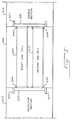
- FIG. 5 shows a sectional view of a gas analyzer of another presently preferred embodiment.
- first and second gas cells 200, 210 are disposed in a housing 205.
- the housing 205 in which the gas cells 200, 210 are disposed is secured to the gas analyzer by locator members 207.
- locator members 207 there are four locator members 207, each made of stainless steel and each 1/8 inches in diameter and 1/8 inches long. It should be noted that any suitable number of locator members can be used and that the material and dimensions of the locator members can be varied.
- the gas cells 200, 210 are coupled with a source section 215 and a detector section 225 to form a rigid, integral source-optical path-detector assembly, such that ambient air (which may contain contaminants) does not flow between the source and detector sections 215, 225 and the gas cells 200, 210.
- the components of the source and detector sections 215, 225 (such as the light source and detectors) are not shown for simplicity.
- Disposed between the source and detector sections 215, 225 and the gas cells 200, 210 are first and second windows 220, 230.
- the first and second windows 220, 230 are sealed against the cells with a set of sealing members 240 to prevent contaminants from entering the cells 200, 210.
- the set of sealing members 240 is formed to allow the housing 205 and the first and second gas cells 200, 210 to be removed from the first and second windows 220, 230. This allows a user of the gas analyzer to remove and clean the gas cells 200, 210 in the field. When the gas cells 200, 210 are placed back into the analyzer, the locator members 207 on the housing 205 ensure proper placement of the gas cells 200, 210, allowing the gas cells 200, 210 to be reassembled into the analyzer without recalibration.
- a "set of sealing members” refers to one sealing member or a plurality of sealing members.
- the "set of sealing members” takes the form of four o-rings. It is preferred that the o-rings be a 013-type o-ring having a 7/16-inch inner diameter and a 0.070 inch thickness. Because o-rings are used as sealing members in this preferred embodiment, the gas cells 200, 210 are shaped as two separate round components. Each cell 200, 210 is preferably 6 inches long with a 0.375 inch diameter, and each window 80, 90 is preferably a 1.375 inch diameter, 0.063 inch-thick synthetic sapphire window. It should be noted that the shape and size of the cells and/or sealing members can be varied.
- the gas analyzer of Figure 6 comprises two purged gas flow channels 320, 330 coupling the source and detector sections 300, 310, which enable purged gas to flow between the source and detector sections 300, 310.
- the components of these sections 300, 310 are not shown for simplicity.
- the gas analyzer also comprises a purged gas circulation device 340 that circulates purged gas through the flow channels 320, 330, as shown by the arrows in Figure 6.
- a purged gas circulation device 340 that circulates purged gas through the flow channels 320, 330, as shown by the arrows in Figure 6.
- Figure 7 is a side view of the gas analyzer of Figure 6 and shows a purged gas provider 350 providing purged gas to the source section 300.
- the purged gas provider 350 takes the form of a single container having an inlet and outlet conduit with the appropriate chemicals between them, preferably in two compartments.
- One of the chemicals is preferably soda lime (a CO 2 scrubber), and the other chemical is preferably magnesium perchlorate (an H 2 O desiccant).
- air enters the purged gas provider 350 flows through the soda lime (which removes CO 2 ), then flows through the magnesium perchlorate (which removes H 2 O vapor), and then flows out of the purged gas provider 350.
- a single purged gas provider 350 can be used for both the source and detector sections 300, 310.
- two containers 350, 360, each containing the two chemicals, are used (see Figure 8).
- the first and second gas cells 300, 310 as well as the flow channels 320, 330 are disposed in a single housing, thereby providing a solid optical path.
- the purged gas circulation device 340 is located in the source section 300 and is the chopping shutter disc described above. It should be noted that the purged gas circulation device can take any form and can be located in the detector section 310 or located external to the source and detector sections 300, 310. However, it is preferred that the purged gas circulation device be in the source section 300 rather than in the detector section 310. It should also be noted that fewer or more than two purged gas flow channels can be used. Further, while the purged gas provider 350 is shown as being internal to the source section 300, the purged gas provider 350 can also be located in the detector section 310 or external to both the source and detector sections 300, 310.
- Inaccurate gas concentration measurements can occur if gas entering a gas analyzer is not at the same temperature as the analyzer's gas cells since measured CO 2 and water vapor concentrations are proportional to temperature.
- carbon dioxide transport rates are computed from high frequency fluctuations in the measured gas concentration and wind speed. Correlated fluctuations in the temperature of air flowing through the analyzer will cause density changes that can generate erroneous results.
- Figure 9 presents a diagram of a gas analyzer that overcomes this problem by bringing the incoming air to a constant temperature (preferably, to the same temperature as the analyzer's gas cells) before the air enters the analyzer's gas cells.
- the gas analyzer of Figure 9 comprises a solid optical path in which first and second gas cells 410, 420 are disposed in a housing 400. Also disposed in the housing 400 are first and second inlet portions 430, 440, which allows incoming air to flow from first and second inlet ports 450, 460 to the first and second gas cells 410, 420, respectively.
- a heat exchanger 470 Disposed in the first and second inlet portions 430, 440 is a heat exchanger 470 that is operative to equilibrating a temperature of incoming air to a temperature of the housing 400.
- the heat exchanger 470 of this preferred embodiment takes the form of a plurality of tubing tightly compressed with each other and into the first and second air inlet portions 430, 440.
- the thermal conductance of the tubing tends to equilibrate the temperature of the air flowing in and around the tubing to the temperature of the housing 400. Specifically, air flowing in and around the tubing is forced into a small flow thickness across a large surface area, thus providing rapid heat exchange. Accordingly, because the heat exchanger 470 equilibrates the temperature of air flowing to the cells 410, 420 to the temperature of the cells 410, 420, temperature-based errors in gas concentration measurements are avoided. To allow the heat exchanger 470 to keep the gas temperature constant and equal to the cell temperature, it is preferred that the gas cells 410, 420 have a large thermal mass to accomplish this task.
- the solid optical path not only provides physical stability, but also provides a uniform thermal cross section.
- Another advantage associated with this preferred embodiment is that a single temperature sensor can be used to measure the average temperature of the optical bench.
- the gas analyzer can report failure of this temperature sensor to the user via a visual and/or audible signal.
- the housing 400 be a solid aluminum block and that the tubing be made of soft copper. It is also preferred that each copper tube have an outer diameter of 1/8 inch and inner diameter of 1/16 inch, with a length of 1.5 inches. Preferably, the first and second inlet portions 430, 440 have a length of 1.5 inches and an inner diameter of 0.375 inches, such that seven copper tubes are compressed in each inlet portion. It is further preferred that the sources of air to the first and second gas cells 410, 420 be directly connected to the inlet ports 450, 460 without tubing. By eliminating the use of tubing, the disadvantages associated with tubing (e.g., pressure drop, gas diffusion, gas absorption, and turbulence) are also eliminated.
- the disadvantages associated with tubing e.g., pressure drop, gas diffusion, gas absorption, and turbulence
- the gas analyzers of these preferred embodiments can also be used to measure the concentration of other gases, such as, but not limited to, nitrogen oxide, carbon moxoide, and methane.
- the gas analyzer can have single or multiple (two or more) gas cells.
- the gas analyzer of these preferred embodiments can have any appropriate data output, such as, but not limited to, an LCD display, uncalibrated or calibrated voltage outputs, current loop outputs, and RS-232C serial output.
- an RS-232C serial output can be used to receive remote commands from an RS-232C terminal or computer.
- the gas analyzers of these preferred embodiments can be used in any suitable application, such as photosynthesis measurements, global warming studies (atmospheric chemistry), ecology, forestry, agronomy, oceanography, environmental studies, bioremediation, and jet engine testing.
- the gas analyzers of these preferred embodiments can be built as portable units that are easily transportable for field use.
Landscapes
- Physics & Mathematics (AREA)
- Spectroscopy & Molecular Physics (AREA)
- Biochemistry (AREA)
- Life Sciences & Earth Sciences (AREA)
- Chemical & Material Sciences (AREA)
- Analytical Chemistry (AREA)
- Health & Medical Sciences (AREA)
- General Health & Medical Sciences (AREA)
- General Physics & Mathematics (AREA)
- Immunology (AREA)
- Pathology (AREA)
- Investigating Or Analysing Materials By Optical Means (AREA)
- Optical Measuring Cells (AREA)
Applications Claiming Priority (2)
| Application Number | Priority Date | Filing Date | Title |
|---|---|---|---|
| US09/419,020 US6369387B1 (en) | 1999-10-15 | 1999-10-15 | Gas analyzer |
| US419020 | 1999-10-15 |
Publications (2)
| Publication Number | Publication Date |
|---|---|
| EP1092971A2 true EP1092971A2 (de) | 2001-04-18 |
| EP1092971A3 EP1092971A3 (de) | 2002-04-24 |
Family
ID=23660453
Family Applications (1)
| Application Number | Title | Priority Date | Filing Date |
|---|---|---|---|
| EP00307471A Withdrawn EP1092971A3 (de) | 1999-10-15 | 2000-08-31 | Gasanalysator |
Country Status (2)
| Country | Link |
|---|---|
| US (1) | US6369387B1 (de) |
| EP (1) | EP1092971A3 (de) |
Cited By (5)
| Publication number | Priority date | Publication date | Assignee | Title |
|---|---|---|---|---|
| EP1693665A1 (de) * | 2005-02-22 | 2006-08-23 | Siemens Aktiengesellschaft | Verfahren und Vorrichtung zum Nachweis von Spurengasen |
| CN104020114A (zh) * | 2014-05-23 | 2014-09-03 | 中国人民解放军海军医学研究所 | 分析氨气痕量浓度的方法 |
| CN105319178A (zh) * | 2015-10-27 | 2016-02-10 | 中国科学院合肥物质科学研究院 | 机动车尾气co和co2浓度实时检测系统及其控制方法 |
| CN117538277A (zh) * | 2023-11-17 | 2024-02-09 | 成都汉威智感科技有限公司 | 多气体多量程自适应调节红外气体传感系统 |
| US20250189441A1 (en) * | 2023-12-08 | 2025-06-12 | Axetris Ag | Device, system and method for optical gas analysis |
Families Citing this family (35)
| Publication number | Priority date | Publication date | Assignee | Title |
|---|---|---|---|---|
| US6590661B1 (en) * | 1999-01-20 | 2003-07-08 | J. Mitchell Shnier | Optical methods for selectively sensing remote vocal sound waves |
| US20030209669A1 (en) * | 2002-05-09 | 2003-11-13 | Chou Bruce C. S. | Miniaturized infrared gas analyzing apparatus |
| US7183552B2 (en) * | 2003-03-07 | 2007-02-27 | Ric Investments, Llc | Optical system for a gas measurement system |
| US6946852B2 (en) * | 2003-03-14 | 2005-09-20 | Steris Inc. | Method and apparatus for measuring concentration of a chemical component in a gas mixture |
| US6960921B2 (en) * | 2003-03-14 | 2005-11-01 | Steris Inc. | Method and apparatus for real time monitoring of metallic cation concentrations in a solution |
| US6897661B2 (en) * | 2003-03-14 | 2005-05-24 | Steris Inc. | Method and apparatus for detection of contaminants in a fluid |
| US6933733B2 (en) * | 2003-03-14 | 2005-08-23 | Steris Inc. | Method and apparatus for measuring the concentration of hydrogen peroxide in a fluid |
| US6992494B2 (en) * | 2003-03-14 | 2006-01-31 | Steris Inc. | Method and apparatus for monitoring the purity and/or quality of steam |
| US6927582B2 (en) * | 2003-03-14 | 2005-08-09 | Steris Inc. | Method and apparatus for monitoring the state of a chemical solution for decontamination of chemical and biological warfare agents |
| US6844742B2 (en) * | 2003-03-14 | 2005-01-18 | Steris Inc. | Method and apparatus for measuring chemical concentration in a fluid |
| US6930493B2 (en) * | 2003-03-14 | 2005-08-16 | Steris Inc. | Method and apparatus for monitoring detergent concentration in a decontamination process |
| US6909972B2 (en) * | 2003-06-06 | 2005-06-21 | Steris Inc. | Method and apparatus for formulating and controlling chemical concentrations in a solution |
| US6917885B2 (en) * | 2003-06-06 | 2005-07-12 | Steris Inc. | Method and apparatus for formulating and controlling chemical concentration in a gas mixture |
| US7255474B2 (en) * | 2003-07-28 | 2007-08-14 | Symyx Technologies, Inc. | Parallel infrared spectroscopy apparatus and method |
| US7541002B2 (en) * | 2004-05-12 | 2009-06-02 | Steris Corporation | Apparatus for determining the efficiency of a vaporizer in a decontamination system |
| US20050276721A1 (en) * | 2004-05-25 | 2005-12-15 | Steris Inc. | Method and apparatus for controlling the concentration of a sterilant chemical in a fluid |
| US7431886B2 (en) * | 2004-09-24 | 2008-10-07 | Steris Corporation | Method of monitoring operational status of sensing devices for determining the concentration of chemical components in a fluid |
| US20080053439A1 (en) * | 2006-08-10 | 2008-03-06 | Lighton John R | Combined device for analytical measurements |
| US20090213381A1 (en) * | 2008-02-21 | 2009-08-27 | Dirk Appel | Analyzer system and optical filtering |
| US9267881B2 (en) | 2008-11-06 | 2016-02-23 | Li-Cor, Inc. | Hybrid gas analyzer with thermally insulated flow cell |
| US8154714B2 (en) * | 2008-11-06 | 2012-04-10 | Li-Cor, Inc. | Gas analyzer |
| US8125626B2 (en) * | 2008-11-06 | 2012-02-28 | Li-Cor, Inc. | Hybrid gas analyzer |
| EP2473869B1 (de) * | 2009-09-03 | 2016-06-29 | Li-Cor, Inc. | Datenhandhabungseinrichtung zur berechnung eines gasflusses und ein entsprechendes rechnerlesbares speichermedium |
| EP2558823A4 (de) | 2010-04-12 | 2018-02-28 | Li-Cor, Inc. | Verfahren und vorrichtung zur bestimmung eines gasflusses |
| US8692997B2 (en) * | 2010-08-25 | 2014-04-08 | Bah Holdings Llc | Optical gas and/or particulate sensors |
| US10060942B2 (en) | 2012-04-06 | 2018-08-28 | Li-Cor, Inc. | Methods and apparatus for measuring gas flux |
| US20130333445A1 (en) * | 2012-06-04 | 2013-12-19 | Eif - Astute | Analyzer for fluids containing an inflammable substance and corresponding method |
| US9759703B2 (en) | 2013-09-27 | 2017-09-12 | Li-Cor, Inc. | Systems and methods for measuring gas flux |
| US10018555B2 (en) * | 2014-03-12 | 2018-07-10 | Shenzhen China Star Optoelectronics Technology Co., Ltd. | Device and method for measuring concentration of etchant |
| EP3180598B1 (de) * | 2014-08-15 | 2024-03-06 | Tenova Goodfellow Inc. | System und verfahren zur analyse von staubiger industrieller abgaschemie |
| US20180045642A1 (en) * | 2016-08-15 | 2018-02-15 | Radiant Innovation Inc. | Gas detection device and method for detecting gas concentration |
| CN106644999B (zh) * | 2016-11-30 | 2023-09-01 | 苏州曼德克光电有限公司 | 一种磨煤机用双气室一氧化碳浓度实时检测装置 |
| US12007330B2 (en) * | 2018-12-31 | 2024-06-11 | Dow Global Technologies Llc | High-temperature optical probe |
| CN110160990A (zh) * | 2019-05-30 | 2019-08-23 | 深圳华领气体技术有限公司 | 痕量气体及其同位素实时在线检测装置 |
| US11561324B1 (en) | 2020-10-27 | 2023-01-24 | Li-Cor, Inc. | Methods and apparatus for measuring gas flux |
Family Cites Families (29)
| Publication number | Priority date | Publication date | Assignee | Title |
|---|---|---|---|---|
| US3270756A (en) | 1963-04-09 | 1966-09-06 | Hugh L Dryden | Fluid flow control valve |
| US3712325A (en) | 1971-05-21 | 1973-01-23 | Avl Ag | Gas mixer |
| US3792272A (en) | 1973-01-12 | 1974-02-12 | Omicron Syst Corp | Breath test device for organic components, including alcohol |
| US3948281A (en) | 1973-02-22 | 1976-04-06 | Scott Environmental Technology, Inc. | Gas blending using null balance analyzer |
| JPS5413388A (en) | 1977-06-30 | 1979-01-31 | Matsushita Electric Works Ltd | Gas concentration meter of ultrared ray absorption type |
| JPS5928855B2 (ja) | 1979-02-15 | 1984-07-16 | マツダ株式会社 | 内燃機関の排ガス測定方法 |
| DE3010516C2 (de) | 1980-03-19 | 1985-02-21 | Leybold-Heraeus GmbH, 5000 Köln | Küvette für optische Gasanalysengeräte |
| US4355234A (en) | 1980-09-19 | 1982-10-19 | Mine Safety Appliances Company | Stable infrared analyzer |
| US4467213A (en) | 1982-06-28 | 1984-08-21 | Beckman Instruments, Inc. | Source assembly for gas analysis instruments |
| JPS59173734A (ja) | 1983-03-23 | 1984-10-01 | Mitsubishi Heavy Ind Ltd | 赤外線ガス分析計 |
| JPS6120840A (ja) | 1984-07-09 | 1986-01-29 | Horiba Ltd | 赤外線分析計の校正機構 |
| DE3525346A1 (de) | 1985-07-16 | 1987-01-29 | Hartmann & Braun Ag | Infrarotanalysator |
| JPS62217139A (ja) | 1986-03-19 | 1987-09-24 | Fujitsu Ltd | ガス濃度測定装置 |
| US4738147A (en) | 1986-12-16 | 1988-04-19 | Sampling Technology, Inc. | Low flow sampling and analysis system |
| US4803370A (en) | 1987-05-18 | 1989-02-07 | Li-Cor, Inc. | Infrared light generation |
| JPS63308541A (ja) | 1987-06-10 | 1988-12-15 | Horiba Ltd | 赤外線ガス分析計 |
| US4829183A (en) | 1987-09-11 | 1989-05-09 | Andros Analyzers Incorporated | Dual sample cell gas analyzer |
| US4914719A (en) | 1989-03-10 | 1990-04-03 | Criticare Systems, Inc. | Multiple component gas analyzer |
| US5065025A (en) | 1990-03-02 | 1991-11-12 | Axiom Analytical, Inc. | Gas sample analysis provided by light pipe radiation structure |
| US5340987A (en) | 1991-03-15 | 1994-08-23 | Li-Cor, Inc. | Apparatus and method for analyzing gas |
| US5332901A (en) | 1991-03-15 | 1994-07-26 | Li-Cor, Inc. | Gas analyzing apparatus and method for simultaneous measurement of carbon dioxide and water |
| US5468961A (en) | 1991-10-08 | 1995-11-21 | Fisher & Paykel Limited | Infrared gas analyser and humidity sensor |
| US5331409A (en) | 1992-06-12 | 1994-07-19 | George Thurtell | Tunable diode laser gas analyzer |
| US5543621A (en) * | 1995-05-15 | 1996-08-06 | San Jose State University Foundation | Laser diode spectrometer for analyzing the ratio of isotopic species in a substance |
| US5747809A (en) * | 1996-06-11 | 1998-05-05 | Sri International | NDIR apparatus and method for measuring isotopic ratios in gaseous samples |
| US5811812A (en) | 1996-11-01 | 1998-09-22 | Andros, Incorporated | Multiple-gas NDIR analyzer |
| US6037592A (en) * | 1997-02-14 | 2000-03-14 | Underground Systems, Inc. | System for measuring gases dissolved in a liquid |
| JPH10281988A (ja) | 1997-04-09 | 1998-10-23 | Nippon Sanso Kk | ガス分析方法及びガス分析装置 |
| DE19911260A1 (de) | 1999-03-13 | 2000-09-14 | Leybold Vakuum Gmbh | Infrarot-Gasanalysator und Verfahren zum Betrieb dieses Analysators |
-
1999
- 1999-10-15 US US09/419,020 patent/US6369387B1/en not_active Expired - Lifetime
-
2000
- 2000-08-31 EP EP00307471A patent/EP1092971A3/de not_active Withdrawn
Cited By (7)
| Publication number | Priority date | Publication date | Assignee | Title |
|---|---|---|---|---|
| EP1693665A1 (de) * | 2005-02-22 | 2006-08-23 | Siemens Aktiengesellschaft | Verfahren und Vorrichtung zum Nachweis von Spurengasen |
| US7324204B2 (en) | 2005-02-22 | 2008-01-29 | Siemens Aktiengesellschaft | Method and apparatus for trace gas detection |
| CN104020114A (zh) * | 2014-05-23 | 2014-09-03 | 中国人民解放军海军医学研究所 | 分析氨气痕量浓度的方法 |
| CN105319178A (zh) * | 2015-10-27 | 2016-02-10 | 中国科学院合肥物质科学研究院 | 机动车尾气co和co2浓度实时检测系统及其控制方法 |
| CN105319178B (zh) * | 2015-10-27 | 2018-05-04 | 中国科学院合肥物质科学研究院 | 机动车尾气co和co2浓度实时检测系统及其控制方法 |
| CN117538277A (zh) * | 2023-11-17 | 2024-02-09 | 成都汉威智感科技有限公司 | 多气体多量程自适应调节红外气体传感系统 |
| US20250189441A1 (en) * | 2023-12-08 | 2025-06-12 | Axetris Ag | Device, system and method for optical gas analysis |
Also Published As
| Publication number | Publication date |
|---|---|
| EP1092971A3 (de) | 2002-04-24 |
| US6369387B1 (en) | 2002-04-09 |
Similar Documents
| Publication | Publication Date | Title |
|---|---|---|
| US6369387B1 (en) | Gas analyzer | |
| US8125626B2 (en) | Hybrid gas analyzer | |
| US8300218B2 (en) | Gas analyzer | |
| US5811812A (en) | Multiple-gas NDIR analyzer | |
| EP1332346B1 (de) | Atemgasanalysierer | |
| KR101098124B1 (ko) | 멀티가스 감시 및 검출 시스템 | |
| US4648714A (en) | Molecular gas analysis by Raman scattering in intracavity laser configuration | |
| US6486474B1 (en) | Infrared spectrometer for the measurement of isotopic ratios | |
| AU776035B2 (en) | Integrated optics probe for spectral analysis | |
| CA1036384A (en) | Non-dispersive multiple gas analyzer | |
| US4746218A (en) | Gas detectors and gas analyzers utilizing spectral absorption | |
| FI91021B (fi) | Laite kaasujen tunnistamiseksi ja pitoisuuden mittaamiseksi sekä menetelmä kaasujen tunnistamiseksi | |
| US4676639A (en) | Gas cell for raman scattering analysis by laser means | |
| US7132657B2 (en) | Infrared gas detector | |
| USRE34153E (en) | Molecular gas analysis by Raman scattering in intracavity laser configuration | |
| EP0834732A2 (de) | Gasanalysator | |
| CA2742728C (en) | Gas analyzer | |
| US5731583A (en) | Folded optical path gas analyzer with cylindrical chopper | |
| US7227642B2 (en) | Absorbance monitor | |
| US20250137922A1 (en) | Non-dispersive infrared sensor |
Legal Events
| Date | Code | Title | Description |
|---|---|---|---|
| PUAI | Public reference made under article 153(3) epc to a published international application that has entered the european phase |
Free format text: ORIGINAL CODE: 0009012 |
|
| AK | Designated contracting states |
Kind code of ref document: A2 Designated state(s): AT BE CH CY DE DK ES FI FR GB GR IE IT LI LU MC NL PT SE |
|
| AX | Request for extension of the european patent |
Free format text: AL;LT;LV;MK;RO;SI |
|
| RIC1 | Information provided on ipc code assigned before grant |
Free format text: 7G 01N 21/35 A, 7G 01N 21/25 B, 7G 01N 21/03 B |
|
| PUAL | Search report despatched |
Free format text: ORIGINAL CODE: 0009013 |
|
| AK | Designated contracting states |
Kind code of ref document: A3 Designated state(s): AT BE CH CY DE DK ES FI FR GB GR IE IT LI LU MC NL PT SE |
|
| AX | Request for extension of the european patent |
Free format text: AL;LT;LV;MK;RO;SI |
|
| AKX | Designation fees paid | ||
| REG | Reference to a national code |
Ref country code: DE Ref legal event code: 8566 |
|
| STAA | Information on the status of an ep patent application or granted ep patent |
Free format text: STATUS: THE APPLICATION IS DEEMED TO BE WITHDRAWN |
|
| 18D | Application deemed to be withdrawn |
Effective date: 20021025 |