EP1093878B1 - Optimisation des paramètres d'usinage pour machine d'usinage par électroérosion - Google Patents
Optimisation des paramètres d'usinage pour machine d'usinage par électroérosion Download PDFInfo
- Publication number
- EP1093878B1 EP1093878B1 EP00118496A EP00118496A EP1093878B1 EP 1093878 B1 EP1093878 B1 EP 1093878B1 EP 00118496 A EP00118496 A EP 00118496A EP 00118496 A EP00118496 A EP 00118496A EP 1093878 B1 EP1093878 B1 EP 1093878B1
- Authority
- EP
- European Patent Office
- Prior art keywords
- process parameters
- machining
- cycle
- cycles
- parameters
- Prior art date
- Legal status (The legal status is an assumption and is not a legal conclusion. Google has not performed a legal analysis and makes no representation as to the accuracy of the status listed.)
- Expired - Lifetime
Links
Images



Classifications
-
- B—PERFORMING OPERATIONS; TRANSPORTING
- B23—MACHINE TOOLS; METAL-WORKING NOT OTHERWISE PROVIDED FOR
- B23H—WORKING OF METAL BY THE ACTION OF A HIGH CONCENTRATION OF ELECTRIC CURRENT ON A WORKPIECE USING AN ELECTRODE WHICH TAKES THE PLACE OF A TOOL; SUCH WORKING COMBINED WITH OTHER FORMS OF WORKING OF METAL
- B23H7/00—Processes or apparatus applicable to both electrical discharge machining and electrochemical machining
- B23H7/14—Electric circuits specially adapted therefor, e.g. power supply
- B23H7/20—Electric circuits specially adapted therefor, e.g. power supply for program control, e.g. adaptive
-
- B—PERFORMING OPERATIONS; TRANSPORTING
- B23—MACHINE TOOLS; METAL-WORKING NOT OTHERWISE PROVIDED FOR
- B23H—WORKING OF METAL BY THE ACTION OF A HIGH CONCENTRATION OF ELECTRIC CURRENT ON A WORKPIECE USING AN ELECTRODE WHICH TAKES THE PLACE OF A TOOL; SUCH WORKING COMBINED WITH OTHER FORMS OF WORKING OF METAL
- B23H7/00—Processes or apparatus applicable to both electrical discharge machining and electrochemical machining
- B23H7/02—Wire-cutting
- B23H7/04—Apparatus for supplying current to working gap; Electric circuits specially adapted therefor
-
- B—PERFORMING OPERATIONS; TRANSPORTING
- B23—MACHINE TOOLS; METAL-WORKING NOT OTHERWISE PROVIDED FOR
- B23H—WORKING OF METAL BY THE ACTION OF A HIGH CONCENTRATION OF ELECTRIC CURRENT ON A WORKPIECE USING AN ELECTRODE WHICH TAKES THE PLACE OF A TOOL; SUCH WORKING COMBINED WITH OTHER FORMS OF WORKING OF METAL
- B23H7/00—Processes or apparatus applicable to both electrical discharge machining and electrochemical machining
- B23H7/26—Apparatus for moving or positioning electrode relatively to workpiece; Mounting of electrode
- B23H7/28—Moving electrode in a plane normal to the feed direction, e.g. orbiting
Definitions
- the present invention relates to a method and apparatus for spark erosion or electrochemical machining of workpieces in which a machining electrode is moved relative to a workpiece, the machining includes cycles, and appropriate process parameters are set for processing the current cycle, particularly taking into account process parameters of the current cycle become.
- the prior art describes a plurality of cyclic processing methods, in particular planetary-averaging methods.
- Such a generic Planetärerodier Kunststoff is for example from the "Industrial Scoreboard" Special Issue, April 1981, page 109ff. known.
- This method involves the planetary eroding of depressions, in which, for machining, a cyclical translation movement between the machining electrode and the workpiece is carried out laterally in planes arranged transversely to the feed direction. Each plane is cyclically processed by the machining electrode, wherein the cyclic translation movements are used in the form of orbital movements for expanding a machining or finishing.
- the spark erosive machining material removal takes place on the electrically conductive workpiece in that the Machining electrode is brought to the workpiece and this takes place an electrical discharge.
- the processing is then carried out by the translational movement between the electrode and the workpiece in a suitable working fluid.
- a gap width control superimposed on the translational movement ensures that the appropriate distance between the machining electrode and the workpiece is maintained.
- this document takes into account the geometry data of preceding planetary cycles in order to adapt the geometry data of the upcoming planetary circulation. Process parameters of previous planetary cycles are not taken into account.
- the associated CNC control processing as complete as soon as the undersize is reached.
- the undersize to be achieved refers to a theoretical gap width stored in process parameter data sets. A change in the effective gap width, as is usually caused by the gap width control remains unrecognized, which has extremely damaging effects on the contour accuracy.
- the invention has for its object to improve the generic method to the effect that without time loss an improved geometric machining accuracy is made possible, in particular to increase the process reliability and reproducibility.
- the invention is preceded by the observation that in cyclic processing a localized development of certain process parameters is observed. For example, If a disturbance occurs at one point of a cycle, the development of this disturbance is usually evident in the same place in the following cycle.
- the process behavior is now stored for already performed cycles and evaluated to determine certain process parameters of the upcoming cycle, which can be approached looking ahead to be processed sections of the upcoming cycle. For example, depending on whether a trouble-free section, an idle section or a critical section is expected, the currently applicable process parameters may be adjusted accordingly. Thus, process disturbances and time losses can be largely avoided, a good form fidelity can be achieved and the process optimized overall.
- At least one process parameter is measured, from which at least one measured process parameter derived at least one process parameter to be set for the current cycle, the at least one derived process parameter stored during the previous cycle, and the at least one stored process parameter set during the current cycle.
- process parameters are used in a table, which are determined in particular with regard to an optimization of the removal, with respect to an execution of an idling and / or with regard to the execution of a guaranteed trouble-free processing.
- predetermined process parameters can be permanently stored, which can then be retrieved in certain situations for the current processing. These can be called up in particular for situations in which process parameter control instabilities occur.
- the previous cycles are examined by a setpoint / actual value comparison of the measured process parameters for sections in which a processing disturbance, an idling condition and / or another condition deviating from the normal case occurs, and at least in the corresponding sections of the current cycle adapted process parameters set.
- sections of a cycle are characterized in which certain situations occur and for which it is possible to process in the subsequent cycle with process parameters optimized with regard to the situation.
- the length of the range is selected depending on the planetary speed.
- the planetary speed corresponds to the wire feed speed.
- the processing is divided into a plurality of layers and sectors and the relevant process parameters are stored in layers and sectors.
- the volume to be removed can be subdivided into layers lying normal to the direction of advance.
- the orbital motion can be divided into sectors so that, as a result, each processing location can be specified by a sector element. Location-related process information can be allocated and stored in a unique way.
- these layers may correspond to the full cut and the after cuts, and the sectors may be defined along the re-cuts.
- the process parameters at the beginning of a sector are preferably set, which are derived from the measured process parameters of preceding cycles, and process parameters of the current cycle are respectively recorded and stored at the end of a sector as measured variables for the cycle following the current cycle.
- this process instabilities are avoided.
- the stored process parameters are multiplied after each cycle by a weighting coefficient.
- a weighting coefficient may be less influential in, for example, an averaging of the process parameters of a certain number of past cycles.
- cycles with interference-prone sections can be multiplied by an increased weighting coefficient so that they advantageously have a greater influence on the subsequent cycles.
- This disturbance could, for example, repeat itself only in the next but one or one of the subsequent cycles. Due to this weighting special measures can be taken in these cycles at the relevant sections.
- the planetary speed is optimized as a process parameter to be set with regard to the removal by determining it from a plurality of cycles, each with a different planetary speed, each cycle being carried out at a constant planetary speed.
- the planetary speed is optimized as a process parameter to be set with regard to the machining accuracy by passing through a cycle at a reduced planetary speed with respect to the removal-optimized planetary speed, and the planetary speed optimized in the machining accuracy is determined on the basis of measured process parameters.
- the machining accuracy can thus be greatly increased, in particular during the final phase of the machining.
- the removal-optimized planetary speed and / or the planetary speed optimized in the machining accuracy are preferably determined periodically after a certain number of cycles or upon the occurrence of relevant changes in the process parameters.
- FIG. 1 shows a schematic representation of a spark erosion device which is designed for planetary orodier processing.
- a workpiece 1 is clamped on a machining table 2 and is processed by a machining electrode 3.
- the machining table 2 displaceable in a horizontal plane of each one acting in the X and Y directions drive 4 and 5.
- the machining electrode 3 can be lowered into the workpiece 1 by a drive 6 acting in the Z direction.
- the three drives 4 to 6 are controlled by a drive control 7, which in turn receives from an interpolator 8, for example, the corresponding step values (in the case of stepper motors) for the individual drives 4 to 6.
- the process parameters occurring during processing such as the actual values of the machining current I FS and the machining voltage U FS in the machining gap, are detected by a parameter detection and processing unit 9, processed and forwarded to a generator 10.
- the parameter acquisition and processing unit 9 is coupled to the generator 10 which, in response to the detected actual values of the process parameters, generates specific setpoint values of the machining current I FS and the machining voltage U FS and via the parameter detection and processing unit 9 to the machining electrode 3 and the workpiece 1 can be laid.
- the parameter acquisition and processing unit 9 is further coupled to a servo unit 11 which, in response to sensed process parameters, provides gap-width-adjusting process parameters, such as the planetary velocity, to the drive controller 7 via the interpolator 8.
- the interpolator 8 simultaneously calculates the individual steps to be executed by the respective drives 4 to 6, for example based on vectors determining the geometry and the planetary speed supplied by the servo unit 11.
- the parameter detection and processing unit 9 recognizes, for example based on the detected actual values of the machining current I FS and the machining voltage U FS in the machining gap, whether a short circuit occurs, and calculated based on the short circuit situation, a corresponding planetary speed, which feeds them to the servo unit 10.
- a rinsing liquid control 12 is coupled to the servo unit 11, which conveys a rinsing liquid flow at a certain pressure via a rinsing nozzle 13 into the machining gap between the workpiece 1 and the machining electrode 3.
- the servo unit 11, the rinse fluid controller 12, the generator 10 and a database 14 are coupled to a CNC controller 15 which controls the process parameters of the individual units.
- the database 14 is used to store process parameters, which are used by the CNC controller 15 in particular for standard situations (accident, idle condition, etc.). In this case, the CNC controller 15 can resort to the stored in the database 14 fixed values for corresponding process parameters, especially in situations with increased process instability.
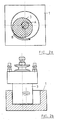
- FIGs 2a and 2b the workpiece 1 and the machining electrode 3 are respectively shown in plan view and in cross-sectional view during planetary erosion.
- Planetärerodieren a progressive expansion of a depression takes place in that on a plane normal to the feed direction (in Fig. 2a, the leaf level) a cyclic, usually circular relative movement (orbital motion) between the workpiece 1 and machining electrode 3, and this relative movement is superimposed on a gap width control.
- This cyclic relative movement can be process-independent.
- the gap width control takes place along a planetary vector as a function of the process parameters and the process conditions in the spark gap.
- the planetary speed is the speed with which the planetary motion, eg the circular relative motion (orbital motion) is carried out.
- the machining electrode 3 is moved along orbital motions at a certain planetary speed, as indicated by the circular arrow A in FIG. 2a.
- the planetary speed is a measure of how fast the machining electrode 3 is moved along this orbital motion impressed by the X and Y drives 4 and 5.
- the translation speed is the relative velocity between the machining electrode 3 and the workpiece 1 caused by the planetary speed at a specific location, eg at the point B in FIG. 2a.
- the geometry of the machining electrode 3 and the workpiece 1 sets so at any time for each point between the machining electrode 3 and workpiece 1 a certain ratio of planetary and translation speed fixed.
- the choice of the optimum planetary speed is very important, because it affects the process significantly. If this is too high, so that the servo unit 11 can no longer hold the ideal erosion position, then the servo unit 11 moves the machining electrode 3 back along the planetary vector, and vice versa.
- the planetary vector is in the direction shown in Figs. 2a and 2b in a direction slightly inclined to the Z direction, so that the machining electrode 3 is lifted from the front surface and from the side surface of the lowering, as soon as the planetary speed and the associated translational speed at the processing point is greater than the erosion speed.
- ablated volume is in a certain range (in Fig. 4b is such an area, for example, above the plotted planetary speed V P3 , see also below) inversely proportional to the translation speed and thus inversely proportional to the planetary speed.
- FIGS. 3a to 3d respectively illustrate how the countersinking of the machining electrode 3 into the workpiece 1 is carried out in layers k, k + 1, k + 2, k + 3, etc., and sectors i, i +1, i + 2, i + 3, etc. per shift is divided.
- Fig. 3c is particularly clear how each layer with increasing depth also has a larger processing surface both on the frontal surface and on the side surface of the reduction.
- the previously defined layers usually do not correspond to the individual orbital motions or circulations that usually occur in planetary orodier machining. Thus, for processing a layer with correct application of the invention, a large number of circulations may be required.
- the layers described above typically have a thickness of 10 to 20 microns, so that a complete machining usually consists of a plurality of these layers.
- a progressive adjustment of the layer thickness can take place.
- the CNC controller 15 detects the actual value of each of the mentioned process parameters and determines its deviation from the setpoint provided from the database 14. This evaluation preferably takes place on the basis of several executed cycles, i. several complete cycles are run per shift. However, it can also satisfy a circulation, especially in the wire erosion, in which there are only a limited number of re-cuts and thus only a limited number of cycles.
- the CNC controller 15 multiplies the stored actual values of the process parameters with each round by a "forgetfulness coefficient" (for example, a factor less than 1), whereby their meaning decreases in most cases temporally in the future.
- a "forgetfulness coefficient" for example, a factor less than 1
- the individual values of the process parameters to be set, both during the "normal", the disturbed and / or the idle machining, the CNC controller 15 refers from the database 12th
- the CNC controller 15 already adapts a certain number of sectors in the following rounds of process parameters to said location.
- renewed process degenerations in this section can be avoided and the processing conditions can be reduced to the normal range. It depends essentially on the speed of the planetary gear and the division chosen (sector width) of how many sector elements before or after the critical area special measures for stabilizing the process must be initiated or canceled. The higher the planetary speed, the earlier preventive measures have to be taken.
- the CNC controller 15 detects per process cycle (eg planetary circulation) in each sector of a shift at the end of the sector certain process parameters as actual values, deriving from a comparison of these actual values with the corresponding ones the database 14 retrieved certain process parameters and stores them. In the subsequent cycle, the process parameters stored for the corresponding sector are retrieved and set at the beginning of the sector. During the course of a sector, the CNC controller 15 usually does not intervene in the regulation, but only detects the actual values of certain process parameters again at the end of this sector.
- process cycle eg planetary circulation
- the CNC controller 15 may optionally monitor certain particularly relevant process parameters which may indicate, for example, a serious incident (such as a collision, etc.) and, in the event of such a failure, initiate, for example, processes stored in the database 14 by: sets certain process parameters according to the stored data.
- a serious incident such as a collision, etc.
- the CNC controller 15 may possibly even derive only its process parameters to be set from the measured actual values of preceding cycles, and the currently ignoring process parameters occurring in the current cycle.
- the CNC controller 15 recognizes a malfunction in the processing in this sector i + 3 and accordingly, for example, reduces the servo target value and increases the pulse pause duration.
- These two newly determined process parameters can either be computationally determined by the CNC control or retrieved from the database 14 (where they are stored for a fault, for example still dependent on the actual actual value of the percentage of short circuits).
- These two new process parameters are stored for the sector i + 3 and recalled in the next cycle at the beginning of this sector i + 3 and adjusted accordingly.
- the CNC controller 15 can already adapt the process parameters a few sectors before the sector i, e.g. in sectors i, i + 1 and i + 2 (e.g., by interpolating the process parameters linearly or otherwise from their value in sector i-1 to their new value to be set in sector i + 3).
- the process parameters determined and stored for each sector and each cycle are multiplied by a weighting factor (eg, less than 1) so that the process parameters of earlier cycles have less influence on the process parameters of the current cycle than those of less recent cycles ,
- a weighting factor eg, less than 1
- a cycle can be run at a reduced planetary speed.
- the machining gap becomes larger and thus the sparks longer. It can then be recognized more accurately, what still needs to be eroded.
- These sections still to be eroded can be prepared by appropriately adapted process parameters for the subsequent cycle to the effect that in the subsequent cycle, for example, only these sections are eroded.
- This sampling cycle thus serves to increase the processing accuracy and can advantageously be applied more intensely, in particular shortly before the end of processing.
- the method described below in conjunction with FIGS. 4 a and 4 b is used by the CNC control 15 to automatically determine the removal-optimal planetary speed.
- a reduced cycle rate V P1 sampling cycle is performed, thereby establishing an increased gap width. Local discontinuities as well as fine geometric features are thereby better captured.
- at least two further cycles (revolutions) are preferably carried out with constant but different planetary speeds V P2 and V P3 , wherein these planetary speeds V P2 and V P3 should be in the range of the ideal planetary speed.
- the CNC control 15 thereafter the process parameters of at least three cycles with constant, respectively different planetary speed V P1 , V P2 and V P3 are available.
- the CNC controller 15 determines on the basis of the determined process parameters by means of a computational method, for example a regression calculation or a practical approximation method, that planetary speed V P opt which leads to the best ablation values.
- the derivation of the removal-optimized planetary speed from the process parameters can take place as follows. On the one hand, this can be derived on the basis of the removed volume, which is determined from the feed movements of the drives 4 to 6 to be carried out by the servo unit 11. For this purpose, several revolutions are performed to establish different support values. The planetary speed is changed in each new round so until no noticeable improvement in the removal rate is measured more.
- the optimization of the planetary velocity with regard to the removal can be based on the calculation of the efficiency.
- the actual value of the mean erosion power is calculated from the actual values for the discharge current and the erosion voltage.
- the actual power is the product of the pulse voltage, the actual value for the discharge current and the duty cycle (ratio T / (T + P), where T is the time of the applied pulse and P is the pause time between two consecutive pulses).
- the new planetary velocity is then determined in an approximation method depending on the efficiency and the planetary velocity of two previously executed cycles (see also FIG. 4b):
- V P 3 V P 2 - ⁇ * ( ⁇ 2 - ⁇ 1 ) / ( V P 1 - V P 2 )
- This determination process may be performed periodically throughout the processing, and the cycle at the slower planetary speed (sampling cycle) may be omitted.
- an ablation-optimal planetary speed V P opt is always determined for the current machining situation. This is then again at least during the ongoing but also for other planetary circulation, but preferably also for several of the following layers k, k + 1, k + 2 basis.
- this removal optimization takes place periodically, for example every 50 layers, or as required, for example, if a significant change in geometry can be deduced from the development of the process parameters.
- the sector-specific information of the preceding cycles is deleted or at least devalued. Unwanted smoothing effects are avoided in this way.
- the determination of the removal-optimal planetary speed V P opt can, as noted, also be independent of the described sampling cycle with a constant, relatively low planetary speed V P1 (FIG. 4a). This separation has the advantage that sampling cycles and removal optimization cycles are only performed as often as necessary.
- the cyclic processing preferably starts by first executing the planetary cycles following the determination process with this optimum planetary speed V P opt , wherein the relevant process parameters are stored sector by sector as described above.
- the ablation-optimized planetary speed V P opt determined in this way is used. If a disturbance becomes noticeable, then measures are immediately taken to prevent the disturbance and to avoid process degeneration. Already during the subsequent circulation, the CNC control 15 is warned to move to the appropriate place with adapted process parameters (thus possibly also with a changed planetary speed). After a certain number of cycles, a new removal-optimal planetary speed V P opt is again determined and, if necessary, the machining accuracy is also checked once again by means of a scanning cycle.
- the respective removal-optimal planetary velocity is determined periodically or else only with a noteworthy change in the processing conditions.
- the material is removed layer by layer, while in the vicinity of critical ranges speed, pulse parameters and servo control parameters are adapted. Idle areas are covered with increased planetary speed.
- the processing is always done with one of the most meaningful planetary speed, the local Working condition and the work progress takes into account, whereby optimal processing times can be achieved with improved dimensional accuracy.
- each sector of the current layer has been processed with the required accuracy. If this is the case, then the end of this work step is reached. In other words, if there is no erosion at any point during a full planetary cycle, the next layer can be tackled.
- the CNC controller 15 can set the planetary speed to avoid loss of time as follows: Shortly before the end of processing a layer is usually eroded only at those locations where more material is to be removed, so typically along the sides the non-round machining electrode. If the planetary speed is increased accordingly at the other locations, virtually no time losses are caused overall. The significance of the sampling cycles is now evident in particular from this example. The fact that these scanning cycles run at low planetary speed, thanks to the larger working gap can still be detected sites to be eroded, which would have remained unrecognized at normal planetary speed.
- the wire erosion is carried out by the relative movement of a running electrode relative to a workpiece, wherein a small distance - the Spark gap - between these parts remains and over the spark gap an electrical discharge takes place.
- a full cut is made, which fundamentally shapes the geometry of the work.
- several re-cuts which lead to the desired processing result, ie the desired dimensional accuracy and roughness.
- This full cut along with the re-cuts represents the cyclic processing in the wire erosion.
- the invention has been described above particularly for die erosion and wire erosion (WEDM). However, it is also possible to transfer the invention to the so-called EDM milling. Taking into account the process-specific peculiarities, the invention is further transferable to the electrochemical machining (ECM) with cyclical work progress.
- EDM electrochemical machining
Landscapes
- Engineering & Computer Science (AREA)
- Chemical & Material Sciences (AREA)
- Chemical Kinetics & Catalysis (AREA)
- Electrochemistry (AREA)
- Mechanical Engineering (AREA)
- Automation & Control Theory (AREA)
- Electrical Discharge Machining, Electrochemical Machining, And Combined Machining (AREA)
- Numerical Control (AREA)
- Turning (AREA)
Claims (17)
- Procédé d'usinage de pièces par électroérosion ou électrochimie, dans lequel on déplace une électrode d'usinage (3) par rapport à une pièce (1), l'usinage comprenant des cycles, des paramètres de traitement appropriés à l'usinage du cycle en cours sont réglés et, pour régler les paramètres de traitement du cycle en cours, on extrait d'au moins un cycle précédent des paramètres de traitement mémorisés, caractérisé en ce que les cycles précédents ont été analysés en comparant des valeurs de consigne/réelles des paramètres de traitement mesurés dans des parties où un défaut d'usinage et/ou un fonctionnement au ralenti s'est produit, et on règle des paramètres de traitement adaptés au moins dans les parties correspondantes du cycle en cours pour empêcher le défaut d'usinage ou pour raccourcir le fonctionnement au ralenti.
- Procédé selon la revendication 1, caractérisé en ce qu'- on mesure au moins un paramètre de traitement pendant au moins un cycle précédent,- on dérive, à partir de l'au moins un paramètre de traitement mesuré, au moins un paramètre de traitement à régler pour le cycle en cours,- on enregistre l'au moins un paramètre de traitement dérivé pendant le cycle précédent, et- on règle l'au moins un paramètre de traitement enregistré pendant le cycle en cours.
- Procédé selon la revendication 1 ou 2, selon lequel, pour régler les paramètres de traitement pendant le cycle en cours, on extrait en variante ou en plus des paramètres de traitement enregistrés dans un tableau (12) qui sont déterminés notamment par rapport à une optimisation d'un enlèvement de matière, par rapport à la réalisation d'un ralenti et/ou par rapport à la réalisation d'un usinage garanti sans défaut.
- Procédé selon l'une des revendications précédentes, caractérisé en ce que
l'usinage comprenant des cycles est :- un élargissement dû à une érosion par enfonçage,- un usinage par érosion filaire avec au moins une recoupe, ou- un usinage par érosion filaire avec une coupe complète par enlèvement de matière. - Procédé selon l'une des revendications précédentes, caractérisé en ce qu'on règle des paramètres de traitement adaptés déjà dans une zone en amont des parties correspondantes du cycle en cours.
- Procédé selon la revendication 5, caractérisé en ce que la longueur de la zone est choisie en fonction de la vitesse du planétaire.
- Procédé selon l'une des revendications précédentes, caractérisé en ce que l'usinage est divisé en une multitude de couches et de secteurs et les paramètres de traitement applicables sont enregistrés par couche et par secteur.
- Procédé selon la revendication 7, caractérisé en ce que, pour le cycle en cours, les paramètres de traitement dérivés des paramètres de traitement mesurés dans des cycles précédents sont réglés au début d'un secteur, et on détecte et on mémorise des, paramètres de traitement du cycle en cours à chaque fois à la fin d'un secteur sous forme de grandeurs de mesure pour le cycle suivant le cycle en cours.
- Procédé selon la revendication 8, caractérisé en ce qu'après avoir réglé les paramètres de traitement au début d'un secteur, et jusqu'à la mesure des paramètres de traitement à la fin d'un secteur, on surveille certains cas de défauts uniquement sur les paramètres de traitement qui ont été sélectionnés.
- Procédé selon l'une des revendications précédentes, caractérisé en ce que les paramètres de traitement mémorisés sont multipliés après chaque cycle par un coefficient de vitesse.
- Procédé selon la revendication 10, caractérisé en ce que des cycles comprenant des parties ayant subi des défauts sont multipliés par un coefficient de vitesse plus élevé.
- Procédé selon l'une des revendications précédentes, caractérisé en ce que les paramètres de traitement à mémoriser comprennent au moins un des paramètres suivants :- la somme des erreurs Servo-Inteps,- la puissance de décharge,- le courant de décharge moyen,- la tension d'érosion moyenne,- la temporisation à l'allumage,- le pourcentage d'impulsions de court-circuit,- le pourcentage d'instabilités,- la fréquence des déplacements de retour programmés,- le nombre d'interventions du procédé pour éviter des impulsions dégénérées,- la tension de pauses moyennes.
- Procédé selon l'une des revendications précédentes, caractérisé en ce que les paramètres de traitement à régler comprennent au moins un des paramètres suivants :- la vitesse du planétaire,- des paramètres d'impulsions, notamment,- la durée de la période,- la durée des pauses,- le courant,- la tension,- des paramètres de servocommande, notamment :- l'amplification,- la valeur de consigne de servocommande,- des déplacements de retour programmés, notamment :- la fréquence des déplacements de retour,- la course des déplacements de retour,- la stratégie en cas de déplacements de retour.
- Procédé selon l'une des revendications précédentes, caractérisé en ce que la vitesse du planétaire servant de paramètre de traitement à régler par rapport à l'enlèvement de matière est optimisée en déterminant celle-ci à partir de plusieurs cycles ayant à chaque fois une vitesse de planétaire différente (VP1, VP2, VP3), chaque cycle étant réalisé avec une vitesse de planétaire constante.
- Procédé selon l'une des revendications précédentes, caractérisé en ce que la vitesse du planétaire servant de paramètre de traitement à régler en terme de précision d'usinage est optimisée en traversant un cycle qui a une vitesse de planétaire inférieure à la vitesse du planétaire optimisée par rapport à l'enlèvement de matière et en déterminant à l'aide des paramètres de traitement mesurés la vitesse du planétaire optimisée en terme de précision d'usinage.
- Procédé selon la revendication 14 ou 15, caractérisé en ce que la vitesse du planétaire optimisée par rapport à l'enlèvement de matière (VP opt) et/ou celle optimisée en terme de précision d'usinage est déterminée à nouveau périodiquement après un certain nombre de cycles ou en introduisant des modifications applicables dans les paramètres de traitement.
- Dispositif d'usinage de pièces par électroérosion ou électrochimie, dans lequel on déplace une électrode d'usinage (3) par rapport à une pièce (1), et lequel comprend une unité servant à la détection des paramètres de traitement et à l'usinage (9) configurée de telle sorte qu'elle divise l'usinage en cycles, règle des paramètres de traitement pour l'usinage du cycle en cours, et pour régler les paramètres de traitement du cycle en cours, extrait des paramètres de traitement mémorisés à partir d'au moins un cycle précédent, caractérisé en ce que l'unité servant à la détection des paramètres de traitement et à l'usinage (9) est en outre configurée de telle sorte qu'elle analyse les cycles précédents par une comparaison valeurs de consigne/réelles des paramètres de traitement mesurés dans des parties où un défaut d'usinage et/ou un fonctionnement au ralenti s'est produit, et règle des paramètres de traitement adaptés au moins dans les parties correspondantes du cycle en cours pour empêcher tout défaut d'usinage ou pour raccourcir le fonctionnement au ralenti.
Applications Claiming Priority (2)
| Application Number | Priority Date | Filing Date | Title |
|---|---|---|---|
| DE19950151A DE19950151A1 (de) | 1999-10-18 | 1999-10-18 | Prozeßparameteroptimierung beim funkerosiven Bearbeiten |
| DE19950151 | 1999-10-18 |
Publications (2)
| Publication Number | Publication Date |
|---|---|
| EP1093878A1 EP1093878A1 (fr) | 2001-04-25 |
| EP1093878B1 true EP1093878B1 (fr) | 2006-06-07 |
Family
ID=7926040
Family Applications (1)
| Application Number | Title | Priority Date | Filing Date |
|---|---|---|---|
| EP00118496A Expired - Lifetime EP1093878B1 (fr) | 1999-10-18 | 2000-08-25 | Optimisation des paramètres d'usinage pour machine d'usinage par électroérosion |
Country Status (6)
| Country | Link |
|---|---|
| US (1) | US6600125B1 (fr) |
| EP (1) | EP1093878B1 (fr) |
| JP (1) | JP2001138140A (fr) |
| AT (1) | ATE328694T1 (fr) |
| DE (2) | DE19950151A1 (fr) |
| ES (1) | ES2265316T3 (fr) |
Cited By (1)
| Publication number | Priority date | Publication date | Assignee | Title |
|---|---|---|---|---|
| CN110394513A (zh) * | 2019-07-22 | 2019-11-01 | 北京理工大学 | 一种复合电极加工多级微结构的在位修整补偿方法 |
Families Citing this family (10)
| Publication number | Priority date | Publication date | Assignee | Title |
|---|---|---|---|---|
| CN100417485C (zh) * | 2004-03-01 | 2008-09-10 | 三菱电机株式会社 | 放电加工装置 |
| WO2007003665A1 (fr) * | 2005-07-01 | 2007-01-11 | Ona Electro-Erosion, S.A. | Procede de finition par electroerosion |
| JP5183226B2 (ja) * | 2008-01-29 | 2013-04-17 | 三菱電機株式会社 | 放射揺動加工方法 |
| EP2179811B1 (fr) * | 2008-10-21 | 2018-10-03 | Agie Charmilles SA | Procédé et appareil de commande d'un procédé d'usinage de décharge électrique |
| US8244497B2 (en) * | 2009-05-29 | 2012-08-14 | Corning Incorporated | Method of solving a process function for manufacturing an extrusion die |
| DE112009005053B4 (de) * | 2009-07-07 | 2021-11-18 | Mitsubishi Electric Corporation | Drahterodierbearbeitungs-Vorrichtung |
| US10987745B2 (en) * | 2019-01-25 | 2021-04-27 | Snap-On Incorporated | Method of manufacturing socket punches |
| CN115720537B (zh) * | 2020-06-25 | 2025-11-07 | 发那科株式会社 | 加工机 |
| CN112083702B (zh) * | 2020-09-27 | 2021-08-17 | 江苏恒宝智能系统技术有限公司 | 一种碳纤维复合材料固化过程监控管理方法及系统 |
| TWI796014B (zh) * | 2021-11-26 | 2023-03-11 | 財團法人金屬工業研究發展中心 | 電化學加工製程精度監控系統及其方法 |
Family Cites Families (18)
| Publication number | Priority date | Publication date | Assignee | Title |
|---|---|---|---|---|
| DE298361C (fr) | ||||
| DE298362C (fr) | 1900-01-01 | |||
| CH581005A5 (fr) * | 1974-11-14 | 1976-10-29 | Charmilles Sa Ateliers | |
| US4247749A (en) * | 1979-02-23 | 1981-01-27 | Ateliers Des Charmilles S.A. | Electrical discharge machining apparatus and process with controlled variable speed electrode orbiting |
| DE3814675A1 (de) * | 1988-04-30 | 1989-11-09 | Koenig Wilfried Prof Dr Ing Dr | Bearbeitungsverfahren zum planetaererodieren |
| JPH07100262B2 (ja) * | 1988-10-07 | 1995-11-01 | 三菱電機株式会社 | 放電加工終了判定方法及びその装置 |
| EP0383370B1 (fr) * | 1989-01-13 | 1995-07-26 | Charmilles Technologies S.A. | Dispositif et procédé de contrôle pour découper par électroérosion en évitant la rupture du fil |
| EP0378280A1 (fr) * | 1989-01-13 | 1990-07-18 | Charmilles Technologies S.A. | Dispositif et procédé pour contrôler la variation d'un paramètre en électroérosion avec un fil-électrode |
| US5051912A (en) * | 1989-02-07 | 1991-09-24 | Hurco Acquisition Corporation | Vectoring/orbiting control unit for electrical discharge machining |
| US5200905A (en) * | 1989-08-09 | 1993-04-06 | Mitsubishi Denki K.K. | Electric discharge machining control apparatus |
| JPH04122524A (ja) * | 1990-09-13 | 1992-04-23 | Fanuc Ltd | 加工条件自動検索制御方式 |
| DE69300988T2 (de) * | 1992-02-12 | 1996-08-08 | Charmilles Technologies | Verfahren und Vorrichtung zum elektroerosiven Herstellen hohler 3-D-Kontouren mit einer dünnen rotierenden Elektrode |
| JPH0691435A (ja) * | 1992-07-31 | 1994-04-05 | Fanuc Ltd | 放電加工機及び放電加工方法 |
| JP3338153B2 (ja) * | 1993-12-22 | 2002-10-28 | 株式会社ソディック | 放電加工条件決定方法及び放電加工制御装置 |
| JP3395431B2 (ja) * | 1995-02-27 | 2003-04-14 | 三菱電機株式会社 | 放電加工方法及びその装置 |
| DE19610082C2 (de) * | 1996-03-14 | 2000-07-13 | Agie Sa | Verfahren zur Steuerung einer Funkenerosionsmaschine |
| DE19614130C2 (de) * | 1996-04-10 | 2002-11-21 | Agie Sa | Verfahren und Vorrichtung zur Steuerung einer Werkzeugmaschine, insbesondere einer Funkenerosionsmaschine |
| JP3512577B2 (ja) * | 1996-10-31 | 2004-03-29 | 三菱電機株式会社 | 放電加工装置および放電加工方法 |
-
1999
- 1999-10-18 DE DE19950151A patent/DE19950151A1/de not_active Withdrawn
-
2000
- 2000-08-25 ES ES00118496T patent/ES2265316T3/es not_active Expired - Lifetime
- 2000-08-25 DE DE50012901T patent/DE50012901D1/de not_active Expired - Lifetime
- 2000-08-25 AT AT00118496T patent/ATE328694T1/de not_active IP Right Cessation
- 2000-08-25 EP EP00118496A patent/EP1093878B1/fr not_active Expired - Lifetime
- 2000-10-13 JP JP2000312912A patent/JP2001138140A/ja active Pending
- 2000-10-16 US US09/688,520 patent/US6600125B1/en not_active Expired - Lifetime
Cited By (1)
| Publication number | Priority date | Publication date | Assignee | Title |
|---|---|---|---|---|
| CN110394513A (zh) * | 2019-07-22 | 2019-11-01 | 北京理工大学 | 一种复合电极加工多级微结构的在位修整补偿方法 |
Also Published As
| Publication number | Publication date |
|---|---|
| ES2265316T3 (es) | 2007-02-16 |
| DE19950151A1 (de) | 2001-06-13 |
| JP2001138140A (ja) | 2001-05-22 |
| US6600125B1 (en) | 2003-07-29 |
| DE50012901D1 (de) | 2006-07-20 |
| ATE328694T1 (de) | 2006-06-15 |
| EP1093878A1 (fr) | 2001-04-25 |
Similar Documents
| Publication | Publication Date | Title |
|---|---|---|
| EP0801341B1 (fr) | Machine d'électro-érosion à fil et méthode pour son fonctionnnement | |
| DE2550649C2 (de) | Elektroerosionsverfahren und -vorrichtung | |
| DE3036462C2 (fr) | ||
| EP0578018B1 (fr) | Méthode et appareil pour la finition de surfaces de coupe d'une pièce d'usinage produite par le procédé d'électro-érosion à fil | |
| DE112008003926T5 (de) | Elektrische Drahterodiermaschine und elektrisches Drahterodierbearbeitungsverfahren | |
| EP1093878B1 (fr) | Optimisation des paramètres d'usinage pour machine d'usinage par électroérosion | |
| DE69131932T2 (de) | Abstandsteuerverfahren einer Plasmaschneidmaschine | |
| DE2932734C2 (de) | Verfahren zur Regelung eines Schneiderodierprozesses | |
| DE3142606C2 (fr) | ||
| EP0963272B1 (fr) | Procede pour l'usinage electro-erosif d'une piece, ainsi que dispositif correspondant | |
| EP0209792B1 (fr) | Procédé pour la course rétrograde commandée d'une électrode à mouvement descendant dans une machine d'électro-érosion | |
| DE3546803C2 (de) | Verfahren zum Regeln der Vorschubbewegung der Werkzeugelektrode einer Funkenerosionsmaschine | |
| DE3023400A1 (de) | Servosteuerverfahren und -system fuer elektroerosive bearbeitung | |
| DE102020135092A1 (de) | Schweißverfahren zum Betrieb eines Schweißroboters mit Schweißnahtverfolgung | |
| DE3546130C2 (de) | Verfahren zur Steuerung der Bearbeitung in einer Elektroerosionsmaschine mit einer Drahtelektrode | |
| DE2250872C3 (de) | Verfahren und Einrichtung zum elektroerosiven Bearbeiten | |
| DD298361A5 (de) | Vorrichtung und verfahren zum steuern einer maschine zum elektroerosiven schneiden beim verhindern eines drahtbruches | |
| DE4335830C2 (de) | Verfahren und Vorrichtung zum funkenerosiven Schneiden einer Innenecke in ein Werkstück mittels einer Drahtelektrode | |
| EP0585715B1 (fr) | Procédé, dispositif et fil pour le découpage par électroérosion | |
| EP1253991A1 (fr) | Dispositif et procede de commande de soudage par points | |
| DE19849577C2 (de) | Verfahren und Vorrichtung zum dreidimensionalen Bearbeiten eines Werkstücks mittels elektroerosiver oder elektrochemischer Bearbeitung | |
| EP3290142A1 (fr) | Procédé et dispositif de détermination de l'usure d'electrodes lors de l'electro-érosion | |
| DE3115580A1 (de) | Verfahren zum bestimmen der relativen lage eines werkzeuges zu einem werkstueck in einer werkzeugmaschine und danach arbeitende werkzeugmaschine | |
| DE19614200C2 (de) | Verfahren zum Bewegen wenigstens eines Führungskopfes einer Drahterosionsmaschine, sowie Drahterosionsmaschine mit einer Stelleinrichtung zum Durchführen von Bewegungen wenigstens eines Führungskopfes | |
| EP0712679B1 (fr) | Méthode et appareil de commande d'usinage par décharge |
Legal Events
| Date | Code | Title | Description |
|---|---|---|---|
| PUAI | Public reference made under article 153(3) epc to a published international application that has entered the european phase |
Free format text: ORIGINAL CODE: 0009012 |
|
| AK | Designated contracting states |
Kind code of ref document: A1 Designated state(s): AT BE CH CY DE DK ES FI FR GB GR IE IT LI LU MC NL PT SE |
|
| AX | Request for extension of the european patent |
Free format text: AL;LT;LV;MK;RO;SI |
|
| 17P | Request for examination filed |
Effective date: 20010419 |
|
| AKX | Designation fees paid |
Free format text: AT BE CH CY DE DK ES FI FR GB GR IE IT LI LU MC NL PT SE |
|
| 17Q | First examination report despatched |
Effective date: 20040917 |
|
| GRAP | Despatch of communication of intention to grant a patent |
Free format text: ORIGINAL CODE: EPIDOSNIGR1 |
|
| GRAC | Information related to communication of intention to grant a patent modified |
Free format text: ORIGINAL CODE: EPIDOSCIGR1 |
|
| GRAS | Grant fee paid |
Free format text: ORIGINAL CODE: EPIDOSNIGR3 |
|
| GRAA | (expected) grant |
Free format text: ORIGINAL CODE: 0009210 |
|
| AK | Designated contracting states |
Kind code of ref document: B1 Designated state(s): AT BE CH CY DE DK ES FI FR GB GR IE IT LI LU MC NL PT SE |
|
| PG25 | Lapsed in a contracting state [announced via postgrant information from national office to epo] |
Ref country code: IE Free format text: LAPSE BECAUSE OF FAILURE TO SUBMIT A TRANSLATION OF THE DESCRIPTION OR TO PAY THE FEE WITHIN THE PRESCRIBED TIME-LIMIT Effective date: 20060607 Ref country code: FI Free format text: LAPSE BECAUSE OF FAILURE TO SUBMIT A TRANSLATION OF THE DESCRIPTION OR TO PAY THE FEE WITHIN THE PRESCRIBED TIME-LIMIT Effective date: 20060607 |
|
| REG | Reference to a national code |
Ref country code: GB Ref legal event code: FG4D Free format text: NOT ENGLISH |
|
| REG | Reference to a national code |
Ref country code: CH Ref legal event code: EP |
|
| REG | Reference to a national code |
Ref country code: IE Ref legal event code: FG4D Free format text: LANGUAGE OF EP DOCUMENT: GERMAN |
|
| REF | Corresponds to: |
Ref document number: 50012901 Country of ref document: DE Date of ref document: 20060720 Kind code of ref document: P |
|
| PG25 | Lapsed in a contracting state [announced via postgrant information from national office to epo] |
Ref country code: MC Free format text: LAPSE BECAUSE OF NON-PAYMENT OF DUE FEES Effective date: 20060831 Ref country code: BE Free format text: LAPSE BECAUSE OF NON-PAYMENT OF DUE FEES Effective date: 20060831 |
|
| GBT | Gb: translation of ep patent filed (gb section 77(6)(a)/1977) |
Effective date: 20060816 |
|
| PG25 | Lapsed in a contracting state [announced via postgrant information from national office to epo] |
Ref country code: DK Free format text: LAPSE BECAUSE OF FAILURE TO SUBMIT A TRANSLATION OF THE DESCRIPTION OR TO PAY THE FEE WITHIN THE PRESCRIBED TIME-LIMIT Effective date: 20060907 Ref country code: SE Free format text: LAPSE BECAUSE OF FAILURE TO SUBMIT A TRANSLATION OF THE DESCRIPTION OR TO PAY THE FEE WITHIN THE PRESCRIBED TIME-LIMIT Effective date: 20060907 |
|
| PG25 | Lapsed in a contracting state [announced via postgrant information from national office to epo] |
Ref country code: PT Free format text: LAPSE BECAUSE OF FAILURE TO SUBMIT A TRANSLATION OF THE DESCRIPTION OR TO PAY THE FEE WITHIN THE PRESCRIBED TIME-LIMIT Effective date: 20061107 |
|
| ET | Fr: translation filed | ||
| REG | Reference to a national code |
Ref country code: ES Ref legal event code: FG2A Ref document number: 2265316 Country of ref document: ES Kind code of ref document: T3 |
|
| REG | Reference to a national code |
Ref country code: IE Ref legal event code: FD4D |
|
| PLBE | No opposition filed within time limit |
Free format text: ORIGINAL CODE: 0009261 |
|
| STAA | Information on the status of an ep patent application or granted ep patent |
Free format text: STATUS: NO OPPOSITION FILED WITHIN TIME LIMIT |
|
| 26N | No opposition filed |
Effective date: 20070308 |
|
| PG25 | Lapsed in a contracting state [announced via postgrant information from national office to epo] |
Ref country code: AT Free format text: LAPSE BECAUSE OF NON-PAYMENT OF DUE FEES Effective date: 20060825 |
|
| BERE | Be: lapsed |
Owner name: AGIE SA Effective date: 20060831 |
|
| PG25 | Lapsed in a contracting state [announced via postgrant information from national office to epo] |
Ref country code: GR Free format text: LAPSE BECAUSE OF FAILURE TO SUBMIT A TRANSLATION OF THE DESCRIPTION OR TO PAY THE FEE WITHIN THE PRESCRIBED TIME-LIMIT Effective date: 20060908 |
|
| PG25 | Lapsed in a contracting state [announced via postgrant information from national office to epo] |
Ref country code: LU Free format text: LAPSE BECAUSE OF NON-PAYMENT OF DUE FEES Effective date: 20060825 |
|
| PGFP | Annual fee paid to national office [announced via postgrant information from national office to epo] |
Ref country code: NL Payment date: 20080813 Year of fee payment: 9 |
|
| PG25 | Lapsed in a contracting state [announced via postgrant information from national office to epo] |
Ref country code: CY Free format text: LAPSE BECAUSE OF FAILURE TO SUBMIT A TRANSLATION OF THE DESCRIPTION OR TO PAY THE FEE WITHIN THE PRESCRIBED TIME-LIMIT Effective date: 20060607 |
|
| REG | Reference to a national code |
Ref country code: NL Ref legal event code: V1 Effective date: 20100301 |
|
| PG25 | Lapsed in a contracting state [announced via postgrant information from national office to epo] |
Ref country code: NL Free format text: LAPSE BECAUSE OF NON-PAYMENT OF DUE FEES Effective date: 20100301 |
|
| REG | Reference to a national code |
Ref country code: FR Ref legal event code: PLFP Year of fee payment: 17 |
|
| PGFP | Annual fee paid to national office [announced via postgrant information from national office to epo] |
Ref country code: IT Payment date: 20160825 Year of fee payment: 17 Ref country code: GB Payment date: 20160819 Year of fee payment: 17 |
|
| PGFP | Annual fee paid to national office [announced via postgrant information from national office to epo] |
Ref country code: FR Payment date: 20160822 Year of fee payment: 17 |
|
| PGFP | Annual fee paid to national office [announced via postgrant information from national office to epo] |
Ref country code: ES Payment date: 20160810 Year of fee payment: 17 |
|
| GBPC | Gb: european patent ceased through non-payment of renewal fee |
Effective date: 20170825 |
|
| REG | Reference to a national code |
Ref country code: FR Ref legal event code: ST Effective date: 20180430 |
|
| PG25 | Lapsed in a contracting state [announced via postgrant information from national office to epo] |
Ref country code: GB Free format text: LAPSE BECAUSE OF NON-PAYMENT OF DUE FEES Effective date: 20170825 |
|
| PG25 | Lapsed in a contracting state [announced via postgrant information from national office to epo] |
Ref country code: FR Free format text: LAPSE BECAUSE OF NON-PAYMENT OF DUE FEES Effective date: 20170831 Ref country code: IT Free format text: LAPSE BECAUSE OF NON-PAYMENT OF DUE FEES Effective date: 20170825 |
|
| REG | Reference to a national code |
Ref country code: ES Ref legal event code: FD2A Effective date: 20181024 |
|
| PGFP | Annual fee paid to national office [announced via postgrant information from national office to epo] |
Ref country code: DE Payment date: 20180823 Year of fee payment: 19 |
|
| PGFP | Annual fee paid to national office [announced via postgrant information from national office to epo] |
Ref country code: CH Payment date: 20180822 Year of fee payment: 19 |
|
| PG25 | Lapsed in a contracting state [announced via postgrant information from national office to epo] |
Ref country code: ES Free format text: LAPSE BECAUSE OF NON-PAYMENT OF DUE FEES Effective date: 20170826 |
|
| REG | Reference to a national code |
Ref country code: DE Ref legal event code: R119 Ref document number: 50012901 Country of ref document: DE |
|
| PG25 | Lapsed in a contracting state [announced via postgrant information from national office to epo] |
Ref country code: LI Free format text: LAPSE BECAUSE OF NON-PAYMENT OF DUE FEES Effective date: 20190831 Ref country code: CH Free format text: LAPSE BECAUSE OF NON-PAYMENT OF DUE FEES Effective date: 20190831 |
|
| PG25 | Lapsed in a contracting state [announced via postgrant information from national office to epo] |
Ref country code: DE Free format text: LAPSE BECAUSE OF NON-PAYMENT OF DUE FEES Effective date: 20200303 |