EP1094065A2 - Cucurbituril Derivate, Verfahren zu ihrer Herstellung und ihre Verwendung - Google Patents
Cucurbituril Derivate, Verfahren zu ihrer Herstellung und ihre Verwendung Download PDFInfo
- Publication number
- EP1094065A2 EP1094065A2 EP00305458A EP00305458A EP1094065A2 EP 1094065 A2 EP1094065 A2 EP 1094065A2 EP 00305458 A EP00305458 A EP 00305458A EP 00305458 A EP00305458 A EP 00305458A EP 1094065 A2 EP1094065 A2 EP 1094065A2
- Authority
- EP
- European Patent Office
- Prior art keywords
- carbon atoms
- groups
- cucurbituril
- formula
- water
- Prior art date
- Legal status (The legal status is an assumption and is not a legal conclusion. Google has not performed a legal analysis and makes no representation as to the accuracy of the status listed.)
- Granted
Links
Images

Classifications
-
- C—CHEMISTRY; METALLURGY
- C07—ORGANIC CHEMISTRY
- C07D—HETEROCYCLIC COMPOUNDS
- C07D245/00—Heterocyclic compounds containing rings of more than seven members having two nitrogen atoms as the only ring hetero atoms
- C07D245/04—Heterocyclic compounds containing rings of more than seven members having two nitrogen atoms as the only ring hetero atoms condensed with carbocyclic rings or ring systems
-
- B—PERFORMING OPERATIONS; TRANSPORTING
- B01—PHYSICAL OR CHEMICAL PROCESSES OR APPARATUS IN GENERAL
- B01D—SEPARATION
- B01D53/00—Separation of gases or vapours; Recovering vapours of volatile solvents from gases; Chemical or biological purification of waste gases, e.g. engine exhaust gases, smoke, fumes, flue gases, aerosols
- B01D53/34—Chemical or biological purification of waste gases
-
- B—PERFORMING OPERATIONS; TRANSPORTING
- B01—PHYSICAL OR CHEMICAL PROCESSES OR APPARATUS IN GENERAL
- B01D—SEPARATION
- B01D53/00—Separation of gases or vapours; Recovering vapours of volatile solvents from gases; Chemical or biological purification of waste gases, e.g. engine exhaust gases, smoke, fumes, flue gases, aerosols
- B01D53/34—Chemical or biological purification of waste gases
- B01D53/46—Removing components of defined structure
- B01D53/48—Sulfur compounds
- B01D53/50—Sulfur oxides
-
- B—PERFORMING OPERATIONS; TRANSPORTING
- B01—PHYSICAL OR CHEMICAL PROCESSES OR APPARATUS IN GENERAL
- B01D—SEPARATION
- B01D53/00—Separation of gases or vapours; Recovering vapours of volatile solvents from gases; Chemical or biological purification of waste gases, e.g. engine exhaust gases, smoke, fumes, flue gases, aerosols
- B01D53/34—Chemical or biological purification of waste gases
- B01D53/46—Removing components of defined structure
- B01D53/54—Nitrogen compounds
- B01D53/56—Nitrogen oxides
-
- B—PERFORMING OPERATIONS; TRANSPORTING
- B01—PHYSICAL OR CHEMICAL PROCESSES OR APPARATUS IN GENERAL
- B01D—SEPARATION
- B01D53/00—Separation of gases or vapours; Recovering vapours of volatile solvents from gases; Chemical or biological purification of waste gases, e.g. engine exhaust gases, smoke, fumes, flue gases, aerosols
- B01D53/34—Chemical or biological purification of waste gases
- B01D53/46—Removing components of defined structure
- B01D53/62—Carbon oxides
-
- B—PERFORMING OPERATIONS; TRANSPORTING
- B01—PHYSICAL OR CHEMICAL PROCESSES OR APPARATUS IN GENERAL
- B01J—CHEMICAL OR PHYSICAL PROCESSES, e.g. CATALYSIS OR COLLOID CHEMISTRY; THEIR RELEVANT APPARATUS
- B01J31/00—Catalysts comprising hydrides, coordination complexes or organic compounds
- B01J31/02—Catalysts comprising hydrides, coordination complexes or organic compounds containing organic compounds or metal hydrides
- B01J31/0234—Nitrogen-, phosphorus-, arsenic- or antimony-containing compounds
- B01J31/0235—Nitrogen containing compounds
- B01J31/0237—Amines
-
- B—PERFORMING OPERATIONS; TRANSPORTING
- B01—PHYSICAL OR CHEMICAL PROCESSES OR APPARATUS IN GENERAL
- B01J—CHEMICAL OR PHYSICAL PROCESSES, e.g. CATALYSIS OR COLLOID CHEMISTRY; THEIR RELEVANT APPARATUS
- B01J31/00—Catalysts comprising hydrides, coordination complexes or organic compounds
- B01J31/02—Catalysts comprising hydrides, coordination complexes or organic compounds containing organic compounds or metal hydrides
- B01J31/0234—Nitrogen-, phosphorus-, arsenic- or antimony-containing compounds
- B01J31/0235—Nitrogen containing compounds
- B01J31/0245—Nitrogen containing compounds being derivatives of carboxylic or carbonic acids
- B01J31/0247—Imides, amides or imidates (R-C=NR(OR))
-
- B—PERFORMING OPERATIONS; TRANSPORTING
- B01—PHYSICAL OR CHEMICAL PROCESSES OR APPARATUS IN GENERAL
- B01J—CHEMICAL OR PHYSICAL PROCESSES, e.g. CATALYSIS OR COLLOID CHEMISTRY; THEIR RELEVANT APPARATUS
- B01J31/00—Catalysts comprising hydrides, coordination complexes or organic compounds
- B01J31/02—Catalysts comprising hydrides, coordination complexes or organic compounds containing organic compounds or metal hydrides
- B01J31/0234—Nitrogen-, phosphorus-, arsenic- or antimony-containing compounds
- B01J31/0235—Nitrogen containing compounds
- B01J31/0245—Nitrogen containing compounds being derivatives of carboxylic or carbonic acids
- B01J31/0249—Ureas (R2N-C(=O)-NR2)
-
- B—PERFORMING OPERATIONS; TRANSPORTING
- B01—PHYSICAL OR CHEMICAL PROCESSES OR APPARATUS IN GENERAL
- B01J—CHEMICAL OR PHYSICAL PROCESSES, e.g. CATALYSIS OR COLLOID CHEMISTRY; THEIR RELEVANT APPARATUS
- B01J31/00—Catalysts comprising hydrides, coordination complexes or organic compounds
- B01J31/02—Catalysts comprising hydrides, coordination complexes or organic compounds containing organic compounds or metal hydrides
- B01J31/0234—Nitrogen-, phosphorus-, arsenic- or antimony-containing compounds
- B01J31/0235—Nitrogen containing compounds
- B01J31/0245—Nitrogen containing compounds being derivatives of carboxylic or carbonic acids
- B01J31/0251—Guanidides (R2N-C(=NR)-NR2)
-
- C—CHEMISTRY; METALLURGY
- C02—TREATMENT OF WATER, WASTE WATER, SEWAGE, OR SLUDGE
- C02F—TREATMENT OF WATER, WASTE WATER, SEWAGE, OR SLUDGE
- C02F1/00—Treatment of water, waste water, or sewage
- C02F1/58—Treatment of water, waste water, or sewage by removing specified dissolved compounds
-
- C—CHEMISTRY; METALLURGY
- C07—ORGANIC CHEMISTRY
- C07D—HETEROCYCLIC COMPOUNDS
- C07D487/00—Heterocyclic compounds containing nitrogen atoms as the only ring hetero atoms in the condensed system, not provided for by groups C07D451/00 - C07D477/00
- C07D487/22—Heterocyclic compounds containing nitrogen atoms as the only ring hetero atoms in the condensed system, not provided for by groups C07D451/00 - C07D477/00 in which the condensed system contains four or more hetero rings
-
- Y—GENERAL TAGGING OF NEW TECHNOLOGICAL DEVELOPMENTS; GENERAL TAGGING OF CROSS-SECTIONAL TECHNOLOGIES SPANNING OVER SEVERAL SECTIONS OF THE IPC; TECHNICAL SUBJECTS COVERED BY FORMER USPC CROSS-REFERENCE ART COLLECTIONS [XRACs] AND DIGESTS
- Y02—TECHNOLOGIES OR APPLICATIONS FOR MITIGATION OR ADAPTATION AGAINST CLIMATE CHANGE
- Y02C—CAPTURE, STORAGE, SEQUESTRATION OR DISPOSAL OF GREENHOUSE GASES [GHG]
- Y02C20/00—Capture or disposal of greenhouse gases
- Y02C20/40—Capture or disposal of greenhouse gases of CO2
Definitions
- the present invention relates to cucurbituril derivatives, their methods of preparation and uses.
- Cucurbituril is a macrocyclic compound whose preparation was first reported by Behrend et al. in 1905 ( Liebigs Ann . Chem . 1905, 339, 1). According to their report, the condensation of glycoluril and excess formaldehyde in the presence of hydrochloric acid (HCl) produces an amorphous solid. Dissolution of the solid in hot concentrated sulfuric acid, dilution of the solution with water followed by slow cooling of the solution to room temperature produces a crystalline material. They wrongly characterized this substance as C 10 H 11 N 7 O 4 ⁇ 2H 2 O solely based on elemental analysis. In 1981, this substance was rediscovered by Mock and coworkers ( J . Am . Chem .
- decamethylcucurbit[5]uril in which five dimethanodimethylglycoluril units form a cyclic structure by the condensation of dimethylglycoluril and formaldehyde, has been reported ( Angew . Chem . Int . Ed . Engl . 1992, 31, 1475).
- the known cucurbituril derivatives are very limited in terms of types and cavity sizes (5.5 or less). Also, they are insoluble in common solvents such as water or methanol, and thus their applications are limited.
- the invention provides a cucurbituril derivate as defined in claim 1 of the appended claims, together with the optional features of claims 2 to 5; a method of preparing a cucurbituril derivate as defined in claim 6, together with the optional features of claims 7 to 11; a method of preparing a cucurbituril derivate as defined in claim 12, together with the optional features of claims 13 to 17; a method of preparing a cucurbituril derivate as defined in claim 18, together with the optional features of claims 19 to 24; and a use of a cucurbituril derivate as defined in claim 25 or 26; and a method according to claim 27 or 28.
- a first objective of preferred embodiments of the present invention is to provide novel cucurbituril derivatives with various-sized cavities and/or with enhanced solubilities in common solvents.
- a second objective of preferred embodiments of the present invention is to provide easy preparation methods for the cucurbituril derivatives.
- a third objective of preferred embodiments of the present invention is to provide uses of the cucurbituril derivatives.
- the first objective is achieved by cucurbituril derivatives having the formula (1) where X is O, S or NH; R 1 and R 2 are independently selected from the group consisting of hydrogen, alkyl groups of 1 to 30 carbon atoms, alkenyl groups of 1 to 30 carbon atoms, alkynyl groups of 1 to 30 carbon atoms, alkylthio groups of 1 to 30 carbon atoms, alkylcarboxyl groups of 1 to 30 carbon atoms, hydroxyalkyl groups of 1 to 30 carbon atoms, alkylsilyl groups of 1 to 30 carbon atoms, alkoxy groups of 1 to 30 carbon atoms, haloalkyl groups of 1 to 30 carbon atoms, nitro group, alkylamine groups of 1 to 30 carbon atoms, amine group, aminoalkyl groups of 1 to 30 carbon atoms, unsubstituted cycloalkyl groups of 5 to 30 carbon atoms, cycloalkyl groups of 4 to 30 carbon atoms with hetero
- R 1 and R 2 are independently selected from the group consisting of hydrogen, alkyl groups of 1 to 30 carbon atoms, alkenyl groups of 1 to 30 carbon atoms, alkynyl groups of 1 to 30 carbon atoms, alkylthio groups of 1 to 30 carbon atoms, alkylcarboxyl groups of 1 to 30 carbon atoms, hydroxyalkyl groups of 1 to 30 carbon atoms, alkylsilyl groups of 1 to 30 carbon atoms, alkoxy groups of 1 to 30 carbon atoms, haloalkyl groups of 1 to 30 carbon atoms, nitro group, alkylamine groups of 1 to 30 carbon atoms, amine group, aminoalkyl groups of 1 to 30 carbon atoms, unsubstituted cycloalkyl groups of 5 to 30 carbon atoms, cycloalkyl groups of 4 to 30 carbon atoms
- a basic process of an example of the invention used for the preparation of cucurbituril derivatives having formula (1) hereinabove comprises: (a1) adding 3 to 7 moles of an acid to 1 mole of compound (A) hereinbelow to form a mixture, adding 2 to 20 moles of alkylaldehyde (B) hereinbelow to the mixture, and stirring the mixture at 70 to 95°C; and (b1) stirring the reaction mixture at 95 to 105°C to complete the reaction.
- the cucurbituril derivatives having formula (1) hereinabove may be formed by (a2) adding 0.1 to 1 moles of an acid to 1 mole of compound (A) hereinabove to form a mixture, adding 2 to 20 moles of alkylaldehyde (B) hereinabove to the mixture, and stirring the mixture at 70 to 85°C, to obtain an intermediate in a gel state; and (b2) drying the gel, adding 3 to 7 moles of an acid for each mole of the dried intermediate, and stirring the reaction mixture at 70 to 105°C.
- the cucurbituril derivatives having the formula (1) hereinabove may be formed by (a3) placing compound (A) hereinabove, and 0.1 to 1 moles of an acid and 2 to 20 moles of alkylaldehyde(B) hereinabove for each mole of compound (A) hereinabove, in a high-pressure reactor, and reacting the mixture at 80 to 130°C to obtain an oligomeric intermediate in powder form; and (b3) adding 3 to 7 moles of an acid for each mole of the oligomeric intermediate, and stirring the mixture at 70 to 105°C.
- reaction products of steps (b1), (b2) and (b3) are a mixture of two or more cucurbituril derivatives having the formula (2) with n of a value from 5 to 20, depending on the reaction conditions.
- the cucurbituril derivatives having the formula (1) prepared by the inventive methods can be utilized to remove organic dyes from waste water, heavy metal from water, and radioactive isotopes from radioactive wastes, to capture and remove unpleasant odor, and air pollutants such as carbon monoxide, carbon dioxide, NO x and SO x , and to deodorize and decolorize livestock waste water and ironwork waste water.
- the cucurbituril derivatives having the formula (1) are applicable in manufacturing sensors for sensing ammonium ions, organic amines, amino acid derivatives, nucleic acid bases, alkali metal or alkaline earth metal ions.
- the cucurbituril derivatives having the formula (1) can be used as additives to polymers, cosmetics, artificially scented papers or textiles, pesticides and herbicides, and drugs, and used as drug carriers.
- the cucurbituril derivatives having the formula (1) can be used for extraction and purification of fullerene or caborane compounds, and used as packing materials of chromatographic columns, as additives to gas separation membranes, as catalysts for various chemical reactions.
- any cucurbituril derivative synthesized in the present invention can be used.
- a mixture of the cucurbituril derivatives from step (b1), (b2) or (b3) can be used for the above-listed purposes without further purification.
- Preferred embodiments of the present invention provide cucurbituril derivatives having the formula (1) where X is O, S or NH; R 1 and R 2 are independently selected from the group consisting of hydrogen, alkyl groups of 1 to 30 carbon atoms, alkenyl groups of 1 to 30 carbon atoms, alkynyl groups of 1 to 30 carbon atoms, alkylthio groups of 1 to 30 carbon atoms, alkylcarboxyl groups of 1 to 30 carbon atoms, hydroxyalkyl groups of 1 to 30 carbon atoms, alkylsilyl groups of 1 to 30 carbon atoms, alkoxy groups of 1 to 30 carbon atoms, haloalkyl groups of 1 to 30 carbon atoms, nitro group, alkylamine groups of 1 to 30 carbon atoms, amine group, aminoalkyl groups of 1 to 30 carbon atoms, unsubstituted cycloalkyl groups of 5 to 30 carbon atoms, cycloalkyl groups of 4 to 30 carbon atoms
- the alkyl groups of 1 to 30 carbon atoms for R 1 and R 2 may include methyl, ethyl, propyl, isopropyl and t-butyl groups.
- the alkenyl groups of 1 to 30 carbon atoms for R 1 and R 2 may include propylene and butene groups, and the alkynyl groups of 1 to 30 carbon atoms therefor may include a hexynyl group.
- the alkylthio groups of 1 to 30 carbon atoms may include butylmethylsulfide and octanethiol groups.
- the alkylcarboxyl groups of 1 to 30 carbon atoms may include carboxypropyl and carboxylbutyl groups, and the hydroxyalkyl groups of 1 to 30 carbon atoms may include hydroxybutyl and hydroxyethyl groups.
- the alkylsilyl groups of 1 to 30 carbon atoms may include aryltriethylsilyl and vinyltriethylsilyl groups, and the alkoxy groups of 1 to 30 carbon atoms may include methoxy and ethoxy groups.
- the haloalkyl groups of 1 to 30 carbon atoms may include CF 3 and CH 2 Cl, and the aminoalkyl groups of 1 to 30 carbon atoms may include 2-aminobutyl and 1-aminobutyl groups.
- the unsubstituted cycloalkyl groups of 5 to 30 carbon atoms may include cyclohexyl and cyclopentyl groups, and the cycloalkyl groups of 4 to 30 carbon atoms with hetero atoms may include piperidyl and tetrahydrofuranyl groups.
- the unsubstituted aryl groups of 6 to 30 carbon atoms may include phenyl, benzyl and naphthyl groups, and the aryl groups of 6 to 30 carbon atoms with hetero atoms may include pentafluorophenyl and pyridyl groups.
- R 1 may be methyl, ethyl, propyl, isopropyl, butyl, isobutyl, t-butyl, phenyl or pyridyl group
- R 2 may be hydrogen, methyl, propyl, phenyl, trichloromethyl, trifluoromethyl, parafluoropheny or ⁇ , ⁇ , ⁇ -trifluorotolyl group.
- R 1 may be hydrogen, and R 2 may be methyl, ethyl, propyl, phenyl, trichloromethyl, trifluoromethyl, parafluorophenyl or ⁇ , ⁇ , ⁇ -trifluorotolyl group.
- R 1 may be methyl group, and R 2 may be methyl, ethyl, propyl, phenyl, trichloromethyl, trifluoromethyl, parafluorophenyl or ⁇ , ⁇ , ⁇ -trifluorotolyl group.
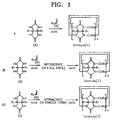
- a method for synthesizing the cucurbituril derivatives according to examples of the present invention can be classified into one of three methods, according to the reaction conditions and the state of intermediate products (refer to FIG. 1).
- an acid is added to compound (A) in an amount of 3 to 7 moles with respect to 1 mole of compound (A), and mixed.
- the acid is diluted with water or an organic solvent to be 1 to 12M, but preferably to be 6 to 12M.
- the organic solvent as an acid diluent may be dimethylsulfoxide, N,N-dimethylformamide, methanol, ethanol, chloroform or an mixture of these solvents.
- alkylaldehyde (B) is reacted with alkylaldehyde (B) in an acidic solution while stirring at 70 to 95°C for 6 to 24 hours.
- the amount of alkylaldehyde (B) used is 2 to 20 moles for each mole of glycoluril, but preferably, 4 moles.
- alkylaldehyde (B) may be formaldehyde, acetaldehyde, propionaldehyde, benzaldehyde, and the like.
- the color of the reaction solution changes into dark red with time.
- the reaction mixture is subjected to a further reaction at 95 to 105°C.
- the final reaction product varies depending on the reaction temperature and the amount of reactants.
- the usual final reaction product is a mixture of two or mare cucurbituril derivatives having the formula (1) hereinabove, where n is a value from 5 to 20 .
- R 1 and R 2 are independently selected from the group consisting of hydrogen, alkyl groups of 1 to 30 carbon atoms, alkenyl groups of 1 to 30 carbon atoms, alkynyl groups of 1 to 30 carbon atoms, alkylthio groups of 1 to 30 carbon atoms, alkylcarboxyl groups of 1 to 30 carbon atoms, hydroxyalkyl groups of 1 to 30 carbon atoms, alkylsilyl groups of 1 to 30 carbon atoms, alkoxy groups of 1 to 30 carbon atoms, haloalkyl groups of 1 to 30 carbon atoms, nitro group, alkylamine groups of 1 to 30 carbon atoms, amine group, aminoalkyl groups of 1 to 30 carbon atoms, unsubstituted cycloalkyl groups of 5 to
- the filtrate is further diluted with water and acetone, and filtered.
- water and acetone are added in a ratio of 1:3 to 1:7 by volume.
- the filter cake is dissolved in water.
- THF tetrahydrofuran
- an acid is added to compound (A) in an amount of 0.1 to 1 moles with respect to 1 mole of compound (A).
- the acid added may be diluted with water or an organic solvent in the same ratio as in the first method mentioned above. Examples of the useful organic solvents have been described in the first synthesis method, and thus examples of the organic solvents are not listed herein.
- the final reaction product slightly varies depending on the reaction temperature and the amount of reactants, as in the first synthesis method.
- the usual final reaction product is a mixture of two or more cucurbituril derivatives in the formula (1) hereinabove, where n is a value from 5 to 20.
- n is a value from 5 to 20, as in the first synthesis method.
- the third synthetic method of the cucurbituril derivatives disclosed by examples of the present invention involves a reaction under a high pressure condition, which is different from the two previously mentioned synthetic methods.
- this synthetic method the amount of acid added for the reaction with compound (A) and alkylaldehyde(B) is reduced, as in the second synthesis method, to produce oligomer powder as an intermediate product.
- the obtained intermediate product is treated with an acid to synthesize the cucurbituril derivatives having the formula (1) hereinabove.
- compound (A), an acid and alkylaldehyde (B) are put into a high-pressure reactor.
- 0.1 to 1 moles of acid and 2 to 4 moles of alkylaldehyde(B) are added with respect to 1 mole of compound (A).
- the acid is diluted with water or an organic solvent prior to use.
- the concentration of the diluted acid solution may vary depending on the reaction conditions, but preferably, 1 to 12M, more preferably 6 to 12M, of the acid solution is added. Then, the mixture is reacted at 80 to 130°C.
- the reaction is carried out under a pressure of 15 to 100 psi, but preferably, 20 to 80 psi, If the reaction pressure is higher than 100 psi, it may place the synthesis process itself into a dangerous situation. Meanwhile, if the reaction pressure is lower than 15 psi, the yield may be low.
- the solid reaction product is washed with water or an organic solvent and dried to yield oligomers in powder form as an intermediate product.
- the separation procedure shown in FIG. 2 is carried out to give the cucurbituril derivatives having the formula (1) hereinabove, where n is a value from 5 to 20, as in the first and second synthesis methods.
- Preferred embodiments of the present invention provide easy preparation methods for the cucurbituril derivatives having the formula (1), where n ranges from 5 to 20, and separation methods based on their different solubilities in a common solvent such as water, acetone and methanol.
- the cucurbituril derivatives having the formula (1) disclosed by examples of the present invention which can be used as a substitute for cyclodextrine, have cavities having a diameter of 4 to 15 ⁇ , which are able to include guest molecules, such as cyclic benzene derivatives, naphthalene derivatives, carborane derivatives, fullerene derivatives, ferrocene derivatives and adamantane derivatives in their cavities.
- the cucurbituril derivatives can selectively remove such compounds by the inclusion therein.
- the cucurbituril derivatives coprecipitate with organic dyes at a certain pH.
- X is S or NH, or R 1 or R 2 is propyl or longer alkyl chain
- the cucurbituril derivatives are soluble in organic solvents, providing wider applications than previously known cucurbituril derivatives.
- the cucurbituril derivatives having the formula (1) can include various compounds with different sizes, and have Lewis base atoms near the cavities of the molecule, which can form chemical bonds with charged metal ions, organometallic ions or organic compounds, and thus the cucurbituril derivatives can have a wide range of applications.
- the cucurbituril derivatives having the formula (1) according to examples of the present invention can be used to remove organic dyes from waste water, heavy metal from water, and radioactive isotopes from radioactive wastes, to capture and remove unpleasant odor, and air pollutants such as carbon monoxide, carbon dioxide, NOx and SOx, and to deodorize and decolorize livestock waste water and ironwork waste water.
- the cucurbituril derivatives having the formula (1) are applicable in manufacturing sensors for sensing ammonium ions, organic amines, amino acid derivatives, nucleic acid bases, alkali metal or alkaline earth metal ions.
- the cucurbituril derivatives having the formula (1) can be used as additives to polymers, cosmetics, artificially scented papers or textiles, pesticides and herbicides, and drugs, and used as drug carriers.
- the cucurbituril derivatives having the formula (1) can be used for extraction and purification of fullerene or caborane compounds, and used as packing materials of chromatographic columns, as additives to gas separation membranes, as catalysts for various chemical reactions.
- a certain pure cucurbituril derivative or a mixture of cucurbituril derivatives can be used.
- use of the mixture of cucurbituril derivatives prepared by one of the three methods in FIG. 1 is preferred in terms of cost, because it does not need additional separation process.
- glycoluril was added to 20 ml of 9M-hydrosulfuric acid (H 2 SO 4 ) aqueous solution and stirred at 70°C.
- formaldehyde was added to the reaction mixture and stirred at 70 to 75°C for 24 hours.
- reaction product was diluted with 50 ml of water and 1.0 l of acetone was added to form a precipitate.
- the obtained precipitate was filtered, washed with acetone and dried for 24 hours.
- the precipitate was dissolved in 200 ml of water, and the water insoluble fraction was filtered away. 800 ml of acetone was added to the filtrate for reprecipitation. The precipitate was filtered and dissolved in 200 ml of water and methanol mixture (mixed in a ratio of 1:1 by volume). The insoluble fraction in the water and methanol mixture was filtered away and 100 ml of acetone was added to the filtrate to form a precipitate.
- the precipitate was filtered, washed with acetone and vacuum dried for 24 hours.
- the dried powder was dissolved in 1M-H 2 SO 4 solution and stored at 5 to 10°C to give a colorless crystalline cucurtbit[5]uril in a yield of 10%.
- the reaction mixture was diluted with 200 ml of water, and 1.0 l of acetone was further added to form a precipitate.
- the precipitate was filtered and then stirred in a mixture of 200 ml of water and 800 ml of acetone for 5 minutes.
- the precipitate was filtered and dissolved in 200 ml of water.
- the water insoluble fraction was filtered and 1.0 l of acetone was added to the filtrate to form a precipitate.
- the precipitate was filtered and dissolved in a mixture of 50 ml of water and 60 ml of methanol.
- the insoluble fraction was filtered and 500 ml of acetone was added to the filtrate to form a precipitate.
- the precipitate was filtered, washed with acetone, and dried for 24 hours to give a cucurbit[5]urile in a yield of 10%.
- the reaction product was diluted with 200 ml of water, and 1.0 l of acetone was added to the solution to form a precipitate.
- the precipitate was filtered, washed with acetone and vacuum dried for 25 hours.
- the precipitate was dissolved in 200 ml of water and 600 ml of acetone, and filtered. The obtained precipitate was dissolved in 150 ml of water and filtered. 1.0 l of acetone was added to the filtrate to form a precipitate. The precipitate was filtered and dissolved in a mixture of 50 ml of water and 60 ml of methanol. The insoluble fraction in the water and methanol solution was filtered away and 500 ml of acetone was added to the filtrate to form a precipitate.
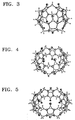
- the crystal structure of the obtained cucurbituril derivative was determined by X-ray crystallography. The result is shown in FIG. 3.
- glycoluril was added to 20 ml of 9M-H 2 SO 4 aqueous solution and stirred at 70°C for 30 minutes. 7.0 ml of formaldehyde was added to the reaction mixture and stirred at 75°C for 24 hours.
- reaction mixture was diluted with 200 lm of water, and 1.0 l of acetone was added to form a precipitate.
- the obtained precipitate was filtered, washed with acetone and dried for 24 hours.
- the precipitate was dissolved in 200 ml of water and 800 ml of acetone, and stirred for 5 minutes.
- the precipitate was filtered, dissolved in a mixture of 200 ml of water and 600 ml of acetone, and stirred for 5 minutes.
- the precipitate was filtered, washed with acetone and vacuum dried for 24 hours.
- the reaction product was dissolved in 100 ml of water, and the water insoluble fraction was filtered away. 1.0 l of acetone was added to the filtrate to form a precipitate. The obtained precipitate was filtered and dissolved in a mixture of 50 ml of water and 50 ml of methanol.
- the dried powder was dissolved in water, the water insoluble fraction of the solution was completely dissolved with an appropriate amount of H 2 SO 4 .
- 5% of THF by volume with respect to the total solution was carefully added to the solution and the acetone was vapor diffused into the solution at room temperature for 12 hours. Then, the reaction product was stored in a refrigerator set at 6°C for 12 hours to give colorless crystalline cucurbit[7]urile in a yield of 20%.
- the reaction mixture was diluted with 200 ml of water, and 1.0 ml of acetone was further added to form a precipitate.
- the precipitate was filtered and then stirred in a mixture of 200 ml of water and 600 ml of acetone for 5 minutes. The precipitate was filtered, washed with acetone and vacuum dried for 24 hours.
- the product was dissolved in 100 ml of water, and the water insoluble fraction was filtered. 1.0 ml of acetone was added to the filtrate to form a precipitate. The precipitate was filtered with acetone and dissolved in a solution of 50 ml of water and 60 ml of methanol. The insoluble fraction in the water and methanol mixture was filtered, washed with acetone and vacuum dried for 24 hours.
- the dried powder was dissolved in water, and an appropriate amount of sulfuric acid was added to dissolve the water insoluble fraction. 5% of THF by volume with respect to the volume of the solution was carefully added to the solution and acetone was vapor diffused into the solution at room temperature for 12 hours.
- the reaction product was stored in a refrigerator set at 6°C for 12 hours to give colorless crystalline cucurbit[7]uril in a yield of 20%.
- the reaction product was diluted with 200 ml of water, and 1.0 l of acetone was added to the solution to form a precipitate.
- the precipitate was filtered, 200 ml of water and 800 ml of acetone were added to the precipitate, and stirred for 5 minutes.
- the obtained precipitate was filtered, 200 ml of water and 600 ml of acetone were added to the precipitate, and stirred for 5 minutes.
- the precipitate was filtered, washed with acetone and vacuum dried for 24 hours.
- the dried product was dissolved in 100 ml of water and the water insoluble fraction was filtered. 1.0 l of acetone was added to the filtrate to form a precipitate. The precipitate was filtered and dissolved in a mixture of 50 ml of water and 60 ml of methanol.
- the dried solid powder was dissolved in water and an appropriate amount of H 2 SO 4 was carefully added to dissolve the water insoluble fraction. 5% of THF by volume with respect to the volume of the solution was carefully added to the solution, and acetone was vacuum diffused into the solution at room temperature for 2 hours.
- the reaction product was stored in a refrigerator set at 6°C for 12 hours to give colorless crystalline cucurbit[7]uril in a yield of 20%.
- the crystal structure of the obtained cucurbituril derivative was determined by X-ray crystallography. The result is shown in FIG. 4.
- reaction mixture was diluted with 100 ml of water, and stored at 6°C to room temperature for 12 hours to 3 days to give colorless crystalline cucurbit[8]uril in a yield of 10%.
- reaction mixture was diluted with 100 ml of water, and stored at room temperature for 12 hours to 3 days to give colorless crystalline cucurbit[8]uril in a yield of 10%.
- reaction product was diluted with 150 ml of water, and stored at room temperature for 12 hours to 3 days to give colorless crystalline cucurbit[8]uril in a yield of 10%.
- the crystal structure of the obtained cucurbituril derivative was determined by X-ray crystallography. The result is shown in FIG. 5.
- the reaction mixture was diluted with 200 ml of water, and 1.0 l of acetone was added to form a precipitate.
- the obtained precipitate was filtered, added to 200 ml of water and 800 ml of acetone, and stirred for 5 minutes.
- the precipitate was filtered, and added to a mixture of 200 ml of water and 600 ml of acetone, and stirred for 5 minutes. The precipitate was filtered, washed with acetone and vacuum dried for 24 hours.
- reaction product was dissolved in 100 ml of water.
- the water insoluble fraction was filtered, washed with acetone and vacuum dried for 24 hours to give a colorless solid cucurbit[6]uril in a yield of 50%.
- reaction solution hardened, forming a gel.
- the obtained gel was washed with water and acetone, and vacuum dried overnight. 10 ml of 11M-H 2 SO 4 aqueous solution was added to the resultant solid compound and stirred at 80°C for 12 hours.
- the reaction mixture was diluted with 200 ml of water, and 1.0 l of acetone was further added to form a precipitate.
- the precipitate was filtered and then stirred in a mixture of 200 ml of water and 600 ml of acetone for 5 minutes.
- the precipitate was filtered, added to a mixture of 200 ml of water and 600 ml of acetone, and stirred for 5 minutes. The precipitate was filtered, washed with acetone and vacuum dried for 24 hours.
- the dried product was dissolved in water.
- the water insoluble fraction was filtered and washed with acetone and vacuum dried for 24 hours to give a colorless solid cucurbit[6]uril in a yield of 50%.
- the reaction product was diluted with 200 ml of water, and 1.0 l of acetone was added to the solution to form a precipitate.
- the precipitate was filtered 200 ml of water and 800 ml of acetone were added to the precipitate, and stirred for 5 minutes.
- the obtained precipitate was filtered, 200 ml of water and 600 ml of acetone were added to the precipitate, and stirred for 5 minutes.
- the precipitate was filtered, washed with acetone and vacuum dried for 24 hours.
- the dried product was dissolved in 100 ml of water.
- the water insoluble fraction was filtered, washed with acetone, and vacuum dried for 24 hours to give a colorless crystalline cucurbit[6]uril in a yield of 50%.
- reaction product was diluted with 50 ml of water and 1.0 l of acetone was added to form a precipitate.
- the obtained precipitate was filtered, washed with acetone and dried for 24 hours, to give a mixture of cucurbituril derivatives having the formula (1) hereinabove, where n is a value from 5 to 20.
- Direct Red 5B (commercially available from Ciba-Geigy Co.) was dissolved in 150 ml of water to prepare an organic dye solution. To half the organic dye solution, 150 mg of cucurbit[7]uril was added and stirred for 30 minutes.
- the UV absorption intensity of the untreated solution was 1.43 and that of the solution treated with the curcurbit[7]uril was 2.37 ⁇ 10 -2 .
- R UV absorption intensity of the dye solution treated with cucurbit[7]uril ⁇ 100/UV absorption intensity of the dye solution before the treatment with cucurbit[7]uril
- Example 1 The process of Example 1 was followed, except that a mixture of 80 mg of cucurbit[7]uril and 70 mg of cucurbit[8]ril was used instead of 150 mg of cucurbit[7]uril.
- Direct Red 5B commercially available from Ciba-Geiba Co.
- ⁇ max 510 nm on the filtrate before and after the treatment with the mixture of the cucurbituril.
- the UV absorption intensity of the untreated solution was 1.43 and that of the solution treated with the mixture of the cucurbituril was 2.02 ⁇ 10 -2 .
- R was 1.4%.
- Example 1 The process of Example 1 was followed, except that a mixture of cucurbituril derivatives from Synthesis Examples 5, where n is a value from 5 to 20, was used instead of the cucurbit[7]uril.
- Direct Red 5B commercially available from Ciba-Geigy Co.
- Example 3 shows that the mixture of cucurbituril derivatives hereinabove, where n is a value from 5 to 20, obtained in Synthesis Example 5, show similar organic dye removal effect to that of separate cucurbituril derivatives produced in Examples 1 through 3.
- This result supports the fact that the cucurbituril derivatives disclosed by examples of the present invention can be used in the form of a mixture to remove organic dyes without being separated.
- the use of the mixture of cucurbituril derivatives can reduce the cost for organic dye removal.
- cyclen tetrahydrochloride (1,4,7,10-tetraazacyclodecane tetrahydrochloride) and 100.0 mg of cucurbit[8]uril were dissolved in water. Heating followed by slow cooling of the solution produced an inclusion complex in which a cyclen molecule was encapsulated in the cavity of cucurbit[8]uril as a colorless crystalline material.
- cyclam tetrahydrochloride (1,4,8,11-tetraazacyclotetradecane tetrahydrochloride) and 10.0 mg of cucurbit[8]uril were dissolved in water. Heating followed by slow cooling of the solution produced an inclusion complex in which a cyclam molecule was encapsulated in the cavity of cucurbit[8]uril as a colorless crystalline material.
- Examples 4 through 8 show that the novel cucurbituril derivatives obtained in Synthesis Examples 1 through 5 can be used in extraction, separation and purification of the organic molecules used in the examples, and other organic molecules such as fullerene.
- the cucurbituril derivatives obtained in Synthesis Examples 1 through 5 have Lewis base atoms near the cavities of the molecule, and thus they can effectively form a complex with positively charged metal ions or other organic ions.
- the following example is for investigating whether the cucurbituril derivatives having this property can be applied in manufacturing sensors for sensing positive metal ions or ammonium ions.
- the cucurbit[5]uril derivative has a binding constant of 5.4 ⁇ 10 3 M -1 with ammonium ions, 3.3 ⁇ 10 2 M -1 with positive lithium ions, 4.5 ⁇ 10 3 M -1 with positive sodium ions, and 2.6 ⁇ 10 4 M -1 with positive potassium ions.
- the cucurbit[5]uril derivative can selectively bind with alkali metal ions, as well as with ammonium ions. The result confirms that cucurbituril derivatives can be used as ion sensors.
- the following example is for investigating the function of the cucurbituril derivatives obtained in Synthesis Examples 1 through 10, as a drug carrier.
- cisplatin an anti-cancer drug, was used.
- Cis -dichloroethylenediamine platinum (II) and 2.0 mg of cucurbit[8]uril were dissolved in water.
- NMR spectroscopy confirms quantitative formation of a 2:1 complex of the dichloroethylenediamine platinum (II) and cucurbit[8]uril.
- the results from Examples 11 through 13 show that the cucurbituril derivatives obtained in Synthesis Examples 1 through 5 can selectively detect amino acids, which have aromatic side chains, and the base of a particular nucleic acid, such as thymine, and thus the cucurbituril derivatives are applicable in separating such substances, or developing sensors for detecting such substances.
- the following example is for investigating whether the cucurbituril derivatives obtained in Synthesis Examples 1 through 5 can be used as additives to pesticides, herbicides, aromatics and the like.
- Methylviologendichloride (so-called paraquat), a herbicide, was used. 5.0 mM of mehylbiologendichloride solution was prepared with D 2 O solvent. Next, cucurbit[8]uril was added to the solution. NMR spectroscopy conforms quantitative formation of a 1:1 complex of methylviolgen and cucurbit[8]uril.
- Example 14 shows that the cucurbituril derivatives according to examples of the present invention can release slowly pesticides, herbicides and aromatics captured therein, and thus they can be used as additives in manufacturing pesticides, herbicides, cosmetics, artificially scented papers or textiles.
- X is S or NH, or R 1 or R 2 is propyl or longer alkyl chain
- the cucurbituril derivatives are soluble in organic solvents, providing wider applications than previously known cucurbituril derivatives.
- the cucurbituril derivatives disclosed by examples of this invention can encapsulate various compounds with different sizes, Furthermore, they have Lewis base atoms near the entrances to their cavities which allow the cucurbituril derivatives to form complexes with metal ions, organometallic ions or positively charged organic compounds.
- the cucurbituril derivatives disclosed by examples of the present invention have wide applications.
- the preparation of the cucurbituril derivatives disclosed by examples of the present invention is easily scaled up for industrial purposes.
- each cucurbituril derivative can be separated from the mixture containing the cucurbituril derivatives having the formula (1), where n is a value from 5 to 20, and a mixture of two or more of the cucurbituril derivatives can also be obtained.
- the cucurbituril derivatives and the mixture thereof disclosed by examples of the present invention may be applied to remove organic dyes from waste water, heavy metal from water and radioactive isotopes from radioactive wastes, to capture and remove unpleasant odor, and air pollutants such as carbon monoxide, carbon dioxide, NO x and SO x , and to deodorize and decolorize livestock waste water and ironwork waste water.
- the cucurbituril derivatives disclosed by examples of the present invention are applicable in manufacturing sensors for sensing ammonium ions, organic amines, amino acid derivatives, nucleic acid bases, alkali metal or alkaline earth metal ions.
- the cucurbituril derivatives can be used as additives to polymers, cosmetics, artificially scented papers or textiles, pesticides and herbicides, and drugs, and used as drug carriers.
- the cucurbituril derivatives having the formula (1) can be used for extraction and purification of fullerene or caborane compounds, and used as packing materials of chromatographic columns, as additives to gas separation membranes, as catalysts for various chemical reactions.
Landscapes
- Chemical & Material Sciences (AREA)
- Engineering & Computer Science (AREA)
- Organic Chemistry (AREA)
- Chemical Kinetics & Catalysis (AREA)
- Environmental & Geological Engineering (AREA)
- General Chemical & Material Sciences (AREA)
- Health & Medical Sciences (AREA)
- Oil, Petroleum & Natural Gas (AREA)
- Analytical Chemistry (AREA)
- Biomedical Technology (AREA)
- Materials Engineering (AREA)
- Life Sciences & Earth Sciences (AREA)
- Hydrology & Water Resources (AREA)
- Water Supply & Treatment (AREA)
- Organic Low-Molecular-Weight Compounds And Preparation Thereof (AREA)
- Macromolecular Compounds Obtained By Forming Nitrogen-Containing Linkages In General (AREA)
- Nitrogen Condensed Heterocyclic Rings (AREA)
- Medicinal Preparation (AREA)
- Cosmetics (AREA)
- Solid-Sorbent Or Filter-Aiding Compositions (AREA)
- Agricultural Chemicals And Associated Chemicals (AREA)
- Compositions Of Macromolecular Compounds (AREA)
- Physical Water Treatments (AREA)
- Removal Of Specific Substances (AREA)
Applications Claiming Priority (5)
| Application Number | Priority Date | Filing Date | Title |
|---|---|---|---|
| KR9945842 | 1999-10-21 | ||
| KR19990045842 | 1999-10-21 | ||
| KR2000033026 | 2000-06-15 | ||
| KR0033026 | 2000-06-15 | ||
| KR10-2000-0033026A KR100400082B1 (ko) | 1999-10-21 | 2000-06-15 | 쿠커비투릴 유도체의 제조방법 |
Publications (3)
| Publication Number | Publication Date |
|---|---|
| EP1094065A2 true EP1094065A2 (de) | 2001-04-25 |
| EP1094065A3 EP1094065A3 (de) | 2001-10-10 |
| EP1094065B1 EP1094065B1 (de) | 2003-12-17 |
Family
ID=26636226
Family Applications (1)
| Application Number | Title | Priority Date | Filing Date |
|---|---|---|---|
| EP00305458A Expired - Lifetime EP1094065B1 (de) | 1999-10-21 | 2000-06-28 | Verfahren zur Herstellung von Cucurbituril Derivaten |
Country Status (4)
| Country | Link |
|---|---|
| US (3) | US6365734B1 (de) |
| EP (1) | EP1094065B1 (de) |
| JP (1) | JP3432483B2 (de) |
| DE (1) | DE60007257T2 (de) |
Cited By (23)
| Publication number | Priority date | Publication date | Assignee | Title |
|---|---|---|---|---|
| WO2002096553A3 (de) * | 2001-05-28 | 2003-03-13 | Syntec Ges Fuer Chemie Und Tec | Anorganische, cucurbituril enthaltenden, absorbierende komposite, verfahren zur herstellung und verwendung |
| WO2003024978A1 (en) | 2001-09-18 | 2003-03-27 | Postech Foundation | Inclusion compound comprising cucurbituril derivatives as host molecule and pharmaceutical composition comprising the same |
| KR100400082B1 (ko) * | 1999-10-21 | 2003-09-29 | 학교법인 포항공과대학교 | 쿠커비투릴 유도체의 제조방법 |
| WO2004055258A1 (de) * | 2002-12-17 | 2004-07-01 | Henkel Commanditgesellschaft Auf Aktien | Verfahren zur temporären ausrüstung von textilien |
| US6869466B2 (en) | 1999-05-07 | 2005-03-22 | Unisearch Limited | Cucurbiturils and method for binding gases and volatiles using cucurbiturils |
| WO2005103053A1 (en) * | 2004-04-26 | 2005-11-03 | Postech Academy-Industry Foundation | Processes of preparing glycolurils and cucurbiturils using microwave |
| WO2006005727A1 (de) * | 2004-07-08 | 2006-01-19 | International University Bremen Gmbh | Photostabilisierung von fluoreszenzfarbstoffen |
| WO2006015725A2 (de) | 2004-08-05 | 2006-02-16 | Henkel Kommanditgesellschaft Auf Aktien | Verwendung von ortho-phenylphenol und/oder dessen derivaten zur hemmung der asexuellen vermehrung von pilzen |
| US7179908B2 (en) * | 2001-07-04 | 2007-02-20 | Pohang University Of Science And Technology Foundation | Water-and organic-soluble cucurbituril derivatives, their preparation methods, their separation methods and uses |
| US7479254B2 (en) | 2005-10-20 | 2009-01-20 | Postech Foundation | Application using non-covalent bond between a cucurbituril derivative and a ligand |
| US7501523B2 (en) | 2003-09-12 | 2009-03-10 | Newsouth Innovations Pty Limited | Method for preparing cucurbiturils |
| US7504029B2 (en) | 2003-02-11 | 2009-03-17 | Postech Foundation | Silica gel bonded with cucurbituril |
| US7520982B2 (en) | 2003-07-26 | 2009-04-21 | Postech Foundation | Cucurbituril-containing polymer, stationary phase and column using the same |
| US7910647B2 (en) | 2003-12-13 | 2011-03-22 | Henkel Ag & Co. Kgaa | Adhesion inhibition of microorganisms by non-ionic surfactants |
| WO2011057590A1 (en) | 2009-11-16 | 2011-05-19 | Masarykova Univerzita | New macrocyclic derivatives of glycolurils, and methods of preparing and using the same |
| EP1871823A4 (de) * | 2005-04-21 | 2012-06-27 | Postech Foundation | Polymerkapsel und herstellungsverfahren dafür |
| CN103992340A (zh) * | 2014-05-28 | 2014-08-20 | 贵州大学 | 单取代六甲基六元瓜环-稀土加合物及合成方法和应用 |
| US9073972B2 (en) | 2008-04-16 | 2015-07-07 | Postech Academy-Industry Foundation | Method of separating and purifying cellular components using non-covalent bond between cucurbituril derivative and guest compound and apparatus using the same |
| CN106745625A (zh) * | 2016-11-29 | 2017-05-31 | 中国科学院福建物质结构研究所 | 从水溶液中捕集、分离、降解亚硝酸根离子的方法与应用 |
| CN106902553A (zh) * | 2017-03-24 | 2017-06-30 | 贵州大学 | 一种基于十元瓜环超分子自组装体的应用及应用方法 |
| CN106905958A (zh) * | 2017-03-21 | 2017-06-30 | 贵州大学 | 一种基于反式七元瓜环的荧光探针、制备方法及应用 |
| CN108752595A (zh) * | 2018-03-27 | 2018-11-06 | 贵州大学 | 六甲基六元瓜环多孔超分子组装体框架及其应用 |
| CN113740472A (zh) * | 2021-08-13 | 2021-12-03 | 杭州师范大学 | 一种温郁金中杀螨剂的微提取方法 |
Families Citing this family (36)
| Publication number | Priority date | Publication date | Assignee | Title |
|---|---|---|---|---|
| AUPQ023299A0 (en) * | 1999-05-07 | 1999-06-03 | Unisearch Limited | Cucurbiturils and method for synthesis |
| KR100499275B1 (ko) * | 2002-01-03 | 2005-07-01 | 학교법인 포항공과대학교 | 하이드록시쿠커비투릴 및 그 유도체, 그 제조방법 및이들의 용도 |
| WO2004110148A1 (de) | 2003-06-17 | 2004-12-23 | Henkel Kommanditgesellschaft Auf Aktien | Hemmung der asexuellen vermehrung von pilzen durch eugenol und/oder dessen derivate |
| KR100554156B1 (ko) * | 2003-07-26 | 2006-02-22 | 학교법인 포항공과대학교 | 쿠커비투릴 유도체가 응집되어 형성된 나노 입자, 그 나노입자에 약물이 담지된 약제학적 조성물, 및 이들의 제조방법 |
| EP1668015B1 (de) * | 2003-09-04 | 2013-08-21 | Technion Research And Development Foundation, Ltd. | Cucurbiturilanordnung und seine verwendungen |
| CN1922187A (zh) * | 2004-01-15 | 2007-02-28 | 新南创新有限公司 | 由葫芦形联脲[7-12]部分包封的多核金属配合物 |
| WO2005087777A1 (en) * | 2004-03-13 | 2005-09-22 | Postech Foundation | Distributed cucurbiturils and preparing method thereof |
| CN1930169A (zh) * | 2004-03-19 | 2007-03-14 | 新南创新有限公司 | 制备包含葫环联脲基团的化合物的方法 |
| KR100638478B1 (ko) * | 2004-04-20 | 2006-10-25 | 학교법인 포항공과대학교 | 이치환 쿠커비투릴이 결합된 실리카겔 |
| KR100567347B1 (ko) * | 2004-04-21 | 2006-04-04 | 학교법인 포항공과대학교 | 쿠커비투릴 유도체를 이용한 고분자 초박막 및 그 제조방법 |
| DE102004056362A1 (de) | 2004-11-22 | 2006-06-01 | Henkel Kgaa | Schimmel-beständige Baustoffe |
| KR100687731B1 (ko) | 2005-10-20 | 2007-03-02 | 학교법인 포항공과대학교 | 쿠커비투릴을 이용한 고분자 초박막의 제조방법 |
| KR100750320B1 (ko) * | 2006-01-04 | 2007-08-17 | 학교법인 포항공과대학교 | 쿠커비투릴을 포함하는 젤 |
| EP1942752A4 (de) * | 2006-03-09 | 2013-01-16 | Postech Acad Ind Found | Zigaretten mit zugesetztem cucurbituril und verfahren zu deren herstellung |
| EP1999122B1 (de) * | 2006-03-24 | 2010-11-24 | Postech Foundation | Stationäre phase und säule unter verwendung von cucurbiturilgebundenem kieselgel, und verfahren zur abtrennung von taxol unter verwendung der säule |
| GB0723714D0 (en) * | 2007-12-04 | 2008-01-16 | Cambridge Entpr Ltd | Supramolecular handcuffs in polymeric architecture |
| GB0922623D0 (en) | 2009-12-23 | 2010-02-10 | Cambridge Entpr Ltd | Methods for the purification of cucurbituril |
| US20110150955A1 (en) | 2009-12-23 | 2011-06-23 | Shannon Elizabeth Klingman | Products and Methods for Reducing Malodor from the Pudendum |
| JP5703129B2 (ja) * | 2011-05-26 | 2015-04-15 | 住友ベークライト株式会社 | 固相化担体および固相化担体の製造方法 |
| JP2012246239A (ja) * | 2011-05-26 | 2012-12-13 | Sumitomo Bakelite Co Ltd | キュカービット[7]ウリルの製造方法 |
| BR112014001868B1 (pt) | 2011-07-26 | 2022-01-11 | Cambridge Enterprise Limited | Cápsulas supramoleculares, método para preparação das referidas cápsulas e método não-terapêutico de distribuir um componente a um local |
| GB201301648D0 (en) | 2013-01-30 | 2013-03-13 | Cambridge Entpr Ltd | Nested supramolecular capsules |
| US11491227B2 (en) | 2012-02-20 | 2022-11-08 | Cambridge Enterprise Limited | Cucurbituril-based hydrogels |
| WO2014077640A1 (en) * | 2012-11-16 | 2014-05-22 | Postech Academy-Industry Foundation | Composition for slow emission of fragrance comprising complexes of cucurbituril and fragrance molecule |
| WO2014077642A1 (en) * | 2012-11-16 | 2014-05-22 | Postech Academy-Industry Foundation | Composition for odor removal comprising cucurbituril |
| WO2014077641A1 (en) * | 2012-11-16 | 2014-05-22 | Postech Academy-Industry Foundation | Composition for odor removal and fragrance emission comprising complexes of cucurbituril and fragrance |
| KR101468299B1 (ko) | 2012-11-16 | 2014-12-02 | 포항공과대학교 산학협력단 | 쿠커비투릴을 포함하는 냄새제거용 조성물 |
| DE102013021899A1 (de) | 2013-12-24 | 2015-06-25 | Jacobs University Bremen Ggmbh | Verfahren zur Detektion eines chiralen Analyten |
| GB201508510D0 (en) | 2015-05-18 | 2015-07-01 | Aqdot Ltd | Curling compositions |
| US11484615B2 (en) * | 2016-02-15 | 2022-11-01 | Aqdot Limited | Cucurbituril compositions and their use |
| GB2547281B (en) | 2016-02-15 | 2019-10-16 | Aqdot Ltd | Pro-fragrance composition |
| KR101997474B1 (ko) * | 2016-06-13 | 2019-07-09 | 기초과학연구원 | 쿠커비투[n]릴을 이용하여 신경전달물질을 제어하는 방법 및 이의 용도 |
| CN108383197A (zh) * | 2018-04-09 | 2018-08-10 | 山东冬瑞高新技术开发有限公司 | 一种绿色印染废水处理剂及其制备方法 |
| US12157869B2 (en) | 2019-07-10 | 2024-12-03 | Jeffrey Dean Lindsay | Methods and compositions for reducing persistent odor in clothing and mitigating biofilms on various materials |
| GB202009637D0 (en) * | 2020-06-24 | 2020-08-05 | Aqdot Ltd | A method of disinfecting a gaseous enviroment, a liquid, or a solid surface |
| CN115770554B (zh) * | 2022-11-08 | 2024-08-27 | 昊华气体有限公司 | 一种改性吸附剂及其在一氟甲烷中脱除六氟乙烷的应用 |
Family Cites Families (25)
| Publication number | Priority date | Publication date | Assignee | Title |
|---|---|---|---|---|
| US2725308A (en) * | 1953-02-27 | 1955-11-29 | Monsanto Chemicals | Composition for and treatment of textile materials |
| US3767669A (en) * | 1971-06-18 | 1973-10-23 | Allied Chem | Phenyl substituted hydroxyalkyl derivatives of glycolurils |
| DE4001139C2 (de) * | 1989-04-19 | 2003-04-17 | Deutsches Textilforschzentrum | Verfahren zur Isolierung von organischen Verbindungen |
| US6165210A (en) * | 1994-04-01 | 2000-12-26 | Gore Enterprise Holdings, Inc. | Self-expandable helical intravascular stent and stent-graft |
| US5900245A (en) * | 1996-03-22 | 1999-05-04 | Focal, Inc. | Compliant tissue sealants |
| US6833408B2 (en) * | 1995-12-18 | 2004-12-21 | Cohesion Technologies, Inc. | Methods for tissue repair using adhesive materials |
| DE19603377B4 (de) * | 1996-01-31 | 2006-12-14 | Sensient Imaging Technologies Gmbh | Verfahren zur Herstellung von Cucurbituril |
| DE69734060T2 (de) * | 1996-05-24 | 2006-06-29 | Angiotech Pharmaceuticals, Inc., Vancouver | Zubereitungen und verfahren zur behandlung oder prävention von krankheiten der körperpassagewege |
| US6059750A (en) * | 1996-08-01 | 2000-05-09 | Thomas J. Fogarty | Minimally invasive direct cardiac massage device and method |
| US5702343A (en) * | 1996-10-02 | 1997-12-30 | Acorn Medical, Inc. | Cardiac reinforcement device |
| US6123662A (en) * | 1998-07-13 | 2000-09-26 | Acorn Cardiovascular, Inc. | Cardiac disease treatment and device |
| US5814233A (en) * | 1997-11-10 | 1998-09-29 | Great Lakes Chemical Corporation | Compositions and methods for treating water |
| JP3588544B2 (ja) * | 1998-02-02 | 2004-11-10 | 伯東株式会社 | 染料除去剤及び染料含有水中の染料を除去する方法 |
| US6818018B1 (en) * | 1998-08-14 | 2004-11-16 | Incept Llc | In situ polymerizable hydrogels |
| US6587734B2 (en) * | 1998-11-04 | 2003-07-01 | Acorn Cardiovascular, Inc. | Cardio therapeutic heart sack |
| US6312725B1 (en) * | 1999-04-16 | 2001-11-06 | Cohesion Technologies, Inc. | Rapid gelling biocompatible polymer composition |
| AUPQ023299A0 (en) * | 1999-05-07 | 1999-06-03 | Unisearch Limited | Cucurbiturils and method for synthesis |
| US6633780B1 (en) * | 1999-06-07 | 2003-10-14 | The Johns Hopkins University | Cardiac shock electrode system and corresponding implantable defibrillator system |
| US6293906B1 (en) * | 2000-01-14 | 2001-09-25 | Acorn Cardiovascular, Inc. | Delivery of cardiac constraint jacket |
| US6425856B1 (en) * | 2000-05-10 | 2002-07-30 | Acorn Cardiovascular, Inc. | Cardiac disease treatment and device |
| US6902522B1 (en) * | 2000-06-12 | 2005-06-07 | Acorn Cardiovascular, Inc. | Cardiac disease treatment and device |
| US6482146B1 (en) * | 2000-06-13 | 2002-11-19 | Acorn Cardiovascular, Inc. | Cardiac disease treatment and device |
| US6951534B2 (en) * | 2000-06-13 | 2005-10-04 | Acorn Cardiovascular, Inc. | Cardiac support device |
| US6887192B1 (en) * | 2000-09-08 | 2005-05-03 | Converge Medical, Inc. | Heart support to prevent ventricular remodeling |
| US7235042B2 (en) * | 2003-09-16 | 2007-06-26 | Acorn Cardiovascular, Inc. | Apparatus and method for applying cardiac support device |
-
2000
- 2000-06-28 US US09/605,635 patent/US6365734B1/en not_active Expired - Lifetime
- 2000-06-28 EP EP00305458A patent/EP1094065B1/de not_active Expired - Lifetime
- 2000-06-28 DE DE60007257T patent/DE60007257T2/de not_active Expired - Lifetime
- 2000-06-30 JP JP2000200196A patent/JP3432483B2/ja not_active Expired - Fee Related
-
2002
- 2002-03-08 US US10/092,468 patent/US6639069B2/en not_active Expired - Lifetime
-
2003
- 2003-08-25 US US10/646,722 patent/US7160466B2/en not_active Expired - Lifetime
Cited By (28)
| Publication number | Priority date | Publication date | Assignee | Title |
|---|---|---|---|---|
| US6869466B2 (en) | 1999-05-07 | 2005-03-22 | Unisearch Limited | Cucurbiturils and method for binding gases and volatiles using cucurbiturils |
| KR100400082B1 (ko) * | 1999-10-21 | 2003-09-29 | 학교법인 포항공과대학교 | 쿠커비투릴 유도체의 제조방법 |
| WO2002096553A3 (de) * | 2001-05-28 | 2003-03-13 | Syntec Ges Fuer Chemie Und Tec | Anorganische, cucurbituril enthaltenden, absorbierende komposite, verfahren zur herstellung und verwendung |
| US7179908B2 (en) * | 2001-07-04 | 2007-02-20 | Pohang University Of Science And Technology Foundation | Water-and organic-soluble cucurbituril derivatives, their preparation methods, their separation methods and uses |
| EP1430061A4 (de) * | 2001-09-18 | 2008-02-13 | Postech Foundation | Einschlussverbindung mit cucurbiturilderivaten als wirtsmolekül, und diese enthaltende pharmazeutische zusammensetzung |
| WO2003024978A1 (en) | 2001-09-18 | 2003-03-27 | Postech Foundation | Inclusion compound comprising cucurbituril derivatives as host molecule and pharmaceutical composition comprising the same |
| WO2004055258A1 (de) * | 2002-12-17 | 2004-07-01 | Henkel Commanditgesellschaft Auf Aktien | Verfahren zur temporären ausrüstung von textilien |
| US7504029B2 (en) | 2003-02-11 | 2009-03-17 | Postech Foundation | Silica gel bonded with cucurbituril |
| US7520982B2 (en) | 2003-07-26 | 2009-04-21 | Postech Foundation | Cucurbituril-containing polymer, stationary phase and column using the same |
| US7501523B2 (en) | 2003-09-12 | 2009-03-10 | Newsouth Innovations Pty Limited | Method for preparing cucurbiturils |
| US7910647B2 (en) | 2003-12-13 | 2011-03-22 | Henkel Ag & Co. Kgaa | Adhesion inhibition of microorganisms by non-ionic surfactants |
| WO2005103053A1 (en) * | 2004-04-26 | 2005-11-03 | Postech Academy-Industry Foundation | Processes of preparing glycolurils and cucurbiturils using microwave |
| US8293922B2 (en) | 2004-04-26 | 2012-10-23 | Postech Academy-Industry Foundation | Processes of preparing glycolurils and cucurbiturils using microwave |
| WO2006005727A1 (de) * | 2004-07-08 | 2006-01-19 | International University Bremen Gmbh | Photostabilisierung von fluoreszenzfarbstoffen |
| WO2006015725A2 (de) | 2004-08-05 | 2006-02-16 | Henkel Kommanditgesellschaft Auf Aktien | Verwendung von ortho-phenylphenol und/oder dessen derivaten zur hemmung der asexuellen vermehrung von pilzen |
| EP1871823A4 (de) * | 2005-04-21 | 2012-06-27 | Postech Foundation | Polymerkapsel und herstellungsverfahren dafür |
| US7718128B2 (en) | 2005-10-20 | 2010-05-18 | Postech Foundation | Application using non-covalent bond between a cucurbituril derivative and a ligand |
| US7479254B2 (en) | 2005-10-20 | 2009-01-20 | Postech Foundation | Application using non-covalent bond between a cucurbituril derivative and a ligand |
| US9073972B2 (en) | 2008-04-16 | 2015-07-07 | Postech Academy-Industry Foundation | Method of separating and purifying cellular components using non-covalent bond between cucurbituril derivative and guest compound and apparatus using the same |
| WO2011057590A1 (en) | 2009-11-16 | 2011-05-19 | Masarykova Univerzita | New macrocyclic derivatives of glycolurils, and methods of preparing and using the same |
| US8779120B2 (en) | 2009-11-16 | 2014-07-15 | Masarykova Univerzita | Macrocyclic derivatives of glycolurils, and methods of preparing and using the same |
| CN103992340A (zh) * | 2014-05-28 | 2014-08-20 | 贵州大学 | 单取代六甲基六元瓜环-稀土加合物及合成方法和应用 |
| CN103992340B (zh) * | 2014-05-28 | 2016-06-22 | 贵州大学 | 单取代六甲基六元瓜环-稀土加合物及合成方法和应用 |
| CN106745625A (zh) * | 2016-11-29 | 2017-05-31 | 中国科学院福建物质结构研究所 | 从水溶液中捕集、分离、降解亚硝酸根离子的方法与应用 |
| CN106905958A (zh) * | 2017-03-21 | 2017-06-30 | 贵州大学 | 一种基于反式七元瓜环的荧光探针、制备方法及应用 |
| CN106902553A (zh) * | 2017-03-24 | 2017-06-30 | 贵州大学 | 一种基于十元瓜环超分子自组装体的应用及应用方法 |
| CN108752595A (zh) * | 2018-03-27 | 2018-11-06 | 贵州大学 | 六甲基六元瓜环多孔超分子组装体框架及其应用 |
| CN113740472A (zh) * | 2021-08-13 | 2021-12-03 | 杭州师范大学 | 一种温郁金中杀螨剂的微提取方法 |
Also Published As
| Publication number | Publication date |
|---|---|
| US6639069B2 (en) | 2003-10-28 |
| US20040039195A1 (en) | 2004-02-26 |
| EP1094065B1 (de) | 2003-12-17 |
| US6365734B1 (en) | 2002-04-02 |
| JP2001122877A (ja) | 2001-05-08 |
| DE60007257D1 (de) | 2004-01-29 |
| JP3432483B2 (ja) | 2003-08-04 |
| EP1094065A3 (de) | 2001-10-10 |
| US7160466B2 (en) | 2007-01-09 |
| DE60007257T2 (de) | 2004-09-16 |
| US20020133003A1 (en) | 2002-09-19 |
Similar Documents
| Publication | Publication Date | Title |
|---|---|---|
| EP1094065B1 (de) | Verfahren zur Herstellung von Cucurbituril Derivaten | |
| KR100400082B1 (ko) | 쿠커비투릴 유도체의 제조방법 | |
| KR100400085B1 (ko) | 수용성 및 지용성 쿠커비투릴 유도체, 그 제조방법, 그분리방법 및 용도 | |
| US7388099B2 (en) | Hydroxycucurbituril derivatives, their preparation methods and uses | |
| Kaden | Synthesis and metal complexes of aza-macrocycles with pendant arms having additional ligating groups | |
| Wöhrle et al. | Polymeric phthalocyanines and their precursors, 7. Synthesis and analytical characterization of polymers from 1, 2, 4, 5‐benzenetetracarboxylic acid derivatives | |
| Denat et al. | Strategies for the regioselective N-functionalization of tetraazacycloalkanes. From cyclam and cyclen towards more sophisticated molecules | |
| König et al. | The evolution of corrole synthesis—from simple one-pot strategies to sophisticated ABC-corroles | |
| Kryatova et al. | Metal-containing ditopic receptors for molecular recognition of diammonium cations | |
| WO1997000245A1 (en) | 3-hydroxy-2(1h)-pyridinone chelating agents | |
| Norrehed et al. | Conformational restriction of flexible molecules in solution by a semirigid bis-porphyrin molecular tweezer | |
| Chung et al. | Reduction of aromatic nitro compounds by ethylenediamine. A new selective reagent for the synthesis of symmetric azo compounds | |
| Schammel et al. | Synthesis of superstructure ligands using a novel methyl vinyl ether functional group | |
| Gale | Bis-amidinium calixarenes: Templates for self-assembled receptors | |
| Lee et al. | Synthesis of pseudoaromatic expanded porphyrin analogues | |
| Wego et al. | Synthesis of cucurbit [5] uril-spermine-[2] rotaxanes | |
| Geißer et al. | Selective Recognition of Copper (II) by a Water‐Soluble, Emitter‐Receptor Conjugate Containing a Ruthenium Chromophore, a Lysine Bridge, and a Cyclen Unit | |
| Davis | Sapphyrins: Aggregation and anion binding behavior in polar, protic media | |
| Flynn | The Synthesis of Dendrimer-Bound Catalysts and Their Use in MacMillan-Type Reactions | |
| Mikkilineni | Carbazole based anion receptors | |
| Alvaro et al. | A soluble and reusable colorimetric sensor based on the covalent attachment of a triarylpentenedione to poly (ethylene glycol) | |
| 李宁 et al. | Synthesis, catalysis of rare earth complexes with aliphatic noncyclic polyether-amino acid Schiff base | |
| Luks et al. | The Template Synthesis and Characterization of New Mono-and Dinuclear Podand Schiff Base Complexesof Scandium Group Elements | |
| Hopkins | CHIRAL BIPYRIDINE MACROCYCLES AS MOLECULAR RECEPTORS AND LIGANDS IN CATALYSIS | |
| Mackay | The synthesis and characterization of macrocyclic ligands and investigations of the thermo and photo reactivity of their transition metal ion complexes |
Legal Events
| Date | Code | Title | Description |
|---|---|---|---|
| PUAI | Public reference made under article 153(3) epc to a published international application that has entered the european phase |
Free format text: ORIGINAL CODE: 0009012 |
|
| AK | Designated contracting states |
Kind code of ref document: A2 Designated state(s): CH DE FR GB LI NL Kind code of ref document: A2 Designated state(s): AT BE CH CY DE DK ES FI FR GB GR IE IT LI LU MC NL PT SE |
|
| AX | Request for extension of the european patent |
Free format text: AL;LT;LV;MK;RO;SI |
|
| RIN1 | Information on inventor provided before grant (corrected) |
Inventor name: KIM, JAHEON, DEPT. OF CHEM., POHANG UNIVERSITY Inventor name: KIM, SOO-YOUNG, DEPT. OF CHEMISTRY Inventor name: KANG, JIN-KOO, CENTER FOR SMART SUPRAMOLECULES Inventor name: JUNG, IN-SUN, DEPT. OF CHEM., POHANG UNIVERSITY Inventor name: LEE, EUNSUNG, DEPT. OF CHEMISTRY Inventor name: KIM, KIMOON, DEPT OF CHEMISTRY |
|
| PUAL | Search report despatched |
Free format text: ORIGINAL CODE: 0009013 |
|
| AK | Designated contracting states |
Kind code of ref document: A3 Designated state(s): AT BE CH CY DE DK ES FI FR GB GR IE IT LI LU MC NL PT SE |
|
| AX | Request for extension of the european patent |
Free format text: AL;LT;LV;MK;RO;SI |
|
| RIN1 | Information on inventor provided before grant (corrected) |
Inventor name: JUNG, IN-SUN, CENTER FOR SMART SUPRAMOLECULESTY Inventor name: KIM, KIMOON, DEPT OF CHEMISTRY Inventor name: KIM, JAHEON, DEPT. OF CHEM., POHANG UNIVERSITY Inventor name: KANG, JIN-KOO, CENTER FOR SMART SUPRAMOLECULES Inventor name: KIM, SOO-YOUNG, DEPT. OF CHEMISTRY Inventor name: LEE, EUNSUNG, DEPT. OF CHEMISTRY |
|
| RIN1 | Information on inventor provided before grant (corrected) |
Inventor name: KIM, SOO-YOUNG, DEPT. OF CHEMISTRY Inventor name: KIM, KIMOON, DEPT OF CHEMISTRY Inventor name: KANG, JIN-KOO, CENTER FOR SMART SUPRAMOLECULES Inventor name: JUNG, IN-SUN, CENTER FOR SMART SUPRAMOLECULES Inventor name: KIM, JAHEON, DEPT. OF CHEM., POHANG UNIVERSITY Inventor name: LEE, EUNSUNG, DEPT. OF CHEMISTRY |
|
| 17P | Request for examination filed |
Effective date: 20020410 |
|
| AKX | Designation fees paid |
Free format text: DE FR GB NL |
|
| RBV | Designated contracting states (corrected) |
Designated state(s): CH DE FR GB LI NL |
|
| 17Q | First examination report despatched |
Effective date: 20020829 |
|
| GRAH | Despatch of communication of intention to grant a patent |
Free format text: ORIGINAL CODE: EPIDOS IGRA |
|
| RTI1 | Title (correction) |
Free format text: PREPARATION METHODS OF CUCURBITURIL DERIVATIVES |
|
| GRAS | Grant fee paid |
Free format text: ORIGINAL CODE: EPIDOSNIGR3 |
|
| GRAA | (expected) grant |
Free format text: ORIGINAL CODE: 0009210 |
|
| AK | Designated contracting states |
Kind code of ref document: B1 Designated state(s): CH DE FR GB LI NL |
|
| REG | Reference to a national code |
Ref country code: GB Ref legal event code: FG4D |
|
| REG | Reference to a national code |
Ref country code: CH Ref legal event code: EP |
|
| REF | Corresponds to: |
Ref document number: 60007257 Country of ref document: DE Date of ref document: 20040129 Kind code of ref document: P |
|
| REG | Reference to a national code |
Ref country code: CH Ref legal event code: NV Representative=s name: MICHELI & CIE INGENIEURS-CONSEILS |
|
| ET | Fr: translation filed | ||
| PLBE | No opposition filed within time limit |
Free format text: ORIGINAL CODE: 0009261 |
|
| STAA | Information on the status of an ep patent application or granted ep patent |
Free format text: STATUS: NO OPPOSITION FILED WITHIN TIME LIMIT |
|
| 26N | No opposition filed |
Effective date: 20040920 |
|
| REG | Reference to a national code |
Ref country code: DE Ref legal event code: 8364 Ref document number: 60007257 Country of ref document: DE |
|
| PGFP | Annual fee paid to national office [announced via postgrant information from national office to epo] |
Ref country code: FR Payment date: 20090629 Year of fee payment: 10 |
|
| PGFP | Annual fee paid to national office [announced via postgrant information from national office to epo] |
Ref country code: NL Payment date: 20100630 Year of fee payment: 11 Ref country code: CH Payment date: 20100712 Year of fee payment: 11 |
|
| PGFP | Annual fee paid to national office [announced via postgrant information from national office to epo] |
Ref country code: GB Payment date: 20100630 Year of fee payment: 11 |
|
| REG | Reference to a national code |
Ref country code: FR Ref legal event code: ST Effective date: 20110228 |
|
| PG25 | Lapsed in a contracting state [announced via postgrant information from national office to epo] |
Ref country code: FR Free format text: LAPSE BECAUSE OF NON-PAYMENT OF DUE FEES Effective date: 20100630 |
|
| REG | Reference to a national code |
Ref country code: DE Ref legal event code: R409 Ref document number: 60007257 Country of ref document: DE |
|
| REG | Reference to a national code |
Ref country code: NL Ref legal event code: V1 Effective date: 20120101 |
|
| REG | Reference to a national code |
Ref country code: CH Ref legal event code: PL |
|
| GBPC | Gb: european patent ceased through non-payment of renewal fee |
Effective date: 20110628 |
|
| REG | Reference to a national code |
Ref country code: DE Ref legal event code: R119 Ref document number: 60007257 Country of ref document: DE Effective date: 20120103 |
|
| PG25 | Lapsed in a contracting state [announced via postgrant information from national office to epo] |
Ref country code: CH Free format text: LAPSE BECAUSE OF NON-PAYMENT OF DUE FEES Effective date: 20110630 Ref country code: LI Free format text: LAPSE BECAUSE OF NON-PAYMENT OF DUE FEES Effective date: 20110630 Ref country code: DE Free format text: LAPSE BECAUSE OF NON-PAYMENT OF DUE FEES Effective date: 20120103 |
|
| PG25 | Lapsed in a contracting state [announced via postgrant information from national office to epo] |
Ref country code: NL Free format text: LAPSE BECAUSE OF NON-PAYMENT OF DUE FEES Effective date: 20120101 |
|
| PG25 | Lapsed in a contracting state [announced via postgrant information from national office to epo] |
Ref country code: GB Free format text: LAPSE BECAUSE OF NON-PAYMENT OF DUE FEES Effective date: 20110628 |
|
| REG | Reference to a national code |
Ref country code: DE Ref legal event code: R409 Ref document number: 60007257 Country of ref document: DE |
|
| REG | Reference to a national code |
Ref country code: DE Ref legal event code: R082 Ref document number: 60007257 Country of ref document: DE Representative=s name: BECK & ROESSIG - EUROPEAN PATENT ATTORNEYS, DE |
|
| PGFP | Annual fee paid to national office [announced via postgrant information from national office to epo] |
Ref country code: DE Payment date: 20150409 Year of fee payment: 16 |
|
| REG | Reference to a national code |
Ref country code: DE Ref legal event code: R119 Ref document number: 60007257 Country of ref document: DE |
|
| PG25 | Lapsed in a contracting state [announced via postgrant information from national office to epo] |
Ref country code: DE Free format text: LAPSE BECAUSE OF NON-PAYMENT OF DUE FEES Effective date: 20170103 |