EP1094164B1 - Panneau aggloméré en mousse - Google Patents
Panneau aggloméré en mousse Download PDFInfo
- Publication number
- EP1094164B1 EP1094164B1 EP00122611A EP00122611A EP1094164B1 EP 1094164 B1 EP1094164 B1 EP 1094164B1 EP 00122611 A EP00122611 A EP 00122611A EP 00122611 A EP00122611 A EP 00122611A EP 1094164 B1 EP1094164 B1 EP 1094164B1
- Authority
- EP
- European Patent Office
- Prior art keywords
- fibers
- binder
- surfactant
- panel
- acoustical panel
- Prior art date
- Legal status (The legal status is an assumption and is not a legal conclusion. Google has not performed a legal analysis and makes no representation as to the accuracy of the status listed.)
- Expired - Lifetime
Links
Images
Classifications
-
- C—CHEMISTRY; METALLURGY
- C04—CEMENTS; CONCRETE; ARTIFICIAL STONE; CERAMICS; REFRACTORIES
- C04B—LIME, MAGNESIA; SLAG; CEMENTS; COMPOSITIONS THEREOF, e.g. MORTARS, CONCRETE OR LIKE BUILDING MATERIALS; ARTIFICIAL STONE; CERAMICS; REFRACTORIES; TREATMENT OF NATURAL STONE
- C04B28/00—Compositions of mortars, concrete or artificial stone, containing inorganic binders or the reaction product of an inorganic and an organic binder, e.g. polycarboxylate cements
- C04B28/02—Compositions of mortars, concrete or artificial stone, containing inorganic binders or the reaction product of an inorganic and an organic binder, e.g. polycarboxylate cements containing hydraulic cements other than calcium sulfates
-
- C—CHEMISTRY; METALLURGY
- C04—CEMENTS; CONCRETE; ARTIFICIAL STONE; CERAMICS; REFRACTORIES
- C04B—LIME, MAGNESIA; SLAG; CEMENTS; COMPOSITIONS THEREOF, e.g. MORTARS, CONCRETE OR LIKE BUILDING MATERIALS; ARTIFICIAL STONE; CERAMICS; REFRACTORIES; TREATMENT OF NATURAL STONE
- C04B26/00—Compositions of mortars, concrete or artificial stone, containing only organic binders, e.g. polymer or resin concrete
- C04B26/02—Macromolecular compounds
-
- E—FIXED CONSTRUCTIONS
- E04—BUILDING
- E04B—GENERAL BUILDING CONSTRUCTIONS; WALLS, e.g. PARTITIONS; ROOFS; FLOORS; CEILINGS; INSULATION OR OTHER PROTECTION OF BUILDINGS
- E04B1/00—Constructions in general; Structures which are not restricted either to walls, e.g. partitions, or floors or ceilings or roofs
- E04B1/62—Insulation or other protection; Elements or use of specified material therefor
- E04B1/74—Heat, sound or noise insulation, absorption, or reflection; Other building methods affording favourable thermal or acoustical conditions, e.g. accumulating of heat within walls
- E04B1/82—Heat, sound or noise insulation, absorption, or reflection; Other building methods affording favourable thermal or acoustical conditions, e.g. accumulating of heat within walls specifically with respect to sound only
- E04B1/84—Sound-absorbing elements
- E04B1/86—Sound-absorbing elements slab-shaped
-
- B—PERFORMING OPERATIONS; TRANSPORTING
- B29—WORKING OF PLASTICS; WORKING OF SUBSTANCES IN A PLASTIC STATE IN GENERAL
- B29C—SHAPING OR JOINING OF PLASTICS; SHAPING OF MATERIAL IN A PLASTIC STATE, NOT OTHERWISE PROVIDED FOR; AFTER-TREATMENT OF THE SHAPED PRODUCTS, e.g. REPAIRING
- B29C67/00—Shaping techniques not covered by groups B29C39/00 - B29C65/00, B29C70/00 or B29C73/00
- B29C67/24—Shaping techniques not covered by groups B29C39/00 - B29C65/00, B29C70/00 or B29C73/00 characterised by the choice of material
- B29C67/242—Moulding mineral aggregates bonded with resin, e.g. resin concrete
-
- C—CHEMISTRY; METALLURGY
- C04—CEMENTS; CONCRETE; ARTIFICIAL STONE; CERAMICS; REFRACTORIES
- C04B—LIME, MAGNESIA; SLAG; CEMENTS; COMPOSITIONS THEREOF, e.g. MORTARS, CONCRETE OR LIKE BUILDING MATERIALS; ARTIFICIAL STONE; CERAMICS; REFRACTORIES; TREATMENT OF NATURAL STONE
- C04B2111/00—Mortars, concrete or artificial stone or mixtures to prepare them, characterised by specific function, property or use
- C04B2111/52—Sound-insulating materials
-
- E—FIXED CONSTRUCTIONS
- E04—BUILDING
- E04B—GENERAL BUILDING CONSTRUCTIONS; WALLS, e.g. PARTITIONS; ROOFS; FLOORS; CEILINGS; INSULATION OR OTHER PROTECTION OF BUILDINGS
- E04B1/00—Constructions in general; Structures which are not restricted either to walls, e.g. partitions, or floors or ceilings or roofs
- E04B1/62—Insulation or other protection; Elements or use of specified material therefor
- E04B1/74—Heat, sound or noise insulation, absorption, or reflection; Other building methods affording favourable thermal or acoustical conditions, e.g. accumulating of heat within walls
- E04B1/82—Heat, sound or noise insulation, absorption, or reflection; Other building methods affording favourable thermal or acoustical conditions, e.g. accumulating of heat within walls specifically with respect to sound only
- E04B1/84—Sound-absorbing elements
- E04B2001/8457—Solid slabs or blocks
-
- Y—GENERAL TAGGING OF NEW TECHNOLOGICAL DEVELOPMENTS; GENERAL TAGGING OF CROSS-SECTIONAL TECHNOLOGIES SPANNING OVER SEVERAL SECTIONS OF THE IPC; TECHNICAL SUBJECTS COVERED BY FORMER USPC CROSS-REFERENCE ART COLLECTIONS [XRACs] AND DIGESTS
- Y10—TECHNICAL SUBJECTS COVERED BY FORMER USPC
- Y10T—TECHNICAL SUBJECTS COVERED BY FORMER US CLASSIFICATION
- Y10T428/00—Stock material or miscellaneous articles
- Y10T428/249921—Web or sheet containing structurally defined element or component
- Y10T428/249924—Noninterengaged fiber-containing paper-free web or sheet which is not of specified porosity
-
- Y—GENERAL TAGGING OF NEW TECHNOLOGICAL DEVELOPMENTS; GENERAL TAGGING OF CROSS-SECTIONAL TECHNOLOGIES SPANNING OVER SEVERAL SECTIONS OF THE IPC; TECHNICAL SUBJECTS COVERED BY FORMER USPC CROSS-REFERENCE ART COLLECTIONS [XRACs] AND DIGESTS
- Y10—TECHNICAL SUBJECTS COVERED BY FORMER USPC
- Y10T—TECHNICAL SUBJECTS COVERED BY FORMER US CLASSIFICATION
- Y10T428/00—Stock material or miscellaneous articles
- Y10T428/249921—Web or sheet containing structurally defined element or component
- Y10T428/249924—Noninterengaged fiber-containing paper-free web or sheet which is not of specified porosity
- Y10T428/249933—Fiber embedded in or on the surface of a natural or synthetic rubber matrix
-
- Y—GENERAL TAGGING OF NEW TECHNOLOGICAL DEVELOPMENTS; GENERAL TAGGING OF CROSS-SECTIONAL TECHNOLOGIES SPANNING OVER SEVERAL SECTIONS OF THE IPC; TECHNICAL SUBJECTS COVERED BY FORMER USPC CROSS-REFERENCE ART COLLECTIONS [XRACs] AND DIGESTS
- Y10—TECHNICAL SUBJECTS COVERED BY FORMER USPC
- Y10T—TECHNICAL SUBJECTS COVERED BY FORMER US CLASSIFICATION
- Y10T428/00—Stock material or miscellaneous articles
- Y10T428/249921—Web or sheet containing structurally defined element or component
- Y10T428/249924—Noninterengaged fiber-containing paper-free web or sheet which is not of specified porosity
- Y10T428/24994—Fiber embedded in or on the surface of a polymeric matrix
-
- Y—GENERAL TAGGING OF NEW TECHNOLOGICAL DEVELOPMENTS; GENERAL TAGGING OF CROSS-SECTIONAL TECHNOLOGIES SPANNING OVER SEVERAL SECTIONS OF THE IPC; TECHNICAL SUBJECTS COVERED BY FORMER USPC CROSS-REFERENCE ART COLLECTIONS [XRACs] AND DIGESTS
- Y10—TECHNICAL SUBJECTS COVERED BY FORMER USPC
- Y10T—TECHNICAL SUBJECTS COVERED BY FORMER US CLASSIFICATION
- Y10T428/00—Stock material or miscellaneous articles
- Y10T428/249921—Web or sheet containing structurally defined element or component
- Y10T428/249953—Composite having voids in a component [e.g., porous, cellular, etc.]
- Y10T428/249978—Voids specified as micro
-
- Y—GENERAL TAGGING OF NEW TECHNOLOGICAL DEVELOPMENTS; GENERAL TAGGING OF CROSS-SECTIONAL TECHNOLOGIES SPANNING OVER SEVERAL SECTIONS OF THE IPC; TECHNICAL SUBJECTS COVERED BY FORMER USPC CROSS-REFERENCE ART COLLECTIONS [XRACs] AND DIGESTS
- Y10—TECHNICAL SUBJECTS COVERED BY FORMER USPC
- Y10T—TECHNICAL SUBJECTS COVERED BY FORMER US CLASSIFICATION
- Y10T428/00—Stock material or miscellaneous articles
- Y10T428/249921—Web or sheet containing structurally defined element or component
- Y10T428/249953—Composite having voids in a component [e.g., porous, cellular, etc.]
- Y10T428/249978—Voids specified as micro
- Y10T428/249979—Specified thickness of void-containing component [absolute or relative] or numerical cell dimension
-
- Y—GENERAL TAGGING OF NEW TECHNOLOGICAL DEVELOPMENTS; GENERAL TAGGING OF CROSS-SECTIONAL TECHNOLOGIES SPANNING OVER SEVERAL SECTIONS OF THE IPC; TECHNICAL SUBJECTS COVERED BY FORMER USPC CROSS-REFERENCE ART COLLECTIONS [XRACs] AND DIGESTS
- Y10—TECHNICAL SUBJECTS COVERED BY FORMER USPC
- Y10T—TECHNICAL SUBJECTS COVERED BY FORMER US CLASSIFICATION
- Y10T428/00—Stock material or miscellaneous articles
- Y10T428/249921—Web or sheet containing structurally defined element or component
- Y10T428/249953—Composite having voids in a component [e.g., porous, cellular, etc.]
- Y10T428/249986—Void-containing component contains also a solid fiber or solid particle
Definitions
- the invention relates to an acoustical panel having improved acoustical and surface hardness properties.
- the manufacture of wet-laid acoustical panels typically includes a wet process having separate dilute water streams of fiber, fillers and binder which are mixed together to create a slurry.
- the fibers are either organic or inorganic. Usually the fibers are inorganic for fire resistance.
- a typical binder is starch. Fillers may include newsprint (which also acts as a binder), clay, and perlite.
- a typical panel wet-forming process involves the successive steps of depositing a wet slurry onto a conveyor screen, draining water from the slurry through the screen. The process also includes suctioning for further water removal, press rolling for compressing out additional water and finally hot air drying the slurry as it is cast on the screen. Upon entering a drier, the wet panel typically has 60 to 70% water content.
- a ceiling board One of the most important aspects of a ceiling board is its sound absorption function.
- Artisans have employed many different techniques to increase sound absorption of acoustic panels, including apertures, fissuring, and striating.
- the relative noise reduction capability is expressed in terms of a noise reduction coefficient (NRC).
- NRC noise reduction coefficient
- wet processed acoustical panels have not had a very high NRC when compared to dry processed ceiling boards, such as those made from fiberglass batts.
- Disadvantages include the cost of the fiberglass relative to natural fibers, complexity and costs associated with manufacturing fiberglass acoustical panels with organic binders, health and environmental concerns associated with the use of organic solvents and organic binders in the manufacture of fiberglass acoustic panels, and the lack of strength associated with acoustic panels having inner cores comprised of fiberglass batts.
- sound absorbent composite materials should achieve an acceptable level of sound absorbency. This is usually done by reducing the density of the panel or increasing panel thickness. Competing with the requirement of high acoustical absorbency is the need for a relatively stiff material to provide sufficient structural integrity and sufficient surface hardness to resist punctures and dents which may occur during the manufacture, transport, installation or use of the product. Additionally, a minimum thickness is also desirable to lower the material cost associated with the manufacture of acoustical panels from the acoustically absorbent material.
- wet-process materials that exhibit sufficient stiffness and surface hardness are usually quite dense, have small and closed cells, and do not display acceptable sound absorption characteristics. Furthermore, wet-process materials with highly acoustical absorbent properties are much less dense due to increased porosity, and therefore do not exhibit sufficient stiffness and surface hardness properties required for acoustic panel applications. Additionally, since traditional wet-processing techniques require a vacuum drawn through a cross-section of the wet-laid material to remove water, a significant porosity size gradient arises through a cross-section of the panel, which further degrades the acoustic attenuation properties and strength of the finished panel.
- U.S. Patent No. 5,277,762 discloses a material and process of manufacturing which overcomes the problem of fiber collapse and perlite separation by floating the slurry prior to draining the water.
- the floating process allows the use of high levels of cellulose and perlite, but at a relatively low density to maintain the necessary high porosity.
- this process achieves a low-density material with desirable acoustical properties, the process produces boards having low surface hardness and stiffness.
- U.S. Patent No. 5,395,438 discloses an acoustical tile composition having no wool content and high levels of expanded perlite or mineral fillers with a starch gel binder to aid in mold forming of a structurally sound acoustic panel. Although the resulting acoustic panel displays acceptable hardness, the panel does not exhibit the noise reduction characteristics needed for an acoustical panel application due to the density of the panel.
- U.S. Patent No. 3,444,956 discloses a latex, pigmented, foam-surfaced acoustical body. This overlay structure, although providing acoustical transparency to the baseboard, does not exhibit sufficient hardness for an acoustical panel application and is therefore not desirable.
- US-A-4 613 627 discloses a method of manufacturing a shaped fibrous product having good strength with high noise reduction and relatively low energy requirements.
- the product is formed from an aqueous composition comprising as ingredients by weight of solids content 25 to 95% fibers, 5 to 75% binder, 0 to 40 % clay, 0 to 15% gypsum and 0,1 to 5% foaming agent.
- the clay and gypsum are to be considered as filler, which amount to 0 to 55%, while the foaming agent may be a surfactant.
- a preferred aqueous composition comprises 25 to 90% fibers, 5 to 30% binder, 0 to 55% filler and 0,5 to 2% surfactant.
- the specified ingredients of example 9 of US-A-4 613 627 comprise 38% fibrous wollastonite and 25% mineral fibers, together 63%, 5% modified starch as a binder, 20% clay and 10,86 % gypsum, i.e. 31% filler and four surfactants amounting to about 1,1%.
- the acoustical ceiling board is produced by admixing the binder and the surfactant with water, which is present in the amount from 30% to 60% by weight. This aqueous admixture is combined with air under agitation, so that air is present in the volume of 60% to 75% of the aqueous foamed binder system. Thereafter the fibers are combined with the aqueous foamed binder system resulting in a slurry, from which the ceiling board is formed which is dried to a moisture content below 3% by weight of the board. Examples refer to estimated noise reduction coefficients (NRC) of 86, 79 and 72, respectively. There is no reference to surface hardness, density, void size and cell structure.
- Example 3 appears to represent the closest prior art with respect to the subject matter of claim 1, its material comprising relative dry weights of fiber, filler and surfactant falling within the claimed ranges.
- US-A-5 047 120 discloses a method of manufacturing mineral wool fibrous products which can be used as acoustical panels having a low density without drying large amounts of water out of the wet mass during production.
- the acoustical panels are produced from an aqueous dispersion comprising as ingredients by weight of solids content 20 to 65% fibers, 5 to 50% binder, 20 to 70% lightweight aggregate and 0.2 to 2.5% surfactant.
- a preferred aqueous dispersion comprises 30 to 40% fiber, 10 to 30% binder and 30 to 40% lightweight aggregate.
- the fibers are typically mineral wool, the lightweight aggregate is typically expanded perlite, while the preferred binder is polyvinyl acetate.
- the lightweight structure mineral fiber panel is produced on a moving foraminous support wire.
- the method comprises the steps of forming a dilute fiber furnish in water, mixing the furnish with a cationic amine-based surfactant frothing aid to form a transistory froth of air bubbles, depositing the froth on a water flooded section of the support wire, applying to the froth brief pulses of high vacuum pressure differential to burst the froth bubbles and strip water from the wet mass, stripping additional water from the wet mass by applying a further vacuum pressure differential to the wet mass and drying the wet mass by passing air through the mass.
- the highly voided mass of rapidly dewatering bubbles is formed upon at least one pervious mesh or scrim.
- the mass of bubbles must at first be resistant to compression as the weight of the water and of the solid pulls down on the fibrous mass during free gravity drainage. As the weight of the mat decreases due to drainage, the bubbles coalesce and break and leave behind an open structure which will not collapse under the stress of high vacuum and high velocity air streams. Compression of the mat is no longer a problem when the bubbles disappear and leave voids through which the air may pass easily.
- the panels manufactured in such a way have a density between 80 to 192 kg/m 3 . There is no reference to noise reduction coefficients, surface hardness and specific void size.
- Fibers suitable for use with the present invention may include, but are not limited to, organic fibers such as cellulosic fibers derived from wood or paper products. Additionally, the composition may also utilize inorganic fibers such as, but not limited to, fiberglass, metal slag wool, rock wool or mineral wool. Furthermore, examples of fillers may include, but are not limited to, clay, perlite, limestone, diatomaceous earth, talc, silicates or wollastonite. Additionally, the composition may include any typical binding material for acoustic paneling material including, but not limited to, cornstarch, modified starches, polyvinyl acetates, polystyrene acrylics, polystyrene butadiene.
- the material comprising the acoustic panel derived from the ingredients mentioned above exhibits good acoustic and structural characteristics due to the process for manufacturing the material.
- the process comprises the step of dry blending the fibers, filler and binder until the fibers are well dispersed through out the dry mixture.
- a conveying device feeds the dry mix to a high-intensity mixer. Simultaneously, the water and surfactant are added to the dry mix.
- the mixing process sufficiently agitates the wet and dry mixtures to create a foamed slurry by incorporating air into the mixture.
- the mixer drives the aerated, foamed slurry down to a bottom portion of the mixer, into a pump and finally through an extrusion die.
- the extrusion die includes an elongated orifice for extruding a sheet of the foamed slurry onto a conveyor for drying. The extruded sheet is dried by conventional means and is then suitable for use as an acoustic panel.
- surfactant may be added as a foamed liquid for further facilitating the creation of a foamed slurry.
- the liquid which would generally comprise water and surfactant, may be agitated to create a foam prior to its addition to the dry mixture.
- each material within the composition may be added via separate streams into the high-intensity mixer to create the foamed material.
- Advantages of the present composition and process include full three-dimensional orientation of the fibers within the materials to ensure enhanced material strength and surface hardness.
- the relative range of void sizes within the slurry is narrow since a vacuum is not drawn through the slurry. Additionally, virtually no gradient in void size through the panel cross-section can be seen.
- the narrow void size range and the virtual elimination of a void size gradient across a cross-sectional thickness of the panel enhances the acoustic absorbency of the panel while increasing its mechanical strength.
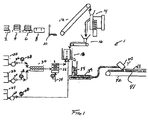
- Fig. 1 schematically illustrates the process for producing the cementitious composite material of the present invention.
- the present invention provides for an acoustical panel that combines strength with high noise reduction formed from a fibrous, open-celled material using a modified wet-formation process.
- the fibrous, open-celled material comprises up to about 50% by weight fibers, between about 3% and about 10% by weight binder, between about 20% and about 75% by weight filler, and about 0.01% to about 2.0% by weight surfactant.
- voids are formed within the panel having an average distribution size diameter of about 50 ⁇ m to about 250 ⁇ m. The formed voids are distributed evenly throughout the panel with very little striation.
- the composition for the acoustic panel includes a dry mix comprised of fiber material, filler material and binding material.
- Suitable fibers may include, but are not limited to, organic fiber material such as cellulosic fibers from wood or paper products.
- the composition includes split cellulosic fibers derived from wood products for the fiber component.
- the composition may also utilize inorganic fibers such as, but not limited to, fiberglass, metal slag wool, rock wool or mineral wool.
- the composition may include a filler comprised of clay and perlite.
- Other acceptable fillers may include, but are not limited to, limestone, diatomaceous earth, talc, silicates or wollastonite.
- the composition includes a binding material typical to acoustic panels including, but not limited to, cornstarch, modified starches, polyvinyl acetates, polystyrene acrylics, and polystyrene butadiene.
- the composition also includes a surfactant for inducing foaming of the ingredients.
- the surfactants may include sodium laureth (1) sulfate, ammonium deceth (3) sulfate, a proprietary oligomeric blend or sodium dodecylbenzene sulfonate. Such surfactants can be used in combination or alone to create the foam.
- a suitable surfactant is sodium dodecylbenzene sulfonate.
- a suitable secondary binder may include starch graft polystyrene acrylic. Other suitable secondary binders may include, but not limited to, any type of starch, polystyrene, polyvinyl acetate, polystyrene acrylics and styrene butadiene.
- Figure 1 schematically illustrates the process 1.
- the method comprises the steps of dry blending pre-weighed amounts of fiber 8, perlite 4, starch (or binder) 2 and clay 6 until the fibers are well dispersed within the dry mix.
- a weigh conveyor 12 feeds the dry ingredients to a mixer 14, through a hopper and onto a conveyor 16.
- Variable speed pumps 26 feed water 20 and surfactant 22 via flow measuring meters 28 to a static mixer 30.
- a high-intensity mixer 18 receives the dry mix, secondary binder 24, if any, and the water 20 and surfactant 22 mixture.
- the water 20 and surfactant 22 can bypass the mixer 32 and be added directly into the static mixer 30.
- the mixer 32 If the mixer 32 is used, air 34 is entrained in the water and surfactant to form a foam.
- the high-intensity mixer 18 creates a foam from the water 20, surfactant 22 and air (open to the atmosphere) to create a wet, foamed slurry.
- a column 38 receives the foamed mix and a positive displacement pump 39 feeds the foamed mix through a die 40.
- a high-intensity, continuous mixing apparatus works well as a high-intensity mixer 18 for adding liquid to the dry mix and aerating the slurry.
- the high-intensity mixer 18 essentially comprises two concentric, cylindrical drums.
- An inner drum rotates while the outer drum remains stationary.
- the cylindrical solid space between the drums defines the mixing volume.
- the inner drum includes impellers projecting into the mixing space to agitate and aerate the mix.
- the weigh conveyor 16 feeds the dry mix to the high-intensity continuous mixer 18 while the inner mixer drum flings the water 20, surfactant 22 and secondary binder 24 into the dry mix from a point at about one-third (1/3) of the way down from the top of the rotating drum.
- the high-intensity mixer 18 at 800 Upm (rpm) slings the liquid radially outward out from an axial center of the mixer 18 to create the wet slurry, while aerating the slurry to create a foamed slurry.
- the mixer 18 drives the aerated, foamed slurry down to a bottom portion of the high-intensity continuous mixer and into the column 38, which is about 1,2 m (four feet) high, and leads to an inlet of the positive displacement pump 39.
- the positive displacement pump 39 pressurizes and feeds the foamed slurry to the extrusion die 40.
- the extrusion die 40 includes an elongated orifice for extruding a sheet 43 of the foamed slurry onto a screen conveyor 42 for drying.
- the die may extrude the foamed slurry onto a pre-positioned scrim, a wet-formed conventional acoustic panel 41 or directly onto the conveyor to form panels from the foamed wet slurry.
- the die orifice may comprise virtually any dimension, an embodiment includes a width of approximately 609,6 mm (twenty-four inches) and a height of approximately (one-quarter 6,4 mm inch) to approximately 61.4 mm (one and one quarter inches).
- the process forms an acoustic panel or board from the foamed slurry that is approximately 6,4 mm (one quarter to approximately 616 mm (one and one quarter inches) thick with a bulk density of approximately 192 kg/m 3 (12.0 lb./ft. 3 ) to approximately 240 kg/m 3 (15 lb./ft. 3 ), although densities may vary considerably depending upon the exact formulation.
- An acoustic panel formed from the aerated slurry has a NRC of at least about 0.65, and a surface hardness of at least about 490 N (110 lbf).
- the process may form the acoustic panel by molding the aerated slurry, or shaping the aerated slurry into panels with rollers or screed blades. Additionally, the process may also include the step of forming the aerated slurry into a preformed acoustic panel using extrusion, rollers and screed blades to create a composite acoustic panel.
- the foamed slurry provides many cells or voids within the slurry. As the slurry is dried, the bubbles coalesce to form intersecting cells. Since the slurry does not need to be vacuum dried, fibers are left in a random, three-dimensional orientation, increasing the final composite material strength and surface hardness. Additionally, the lack of vacuum drying reduces or eliminates a void size gradient as a function of cross-sectional panel position.
- the void size has a range of about 50 ⁇ m to about 250 ⁇ m.
- the mixer 32 may also prefoam the water and surfactant prior to being combined with the dry mix of fibers, filler and binder.
- a pump may then transmit the water-surfactant foam to the high-intensity mixer 18 where additional foaming can occur upon the additional agitation and aeration of the dry mixture.
- Applicants have measured the acoustic performance, surface hardness and cell size of several panel samples using standard techniques known in the art. More specifically, to compare the acoustic performance characteristics of the present invention to that of other art acoustic panels, Applicants measured the acoustic absorption properties of composite boards made in connection with the present invention directly in terms of the noise reduction coefficient (NRC). Applicants derive the NRC from a standard test method in accordance to ASTM test designation C423-84a, whereby sound absorption is measured at a specific range of frequencies. Applicants also utilize the impedance and airflow resistance test measurements to measure the acoustic performance of the material. The impedance test utilizes standards and test specifications set forth in ASTM C384. The acoustical ohms airflow resistance test utilizes standards and test specifications set forth in ASTM C522-87.
- NRC noise reduction coefficient
- ASTM C367-95, Sections 2-7 To measure the surface hardness of an acoustical panel formed from the process, Applicants utilize a hardness test specification set forth in ASTM C367-95, Sections 2-7. More specifically, the ASTM C376-95 standard requires the recordation of a force required 51 mm for (two inch) diameter spheres to penetrate 6,4 mm (one-quarter inch) into the acoustic panel.
- Applicants compare the performance characteristics of the acoustic panel to similar performance characteristics of an acoustic panel disclosed in U.S. Patent No. 5,395,438 .
- the direct comparisons of relevant performance characteristics of the present invention to that of U.S. Patent No. 5,395,438 demonstrate acoustic performance improvements while maintaining the surface hardness properties of the present invention.
- Applicants have defined clay as having a minimum surface area of 10 m 2 /g. This is measured using nitrogen as the absorbate in the porosimeter, (BET Surface Area method).
Landscapes
- Chemical & Material Sciences (AREA)
- Engineering & Computer Science (AREA)
- Physics & Mathematics (AREA)
- Ceramic Engineering (AREA)
- Structural Engineering (AREA)
- Acoustics & Sound (AREA)
- Architecture (AREA)
- Materials Engineering (AREA)
- Organic Chemistry (AREA)
- Civil Engineering (AREA)
- Electromagnetism (AREA)
- Chemical Kinetics & Catalysis (AREA)
- Inorganic Chemistry (AREA)
- Building Environments (AREA)
- Laminated Bodies (AREA)
Claims (6)
- Panneau acoustique pourvu- d'un coefficient de réduction de bruit CRB (ASTM C 423-84a) d'au moins 0,65,- d'une dureté de surface (ASTM C 367-95) d'au moins environ 490 N (110 lbf) et- d'une densité de 192 à 240 kg/m3 (12 à 15 Ibs/ft3),- dans lequel le panneau est formé d'un matériau fibreux,- ledit matériau ayant des alvéoles ouvertes et comprenant- - jusqu'à environ 50% en poids de fibres sèches ;- - entre environ 3% et environ 10% en poids de liant sec ;- - entre environ 20% et environ 75% en poids de matière de charge sèche ; et- - entre environ 0,01% et environ 2% en poids d'agent de surface sec ; et- dans lequel le matériau contient des vides de diamètre de distribution de taille moyenne d'environ 50 µm à environ 250 µm.
- Panneau acoustique selon la revendication 1, caractérisé par sa formation à partir d'une suspension épaisse expansée aérée incluant un agent de surface, des fibres, un liant et une matière de charge.
- Panneau acoustique selon la revendication 1 ou 2, caractérisé en ce que l'agent de surface est choisi dans le groupe composé de laureth sulfate de sodium, le deceth sulfate d'ammonium et le dodécylbenzène sulfonate de sodium.
- Panneau acoustique selon l'une des revendications précédentes, caractérisé en ce que la matière de charge est choisie dans le groupe composé d'argile de kaolin, la perlite, le calcaire, la terre diatomée, le talc, des silicates et la wollastonite.
- Panneau acoustique selon l'une des revendications précédentes, caractérisé en ce que les fibres sont des fibres cellulosiques, des fibres synthétiques ou des fibres choisies dans le groupe composé de fibre de verre, laine de laitier et laine minérale.
- Panneau acoustique selon l'une des revendications précédentes, caractérisé en ce que le liant est choisi dans le groupe composé d'amidon, de polystyrène, d'acétate de polyvinyle, des acryliques-polystyrène et de styrène-butadiène.
Applications Claiming Priority (2)
| Application Number | Priority Date | Filing Date | Title |
|---|---|---|---|
| US15998799P | 1999-10-18 | 1999-10-18 | |
| US159987P | 1999-10-18 |
Publications (2)
| Publication Number | Publication Date |
|---|---|
| EP1094164A1 EP1094164A1 (fr) | 2001-04-25 |
| EP1094164B1 true EP1094164B1 (fr) | 2008-12-10 |
Family
ID=22574991
Family Applications (1)
| Application Number | Title | Priority Date | Filing Date |
|---|---|---|---|
| EP00122611A Expired - Lifetime EP1094164B1 (fr) | 1999-10-18 | 2000-10-17 | Panneau aggloméré en mousse |
Country Status (5)
| Country | Link |
|---|---|
| US (1) | US6596389B1 (fr) |
| EP (1) | EP1094164B1 (fr) |
| AT (1) | ATE417161T1 (fr) |
| CA (1) | CA2323340A1 (fr) |
| DE (1) | DE60041028D1 (fr) |
Families Citing this family (52)
| Publication number | Priority date | Publication date | Assignee | Title |
|---|---|---|---|---|
| US6983821B2 (en) * | 1999-10-01 | 2006-01-10 | Awi Licensing Company | Acoustical panel having a honeycomb structure and method of making the same |
| AU2002951270A0 (en) * | 2002-09-06 | 2002-09-19 | Vri Biomedical Ltd | Probiotic Bacterium and Methods of Use |
| USRE44893E1 (en) | 2004-03-26 | 2014-05-13 | Hanwha Azdel, Inc. | Fiber reinforced thermoplastic sheets with surface coverings |
| US20060182947A1 (en) * | 2005-02-16 | 2006-08-17 | Azdel, Inc. | Fiber reinforced thermoplastic composite including mineral fillers |
| CN101842331B (zh) * | 2007-08-29 | 2013-07-17 | 阿姆斯特郎世界工业公司 | 高度吸音的湿法成形基底 |
| US8563449B2 (en) * | 2008-04-03 | 2013-10-22 | Usg Interiors, Llc | Non-woven material and method of making such material |
| US20090252941A1 (en) * | 2008-04-03 | 2009-10-08 | Usg Interiors, Inc. | Non-woven material and method of making such material |
| GB2461317B (en) * | 2008-06-28 | 2013-02-06 | James Halstead Plc | Floor covering |
| US8356373B2 (en) | 2009-03-06 | 2013-01-22 | Noel Group Llc | Unitary composite/hybrid cushioning structure(s) and profile(s) comprised of a thermoplastic foam(s) and a thermoset material(s) |
| CN102985388A (zh) * | 2009-10-02 | 2013-03-20 | 尤尼弗瑞克斯I有限责任公司 | 超低重量隔热板 |
| USD694553S1 (en) | 2010-03-03 | 2013-12-03 | Noel Group Llc | Mattress bed cushion |
| USD693144S1 (en) | 2010-03-03 | 2013-11-12 | Noel Group Llc | Mattress bed cushion |
| USD693145S1 (en) | 2010-03-03 | 2013-11-12 | Noel Group Llc | Mattress bed cushion |
| USD693148S1 (en) | 2010-03-03 | 2013-11-12 | Noel Group Llc | Mattress bed cushion |
| USD688492S1 (en) | 2010-03-03 | 2013-08-27 | Noel Group Llc | Mattress bed cushion |
| US8028803B1 (en) * | 2010-04-13 | 2011-10-04 | Usg Interiors, Inc. | Molding a lightweight cast acoustical product |
| US9068346B1 (en) * | 2010-08-20 | 2015-06-30 | The Board Of Regents Of The University Of Texas System | Acoustic attenuators based on porous nanostructured materials |
| MX2013012272A (es) | 2011-04-29 | 2014-02-17 | Nomaco Inc | Estructuras de amortiguamiento compuestas/hibridas unitarias y perfiles comprendidos de espumas termoplasticas y materiales termoestables y metodos relacionados. |
| WO2013049570A1 (fr) | 2011-09-30 | 2013-04-04 | Nomaco Inc. | Ensembles matelas alvéolaires et procédés associés |
| USD691400S1 (en) | 2012-02-10 | 2013-10-15 | Nomaco Inc. | Stackable base for mattress assembly |
| NL2008466C2 (en) * | 2012-03-12 | 2013-09-16 | Paperfoam B V | A method and apparatus for manufacturing sustainable products with a blown, foam structure. |
| USD693149S1 (en) | 2012-04-27 | 2013-11-12 | Noel Group Llc | Mattress bed cushion |
| USD692693S1 (en) | 2012-04-27 | 2013-11-05 | Noel Group Llc | Mattress bed cushion |
| USD693146S1 (en) | 2012-04-27 | 2013-11-12 | Noel Group Llc | Mattress bed cushion |
| USD694552S1 (en) | 2012-04-27 | 2013-12-03 | Noel Group Llc | Mattress bed cushion |
| USD693147S1 (en) | 2012-04-27 | 2013-11-12 | Noel Group Llc | Mattress bed cushion |
| USD697337S1 (en) | 2012-07-03 | 2014-01-14 | Nomaco, Inc. | Stackable base for mattress assembly |
| USD690536S1 (en) | 2012-07-26 | 2013-10-01 | Nomaco Inc. | Motion isolation insulator pad |
| USD694041S1 (en) | 2012-09-28 | 2013-11-26 | Noel Group Llc | Mattress bed cushion |
| USD692694S1 (en) | 2012-09-28 | 2013-11-05 | Noel Group Llc | Mattress bed cushion |
| USD688069S1 (en) | 2012-09-28 | 2013-08-20 | Noel Group Llc | Mattress bed cushion |
| USD709301S1 (en) | 2012-11-09 | 2014-07-22 | Noel Group Llc | Mattress bed cushion |
| USD701713S1 (en) | 2012-11-09 | 2014-04-01 | Noel Group, Llc | Mattress bed cushion |
| USD707467S1 (en) | 2012-11-09 | 2014-06-24 | Noel Group Llc | Mattress bed cushion |
| USD707468S1 (en) | 2012-11-09 | 2014-06-24 | Noel Group Llc | Mattress bed cushion |
| WO2014176400A1 (fr) | 2013-04-26 | 2014-10-30 | Noel Group Llc | Ensembles de rembourrage pourvus d'éléments thermoplastiques encapsulés dans une matrice thermodurcie, fournissant un appui et un flux d'air adaptables, et procédés associés |
| USD704962S1 (en) | 2013-09-09 | 2014-05-20 | Noel Group Llc | Mattress bed cushion |
| RU2567570C9 (ru) * | 2013-11-21 | 2016-03-27 | Общество с ограниченной ответственностью "ТЕРРАБИЛДИНГ" | Минеральная плита |
| CN103624859B (zh) * | 2013-12-13 | 2016-05-11 | 福建农林大学 | 膨胀珍珠岩低密度复合刨花板及其制造方法 |
| US9243401B2 (en) * | 2014-05-16 | 2016-01-26 | Awi Licensing Company | Acoustic ceiling board with improved aesthetics |
| FI126474B (en) | 2014-11-24 | 2016-12-30 | Paptic Oy | Fiber sheets and structures comprising fiber sheets |
| WO2017079169A1 (fr) | 2015-11-03 | 2017-05-11 | Kimberly-Clark Worldwide, Inc. | Mouchoir en papier à volume élevé et peu pelucheux |
| US10094614B2 (en) * | 2016-12-14 | 2018-10-09 | Usg Interiors, Llc | Method for dewatering acoustical panels |
| US12331465B2 (en) | 2017-04-28 | 2025-06-17 | Kimberly-Clark Worldwide, Inc. | Foam-formed fibrous sheets with crimped staple fibers |
| MX2020004101A (es) | 2017-11-29 | 2020-07-24 | Kimberly Clark Co | Lamina fibrosa con propiedades mejoradas. |
| US10810988B2 (en) * | 2017-12-01 | 2020-10-20 | Spirit Aerosystems, Inc. | Acoustic panel employing rounded particles in septum layer and system and method for making same |
| MX2020010796A (es) * | 2018-04-13 | 2021-01-15 | Imerys Usa Inc | Compuestos para reducir ruido. |
| CN112469857B (zh) | 2018-07-25 | 2022-06-17 | 金伯利-克拉克环球有限公司 | 用于制备三维泡沫铺设的非织造物的方法 |
| CN116574302A (zh) * | 2023-06-27 | 2023-08-11 | 福建工程学院 | 一种使用高岭土制备阻燃轻质多孔植物纤维材料的方法 |
| WO2025119470A1 (fr) * | 2023-12-06 | 2025-06-12 | Essity Hygiene And Health Aktiebolag | Procédé de fabrication de produit absorbant sous forme de bande, produit absorbant sous forme de bande et appareil de fabrication d'un produit absorbant sous forme de bande |
| WO2025119469A1 (fr) * | 2023-12-06 | 2025-06-12 | Essity Hygiene And Health Aktiebolag | Procédé de fabrication de produit absorbant sous forme de bande, produit absorbant sous forme de bande et appareil de fabrication d'un produit absorbant sous forme de bande |
| WO2025119468A1 (fr) * | 2023-12-06 | 2025-06-12 | Essity Hygiene And Health Aktiebolag | Appareil, procédé de fabrication d'un produit absorbant à base de bande, et produit absorbant à base de bande |
Family Cites Families (18)
| Publication number | Priority date | Publication date | Assignee | Title |
|---|---|---|---|---|
| US3444956A (en) | 1966-02-08 | 1969-05-20 | Conwed Corp | Foam surfaced acoustical body |
| US3542640A (en) | 1967-03-23 | 1970-11-24 | Procter & Gamble | Method for drying a wet foam containing cellulosic fibers |
| FI65459C (fi) | 1972-04-07 | 1984-05-10 | Wiggins Teape Res Dev | Foerfarande och anordning foer framstaellning av en foerskummad fibersuspension |
| DE2408028B2 (de) * | 1974-02-20 | 1978-05-11 | Fa. Carl Freudenberg, 6940 Weinheim | Schallschluckplatte |
| US4488932A (en) | 1982-08-18 | 1984-12-18 | James River-Dixie/Northern, Inc. | Fibrous webs of enhanced bulk and method of manufacturing same |
| US4613627A (en) * | 1982-12-13 | 1986-09-23 | Usg Acoustical Products Company | Process for the manufacture of shaped fibrous products and the resultant product |
| GB8315164D0 (en) | 1983-06-02 | 1983-07-06 | Redland Technology Ltd | Boards |
| US5250153A (en) * | 1987-01-12 | 1993-10-05 | Usg Interiors, Inc. | Method for manufacturing a mineral wool panel |
| FR2631024B1 (fr) * | 1988-05-04 | 1997-08-22 | Aris Sa | Materiau composite refractaire et son procede de fabrication |
| US5047120A (en) * | 1988-07-11 | 1991-09-10 | Usg Interiors, Inc. | Method for manufacture of lightweight frothed mineral wool panel |
| US5134179A (en) * | 1988-11-25 | 1992-07-28 | Armstrong World Industries, Inc. | Composite fiberboard and process of manufacture |
| US5277762A (en) | 1991-04-26 | 1994-01-11 | Armstrong World Industries, Inc. | Composite fiberboard and process of manufacture |
| US5395438A (en) | 1994-01-14 | 1995-03-07 | Usg Interiors, Inc. | Mineral wool-free acoustical tile composition |
| SE503065C2 (sv) | 1994-07-13 | 1996-03-18 | Moelnlycke Ab | Förfarande och anordning för framställning av en skumformad fiber- eller pappersbana |
| US5558710A (en) * | 1994-08-08 | 1996-09-24 | Usg Interiors, Inc. | Gypsum/cellulosic fiber acoustical tile composition |
| US5612385A (en) | 1994-08-30 | 1997-03-18 | Ceaser; Anthony | Aerated fibrous foam compositions |
| US5911818A (en) * | 1997-08-20 | 1999-06-15 | Usg Interiors, Inc. | Acoustical tile composition |
| US6171388B1 (en) * | 1998-03-17 | 2001-01-09 | Rhodia Inc. | Lightweight gypsum composition |
-
2000
- 2000-10-17 CA CA002323340A patent/CA2323340A1/fr not_active Abandoned
- 2000-10-17 AT AT00122611T patent/ATE417161T1/de not_active IP Right Cessation
- 2000-10-17 EP EP00122611A patent/EP1094164B1/fr not_active Expired - Lifetime
- 2000-10-17 DE DE60041028T patent/DE60041028D1/de not_active Expired - Lifetime
- 2000-10-17 US US09/690,266 patent/US6596389B1/en not_active Expired - Lifetime
Also Published As
| Publication number | Publication date |
|---|---|
| DE60041028D1 (de) | 2009-01-22 |
| EP1094164A1 (fr) | 2001-04-25 |
| US6596389B1 (en) | 2003-07-22 |
| ATE417161T1 (de) | 2008-12-15 |
| CA2323340A1 (fr) | 2001-04-18 |
Similar Documents
| Publication | Publication Date | Title |
|---|---|---|
| EP1094164B1 (fr) | Panneau aggloméré en mousse | |
| EP1088946B1 (fr) | Panneau acoustique présentant une structure en nid d'abeille et procédé de fabrication | |
| US6983821B2 (en) | Acoustical panel having a honeycomb structure and method of making the same | |
| US5013405A (en) | Method of making a low density frothed mineral wool | |
| US4127628A (en) | Molded gypsum product and process for preparing the same | |
| EP2225185B1 (fr) | Panneaux résistants, absorbant le son et leur procédé de fabrication | |
| EP1568671B1 (fr) | Procédé et dispositif pour la préparation d' un corps cellulaire à base d'un liant hydraulique | |
| US5071511A (en) | Acoustical mineral fiberboard | |
| US5047120A (en) | Method for manufacture of lightweight frothed mineral wool panel | |
| MXPA00009587A (es) | Metodo y aparato para una estructura de espuma inorganica para utilizarse como un panel acustico durable. | |
| US3494824A (en) | Foamed water felted insulation and building product | |
| US20250163699A1 (en) | Pelletization of recycled ceiling materials | |
| CN102812185A (zh) | 使用降解纤维制造涂料和涂覆的吸声嵌板的方法 | |
| EP0347810A2 (fr) | Panneau acoustique en fibres minérales et son procédé de fabrication | |
| AU606132B2 (en) | Low density frothed mineral wool panel and method | |
| MXPA00010207A (en) | Foamed composite panel with improved acoustics and durability | |
| AU601546B2 (en) | Method for manufacture of lightweight frothed mineral wool panel | |
| JP4059976B2 (ja) | 軽量無機質板 | |
| EP0296242A1 (fr) | Panneau de laine minerale de faible densite et procede de fabrication de ce panneau | |
| AU608463B2 (en) | Low density mineral wool panel and method | |
| SU1178742A1 (ru) | Способ изготовлени тепло-звукоизол ционных изделий | |
| DE102021132863A1 (de) | Biologisch abbaubare und kompostierbare Schallschutzplatte | |
| JPH09158100A (ja) | 繊維板 | |
| MXPA00009585A (en) | Acoustical panel having a honeycomb structure and method of making the same |
Legal Events
| Date | Code | Title | Description |
|---|---|---|---|
| PUAI | Public reference made under article 153(3) epc to a published international application that has entered the european phase |
Free format text: ORIGINAL CODE: 0009012 |
|
| AK | Designated contracting states |
Kind code of ref document: A1 Designated state(s): AT BE CH CY DE DK ES FI FR GB GR IE IT LI LU MC NL PT SE |
|
| AX | Request for extension of the european patent |
Free format text: AL;LT;LV;MK;RO;SI |
|
| 17P | Request for examination filed |
Effective date: 20010914 |
|
| AKX | Designation fees paid |
Free format text: AT BE CH CY DE DK ES FI FR GB GR IE IT LI LU MC NL PT SE |
|
| 17Q | First examination report despatched |
Effective date: 20030410 |
|
| 17Q | First examination report despatched |
Effective date: 20030410 |
|
| GRAP | Despatch of communication of intention to grant a patent |
Free format text: ORIGINAL CODE: EPIDOSNIGR1 |
|
| GRAS | Grant fee paid |
Free format text: ORIGINAL CODE: EPIDOSNIGR3 |
|
| GRAS | Grant fee paid |
Free format text: ORIGINAL CODE: EPIDOSNIGR3 |
|
| GRAA | (expected) grant |
Free format text: ORIGINAL CODE: 0009210 |
|
| AK | Designated contracting states |
Kind code of ref document: B1 Designated state(s): AT BE CH CY DE DK ES FI FR GB GR IE IT LI LU MC NL PT SE |
|
| REG | Reference to a national code |
Ref country code: GB Ref legal event code: FG4D |
|
| REG | Reference to a national code |
Ref country code: CH Ref legal event code: EP |
|
| REG | Reference to a national code |
Ref country code: IE Ref legal event code: FG4D |
|
| REF | Corresponds to: |
Ref document number: 60041028 Country of ref document: DE Date of ref document: 20090122 Kind code of ref document: P |
|
| PG25 | Lapsed in a contracting state [announced via postgrant information from national office to epo] |
Ref country code: FI Free format text: LAPSE BECAUSE OF FAILURE TO SUBMIT A TRANSLATION OF THE DESCRIPTION OR TO PAY THE FEE WITHIN THE PRESCRIBED TIME-LIMIT Effective date: 20081210 Ref country code: NL Free format text: LAPSE BECAUSE OF FAILURE TO SUBMIT A TRANSLATION OF THE DESCRIPTION OR TO PAY THE FEE WITHIN THE PRESCRIBED TIME-LIMIT Effective date: 20081210 |
|
| NLV1 | Nl: lapsed or annulled due to failure to fulfill the requirements of art. 29p and 29m of the patents act | ||
| PG25 | Lapsed in a contracting state [announced via postgrant information from national office to epo] |
Ref country code: BE Free format text: LAPSE BECAUSE OF FAILURE TO SUBMIT A TRANSLATION OF THE DESCRIPTION OR TO PAY THE FEE WITHIN THE PRESCRIBED TIME-LIMIT Effective date: 20081210 Ref country code: ES Free format text: LAPSE BECAUSE OF FAILURE TO SUBMIT A TRANSLATION OF THE DESCRIPTION OR TO PAY THE FEE WITHIN THE PRESCRIBED TIME-LIMIT Effective date: 20090321 |
|
| PG25 | Lapsed in a contracting state [announced via postgrant information from national office to epo] |
Ref country code: AT Free format text: LAPSE BECAUSE OF FAILURE TO SUBMIT A TRANSLATION OF THE DESCRIPTION OR TO PAY THE FEE WITHIN THE PRESCRIBED TIME-LIMIT Effective date: 20081210 Ref country code: PT Free format text: LAPSE BECAUSE OF FAILURE TO SUBMIT A TRANSLATION OF THE DESCRIPTION OR TO PAY THE FEE WITHIN THE PRESCRIBED TIME-LIMIT Effective date: 20090511 Ref country code: SE Free format text: LAPSE BECAUSE OF FAILURE TO SUBMIT A TRANSLATION OF THE DESCRIPTION OR TO PAY THE FEE WITHIN THE PRESCRIBED TIME-LIMIT Effective date: 20090310 |
|
| PLBE | No opposition filed within time limit |
Free format text: ORIGINAL CODE: 0009261 |
|
| STAA | Information on the status of an ep patent application or granted ep patent |
Free format text: STATUS: NO OPPOSITION FILED WITHIN TIME LIMIT |
|
| PG25 | Lapsed in a contracting state [announced via postgrant information from national office to epo] |
Ref country code: DK Free format text: LAPSE BECAUSE OF FAILURE TO SUBMIT A TRANSLATION OF THE DESCRIPTION OR TO PAY THE FEE WITHIN THE PRESCRIBED TIME-LIMIT Effective date: 20081210 |
|
| 26N | No opposition filed |
Effective date: 20090911 |
|
| PG25 | Lapsed in a contracting state [announced via postgrant information from national office to epo] |
Ref country code: MC Free format text: LAPSE BECAUSE OF NON-PAYMENT OF DUE FEES Effective date: 20091031 |
|
| REG | Reference to a national code |
Ref country code: CH Ref legal event code: PL |
|
| REG | Reference to a national code |
Ref country code: IE Ref legal event code: MM4A |
|
| PG25 | Lapsed in a contracting state [announced via postgrant information from national office to epo] |
Ref country code: IE Free format text: LAPSE BECAUSE OF NON-PAYMENT OF DUE FEES Effective date: 20091017 Ref country code: CH Free format text: LAPSE BECAUSE OF NON-PAYMENT OF DUE FEES Effective date: 20091031 Ref country code: GR Free format text: LAPSE BECAUSE OF FAILURE TO SUBMIT A TRANSLATION OF THE DESCRIPTION OR TO PAY THE FEE WITHIN THE PRESCRIBED TIME-LIMIT Effective date: 20090311 Ref country code: LI Free format text: LAPSE BECAUSE OF NON-PAYMENT OF DUE FEES Effective date: 20091031 |
|
| PG25 | Lapsed in a contracting state [announced via postgrant information from national office to epo] |
Ref country code: IT Free format text: LAPSE BECAUSE OF FAILURE TO SUBMIT A TRANSLATION OF THE DESCRIPTION OR TO PAY THE FEE WITHIN THE PRESCRIBED TIME-LIMIT Effective date: 20081210 |
|
| PG25 | Lapsed in a contracting state [announced via postgrant information from national office to epo] |
Ref country code: LU Free format text: LAPSE BECAUSE OF NON-PAYMENT OF DUE FEES Effective date: 20091017 |
|
| PG25 | Lapsed in a contracting state [announced via postgrant information from national office to epo] |
Ref country code: CY Free format text: LAPSE BECAUSE OF FAILURE TO SUBMIT A TRANSLATION OF THE DESCRIPTION OR TO PAY THE FEE WITHIN THE PRESCRIBED TIME-LIMIT Effective date: 20081210 |
|
| REG | Reference to a national code |
Ref country code: FR Ref legal event code: PLFP Year of fee payment: 16 |
|
| REG | Reference to a national code |
Ref country code: FR Ref legal event code: PLFP Year of fee payment: 17 |
|
| REG | Reference to a national code |
Ref country code: FR Ref legal event code: PLFP Year of fee payment: 18 |
|
| REG | Reference to a national code |
Ref country code: FR Ref legal event code: PLFP Year of fee payment: 19 |
|
| PGFP | Annual fee paid to national office [announced via postgrant information from national office to epo] |
Ref country code: DE Payment date: 20191029 Year of fee payment: 20 |
|
| PGFP | Annual fee paid to national office [announced via postgrant information from national office to epo] |
Ref country code: FR Payment date: 20191025 Year of fee payment: 20 |
|
| PGFP | Annual fee paid to national office [announced via postgrant information from national office to epo] |
Ref country code: GB Payment date: 20191028 Year of fee payment: 20 |
|
| REG | Reference to a national code |
Ref country code: DE Ref legal event code: R071 Ref document number: 60041028 Country of ref document: DE |
|
| REG | Reference to a national code |
Ref country code: GB Ref legal event code: PE20 Expiry date: 20201016 |
|
| PG25 | Lapsed in a contracting state [announced via postgrant information from national office to epo] |
Ref country code: GB Free format text: LAPSE BECAUSE OF EXPIRATION OF PROTECTION Effective date: 20201016 |