EP1094780B1 - Construction dentaire vitroceramique moulee avec facette en materiau composite - Google Patents
Construction dentaire vitroceramique moulee avec facette en materiau composite Download PDFInfo
- Publication number
- EP1094780B1 EP1094780B1 EP99933832A EP99933832A EP1094780B1 EP 1094780 B1 EP1094780 B1 EP 1094780B1 EP 99933832 A EP99933832 A EP 99933832A EP 99933832 A EP99933832 A EP 99933832A EP 1094780 B1 EP1094780 B1 EP 1094780B1
- Authority
- EP
- European Patent Office
- Prior art keywords
- construct
- glass
- coping
- ceramic
- dental construct
- Prior art date
- Legal status (The legal status is an assumption and is not a legal conclusion. Google has not performed a legal analysis and makes no representation as to the accuracy of the status listed.)
- Expired - Lifetime
Links
- 239000002241 glass-ceramic Substances 0.000 title claims description 12
- 239000002131 composite material Substances 0.000 title description 11
- 239000000463 material Substances 0.000 claims description 36
- 230000010485 coping Effects 0.000 claims description 23
- 239000000919 ceramic Substances 0.000 claims description 21
- 239000000203 mixture Substances 0.000 claims description 15
- 239000011521 glass Substances 0.000 claims description 14
- 239000000945 filler Substances 0.000 claims description 11
- 239000011347 resin Substances 0.000 claims description 11
- 229920005989 resin Polymers 0.000 claims description 11
- BLRPTPMANUNPDV-UHFFFAOYSA-N Silane Chemical compound [SiH4] BLRPTPMANUNPDV-UHFFFAOYSA-N 0.000 claims description 7
- 239000000805 composite resin Substances 0.000 claims description 7
- 239000002245 particle Substances 0.000 claims description 7
- 229910000077 silane Inorganic materials 0.000 claims description 7
- 239000011159 matrix material Substances 0.000 claims description 6
- KLZUFWVZNOTSEM-UHFFFAOYSA-K Aluminium flouride Chemical compound F[Al](F)F KLZUFWVZNOTSEM-UHFFFAOYSA-K 0.000 claims description 4
- FUJCRWPEOMXPAD-UHFFFAOYSA-N Li2O Inorganic materials [Li+].[Li+].[O-2] FUJCRWPEOMXPAD-UHFFFAOYSA-N 0.000 claims description 4
- GWEVSGVZZGPLCZ-UHFFFAOYSA-N Titan oxide Chemical compound O=[Ti]=O GWEVSGVZZGPLCZ-UHFFFAOYSA-N 0.000 claims description 4
- MCMNRKCIXSYSNV-UHFFFAOYSA-N Zirconium dioxide Chemical compound O=[Zr]=O MCMNRKCIXSYSNV-UHFFFAOYSA-N 0.000 claims description 4
- 229910052788 barium Inorganic materials 0.000 claims description 3
- CETPSERCERDGAM-UHFFFAOYSA-N ceric oxide Chemical compound O=[Ce]=O CETPSERCERDGAM-UHFFFAOYSA-N 0.000 claims description 3
- 229910000422 cerium(IV) oxide Inorganic materials 0.000 claims description 3
- XUCJHNOBJLKZNU-UHFFFAOYSA-M dilithium;hydroxide Chemical compound [Li+].[Li+].[OH-] XUCJHNOBJLKZNU-UHFFFAOYSA-M 0.000 claims description 3
- MRELNEQAGSRDBK-UHFFFAOYSA-N lanthanum oxide Inorganic materials [O-2].[O-2].[O-2].[La+3].[La+3] MRELNEQAGSRDBK-UHFFFAOYSA-N 0.000 claims description 3
- KTUFCUMIWABKDW-UHFFFAOYSA-N oxo(oxolanthaniooxy)lanthanum Chemical compound O=[La]O[La]=O KTUFCUMIWABKDW-UHFFFAOYSA-N 0.000 claims description 3
- 229910017970 MgO-SiO2 Inorganic materials 0.000 claims description 2
- KKCBUQHMOMHUOY-UHFFFAOYSA-N Na2O Inorganic materials [O-2].[Na+].[Na+] KKCBUQHMOMHUOY-UHFFFAOYSA-N 0.000 claims description 2
- 239000005354 aluminosilicate glass Substances 0.000 claims description 2
- DSAJWYNOEDNPEQ-UHFFFAOYSA-N barium atom Chemical compound [Ba] DSAJWYNOEDNPEQ-UHFFFAOYSA-N 0.000 claims description 2
- 229910001632 barium fluoride Inorganic materials 0.000 claims description 2
- QVQLCTNNEUAWMS-UHFFFAOYSA-N barium oxide Inorganic materials [Ba]=O QVQLCTNNEUAWMS-UHFFFAOYSA-N 0.000 claims description 2
- 239000000404 calcium aluminium silicate Substances 0.000 claims description 2
- 235000012215 calcium aluminium silicate Nutrition 0.000 claims description 2
- WNCYAPRTYDMSFP-UHFFFAOYSA-N calcium aluminosilicate Chemical compound [Al+3].[Al+3].[Ca+2].[O-][Si]([O-])=O.[O-][Si]([O-])=O.[O-][Si]([O-])=O.[O-][Si]([O-])=O WNCYAPRTYDMSFP-UHFFFAOYSA-N 0.000 claims description 2
- 229940078583 calcium aluminosilicate Drugs 0.000 claims description 2
- WUKWITHWXAAZEY-UHFFFAOYSA-L calcium difluoride Chemical compound [F-].[F-].[Ca+2] WUKWITHWXAAZEY-UHFFFAOYSA-L 0.000 claims description 2
- 229910001634 calcium fluoride Inorganic materials 0.000 claims description 2
- YEXPOXQUZXUXJW-UHFFFAOYSA-N lead(II) oxide Inorganic materials [Pb]=O YEXPOXQUZXUXJW-UHFFFAOYSA-N 0.000 claims description 2
- CPLXHLVBOLITMK-UHFFFAOYSA-N magnesium oxide Inorganic materials [Mg]=O CPLXHLVBOLITMK-UHFFFAOYSA-N 0.000 claims description 2
- 239000003607 modifier Substances 0.000 claims description 2
- NOTVAPJNGZMVSD-UHFFFAOYSA-N potassium monoxide Inorganic materials [K]O[K] NOTVAPJNGZMVSD-UHFFFAOYSA-N 0.000 claims description 2
- CHWRSCGUEQEHOH-UHFFFAOYSA-N potassium oxide Chemical compound [O-2].[K+].[K+] CHWRSCGUEQEHOH-UHFFFAOYSA-N 0.000 claims description 2
- 229910052712 strontium Inorganic materials 0.000 claims description 2
- CIOAGBVUUVVLOB-UHFFFAOYSA-N strontium atom Chemical compound [Sr] CIOAGBVUUVVLOB-UHFFFAOYSA-N 0.000 claims description 2
- PBCFLUZVCVVTBY-UHFFFAOYSA-N tantalum pentoxide Inorganic materials O=[Ta](=O)O[Ta](=O)=O PBCFLUZVCVVTBY-UHFFFAOYSA-N 0.000 claims description 2
- RUDFQVOCFDJEEF-UHFFFAOYSA-N yttrium(III) oxide Inorganic materials [O-2].[O-2].[O-2].[Y+3].[Y+3] RUDFQVOCFDJEEF-UHFFFAOYSA-N 0.000 claims description 2
- XLOMVQKBTHCTTD-UHFFFAOYSA-N zinc oxide Inorganic materials [Zn]=O XLOMVQKBTHCTTD-UHFFFAOYSA-N 0.000 claims description 2
- GFQYVLUOOAAOGM-UHFFFAOYSA-N zirconium(iv) silicate Chemical compound [Zr+4].[O-][Si]([O-])([O-])[O-] GFQYVLUOOAAOGM-UHFFFAOYSA-N 0.000 claims description 2
- 229910052684 Cerium Inorganic materials 0.000 claims 1
- JOYRKODLDBILNP-UHFFFAOYSA-N Ethyl urethane Chemical compound CCOC(N)=O JOYRKODLDBILNP-UHFFFAOYSA-N 0.000 claims 1
- KRHYYFGTRYWZRS-UHFFFAOYSA-M Fluoride anion Chemical compound [F-] KRHYYFGTRYWZRS-UHFFFAOYSA-M 0.000 claims 1
- 229910052746 lanthanum Inorganic materials 0.000 claims 1
- 229910052745 lead Inorganic materials 0.000 claims 1
- 229910052749 magnesium Inorganic materials 0.000 claims 1
- 229910052700 potassium Inorganic materials 0.000 claims 1
- 229910052710 silicon Inorganic materials 0.000 claims 1
- 229910052708 sodium Inorganic materials 0.000 claims 1
- 239000011734 sodium Substances 0.000 claims 1
- 229910052727 yttrium Inorganic materials 0.000 claims 1
- 238000000034 method Methods 0.000 description 18
- VYPSYNLAJGMNEJ-UHFFFAOYSA-N Silicium dioxide Chemical compound O=[Si]=O VYPSYNLAJGMNEJ-UHFFFAOYSA-N 0.000 description 13
- 238000005266 casting Methods 0.000 description 9
- 239000006112 glass ceramic composition Substances 0.000 description 8
- 239000000243 solution Substances 0.000 description 7
- 210000000214 mouth Anatomy 0.000 description 5
- NBIIXXVUZAFLBC-UHFFFAOYSA-N Phosphoric acid Chemical compound OP(O)(O)=O NBIIXXVUZAFLBC-UHFFFAOYSA-N 0.000 description 4
- 239000011248 coating agent Substances 0.000 description 4
- 238000000576 coating method Methods 0.000 description 4
- 238000009472 formulation Methods 0.000 description 4
- 229910052751 metal Inorganic materials 0.000 description 4
- 239000002184 metal Substances 0.000 description 4
- 229910001092 metal group alloy Inorganic materials 0.000 description 4
- 230000008569 process Effects 0.000 description 4
- 239000000377 silicon dioxide Substances 0.000 description 4
- 239000000758 substrate Substances 0.000 description 4
- KFZMGEQAYNKOFK-UHFFFAOYSA-N Isopropanol Chemical compound CC(C)O KFZMGEQAYNKOFK-UHFFFAOYSA-N 0.000 description 3
- 238000010438 heat treatment Methods 0.000 description 3
- 238000002844 melting Methods 0.000 description 3
- 230000008018 melting Effects 0.000 description 3
- 229910052573 porcelain Inorganic materials 0.000 description 3
- 238000001556 precipitation Methods 0.000 description 3
- 239000002243 precursor Substances 0.000 description 3
- CSCPPACGZOOCGX-UHFFFAOYSA-N Acetone Chemical compound CC(C)=O CSCPPACGZOOCGX-UHFFFAOYSA-N 0.000 description 2
- 229910000497 Amalgam Inorganic materials 0.000 description 2
- LFQSCWFLJHTTHZ-UHFFFAOYSA-N Ethanol Chemical compound CCO LFQSCWFLJHTTHZ-UHFFFAOYSA-N 0.000 description 2
- KRHYYFGTRYWZRS-UHFFFAOYSA-N Fluorane Chemical compound F KRHYYFGTRYWZRS-UHFFFAOYSA-N 0.000 description 2
- PXHVJJICTQNCMI-UHFFFAOYSA-N Nickel Chemical compound [Ni] PXHVJJICTQNCMI-UHFFFAOYSA-N 0.000 description 2
- 239000006087 Silane Coupling Agent Substances 0.000 description 2
- PNEYBMLMFCGWSK-UHFFFAOYSA-N aluminium oxide Inorganic materials [O-2].[O-2].[O-2].[Al+3].[Al+3] PNEYBMLMFCGWSK-UHFFFAOYSA-N 0.000 description 2
- 229910000147 aluminium phosphate Inorganic materials 0.000 description 2
- 239000007864 aqueous solution Substances 0.000 description 2
- 230000015572 biosynthetic process Effects 0.000 description 2
- 238000003279 ceramming Methods 0.000 description 2
- 238000007796 conventional method Methods 0.000 description 2
- 238000001816 cooling Methods 0.000 description 2
- 229910052906 cristobalite Inorganic materials 0.000 description 2
- 238000004108 freeze drying Methods 0.000 description 2
- 230000006698 induction Effects 0.000 description 2
- 238000005495 investment casting Methods 0.000 description 2
- 238000004519 manufacturing process Methods 0.000 description 2
- BASFCYQUMIYNBI-UHFFFAOYSA-N platinum Chemical compound [Pt] BASFCYQUMIYNBI-UHFFFAOYSA-N 0.000 description 2
- 229920000058 polyacrylate Polymers 0.000 description 2
- 239000000126 substance Substances 0.000 description 2
- 239000000725 suspension Substances 0.000 description 2
- 238000003786 synthesis reaction Methods 0.000 description 2
- VNQXSTWCDUXYEZ-UHFFFAOYSA-N 1,7,7-trimethylbicyclo[2.2.1]heptane-2,3-dione Chemical compound C1CC2(C)C(=O)C(=O)C1C2(C)C VNQXSTWCDUXYEZ-UHFFFAOYSA-N 0.000 description 1
- HWSSEYVMGDIFMH-UHFFFAOYSA-N 2-[2-[2-(2-methylprop-2-enoyloxy)ethoxy]ethoxy]ethyl 2-methylprop-2-enoate Chemical compound CC(=C)C(=O)OCCOCCOCCOC(=O)C(C)=C HWSSEYVMGDIFMH-UHFFFAOYSA-N 0.000 description 1
- DBCAQXHNJOFNGC-UHFFFAOYSA-N 4-bromo-1,1,1-trifluorobutane Chemical compound FC(F)(F)CCCBr DBCAQXHNJOFNGC-UHFFFAOYSA-N 0.000 description 1
- 239000004342 Benzoyl peroxide Substances 0.000 description 1
- OMPJBNCRMGITSC-UHFFFAOYSA-N Benzoylperoxide Chemical compound C=1C=CC=CC=1C(=O)OOC(=O)C1=CC=CC=C1 OMPJBNCRMGITSC-UHFFFAOYSA-N 0.000 description 1
- OKTJSMMVPCPJKN-UHFFFAOYSA-N Carbon Chemical compound [C] OKTJSMMVPCPJKN-UHFFFAOYSA-N 0.000 description 1
- 229910019142 PO4 Inorganic materials 0.000 description 1
- AMFGWXWBFGVCKG-UHFFFAOYSA-N Panavia opaque Chemical compound C1=CC(OCC(O)COC(=O)C(=C)C)=CC=C1C(C)(C)C1=CC=C(OCC(O)COC(=O)C(C)=C)C=C1 AMFGWXWBFGVCKG-UHFFFAOYSA-N 0.000 description 1
- 239000006096 absorbing agent Substances 0.000 description 1
- 230000004913 activation Effects 0.000 description 1
- 239000002318 adhesion promoter Substances 0.000 description 1
- 238000004026 adhesive bonding Methods 0.000 description 1
- 150000004703 alkoxides Chemical class 0.000 description 1
- 229910045601 alloy Inorganic materials 0.000 description 1
- 239000000956 alloy Substances 0.000 description 1
- 239000007900 aqueous suspension Substances 0.000 description 1
- 239000010953 base metal Substances 0.000 description 1
- 230000008901 benefit Effects 0.000 description 1
- 235000019400 benzoyl peroxide Nutrition 0.000 description 1
- 230000002902 bimodal effect Effects 0.000 description 1
- 239000007767 bonding agent Substances 0.000 description 1
- 229930006711 bornane-2,3-dione Natural products 0.000 description 1
- 229910010293 ceramic material Inorganic materials 0.000 description 1
- 239000006024 cerammable glass Substances 0.000 description 1
- 238000004140 cleaning Methods 0.000 description 1
- 229910052681 coesite Inorganic materials 0.000 description 1
- 239000012612 commercial material Substances 0.000 description 1
- 230000008602 contraction Effects 0.000 description 1
- 229910052593 corundum Inorganic materials 0.000 description 1
- 239000007822 coupling agent Substances 0.000 description 1
- 238000005336 cracking Methods 0.000 description 1
- 238000002425 crystallisation Methods 0.000 description 1
- 230000008025 crystallization Effects 0.000 description 1
- 238000001723 curing Methods 0.000 description 1
- 230000002950 deficient Effects 0.000 description 1
- 230000032798 delamination Effects 0.000 description 1
- 239000002670 dental porcelain Substances 0.000 description 1
- 229940023487 dental product Drugs 0.000 description 1
- 210000004513 dentition Anatomy 0.000 description 1
- 230000018109 developmental process Effects 0.000 description 1
- ZBCBWPMODOFKDW-UHFFFAOYSA-N diethanolamine Chemical compound OCCNCCO ZBCBWPMODOFKDW-UHFFFAOYSA-N 0.000 description 1
- 239000003085 diluting agent Substances 0.000 description 1
- 238000009826 distribution Methods 0.000 description 1
- 235000019441 ethanol Nutrition 0.000 description 1
- MKVYSRNJLWTVIK-UHFFFAOYSA-N ethyl carbamate;2-methylprop-2-enoic acid Chemical class CCOC(N)=O.CC(=C)C(O)=O.CC(=C)C(O)=O MKVYSRNJLWTVIK-UHFFFAOYSA-N 0.000 description 1
- STVZJERGLQHEKB-UHFFFAOYSA-N ethylene glycol dimethacrylate Substances CC(=C)C(=O)OCCOC(=O)C(C)=C STVZJERGLQHEKB-UHFFFAOYSA-N 0.000 description 1
- 238000010304 firing Methods 0.000 description 1
- 229910021485 fumed silica Inorganic materials 0.000 description 1
- 229910002804 graphite Inorganic materials 0.000 description 1
- 239000010439 graphite Substances 0.000 description 1
- 238000013007 heat curing Methods 0.000 description 1
- 238000001027 hydrothermal synthesis Methods 0.000 description 1
- 150000002500 ions Chemical class 0.000 description 1
- 238000011068 loading method Methods 0.000 description 1
- 229910001635 magnesium fluoride Inorganic materials 0.000 description 1
- 230000018984 mastication Effects 0.000 description 1
- 238000010077 mastication Methods 0.000 description 1
- 150000002734 metacrylic acid derivatives Chemical class 0.000 description 1
- 238000002156 mixing Methods 0.000 description 1
- 239000000178 monomer Substances 0.000 description 1
- GYVGXEWAOAAJEU-UHFFFAOYSA-N n,n,4-trimethylaniline Chemical compound CN(C)C1=CC=C(C)C=C1 GYVGXEWAOAAJEU-UHFFFAOYSA-N 0.000 description 1
- 229910052759 nickel Inorganic materials 0.000 description 1
- 230000003287 optical effect Effects 0.000 description 1
- 125000000962 organic group Chemical group 0.000 description 1
- 238000012856 packing Methods 0.000 description 1
- 239000010452 phosphate Substances 0.000 description 1
- 229910052697 platinum Inorganic materials 0.000 description 1
- 239000002861 polymer material Substances 0.000 description 1
- 238000006116 polymerization reaction Methods 0.000 description 1
- 230000001376 precipitating effect Effects 0.000 description 1
- 239000010453 quartz Substances 0.000 description 1
- 230000009467 reduction Effects 0.000 description 1
- 230000003014 reinforcing effect Effects 0.000 description 1
- 230000008439 repair process Effects 0.000 description 1
- 150000003839 salts Chemical class 0.000 description 1
- 150000004756 silanes Chemical class 0.000 description 1
- 238000005245 sintering Methods 0.000 description 1
- 238000001694 spray drying Methods 0.000 description 1
- 239000007858 starting material Substances 0.000 description 1
- 229910052682 stishovite Inorganic materials 0.000 description 1
- 238000001308 synthesis method Methods 0.000 description 1
- 238000002076 thermal analysis method Methods 0.000 description 1
- 230000036346 tooth eruption Effects 0.000 description 1
- 231100000331 toxic Toxicity 0.000 description 1
- 230000002588 toxic effect Effects 0.000 description 1
- 229910052905 tridymite Inorganic materials 0.000 description 1
- XLYOFNOQVPJJNP-UHFFFAOYSA-N water Substances O XLYOFNOQVPJJNP-UHFFFAOYSA-N 0.000 description 1
- 238000009736 wetting Methods 0.000 description 1
- 229910001845 yogo sapphire Inorganic materials 0.000 description 1
Images
Classifications
-
- A—HUMAN NECESSITIES
- A61—MEDICAL OR VETERINARY SCIENCE; HYGIENE
- A61K—PREPARATIONS FOR MEDICAL, DENTAL OR TOILETRY PURPOSES
- A61K6/00—Preparations for dentistry
- A61K6/80—Preparations for artificial teeth, for filling teeth or for capping teeth
- A61K6/831—Preparations for artificial teeth, for filling teeth or for capping teeth comprising non-metallic elements or compounds thereof, e.g. carbon
- A61K6/833—Glass-ceramic composites
-
- A—HUMAN NECESSITIES
- A61—MEDICAL OR VETERINARY SCIENCE; HYGIENE
- A61K—PREPARATIONS FOR MEDICAL, DENTAL OR TOILETRY PURPOSES
- A61K6/00—Preparations for dentistry
- A61K6/80—Preparations for artificial teeth, for filling teeth or for capping teeth
- A61K6/884—Preparations for artificial teeth, for filling teeth or for capping teeth comprising natural or synthetic resins
- A61K6/887—Compounds obtained by reactions only involving carbon-to-carbon unsaturated bonds
-
- A—HUMAN NECESSITIES
- A61—MEDICAL OR VETERINARY SCIENCE; HYGIENE
- A61K—PREPARATIONS FOR MEDICAL, DENTAL OR TOILETRY PURPOSES
- A61K6/00—Preparations for dentistry
- A61K6/80—Preparations for artificial teeth, for filling teeth or for capping teeth
- A61K6/884—Preparations for artificial teeth, for filling teeth or for capping teeth comprising natural or synthetic resins
- A61K6/891—Compounds obtained otherwise than by reactions only involving carbon-to-carbon unsaturated bonds
- A61K6/893—Polyurethanes
Definitions
- the present invention relates to non-metallic dental products. More particularly, the invention relates to dental prosthetic devices formed from a composite veneered cast, sintered or hot pressed glass-ceramic material.
- a major purpose of the dental profession has been to replace or correct damaged or deformed tooth structure or conditions by fabricating and installing dental constructs such as crowns, inlays, onlays, bridges (fixed partial dentures) and the like.
- dental constructs such as crowns, inlays, onlays, bridges (fixed partial dentures) and the like.
- These prostheses ideally should (1) be inert in the oral environment, (2) resist the forces of mastication, (3) be capable of assuming physiologically compatible anatomical configurations, and (4) exhibit aesthetic characteristics similar to those of natural teeth.
- the constructs should be easily customized for colour shading and shape at the chair-side.
- the substrate and the veneering material of a dental construct should ideally not be sensitive to slight mismatch between their thermal expansion characteristics.
- the veneering material should not be subject to failure at very low strains.
- a dental construct according to the present invention comprises a glass-ceramic coping having a resin composite material in the form of a veneer bonded or otherwise affixed to at least a portion of the coping.
- a dental construct having a glass-ceramic base or coping and a resin composite material in the form of a veneer bonded to the coping.
- the dental construct can be without limitation, a crown or bridge (fixed denture) restoration such as anterior or posterior crowns and bridges, Maryland-type bridges, onlays, inlays or any other type of dental restoration or appliance.
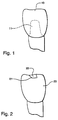
- the invention will be exemplified herein with respect to a crown 10 as depicted in the drawing, with the understanding that any dental construct is within the scope of the invention.
- Figure 1 depicts a prepared tooth 11 (shown partially in phantom lines) having a crown 10 affixed thereto. Crown 10 is affixed to prepared tooth 11 in any manner conventional with dental restorations, including cementatious and/or adhesive bonding.
- the dental construct of the invention is preferably fabricated from a glass-ceramic material.
- a glass-ceramic material Any method which is conventional in the art for preparing a glass-ceramic dental coping is within the scope of the invention.
- the coping may be fabricated by being hot pressed, built-up by sintering frit using conventional methods, or by casting the glass-ceramic substructure using the lost wax casting method.
- An example of the fabrication of a glass-ceramic dental product is described in U.S. Pat. No. 4,431,420 which is hereby incorporated by reference for such disclosure.
- a commercially available example of a glass-ceramic material is DICOR® brand glass-ceramic material available from Dentsply International Inc., York, Pennsylvania. It is known to be a tetrasilic-micaglass-ceramic K 2 O-MgF 2 -MgO-SiO 2 .
- Preferred glass-ceramic materials are Li 2 O-CaO- Al 2 O 3 - SiO 2 -X, Al(PO 3 ) 3 -SiO 2 -Li 2 O-CaX and Li 2 O-ZnO-P 2 O 5 -X, where X is a network modifier such as TiO 2 , ZrO 2 , La 2 O 3 , CeO 2 , Y 2 O 3 , ZnO, MgO, BaO, PbO, Ta 2 O 5 , Li 2 O, K 2 O, CaF 2 , MgF 2 , AlF 3 , BaF 2 , and Na 2 O.
- X is a network modifier such as TiO 2 , ZrO 2 , La 2 O 3 , CeO 2 , Y 2 O 3 , ZnO, MgO, BaO, PbO, Ta 2 O 5 , Li 2 O, K 2 O, CaF 2 , MgF 2 , AlF 3 , BaF 2 ,
- Such materials are preferably synthesized by wet chemical methods such as 1) Sol-gel polymerization of prehydrolyzed alkoxides (some soluble metal salts may be added becoming complexed into the gel). 2) The precipitation of precursors from suspensions by spray-drying, spray-freeze drying or freeze-drying. 3) Room temperature or elevated aqueous solution precipitation synthesis methods. 4) Hydrothermal synthesis in which the aqueous solutions or suspensions of precursor materials are heated at elevated temperatures and pressures. 5) Organic solution synthesis precipitation methods, and 6) Glycothermal synthesis in which the organic solutions or suspensions of precursor materials are heated at elevated temperatures and pressures. These methods allow homogeneous glasses and ceramics to be formed at temperatures well below the normal temperature required to sinter high density bodies of uniform microstructure.
- compositions can be produced to allow them to be cast using the lost wax-casting process.
- a wax replica of the coping is produced sprued and invested in a refractory mold material, typically a silica refractory with a phosphate bonding agent is preferred.
- the burnout temperature for the mould is typically about 900°C, which should be heat soaked for at least 40 minutes prior to casting.
- the silica refractory is preferably in the form of amorphous silica and quartz rather than cristobalite. A lower compensation is required for the contraction of the glass on cooling following casting compared to a metal structure.
- the glass compositions identified above can be cast at temperatures from about 1,150 to about 1,450°C, and can be cerammed at temperatures between about 510 to 1200°C depending upon the composition. These materials posses good mechanical properties such as: modulus of elasticity values of 95-115 GPa compared to conventional dental porcelain which has a modulus of 65-75 GPa, fracture toughness values of between 1.2 and 1.8 K 1C (MPa m 1/2 ) and 'True Hardness' values of between 3.5 to 5.9 GPa.
- a preferred method of casting the cerammable glass materials involves the use of an induction process to melt the glass or glass-ceramic starting material.
- a conducting insert is employed in the melting crucible to allow melting of the non-conducting glass to take place.
- a graphite or platinum insert is placed within the refractory crucible.
- the castings are removed from the investment mould by hand and lightly gritblasted with 25 ⁇ m alumina grains.
- the glass material is subjected to a controlled crystallization (ceramming) by a conventional heat treatment procedure.
- the cast construct (coping) is exposed to a temperature of 850°C for 30 minutes.
- the precise ceramming temperature for each glass composition has to be determined from the thermal analysis (DTA, curve).
- the heating can be performed in a gas fired or electric furnace with appropriate temperature control ( ⁇ 5°C).
- the cerammed coping is then coated or at least partially coated, with a resin composite material in the form of a veneer, and contoured and shaped to simulate a natural tooth.
- a resin composite material in the form of a veneer, and contoured and shaped to simulate a natural tooth.
- Any composite material that is appropriate for use in the oral cavity is within the scope of the invention for use as the veneer coating.
- Preferred veneering materials include composites with dimethacrylate matrix resins. These matrix resins are generally mixtures of BIS-GMA and TEGDMA, in many commercial material, however urethane dimethacrylates and large oligomeric structures of BIS-GMA-urethanes may also be used.
- Such composite materials having a blend of glass or ceramic particles dispersed in a polymerizable synthetic organic resin matrix.
- the polymer materials being blended together with finely divided inorganic (filler) reinforcing phase such as a calcium aluminosilicate, zirconium silicate, barium or strontium aluminosilicate glass or ceramics, preferably having a blending of large and small particles (0.04 to 10 ⁇ m) to obtain optimum packing density and mechanical properties.
- the so called hybrid systems may have either a bimodal or in some cases a trimodal blend of particle size. The trimodal systems lend themselves to a greater loading density.
- the size and distribution of the filler particles and the refractive index of filler and matrix resin should be oiptimized to give appropriate translucence for natural aesthetic results.
- the filler particles of such composites preferably are surface treated to provide adhesion between the resin matrix and the glass or ceramic filler particles. Adhesion being achieved by using a silane (organo functional adhesion promoter) treatment. Most composite systems contain 2-5% of fumed silica to adjust viscosity and handling characteristics. This sub-micron silica is also generally treated with a silane coupling agent to reduce the uptake of water by the large surface area.
- silane organo functional adhesion promoter
- Such composite materials may use photopolymerizing systems activated by visible light in which a light sensitive absorber such as camphorquinone is used together with an aliphatic amine accelerator.
- a light sensitive absorber such as camphorquinone
- an aliphatic amine accelerator such as camphorquinone
- chemically activated composite systems using the N,N-dimethyl-para-toluidine and benzoyl peroxide or similar system for chemical activation will be very appropriate, as will the heat curing systems since the veneering process is fabricated as an indirect system outside the mouth.
- the coping may be etched by being physically contacted with a solution of hydrofluoric acid from 5 to 15 seconds (depending on the composition of the ceramic) to produce a micromechanical retentive surface. Cleaning of the ceramic surface with isopropyl alcohol, acetone or phosphoric acid is preferable, prior to silane treatment.
- the etched and clean surface should preferably be treated with a coupling agent such as a hydrolyzed solution of aminopropoxyltriethoxy methacrylates silane or 3-(methoxyloxypropyl)-trimethoxysilane.
- a coupling agent such as a hydrolyzed solution of aminopropoxyltriethoxy methacrylates silane or 3-(methoxyloxypropyl)-trimethoxysilane.
- a phosphoric acid solution can be added to the silane coupling agent to hydrolyse it prior to application on the ceramic surface.
- a dilute solution of activated silane with ethyl alcohol can be used.
- the clean etched cerammed coping surface is then coated with the silane solution and dried for 30 minutes to one hour at 60°C.
- the glass-ceramic coping will typically be from about 0.4 to about 1.00 mm in thickness. Greater thickness will be required in situations of higher masticatory stress (biting force).
- the overall combined thickness of coping and veneer will be dictated by function and aesthetics. However, typically the veneer would range from about 0.2 to as high as about 2.00 mm.
- the viscosity of the veneering resin (which may be as high as 100,000 cp or more) may be too high to allow good wetting of the surface of the silane treated ceramic coping substrate.
- the viscosity of the first coating of veneer can be reduced if necessary by use of low molecular weight monomer dimethacrylate diluents, such as ethylene glycol dimethacrylate (3.40 cp).
- a veneered structure according to the present invention has the strength, toughness and molulus of elasticity of a glass-ceramic structure with good marginal fit, combined with a tough composite coating which can be easily fabricated, with the option of adjustment of aesthetics and repair even when in place in the patient's mouth.
- an inlay having a hollow cavity therein.
- tooth 20 is prepared to receive an inlay 21. That is, most likely, tooth 20 will have had a damaged or decayed area (not shown) removed by conventional dental techniques.
- Inlay 21 having an open area 22 therein is formed according to any technique as was discussed above, and in the shape of the excavated area of tooth 20.
- Inlay 21 may be referred to as a "hollow box inlay”.
- the cerammed, etched and silane treated hollow box inlay 21 is cemented or otherwise affixed to tooth 20 by conventional techniques.
- the relatively stiff ceramic supports the tooth 20 at the margins.
- the open area 22 of hollow box inlay 21 is then filled with a resin material such as a dimethacrylate as was discussed hereinabove. It will be appreciated that when worn, the resin material can be easily replaced while the margins will remain intact supported by the stronger and more rigid ceramic.
- an advantage of the present invention over previous dental constructs is the ability of the dental practitioner to customize the color (shade and physical aesthetics) of the veneering material.
- the veneer can also be easily repaired, changed or replaced with a subsequent veneer at the chair-side by the dental practitioner.
- compositions of Castable Glass-Ceramic Materials Materials %SiO 2 %Al 2 O 3 %La 2 O 3 %CeO 2 %CaO %Li 2 O NAB/CG/7c 44 16 23 6 5 6 NAB/CG/10a 59 12 13 - 8 8 NAB/CG/10b 49 12 23 - 8 8 NAB/CG/L1 44 16 38 - 2 - NAB/CG/L3 36 16 46 - 2 - NAB/CG/L4a 32 16 50 - - 2 NAB/CG/L5 30 15 53 - 2 7
- the softening temperatures ranged from 863 to 1075°C for these materials.
- the thermal coefficient of expansion values for the examples shown in Table 2 ranged from 2.03 to 5.88 X 10 - 6/°C. All of the formulations were cerammable (capable of precipitating crystalline phases following heat treatment) which resulted in a significant increase in the values for mechanical properties such as fracture toughness and modulus of elasticity. Examples of Properties for Castable Glass-Ceramic Materials Materials Softening Temperature °C Coefficient Thermal Exp.
- a dental construct according to the present invention accomplishes the objects of the invention as set forth above, and otherwise constitutes a novel. unique and heretofore unknown contribution to the art.
Landscapes
- Health & Medical Sciences (AREA)
- Oral & Maxillofacial Surgery (AREA)
- Plastic & Reconstructive Surgery (AREA)
- Epidemiology (AREA)
- Life Sciences & Earth Sciences (AREA)
- Animal Behavior & Ethology (AREA)
- General Health & Medical Sciences (AREA)
- Public Health (AREA)
- Veterinary Medicine (AREA)
- Chemical & Material Sciences (AREA)
- Engineering & Computer Science (AREA)
- Ceramic Engineering (AREA)
- Dental Preparations (AREA)
Claims (10)
- Assemblage dentaire non métallique comprenant une chape vitrocéramique comportant un matériau composite de résine sous forme d'un revêtement fixé à au moins une partie de la chape.
- Assemblage non métallique suivant la revendication 1, dans lequel ladite chape comprend une matière choisie dans le groupe consistant en K, Mg, Si, Li, P, La, Ce, Y, Ba, Pb, Ta, Ca, Na et leurs mélanges.
- Assemblage non métallique suivant la revendication 2, dans lequel la matière de chape comprend un oxyde ou un fluorure.
- Assemblage dentaire non métallique suivant la revendication 3, dans lequel ladite matière de chape est choisie dans les groupes consistant en K2O-MgF2-MgO-SiO2; Li2O-CaO-Al2O3-SiO2-X, Al(PO3)3-SiO2-Li2O-CaX et Li2-ZnO-P2O5-X, dans lesquels X représente un modificateur de réseau consistant en modificateur choisi dans le groupe consistant en TiO2, ZrO2, La2O3, CeO2, Y2O3, ZnO, MgO, BaO, PbC, Ta2O5, Li2O, K2O, CaF2, AlF3, BaF2 et Na2O.
- Assemblage dentaire non métallique suivant la revendication 1, dans lequel le matériau composite de résine est une résine de diméthacrylate ou un uréthanne.
- Assemblage dentaire non métallique suivant la revendication 5, dans lequel le matériau composite de résine est mélangé à une matière de charge finement divisée.
- Assemblage dentaire non métallique suivant la revendication 6, dans lequel la matière de charge est choisie dans le groupe consistant en aluminosilicate de calcium, silicate de zirconium, verre d'aluminosilicate de baryum ou de strontium et matières céramiques.
- Assemblage dentaire non métallique suivant la revendication 7, dans lequel ladite matière de charge a un diamètre de particule de 0,04 à 10 micromètres.
- Assemblage dentaire non métallique suivant la revendication 7, dans lequel la matière de charge est traitée en surface pour assurer l'adhérence à la matrice de résine et ladite matière de charge consistant en verre ou matière céramique.
- Assemblage dentaire non métallique suivant la revendication 9, dans lequel la matière de charge est traitée en surface en utilisant une matière du type silane.
Applications Claiming Priority (3)
| Application Number | Priority Date | Filing Date | Title |
|---|---|---|---|
| US9248498P | 1998-07-10 | 1998-07-10 | |
| US92484P | 1998-07-10 | ||
| PCT/US1999/015548 WO2000002525A1 (fr) | 1998-07-10 | 1999-07-09 | Construction dentaire vitroceramique moulee avec facette en materiau composite |
Publications (2)
| Publication Number | Publication Date |
|---|---|
| EP1094780A1 EP1094780A1 (fr) | 2001-05-02 |
| EP1094780B1 true EP1094780B1 (fr) | 2004-05-19 |
Family
ID=22233451
Family Applications (1)
| Application Number | Title | Priority Date | Filing Date |
|---|---|---|---|
| EP99933832A Expired - Lifetime EP1094780B1 (fr) | 1998-07-10 | 1999-07-09 | Construction dentaire vitroceramique moulee avec facette en materiau composite |
Country Status (4)
| Country | Link |
|---|---|
| EP (1) | EP1094780B1 (fr) |
| CA (1) | CA2337212C (fr) |
| DE (1) | DE69917458T2 (fr) |
| WO (1) | WO2000002525A1 (fr) |
Families Citing this family (4)
| Publication number | Priority date | Publication date | Assignee | Title |
|---|---|---|---|---|
| GB2461278A (en) * | 2008-06-25 | 2009-12-30 | Univ Sheffield | Dental constructs comprising glass ceramic with fluor-canasite structure |
| US11141355B2 (en) * | 2016-06-03 | 2021-10-12 | Den-Mat Holdings, Llc | Caries-resistant composite resin |
| KR102228118B1 (ko) | 2019-02-12 | 2021-03-16 | 주식회사 하스 | 결정화 유리를 포함하는 치과용 복합체 |
| CN109824351B (zh) * | 2019-03-29 | 2021-11-23 | 景德镇陶瓷大学 | 一种高强度齿科修复用陶瓷复合材料及其制备方法 |
Family Cites Families (8)
| Publication number | Priority date | Publication date | Assignee | Title |
|---|---|---|---|---|
| ATE15588T1 (de) * | 1979-07-13 | 1985-10-15 | Corning Glass Works | Kuenstliche zaehne und zahnaerztliche werkzeuge sowie deren herstellung. |
| US4297266A (en) * | 1980-02-08 | 1981-10-27 | Den-Mat, Inc. | Microfilled dental composite and method using the same |
| US4433959A (en) * | 1982-03-24 | 1984-02-28 | Jaff Investment Company | Composite laminate dental veneer containing color systems |
| US4650550A (en) * | 1982-04-20 | 1987-03-17 | Dentsply Research And Development Corporation | Manufacture and repair of dental appliances |
| US4806383A (en) * | 1987-02-24 | 1989-02-21 | Dentsply Gmbh | Method of applying opaque dental cermic material to a metal structure |
| US4895516A (en) * | 1987-10-14 | 1990-01-23 | Hulten Johan O | Intermediate ceramic bonding layer for bonding of a resin to an alloy structure or substructure |
| US5183834A (en) * | 1989-04-05 | 1993-02-02 | Dentsply G.M.B.H. | Pasty dental veneer making composition |
| DE3913250A1 (de) * | 1989-04-22 | 1990-10-25 | Degussa | Dentalmaterial (ii) |
-
1999
- 1999-07-09 DE DE69917458T patent/DE69917458T2/de not_active Expired - Lifetime
- 1999-07-09 CA CA2337212A patent/CA2337212C/fr not_active Expired - Fee Related
- 1999-07-09 EP EP99933832A patent/EP1094780B1/fr not_active Expired - Lifetime
- 1999-07-09 WO PCT/US1999/015548 patent/WO2000002525A1/fr not_active Ceased
Also Published As
| Publication number | Publication date |
|---|---|
| CA2337212C (fr) | 2011-07-05 |
| DE69917458T2 (de) | 2004-09-23 |
| DE69917458D1 (de) | 2004-06-24 |
| WO2000002525A1 (fr) | 2000-01-20 |
| CA2337212A1 (fr) | 2000-01-20 |
| EP1094780A1 (fr) | 2001-05-02 |
Similar Documents
| Publication | Publication Date | Title |
|---|---|---|
| Koutayas et al. | All-ceramic posts and cores: the state of the art. | |
| US7229286B2 (en) | Composite veneered cast glass-ceramic dental construct | |
| JP4113854B2 (ja) | 歯形および歯科用充填物を製造するための注入セラミック網状構造物を製造する方法 | |
| US6645285B2 (en) | Machinable glass-ceramics | |
| EP2285341B1 (fr) | Système de porcelaine intégré pour prothèse dentaire | |
| US4789649A (en) | Micaceous-cordierite-glass ceramic | |
| US20050127544A1 (en) | High-strength dental restorations | |
| EP1189571A1 (fr) | Compositions de porcelaine pour noyaux et alliages entierement ceramique a faible expansion | |
| Raghavan | Ceramics in dentistry | |
| KR102796162B1 (ko) | 치과 보철물 제조를 위한 복합체 벌크 블록 | |
| EP1094780B1 (fr) | Construction dentaire vitroceramique moulee avec facette en materiau composite | |
| Pollington et al. | An update of ceramics in dentistry | |
| US20050272008A1 (en) | Dental prosthetic reinforced with zirconia ceramic | |
| Hobo et al. | A new laminate veneer technique using a castable apatite ceramic material. II. Practical procedures. | |
| JP3218207B2 (ja) | 全セラミック性歯構造体の作成方法 | |
| JP2023535253A (ja) | 歯科補綴物製造のためのバルクブロック | |
| Agrawal et al. | Ceramics–Shadow of Enamel: an Overview | |
| Pavlović et al. | Contemporary dental ceramics | |
| Astekar et al. | Indirect restorations-a review. | |
| Gadomska et al. | Właściwości i zastosowanie ceramiki szklanej w wykonawstwie stałych uzupełnień protetycznych | |
| Beldiman et al. | Zirconia. characteristics and technology for fixed restorations | |
| McDonald | Advances in operative dentistry and fixed prosthodontics | |
| Ranjan et al. | CERAMIC | |
| Gadomska et al. | Features and use of glass-ceramics in fabrication of fixed prosthetic restorations | |
| Blatz et al. | Selected Properties of a Synthetic Quartz Glass-Ceramic. |
Legal Events
| Date | Code | Title | Description |
|---|---|---|---|
| PUAI | Public reference made under article 153(3) epc to a published international application that has entered the european phase |
Free format text: ORIGINAL CODE: 0009012 |
|
| 17P | Request for examination filed |
Effective date: 20010108 |
|
| AK | Designated contracting states |
Kind code of ref document: A1 Designated state(s): AT BE CH CY DE DK ES FI FR GB GR IE IT LI LU MC NL PT SE |
|
| 17Q | First examination report despatched |
Effective date: 20010508 |
|
| GRAP | Despatch of communication of intention to grant a patent |
Free format text: ORIGINAL CODE: EPIDOSNIGR1 |
|
| GRAP | Despatch of communication of intention to grant a patent |
Free format text: ORIGINAL CODE: EPIDOSNIGR1 |
|
| GRAS | Grant fee paid |
Free format text: ORIGINAL CODE: EPIDOSNIGR3 |
|
| GRAA | (expected) grant |
Free format text: ORIGINAL CODE: 0009210 |
|
| AK | Designated contracting states |
Kind code of ref document: B1 Designated state(s): DE FR GB IT |
|
| REG | Reference to a national code |
Ref country code: GB Ref legal event code: FG4D |
|
| REG | Reference to a national code |
Ref country code: IE Ref legal event code: FG4D |
|
| REF | Corresponds to: |
Ref document number: 69917458 Country of ref document: DE Date of ref document: 20040624 Kind code of ref document: P |
|
| ET | Fr: translation filed | ||
| PLBE | No opposition filed within time limit |
Free format text: ORIGINAL CODE: 0009261 |
|
| STAA | Information on the status of an ep patent application or granted ep patent |
Free format text: STATUS: NO OPPOSITION FILED WITHIN TIME LIMIT |
|
| REG | Reference to a national code |
Ref country code: IE Ref legal event code: MM4A |
|
| 26N | No opposition filed |
Effective date: 20050222 |
|
| REG | Reference to a national code |
Ref country code: FR Ref legal event code: PLFP Year of fee payment: 18 |
|
| PGFP | Annual fee paid to national office [announced via postgrant information from national office to epo] |
Ref country code: FR Payment date: 20160613 Year of fee payment: 18 |
|
| PGFP | Annual fee paid to national office [announced via postgrant information from national office to epo] |
Ref country code: GB Payment date: 20160706 Year of fee payment: 18 Ref country code: DE Payment date: 20160705 Year of fee payment: 18 Ref country code: IT Payment date: 20160720 Year of fee payment: 18 |
|
| REG | Reference to a national code |
Ref country code: DE Ref legal event code: R119 Ref document number: 69917458 Country of ref document: DE |
|
| GBPC | Gb: european patent ceased through non-payment of renewal fee |
Effective date: 20170709 |
|
| REG | Reference to a national code |
Ref country code: FR Ref legal event code: ST Effective date: 20180330 |
|
| PG25 | Lapsed in a contracting state [announced via postgrant information from national office to epo] |
Ref country code: DE Free format text: LAPSE BECAUSE OF NON-PAYMENT OF DUE FEES Effective date: 20180201 Ref country code: GB Free format text: LAPSE BECAUSE OF NON-PAYMENT OF DUE FEES Effective date: 20170709 |
|
| PG25 | Lapsed in a contracting state [announced via postgrant information from national office to epo] |
Ref country code: FR Free format text: LAPSE BECAUSE OF NON-PAYMENT OF DUE FEES Effective date: 20170731 |
|
| PG25 | Lapsed in a contracting state [announced via postgrant information from national office to epo] |
Ref country code: IT Free format text: LAPSE BECAUSE OF NON-PAYMENT OF DUE FEES Effective date: 20170709 |