EP1094894B1 - Produit hydrogel destine a l'adsorption - Google Patents
Produit hydrogel destine a l'adsorption Download PDFInfo
- Publication number
- EP1094894B1 EP1094894B1 EP99931670A EP99931670A EP1094894B1 EP 1094894 B1 EP1094894 B1 EP 1094894B1 EP 99931670 A EP99931670 A EP 99931670A EP 99931670 A EP99931670 A EP 99931670A EP 1094894 B1 EP1094894 B1 EP 1094894B1
- Authority
- EP
- European Patent Office
- Prior art keywords
- cross
- support matrix
- gel
- polysaccharide
- protein
- Prior art date
- Legal status (The legal status is an assumption and is not a legal conclusion. Google has not performed a legal analysis and makes no representation as to the accuracy of the status listed.)
- Expired - Lifetime
Links
- 239000000017 hydrogel Substances 0.000 title claims abstract description 20
- 238000001179 sorption measurement Methods 0.000 title claims abstract description 7
- 239000011159 matrix material Substances 0.000 claims abstract description 53
- XLYOFNOQVPJJNP-UHFFFAOYSA-N water Substances O XLYOFNOQVPJJNP-UHFFFAOYSA-N 0.000 claims abstract description 38
- 150000004676 glycans Chemical class 0.000 claims abstract description 34
- 229920001282 polysaccharide Polymers 0.000 claims abstract description 34
- 239000005017 polysaccharide Substances 0.000 claims abstract description 34
- 102000004169 proteins and genes Human genes 0.000 claims abstract description 26
- 108090000623 proteins and genes Proteins 0.000 claims abstract description 26
- 229920000642 polymer Polymers 0.000 claims abstract description 17
- 239000002861 polymer material Substances 0.000 claims abstract description 9
- 229920002678 cellulose Polymers 0.000 claims abstract description 6
- 239000001913 cellulose Substances 0.000 claims abstract description 6
- 229920001817 Agar Polymers 0.000 claims abstract description 5
- 239000008272 agar Substances 0.000 claims abstract description 5
- 229920002472 Starch Polymers 0.000 claims abstract description 4
- 239000008107 starch Substances 0.000 claims abstract description 4
- 235000019698 starch Nutrition 0.000 claims abstract description 4
- 239000000047 product Substances 0.000 claims description 58
- 229920002873 Polyethylenimine Polymers 0.000 claims description 41
- 229920001281 polyalkylene Polymers 0.000 claims description 18
- 229920000768 polyamine Polymers 0.000 claims description 17
- 230000004913 activation Effects 0.000 claims description 16
- 150000001412 amines Chemical class 0.000 claims description 16
- 239000003431 cross linking reagent Substances 0.000 claims description 16
- 238000011282 treatment Methods 0.000 claims description 13
- 239000002253 acid Substances 0.000 claims description 12
- 150000002466 imines Chemical class 0.000 claims description 12
- 238000000034 method Methods 0.000 claims description 12
- 239000000203 mixture Substances 0.000 claims description 12
- -1 halogen cyanurate Chemical class 0.000 claims description 11
- QAOWNCQODCNURD-UHFFFAOYSA-N Sulfuric acid Chemical compound OS(O)(=O)=O QAOWNCQODCNURD-UHFFFAOYSA-N 0.000 claims description 10
- 230000008569 process Effects 0.000 claims description 10
- 238000005406 washing Methods 0.000 claims description 10
- 238000010168 coupling process Methods 0.000 claims description 9
- 238000005859 coupling reaction Methods 0.000 claims description 9
- 229920000936 Agarose Polymers 0.000 claims description 8
- IJGRMHOSHXDMSA-UHFFFAOYSA-N Atomic nitrogen Chemical group N#N IJGRMHOSHXDMSA-UHFFFAOYSA-N 0.000 claims description 8
- SXRSQZLOMIGNAQ-UHFFFAOYSA-N Glutaraldehyde Chemical compound O=CCCCC=O SXRSQZLOMIGNAQ-UHFFFAOYSA-N 0.000 claims description 8
- 230000008878 coupling Effects 0.000 claims description 8
- 239000007795 chemical reaction product Substances 0.000 claims description 7
- 229910052736 halogen Inorganic materials 0.000 claims description 7
- 239000001117 sulphuric acid Substances 0.000 claims description 7
- 235000011149 sulphuric acid Nutrition 0.000 claims description 7
- MOOAHMCRPCTRLV-UHFFFAOYSA-N boron sodium Chemical compound [B].[Na] MOOAHMCRPCTRLV-UHFFFAOYSA-N 0.000 claims description 6
- 238000004519 manufacturing process Methods 0.000 claims description 5
- 239000000126 substance Substances 0.000 claims description 5
- 125000001424 substituent group Chemical group 0.000 claims description 5
- 150000002367 halogens Chemical class 0.000 claims description 4
- 229910052757 nitrogen Inorganic materials 0.000 claims description 4
- KHIWWQKSHDUIBK-UHFFFAOYSA-N periodic acid Chemical class OI(=O)(=O)=O KHIWWQKSHDUIBK-UHFFFAOYSA-N 0.000 claims description 4
- 230000000717 retained effect Effects 0.000 claims description 4
- 239000007790 solid phase Substances 0.000 claims description 4
- 125000003903 2-propenyl group Chemical group [H]C([*])([H])C([H])=C([H])[H] 0.000 claims description 3
- 229920002307 Dextran Polymers 0.000 claims description 3
- 125000003118 aryl group Chemical group 0.000 claims description 3
- 230000015556 catabolic process Effects 0.000 claims description 3
- 238000006731 degradation reaction Methods 0.000 claims description 3
- 150000003944 halohydrins Chemical class 0.000 claims description 3
- JGJLWPGRMCADHB-UHFFFAOYSA-N hypobromite Inorganic materials Br[O-] JGJLWPGRMCADHB-UHFFFAOYSA-N 0.000 claims description 3
- 125000002924 primary amino group Chemical group [H]N([H])* 0.000 claims description 3
- PAAZPARNPHGIKF-UHFFFAOYSA-N 1,2-dibromoethane Chemical compound BrCCBr PAAZPARNPHGIKF-UHFFFAOYSA-N 0.000 claims description 2
- 150000001299 aldehydes Chemical class 0.000 claims description 2
- 125000003342 alkenyl group Chemical group 0.000 claims description 2
- 125000000217 alkyl group Chemical group 0.000 claims description 2
- 150000001413 amino acids Chemical class 0.000 claims description 2
- 125000004181 carboxyalkyl group Chemical group 0.000 claims description 2
- 229920006037 cross link polymer Polymers 0.000 claims description 2
- 238000010828 elution Methods 0.000 claims description 2
- 125000005343 heterocyclic alkyl group Chemical group 0.000 claims description 2
- 239000012528 membrane Substances 0.000 claims description 2
- 239000001301 oxygen Chemical group 0.000 claims description 2
- 229910052760 oxygen Chemical group 0.000 claims description 2
- 229920000647 polyepoxide Polymers 0.000 claims description 2
- 125000000467 secondary amino group Chemical group [H]N([*:1])[*:2] 0.000 claims description 2
- 229920003169 water-soluble polymer Polymers 0.000 claims description 2
- NINIDFKCEFEMDL-UHFFFAOYSA-N Sulfur Chemical group [S] NINIDFKCEFEMDL-UHFFFAOYSA-N 0.000 claims 1
- 239000005864 Sulphur Chemical group 0.000 claims 1
- 239000003463 adsorbent Substances 0.000 abstract description 18
- 229920000620 organic polymer Polymers 0.000 abstract description 3
- 239000000499 gel Substances 0.000 description 87
- CDBYLPFSWZWCQE-UHFFFAOYSA-L Sodium Carbonate Chemical compound [Na+].[Na+].[O-]C([O-])=O CDBYLPFSWZWCQE-UHFFFAOYSA-L 0.000 description 50
- 239000010949 copper Substances 0.000 description 25
- 229910000029 sodium carbonate Inorganic materials 0.000 description 25
- HEMHJVSKTPXQMS-UHFFFAOYSA-M Sodium hydroxide Chemical compound [OH-].[Na+] HEMHJVSKTPXQMS-UHFFFAOYSA-M 0.000 description 24
- 235000018102 proteins Nutrition 0.000 description 22
- FAGUFWYHJQFNRV-UHFFFAOYSA-N tetraethylenepentamine Chemical compound NCCNCCNCCNCCN FAGUFWYHJQFNRV-UHFFFAOYSA-N 0.000 description 22
- RYGMFSIKBFXOCR-UHFFFAOYSA-N Copper Chemical compound [Cu] RYGMFSIKBFXOCR-UHFFFAOYSA-N 0.000 description 18
- 238000006243 chemical reaction Methods 0.000 description 14
- 239000002245 particle Substances 0.000 description 14
- JPVYNHNXODAKFH-UHFFFAOYSA-N Cu2+ Chemical compound [Cu+2] JPVYNHNXODAKFH-UHFFFAOYSA-N 0.000 description 13
- 239000000872 buffer Substances 0.000 description 13
- 229910052802 copper Inorganic materials 0.000 description 11
- 239000000243 solution Substances 0.000 description 11
- 229910052751 metal Inorganic materials 0.000 description 10
- 239000002184 metal Substances 0.000 description 10
- 229920000742 Cotton Polymers 0.000 description 9
- LFQSCWFLJHTTHZ-UHFFFAOYSA-N Ethanol Chemical compound CCO LFQSCWFLJHTTHZ-UHFFFAOYSA-N 0.000 description 9
- HPILSDOMLLYBQF-UHFFFAOYSA-N 2-[1-(oxiran-2-ylmethoxy)butoxymethyl]oxirane Chemical compound C1OC1COC(CCC)OCC1CO1 HPILSDOMLLYBQF-UHFFFAOYSA-N 0.000 description 8
- 125000003277 amino group Chemical group 0.000 description 8
- 239000012153 distilled water Substances 0.000 description 8
- 125000002887 hydroxy group Chemical group [H]O* 0.000 description 8
- 229910021645 metal ion Inorganic materials 0.000 description 8
- 229920006395 saturated elastomer Polymers 0.000 description 8
- UIIMBOGNXHQVGW-UHFFFAOYSA-M Sodium bicarbonate Chemical compound [Na+].OC([O-])=O UIIMBOGNXHQVGW-UHFFFAOYSA-M 0.000 description 6
- 230000008901 benefit Effects 0.000 description 6
- 229910001431 copper ion Inorganic materials 0.000 description 6
- ARUVKPQLZAKDPS-UHFFFAOYSA-L copper(II) sulfate Chemical compound [Cu+2].[O-][S+2]([O-])([O-])[O-] ARUVKPQLZAKDPS-UHFFFAOYSA-L 0.000 description 6
- 238000001914 filtration Methods 0.000 description 6
- 239000000725 suspension Substances 0.000 description 6
- 238000010306 acid treatment Methods 0.000 description 5
- 239000002585 base Substances 0.000 description 5
- 239000003153 chemical reaction reagent Substances 0.000 description 5
- 238000004132 cross linking Methods 0.000 description 5
- 238000002474 experimental method Methods 0.000 description 5
- BRLQWZUYTZBJKN-UHFFFAOYSA-N Epichlorohydrin Chemical compound ClCC1CO1 BRLQWZUYTZBJKN-UHFFFAOYSA-N 0.000 description 4
- 239000012507 Sephadex™ Substances 0.000 description 4
- 239000011162 core material Substances 0.000 description 4
- PEDCQBHIVMGVHV-UHFFFAOYSA-N Glycerine Chemical compound OCC(O)CO PEDCQBHIVMGVHV-UHFFFAOYSA-N 0.000 description 3
- 239000004698 Polyethylene Substances 0.000 description 3
- 239000007864 aqueous solution Substances 0.000 description 3
- 230000001588 bifunctional effect Effects 0.000 description 3
- 239000011230 binding agent Substances 0.000 description 3
- AFOSIXZFDONLBT-UHFFFAOYSA-N divinyl sulfone Chemical compound C=CS(=O)(=O)C=C AFOSIXZFDONLBT-UHFFFAOYSA-N 0.000 description 3
- 150000002118 epoxides Chemical class 0.000 description 3
- 239000011521 glass Substances 0.000 description 3
- 150000002739 metals Chemical class 0.000 description 3
- 229920000573 polyethylene Polymers 0.000 description 3
- 229910000030 sodium bicarbonate Inorganic materials 0.000 description 3
- 239000007787 solid Substances 0.000 description 3
- MBYLVOKEDDQJDY-UHFFFAOYSA-N tris(2-aminoethyl)amine Chemical compound NCCN(CCN)CCN MBYLVOKEDDQJDY-UHFFFAOYSA-N 0.000 description 3
- HAZWONBCJXKAMF-UHFFFAOYSA-N 2-[1-[1,3-bis[2-(oxiran-2-ylmethoxy)propoxy]propan-2-yloxy]propan-2-yloxymethyl]oxirane Chemical compound C1OC1COC(C)COCC(OCC(C)OCC1OC1)COCC(C)OCC1CO1 HAZWONBCJXKAMF-UHFFFAOYSA-N 0.000 description 2
- VVJKKWFAADXIJK-UHFFFAOYSA-N Allylamine Chemical compound NCC=C VVJKKWFAADXIJK-UHFFFAOYSA-N 0.000 description 2
- VEXZGXHMUGYJMC-UHFFFAOYSA-N Hydrochloric acid Chemical compound Cl VEXZGXHMUGYJMC-UHFFFAOYSA-N 0.000 description 2
- 229920005654 Sephadex Polymers 0.000 description 2
- 239000011543 agarose gel Substances 0.000 description 2
- 150000001720 carbohydrates Chemical class 0.000 description 2
- 235000014633 carbohydrates Nutrition 0.000 description 2
- 230000008859 change Effects 0.000 description 2
- 239000003638 chemical reducing agent Substances 0.000 description 2
- 230000001965 increasing effect Effects 0.000 description 2
- 150000002500 ions Chemical class 0.000 description 2
- 239000000463 material Substances 0.000 description 2
- QJGQUHMNIGDVPM-UHFFFAOYSA-N nitrogen group Chemical group [N] QJGQUHMNIGDVPM-UHFFFAOYSA-N 0.000 description 2
- 239000007800 oxidant agent Substances 0.000 description 2
- 230000035515 penetration Effects 0.000 description 2
- 239000012071 phase Substances 0.000 description 2
- 239000011148 porous material Substances 0.000 description 2
- 235000004252 protein component Nutrition 0.000 description 2
- 235000004400 serine Nutrition 0.000 description 2
- 239000012798 spherical particle Substances 0.000 description 2
- 238000006467 substitution reaction Methods 0.000 description 2
- 210000002268 wool Anatomy 0.000 description 2
- VHJLVAABSRFDPM-UHFFFAOYSA-N 1,4-dithiothreitol Chemical compound SCC(O)C(O)CS VHJLVAABSRFDPM-UHFFFAOYSA-N 0.000 description 1
- SHKUUQIDMUMQQK-UHFFFAOYSA-N 2-[4-(oxiran-2-ylmethoxy)butoxymethyl]oxirane Chemical compound C1OC1COCCCCOCC1CO1 SHKUUQIDMUMQQK-UHFFFAOYSA-N 0.000 description 1
- OSDWBNJEKMUWAV-UHFFFAOYSA-N Allyl chloride Chemical compound ClCC=C OSDWBNJEKMUWAV-UHFFFAOYSA-N 0.000 description 1
- 108091003079 Bovine Serum Albumin Proteins 0.000 description 1
- BVKZGUZCCUSVTD-UHFFFAOYSA-L Carbonate Chemical compound [O-]C([O-])=O BVKZGUZCCUSVTD-UHFFFAOYSA-L 0.000 description 1
- 239000004971 Cross linker Substances 0.000 description 1
- BWGNESOTFCXPMA-UHFFFAOYSA-N Dihydrogen disulfide Chemical compound SS BWGNESOTFCXPMA-UHFFFAOYSA-N 0.000 description 1
- 239000005977 Ethylene Substances 0.000 description 1
- 102000007474 Multiprotein Complexes Human genes 0.000 description 1
- 108010085220 Multiprotein Complexes Proteins 0.000 description 1
- 239000004743 Polypropylene Substances 0.000 description 1
- MTCFGRXMJLQNBG-UHFFFAOYSA-N Serine Natural products OCC(N)C(O)=O MTCFGRXMJLQNBG-UHFFFAOYSA-N 0.000 description 1
- 238000010521 absorption reaction Methods 0.000 description 1
- DHKHKXVYLBGOIT-UHFFFAOYSA-N acetaldehyde Diethyl Acetal Natural products CCOC(C)OCC DHKHKXVYLBGOIT-UHFFFAOYSA-N 0.000 description 1
- 239000012190 activator Substances 0.000 description 1
- 238000013019 agitation Methods 0.000 description 1
- 125000003158 alcohol group Chemical group 0.000 description 1
- 125000001931 aliphatic group Chemical group 0.000 description 1
- 239000003513 alkali Substances 0.000 description 1
- 239000012670 alkaline solution Substances 0.000 description 1
- 230000029936 alkylation Effects 0.000 description 1
- 238000005804 alkylation reaction Methods 0.000 description 1
- BHELZAPQIKSEDF-UHFFFAOYSA-N allyl bromide Chemical compound BrCC=C BHELZAPQIKSEDF-UHFFFAOYSA-N 0.000 description 1
- WNROFYMDJYEPJX-UHFFFAOYSA-K aluminium hydroxide Chemical compound [OH-].[OH-].[OH-].[Al+3] WNROFYMDJYEPJX-UHFFFAOYSA-K 0.000 description 1
- 229910021502 aluminium hydroxide Inorganic materials 0.000 description 1
- SMYKVLBUSSNXMV-UHFFFAOYSA-K aluminum;trihydroxide;hydrate Chemical compound O.[OH-].[OH-].[OH-].[Al+3] SMYKVLBUSSNXMV-UHFFFAOYSA-K 0.000 description 1
- 235000001014 amino acid Nutrition 0.000 description 1
- 125000004429 atom Chemical group 0.000 description 1
- 239000012620 biological material Substances 0.000 description 1
- 229940098773 bovine serum albumin Drugs 0.000 description 1
- GDTBXPJZTBHREO-UHFFFAOYSA-N bromine Chemical compound BrBr GDTBXPJZTBHREO-UHFFFAOYSA-N 0.000 description 1
- CDQSJQSWAWPGKG-UHFFFAOYSA-N butane-1,1-diol Chemical compound CCCC(O)O CDQSJQSWAWPGKG-UHFFFAOYSA-N 0.000 description 1
- 239000002738 chelating agent Substances 0.000 description 1
- 239000011248 coating agent Substances 0.000 description 1
- 238000000576 coating method Methods 0.000 description 1
- 150000001875 compounds Chemical class 0.000 description 1
- 239000012141 concentrate Substances 0.000 description 1
- 238000010276 construction Methods 0.000 description 1
- 239000012084 conversion product Substances 0.000 description 1
- 229920001577 copolymer Polymers 0.000 description 1
- 229920003020 cross-linked polyethylene Polymers 0.000 description 1
- 239000004703 cross-linked polyethylene Substances 0.000 description 1
- 230000006378 damage Effects 0.000 description 1
- MTHSVFCYNBDYFN-UHFFFAOYSA-N diethylene glycol Chemical compound OCCOCCO MTHSVFCYNBDYFN-UHFFFAOYSA-N 0.000 description 1
- 239000003814 drug Substances 0.000 description 1
- 229940079593 drug Drugs 0.000 description 1
- 230000007613 environmental effect Effects 0.000 description 1
- RTZKZFJDLAIYFH-UHFFFAOYSA-N ether Substances CCOCC RTZKZFJDLAIYFH-UHFFFAOYSA-N 0.000 description 1
- 238000000605 extraction Methods 0.000 description 1
- 102000034240 fibrous proteins Human genes 0.000 description 1
- 108091005899 fibrous proteins Proteins 0.000 description 1
- 238000011049 filling Methods 0.000 description 1
- 239000000706 filtrate Substances 0.000 description 1
- 239000006260 foam Substances 0.000 description 1
- 239000003574 free electron Substances 0.000 description 1
- 125000000524 functional group Chemical group 0.000 description 1
- 229930182830 galactose Natural products 0.000 description 1
- 239000007789 gas Substances 0.000 description 1
- 239000007863 gel particle Substances 0.000 description 1
- RBNPOMFGQQGHHO-UHFFFAOYSA-N glyceric acid Chemical compound OCC(O)C(O)=O RBNPOMFGQQGHHO-UHFFFAOYSA-N 0.000 description 1
- 125000003827 glycol group Chemical group 0.000 description 1
- 210000004209 hair Anatomy 0.000 description 1
- 230000026030 halogenation Effects 0.000 description 1
- 238000005658 halogenation reaction Methods 0.000 description 1
- 238000010438 heat treatment Methods 0.000 description 1
- 229910001385 heavy metal Inorganic materials 0.000 description 1
- 230000007062 hydrolysis Effects 0.000 description 1
- 238000006460 hydrolysis reaction Methods 0.000 description 1
- 230000003301 hydrolyzing effect Effects 0.000 description 1
- NBZBKCUXIYYUSX-UHFFFAOYSA-N iminodiacetic acid Chemical compound OC(=O)CNCC(O)=O NBZBKCUXIYYUSX-UHFFFAOYSA-N 0.000 description 1
- 230000001939 inductive effect Effects 0.000 description 1
- 238000002156 mixing Methods 0.000 description 1
- 230000007935 neutral effect Effects 0.000 description 1
- 230000003647 oxidation Effects 0.000 description 1
- 238000007254 oxidation reaction Methods 0.000 description 1
- 230000000149 penetrating effect Effects 0.000 description 1
- 229920003023 plastic Polymers 0.000 description 1
- 239000004033 plastic Substances 0.000 description 1
- 231100000614 poison Toxicity 0.000 description 1
- 230000007096 poisonous effect Effects 0.000 description 1
- 229920001748 polybutylene Polymers 0.000 description 1
- 229920001155 polypropylene Polymers 0.000 description 1
- 239000000843 powder Substances 0.000 description 1
- 238000004064 recycling Methods 0.000 description 1
- 230000009467 reduction Effects 0.000 description 1
- 238000009877 rendering Methods 0.000 description 1
- 230000008684 selective degradation Effects 0.000 description 1
- 150000003355 serines Chemical class 0.000 description 1
- JQWHASGSAFIOCM-UHFFFAOYSA-M sodium periodate Chemical class [Na+].[O-]I(=O)(=O)=O JQWHASGSAFIOCM-UHFFFAOYSA-M 0.000 description 1
- 238000003756 stirring Methods 0.000 description 1
- 150000003573 thiols Chemical class 0.000 description 1
- 239000002699 waste material Substances 0.000 description 1
Images
Classifications
-
- B—PERFORMING OPERATIONS; TRANSPORTING
- B01—PHYSICAL OR CHEMICAL PROCESSES OR APPARATUS IN GENERAL
- B01J—CHEMICAL OR PHYSICAL PROCESSES, e.g. CATALYSIS OR COLLOID CHEMISTRY; THEIR RELEVANT APPARATUS
- B01J20/00—Solid sorbent compositions or filter aid compositions; Sorbents for chromatography; Processes for preparing, regenerating or reactivating thereof
- B01J20/22—Solid sorbent compositions or filter aid compositions; Sorbents for chromatography; Processes for preparing, regenerating or reactivating thereof comprising organic material
- B01J20/26—Synthetic macromolecular compounds
-
- B—PERFORMING OPERATIONS; TRANSPORTING
- B01—PHYSICAL OR CHEMICAL PROCESSES OR APPARATUS IN GENERAL
- B01J—CHEMICAL OR PHYSICAL PROCESSES, e.g. CATALYSIS OR COLLOID CHEMISTRY; THEIR RELEVANT APPARATUS
- B01J20/00—Solid sorbent compositions or filter aid compositions; Sorbents for chromatography; Processes for preparing, regenerating or reactivating thereof
- B01J20/30—Processes for preparing, regenerating, or reactivating
- B01J20/32—Impregnating or coating ; Solid sorbent compositions obtained from processes involving impregnating or coating
- B01J20/3202—Impregnating or coating ; Solid sorbent compositions obtained from processes involving impregnating or coating characterised by the carrier, support or substrate used for impregnation or coating
- B01J20/3206—Organic carriers, supports or substrates
- B01J20/3208—Polymeric carriers, supports or substrates
- B01J20/3212—Polymeric carriers, supports or substrates consisting of a polymer obtained by reactions otherwise than involving only carbon to carbon unsaturated bonds
-
- B—PERFORMING OPERATIONS; TRANSPORTING
- B01—PHYSICAL OR CHEMICAL PROCESSES OR APPARATUS IN GENERAL
- B01J—CHEMICAL OR PHYSICAL PROCESSES, e.g. CATALYSIS OR COLLOID CHEMISTRY; THEIR RELEVANT APPARATUS
- B01J20/00—Solid sorbent compositions or filter aid compositions; Sorbents for chromatography; Processes for preparing, regenerating or reactivating thereof
- B01J20/30—Processes for preparing, regenerating, or reactivating
- B01J20/32—Impregnating or coating ; Solid sorbent compositions obtained from processes involving impregnating or coating
- B01J20/3231—Impregnating or coating ; Solid sorbent compositions obtained from processes involving impregnating or coating characterised by the coating or impregnating layer
- B01J20/3242—Layers with a functional group, e.g. an affinity material, a ligand, a reactant or a complexing group
- B01J20/3268—Macromolecular compounds
- B01J20/3272—Polymers obtained by reactions otherwise than involving only carbon to carbon unsaturated bonds
-
- B—PERFORMING OPERATIONS; TRANSPORTING
- B01—PHYSICAL OR CHEMICAL PROCESSES OR APPARATUS IN GENERAL
- B01J—CHEMICAL OR PHYSICAL PROCESSES, e.g. CATALYSIS OR COLLOID CHEMISTRY; THEIR RELEVANT APPARATUS
- B01J20/00—Solid sorbent compositions or filter aid compositions; Sorbents for chromatography; Processes for preparing, regenerating or reactivating thereof
- B01J20/30—Processes for preparing, regenerating, or reactivating
- B01J20/32—Impregnating or coating ; Solid sorbent compositions obtained from processes involving impregnating or coating
- B01J20/3231—Impregnating or coating ; Solid sorbent compositions obtained from processes involving impregnating or coating characterised by the coating or impregnating layer
- B01J20/3242—Layers with a functional group, e.g. an affinity material, a ligand, a reactant or a complexing group
- B01J20/3268—Macromolecular compounds
- B01J20/328—Polymers on the carrier being further modified
- B01J20/3282—Crosslinked polymers
-
- B—PERFORMING OPERATIONS; TRANSPORTING
- B01—PHYSICAL OR CHEMICAL PROCESSES OR APPARATUS IN GENERAL
- B01J—CHEMICAL OR PHYSICAL PROCESSES, e.g. CATALYSIS OR COLLOID CHEMISTRY; THEIR RELEVANT APPARATUS
- B01J20/00—Solid sorbent compositions or filter aid compositions; Sorbents for chromatography; Processes for preparing, regenerating or reactivating thereof
- B01J20/30—Processes for preparing, regenerating, or reactivating
- B01J20/32—Impregnating or coating ; Solid sorbent compositions obtained from processes involving impregnating or coating
- B01J20/3231—Impregnating or coating ; Solid sorbent compositions obtained from processes involving impregnating or coating characterised by the coating or impregnating layer
- B01J20/3289—Coatings involving more than one layer of same or different nature
Definitions
- the present invention relates to a hydrogel product for adsorption where a non-water-soluble support matrix is cross-linked to polymers which give rise to an in water swellable adsorbent.
- a support matrix an organic polymer or a combination of such, e.g. polysaccharide such as agar, cellulose, starch etc., protein and components of protein and polysaccharide.
- the present invention aims for achieving an improved adsorbent which selectively binds different materials, preferably metals.
- the invention aims for an adsorbent which can be regenerated with required, powerful means without causing the adsorbent to be non-usable, e.g. loses its form, is e.g. eluated or treated with 20% H 2 SO 4 .
- the invention aims for an adsorbent which effectively may bind and concentrate poisonous compounds and which is cheap enough for making an economically harmless rendering possible of such materials through e.g. dumping.
- the invention aims for an adsorbent which makes economically recycling of small amounts of valuable metals possible, from large quantities of waste.
- adsorbent according to the invention which in its most common embodiment is built upon a support matrix consisting of polysaccharide to which different polymers have been cross-linked with other cross-linking agents.
- the support matrix may also consist of protein or a mixture of protein and polysaccharide.
- a polysaccharide such as agarose and cellulose may be interpreted as thread-shaped molecules consisting of monomeric units containing several hydroxyl groups and internal och external ether bonds (acetal bonds), which taken together give the polysaccharide affinity to water (it is said to be hydrophilic).
- Such polymers form in water swellable gels with hydroxyls as targets for substitution.
- Alkylation of the hydroxyls calls generally for a strong alkaline environment.
- the present invention relates to a product in which adjacent amino groups have been incorporated into the matrix. These amino groups may be alkylated under less drastic conditions (lower alkalinity than the hydroxyls).
- the amino groups are part of polyalkylene imines (which actually ought to be called polyalkylene amines) which first are coupled to the polysaccharide. This can be done at a high pH e.g. 13-14. If an oligoethylene imine or polyethylene imine is selected the amino group density will be higher than the hydroxyl density in the original gel network which is an advantage for the production of the product.
- our adsorbent differs from these metal adsorbents through that the carbohydrate/protein component (the support matrix) may be hydrolysed with a strong acid without causing the product to change shape macroscopically. This component may also be decomposed through oxidation with saturated sodium periodate solution. Where the gel thus retains its form despite these drastic treatments. If the product is produced in the form of particles, these may after acid treatment be packed in beds which allow high filtration velocities. These characteristics are acquired through coupling together soluble polymer with a carbohydrate-polyamine complex in a non-soluble (gel)form with a cross-linking reagent.
- our adsorbent according to the present invention differs from these above mentioned prior art metal adsorbents through, among other things, that the carbohydrate/protein component (support matrix) may undergo drastic treatments without the product macroscopically changing shape. If then the product is produced in the form of particles, these may after treatment be packed in beds which allow high filtration velocities.
- the present invention relates to a hydrogel product for adsorption purposes consisting of an in water non-soluble support matrix and cross-linked polymers, characterized by that the support matrix is substituted with a first, soluble polymer material chemically bound to the support matrix, whereupon additional polymer materials are built in in the primarily synthesized support matrix polymer complex through different kinds of cross-links; optionally the support matrix may be present in the form of an acid- or base-stable residue.
- the present invention relates to a process for production of this hydrogel product characterized by that polyalkylene imine chains A 1 are incorporated into the polysaccharide/protein-network (i.e. the support matrix) which thereafter is activated and at the same time cross-linked with a cross-linking agent X 1 whereupon the product is coupled to a new alkyleneimine A 2 which thereupon is activated by X 2 , and so on, or polyalkylene imine chains A 1 are incorporated into the network of the support matrix whereupon the product is reacted with a mixture of cross-linking agents and polyamine, and non-reacted reaction products are removed from the solid phase through washing.
- polysaccharide/protein-network i.e. the support matrix
- support matrix mean in the present application a matrix which is built up of a first, in water non-soluble polymer material.
- the invention is demonstrated in the form of a support matrix consisting of cross-linked spherical agarose particles but the support matrix may also comprise agar particles and other polysaccharides, agarose or derivatives thereof, cellulose (e.g. cotton) or derivatives thereof, cross-linked dextran or derivatives thereof, and starch or derivatives thereof, and also proteins, or a combination of polysaccharide and protein.
- the support matrix may instead of a polysaccharide, comprise a protein with suitable side chains as in the case with hair (wool) and silk. They contain e.g. OH from serine and -S-S-groups which may be converted to -SH and amino groups. OH-groups of the serines may be converted into SH-groups.
- OH-groups of the serines may be converted into SH-groups.
- the support matrix may be expanded to other protein and protein complexes.
- the protein is activated with a bifunctional reagent e.g. a bisepoxide, epichlorhydrin, divinyl sulphone etc whereupon the polyethylene imine is coupled and so on.
- a support matrix may be built up from both protein and polysaccharide e.g. through mixing protein particles with agar in a hot solution which thereafter is allowed to congeal to a gel. Polyamine may then be built up around the gel component.
- a such construction of the invention may offer certain advantages.
- the protein and polysaccharide may separately be enzymatically degraded, alternatively the protein may be degraded in strong alkali whereupon the polysaccharide may be degraded in acid.
- the intermediate may be substituted. A such selective degradation may be valuable for controlling the porosity of the end product.
- the invention according to the present application may also be present in the shape of a pearl, suitably spherical, thread or membrane or may even be porous and spongy (foam plastic shaped). Thus it may be present in a rather arbitrary form.
- an acid- and base-stable residue mean in the present application a residue which is formed when treating the support matrix with an acid, a base, an oxidizing agent or a reducing agent.
- the acid may be H 2 SO 4 .
- the treatment with oxidizing agent may be performed with saturated periodate solution at pH 7.
- the reducing agent may be sodium boron hydride.
- the hydrogel product may also be described with the structural formula: P-Y-X 1 A 1 -X 2 A 2 -...-X i A i -X n A n
- P is the support matrix
- Y is a nitrogen-, sulphur- or oxygen bridge
- X 1 ....X i VietnameseX n are same or different di
- a 1 ??A i .... A 1 are water-soluble polymer materials, preferably same or different kinds of cross-linked residues of amines, n and i är whole numbers where i ⁇ n and n > 2.
- a 1 ....A n may consist of, one or more, residues of a straight or branched polyalkylene amine (generally called polyalkylene imine), preferably oligo- or polyethylene amine, or residues of any of the amines NHR 1 R 2 where R 1 may be identical to or different from R 2 and R may be H, alkyl, aromatic or heterocyclic alkyl, carboxyalkyl or any other amino acid.
- polyalkylene imine preferably oligo- or polyethylene amine, or residues of any of the amines NHR 1 R 2 where R 1 may be identical to or different from R 2 and R may be H, alkyl, aromatic or heterocyclic alkyl, carboxyalkyl or any other amino acid.
- the cross-linking agents may be of different kinds. They may be bi-, tri- or polyfunctional. The more activated functions the cross-linking agent possesses the more efficient both the cross-binding and the activation will be.
- a trifunctional cross-binding agent as e.g. trihalotriazine or e.g. triepoxide may be working both as cross-binding agent and activator.
- Cross-linking agent may be halohydrin, di-, tri- or polyepoxide, halodiazine or halotriazine, di-, tri- or polyfunctional aldehyde, preferably glutaraldehyde or polymerized glutaraldehyde, di-, tri- or polyaziridine, X 1 -alkylene-X 2 , where X 1 and X 2 is halogen, preferably ethylene dibromide, or halogen cyanurate.
- the cross-linking agents in the products may be of different kinds whereby one or more cross-links may be broken and leave one or more other cross-links intact.
- the alkylene imines which are used for production of the product according to the present application may be of a low molecular type e.g. tetraethylene pentamine or high molecular type e.g. polyethylene imine.
- the amine may have a linear molecular structure or it may be branched as e.g. tris(2-amino ethyl)amine, TREN.
- TREN tris(2-amino ethyl)amine
- the invention relates to polyalkylene amines in general of which polyethylene amine is one example. Reliable experience gives at hand that polypropylene and polybutylene amine give products with characteristics which do not fundamentally differ from polyethylene variants. The latter are somewhat more hydrophilic.
- the invention according to the present application has a considerable stability and it places itself in a preserved, original form even after powerful chemical influence, e.g. elution, treatment using a strong acid, e.g. 20% sulphuric acid, treatment using saturated periodate solution at pH 7, or treatment using sodium boron hydride.
- a strong acid e.g. 20% sulphuric acid
- the processes according to (1), (2) and (3) may also comprise the polysaccharide/protein-network being subjected to degradation whereby an acid- and base-stable residue is formed.
- the cross-linking may be performed in another way namely through the cross-binding agent being built up on the amino units.
- the allylamine is thereafter converted in a reactive form through halogenation e.g. bromation with bromine water: I + Br 2 -> X-NH-CH 2 -CH 2 Br-CHBr I + HOBr-> X-NH-CH 2 -CHOH-CH 2 Br
- halogenation e.g. bromation with bromine water: I + Br 2 -> X-NH-CH 2 -CH 2 Br-CHBr I + HOBr-> X-NH-CH 2 -CHOH-CH 2 Br
- halogenation e.g. bromation with bromine water: I + Br 2 -> X-NH-CH 2 -CH 2 Br-CHBr I + HOBr-> X-NH-CH 2 -CHOH-CH 2 Br
- the bromated product may be coupled to amines such as polyamines but also thiols.
- This two-step activation has certain advantages.
- the amino groups in polyethylene imine are adjacent and ring closing comes under better control and higher capacity may be obtained.
- first non-saturated substituents preferably alkenyl groups, most preferred allyl groups
- the activation and the coupling may be repeated several times or first a polyalkylene network is cross-linked whereupon it is coupled to a solid polysaccharide/protein phase which may be cross-linked polysaccharide/protein with or without polyalkylene imine coupled according to what is mentioned above.
- polyethylene imine-polyethylene imine complex When the thus formed polyethylene imine-polyethylene imine complex in turn is cross-linked with more polyethylene imine an increasingly higher molecular polyethylene imine complex is formed which through repeatedly similar operations gives an increasingly more stable polymer complex.
- the thus treated particles keeps their form and may thus be subjected to extremely drastic treatment such as with a strong acid or base without losing the metal binding capability under the condition that cross-binding reagents such as epoxides, halohydrins or halogen cyanurates have been used.
- low molecular ethylene amines such as e.g. tetraethylene pentamine give after repeated reactions according to what is mentioned above, very stable permeable complexes which after reaction with heavy metals such as copper ions even after strong acid treatment retain an essential amount of copper ions, obviously in a strong complex-bound form or confined in the strongly cross-linked molecular network.
- the characteristics of the product according to the invention depends on the density of the matrix (agarose concentration in the particles) and is reflected by how molecules of different size may penetrate into the matrix.
- the explanations to why the metal ions are adsorbed by the matrix may also e.g. be thanks to the great amount of amino groups in the matrix which may achieve a Z-potential which is powerful enough for the ions to be captured.
- the free electron pairs in the amino groups may be those who participate actively when capturing the ions. Thus it may depend upon that there is some kind of reciprocal utilization of electrons (electron delocalization).
- Covalent binding may be another explanation to why the invention works, as well as electrostatic forces.
- the invention is demonstrated in the form of different particles e.g. NovaroseTM SE 10 (Novarose is a trademark owned by Inovata AB) which preferably is penetrated by protein molecules in average not much greater than 10000 Dalton, Novarose SE 100 which is penetrated by molecules approximately 10 times greater, and Novarose SE 1000 which is penetrated by molecules greater than 1 million Dalton.
- NovaroseTM SE 10 Novarose is a trademark owned by Inovata AB
- Novarose SE 100 which is penetrated by molecules approximately 10 times greater
- Novarose SE 1000 which is penetrated by molecules greater than 1 million Dalton.
- Application areas for the present invention may be e.g. within the area of environmental technique in order to remove non-desirable metal ions from leachate.
- a concentration of metal ions is obtained at the same time which may be desirable to achieve in other applications such as e.g. extraction of metal.
- Metallurgical industry may have use of this invention partly for removal of metal ions or partly for concentration of metal ions.
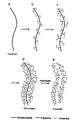
- Figure 1 shows in step a) the degradable support matrix in the form of a polysaccharide (D-polymer), step b) when polyamines have been cross-linked to the basic matrix and a layer (coating) with polyamines is obtained, i.e. a support matrix polymer complex is obtained, step c) when further polyamines have been cross-linked and an additional layer (whereby a hydrogel product has been obtained) is obtained and step d) when additional polyamines has been cross-linked and an additional layer is obtained, whereby an additional hydrogel product has been obtained (DR-complex ) with three layers.
- Step e) shows hydrogel product after it has been degraded e.g. through hydrolysis whereby an acid- and base-stable residue of the support matrix is obtained and an additional hydrogel product (R-polymer).
- the product was synthesized from a more porous agarose gel than in example 1 (where, according to the manufacturing company, INOVATA AB, the original gel is penetrated by proteins with a molecular weight in the range of 10-50 kDalton).
- the first coupling was performed using a high molecular polyethylene imine, PEI, obtained from Sigma-Aldrich, Milwaukee, USA. Thereafter the gel was saturated with copper sulphate and the excess of copper was washed away. The copper-saturated gel was converted with tetraethylene pentamine, TEPA.
- the activation was performed in two ways:
- Example 2 The reaction was performed as in Example 2 with the difference that the activation before the TEPA-coupling was performed with 10 ml of glutaraldehyde in 10 ml of 0.1 M Na 2 CO 3 during 2 hours.
- the gel was converted as in Example 2 and the copper-saturated product was analysed.
- the experiments according to the working examples 1-5 show that the product may be obtained in different forms through performing the activation under different conditions with bisepoxide, a bifunctional reagent, and with glutaraldehyde, which in its monomeric form is a bifunctional reagent but contains generally an unspecified amount of polymer with many functional groups. Further the experiments show that gel product in different form is obtained from polyethylene imines with different molecular weight and with starting-gels with different porosity, and further that gel product also is obtained through activation in the absence of Cu ++ (Example 1) and in the presence of Cu ++ (Examples 2-5).
- the acid stability of the gel products was tested qualitatively with 2 M H 2 SO 4 . After 3 days of exposure for the acid the gel was captured according to Example 2 on a filter. No change due to the influence of the acid could visually be observed. A bed of gel particles showed excellent flow characteristics and the gel absorbed great amounts of copper ions.
- the agarose-PEI-gel has become very acid stable.
- a very acid-stable gel which consists of strongly cross-linked polyethylene amine gel (in spherical particle form as the original polysaccharide gel) with covalently fixed galactose residues, which is demonstrated by the good ability of the product in adsorbing galactose specific lectines.
- the main part of the gel (approx. 100 g of dry-sucked product) was suspended in 100 ml of 0.2 M Na 2 CO 3 . 4.5 g of divinyl sulphone was added. After 75 minutes the gel was washed and transferred to 50 ml of 0.2 M Na 2 CO 3 . 9.3 g of polyethylene imine was added and after 90 minutes also 20 ml of tetraethylene pentamine. After 3 days, the reaction was stopped. The gel was washed and converted to copper form and was analysed (L3). Cu: 3.3%; N: 3.8%
- Example 6 18 g of the end-product in Example 6 was washed with 0.1 M iminodiacetate whereby the copper was eluted. The gel was transferred to 2 M sulphuric acid. After 48 hours the gel was filtered off and washed with water until a neutral reaction was obtained and converted to copper form and was analysed.
- Example 6 shows how you through first incorporating polyethylene imine and thereafter adding to the same solution the more low molecular tetraethylene pentamine, efficiently may increase the nitrogen content and the copper capacity.
- polyethylene imine and tetraethylene pentamine now with divinyl sulphone instead of epichlorhydrin as coupling-reagent and bridge former at a lower alkalinity, the copper capacity could additionally be increased.
- the gel was then transferred to the Erlenmeyer-flask together with 100 ml of buffer and 10 g of glycerol propoxylate triglycidyl ether was added. The mixture was shaken at room temperature during 90 min, at 150 rpm. The gel was then washed with 2 l of water and 30 g of dry-sucked gel was obtained and was marked "Gel A". The residue, approx. 50 g, was washed over to the buffer. The gel was then transferred to the Erlenmeyer-flask again and 50 ml of buffer and 10 g of 50% PEI 2000 solution was added. Was shaken during 3.5 hours whereupon 20 g of TEPA was added. The mixture was then shaken during approx.
- the gel was washed with 2 1 of water and half of it was taken off and was packed and marked "B". The other half was washed over to buffer, dry-sucked, transferred to the Erlenmeyer-flask together with 25 ml of buffer. 5 g of the epoxide was added and the mixture was shaken during 90 minutes. The gel was washed with buffer; was dry-sucked. 25 ml of buffer was added together with 3 g of PEI 2000. The mixture was shaken during 3 hours whereafter 10 g of TREN was added. The mixture was shaken over night (18 hours), washed, and marked "C". The three gels were measured for copper and were analysed.
- Sponge-formed cellulose was activated and coupled in accordance with example 14.
- the product adsorbed copper and retained the shape after acid treatment.
Landscapes
- Chemical & Material Sciences (AREA)
- Analytical Chemistry (AREA)
- Organic Chemistry (AREA)
- Chemical Kinetics & Catalysis (AREA)
- Solid-Sorbent Or Filter-Aiding Compositions (AREA)
- Macromolecular Compounds Obtained By Forming Nitrogen-Containing Linkages In General (AREA)
- Colloid Chemistry (AREA)
Claims (11)
- Produit hydrogel pour adsorption, constitué d'une matrice de support insoluble dans l'eau et de polymères réticulés, caractérisé en ce que la matrice de support porte comme substituant une première substance polymère soluble, chimiquement liée à la matrice de support, des substances polymères supplémentaires étant ensuite incorporées, par des liaisons de réticulation de divers types, au complexe de polymère et de matrice de support synthétisé en premier lieu, et la matrice de support se présentant éventuellement sous la forme d'un résidu stable vis-à-vis des acides et des bases.
- Produit hydrogel conforme à la revendication 1, caractérisé en ce que les agents de réticulation sont de types divers, une ou plusieurs liaisons de réticulation pouvant être rompues et une ou plusieurs liaisons de réticulation pouvant être laissées intactes.
- Produit hydrogel conforme à la revendication 1 ou 2, caractérisé par la formule structurale :
P représente la matrice de support,
Y représente un pont azoté, soufré ou oxygéné,
les X1, ...Xi, ...Xn représentent des agents de réticulation difonctionnels, trifonctionnels ou polyfonctionnels, identiques ou différents,
les A1, ...Ai, ...An représentent des substances polymères hydrosolubles, de préférence des résidus réticulés d'amines identiques ou différents, et n et i représentent des nombres entiers, avec i < n et n > 2. - Produit hydrogel conforme à l'une des revendications précédentes, caractérisé en ce que la matrice de support est constituée d'un polysaccharide comme l'agar-agar, l'agarose ou leurs dérivés, la cellulose ou ses dérivés, le dextrane réticulé ou ses dérivés, ou l'amidon ou ses dérivés, d'une protéine ou d'une combinaison de polysaccharide et de protéine.
- Produit hydrogel conforme à l'une des revendications précédentes, caractérisé en ce que l'un ou plusieurs des agents de réticulation X1 à Xn est/sont des halogénhydrines, des diépoxydes, triépoxydes ou polyépoxydes, des halogénodiazines ou halogénotriazines, des aldéhydes difonctionnels, trifonctionnels ou polyfonctionnels (de préférence du glutaraldéhyde ou un polymère de glutaraldéhyde), des diaziridines, triaziridines ou polyaziridines, des composés de type X1-alkylène-X2 où X1 et X2 représentent des atomes d'halogène (de préférence du dibromure d'éthylène) ou des cyanurates halogénés.
- Produit hydrogel conforme à l'une des revendications précédentes, caractérisé en ce que l'un ou plusieurs des A1 à An est/sont constitué(s) de résidus d'une polyalkylène-amine à chaíne linéaire ou ramifiée (appelée généralement "polyalkylène-imine"), de préférence d'une oligoéthylène-amine ou d'une polyéthylène-amine, ou de résidus d'une amine de formule NHR1R2 dans laquelle R1 et R2 peuvent être identiques ou différents et représentent chacun un atome d'hydrogène, un groupe alkyle, aromatique ou hétérocycloalkyle, un groupe carboxyalkyle ou le reste d'un autre acide aminé.
- Produit hydrogel conforme à l'une des revendications précédentes, caractérisé par une forme arbitraire, de préférence particulière, et spécialement, une forme sphérique, une forme de fil ou une forme de membrane, ou même un aspect poreux ou spongieux.
- Produit hydrogel conforme à la revendication 7, caractérisé en ce qu'il conserve sa forme initiale même après une action chimique énergique, par exemple une élution, un traitement par un acide fort comme de l'acide sulfurique à 20 %, un traitement par une solution saturée de periodate à pH 7, ou un traitement par du borohydrure de sodium.
- Procédé de production d'un produit hydrogel conforme à l'une des revendications 1 à 8, caractérisé en ce que l'on incorpore des chaínes de polyalkylène-imine A1 dans le réseau polysaccharide/protéine, c'est-à-dire la matrice de support, laquelle est ensuite activée et en même temps réticulée par un agent de réticulation X1, après quoi l'on couple le produit avec une nouvelle alkylène-imine A2 qui est ensuite activée par X2, et ainsi de suite, ou bien l'on incorpore des chaínes de polyalkylène-imine A1 dans le réseau de la matrice de support et l'on fait ensuite réagir le produit avec un mélange d'agents de réticulation et de polyamine, puis on élimine de la phase solide, par lavage, les produits de réaction qui n'ont pas réagi.
- Procédé conforme à la revendication 9, caractérisé en ce que l'on soumet le réseau polysaccharide/protéine à une dégradation, grâce à quoi il se forme un résidu stable vis-à-vis des acides et des bases.
- Procédé conforme à l'une des revendications 9 et 10, caractérisé en ce que l'activation par des motifs de polyamine A1-An se déroule selon un procédé en deux étapes au cours duquel des substituants insaturés, qui sont de préférence des groupes alcényle et surtout des groupes allyle, sont d'abord incorporés au niveau des groupes amino primaires ou secondaires, puis ces substituants insaturés sont désaturés avec de l'eau halogénée, de préférence de l'eau de brome, à la suite de quoi a lieu le couplage avec les amines, de préférence en milieu alcalin.
Applications Claiming Priority (3)
| Application Number | Priority Date | Filing Date | Title |
|---|---|---|---|
| SE9802099A SE512234C2 (sv) | 1998-06-12 | 1998-06-12 | Hydrogelprodukt för adsorptionsändamål bestående av en vattenolöslig stödmatris som är tvärbunden med polymerer |
| SE9802099 | 1998-06-12 | ||
| PCT/SE1999/000991 WO1999064149A1 (fr) | 1998-06-12 | 1999-06-08 | Produit hydrogel destine a l'adsorption |
Publications (2)
| Publication Number | Publication Date |
|---|---|
| EP1094894A1 EP1094894A1 (fr) | 2001-05-02 |
| EP1094894B1 true EP1094894B1 (fr) | 2003-05-21 |
Family
ID=20411682
Family Applications (1)
| Application Number | Title | Priority Date | Filing Date |
|---|---|---|---|
| EP99931670A Expired - Lifetime EP1094894B1 (fr) | 1998-06-12 | 1999-06-08 | Produit hydrogel destine a l'adsorption |
Country Status (6)
| Country | Link |
|---|---|
| EP (1) | EP1094894B1 (fr) |
| AT (1) | ATE240782T1 (fr) |
| AU (1) | AU4811399A (fr) |
| DE (1) | DE69908133T2 (fr) |
| SE (1) | SE512234C2 (fr) |
| WO (1) | WO1999064149A1 (fr) |
Families Citing this family (1)
| Publication number | Priority date | Publication date | Assignee | Title |
|---|---|---|---|---|
| EP1289651A1 (fr) * | 2000-06-08 | 2003-03-12 | Jerker Porath | Produit hydrogel a des fins d'adsorption |
Family Cites Families (5)
| Publication number | Priority date | Publication date | Assignee | Title |
|---|---|---|---|---|
| US4144190A (en) * | 1976-07-08 | 1979-03-13 | Ciba-Geigy Ag | Polysaccharide-containing adsorbent |
| CH634283A5 (de) * | 1978-02-24 | 1983-01-31 | Ciba Geigy Ag | Verfahren zur entfernung von schwermetallionen aus waesserigen loesungen. |
| SE466534B (sv) * | 1988-12-30 | 1992-03-02 | Exploaterings Ab Tbf | Adsorptionsmedel foer metalljoner, proteiner och andra oorganiska och organiska substanser |
| US5120443A (en) * | 1991-06-03 | 1992-06-09 | Brigham Young University | Processes for removing, separating and concentrating rhodium, iridium, and ruthenium from solutions using macrocyclic and nonmacrocyclic polyalkylene-polyamine-containing ligands bonded to inorganic supports |
| AUPM632894A0 (en) * | 1994-06-21 | 1994-07-14 | Alldredge, Robert Louis | Immobilised branched polyalkyleneimines |
-
1998
- 1998-06-12 SE SE9802099A patent/SE512234C2/sv not_active IP Right Cessation
-
1999
- 1999-06-08 WO PCT/SE1999/000991 patent/WO1999064149A1/fr not_active Ceased
- 1999-06-08 AU AU48113/99A patent/AU4811399A/en not_active Abandoned
- 1999-06-08 DE DE69908133T patent/DE69908133T2/de not_active Expired - Fee Related
- 1999-06-08 AT AT99931670T patent/ATE240782T1/de not_active IP Right Cessation
- 1999-06-08 EP EP99931670A patent/EP1094894B1/fr not_active Expired - Lifetime
Also Published As
| Publication number | Publication date |
|---|---|
| SE512234C2 (sv) | 2000-02-14 |
| SE9802099D0 (sv) | 1998-06-12 |
| DE69908133D1 (de) | 2003-06-26 |
| DE69908133T2 (de) | 2004-04-08 |
| EP1094894A1 (fr) | 2001-05-02 |
| SE9802099L (sv) | 1999-12-13 |
| WO1999064149A1 (fr) | 1999-12-16 |
| ATE240782T1 (de) | 2003-06-15 |
| AU4811399A (en) | 1999-12-30 |
Similar Documents
| Publication | Publication Date | Title |
|---|---|---|
| US6339039B1 (en) | Hydrogel product for adsorption purposes | |
| DE69007769T2 (de) | Metallchelatierendes, hydrophiles Polymer. | |
| Constantin et al. | Removal of anionic dyes from aqueous solutions by an ion-exchanger based on pullulan microspheres | |
| Huang et al. | A comparative study of mechanism and performance of anionic and cationic dialdehyde nanocelluloses for dye adsorption and separation | |
| DE68927553T2 (de) | Adsorbierungsmittel für metallionen, proteinen oder sonstige anorganische und organische verbindungen | |
| EP2422878A1 (fr) | Adsorbant de métaux contenant un polymère chélatant | |
| JP4818105B2 (ja) | ゼオライトとキトサンとが化学的に結合された多孔性混成体の製造方法及びこれにより製造された多孔性混成体 | |
| EP0167502B1 (fr) | Produit liant des ions métalliques pour inhiber la croissance bactérielle pour l'immobilisation et la purification de biopolymères et analogues | |
| Anirudhan et al. | Preparation, characterization and adsorption behavior of tannin-modified poly (glycidylmethacrylate)-grafted zirconium oxide-densified cellulose for the selective separation of bovine serum albumin | |
| EP0165912B1 (fr) | Adsorbant à base de thioéther pour la séparation de protéines et analogues | |
| EP0028126A1 (fr) | Produit préparé à partir d'un dérivé de chitine réticulé ionique, sa préparation et son utilisation | |
| Farias et al. | Natural and cross-linked chitosan spheres as adsorbents for diesel oil removal | |
| Anirudhan et al. | Investigation of the extraction of hemoglobin by adsorption onto nanocellulose-based superabsorbent composite having carboxylate functional groups from aqueous solutions: kinetic, equilibrium, and thermodynamic profiles | |
| Kalkan et al. | Adsorptive removal of Acid Fuchsin dye using by-product silica fume and laccase-modified silica fume | |
| JPS6242739A (ja) | 液体媒体からの水銀の除去に用いる不溶性組成物 | |
| EP0764049B1 (fr) | Adsorbant de proteines resistant aux alcalis | |
| JP6253059B2 (ja) | エンドトキシン吸着材 | |
| WO1991019675A1 (fr) | Procede et dispositif de purification d'eau | |
| EP1094894A1 (fr) | Produit hydrogel destine a l'adsorption | |
| JP2010014716A (ja) | 電気的中性の親水性外側表面を有する化学的に変性された多孔質材料 | |
| US20030186807A1 (en) | Hydrogel product for adsorption purposes | |
| Oladoja et al. | Progress and prospects of polysaccharide composites as adsorbents for water and wastewater treatment | |
| WO2001094007A1 (fr) | Produit hydrogel a des fins d'adsorption | |
| GB1600241A (en) | Ampholytic materials | |
| Pal et al. | Lead cleanup from environment using altered form of chitosan: a review |
Legal Events
| Date | Code | Title | Description |
|---|---|---|---|
| PUAI | Public reference made under article 153(3) epc to a published international application that has entered the european phase |
Free format text: ORIGINAL CODE: 0009012 |
|
| 17P | Request for examination filed |
Effective date: 20001116 |
|
| AK | Designated contracting states |
Kind code of ref document: A1 Designated state(s): AT BE CH CY DE DK ES FI FR GB GR IE IT LI LU MC NL PT SE |
|
| GRAH | Despatch of communication of intention to grant a patent |
Free format text: ORIGINAL CODE: EPIDOS IGRA |
|
| GRAH | Despatch of communication of intention to grant a patent |
Free format text: ORIGINAL CODE: EPIDOS IGRA |
|
| GRAA | (expected) grant |
Free format text: ORIGINAL CODE: 0009210 |
|
| AK | Designated contracting states |
Designated state(s): AT BE CH CY DE DK ES FI FR GB GR IE IT LI LU MC NL PT SE |
|
| PG25 | Lapsed in a contracting state [announced via postgrant information from national office to epo] |
Ref country code: NL Free format text: LAPSE BECAUSE OF FAILURE TO SUBMIT A TRANSLATION OF THE DESCRIPTION OR TO PAY THE FEE WITHIN THE PRESCRIBED TIME-LIMIT Effective date: 20030521 Ref country code: LI Free format text: LAPSE BECAUSE OF FAILURE TO SUBMIT A TRANSLATION OF THE DESCRIPTION OR TO PAY THE FEE WITHIN THE PRESCRIBED TIME-LIMIT Effective date: 20030521 Ref country code: IT Free format text: LAPSE BECAUSE OF FAILURE TO SUBMIT A TRANSLATION OF THE DESCRIPTION OR TO PAY THE FEE WITHIN THE PRESCRIBED TIME-LIMIT;WARNING: LAPSES OF ITALIAN PATENTS WITH EFFECTIVE DATE BEFORE 2007 MAY HAVE OCCURRED AT ANY TIME BEFORE 2007. THE CORRECT EFFECTIVE DATE MAY BE DIFFERENT FROM THE ONE RECORDED. Effective date: 20030521 Ref country code: FI Free format text: LAPSE BECAUSE OF FAILURE TO SUBMIT A TRANSLATION OF THE DESCRIPTION OR TO PAY THE FEE WITHIN THE PRESCRIBED TIME-LIMIT Effective date: 20030521 Ref country code: CH Free format text: LAPSE BECAUSE OF FAILURE TO SUBMIT A TRANSLATION OF THE DESCRIPTION OR TO PAY THE FEE WITHIN THE PRESCRIBED TIME-LIMIT Effective date: 20030521 Ref country code: BE Free format text: LAPSE BECAUSE OF FAILURE TO SUBMIT A TRANSLATION OF THE DESCRIPTION OR TO PAY THE FEE WITHIN THE PRESCRIBED TIME-LIMIT Effective date: 20030521 Ref country code: AT Free format text: LAPSE BECAUSE OF FAILURE TO SUBMIT A TRANSLATION OF THE DESCRIPTION OR TO PAY THE FEE WITHIN THE PRESCRIBED TIME-LIMIT Effective date: 20030521 |
|
| REG | Reference to a national code |
Ref country code: GB Ref legal event code: FG4D |
|
| REG | Reference to a national code |
Ref country code: CH Ref legal event code: EP |
|
| PG25 | Lapsed in a contracting state [announced via postgrant information from national office to epo] |
Ref country code: LU Free format text: LAPSE BECAUSE OF NON-PAYMENT OF DUE FEES Effective date: 20030608 Ref country code: CY Free format text: LAPSE BECAUSE OF FAILURE TO SUBMIT A TRANSLATION OF THE DESCRIPTION OR TO PAY THE FEE WITHIN THE PRESCRIBED TIME-LIMIT Effective date: 20030608 |
|
| PG25 | Lapsed in a contracting state [announced via postgrant information from national office to epo] |
Ref country code: IE Free format text: LAPSE BECAUSE OF NON-PAYMENT OF DUE FEES Effective date: 20030609 |
|
| REG | Reference to a national code |
Ref country code: IE Ref legal event code: FG4D |
|
| REF | Corresponds to: |
Ref document number: 69908133 Country of ref document: DE Date of ref document: 20030626 Kind code of ref document: P |
|
| PG25 | Lapsed in a contracting state [announced via postgrant information from national office to epo] |
Ref country code: MC Free format text: LAPSE BECAUSE OF NON-PAYMENT OF DUE FEES Effective date: 20030630 |
|
| PG25 | Lapsed in a contracting state [announced via postgrant information from national office to epo] |
Ref country code: SE Free format text: LAPSE BECAUSE OF FAILURE TO SUBMIT A TRANSLATION OF THE DESCRIPTION OR TO PAY THE FEE WITHIN THE PRESCRIBED TIME-LIMIT Effective date: 20030821 Ref country code: PT Free format text: LAPSE BECAUSE OF FAILURE TO SUBMIT A TRANSLATION OF THE DESCRIPTION OR TO PAY THE FEE WITHIN THE PRESCRIBED TIME-LIMIT Effective date: 20030821 Ref country code: GR Free format text: LAPSE BECAUSE OF FAILURE TO SUBMIT A TRANSLATION OF THE DESCRIPTION OR TO PAY THE FEE WITHIN THE PRESCRIBED TIME-LIMIT Effective date: 20030821 Ref country code: DK Free format text: LAPSE BECAUSE OF FAILURE TO SUBMIT A TRANSLATION OF THE DESCRIPTION OR TO PAY THE FEE WITHIN THE PRESCRIBED TIME-LIMIT Effective date: 20030821 |
|
| PG25 | Lapsed in a contracting state [announced via postgrant information from national office to epo] |
Ref country code: ES Free format text: LAPSE BECAUSE OF FAILURE TO SUBMIT A TRANSLATION OF THE DESCRIPTION OR TO PAY THE FEE WITHIN THE PRESCRIBED TIME-LIMIT Effective date: 20030901 |
|
| NLV1 | Nl: lapsed or annulled due to failure to fulfill the requirements of art. 29p and 29m of the patents act | ||
| REG | Reference to a national code |
Ref country code: CH Ref legal event code: PL |
|
| ET | Fr: translation filed | ||
| PLBE | No opposition filed within time limit |
Free format text: ORIGINAL CODE: 0009261 |
|
| STAA | Information on the status of an ep patent application or granted ep patent |
Free format text: STATUS: NO OPPOSITION FILED WITHIN TIME LIMIT |
|
| REG | Reference to a national code |
Ref country code: IE Ref legal event code: MM4A |
|
| 26N | No opposition filed |
Effective date: 20040224 |
|
| PGFP | Annual fee paid to national office [announced via postgrant information from national office to epo] |
Ref country code: DE Payment date: 20080620 Year of fee payment: 10 |
|
| PGFP | Annual fee paid to national office [announced via postgrant information from national office to epo] |
Ref country code: FR Payment date: 20080530 Year of fee payment: 10 |
|
| PGFP | Annual fee paid to national office [announced via postgrant information from national office to epo] |
Ref country code: GB Payment date: 20080623 Year of fee payment: 10 |
|
| GBPC | Gb: european patent ceased through non-payment of renewal fee |
Effective date: 20090608 |
|
| REG | Reference to a national code |
Ref country code: FR Ref legal event code: ST Effective date: 20100226 |
|
| PG25 | Lapsed in a contracting state [announced via postgrant information from national office to epo] |
Ref country code: FR Free format text: LAPSE BECAUSE OF NON-PAYMENT OF DUE FEES Effective date: 20090630 |
|
| PG25 | Lapsed in a contracting state [announced via postgrant information from national office to epo] |
Ref country code: GB Free format text: LAPSE BECAUSE OF NON-PAYMENT OF DUE FEES Effective date: 20090608 |
|
| PG25 | Lapsed in a contracting state [announced via postgrant information from national office to epo] |
Ref country code: DE Free format text: LAPSE BECAUSE OF NON-PAYMENT OF DUE FEES Effective date: 20100101 |