EP1096007A1 - Chitinase und Verfahren zu ihrer Herstellung - Google Patents
Chitinase und Verfahren zu ihrer Herstellung Download PDFInfo
- Publication number
- EP1096007A1 EP1096007A1 EP00307917A EP00307917A EP1096007A1 EP 1096007 A1 EP1096007 A1 EP 1096007A1 EP 00307917 A EP00307917 A EP 00307917A EP 00307917 A EP00307917 A EP 00307917A EP 1096007 A1 EP1096007 A1 EP 1096007A1
- Authority
- EP
- European Patent Office
- Prior art keywords
- chitinase
- chitin
- acetylglucosamine
- activity
- enzyme
- Prior art date
- Legal status (The legal status is an assumption and is not a legal conclusion. Google has not performed a legal analysis and makes no representation as to the accuracy of the status listed.)
- Withdrawn
Links
Images

Classifications
-
- C—CHEMISTRY; METALLURGY
- C12—BIOCHEMISTRY; BEER; SPIRITS; WINE; VINEGAR; MICROBIOLOGY; ENZYMOLOGY; MUTATION OR GENETIC ENGINEERING
- C12N—MICROORGANISMS OR ENZYMES; COMPOSITIONS THEREOF; PROPAGATING, PRESERVING, OR MAINTAINING MICROORGANISMS; MUTATION OR GENETIC ENGINEERING; CULTURE MEDIA
- C12N9/00—Enzymes; Proenzymes; Compositions thereof; Processes for preparing, activating, inhibiting, separating or purifying enzymes
- C12N9/14—Hydrolases (3)
- C12N9/24—Hydrolases (3) acting on glycosyl compounds (3.2)
- C12N9/2402—Hydrolases (3) acting on glycosyl compounds (3.2) hydrolysing O- and S- glycosyl compounds (3.2.1)
- C12N9/2405—Glucanases
- C12N9/2434—Glucanases acting on beta-1,4-glucosidic bonds
- C12N9/2442—Chitinase (3.2.1.14)
-
- C—CHEMISTRY; METALLURGY
- C12—BIOCHEMISTRY; BEER; SPIRITS; WINE; VINEGAR; MICROBIOLOGY; ENZYMOLOGY; MUTATION OR GENETIC ENGINEERING
- C12Y—ENZYMES
- C12Y302/00—Hydrolases acting on glycosyl compounds, i.e. glycosylases (3.2)
- C12Y302/01—Glycosidases, i.e. enzymes hydrolysing O- and S-glycosyl compounds (3.2.1)
- C12Y302/01014—Chitinase (3.2.1.14)
Definitions
- the present invention relates to novel chitinase and a method for preparing the same. Description of the Related Art:
- Chitin is an insoluble polysaccharide consisting of ⁇ -(1,4)-linked N-acetylglucosamine and is present widely in the bacterial kingdom, plant kingdom and animal kingdom. Chitin is at a yearly production comparative to that of cellulose and is considered as one of the most abundant biomass resources.
- chitin-derived low-molecular N-acetylglucosamine oligomer is known to have useful physiological activities such as immunopotentiation, anti-bacterial activity and anti-vial activity.
- the N-acetylglucosamine oligomer has been commonly produced by thermally treating the shell of crab and shrimp in sodium hydroxide solution thereby removing protein, and removing ash with hydrochloric acid to recover chitin, and then preparing the resulting chitin into low-molecular substances by the limited hydrochloride hydrolysis method. Additionally, a method using hydrogen fluoride has been proposed recently.
- any of these methods is disadvantageous in that the disposal of the equipment and liquid waste requires high cost. Furthermore, the essential bonds are readily cut so that the resulting production efficiency is unavoidably low due to the resulting byproducts.
- chitinase as chitin decomposition enzyme acts only on certain predetermined sites in chitin under mild reaction conditions owing to the substrate specificity so that less byproducts are generated, cost reduction is possible. Therefore, industrially applicable methods for producing chitinase have been demanded.
- chitinase species derived from microorganisms of genera Bacillus, Serratia , and Streptomyces are commercially available for the purpose of using the chitinase species for academic research works but are so expensive. Additionally, these chitinase species are at optimum pH in acidity (pH 2 to 6). Thus, these chitinase species are not suitable for use at a range of pHs above neutrality. Additionally, the temperature range in which these chitinase species exert their action is narrow (the active temperature range of 30°C to 45°C).
- microorganisms of the genus Vibrio generate chitinase, but the microorganisms are all mesophilic microorganisms derived from the genus Vibrio [Akio Ohtakara, Masaru Mitsutomi and Yasushi Uchida, J. Ferment. Technol., 57 , 169-177 (1979)]. It has never been known that psychrotrophic microorganisms of the genus Vibrio generate chitinase.
- mesophilic microorganisms of the genus Vibrio at the optimum temperature at 30°C to 40°C require strict temperature control; and additionally, the thermal stability thereof reaches the threshold at 30°C to 35°C.
- the mesophilic microorganisms of the genus Vibrio are likely to be inactivated, disadvantageously.
- the invention relates to chitinase with the following physico-chemical properties.
- the invention furthermore relates to a method for producing the chitinase, comprising culturing a chitinase-generating bacterium reacting with chitin to generate N-acetylglucosamine oligomer and collecting the generated chitinase from the culture, wherein the chitinase-generating bacterium is a marine psychrotrophic bacterium of the genus Vibrio .
- the chitinase as a novel enzyme in accordance with the invention can be used for modifying chitin into low molecular substances by allowing the chitinase to react with chitin.
- the inventive chitinase can preferably be used for industrial production of N-acetylglucosamine oligomer.
- novel chitinase of the invention has an action to cut the ⁇ -1,4 bond of chitin in a random manner to generate an oligomer comprising the tetramer and dimer of N-acetylglucosamine as the principal components.
- the active temperature range of the inventive novel chitinase characteristically is as wide as 4 to 60°C. More specifically, the inventive chitinase characteristically has unique temperature properties including the property as a psychrotrophic enzyme and additionally the property that the inventive chitinase exerts its activity up to a temperature range higher than those of known chitinase species derived from mesophilic bacteria.
- the physico-chemical properties of the inventive chitinase are as follows.
- the inventive chitinase sufficiently decomposes chitin in solid, such as powdery chitin in a heterogeneous reaction system. However, the reaction velocity of the inventive chitinase is elevated for substrates such as regenerated chitin such as colloidal chitin and glycol chitin as a water-soluble derivative of chitin.
- the enzyme activity of the inventive chitinase was assayed by the following method.
- Chitin (manufactured by Katakura Chikkarin, Ltd.) was dissolved in hydrochloric acid, again deposited in water, filtered and rinsed, to prepare colloidal chitin.
- colloidal chitin (20 mg) as a substrate, an enzyme solution (1 ml) and 0.4 M phosphate buffer, pH 8.7 (0.2 ml), followed by sealing and agitation at 37°C for 2 hours.
- the agitation mixture was centrifuged, to recover the supernatant containing the generated oligomer comprising the tetramer and dimer of N-acetylglucosamine as the principal components; 0.4 ml of the supernatant was transferred in a test tube, where the oligomer was decomposed with commercially available ⁇ -N-acetylglucosaminidase to the monomer N-acetylglucosamine.
- ⁇ -N-acetylglucosaminidase satisfactorily, use can be made of a commercially available cellulase "Cellulosin AP" (under trade name; a product manufactured by Ueda Chemical Co.).
- Cellulosin AP is identical with "Cellulosin AC40" (under trade name; a product manufactured by Hankyu Kyoei Bussan Co., Ltd.).
- Cellulosin AC40 under trade name; a product manufactured by Hankyu Kyoei Bussan Co., Ltd.
- the generated N-acetylglucosamine was subjected to colorimetric assay by the Morgan-Elson method [Kimiko Abe, Nobuko Seno; Seibutu-Kagaku Jikken (Biochemical Experiments), Vol. 11, Sugar Experimental Method, p. 22-23 (1968), Kyoritsu Shuppan].
- the quantity of the enzyme (chitinase) generating the oligomer corresponding to 1 ⁇ mol N-acetylglucosamine per one minute is defined as one unit of the enzyme.
- the novel chitinase of the Invention can preferably be produced by culturing a chitinase-generating bacterium reacting with chitin to generate the N-acetylglucosamine oligomer and collecting the chitinase from the culture, wherein the chitinase-generating bacterium is a marine psychrotrophic bacterium of the genus Vibrio .
- Any marine psychrotrophic bacterium of the genus Vlbrio and with the potency to generate the chitinase can be used as the bacterium according to the method for producing chitinase.
- the marine psychrotrophic bacterial strain P2K-5 isolated from the in-depth water in a Boso sea trench in Japan is listed.
- the marine psychrotrophic bacterial strain P2K-5 is deposited under the Accession No. FERM BP-5769 at the National Institute of Bioscience and Human-Technology, Agency of Industrial Science and Technology, MITI.
- the marine psychrotrophic bacterial strain P2K-5 (FERM BP-5769) generating chitinase is of the following bacteriological properties.
- Chitinase production using the marine psychrotrophic bacterial strain P2K-5 comprises inoculating the bacterium in an appropriate culture medium, preferably in the presence of an induction agent, by a general method.
- the induction agent includes chitin, regenerated chitin such as colloidal chitin, chitin decomposition products and chitin derivatives such as glycol chitin, singly or in combination with two or more thereof.
- the induction agent is added at a concentration of generally 0.1 g/liter or more, preferably 1 to 50 g/liter.
- the culture medium includes glucose, maltose, xylose, sucrose and peptone;
- the nitrogen source includes organic nitrogen such as yeast extract, peptone, meat extract and amino acid solutions and inorganic nitrogen such as ammonium sulfate and ammonium chloride.
- the induction agent can be used satisfactorily as such carbon source and nitrogen source.
- the inorganic salt use can be made of appropriate combinations of magnesium sulfate, magnesium chloride, sodium phosphate, potassium phosphate, potassium chloride, sodium chloride and calcium chloride.
- the culture medium is adjusted to a range of pH 6,5 to 8.5, with the addition of an appropriate acid or base, which is then sterilized in an autoclave.
- the culture conditions are preferably aerobic shaking or agitation culturing at a temperature of 5 to 35°C, preferably 20 to 28°C for about 20 to 72 hours.
- the bacterium can be cultured under stationary culture.
- the method for separating the bacterium and the culture broth from the resulting culture includes conventional centrifugation method and filtration method, but centrifugation method is preferable.
- the supernatant per se can be utilized as a crude enzyme solution, but the objective enzyme can be deposited, concentrated and harvested through salting with ammonium sulfate.
- novel chitinase of the invention can be recovered.
- the bacterial strain P2K-5 (FERM BP-5769; 200 ⁇ l) stored under refrigeration was inoculated in a 1/2 TZ culture medium (Akihiko Maruyama, Naoki Mita, and Takanori Higashihara, J. oceanogr. 49, 353-376, 1993) (5 ml) in a test tube with "Silico Stopper" (under trade name; Shin-etsu Polymer) and then overnight cultured under shaking at 25°C.
- the composition of the 1/2 TZ culture medium was as follows: 2.5 g/liter polypeptone (manufactured by Daigo Co.), 0.5 g/liter yeast extract (manufactured by Difco Co.), 477 g/liter HEPES (under trade name; manufactured by Dojin CO.), 21.533 g/liter sodium chloride, 3.607 g/liter sodium sulfate, 0.609 g/liter potassium chloride, 0.176 g/liter sodium hydrogencarbonate, 0.088 g/liter potassium bromide, 0.023 g/liter boric acid, 0.003 g/liter sodium fluoride, 9.747 g/liter magnesium chloride ⁇ 6H 2 O, 1.368 g/liter calcium chloride ⁇ 2H 2 O, and 0.022 g/liter strontium chloride ⁇ 6H 2 O.
- the culture (1 ml) was added to "Marine broth” (under trade name; manufactured by Difco Co.) (100 ml), for further culturing under shaking for 24 hours.
- the culture (25 ml) was added to a 1/2 TZ culture medium (1 liter) containing 20 g of chitin powder, for aerobic culturing under shaking at 25°C for 48 hours. Thereafter, the culture was centrifuged at 8,000 ⁇ g for 20 minutes; and the resulting supernatant was recovered.
- the supernatant was adjusted to 80% saturation with solid ammonium sulfate; and the resulting precipitate was collected by centrifugation and dissolved again, to recover a crude enzyme solution at a specific activity of 0.00078 unit/mg ⁇ protein and the total activity of 2.30 units.
- the crude solution was passed through a column packed with "Butyl Sepharose 4FF" (50 ml) (under trade name; hydrophobic chromatographic resin; manufactured by Pharmacia Co.) preliminarily equilibrated with 0.1 M phosphate buffer, pH 7.0 containing 1.5 M ammonium sulfate, to adsorb the objective enzyme to the resin.
- a column was rinsed with the same phosphate buffer and the concentration of ammonium sulfate was modified in a step-wise manner to elute the objective enzyme, an enzyme fraction with the total activity of 1.04 units and a specific activity of 0.0077 unit/mg ⁇ protein was recovered.
- the active fraction was passed through a column packed with 10 mM "TSKgel Super Q Toyopearl 650 M" (under trade name; ion exchange chromatographic resin; manufactured by Toso Co., Ltd.) preliminarily equilibrated with 10 mM phosphate buffer, pH 7.0, to adsorb the objective enzyme to the resin.
- 10 mM phosphate buffer pH 7.0
- concentration of NaCl in the phosphate buffer was modified in a step-wise manner to elute the objective enzyme, an enzyme fraction with the total activity of 0.51 unit and a specific activity of 0.078 unit/mg ⁇ protein was recovered.
- a substrate colloidal chitin (20 mg) and the enzyme solution (1 ml; 0.0014 unit) were placed in a sample tube; and the mixture was then adjusted to various pHs by using 0.2 ml of 0.4 M phosphate buffer, for reaction at 30°C for 2 hours, to recover a supernatant containing the generated oligomer of N-acetylglucosamine through centrifugation.
- the supernatant of 0.4 ml was transferred in a test tube, followed by addition of 0.1 ml of Cellulosin AP (under trade name; manufactured by Ueda Chemical Co.; aqueous 1% solution), for shaking at 37°C for 30 minutes; the generated N-acetylglucosamine was subjected to colorimetric assay by the Morgan-Elson method.
- Cellulosin AP under trade name; manufactured by Ueda Chemical Co.; aqueous 1% solution
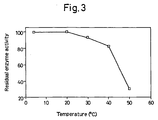
- a substrate colloidal chitin (20 mg) and the enzyme solution (1 ml; specific activity of 0.0014 unit) were placed in a sample tube; and the mixture was then adjusted to pH 7.8 by using 0.2 ml of 0.4 M phosphate buffer, for reaction at various temperatures for 2 hours, to recover a supernatant containing the generated oligomer of N-acetylglucosamine through centrifugation.
- the supernatant of 0.4 ml was transferred in a test tube, followed by addition of 0.1 ml of Cellulosin AP (under trade name; manufactured by Ueda Chemical Co.; aqueous 1% solution), for shaking at 37°C for 30 minutes; the generated N-acetylglucosamine was subjected to colorimetric assay by the Morgan-Elson method.
- Cellulosin AP under trade name; manufactured by Ueda Chemical Co.; aqueous 1% solution
- the residual activity at various temperatures is shown in Fig. 3, compared with the enzyme activity in a sample tube preliminarily containing the enzyme solution and colloidal chitin, for reaction at 30°C for 2 hours.
- the novel chitinase can be provided, having useful functions such as the production of the oligomer comprising the tetramer and dimer of N-acetylglucosamine by decomposing chitin and having high activity at low temperature as well as even at high temperature, namely a wide active temperature range, so the chitinase can be used under a wide variety of conditions.
- the other advantage is brought about, furthermore, namely the method for producing the chitinase, which can efficiently be applied industrially.
Landscapes
- Chemical & Material Sciences (AREA)
- Life Sciences & Earth Sciences (AREA)
- Organic Chemistry (AREA)
- Health & Medical Sciences (AREA)
- Genetics & Genomics (AREA)
- Engineering & Computer Science (AREA)
- Bioinformatics & Cheminformatics (AREA)
- Zoology (AREA)
- Wood Science & Technology (AREA)
- General Health & Medical Sciences (AREA)
- Biochemistry (AREA)
- General Engineering & Computer Science (AREA)
- Microbiology (AREA)
- Biotechnology (AREA)
- Biomedical Technology (AREA)
- Molecular Biology (AREA)
- Medicinal Chemistry (AREA)
- Enzymes And Modification Thereof (AREA)
- Micro-Organisms Or Cultivation Processes Thereof (AREA)
- Preparation Of Compounds By Using Micro-Organisms (AREA)
Applications Claiming Priority (2)
| Application Number | Priority Date | Filing Date | Title |
|---|---|---|---|
| JP30481499 | 1999-10-27 | ||
| JP11304814A JP3118573B1 (ja) | 1999-10-27 | 1999-10-27 | キチナーゼ及びその製造法 |
Publications (1)
| Publication Number | Publication Date |
|---|---|
| EP1096007A1 true EP1096007A1 (de) | 2001-05-02 |
Family
ID=17937582
Family Applications (1)
| Application Number | Title | Priority Date | Filing Date |
|---|---|---|---|
| EP00307917A Withdrawn EP1096007A1 (de) | 1999-10-27 | 2000-09-13 | Chitinase und Verfahren zu ihrer Herstellung |
Country Status (3)
| Country | Link |
|---|---|
| US (1) | US6352850B1 (de) |
| EP (1) | EP1096007A1 (de) |
| JP (1) | JP3118573B1 (de) |
Families Citing this family (4)
| Publication number | Priority date | Publication date | Assignee | Title |
|---|---|---|---|---|
| JP2008079501A (ja) * | 2005-03-14 | 2008-04-10 | Yamaguchi Univ | カイコキチナーゼおよびそれを含有してなる昆虫防除剤。 |
| RU2318831C1 (ru) * | 2006-08-21 | 2008-03-10 | Федеральное государственное образовательное учреждение высшего профессионального образования "Калининградский государственный технический университет" | Способ комплексной переработки рачка гаммаруса |
| PL235436B1 (pl) | 2014-11-28 | 2020-08-10 | Univ Jagiellonski | Kompleks białkowy zawierający białko G i chitynazę A, sposób wyodrębniania z roztworu wodnego chitynazy A oraz jego zastosowania |
| KR102027295B1 (ko) * | 2017-08-08 | 2019-11-04 | 전남대학교산학협력단 | 키티나아제를 생산할 수 있는 신규한 살리니비브리오 속 균주 및 이의 용도 |
Citations (4)
| Publication number | Priority date | Publication date | Assignee | Title |
|---|---|---|---|---|
| JPS6054681A (ja) * | 1983-09-05 | 1985-03-29 | Minoru Yabuki | キチナ−ゼ及びその製造法 |
| US4686185A (en) * | 1984-08-02 | 1987-08-11 | Wakunaga Kono Kabushiki Kaisha | Microorganism of new species of genus Streptomyces and use thereof for production of chitinase |
| US5068190A (en) * | 1988-09-21 | 1991-11-26 | Noda Institute For Scientific Research | N-acetylhexosamine-dehydrogenase, process for producing same, method for the quantitative analysis of N-acetylglucosamine or N-acetylgalactosamine using same and kit for use in the quantitative analysis |
| JPH06113846A (ja) * | 1991-03-20 | 1994-04-26 | Mercian Corp | キチナーゼ |
Family Cites Families (3)
| Publication number | Priority date | Publication date | Assignee | Title |
|---|---|---|---|---|
| US5587292A (en) * | 1987-05-22 | 1996-12-24 | Board Of Supervisors Of Louisiana State University And Agricultural And Mechanical College | Diagnosis of fungal infections with a chitinase |
| US5914239A (en) * | 1995-11-15 | 1999-06-22 | Board Of Supervisors Of Louisiana State University And Agricultural And Mechanical College | Diagnosis of fungal infections, and a chitin-binding lectin useful in such diagnoses |
| JP2824508B2 (ja) * | 1996-03-04 | 1998-11-11 | 工業技術院長 | N−アセチルグルコサミン6−リン酸デアセチラーゼ |
-
1999
- 1999-10-27 JP JP11304814A patent/JP3118573B1/ja not_active Expired - Lifetime
-
2000
- 2000-09-13 EP EP00307917A patent/EP1096007A1/de not_active Withdrawn
- 2000-09-14 US US09/661,808 patent/US6352850B1/en not_active Expired - Fee Related
Patent Citations (4)
| Publication number | Priority date | Publication date | Assignee | Title |
|---|---|---|---|---|
| JPS6054681A (ja) * | 1983-09-05 | 1985-03-29 | Minoru Yabuki | キチナ−ゼ及びその製造法 |
| US4686185A (en) * | 1984-08-02 | 1987-08-11 | Wakunaga Kono Kabushiki Kaisha | Microorganism of new species of genus Streptomyces and use thereof for production of chitinase |
| US5068190A (en) * | 1988-09-21 | 1991-11-26 | Noda Institute For Scientific Research | N-acetylhexosamine-dehydrogenase, process for producing same, method for the quantitative analysis of N-acetylglucosamine or N-acetylgalactosamine using same and kit for use in the quantitative analysis |
| JPH06113846A (ja) * | 1991-03-20 | 1994-04-26 | Mercian Corp | キチナーゼ |
Non-Patent Citations (3)
| Title |
|---|
| DATABASE WPI Week 8519, Derwent World Patents Index; AN 85-113317, XP002161349 * |
| DATABASE WPI Week 9421, Derwent World Patents Index; AN 94-172744, XP002161350 * |
| FUJISHIMA S. ET AL.: "Production of Chitinolytic Enzymes from Marine Bacteria - Enzymes of Psychrotropic Bacteria", BIO INDUSTRY, vol. 15, no. 3, 1998, pages 5 - 12, XP000986615 * |
Also Published As
| Publication number | Publication date |
|---|---|
| JP2001120266A (ja) | 2001-05-08 |
| US6352850B1 (en) | 2002-03-05 |
| JP3118573B1 (ja) | 2000-12-18 |
Similar Documents
| Publication | Publication Date | Title |
|---|---|---|
| Tokuyasu et al. | Purification and characterization of extracellular chitin deacetylase from Colletotrichum lindemuthianum | |
| JP2000513925A (ja) | N―アセチル―d―グルコサミンの生産方法 | |
| MXPA04001186A (es) | N-acetil-d-glucosamina y proceso para producir n-acetil-d-glucosamina. | |
| EP0030393A1 (de) | Xanthanase-Enzym und seine Herstellung | |
| US6352850B1 (en) | Chitinase and method for preparing the same | |
| JP3865801B2 (ja) | 新規なβ−アガラーゼ,その製造方法及びその用途 | |
| JP2021048835A (ja) | エキソキチナーゼと、エキソキチナーゼを生産する菌株と、エキソキチナーゼを精製する方法と、並びにその菌株からn−アセチルグルコサミンを生産する方法 | |
| Cabib | Chitinase from Serratia marcescens | |
| Swartz et al. | Agarase from an agar-digesting bacterium | |
| CA2073954A1 (en) | Process for the production of activated sialic acids | |
| EP0771868B1 (de) | Deaminoneuraminidase und herstellungsverfahren dafür | |
| JP3634883B2 (ja) | 耐熱性トレハロースホスホリラーゼ、その製造方法、その製造に使用する菌、及び該酵素を用いるトレハロースの製造方法 | |
| Sundarraj et al. | Breakdown of chitin by Cytophaga johnsonii | |
| US5744325A (en) | Process for producing N-acetylglucosamine-6-phosphate deacetylase | |
| JP2615443B2 (ja) | N−アセチル−d−グルコサミンデアセチラーゼの製造方法 | |
| JPH01247080A (ja) | 2段階発酵による多糖類の製造法 | |
| JP3656762B2 (ja) | ラミナリトリオースの製造法 | |
| JPH0833496A (ja) | オリゴ糖の製造法 | |
| JP3026312B2 (ja) | キチン分解物の製造法 | |
| JP4439153B2 (ja) | 耐熱性マンノースイソメラーゼ及び該酵素を用いたマンノースの製造法 | |
| JPS61280277A (ja) | キトサナ−ゼの製造法 | |
| JP3000169B2 (ja) | エンド―β―N―アセチルグルコサミニダーゼおよびその製造方法 | |
| JP3621985B2 (ja) | 新規β−N−アセチルヘキソサミニダーゼ及びその製造方法 | |
| JPH0269183A (ja) | β‐1,3‐グルカナーゼおよびその製法 | |
| KR100656987B1 (ko) | 에어로모나스 속 GJ-18 균주를 이용한 키틴으로부터N-아세틸-β-D-글루코사민과 N,N'-디아세틸키토비오스의생산 |
Legal Events
| Date | Code | Title | Description |
|---|---|---|---|
| PUAI | Public reference made under article 153(3) epc to a published international application that has entered the european phase |
Free format text: ORIGINAL CODE: 0009012 |
|
| AK | Designated contracting states |
Kind code of ref document: A1 Designated state(s): FR GB |
|
| AX | Request for extension of the european patent |
Free format text: AL;LT;LV;MK;RO;SI |
|
| 17P | Request for examination filed |
Effective date: 20011003 |
|
| AKX | Designation fees paid |
Free format text: FR GB |
|
| REG | Reference to a national code |
Ref country code: DE Ref legal event code: 8566 |
|
| 17Q | First examination report despatched |
Effective date: 20050627 |
|
| STAA | Information on the status of an ep patent application or granted ep patent |
Free format text: STATUS: THE APPLICATION IS DEEMED TO BE WITHDRAWN |
|
| 18D | Application deemed to be withdrawn |
Effective date: 20051108 |