EP1096079A1 - Wärme- und/oder Lärmisolierschaumplatte und Verfahren zu ihrer Herstellung - Google Patents
Wärme- und/oder Lärmisolierschaumplatte und Verfahren zu ihrer Herstellung Download PDFInfo
- Publication number
- EP1096079A1 EP1096079A1 EP00402582A EP00402582A EP1096079A1 EP 1096079 A1 EP1096079 A1 EP 1096079A1 EP 00402582 A EP00402582 A EP 00402582A EP 00402582 A EP00402582 A EP 00402582A EP 1096079 A1 EP1096079 A1 EP 1096079A1
- Authority
- EP
- European Patent Office
- Prior art keywords
- plate
- stud
- cavity
- tube
- face
- Prior art date
- Legal status (The legal status is an assumption and is not a legal conclusion. Google has not performed a legal analysis and makes no representation as to the accuracy of the status listed.)
- Withdrawn
Links
Images


Classifications
-
- F—MECHANICAL ENGINEERING; LIGHTING; HEATING; WEAPONS; BLASTING
- F24—HEATING; RANGES; VENTILATING
- F24D—DOMESTIC- OR SPACE-HEATING SYSTEMS, e.g. CENTRAL HEATING SYSTEMS; DOMESTIC HOT-WATER SUPPLY SYSTEMS; ELEMENTS OR COMPONENTS THEREFOR
- F24D3/00—Hot-water central heating systems
- F24D3/12—Tube and panel arrangements for ceiling, wall, or underfloor heating
- F24D3/14—Tube and panel arrangements for ceiling, wall, or underfloor heating incorporated in a ceiling, wall or floor
- F24D3/141—Tube mountings specially adapted therefor
- F24D3/142—Tube mountings specially adapted therefor integrated in prefab construction elements
-
- Y—GENERAL TAGGING OF NEW TECHNOLOGICAL DEVELOPMENTS; GENERAL TAGGING OF CROSS-SECTIONAL TECHNOLOGIES SPANNING OVER SEVERAL SECTIONS OF THE IPC; TECHNICAL SUBJECTS COVERED BY FORMER USPC CROSS-REFERENCE ART COLLECTIONS [XRACs] AND DIGESTS
- Y02—TECHNOLOGIES OR APPLICATIONS FOR MITIGATION OR ADAPTATION AGAINST CLIMATE CHANGE
- Y02B—CLIMATE CHANGE MITIGATION TECHNOLOGIES RELATED TO BUILDINGS, e.g. HOUSING, HOUSE APPLIANCES OR RELATED END-USER APPLICATIONS
- Y02B30/00—Energy efficient heating, ventilation or air conditioning [HVAC]
Definitions
- the invention relates to a plate made of thermally and / or phonically insulating, such as expanded polystyrene, intended to enter the composition of an assembly of plates of the same type to cover a surface.
- These plates have pads for holding fluids transport pipes, in particular heating pipes used in the production of heating systems by the soil, and can in particular be used in the manufacture of slabs floating.
- a floating slab incorporating a heating device by the ground can be achieved in the following manner.
- the route of the tube network has straight portions and curved portions in order to obtain the most homogeneous possible distribution of the heating on the surface considered. When it is put in place, and until the cement, the pipes must be kept in position.
- a first solution consists in placing the tubes between studs, so that the contact surface between the tubes and the insulating plates is significant, friction ensuring the maintenance, which, unfortunately, reduces proportion the heating efficiency.
- Molds must be designed so that, in the final form of the plates, the deformations resulting from this creep, in particular at the level of the spouts.
- the present invention constitutes an alternative to the last of the aforementioned solutions, which aims to overcome the disadvantages of others and presents the advantage of offering a plate without undercut achievable in a mold in two parts by a conventional molding process.
- the invention therefore aims to offer a plate in which tubes can be snapped on and held in place, that these tubes have straight or curved portions, while minimizing the contact surface between the tubes and the plate, not requiring the use of additional holding devices such as clips and being achievable in a two-part mold by a process of classic molding.
- the invention provides a plate made of material thermally and / or phonically insulating, provided with at least one first pad and intended to enter into the composition of an assembly of plates of the same type for cover a surface suitable for receiving at least one fluid transport tube which is snapped between the first stud and a second stud adjacent to the first, which studs are located either on the same plate, or one on a first plate and the other on a second plate adjacent to the first, characterized in that at least the first pad has at least one locking region, the tube being intended to be snapped between this locking region of the first pad and the second pad, said region of lock comprising at least one elastic blade delimited by a surface of lock located at the periphery of the first stud and intended to cooperate at least partially with the tube, and a wall of a cavity formed in the first stud.
- the invention has several advantages.
- the pinching of the tubes snapped into a plate according to the invention is improved compared to that obtained in the devices previously described which have spouts.
- the elastic blade keeps enough elasticity, after deformation, to continue to exert some pressure on the tube.
- the invention also makes it possible to design plates in which you can lock a range of tubes whose diameters cover a wider range. This advantage is also linked to the elasticity of the elastic blade.
- said cavity opens only on the face of the plate opposite to that which carries said stud.
- the face of the plate carrying the studs being simpler, and especially without undercut, it is easier to apply a treatment of surface, for example lamination. This is another advantage.
- this cavity can have a shape substantially frustoconical which flares towards the face of the plate opposite to that which carries said stud or a shape substantially obtained by the juxtaposition of at minus two trunks of cones in the extension of each other, which trunks of cones flare in the direction of the face opposite to that which carries said stud and are connected to each other by a progressive connection surface, the elastic blade being delimited by said locking surface and by a wall of the truncated cone whose section along a plane transverse to the stud has the smallest area.
- the dimensions of the cavity can be determined so that the elastic blade, pushed back by the tube which is snapped in, comes to a stop, if necessary if necessary, against at least one wall of said cavity before being able to yield.
- This same cavity can also have, in the region of the blade elastic, a section along a plane transverse to the stud in which it is formed, which is elongated in a direction substantially parallel to the axis of a snap-in tube by means of the locking region of the first pad.
- the invention also relates to a method of manufacturing by molding of a plate as it has just been defined. It includes a step in which a material is introduced into a mold, for example in the form of balls of polystyrene pre-expanded to the desired density and ready for the molding operation, a step of setting the material, a step of demolding the plate and a possible filming step of the face which carries the studs. Molding can advantageously be made in a two-part mold, the first part of this mold being present a first complementary imprint, near the recesses, of the face of the plate carrying said pad, and the second part of this mold may have a second complementary imprint, near the recesses, of the face of the plate opposite to that carrying said pad.
- the studs represent a certain mass of material which, in the case hot molding, must cool.
- the presence of a cavity in the reduced pad all the material to be cooled.
- the area (s) of the mold forms complementary, apart from withdrawals, of this cavity improve cooling by because of the heat they allow to evacuate.
- the cavity one of the walls of which participates in the definition of the locking zone is obtained by means of the part of the mold which presents the complementary imprint, near the indents, of the face of the opposite plate to that carrying said pad. It is therefore possible to change the characteristics of this cavity, and therefore those of the elastic blade, changing only one of the two parts of the mold. So we can easily consider several combinations in the assembly of the two parts of the mold which make it possible to obtain plates whose latching regions have different characteristics, which constitutes a another advantage of the invention. In this way, one can also provide a more flexible production.
- a plate 1 of substantially shaped parallelepiped has a first face 2 provided with studs 3, a second face 4, substantially parallel to the first, and four sides 5 connecting these two faces.
- the plate 1 is intended to enter into an assembly of plates 1 identical to it, in which the plates 1 are assembled by their sides 5 for cover a surface, the pads 3 being turned towards the outside of the covered surface.
- the sides 5 of the plate are provided with hooking means. They him allow to be fitted by its sides 5 to an adjacent plate 1 provided with means of complementary shape.
- Each side 5 is provided with a groove and a rib, which run alongside it. They are turned towards one of the faces 2,4 of the plate 1.
- the groove and the side 5 which is provided define between them the rib, which is located below the flat surface of the face 2,4 towards which it is turned. All thus has a beak-shaped profile.
- the ribs 7 and the grooves 8 of two of the sides are turned towards the face 2 of the plate 1 which carries the studs 3 and are shaped complementary, respectively, to the grooves 9 and the ribs 10 of the other two sides 5, which face the other side 4.
- a first and a second plates 1 we fit a rib 7 of the first plate 1 and a rib 10 of the second plate 1 in, respectively, a groove 9 of the second plate 1 and a groove 8 of the first plate 1, the grooves of a part, and the ribs on the other hand, being of complementary shapes.
- the pads 3 are arranged in groups forming an elementary pattern 11.
- the elementary patterns 11, which each consist of four studs 3 arranged at the four corners of a square C, are staggered therein so that that they are regularly repeated there according to the two dimensions of plate 1, at the like a checkerboard alternating elementary patterns 11 and spaces 12 devoid of studs 3.
- the plates 1 are transported in mounted pairs head to tail with the surfaces 2 facing each other, the four studs 3 forming a pattern elementary 11 coming into spaces 12 devoid of studs 3.
- the pads 3, all similar, have a shape substantially cylindrical with non-circular cross-section. They stretch in one direction substantially perpendicular to the faces of the plate. They flare at their bases and are provided with a flat surface 14 at their free end, which is chamfered.
- the tubes are intended to be locked between a first locking region 15 of a stud 3 and a second locking region 15 of another pad 3, facing the first.
- Each pad 3 is located at the top O of a square C.
- a pad 3 can collaborate with three other studs 3 for holding a tube, it has three locking regions 15. Two of them are located on the sides of the square C passing through the vertex O, the third on the diagonal A of this same square C passing through the same vertex O, at the opposite of the center of the square.
- the locking region 15 of a stud has a surface of locking 16, intended to cooperate with a tube, a cavity 17 internal to the pad 3, and an elastic blade 18 delimited by the locking surface 16 and by a wall 6 of said cavity.
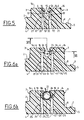
- FIG. 5 shows, in section, two locking regions 15 facing each other screws, according to one embodiment, which belong to two adjacent studs 3 and which are provided to collaborate in the locking of a tube.
- the two surfaces of locking 16 facing each other are substantially sectors of cylinders parallel, without necessarily being cylinders of revolution, convex and regular.
- the two locking surfaces 16 facing each other belonging to two adjacent pads 3 are connected by a raised bridge 13, which has a flat upper surface substantially parallel to the faces 2.4 of the plate 1 and whose role has already been clarified.
- Cavity 17 which participates in the region of locking device 15 has the shape of a first truncated cone 19 in the vicinity of the locking surface 16.
- This first truncated cone 19 extends in a direction substantially parallel to the pads 3, so that the elastic blade 18 has a section along a transverse plane to stud 3 substantially constant over the height of the locking surface 16. It flares slightly towards the face of the plate devoid of studs.
- the section of this first truncated cone 19 along a plane parallel to the faces 2,4 of the plate 1 has the shape of a semicircle oriented so that the straight segment is turned towards the locking surface 16.
- the wall 6 of the cavity 17 which delimits one of the faces of the elastic blade 18 is substantially planar.
- the cavity 17 does not open on the side of the face 2 carrying the studs 3. It is extended towards the face 4 devoid of studs 3 by a second truncated cone 20, which opens onto this face 4.
- this second truncated cone 20 extends in the extension from the first, in a direction substantially parallel to the stud 3. It widens slightly towards face 4 of plate 1 onto which it opens.
- the circular sector of the first truncated cone 19 and the second truncated cone 20 are based on the same cone.
- the shape of the entire cavity 17 is obtained by cutting off a trunk of substantially cone of revolution, at its narrowest end and over part of its height, its half according to one of its planes of symmetry.
- the flat sector of the first trunk of cone and the second truncated cone are connected under the raised bridge 13 by a progressive connection surface 21.
- Figure 6a is a section similar to that of Figure 5, which shows an alternative embodiment of the cavity 17.
- This here has the shape of a trunk of cone which is not of revolution and extends in a direction substantially perpendicular to the faces 2,4 of the plate 1. It only leads to that of the faces of the plate 1 which does not carry the studs 3 and flares towards this same face 4.
- Two of its lateral faces 23, 24 are flat and facing each other, and are connected to their lateral ends by two other facing surfaces 25 each having the shape of two half trunks of cone of revolution whose concavity is turned towards the interior of the cavity 17.
- the section of the cavity along a plane parallel to the faces 2,4 of the plate 1, as can be seen in FIG.
- FIG. 6b a tube 22 of circular section has been snapped on between the locking regions 15 of two adjacent pads 3, of the type of those shown in Figure 6a.
- the tube 22 has been inserted between the two studs 3 until heightening bridge 13 which forms a stop and thus retains the tube 22 in heightening at a certain distance from the surface 2 of the plate 1.
- the external wall of the tube 22 and the locking surfaces 16 are in contact.
- the two elastic blades 18 are pushed back by the tube 22 and in response exert a holding pressure which encloses this one.
- the tube 22 is also held by the upper ends of the studs 3 adjacent, which ends act in concert like two spouts 26 turned towards each other and which push the tube 22 towards the flat surface of the trigger guard elevation 13, so that, even if the elastic blades 18 fail, the tube 22 will nevertheless kept snapped.
- the elastic blades 18 of a part, and the upper ends of the studs 3 on the other hand, compete, but of differently, to the maintenance of the tubes 22, which maintenance is, therefore, particularly effective, especially when compared to that provided by the means currently known.
- the elastic blade 18 acts as soon as it is distorted. In addition, it may experience larger deformations than those obtained by crushing the material with conventional studs.
- these plates 1 are made of expanded polystyrene. They can then be obtained by a process known per se for molding such a material, process in which they are balls polystyrene pre-expanded to the desired density and ready for the molding operation which are injected. They have the non-negligible advantage of being able to be made in a two-part mold.
- the first part is used for molding the side 2 of the plate 1 which carries the studs 3.
- the second part has an imprint complementary, apart from the withdrawals, on the other face 4 of the plate 1, and, in particular, extensions of complementary shapes, apart from the cavities, 17 of the regions of lock 15. Productivity gains from using two-part molds are substantial.
- the use of other materials for the manufacture of plate 1 and / or other molding processes can be envisaged, without departing from the scope of the invention.
- the pads 3 represent a certain mass of material which must cool during molding.
- the presence of three cavities 17 in the reduced pad 3 all the material to be cooled.
- the mold growths which give their 17 cavity shapes improve cooling due to the heat they allow to evacuate.
- a filming operation is then carried out of the face 2 of the plate 1 which carries the studs 3. It is facilitated by the shape of the studs 3, because these have no concave surface.
- the plates 1 according to the invention are intended to be assembled by their sides 5 to cover a surface, in particular a ground. Sure the assembly thus produced, tubes are then snapped to form a network allowing the circulation of a fluid. Finally, we can pour on the plates 1 a layer of cement a few centimeters thick in which the pipes. During their installation, and until the cement sets, the pipes are held in position between the two locking regions 15 of two studs 3 adjacent. Once the cement had set, we thus obtained a floating slab incorporating a device allowing in particular underfloor heating, but also cooling or any temperature regulation that can be envisaged with such a device.
Landscapes
- Engineering & Computer Science (AREA)
- Physics & Mathematics (AREA)
- Thermal Sciences (AREA)
- Chemical & Material Sciences (AREA)
- Combustion & Propulsion (AREA)
- Mechanical Engineering (AREA)
- General Engineering & Computer Science (AREA)
- Steam Or Hot-Water Central Heating Systems (AREA)
- Supports For Pipes And Cables (AREA)
Applications Claiming Priority (2)
| Application Number | Priority Date | Filing Date | Title |
|---|---|---|---|
| FR9913584 | 1999-10-29 | ||
| FR9913584A FR2800407B1 (fr) | 1999-10-29 | 1999-10-29 | Plaque moulee thermiquement et/ou phoniquement isolante et son procede de fabrication |
Publications (1)
| Publication Number | Publication Date |
|---|---|
| EP1096079A1 true EP1096079A1 (de) | 2001-05-02 |
Family
ID=9551533
Family Applications (1)
| Application Number | Title | Priority Date | Filing Date |
|---|---|---|---|
| EP00402582A Withdrawn EP1096079A1 (de) | 1999-10-29 | 2000-09-19 | Wärme- und/oder Lärmisolierschaumplatte und Verfahren zu ihrer Herstellung |
Country Status (2)
| Country | Link |
|---|---|
| EP (1) | EP1096079A1 (de) |
| FR (1) | FR2800407B1 (de) |
Cited By (13)
| Publication number | Priority date | Publication date | Assignee | Title |
|---|---|---|---|---|
| US20110047907A1 (en) * | 2009-08-28 | 2011-03-03 | DZT Industries, LLC | Method and apparatus for positioning heating elements |
| US9625163B2 (en) | 2014-08-18 | 2017-04-18 | Progress Profiles Spa | Method and apparatus for positioning heating elements |
| US9719265B2 (en) | 2015-03-17 | 2017-08-01 | Progress Profiles Spa | Floor underlayment for positioning heating elements |
| US9726383B1 (en) * | 2016-06-17 | 2017-08-08 | Progress Profiles S.P.A. | Support for radiant covering and floor heating elements |
| USD813421S1 (en) | 2009-08-28 | 2018-03-20 | Progress Profiles Spa | Floor underlayment |
| US10215423B2 (en) | 2014-08-18 | 2019-02-26 | Progress Profiles S.P.A. | Method and apparatus for positioning heating elements |
| US10859274B2 (en) | 2016-04-01 | 2020-12-08 | Progress Profiles S.P.A. | Support for radiant covering and floor heating elements |
| USD971449S1 (en) | 2016-04-13 | 2022-11-29 | Progress Profiles S.P.A. | Floor underlayment |
| WO2024082071A1 (en) * | 2022-10-17 | 2024-04-25 | Dmx Membranes Limited | Flooring underlayment |
| USD1036242S1 (en) | 2020-04-22 | 2024-07-23 | Progress Profiles S.P.A. | Floor underlayment |
| USD1036243S1 (en) | 2020-10-09 | 2024-07-23 | Progress Profiles S.P.A. | Floor underlayment |
| USD1036979S1 (en) | 2020-04-06 | 2024-07-30 | Progress Profiles S.P.A. | Floor underlayment |
| USD1101979S1 (en) | 2023-02-07 | 2025-11-11 | Progress Profiles S.P.A. | Floor underlayment |
Citations (4)
| Publication number | Priority date | Publication date | Assignee | Title |
|---|---|---|---|---|
| US4250674A (en) * | 1977-05-06 | 1981-02-17 | Artus Feist | Panels for cladding floors, walls and ceilings of rooms |
| AT362913B (de) * | 1979-07-20 | 1981-06-25 | Feist Artus | Einrichtung zur waermeisolation und gleichzeitigen waermeenergiegewinnung bei einem gebaeude |
| DE8117704U1 (de) * | 1981-06-16 | 1982-01-07 | Fixotherm Gesellschaft für Entwicklung + Vertrieb von Energiesystemen mbH, 5090 Leverkusen | "Fußbodenplatte" |
| FR2746426A1 (fr) * | 1996-03-21 | 1997-09-26 | Isobox Technologies | Dalle moulee thermiquement isolante et son procede de fabrication |
Family Cites Families (1)
| Publication number | Priority date | Publication date | Assignee | Title |
|---|---|---|---|---|
| DE3509423A1 (de) | 1985-03-15 | 1986-09-25 | Roth Werke Gmbh, 3563 Dautphetal | Beheizbarer fussboden |
-
1999
- 1999-10-29 FR FR9913584A patent/FR2800407B1/fr not_active Expired - Fee Related
-
2000
- 2000-09-19 EP EP00402582A patent/EP1096079A1/de not_active Withdrawn
Patent Citations (4)
| Publication number | Priority date | Publication date | Assignee | Title |
|---|---|---|---|---|
| US4250674A (en) * | 1977-05-06 | 1981-02-17 | Artus Feist | Panels for cladding floors, walls and ceilings of rooms |
| AT362913B (de) * | 1979-07-20 | 1981-06-25 | Feist Artus | Einrichtung zur waermeisolation und gleichzeitigen waermeenergiegewinnung bei einem gebaeude |
| DE8117704U1 (de) * | 1981-06-16 | 1982-01-07 | Fixotherm Gesellschaft für Entwicklung + Vertrieb von Energiesystemen mbH, 5090 Leverkusen | "Fußbodenplatte" |
| FR2746426A1 (fr) * | 1996-03-21 | 1997-09-26 | Isobox Technologies | Dalle moulee thermiquement isolante et son procede de fabrication |
Cited By (32)
| Publication number | Priority date | Publication date | Assignee | Title |
|---|---|---|---|---|
| USD813421S1 (en) | 2009-08-28 | 2018-03-20 | Progress Profiles Spa | Floor underlayment |
| US9188348B2 (en) * | 2009-08-28 | 2015-11-17 | Progress Profiles Spa | Method and apparatus for positioning heating elements |
| US9416979B2 (en) | 2009-08-28 | 2016-08-16 | Progress Profiles Spa | Method and apparatus for positioning heating elements |
| US9518746B2 (en) | 2009-08-28 | 2016-12-13 | Progress Profiles Spa | Method and apparatus for positioning heating elements |
| US11846432B2 (en) | 2009-08-28 | 2023-12-19 | Progress Profiles Spa | Method and apparatus for positioning heating elements |
| US11041638B2 (en) | 2009-08-28 | 2021-06-22 | Progress Profiles Spa | Method and apparatus for positioning heating elements |
| US10006644B2 (en) | 2009-08-28 | 2018-06-26 | Progress Profiles Spa | Method and apparatus for positioning heating elements |
| USD797957S1 (en) | 2009-08-28 | 2017-09-19 | Progress Profiles S.P.A. | Floor underlayment |
| US20110047907A1 (en) * | 2009-08-28 | 2011-03-03 | DZT Industries, LLC | Method and apparatus for positioning heating elements |
| US9777931B2 (en) | 2014-08-18 | 2017-10-03 | Progress Profiles Spa | Method and apparatus for positioning heating elements |
| US10712020B2 (en) | 2014-08-18 | 2020-07-14 | Progress Profiles Spa | Method and apparatus for positioning heating elements |
| US10107505B2 (en) | 2014-08-18 | 2018-10-23 | Progress Profiles Spa | Method and apparatus for positioning heating elements |
| US10215423B2 (en) | 2014-08-18 | 2019-02-26 | Progress Profiles S.P.A. | Method and apparatus for positioning heating elements |
| US12044417B2 (en) | 2014-08-18 | 2024-07-23 | Progress Profiles Spa | Method and apparatus for positioning heating elements |
| US10408469B2 (en) | 2014-08-18 | 2019-09-10 | Progress Profiles Spa | Method and apparatus for positioning heating elements |
| US9625163B2 (en) | 2014-08-18 | 2017-04-18 | Progress Profiles Spa | Method and apparatus for positioning heating elements |
| US10739016B2 (en) | 2014-08-18 | 2020-08-11 | Progress Profiles Spa | Method and apparatus for positioning heating elements |
| US9719265B2 (en) | 2015-03-17 | 2017-08-01 | Progress Profiles Spa | Floor underlayment for positioning heating elements |
| US10502434B2 (en) | 2016-04-01 | 2019-12-10 | Progress Profiles S.P.A. | Support for radiant covering and floor heating elements |
| US10859274B2 (en) | 2016-04-01 | 2020-12-08 | Progress Profiles S.P.A. | Support for radiant covering and floor heating elements |
| US12560339B2 (en) | 2016-04-01 | 2026-02-24 | Progress Profiles S.P.A. | Support for radiant covering and floor heating elements |
| USD841837S1 (en) | 2016-04-13 | 2019-02-26 | Progress Profiles S.P.A. | Floor underlayment |
| USD872901S1 (en) | 2016-04-13 | 2020-01-14 | Progress Profiles S.P.A. | Floor underlayment |
| USD971449S1 (en) | 2016-04-13 | 2022-11-29 | Progress Profiles S.P.A. | Floor underlayment |
| USD880732S1 (en) | 2016-04-13 | 2020-04-07 | Progress Profiles S.P.A. | Floor underlayment |
| USD874028S1 (en) | 2016-04-13 | 2020-01-28 | Progress Profiles S.P.A. | Floor underlayment |
| US9726383B1 (en) * | 2016-06-17 | 2017-08-08 | Progress Profiles S.P.A. | Support for radiant covering and floor heating elements |
| USD1036979S1 (en) | 2020-04-06 | 2024-07-30 | Progress Profiles S.P.A. | Floor underlayment |
| USD1036242S1 (en) | 2020-04-22 | 2024-07-23 | Progress Profiles S.P.A. | Floor underlayment |
| USD1036243S1 (en) | 2020-10-09 | 2024-07-23 | Progress Profiles S.P.A. | Floor underlayment |
| WO2024082071A1 (en) * | 2022-10-17 | 2024-04-25 | Dmx Membranes Limited | Flooring underlayment |
| USD1101979S1 (en) | 2023-02-07 | 2025-11-11 | Progress Profiles S.P.A. | Floor underlayment |
Also Published As
| Publication number | Publication date |
|---|---|
| FR2800407B1 (fr) | 2002-01-11 |
| FR2800407A1 (fr) | 2001-05-04 |
Similar Documents
| Publication | Publication Date | Title |
|---|---|---|
| EP1096079A1 (de) | Wärme- und/oder Lärmisolierschaumplatte und Verfahren zu ihrer Herstellung | |
| FR2746426A1 (fr) | Dalle moulee thermiquement isolante et son procede de fabrication | |
| EP0253721B1 (de) | Wärmeschrumpfbare Hülse mit Mitteln zum Steuern ihrer gleichförmigen Erwärmung sowie Verfahren zu deren Herstellung | |
| FR2545037A1 (fr) | Element de construction-sandwich en materiau composite fibreux | |
| EP3766715B1 (de) | Verstärkungseinsatz, der mit durchgangslöchern versehen ist | |
| CA2667006A1 (fr) | Outil composite pour le moulage de pieces cylindriques | |
| EP1684041A1 (de) | Flachrohr mit Einsatz für Wärmetauscher | |
| FR2950371A1 (fr) | Systeme de fixation d'une dalle pour terrasse | |
| FR2852339A1 (fr) | Plaque a sol equipee de plots de retenue de tubes de chauffage ou de refroidissement par le sol | |
| FR2509773A1 (fr) | Dispositif destine a permettre l'appui d'un plancher sur un mur, et procede de construction mettant en oeuvre celui-ci | |
| EP3390028B1 (de) | Lamellen zum auskleiden einer reifenform und zugehöriges herstellungsverfahren | |
| FR2637933A1 (fr) | Bloc de coffrage empilable en materiau leger et procede de moulage de ce bloc | |
| BE1017285A3 (fr) | Entrevous isolant pour plancher a poutrelles et plancher obtenu. | |
| EP3894643A1 (de) | Vorrichtung zur unterstützung der glättung einer beschichtung | |
| FR3032735B1 (fr) | Bloc de construction comportant un element isolant s'etendant sur toute sa longueur | |
| EP3727820B1 (de) | Lamellenblattanordnung | |
| EP0678141B1 (de) | Transparentes und/oder wärmedämmendes bauelement für mauern und verfahren zur herstellung einiger dieser elemente | |
| FR3011761A1 (fr) | Pied pour un accessoire et accessoire de reservoir de vehicule automobile, procede de fabrication d'un tel reservoir. | |
| FR2943701A1 (fr) | Procede de fabrication d'un panneau prefabrique destine a former une paroi isolante de batiment | |
| EP3717219B1 (de) | Formteil mit einer versteifungsstruktur | |
| FR3078353A1 (fr) | Element de revetement de surface de type dalle, tomette ou latte | |
| EP1666678B1 (de) | Isolierendes Füllelement aus expandierten plastischen Material für Decken und Verfahren zu seiner Herstellung | |
| FR3147576A1 (fr) | Dispositif d’assemblage de blocs et procédé de mise en œuvre | |
| FR2717519A1 (fr) | Dalles d'isolation thermique et phonique et procédé de réalisation de telles dalles. | |
| FR2469992A1 (fr) | Moule destine a la fabrication de plaques et notamment de plaques en platre |
Legal Events
| Date | Code | Title | Description |
|---|---|---|---|
| PUAI | Public reference made under article 153(3) epc to a published international application that has entered the european phase |
Free format text: ORIGINAL CODE: 0009012 |
|
| AK | Designated contracting states |
Kind code of ref document: A1 Designated state(s): BE DE NL |
|
| AX | Request for extension of the european patent |
Free format text: AL;LT;LV;MK;RO;SI |
|
| 17P | Request for examination filed |
Effective date: 20011010 |
|
| AKX | Designation fees paid |
Free format text: AT BE CH LI |
|
| RBV | Designated contracting states (corrected) |
Designated state(s): BE DE NL |
|
| REG | Reference to a national code |
Ref country code: DE Ref legal event code: 8566 |
|
| 17Q | First examination report despatched |
Effective date: 20020206 |
|
| STAA | Information on the status of an ep patent application or granted ep patent |
Free format text: STATUS: THE APPLICATION IS DEEMED TO BE WITHDRAWN |
|
| 18D | Application deemed to be withdrawn |
Effective date: 20030917 |