EP1096145A2 - Einlassventil für regelbaren Verdrängerverdichter - Google Patents
Einlassventil für regelbaren Verdrängerverdichter Download PDFInfo
- Publication number
- EP1096145A2 EP1096145A2 EP00121972A EP00121972A EP1096145A2 EP 1096145 A2 EP1096145 A2 EP 1096145A2 EP 00121972 A EP00121972 A EP 00121972A EP 00121972 A EP00121972 A EP 00121972A EP 1096145 A2 EP1096145 A2 EP 1096145A2
- Authority
- EP
- European Patent Office
- Prior art keywords
- suction
- suction valve
- valve
- flexible
- chamber
- Prior art date
- Legal status (The legal status is an assumption and is not a legal conclusion. Google has not performed a legal analysis and makes no representation as to the accuracy of the status listed.)
- Withdrawn
Links
Images




Classifications
-
- F—MECHANICAL ENGINEERING; LIGHTING; HEATING; WEAPONS; BLASTING
- F04—POSITIVE - DISPLACEMENT MACHINES FOR LIQUIDS; PUMPS FOR LIQUIDS OR ELASTIC FLUIDS
- F04B—POSITIVE-DISPLACEMENT MACHINES FOR LIQUIDS; PUMPS
- F04B39/00—Component parts, details, or accessories, of pumps or pumping systems specially adapted for elastic fluids, not otherwise provided for in, or of interest apart from, groups F04B25/00 - F04B37/00
- F04B39/0027—Pulsation and noise damping means
-
- F—MECHANICAL ENGINEERING; LIGHTING; HEATING; WEAPONS; BLASTING
- F04—POSITIVE - DISPLACEMENT MACHINES FOR LIQUIDS; PUMPS FOR LIQUIDS OR ELASTIC FLUIDS
- F04B—POSITIVE-DISPLACEMENT MACHINES FOR LIQUIDS; PUMPS
- F04B27/00—Multi-cylinder pumps specially adapted for elastic fluids and characterised by number or arrangement of cylinders
- F04B27/08—Multi-cylinder pumps specially adapted for elastic fluids and characterised by number or arrangement of cylinders having cylinders coaxial with, or parallel or inclined to, main shaft axis
- F04B27/10—Multi-cylinder pumps specially adapted for elastic fluids and characterised by number or arrangement of cylinders having cylinders coaxial with, or parallel or inclined to, main shaft axis having stationary cylinders
- F04B27/1009—Distribution members
-
- F—MECHANICAL ENGINEERING; LIGHTING; HEATING; WEAPONS; BLASTING
- F04—POSITIVE - DISPLACEMENT MACHINES FOR LIQUIDS; PUMPS FOR LIQUIDS OR ELASTIC FLUIDS
- F04B—POSITIVE-DISPLACEMENT MACHINES FOR LIQUIDS; PUMPS
- F04B39/00—Component parts, details, or accessories, of pumps or pumping systems specially adapted for elastic fluids, not otherwise provided for in, or of interest apart from, groups F04B25/00 - F04B37/00
- F04B39/10—Adaptations or arrangements of distribution members
- F04B39/1073—Adaptations or arrangements of distribution members the members being reed valves
Definitions
- the present invention relates to a suction valve in a following variable displacement compressor.
- the compressor has a swash plate accommodated in a crank chamber, where the pressure is controlled so as to rotate the swash plate integrally and inclinably with a drive shaft, and a plurality of pistons, which are accommodated in cylinder bores arranged around the drive shaft and reciprocate in accordance with rotation of the swash plate.
- the inclination angle of the swash plate is adjusted in response to the pressure in the crank chamber, which is changed by adjusting the amount of gas supplied from a discharge chamber to the crank chamber, and the amount of gas relieved from the crank chamber to the suction chamber.
- flexible suction valves open and close suction ports, and in suction movements of the pistons, the suction valves are pushed up and draw gas through the suction ports into the cylinder bores.
- the pistons reciprocate with a stroke in accordance with the inclination angle of the inclinable swash plate, and the discharge capacity decreases when the inclination angle of the swash plate decreases.
- a small discharge capacity state an average amount of gas passing through the suction port is small, and the suction valve can hardly contact a stopper for regulating the maximum opening degree due to its small opening degree.
- the vibrations of the suction valve easily occur.
- the object of the present invention is to offer an effective suction valve enough to prevent noise or clatter caused by vibrations of suction valves in a variable displacement compressor.
- the compressor has a swash plate accommodated in a crank chamber, where the pressure is controlled, so as to rotate the swash plate integrally and inclinably with a drive shaft, and a plurality of pistons, which are accommodated in cylinder bores arranged around the drive shaft and reciprocate in accordance with rotation of the swash plate.
- the inclination angle of the swash plate is adjusted in response to the pressure of the crank chamber, which is changed by adjusting the amount of gas supplied from a discharge chamber to the crank chamber, and the amount of gas relieved from the crank chamber to the suction chamber.
- flexible suction valves open and close suction ports, and in suction movements of pistons the suction valves are pushed up and draw gas through the suction ports into the cylinder bores.
- a twisting flexibility regulating means to bend and twist the suction valve, and a maximum opening degree regulating means having a receiving portion receiving the suction valve and regulating maximum opening degree of the suction valve in contact with the suction valve comprise the structure of the suction valve.
- the maximum opening degree regulating means is formed at the associated cylinder bore as follows. A first distance (between the suction valve at the more twisted side in closed position and a confronting point on the receiving portion) is longer than a second distance (between the suction valve at the other side in closed position and a confronting point on the receiving portion).
- the suction valve bends while twisting and the opposite side to the twisted side contacts the receiving portion first. Then, as the opening degree of the suction valve becomes larger, the suction valve becomes more twisted. And the twisted side of the suction valve approaches the receiving portion.
- the maximum opening degree regulating means is a recess for regulating maximum opening degree recessed in the direction of the reciprocating movement of the piston along the circumferential surface of the cylinder bore.
- the receiving portion is a bottom of the recess for regulating maximum opening degree, which is the receiving portion of the recess.
- the receiving portion is inclined in the direction of width of the confronting suction valve.
- the lower bending flexibility side of the suction valve contacts the shallower stopper side of the recess for regulating maximum opening degree first. Then, as the opening degree of the suction valve becomes larger, the suction valve becomes more twisted. And the higher bending flexibility side of the suction valve approaches the deeper stopper side of the recess for regulating maximum degree of opening.
- the twisting flexibility regulating means comprises two bending flexibility regulating means of which bending flexibilities are different each other and arranged in the direction of width of the suction valve, so that the distance between the higher bending flexibility side of the suction valve and the confronting receiving portion is longer than that between the lower bending flexibility side and the confronting receiving portion.
- the lower bending flexibility side of the suction valve contacts the receiving portion first. Then, as the opening degree of the suction valve becomes larger, the suction valve becomes more twisted. And the higher bending flexibility side of the suction valve approaches the receiving portion.
- the bending flexibilities are different each other in the direction of width of the suction valve, the suction valve twists easily when the opening degree of the suction valve becomes large.
- the suction valve has a pair of flexible portions separated in width and a closing portion closing the suction port placed adjoining to a pair of the flexible portions.
- the bending flexibility regulating means is a pair of the flexible portions. And each flexible portion - urges the suction valve so as to close the suction port. And the bending flexibilities of a pair of the flexible portions are different.
- the suction valve twists easily when the opening degree of the suction valve becomes large.
- the suction valve has a single flexible portion, and the closing portion closing the suction port placed adjoining to the flexible portion. Moreover, the flexible portion urges the suction valve so as to close the suction port. And the flexible portion, which is biased in the direction of width from the central line of the suction valve, is the twisting flexibility regulating means.
- a part of the closing portion substantially constantly contacts the receiving portion of the recess for regulating maximum opening degree.
- a plurality of the pistons are arranged around the drive shaft.
- the pistons reciprocate in the cylinder bore in accordance with the rotation of the drive shaft.
- the suction ports are formed in a valve plate defining a suction chamber, a discharge chamber and the cylinder bores.
- the discharge chamber is formed so as to surround the suction chamber. The gas in the suction chamber is sucked through the suction ports into the cylinder bores. The gas in the cylinder bores is discharged through the discharge ports formed in the valve plate into the discharge chamber.
- a cylindrical suction chamber can be formed.
- a circular suction chamber is formed.
- the cylindrical suction chamber is superior to the circular suction chamber to suppress the suction pulsations.
- a front housing 12 is secured to the front side of a cylinder block 11.
- a rear housing 13 is secured via a valve plate 14, a suction valve disk 15, a discharge valve disk 16 and a retainer plate 17 to the rear side of the cylinder block 11.
- a drive shaft 18 is rotatably supported by the front housing 12 and the cylinder block 11.
- the front housing 12 and the cylinder block 11 define a crank chamber 121 therebetween, where the pressure is controlled.
- the drive shaft 18 protrudes from the crank chamber 121 and the driving force is transmitted to the drive shaft 18 through a pulley (not illustrated) and a belt (not illustrated) from an external driving source such as a vehicle engine (not illustrated).
- a rotor 19 is mounted on the drive shaft 18.
- a swash plate 20 is supported on the drive shaft 18 slidably in the direction of the axis of the drive shaft 18, and inclinably with respect to the axis of the drive shaft.
- the swash plate 20 rotates integrally with the drive shaft 18 by the cooperation between a pair of guide pins 23 mounted on the swash plate 20 and a pair of guide holes 25 at the rotor 19.
- the inclination of the swash plate 20 is guided by the slide guide relation that the surfaces of the guide hole 25 and the guide pin 23 contact each other, and by the support of the drive shaft 18 whose outer surface contacts the surface of a center through hole of the swash plate 20.
- the guide pin 23 and the guide hole 25 comprise the guide mechanism to incline and slide the swash plate 20.
- the inclination angle of the swash plate 20 increases.
- the inclination angle of the swash plate 20 decreases.
- the minimum inclination angle of the swash plate 20 is regulated by abutting contact between a circular clip 28 mounted on the drive shaft 18 and the swash plate 20.
- the maximum inclination angle of the swash plate 20 is regulated by abutting contact between the rotor 19 and the swash plate 20.
- the solid lines and the two-dot line of the swash plate 20 in Fig. 1 respectively show the positions of the minimum inclination angle and the maximum inclination angle of the swash plate 20.
- a plurality (five in the embodiment) of the cylinder bores 111 are formed in the cylinder block 11.
- the cylinder bores 111 are arranged around the axis of the drive shaft 18 at an equal interval and a piston 26 is accommodated in each cylinder bore 111.
- the rotating movement of the swash plate 20 is converted through shoes 27 to a back-and-forth reciprocating movement of each piston 26, and each piston 26 moves back and forth in the associated cylinder bore 111.
- a suction chamber 131 and a discharge chamber 132 are defined in a rear housing 13.
- the discharge chamber 132 which is in the region of the discharge pressure, surrounds the suction chamber 131, which is in the region of the suction pressure through the separation wall 133.
- a supply passage 30 is placed on the back side wall of the rear housing 13. The supply passage 30 extends from a circumferential wall of the rear housing 13 and communicates external refrigerant circuit 31 with the suction chamber 131 across the discharge chamber 132.
- a suction port 21 corresponding to each cylinder bore 111 is formed in the valve plate 14, the discharge valve disk 16 and the retainer plate 17.
- a discharge port 22 corresponding to each cylinder bore 111 is formed in the suction valve disk 15 and the valve plate 14.
- Suction valves 24 are formed on the suction valve disk 15 and discharge valves 161 are formed on the discharge valve disk 16.
- the suction valves 24 open and close the suction ports 21.
- the discharge valves 161 open and close the discharge ports 22.
- Each discharge port 22 communicates with the associated cylinder bore 111 through each opening 244 on each suction valve 24. As shown in Fig. 3, the distances between an outlet 301 of the supply passage 30 and each suction port 21 are nearly equal.
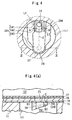
- a recess 29 for regulating maximum degree of opening which is the maximum opening degree regulating means, is formed at each cylinder bore 111.
- the recess 29 for regulating maximum degree of opening regulates the maximum opening degree of the suction valves 24.
- a stopper 291 which is the bottom of the recess 29, is inclined in the direction of width of the confronting suction valve 24.
- the stopper 291 is a receiving portion to receive the suction valve 24 by contacting the suction valve 24.
- the distance between the suction valve 24 and the confronting stopper 291 becomes gradually longer from the right side of the suction valve 24 (on the right side of the central line C in width of the suction valve 24 in Fig. 4 and 4(a)) toward the left side of the suction valve 24 (on the left side of the central line C in width of the suction valve 24 in Fig. 4 and 4(a)). That is, the recess 29 for regulating maximum opening degree becomes gradually deeper from the right side of the suction valve 24 toward the left side of the suction valve 24.
- the refrigerant gas in the cylinder bore 111 is discharged to the discharge chamber 132 through the discharge port 22, pushing up the discharge valve 161 by the discharge action of the piston 26.
- the opening degree of the discharge valve 161 is regulated by contacting a retainer 171 on the retainer plate 17.
- the refrigerant gas discharged into the discharge chamber 132 flows outside of the compressor, through a condenser 32, an expansion valve 33 and an evaporator 34 in the external refrigerant circuit 31, and returns to the suction chamber 131 via the supply passage 30.
- a magnetic capacity control valve 36 is placed in a pressure supply passage 35 (illustrated in Fig. 2) connecting the discharge chamber 132 with the crank chamber 121.
- the refrigerant gas in the discharge chamber 132 is supplied to the crank chamber 121 through the pressure supply passage 35.
- the magnetic capacity control valve 36 is excited and de-excited by the controller (not illustrated), which controls the control valve 36 based on the room temperature detected by the room temperature detector (not illustrated) detecting the room temperature in the vehicle, and on the target room temperature set by the room temperature controller (not illustrated).
- the pressure (The suction pressure) in the suction chamber 131 acts through a pressure sensing chamber 382 on a bellows 381 comprising a pressure sensing means 38 in the magnetic capacity control valve 36.
- the suction pressure in the suction chamber 131 reflects the cooling load.
- a valve body 40 is connected to the bellows 381, and the valve body 40 opens and closes a valve hole 41.
- the magnetic driving force of the solenoid 39 acts to urge the valve body 40 so as to close the valve hole 41.
- the magnetic capacity control valve 36 controls to set the suction pressure corresponding to the electric current supplied to the solenoid 39.
- the opening degree of the valve hole 41 decreases. So, the amount of the refrigerant gas supplied from the discharge chamber 132 to the crank chamber 121 decreases.
- the refrigerant gas in the crank chamber 121 flows into the suction chamber 131 through a pressure release passage 37 (as illustrated in Fig. 2), so the pressure in the crank chamber 121 decreases. Accordingly, the inclination angle of the swash plate 20 increases and the discharge capacity also increases. At this time, the increase of the discharge capacity causes the suction pressure decrease.
- the opening degree of the valve hole 41 increases. So, the amount of the refrigerant gas supplied from the discharge chamber 132 to the crank chamber 121 increases. Accordingly, the pressure in the crank chamber 121 increases.
- the inclination angle of the swash plate 20 decreases and the discharge capacity also decreases. At this time, the decrease of the discharge capacity causes the suction pressure increase.
- the suction valve 24 is a bendable flexible valve composed of a pair of flexible portions 241 and 242, and of the closing portion 243 placed adjoining to the flexible portions 241 and 242 to form a free end to close the suction port 21.
- An opening 244 is formed between a pair of flexible portions 241 and 242. While the lengths L1 and L2 of a pair of flexible portions 241 and 242 are nearly equal, the width h of the flexible portion 241 at the left side of the suction valve 24 is shorter than the width H of the flexible portion 242 at the right side of the suction valve 24.
- the suction valve 24 extends so as to cross the cylinder bore 111 radially from the discharge chamber 132 side to the suction chamber 131 side.
- the first embodiment has the following effects.
- the compressor is the same variable displacement compressor as the first embodiment, and the same reference numerals as the first embodiment are given to the components corresponding to the first embodiment.
- a projection 245 for regulating opening degree is integrally formed on the end portion of the suction valve 24, a projection 245 for regulating opening degree is integrally formed.
- the projection 245 is bent at nearly a right angle with respect to the suction valve 24 so as to face the stopper 292 of the recess 29A for regulating maximum opening degree.
- the stopper 292 of the recess 29A is parallel to the suction valve disk 15.
- the suction valve 24 twists as shown in two-dot line in Fig. 5(a), and the projection 245 contacts the stopper 292.
- the recess 29A and the projection 245 comprise the maximum opening degree regulating means.
- the compressor is the same variable displacement compressor as the first embodiment, and the same reference numerals as the first embodiment are given to the components corresponding to the first embodiment.
- the suction valve 24A is a bendable flexible valve composed of a single flexible portion 246, and of the closing portion 247 placed adjoining to the flexible portion 246 to form a free end.
- the flexible portion 246 is biased to the left side from the central line C of the suction valve 24A in Fig. 6.
- the stopper 293 of the recess 29B for regulating maximum opening degree inclines so that it gradually becomes deeper as it goes from the left side to the right side of the suction valve 24A.
- the left side of the end portion of the closing portion 247 is almost in contact with the stopper 293 when the suction port 21 is closed by the suction valve 24A as well.
- the suction valve 24A twists at the left side of the end portion of the closing portion 247 contacting the stopper 293 from the beginning of the bending.
- the suction valve 24A which is shown in two-dot line in Fig. 6(a) illustrates a twisted condition in a small discharge capacity state.
- the end of the suction valve 24A is substantially in contact with the stopper 293. So, the vibrations of the suction valve 24A are securely prevented.
- a first distance (between a point at the more twisted side on the suction valve in closed position and its confronting point on the receiving portion) is different from a second distance (between a point at the other side on the suction valve in closed position and its confronting point on the receiving portion). And the first distance is longer than the second distance. So, the unusual noise caused by the vibrations of the suction valve in the variable displacement compressor is effectively prevented.
- the object of the present invention is to offer a structure of a suction valve enough to prevent a noise or clatter caused by vibrations of a suction valve in a variable displacement compressor having pistons.
- the suction valve is a bendable flexible valve composed of flexible portions, and of a closing portion placed adjoining to the flexible portions to form a free end to close a suction port.
- the lengths of the flexible portions of the suction valve are nearly equal, but the widths of the flexible portions of the suction valve are different each other.
- the distance between the suction valve and a receiving portion which regulates maximum opening degree is determined so that the lower bending flexibility side of the flexible portions contacts the receiving portion from the beginning or as soon as the suction valve starts to open, and that the higher bending flexibility side of the flexible portions approaches the receiving portion with the lower bending flexibility side of the flexible portion contacting the receiving portion, while the suction valve is twisted.
Landscapes
- Engineering & Computer Science (AREA)
- Mechanical Engineering (AREA)
- General Engineering & Computer Science (AREA)
- Compressors, Vaccum Pumps And Other Relevant Systems (AREA)
- Compressor (AREA)
- Check Valves (AREA)
Applications Claiming Priority (2)
| Application Number | Priority Date | Filing Date | Title |
|---|---|---|---|
| JP30227999A JP2001123956A (ja) | 1999-10-25 | 1999-10-25 | 可変容量型圧縮機における吸入弁構造 |
| JP30227999 | 1999-10-25 |
Publications (2)
| Publication Number | Publication Date |
|---|---|
| EP1096145A2 true EP1096145A2 (de) | 2001-05-02 |
| EP1096145A3 EP1096145A3 (de) | 2002-01-16 |
Family
ID=17907103
Family Applications (1)
| Application Number | Title | Priority Date | Filing Date |
|---|---|---|---|
| EP00121972A Withdrawn EP1096145A3 (de) | 1999-10-25 | 2000-10-09 | Einlassventil für regelbaren Verdrängerverdichter |
Country Status (3)
| Country | Link |
|---|---|
| US (1) | US6379121B1 (de) |
| EP (1) | EP1096145A3 (de) |
| JP (1) | JP2001123956A (de) |
Cited By (1)
| Publication number | Priority date | Publication date | Assignee | Title |
|---|---|---|---|---|
| WO2013006932A1 (en) * | 2011-07-04 | 2013-01-17 | Whirlpool S.A. | Valve system for high frequency compressors |
Families Citing this family (1)
| Publication number | Priority date | Publication date | Assignee | Title |
|---|---|---|---|---|
| JP2005054703A (ja) * | 2003-08-06 | 2005-03-03 | Toyota Industries Corp | 圧縮機における吐出弁構造 |
Family Cites Families (12)
| Publication number | Priority date | Publication date | Assignee | Title |
|---|---|---|---|---|
| JPH0756258B2 (ja) * | 1985-10-04 | 1995-06-14 | 株式会社豊田自動織機製作所 | 可変容量圧縮機 |
| JPH0335899Y2 (de) * | 1985-10-21 | 1991-07-30 | ||
| JPS6341683A (ja) * | 1986-08-06 | 1988-02-22 | Toshiba Corp | 圧縮機のリ−ド弁装置 |
| JPH0450470Y2 (de) * | 1987-04-16 | 1992-11-27 | ||
| US5266016A (en) * | 1989-09-18 | 1993-11-30 | Tecumseh Products Company | Positive stop for a suction leaf valve of a compressor |
| US5267839A (en) * | 1991-09-11 | 1993-12-07 | Kabushiki Kaisha Toyoda Jidoshokki Seisakusho | Reciprocatory piston type compressor with a rotary valve |
| US5891704A (en) * | 1992-11-19 | 1999-04-06 | Anticancer, Inc. | Method to produce high levels of methioninase |
| JPH08193575A (ja) * | 1995-01-13 | 1996-07-30 | Sanden Corp | 弁板装置 |
| JPH08261154A (ja) * | 1995-03-22 | 1996-10-08 | Toyota Autom Loom Works Ltd | ピストン型圧縮機 |
| JPH0914138A (ja) * | 1995-06-28 | 1997-01-14 | Sanyo Electric Co Ltd | 密閉型圧縮機 |
| JPH10238463A (ja) * | 1997-02-25 | 1998-09-08 | Toyota Autom Loom Works Ltd | 圧縮機 |
| US6318972B1 (en) * | 2000-03-30 | 2001-11-20 | Ford Motor Technologies, Inc. | Valve recess in cylinder block of a compressor |
-
1999
- 1999-10-25 JP JP30227999A patent/JP2001123956A/ja active Pending
-
2000
- 2000-10-09 EP EP00121972A patent/EP1096145A3/de not_active Withdrawn
- 2000-10-23 US US09/694,415 patent/US6379121B1/en not_active Expired - Fee Related
Cited By (1)
| Publication number | Priority date | Publication date | Assignee | Title |
|---|---|---|---|---|
| WO2013006932A1 (en) * | 2011-07-04 | 2013-01-17 | Whirlpool S.A. | Valve system for high frequency compressors |
Also Published As
| Publication number | Publication date |
|---|---|
| EP1096145A3 (de) | 2002-01-16 |
| US6379121B1 (en) | 2002-04-30 |
| JP2001123956A (ja) | 2001-05-08 |
Similar Documents
| Publication | Publication Date | Title |
|---|---|---|
| EP0775824A1 (de) | Kompressor mit veränderlicher Verdrängung | |
| KR100462032B1 (ko) | 용량가변형 압축기의 제어밸브 | |
| KR101995886B1 (ko) | 사판식 압축기의 흡입맥동 저감장치 | |
| EP1186777A2 (de) | Kontrollventil für einen variablen Verdrängungskompressor | |
| KR20140104300A (ko) | 흡입체크밸브 | |
| US6146107A (en) | Variable displacement compressor | |
| US7559208B2 (en) | Displacement control mechanism for variable displacement compressor | |
| US6203284B1 (en) | Valve arrangement at the discharge chamber of a variable displacement compressor | |
| JP2000329066A (ja) | ピストン式圧縮機における吸入弁構造 | |
| US6471490B2 (en) | Piston type compressor having suction structure with arcuately shaped suction valve | |
| US20060165534A1 (en) | Displacement control valve for variable displacement compressor | |
| US6379121B1 (en) | Suction valve in variable displacement compressor | |
| US6250892B1 (en) | Refrigerant suction structures for compressors | |
| KR101104275B1 (ko) | 가변용량형 사판식 압축기 | |
| EP1207302A2 (de) | Regelventil für einen Verdichter variabler Verdrängung | |
| KR101452888B1 (ko) | 압축기의 밸브플레이트 조립체 | |
| CN111656012A (zh) | 可变容量斜盘式压缩机 | |
| EP1493923A2 (de) | Taumelscheibenverdichter | |
| KR101621247B1 (ko) | 용량가변형 압축기의 체크밸브 | |
| US6474957B2 (en) | Piston type compressor having arcuately shaped fluid port | |
| KR102051661B1 (ko) | 컨트롤 밸브 및 가변 용량식 압축기 | |
| KR102524602B1 (ko) | 가변식 압축기용 체크 밸브 | |
| US11015587B2 (en) | Piston compressor | |
| KR101261136B1 (ko) | 압축기 | |
| JPH08312528A (ja) | 斜板式可変容量型コンプレッサ |
Legal Events
| Date | Code | Title | Description |
|---|---|---|---|
| PUAI | Public reference made under article 153(3) epc to a published international application that has entered the european phase |
Free format text: ORIGINAL CODE: 0009012 |
|
| 17P | Request for examination filed |
Effective date: 20001009 |
|
| AK | Designated contracting states |
Kind code of ref document: A2 Designated state(s): AT BE CH CY DE DK ES FI FR GB GR IE IT LI LU MC NL PT SE Kind code of ref document: A2 Designated state(s): DE FR IT |
|
| AX | Request for extension of the european patent |
Free format text: AL;LT;LV;MK;RO;SI |
|
| PUAL | Search report despatched |
Free format text: ORIGINAL CODE: 0009013 |
|
| RAP1 | Party data changed (applicant data changed or rights of an application transferred) |
Owner name: KABUSHIKI KAISHA TOYOTA JIDOSHOKKI |
|
| RIC1 | Information provided on ipc code assigned before grant |
Free format text: 7F 04B 27/10 A, 7F 04B 39/10 B, 7F 04B 39/00 B |
|
| AK | Designated contracting states |
Kind code of ref document: A3 Designated state(s): AT BE CH CY DE DK ES FI FR GB GR IE IT LI LU MC NL PT SE |
|
| AX | Request for extension of the european patent |
Free format text: AL;LT;LV;MK;RO;SI |
|
| AKX | Designation fees paid |
Free format text: DE FR IT |
|
| 17Q | First examination report despatched |
Effective date: 20021217 |
|
| STAA | Information on the status of an ep patent application or granted ep patent |
Free format text: STATUS: THE APPLICATION IS DEEMED TO BE WITHDRAWN |
|
| 18D | Application deemed to be withdrawn |
Effective date: 20030429 |