EP1096306B1 - Zweifarbige Kugeln mit Ladungshilfsstoffen - Google Patents
Zweifarbige Kugeln mit Ladungshilfsstoffen Download PDFInfo
- Publication number
- EP1096306B1 EP1096306B1 EP00123151A EP00123151A EP1096306B1 EP 1096306 B1 EP1096306 B1 EP 1096306B1 EP 00123151 A EP00123151 A EP 00123151A EP 00123151 A EP00123151 A EP 00123151A EP 1096306 B1 EP1096306 B1 EP 1096306B1
- Authority
- EP
- European Patent Office
- Prior art keywords
- alkylene oxide
- poly
- bichromal
- beads
- display
- Prior art date
- Legal status (The legal status is an assumption and is not a legal conclusion. Google has not performed a legal analysis and makes no representation as to the accuracy of the status listed.)
- Expired - Lifetime
Links
- 239000011324 bead Substances 0.000 title claims description 55
- 239000002671 adjuvant Substances 0.000 title claims description 21
- 229920000233 poly(alkylene oxides) Polymers 0.000 claims description 29
- -1 acetate ester Chemical class 0.000 claims description 27
- 239000008393 encapsulating agent Substances 0.000 claims description 14
- 229910019142 PO4 Inorganic materials 0.000 claims description 6
- 239000010452 phosphate Substances 0.000 claims description 6
- 125000002947 alkylene group Chemical group 0.000 claims description 5
- 150000001412 amines Chemical class 0.000 claims description 5
- 235000014113 dietary fatty acids Nutrition 0.000 claims description 4
- 239000000194 fatty acid Substances 0.000 claims description 4
- 229930195729 fatty acid Natural products 0.000 claims description 4
- 150000004665 fatty acids Chemical class 0.000 claims description 4
- 150000002191 fatty alcohols Chemical class 0.000 claims description 4
- LFQSCWFLJHTTHZ-UHFFFAOYSA-N Ethanol Chemical compound CCO LFQSCWFLJHTTHZ-UHFFFAOYSA-N 0.000 claims description 3
- HVUMOYIDDBPOLL-XWVZOOPGSA-N Sorbitan monostearate Chemical compound CCCCCCCCCCCCCCCCCC(=O)OC[C@@H](O)[C@H]1OC[C@H](O)[C@H]1O HVUMOYIDDBPOLL-XWVZOOPGSA-N 0.000 claims description 3
- 239000001587 sorbitan monostearate Substances 0.000 claims description 3
- 235000011076 sorbitan monostearate Nutrition 0.000 claims description 3
- 229940035048 sorbitan monostearate Drugs 0.000 claims description 3
- 125000000383 tetramethylene group Chemical group [H]C([H])([*:1])C([H])([H])C([H])([H])C([H])([H])[*:2] 0.000 claims description 2
- 239000000049 pigment Substances 0.000 description 21
- 229920000642 polymer Polymers 0.000 description 15
- 239000000203 mixture Substances 0.000 description 14
- GWEVSGVZZGPLCZ-UHFFFAOYSA-N Titan oxide Chemical compound O=[Ti]=O GWEVSGVZZGPLCZ-UHFFFAOYSA-N 0.000 description 13
- 238000009472 formulation Methods 0.000 description 12
- 239000000463 material Substances 0.000 description 11
- 229920001971 elastomer Polymers 0.000 description 9
- 239000000806 elastomer Substances 0.000 description 9
- 239000003921 oil Substances 0.000 description 8
- 230000005684 electric field Effects 0.000 description 7
- 230000005404 monopole Effects 0.000 description 7
- 239000001993 wax Substances 0.000 description 7
- 239000011521 glass Substances 0.000 description 6
- IAYPIBMASNFSPL-UHFFFAOYSA-N Ethylene oxide Chemical group C1CO1 IAYPIBMASNFSPL-UHFFFAOYSA-N 0.000 description 5
- 239000006229 carbon black Substances 0.000 description 5
- 235000019241 carbon black Nutrition 0.000 description 5
- 238000000576 coating method Methods 0.000 description 5
- 239000006185 dispersion Substances 0.000 description 5
- 238000000034 method Methods 0.000 description 5
- 239000003086 colorant Substances 0.000 description 4
- 229910000859 α-Fe Inorganic materials 0.000 description 4
- PWHULOQIROXLJO-UHFFFAOYSA-N Manganese Chemical compound [Mn] PWHULOQIROXLJO-UHFFFAOYSA-N 0.000 description 3
- 239000011248 coating agent Substances 0.000 description 3
- AMGQUBHHOARCQH-UHFFFAOYSA-N indium;oxotin Chemical compound [In].[Sn]=O AMGQUBHHOARCQH-UHFFFAOYSA-N 0.000 description 3
- 229910052748 manganese Inorganic materials 0.000 description 3
- 239000011572 manganese Substances 0.000 description 3
- 239000012463 white pigment Substances 0.000 description 3
- 125000000217 alkyl group Chemical group 0.000 description 2
- 239000007788 liquid Substances 0.000 description 2
- 239000011344 liquid material Substances 0.000 description 2
- 238000002844 melting Methods 0.000 description 2
- 230000008018 melting Effects 0.000 description 2
- 229920001451 polypropylene glycol Polymers 0.000 description 2
- 238000002360 preparation method Methods 0.000 description 2
- 229920002545 silicone oil Polymers 0.000 description 2
- 239000000758 substrate Substances 0.000 description 2
- OKTJSMMVPCPJKN-UHFFFAOYSA-N Carbon Chemical compound [C] OKTJSMMVPCPJKN-UHFFFAOYSA-N 0.000 description 1
- 239000004215 Carbon black (E152) Substances 0.000 description 1
- 229920004511 Dow Corning® 200 Fluid Polymers 0.000 description 1
- 229920003171 Poly (ethylene oxide) Polymers 0.000 description 1
- 239000004698 Polyethylene Substances 0.000 description 1
- 239000004721 Polyphenylene oxide Substances 0.000 description 1
- 239000002253 acid Substances 0.000 description 1
- 150000007513 acids Chemical class 0.000 description 1
- 239000000654 additive Substances 0.000 description 1
- 230000000996 additive effect Effects 0.000 description 1
- 150000001298 alcohols Chemical class 0.000 description 1
- UVCQMCCIAHQDAF-GYOQZRFSSA-N alpha-Bacterioruberin Natural products CC(=C/C=C/C=C(C)/C=C/C=C(C)/C=C/C=C(C)/C=C/C(CCC(C)(C)O)C(C)(C)O)C=CC=C(/C)C=CC=C(/C)C=CC(CCC(C)(C)O)C(C)(C)O UVCQMCCIAHQDAF-GYOQZRFSSA-N 0.000 description 1
- 150000001408 amides Chemical class 0.000 description 1
- 229940095564 anhydrous calcium sulfate Drugs 0.000 description 1
- 150000001721 carbon Chemical class 0.000 description 1
- 229910052799 carbon Inorganic materials 0.000 description 1
- 125000004432 carbon atom Chemical group C* 0.000 description 1
- 239000004203 carnauba wax Substances 0.000 description 1
- 235000013869 carnauba wax Nutrition 0.000 description 1
- 238000005266 casting Methods 0.000 description 1
- 239000003795 chemical substances by application Substances 0.000 description 1
- 230000003247 decreasing effect Effects 0.000 description 1
- 230000001419 dependent effect Effects 0.000 description 1
- 238000009826 distribution Methods 0.000 description 1
- 239000000975 dye Substances 0.000 description 1
- 230000008030 elimination Effects 0.000 description 1
- 238000003379 elimination reaction Methods 0.000 description 1
- 238000013100 final test Methods 0.000 description 1
- 239000012530 fluid Substances 0.000 description 1
- 230000006870 function Effects 0.000 description 1
- UQEAIHBTYFGYIE-UHFFFAOYSA-N hexamethyldisiloxane Chemical compound C[Si](C)(C)O[Si](C)(C)C UQEAIHBTYFGYIE-UHFFFAOYSA-N 0.000 description 1
- 229930195733 hydrocarbon Natural products 0.000 description 1
- 150000002430 hydrocarbons Chemical class 0.000 description 1
- 238000002156 mixing Methods 0.000 description 1
- 150000002989 phenols Chemical class 0.000 description 1
- 239000002985 plastic film Substances 0.000 description 1
- 229920000570 polyether Polymers 0.000 description 1
- 229920000573 polyethylene Polymers 0.000 description 1
- 239000001818 polyoxyethylene sorbitan monostearate Substances 0.000 description 1
- 235000010989 polyoxyethylene sorbitan monostearate Nutrition 0.000 description 1
- 229920001296 polysiloxane Polymers 0.000 description 1
- 229920000136 polysorbate Polymers 0.000 description 1
- 230000004044 response Effects 0.000 description 1
- 239000007787 solid Substances 0.000 description 1
- 239000000126 substance Substances 0.000 description 1
- 238000012360 testing method Methods 0.000 description 1
- 239000004408 titanium dioxide Substances 0.000 description 1
- OGIDPMRJRNCKJF-UHFFFAOYSA-N titanium oxide Inorganic materials [Ti]=O OGIDPMRJRNCKJF-UHFFFAOYSA-N 0.000 description 1
- 229940045860 white wax Drugs 0.000 description 1
Images
Classifications
-
- G—PHYSICS
- G09—EDUCATION; CRYPTOGRAPHY; DISPLAY; ADVERTISING; SEALS
- G09F—DISPLAYING; ADVERTISING; SIGNS; LABELS OR NAME-PLATES; SEALS
- G09F9/00—Indicating arrangements for variable information in which the information is built-up on a support by selection or combination of individual elements
- G09F9/30—Indicating arrangements for variable information in which the information is built-up on a support by selection or combination of individual elements in which the desired character or characters are formed by combining individual elements
- G09F9/37—Indicating arrangements for variable information in which the information is built-up on a support by selection or combination of individual elements in which the desired character or characters are formed by combining individual elements being movable elements
- G09F9/372—Indicating arrangements for variable information in which the information is built-up on a support by selection or combination of individual elements in which the desired character or characters are formed by combining individual elements being movable elements the positions of the elements being controlled by the application of an electric field
-
- G—PHYSICS
- G02—OPTICS
- G02B—OPTICAL ELEMENTS, SYSTEMS OR APPARATUS
- G02B26/00—Optical devices or arrangements for the control of light using movable or deformable optical elements
- G02B26/02—Optical devices or arrangements for the control of light using movable or deformable optical elements for controlling the intensity of light
- G02B26/026—Optical devices or arrangements for the control of light using movable or deformable optical elements for controlling the intensity of light based on the rotation of particles under the influence of an external field, e.g. gyricons, twisting ball displays
-
- Y—GENERAL TAGGING OF NEW TECHNOLOGICAL DEVELOPMENTS; GENERAL TAGGING OF CROSS-SECTIONAL TECHNOLOGIES SPANNING OVER SEVERAL SECTIONS OF THE IPC; TECHNICAL SUBJECTS COVERED BY FORMER USPC CROSS-REFERENCE ART COLLECTIONS [XRACs] AND DIGESTS
- Y10—TECHNICAL SUBJECTS COVERED BY FORMER USPC
- Y10T—TECHNICAL SUBJECTS COVERED BY FORMER US CLASSIFICATION
- Y10T428/00—Stock material or miscellaneous articles
- Y10T428/29—Coated or structually defined flake, particle, cell, strand, strand portion, rod, filament, macroscopic fiber or mass thereof
- Y10T428/2982—Particulate matter [e.g., sphere, flake, etc.]
- Y10T428/2984—Microcapsule with fluid core [includes liposome]
- Y10T428/2985—Solid-walled microcapsule from synthetic polymer
-
- Y—GENERAL TAGGING OF NEW TECHNOLOGICAL DEVELOPMENTS; GENERAL TAGGING OF CROSS-SECTIONAL TECHNOLOGIES SPANNING OVER SEVERAL SECTIONS OF THE IPC; TECHNICAL SUBJECTS COVERED BY FORMER USPC CROSS-REFERENCE ART COLLECTIONS [XRACs] AND DIGESTS
- Y10—TECHNICAL SUBJECTS COVERED BY FORMER USPC
- Y10T—TECHNICAL SUBJECTS COVERED BY FORMER US CLASSIFICATION
- Y10T428/00—Stock material or miscellaneous articles
- Y10T428/29—Coated or structually defined flake, particle, cell, strand, strand portion, rod, filament, macroscopic fiber or mass thereof
- Y10T428/2982—Particulate matter [e.g., sphere, flake, etc.]
- Y10T428/2991—Coated
- Y10T428/2998—Coated including synthetic resin or polymer
Definitions
- This invention generally relates to display media, and the preparation of display media, and to devices using such display media.
- this invention relates to display media and displays for which the image remains in view after the field and/or power used to form the image is eliminated (completely reduced to zero), or reduced (decreased to a level below normally required to form the image).
- the image is formed by switching materials in the pixels between two states (such as, for example, black and white).
- the display media comprise bichromal beads, and in preferred embodiments, Gyricon beads.
- the bichromal beads comprise charge adjuvants dispersed or contained therein.
- the charge adjuvants are polymers, and in preferred embodiments, polymers containing a relatively high level of ethylene oxide groups.
- the display media made with Gyricon beads are useful in generating images which can be stored or erased, and function by rotating a bichromal sphere by an external field to create the image.
- EP-A-0933752 discloses an electric paper display being obtainable by a method comprising the steps of:
- the present invention provides, in embodiments, for bichromal sphere formulations that include charge adjuvants in order to help achieve lower switching voltages, faster and more complete rotation of beads, a large percentage of the beads removable from the stiction of the cavity walls, and more distinct voltage thresholds for displays and display media containing bichromal beads, and in particular, Gyricon beads.
- the bichromal bead formulation herein provides stronger monopole and dipole strengths.
- Embodiments of the present invention include: a display medium comprising a) an encapsulant medium, and b) bichromal beads comprising a charge adjuvant, wherein said bichromal beads are dispersed in said encapsulant medium, wherein said charge adjuvant comprises a poly(alkylene oxide) being selected from the group consisting of poly(alkylene oxide) acetate ester, poly(alkylene oxide) alcohol, poly(alkylene oxide) phosphate ester, poly(alkylene oxide) acrylate ester, poly(alkylene oxide) sulfate ester, poly(alkylene oxide) sorbitan monostearate, ethoxylated amids, fatty acids, fatty alcohols and fatty amines.
- a poly(alkylene oxide) being selected from the group consisting of poly(alkylene oxide) acetate ester, poly(alkylene oxide) alcohol, poly(alkylene oxide) phosphate ester, poly(alkylene oxide) acrylate
- Embodiments also include: a display apparatus capable of causing an image to be displayed on the display medium comprising:
- the present invention relates to twisting ball display media containing bichromal beads or balls.
- the display medium comprises a medium that, in embodiments, has many attributes of a paper document.
- the media may look like paper, have ambient light behavior like paper, be flexible like paper, be carried around like paper, be copied like paper, and have nearly the archival memory of paper.
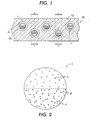
- FIG. 1 there is shown a cross sectional view of a portion of a display medium 10 comprising a plurality of bichromal beads 1 which have a darker pigmented hemisphere 2D on one side and a lighter hemisphere 3L on the other side.
- Figure 2 is an enlarged view of the bichromal beads 1, and depicts lighter pigments L dispersed or contained in hemisphere 3L, and depicts darker pigments D in hemisphere 2D.
- the display media 12 can be any media capable of displaying an image, such as a sheet, and may comprise any suitable material for housing the bichromal beads such as, for example, an elastomer material.
- each of the hemispheres 3L and 2D contain electrical charges.
- the values of these charges are found to be dependent upon both the concentrations of pigments and the presence of the charge adjuvant (where present).
- bichromal spheres are dispersed or contained in an encapsulant medium.
- the beads may be microencapsulated. In this case, the beads may still be dispersed or contained in a encapsulant medium, but they may also be, e.g., painted or brushed onto surfaces, or the like.
- the bichromal spheres of the present invention which comprise hemispheres of different colors and different amounts of electrostatic charge are useful as a flexible "electric paper" display media.
- the present invention is generally directed to a display medium, or a rotary twisted ball, electric paper or a Gyricon display medium, comprised of bichromal spheres or Gyricon beads.
- the flexible display medium under the action of an external electric field, allows the bichromal spheres to rotate in accordance with their electrical anisotropy within the encapsulant medium to provide an image.
- the bichromal spheres are darker or black on one side and lighter or white on the other side.
- Preferred bichromal spheres consist of white pigment titanium dioxide dispersed in the base material on one side of the bead, and a black pigment dispersed in the base material on the other side of the bead.
- the bichromal spheres are relatively small, for example from about 2 to about 200 microns in diameter, and preferably from about 30 to about 120 microns in diameter.
- the bichromal spheres are also preferably fabricated by the processes as disclosed in U.S. Patent 5,262,098 , or as disclosed in copending applications Attorney Reference No. D/99235, mailed July 23, 1999, entitled “Method and Apparatus for Fabricating Bichromal Elements, and Attorney Reference No. D/99235Q, mailed July 23, 1999, entitled “Method and Apparatus for Fabricating Bichromal Elements.
- other known methods for the preparation of bichromal spheres can be practiced, such as disclosed in U.S . Patent 4,126,854.
- Bichromal beads have both monopole and dipole charge components.
- the monopole charge is simply the net charge on the bead, expressed as proportional to Q(1) + Q(2), where Q(1) and Q(2) is the total charge on the lighter or white side of the bead and Q(2) is the total charge on the darker or black side of the bead. If Q(1) and Q(2) were equal and opposite polarity charges, the monopole charge would be zero. Typically, they have the same polarity.
- the monopole charge is responsible for causing the bead to move from one cavity wall position to the opposite position, upon application of an electric field. Without this charge, the bead would remain locked to the cavity wall and rotation would be very difficult.
- the dipole moment causes the bead to rotate as it moves across the oil-filled cavity.
- the force causing this rotation is proportional to the dipole moment, which itself is proportional to Q(1) - Q(2).
- the charge adjuvants appear to augment the monopole and dipole charge distributions on the bichromal bead.
- the bichromal elements, or spheres or beads preferably comprise charge adjuvants in one or both hemispheres.
- the presence of the charge adjuvants improves the bichromal bead behavior in an electric field by contributing to a lower switching voltage, faster rotation, elimination of cavity wall sticking, and/or a more distinct voltage threshold for displays and display media containing the bichromal beads, an example being Gyricon beads.
- charge adjuvants include polymers such as polyalkyls such as polyethylene oxide, polypropylene oxide, polyethylene oxide-polypropylene oxide copolymers, ethoxylated alcohols, amides, amines, acids, phenols and derivatives thereof.
- the charge adjuvant may comprises a poly(alkylene oxide) which may be an alkyl poly(alkylene oxide).
- the charge adjuvant comprises a poly(alkylene oxide) which is selected from the group consisting of poly(alkylene oxide) acetate ester, poly(alkylene oxide) alcohol, poly(alkylene oxide) phosphate ester, poly(alkylene oxide) acrylate ester, poly(alkylene oxide) sulfate ester, poly(alkylene oxide) sorbitan monostearate, ethoxylated amids, fatty acids, fatty alcohols and fatty amines.
- a poly(alkylene oxide) which is selected from the group consisting of poly(alkylene oxide) acetate ester, poly(alkylene oxide) alcohol, poly(alkylene oxide) phosphate ester, poly(alkylene oxide) acrylate ester, poly(alkylene oxide) sulfate ester, poly(alkylene oxide) sorbitan monostearate, ethoxylated amids, fatty acids, fatty alcohols and fatty amines.
- the charge adjuvant may comprise a poly(alkylene oxide) wherein said alkylene is selected from the group consisting of methylene, ethylene, propylene and butylene.
- the bichromal spheres or beads comprise a polymer having polyether functionality. It is preferred that the alkyl poly(alkylene oxide) have at least 4, and preferably from about 20 to about 100 alkylene oxide units per polymer molecule. Preferably, the polymers having the highest ethylene oxide levels are used.
- the charge adjuvant is present in the bichromal beads in an amount of from about 0.1 to about 50 weight percent, and preferably from about 1 to about 5 weight percent, based on the total weight of solids, which includes the weight of the wax and pigment or dye.
- the pigment or dye is present in an amount of from about 1 to about 70 weight percent.
- the bichromal beads may further comprise a pigment.
- Said pigment may be selected from the group consisting of carbon black and titanium oxide.
- Said pigment may be a manganese ferrite.
- charge adjuvants include those from Baker/Petrolite UNITHOX ® such as 5175 (acetate ester, E 16.7 EO 42 ), 5126 (phosphate ester, (E 16.7 EO 42 ), 5142 (acrylate ester, E 16.7 EO 42 ), 5208 (phosphate ester, E 24 EO 17 ), 5152 (sulfate ester, E 24 ,EO 17 ), 5119 (phosphate ester (E 16.7 EO 42 ), and the like.
- EO percentage refers to the percentage by weight of the molecule comprising ethylene oxide.
- Such commercially available UNITHOX ® polymers are preferably present at levels ranging from about 0.1 to about 8 percent, and particularly preferred of from about 0.2 to about 5 percent by total weight of the pigmented dispersion, and preferably the black or dark pigmented dispersion.
- Other commercially available polymers include POLYOX ® N-10 (ethylene oxide and fumed siiica). This commercially available polymer ethoxylate is preferably present in an amount of from about 0.1 to about 8 percent, and preferably from about 0.2 to about 3 percent by total weight of the pigmented dispersion.
- Another commercially available polymer includes UNITHOX ® 750, which is preferably present in an amount of from about 0.01 to about 3 percent, preferably from about 0.1 to about 0.5 percent by total weight of the pigmented dispersion.
- a preferred commercially available polymer is TWEEN ® 61 (polyoxyethylene sorbitan monostearate), which is preferably present in an amount of from about 0.1 to about 5 percent, preferably from about 0.5 to about 1 percent by total weight of the pigmented dispersion.
- charge adjuvants include ethoxylated amids, fatty acids, fatty alcohols and fatty amines, and commercially available charge adjuvants such as BRIJ ® and MYRI ® (ICI Americas, Inc.), and ETHOMIDES ® , ETHOMINES ® and ETHOTAT ® (Akzo Nobel Chemicals, Inc.).
- charge adjuvants be selected that are not soluble in the dielectric liquid that fills the cavities in which the bichromal balls are contained.
- the beads comprise a polymer or wax as a base material.
- suitable polymers include a low melting hydrocarbon, preferably with a melting point of from about 50 to about 180°C, and more specifically from about 80 to about 130°C. Further, it is preferred that the polymer have a carbon content of from about 18 to about 1,000, and more specifically from about 50 to about 200 carbon atoms.
- a preferred wax is Polywax 1000 from Baker Petrolite Corporation. Examples of suitable waxes include carnauba wax and candelia wax.
- a pigment is used.
- the darker pigment in the darker hemisphere 2D is a manganese ferrite or carbon black, although other suitable pigments can be used such as modified carbon blacks, magnetites, ferrites such as manganese ferrite, and color pigments.
- a black pigment is used, a preferred black pigment is 6331 from Ferro Corporation.
- a preferred white pigment is DuPont R104 TiO 2 pigment.
- the bichromal beads are dispersed or contained in an encapsulant media.
- the encapsulant media comprises an elastomer material.
- preferred elastomer materials include polysiloxanes, such as Sylgard 184.
- Said elastomer material may comprise an oil. Examples of suitable elastomer materials are included in U.S. Patent 4,126,854 .
- the encapsulant medium comprises a liquid material for the purpose of providing liquid-filled cavities for each bichromal bead in which the bead can rotate relatively freely. Without any fluid around the bead, the bead is tightly held in the elastomer and cannot rotate, since there is no gap between the bead and the elastomer.
- Preferred liquid materials include oils such as Isopar oils or silicone oils, for example, Dow Corning 200 silicone oil, 10cS or less.
- the encapsulant medium is swelled in the oil. Reference is made to U.S. Patent 4,126,854 which discusses oils and how an elastomer is swelled in oil.
- the encapsulant medium comprising the bichromal beads dispersed or contained therein is sandwiched between two outer substrates which, in total, comprise the display media.
- the outer substrates are typically glass or plastic sheets that comprise indium tin oxide coatings on their inner surfaces. These coatings may be subdivided to allow application of the desired electric field at each pixel.
- a black pigmented wax was made by dispersing 20% of F-6331 pigment (Ferro Corp.), 2.3% of X-5175 (Baker-Petrolite UNITHOX ® , acetate ester, E 16.7 ,EO 42 ), into 77.7% of Polywax 1000 (Baker-Petrolite).
- This wax and a white wax consisting of 20% TiO 2 (R104 from DuPont) and 80% Polywax 1000 were used to make bichromal balls. The balls were sieved into fractions, and the 90-106 ⁇ m (90-106 micron) fraction was used to make an elastomer sheet.
- the sheet was made by mixing 5.00 g of SYLGARD 184 base, 0.75 g SYLGARD 184 curing agent, and 5.75 g of the 90-106 ⁇ m (90-106 micron) balls; placing the mixture under vacuum to de-aerate; casting the mixture into a 0.03 cm (0.012 inch)sheet; and curing at 90°C for 2 hours. After curing, small subsheets were cut out and soaked in ISOPAR-L with anhydrous calcium sulfate overnight.
- the subsheets were made into displays by mounting between two glass plates coated with indium tin oxide in order to test the soaked subsheets.
- the surface of the glass plates with the indium tin oxide coating was placed on the inside adjacent to the subsheet.
- the components from one side to the other are glass, ITO coating, soaked subsheet, ITO coating on glass plate #2, glass plate #2.
- Formulations 1 and 2 provided excellent bead rotation. When the same formulations were made without the use of the 5175 additive, very poor results were obtained.
- Formulation 3 using a pigment other than carbon black, also provided good bichromal bead rotation.
- the same formulation without the 5175 provided very poor rotation.
Landscapes
- Physics & Mathematics (AREA)
- General Physics & Mathematics (AREA)
- Health & Medical Sciences (AREA)
- Life Sciences & Earth Sciences (AREA)
- Molecular Biology (AREA)
- Optics & Photonics (AREA)
- Engineering & Computer Science (AREA)
- Theoretical Computer Science (AREA)
- Electrochromic Elements, Electrophoresis, Or Variable Reflection Or Absorption Elements (AREA)
- Manufacturing Of Micro-Capsules (AREA)
Claims (6)
- Anzeigemedium umfassend a) ein Einbettungsmedium und b) zweifarbige Kügelchen, wobei die zweifarbigen Kügelchen in dem Einbettungsmedium dispergiert sind, dadurch gekennzeichnet, dass die zweifarbigen Kügelchen ein Ladungsadjuvans umfassen, welches ein Poly(alkylenoxid) umfasst, das ausgewählt ist aus der Gruppe bestehend aus Poly(alkylenoxid)acetatester, Poly(alkylenoxid)alkohol, Poly(alkylenoxid)-phosphatester, Poly(alkylenoxid)acrylatester, Poly(alkylenoxid)sulfatester, Poly-(alkylenoxid)sorbitanmonostearat, ethoxylierten Amiden, Fettsäuren, Fettalkoholen und Fettaminen.
- Anzeigemedium nach Anspruch 1, wobei das Poly(alkylenoxid) wenigstens 4 Alkylenoxideinheiten pro Poly(alkylenoxid)-Molekül aufweist.
- Anzeigemedium nach Anspruch 2, wobei das Poly(alkylenoxid) ungefähr 20 bis ungefähr 100 Alkylenoxideinheiten pro Poly(alkylenoxid)-Molekül aufweist.
- Anzeigemedium nach Anspruch 1, wobei das Alkylen ausgewählt ist aus der Gruppe bestehend aus Methylen, Ethylen, Propylen und Butylen.
- Anzeigemedium nach Anspruch 1, wobei die zweifarbigen Kügelchen mikroverkapselt sind.
- Anzeigevorrichtung, die bewirken kann, dass ein Bild auf dem Anzeigemedium angezeigt wird, umfassend:(i) ein Anzeigemedium nach einem der Ansprüche 1 bis 6,(ii) ein Mittel zum Ausrichten der zweifarbigen Kügelchen in dem Einbettungsmedium, so dass ein Bild auf dem Anzeigemedium gebildet wird.
Applications Claiming Priority (2)
| Application Number | Priority Date | Filing Date | Title |
|---|---|---|---|
| US427411 | 1999-10-26 | ||
| US09/427,411 US6496298B1 (en) | 1999-10-26 | 1999-10-26 | Bichromal beads having charge adjuvants therein |
Publications (3)
| Publication Number | Publication Date |
|---|---|
| EP1096306A2 EP1096306A2 (de) | 2001-05-02 |
| EP1096306A3 EP1096306A3 (de) | 2001-08-08 |
| EP1096306B1 true EP1096306B1 (de) | 2008-08-13 |
Family
ID=23694765
Family Applications (1)
| Application Number | Title | Priority Date | Filing Date |
|---|---|---|---|
| EP00123151A Expired - Lifetime EP1096306B1 (de) | 1999-10-26 | 2000-10-25 | Zweifarbige Kugeln mit Ladungshilfsstoffen |
Country Status (4)
| Country | Link |
|---|---|
| US (1) | US6496298B1 (de) |
| EP (1) | EP1096306B1 (de) |
| JP (1) | JP2001183708A (de) |
| DE (1) | DE60039833D1 (de) |
Families Citing this family (4)
| Publication number | Priority date | Publication date | Assignee | Title |
|---|---|---|---|---|
| AU2003275591A1 (en) * | 2002-10-22 | 2004-05-13 | Oji Paper Co., Ltd. | Display element and manufacturing method thereof |
| US7235196B2 (en) * | 2004-07-07 | 2007-06-26 | Xerox Corporation | Display capsules and a method of manufacturing thereof |
| US7523546B2 (en) * | 2005-05-04 | 2009-04-28 | Nokia Corporation | Method for manufacturing a composite layer for an electronic device |
| US7382520B2 (en) * | 2005-08-26 | 2008-06-03 | Xerox Corporation | Charge control agents in display media |
Family Cites Families (32)
| Publication number | Priority date | Publication date | Assignee | Title |
|---|---|---|---|---|
| US4143103A (en) | 1976-05-04 | 1979-03-06 | Xerox Corporation | Method of making a twisting ball panel display |
| US4126854A (en) | 1976-05-05 | 1978-11-21 | Xerox Corporation | Twisting ball panel display |
| US4261653A (en) | 1978-05-26 | 1981-04-14 | The Bendix Corporation | Light valve including dipolar particle construction and method of manufacture |
| CA1190362A (en) | 1982-01-18 | 1985-07-16 | Reiji Ishikawa | Method of making a rotary ball display device |
| GB8612691D0 (en) | 1986-05-23 | 1986-07-02 | Ontario Research Foundation | Manufacturing magnetic particles |
| JPS6394501A (ja) * | 1986-10-09 | 1988-04-25 | 宇部興産株式会社 | イオン伝導性固体電解盾の製造法 |
| JPS63221188A (ja) * | 1987-03-09 | 1988-09-14 | Sekisui Chem Co Ltd | エレクトロクロミツク素子 |
| DE3934229A1 (de) | 1989-10-13 | 1991-04-18 | Thomson Brandt Gmbh | Verfahren zum positionieren eines lichtstrahls auf einer bildflaeche |
| JPH03139552A (ja) * | 1989-10-24 | 1991-06-13 | Ube Ind Ltd | イオン伝導性固体電解質 |
| CA2027440C (en) | 1989-11-08 | 1995-07-04 | Nicholas K. Sheridon | Paper-like computer output display and scanning system therefor |
| JPH03196407A (ja) * | 1989-12-26 | 1991-08-27 | Ube Ind Ltd | イオン伝導性固体電解質 |
| JPH03238704A (ja) * | 1990-02-16 | 1991-10-24 | Toyo Ink Mfg Co Ltd | 高分子固体電解質 |
| US5227185A (en) | 1992-06-08 | 1993-07-13 | Minnesota Mining And Manufacturing Company | Abrasion-resistant coating composition and abrasion resistant energy control sheet |
| US5786110A (en) | 1992-06-22 | 1998-07-28 | Arizona Board Of Regents | Alkali-metal-ion conducting electrolytes |
| US5262098A (en) | 1992-12-23 | 1993-11-16 | Xerox Corporation | Method and apparatus for fabricating bichromal balls for a twisting ball display |
| JP3196407B2 (ja) | 1993-03-19 | 2001-08-06 | 松下電器産業株式会社 | 電子機器の保護袋 |
| US5460905A (en) | 1993-06-16 | 1995-10-24 | Moltech Corporation | High capacity cathodes for secondary cells |
| JP3359389B2 (ja) * | 1993-07-23 | 2002-12-24 | 松下電器産業株式会社 | ポリマー電解質 |
| US5538812A (en) | 1994-02-04 | 1996-07-23 | Moltech Corporation | Electrolyte materials containing highly dissociated metal ion salts |
| US5648187A (en) | 1994-02-16 | 1997-07-15 | Moltech Corporation | Stabilized anode for lithium-polymer batteries |
| JP3526080B2 (ja) * | 1994-07-19 | 2004-05-10 | 大倉工業株式会社 | 半導電性フッ素樹脂組成物 |
| JP3239253B2 (ja) * | 1994-12-16 | 2001-12-17 | 大倉工業株式会社 | 半導電性フッ素樹脂組成物および半導電性フッ素樹脂フィルム |
| US5601947A (en) | 1995-06-07 | 1997-02-11 | Moltech Corporation | Electroactive high storage capacity polycarbon-sulfide materials and electrolytic cells containing same |
| JP3394125B2 (ja) | 1995-11-28 | 2003-04-07 | 松下電器産業株式会社 | 非水電解質二次電池 |
| US5919587A (en) | 1996-05-22 | 1999-07-06 | Moltech Corporation | Composite cathodes, electrochemical cells comprising novel composite cathodes, and processes for fabricating same |
| US5772934A (en) | 1996-05-24 | 1998-06-30 | W. R. Grace & Co.-Conn. | Process to produce lithium-polymer batteries |
| WO1997048145A1 (en) | 1996-06-14 | 1997-12-18 | Moltech Corporation | Composition useful in electrolytes of secondary battery cells |
| US5914805A (en) | 1996-06-27 | 1999-06-22 | Xerox Corporation | Gyricon display with interstitially packed particles |
| CA2210040A1 (en) | 1996-07-23 | 1998-01-23 | Rohm And Haas Company | Electrolyte and electrolytic cell |
| US6025111A (en) * | 1996-10-23 | 2000-02-15 | Eastman Kodak Company | Stable matte formulation for imaging elements |
| US5716421A (en) | 1997-04-14 | 1998-02-10 | Motorola, Inc. | Multilayered gel electrolyte bonded rechargeable electrochemical cell and method of making same |
| US5900858A (en) | 1997-05-30 | 1999-05-04 | Xerox Corporation | Rotation mechanism for bichromal balls of a twisting ball display sheet based on contact potential charging |
-
1999
- 1999-10-26 US US09/427,411 patent/US6496298B1/en not_active Expired - Fee Related
-
2000
- 2000-10-25 EP EP00123151A patent/EP1096306B1/de not_active Expired - Lifetime
- 2000-10-25 DE DE60039833T patent/DE60039833D1/de not_active Expired - Lifetime
- 2000-10-26 JP JP2000326313A patent/JP2001183708A/ja not_active Withdrawn
Also Published As
| Publication number | Publication date |
|---|---|
| JP2001183708A (ja) | 2001-07-06 |
| EP1096306A2 (de) | 2001-05-02 |
| DE60039833D1 (de) | 2008-09-25 |
| US6496298B1 (en) | 2002-12-17 |
| EP1096306A3 (de) | 2001-08-08 |
Similar Documents
| Publication | Publication Date | Title |
|---|---|---|
| US7551346B2 (en) | Electro-optic displays, and materials for use therein | |
| US4368952A (en) | Magnetic display panel using reversal magnetism | |
| EP2802936B1 (de) | Fluid für elektrophoretische anzeige | |
| EP0933752B1 (de) | Gepolte Elektreten für Anzeigen aus elektrischem Papier auf Gyricon Basis | |
| JP2009009092A (ja) | 電気泳動液、電気泳動表示媒体、電気泳動表示素子及び電気泳動表示装置 | |
| US6335818B1 (en) | Bichromal beads having electrolytes therein | |
| JP5134637B2 (ja) | 電気泳動表示用液、それを用いた電気泳動表示装置及び電子機器 | |
| EP1096304B1 (de) | Zweifarbige Kugeln mit Kristallmaterial | |
| TWI673334B (zh) | 用於電泳介質的光熱引發聚合抑制劑 | |
| US6496298B1 (en) | Bichromal beads having charge adjuvants therein | |
| JP4398621B2 (ja) | 回転要素シート材および回転要素シート材をアドレッシングする方法および回転要素シート材を作成する方法 | |
| EP1671172A2 (de) | Elektrophoretische medien | |
| TWI751549B (zh) | 彩色電泳顯示器 | |
| CA2332404C (en) | Magnetic material-inverting display panel | |
| AU773093B2 (en) | Magnetic material-inverting display panel | |
| US7193769B2 (en) | Two particle electophoretic systems, electronic displays including two particle electophoretic systems, and methods for producing the two particle electophoretic systems | |
| US7382520B2 (en) | Charge control agents in display media | |
| US11079651B2 (en) | Multi-color electro-optic media | |
| KR102933258B1 (ko) | 전기영동 표시장치 | |
| EP1220009B1 (de) | Sequestrierte magnetische Kontrollkissen | |
| JP4858896B2 (ja) | 粒子の電気泳動または回転を利用した表示装置 | |
| JP2004070043A (ja) | 二色回転粒子およびディスプレイ用表示シート | |
| CN118330959A (zh) | 一种电光学材料及其制造方法 | |
| US20080024466A1 (en) | Method for measuring effective operation of gyricon display device |
Legal Events
| Date | Code | Title | Description |
|---|---|---|---|
| PUAI | Public reference made under article 153(3) epc to a published international application that has entered the european phase |
Free format text: ORIGINAL CODE: 0009012 |
|
| AK | Designated contracting states |
Kind code of ref document: A2 Designated state(s): DE FR GB |
|
| AX | Request for extension of the european patent |
Free format text: AL;LT;LV;MK;RO;SI |
|
| PUAL | Search report despatched |
Free format text: ORIGINAL CODE: 0009013 |
|
| AK | Designated contracting states |
Kind code of ref document: A3 Designated state(s): AT BE CH CY DE DK ES FI FR GB GR IE IT LI LU MC NL PT SE |
|
| AX | Request for extension of the european patent |
Free format text: AL;LT;LV;MK;RO;SI |
|
| 17P | Request for examination filed |
Effective date: 20020208 |
|
| AKX | Designation fees paid |
Free format text: DE FR GB |
|
| GRAP | Despatch of communication of intention to grant a patent |
Free format text: ORIGINAL CODE: EPIDOSNIGR1 |
|
| GRAS | Grant fee paid |
Free format text: ORIGINAL CODE: EPIDOSNIGR3 |
|
| GRAA | (expected) grant |
Free format text: ORIGINAL CODE: 0009210 |
|
| AK | Designated contracting states |
Kind code of ref document: B1 Designated state(s): DE FR GB |
|
| REG | Reference to a national code |
Ref country code: GB Ref legal event code: FG4D |
|
| REF | Corresponds to: |
Ref document number: 60039833 Country of ref document: DE Date of ref document: 20080925 Kind code of ref document: P |
|
| PLBE | No opposition filed within time limit |
Free format text: ORIGINAL CODE: 0009261 |
|
| STAA | Information on the status of an ep patent application or granted ep patent |
Free format text: STATUS: NO OPPOSITION FILED WITHIN TIME LIMIT |
|
| 26N | No opposition filed |
Effective date: 20090514 |
|
| PGFP | Annual fee paid to national office [announced via postgrant information from national office to epo] |
Ref country code: FR Payment date: 20101020 Year of fee payment: 11 |
|
| PGFP | Annual fee paid to national office [announced via postgrant information from national office to epo] |
Ref country code: DE Payment date: 20101020 Year of fee payment: 11 |
|
| PGFP | Annual fee paid to national office [announced via postgrant information from national office to epo] |
Ref country code: GB Payment date: 20101020 Year of fee payment: 11 |
|
| GBPC | Gb: european patent ceased through non-payment of renewal fee |
Effective date: 20111025 |
|
| REG | Reference to a national code |
Ref country code: FR Ref legal event code: ST Effective date: 20120629 |
|
| PG25 | Lapsed in a contracting state [announced via postgrant information from national office to epo] |
Ref country code: DE Free format text: LAPSE BECAUSE OF NON-PAYMENT OF DUE FEES Effective date: 20120501 |
|
| REG | Reference to a national code |
Ref country code: DE Ref legal event code: R119 Ref document number: 60039833 Country of ref document: DE Effective date: 20120501 |
|
| PG25 | Lapsed in a contracting state [announced via postgrant information from national office to epo] |
Ref country code: FR Free format text: LAPSE BECAUSE OF NON-PAYMENT OF DUE FEES Effective date: 20111102 Ref country code: GB Free format text: LAPSE BECAUSE OF NON-PAYMENT OF DUE FEES Effective date: 20111025 |