EP1096803A2 - Videocoder und Verfahren zur Einstellung der Quantisierungsstufe in Echtzeit - Google Patents
Videocoder und Verfahren zur Einstellung der Quantisierungsstufe in Echtzeit Download PDFInfo
- Publication number
- EP1096803A2 EP1096803A2 EP00123169A EP00123169A EP1096803A2 EP 1096803 A2 EP1096803 A2 EP 1096803A2 EP 00123169 A EP00123169 A EP 00123169A EP 00123169 A EP00123169 A EP 00123169A EP 1096803 A2 EP1096803 A2 EP 1096803A2
- Authority
- EP
- European Patent Office
- Prior art keywords
- quantization
- frames
- value
- computed
- bits
- Prior art date
- Legal status (The legal status is an assumption and is not a legal conclusion. Google has not performed a legal analysis and makes no representation as to the accuracy of the status listed.)
- Withdrawn
Links
Images



Classifications
-
- H—ELECTRICITY
- H04—ELECTRIC COMMUNICATION TECHNIQUE
- H04N—PICTORIAL COMMUNICATION, e.g. TELEVISION
- H04N21/00—Selective content distribution, e.g. interactive television or video on demand [VOD]
- H04N21/60—Network structure or processes for video distribution between server and client or between remote clients; Control signalling between clients, server and network components; Transmission of management data between server and client, e.g. sending from server to client commands for recording incoming content stream; Communication details between server and client
- H04N21/65—Transmission of management data between client and server
- H04N21/658—Transmission by the client directed to the server
-
- H—ELECTRICITY
- H04—ELECTRIC COMMUNICATION TECHNIQUE
- H04N—PICTORIAL COMMUNICATION, e.g. TELEVISION
- H04N19/00—Methods or arrangements for coding, decoding, compressing or decompressing digital video signals
- H04N19/10—Methods or arrangements for coding, decoding, compressing or decompressing digital video signals using adaptive coding
- H04N19/102—Methods or arrangements for coding, decoding, compressing or decompressing digital video signals using adaptive coding characterised by the element, parameter or selection affected or controlled by the adaptive coding
- H04N19/124—Quantisation
- H04N19/126—Details of normalisation or weighting functions, e.g. normalisation matrices or variable uniform quantisers
-
- H—ELECTRICITY
- H04—ELECTRIC COMMUNICATION TECHNIQUE
- H04N—PICTORIAL COMMUNICATION, e.g. TELEVISION
- H04N19/00—Methods or arrangements for coding, decoding, compressing or decompressing digital video signals
- H04N19/10—Methods or arrangements for coding, decoding, compressing or decompressing digital video signals using adaptive coding
- H04N19/134—Methods or arrangements for coding, decoding, compressing or decompressing digital video signals using adaptive coding characterised by the element, parameter or criterion affecting or controlling the adaptive coding
- H04N19/146—Data rate or code amount at the encoder output
- H04N19/15—Data rate or code amount at the encoder output by monitoring actual compressed data size at the memory before deciding storage at the transmission buffer
-
- H—ELECTRICITY
- H04—ELECTRIC COMMUNICATION TECHNIQUE
- H04N—PICTORIAL COMMUNICATION, e.g. TELEVISION
- H04N19/00—Methods or arrangements for coding, decoding, compressing or decompressing digital video signals
- H04N19/10—Methods or arrangements for coding, decoding, compressing or decompressing digital video signals using adaptive coding
- H04N19/134—Methods or arrangements for coding, decoding, compressing or decompressing digital video signals using adaptive coding characterised by the element, parameter or criterion affecting or controlling the adaptive coding
- H04N19/146—Data rate or code amount at the encoder output
- H04N19/152—Data rate or code amount at the encoder output by measuring the fullness of the transmission buffer
-
- H—ELECTRICITY
- H04—ELECTRIC COMMUNICATION TECHNIQUE
- H04N—PICTORIAL COMMUNICATION, e.g. TELEVISION
- H04N19/00—Methods or arrangements for coding, decoding, compressing or decompressing digital video signals
- H04N19/10—Methods or arrangements for coding, decoding, compressing or decompressing digital video signals using adaptive coding
- H04N19/134—Methods or arrangements for coding, decoding, compressing or decompressing digital video signals using adaptive coding characterised by the element, parameter or criterion affecting or controlling the adaptive coding
- H04N19/157—Assigned coding mode, i.e. the coding mode being predefined or preselected to be further used for selection of another element or parameter
- H04N19/159—Prediction type, e.g. intra-frame, inter-frame or bidirectional frame prediction
-
- H—ELECTRICITY
- H04—ELECTRIC COMMUNICATION TECHNIQUE
- H04N—PICTORIAL COMMUNICATION, e.g. TELEVISION
- H04N19/00—Methods or arrangements for coding, decoding, compressing or decompressing digital video signals
- H04N19/10—Methods or arrangements for coding, decoding, compressing or decompressing digital video signals using adaptive coding
- H04N19/169—Methods or arrangements for coding, decoding, compressing or decompressing digital video signals using adaptive coding characterised by the coding unit, i.e. the structural portion or semantic portion of the video signal being the object or the subject of the adaptive coding
- H04N19/17—Methods or arrangements for coding, decoding, compressing or decompressing digital video signals using adaptive coding characterised by the coding unit, i.e. the structural portion or semantic portion of the video signal being the object or the subject of the adaptive coding the unit being an image region, e.g. an object
- H04N19/172—Methods or arrangements for coding, decoding, compressing or decompressing digital video signals using adaptive coding characterised by the coding unit, i.e. the structural portion or semantic portion of the video signal being the object or the subject of the adaptive coding the unit being an image region, e.g. an object the region being a picture, frame or field
-
- H—ELECTRICITY
- H04—ELECTRIC COMMUNICATION TECHNIQUE
- H04N—PICTORIAL COMMUNICATION, e.g. TELEVISION
- H04N19/00—Methods or arrangements for coding, decoding, compressing or decompressing digital video signals
- H04N19/10—Methods or arrangements for coding, decoding, compressing or decompressing digital video signals using adaptive coding
- H04N19/169—Methods or arrangements for coding, decoding, compressing or decompressing digital video signals using adaptive coding characterised by the coding unit, i.e. the structural portion or semantic portion of the video signal being the object or the subject of the adaptive coding
- H04N19/177—Methods or arrangements for coding, decoding, compressing or decompressing digital video signals using adaptive coding characterised by the coding unit, i.e. the structural portion or semantic portion of the video signal being the object or the subject of the adaptive coding the unit being a group of pictures [GOP]
-
- H—ELECTRICITY
- H04—ELECTRIC COMMUNICATION TECHNIQUE
- H04N—PICTORIAL COMMUNICATION, e.g. TELEVISION
- H04N21/00—Selective content distribution, e.g. interactive television or video on demand [VOD]
- H04N21/60—Network structure or processes for video distribution between server and client or between remote clients; Control signalling between clients, server and network components; Transmission of management data between server and client, e.g. sending from server to client commands for recording incoming content stream; Communication details between server and client
- H04N21/63—Control signaling related to video distribution between client, server and network components; Network processes for video distribution between server and clients or between remote clients, e.g. transmitting basic layer and enhancement layers over different transmission paths, setting up a peer-to-peer communication via Internet between remote STB's; Communication protocols; Addressing
- H04N21/637—Control signals issued by the client directed to the server or network components
- H04N21/6377—Control signals issued by the client directed to the server or network components directed to server
Definitions
- the present invention is related to the field of coding a digital video signal in bits, and more specifically to coding at variable bit rate and quantization step size in order to achieve compression and high image quality.
- Encoders that code digital video in bits achieve compression by choosing optimally a parameter called the quantization step size, also known simply as quantization step.
- the quantization step size is chosen to address the trade-off between a minimum required image quality and a maximum bandwidth for processing and/or transmission of data.
- using a larger, coarser quantization step size requires fewer bits to store a scene, but decreases image quality.
- using a smaller, finer quantization step size requires more bits to encode the scene, but produces higher image quality. That is because, although the number of pixels is always the same, with a finer quantization the pixel "values" are encoded more accurately. Additionally, for a given quantization step size, the pixel values in simpler scenes are more correlated, and can be described with fewer bits than those in more complex scenes.
- VBR variable bit rate
- bit rate (seen in Fig. 2) varies according to scene complexity, hence the name variable bit rate (VBR) mode.
- VBR variable bit rate
- the VBR mode is useful in asynchronous transmission mode (ATM).
- ATM asynchronous transmission mode
- the next quantization step size is usually computed by tracking and examining slowly moving average statistics about the complexity of the scene in the frames. As such, the quantization step size can not react quickly to flashes or sudden scene changes, in order to prevent the buffer in the encoder from bit overflow.
- the tracked statistics typically include the produced bit rate, the target average bit rate, the quantization parameters that are used in previous frames, and other related parameters. More advanced methods use histograms of instantaneous bit rate of typical VBR video, and of other statistics.
- the VBR mode is most useful for storing compressed video in CD-ROM or DVD.
- the most complex ones encode an entire video frame sequence multiple times, each time with different quantization step sizes. Then, after examining the entire recorded sequences, a single set is selected or created, that has optimized the trade-off between the desired image quality and the desired number of bits.
- These methods are called multiple pass VBR control methods, and are quite effective in maintaining nearly constant quantization throughout the video sequence. However, these methods are not applicable to real-time encoding, since they result in long delays from the high computational complexity, and require extra memory using these delays.
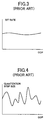
- Figs. 3 and 4 These methods are called constant bit rate (CBR) mode, and are intended for transmission through channels with fixed bandwidth. As such, they are most useful for real-time encoding. As can be seen in Fig. 3, the bit rate can be maintained nearly constant for many groups of pictures. However, the quantization step size has to keep changing rapidly, and can end up evolving as shown in Fig. 4. Unfortunately, the rapid quantization changes result in annoying fluctuations of the video image quality, which is a major drawback of the CBR mode.
- CBR constant bit rate
- a difficulty in CBR mode encoding is that a decision has to be made on the quantization step size of an upcoming frame without knowing in advance how complex is the scene.
- An average value is chosen to begin with, and then various algorithms are used to project a useful quantization step size.
- the value of the step size is often modified at each image block of a frame in order to further guarantee that the number of bits produced is close to the desired target.
- These algorithms typically use statistics for the instantaneous complexity of the scene, and are used to project and adapt the step size for the next scene.
- the present invention overcomes these problems and limitations of the prior art.
- the present invention provides a video encoder for encoding a series of groups of frames with an adjustable quantization step, and a method for adjusting the quantization step.
- the method tracks a complexity parameter of the encoded scenes, and computes a first quantization value in dependence upon the generated complexity parameter.
- the method further computes a minimum and a maximum step size in dependence upon a number of the bits that have already been generated, and with a preset target number of bits.
- the quantization step for the next group of pictures is set in accordance with the first quantization value, but subject to the range defined by the minimum and maximum step sizes.
- the method further adjusts the minimum and the maximum step sizes to achieve fine tuned performance.
- the present invention provides a video encoder for encoding a series of groups of frames with an adjustable quantization step, and a method for adjusting the quantization step.
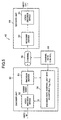
- a system 40 includes an encoder unit 42 and a decoder unit 44.
- Unit 42 is coupled with unit 44, optionally through a channel 46, as is known in the art.
- the channel can be anything from a long distance transmission to a set of connections within a single apparatus.
- Encoder unit 42 includes a video encoder 52, an encoder buffer 54, and an encoder rate control unit 56 that is made according to the present invention.
- Decoder unit 44 includes a decoder buffer 62, and the video decoder 64.
- a channel rate control unit 68 may be provided as is known in the art.
- Encoder 52 includes a controllable quantizer for encoding video data according to an adjustable quantization step, thereby generating bits.
- a video signal VIDEO IN which is a series of frames arranged in groups, is received by video encoder 52, which can be an MPEG encoder.
- the encoder also receives data from encoder rate control unit 56 regarding quantization step size. This way unit 56 controls the quantizer by setting the quantization step of the encoding unit at an adjustable value for the frames of each group.
- the encoder encodes the video signal according to the received quantization step size, thereby producing a digital signal CODED VIDEO.
- Signal CODED VIDEO is then input in encoder buffer 54 at the rate that it is being produced by encoder 52.
- Data is fed from encoder buffer 54 into channel 46 at a constant or variable rate.
- the data is then input in decoder buffer 62, and from there into video decoder 64 for final decoding (signal VIDEO OUT).
- Control unit 56 can be a chip with programmable software. It can also be implemented in conjunction with unit 52. Unit 56 includes features that can be implemented in software, as will be obvious to a person skilled in the art in view of the present description.
- Frames in a GOP are coded as I-, P-, or B-type frames.
- the MPEG standard allows many combinations, but the most used sequence consists of 15 frames in a GOP (group of frames) that follow the pattern: IBBPBBPBBPBBPBB
- the first frame is I or intra coded. That means that it is coded by itself, without using any inputs from other frames.
- the pixel values for a given P frame are predicted from pixels in the previously coded P (or I) frame. Only the prediction error is coded, which typically requires substantially fewer bits than encoding a frame in intra mode.
- the means for generating the complexity parameter generates complexity parameters XI, XP, XB for Ni I-type frames, Np P-type frames and Nb B-type frames.
- the means for computing the first quantization value computes the first quantization value. It computes the first quantization value preferably as an average of products Np*XP, Nb*XB and Ni*XI, by ascribing equal weights to product Ni*XI and to product Np*XP, and less weight to product Nb*XB than to product Ni*XI.
- the features of unit 56 further include means for computing a first quantization value in dependence upon the generated complexity parameter, means for computing a minimum and a maximum step size in dependence upon a number of the bits associated with the frames occurring before the selected frame, and with a preset or predetermined target number of bits.
- the priorly occurring frames could be in groups occurring before the groups of the selected frame.
- the target number of bits is determined by the desired video image quality.
- the features further include means for setting the quantization step in accordance with the first quantization value if the first quantization value is within a range defined by the minimum and maximum step sizes.
- unit 56 further includes means for decreasing the computed maximum step size if the computed maximum step size exceeds a hard ceiling value, and means for increasing the computed minimum step size, if the computed minimum step size is lower than a hard floor value.
- the hard ceiling and floor values are preferably fixed.
- model parameters are considered for the upcoming initialization.
- the model parameters are made for a model GOP (group of frames or group of pictures), and are carried for all the other groups.
- the method encodes a GOP with similar quality using a typical video coder such as MPEG2. This can be achieved by encoding all frames with the same quantization step size Q.
- Bits X Q , where X is the complexity parameter for the frame, which is different for I, P and B frames.
- B GOP N I X I Q + N P X P Q + N B X B Q , where N I , N P , N B is the number of I, P, and B frames in the GOP.
- values are initialized.
- they are initialized as follows:
- rate control parameters are initialized as follows:
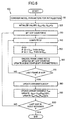
- a subprocess starts for each group of frames, until all groups in the series are processed. More specifically, according to step 130 of the invention, a counter is initialized for the group:
- the quantization step size Q for encoding the upcoming frame is selected. This is accomplished by computing a first quantization value Q1. This computation is in dependence upon the generated complexity parameters X I , X P , X B from previous scenes.
- the above formula gives the first quantization value as an average value sum.
- Equation (3) (N I X I + N P X P + N B X B 4/5) B GOP
- Equation (3) X B is multiplied by 4/5, and the value of Q for I and P frames is made smaller, thus these frames will be encoded with higher quality. Since the B frames will be perceived as having the same quality as the others, the overall video quality will improve.
- step 150 an adjustment occurs that places Q within the allowable range.
- the quantization step is set equal to the first quantization value Q1, computed immediately above, but subject to the condition that the quantization step size be within an allowable range.
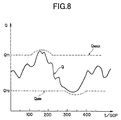
- the allowable range is between Q MIN and Q MAX . It should be remembered that a feature of this invention is that QMAX, QMIN can be updated by computing. This updating is described with reference to a later step.
- B GOP the target number of bits for a given GOP, B GOP .
- B GOP the target number of bits for a given GOP, B GOP .
- the minimum and maximum step sizes are also known simply as a minimum and a maximum step, respectively.
- step 160 the frame is encoded using the set quantization step size Q.
- the quantization step can be computed after every frame, or after every group of frames.
- bit counters are updated, and the scene complexity parameters X are also updated as is known in the art. Let Bits be the number of bits occupied by the current frame.
- step 170 it is inquired if that were the last frame in the GOP. If not, the process returns to step 140, as above.
- updating takes place as per step 180. Specifically,
- a new maximum step size Q MAX is computed in dependence upon a number of the bits associated with the frames of the group, and upon a preset target number of bits.
- a minimum step size Q MIN is computed in dependence upon the number of the bits associated with the frames of the group, and upon the preset target number of bits.
- step 200 it is inquired if that were the last GOP in the series. If not, the process continues to step 130, as above. Else the process terminates.
- the computed maximum step size should not be allowed to exceed the precomputed or preset hard ceiling value Q C , which is necessary for some encoding methods, such as MPEG2.
- the computed minimum step size should not be allowed to be below the precomputed or preset hard floor value Q F . As such, if the values for Q MAX , Q MIN are computed to be outside that range, the computed values are adjusted accordingly.
- P ERR If P ERR is positive, the produced bit rate is lower than the target bit rate. If negative, the rate is higher than the target. In general, and as a matter of good practice, P ERR should not be too far from zero, so that the produced bit rate is reasonably close to the target. Although this is relative to the value of Speed, i.e., the same value of P ERR corresponds to lower Errorbits when Speed is small.
- Q MAX and Q MIN are made to depend on P ERR . Each dependency accomplishes a different function.
- Adjusting the Q MAX according to P ERR accomplishes quality protection.
- a maximum quantization step size threshold Q T1 was determined, that ensures good visual quality. It the step size is larger than Q T1 , compression noise is often visible and annoying.
- Q When a video scene is complex, Q will be limited by Q T1 for some time, and P ERR will be negative and decreasing. If the scene is long, at some point Q MAX will have to be increased to avoid having a large (negative) bit error P ERR . Then Q will likely take values larger than Q T1 , and compression artifacts will become noticeable. From experience, once compression noise is visible, it does not matter too much whether Q MAX is a little higher or quite higher than Q T1 , since the user will notice annoying compression noise in both cases.
- Adjusting the Q MIN according to P ERR accomplishes Bit rate protection. From experiments with human subjects, it was also observed that when the quantization step size Q is below some threshold Q T2 , the visual quality is already so good, that decreasing the step size does not produce a significant improvement in visual quality.
- the invention takes advantage of this property by making the minimum quantization step size Q MIN to be larger than or equal to Q T2 for most values of P ERR . By keeping the step size above such limit, there is a "saving of bits" from easy video scenes, for future scenes that may need them. As in the previous section, this should be done only when P ERR is small. If P ERR is a positive large number, too many bits will have been saved, and hence Q MIN will need to decrease, as seen in Fig. 7. Again, the hard floor value Q F should be respected.
- the resulting maximum and minimum step sizes allow a range DQ for the step size.
- the range changes as P ERR changes.
- control unit of the invention will still increase or decrease Q rapidly according to scene complexity, because as soon as an I, P, and B frame of a new scene are encoded, the value of Q will be adapted to the new scene conditions.
- the preferred embodiment of the invention is a VBR method with the capability of reaction of a CBR method.
- the method of the invention selects a quantization step Q using the above described near-CBR method, and limits Q when appropriate to operate in VBR mode. These limits only affect the quality bounds and the average bit rate, but not the method's capability of reaction.
- the quantization step size for each DCT coefficient is determined by the quantization type, scale, and matrix.
- the type of quantization can be either linear or non-linear, and the quantization code determines the quantization scale as shown in Table 300 of FIG. 9.
- the encoder of the invention tracks the fullness of the encoder buffer, and makes adjustments when the buffer is nearly full.
- the encoder monitors the fullness of the decoder buffer, since the fullness of decoder and encoder buffer are inversely related (e.g., when the encoder buffer overflows, the decoder buffer underflows).
- the method of the invention is preferably adapted to react quickly, by increasing quantization whenever the encoder buffer becomes full.
- One of the key advantages of the invention is that it can so react, because it is a constrained CBR technique. Specifically, when there is danger of buffer overflow, Q MAX can be increased (i.e., relax the constraints), and the method will increase the quantization step size accordingly.
- a variable P BUF is defined to be the percentage of fullness in the encoder buffer.
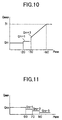
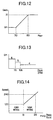
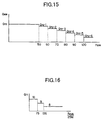
- a second function is defined for Q MAX as applied to MPEG2 encoding, that is seen in FIG. 12. The second function increases Q MAX according to P BUF .
- the value of Q MAX can be set to be the largest of the values from FIGs. 10 and 12.
- the method is adapted to different coding conditions, by adjusting the values of the parameters Q T1 , Q T2 , and Speed, in dependence upon the target average bit rate R AVG and the maximum or peak bit rate R MAX . These values remain fixed for the entire coding session, since R AVG and R MAX are also fixed.
- Q T1 is discussed in terms of R AVG /(25M).
- R AVG is the average bit rate in bits per second and M is the number of macroblocks in a frame. If the video frame rate is 25 frames per second, the fraction R AVG /(25M) is the average number of bits per macroblock.
- 75 and 106 correspond to 2.5 and 3.5 Megabits per second (Mbps), respectively.
- Q T1 4. This value was determined empirically by setting the quantization scale fixed to different values, and selecting the maximum scale that produced good visual image quality. At low bit rates Q T1 is increased, because then it is very difficult to maintain the quantization scale below 4.
- Q T2 Q T1 -1 .
- This choice is also based on empirical experiments. Fortuitously, in this linear case the range of quantization scales is only 1. As will be seen below, in non-linear quantization, there are more scales available for the same range, and hence there may have be some additional benefits for bit rate and quality control.
- Speed should be reduced for a more accurate video time length. For example, consider the case that the coded bit stream is being stored on a tape (or disc) of limited capacity. In order to guarantee that the tape will contain a given number of seconds of encoded video, Speed should be gradually reduced at the end of the tape.
- Non linear quantization is now described.
- Non-linear quantization was adopted in MPEG2 in order to allow better quantization control when encoding video at high bit rates.
- the non-linear case provides smaller scale increments for the quantization codes between 1 and 8, as shown in Table 300 of FIG. 9.
- non-linear quantization permits very large values of quantization scales, which may be useful when encoding video segments that are hard to compress.
- the maximum quantization value Q MAX is controlled by the buffer fullness P BUF , as shown in Fig. 12. Since P BUF can fluctuate wildly in the VBR case, Q MAX and the quantization parameter Q will also fluctuate significantly from frame to frame. As a result, the video quality will fluctuate significantly as well.
- VBR rate control technique is modified so that the quality of the encoded video is always high.
- This mode of operation is also known as the "quality-guaranteed" mode.
- VBR1 the previous rate control mode
- VBR2 the new (quality-guaranteed) mode
- the peak rate needs to be high enough to permit a quantizer below Q T1 for most video scenes.
- VBR2 mode A disadvantage of the VBR2 mode is that the time or bit error can be very large. In fact, with the VBR2 approach one can only guarantee a minimum time-length of recording time, which is determined by the peak bit rate.
- the method for setting the quantization step also comprises storing the generated bits in the buffer, and tracking how many bits are stored in the buffer. Then a buffer fullness is monitored as the tracked number of bits stored in the buffer in relation to a preset buffer capacity. The maximum step is computed in dependence upon the buffer fullness. But even that is subject to a preset hard ceiling, as per FIG. 12.
- VBR2 VBR2
- P ERR Errorbits
- B GOP which is the target average number of bits for a GOP.
- P ERR has a very large negative value
- B GOP will become quite small, and hence the reaction to prevent buffer overflow could be too strong, producing unnecessarily high compression noise when the buffer is full.
- the target average bit rate cannot be guaranteed (and that is because Q is constrained to take values between Q T1 and Q T2)
- B GOP will affect the "unconstrained" value of Q.
- Q will tend to be larger (i.e. closer to Q T1 ) when the target average bit rate is low, and smaller (i.e. closer to Q T2 ) when the target is high.
- the error bits will affect the value of B GOP up to some point (up until P ERR is no less than -30). Therefore, the desired target average bit rate should be always set as a parameter in the encoder, in order to achieve a bit rate as close as possible to the desired target. More specifically, the average bit rate parameter should either be equal or maybe a little lower than the desired average target, but not larger.
- VBR2 mode was tested with different average and peak bit rates in a wide variety of video scenes.
- the default average and peak bit rates were set to 4.5 and 9 Mbps, respectively. It was observed that VBR2 encoded the scenes with good image quality, even throughout difficult segments, while preventing buffer overflow.
- Yet another optional feature of the invention can ensure that the quality of pictures will not fluctuate quickly. This is implemented by computing a time integral of a buffer fullness indicator P BUF , and adjusting the base value Q T1 in dependence upon the time integral. In other words, the maximum step size is computed in further dependence upon the time integral of P BUF . More particularly, the base value of Q MAX (Q T1 in Figure 7) is increased when P BUF is above 30 percent for too long.
Landscapes
- Engineering & Computer Science (AREA)
- Multimedia (AREA)
- Signal Processing (AREA)
- Compression Or Coding Systems Of Tv Signals (AREA)
- Compression, Expansion, Code Conversion, And Decoders (AREA)
Applications Claiming Priority (2)
| Application Number | Priority Date | Filing Date | Title |
|---|---|---|---|
| US427889 | 1999-10-26 | ||
| US09/427,889 US6535251B1 (en) | 1999-10-26 | 1999-10-26 | Video encoder and method for adjusting quantization step in real time |
Publications (2)
| Publication Number | Publication Date |
|---|---|
| EP1096803A2 true EP1096803A2 (de) | 2001-05-02 |
| EP1096803A3 EP1096803A3 (de) | 2007-06-20 |
Family
ID=23696718
Family Applications (1)
| Application Number | Title | Priority Date | Filing Date |
|---|---|---|---|
| EP00123169A Withdrawn EP1096803A3 (de) | 1999-10-26 | 2000-10-25 | Videocoder und Verfahren zur Einstellung der Quantisierungsstufe in Echtzeit |
Country Status (3)
| Country | Link |
|---|---|
| US (1) | US6535251B1 (de) |
| EP (1) | EP1096803A3 (de) |
| JP (1) | JP2001169284A (de) |
Cited By (7)
| Publication number | Priority date | Publication date | Assignee | Title |
|---|---|---|---|---|
| FR2829657A1 (fr) * | 2001-09-13 | 2003-03-14 | Cit Alcatel | Procede et dispositif pour la compression de donnees devant etre transmises avec un debit constant |
| GB2380351A (en) * | 2001-08-28 | 2003-04-02 | Nec Corp | Encoder with means to adjust a quantisation step size |
| DE10157111A1 (de) * | 2001-11-21 | 2003-06-05 | Deutsche Telekom Ag | Begrenzung der Bitrate für die Übermittlung von Videosignalen mit zeitlich variablen Datenmengen im ATM-Netz |
| US7352809B2 (en) | 2003-02-21 | 2008-04-01 | Polycom, Inc. | System and method for optimal transmission of a multitude of video pictures to one or more destinations |
| ITTO20090486A1 (it) * | 2009-06-25 | 2010-12-26 | St Microelectronics Pvt Ltd | Controllore dinamico della velocita' di trasmissione indipendente dal gruppo di immagini |
| CN103517080A (zh) * | 2012-06-21 | 2014-01-15 | 北京数码视讯科技股份有限公司 | 实时视频流编码器和实时视频流编码方法 |
| WO2017165529A1 (en) * | 2016-03-22 | 2017-09-28 | Qualcomm Incorporated | Apparatus and methods for adaptive calculation of quantization parameters in display stream compression |
Families Citing this family (29)
| Publication number | Priority date | Publication date | Assignee | Title |
|---|---|---|---|---|
| US6982762B1 (en) * | 1998-05-30 | 2006-01-03 | Stmicroelectronics Asia Pacific Pte Limited | Sequence adaptive bit allocation for pictures encoding |
| JP3871840B2 (ja) * | 1999-12-24 | 2007-01-24 | 日本電気株式会社 | 圧縮動画像再符号化装置 |
| US7477688B1 (en) * | 2000-01-26 | 2009-01-13 | Cisco Technology, Inc. | Methods for efficient bandwidth scaling of compressed video data |
| EP1124381A1 (de) * | 2000-02-08 | 2001-08-16 | Deutsche Thomson-Brandt Gmbh | Verfahren und Vorrichtung zur Bitratensteuerung in einem Video- oder Audiocoder |
| JP2001245303A (ja) * | 2000-02-29 | 2001-09-07 | Toshiba Corp | 動画像符号化装置および動画像符号化方法 |
| US7346776B2 (en) * | 2000-09-11 | 2008-03-18 | Digimarc Corporation | Authenticating media signals by adjusting frequency characteristics to reference values |
| US8369401B1 (en) * | 2000-10-06 | 2013-02-05 | Stmicroelectronics Asia Pacific Pte Ltd. | System and method of bit allocation in scene change situations |
| KR100357689B1 (ko) * | 2000-11-13 | 2002-10-19 | 삼성전자 주식회사 | 일관된 화질을 가지는 실시간 가변 비트율 엠펙 비디오전송 시스템 |
| JP2002354476A (ja) * | 2001-05-24 | 2002-12-06 | Pioneer Electronic Corp | 量子化単位設定装置及び量子化単位設定方法、符号化装置及び符号化方法並びに情報記録媒体及び量子化単位設定用プログラム |
| US20030112863A1 (en) | 2001-07-12 | 2003-06-19 | Demos Gary A. | Method and system for improving compressed image chroma information |
| US6895054B2 (en) * | 2001-09-28 | 2005-05-17 | Divxnetworks, Inc. | Dynamic bit rate control process |
| US7483488B1 (en) * | 2002-05-30 | 2009-01-27 | Intervideo, Inc. | Systems and methods for improving bit rate control of video encoding by correcting for the effects of scene changes and bit stuffing in a video buffer verifier (VBV) buffer model |
| US7197072B1 (en) * | 2002-05-30 | 2007-03-27 | Intervideo, Inc. | Systems and methods for resetting rate control state variables upon the detection of a scene change within a group of pictures |
| US7418037B1 (en) * | 2002-07-15 | 2008-08-26 | Apple Inc. | Method of performing rate control for a compression system |
| US7804897B1 (en) | 2002-12-16 | 2010-09-28 | Apple Inc. | Method for implementing an improved quantizer in a multimedia compression and encoding system |
| US7940843B1 (en) | 2002-12-16 | 2011-05-10 | Apple Inc. | Method of implementing improved rate control for a multimedia compression and encoding system |
| US20040143850A1 (en) * | 2003-01-16 | 2004-07-22 | Pierre Costa | Video Content distribution architecture |
| KR20040076034A (ko) * | 2003-02-24 | 2004-08-31 | 삼성전자주식회사 | 동 영상의 가변 비트율 부호화 방법 및 장치 |
| US7535959B2 (en) * | 2003-10-16 | 2009-05-19 | Nvidia Corporation | Apparatus, system, and method for video encoder rate control |
| US20050207501A1 (en) * | 2004-03-18 | 2005-09-22 | Sony Corporation | Method of and system for video bit allocation for scene cuts and scene changes |
| US7474701B2 (en) * | 2004-09-23 | 2009-01-06 | International Business Machines Corporation | Single pass variable bit rate control strategy and encoder for processing a video frame of a sequence of video frames |
| US8634458B2 (en) | 2005-02-23 | 2014-01-21 | Canon Kabushiki Kaisha | Image processing apparatus |
| JP4759360B2 (ja) * | 2005-10-07 | 2011-08-31 | キヤノン株式会社 | 画像処理装置 |
| JP2006295852A (ja) * | 2005-04-14 | 2006-10-26 | Sony Corp | 画像符号化装置,画像符号化方法,撮像装置およびプログラム |
| US8363717B2 (en) * | 2005-05-17 | 2013-01-29 | Canon Kabushiki Kaisha | Image processing apparatus |
| US8090022B2 (en) * | 2007-01-05 | 2012-01-03 | Sony Corporation | Video coding system |
| JP2009077105A (ja) * | 2007-09-20 | 2009-04-09 | Sony Corp | 編集装置および編集方法、プログラム、並びに記録媒体 |
| US8848788B2 (en) * | 2009-05-16 | 2014-09-30 | Thomson Licensing | Method and apparatus for joint quantization parameter adjustment |
| US11252429B2 (en) * | 2018-04-27 | 2022-02-15 | Ati Technologies Ulc | Low-latency consumption of an encoded video bitstream |
Family Cites Families (18)
| Publication number | Priority date | Publication date | Assignee | Title |
|---|---|---|---|---|
| DE3710119A1 (de) | 1987-03-27 | 1988-10-13 | Philips Patentverwaltung | Quellcodierer fuer videobilder |
| JP2892783B2 (ja) * | 1990-07-09 | 1999-05-17 | 松下電器産業株式会社 | 動画像信号の符号化装置 |
| US5038209A (en) | 1990-09-27 | 1991-08-06 | At&T Bell Laboratories | Adaptive buffer/quantizer control for transform video coders |
| US5159447A (en) | 1991-05-23 | 1992-10-27 | At&T Bell Laboratories | Buffer control for variable bit-rate channel |
| US5262855A (en) * | 1992-03-25 | 1993-11-16 | Intel Corporation | Method and apparatus for encoding selected images at lower resolution |
| US5426463A (en) | 1993-02-22 | 1995-06-20 | Rca Thomson Licensing Corporation | Apparatus for controlling quantizing in a video signal compressor |
| GB2278973B (en) | 1993-06-11 | 1997-10-29 | Quantel Ltd | Video image processing systems |
| US5592225A (en) * | 1993-09-30 | 1997-01-07 | Matsushita Electric Industrial Co., Ltd. | Device and method for controlling coding |
| US5543853A (en) | 1995-01-19 | 1996-08-06 | At&T Corp. | Encoder/decoder buffer control for variable bit-rate channel |
| US5612900A (en) | 1995-05-08 | 1997-03-18 | Kabushiki Kaisha Toshiba | Video encoding method and system which encodes using a rate-quantizer model |
| KR100207638B1 (ko) | 1995-05-29 | 1999-07-15 | 윤종용 | 가변비트율 비디오 부호화방법 |
| US5675384A (en) | 1995-10-03 | 1997-10-07 | Nec Usa, Inc. | VBR MPEG video encoding for ATM networks with dynamic bandwidth renegotiation |
| US5764293A (en) | 1995-12-26 | 1998-06-09 | C-Cube Microsystems, Inc. | Method of encoding video using master and slave encoders wherein bit budgets for frames to be encoded are based on encoded frames |
| US5731837A (en) * | 1996-01-25 | 1998-03-24 | Thomson Multimedia, S.A. | Quantization circuitry as for video signal compression systems |
| US6115421A (en) * | 1996-04-25 | 2000-09-05 | Matsushita Electric Industrial Co., Ltd. | Moving picture encoding apparatus and method |
| KR100211053B1 (ko) | 1996-11-26 | 1999-07-15 | 이계철 | 가변비트율 비디오 트래픽 등가대역폭 예측 장치 및 그 방법 |
| WO1998037701A1 (en) * | 1997-02-12 | 1998-08-27 | Sarnoff Corporation | Apparatus and method for optimizing the rate control in a coding system |
| WO1999030504A1 (en) * | 1997-12-08 | 1999-06-17 | Sony Corporation | Encoder and encoding method |
-
1999
- 1999-10-26 US US09/427,889 patent/US6535251B1/en not_active Expired - Fee Related
-
2000
- 2000-10-20 JP JP2000321777A patent/JP2001169284A/ja active Pending
- 2000-10-25 EP EP00123169A patent/EP1096803A3/de not_active Withdrawn
Cited By (12)
| Publication number | Priority date | Publication date | Assignee | Title |
|---|---|---|---|---|
| GB2380351A (en) * | 2001-08-28 | 2003-04-02 | Nec Corp | Encoder with means to adjust a quantisation step size |
| US7408985B2 (en) | 2001-08-28 | 2008-08-05 | Nec Corporation | Moving picture coding apparatus and method |
| FR2829657A1 (fr) * | 2001-09-13 | 2003-03-14 | Cit Alcatel | Procede et dispositif pour la compression de donnees devant etre transmises avec un debit constant |
| WO2003024118A3 (fr) * | 2001-09-13 | 2004-02-19 | Cit Alcatel | Procede et dispositif pour la compression de donnees devant etre transmises avec un debit constant |
| US7336843B2 (en) | 2001-09-13 | 2008-02-26 | Alcatel | Method and device for compressing data to be transmitted at constant bit rate |
| DE10157111A1 (de) * | 2001-11-21 | 2003-06-05 | Deutsche Telekom Ag | Begrenzung der Bitrate für die Übermittlung von Videosignalen mit zeitlich variablen Datenmengen im ATM-Netz |
| US7352809B2 (en) | 2003-02-21 | 2008-04-01 | Polycom, Inc. | System and method for optimal transmission of a multitude of video pictures to one or more destinations |
| ITTO20090486A1 (it) * | 2009-06-25 | 2010-12-26 | St Microelectronics Pvt Ltd | Controllore dinamico della velocita' di trasmissione indipendente dal gruppo di immagini |
| US8913658B2 (en) | 2009-06-25 | 2014-12-16 | Stmicroelectronics International N.V. | GOP-independent dynamic bit-rate controller |
| US9497464B2 (en) | 2009-06-25 | 2016-11-15 | Stmicroelectronics International N.V. | GOP-independent dynamic bit-rate controller |
| CN103517080A (zh) * | 2012-06-21 | 2014-01-15 | 北京数码视讯科技股份有限公司 | 实时视频流编码器和实时视频流编码方法 |
| WO2017165529A1 (en) * | 2016-03-22 | 2017-09-28 | Qualcomm Incorporated | Apparatus and methods for adaptive calculation of quantization parameters in display stream compression |
Also Published As
| Publication number | Publication date |
|---|---|
| US6535251B1 (en) | 2003-03-18 |
| JP2001169284A (ja) | 2001-06-22 |
| EP1096803A3 (de) | 2007-06-20 |
Similar Documents
| Publication | Publication Date | Title |
|---|---|---|
| US6535251B1 (en) | Video encoder and method for adjusting quantization step in real time | |
| EP0804035B1 (de) | Gerät und Verfahren zur Bewegtbildkodierung | |
| US20070189380A1 (en) | Method and apparatus for video buffer verifier underflow and overflow control | |
| JP3756346B2 (ja) | ビデオ・フレームの多重ストリームを処理する方法及びシステム | |
| EP1074148B1 (de) | Kodierung von bewegten bildern mit globaler konstanter bitrate | |
| EP0883963B1 (de) | Dynamische steuerung der kodierrate in einem blockbasierten videokodierungssystem | |
| US8311094B2 (en) | Buffer underflow prevention | |
| WO2000018137A1 (en) | Frame-level rate control for video compression | |
| EP1825681B1 (de) | Quantisiererparameterbestimmung für die videocodierer-ratenregelung | |
| KR20010014281A (ko) | 데이터 스트림의 트랜스코딩 방법 | |
| EP1829374A1 (de) | Verarbeitung von videosignalen | |
| EP1157560B1 (de) | Bitratensteuerung für videodatenkomprimierung | |
| US20040096113A1 (en) | Coding method, coding apparatus and coding program of image information | |
| US20090116555A1 (en) | Image encoding apparatus, method of controlling the same, and computer program | |
| JP4179917B2 (ja) | 動画像符号化装置及び方法 | |
| WO2004105393A1 (en) | Methods and apparatus for improving video quality in statistical multiplexing. | |
| US20030174771A1 (en) | Method, apparatus, and program for variable bit rate encoding | |
| JP2873781B2 (ja) | 動画像符号量制御方法と装置 | |
| JPH09261638A (ja) | 画像符号化装置 | |
| CN117014613B (zh) | 一种恒定视频质量的码率控制方法及装置 | |
| JP4254784B2 (ja) | 動画像符号化装置、方法及びプログラム | |
| JP4346732B2 (ja) | ビデオ・フレームの多重ストリームを処理する方法及びシステム | |
| Pan et al. | Content adaptive frame skipping for low bit rate video coding | |
| Mitchell et al. | Rate Control in MPEG | |
| JP2007135045A (ja) | 圧縮符号化装置、圧縮符号化方法、および記録媒体 |
Legal Events
| Date | Code | Title | Description |
|---|---|---|---|
| PUAI | Public reference made under article 153(3) epc to a published international application that has entered the european phase |
Free format text: ORIGINAL CODE: 0009012 |
|
| AK | Designated contracting states |
Kind code of ref document: A2 Designated state(s): AT BE CH CY DE DK ES FI FR GB GR IE IT LI LU MC NL PT SE |
|
| AX | Request for extension of the european patent |
Free format text: AL;LT;LV;MK;RO;SI |
|
| PUAL | Search report despatched |
Free format text: ORIGINAL CODE: 0009013 |
|
| AK | Designated contracting states |
Kind code of ref document: A3 Designated state(s): AT BE CH CY DE DK ES FI FR GB GR IE IT LI LU MC NL PT SE |
|
| AX | Request for extension of the european patent |
Extension state: AL LT LV MK RO SI |
|
| STAA | Information on the status of an ep patent application or granted ep patent |
Free format text: STATUS: THE APPLICATION HAS BEEN WITHDRAWN |
|
| 17P | Request for examination filed |
Effective date: 20070820 |
|
| 18W | Application withdrawn |
Effective date: 20070824 |