EP1098894B1 - Inhibiteurs de fkbp - Google Patents
Inhibiteurs de fkbp Download PDFInfo
- Publication number
- EP1098894B1 EP1098894B1 EP99926683A EP99926683A EP1098894B1 EP 1098894 B1 EP1098894 B1 EP 1098894B1 EP 99926683 A EP99926683 A EP 99926683A EP 99926683 A EP99926683 A EP 99926683A EP 1098894 B1 EP1098894 B1 EP 1098894B1
- Authority
- EP
- European Patent Office
- Prior art keywords
- alkyl
- optionally substituted
- substance according
- halo
- formula
- Prior art date
- Legal status (The legal status is an assumption and is not a legal conclusion. Google has not performed a legal analysis and makes no representation as to the accuracy of the status listed.)
- Expired - Lifetime
Links
- 0 C[C@@]1N(*)[C@@](C)C*C1 Chemical compound C[C@@]1N(*)[C@@](C)C*C1 0.000 description 13
- BIHRPYMMVOCREW-MJBXVCDLSA-N C[C@H]1N(CCNC([C@H]2NCCCC2)=O)[C@@H](C)CCC1 Chemical compound C[C@H]1N(CCNC([C@H]2NCCCC2)=O)[C@@H](C)CCC1 BIHRPYMMVOCREW-MJBXVCDLSA-N 0.000 description 2
- WXTUPZCUXANAJB-JTQLQIEISA-N OC([C@H](CCCC1)N1c1nc(cccc2)c2[o]1)=O Chemical compound OC([C@H](CCCC1)N1c1nc(cccc2)c2[o]1)=O WXTUPZCUXANAJB-JTQLQIEISA-N 0.000 description 2
- LOXPXCGKEOIPLN-UHFFFAOYSA-N CC(C)(C)OC([n](c1ccc2)c(Cl)nc1c2F)=O Chemical compound CC(C)(C)OC([n](c1ccc2)c(Cl)nc1c2F)=O LOXPXCGKEOIPLN-UHFFFAOYSA-N 0.000 description 1
- LINVHEWWYHXHNL-UHFFFAOYSA-N CC(C)(C)OC([n]1c(Cl)nc2c(C)cccc12)=O Chemical compound CC(C)(C)OC([n]1c(Cl)nc2c(C)cccc12)=O LINVHEWWYHXHNL-UHFFFAOYSA-N 0.000 description 1
- ANNRQKXAPAZWIN-DTORHVGOSA-N CC(C)N1[C@@H](C)COC[C@H]1C Chemical compound CC(C)N1[C@@H](C)COC[C@H]1C ANNRQKXAPAZWIN-DTORHVGOSA-N 0.000 description 1
- LXUUCCBQRKXIAV-UHFFFAOYSA-N COC(c1cccc(N2CC2)c1O)=O Chemical compound COC(c1cccc(N2CC2)c1O)=O LXUUCCBQRKXIAV-UHFFFAOYSA-N 0.000 description 1
- ONQOTPJCDCKJMO-UHFFFAOYSA-N COC(c1cccc2c1[o]c(S)n2)=O Chemical compound COC(c1cccc2c1[o]c(S)n2)=O ONQOTPJCDCKJMO-UHFFFAOYSA-N 0.000 description 1
- MVMWMVFUUITCNU-BQBZGAKWSA-N C[C@@H](CCC1)N(C)[C@@H]1I Chemical compound C[C@@H](CCC1)N(C)[C@@H]1I MVMWMVFUUITCNU-BQBZGAKWSA-N 0.000 description 1
- NJZGFLUDWRQZRI-KNVOCYPGSA-N C[C@H]1N(C)[C@@H](C)COC1 Chemical compound C[C@H]1N(C)[C@@H](C)COC1 NJZGFLUDWRQZRI-KNVOCYPGSA-N 0.000 description 1
- WERPLJCXYWMWOR-YRNRMSPPSA-N C[C@H]1N(CCNC([C@H](CCCC2)N2c2nc(ccc(C(F)(F)F)c3)c3[nH]2)=O)[C@@H](C)CCC1 Chemical compound C[C@H]1N(CCNC([C@H](CCCC2)N2c2nc(ccc(C(F)(F)F)c3)c3[nH]2)=O)[C@@H](C)CCC1 WERPLJCXYWMWOR-YRNRMSPPSA-N 0.000 description 1
- DXUUDRMDBJAXDU-LBPRGKRZSA-N Cc(c(C)c1)cc2c1[o]c(N(CCCC1)[C@@H]1C(O)=O)n2 Chemical compound Cc(c(C)c1)cc2c1[o]c(N(CCCC1)[C@@H]1C(O)=O)n2 DXUUDRMDBJAXDU-LBPRGKRZSA-N 0.000 description 1
- SYUSWWBZZRCZGH-UHFFFAOYSA-N Cc(cccc1[nH]2)c1nc2Cl Chemical compound Cc(cccc1[nH]2)c1nc2Cl SYUSWWBZZRCZGH-UHFFFAOYSA-N 0.000 description 1
- ZFSLVIPTTSYCLG-UHFFFAOYSA-N Fc(cccc1[nH]2)c1nc2Cl Chemical compound Fc(cccc1[nH]2)c1nc2Cl ZFSLVIPTTSYCLG-UHFFFAOYSA-N 0.000 description 1
- BZOYMJRSVUNUAX-KRWDZBQOSA-N O=C([C@H](CCCC1)N1c1nc2ccccc2[o]1)NCCN1CCCCC1 Chemical compound O=C([C@H](CCCC1)N1c1nc2ccccc2[o]1)NCCN1CCCCC1 BZOYMJRSVUNUAX-KRWDZBQOSA-N 0.000 description 1
- FMTDOYKIDNUJOX-IBGZPJMESA-N O=C([C@H](CCCC1)N1c1nc2ccccc2[o]1)NCCNC(OCc1ccccc1)=O Chemical compound O=C([C@H](CCCC1)N1c1nc2ccccc2[o]1)NCCNC(OCc1ccccc1)=O FMTDOYKIDNUJOX-IBGZPJMESA-N 0.000 description 1
Classifications
-
- C—CHEMISTRY; METALLURGY
- C07—ORGANIC CHEMISTRY
- C07D—HETEROCYCLIC COMPOUNDS
- C07D401/00—Heterocyclic compounds containing two or more hetero rings, having nitrogen atoms as the only ring hetero atoms, at least one ring being a six-membered ring with only one nitrogen atom
- C07D401/02—Heterocyclic compounds containing two or more hetero rings, having nitrogen atoms as the only ring hetero atoms, at least one ring being a six-membered ring with only one nitrogen atom containing two hetero rings
- C07D401/04—Heterocyclic compounds containing two or more hetero rings, having nitrogen atoms as the only ring hetero atoms, at least one ring being a six-membered ring with only one nitrogen atom containing two hetero rings directly linked by a ring-member-to-ring-member bond
-
- A—HUMAN NECESSITIES
- A61—MEDICAL OR VETERINARY SCIENCE; HYGIENE
- A61K—PREPARATIONS FOR MEDICAL, DENTAL OR TOILETRY PURPOSES
- A61K31/00—Medicinal preparations containing organic active ingredients
- A61K31/33—Heterocyclic compounds
- A61K31/395—Heterocyclic compounds having nitrogen as a ring hetero atom, e.g. guanethidine or rifamycins
- A61K31/41—Heterocyclic compounds having nitrogen as a ring hetero atom, e.g. guanethidine or rifamycins having five-membered rings with two or more ring hetero atoms, at least one of which being nitrogen, e.g. tetrazole
- A61K31/42—Oxazoles
- A61K31/423—Oxazoles condensed with carbocyclic rings
-
- A—HUMAN NECESSITIES
- A61—MEDICAL OR VETERINARY SCIENCE; HYGIENE
- A61K—PREPARATIONS FOR MEDICAL, DENTAL OR TOILETRY PURPOSES
- A61K31/00—Medicinal preparations containing organic active ingredients
- A61K31/33—Heterocyclic compounds
- A61K31/395—Heterocyclic compounds having nitrogen as a ring hetero atom, e.g. guanethidine or rifamycins
- A61K31/41—Heterocyclic compounds having nitrogen as a ring hetero atom, e.g. guanethidine or rifamycins having five-membered rings with two or more ring hetero atoms, at least one of which being nitrogen, e.g. tetrazole
- A61K31/425—Thiazoles
- A61K31/428—Thiazoles condensed with carbocyclic rings
-
- A—HUMAN NECESSITIES
- A61—MEDICAL OR VETERINARY SCIENCE; HYGIENE
- A61P—SPECIFIC THERAPEUTIC ACTIVITY OF CHEMICAL COMPOUNDS OR MEDICINAL PREPARATIONS
- A61P21/00—Drugs for disorders of the muscular or neuromuscular system
-
- A—HUMAN NECESSITIES
- A61—MEDICAL OR VETERINARY SCIENCE; HYGIENE
- A61P—SPECIFIC THERAPEUTIC ACTIVITY OF CHEMICAL COMPOUNDS OR MEDICINAL PREPARATIONS
- A61P21/00—Drugs for disorders of the muscular or neuromuscular system
- A61P21/04—Drugs for disorders of the muscular or neuromuscular system for myasthenia gravis
-
- A—HUMAN NECESSITIES
- A61—MEDICAL OR VETERINARY SCIENCE; HYGIENE
- A61P—SPECIFIC THERAPEUTIC ACTIVITY OF CHEMICAL COMPOUNDS OR MEDICINAL PREPARATIONS
- A61P25/00—Drugs for disorders of the nervous system
- A61P25/14—Drugs for disorders of the nervous system for treating abnormal movements, e.g. chorea, dyskinesia
-
- A—HUMAN NECESSITIES
- A61—MEDICAL OR VETERINARY SCIENCE; HYGIENE
- A61P—SPECIFIC THERAPEUTIC ACTIVITY OF CHEMICAL COMPOUNDS OR MEDICINAL PREPARATIONS
- A61P25/00—Drugs for disorders of the nervous system
- A61P25/14—Drugs for disorders of the nervous system for treating abnormal movements, e.g. chorea, dyskinesia
- A61P25/16—Anti-Parkinson drugs
-
- A—HUMAN NECESSITIES
- A61—MEDICAL OR VETERINARY SCIENCE; HYGIENE
- A61P—SPECIFIC THERAPEUTIC ACTIVITY OF CHEMICAL COMPOUNDS OR MEDICINAL PREPARATIONS
- A61P25/00—Drugs for disorders of the nervous system
- A61P25/28—Drugs for disorders of the nervous system for treating neurodegenerative disorders of the central nervous system, e.g. nootropic agents, cognition enhancers, drugs for treating Alzheimer's disease or other forms of dementia
-
- A—HUMAN NECESSITIES
- A61—MEDICAL OR VETERINARY SCIENCE; HYGIENE
- A61P—SPECIFIC THERAPEUTIC ACTIVITY OF CHEMICAL COMPOUNDS OR MEDICINAL PREPARATIONS
- A61P43/00—Drugs for specific purposes, not provided for in groups A61P1/00-A61P41/00
-
- C—CHEMISTRY; METALLURGY
- C07—ORGANIC CHEMISTRY
- C07D—HETEROCYCLIC COMPOUNDS
- C07D211/00—Heterocyclic compounds containing hydrogenated pyridine rings, not condensed with other rings
- C07D211/04—Heterocyclic compounds containing hydrogenated pyridine rings, not condensed with other rings with only hydrogen or carbon atoms directly attached to the ring nitrogen atom
- C07D211/06—Heterocyclic compounds containing hydrogenated pyridine rings, not condensed with other rings with only hydrogen or carbon atoms directly attached to the ring nitrogen atom having no double bonds between ring members or between ring members and non-ring members
- C07D211/36—Heterocyclic compounds containing hydrogenated pyridine rings, not condensed with other rings with only hydrogen or carbon atoms directly attached to the ring nitrogen atom having no double bonds between ring members or between ring members and non-ring members with hetero atoms or with carbon atoms having three bonds to hetero atoms with at the most one bond to halogen, e.g. ester or nitrile radicals, directly attached to ring carbon atoms
- C07D211/60—Carbon atoms having three bonds to hetero atoms with at the most one bond to halogen, e.g. ester or nitrile radicals
-
- C—CHEMISTRY; METALLURGY
- C07—ORGANIC CHEMISTRY
- C07D—HETEROCYCLIC COMPOUNDS
- C07D413/00—Heterocyclic compounds containing two or more hetero rings, at least one ring having nitrogen and oxygen atoms as the only ring hetero atoms
- C07D413/02—Heterocyclic compounds containing two or more hetero rings, at least one ring having nitrogen and oxygen atoms as the only ring hetero atoms containing two hetero rings
- C07D413/04—Heterocyclic compounds containing two or more hetero rings, at least one ring having nitrogen and oxygen atoms as the only ring hetero atoms containing two hetero rings directly linked by a ring-member-to-ring-member bond
-
- C—CHEMISTRY; METALLURGY
- C07—ORGANIC CHEMISTRY
- C07D—HETEROCYCLIC COMPOUNDS
- C07D413/00—Heterocyclic compounds containing two or more hetero rings, at least one ring having nitrogen and oxygen atoms as the only ring hetero atoms
- C07D413/14—Heterocyclic compounds containing two or more hetero rings, at least one ring having nitrogen and oxygen atoms as the only ring hetero atoms containing three or more hetero rings
-
- C—CHEMISTRY; METALLURGY
- C07—ORGANIC CHEMISTRY
- C07D—HETEROCYCLIC COMPOUNDS
- C07D471/00—Heterocyclic compounds containing nitrogen atoms as the only ring hetero atoms in the condensed system, at least one ring being a six-membered ring with one nitrogen atom, not provided for by groups C07D451/00 - C07D463/00
- C07D471/12—Heterocyclic compounds containing nitrogen atoms as the only ring hetero atoms in the condensed system, at least one ring being a six-membered ring with one nitrogen atom, not provided for by groups C07D451/00 - C07D463/00 in which the condensed system contains three hetero rings
- C07D471/14—Ortho-condensed systems
Definitions
- This invention relates to 1-heteroaryl-pyrrolidine, -piperidine and -homopiperidine derivatives and to processes for the preparation of, intermediates used in the preparation of, compositions containing and the uses of, such derivatives.
- US Patent 5,721,256 describes various pyrrolidine, piperidine and homopiperidine derivatives having an SO 2 linking group at the 1-position of the heterocycle, as having affinity for rotamase enzymes.
- European Patent Application publication number 0 657 451 A2 generically discloses a number of 2-(1-pyrrolidino)-benzoxazoles as leukotriene biosynthesis inhibitors, and specifically discloses methyl 1-(5-chloro-2-benzoxazolyl)proline.
- the presently-disclosed substances are neurotrophic agents which have an affinity for FKBP-type immunophilins.
- they are potent inhibitors of the enzyme activity and especially of the cis - trans prolyl isomerase (rotamase) activity of FKBP-type immunophilins, particularly the immunophilins FKBP-12 and FKBP-52.
- the present substances do not significantly inhibit the protein phosphatase calcineurin and therefore lack any significant immunosuppressive activity.
- the present substances moderate neuronal degeneration and promote neuronal regeneration and outgrowth and as such can be used for treating neurological disorders arising from neurodegenerative diseases or other disorders involving nerve damage.
- the neurological disorders that may be treated include senile dementia (Alzheimer's disease) and other dementias, amyotrophic lateral sclerosis and other forms of motor neurone disease, Parkinson's disease, Huntington's disease, neurological deficits associated with stroke, all forms of degenerative disease affecting the central or peripheral nervous system (e.g. cerebellar-brainstem atrophies, syndromes of progressive ataxias), all forms of muscular dystrophy, progressive muscular atrophies, progressive bulbar muscular atrophy, physical or traumatic damage to the central or peripheral nervous system (e.g.
- peripheral neuropathy both diabetic and non-diabetic
- trigeminal neuralgia glossopharyngeal neuralgia
- Bell's Palsy all forms of auto-immune related disease resulting in damage of the central or peripheral nervous system (e.g. multiple sclerosis, myasthenia gravis, Guillain-Barré syndrome), AIDS related disorders of the nervous system, dapsone ticks, bulbar and retrobulbar affections of the optic nerve (e.g. retinopathies and retrobulbar neuritis), hearing disorders such as tinnitus, and prion diseases.
- the present substances can be used for treating senile dementia (Alzheimer's disease) or another dementia, amyotrophic lateral sclerosis or another form of motor neurone disease, Parkinson's disease, Huntingdon's disease, a neurological deficit associated with stroke, physical or traumatic damage to the central or peripheral nervous system (e.g. spinal cord), a peripheral neuropathy (either diabetic or non-diabetic), multiple sclerosis or a hearing disorder such as tinnitus.
- senile dementia Alzheimer's disease
- another dementia amyotrophic lateral sclerosis or another form of motor neurone disease
- Parkinson's disease Huntingdon's disease
- a neurological deficit associated with stroke e.g. spinal cord
- peripheral neuropathy either diabetic or non-diabetic
- multiple sclerosis a hearing disorder such as tinnitus.
- the substances of the present invention are compounds of the formula (I): or a pharmaceutically acceptable salt, or solvate of either entity, wherein: X is O, S, NH or N(C 1-6 alkyl); R 1 , R 2 , R 3 and R 4 are each independently H, OH, OCO(C 1-6 alkyl), CO 2 (C 1-6 alkyl), CONH 2 , CONH(C 1-6 alkyl), CON(C 1-6 alkyl) 2 , halo, C 3-7 cycloalkyl, C 3-7 cycloalkyloxy, C 2-6 alkenyl, aryl 1 , C 1-6 alkyl optionally substituted by one or more substituents selected from halo and C 3-7 cycloalkyl, and C 1-6 alkoxy optionally substituted by one or more substituents selected from fluoro and C 3-7 cycloalkyl; A is unbranched C 3-5 alkylene optionally substituted by up to three C 1-6 alkyl groups;
- halo means fluoro, chloro, bromo or iodo.
- Alkyl, alkoxy, alkenyl, alkylene and alkenylene groups, except where indicated, can be unbranched- or branched-chain, where the number of carbon atoms allows.
- the pharmaceutically acceptable salts of the compounds of the formula (I) include the acid addition and the base salts thereof.
- Suitable acid addition salts are formed from acids which form non-toxic salts and examples are the hydrochloride, hydrobromide, hydroiodide, sulphate, bisulphate, nitrate, phosphate, hydrogen phosphate, acetate, maleate, fumarate, lactate, tartrate, citrate, gluconate, succinate, saccharate, benzoate, methanesulphonate, ethanesuiphonate, benzenesulphonate, p -toluenesulphonate and pamoate salts.
- Suitable base salts are formed from bases which form non-toxic salts and examples are the sodium, potassium, aluminium, calcium, magnesium, zinc and diethanolamine salts.
- the pharmaceutically acceptable solvates of the compounds of the formula (I) include the hydrates thereof.
- a compound of the formula (I) contains one or more asymmetric carbon atoms and therefore exists in two or more stereoisomeric forms.
- the present invention includes the individual stereoisomers of the compounds of the formula (I) and, where appropriate, the individual tautomeric forms thereof, together with mixtures thereof.
- Certain of the compounds of formula (I) can exist as geometric isomers.
- the present invention includes the individual geometric isomers of the compounds of the formula (I), together with mixtures thereof.
- Separation of diastereoisomers and geometric isomers may be achieved by conventional techniques, e.g. by fractional crystallisation, chromatography or H.P.L.C. of a mixture of isomers of a compound of the formula (I) or a suitable salt or derivative thereof.
- An individual enantiomer of a compound of the formula (I) may also be prepared from a corresponding optically pure intermediate or by resolution, such as by H.P.L.C. of the corresponding racemate using a suitable chiral support or by fractional crystallisation of the diastereoisomeric salts formed by reaction of the corresponding racemate with a suitable optically active acid or base, as appropriate.
- X is O or NH.
- At least two of R 1 , R 2 , R 3 and R 4 are H.
- R 1 is H, halo or CO 2 (C 1-6 alkyl). More preferably R 1 is H or CO 2 CH 3 .
- R 2 is H, halo, C 3-7 cycloalkyl, C 3-7 cycloalkyloxy, C 2-6 alkenyl, C 1-6 alkyl optionally substituted by one or more substituents selected from halo and C 3-7 cycloalkyl, or C 1-6 alkoxy optionally substituted by one or more substituents selected from fluoro and C 3-7 cycloalkyl. More preferably R 2 is H, halo, C 1-6 alkyl optionally substituted by one or more substituents selected from halo and C 3-7 cycloalkyl, or C 1-6 alkoxy optionally substituted by one or more C 3-7 cycloalkyl groups.
- R 2 is H, halo, C 1-4 alkyl optionally substituted by one or more halo, or C 1-4 alkoxy. Even more preferably R 2 is H, F, I, Br, Cl, CH 3 , C 2 H 5 , CH 2 CH(CH 3 ) 2 , CF 3 , OCH 3 or OCH(CH 3 ) 2 . Most preferably R 2 is H, F, Cl, Br, I or CF 3 .
- R 3 is H, halo, C 3-7 cycloalkyl, C 3-7 cycloalkyloxy, C 2-6 alkenyl, C 1-6 alkyl optionally substituted by one or more substituents selected from halo and C 3-7 cycloalkyl, or C 1-6 alkoxy optionally substituted by one or more substituents selected from fluoro and C 3-7 cycloalkyl. More preferably R 3 is H, halo, C 1-6 alkyl optionally substituted by one or more substituents selected from halo and C 3-7 cycloalkyl, or C 1-6 alkoxy optionally substituted by one or more C 3-7 cycloalkyl groups.
- R 3 is H, halo, C 1-4 alkyl optionally substituted by one or more halo, or C 1-4 alkoxy. Even more preferably R 3 is H, F, I, Br, Cl, CH 3 , C 2 H 5 , CH 2 CH(CH 3 ) 2 , CF 3 , OCH 3 or OCH(CH 3 ) 2 . Most preferably R 3 is H, F, Cl, Br, I or CF 3 .
- R 2 and R 3 are preferably each independently H, halo or CF 3 .
- R 4 is H, halo or C 1-6 alkyl. More preferably R 4 is H or CH 3 .
- A is unbranched C 3-5 alkylene optionally substituted by a C 1-6 alkyl group. More preferably A is unbranched C 3-5 alkylene. Most preferably A is butylene, i.e. (CH 2 ) 4 .
- D is O.
- E is NH or N(C 1-6 alkyl). Most preferably E is NH.
- G is C 1-14 alkyl or C 2-14 alkenyl, each of which is mono- or disubstituted by substituents independently selected from het, aryl, cycloalk or NR 5 R 6 . More preferably G is C 2-4 alkyl or C 2-4 alkenyl, each of which is terminally monosubstituted by NR 5 R 6 .
- G is C 2-4 alkyl or C 2-4 alkenyl, each of which is terminally substituted by NR 5 R 6 , where R 5 and R 6 are either each independently H or C 1-6 alkyl, or are taken together to form, with the nitrogen atom to which they are attached, a 5 to 7-membered ring optionally containing another hetero-moiety selected from NR 7 or O, and which ring is optionally substituted by up to 3 substituents independently selected from C 1-6 alkyl and C 1-6 alkoxy, and wherein R 7 is H, C 1-6 alkyl, COR 8 or CONR 9 R 10 .
- G is (CH 2 ) m NR 5 R 6 , where m is 2, 3 or 4, and R 5 and R 6 are either each both H, or are taken together to form, with the nitrogen atom to which they are attached, a 6-membered ring optionally containing another hetero-moiety at the 4-position relative to the ring nitrogen directly attached to the (CH 2 ) m , moiety, which hetero-moiety is selected from NH, NCOCH 3 , NCH 3 , NCONHCH(CH 3 ) 2 or O, and which ring is optionally substituted by up to 2 CH 3 substituents on the ring atoms adjacent to the ring nitrogen directly attached to the (CH 2 ) m moiety.
- G is (CH 2 ) 2 NR 5 R 6 , where R 5 and R 6 are both H or are taken together taken together to form, with the nitrogen atom to which they are attached, a 6-membered ring optionally containing another hetero-moiety at the 4-position relative to the ring nitrogen directly attached to the (CH 2 ) m moiety, which hetero-moiety is selected from NH, NCOCH 3 , NCH 3 , NCONHCH(CH 3 ) 2 or O, and which ring is optionally substituted by up to 2 CH 3 substituents on the ring atoms adjacent to the ring nitrogen directly attached to the (CH 2 ) 2 moiety.
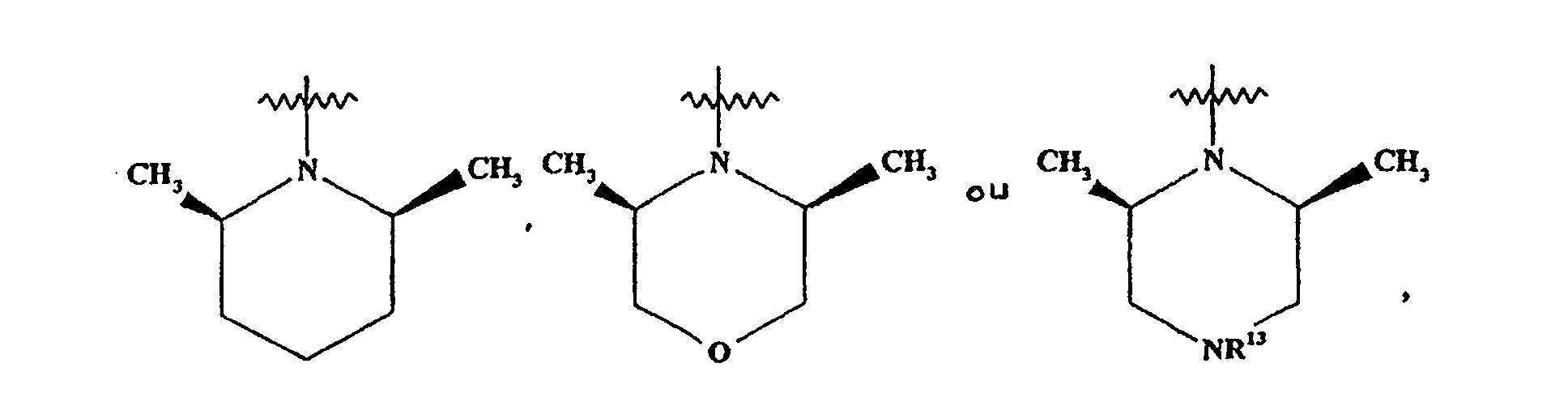
- G is (CH 2 ) 2 NR 5 R 6 , where NR 5 R 6 is piperidino, morpholino, piperazino, where R 13 is H, COCH 3 , CH 3 , or CONHCH(CH 3 ) 2 .
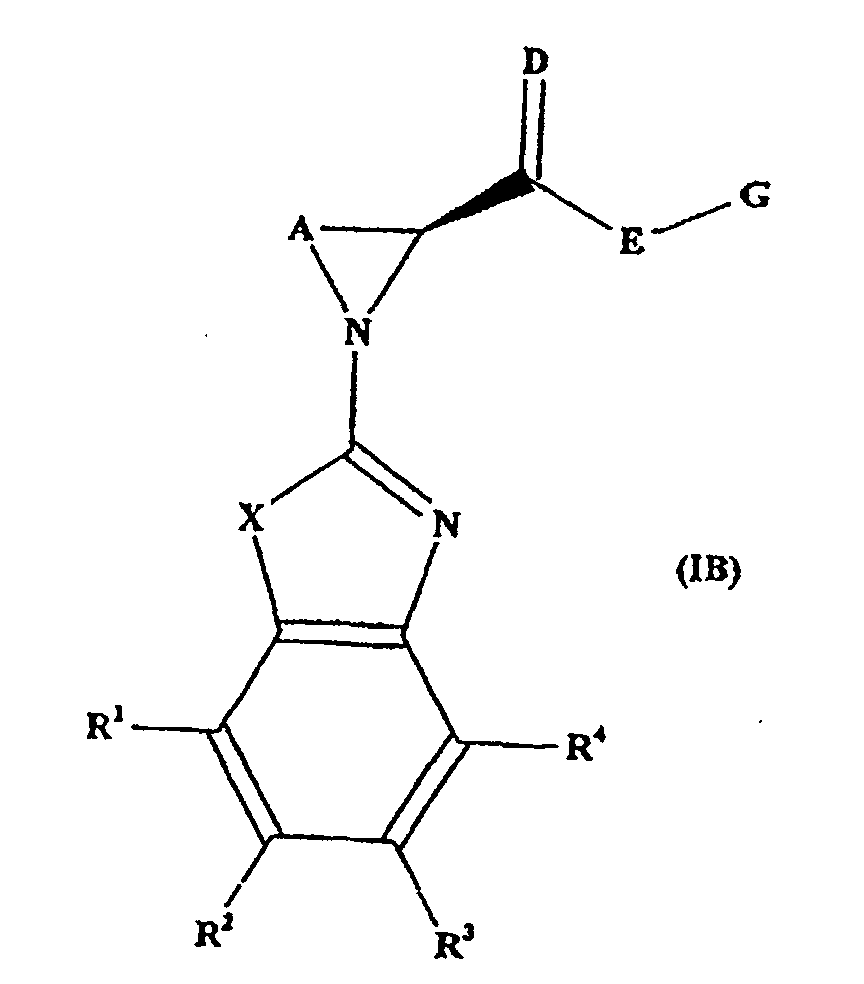
- the compounds have the stereochemistry shown in formula (IB) below.
- a preferred group of substances are those where the substituents X, A, D, E, G, R 1 , R 2 , R 3 and R 4 have the values found in the Examples below, and the stereochemistry is as shown above in formula (IB).
- the most preferred group of substances are the compounds of the Examples below and their salts and solvates.
- Particularly preferred substances are the compounds of Examples 3, 10, 11, 12 16, 17, 18, 19, 20, 22, 27 and 31, and the salts and solvates thereof.
- the compounds of the formula (I) can be prepared by a number of methods using conventional procedures such as by the following illustrative methods, and suitable adaptation thereof. Such methods are a further aspect of the invention.
- All the compounds of formula (I) can be made via reaction of a compound of the formula (II) (including regioisomers thereof (IIA) where appropriate) below where X 1 is O, S, N(C 1-6 alkyl) or N(APG), where "APG” is an amino-protecting group which can be readily removed to give the corresponding NH compound, and L 1 is a suitable leaving moiety such as Cl, Br, I, SH, SCH 3 , SO 2 CH 3 , SO 2 CF 3 , OSO 2 CH 3 or OSO 2 CF 3 , with a compound of formula (III) below.
- X 1 is O, S, N(C 1-6 alkyl) or N(APG)
- APG is an amino-protecting group which can be readily removed to give the corresponding NH compound
- L 1 is a suitable leaving moiety such as Cl, Br, I, SH, SCH 3 , SO 2 CH 3 , SO 2 CF 3 , OSO 2 CH 3 or OSO 2 CF
- amino-protecting groups are well-known to the skilled chemist and are exemplified in "Protecting Groups in Organic Synthesis” by TW Greene and PGM Wuts, John Wiley & Sons Inc., 1991, herein incorporated by reference.
- the amino-protecting group is the t -butyloxycarbonyl (“Boc”) group, which can be readily removed either in situ during the course of the reaction between (II) and (III) above, or by later treatment with trifluoroacetic acid (TFA), in a suitable solvent such as dichloromethane.
- the reaction is carried out by heating the subtrates (II) (including regioisomers (IIA) thereof where appropriate) and (III) together in a suitable organic solvent such as dimethylacetamide, to a temperature in the range 25-200°C, preferably around 80°C, optionally in the presence of a base such as triethylamine or diisopropylethylamine, also optionally in the presence of a metal such as copper.
- a suitable organic solvent such as dimethylacetamide
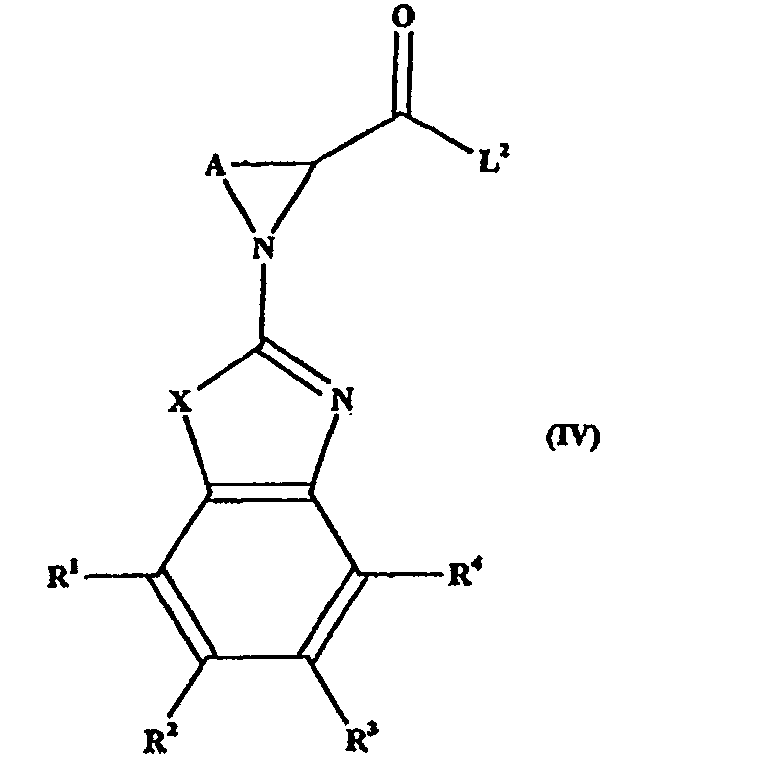
- Examples of such activated esters can be derived from the parent acid (TV; L 2 is OH), for example by reaction with a hydroxybenzotriazole-type reagent such as 1-hydroxybenzotriazole, and a carbodiimide reagent such as 1-(3-dimethylaminopropyl)-3-ethylcarbodiimide.
- a hydroxybenzotriazole-type reagent such as 1-hydroxybenzotriazole
- a carbodiimide reagent such as 1-(3-dimethylaminopropyl)-3-ethylcarbodiimide.
- hydroxybenzotriazole based reagents which can be used by themselves are benzotriazol-1-yloxytris(dimethylamino)-phosphonium hexafluorophosphate and O-(1H-benzotriazol-1-yl)-N,N,N',N'-tetramethyluronium tetrafluoroborate.
- L 2 include the moieties derived from reaction of (IV; L 2 is OH) with pentafluorophenol and N-hydroxysuccinimide.
- L 2 moieties can be used which make compounds of formula (IV) a mixed anhydride and examples include the compounds derived from reaction of compounds of formula (IV; L 2 is OH) with reagents such as isobutylchloroformate and bis(2-oxo-3-oxazolidinyl)phosphinic chloride. Additionally, L 2 can be imidazolyl, such compounds being derived from reaction of compounds of formula (IV; L 2 is OH), with N,N'-carbonyldiimidazole.
- reaction of compounds of formula (IV) with compounds of formula G-E-H is suitably carried out in a suitable solvent in the presence of an optional base, such as N-methylmorpholine.
- compounds of the formula (I), where X is O or S, D is O and E is O, NH or N(C 1-6 alkyl), may be prepared by directly heating together compounds of the formula (IV) (including tautomers thereof where appropriate), for example where L 2 is OH, with compounds of the formula G-E-H, where E is O, NH or N(C 1-6 alkyl), optionally in the presence of a catalyst, such as a suitable acid or base, and optionally in an appropriate solvent.
- a catalyst such as a suitable acid or base
- compounds of formula (I) where X is NH can be made via reaction of a compound of formula (IVA) or (IVB): where X 2 is N-APG, where APG is defined as for Method 1 above.
- Compounds of the formula (I) where E is CR 11 R 12 can be prepared by reaction of a compound of the formula (IV) (including tautomers thereof where appropriate) as defined above, with an organometallic species M n CR 11 R 12 G, where n is 1 or less, depending on the valence of the metallic species M.
- M can be a single metal or a combination of metals, optionally with other ligands such as halides (e.g. Grignard-type reagents).
- An example of this type of reaction is where L 2 is a halide, M is CuLi and n is 0.5. This type of reaction is described in "Advanced Organic Chemistry" by J.March, 3rd edition, Wiley Interscience in sections 0-106 and 0-107 and the references therein, herein incorporated by reference.
- a suitable reagent for carrying out such a transformation is 2,4-bis(4-methoxyphenyl)-1,3,2,4-dithiadiphosphetane-2,4-disulphide (Lawesson's reagent).
- Lawesson's reagent 2,4-bis(4-methoxyphenyl)-1,3,2,4-dithiadiphosphetane-2,4-disulphide
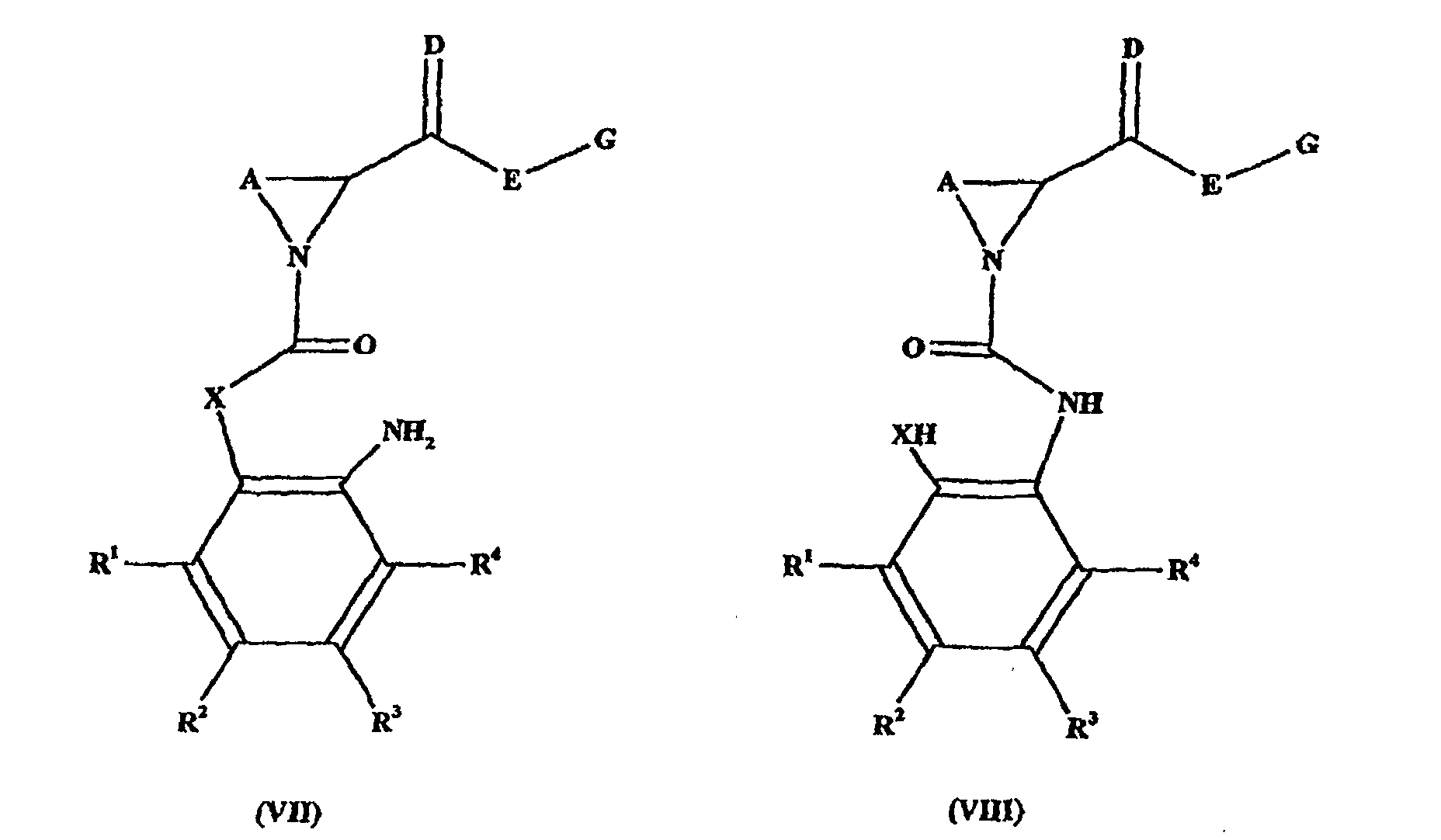
- reaction in some circumstances, i.e. specific substituents, solvents, bases, reaction conditions, etc., will proceed directly to give the compound of formula (I). In other circumstances the formation may proceed in a stepwise manner via intermediates of formulae (VII) or (VIII), or salts thereof: which may be stable and isolatable.
- Certain of the subtances of the invention may be interconverted into other substances of the invention by conventional functional group interconversion methods.
- reaction steps outlined herein could result in racemisation at certain sensitive stereochemical centres, if present.
- the compound with the desired stereochemistry may be made for example by subsequent resolution using conventional methods such as by chiral HPLC, or by instead carrying out the relevant transformation in a manner which does not lead to racemisation, for example by use of a chiral auxiliary in the reactant.
- a pharmaceutically acceptable salt of a compound of the formula (I) may be readily prepared by mixing together solutions of a compound of the formula (I) and the desired acid or base, as appropriate.
- the salt may precipitate from solution and be collected by filtration or may be recovered by evaporation of the solvent.
- the affinity of the compounds of the formula (I) for FKBP-12 can be determined in vitro in a coupled colorimetric PPIase assay using similar procedures to published methods (e.g. see Kofron, J.L., et al ., Biochemistry, 1991, 30, 6127-6134, Zarnt, T., et al ., Biochem. J. 1995, 305, 159-164, Holt, D.A., et al ., J. Am. Chem. Soc., 1993, 115, 9925-9938).
- the cis-trans isomerisation of a hydrophobic amino acid-proline bond in a tetrapeptide substrate e.g.
- the phenylalanine-proline bond in N-succinyl-ala-phe-pro-phe-p-nitroanilide can be determined by monitoring cleavage of pNA from the transPro-containing peptide by an excess of chymotrypsin.
- IC 50 the concentration of the compound of the formula (I) producing 50% inhibition
- Assay buffer 2.175ml
- 50mM 4-(2-hydroxyethyl)-1-piperazineethanesulphonic acid (HEPES) 100mM NaCl, 1mM dithiothreitol (DTT), pH 8.0
- HEPES 4-(2-hydroxyethyl)-1-piperazineethanesulphonic acid
- DTT dithiothreitol
- K i,app (the apparent inhibition constant) was determined for the present compounds using the assay procedure described below.
- Assay buffer (2.175ml) (50mM HEPES, 100mM NaCl, 1mM DTT, pH 8.0) is equilibrated to 10°C in a cuvette. 12.5 ⁇ l of a solution of the present compound in DMSO, 250 ⁇ l of a 60mg/ml solution of ⁇ -chymotrypsin in 1mM aqueous hydrochloric acid and then 50 ⁇ L of a solution of human recombinant FKBP-12 (1.5 ⁇ M) in assay buffer are added and mixed.
- the reaction is initiated by adding 12.5 ⁇ l of a solution of anhydrous succinyl-AFPF-pNA (100 ⁇ M final concentration) in a 400mM solution of LiCl in trifluoroethanol
- the absorbance at 390nM is monitored for 3 minutes collecting data every 0.5 second.
- Data are fitted with a first order rate equation with offset and the initial velocity (v) is calculated from the concentration of cis ( re leu-pro bond)-succinyl-AFPF-pNA at t o and the first order rate constant at different inhibitor concentrations (I).
- [I] are fitted with an equation for reversible tight binding inhibition to generate values for K i,app (see Morrison, J.F., et al , Comments Mol. Cell Biophys., 1985, 2, 347-368). This analysis is used when the K i,app approaches the concentration of FKBP-12 in the assay (30nM).
- Dixon analysis (see Dixon, M., Biochem. J.,1953, 55, 170-171) is used for generating values of K i,app for less potent compounds.
- the neurite outgrowth promoting activity of the compounds of the formula (I), without proviso, can be determined in explant cultures of embryonic chick dorsal root ganglia.
- Dorsal root ganglia DDG are isolated aseptically according to the method of Bray (see “Culturing Nerve Cells", Ed. G.Banker and K. Goslin, MIT Press, Cambridge, MA, 1991, p.119).
- the individual ganglia were kept in Ca 2+ /Mg 2+ - free Tyrodes buffer on ice until a number of ganglia had been collected.
- An alternative system for measuring neurite outgrowth promoting activity of FKBP-12 PPIase inhibitors is the SH-SY-5Y neuroblastoma model described by Gold, B.G., et al , in Exp. Neurol. ,1997, 147(2), 269-278.
- Cells are maintained in Dulbecco's Modified Eagle's Medium (DMEM) supplemented with 10% foetal calf serum (FCS), 50U/ml penicillin, 50 ⁇ g/ml streptomycin at 37°C in a 7% CO 2 atmosphere.
- DMEM Dulbecco's Modified Eagle's Medium
- FCS foetal calf serum
- 50U/ml penicillin
- streptomycin 50 ⁇ g/ml streptomycin
- the neurotrophic activity of the present substances can be evaluated in vivo using the sciatic nerve crush model in rat as a model for peripheral nerve regeneration (see Bridge, P.M., et al . , Experimental Neurology, 1994, 127, 284-290, Medinaceli, L., et al ., Expl. Neurology, 1982, 77, 634-643, Gold, B.G., et al ., Restorative Neurology and Neuroscience, 1994, 6, 287-296), the 1-methyl-4-phenyl-1,2,3,6-tetrahydropyridine (MPTP) and 6-hydroxydopamine models in various species as a model for regeneration in Parkinson's disease (see Mokry, J., Physiol.
- the substances of the invention can be administered alone but will generally be administered in admixture with a suitable pharmaceutical excipient diluent or carrier selected with regard to the intended route of administration and standard pharmaceutical practice.
- the substances of the invention can be administered orally or sublingually in the form of tablets, capsules, ovules, elixirs, solutions or suspensions, which may contain flavouring or colouring agents, for immediate or controlled release applications.
- Such tablets may contain excipients such as microcrystalline cellulose, lactose, sodium citrate, calcium carbonate, dicalcium phosphate and glycine, disintegrants such as starch (preferably corn, potato or tapioca starch), alginic acid and certain complex silicates, and granulation binders such as polyvinylpyrrolidone, sucrose, gelatin and acacia.
- excipients such as microcrystalline cellulose, lactose, sodium citrate, calcium carbonate, dicalcium phosphate and glycine
- disintegrants such as starch (preferably corn, potato or tapioca starch), alginic acid and certain complex silicates
- granulation binders such as polyvinylpyrrolidone, sucrose, gelatin and acacia.
- lubricating agents such as magnesium stearate, sodium lauryl sulfate and talc may be included.
- Solid compositions of a similar type may also be employed as fillers in gelatin capsules.
- Preferred excipients in this regard include lactose or milk sugar as well as high molecular weight polyethylene glycols.
- the substances of the invention may be combined with various sweetening or flavouring agents, colouring matter or dyes, with emulsifying and/or suspending agents and with diluents such as water, ethanol, propylene glycol and glycerin, and combinations thereof.
- the substances of the invention can also be injected parenterally, for example, intravenously, intraperitoneally, intrathecally, intraventricularly, intrasternally, intracranially, intramuscularly or subcutaneously, or they may be administered by infusion techniques. They are best used in the form of a sterile aqueous solution which may contain other substances, for example, enough salts or glucose to make the solution isotonic with blood.
- aqueous solutions should be suitably buffered (preferably to a pH of from 3 to 9), if necessary.
- suitable parenteral formulations under sterile conditions is readily accomplished by standard pharmaceutical techniques well-known to those skilled in the art.
- the daily dosage level of the substances of the invention will usually be from 1 ⁇ g/kg to 25 mg/kg (in single or divided doses).
- tablets or capsules of the may contain from 0.05 mg to 1.0 g of active substance for administration singly or two or more at a time, as appropriate.
- the physician in any event will determine the actual dosage which will be most suitable for any individual patient and it will vary with the age, weight and response of the particular patient.
- the above dosages are exemplary of the average case. There can, of course, be individual instances where higher or lower dosage ranges are merited and such are within the scope of this invention.
- the substances of the invention can also be administered intranasally or by inhalation and are conveniently delivered in the form of a dry powder inhaler or an aerosol spray presentation from a pressurised container or a nebuliser with the use of a suitable propellant, e.g. dichlorodifluoromethane, trichlorofluoromethane, dichlorotetrafluoroethane, a hydrofluoroalkane such as 1,1,1,2-tetrafluoroethane (HFA 134A [trade mark] or 1,1,1,2,3,3,3-heptafluoropropane (HFA 227EA [trade mark]), carbon dioxide or other suitable gas.
- a suitable propellant e.g. dichlorodifluoromethane, trichlorofluoromethane, dichlorotetrafluoroethane, a hydrofluoroalkane such as 1,1,1,2-tetrafluoroethane (HFA 134A [
- the dosage unit may be determined by providing a valve to deliver a metered amount.
- the pressurised container or nebuliser may contain a solution or suspension of the active compound, e.g. using a mixture of ethanol and the propellant as the solvent, which may additionally contain a lubricant, e.g. sorbitan trioleate.
- a lubricant e.g. sorbitan trioleate.
- Capsules and cartridges (made, for example, from gelatin) for use in an inhaler or insufflator may be formulated to contain a powder mix of a substance of the invention and a suitable powder base such as lactose or starch.
- Aerosol or dry powder formulations are preferably arranged so that each metered dose or "puff' contains from 20 ⁇ g to 20 mg of a substance of the invention for delivery to the patient.
- the overall daily dose with an aerosol will be in the range of from 20 ⁇ g to 20 mg which may be administered in a single dose or, more usually, in divided doses throughout the day.
- the substances of the invention can be administered in the form of a suppository or pessary, or they may be applied topically in the form of a lotion, solution, cream, ointment or dusting powder.
- the substances of the invention may also be transdermally administered by the use of a skin patch. They may also be administered by the ocular route, particularly for treating neurological disorders of the eye.
- the substances can be formulated as micronised suspensions in isotonic, pH adjusted, sterile saline, or, preferably, as solutions in isotonic, pH adjusted, sterile saline, optionally in combination with a preservative such as a benzylalkonium chloride.
- a preservative such as a benzylalkonium chloride.
- they may be formulated in an ointment such as petrolatum.
- the substances of the invention can be formulated as a suitable ointment containing the active compound suspended or dissolved in, for example, a mixture with one or more of the following: mineral oil, liquid petrolatum, white petrolatum, propylene glycol, polyoxyethylene polyoxypropylene compound, emulsifying wax and water.
- they can be formulated as a suitable lotion or cream, suspended or dissolved in, for example, a mixture of one or more of the following: mineral oil, sorbitan monostearate, a polyethylene glycol, liquid paraffin, polysorbate 60, cetyl esters wax, cetearyl alcohol, 2-octyldodecanol, benzyl alcohol and water.
- the substances of the invention can also be administered together with other neurotrophic agents such as neurotrophic growth factor (NGF), glial derived growth factor, brain derived growth factor, ciliary neurotrophic factor and/or neurotrophin-3.
- neurotrophic growth factor NGF
- glial derived growth factor glial derived growth factor
- brain derived growth factor glial derived growth factor
- ciliary neurotrophic factor ciliary neurotrophic factor and/or neurotrophin-3.
- the dosage level of the neurotrophic agent will depend upon the neurotrophic effectiveness of the combination and the route of administration used.
- N-methylmorpholine (0.085ml) was added to a solution of (2 S )-1-(1,3-benzoxazol-2-yl)-2-piperidinecarboxylic acid (95.5mg) [see Preparation 3], hydroxybenzotriazole hydrate (89.0mg), 2-piperidinoethylamine(50mg) [see J. Chem. Soc, (1935), 1421-1426] and 1-(3-dimethylaminopropyl)-3-ethylcarbodiimide hydrochloride (140mg) in dichloromethane (20ml).
- the reaction mixture was stirred at room temperature for 18 hours, after which time the mixture was diluted with water and the organic layer was separated, dried over magnesium sulphate and the solvent removed under reduced pressure.
- the crude product was purified by coloumn chromatography on silica gel eluting with a solvent gradient of 4 : 1 : 0, changing to 0 : 95 : 5, by volume, hexane : ethyl acetate : 0.88 aqueous ammonia solution solution to afford (2 S )-1-(1,3-benzoxazol-2-yl)- N 2 -(2-piperidinoethyl)-2-piperidinecarboxamide (109mg) as a white solid.
- Trifluoroacetic acid (10ml) was added to a solution of tert -butyl (cis)-4-[2-([(2 S )-1-(1,3-benzoxazol-2-yl)-2-piperidinyl]carbonylamino)ethyl]-3,5-dimethyl-1-piperazinecarboxylate (0.95g) [see Preparation 8] in dichloromethane (10ml) at 0°C.
- the reaction mixture was then stirred at room temperature for 1.5hours, after which time the solvent was removed under reduced pressure and the residue partitioned between saturated potassium carbonate solution and ethyl acetate. The organic layer was separated, dried over magnesium sulphate and the solvent removed under reduced pressure.
- Acetyl chloride (0.018ml) was added to a solution of (2 S )-1-(1,3-benzoxazol-2-yl)- N 2 -2-[(cis)-2,6-dimethyl-1-piperazinyl]ethyl-2-piperidinecarboxamide (0.1g) [see Example 8] and potassium carbonate (36mg) in acetonitrile (2ml).
- the reaction mixture was stirred at room temperature for 2 hours, after which time the solvent was removed under reduced pressure and the residue partitioned between ethyl acetate and water. The organic layer was separated, dried over magnesium sulphate and the solvent removed under reduced pressure.
- the title compound was prepared by a similar method to Example 1 from (2 S )-1-(1,3-benzoxazol-2-yl)-2-piperidinecarboxylic acid [see Preparation 3] and 2-(3,5-dimethylmorpholino)ethylamine [see Preparation 12].
- the crude product was purified by column chromatography on silica gel eluting with a solvent gradient of 100 : 0 changing to 95 : 5, by volume, dichloromethane : methanol to afford (2 S )-1-(1,3-benzoxazol-2-yl)- N 2 -[2-(3,5-dimethylmorpholino)ethyl]-2-piperidinecarboxamide as a solid.
- N-Ethyldiisopropylamine (6.52ml) was added to a solution of (2 S )-2-(methoxycarbonyl)piperidinium chloride (3.057g) [see Preparation 1] and 2-chlorobenzoxazole (2.13ml) in acetonitrile (50ml).
- the reaction mixture was stirred at room temperature for 18hours and then at 50°C for a further 2 hours.
- the solvent was removed under reduced pressure and the residue partitioned between ethyl acetate and water, the organic layer was separated, dried over magnesium sulphate and the solvent removed under reduced pressure.
- Aqueous lithium hydroxide solution (1N, 51ml) was added to a solution of methyl (2 S )-1-(1,3-benzoxazol-2-yl)-2-piperidinecarboxylate (8.987g) [see Preparation 2] in methanol (306ml) at 0°C.
- the reaction mixture was stirred at room temperature for 18hours, after which time the solvent was removed under reduced pressure and the residue partitioned between ethyl acetate and water.
- N-methylmorpholine (0.47ml) was added to a solution of (2 S )-1-(1,3-benzoxazol-2-yl)-2-piperidinecarboxylic acid (352.6mg) [see Preparation 3], hydroxybenzotriazole hydrate (338.4mg), N-benzyloxycarbonyl-1,2-diaminoethane hydrochloride (499.5mg) and 1-(3-dimethylaminopropyl)-3-ethylcarbodiimide hydrochloride (552.7mg) in dichloromethane (15ml).
- the reaction mixture was stirred at room temperature for 18hours, after which time the mixture was diluted with water and the organic layer was separated, dried over magnesium sulphate and the solvent removed under reduced pressure.
- the crude product was purified by coloumn chromatography on silica gel eluting with a solvent gradient of 1 : 1, changing to 1 : 9, by volume, hexane : ethyl acetate to afford benzyl N -[2-([(2 S )-1-(1,3-benzoxazol-2-yl)-2-piperidinyl]carbonylamino)ethyl]carbamate (550mg) as an oil.
- the title compound was prepared by a similar method to Preparation 6 from 3,5-dimethyl-1,4-oxazinan-4-ium chloride [see Preparation 10] and N(2-bromoethyl) phthalimide.
- the crude product was purified by column chromatography on silica gel eluting with a solvent system of 8 : 1, by volume, hexane : ethyl acetate to afford 2-[2-(3,5-dimethylmorpholino)ethyl]-1 H -isoindole-1,3(2 H )-dione (455mg) as an oil.
- the crude product was purified by column chromatography on silica gel eluting with a solvent gradient of 100 : 0 changing to 92 : 8, by volume, dichloromethane : methanol/0.88 aqueous ammonia solution (20/1), in 1% increments to afford tert -butyl (2 S )-2-[(2-[(cis)-2,6-dimethyl-1-piperidinyl]ethylamino)carbonyl]-1-piperidinecarboxylate as an oil.
- Di-tert-butyldicarbonate (593mg) was added to a solution of 2-chloro-5-(trifluoromethyl)-1 H -1,3-benzimidazole (500mg) [see JP 02306916 A2 901220] in acetonitrile (5ml), and dimethylaminopyridine (27mg) was then added.
- reaction mixture was stirred for 10minutes at room temperature, after which time the solvent was removed under reduced pressure and the residue purified by column chromatography on silica gel eluting with a solvent gradient of 100 : 0 changing to 85 : 15, by volume, hexane : ethyl acetate, in 5% increments, to afford tert -butyl 2-chloro-5-(trifluoromethyl)-1 H -1,3-benzimidazole-1-carboxylate (678mg) as a gum, as a 1 : 1 mixture of regioisomers.
- the title compound was prepared by a similar method to Preparation 2 from 2-chloro-5-methyl-1,3-benzoxazole [see J.Med.Chem, 1988, 31, 1719-1728] and (2 S )-2-[(benzyloxy)carbonyl]piperidinium chloride [see EP 530167 A1 930303].
- the crude product was purified by column chromatography on silica gel eluting with a solvent gradient of 90 : 10 changing to 70 : 30, by volume, hexane : ethyl acetate to afford benzyl (2 S )-1-(5-methyl-1,3-benzoxazol-2-yl)-2-piperidinecarboxylate as an oil.
- Benzyl (2 S )-1-(5-methyl-1,3-benzoxazol-2-yl)-2-piperidinecarboxylate (0.19g) [see Preparation 17] was dissolved in ethanol (5ml) and 10% palladium on carbon (0.05g) was added. The reaction mixture was hydrogenated at 15psi for 3hours at room temperature, after which time 10% palladium on carbon (25mg) was added and the mixture was hydrogenated for a further 1hr, the catalyst was then filtered off through a plug of arabocel and washed with ethanol.
- the title compound was prepared by a similar method to Preparation 2 from (2 S )-2-(ethoxycarbonyl)piperidinium chloride [see J. Am. Chem. Soc. (1993), 115, 9925-9938] and 2-chloro-5-fluoro-1,3-benzoxazole [see J. Med. Chem. (1988), 31, 1719-1728].
- the crude product was purified by column chromatography on silica gel eluting with a solvent system of 3 : 1, by volume, hexane : ethyl acetate, to afford ethyl (2 S )-1-(5-fluoro-1,3-benzoxazol-2-yl)-2-piperidinecarboxylate as an oil.
- the title compound was prepared by a similar method to Preparation 3 from ethyl (2 S )-1-(5-fluoro-1,3-benzoxazol-2-yl)-2-piperidinecarboxylate [see Preparation 19] and 1N aqueous lithium hydroxide to afford (2 S )-1-(5-fluoro-1,3-benzoxazol-2-yl)-2-piperidinecarboxylic acid as a solid.
- the crude product was purified by column chromatography on silica gel eluting with a solvent gradient of 90 : 10 changing to 85 : 15, by volume, hexane : ethyl acetate to afford tert -butyl 2-chloro-5-methoxy-1 H -1,3-benzimidazole-1-carboxylate (470mg) as an off-white solid, as a 1 : 1 mixture of regioisomers.
- the title compound was prepared by a similar method to Preparation 21 from 2-chloro-6-fluoro-1 H -1,3-benzimidazole [see JP 62061978 A2 870318. Showa, and references cited within].
- the crude product was purified by column chromatography on silica gel eluting with a solvent gradient of 100 : 0 changing to 90 : 10, by volume, hexane: ethyl acetate to afford tert -butyl 2-chloro-6-fluoro-1 H -1,3-benzimidazole-1-carboxylate as a white solid, as a 1 : 1 mixture of regioisomers.
- the title compound was prepared by a similar method to Preparation 21 from 2,6-dichloro-1 H -1,3-benzimidazole [see US, 44pp. cont.-in-part of US 5,248, 672. CODEN : USXXAM, US 5574058 A 961112].
- the crude product was purified by column chromatography on silica gel eluting with a solvent gradient of 100 : 0 changing to 80 : 20, by volume, hexane : ethyl acetate in 5% increments to afford tert -butyl 2,6-dichloro-1 H -1,3-benzimidazole-1-carboxylate as a solid, as a 1 : 1 mixture of regioisomers.
- 1,1'-Carbonyldiimidazole (13.6g) was added to a solution of 2-amino-4-iodophenylamine (13.2g) [see Makromol. Chem. (1993), 194(3), 859-868] in tetrahydrofuran (100ml). The reaction mixture was stirred for 18hours at room temperature, after which time the solvent was removed under reduced pressure, and the residue partitioned between 1N aqueous sodium hydroxide and diethyl ether.
- the title compound was prepared by a similar method to Preparation 21 from 2-chloro-6-iodo-1 H -1,3-benzimidazole [see Preparation 25].
- the crude product was purified by column chromatography on silica gel eluting with a solvent system of 95 : 5, by volume, hexane : ethyl acetate to afford tert -butyl 2-chloro-6-iodo-1 H -1,3-benzimidazole-1-carboxylate as a white solid, as a 1 : 1 mixture of regioisomers.
- the title compound was prepared by a similar method to Preparation 2 from (2 S )-2-[(benzyloxy)carbonyl]piperidinium chloride [see EP 530167 A1 930303] and 2,5-dichloro-1,3-benzoxazole [see J.O.C. (1996), 61(10), 3289-3297].
- the crude product was purified by column chromatography on silica gel eluting with a solvent system of 95 : 5, by volume, hexane : ethyl acetate to afford benzyl (2 S )-1-(5-chloro-1,3-benzoxazol-2-yl)-2-piperidinecarboxylate as an oil.
- the title compound was prepared by a similar method to Preparation 3 from benzyl (2 S )-1-(5-chloro-1,3-benzoxazol-2-yl)-2-piperidinecarboxylate [see Preparation 28] and 1N aqueous lithium hydroxide solution to afford (2 S )-1-(5-chloro-1,3-benzoxazol-2-yl)-2-piperidinecarboxylic acid as an oil.
- the title compound was prepared by a similar method to Preparation 3 from benzyl (2 S )-1-[5-(trifluoromethyl)-1,3-benzoxazol-2-yl]-2-piperidinecarboxylate [see Preparation 30] and 1N aqueous lithium hydroxide solution to afford (2 S )-1-[5-(trifluoromethyl)-1,3-benzoxazol-2-yl]-2-piperidinecarboxylic acid as an oil.
- the title compound was prepared by a similar method to Preparation 21 from 2-chlorobenzimidazole and di- t -butyl dicarbonate.
- the crude product was purified by column chromatography on silica gel eluting with a solvent gradient of 100 : 0 changing to 90 : 10, by volume, hexane : ethyl acetate to afford tert -butyl 2-chloro-1 H -benzimidazole-1-carboxylate as an oil.
- Triethylamine (1.48ml) was added to a suspension of 2-chloro-1,3-benzoxazol-6-ol (1.63g) [see Preparation 34] in dichloromethane (20ml), and after 5minutes acetic anhydride (1.01ml) was added. The reaction mixture was stirred at room temperature for 18hours, after which time the solvent was removed under reduced pressure.
- the title compound was prepared by a similar method to Preparation 2 from (2 S )-2-[(benzyloxy)carbonyl]piperidinium chloride [see EP 530167 A1 930303] and 2-chloro-1,3-benzoxazol-6-yl acetate [see Preparation 35].
- the crude product was purified by column chromatography on silica gel eluting with a solvent gradient of 80 : 10 changing to 40 : 10, by volume, hexane : ethyl acetate to afford benzyl (2 S )-1-[6-(acetyloxy)-1,3-benzoxazol-2-yl]-2-piperidinecarboxylate as a gum.
- the crude product was purified by column chromatography on silica gel eluting with a solvent gradient of 100 : 0 : 0 ,changing to 99.4:1.4: 0.2, by volume, dichloromethane : methanol: 0.88 aqueous ammonia solution, to afford 2-[(2 S )-2-[(2-[(cis)-2,6-dimethyl-1-piperidinyl]ethylamino)carbonyl]-1-piperidinyl]-1,3-benzoxazol-6-yl acetate as a white foam.
- 2,4,4,6-Tetrabromo-2,5-cyclohexadien-1-one (4.7g) was added to a solution of methyl (2 S )-1-(1,3-benzoxazol-2-yl)-2-piperidinecarboxylate (3.0g) [see Preparation 2] in dichloromethane (60ml) at -10°C over a period of 10mins. The reaction mixture was then warmed to room temperature and diluted with dichloromethane.
- the title compound was prepared by a similar method to Preparation 3 from methyl (2 S )-1-(6-isobutyl-1,3-benzoxazol-2-yl)-2-piperidinecarboxylate [see Preparation 41] and 1N aqueous lithium hydroxide solution, to afford (2 S )-1-(6-isobutyl-1,3-benzoxazol-2-yl)-2-piperidinecarboxylic acid as a foam.
- the reaction was cooled, the solvent removed at reduced pressure, and the residue dissolved in ethyl acetate and washed sequentially with 1M aqueous citric acid solution, saturated aqueous sodium hydrogen carbonate solution, brine, then dried over magnesium sulfate and the solvent removed at reduced pressure.
- the crude product was purified by column chromatography on silica gel eluting with a solvent gradient of 5 : 1, by volume, hexane: ethyl acetate to afford benzyl (2S) -1-[7-(methoxy)carbonyl-1,3-benzoxazol-2-yl]-2-piperidinecarboxylate (0.44g) as an orange gum.
- the title compound was prepared by a similar method to Preparation 2 from 2-chloro-5,6-dimethyl-1,3-benzoxazole [see J.Med. Chem. (1972), 15, 523-9] and (2S)-2-[(benzyloxy)carbonyl]piperidine [see EP 530167 A1 930303].
- the crude product was purified by column chromatography on silica gel eluting with a solvent gradient of 100 : 0 changing to 80 : 20, by volume, hexane : ethyl acetate to afford benzyl (2S) -1-[5,6-dimethyl-1,3-benzoxazol-2-yl]-2-piperidinecarboxylate as a yellow coloured solid.
Landscapes
- Chemical & Material Sciences (AREA)
- Organic Chemistry (AREA)
- Health & Medical Sciences (AREA)
- Medicinal Chemistry (AREA)
- Veterinary Medicine (AREA)
- Public Health (AREA)
- Pharmacology & Pharmacy (AREA)
- Life Sciences & Earth Sciences (AREA)
- Animal Behavior & Ethology (AREA)
- General Health & Medical Sciences (AREA)
- Engineering & Computer Science (AREA)
- Bioinformatics & Cheminformatics (AREA)
- Neurology (AREA)
- Nuclear Medicine, Radiotherapy & Molecular Imaging (AREA)
- General Chemical & Material Sciences (AREA)
- Epidemiology (AREA)
- Chemical Kinetics & Catalysis (AREA)
- Biomedical Technology (AREA)
- Neurosurgery (AREA)
- Physical Education & Sports Medicine (AREA)
- Psychology (AREA)
- Orthopedic Medicine & Surgery (AREA)
- Psychiatry (AREA)
- Hospice & Palliative Care (AREA)
- Pharmaceuticals Containing Other Organic And Inorganic Compounds (AREA)
- Plural Heterocyclic Compounds (AREA)
- Hydrogenated Pyridines (AREA)
- Glass Compositions (AREA)
- Nitrogen Condensed Heterocyclic Rings (AREA)
- Medicines That Contain Protein Lipid Enzymes And Other Medicines (AREA)
Abstract
Claims (49)
- Composé de formule (I) :ou un de ses sels pharmaceutiquement acceptables, ou bien un produit de solvatation de l'une ou l'autre entité, formule dans laquelle :
 X représente O, S, un groupe NH ou N(alkyle en C1 à C6) ;R1, R2, R3 et R4 représentent chacun, indépendamment, H, un groupe OH, OCO(alkyle en C1 à C6), CO2(alkyle en C1 à C6), CONH2, CONH(alkyle en C1 à C6), CON(alkyle en C1 à C6)2, halogéno, cycloalkyle en C3 à C7, cycloalkyloxy en C3 à C7, alcényle en C2 à C6, aryle, alkyle en C1 à C6 facultativement substitué avec un ou plusieurs substituants choisis entre des substituants halogéno et cycloalkyle en C3 à C7, et alkoxy en C1 à C6 facultativement substitué avec un ou plusieurs substituants choisis entre des substituants fluoro et cycloalkyle en C3 à C7 ;A représente un groupe alkylène en C3 à C5 non ramifié substitué avec jusqu'à trois groupes alkyle en C1 à C6 ;D représente O ou S ;E représente O, S, un groupe NH, N(alkyle en C1 à C6) ou CR11R12 ;G représente un groupe alkyle en C1 à C14 ou alcényle en C2 à C14, chacun étant facultativement substitué avec un ou plusieurs substituants choisis, indépendamment, entre des substituants halogéno, aryle, alkoxy en C1 à C4, cyclo-alkyle, het et NR5R6 ;R5 et R6 représentent chacun, indépendamment, H ou un groupe alkyle en C1 à C6, ou bien sont pris conjointement pour former, avec l'atome d'azote auquel ils sont fixés, un noyau hétérocyclique tétra- à heptagonal contenant facultativement un autre hétérogroupement choisi entre NR7, O et S(O)p, noyau hétérocyclique tétra- à heptagonal qui est facultativement substitué avec jusqu'à 3 substituants choisis indépendamment entre des substituants alkyle en C1 à C6 et alkoxy en C1 à C6 ;R7 représente H, un groupe alkyle en C1 à C6, alcényle en C2 à C6, COR8, SO2R8, CONR9R10, CO2R8 ou SO2NR9R10 ;R8 représente un groupe cycloalkyle en C3 à C7, alcényle en C2 à C6, aryle, ou alkyle en C1 à C6 facultativement substitué avec un substituant cycloalkyle en C3 à C7 ou aryle ;R9 et R10 représentent chacun, indépendamment, H, un groupe alcényle en C2 à C6, cycloalkyle en C3 à C7, ou alkyle en C1 à C6 facultativement substitué avec un substituant cyclo-alkyle en C3 à C7 ou aryle ;R11 et R12 représentent chacun, indépendamment, H, un groupe aryle, alcényle en C2 à C8 ou alkyle en C1 à C8, lesdits groupes alcényle en C2 à C8 et alkyle en C1 à C8 étant facultativement substitués avec un ou plusieurs substituants choisis indépendamment entre des substituants halogéno, NO2, alkyle en C1 à C6, alcényle en C2 à C6, cycloalkyle, OH, alkoxy en C1 à C6, alcényloxy en C2 à C6, phényloxy, benzyloxy, NH2, aryle et het ;p est égal à 0, 1 ou 2 ;le terme "aryle" désignant un groupe phényle ou naphtyle, chacun de ces groupes étant facultativement substitué avec jusqu'à 3 substituants choisis indépendamment entre des substituants alkyle en C1 à C6 facultativement substitué avec un ou plusieurs groupes halogéno ou cycloalkyle en C3 à C7, alcényle en C2 à C6, alkoxy en C1 à C6, alcényloxy en C2 à C6, OH, halogéno, NO2, phényloxy, benzyloxy, phényle et NH2 ;le terme "aryle" désigne un groupe phényle, naphtyle ou benzyle, chacun de ces groupes étant facultativement substitué avec 1 ou 2 substituants choisis indépendamment entre des substituants alkyle en C1 à C6 facultativement substitué avec un ou plusieurs groupes halogéno ou cycloalkyle en C3 à C7, alkoxy en C1 à C6 et halogéno ;le terme "cycloalkyle" désigne un groupe cycloalkyle en C3 à C8 facultativement substitué avec jusqu'à 3 substituants choisis indépendamment entre des substituants alcényle en C2 à C6, alkoxy en C1 à C6, alcényloxy en C2 à C6, OH, halogéno, et alkyle en C1 à C6 facultativement substitué avec un ou plusieurs substituants halogéno ;et le terme "het" désigne un hétérocycle monocyclique penta- ou hexagonal ou un hétérocycle bicyclique octa-, nonta- ou décagonal contenant 1 à 3 hétéroatomes choisis indépendamment entre O, N et S, qui est facultativement substitué avec jusqu'à 3 substituants choisis indépendamment entre des substituants alkyle en C1 à C6 facultativement substitué avec un ou plusieurs groupes halogéno ou cycloalkyle en C3 à C7, alcényle en C2 à C6, alkoxy en C1 à C6, alcényloxy en C2 à C6, OH, halogéno, NO2, phényloxy, benzyloxy et NH2 ;sous réserve que le composé ne soit pas la méthyl-1-(5-chloro-2-benzoxazolyl)proline.
 - Composé suivant la revendication 1, dans lequel X représente O ou un groupe NH.
- Composé suivant l'une quelconque des revendications précédentes, dans lequel au moins deux des groupes R1, R2, R3 et R4 représentent H.
- Composé suivant l'une quelconque des revendications précédentes, dans lequel R1 représente H, un groupe halogéno ou CO2(alkyle en C1 à C6).
- Composé suivant l'une quelconque des revendications précédentes, dans lequel R2 représente H, un groupe halogéno, cycloalkyle en C3 à C7, cycloalkyloxy en C3 à C7, alcényle en C2 à C6, alkyle en C1 à C6 facultativement substitué avec un ou plusieurs substituants choisis entre des substituants halogéno et cycloalkyle en C3 à C7, ou alkoxy en C1 à C6 facultativement substitué avec un ou plusieurs substituants choisis entre des substituants fluoro et cycloalkyle en C3 à C7.
- Composé suivant l'une quelconque des revendications précédentes, dans lequel R3 représente H, un groupe halogéno, cycloalkyle en C3 à C7, cycloalkyloxy en C3 à C7, alcényle en C2 à C6, alkyle en C1 à C6 facultativement substitué avec un ou plusieurs substituants choisis entre des substituants halogéno et cycloalkyle en C3 à C7, ou alkoxy en C1 à C6 facultativement substitué avec un ou plusieurs substituants choisis entre des substituants fluoro et cycloalkyle en C3 à C7.
- Composé suivant l'une quelconque des revendications précédentes, dans lequel X représente O ou un groupe NH, et R2 et R3 représentent chacun, indépendamment, H, un groupe halogéno ou CF3.
- Composé suivant l'une quelconque des revendications précédentes, dans lequel R4 représente H, un groupe halogéno ou alkyle en C1 à C6.
- Composé suivant l'une quelconque des revendications précédentes, dans lequel A représente un groupe alkylène en C3 à C5 non ramifié.
- Composé suivant l'une quelconque des revendications précédentes, dans lequel D représente O.
- Composé suivant l'une quelconque des revendications précédentes, dans lequel E représente un groupe NH.
- Composé suivant l'une quelconque des revendications précédentes, dans lequel G représente un groupe alkyle en C1 à C14 ou alcényle en C2 à C14, chacun étant mono- ou disubstitué avec des substituants choisis indépendamment entre des substituants het, aryle, cycloalkyle et NR5R6.
- Composé suivant l'une quelconque des revendications précédentes, qui a la stéréochimie représentée dans la formule (IB) ci-dessous :
- Composé suivant l'une quelconque des revendications précédentes, dans lequel R1 représente H ou un groupe CO2CH3.
- Composé suivant l'une quelconque des revendications 1 à 6 et 8 à 14, dans lequel R2 représente H, un groupe halogéno, alkyle en C1 à C6 facultativement substitué avec un ou plusieurs substituants choisis entre des substituants halogéno et cycloalkyle en C3 à C7, ou alkoxy en C1 à C6 facultativement substitué avec un ou plusieurs groupes cycloalkyle en C3 à C7.
- Composé suivant l'une quelconque des revendications 1 à 6 et 8 à 14, dans lequel R3 représente H, un groupe halogéno, alkyle en C1 à C6 facultativement substitué avec un ou plusieurs substituants choisis entre des substituants halogéno et cycloalkyle en C3 à C7, ou alkoxy en C1 à C6 facultativement substitué avec un ou plusieurs groupes cycloalkyle en C3 à C7.
- Composé suivant l'une quelconque des revendications précédentes, dans lequel R4 représente H ou un groupe CH3.
- Composé suivant l'une quelconque des revendications précédentes, dans lequel A représente un groupe (CH2)4.
- Composé suivant l'une quelconque des revendications précédentes, dans lequel G représente un groupe alkyle en C2 à C4 ou alcényle en C2 à C4, chacun de ces groupes étant monosubstitué en position terminale avec un substituant NR5R6.
- Composé suivant l'une quelconque des revendications 1 à 6 et 8 à 19, dans lequel R2 représente H, un groupe halogéno, alkyle en C1 à C4 facultativement substitué avec un ou plusieurs substituants halogéno, ou alkoxy en C1 à C4.
- Composé suivant l'une quelconque des revendications 1 à 6 et 8 à 20, dans lequel R3 représente H, un groupe halogéno, alkyle en C1 à C4 facultativement substitué avec un ou plusieurs substituants halogéno, ou alkoxy en C1 à C4.
- Composé suivant l'une quelconque des revendications précédentes, dans lequel G représente un groupe alkyle en C2 à C4 ou alcényle en C2 à C4, chacun de ces groupes étant substitué en position terminale avec un substituant NR5R6, dans lequel R5 et R6 représentent chacun, indépendamment, H ou un groupe alkyle en C1 à C6, ou bien sont pris conjointement pour former, avec l'atome d'azote auquel ils sont fixés, un noyau penta- à heptagonal contenant facultativement un autre hétérogroupement choisi entre NR7 et O, noyau qui est facultativement substitué avec jusqu'à 3 substituants choisis, indépendamment, entre des substituants alkyle en C1 à C6 et alkoxy en C1 à C6, et R7 représente H, un groupe alkyle en C1 à C6, COR8 ou CONR9R10.
- Composé suivant l'une quelconque des revendications 1 à 6 et 8 à 22, dans lequel R2 représente H, F, I, Br, Cl, un groupe CH3, C2H5, CH2CH(CH3)2, CF3, OCH3 ou OCH(CH3)2.
- Composé suivant l'une quelconque des revendications 1 à 6 et 8 à 23, dans lequel R3 représente H, F, I, Br, Cl, un groupe CH3, C2H5, CH2CH(CH3)2, CF3, OCH3 ou OCH(CH3)2.
- Composé suivant l'une quelconque des revendications précédentes, dans lequel G représente un groupe (CH2)mNR5R6, dans lequel m est égal à 2, 3 ou 4, et R5 et R6 représentent chacun H, ou bien sont pris conjointement pour former, avec l'atome d'azote auquel ils sont fixés, un noyau hexagonal contenant facultativement un autre hétérogroupement en position 4 par rapport à l'atome d'azote du noyau fixé directement au groupement (CH2)m, hétérogroupement qui est choisi entre NH, NCOCH3, NCH3, NCONHCH(CH3)2 et O, et noyau qui est facultativement substitué avec jusqu'à 2 substituants CH3 sur les atomes du noyau adjacents à l'atome d'azote du noyau fixé directement au groupement (CH2)m.
- Composé suivant l'une quelconque des revendications précédentes, dans lequel R2 représente H, F, Cl, Br, I ou un groupe CF3.
- Composé suivant l'une quelconque des revendications précédentes, dans lequel R3 représente H, F, Cl, Br, I ou un groupe CF3.
- Composé suivant l'une quelconque des revendications précédentes, dans lequel G représente un groupe (CH2)2NR5R6, dans lequel R5 et R6 représentent l'un et l'autre H ou bien sont pris conjointement pour former, avec l'atome d'azote auquel ils sont fixés, un noyau hexagonal contenant facultativement un autre hétérogroupement en position 4 par rapport à l'atome d'azote du noyau fixé directement au groupement (CH2)m, hétéro-groupement qui est choisi entre NH, NCOCH3, NCH3, NCONHCH(CH3)2 et O, et noyau qui est facultativement substitué avec jusqu'à 2 substituants CH3 sur les atomes du noyau adjacents à l'atome d'azote du noyau fixé directement au groupement (CH2)2.
- Composé suivant l'une quelconque des revendications précédentes, dans lequel G représente un groupe (CH2)2NR5R6, dans lequel NR5R6 représente un groupe pipéridino, morpholino, pipérazino,dans lequel R13 représente H, un groupe COCH3, CH3 ou CONHCH(CH3)2.
- Composé suivant la revendication 1, dans lequel les substituants X, A, D, E, G, R1, R2, R3 et R4 ont les valeurs indiquées dans les exemples, et la stéréochimie répond à la définition figurant dans la revendication 13.
- Composé suivant la revendication 1, qui est choisi parmi les composés des exemples et leurs sels et produits de solvatation.
- Composé suivant la revendication 1, qui est choisi parmi les composés des exemples 3, 10, 11, 12, 16, 17, 18, 19, 20, 22, 27 et 31 et leurs sels et produits de solvatation.
- Composition pharmaceutique comprenant un composé suivant l'une quelconque des revendications précédentes, conjointement avec un excipient, diluant ou support pharmaceutiquement acceptable, contenant également de manière facultative un autre agent neurotrope.
- Composé ou composition suivant l'une quelconque des revendications précédentes, destiné à être utilisé comme médicament.
- Utilisation d'un composé suivant l'une quelconque des revendications 1 à 32, sans réserve, pour la production d'un médicament destiné au traitement de la dégénérescence neuronale.
- Utilisation d'un composé suivant l'une quelconque des revendications 1 à 32, sans réserve, ou d'une composition le contenant, pour la production d'un médicament destiné à activer la régénération et la propagation neuronales.
- Utilisation d'un composé suivant l'une quelconque des revendications 1 à 32, sans réserve, pour la production d'un médicament destiné au traitement d'une maladie ou affection neurologique telle qu'une maladie neuro-dégénérative.
- Utilisation répondant à la définition suivant la revendication 37, dans laquelle la maladie ou l'affection neurologique est choisie dans le groupe consistant en la démence sénile (maladie d'Alzheimer) et d'autres démences, la sclérose latérale amyotrophique et d'autres formes de maladie neuronale motrice, la maladie de Parkinson, la maladie de Huntington, des déficiences neurologiques associées à un ictus, toutes les formes de maladie dégénérative atteignant le système nerveux central ou périphérique (par exemple les atrophies du cervelet-tronc cérébral, des syndromes d'ataxie progressive, toutes les formes de dystrophie musculaire, les atrophies musculaires progressives, l'atrophie musculaire bulbaire progressive, une altération physique ou traumatique du système nerveux central ou périphérique (par exemple de la moelle épinière, les syndromes provoqués par les disques intervertébraux comportant une hernie, une rupture ou un prolapsus, la spondylose cervicale, des troubles des plexus, des syndromes de traversée thoraco-cervico-branchiale, toutes les formes de neuropathie périphérique (diabétique et non diabétique), les névralgies du trijumeau, les névralgies glossopharyngées, la paralysie de Bell, toutes les formes de maladie de type auto-immun ayant pour résultat l'altération du système nerveux central ou périphérique (par exemple la sclérose en plaques, la myasthénie grave, le syndrome de Guillain-Barré), des troubles du système nerveux en rapport avec le SIDA, les tics provoqués par la dapsone, les affections bulbaires et rétrobulbaires du nerf optique (par exemple les rétinopathies et la névrite rétrobulbaire), des troubles de l'audition tels que les bourdonnements d'oreilles, et des maladies à prions.
- Utilisation répondant à la définition suivant la revendication 38, dans laquelle la maladie ou affection neurologique et la démence sénile (maladie d'Alzheimer) et une autres démence, la sclérose latérale amyotrophique et une autre forme de maladie neuronale motrice, la maladie de Parkinson, la maladie de Huntington, une déficience neurologique associée à un ictus, une altération physicotraumatique du système nerveux central ou périphérique (par exemple de la moelle épinière), une neuropathie périphérique (diabétique et non diabétique), la sclérose en plaques ou un trouble de l'audition tel que les bourdonnements d'oreilles.
- Procédé pour la préparation d'un composé de formule (I) ou d'un de ses sels ou produits de solvatation pharmaceutiquement acceptables répondant à la définition suivant la revendication 1, qui comprend la réaction d'un composé de formule (II) (y compris de ces régio-isomères (IIA) lorsque cela est approprié) ci-dessous, dans laquelle X1 représente O, S, un groupe N(alkyle en C1 à C6) ou N(APG), dans lequel le terme "APG" désigne un groupe protecteur de la fonction amino qui peut être aisément éliminé en donnant le composé à fonction NH correspondant, et L1 représente un groupement partant convenable tel qu'un groupement Cl, Br, I, SH, SCH3, SO2CH3, SO2CF3, OSO2CH3 ou OSO2CF3, avec un composé de formule (III) :dans laquelle, sauf spécification contraire, les substituants répondent aux définitions suivant la revendication 1.

- Procédé pour la préparation d'un composé de formule (I) ou d'un de ses sels ou produits de solvatation pharmaceutiquement acceptables répondant à la définition suivant la revendication 1, dans lequel X représente O ou S, D représente O et E représente O, S, un groupe NH ou N(alkyle en C1 à C6), qui comprend la réaction d'un composé de formuledans laquelle X représente O ou S et L2 représente un groupe partant convenable tel qu'un groupe azoture, mésylate, tosylate, OH, Cl, Br, I, etc., y compris dans laquelle le groupement COL2 est un ester activé convenable, avec un composé de formule G-E-H ou un de ses sels.
- Procédé pour la préparation d'un composé de formule (I) ou d'un de ses sels ou produits de solvatation pharmaceutiquement acceptables répondant à la définition suivant la revendication 1, dans lequel X représente un groupe NH, qui comprend la réaction d'un composé de formule (IVA) ou (IVB) :dans laquelle X2 représente un groupe N-APG, L2 représente un groupe partant convenable tel qu'un groupe azoture, mésylate, tosylate, OH, Cl, Br, I, etc., y compris dans laquelle le groupement COL2 est un ester activé convenable, avec un composé de formule G-E-H, ou un de ses sels.

- Procédé pour la préparation d'un composé de formule (I) ou d'un de ses sels ou produits de solvatation pharmaceutiquement acceptables répondant à la définition suivant la revendication 1, dans lequel E représente un groupe CR11R12, comprenant la réaction d'un composé de formule (IV), (IVA) ou (IVB) répondant à la définition suivant les revendications 41 et 42 avec une entité organo-métallique de formule MnCR11R12G.
- Procédé pour la préparation d'un composé de formule (I) ou un de ses sels ou produits de solvatation pharmaceutiquement acceptables répondant à la définition suivant la revendication 1, dans lequel D représente S, qui comprend la réaction d'un composé correspondant de formule (I) dans laquelle D représente O avec un agent nucléophile comprenant du soufre.
- Procédé pour la préparation d'un composé de formule (I) ou d'un de ses sels ou produits de solvatation pharmaceutiquement acceptables répondant à la définition suivant la revendication 1, qui comprend la réaction d'un composé de formule (V) avec un composé de formule (VI) :dans laquelle L3 représente un groupe partant convenable tel qu'un groupe Cl, Br ou I.

- Composé de formule (IV) répondant à la définition suivant la revendication 41, ou un de ses sels.
- Composé de formule (IVA) ou (IVB) répondant à la définition suivant la revendication 42, ou un de ses sels.
- Composé de formule (IVC) ou (IVD) :ou un de ses sels.

- Composé de formule (VII) ou (VIII) :dans laquelle les substituants répondent aux définitions suivant la revendication 1, ou un de ses sels.
Priority Applications (1)
| Application Number | Priority Date | Filing Date | Title |
|---|---|---|---|
| SI9930120T SI1098894T1 (en) | 1998-07-20 | 1999-07-01 | Fkbp inhibitors |
Applications Claiming Priority (3)
| Application Number | Priority Date | Filing Date | Title |
|---|---|---|---|
| GB9815696 | 1998-07-20 | ||
| GBGB9815696.1A GB9815696D0 (en) | 1998-07-20 | 1998-07-20 | Heterocyclics |
| PCT/IB1999/001227 WO2000005231A1 (fr) | 1998-07-20 | 1999-07-01 | Inhibiteurs de fkbp |
Publications (2)
| Publication Number | Publication Date |
|---|---|
| EP1098894A1 EP1098894A1 (fr) | 2001-05-16 |
| EP1098894B1 true EP1098894B1 (fr) | 2002-10-02 |
Family
ID=10835773
Family Applications (1)
| Application Number | Title | Priority Date | Filing Date |
|---|---|---|---|
| EP99926683A Expired - Lifetime EP1098894B1 (fr) | 1998-07-20 | 1999-07-01 | Inhibiteurs de fkbp |
Country Status (45)
Families Citing this family (10)
| Publication number | Priority date | Publication date | Assignee | Title |
|---|---|---|---|---|
| GB9815696D0 (en) * | 1998-07-20 | 1998-09-16 | Pfizer Ltd | Heterocyclics |
| GB9815880D0 (en) * | 1998-07-21 | 1998-09-16 | Pfizer Ltd | Heterocycles |
| GB0008939D0 (en) * | 2000-04-11 | 2000-05-31 | Glaxo Group Ltd | Process for preparing substituted benzimidazole compounds |
| IL155952A0 (en) | 2000-11-28 | 2003-12-23 | Wyeth Corp | Expression analysis of fkbp nucleic acids and polypeptides useful in the diagnosis and treatment of prostate cancer |
| US7186518B2 (en) * | 2003-11-21 | 2007-03-06 | Dade Behring Inc. | Method and composition useful for determining FK 506 |
| WO2009154754A2 (fr) * | 2008-06-17 | 2009-12-23 | Concert Pharmaceuticals, Inc. | Synthèse de dérivés de morpholine deutérés |
| DE102008060549A1 (de) | 2008-12-04 | 2010-06-10 | MAX-PLANCK-Gesellschaft zur Förderung der Wissenschaften e.V. | Wirkstoff-Peptid-Konstrukt zur extrazellulären Anreicherung |
| TWI534142B (zh) | 2011-03-15 | 2016-05-21 | 大正製藥股份有限公司 | Azole derivatives |
| EP2705856A1 (fr) | 2012-09-07 | 2014-03-12 | Deutsches Zentrum für Neurodegenerative Erkrankungen e.V. | Composés pour le traitement de troubles neurodégénératifs |
| CN106138044B (zh) * | 2016-07-15 | 2017-05-03 | 鲁俊东 | 一种治疗腰椎间盘突出症的药物 |
Family Cites Families (9)
| Publication number | Priority date | Publication date | Assignee | Title |
|---|---|---|---|---|
| FI91859C (fi) * | 1987-06-17 | 1994-08-25 | Eisai Co Ltd | Analogiamenetelmä antiallergisena aineena aktiivisen bentsotiatsolijohdannaisen valmistamiseksi |
| FR2696176B1 (fr) * | 1992-09-28 | 1994-11-10 | Synthelabo | Dérivés de pipéridine, leur préparation et leur application en thérapeutique. |
| CO4520280A1 (es) * | 1993-10-26 | 1997-10-15 | Boehringer Ingelheim Pharma | Derivados de pirrolidina, inhibidores de la bioscientesis de leucotrienos |
| US5801187A (en) * | 1996-09-25 | 1998-09-01 | Gpi-Nil Holdings, Inc. | Heterocyclic esters and amides |
| GB9700597D0 (en) * | 1997-01-14 | 1997-03-05 | Sandoz Pharma Uk | Organic compounds |
| US5721256A (en) * | 1997-02-12 | 1998-02-24 | Gpi Nil Holdings, Inc. | Method of using neurotrophic sulfonamide compounds |
| GB9815696D0 (en) * | 1998-07-20 | 1998-09-16 | Pfizer Ltd | Heterocyclics |
| GB9815880D0 (en) * | 1998-07-21 | 1998-09-16 | Pfizer Ltd | Heterocycles |
| US6509464B1 (en) * | 1999-07-15 | 2003-01-21 | Pfizer Inc | FKBP inhibitors |
-
1998
- 1998-07-20 GB GBGB9815696.1A patent/GB9815696D0/en not_active Ceased
-
1999
- 1999-01-07 UA UA2001010434A patent/UA60368C2/uk unknown
- 1999-06-30 HN HN1999000101A patent/HN1999000101A/es unknown
- 1999-07-01 PL PL99345705A patent/PL345705A1/xx not_active Application Discontinuation
- 1999-07-01 SK SK70-2001A patent/SK702001A3/sk unknown
- 1999-07-01 WO PCT/IB1999/001227 patent/WO2000005231A1/fr not_active Ceased
- 1999-07-01 TR TR2001/00133T patent/TR200100133T2/xx unknown
- 1999-07-01 HR HR20010053A patent/HRP20010053A2/hr not_active Application Discontinuation
- 1999-07-01 DK DK99926683T patent/DK1098894T3/da active
- 1999-07-01 OA OA1200100024A patent/OA11586A/en unknown
- 1999-07-01 HU HU0103020A patent/HUP0103020A3/hu unknown
- 1999-07-01 AT AT99926683T patent/ATE225346T1/de not_active IP Right Cessation
- 1999-07-01 DE DE69903319T patent/DE69903319T2/de not_active Expired - Fee Related
- 1999-07-01 ID IDW20010154A patent/ID27022A/id unknown
- 1999-07-01 EP EP99926683A patent/EP1098894B1/fr not_active Expired - Lifetime
- 1999-07-01 EE EEP200100043A patent/EE200100043A/xx unknown
- 1999-07-01 BR BR9912307-0A patent/BR9912307A/pt not_active Application Discontinuation
- 1999-07-01 CZ CZ2001224A patent/CZ2001224A3/cs unknown
- 1999-07-01 AU AU43855/99A patent/AU756769B2/en not_active Ceased
- 1999-07-01 IL IL14024399A patent/IL140243A0/xx unknown
- 1999-07-01 PT PT99926683T patent/PT1098894E/pt unknown
- 1999-07-01 AP APAP/P/2001/002045A patent/AP2001002045A0/en unknown
- 1999-07-01 JP JP2000561187A patent/JP3545341B2/ja not_active Expired - Fee Related
- 1999-07-01 EA EA200100051A patent/EA200100051A1/ru unknown
- 1999-07-01 YU YU83100A patent/YU83100A/sh unknown
- 1999-07-01 CA CA002338276A patent/CA2338276C/fr not_active Expired - Fee Related
- 1999-07-01 ES ES99926683T patent/ES2183567T3/es not_active Expired - Lifetime
- 1999-07-01 HK HK02102302.7A patent/HK1040706A1/zh unknown
- 1999-07-01 SI SI9930120T patent/SI1098894T1/xx unknown
- 1999-07-01 CN CN99810385A patent/CN1315951A/zh active Pending
- 1999-07-01 KR KR1020017000834A patent/KR20010083130A/ko not_active Ceased
- 1999-07-01 NZ NZ508839A patent/NZ508839A/xx unknown
- 1999-07-12 PA PA19998477601A patent/PA8477601A1/es unknown
- 1999-07-15 US US09/354,193 patent/US6166011A/en not_active Expired - Fee Related
- 1999-07-16 PE PE1999000722A patent/PE20000867A1/es not_active Application Discontinuation
- 1999-07-19 DZ DZ990148A patent/DZ2848A1/fr active
- 1999-07-19 TN TNTNSN99146A patent/TNSN99146A1/fr unknown
- 1999-07-19 MA MA25689A patent/MA26661A1/fr unknown
- 1999-07-19 CO CO99045678A patent/CO5080761A1/es unknown
- 1999-07-19 AR ARP990103543A patent/AR016501A1/es not_active Application Discontinuation
- 1999-07-19 GT GT199900113A patent/GT199900113A/es unknown
-
2000
- 2000-12-29 IS IS5799A patent/IS5799A/is unknown
-
2001
- 2001-01-09 ZA ZA200100229A patent/ZA200100229B/en unknown
- 2001-01-18 NO NO20010299A patent/NO20010299L/no not_active Application Discontinuation
- 2001-02-14 BG BG105249A patent/BG105249A/xx unknown
-
2003
- 2003-04-01 US US10/404,524 patent/US20040058905A1/en not_active Abandoned
Also Published As
Similar Documents
| Publication | Publication Date | Title |
|---|---|---|
| US6610707B1 (en) | Heterocyclic compounds as inhibitors of rotomase enzymes | |
| US6562964B1 (en) | Heterocyclic compounds as inhibitors of rotamase enzymes | |
| JPH09501439A (ja) | ニューロキニンアンタゴニストとして有用な複素環 | |
| AU2003284188A1 (en) | Piperidinyl cyclopentyl aryl benzylamide modulators of chemokine receptor activity | |
| EP1098894B1 (fr) | Inhibiteurs de fkbp | |
| WO2006102308A2 (fr) | Antagonistes de bêta-lactamyl vasopressine v1b | |
| US6686357B1 (en) | FKBP inhibitors | |
| CN1898244B (zh) | 作为血管升压素拮抗剂的三唑衍生物 | |
| JPH0971564A (ja) | ベンズアミドオキシム誘導体及びその医薬用途 | |
| MXPA00008623A (es) | Compuestos heterociclicos como inhibidores de enzimas rotamasas |
Legal Events
| Date | Code | Title | Description |
|---|---|---|---|
| PUAI | Public reference made under article 153(3) epc to a published international application that has entered the european phase |
Free format text: ORIGINAL CODE: 0009012 |
|
| 17P | Request for examination filed |
Effective date: 20001214 |
|
| AK | Designated contracting states |
Kind code of ref document: A1 Designated state(s): AT BE CH CY DE DK ES FI FR GB GR IE IT LI LU MC NL PT SE |
|
| AX | Request for extension of the european patent |
Free format text: AL PAYMENT 20001214;LT PAYMENT 20001214;LV PAYMENT 20001214;MK PAYMENT 20001214;RO PAYMENT 20001214;SI PAYMENT 20001214 |
|
| 17Q | First examination report despatched |
Effective date: 20010703 |
|
| GRAG | Despatch of communication of intention to grant |
Free format text: ORIGINAL CODE: EPIDOS AGRA |
|
| GRAG | Despatch of communication of intention to grant |
Free format text: ORIGINAL CODE: EPIDOS AGRA |
|
| GRAH | Despatch of communication of intention to grant a patent |
Free format text: ORIGINAL CODE: EPIDOS IGRA |
|
| GRAH | Despatch of communication of intention to grant a patent |
Free format text: ORIGINAL CODE: EPIDOS IGRA |
|
| GRAA | (expected) grant |
Free format text: ORIGINAL CODE: 0009210 |
|
| AK | Designated contracting states |
Kind code of ref document: B1 Designated state(s): AT BE CH CY DE DK ES FI FR GB GR IE IT LI LU MC NL PT SE |
|
| AX | Request for extension of the european patent |
Free format text: AL PAYMENT 20001214;LT PAYMENT 20001214;LV PAYMENT 20001214;MK PAYMENT 20001214;RO PAYMENT 20001214;SI PAYMENT 20001214 |
|
| REF | Corresponds to: |
Ref document number: 225346 Country of ref document: AT Date of ref document: 20021015 Kind code of ref document: T |
|
| REG | Reference to a national code |
Ref country code: GB Ref legal event code: FG4D |
|
| REG | Reference to a national code |
Ref country code: CH Ref legal event code: NV Representative=s name: E. BLUM & CO. PATENTANWAELTE Ref country code: CH Ref legal event code: EP |
|
| REG | Reference to a national code |
Ref country code: DK Ref legal event code: T3 |
|
| REG | Reference to a national code |
Ref country code: IE Ref legal event code: FG4D |
|
| REF | Corresponds to: |
Ref document number: 69903319 Country of ref document: DE Date of ref document: 20021107 |
|
| REG | Reference to a national code |
Ref country code: GR Ref legal event code: EP Ref document number: 20020403865 Country of ref document: GR |
|
| ET | Fr: translation filed | ||
| REG | Reference to a national code |
Ref country code: PT Ref legal event code: SC4A Free format text: AVAILABILITY OF NATIONAL TRANSLATION Effective date: 20021219 |
|
| REG | Reference to a national code |
Ref country code: ES Ref legal event code: FG2A Ref document number: 2183567 Country of ref document: ES Kind code of ref document: T3 |
|
| PG25 | Lapsed in a contracting state [announced via postgrant information from national office to epo] |
Ref country code: MC Free format text: LAPSE BECAUSE OF NON-PAYMENT OF DUE FEES Effective date: 20030731 |
|
| PLBE | No opposition filed within time limit |
Free format text: ORIGINAL CODE: 0009261 |
|
| STAA | Information on the status of an ep patent application or granted ep patent |
Free format text: STATUS: NO OPPOSITION FILED WITHIN TIME LIMIT |
|
| 26N | No opposition filed |
Effective date: 20030703 |
|
| PGFP | Annual fee paid to national office [announced via postgrant information from national office to epo] |
Ref country code: AT Payment date: 20040615 Year of fee payment: 6 |
|
| PGFP | Annual fee paid to national office [announced via postgrant information from national office to epo] |
Ref country code: DK Payment date: 20040617 Year of fee payment: 6 |
|
| PGFP | Annual fee paid to national office [announced via postgrant information from national office to epo] |
Ref country code: NL Payment date: 20040621 Year of fee payment: 6 |
|
| PGFP | Annual fee paid to national office [announced via postgrant information from national office to epo] |
Ref country code: LU Payment date: 20040624 Year of fee payment: 6 |
|
| PGFP | Annual fee paid to national office [announced via postgrant information from national office to epo] |
Ref country code: PT Payment date: 20040629 Year of fee payment: 6 |
|
| PGFP | Annual fee paid to national office [announced via postgrant information from national office to epo] |
Ref country code: SE Payment date: 20040705 Year of fee payment: 6 Ref country code: FI Payment date: 20040705 Year of fee payment: 6 |
|
| PGFP | Annual fee paid to national office [announced via postgrant information from national office to epo] |
Ref country code: GR Payment date: 20040727 Year of fee payment: 6 |
|
| PGFP | Annual fee paid to national office [announced via postgrant information from national office to epo] |
Ref country code: BE Payment date: 20040728 Year of fee payment: 6 |
|
| PGFP | Annual fee paid to national office [announced via postgrant information from national office to epo] |
Ref country code: CY Payment date: 20040817 Year of fee payment: 6 |
|
| PGFP | Annual fee paid to national office [announced via postgrant information from national office to epo] |
Ref country code: CH Payment date: 20040914 Year of fee payment: 6 |
|
| REG | Reference to a national code |
Ref country code: SI Ref legal event code: IF |
|
| PG25 | Lapsed in a contracting state [announced via postgrant information from national office to epo] |
Ref country code: LU Free format text: LAPSE BECAUSE OF NON-PAYMENT OF DUE FEES Effective date: 20050701 Ref country code: CY Free format text: LAPSE BECAUSE OF NON-PAYMENT OF DUE FEES Effective date: 20050701 Ref country code: AT Free format text: LAPSE BECAUSE OF NON-PAYMENT OF DUE FEES Effective date: 20050701 |
|
| PG25 | Lapsed in a contracting state [announced via postgrant information from national office to epo] |
Ref country code: SE Free format text: LAPSE BECAUSE OF NON-PAYMENT OF DUE FEES Effective date: 20050702 |
|
| PG25 | Lapsed in a contracting state [announced via postgrant information from national office to epo] |
Ref country code: FI Free format text: LAPSE BECAUSE OF NON-PAYMENT OF DUE FEES Effective date: 20050710 |
|
| PG25 | Lapsed in a contracting state [announced via postgrant information from national office to epo] |
Ref country code: LI Free format text: LAPSE BECAUSE OF NON-PAYMENT OF DUE FEES Effective date: 20050731 Ref country code: CH Free format text: LAPSE BECAUSE OF NON-PAYMENT OF DUE FEES Effective date: 20050731 Ref country code: BE Free format text: LAPSE BECAUSE OF NON-PAYMENT OF DUE FEES Effective date: 20050731 |
|
| PG25 | Lapsed in a contracting state [announced via postgrant information from national office to epo] |
Ref country code: DK Free format text: LAPSE BECAUSE OF NON-PAYMENT OF DUE FEES Effective date: 20050801 |
|
| PG25 | Lapsed in a contracting state [announced via postgrant information from national office to epo] |
Ref country code: PT Free format text: LAPSE BECAUSE OF NON-PAYMENT OF DUE FEES Effective date: 20060102 |
|
| PG25 | Lapsed in a contracting state [announced via postgrant information from national office to epo] |
Ref country code: NL Free format text: LAPSE BECAUSE OF NON-PAYMENT OF DUE FEES Effective date: 20060201 |
|
| PG25 | Lapsed in a contracting state [announced via postgrant information from national office to epo] |
Ref country code: GR Free format text: LAPSE BECAUSE OF NON-PAYMENT OF DUE FEES Effective date: 20060202 |
|
| REG | Reference to a national code |
Ref country code: CH Ref legal event code: PL |
|
| EUG | Se: european patent has lapsed | ||
| LTLA | Lt: lapse of european patent or patent extension |
Effective date: 20050701 |
|
| NLV4 | Nl: lapsed or anulled due to non-payment of the annual fee |
Effective date: 20060201 |
|
| REG | Reference to a national code |
Ref country code: DK Ref legal event code: EBP |
|
| REG | Reference to a national code |
Ref country code: SI Ref legal event code: KO00 Effective date: 20060522 |
|
| PGFP | Annual fee paid to national office [announced via postgrant information from national office to epo] |
Ref country code: IE Payment date: 20070713 Year of fee payment: 9 |
|
| PGFP | Annual fee paid to national office [announced via postgrant information from national office to epo] |
Ref country code: ES Payment date: 20070723 Year of fee payment: 9 |
|
| PGFP | Annual fee paid to national office [announced via postgrant information from national office to epo] |
Ref country code: DE Payment date: 20070731 Year of fee payment: 9 |
|
| PGFP | Annual fee paid to national office [announced via postgrant information from national office to epo] |
Ref country code: GB Payment date: 20070618 Year of fee payment: 9 |
|
| BERE | Be: lapsed |
Owner name: *PFIZER INC. Effective date: 20050731 |
|
| PGFP | Annual fee paid to national office [announced via postgrant information from national office to epo] |
Ref country code: IT Payment date: 20070713 Year of fee payment: 9 |
|
| PGFP | Annual fee paid to national office [announced via postgrant information from national office to epo] |
Ref country code: FR Payment date: 20070706 Year of fee payment: 9 |
|
| GBPC | Gb: european patent ceased through non-payment of renewal fee |
Effective date: 20080701 |
|
| REG | Reference to a national code |
Ref country code: IE Ref legal event code: MM4A |
|
| PG25 | Lapsed in a contracting state [announced via postgrant information from national office to epo] |
Ref country code: DE Free format text: LAPSE BECAUSE OF NON-PAYMENT OF DUE FEES Effective date: 20090203 |
|
| REG | Reference to a national code |
Ref country code: FR Ref legal event code: ST Effective date: 20090331 |
|
| PG25 | Lapsed in a contracting state [announced via postgrant information from national office to epo] |
Ref country code: GB Free format text: LAPSE BECAUSE OF NON-PAYMENT OF DUE FEES Effective date: 20080701 |
|
| PG25 | Lapsed in a contracting state [announced via postgrant information from national office to epo] |
Ref country code: IE Free format text: LAPSE BECAUSE OF NON-PAYMENT OF DUE FEES Effective date: 20080701 |
|
| PG25 | Lapsed in a contracting state [announced via postgrant information from national office to epo] |
Ref country code: IT Free format text: LAPSE BECAUSE OF NON-PAYMENT OF DUE FEES Effective date: 20080701 Ref country code: FR Free format text: LAPSE BECAUSE OF NON-PAYMENT OF DUE FEES Effective date: 20080731 |
|
| REG | Reference to a national code |
Ref country code: ES Ref legal event code: FD2A Effective date: 20080702 |
|
| PG25 | Lapsed in a contracting state [announced via postgrant information from national office to epo] |
Ref country code: ES Free format text: LAPSE BECAUSE OF NON-PAYMENT OF DUE FEES Effective date: 20080702 |