EP1100249A2 - Optimierung des Audiofrequenzganges eines Voice-over-IP-systems - Google Patents
Optimierung des Audiofrequenzganges eines Voice-over-IP-systems Download PDFInfo
- Publication number
- EP1100249A2 EP1100249A2 EP00309598A EP00309598A EP1100249A2 EP 1100249 A2 EP1100249 A2 EP 1100249A2 EP 00309598 A EP00309598 A EP 00309598A EP 00309598 A EP00309598 A EP 00309598A EP 1100249 A2 EP1100249 A2 EP 1100249A2
- Authority
- EP
- European Patent Office
- Prior art keywords
- computer
- source
- destination
- audio
- gain
- Prior art date
- Legal status (The legal status is an assumption and is not a legal conclusion. Google has not performed a legal analysis and makes no representation as to the accuracy of the status listed.)
- Withdrawn
Links
Images


Classifications
-
- H—ELECTRICITY
- H04—ELECTRIC COMMUNICATION TECHNIQUE
- H04L—TRANSMISSION OF DIGITAL INFORMATION, e.g. TELEGRAPHIC COMMUNICATION
- H04L12/00—Data switching networks
- H04L12/64—Hybrid switching systems
- H04L12/6418—Hybrid transport
-
- H—ELECTRICITY
- H04—ELECTRIC COMMUNICATION TECHNIQUE
- H04L—TRANSMISSION OF DIGITAL INFORMATION, e.g. TELEGRAPHIC COMMUNICATION
- H04L65/00—Network arrangements, protocols or services for supporting real-time applications in data packet communication
- H04L65/60—Network streaming of media packets
- H04L65/75—Media network packet handling
- H04L65/756—Media network packet handling adapting media to device capabilities
-
- H—ELECTRICITY
- H04—ELECTRIC COMMUNICATION TECHNIQUE
- H04L—TRANSMISSION OF DIGITAL INFORMATION, e.g. TELEGRAPHIC COMMUNICATION
- H04L65/00—Network arrangements, protocols or services for supporting real-time applications in data packet communication
- H04L65/60—Network streaming of media packets
- H04L65/75—Media network packet handling
- H04L65/762—Media network packet handling at the source
-
- H—ELECTRICITY
- H04—ELECTRIC COMMUNICATION TECHNIQUE
- H04L—TRANSMISSION OF DIGITAL INFORMATION, e.g. TELEGRAPHIC COMMUNICATION
- H04L65/00—Network arrangements, protocols or services for supporting real-time applications in data packet communication
- H04L65/60—Network streaming of media packets
- H04L65/75—Media network packet handling
- H04L65/764—Media network packet handling at the destination
-
- H—ELECTRICITY
- H04—ELECTRIC COMMUNICATION TECHNIQUE
- H04L—TRANSMISSION OF DIGITAL INFORMATION, e.g. TELEGRAPHIC COMMUNICATION
- H04L65/00—Network arrangements, protocols or services for supporting real-time applications in data packet communication
- H04L65/80—Responding to QoS
-
- H—ELECTRICITY
- H04—ELECTRIC COMMUNICATION TECHNIQUE
- H04L—TRANSMISSION OF DIGITAL INFORMATION, e.g. TELEGRAPHIC COMMUNICATION
- H04L9/00—Cryptographic mechanisms or cryptographic arrangements for secret or secure communications; Network security protocols
- H04L9/40—Network security protocols
-
- H—ELECTRICITY
- H04—ELECTRIC COMMUNICATION TECHNIQUE
- H04M—TELEPHONIC COMMUNICATION
- H04M7/00—Arrangements for interconnection between switching centres
- H04M7/006—Networks other than PSTN/ISDN providing telephone service, e.g. Voice over Internet Protocol (VoIP), including next generation networks with a packet-switched transport layer
-
- H—ELECTRICITY
- H04—ELECTRIC COMMUNICATION TECHNIQUE
- H04L—TRANSMISSION OF DIGITAL INFORMATION, e.g. TELEGRAPHIC COMMUNICATION
- H04L12/00—Data switching networks
- H04L12/64—Hybrid switching systems
- H04L12/6418—Hybrid transport
- H04L2012/6486—Signalling Protocols
-
- H—ELECTRICITY
- H04—ELECTRIC COMMUNICATION TECHNIQUE
- H04L—TRANSMISSION OF DIGITAL INFORMATION, e.g. TELEGRAPHIC COMMUNICATION
- H04L65/00—Network arrangements, protocols or services for supporting real-time applications in data packet communication
- H04L65/1066—Session management
- H04L65/1101—Session protocols
-
- H—ELECTRICITY
- H04—ELECTRIC COMMUNICATION TECHNIQUE
- H04L—TRANSMISSION OF DIGITAL INFORMATION, e.g. TELEGRAPHIC COMMUNICATION
- H04L69/00—Network arrangements, protocols or services independent of the application payload and not provided for in the other groups of this subclass
- H04L69/24—Negotiation of communication capabilities
Definitions
- the present invention relates to computer network systems in general, and to telephony-over-LAN systems in particular.
- the computer networks may be local area networks such as those contained within a single building, campus area networks, which may extend between several buildings, or may be a global or wide area network such as the Internet.
- ToL telephony-over-LAN
- VOIP Voice over IP
- the computer networks may be local area networks such as those contained within a single building, campus area networks, which may extend between several buildings, or may be a global or wide area network such as the Internet.
- PBX private branch exchange
- embodiments of the present invention operate to exchange audio component data between a call source computer and a call destination computer on the network. Once the source and destination computers know the audio component data of the corresponding computer system with which they are to communicate, the audio components are dynamically programmed to optimize the transmitted sound quality for that particular call.
- a source computer and a destination computer determine characteristics of their audio components by looking in a local database. These characteristics can include the gain of signals transmitted from a sound card, a encoding method used by a codec and the frequency response of a microphone.
- the information received from the local database is transmitted to the corresponding computer such that the computers can collaborate in optimizing the component parameters to produce a quality audio signal.
- each of the source and destination computers determines the characteristics of its audio components by searching a database which is connected to the computer network. Once the audio characteristics are known, they are transmitted to the corresponding computer to optimize the audio components.
- the characteristics of the audio components in the source and destination computers can be determined empirically by transmitting a test signal from the source or destination and monitoring the amplitude and frequency characteristics of the audio signals produced in response to the test signal.
- the source computer can adjust the parameters of both the destination computer and its own audio components to produce an optimal audio signal.
- each of the source and destination computers can adjust their own audio components to produce an optimum audio signal.
- the present invention is a system for dynamically optimizing one or more parameters of an audio component of a source and destination computer to improve the quality of voice signals transmitted on a telephony-over-LAN system.
- FIGURE 1 is a simplified block diagram of a typical telephony-over-LAN system.
- the system includes a computer network 10 such as a local area network, campus area network, or a global network such as the Internet, having one or more computers connected to it.
- a computer 12 includes such conventional components as a processor 14, monitor 16 and keyboard/mouse 18.
- the computer system 12 includes one or more audio components such as a set of speakers 20, a sound card 22, and a headset/microphone 24.
- a second computer system 30 connected to the network 10 also includes a processor 32, monitor 34 and keyboard/mouse 36.
- the computer system 30 has a number of audio components such as a set of speakers 38, sound card 40 and a headset/microphone 42.
- Each of the audio components of the computer system 30 may alone or in combination produce audio signals having a different gain and frequency content than the audio components of the computer system 12.
- the computer systems 12 and 30 run software which allows them to transmit real time audio signals between them, thereby allowing each computer system to operate as a telephone.
- the computer network 10 also includes a gatekeeper computer 50, which performs a series of standardized operations, such as call setup and tear-down between two computers wishing to communicate over the LAN.
- the setup and tear-down are generally performed according to a predefined standard such as H.323 or SIP.
- a request is placed to the gatekeeper 50 which determines if the user has the proper authority to make the desired call. If so, the call is set up with the destination computer. Once the call is set up, the gatekeeper 50 typically remains idle until the call is broken down, or until a specific feature (e.g., call forwarding) is involved. In addition, the gatekeeper may periodically check on the status of the connection. Finally the gatekeeper 50 may perform additional functions as billing, so that users of the sending and receiving computers or their departments can be billed for use of the network.
- the audio components found in the computer system 10 may produce audio signals having different characteristics than the audio components of the computer system 30 (the destination computer). Because of the differences in the audio components, the voice signals transmitted between the source and destination computers may not be optimized to produce an audio signal of a desired quality for the users.
- the desired audio signal may be defined in terms of a lack of distortion or may also be defined in terms of user preferences such as a particular gain level or frequency response. For example, some users may like more bass in their voice signals or more treble, etc.
- the source computer 12 and the destination computer 30 exchange information concerning their particular audio components. Once the computers know about the other computer's audio components, the components can be dynamically programmed to produce an audio signal with a desired gain or frequency response.
- FIGURES 2A-2B illustrate a series of steps performed by one embodiment of the invention to improve the audio quality of voice signals transmitted on a LAN.
- the source computer contacts the gatekeeper to set up a call to a destination computer on the LAN.
- the gatekeeper determines whether the source has the proper permission to call the destination computer. For example, if the source computer is in a building lobby and a user requests to dial an international call, the gatekeeper will likely not allow the call to continue.
- the source computer contacts the destination computer on a signaling channel and alerts the destination computer that the source computer wishes to place a call in accordance with the H.225 call signaling standard.
- the destination computer contacts the gatekeeper to determine whether the destination computer can accept the call as well as complete other administrative tasks such as completing a billing record, etc.
- the destination computer contacts the source computer to acknowledge the call requested.
- the source and destination computers exchange terminal capabilities including the particular scheme to be used in encoding the voice data to be transmitted between the two in accordance with the H.245 control channel dialog.
- one embodiment of the present invention enhances the H.245 control channel dialog such that the source and destination computers obtain in step 110 information regarding their audio components and then exchange in step 118 the information in order to jointly decide on the settings of these components to produce the best possible audio signals.
- each computer exchanges information concerning the gain of the signals transmitted by its sound card as well as the frequency response of the microphone used at the source or destination computer.
- each computer can look up these parameters on a local database at a step 112. For example, in the Windows operating system, information concerning the configuration of peripheral drivers is typically stored in the registry directory. Information on other audio characteristics of the equipment in use can be stored in a local database delivered as part of the ToL system. If the information is not stored on a local database, then each computer may be able to look up such information on a database that is accessible on the computer network at a step 114.
- each computer runs software that measures gain and distortion of the audio signals created by its sound card.
- each computer can prompt a user to read a test sentence into the microphone or can cause its speakers to operate a test signal that is picked up by the microphone. The signal produced by the microphone can then be determined.
- each computer has determined gain and frequency characteristics of its own audio equipment in step 110, the information is exchanged with the corresponding computer at a step 118.
- the audio components are optimized based on information received from the corresponding computer at a step 120.
- the settings of the audio components are determined based on a collaboration by the participating computers. For example, if a call should have a desired gain setting of "8" and one computer's sound card has its gain set at "10" and the other computer's sound card is set at "2", then the two computers can agree to reduce the gain of the first computer's sound card by 6 and to increase the gain of the second computer's sound card by 2.
- the gains are preferably set to achieve the highest possible gain with the lowest possible distortion.
- the call can take place between the source and destination.
- the source and destination complete a media channel dialog followed by the bidirectional exchange of audio information at a step 124.
- the sessions between the source and destination, between the source and gatekeeper, and between the destination and gatekeeper are released at a step 126.
- Each of the steps 122-126 is performed in accordance with the H.323 protocol.
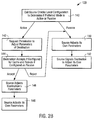
- FIGURE 2B illustrates in further detail, the step 120 described above, wherein the audio components of the source and destination are dynamically adjusted to transmit an optimum voice signal over the local area network.
- the source computer checks its local configuration to determine if it is operating in an active or a passive mode.
- An active mode indicates that the source computer should attempt to adjust the audio components of the destination computer or, conversely, if the source computer is being called, to have its audio components modified by another computer. If the source computer is not programmed to operate in an active mode, it is presumed to operate in a passive mode, whereby the computer will not attempt to modify another computers audio components or to allow its audio components to be modified by a remote computer. Rather, a computer operating in the passive mode will only modify its own audio components based on the desired gain and frequency response settings that were selected.
- step 142 processing proceeds to a step 142, wherein the source computer requests permission from the destination computer to adjust the destination computers audio components.
- step 144 it is determined if the destination computer accepts the request to configure its audio components, i.e., the destination is operating in the active mode or rejects the request, i.e., the destination computer is operating in the passive mode. If the source and destination computers are both operating in the active mode, the source computer adjusts the destination computers' audio components to provide an optimum audio signal at a step 146.
- step 148 the source computer then adjusts its own audio components to produce an optimum audio signal.
- the adjustments may involve such steps as programming each computer's sound card to produce audio signals having a predefined amplitude.
- a graphic equalizer function in each sound card may be adjusted to compensate for variations in the frequency response of each computer's microphone.
- the source computer assumes the master role and adjusts audio components on both computers.
- the destination computer could assume this master role, if an agreed-on standard specified this alternative convention. It is only necessary that all computers use the same convention.
- processing proceeds to a step 150, wherein the source computer adjusts the operating parameters of its own audio components to provide an optimum audio signal.
- the source computer signals the destination computer to adjust the parameters of its own audio components. With the audio components adjusted, the amplitude of the audio signals and their frequency content will be selected to improve the quality of the voice signals produced and received by the source and destination computers.
- the present invention is not limited to two-way calling but can be extended to multiple party calls.
- each computer provides the others with information concerning its audio signals and the computers negotiate how the components should be set to achieve an optimum audio signal.
- this MCU should be regarded as the source computer for the call, configured in active mode, regardless of the actual originating computer. This convention extends the optimization algorithm to MCU-based calls.
- Embodiments of the invention provide a method and a system in which to improve the quality of audio signals transmitted over a computer network, a source computer 12 and a destination computer 30 that participate in the call exchange information, for example, concerning the gain and the frequency characteristics response of the audio components of each participating computer.
- the parameters of the audio components of the source and/or destination computer are then adjusted to produce an audio signal having one or more desired characteristics.
Landscapes
- Engineering & Computer Science (AREA)
- Multimedia (AREA)
- Computer Networks & Wireless Communication (AREA)
- Signal Processing (AREA)
- Computer Security & Cryptography (AREA)
- Telephonic Communication Services (AREA)
- Reverberation, Karaoke And Other Acoustics (AREA)
- Small-Scale Networks (AREA)
Applications Claiming Priority (2)
| Application Number | Priority Date | Filing Date | Title |
|---|---|---|---|
| US09/439,298 US6707827B1 (en) | 1999-11-12 | 1999-11-12 | Method and apparatus for optimizing audio response in telephony-over-LAN systems |
| US439298 | 1999-11-12 |
Publications (2)
| Publication Number | Publication Date |
|---|---|
| EP1100249A2 true EP1100249A2 (de) | 2001-05-16 |
| EP1100249A3 EP1100249A3 (de) | 2003-08-27 |
Family
ID=23744132
Family Applications (1)
| Application Number | Title | Priority Date | Filing Date |
|---|---|---|---|
| EP00309598A Withdrawn EP1100249A3 (de) | 1999-11-12 | 2000-10-31 | Optimierung des Audiofrequenzganges eines Voice-over-IP-systems |
Country Status (3)
| Country | Link |
|---|---|
| US (1) | US6707827B1 (de) |
| EP (1) | EP1100249A3 (de) |
| JP (1) | JP2001223811A (de) |
Cited By (4)
| Publication number | Priority date | Publication date | Assignee | Title |
|---|---|---|---|---|
| WO2005094049A1 (de) * | 2004-03-23 | 2005-10-06 | Siemens Aktiengesellschaft | Schaltungsanordnung und verfahren zur anpassung von übertragungsstrecken |
| WO2007125413A3 (en) * | 2006-05-02 | 2008-01-03 | Skype Ltd | User interface for handling call quality in a communication system |
| US7672693B2 (en) | 2003-11-10 | 2010-03-02 | Nokia Corporation | Controlling method, secondary unit and radio terminal equipment |
| US8245266B2 (en) | 2007-09-27 | 2012-08-14 | Skype | User interface |
Families Citing this family (10)
| Publication number | Priority date | Publication date | Assignee | Title |
|---|---|---|---|---|
| JP3360041B2 (ja) * | 1999-06-11 | 2002-12-24 | エヌイーシーインフロンティア株式会社 | 電話装置 |
| US6928329B1 (en) * | 2000-02-29 | 2005-08-09 | Microsoft Corporation | Enabling separate chat and selective enablement of microphone |
| US7240093B1 (en) * | 2000-02-29 | 2007-07-03 | Microsoft Corporation | Use of online messaging to facilitate selection of participants in game play |
| US7130273B2 (en) * | 2001-04-05 | 2006-10-31 | Level 3 Communications, Inc. | QOS testing of a hardware device or a software client |
| US7280487B2 (en) * | 2001-05-14 | 2007-10-09 | Level 3 Communications, Llc | Embedding sample voice files in voice over IP (VOIP) gateways for voice quality measurements |
| US7173910B2 (en) * | 2001-05-14 | 2007-02-06 | Level 3 Communications, Inc. | Service level agreements based on objective voice quality testing for voice over IP (VOIP) networks |
| GB2405773B (en) * | 2003-09-02 | 2006-11-08 | Siemens Ag | A method of controlling provision of audio communication on a network |
| US7388946B1 (en) | 2003-09-02 | 2008-06-17 | Level 3 Communications, Llc | System and method for evaluating the quality of service in an IP telephony network using call forwarding |
| JP5411880B2 (ja) | 2011-01-14 | 2014-02-12 | レノボ・シンガポール・プライベート・リミテッド | 情報処理装置、その音声設定方法、およびコンピュータが実行するためのプログラム |
| US9318991B2 (en) | 2013-04-11 | 2016-04-19 | The Boeing Company | Electric motor frequency modulation system |
Family Cites Families (20)
| Publication number | Priority date | Publication date | Assignee | Title |
|---|---|---|---|---|
| WO1992015986A1 (en) | 1991-03-05 | 1992-09-17 | Picturetel Corporation | Variable bit rate speech encoder |
| US5319702A (en) * | 1992-07-29 | 1994-06-07 | Tele-Matic Corporation | Method and apparatus for detecting and responding to hook flash events occurring on a remote telephone |
| US5452289A (en) | 1993-01-08 | 1995-09-19 | Multi-Tech Systems, Inc. | Computer-based multifunction personal communications system |
| US5825771A (en) * | 1994-11-10 | 1998-10-20 | Vocaltec Ltd. | Audio transceiver |
| US5838665A (en) * | 1996-03-11 | 1998-11-17 | Integrated Technology, Inc. | Data network telephone adaptor device |
| US5742773A (en) * | 1996-04-18 | 1998-04-21 | Microsoft Corporation | Method and system for audio compression negotiation for multiple channels |
| US5815553A (en) * | 1996-10-02 | 1998-09-29 | Mcdonnell Douglas Corporation | Apparatus for voice communication over local area networks |
| JP3759546B2 (ja) * | 1996-12-03 | 2006-03-29 | ソニー株式会社 | 電話装置、モデム装置、コンピユータ装置及び通信端末装置 |
| US5983183A (en) * | 1997-07-07 | 1999-11-09 | General Data Comm, Inc. | Audio automatic gain control system |
| US6219378B1 (en) * | 1997-09-17 | 2001-04-17 | Texas Instruments Incorporated | Digital subscriber line modem initialization |
| US6175565B1 (en) * | 1997-09-17 | 2001-01-16 | Nokia Corporation | Serial telephone adapter |
| US6167043A (en) * | 1998-02-17 | 2000-12-26 | Intelect Communications, Inc. | Method and system for small office and home office telephone private branch exchange allowing simultaneous data and voice communications |
| US6111755A (en) * | 1998-03-10 | 2000-08-29 | Park; Jae-Sung | Graphic audio equalizer for personal computer system |
| US6259691B1 (en) * | 1998-07-24 | 2001-07-10 | 3Com Corporation | System and method for efficiently transporting dual-tone multi-frequency/multiple frequency (DTMF/MF) tones in a telephone connection on a network-based telephone system |
| US6240070B1 (en) * | 1998-10-09 | 2001-05-29 | Siemens Information And Communication Networks, Inc. | System and method for improving audio quality on a conferencing network |
| US6404873B1 (en) * | 1998-12-01 | 2002-06-11 | Siemens Information And Communication Networks, Inc. | Subconference calling in a telephony-over-LAN environment |
| US6463053B1 (en) * | 1998-12-01 | 2002-10-08 | Nortel Networks Limited | Voice-and-fax-over IP dialing plan |
| US6496477B1 (en) * | 1999-07-09 | 2002-12-17 | Texas Instruments Incorporated | Processes, articles, and packets for network path diversity in media over packet applications |
| US6404746B1 (en) * | 1999-07-13 | 2002-06-11 | Intervoice Limited Partnership | System and method for packet network media redirection |
| US6363065B1 (en) * | 1999-11-10 | 2002-03-26 | Quintum Technologies, Inc. | okApparatus for a voice over IP (voIP) telephony gateway and methods for use therein |
-
1999
- 1999-11-12 US US09/439,298 patent/US6707827B1/en not_active Expired - Lifetime
-
2000
- 2000-10-31 EP EP00309598A patent/EP1100249A3/de not_active Withdrawn
- 2000-11-13 JP JP2000345673A patent/JP2001223811A/ja active Pending
Cited By (9)
| Publication number | Priority date | Publication date | Assignee | Title |
|---|---|---|---|---|
| US7672693B2 (en) | 2003-11-10 | 2010-03-02 | Nokia Corporation | Controlling method, secondary unit and radio terminal equipment |
| EP2429157A2 (de) | 2003-11-10 | 2012-03-14 | Nokia Corporation | Steuerverfahren, Sekundäreinheit und Funkendgerät |
| EP1683374B1 (de) * | 2003-11-10 | 2012-10-31 | Nokia Corporation | Steuerverfahren, sekundäreinheit und funkendgerät |
| EP2429157A3 (de) * | 2003-11-10 | 2014-08-06 | Nokia Corporation | Steuerverfahren, Sekundäreinheit und Funkendgerät |
| WO2005094049A1 (de) * | 2004-03-23 | 2005-10-06 | Siemens Aktiengesellschaft | Schaltungsanordnung und verfahren zur anpassung von übertragungsstrecken |
| WO2007125413A3 (en) * | 2006-05-02 | 2008-01-03 | Skype Ltd | User interface for handling call quality in a communication system |
| US8819216B2 (en) | 2006-05-02 | 2014-08-26 | Skype | User interface |
| US9524088B2 (en) | 2006-05-02 | 2016-12-20 | Skype | User interface |
| US8245266B2 (en) | 2007-09-27 | 2012-08-14 | Skype | User interface |
Also Published As
| Publication number | Publication date |
|---|---|
| JP2001223811A (ja) | 2001-08-17 |
| US6707827B1 (en) | 2004-03-16 |
| EP1100249A3 (de) | 2003-08-27 |
Similar Documents
| Publication | Publication Date | Title |
|---|---|---|
| US7062025B2 (en) | Internet-enabled conferencing system and method accommodating PSTN and IP traffic | |
| US6707827B1 (en) | Method and apparatus for optimizing audio response in telephony-over-LAN systems | |
| US6031896A (en) | Real-time voicemail monitoring and call control over the internet | |
| US7839803B1 (en) | Method and system of teleconferencing | |
| US6327276B1 (en) | Conferencing over LAN/WAN using a hybrid client/server configuration | |
| US6961416B1 (en) | Internet-enabled conferencing system and method accommodating PSTN and IP traffic | |
| US6408327B1 (en) | Synthetic stereo conferencing over LAN/WAN | |
| US7848738B2 (en) | Teleconferencing system with multiple channels at each location | |
| EP1324608A2 (de) | Vorrichtung und Verfahren zum Aufbau einer Videokonferenz | |
| AU5724999A (en) | Method and system of teleconferencing | |
| US20040239754A1 (en) | Systems and methods for videoconference and/or data collaboration initiation | |
| EP1216554A1 (de) | System und verfahren zum bereitstellen sprachtondaten in einem paketvermittelten netz | |
| US20040218583A1 (en) | Computer telephony integration adapter | |
| US20070291667A1 (en) | Intelligent audio limit method, system and node | |
| US7983406B2 (en) | Adaptive, multi-channel teleconferencing system | |
| EP1885111B1 (de) | Konferenzserver | |
| US20050259636A1 (en) | Voice over internet protocol system having dynamic gain control function and method thereof | |
| US20080232569A1 (en) | Teleconferencing System with Multi-channel Imaging | |
| US8077700B2 (en) | Dynamic call characteristic control on a per call basis | |
| US20030081593A1 (en) | Method for charging internet phone network | |
| US8284926B2 (en) | Enterprise-distributed noise management | |
| US7945665B2 (en) | Centralized load distribution for an H.323 network | |
| KR100598351B1 (ko) | 이기종 망간의 다자간 회의 장치 | |
| EP1465396A2 (de) | Anordnung und Verfahren zur Bereitstellung von Anrufszustandsinformationen in einem Hybridnetzwerk | |
| JP2003348121A (ja) | ゲートキーパー装置およびエンドポイント端末 |
Legal Events
| Date | Code | Title | Description |
|---|---|---|---|
| PUAI | Public reference made under article 153(3) epc to a published international application that has entered the european phase |
Free format text: ORIGINAL CODE: 0009012 |
|
| AK | Designated contracting states |
Kind code of ref document: A2 Designated state(s): AT BE CH CY DE DK ES FI FR GB GR IE IT LI LU MC NL PT SE |
|
| AX | Request for extension of the european patent |
Free format text: AL;LT;LV;MK;RO;SI |
|
| RAP1 | Party data changed (applicant data changed or rights of an application transferred) |
Owner name: SIEMENS INFORMATION AND COMMUNICATION NETWORKS INC |
|
| PUAL | Search report despatched |
Free format text: ORIGINAL CODE: 0009013 |
|
| AK | Designated contracting states |
Designated state(s): AT BE CH CY DE DK ES FI FR GB GR IE IT LI LU MC NL PT SE |
|
| AX | Request for extension of the european patent |
Extension state: AL LT LV MK RO SI |
|
| RIC1 | Information provided on ipc code assigned before grant |
Ipc: 7H 04L 12/64 B Ipc: 7H 04M 7/00 A |
|
| 17P | Request for examination filed |
Effective date: 20040218 |
|
| AKX | Designation fees paid |
Designated state(s): DE FR GB IT |
|
| STAA | Information on the status of an ep patent application or granted ep patent |
Free format text: STATUS: THE APPLICATION IS DEEMED TO BE WITHDRAWN |
|
| 18D | Application deemed to be withdrawn |
Effective date: 20060503 |