EP1101584A2 - Verfahren zur Herstellung von Fliesen mit Vertiefungen und Reliefs auf der freiliegenden Seite um das Erscheinungsbild von Bruchstein nach zu bilden - Google Patents
Verfahren zur Herstellung von Fliesen mit Vertiefungen und Reliefs auf der freiliegenden Seite um das Erscheinungsbild von Bruchstein nach zu bilden Download PDFInfo
- Publication number
- EP1101584A2 EP1101584A2 EP00203852A EP00203852A EP1101584A2 EP 1101584 A2 EP1101584 A2 EP 1101584A2 EP 00203852 A EP00203852 A EP 00203852A EP 00203852 A EP00203852 A EP 00203852A EP 1101584 A2 EP1101584 A2 EP 1101584A2
- Authority
- EP
- European Patent Office
- Prior art keywords
- tile
- depressions
- punch
- appearance
- mould
- Prior art date
- Legal status (The legal status is an assumption and is not a legal conclusion. Google has not performed a legal analysis and makes no representation as to the accuracy of the status listed.)
- Withdrawn
Links
- 238000000034 method Methods 0.000 title claims abstract description 28
- 238000004519 manufacturing process Methods 0.000 title claims description 4
- 239000000843 powder Substances 0.000 claims abstract description 19
- 239000000203 mixture Substances 0.000 claims abstract description 17
- 238000001035 drying Methods 0.000 claims abstract description 11
- 239000004927 clay Substances 0.000 claims abstract description 8
- 239000000049 pigment Substances 0.000 claims abstract description 8
- 238000010304 firing Methods 0.000 claims abstract description 7
- 239000000463 material Substances 0.000 claims description 27
- 235000013339 cereals Nutrition 0.000 claims description 13
- 239000012528 membrane Substances 0.000 claims description 12
- 239000000919 ceramic Substances 0.000 claims description 11
- 239000004575 stone Substances 0.000 claims description 11
- 229910000831 Steel Inorganic materials 0.000 claims description 7
- 239000010959 steel Substances 0.000 claims description 7
- 230000001680 brushing effect Effects 0.000 claims description 6
- 238000009825 accumulation Methods 0.000 claims description 3
- 239000000126 substance Substances 0.000 claims description 3
- 229920002472 Starch Polymers 0.000 claims description 2
- 235000019698 starch Nutrition 0.000 claims description 2
- 239000008107 starch Substances 0.000 claims description 2
- 239000010902 straw Substances 0.000 claims description 2
- 241000261585 Hadrobregmus pertinax Species 0.000 claims 1
- 238000009408 flooring Methods 0.000 claims 1
- 238000007664 blowing Methods 0.000 description 6
- XEEYBQQBJWHFJM-UHFFFAOYSA-N Iron Chemical compound [Fe] XEEYBQQBJWHFJM-UHFFFAOYSA-N 0.000 description 4
- 238000011068 loading method Methods 0.000 description 4
- 239000004579 marble Substances 0.000 description 4
- 238000004040 coloring Methods 0.000 description 3
- 230000001788 irregular Effects 0.000 description 3
- RTAQQCXQSZGOHL-UHFFFAOYSA-N Titanium Chemical compound [Ti] RTAQQCXQSZGOHL-UHFFFAOYSA-N 0.000 description 2
- 235000002017 Zea mays subsp mays Nutrition 0.000 description 2
- 230000000694 effects Effects 0.000 description 2
- 229910052742 iron Inorganic materials 0.000 description 2
- 239000007788 liquid Substances 0.000 description 2
- 230000007935 neutral effect Effects 0.000 description 2
- 239000007921 spray Substances 0.000 description 2
- 239000010936 titanium Substances 0.000 description 2
- 229910052719 titanium Inorganic materials 0.000 description 2
- 235000007319 Avena orientalis Nutrition 0.000 description 1
- 244000075850 Avena orientalis Species 0.000 description 1
- 235000007340 Hordeum vulgare Nutrition 0.000 description 1
- 240000005979 Hordeum vulgare Species 0.000 description 1
- 240000007594 Oryza sativa Species 0.000 description 1
- 235000007164 Oryza sativa Nutrition 0.000 description 1
- 239000004372 Polyvinyl alcohol Substances 0.000 description 1
- 241000209140 Triticum Species 0.000 description 1
- 235000021307 Triticum Nutrition 0.000 description 1
- 240000008042 Zea mays Species 0.000 description 1
- 235000016383 Zea mays subsp huehuetenangensis Nutrition 0.000 description 1
- 241000482268 Zea mays subsp. mays Species 0.000 description 1
- 238000004220 aggregation Methods 0.000 description 1
- 230000002776 aggregation Effects 0.000 description 1
- 239000007900 aqueous suspension Substances 0.000 description 1
- 235000019646 color tone Nutrition 0.000 description 1
- 239000003086 colorant Substances 0.000 description 1
- 239000000549 coloured material Substances 0.000 description 1
- 238000005520 cutting process Methods 0.000 description 1
- 238000005034 decoration Methods 0.000 description 1
- 230000008021 deposition Effects 0.000 description 1
- 238000005516 engineering process Methods 0.000 description 1
- 239000002657 fibrous material Substances 0.000 description 1
- 230000004907 flux Effects 0.000 description 1
- 239000012634 fragment Substances 0.000 description 1
- 238000000227 grinding Methods 0.000 description 1
- 235000009973 maize Nutrition 0.000 description 1
- 238000002156 mixing Methods 0.000 description 1
- 239000002245 particle Substances 0.000 description 1
- 229920000642 polymer Polymers 0.000 description 1
- 229920002451 polyvinyl alcohol Polymers 0.000 description 1
- 238000003825 pressing Methods 0.000 description 1
- 230000003252 repetitive effect Effects 0.000 description 1
- 230000000284 resting effect Effects 0.000 description 1
- 235000009566 rice Nutrition 0.000 description 1
- 238000000926 separation method Methods 0.000 description 1
- 238000010186 staining Methods 0.000 description 1
- 229920002994 synthetic fiber Polymers 0.000 description 1
- 238000009827 uniform distribution Methods 0.000 description 1
- 238000001238 wet grinding Methods 0.000 description 1
Images

Classifications
-
- B—PERFORMING OPERATIONS; TRANSPORTING
- B28—WORKING CEMENT, CLAY, OR STONE
- B28B—SHAPING CLAY OR OTHER CERAMIC COMPOSITIONS; SHAPING SLAG; SHAPING MIXTURES CONTAINING CEMENTITIOUS MATERIAL, e.g. PLASTER
- B28B11/00—Apparatus or processes for treating or working the shaped or preshaped articles
- B28B11/08—Apparatus or processes for treating or working the shaped or preshaped articles for reshaping the surface, e.g. smoothing, roughening, corrugating, making screw-threads
- B28B11/0872—Non-mechanical reshaping of the surface, e.g. by burning, acids, radiation energy, air flow, etc.
-
- B—PERFORMING OPERATIONS; TRANSPORTING
- B28—WORKING CEMENT, CLAY, OR STONE
- B28B—SHAPING CLAY OR OTHER CERAMIC COMPOSITIONS; SHAPING SLAG; SHAPING MIXTURES CONTAINING CEMENTITIOUS MATERIAL, e.g. PLASTER
- B28B11/00—Apparatus or processes for treating or working the shaped or preshaped articles
- B28B11/04—Apparatus or processes for treating or working the shaped or preshaped articles for coating or applying engobing layers
- B28B11/044—Apparatus or processes for treating or working the shaped or preshaped articles for coating or applying engobing layers with glaze or engobe or enamel or varnish
-
- B—PERFORMING OPERATIONS; TRANSPORTING
- B28—WORKING CEMENT, CLAY, OR STONE
- B28B—SHAPING CLAY OR OTHER CERAMIC COMPOSITIONS; SHAPING SLAG; SHAPING MIXTURES CONTAINING CEMENTITIOUS MATERIAL, e.g. PLASTER
- B28B11/00—Apparatus or processes for treating or working the shaped or preshaped articles
- B28B11/08—Apparatus or processes for treating or working the shaped or preshaped articles for reshaping the surface, e.g. smoothing, roughening, corrugating, making screw-threads
-
- B—PERFORMING OPERATIONS; TRANSPORTING
- B28—WORKING CEMENT, CLAY, OR STONE
- B28B—SHAPING CLAY OR OTHER CERAMIC COMPOSITIONS; SHAPING SLAG; SHAPING MIXTURES CONTAINING CEMENTITIOUS MATERIAL, e.g. PLASTER
- B28B3/00—Producing shaped articles from the material by using presses; Presses specially adapted therefor
- B28B3/003—Pressing by means acting upon the material via flexible mould wall parts, e.g. by means of inflatable cores, isostatic presses
-
- B—PERFORMING OPERATIONS; TRANSPORTING
- B28—WORKING CEMENT, CLAY, OR STONE
- B28B—SHAPING CLAY OR OTHER CERAMIC COMPOSITIONS; SHAPING SLAG; SHAPING MIXTURES CONTAINING CEMENTITIOUS MATERIAL, e.g. PLASTER
- B28B7/00—Moulds; Cores; Mandrels
- B28B7/0064—Moulds characterised by special surfaces for producing a desired surface of a moulded article, e.g. profiled or polished moulding surfaces
-
- B—PERFORMING OPERATIONS; TRANSPORTING
- B28—WORKING CEMENT, CLAY, OR STONE
- B28B—SHAPING CLAY OR OTHER CERAMIC COMPOSITIONS; SHAPING SLAG; SHAPING MIXTURES CONTAINING CEMENTITIOUS MATERIAL, e.g. PLASTER
- B28B7/00—Moulds; Cores; Mandrels
- B28B7/34—Moulds, cores, or mandrels of special material, e.g. destructible materials
- B28B7/342—Moulds, cores, or mandrels of special material, e.g. destructible materials which are at least partially destroyed, e.g. broken, molten, before demoulding; Moulding surfaces or spaces shaped by, or in, the ground, or sand or soil, whether bound or not; Cores consisting at least mainly of sand or soil, whether bound or not
-
- E—FIXED CONSTRUCTIONS
- E04—BUILDING
- E04F—FINISHING WORK ON BUILDINGS, e.g. STAIRS, FLOORS
- E04F13/00—Coverings or linings, e.g. for walls or ceilings
- E04F13/07—Coverings or linings, e.g. for walls or ceilings composed of covering or lining elements; Sub-structures therefor; Fastening means therefor
- E04F13/08—Coverings or linings, e.g. for walls or ceilings composed of covering or lining elements; Sub-structures therefor; Fastening means therefor composed of a plurality of similar covering or lining elements
- E04F13/14—Coverings or linings, e.g. for walls or ceilings composed of covering or lining elements; Sub-structures therefor; Fastening means therefor composed of a plurality of similar covering or lining elements stone or stone-like materials, e.g. ceramics concrete; of glass or with an outer layer of stone or stone-like materials or glass
- E04F13/147—Coverings or linings, e.g. for walls or ceilings composed of covering or lining elements; Sub-structures therefor; Fastening means therefor composed of a plurality of similar covering or lining elements stone or stone-like materials, e.g. ceramics concrete; of glass or with an outer layer of stone or stone-like materials or glass with an outer layer imitating natural stone, brick work or the like
Definitions
- This invention relates to the manufacture of paving or facing tiles with particular aesthetic characteristics.
- This stone such as natural marble provided with irregular multi-colour veining, has been produced practically perfectly, by a method known as bulk coloration which enables tiles to be formed composed of at least two powders forming an agglomerate of partly mixed masses emerging at the tile surface, in the manner of natural marble veining.
- the object of this patent is to provide a method enabling ceramic tiles to be manufactured having the aforesaid appearance, either formal or chromatic, of split quarrystone, or of natural stone of non-flat surface.
- a ceramic mix is fed into the forming cavity of a mould, and then pressed with an upper punch which reproduces the form of the stone to be reproduced, with the purpose of creating the exposed upper surface of the tile.
- a layer of atomized clay covered by a second layer of multi-colour glazes variously mixed and distributed can also be used.
- the punch is constructed of steel, and can be covered by rubber or equivalent materials.
- a reverse face punch the purpose of which is to create the tile rear side, and is of steel or of steel covered by a rubber layer intended to form the rear face of the tile.
- the invention provides for the rubber covering layer of the lower punch to reproduce in negative, on that side intended to come into contact with the material to be pressed, the shape of the upper punch to hence obtain substantially uniform tile thicknesses.
- the lower punch is preferably an isostatic punch, hence in this case the profiled layer of rubber or equivalent material being the membrane of the said isostatic punch.
- an isostatic punch is known to comprise a rubber membrane which on one side is in contact with the material to be compressed and on the other side floats on an oil film.
- this latter is preferably made with as uniform a thickness as possible, in order to maintain uniform deformability under the pressing action of the material.
- the membrane rear surface which comes into contact with the oil, presents unevenness corresponding to that of the upper surface which comes into contact with the material.
- the crude tile formed in this manner is subjected to normal drying by known means.
- the tile is subjected immediately after drying to an operation known as flashing, consisting of spray-applying an aqueous suspension of neutral or coloured glaze.
- Said glaze is applied by sprays directed tangentially to the tile surface, and preferably in a direction perpendicular to the reliefs or crests.
- the tile is preferably subjected to a brushing operation effected by slightly abrasive soft pads.
- coloured glaze is followed, according to the invention, by a blowing operation consisting of subjecting the tile surface to an air stream in a substantially tangential direction, the purpose of which is to accumulate the glaze behind and in front of crests and in the surface cavities, and to at least partially remove it from those regions mostly subjected to the action of the stream.
- the orientation of the air stream is chosen, according to the invention, on the basis of the chromatic effect to be obtained, and is preferably perpendicular to direction of the crests and depressions, in one or in the opposite direction.
- the tile After the blowing operation the tile can be conveniently subjected to a brushing operation effected by a soft blade, or by a brush acting in the same direction as the blow.
- the tile After subjection to the air stream, known for simplicity hereinafter as the blowing operation, the tile is subjected to firing by known methods using known cycles.
- the base mix can be obtained by partially mixing together at least two atomized powder masses coloured differently so that the tile mass obtained is characterised by veining or staining reproducing the appearance of natural marble.
- the mould cavity is filled by one of the known double loading systems, ie with a first layer of single-colour material, and a second thin layer of coloured material, which can be single- or multi-colour depending on the required appearance of the finished product.
- a further variant of the invention enables the split surface of the tile to be provided with shallow, more or less extensive craters of opaque neutral colour, or glossy, or coloured.
- the means for feeding said bodies, constituting substantially a third loading, are totally similar to the known means for effecting the second loading.
- volatile material means a material which burns away or sublimes completely at a temperature less than or equal to 600°C, so that it disappears completely at the latest during the initial stage of the kiln firing process to create more or less extensive craters.
- Materials can also be used which burn away or sublime at lower temperature, typically the temperature attained by the tile during the drying stage.
- a particularly suitable flake forming material is an easily combustible fibrous material, such as sawdust.
- the material resulting from the crushing or grinding of maize grains has proved particularly convenient.
- Cereal flakes have also proved convenient, as have oven-baked cereals such as popcorn, or even straw fragments.
- the volatile material is required to disappear as early as the drying stage, it is convenient to use a wax or an equivalent synthetic material.
- the material before being reduced to flakes is mixed with powdered coloured atomized clay, or with pigments or powdered vitreous glaze.
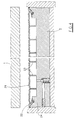
- Figure 4 is a section through an isostatic lower punch of the invention, associated with the respective steel upper punch.
- the base ceramic mix is prepared by wet grinding a mixture composed of high quality, high plasticity clays of very low iron and titanium content, fluxes and feldspathic sands also of very low iron and titanium content. Subsequent drying of the liquid mixture is achieved by an atomizer which produces a powder of controlled moisture content and particle size.
- the powder mix obtained in this manner passes through a continuous colouring device in which the powder is pigmented by feeding colouring oxides together with the powder in predetermined proportions, and is fed into the feed hopper of the press.
- the press is fed using a machine which distributes several atomized layers in different successive loadings.
- the mould forming cavities are filled with a first layer of coloured base mix to the extent of about 90% of the total tile thickness.
- a second layer is applied composed of a mixture of four atomized ceramic glazes differing in colour and fusibility.
- This mixture is obtained by withdrawing from four different containers, one per component, cyclically variable quantities of the components and distributing them with a variable repetitive cycle within the forming cavity.
- the membrane In correspondence with the top of the grating, the membrane carries incised grooves intended to form the coplanar feet of the tile.
- the three superposed layers are then pressed with a specific pressure of 400 kg/cm 2 using a hydraulic press.
- the tiles are removed from the mould and then dried in a normal vertical dryer with boat-shaped containers, using a 60 minute cycle at 250°C.
- the dried but hot tiles (at this stage the tile is still at 70°C) are sprayed tangentially, using a spray gun, with a film of liquid ceramic glaze which, after its rapid drying, is removed from the more projecting parts of the tile structure with a rotary disc brush.
- the mixture is distributed by known means.
- a soft rubber blade is used to facilitate deposition and accumulation of the powder in the bas-relief regions adjacent to the crests and in the surface depressions.
- the tile is blown tangentially to partly remove the previously applied powdered glaze mixture and partly force it into the specific recesses in the tile structure.
- a fixer is applied to the glaze remaining on the tile, in this case it being a 5-10% polymer solution in polyvinyl alcohol.
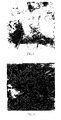
- the tile is then fired in a ceramic roller kiln at a temperature of 1200°C using a residence cycle of 60 minutes, to assume the appearance shown in the figures.
Landscapes
- Engineering & Computer Science (AREA)
- Chemical & Material Sciences (AREA)
- Ceramic Engineering (AREA)
- Mechanical Engineering (AREA)
- Structural Engineering (AREA)
- Manufacturing & Machinery (AREA)
- Architecture (AREA)
- Civil Engineering (AREA)
- Finishing Walls (AREA)
Applications Claiming Priority (2)
| Application Number | Priority Date | Filing Date | Title |
|---|---|---|---|
| ITRE990116 | 1999-11-15 | ||
| IT1999RE000116A IT1311048B1 (it) | 1999-11-15 | 1999-11-15 | Metodo per fabbricare piastrelle aventi l'aspetto della pietra di cava spaccata. |
Publications (2)
| Publication Number | Publication Date |
|---|---|
| EP1101584A2 true EP1101584A2 (de) | 2001-05-23 |
| EP1101584A3 EP1101584A3 (de) | 2003-03-26 |
Family
ID=11399512
Family Applications (1)
| Application Number | Title | Priority Date | Filing Date |
|---|---|---|---|
| EP00203852A Withdrawn EP1101584A3 (de) | 1999-11-15 | 2000-11-03 | Verfahren zur Herstellung von Fliesen mit Vertiefungen und Reliefs auf der freiliegenden Seite um das Erscheinungsbild von Bruchstein nach zu bilden |
Country Status (2)
| Country | Link |
|---|---|
| EP (1) | EP1101584A3 (de) |
| IT (1) | IT1311048B1 (de) |
Cited By (3)
| Publication number | Priority date | Publication date | Assignee | Title |
|---|---|---|---|---|
| EP1707331A3 (de) * | 2005-03-30 | 2007-10-31 | Godelmann Pflastersteine GmbH & Co. KG | Verfahren sowie Form zum Herstellen von Bodenplatten aus zementgebundenem Material bzw. Beton |
| WO2009092977A2 (fr) | 2008-01-24 | 2009-07-30 | Guermont Milene | Procedes de fabrication et de decoration de structures en beton |
| CN114179195A (zh) * | 2021-11-03 | 2022-03-15 | 江西和美陶瓷有限公司 | 一种陶瓷压砖机及控制系统 |
Family Cites Families (5)
| Publication number | Priority date | Publication date | Assignee | Title |
|---|---|---|---|---|
| JP2967838B2 (ja) * | 1991-04-26 | 1999-10-25 | 東陶機器株式会社 | 窯業製品およびその製造方法 |
| JP2603783B2 (ja) * | 1992-07-10 | 1997-04-23 | ナショナル住宅産業株式会社 | 施釉方法 |
| JPH07144981A (ja) * | 1993-11-19 | 1995-06-06 | Inax Corp | タイルの陰影加飾方法 |
| JP3489861B2 (ja) * | 1993-12-28 | 2004-01-26 | クリオン株式会社 | Alcパネル及びその下塗り塗装方法 |
| JP2001247387A (ja) * | 2000-03-01 | 2001-09-11 | Inax Corp | タイルの製造方法 |
-
1999
- 1999-11-15 IT IT1999RE000116A patent/IT1311048B1/it active
-
2000
- 2000-11-03 EP EP00203852A patent/EP1101584A3/de not_active Withdrawn
Cited By (4)
| Publication number | Priority date | Publication date | Assignee | Title |
|---|---|---|---|---|
| EP1707331A3 (de) * | 2005-03-30 | 2007-10-31 | Godelmann Pflastersteine GmbH & Co. KG | Verfahren sowie Form zum Herstellen von Bodenplatten aus zementgebundenem Material bzw. Beton |
| WO2009092977A2 (fr) | 2008-01-24 | 2009-07-30 | Guermont Milene | Procedes de fabrication et de decoration de structures en beton |
| WO2009092977A3 (fr) * | 2008-01-24 | 2010-03-25 | Guermont Milene | Procedes de fabrication et de decoration de structures en beton |
| CN114179195A (zh) * | 2021-11-03 | 2022-03-15 | 江西和美陶瓷有限公司 | 一种陶瓷压砖机及控制系统 |
Also Published As
| Publication number | Publication date |
|---|---|
| ITRE990116A0 (it) | 1999-11-15 |
| IT1311048B1 (it) | 2002-02-28 |
| ITRE990116A1 (it) | 2001-05-15 |
| EP1101584A3 (de) | 2003-03-26 |
Similar Documents
| Publication | Publication Date | Title |
|---|---|---|
| CN107756608B (zh) | 一种干粒釉布料仿石砖及其制备方法 | |
| US4474920A (en) | Embossable coating | |
| CN107935386B (zh) | 颗粒状干粒釉、颗粒状干粒釉布料仿石砖及其制备方法 | |
| RU2537867C1 (ru) | Способ нанесения декоративной отделки на древесно-стружечную плиту | |
| US4267221A (en) | Architectural panel and method of making the same | |
| US4353949A (en) | Embossable coating and method of producing embossed coated substrate | |
| CN113860795A (zh) | 一种通体纹理材料及其制备方法 | |
| CN110883909B (zh) | 仿天然纹理景观砖的制备工艺及生产系统 | |
| US20220410427A1 (en) | Procedure and system for the production of slabs made of mineral grits bound with resins | |
| CN107902900B (zh) | 包裹形干粒釉、包裹形干粒釉布料仿石砖及其制备方法 | |
| EP1101584A2 (de) | Verfahren zur Herstellung von Fliesen mit Vertiefungen und Reliefs auf der freiliegenden Seite um das Erscheinungsbild von Bruchstein nach zu bilden | |
| EP1101585A2 (de) | Verfahren zur Herstellung von Fliesen mit dem Erscheinungsbild alter, rustikaler, handwerklich hergestellter Fliesen | |
| CN107932686A (zh) | 面条状干粒釉、面条状干粒釉布料仿石砖及其制备方法 | |
| CN117980573A (zh) | 陶瓷砖和用于生产陶瓷砖的方法 | |
| WO2024154027A1 (en) | Method and plant for manufacturing slabs made of stone or stone-like agglomerate material and having veins and surface chromatic effects and slab so obtained | |
| CN107935387A (zh) | 多彩片状干粒釉、片状干粒釉布料仿石砖及其制备方法 | |
| CN110066163B (zh) | 一种一石多面陶瓷大板的制备方法及陶瓷大板 | |
| JP2000203925A (ja) | バフ研磨されるセラミック製舗床およびコーティングの製造方法 | |
| JPH05229884A (ja) | 模様タイルの製造方法 | |
| CN111745806B (zh) | 一种陶瓷产品干粒布料工艺 | |
| CN110078522A (zh) | 一种瓷砖生产工艺 | |
| JP4270605B2 (ja) | レンガ調の窯業系化粧板 | |
| JPS5913474B2 (ja) | 押出成形したタイルの表面装飾技法゜ | |
| JPH02269007A (ja) | 陶磁器素地の加飾方法 | |
| JPH04260653A (ja) | 装飾陶磁器及びその製造方法 |
Legal Events
| Date | Code | Title | Description |
|---|---|---|---|
| PUAI | Public reference made under article 153(3) epc to a published international application that has entered the european phase |
Free format text: ORIGINAL CODE: 0009012 |
|
| AK | Designated contracting states |
Kind code of ref document: A2 Designated state(s): AT BE CH CY DE DK ES FI FR GB GR IE IT LI LU MC NL PT SE TR |
|
| AX | Request for extension of the european patent |
Free format text: AL;LT;LV;MK;RO;SI |
|
| PUAL | Search report despatched |
Free format text: ORIGINAL CODE: 0009013 |
|
| AK | Designated contracting states |
Kind code of ref document: A3 Designated state(s): AT BE CH CY DE DK ES FI FR GB GR IE IT LI LU MC NL PT SE TR Designated state(s): AT BE CH CY DE DK ES FI FR GB GR IE IT LI LU MC NL PT SE TR |
|
| AX | Request for extension of the european patent |
Extension state: AL LT LV MK RO SI |
|
| AKX | Designation fees paid | ||
| REG | Reference to a national code |
Ref country code: DE Ref legal event code: 8566 |
|
| STAA | Information on the status of an ep patent application or granted ep patent |
Free format text: STATUS: THE APPLICATION IS DEEMED TO BE WITHDRAWN |
|
| 18D | Application deemed to be withdrawn |
Effective date: 20030927 |