EP1101785A1 - Hohl- oder Bündelader - Google Patents
Hohl- oder Bündelader Download PDFInfo
- Publication number
- EP1101785A1 EP1101785A1 EP99402830A EP99402830A EP1101785A1 EP 1101785 A1 EP1101785 A1 EP 1101785A1 EP 99402830 A EP99402830 A EP 99402830A EP 99402830 A EP99402830 A EP 99402830A EP 1101785 A1 EP1101785 A1 EP 1101785A1
- Authority
- EP
- European Patent Office
- Prior art keywords
- hollow
- flame
- loose tube
- flame retardant
- charger
- Prior art date
- Legal status (The legal status is an assumption and is not a legal conclusion. Google has not performed a legal analysis and makes no representation as to the accuracy of the status listed.)
- Withdrawn
Links
- 239000003063 flame retardant Substances 0.000 claims abstract description 14
- RNFJDJUURJAICM-UHFFFAOYSA-N 2,2,4,4,6,6-hexaphenoxy-1,3,5-triaza-2$l^{5},4$l^{5},6$l^{5}-triphosphacyclohexa-1,3,5-triene Chemical compound N=1P(OC=2C=CC=CC=2)(OC=2C=CC=CC=2)=NP(OC=2C=CC=CC=2)(OC=2C=CC=CC=2)=NP=1(OC=1C=CC=CC=1)OC1=CC=CC=C1 RNFJDJUURJAICM-UHFFFAOYSA-N 0.000 claims abstract description 13
- 239000012815 thermoplastic material Substances 0.000 claims abstract description 5
- 229920000728 polyester Polymers 0.000 claims description 7
- 229910052698 phosphorus Inorganic materials 0.000 claims description 6
- 239000011574 phosphorus Substances 0.000 claims description 6
- OAICVXFJPJFONN-UHFFFAOYSA-N Phosphorus Chemical compound [P] OAICVXFJPJFONN-UHFFFAOYSA-N 0.000 claims description 5
- 239000013307 optical fiber Substances 0.000 claims description 5
- 239000000654 additive Substances 0.000 claims description 4
- 239000000126 substance Substances 0.000 claims description 4
- 230000000996 additive effect Effects 0.000 claims 3
- 239000004020 conductor Substances 0.000 abstract 1
- 229920000642 polymer Polymers 0.000 description 6
- 238000001125 extrusion Methods 0.000 description 4
- 238000006068 polycondensation reaction Methods 0.000 description 4
- 229920001634 Copolyester Polymers 0.000 description 3
- 238000000034 method Methods 0.000 description 3
- 230000003287 optical effect Effects 0.000 description 3
- -1 polyethylene Polymers 0.000 description 3
- 238000006116 polymerization reaction Methods 0.000 description 3
- 238000007385 chemical modification Methods 0.000 description 2
- 238000005516 engineering process Methods 0.000 description 2
- 230000002349 favourable effect Effects 0.000 description 2
- 239000004033 plastic Substances 0.000 description 2
- 229920003023 plastic Polymers 0.000 description 2
- 239000007790 solid phase Substances 0.000 description 2
- 229920001169 thermoplastic Polymers 0.000 description 2
- 239000004416 thermosoftening plastic Substances 0.000 description 2
- 230000009974 thixotropic effect Effects 0.000 description 2
- 0 C*CC(CP1(Oc2ccccc2-c2c1cccc2)=O)*CCO Chemical compound C*CC(CP1(Oc2ccccc2-c2c1cccc2)=O)*CCO 0.000 description 1
- 239000004970 Chain extender Substances 0.000 description 1
- 239000004594 Masterbatch (MB) Substances 0.000 description 1
- 239000004952 Polyamide Substances 0.000 description 1
- 239000004698 Polyethylene Substances 0.000 description 1
- 239000004743 Polypropylene Substances 0.000 description 1
- 230000001588 bifunctional effect Effects 0.000 description 1
- 230000005540 biological transmission Effects 0.000 description 1
- 239000012141 concentrate Substances 0.000 description 1
- 238000009833 condensation Methods 0.000 description 1
- 230000005494 condensation Effects 0.000 description 1
- 238000010276 construction Methods 0.000 description 1
- 230000000694 effects Effects 0.000 description 1
- 230000007613 environmental effect Effects 0.000 description 1
- 239000000835 fiber Substances 0.000 description 1
- 239000000945 filler Substances 0.000 description 1
- 238000009776 industrial production Methods 0.000 description 1
- 239000000463 material Substances 0.000 description 1
- 239000000155 melt Substances 0.000 description 1
- 239000002184 metal Substances 0.000 description 1
- 230000007935 neutral effect Effects 0.000 description 1
- 229920002647 polyamide Polymers 0.000 description 1
- 229920000573 polyethylene Polymers 0.000 description 1
- 229920001155 polypropylene Polymers 0.000 description 1
- 229920002635 polyurethane Polymers 0.000 description 1
- 239000004814 polyurethane Substances 0.000 description 1
- 239000011253 protective coating Substances 0.000 description 1
- 238000003892 spreading Methods 0.000 description 1
Images

Classifications
-
- G—PHYSICS
- G02—OPTICS
- G02B—OPTICAL ELEMENTS, SYSTEMS OR APPARATUS
- G02B6/00—Light guides; Structural details of arrangements comprising light guides and other optical elements, e.g. couplings
- G02B6/44—Mechanical structures for providing tensile strength and external protection for fibres, e.g. optical transmission cables
- G02B6/4401—Optical cables
- G02B6/4429—Means specially adapted for strengthening or protecting the cables
- G02B6/4436—Heat resistant
-
- C—CHEMISTRY; METALLURGY
- C08—ORGANIC MACROMOLECULAR COMPOUNDS; THEIR PREPARATION OR CHEMICAL WORKING-UP; COMPOSITIONS BASED THEREON
- C08G—MACROMOLECULAR COMPOUNDS OBTAINED OTHERWISE THAN BY REACTIONS ONLY INVOLVING UNSATURATED CARBON-TO-CARBON BONDS
- C08G63/00—Macromolecular compounds obtained by reactions forming a carboxylic ester link in the main chain of the macromolecule
- C08G63/68—Polyesters containing atoms other than carbon, hydrogen and oxygen
- C08G63/692—Polyesters containing atoms other than carbon, hydrogen and oxygen containing phosphorus
- C08G63/6924—Polyesters containing atoms other than carbon, hydrogen and oxygen containing phosphorus derived from polycarboxylic acids and polyhydroxy compounds
- C08G63/6926—Dicarboxylic acids and dihydroxy compounds
-
- C—CHEMISTRY; METALLURGY
- C08—ORGANIC MACROMOLECULAR COMPOUNDS; THEIR PREPARATION OR CHEMICAL WORKING-UP; COMPOSITIONS BASED THEREON
- C08K—Use of inorganic or non-macromolecular organic substances as compounding ingredients
- C08K5/00—Use of organic ingredients
- C08K5/49—Phosphorus-containing compounds
- C08K5/51—Phosphorus bound to oxygen
- C08K5/53—Phosphorus bound to oxygen bound to oxygen and to carbon only
- C08K5/5313—Phosphinic compounds, e.g. R2=P(:O)OR'
-
- G—PHYSICS
- G02—OPTICS
- G02B—OPTICAL ELEMENTS, SYSTEMS OR APPARATUS
- G02B6/00—Light guides; Structural details of arrangements comprising light guides and other optical elements, e.g. couplings
- G02B6/44—Mechanical structures for providing tensile strength and external protection for fibres, e.g. optical transmission cables
- G02B6/4401—Optical cables
- G02B6/4429—Means specially adapted for strengthening or protecting the cables
- G02B6/44386—Freeze-prevention means
Definitions
- the invention relates to a hollow or loose tube according to the preamble of the claim 1.
- a hollow or loose tube is understood to mean a plastic tube - core sleeve - with one or more, low-friction and against deformation sufficiently stable housed optical fibers. Show hollow or loose tubes all features of a universally usable basic element for an optical cable on.
- Tubular or loose tubes with a slightly thixotropic, chemical are usually neutral mass filled within a temperature range of -30 ° C to + 70 ° C neither freezes nor leaks and the protective coating of the optical fiber does not attacks and swells.
- Optical cables equipped with hollow or loose tubes are preferred wherever there is transmission capacity despite a wide variety of environmental influences particularly high demands are made.
- Optical cables are known which have means in their construction which are used in the event of a fire guarantee functional integrity and spread of flames prevent as much as possible. However, these funds are all in the Coat area. Are known for. B. metal layers, plastic shells with a high proportion Fillers etc.
- the invention has for its object a hollow or loose tube so to design that the buffer tube is flame retardant or non-flammable and thus a Prevents the flame from spreading.
- the invention is based on the embodiment shown schematically in the figure explained in more detail.
- a loose tube is shown in section, with 1 the ferrule, with 2 the optical fibers and with 3 the space filled with a thixotropic mass between the buffer tube 1 and the optical fibers 2 is designated.
- the core sleeve 1 consists of a thermoplastic and is by extrusion manufactured.
- the buffer tube 1 consists of a flame-retardant polyester with a Phosphorus content between 0.4 to 2.0% by weight. A is particularly preferred Phosphorus content from 0.5 to 0.7% by weight.
- the flame-retardant additives which are particularly suitable for the casing according to the invention satisfy the chemical formula. or
- the flame retardant produced according to the process technology described Copolyesters can be extruded at high speeds. That way made of thermoplastic polyester core has a high Strength, a favorable creep behavior, a high dimensional stability, a favorable Sliding and wear behavior, a high chemical resistance as well as a excellent flame resistance. It has proven to be particularly advantageous that no proportions of the phosphorus compound used are volatile.
Landscapes
- Chemical & Material Sciences (AREA)
- Health & Medical Sciences (AREA)
- Chemical Kinetics & Catalysis (AREA)
- Medicinal Chemistry (AREA)
- Polymers & Plastics (AREA)
- Organic Chemistry (AREA)
- Physics & Mathematics (AREA)
- General Physics & Mathematics (AREA)
- Optics & Photonics (AREA)
- Compositions Of Macromolecular Compounds (AREA)
Abstract
Es wird eine Hohl- oder Bündelader beschrieben, bestehend aus einer Aderhülle (1) sowie innerhalb der Aderhülle (1) befindlichen Lichtwellenleitern (2), wobei die Aderhülle (1) aus einem thermoplastischen Werkstoff besteht, der einen flammhemmenden Zusatz enthält.
Description
Die Erfindung betrifft eine Hohl- oder Bündelader nach dem Oberbegriff des Anspruchs
1.
Unter einer Hohl- oder Bündelader versteht man ein Kunststoffröhrchen - Aderhülle - mit
einem bzw. mehreren darin befindlichen, reibungsarm und gegen Deformation
hinreichend stabil untergebrachten Lichtwellenleitern. Hohl- bzw. Bündeladern weisen
alle Merkmale eines universell verwendbaren Grundelementes für ein optisches Kabel
auf.
Üblicherweise sind Hohl- bzw. Bündeladern mit einer leicht thixotropen, chemisch
neutralen Masse gefüllt, die innerhalb eines Temperaturintervalls von -30 °C bis + 70 °C
weder einfriert noch ausläuft und die Schutzbeschichtung des Lichtwellenleiters nicht
angreift und aufquellen läßt.
Mit Hohl- bzw. Bündeladern bestückte optische Kabel finden ihren bevorzugten Einsatz
überall dort, wo an die Übertragungskapazität trotz unterschiedlichster Umwelteinflüsse
besonders hohe Anforderungen gestellt werden. Als Material für die Aderhülle haben
sich thermoplastische Werkstoffe wie z. B. Polyethylen, Polypropylen, Polyamid,
Polyurethan, Polyester etc als geeignet erwiesen.
Es sind optische Kabel bekannt, die in ihrem Aufbau Mittel aufweisen, die im Brandfall
einen Funktionserhalt gewährleisten sowie auch eine Ausbreitung der Flammen
weitestgehend verhindern. Diese Mittel befinden sich jedoch ausnahmslos im
Mantelbereich. Bekannt sind z. B. Metallschichten, Kunststoffmäntel mit hohem Anteil an
Füllstoffen etc.
Um ein Kabel anschließen zu können, ist es erforderlich, den Mantel abzusetzen und die
Kabelseele mit den Hohl- bzw. Bündeladern freizulegen. In diesem Bereich kann in
einem Brandfall die Flamme an die Aderhülle heran und diese beschädigen.
Der Erfindung liegt die Aufgabe zugrunde, eine Hohl- bzw. Bündelader so
auszugestalten, daß die Aderhülle flammhemmend bzw. unbrennbar ist und somit eine
Ausbreitung der Flammen verhindert.
Diese Aufgabe wird durch die im Kennzeichen des Anspruchs 1 erfaßten Merkmale
gelöst.
Weitere vorteilhafte Ausgestaltungen der Erfindung sind in den Unteransprüchen erfaßt.
Die Erfindung ist anhand des in der Figur schematisch dargestellten Ausführungsbeispiels
näher erläutert.
In der Figur ist eine Bündelader im Schnitt dargestellt, wobei mit 1 die Aderhülle, mit 2
die Lichtwellenleiter und mit 3 der mit einer thixotropen Masse ausgefüllte Raum
zwischen der Aderhülle 1 und den Lichtwellenleitern 2 bezeichnet ist.
Die Aderhülle 1 besteht aus einem thermoplastischen Kunststoff und ist durch Extrusion
hergestellt. Die Aderhülle 1 besteht aus einem flammhemmenden Polyester mit einem
Phosphorgehalt zwischen 0,4 bis 2,0 Gew.%. Besonders bevorzugt wird ein
Phosphorgehalt von 0,5 bis 0,7 Gew.%.
Zur industriellen Herstellung von flammhemmenden Polymeren auf Basis von Polyester
hat sich die chemische Modifikation des Polymers durch Copolykondensation sowohl in
bezug auf die Produkteigenschaften als auch in wirtschaftlicher Hinsicht am günstigsten
erwiesen. Bei dieser Technologie wird das bifunktionelle Flammschutzmittel statistisch in
die Polymerkette eingebaut. Deshalb ist auch die flammhemmende Wirkung permanent,
da das Flammschutzmittel nicht aus dem Polymer herausmigrieren kann. Das
Flammschutzmittel kann die Polymerkette während der Polykondensation oder im Falle
der Verfügbarkeit von master-batch-Konzentraten auch bei den nachfolgenden
Weiterverarbeitungsprozessen, wie z. B. durch Eintragen in die Polymerschmelze nach
Aufschmelzen des Polyesters mittels Extruders, eingebaut werden. Durch die chemische
Modifizierung mit einem geeigneten Flammschutzmittel werden die Eigenschaften des
entstehenden Copolyesters und die daraus hergestellten Produkte im Vergleich zum
unmodifizierten Homopolyester nur unwesentlich verändert.
Die für die erfindungsgemäße Hülle besonders geeigneten flammhemmenden Zusätze
genügen der chemischen Formel.
 oder
oder
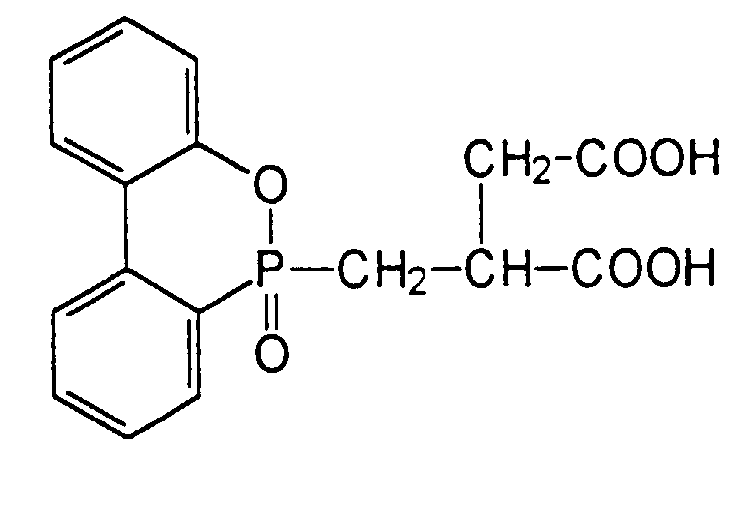
Da bekanntermaßen für die Rohrextrusion von Polyestern höhere Polymerisationsgrade
erfoderlich sind, als z. B. für die Spinnextrusion von Fasern oder Filamenten, ist es in der
Regel erforderlich, die nach dem Schmelzkondensationsverfahren hergestellten
phosphorhaltigen Copolyester durch eine nachgeschaltete Festphasepolykondensation
auf die für die Rohrextrusion erforderlichen hohen Polymerisationsgrade nach zu
kondensieren. Es besteht aber auch die Möglichkeit, die erforderlichen hohen
Polymerisationsgrade während der Schmelzpolykondensation zum Beispiel mittels Einsatz
der in der Literatur bekannten sog. Chain extender (Kettenverlängerer) zu erreichen. In
diesem Falle ist eine Festphasepolykondensation nicht mehr erforderlich.
Die nach der beschriebenen Verfahrenstechnik produzierten flammhemmenden
Copolyester lassen sich bei hohen Geschwindigkeiten extrudieren. Die auf diese Weise
hergestellte aus thermoplastischen Polyester bestehende Aderhülle weist eine hohe
Festigkeit, ein günstiges Zeitstandsverhalten, eine hohe Maßbeständigkeit, ein günstiges
Gleit- und Verschleißverhalten, eine hohe Chemikalienbeständigkeit sowie eine
hervorragende Flammbeständigkeit auf. Als besonders vorteilhaft hat sich erwiesen, daß
keine Anteile der verwendeten Phosphorverbindung flüchtig sind.
Claims (5)
- Hohl- oder Bündelader, bestehend aus einer Aderhülle (1) sowie innerhalb der Aderhülle (1) befindlichen Lichtwellenleitern (2), wobei die Aderhülle (1) aus einem thermoplastischen Werkstoff besteht, dadurch gekennzeichnet, daß der thermoplastische Werkstoff einen flammhemmenden Zusatz enthält.
- Hohl- oder Bündelader nach Anspruch 1, dadurch gekennzeichnet, daß der thermoplastische Werkstoff ein Polyester ist.
- Hohl- oder Bündelader nach Anspruch 1 oder 2, dadurch gekennzeichnet, daß der flammhemmende Zusatz ein phosphorhaltiges Comonomer ist.
- Hohl- oder Bündelader nach Anspruch 3, dadurch gekennzeichnet, daß der Phosphorgehalt in der Aderhülle zwischen 0,2 und 1 % beträgt.
- Hohl- oder Bündelader nach einem der Ansprüche 3 oder 4, dadurch gekennzeichnet, daß der flammhemmende Zusatz durch die chemische Formeloder
 beschrieben ist.
Priority Applications (1)
| Application Number | Priority Date | Filing Date | Title |
|---|---|---|---|
| EP99402830A EP1101785A1 (de) | 1999-11-15 | 1999-11-15 | Hohl- oder Bündelader |
Applications Claiming Priority (1)
| Application Number | Priority Date | Filing Date | Title |
|---|---|---|---|
| EP99402830A EP1101785A1 (de) | 1999-11-15 | 1999-11-15 | Hohl- oder Bündelader |
Publications (1)
| Publication Number | Publication Date |
|---|---|
| EP1101785A1 true EP1101785A1 (de) | 2001-05-23 |
Family
ID=8242177
Family Applications (1)
| Application Number | Title | Priority Date | Filing Date |
|---|---|---|---|
| EP99402830A Withdrawn EP1101785A1 (de) | 1999-11-15 | 1999-11-15 | Hohl- oder Bündelader |
Country Status (1)
| Country | Link |
|---|---|
| EP (1) | EP1101785A1 (de) |
Cited By (1)
| Publication number | Priority date | Publication date | Assignee | Title |
|---|---|---|---|---|
| DE10330774A1 (de) * | 2003-07-08 | 2005-03-03 | Schill + Seilacher Ag | Flammhemmend modifizierte, phosphorhaltige Copolyester, deren Verwendung und Verfahren zu ihrer Herstellung |
Citations (7)
| Publication number | Priority date | Publication date | Assignee | Title |
|---|---|---|---|---|
| DE2646218A1 (de) * | 1975-10-14 | 1977-04-28 | Toyo Boseki | Neue phosphor-enthaltende verbindungen |
| EP0212706A1 (de) * | 1985-07-23 | 1987-03-04 | Koninklijke Philips Electronics N.V. | Optische Glasfaser mit einer Kunststoffbedeckung und härtbare Kunststoffzusammensetzung |
| DE4140543A1 (de) * | 1991-12-09 | 1993-06-17 | Bayer Ag | Neue phosphorhaltige duromere aus oligophosphiten |
| JPH06263809A (ja) * | 1993-03-17 | 1994-09-20 | Japan Synthetic Rubber Co Ltd | 液状硬化性樹脂組成物 |
| WO1995002004A1 (en) * | 1993-07-08 | 1995-01-19 | Dsm N.V. | Halogen-free radiation curable flame retardant compositions |
| US5399428A (en) * | 1994-03-11 | 1995-03-21 | Monsanto Company | Flame retardant polyester copolymers |
| JPH08109518A (ja) * | 1994-09-30 | 1996-04-30 | Kanebo Ltd | 耐光性に優れた高難燃性ポリエステル複合繊維 |
-
1999
- 1999-11-15 EP EP99402830A patent/EP1101785A1/de not_active Withdrawn
Patent Citations (7)
| Publication number | Priority date | Publication date | Assignee | Title |
|---|---|---|---|---|
| DE2646218A1 (de) * | 1975-10-14 | 1977-04-28 | Toyo Boseki | Neue phosphor-enthaltende verbindungen |
| EP0212706A1 (de) * | 1985-07-23 | 1987-03-04 | Koninklijke Philips Electronics N.V. | Optische Glasfaser mit einer Kunststoffbedeckung und härtbare Kunststoffzusammensetzung |
| DE4140543A1 (de) * | 1991-12-09 | 1993-06-17 | Bayer Ag | Neue phosphorhaltige duromere aus oligophosphiten |
| JPH06263809A (ja) * | 1993-03-17 | 1994-09-20 | Japan Synthetic Rubber Co Ltd | 液状硬化性樹脂組成物 |
| WO1995002004A1 (en) * | 1993-07-08 | 1995-01-19 | Dsm N.V. | Halogen-free radiation curable flame retardant compositions |
| US5399428A (en) * | 1994-03-11 | 1995-03-21 | Monsanto Company | Flame retardant polyester copolymers |
| JPH08109518A (ja) * | 1994-09-30 | 1996-04-30 | Kanebo Ltd | 耐光性に優れた高難燃性ポリエステル複合繊維 |
Non-Patent Citations (2)
| Title |
|---|
| DATABASE WPI Week 199442, Derwent World Patents Index; AN 1994-338311, XP002134878 * |
| PATENT ABSTRACTS OF JAPAN vol. 1996, no. 08 30 August 1996 (1996-08-30) * |
Cited By (1)
| Publication number | Priority date | Publication date | Assignee | Title |
|---|---|---|---|---|
| DE10330774A1 (de) * | 2003-07-08 | 2005-03-03 | Schill + Seilacher Ag | Flammhemmend modifizierte, phosphorhaltige Copolyester, deren Verwendung und Verfahren zu ihrer Herstellung |
Similar Documents
| Publication | Publication Date | Title |
|---|---|---|
| DE3142156C2 (de) | Optische Ader mit einem Kern aus einer oder mehreren optischen Kunststoffasern und einer Kunststoffhülle sowie daraus hergestellter Lichtleitkörper und daraus hergestelltes optisches Kabel | |
| DE3587521T2 (de) | Kunststoffaser mit optischen übertragungseigenschaften. | |
| EP0874262A2 (de) | Optisches Kabel und Verfahren zum Herstellen eines optischen Kabels | |
| DE2641166A1 (de) | Ummantelte lichtleitfaser | |
| DE2604307A1 (de) | Optisches kabel | |
| CH622354A5 (de) | ||
| DE3118172C2 (de) | ||
| DE3724997C2 (de) | ||
| EP0178373B1 (de) | Schutzhülle für mindestens einen Lichtwellenleiter | |
| EP1456704B1 (de) | Optische festader und verfahren zu deren herstellung | |
| DE4020800A1 (de) | Verfahren zur herstellung einer zugkraftverstaerkten kunststoffhuelle | |
| DE202008011737U1 (de) | Ummantelte elektrische Leitung | |
| DE3232108A1 (de) | Optisches kabel | |
| DE2730702A1 (de) | Optisches kabel | |
| DE2947942C2 (de) | Faser für optische Übertragungen | |
| DE19820095A1 (de) | Extrudierbare, halogenfreie Mischung | |
| DE3023669A1 (de) | Selbsttragendes optisches nachrichtenkabel | |
| EP0108296B1 (de) | Flammgeschützte Gehäuse für Kabelverbindungen der Nachrichten- und Energieübertragung | |
| DE3852977T2 (de) | Formkörper auf Basis einer Harzzusammensetzung. | |
| DE112013001163T5 (de) | Kabelbaum-Schutzmaterial und Kabelbaum | |
| EP1184698A1 (de) | Optisches Kabel | |
| WO1999012063A1 (de) | Polymere optische faser mit mehrschichtiger schutzumhüllung | |
| DE2911421A1 (de) | Lichtleiteranordnung | |
| DE2913054C2 (de) | ||
| DE29619549U1 (de) | Hohl- oder Bündelader |
Legal Events
| Date | Code | Title | Description |
|---|---|---|---|
| PUAI | Public reference made under article 153(3) epc to a published international application that has entered the european phase |
Free format text: ORIGINAL CODE: 0009012 |
|
| 17P | Request for examination filed |
Effective date: 20000705 |
|
| AK | Designated contracting states |
Kind code of ref document: A1 Designated state(s): AT BE CH CY DE DK ES FI FR GB GR IE IT LI LU MC NL PT SE |
|
| AX | Request for extension of the european patent |
Free format text: AL;LT;LV;MK;RO;SI |
|
| AKX | Designation fees paid |
Free format text: AT BE CH CY DE DK ES FI FR GB GR IE IT LI LU MC NL PT SE |
|
| STAA | Information on the status of an ep patent application or granted ep patent |
Free format text: STATUS: THE APPLICATION IS DEEMED TO BE WITHDRAWN |
|
| 18D | Application deemed to be withdrawn |
Effective date: 20020601 |