EP1102408B1 - Décodeur Viterbi - Google Patents
Décodeur Viterbi Download PDFInfo
- Publication number
- EP1102408B1 EP1102408B1 EP00310118A EP00310118A EP1102408B1 EP 1102408 B1 EP1102408 B1 EP 1102408B1 EP 00310118 A EP00310118 A EP 00310118A EP 00310118 A EP00310118 A EP 00310118A EP 1102408 B1 EP1102408 B1 EP 1102408B1
- Authority
- EP
- European Patent Office
- Prior art keywords
- path
- selection signal
- memory
- metrics
- state
- Prior art date
- Legal status (The legal status is an assumption and is not a legal conclusion. Google has not performed a legal analysis and makes no representation as to the accuracy of the status listed.)
- Expired - Lifetime
Links
Images







Classifications
-
- H—ELECTRICITY
- H03—ELECTRONIC CIRCUITRY
- H03M—CODING; DECODING; CODE CONVERSION IN GENERAL
- H03M13/00—Coding, decoding or code conversion, for error detection or error correction; Coding theory basic assumptions; Coding bounds; Error probability evaluation methods; Channel models; Simulation or testing of codes
- H03M13/37—Decoding methods or techniques, not specific to the particular type of coding provided for in groups H03M13/03 - H03M13/35
- H03M13/39—Sequence estimation, i.e. using statistical methods for the reconstruction of the original codes
- H03M13/41—Sequence estimation, i.e. using statistical methods for the reconstruction of the original codes using the Viterbi algorithm or Viterbi processors
- H03M13/4107—Sequence estimation, i.e. using statistical methods for the reconstruction of the original codes using the Viterbi algorithm or Viterbi processors implementing add, compare, select [ACS] operations
-
- H—ELECTRICITY
- H03—ELECTRONIC CIRCUITRY
- H03M—CODING; DECODING; CODE CONVERSION IN GENERAL
- H03M13/00—Coding, decoding or code conversion, for error detection or error correction; Coding theory basic assumptions; Coding bounds; Error probability evaluation methods; Channel models; Simulation or testing of codes
- H03M13/37—Decoding methods or techniques, not specific to the particular type of coding provided for in groups H03M13/03 - H03M13/35
- H03M13/39—Sequence estimation, i.e. using statistical methods for the reconstruction of the original codes
- H03M13/41—Sequence estimation, i.e. using statistical methods for the reconstruction of the original codes using the Viterbi algorithm or Viterbi processors
Definitions
- the present invention relates generally to a Viterbi decoder used for maximum likelihood decoding of convolutional codes.
- a Viterbi decoder is used for maximum likelihood decoding of convolutional codes, wherein from a plurality of known code sequences of possible input code sequences, a code sequence closest in code distance to that generated by a convolutional encoder is selected as a maximum likelihood code sequence (maximum likelihood path), and based on the information thus selected, decoded data are obtained.
- the Viterbi decoding has a high capability for correcting random errors occurring in a communication channel and allows a particularly high encoding gain to be obtained in combination with a soft decision decoding system. For instance, in a mobile communication system, in which bit errors affect communication quality considerably and which tends to be affected by interference waves easily, convolutional codes are used as error collecting codes and the Viterbi decoding is employed for decoding them.
- FIG. 9 shows a structural example of a convolutional encoder for generating such a code.
- information bits as input data are delayed sequentially by two delay elements 901 and 902 such as flip-flops or the like.
- the input data and data from the delay element 902 are added by an adder 903, which is output as an output G0.
- the input data and data from the delay element 901 are added by an adder 904 and then data from the adder 904 and the data from the delay element 902 are added by an adder 905, which is output as an output G1.
- the states S[1:0] of the encoder can include four states of (00), (01), (10), and (11). There are always two possible transition states with respect to an input.
- a trellis diagram is used, and such state transitions are illustrated by a trellis diagram shown in FIG. 10.
- solid-line arrows (branches) indicate transitions in the case of an input "0" and broken-line branches indicate transitions in the case of an input "1".
- the numerals provided along the respective branches are codes (G0, G1) output upon the transitions of the respective branches.
- two branches become confluent in transition to the respective states without fail.
- a combination (a path) of maximum likelihood (most likely) branches out of the two respective branches reaching the respective states is selected and information (a path selection signal) of the path (a surviving path) thus selected is stored in a memory.
- the path selection is executed until a predetermined path length is obtained and then a maximum likelihood surviving path is searched (traced back) based on contents of the path selection signal memory. Based on the change of the respective maximum likelihood states obtained by the trace-back, information input to the convolutional encoder is decoded.
- the Viterbi decoder for decoding convolutional codes based on such a Viterbi algorithm basically includes a branch metric calculation means, an ACS (add-compare-select) operation means, a path metric memory, a path selection signal memory, and a trace-back means.
- the branch metric calculation means calculates code distances (branch metrics) between input code sequences and code sequences predicted in respective branches.
- the ACS operation means calculates accumulated values (path metrics) of branch metrics reaching respective states and selects surviving paths.
- the path metric memory stores the path metrics of the respective states, and the path selection signal memory stores information of the selected paths.
- the trace-back means searches maximum likelihood surviving paths based on the contents of the path selection signal memory.
- the surviving paths in respective states are selected according to a so-called path metric transition diagram, and the path metrics of the surviving paths are calculated.
- This path metric transition diagram is prepared based on the trellis diagram as shown in FIG. 10.
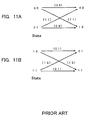
- FIGs. 11A and 11B show path metric transition diagrams when codes indicated by the trellis diagram shown in FIG. 10 are used. That is to say, in the trellis diagram shown in FIG. 10, there are two paths that become confluent in the state (00), one of which is generated by an output of a code (00) from the state (00) and the other of which generates a code (11) from the state (01).
- a maximum likelihood value of two path metrics PM00(new)a and PM00(new)b during the ACS operation is selected and the path metric thus selected is determined as the path metric PM00(new) of the current state (00).
- the path metric PM01(new) in the current state is expressed by one of the following two formulae.
- the difference between PM00(new) and PM10(new) is only the correspondence between PMxx(old) and BMxx when BM11 and BM00 are added to PM00(old) and PM01(old).
- the difference between PM01(new) and PM11(new) also is only the correspondence between PMxx(old) and BMxx when BM01 and BM10 are added to PM10(old) and PM11(old).
- the two PMxx(old) in each case described above have the relationship of continuous even and odd number states and the two PMxx(new) have the relationship of upper and lower order states in which only their most significant bits differ from each other.
- the pair of path metrics to be determined as current states have the relationship that only the least significant bits of their preceding states are different from each other.
- maximum likelihood path metric selection information (path selection signals) of the respective states is indicated as PS00(new), PS01(new), PS10(new) and PS11(new), and the relationships between their values and path metric selections are assumed as follows.
- PSxx(new) 0 ⁇ PMxx(new)a is selected.
- the values of respective PSxx(new) are the same as those of the least significant bits of the corresponding states at the preceding time point.
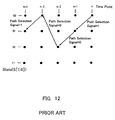
- the states selected in the past can be determined from the values of the path selection signals at respective time points. This operation is referred to as "trace-back" and one example is shown in FIG. 12.
- a method in which an additional bit (a tailbit) is added to an information bit so that the state of the encoder is converged to a predetermined value (for instance, 00 or the like) at the end of the convolutional code sequence.
- a tailbit an additional bit
- the state transitions in the convolutional encoder are caused by successive inputs of information bits to the delay elements. Therefore, the determination of the state transitions by trace-back to the past states means the direct determination of the information bits.
- the information bits can be decoded from the received code sequence by Viterbi decoding.
- a path metric memory for storing a path metric obtained from a result of the ACS operation.
- the path metric that is obtained from a result of the ACS operation and is to be used for the ACS operation at a subsequent time point is allocated to one address of the RAM.
- a path metric of one state is assigned to one address of one RAM.
- JP 9-232973 A discloses a calculation method in which, based on the fact that two PMxx(new) with a relationship of upper and lower order states can be calculated from two BMxx and two PMxx(old) with a relationship of continuous even and odd number states as described above, two path metrics are read out and two path metrics are calculated to be output.
- two memories are provided for the upper orders and lower orders of the path metrics, respectively, and an arrangement for reading out continuous even and odd numbers of the path metrics at a time is provided, thus calculating two path metrics by one-time readout and one-time writing.
- an address of a path selection signal memory is determined from a Viterbi state and furthermore, the next Viterbi state can be determined from a path selection signal read out from the memory.
- the determination of an address and memory access must be executed during one processing unit (one cycle).
- operation delays in the memory are indicated as in FIG. 13B.
- the operation delays include initially, an address delay caused by wiring indicated as a delay A and next, an output delay in the memory and a data delay caused by wiring, which are indicated as a delay C. These operation delays are rather long in general.
- the upper limit of the speed of the trace-back operation is determined as shown in FIG. 13C.
- delays B and D also are included, which relate to a selector for extracting a path selection signal for one state from one word read out from the path selection signal memory.
- the upper limit of the operation speed is determined depending on a longer delay out of the following two delays.
- a Viterbi decoder employing a routing network for routing old path metrics to the input local memories of add-compare-select operation sections is disclosed in "Area-efficient architectures for the Viterbi algorithm-Part I: Theory", IEEE Trans. on Communications, Vol. 41, No. 4, April 1993, pp. 636-644 and "Area-efficient architectures for the Viterbi algorithm-Part ll: Applications", IEEE Trans. on Communications. Vol. 41, No. 5, May 1993, pp. 802-807 written by Shung C.B et al.. The independent claims are characterized over these documents.
- the present invention is intended to provide a Viterbi decoder in which while using conventional memories such as a RAM or the like for a path metric memory and a path selection signal memory, an ACS operation with a reduced number of times the memory is accessed and a high speed trace-back operation are executed.
- a Viterbi decoder in which while using conventional memories such as a RAM or the like for a path metric memory and a path selection signal memory, an ACS operation with a reduced number of times the memory is accessed and a high speed trace-back operation are executed.
- Viterbi deccoder as claimed in claim 1.
- a method of Viterbi decoding in a Viterbi decoder as claimed in claim 6.
- a further disclosed Viterbi decoder includes a branch metric operation section, an add-compare-select (ACS) operation section, a path metric permutation section, and a path metric memory.
- the branch metric operation section calculates branch metrics based on input codes.
- the ACS operation section calculates path metrics of respective states by time-sharing processing based on the branch metrics calculated by the branch metric operation section.
- the path metric permutation section temporarily delays the path metrics sequentially calculated by and output from the ACS operation section and permutates the path metrics to have different time series from those of the path metrics output from the ACS operation section.
- the path metric memory stores path metrics output from the path metric permutation section.
- the path metric memory stores, reads out, and writes path metrics of continuous even number states and path metrics of continuous odd number states, as one storage unit per address.
- the path metric permutation section temporarily delays time series of plural pairs of path metrics of upper order states and path metrics of lower order states calculated by the ACS operation section and permutates the path metrics to obtain time series of plural pairs of path metrics of continuous even number states and path metrics of continuous odd number states.
- the path metric permutation section for temporarily delaying time series of plural pairs of path metrics of upper order states and path metrics of lower order states calculated by the ACS operation section and permutating the path metrics to obtain time series of plural pairs of path metrics of continuous even number states and path metrics of continuous odd number states, four path metrics are updated by two-time readouts and two-time writings with respect to the path metric memory alone.
- the ACS operation section also selects a maximum likelihood path in combination with a path metric at a preceding time point and generates a path selection signal as information of the path thus selected (a surviving path)
- the further disclosed Viterbi decoder further includes a path selection signal memory for storing the path selection signal and a trace-back operation section for searching past state transition using a past path selection signal read out from the path selection signal memory and outputting decoded data
- the trace-back operation section includes a Viterbi state memory for storing a Viterbi state following the surviving path based on the path selection signal obtained from the path selection signal memory, a Viterbi state prediction section for predicting a part of a Viterbi state to be updated next based on contents of the Viterbi state memory, and a path selection signal memory address calculation section for calculating an address of the path selection signal memory storing the path selection signal based on the part of the Viterbi state predicted by the
- the Viterbi state prediction section includes an up/down counter for changing a state according to a readout control signal of the path selection signal memory and a shift control signal of the Viterbi state memory and a selector for changing a correspondence between the contents of the Viterbi state memory and the part of the Viterbi state to be updated next according to a value of the up/down counter.
- pipeline processing is employed in at least one stage selected from a stage where the path selection signal memory address calculation section calculates an address based on the part of the Viterbi state predicted by the Viterbi state prediction section, a stage where based on the address thus calculated the path selection signal is read out from the path selection signal memory, and a stage where based on the path selection signal thus read out the Viterbi state following the surviving path is stored in the Viterbi state memory.
- a Viterbi decoder of another embodiment of the present invention includes a branch metric operation section, an add-compare-select (ACS) operation section, a path metric permutation section, a path metric/path selection signal common memory, a trace-back operation section, and an address generation/memory control section.
- the branch metric operation section calculates branch metrics based on input codes.
- the ACS operation section preferably further calculates path metrics of respective states by time-sharing processing based on the branch metrics calculated by the branch metric operation section, selects a maximum likelihood path in combination with a path metric at a preceding time point, and generates a path selection signal as information of the maximum likelihood path thus selected (a surviving path).
- the path metric permutation section preferably further temporarily delays path metrics sequentially calculated by and output from the ACS operation section and permutates the path metrics to have different time series from those of the path metrics output from the ACS operation section.
- the path metric/path selection signal common memory stores path metrics and path selection signals.
- the trace-back operation section searches past state transition using a past path selection signal read out from the path metric/path selection signal common memory and outputs decoded data.
- the trace-back operation section includes a Viterbi state memory for storing a Viterbi state following the surviving path based on the path selection signal obtained from the path metric/path selection signal common memory, a Viterbi state prediction section for predicting a part of a Viterbi state to be updated next based on contents of the Viterbi state memory, and a path selection signal memory address calculation section for calculating an address of the path selection signal memory storing the path selection signal based on the part of the Viterbi state predicted by the Viterbi state prediction section.
- the address generation/memory control section receives path metrics from the path metric permutation section and the path selection signal from the ACS operation section, generates and writes a specific address with respect to the path metric/path selection signal common memory, reads out the path metrics and the path selection signal that are stored in the path metric/path selection signal common memory, and supplies the path metrics to the ACS operation section and the path selection signal to the trace-back operation section.
- the ACS operation section, the path metric operation section, and the trace-back operation section access the path metric/path selection signal common memory in a time sharing manner by the address generation/memory control section.
- the ACS operation in the Viterbi decoder is executed by time-sharing processing and the sequences of path metric states to be written in the path metric memory or the path metric/path selection signal common memory are changed using the path metric permutation section.
- the path selection signal from the path selection signal memory or the path metric/path selection signal common memory is read out by pipeline processing using the Viterbi state prediction section, thus executing the trace-back operation.
- the number of memory accesses in the ACS operation is reduced and the trace-back operation can be executed at a high speed, thus allowing power consumption to be reduced and the Viterbi decoding process to be accelerated.
- the ACS operation in the Viterbi decoder is executed by the time-sharing processing and the sequences of the path metric states to be written in the path metric memory are changed using the path metric permutation section. Therefore, using one memory, four path metrics can be calculated by four-time memory accesses. Consequently, the number of memory accesses required per process in the ACS operation can be reduced, the Viterbi decoding operation can be accelerated, and the power consumption can be reduced.
- the Viterbi state prediction section is provided in the trace-back operation section in the Viterbi decoder to execute the readout from the path selection signal memory by the pipeline processing. Therefore, while a conventional memory such as a RAM or the like is used for the path selection signal memory, a high speed trace-back operation can be achieved, thus accelerating the Viterbi decoding operation and reducing the power consumption.
- an address generation/memory control section is provided so that one RAM is shared among the ACS operation section, the path metric permutation section, and the trace-back operation section. Consequently, a Viterbi decoder in which the use of the RAM is minimized can be obtained.
- FIG. 1 is a block diagram showing a schematic configuration of a Viterbi decoder according to an embodiment of the present invention.
- a Viterbi decoder selects a combination (a path) of maximum likelihood (most likely) branches selected from two respective branches of respective states to select a surviving path until its predetermined length is obtained and detects a maximum likelihood path out of paths selected in the respective states, thus decoding received codes.
- a Viterbi decoder for decoding convolutional codes based on such a Viterbi algorithm basically includes a branch metric operation section 102, an ACS (add-compare-select) operation section 103, a path metric permutation section 104, a path metric memory 105, a path selection signal memory 106, and a trace-back operation section 107.
- the branch metric operation section 102 calculates metrics between sequences of received data (received sequences) from a terminal 101 and the above-mentioned respective branches.
- the ACS operation section 103 selects surviving paths and calculates path metrics of the surviving paths.
- the path metric permutation section 104 temporarily delays the path metrics sequentially calculated by and output from the ACS operation section 103 and permutates the path metrics to have different time series from those of the path metrics output from the ACS operation section 103.
- the path metric memory 105 stores path metrics of respective states.
- the path selection signal memory 106 stores information of selected paths (path selection signals).
- the trace-back operation section 107 searches past state transition using past path selection signals read out from the path selection signal memory 106 and outputs decoded data from a terminal 108.
- These 256 states are indicated as "00" to "FF" using two digits hexadecimal notations and the path metric of a state xx is indicated as PM[xx].
- a path metric of a new state is indicated as PM[xx](new) and a path metric of a state at the preceding time point as PM[xx](old).
- a maximum likelihood path is selected out of two paths subjected to transition to respective states.
- paths for transition to a new state 00 (new) are two paths from states 00 (old) and 01 (old) at a preceding time point.
- the received codes (G0, G1) are required to be, for example, (00) and (11), respectively.
- These expected two received codes are determined uniquely according to generating polynomials of a convolutional encoder with respect to the respective states xx (new).
- the two received codes denote those expected "when "0” is input to the convolutional encoder as an information bit” and "when "1” is input to the convolutional encoder as an information bit”.
- metrics (branch metrics) of respective received code patterns are determined and in the ACS operation section 103, a maximum likelihood of a path is determined in combination with a metric (a path metric) at a preceding time point to select a surviving path and a path metric for the subsequent time point is stored and retained in the path metric memory 105.
- B M 0 [ 80 ] B M 1 [ 00 ]
- B M 1 [ 80 ] B M 0 [ 00 ]
- B M 0 [ 81 ] B M 1 [ 01 ]
- B M 1 [ 81 ] B M 0 [ 01 ]
- path metrics permutation section 104 using the path metric permutation section 104, four path metrics obtained sequentially from the ACS operation section 103 are permutated to two pairs of path metrics, each of which includes two path metrics of continuous even and odd number states.
- the present embodiment is configured so that using a RAM (a random access memory) as the path metric memory 105, the path metrics of continuous even and odd number states are stored as one storage unit per address of the RAM. Therefore, with the following four memory accesses, four path metrics are updated.
- a RAM a random access memory
- path metrics are updated, for example, as shown in FIG. 2A.
- a state (old) is indicated as n
- a state (new) as m
- an upper state and a lower state in the state (new) are indicated as m(U) and m(L), respectively.
- the upper state and the lower state are defined as follows. As shown in FIG. 9, in the case where the input side of an information bit is the most significant bit of the state, with respect to a pair of states with the same bit except for their most significant bits, the "upper state” is the state with "1" as the most significant bit and the "lower state” is the state with "0" as the most significant bit. For example, in the path metric transition diagrams shown in FIGs.
- the state "00" after state transition is the lower state and the state "10" is the upper state.
- the upper and lower states also can be defined in the case where the input side of an information bit is the least significant bit of the state, which is mathematically the same as the above-mentioned definition.
- branch metrics BM0[m] and BM1[m] are input from terminals 201 and 202, and path metrics PM[n] and PM[n+1] of continuous even and odd number states are input from terminals 203 and 204, respectively.
- adders 205, 206, 207 and 208 calculate path metrics PM0[m(L)] and PM1[m(L)] of lower states and PM0[m(U)] and PM1[m(U)] of upper states.
- Subtracters 209 and 210 compare PM0[m(L)] with PM1[m(L)] and PM0[m(U)] with PM1[m(U)], respectively.
- code bits represent the comparison results.
- a code bit "sign [m(L)]" of the result of comparison between PM0[m(L)] and PM1[m(L)] and a code bit "sign[m(U)]" of the result of comparison between PM0[m(U)] and PM1[m(U)] are used as selection signals in selectors 211 and 212 described later and also are output from terminals 217 and 218 as path selection signals PS[m(L)] and PS[m(U)], respectively.
- Path metrics with high likelihood are calculated as PM[m(L)] and PM[m(U)] by the selectors 211 and 212. These path metrics are delayed temporarily by delay elements 213, 214, 215 of flip-flops and the like in the path metric permutation section 104.
- path selection signals PS[m+1(L)] and PS[m+1(U)] and path metrics PM[m+1(L)] and PM[m+1(U)] are calculated.
- the path metrics PM[m+1(L)] and PM[m+1(U)] together with the PM[m(L)] and PM[m(U)] that have been delayed are permutated and are selected by the selector 216 as a pair of PM[m(L)] and PM[m+1(L)] and a pair of PM[m(U)] and PM[m+1(U)], which then are output from the terminals 219 and 220.
- FIG. 3A is a block diagram showing a specific configuration example of the trace-back operation.
- the trace-back operation section 107 includes a data buffer 302, a selector 303, a shift register 304, a next Viterbi state prediction section 305, and an address buffer 306.
- the data buffer 302 temporarily delays path selection signal data (with n bit width) including path selection signals for a plurality of states ( n states).
- the selector 303 extracts a path selection signal (with one bit width) for one state from the path selection signal data.
- the shift register 304 updates a Viterbi state by the path selection signal.
- the next Viterbi state prediction section 305 predicts a part of a Viterbi state to be updated next from the Viterbi state.
- the address buffer 306 temporarily delays a path selection signal memory address calculated by and output from the next Viterbi state prediction section 305.
- the shift register 304 indicates the Viterbi state as well as a decoding bit obtained from transition of the Viterbi state.
- FIG. 3B is a timing chart showing the delays of respective signals in the above-mentioned configuration.
- the timing chart includes a clock as a reference, an output of the next Viterbi state prediction section, an input of the path selection signal memory address, an output of the path selection signal memory data, and an output of the data buffer, sequentially.
- the respective signals include an address delay caused by wiring, an output delay in the path selection signal memory, and a data delay caused by wiring.
- delays A and C shown in FIG. 3A are divided in a pipeline operation as shown in FIG. 3B by the operation of the path selection signal memory 106 in synchronization with the clock, the address buffer 306, and the data buffer 302.
- the upper limit of the speed of the trace-back operation is determined as shown in FIG. 3C.
- the upper limit of the operation speed is determined depending on the longest delay out of the following delays.
- next Viterbi state prediction section 305 which is an important point in the present embodiment, is described with reference to FIG. 4 as follows.
- the Viterbi state indicates contents of delay elements in the convolutional encoder.
- the contents of the delay elements are shifted by one bit every time one information bit is input.
- one bit shift and time variation in one cycle are equivalent with respect to a part of the Viterbi state.
- FIG. 5A A specific circuit structure for achieving this operation is shown in FIG. 5A.
- a lower order (on an input side of the path selection signal) of a Viterbi state input from the shift register 304 to the next Viterbi state prediction section 305 becomes selection information (a bit address) for the selector 303 (FIG. 3A) extracting a path selection signal from the path selection signal data.
- an upper order of the Viterbi state becomes a path selection signal memory address (a word address)
- a selector 501 selects a bit range of the Viterbi state from which the word address is to be extracted
- an up/down counter 502 computes the information selected by the selector 501.
- the value of the up/down counter 502 is changed according to a read signal of path selection data and a shift signal of the shift register 304.
- FIG. 5B shows the relationship among a read signal of the path selection data, a shift signal of the shift register, and a value of the up/down counter 502.
- the up/down counter 502 retains the preceding value when the read signal is "0" (no reading) and the shift signal also is “0" (no shift), or when the read signal is "1" (reading) and the shift signal also is “1" (shift).
- the up/down counter 502 adds "1".
- the up/down counter 502 subtracts "1".
- the state where only one of the read signal and the shift signal is "1" depends on the number of stages in the pipeline structure shown in FIG. 3B.
- the state where the read signal is "1" and the shift signal is "0" continues for three cycles in an initial period of the trace-back, and the state where the read signal is "0" and the shift signal is "1” continues for three cycles in the end of the trace-back. Therefore, when an initial value of the up/down counter 502 is "0", the value of the up/down counter 502 varies between "0" and "3".
- FIG. 5C shows the relationship between a value of the up/down counter 502 and a word address to be selected by the selector 501.
- the value of the up/down counter 502 increases, i.e. when the read signal is "1" and the shift signal is "0"
- an operation is carried out so as to select the lower order side of the Viterbi state sequentially as the word address.
- This operation is executed for predicting a path selection signal memory address to be updated next as described with reference to FIG. 4.
- This prediction operation uses a part of the bit address as the word address and therefore, the bit width of the maximum bit address can be used as a prediction range.
- FIG. 6 shows a series of operation timings in the above-mentioned trace-back operation.
- FIG. 6 shows, from the top, a reference clock, an output of the next Viterbi state prediction section 305, an output of the address buffer 306, an output of the memory (the path selection signal memory) 106, a path selection signal, a least significant bit of the shift register 304, a path selection data read signal, a shift register shift signal, and a value of the up/down counter 502.
- the use of the output of the next Viterbi state prediction section 305 allows the trace-back to be executed in the pipeline operation.
- Viterbi decoder With reference to FIG. 7, an example of a Viterbi decoder according to another embodiment of the present invention is described as follows.
- the aforementioned operation means and a conventional RAM are used and the use of the RAM is minimized.
- a Viterbi decoder shown in FIG. 7 includes an address generation/memory control section 706 and a path metric/path selection signal common memory 705 in addition to the aforementioned branch metric operation section 102, ACS operation section 103, path metric permutation section 104, and trace-back operation section 107.
- the address generation/memory control section 706 is connected to the ACS operation section 103, the path metric permutation section 104, and the trace-back operation section 107.
- the path metric/path selection signal common memory 705 is connected to the address generation/memory control section 706.
- the address generation/memory control section 706 generates the following memory access address MEMADR from path metric state numbers n and m and a path selection signal state number j based on a path metric memory area start address PMSADR, a path selection signal memory area start address PSSADR, and a memory area assignment signal PMPSSEL.
- MEMADR PMPSSEL ? ( PMSADR + n ) : ( PMSADR + m ) : ( PSSADR + j )
- the PMPSSEL is changed to any one of 0, 1, and 2 at appropriate time points, and the ACS operation section 103, the path metric permutation section 104, and the trace-back operation section 107 operate in synchronization with the PMPSSEL, respectively.
- Viterbi decoding in which one conventional RAM is shared among the respective operation sections and the use of the RAM is minimized can be achieved.
Landscapes
- Physics & Mathematics (AREA)
- Probability & Statistics with Applications (AREA)
- Engineering & Computer Science (AREA)
- Theoretical Computer Science (AREA)
- Error Detection And Correction (AREA)
- Detection And Correction Of Errors (AREA)
Claims (6)
- Décodeur de Viterbi, comprenant :une section (102) d'opération métrique de branche agencée pour calculer des métriques de branche sur la base de codes d'entrée ;une mémoire (105) de métrique de chemin destinée à stocker, lire et écrire une métrique de chemin d'états de nombres pairs et de nombres impairs contigus en tant qu'une unité de stockage ;une section (103) d'opérations d'addition-comparaison-sélection ACS destinée à calculer une première paire de nouvelles métriques de chemin d'un état supérieur et d'un état inférieur avec des nombres d'état pairs simultanément et destinée à calculer une seconde paire de nouvelles métriques de chemin d'un état supérieur et d'un état inférieur avec des nombres d'état impairs contigus à la première paire de nouvelles métriques de chemin simultanément, la section (103) d'opérations d'addition-comparaison-sélection étant agencée de sorte que la première paire de nouvelles métriques de chemin soit uniquement obtenue sur la base d'une première paire d'anciennes métriques de chemin d'états de nombres pairs et de nombres impairs contigus qui sont lues à partir de la mémoire (105) de métrique de chemin en utilisant un premier accès et la métrique de branche calculée par la section (102) d'opérations métriques de branche, et de sorte que la seconde paire de nouvelles métriques de chemin soit obtenue sur la base d'uniquement une paire supplémentaire d'anciennes métriques de chemin d'état de nombres pairs et de nombres impairs contigus qui sont lus à partir de la mémoire (105) de métrique de chemin en utilisant un second accès différent du premier accès dans une série temporelle et la métrique de branche calculée par la section (102) d'opération métrique de branche ; etune section (104) de permutation métrique de chemin agencée pour permuter la première paire de nouvelles métriques de chemin et la seconde paire de nouvelles métriques de chemin calculée séquentiellement par la section (103) d'opérations d'ACS dans un ordre de série temporelle en tant qu'une paire de métriques de chemin d'états supérieur de nombres pairs et supérieur de nombres impairs contigus et une paire de métriques de chemin d'états inférieur de nombres pairs et inférieur de nombres impairs contigus ;dans lequel les deux paires de métriques de chemin permutées par la section (104) de permutation métrique de chemin sont écrites sur la mémoire (105) de métrique de chemin par accès unique pour chaque paire dans une série temporelle différente.
- Décodeur de Viterbi selon la revendication 1, comprenant en outre :une mémoire (106) de signal de sélection de chemin ; etune section (107) d'opération de retour à l'origine ;dans lequel la section (103) d'opération d'ACS est agencée afin, également, de sélectionner un chemin de vraisemblance maximale en combinaison avec une métrique de chemin à un point temporel précédent et afin de générer un signal de sélection de chemin en tant qu'information du chemin de vraisemblance maximale, qui est un chemin survivant, ainsi sélectionné ;la mémoire (106) de signal de sélection de chemin est agencée afin de stocker le signal de sélection de chemin,la section (107) d'opération de retour à l'origine est agencée pour rechercher une transition d'état passé en utilisant un signal de sélection de chemin passé lu à partir de la mémoire (106) de signal de sélection de chemin et sort des données décodées, etla section (107) d'opération de retour à l'origine comporte :une mémoire d'état de Viterbi destinée à stocker un état Viterbi qui suit le chemin survivant sur la base du signal de sélection de chemin obtenu à partir de la mémoire de signal de sélection de chemin ;une section (305) de prédiction d'état de Viterbi destinée à prédire une partie d'un état de Viterbi devant être mis à jour ensuite, sur la base du contenu de la mémoire d'état de Viterbi ; etune section de calcul d'adresse de mémoire de signal de sélection de chemin destinée à calculer une adresse de la mémoire (106) de signal de sélection de chemin stockant le signal de sélection de chemin sur la base de la partie de l'état de Viterbi prédit par la section (305) de prédiction d'état de Viterbi.
- Décodeur de Viterbi selon la revendication 2, dans lequel la section (305) de prédiction d'état de Viterbi comporte :un compteur/décompteur (502) destiné à changer un état selon un signal de commande lu de la mémoire (106) de signal de sélection de chemin et un signal de commande de décalage de la mémoire d'état de Viterbi ; etun sélecteur destiné à changer une correspondance entre le contenu de la mémoire d'état de Viterbi et la partie de l'état de Viterbi devant être mis à jour ensuite selon une valeur du compteur/décompteur (502).
- Décodeur de Viterbi selon la revendication 2, comprenant un moyen de traitement en pipeline destiné à au moins un stade sélectionné parmi :un stade calculant une adresse dans la section de calcul d'adresse de mémoire (106) de signal de sélection de chemin, ladite adresse étant basée sur la partie de l'état de Viterbi prédit par la section (305) de prédiction d'état de Viterbi ;un stade de lecture de signal de sélection dé chemin à partir de la mémoire (106) de signal de sélection de chemin, ladite lecture étant basée sur l'adresse calculée ; etun stade de stockage de l'état de Viterbi qui suit le chemin survivant dans la mémoire d'état de Viterbi, ledit stockage étant basé sur le signal de sélection de chemin lu.
- Décodeur de Viterbi selon la revendication 1, dans lequel ladite section (103) d'opérations d'addition-comparaison-sélection (ACS) est agencée afin de calculer une métrique de chemin d'états respectifs par traitement en temps partagé sur la base de la métrique de branche calculée par la section (102) d'opération métrique de branche, afin de sélectionner un chemin de vraisemblance maximale en combinaison avec une métrique de chemin au niveau d'un point temporel précédent, et afin de générer un signal de sélection de chemin en tant qu'information du chemin de vraisemblance maximale, qui est un chemin survivant, ainsi sélectionné ;
ladite section (104) de permutation métrique de chemin est agencée afin de retarder temporairement les métriques de chemin calculées séquentiellement par et sorties de la section (103) d'opérations d'ACS et afin de permuter les métriques de chemin afin d'avoir une série temporelle différente de celles des métriques de chemin sorties depuis la section (103) d'opérations d'ACS ;
le décodeur de Viterbi comprenant en outre :une mémoire commune de signal de sélection de chemin/métrique de chemin destinée à stocker des métriques de chemin et des signaux de sélection de chemin ;une section (107) d'opération de retour à l'origine destinée à rechercher une transition d'état passé en utilisant un signal de sélection de chemin passé lu à partir de la mémoire commune (705) de signal de sélection de chemin/métrique de chemin et sortir des données décodées, la section (107) d'opération de retour à l'origine comportant :dans lequel la section (103) d'opération d'ACS, la section de permutation métrique de chemin, et la section d'opération de retour à l'origine sont agencées afin d'accéder à la mémoire commune (705) de signal de sélection de chemin/métrique de chemin en temps partagé, sous la commande de la section (706) de commande de mémoire/génération d'adresse.une mémoire d'état de Viterbi destinée à stocker un état de Viterbi qui suit le chemin survivant sur la base du signal de sélection de chemin obtenu depuis la mémoire commune (705) de signal de sélection de chemin/métrique de chemin ; etune section (305) de prédiction d'état de Viterbi destinée à prédire une partie d'un état de Viterbi devant être mis à jour ensuite sur la base d'un contenu de la mémoire d'état de Viterbi ; etune section de calcul d'adresse de mémoire de signaux de sélection de chemin destinée à calculer une adresse de la mémoire de signal de sélection de chemin stockant le signal de sélection de chemin sur la base de la partie de l'état de Viterbi prédite par la section (305) de prédiction d'état de Viterbi ; etune section (706) de commande de mémoire/génération d'adresse destinée à recevoir une métrique de chemin depuis la section de permutation de métrique de chemin et le signal de sélection de chemin depuis la section (103) d'opération d'ACS, générer et écrire une adresse spécifique en rapport avec la mémoire commune (705) de signal de sélection de chemin/métrique de chemin, lire les métriques de chemin et le signal de sélection de chemin qui sont stockés sur la mémoire commune (705) de signal de sélection de chemin/métrique de chemin, et délivrer les métriques de chemin à la section (103) d'opérations d'ACS et le signal de sélection de chemin à la section (107) d'opération de retour à l'origine ; - Procédé de décodage de Viterbi dans un décodeur de Viterbi,
le décodeur de Viterbi comprenant :une mémoire (105) de métrique de chemin destinée à stocker, lire et écrire des métriques de chemin d'états de nombres pairs et de nombres impairs contigus en tant qu'une unité de stockage,le procédé comprenant les étapes suivantes :lire une première paire d'anciennes métriques de chemin d'états de nombres pairs et de nombres impairs contigus à partir de la mémoire (105) de métrique de chemin en utilisant un premier accès ;calculer une première paire de métriques de branche ;calculer une première paire de nouvelles métriques de chemin d'un état supérieur et d'un état inférieur avec des nombres d'état pairs simultanément en exécutant une opération d'addition-comparaison-sélection ACS sur la base d'uniquement une première paire d'anciennes métriques de chemin et la première paire de métriques de branche ;lire une seconde paire d'anciennes métriques de chemin d'états de nombres pairs et de nombres impairs contigus à partir de la mémoire métrique de chemin en utilisant un second accès différent du premier accès dans une série temporelle ;calculer une seconde paire de métriques de branche;calculer une seconde paire de nouvelles métriques de chemin d'un état supérieur et d'un état inférieur avec des nombres d'état impairs contigus à la première paire de nouvelles métriques de chemin simultanément, en exécutant une opération d'addition-comparaison-sélection ACS sur la base d'uniquement une paire supplémentaire d'anciennes métriques de chemin et la seconde paire de métriques de branche dans une série temporelle différente de celles du calcul de la première paire de nouvelles métriques de chemin ;permuter la première paire de nouvelles métriques de chemin et la seconde paire de nouvelles métriques de chemin dans un ordre de série temporelle en tant qu'une paire de métriques de chemin d'états supérieur de nombres pairs et supérieur de nombres impairs contigus et une paire de métriques de chemin d'états inférieur de nombres pairs et inférieur de nombres impairs contigus ; etécrire les deux paires de métriques de chemin permutées sur la mémoire (105) de métrique de chemin par accès unique pour chaque paire dans une série temporelle différente.
Applications Claiming Priority (2)
| Application Number | Priority Date | Filing Date | Title |
|---|---|---|---|
| JP33161299A JP3515720B2 (ja) | 1999-11-22 | 1999-11-22 | ビタビ復号器 |
| JP33161299 | 1999-11-22 |
Publications (3)
| Publication Number | Publication Date |
|---|---|
| EP1102408A2 EP1102408A2 (fr) | 2001-05-23 |
| EP1102408A3 EP1102408A3 (fr) | 2003-08-27 |
| EP1102408B1 true EP1102408B1 (fr) | 2006-06-21 |
Family
ID=18245612
Family Applications (1)
| Application Number | Title | Priority Date | Filing Date |
|---|---|---|---|
| EP00310118A Expired - Lifetime EP1102408B1 (fr) | 1999-11-22 | 2000-11-15 | Décodeur Viterbi |
Country Status (5)
| Country | Link |
|---|---|
| US (1) | US6324226B1 (fr) |
| EP (1) | EP1102408B1 (fr) |
| JP (1) | JP3515720B2 (fr) |
| KR (1) | KR100426712B1 (fr) |
| DE (1) | DE60028906T2 (fr) |
Families Citing this family (28)
| Publication number | Priority date | Publication date | Assignee | Title |
|---|---|---|---|---|
| US6741664B1 (en) | 1999-02-05 | 2004-05-25 | Broadcom Corporation | Low-latency high-speed trellis decoder |
| TW447194B (en) * | 1999-04-12 | 2001-07-21 | Matsushita Electric Industrial Co Ltd | Viterbi decoding device and method |
| US7225393B2 (en) * | 1999-10-01 | 2007-05-29 | Matsushita Electric Industrial Co., Ltd. | Viterbi decoder and Viterbi decoding method |
| JP3501725B2 (ja) * | 2000-05-12 | 2004-03-02 | 日本電気株式会社 | ビタビ復号器 |
| US6842490B1 (en) * | 2000-10-11 | 2005-01-11 | Feng Qian | Viterbi decoder with adaptive traceback |
| JP3532884B2 (ja) * | 2001-05-18 | 2004-05-31 | 松下電器産業株式会社 | ビタビ復号器 |
| US7830630B2 (en) * | 2001-06-28 | 2010-11-09 | Stmicroelectronics, Inc. | Circuit and method for detecting the phase of a servo signal |
| KR100834663B1 (ko) * | 2002-03-11 | 2008-06-02 | 삼성전자주식회사 | 직접 메모리 접근을 이용한 비터비 복호기 및 비터비 복호 방법 |
| US6928605B2 (en) * | 2002-03-29 | 2005-08-09 | Intel Corporation | Add-compare-select accelerator using pre-compare-select-add operation |
| US7046747B2 (en) * | 2002-04-16 | 2006-05-16 | Intel Corporation | Viterbi decoder and decoding method using rescaled branch metrics in add-compare-select operations |
| US7020223B2 (en) | 2002-04-16 | 2006-03-28 | Intel Corporation | Viterbi decoder and method using sequential two-way add-compare-select operations |
| CN100477534C (zh) * | 2002-08-14 | 2009-04-08 | 联发科技股份有限公司 | 维特比解码器的解码电路与方法 |
| EP1450493A1 (fr) | 2003-02-19 | 2004-08-25 | Nokia Corporation | Décodeur de Viterbi avec calcul des métriques de chemin sur deux colonnes du treillis et routage des métriques de chemin dans la mémoire |
| US7496159B2 (en) * | 2003-12-01 | 2009-02-24 | Mediatek Inc. | Survivor memory management in a Viterbi decoder |
| US20060068911A1 (en) * | 2004-09-30 | 2006-03-30 | Microsoft Corporation | Game console communication with a computer |
| US7275204B2 (en) * | 2004-09-30 | 2007-09-25 | Marvell International Ltd. | Distributed ring control circuits for Viterbi traceback |
| TWI241072B (en) * | 2004-12-09 | 2005-10-01 | Ind Tech Res Inst | Prediction device and method applied in a Viterbi decoder |
| US7506239B2 (en) * | 2004-12-23 | 2009-03-17 | Raghavan Sudhakar | Scalable traceback technique for channel decoder |
| US7571369B2 (en) | 2005-02-17 | 2009-08-04 | Samsung Electronics Co., Ltd. | Turbo decoder architecture for use in software-defined radio systems |
| US7603613B2 (en) | 2005-02-17 | 2009-10-13 | Samsung Electronics Co., Ltd. | Viterbi decoder architecture for use in software-defined radio systems |
| US7933405B2 (en) * | 2005-04-08 | 2011-04-26 | Icera Inc. | Data access and permute unit |
| JP4600183B2 (ja) * | 2005-06-28 | 2010-12-15 | ソニー株式会社 | ビタビ復号装置 |
| US20070266303A1 (en) * | 2006-04-27 | 2007-11-15 | Qualcomm Incorporated | Viterbi decoding apparatus and techniques |
| RU2399157C2 (ru) * | 2008-10-28 | 2010-09-10 | Общество с ограниченной ответственностью "Научно-производственное предприятие "Цифровые решения" | Декодер сверточных кодов для dvb-t приемника |
| JP2010206570A (ja) * | 2009-03-04 | 2010-09-16 | Sony Corp | 復号装置、復号方法 |
| JP6551534B2 (ja) * | 2015-03-23 | 2019-07-31 | 日本電気株式会社 | 情報処理装置、情報処理方法、及びプログラム |
| US10069517B2 (en) * | 2016-07-06 | 2018-09-04 | Samsung Electronics Co., Ltd. | Convolutional decoder and method of decoding convolutional codes |
| KR102693857B1 (ko) * | 2016-07-06 | 2024-08-09 | 삼성전자주식회사 | 컨볼루션 디코더 및 컨볼루션 코드들을 디코딩하는 방법 |
Family Cites Families (10)
| Publication number | Priority date | Publication date | Assignee | Title |
|---|---|---|---|---|
| US5539757A (en) * | 1993-12-22 | 1996-07-23 | At&T Corp. | Error correction systems with modified Viterbi decoding |
| US5497384A (en) * | 1993-12-29 | 1996-03-05 | International Business Machines Corporation | Permuted trellis codes for input restricted partial response channels |
| US5530707A (en) * | 1994-03-09 | 1996-06-25 | At&T Corp. | Area-efficient decoders for rate-k/n convolutional codes and other high rate trellis codes |
| US5537424A (en) * | 1994-08-12 | 1996-07-16 | International Business Machines Corporation | Matched spectral null codes with partitioned systolic trellis structures |
| US5841796A (en) | 1995-03-14 | 1998-11-24 | Comsat Corporation | Apparatus and method for calculating viterbi path metric using exponentially-weighted moving average |
| US5859861A (en) | 1995-06-21 | 1999-01-12 | Hyundai Electronics Ind. Co., Ltd. | High speed viterbi decoder |
| JPH09232973A (ja) * | 1996-02-28 | 1997-09-05 | Sony Corp | ビタビ復号器 |
| US5815515A (en) * | 1996-03-28 | 1998-09-29 | Lsi Logic Corporation | Edge metric calculation method and apparatus using permutations |
| US5872817A (en) | 1997-07-02 | 1999-02-16 | Lucent Technologies Inc. | Joint viterbi decoder and decision feedback equalizer |
| JP2000138595A (ja) | 1998-10-29 | 2000-05-16 | Nec Corp | ビタビ復号器 |
-
1999
- 1999-11-22 JP JP33161299A patent/JP3515720B2/ja not_active Expired - Fee Related
-
2000
- 2000-11-15 DE DE60028906T patent/DE60028906T2/de not_active Expired - Lifetime
- 2000-11-15 EP EP00310118A patent/EP1102408B1/fr not_active Expired - Lifetime
- 2000-11-16 US US09/714,405 patent/US6324226B1/en not_active Expired - Fee Related
- 2000-11-22 KR KR10-2000-0069518A patent/KR100426712B1/ko not_active Expired - Fee Related
Also Published As
| Publication number | Publication date |
|---|---|
| KR20010051871A (ko) | 2001-06-25 |
| DE60028906D1 (de) | 2006-08-03 |
| JP2001156651A (ja) | 2001-06-08 |
| US6324226B1 (en) | 2001-11-27 |
| EP1102408A3 (fr) | 2003-08-27 |
| DE60028906T2 (de) | 2007-02-01 |
| EP1102408A2 (fr) | 2001-05-23 |
| KR100426712B1 (ko) | 2004-04-13 |
| JP3515720B2 (ja) | 2004-04-05 |
Similar Documents
| Publication | Publication Date | Title |
|---|---|---|
| US6324226B1 (en) | Viterbi decoder | |
| EP0234558B1 (fr) | Cheminement pour un décodeur viterbi | |
| EP1049001B1 (fr) | Appareil arithmétique | |
| US4606027A (en) | Error correction apparatus using a Viterbi decoder | |
| EP0926836B1 (fr) | Méthode et appareil de décodage Viterbi | |
| US5928378A (en) | Add-compare-select processor in Viterbi decoder | |
| US7277507B2 (en) | Viterbi decoder | |
| US6343105B1 (en) | Viterbi decoder | |
| US20010044921A1 (en) | Viterbi decoder with high speed processing function | |
| US5878060A (en) | Viterbi decoding apparatus and viterbe decoding method | |
| JPH09238086A (ja) | ビタビデコーダの論理ブロック | |
| KR100262303B1 (ko) | 비터비알고리즘을적용하는복호과정에서의생존경로역추적방법및그장치 | |
| RU2222105C2 (ru) | Способ и устройство для определения состояния максимального правдоподобия в декодирующем устройстве | |
| JP2010206570A (ja) | 復号装置、復号方法 | |
| JP2004120791A (ja) | ビタビ復号器 | |
| JP2904271B2 (ja) | ビタビ復号器用パスメモリユニットおよび復号方法 | |
| KR19990076528A (ko) | 비터비 알고리즘 처리를 위한 가산 비교 선택 고속화 장치 및방법 | |
| KR100491016B1 (ko) | 역방향 상태 천이의 연속적 제어에 의한 역추적 비터비복호기 및 그 방법 | |
| KR100223925B1 (ko) | 비터비 디코딩장치 | |
| JPH0361375B2 (fr) | ||
| JP2000196468A (ja) | ビタビ復号化装置およびビタビ復号化方法 | |
| KR20040031323A (ko) | 비터비 복호기의 경로 메트릭 저장 장치 및 방법 | |
| JP2001257603A (ja) | ビタビ復号装置および方法 | |
| KR100399410B1 (ko) | 비터비 복호기 및 그 복호 방법 | |
| JPH07288478A (ja) | ビタビ復号方法およびビタビ復号化装置 |
Legal Events
| Date | Code | Title | Description |
|---|---|---|---|
| PUAI | Public reference made under article 153(3) epc to a published international application that has entered the european phase |
Free format text: ORIGINAL CODE: 0009012 |
|
| AK | Designated contracting states |
Kind code of ref document: A2 Designated state(s): AT BE CH CY DE DK ES FI FR GB GR IE IT LI LU MC NL PT SE TR |
|
| AX | Request for extension of the european patent |
Free format text: AL;LT;LV;MK;RO;SI |
|
| PUAL | Search report despatched |
Free format text: ORIGINAL CODE: 0009013 |
|
| AK | Designated contracting states |
Designated state(s): AT BE CH CY DE DK ES FI FR GB GR IE IT LI LU MC NL PT SE TR |
|
| AX | Request for extension of the european patent |
Extension state: AL LT LV MK RO SI |
|
| 17P | Request for examination filed |
Effective date: 20031212 |
|
| 17Q | First examination report despatched |
Effective date: 20040123 |
|
| AKX | Designation fees paid |
Designated state(s): DE FR GB |
|
| GRAP | Despatch of communication of intention to grant a patent |
Free format text: ORIGINAL CODE: EPIDOSNIGR1 |
|
| GRAS | Grant fee paid |
Free format text: ORIGINAL CODE: EPIDOSNIGR3 |
|
| GRAA | (expected) grant |
Free format text: ORIGINAL CODE: 0009210 |
|
| AK | Designated contracting states |
Kind code of ref document: B1 Designated state(s): DE FR GB |
|
| REG | Reference to a national code |
Ref country code: GB Ref legal event code: FG4D |
|
| REF | Corresponds to: |
Ref document number: 60028906 Country of ref document: DE Date of ref document: 20060803 Kind code of ref document: P |
|
| ET | Fr: translation filed | ||
| PLBE | No opposition filed within time limit |
Free format text: ORIGINAL CODE: 0009261 |
|
| STAA | Information on the status of an ep patent application or granted ep patent |
Free format text: STATUS: NO OPPOSITION FILED WITHIN TIME LIMIT |
|
| 26N | No opposition filed |
Effective date: 20070322 |
|
| PGFP | Annual fee paid to national office [announced via postgrant information from national office to epo] |
Ref country code: DE Payment date: 20101110 Year of fee payment: 11 |
|
| PGFP | Annual fee paid to national office [announced via postgrant information from national office to epo] |
Ref country code: GB Payment date: 20101110 Year of fee payment: 11 |
|
| PGFP | Annual fee paid to national office [announced via postgrant information from national office to epo] |
Ref country code: FR Payment date: 20111118 Year of fee payment: 12 |
|
| GBPC | Gb: european patent ceased through non-payment of renewal fee |
Effective date: 20121115 |
|
| REG | Reference to a national code |
Ref country code: FR Ref legal event code: ST Effective date: 20130731 |
|
| REG | Reference to a national code |
Ref country code: DE Ref legal event code: R119 Ref document number: 60028906 Country of ref document: DE Effective date: 20130601 |
|
| PG25 | Lapsed in a contracting state [announced via postgrant information from national office to epo] |
Ref country code: DE Free format text: LAPSE BECAUSE OF NON-PAYMENT OF DUE FEES Effective date: 20130601 |
|
| PG25 | Lapsed in a contracting state [announced via postgrant information from national office to epo] |
Ref country code: GB Free format text: LAPSE BECAUSE OF NON-PAYMENT OF DUE FEES Effective date: 20121115 Ref country code: FR Free format text: LAPSE BECAUSE OF NON-PAYMENT OF DUE FEES Effective date: 20121130 |