EP1450493A1 - Décodeur de Viterbi avec calcul des métriques de chemin sur deux colonnes du treillis et routage des métriques de chemin dans la mémoire - Google Patents
Décodeur de Viterbi avec calcul des métriques de chemin sur deux colonnes du treillis et routage des métriques de chemin dans la mémoire Download PDFInfo
- Publication number
- EP1450493A1 EP1450493A1 EP03100380A EP03100380A EP1450493A1 EP 1450493 A1 EP1450493 A1 EP 1450493A1 EP 03100380 A EP03100380 A EP 03100380A EP 03100380 A EP03100380 A EP 03100380A EP 1450493 A1 EP1450493 A1 EP 1450493A1
- Authority
- EP
- European Patent Office
- Prior art keywords
- path metrics
- trellis
- multiplexer
- path
- memory
- Prior art date
- Legal status (The legal status is an assumption and is not a legal conclusion. Google has not performed a legal analysis and makes no representation as to the accuracy of the status listed.)
- Withdrawn
Links
- 230000015654 memory Effects 0.000 title claims abstract description 81
- 238000004364 calculation method Methods 0.000 title claims abstract description 74
- 230000007704 transition Effects 0.000 description 18
- 238000000034 method Methods 0.000 description 6
- 230000005540 biological transmission Effects 0.000 description 5
- 230000009897 systematic effect Effects 0.000 description 4
- 238000010586 diagram Methods 0.000 description 2
- 238000004519 manufacturing process Methods 0.000 description 2
- 238000010276 construction Methods 0.000 description 1
- 230000001419 dependent effect Effects 0.000 description 1
- 238000005562 fading Methods 0.000 description 1
- 230000000644 propagated effect Effects 0.000 description 1
Images

Classifications
-
- H—ELECTRICITY
- H04—ELECTRIC COMMUNICATION TECHNIQUE
- H04L—TRANSMISSION OF DIGITAL INFORMATION, e.g. TELEGRAPHIC COMMUNICATION
- H04L1/00—Arrangements for detecting or preventing errors in the information received
- H04L1/004—Arrangements for detecting or preventing errors in the information received by using forward error control
- H04L1/0056—Systems characterized by the type of code used
- H04L1/0059—Convolutional codes
- H04L1/006—Trellis-coded modulation
-
- H—ELECTRICITY
- H03—ELECTRONIC CIRCUITRY
- H03M—CODING; DECODING; CODE CONVERSION IN GENERAL
- H03M13/00—Coding, decoding or code conversion, for error detection or error correction; Coding theory basic assumptions; Coding bounds; Error probability evaluation methods; Channel models; Simulation or testing of codes
- H03M13/03—Error detection or forward error correction by redundancy in data representation, i.e. code words containing more digits than the source words
- H03M13/23—Error detection or forward error correction by redundancy in data representation, i.e. code words containing more digits than the source words using convolutional codes, e.g. unit memory codes
-
- H—ELECTRICITY
- H03—ELECTRONIC CIRCUITRY
- H03M—CODING; DECODING; CODE CONVERSION IN GENERAL
- H03M13/00—Coding, decoding or code conversion, for error detection or error correction; Coding theory basic assumptions; Coding bounds; Error probability evaluation methods; Channel models; Simulation or testing of codes
- H03M13/37—Decoding methods or techniques, not specific to the particular type of coding provided for in groups H03M13/03 - H03M13/35
- H03M13/39—Sequence estimation, i.e. using statistical methods for the reconstruction of the original codes
- H03M13/41—Sequence estimation, i.e. using statistical methods for the reconstruction of the original codes using the Viterbi algorithm or Viterbi processors
- H03M13/4107—Sequence estimation, i.e. using statistical methods for the reconstruction of the original codes using the Viterbi algorithm or Viterbi processors implementing add, compare, select [ACS] operations
-
- H—ELECTRICITY
- H03—ELECTRONIC CIRCUITRY
- H03M—CODING; DECODING; CODE CONVERSION IN GENERAL
- H03M13/00—Coding, decoding or code conversion, for error detection or error correction; Coding theory basic assumptions; Coding bounds; Error probability evaluation methods; Channel models; Simulation or testing of codes
- H03M13/37—Decoding methods or techniques, not specific to the particular type of coding provided for in groups H03M13/03 - H03M13/35
- H03M13/39—Sequence estimation, i.e. using statistical methods for the reconstruction of the original codes
- H03M13/41—Sequence estimation, i.e. using statistical methods for the reconstruction of the original codes using the Viterbi algorithm or Viterbi processors
- H03M13/4161—Sequence estimation, i.e. using statistical methods for the reconstruction of the original codes using the Viterbi algorithm or Viterbi processors implementing path management
-
- H—ELECTRICITY
- H03—ELECTRONIC CIRCUITRY
- H03M—CODING; DECODING; CODE CONVERSION IN GENERAL
- H03M13/00—Coding, decoding or code conversion, for error detection or error correction; Coding theory basic assumptions; Coding bounds; Error probability evaluation methods; Channel models; Simulation or testing of codes
- H03M13/65—Purpose and implementation aspects
- H03M13/6502—Reduction of hardware complexity or efficient processing
- H03M13/6505—Memory efficient implementations
-
- H—ELECTRICITY
- H04—ELECTRIC COMMUNICATION TECHNIQUE
- H04L—TRANSMISSION OF DIGITAL INFORMATION, e.g. TELEGRAPHIC COMMUNICATION
- H04L1/00—Arrangements for detecting or preventing errors in the information received
- H04L1/004—Arrangements for detecting or preventing errors in the information received by using forward error control
- H04L1/0045—Arrangements at the receiver end
- H04L1/0054—Maximum-likelihood or sequential decoding, e.g. Viterbi, Fano, ZJ algorithms
Definitions
- the invention relates to a decoder for a trellis code.
- the channel used in telecommunications systems frequently causes interference in data transmission. Interference occurs in all kinds of systems but particularly in wireless telecommunications systems the transmission path attenuates and distorts the signal to be transmitted in various ways. On the transmission path interference is typically caused by multi-path propagation of the signal and different kinds of fading and reflection as well as by other signals transmitted on the same transmission path.
- convolutional encoding In convolutional encoding the signal consisting of symbols is encoded into code words, which are based on the convolution of the symbols with themselves or with another signal.
- the coding rate and coding polynomials define the convolutional code.
- the coding rate (k/n) means the number (n) of encoded symbols in relation to the number (k) of symbols to be encoded.
- the coding is usually implemented by means of shift registers.
- the constraint length K of the code refers to the degree of coding polynomials plus one.
- the coding process may be regarded as a state machine with 2 K-1 states.
- a signal that has propagated on a channel is decoded in a receiver.
- the convolutional code can be both encoded and decoded using a trellis whose nodes (or equally states) correspond to the states of the encoder used in signal encoding and the paths between nodes belonging to two successive trellis columns of the trellis correspond to allowed state transitions between the encoder states.
- the code unequivocally attaches the beginning and the end state of the transition, the bit under encoding and the bits of the encoding result to each state transition.
- the purpose of the decoder is thus to determine successive states of the coder, i.e. transitions from one state to another, which are caused by the original bits. To determine the transitions, metrics are calculated in the decoder.
- path metrics also state metrics
- branch metrics There are two kinds of metrics: path metrics (also state metrics) and branch metrics.
- the path metrics represent the probability at which the set of symbols included in the received signal leads to the state corresponding to the node in question.
- the branch metrics are proportional to the probabilities of transitions.
- a Viterbi algorithm is usually used in decoding of a convolutional code.
- the decoder can calculate for example eight new path metrics in parallel, whereupon 32 successive phases are needed to calculate one trellis column of a 256-state convolutional code.
- Another possibility is to extend parallel calculation over trellis columns, whereby four ACS-units (Add-Compare-Select) are used for one column, and to which ACS-units four more ACS-units are connected for calculating the path metrics of the next trellis column. With such an arrangement the calculation of the path metrics is advanced by two trellis columns instead of just one.
- the present invention seeks to provide an improved decoder for a trellis code.
- a decoder for a trellis code comprising: a path metrics calculation unit for calculating path metrics over at least two trellis columns in a trellis, the path metrics calculation unit including an input interface for old path metrics and an output interface for new path metrics; a memory for storing path metrics of the trellis, the memory including a read interface for reading old path metrics from the memory and a write interface for writing new path metrics into the memory; an input multiplexer connected between the read interface of the memory and the input interface of the path metrics calculation unit; an output multiplexer connected between the output interface of the path metrics calculation unit and the write interface of the memory; and a control for controlling configuration of the input multiplexer and configuration of the output multiplexer on the basis of states of the trellis, which state of the trellis defines the way the old path metrics and the new path metrics relate to each other, whereby internal configuration of the path metrics calculation unit remains the same for different code constraint lengths.
- the solution of the invention is especially effective when the code has many states, for example 64, 128, 256 states or more.
- the routing of path metric buses is controlled with the help of the states of the code.
- the routing structures for buses are unified so that the same path metrics calculation unit can be used for decoding of codes having different code constraint lengths.
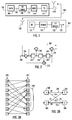
- the transmitter 100 comprises a data source 106, which may be a speech encoder or another conventional data source used in circuit-switched or packet-switched data transmission.
- a signal 108 to be transmitted is received from the output of the data source and supplied to a channel encoder 110, which in this case is a convolutional encoder.
- the encoded symbols 112 are supplied to a modulator 114, where the signal is modulated in a prior art manner.
- the modulated signal is supplied to radio frequency parts 116, where it is amplified and transmitted to the radio path 104 by an antenna 118.
- the receiver 102 comprises an antenna 120 for receiving the signal, which is supplied to a demodulator 124 via radio frequency parts 122.
- the demodulated signal is supplied to a channel decoder 126, where the signal is decoded using the trellis as described below. From the decoder the decoded signal 128 is supplied further to the other parts of the receiver 102.
- An eight-state systematic and recursive encoder for a convolutional code will be described next with reference to Figure 2.
- An input bit which is described in the first column of Table 1, enters the input 200 of the encoder.
- the present state of the encoder i.e. the bits from each block 214, 216, 218 arranged one after another, is illustrated in the second column of Table 1.
- Columns 2 and 3 present the states using binary numbers, but the corresponding decimal numbers are also presented in parentheses.
- the contents of the delay elements 214, 216, 218 are interpreted into a binary digit such that the most significant bit is in the delay element 214 and the least significant bit is in the delay element 218.
- the third column in the table shows the next state of the encoder.
- the encoder has two outputs: a systematic bit exits from output 202 and a parity bit from output 204, which is illustrated in the fifth column of Table 1.
- the coding result of one state transition of the encoder comprises two bits: a systematic bit and a parity bit.
- the encoder further comprises summing blocks 206, 208, 210 and 212 for implementing recursion. Because two output bits are generated for each input bit, the coding rate is 1/2.
- Figure 3A illustrates two successive trellis columns 320, 322 of the trellis of the encoder shown in Figure 2.
- the numbers in parentheses in the second and the third column of Table 1 refer to the trellis nodes denoted by numbers 0 to 7 in Figure 3A.
- Table 1 also shows state transitions of the encoder in the fourth column. Each state has two feasible new states, which are determined according to the input bit to be encoded at a given time.
- the trellis has one trellis column more than is the number of bits to be encoded and possibly a few extra trellis columns thanks to the termination method used.
- a butterfly chart for part 324 of the trellis of Figure 3A is shown in Figure 3B.
- the butterfly chart consists of the nodes 300, 302 of the preceding trellis column 320 and of the nodes 304, 306 of the present trellis column 322.
- the butterfly chart also includes the allowed state transitions 310, 312, 314, 316.
- the calculation of the path metrics and the branch metrics and the connection between them are determined by the convolutional code and the decoder applied.
- the transition from one trellis column to another is performed by an ACS-operation (Add-Compare-Select) in the butterfly chart.
- 'Add' refers to adding the branch metrics of the allowed transition paths to the path metrics of the first trellis column.
- 'Compare' refers to the fact that in the nodes of the second trellis column, the values of the path metrics of the paths that are allowed to arrive in these nodes are compared with one another.
- 'Select' refers to the fact that in the node of the second trellis column a path representing the best path metrics value is selected as the path of the node in question, i.e. this path is the winner (or survivor) path. The lost paths are rejected.
- the trellis typically describes a binary-encoded signal, in which case there are two feasible paths 310, 312, 314, 316 from one node 300, 302 of the first trellis column to the two nodes 304, 306 of the second trellis column.
- one ACS-operation is needed for each node.
- the transition path of the winner path is stored in a memory for further processing. For example, when the winner path of the node 304 has arrived along the transition path 310, then a bit with value 0 is stored in the memory, and when the winner path of the node 304 has arrived along the transition path 312, then a bit with value 1 is stored in the memory.
- the values X and Y of the new path metrics can be calculated e.g. as follows: where A and B are the values of the path metrics from the preceding trellis column and P1, P2, P3 and P4 are the corresponding values of the branch metrics between the nodes.
- Information on the transition path may be stored such that a winning path stemming from the node 300 is denoted with a bit with value 0 and a winning path stemming from the node 302 is denoted with a bit with value 1.
- the path metrics of all nodes of one trellis column can be calculated by processing all butterfly charts.
- Figures 4A, 4B, 4C and 4D list all the possible ways in which the winner paths can be formed in the case of the example shown in the butterfly chart of Figure 3B.
- Figure 4A illustrates a case where the winner path of node 304 is path 310 and its rejected path is path 312, and the winner path of node 306 is path 316 and its rejected path is path 314.
- Figure 4B the winner path of node 304 is path 312 and its rejected path is path 310, and the winner path of node 306 is path 314 and its rejected path is path 316.
- Figure 4C the winner path of node 304 is path 310 and its rejected path is path 312, and the winner path of node 306 is path 314 and its rejected path is path 316.
- Figure 4D the winner path of node 304 is path 312 and its rejected path is path 310, and the winner path of node 306 is path 316 and its rejected path is path 314.
- the trellis relates to the convolutional code.
- the number of states is relative small, eight, which is also the length of the trellis column. All new path metrics of one trellis column can be calculated simultaneously utilizing only eight ACS-units.
- the coding rate influences positively the protection capability of the code: the smaller the rate, the better the protection.
- the number of the states is 256.
- Input bit enters the input 500 of the encoder.
- the delay elements 502, 504, 506, 508, 510, 512, 514, 516 each have a value of 0 or 1.
- the encoder also comprises the summing blocks 520, 522, 524, 526, 528, 530, 532, 534, 536, 538.
- the encoder has two outputs 540 and 542.
- the encoder of Figure 5B has three outputs 580, 582, 584, and thus also more summing blocks 550, 552, 554, 556, 558, 560, 562, 564, 566, 568, 570, 572, 574, 576, 578 than the encoder of Figure 5A.
- the calculation of path metrics over two columns using eight ACS-units which are divided into two groups each having four ACS-units, is examined. These two groups are connected to each other. Each group calculates the path metrics of one trellis column such that the latter group takes on the calculation from the path metrics calculated by the previous group.
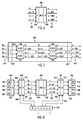
- the incoming path metrics 602 of the path metrics calculation unit 600 and the outgoing path metrics 604 of the path metrics calculation unit 600 there is determined the following relation: the incoming path metrics of the state 4n+p corresponds with the outgoing path metrics of the state n+pN/4, where N is the total number of code states, n gets the values 0, 1, 2,..., N/4-1, and p gets the values 0, 1, 2 and 3.
- the path metrics comprise sets having four path metrics each such that the path metrics of the states 4n, 4n+1, 4n+2 and 4n+3 belong to each set.
- the path metrics of the incoming group 602, i.e. 4n, 4n+1, 4n+2 and 4n+3 are fed into the input interface 606 of the path metrics calculation unit 600, then after processing the set in the ACS-units, the path metrics of the corresponding outgoing set 604, i.e. n, n+N/4, n+2N/4 and n+3N/4, are obtained from the output interface 608 of the path metrics calculation unit 600, as illustrated by Figure 6.
- the trellis of the code determines the path metrics of the states, as illustrated in Figure 7.
- the input path metrics are processed as follows: the path metrics of states 2n and 2n+N/2 are calculated in the double ACS-unit 700 from the path metrics of states 4n and 4n+1, and the path metrics of states 2n+1 and 2n+1+N/2 are calculated in the double ACS-unit 702 from the path metrics of states 4n+2 and 4n+3.
- the path metrics of the first column are processed as follows: the path metrics of states n and n+N/2 are calculated in the double ACS-unit 704 from the path metrics of states 2n and 2n+1, and the path metrics for states n+N/4 and n+3N/4 are calculated in the double ACS-unit 706 from the path metrics of states 2n+N/2 and 2n+N/2+1.
- path metrics are placed in the memory 850, 856, how they are fed into the input interface 606 of the path metrics calculation unit 600 from the memory 850, and how they are fed from the output interface 608 of the path metrics calculation unit 600 back into the memory 856.
- path metrics memories 800, 802, 804, 806 are needed for the old path metrics and other four path metrics memories 816, 818, 820, 822 are needed for the new path metrics. If the memories are dual-port memories, then only four path memories altogether are needed. Both the memories of the old path metrics and the memories of the new path metrics are numbered from 0 to 3 and they are thus correspondingly denoted as M0, M1, M2 and M3.
- the path metrics of each state always belong to the memory with the same denotation irrespective of whether it is old or new path metrics.
- X div Y is denoted integral part of the division (X/Y), and by A mod B is denoted the remainder of the division (A/B).
- the address of state s in the corresponding memory is (s div 4).
- Table 2 illustrates the contents of the four memories for a code having 256 states.
- the four read addresses of an n:th input set that is, the path metrics of the states 4n, 4n+1, 4n+2 and 4n+3, are the same for all four path metrics and the addresses are n for the memories M0, M1, M2, M3.
- the write addresses of the output path metrics of the n:th input set that is, the write addresses of the path metrics of the states n, n+N/4, n+2N/4 and n+3N/4, are equal to n div 4, (n+N/4) div 4, (n+2N/4) div 4, and (n+3N/4) div 4 at the input of the output multiplexer.
- the write addresses are routed with their path metrics using a multiplexer, as will be explained below.
- multiplexers 830, 832 i.e. bus control switches, in order to route path metrics correctly while transferring the path metrics information between the memories and the path metrics calculation unit.
- Table 2 the operation of the input multiplexer 830 is illustrated in the column IN MUX and the operation of the output multiplexer 832 in the column OUT MUX.
- the decoder for the trellis code comprises the path metrics calculation unit 600 for calculating path metrics over at least two trellis columns in a trellis.
- the path metrics calculation unit 600 includes an input interface 606 for old path metrics and an output interface 608 for new path metrics.
- the decoder also comprises the memory 850, 856 for storing path metrics of the trellis.
- the memory 850, 856 includes a read interface 852 for reading old path metrics from the memory 850 and a write interface 854 for writing new path metrics into the memory 856.
- the decoder also comprises two multiplexers: an input multiplexer 830 connected between the read interface 852 of the memory 850 and the input interface 606 of the path metrics calculation unit 600, and an output multiplexer 832 connected between the output interface 608 of the path metrics calculation unit 600 and the write interface 854 of the memory 856.
- a control 840, 842, 844, 846 in the decoder for controlling configuration of the input multiplexer 830 and configuration of the output multiplexer 832 on the basis of states 824 of the trellis.
- the state 824 of the trellis defines the way the old path metrics and the new path metrics relate to each other, whereby internal configuration of the path metrics calculation unit 600 remains the same for different code constraint lengths.
- the decoder for the trellis code is usually implemented by one or more application-specific integrated circuits (ASIC).
- ASIC application-specific integrated circuits
- Other hardware implementations may also be feasible, such as a circuit made of separate logic components, or even a software implementation, such as a processor with software, provided that enough processing capacity and speed is provided by the implementation.
- a hybrid combination of these implementation techniques is also possible.
- a person skilled in the art will take into consideration for instance the requirements set on the size and power consumption of the device, the required processing power and speed, manufacturing costs and production volumes.
- the multiplexer 830, 832 includes as many interconnected sub-multiplexers 808, 810, 812, 814 as there are trellis columns over which the path metrics are calculated.
- both the input multiplexer 830 and the output multiplexer 832 include two serially interconnected sub-multiplexers 808, 810 and 812, 814.
- the first sub-multiplexer 810, 814 two neighboring buses exchange data.
- the first sub-multiplexer 810, 814 is denoted with 1X.
- the second sub-multiplexer 808, 812 two neighboring bus pairs exchange data.
- the second sub-multiplexer 808, 812 is denoted with 2X.
- the order between the sub-multiplexers is irrelevant as long as the control signals take the order into account.
- the control can be such that if the control signal has value 1 the exchange is performed, with value 0 the exchange is not performed.
- Such an operation of the multiplexer where neither sub-multiplexer changes the order of the buses is denoted with 0X, i.e. it is a direct connection.
- Denotations 0X, 1X and 2X are also used in Table 2.
- Denotation 1X2X means that both 1X and 2X are performed.
- control 840, 842, 844, 846 includes a binary counter 824 representing a state of the trellis.
- the control 840, 842, 844, 846 depends on the bit values of predetermined positions in the binary counter 824.
- the most significant bit of the index n controls 840 the 2X sub-multiplexer 808 in the input multiplexer 830, and its second most significant bit controls 842 the 1X sub-multiplexer 810 in the input multiplexer 830.
- the least significant bit of the index n controls 846 the 1X sub-multiplexer 814 in the output multiplexer 832, and its second least significant bit controls 844 the 2X sub-multiplexer 812 in the output multiplexer 832.
- the update step of the state s is 4 and that of n is 1.
- the path metrics calculation unit 600 calculates the new path metrics of the states 0, 64, 128 and 192 from the path metrics of the states 0, 1, 2 and 3. These new path metrics are fed through the output multiplexer 832 into four memories 816, 818, 820, 822.
- the output multiplexer 832 does not perform any exchanges between the buses, and hence the new path metrics remain in the original buses: the path metrics of the state 0 is stored in the M0 memory 816, the path metrics of the state 64 is stored in the M1 memory 818, the path metrics of the state 128 is stored in the M2 memory 820, and the path metrics of the state 192 are is stored in the M3 memory 822.
- the address is the number value of the state divided by four, i.e. 0, 16, 32 and 48, as can be seen from Table 1.
- the path metrics calculation unit 600 calculates the new path metrics of states 1, 65, 129 and 193 from the old path metrics of the states 4, 5, 6 and 7, and the new path metrics are stored through the output multiplexer 832 in the memories 816, 818, 820, 822.
- the 1X sub-multiplexer 814 of the output multiplexer 832 exchanges the data within each pair of two neighboring buses.
- the path metrics of the state 65 is stored in the address 16 of the M0 memory 816
- the path metrics of the state 1 is stored in the address 0 of the M1 memory 818
- the path metrics of the state 193 is stored in the address 48 of the M2 memory 820
- the path metrics of the state 129 are stored in the address 32 of the M3 memory 822, as is illustrated in Table 2.
- the path metrics calculation unit 600 receives the path metrics in the right order of 200, 201, 202 and 203. The path metrics calculation unit 600 then calculates the new path metrics of the states 50, 114, 178 and 242.
- the output multiplexer 832 performs exchange in its 2X sub-multiplexer 812.
- the order of the path metrics is 178, 242, 50 and 114.
- the path metrics of the state 178 is stored in the address 44 of the M0 memory 816
- the path metrics of the state 242 is stored in the address 60 of the M1 memory 818
- the path metrics of the state 50 is stored in the address 12 of the M2 memory 820
- the path metrics of the state 114 are stored in the address 28 of the M3 memory 822, as is illustrated in Table 2.
- the described solution is used for decoding of convolutional codes having different code constraint lengths as the change in the code constraint length is taken into account.
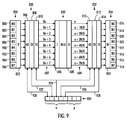
- Figure 9 illustrates a trellis decoder that computes the path metrics over three trellis columns without saving the path metrics in the memory between the three columns.
- the n:th set 602 of the ingoing path metrics consists of the path metrics of the states 8n, 8n+1, 8n+2, 8n+3, 8n+4, 8n+5, 8n+6, 8n+7 and the corresponding outgoing set 604 is n, n+N/8, n+2N/8, n+3N/8, n+4N/8, n+5N/8, n+6N/8, and n+7N/8.
- Table 3 shows how the path metrics of a 256-state code are stored in eight memories 800, 802, 804, 806, 900, 902, 904, 906 and how the I/O-multiplexers 830, 832 route path metrics from the input memories 850 to the path metrics calculation unit 600 and from there to the output memories 816,818,820,822,912,914,916,918.
- both the input multiplexer 830 and the output multiplexer 832 include three serially interconnected sub-multiplexers 808, 810, 908 and 812, 814, 910.
- the third sub-multiplexer 908, 910 exchanges data between two groups, each having four adjoining buses.
- the third sub-multiplexer 908, 910 is denoted with 4X.
- the control is now a little different from that in Figure 8.
- Index n in the binary counter 824 has now five bits and p has three bits.
- the address of state s in the corresponding memory is (s div 8).
- the path metric of the state 242 is in the memory M5 at the address 30.
- the path metrics of the states 0, 1, 2, 3, 4, 5, 6 and 7 are transferred from the address 0 of the eight input memories 850 via the input multiplexer 830 to the path metrics calculation unit 600.
- each new path metric in its memory 856 equals to the value of its state divided by 8, only the integer part of the quotient counts. So the path metric of the state 0 has the output address 0 for the memory M0, the path metric of the state 32 has the output address 4 for the memory M1, and so on.
- the input multiplexer 830 performs exchanges with the first 1X sub-multiplexer 810 and the third 4X sub-multiplexer 908, so the order of path metrics at the input 606 of the path metrics calculation unit 600 is 184, 185, 186, 187, 188, 189, 190 and 191.
- path metrics calculation units 600 it is possible to connect two or more path metrics calculation units 600 in parallel to boost decoding capacity.
- two path metrics calculation units of Figure 8 have 16 ACS units to compute the path metrics over two trellis columns.
- the path metric calculation units 600 can also be connected in a serial manner, i.e. by connecting two or more path metrics calculation units 600 into a serial chain.
- an intermediate memory between the path metrics calculation units 600 need not be of a full size but capable to store 16 or 32 path metrics.
Landscapes
- Engineering & Computer Science (AREA)
- Physics & Mathematics (AREA)
- Probability & Statistics with Applications (AREA)
- Theoretical Computer Science (AREA)
- Computer Networks & Wireless Communication (AREA)
- Signal Processing (AREA)
- Artificial Intelligence (AREA)
- Error Detection And Correction (AREA)
Priority Applications (2)
| Application Number | Priority Date | Filing Date | Title |
|---|---|---|---|
| EP03100380A EP1450493A1 (fr) | 2003-02-19 | 2003-02-19 | Décodeur de Viterbi avec calcul des métriques de chemin sur deux colonnes du treillis et routage des métriques de chemin dans la mémoire |
| US10/781,492 US7242723B2 (en) | 2003-02-19 | 2004-02-18 | Decoder for a trellis code |
Applications Claiming Priority (1)
| Application Number | Priority Date | Filing Date | Title |
|---|---|---|---|
| EP03100380A EP1450493A1 (fr) | 2003-02-19 | 2003-02-19 | Décodeur de Viterbi avec calcul des métriques de chemin sur deux colonnes du treillis et routage des métriques de chemin dans la mémoire |
Publications (1)
| Publication Number | Publication Date |
|---|---|
| EP1450493A1 true EP1450493A1 (fr) | 2004-08-25 |
Family
ID=32731586
Family Applications (1)
| Application Number | Title | Priority Date | Filing Date |
|---|---|---|---|
| EP03100380A Withdrawn EP1450493A1 (fr) | 2003-02-19 | 2003-02-19 | Décodeur de Viterbi avec calcul des métriques de chemin sur deux colonnes du treillis et routage des métriques de chemin dans la mémoire |
Country Status (2)
| Country | Link |
|---|---|
| US (1) | US7242723B2 (fr) |
| EP (1) | EP1450493A1 (fr) |
Families Citing this family (1)
| Publication number | Priority date | Publication date | Assignee | Title |
|---|---|---|---|---|
| JP4702721B2 (ja) * | 2004-06-23 | 2011-06-15 | エスティー‐エリクソン、ソシエテ、アノニム | ビタビ・メトリック計算のためのアドレッシング方法 |
Citations (3)
| Publication number | Priority date | Publication date | Assignee | Title |
|---|---|---|---|---|
| EP1102408A2 (fr) * | 1999-11-22 | 2001-05-23 | Matsushita Electric Industrial Co., Ltd. | Décodeur Viterbi |
| WO2001078239A2 (fr) * | 2000-04-06 | 2001-10-18 | Qualcomm Incorporated | Procede et dispositif servant a lire et memoriser des parametres d'etat pour mise en application d'un decodeur viterbi acs tres rapide |
| US20010044921A1 (en) * | 2000-05-12 | 2001-11-22 | Nec Corporation | Viterbi decoder with high speed processing function |
Family Cites Families (4)
| Publication number | Priority date | Publication date | Assignee | Title |
|---|---|---|---|---|
| US20060262832A1 (en) * | 1997-03-12 | 2006-11-23 | Interdigital Technology Corporation | Convolutionally encoding and decoding multiple data streams |
| KR100285067B1 (ko) * | 1998-09-25 | 2001-03-15 | 윤종용 | 비터비 디코더의 가산 비교 선택 회로 |
| US6252904B1 (en) * | 1998-11-13 | 2001-06-26 | Broadcom Corporation | High-speed decoder for a multi-pair gigabit transceiver |
| US7020214B2 (en) * | 2000-09-18 | 2006-03-28 | Lucent Technologies Inc. | Method and apparatus for path metric processing in telecommunications systems |
-
2003
- 2003-02-19 EP EP03100380A patent/EP1450493A1/fr not_active Withdrawn
-
2004
- 2004-02-18 US US10/781,492 patent/US7242723B2/en not_active Expired - Fee Related
Patent Citations (3)
| Publication number | Priority date | Publication date | Assignee | Title |
|---|---|---|---|---|
| EP1102408A2 (fr) * | 1999-11-22 | 2001-05-23 | Matsushita Electric Industrial Co., Ltd. | Décodeur Viterbi |
| WO2001078239A2 (fr) * | 2000-04-06 | 2001-10-18 | Qualcomm Incorporated | Procede et dispositif servant a lire et memoriser des parametres d'etat pour mise en application d'un decodeur viterbi acs tres rapide |
| US20010044921A1 (en) * | 2000-05-12 | 2001-11-22 | Nec Corporation | Viterbi decoder with high speed processing function |
Non-Patent Citations (4)
| Title |
|---|
| BLACK P J ET AL: "A unified approach to the Viterbi algorithm state metric update for shift register processes", DIGITAL SIGNAL PROCESSING 2, ESTIMATION, VLSI. SAN FRANCISCO, MAR. 23 - 26, 1992, PROCEEDINGS OF THE INTERNATIONAL CONFERENCE ON ACOUSTICS, SPEECH AND SIGNAL PROCESSING (ICASSP), NEW YORK, IEEE, US, vol. 5 CONF. 17, 23 March 1992 (1992-03-23), pages 629 - 632, XP010059310, ISBN: 0-7803-0532-9 * |
| HENDRIX H: "Viterbi Decoding Techniques in the TMS320C54x Family", TEXAS INSTRUMENTS TECHNICAL JOURNAL, TEXAS INSTRUMENTS, DALLAS, TX, US, June 1996 (1996-06-01), pages 1 - 20, XP002150239, ISSN: 0893-7877 * |
| SHUNG C B ET AL: "Area-efficient architectures for the Viterbi algorithm - Part II: Applications", IEEE TRANSACTIONS ON COMMUNICATIONS, IEEE INC. NEW YORK, US, vol. 41, no. 5, 1 May 1993 (1993-05-01), pages 802 - 807, XP002245075, ISSN: 0090-6778 * |
| SHUNG C B: "AREA-EFFICIENT ARCHITECTURES FOR THE VITERBI ALGORITHM. ÖPART I: THEORY", IEEE TRANSACTIONS ON COMMUNICATIONS, IEEE INC. NEW YORK, US, vol. 41, no. 4, 1 April 1993 (1993-04-01), pages 636 - 644, XP000372705, ISSN: 0090-6778 * |
Also Published As
| Publication number | Publication date |
|---|---|
| US20040190642A1 (en) | 2004-09-30 |
| US7242723B2 (en) | 2007-07-10 |
Similar Documents
| Publication | Publication Date | Title |
|---|---|---|
| JP3604955B2 (ja) | 畳込み復号装置 | |
| US4606027A (en) | Error correction apparatus using a Viterbi decoder | |
| EP0590597B1 (fr) | Appareil arithmétique | |
| EP1102408B1 (fr) | Décodeur Viterbi | |
| US5502735A (en) | Maximum likelihood sequence detector | |
| US7127664B2 (en) | Reconfigurable architecture for decoding telecommunications signals | |
| KR100580160B1 (ko) | 변형된 역추적 방식의 2단 연출력 비터비 알고리즘 복호화기 | |
| EP1204211B1 (fr) | Processeur papillon pour les télécommunications | |
| EP1204212B1 (fr) | Méthode et appareil pour le traitement des métriques de chemin dans les systèmes de télécommunications | |
| KR100779782B1 (ko) | 비터비 디코더 용 고속 acs 유닛 | |
| EP1069692B1 (fr) | Décodeur Viterbi et émetteur | |
| JP2004511162A (ja) | チャネルコード化のためのシステム及び方法 | |
| US8009773B1 (en) | Low complexity implementation of a Viterbi decoder with near optimal performance | |
| US20040243916A1 (en) | Method and apparatus for decoding multi-level trellis coded modulation | |
| EP0467522B1 (fr) | Détecteur de séquence à maximum de vraisemblance | |
| EP3996285A1 (fr) | Traçabilité parallèle dans un décodeur viterbi | |
| US7242723B2 (en) | Decoder for a trellis code | |
| JP3259725B2 (ja) | ビタビ復号装置 | |
| US20040122883A1 (en) | High speed add-compare-select circuit for radix-4 Viterbi decoder | |
| US7793200B1 (en) | Method of and circuit for accessing a memory of a trellis decoder | |
| EP1300954A1 (fr) | Dispositif et méthode d'encodage, dispositif et méthode de décodage, support de fourniture et méthode pour générer des informations sur la position de données de substitution | |
| EP0807336B1 (fr) | Procede d'etablissement de parametres de transition et recepteur de systeme radio cellulaire | |
| EP1542370A1 (fr) | Procédé et appareil pour la calcul des étiquettes de branche dans un décodeur Viterbi | |
| US7852960B2 (en) | Method of computing path metrics in a high-speed Viterbi detector and related apparatus thereof | |
| JP3720251B2 (ja) | ヴィタビ復号器 |
Legal Events
| Date | Code | Title | Description |
|---|---|---|---|
| PUAI | Public reference made under article 153(3) epc to a published international application that has entered the european phase |
Free format text: ORIGINAL CODE: 0009012 |
|
| AK | Designated contracting states |
Kind code of ref document: A1 Designated state(s): AT BE BG CH CY CZ DE DK EE ES FI FR GB GR HU IE IT LI LU MC NL PT SE SI SK TR |
|
| AX | Request for extension of the european patent |
Extension state: AL LT LV MK RO |
|
| AKX | Designation fees paid | ||
| REG | Reference to a national code |
Ref country code: DE Ref legal event code: 8566 |
|
| DBV | Designated contracting states (deleted) | ||
| STAA | Information on the status of an ep patent application or granted ep patent |
Free format text: STATUS: THE APPLICATION IS DEEMED TO BE WITHDRAWN |
|
| 18D | Application deemed to be withdrawn |
Effective date: 20050226 |