EP1103260B1 - Transdermalsystem zur Abgabe von Clonidin - Google Patents
Transdermalsystem zur Abgabe von Clonidin Download PDFInfo
- Publication number
- EP1103260B1 EP1103260B1 EP00126102A EP00126102A EP1103260B1 EP 1103260 B1 EP1103260 B1 EP 1103260B1 EP 00126102 A EP00126102 A EP 00126102A EP 00126102 A EP00126102 A EP 00126102A EP 1103260 B1 EP1103260 B1 EP 1103260B1
- Authority
- EP
- European Patent Office
- Prior art keywords
- clonidine
- accordance
- transdermal system
- adhesive layer
- layer
- Prior art date
- Legal status (The legal status is an assumption and is not a legal conclusion. Google has not performed a legal analysis and makes no representation as to the accuracy of the status listed.)
- Expired - Lifetime
Links
- GJSURZIOUXUGAL-UHFFFAOYSA-N Clonidine Chemical compound ClC1=CC=CC(Cl)=C1NC1=NCCN1 GJSURZIOUXUGAL-UHFFFAOYSA-N 0.000 title claims abstract description 60
- 229960002896 clonidine Drugs 0.000 title claims abstract description 56
- 229940100640 transdermal system Drugs 0.000 title claims description 20
- 239000012790 adhesive layer Substances 0.000 claims abstract description 14
- 229920006132 styrene block copolymer Polymers 0.000 claims abstract description 5
- 229920001577 copolymer Polymers 0.000 claims abstract description 4
- 239000010410 layer Substances 0.000 claims description 26
- 239000000853 adhesive Substances 0.000 claims description 15
- 239000002904 solvent Substances 0.000 claims description 8
- LFQSCWFLJHTTHZ-UHFFFAOYSA-N Ethanol Chemical compound CCO LFQSCWFLJHTTHZ-UHFFFAOYSA-N 0.000 claims description 7
- 208000007271 Substance Withdrawal Syndrome Diseases 0.000 claims description 7
- -1 polyethylene Polymers 0.000 claims description 6
- 208000019901 Anxiety disease Diseases 0.000 claims description 4
- 239000004971 Cross linker Substances 0.000 claims description 4
- 206010027304 Menopausal symptoms Diseases 0.000 claims description 4
- 208000019695 Migraine disease Diseases 0.000 claims description 4
- 230000036506 anxiety Effects 0.000 claims description 4
- 229940079593 drug Drugs 0.000 claims description 4
- 239000003814 drug Substances 0.000 claims description 4
- 230000001660 hyperkinetic effect Effects 0.000 claims description 4
- 239000004033 plastic Substances 0.000 claims description 4
- 229920003023 plastic Polymers 0.000 claims description 4
- 231100000331 toxic Toxicity 0.000 claims description 4
- 230000002588 toxic effect Effects 0.000 claims description 4
- 239000004743 Polypropylene Substances 0.000 claims description 3
- 230000003542 behavioural effect Effects 0.000 claims description 3
- 208000037265 diseases, disorders, signs and symptoms Diseases 0.000 claims description 3
- 239000002984 plastic foam Substances 0.000 claims description 3
- 229920001155 polypropylene Polymers 0.000 claims description 3
- 239000004698 Polyethylene Substances 0.000 claims description 2
- 229920000728 polyester Polymers 0.000 claims description 2
- 229920000573 polyethylene Polymers 0.000 claims description 2
- 239000011888 foil Substances 0.000 claims 4
- 206010020852 Hypertonia Diseases 0.000 claims 1
- 239000002759 woven fabric Substances 0.000 claims 1
- GOXQRTZXKQZDDN-UHFFFAOYSA-N 2-Ethylhexyl acrylate Chemical compound CCCCC(CC)COC(=O)C=C GOXQRTZXKQZDDN-UHFFFAOYSA-N 0.000 abstract 1
- 239000000203 mixture Substances 0.000 description 13
- 239000004820 Pressure-sensitive adhesive Substances 0.000 description 11
- 230000001070 adhesive effect Effects 0.000 description 11
- 230000000052 comparative effect Effects 0.000 description 9
- 238000000338 in vitro Methods 0.000 description 8
- 239000011159 matrix material Substances 0.000 description 8
- XEKOWRVHYACXOJ-UHFFFAOYSA-N Ethyl acetate Chemical compound CCOC(C)=O XEKOWRVHYACXOJ-UHFFFAOYSA-N 0.000 description 6
- 239000011505 plaster Substances 0.000 description 6
- 229920006267 polyester film Polymers 0.000 description 6
- NIXOWILDQLNWCW-UHFFFAOYSA-M Acrylate Chemical compound [O-]C(=O)C=C NIXOWILDQLNWCW-UHFFFAOYSA-M 0.000 description 5
- 239000004480 active ingredient Substances 0.000 description 5
- 239000000243 solution Substances 0.000 description 5
- 206010020772 Hypertension Diseases 0.000 description 4
- 229920002367 Polyisobutene Polymers 0.000 description 4
- 238000010521 absorption reaction Methods 0.000 description 4
- 210000004027 cell Anatomy 0.000 description 4
- 238000004132 cross linking Methods 0.000 description 4
- 239000003623 enhancer Substances 0.000 description 4
- 238000004519 manufacturing process Methods 0.000 description 4
- 239000002985 plastic film Substances 0.000 description 4
- 229920006255 plastic film Polymers 0.000 description 4
- 229920000642 polymer Polymers 0.000 description 4
- 239000000126 substance Substances 0.000 description 4
- DNIAPMSPPWPWGF-UHFFFAOYSA-N Propylene glycol Chemical compound CC(O)CO DNIAPMSPPWPWGF-UHFFFAOYSA-N 0.000 description 3
- 229940124532 absorption promoter Drugs 0.000 description 3
- 239000013543 active substance Substances 0.000 description 3
- 208000029650 alcohol withdrawal Diseases 0.000 description 3
- 238000009792 diffusion process Methods 0.000 description 3
- 238000000034 method Methods 0.000 description 3
- 206010027599 migraine Diseases 0.000 description 3
- VOXZDWNPVJITMN-ZBRFXRBCSA-N 17β-estradiol Chemical compound OC1=CC=C2[C@H]3CC[C@](C)([C@H](CC4)O)[C@@H]4[C@@H]3CCC2=C1 VOXZDWNPVJITMN-ZBRFXRBCSA-N 0.000 description 2
- ZNIFSRGNXRYGHF-UHFFFAOYSA-N Clonidine hydrochloride Chemical compound Cl.ClC1=CC=CC(Cl)=C1NC1=NCCN1 ZNIFSRGNXRYGHF-UHFFFAOYSA-N 0.000 description 2
- KFZMGEQAYNKOFK-UHFFFAOYSA-N Isopropanol Chemical compound CC(C)O KFZMGEQAYNKOFK-UHFFFAOYSA-N 0.000 description 2
- 241000699660 Mus musculus Species 0.000 description 2
- VYPSYNLAJGMNEJ-UHFFFAOYSA-N Silicium dioxide Chemical compound O=[Si]=O VYPSYNLAJGMNEJ-UHFFFAOYSA-N 0.000 description 2
- 239000003522 acrylic cement Substances 0.000 description 2
- 230000004071 biological effect Effects 0.000 description 2
- 239000007853 buffer solution Substances 0.000 description 2
- 229940089266 clonidine transdermal system Drugs 0.000 description 2
- 239000008119 colloidal silica Substances 0.000 description 2
- 208000035475 disorder Diseases 0.000 description 2
- 238000001035 drying Methods 0.000 description 2
- 238000009472 formulation Methods 0.000 description 2
- 239000012982 microporous membrane Substances 0.000 description 2
- 239000002480 mineral oil Substances 0.000 description 2
- 235000010446 mineral oil Nutrition 0.000 description 2
- 238000011580 nude mouse model Methods 0.000 description 2
- 230000036962 time dependent Effects 0.000 description 2
- QCHFTSOMWOSFHM-WPRPVWTQSA-N (+)-Pilocarpine Chemical compound C1OC(=O)[C@@H](CC)[C@H]1CC1=CN=CN1C QCHFTSOMWOSFHM-WPRPVWTQSA-N 0.000 description 1
- IIZPXYDJLKNOIY-JXPKJXOSSA-N 1-palmitoyl-2-arachidonoyl-sn-glycero-3-phosphocholine Chemical compound CCCCCCCCCCCCCCCC(=O)OC[C@H](COP([O-])(=O)OCC[N+](C)(C)C)OC(=O)CCC\C=C/C\C=C/C\C=C/C\C=C/CCCCC IIZPXYDJLKNOIY-JXPKJXOSSA-N 0.000 description 1
- VZSRBBMJRBPUNF-UHFFFAOYSA-N 2-(2,3-dihydro-1H-inden-2-ylamino)-N-[3-oxo-3-(2,4,6,7-tetrahydrotriazolo[4,5-c]pyridin-5-yl)propyl]pyrimidine-5-carboxamide Chemical compound C1C(CC2=CC=CC=C12)NC1=NC=C(C=N1)C(=O)NCCC(N1CC2=C(CC1)NN=N2)=O VZSRBBMJRBPUNF-UHFFFAOYSA-N 0.000 description 1
- JKMHFZQWWAIEOD-UHFFFAOYSA-N 2-[4-(2-hydroxyethyl)piperazin-1-yl]ethanesulfonic acid Chemical compound OCC[NH+]1CCN(CCS([O-])(=O)=O)CC1 JKMHFZQWWAIEOD-UHFFFAOYSA-N 0.000 description 1
- VSKJLJHPAFKHBX-UHFFFAOYSA-N 2-methylbuta-1,3-diene;styrene Chemical compound CC(=C)C=C.C=CC1=CC=CC=C1.C=CC1=CC=CC=C1 VSKJLJHPAFKHBX-UHFFFAOYSA-N 0.000 description 1
- XBIUWALDKXACEA-UHFFFAOYSA-N 3-[bis(2,4-dioxopentan-3-yl)alumanyl]pentane-2,4-dione Chemical compound CC(=O)C(C(C)=O)[Al](C(C(C)=O)C(C)=O)C(C(C)=O)C(C)=O XBIUWALDKXACEA-UHFFFAOYSA-N 0.000 description 1
- PQSUYGKTWSAVDQ-ZVIOFETBSA-N Aldosterone Chemical compound C([C@@]1([C@@H](C(=O)CO)CC[C@H]1[C@@H]1CC2)C=O)[C@H](O)[C@@H]1[C@]1(C)C2=CC(=O)CC1 PQSUYGKTWSAVDQ-ZVIOFETBSA-N 0.000 description 1
- PQSUYGKTWSAVDQ-UHFFFAOYSA-N Aldosterone Natural products C1CC2C3CCC(C(=O)CO)C3(C=O)CC(O)C2C2(C)C1=CC(=O)CC2 PQSUYGKTWSAVDQ-UHFFFAOYSA-N 0.000 description 1
- 102000005862 Angiotensin II Human genes 0.000 description 1
- 101800000733 Angiotensin-2 Proteins 0.000 description 1
- 239000004230 Fast Yellow AB Substances 0.000 description 1
- 239000007995 HEPES buffer Substances 0.000 description 1
- CZGUSIXMZVURDU-JZXHSEFVSA-N Ile(5)-angiotensin II Chemical compound C([C@@H](C(=O)N[C@@H]([C@@H](C)CC)C(=O)N[C@@H](CC=1NC=NC=1)C(=O)N1[C@@H](CCC1)C(=O)N[C@@H](CC=1C=CC=CC=1)C([O-])=O)NC(=O)[C@@H](NC(=O)[C@H](CCCNC(N)=[NH2+])NC(=O)[C@@H]([NH3+])CC([O-])=O)C(C)C)C1=CC=C(O)C=C1 CZGUSIXMZVURDU-JZXHSEFVSA-N 0.000 description 1
- 241000699666 Mus <mouse, genus> Species 0.000 description 1
- IMONTRJLAWHYGT-ZCPXKWAGSA-N Norethindrone Acetate Chemical compound C1CC2=CC(=O)CC[C@@H]2[C@@H]2[C@@H]1[C@@H]1CC[C@](C#C)(OC(=O)C)[C@@]1(C)CC2 IMONTRJLAWHYGT-ZCPXKWAGSA-N 0.000 description 1
- 239000005662 Paraffin oil Substances 0.000 description 1
- 102100028255 Renin Human genes 0.000 description 1
- 108090000783 Renin Proteins 0.000 description 1
- QCHFTSOMWOSFHM-UHFFFAOYSA-N SJ000285536 Natural products C1OC(=O)C(CC)C1CC1=CN=CN1C QCHFTSOMWOSFHM-UHFFFAOYSA-N 0.000 description 1
- 150000001252 acrylic acid derivatives Chemical class 0.000 description 1
- 210000004404 adrenal cortex Anatomy 0.000 description 1
- 229960002478 aldosterone Drugs 0.000 description 1
- 102000030484 alpha-2 Adrenergic Receptor Human genes 0.000 description 1
- 108020004101 alpha-2 Adrenergic Receptor Proteins 0.000 description 1
- 229950006323 angiotensin ii Drugs 0.000 description 1
- 230000036772 blood pressure Effects 0.000 description 1
- 230000000747 cardiac effect Effects 0.000 description 1
- 229940063628 catapres Drugs 0.000 description 1
- 229960002925 clonidine hydrochloride Drugs 0.000 description 1
- 239000011248 coating agent Substances 0.000 description 1
- 238000000576 coating method Methods 0.000 description 1
- 230000001427 coherent effect Effects 0.000 description 1
- 238000010276 construction Methods 0.000 description 1
- 230000002596 correlated effect Effects 0.000 description 1
- 238000005520 cutting process Methods 0.000 description 1
- 230000001419 dependent effect Effects 0.000 description 1
- 239000006185 dispersion Substances 0.000 description 1
- 238000004090 dissolution Methods 0.000 description 1
- 238000009826 distribution Methods 0.000 description 1
- 238000012377 drug delivery Methods 0.000 description 1
- 230000000694 effects Effects 0.000 description 1
- 238000005516 engineering process Methods 0.000 description 1
- 229960005309 estradiol Drugs 0.000 description 1
- 239000004744 fabric Substances 0.000 description 1
- 239000000945 filler Substances 0.000 description 1
- 230000004907 flux Effects 0.000 description 1
- 239000011521 glass Substances 0.000 description 1
- 238000004128 high performance liquid chromatography Methods 0.000 description 1
- 239000012456 homogeneous solution Substances 0.000 description 1
- 125000002636 imidazolinyl group Chemical group 0.000 description 1
- 238000011835 investigation Methods 0.000 description 1
- 239000002085 irritant Substances 0.000 description 1
- 231100000021 irritant Toxicity 0.000 description 1
- 238000010030 laminating Methods 0.000 description 1
- 239000000787 lecithin Substances 0.000 description 1
- 229940067606 lecithin Drugs 0.000 description 1
- 235000010445 lecithin Nutrition 0.000 description 1
- 239000007788 liquid Substances 0.000 description 1
- 239000012528 membrane Substances 0.000 description 1
- 230000006855 networking Effects 0.000 description 1
- 229960001652 norethindrone acetate Drugs 0.000 description 1
- 238000004806 packaging method and process Methods 0.000 description 1
- 206010033675 panniculitis Diseases 0.000 description 1
- 230000036513 peripheral conductance Effects 0.000 description 1
- 230000002093 peripheral effect Effects 0.000 description 1
- 239000000546 pharmaceutical excipient Substances 0.000 description 1
- 229960001416 pilocarpine Drugs 0.000 description 1
- 210000002381 plasma Anatomy 0.000 description 1
- 229920001195 polyisoprene Polymers 0.000 description 1
- 229920001296 polysiloxane Polymers 0.000 description 1
- 230000001242 postsynaptic effect Effects 0.000 description 1
- 238000002360 preparation method Methods 0.000 description 1
- 230000003518 presynaptic effect Effects 0.000 description 1
- 230000002035 prolonged effect Effects 0.000 description 1
- 239000011814 protection agent Substances 0.000 description 1
- 208000020016 psychiatric disease Diseases 0.000 description 1
- 238000004080 punching Methods 0.000 description 1
- 239000007787 solid Substances 0.000 description 1
- 238000003860 storage Methods 0.000 description 1
- 210000004304 subcutaneous tissue Anatomy 0.000 description 1
- 239000000758 substrate Substances 0.000 description 1
- 230000002889 sympathetic effect Effects 0.000 description 1
- 210000001519 tissue Anatomy 0.000 description 1
- 230000037317 transdermal delivery Effects 0.000 description 1
- XLYOFNOQVPJJNP-UHFFFAOYSA-N water Substances O XLYOFNOQVPJJNP-UHFFFAOYSA-N 0.000 description 1
Images
Classifications
-
- A—HUMAN NECESSITIES
- A61—MEDICAL OR VETERINARY SCIENCE; HYGIENE
- A61K—PREPARATIONS FOR MEDICAL, DENTAL OR TOILETRY PURPOSES
- A61K9/00—Medicinal preparations characterised by special physical form
- A61K9/70—Web, sheet or filament bases ; Films; Fibres of the matrix type containing drug
- A61K9/7023—Transdermal patches and similar drug-containing composite devices, e.g. cataplasms
- A61K9/703—Transdermal patches and similar drug-containing composite devices, e.g. cataplasms characterised by shape or structure; Details concerning release liner or backing; Refillable patches; User-activated patches
- A61K9/7038—Transdermal patches of the drug-in-adhesive type, i.e. comprising drug in the skin-adhesive layer
- A61K9/7046—Transdermal patches of the drug-in-adhesive type, i.e. comprising drug in the skin-adhesive layer the adhesive comprising macromolecular compounds
- A61K9/7053—Transdermal patches of the drug-in-adhesive type, i.e. comprising drug in the skin-adhesive layer the adhesive comprising macromolecular compounds obtained by reactions only involving carbon to carbon unsaturated bonds, e.g. polyvinyl, polyisobutylene, polystyrene
- A61K9/7061—Polyacrylates
-
- A—HUMAN NECESSITIES
- A61—MEDICAL OR VETERINARY SCIENCE; HYGIENE
- A61K—PREPARATIONS FOR MEDICAL, DENTAL OR TOILETRY PURPOSES
- A61K31/00—Medicinal preparations containing organic active ingredients
- A61K31/33—Heterocyclic compounds
- A61K31/395—Heterocyclic compounds having nitrogen as a ring hetero atom, e.g. guanethidine or rifamycins
- A61K31/41—Heterocyclic compounds having nitrogen as a ring hetero atom, e.g. guanethidine or rifamycins having five-membered rings with two or more ring hetero atoms, at least one of which being nitrogen, e.g. tetrazole
- A61K31/4164—1,3-Diazoles
- A61K31/4168—1,3-Diazoles having a nitrogen attached in position 2, e.g. clonidine
Definitions
- the invention relates to active substance-containing transdermal systems (also called matrix plaster or simply plaster in the following) for the delivery of clonidine and its use for treatment from hypertension, migraine, anxiety, hyperkinetic Behavioral disorders, withdrawal symptoms in alcohol or drug withdrawal and menopausal symptoms.
- active substance-containing transdermal systems also called matrix plaster or simply plaster in the following
- Patterns Active substance-containing transdermal systems
- matrix and reservoir systems Two major technical Systems distinguished: matrix and reservoir systems.
- the invention relates only to matrix systems in which medical Active ingredients directly into a semi-solid matrix of polymers be embedded.
- Clonidine is an antisympathotonicum with imidazoline structure. It has affinity for ⁇ 1- and, more strongly, for pre- and postsynaptic ⁇ 2 adrenoreceptors and lowers the peripheral Sympathetic tone. Clonidine primarily causes a lowering of blood pressure due to declining cardiac output and - at prolonged medication - by reducing peripheral vascular resistance. At the same time it reduces the renin release with a decrease of angiotensin II in the blood plasma with release of aldosterone from the adrenal cortex.
- Clonidine hydrochloride exists as a mesomeric component.
- the chemical name is 2- (2,6-dichlorophenylamino) -2-imidazoline hydrochloride.
- transdermal systems that contain clonidine, been developed.
- US Pat. No. 4,559,222 describes of 17 December 1985 a multilayer transdermal system, in the clonidine base in mineral oil along with colloidal Silica in a first layer in a polyisobutylene adhesive is included.
- This layer is a microporous Membrane applied, in turn, an adhesive layer is applied.
- This adhesive layer will glued to the skin.
- the transdermal system is on the side the drug-containing layer with a clonidine impermeable Covered film.
- U.S. Patent 5,958,446 describes an invention according to which a mixture of self-adhesive acrylates and polyisobutylene or silicones gives a higher flux through the skin than when using the polymers alone.
- the patent claims Although the use of clonidine as an active ingredient leads but no example of this.
- the disadvantage of the described Invention is that the combination of two polymers in the vast majority of examples described (eg. With 17 ⁇ -estradiol, norethisterone acetate, pilocarpine, all Substances that penetrate well through the skin)
- absorption promoters such as lecithin or propylene glycol was prepared to a sufficient flow receive. That is, the use of those described in the patent Blends of polymers alone are not enough to transdermal systems produce with sufficient effect.
- the object of the present invention is now in a Transdermal system for the delivery of clonidine available which can be produced very cheaply gentle on the skin is easy for patients to apply, No additional fixing aid needed, between 100 and 300 ⁇ g of clonidine per day through the skin releases and no toxic Crosslinker or solvent / absorption enhancer contains
- this object is achieved with a transdermal system for the release of clonidine according to claim 1.
- the invention thus relates to transdermal delivery systems from clonidine from one Clonidine-containing pressure-sensitive adhesive layer of a styrene-Blook copolymer, which are not toxic crosslinkers or solvents or absorption promoters and adjacent to the clonidine-containing pressure-sensitive adhesive layer a cover and on the opposite of the cover Side of the pressure-sensitive adhesive layer temporarily covering and removable carrier.
- the invention further relates to the use of these transdermal systems for the treatment of hypertension, migraine, anxiety, Hyperkinetic behavior disorders, withdrawal symptoms in alcohol or drug withdrawal and menopausal Symptoms according to claim 15.
- An advantageous embodiment is characterized in that that the pressure-sensitive adhesive layer clonidine in the concentration range from 0.1 to 20 wt .-%.
- a further advantageous embodiment is characterized in that that the pressure-sensitive adhesive layer clonidine in the concentration range from 2 to 10 wt .-%.
- a further advantageous embodiment is characterized in that that the clonidine-containing pressure-sensitive adhesive layer a Layer of a sheet-like self-adhesive plaster with multilayer Construction forms.
- a further advantageous embodiment is characterized in that that the cover of plastic film, plastic foam, Fabric or fleece exists.
- a further advantageous embodiment is characterized in that that the carrier made of plastic, paper or a Laminate consists of it.
- a further advantageous embodiment is characterized in that that the carrier is siliconized.
- a further advantageous embodiment is characterized in that that the plastic film is polyester, Polyethylene or polypropylene film is.
- a further advantageous embodiment is characterized in that the dry pressure-sensitive adhesive layer has a basis weight of 20 to 150 g / m 2 .
- a further advantageous embodiment is characterized in that the dry pressure-sensitive adhesive layer has a basis weight of 50 to 120 g / m 2 .
- a further advantageous embodiment is characterized in that that the release rate 10 to 1000 micrograms of clonidine per day is.
- a further advantageous embodiment is characterized in that the release rate is 50 to 500 ⁇ g of clonidine per day.
- clonidine patches The production of clonidine patches is based on conventional Machines that are known in the art made.
- Clonidine base is dissolved in a suitable, volatile solvent, z.
- a suitable, volatile solvent z.
- ethyl acetate, ethanol or isopropanol or dispersed The solution / dispersion is mixed with a solution of the pressure-sensitive adhesive described above in one mixed suitable vessel.
- conventional substances such as fillers, skin protection agents, Tackifiers or the like may be added.
- the mixture from clonidine and the acrylate and optionally other substances is applied to a substrate in a conventional coating machine or a carrier, for. B. from siliconized plastic films, siliconized paper or similar, applied and in a subsequent Dryer freed from solvent. After leaving the dryer is now dried and self-adhesive Active substance / adhesive matrix with a further layer, the z.
- a plastic film a fleece, a plastic foam, a Tissue or the like may be, laminated to cover.
- the systems contain clonidine in the concentration range of 0.1 to 20%, preferably in the range of 2 to 10%.
- the basis weight of the dried pressure-sensitive adhesive layer (matrix) is usually in the range from 20 to 150 g / m 2 , preferably in the range from 50 to 120 g / m 2 .
- the release rate is in the range of 10 to 1000 ⁇ g of clonidine per day, preferably in the range of 50 to 500 ⁇ g per day.
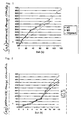
- the release studies only the release behavior take the drug from the patch, but what usually not correlated with the biological effect.
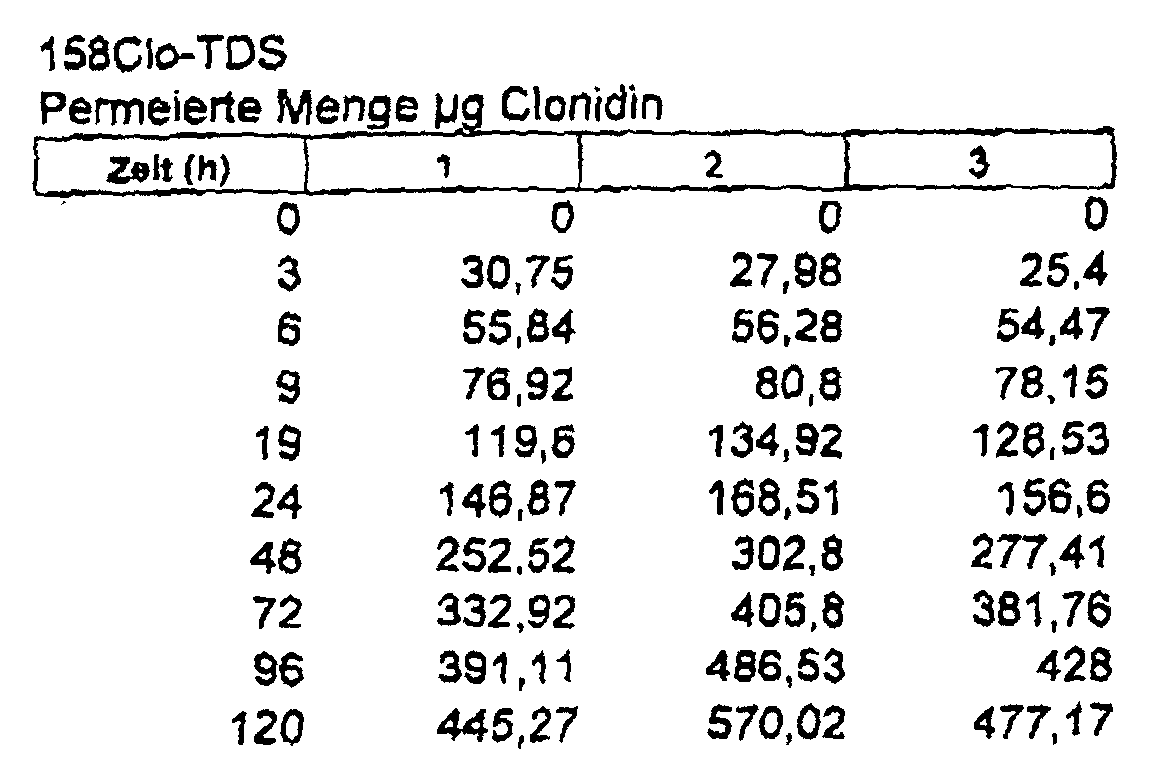
- the skin permeation model takes additional account necessary release the distribution of the active ingredient in the skin and the diffusion through the skin. Hereby are in usually correlations with the biological effect possible.
- a 1.5 cm 2 piece of skin from female nude mice freed of subcutaneous tissue is placed on the exactly 1 cm 2 opening of an automated diffusion cell, covered with a ca. 1.5 cm 2 piece of clonidine patch and sealed with a pressure device on the cell. Then the cell is filled with 25 ml of a physiological HEPES buffer solution and heated to 34 ° C. At defined times samples are taken from the buffer solution and the active ingredient content in them is determined by high pressure liquid chromatography.
- a clonidine patch was prepared using a self-crosslinking acrylate adhesive without added absorption enhancers.
- the system had the following characteristics: Content of clonidine 5.25 mg area 7 cm 2 composition Acrylic adhesive Duro-Tak 87-2052 64.75 mg siliconized polyester film FL2200075 1S 7 cm 2 Polyester film Hostaphan MN 19 MED 7 cm 2
- the Duro-Tak pressure sensitive adhesive becomes self-crosslinking at low temperature by the addition of aluminum acetylacetonate.
- Clonidine is dissolved in ethyl acetate.
- the solution is added to a sufficient amount of the commercially available adhesive solution and homogenized with a stirrer.
- the homogeneous solution is then spread with a doctor blade on a sheet of a siliconized polyester film (about 75 microns) with a defined layer thickness.
- the sheet is then dried for drying and crosslinking for 30 min at 50 ° C in a drying oven. Thereafter, an approximately 19 microns thick polyester film is laminated to the adhesive layer. From the finished laminate 7 cm 2 large patches are punched out by means of a hand punch.
- a clonidine patch according to the invention has the following characteristics: Content of clonidine 5.25 mg area 7 cm 2 composition Acrylic adhesive Duro-Tak 87-4098 64.75 mg siliconized polyester film FL200075 1S ** 7 cm 2 Polyester film Hostaphan MN 19 MED *** 7 cm 2
- patches with clonidine in non-crosslinked acrylate adhesive Duro-Tak 87-4098 / Duro-Tak 387-2051 (area 10 cm 2 ): Salary: 5% clonidine 5.33% clonidine Skin remote side (layer I) clonidine 5.0% 4.5% DT 87-4098 95.0% 85.5% DT 2051 - 10.0% grammage 70 g / m 2 94g / m 2 Skin-friendly side (II) clonidine 5.0% 7.0% Foral E 105 8.5% 8.5% DT 87-4098 86.5% 84.5% grammage 70 g / m 2 46 g / m 2
Landscapes
- Health & Medical Sciences (AREA)
- Engineering & Computer Science (AREA)
- Bioinformatics & Cheminformatics (AREA)
- Pharmacology & Pharmacy (AREA)
- Chemical & Material Sciences (AREA)
- Medicinal Chemistry (AREA)
- Dermatology (AREA)
- Epidemiology (AREA)
- Life Sciences & Earth Sciences (AREA)
- Animal Behavior & Ethology (AREA)
- General Health & Medical Sciences (AREA)
- Public Health (AREA)
- Veterinary Medicine (AREA)
- Pharmaceuticals Containing Other Organic And Inorganic Compounds (AREA)
- Medicinal Preparation (AREA)
Description
- Hypertonie
- Migräne
- Angstzuständen
- hyperkinetischen Verhaltensstörungen
- Entzugserscheinungen bei Alkohol- oder Drogenentzug
- menopausalen Symptomen
| Gehalt Clonidin | 5 mg |
| Fläche | 7 cm2 |
| Gehalt Clonidin | 5,25 mg |
| Fläche | 7 cm2 |
| Zusammensetzung | |
| Acrylatkleber Duro-Tak 87-2052 | 64,75 mg |
| silikonisierte Polyester-Folie FL2200075 1S | 7 cm2 |
| Polyester-Folie Hostaphan MN 19 MED | 7 cm2 |
| Der Duro-Tak-Haftkleber wird bei niedriger Temperatur durch den Zusatz von Aluminiumacetylacetonat selbstvernetzend. |
| Gehalt Clonidin | 5,25 mg |
| Fläche | 7 cm2 |
| Zusammensetzung | |
| Acrylatkleber Duro-Tak 87-4098 | 64,75 mg |
| silikonisierte Polyester-Folie FL200075 1S** | 7 cm2 |
| Polyester-Folie Hostaphan MN 19 MED*** | 7 cm2 |
| In-vitro-Freisetzung Clonidin-Transdermalsystem (Matrixpflaster) | ||
| Zeit (Stunden) | Vergl. Bsp. 1 | Beispiel 1 |
| Freisetzung Clonidin (%) | ||
| 2 | 10, 44 | 9,96 |
| 4 | 11,82 | 13,92 |
| 24 | 20,95 | 19,76 |
| In-vitro-Hautpermeation Clonidin-Transdermalsystem (Matrixpflaster) | |||
| Zeit (Stunden) | Vergl. Bsp. 1 | Vergl. Bsp. 2 | Beispiel |
| Permeation Clonidin (µg/cm2) | |||
| 3 | 24 | 24,5 | |
| 6 | 56 | 54 | |
| 9 | 80,5 | 86 | |
| 14 | 113,5 | 23,32 | 128,5 |
| 19 | 139 | 46,94 | 165,5 |
| 24 | 163,5 | 55,84 | 186 |
| 32 | 82,68 | ||
| 36 | 233,5 | 229 | |
| 40 | 105,37 | ||
| 48 | 305,5 | 259,5 |
| Gehalt: | 5% Clonidin | 5,33% Clonidin | |
| Hautabgewandte Seite (Schicht I) | Clonidin | 5,0% | 4,5% |
| DT 87-4098 | 95,0% | 85,5% | |
| DT 2051 | - | 10,0% | |
| Flächengewicht | 70 g/m 2 | 94g/m2 | |
| Hautzugcwandte Seite (II) | Clonidin | 5,0% | 7,0% |
| Foral E 105 | 8,5% | 8,5% | |
| DT 87-4098 | 86,5% | 84,5% | |
| Flächengewicht | 70 g/m2 | 46 g/m2 |
| Gehalt | Clonidin | 6% |
| Foral 105E | 5% | |
| Paraffinöl | 5% | |
| Duro-Tak 87-6174 | 84% | |
| Flächengewicht : | 140 g/m2,10 cm2 |
| Zeit (h) | A/C | B/C | Catapres-3 (Vergleichsbeispiel 1) |
| 0 | 0 | 0 | 0 |
| 3 | 42,9 | 37,01 | |
| 6 | 82,54 | 76,08 | |
| 8 | 67,96 | ||
| 9 | 112,52 | 106,77 | |
| 19 | 168,24 | 178,4 | |
| 24 | 212,06 | 213,73 | 149.03 |
| 32 | 273,45 | 281,98 | |
| 36 | 198,47 | ||
| 48 | 328,01 | 341,37 | 254,41 |
| 60 | 370,78 | 387,99 | 318,22 |
| 72 | 383,69 | ||
| 84 | 458,08 | ||
| 86 | 422,55 | 481,1 | |
| 108 | 620,38 | ||
| 120 | 679,48 |
Claims (14)
- Transdermalsystem zur Abgabe von Clonidin aus einer Clonidin enthaltenden Haftkleberschicht aus einem Styrol-Block-Copolymer, die keine toxischen Vernetzer oder Lösemittel oder Resorptionsförderer enthält, sowie neben der Clonidin enthaltenden Haftkleberschicht einer Abdeckung und auf der der Abdeckung gegenüberliegenden Seite einem die Haftkleberschicht temporär abdeckenden und abziehbaren Träger.
- Transdermalsystem nach Anspruch 1, dadurch gekennzeichnet, daß die Haftkleberschicht Clonidin im Konzentrationsbereich von 0,1 bis 20 Gew.-% aufweist.
- Transdermalsystem nach Anspruch 2, dadurch gekennzeichnet, daß die Haftkleberschicht Clonidin im Konzentrationsbereich von 2 bis 10 Gew.-% aufweist.
- Transdermalsystem nach einem der vorhergehenden Ansprüche, dadurch gekennzeichnet, daß die Clonidin enthaltende Haftkleberschicht eine Schicht eines flächigen selbstklebenden Pflasters mit mehrschichtigem Aufbau bildet.
- Transdermalsystem nach Anspruch 1, dadurch gekennzeichnet, daß die Abdeckung aus Kunststoffolie, Kunststoffschaum, Gewebe oder Vlies besteht.
- Transdermalsystem nach Anspruch 1, dadurch gekennzeichnet, daß der Träger aus Kunststoffolie, Papier oder einem Laminat daraus besteht.
- Transdermalsystem nach Anspruch 6, dadurch gekennzeichnet, daß der Träger silikonisiert ist.
- Transdermalsystem nach Anspruch 5 oder 6, dadurch gekennzeichnet, daß es sich bei der Kunststoffolie um Polyester-, Polyethylen- oder Polypropylen-Folie handelt.
- Transdermalsystem nach einem der Ansprüche 4 bis 8 dadurch gekennzeichnet, daß die trockene Haftkleberschicht ein Flächengewicht von 20 bis 150 g/m2 hat.
- Transdermalsystem nach Anspruch 9, dadurch gekennzeichnet, daß die trockene Haftkleberschicht ein Flächengewicht von 50 bis 120 g/m2 hat.
- Transdermalsystem nach einem der vorherigen Ansprüche,
dadurch gekennzeichnet, daß die Abgaberate 10 bis 1000 µg Clonidin pro Tag beträgt. - Transdermalsystem nach Anspruch 11, dadurch gekennzeichnet, daß die Abgaberate 50 bis 500 µg Clonidin pro Tag beträgt.
- Transdermalsystem nach einem der vorhergehenden Ansprüche, gekennzeichnet durch ein Styrol-Isopren-Styrol-Copolymer (Styren-Isopren-Styren-Copolymer) als Styrol-Block-Copolymer (Styren-Block-Copolymer).
- Transdermalsystems nach einem der vorherigen Ansprüche zur Behandlung von Hypertonie, Migräne, Angstzuständen, hyperkinetischen Verhaltensstörungen, Entzugserscheinungen bei Alkohol- oder Drogenentzug und menopausalen Symptomen.
Applications Claiming Priority (2)
| Application Number | Priority Date | Filing Date | Title |
|---|---|---|---|
| US45118099A | 1999-11-29 | 1999-11-29 | |
| US451180 | 1999-11-29 |
Publications (3)
| Publication Number | Publication Date |
|---|---|
| EP1103260A2 EP1103260A2 (de) | 2001-05-30 |
| EP1103260A3 EP1103260A3 (de) | 2001-08-22 |
| EP1103260B1 true EP1103260B1 (de) | 2005-01-26 |
Family
ID=23791130
Family Applications (1)
| Application Number | Title | Priority Date | Filing Date |
|---|---|---|---|
| EP00126102A Expired - Lifetime EP1103260B1 (de) | 1999-11-29 | 2000-11-29 | Transdermalsystem zur Abgabe von Clonidin |
Country Status (5)
| Country | Link |
|---|---|
| US (1) | US20040028726A1 (de) |
| EP (1) | EP1103260B1 (de) |
| AT (1) | ATE287711T1 (de) |
| DE (1) | DE50009346D1 (de) |
| ES (1) | ES2232370T3 (de) |
Families Citing this family (31)
| Publication number | Priority date | Publication date | Assignee | Title |
|---|---|---|---|---|
| DE10141652B4 (de) | 2001-08-24 | 2011-04-07 | Lts Lohmann Therapie-Systeme Ag | Transdermales therapeutisches System auf der Basis von Polyacrylat-Haftklebern ohne funktionelle Gruppen und seine Verwendung |
| US7888422B2 (en) * | 2005-11-09 | 2011-02-15 | Mylan Technologies Inc. | Long-wearing removable pressure sensitive adhesive |
| US8536445B2 (en) * | 2006-06-02 | 2013-09-17 | Emcore Solar Power, Inc. | Inverted metamorphic multijunction solar cells |
| US20080102097A1 (en) * | 2006-10-31 | 2008-05-01 | Zanella John M | Device and method for treating osteolysis using a drug depot to deliver an anti-inflammatory agent |
| US9017301B2 (en) * | 2007-09-04 | 2015-04-28 | Mylan Technologies, Inc. | Transdermal drug delivery systems comprising a coated release liner |
| US8470360B2 (en) | 2008-04-18 | 2013-06-25 | Warsaw Orthopedic, Inc. | Drug depots having different release profiles for reducing, preventing or treating pain and inflammation |
| USRE48948E1 (en) | 2008-04-18 | 2022-03-01 | Warsaw Orthopedic, Inc. | Clonidine compounds in a biodegradable polymer |
| US9132119B2 (en) | 2008-04-18 | 2015-09-15 | Medtronic, Inc. | Clonidine formulation in a polyorthoester carrier |
| US8956641B2 (en) * | 2008-04-18 | 2015-02-17 | Warsaw Orthopedic, Inc. | Alpha adrenergic receptor agonists for treatment of inflammatory diseases |
| US20090264477A1 (en) * | 2008-04-18 | 2009-10-22 | Warsaw Orthopedic, Inc., An Indiana Corporation | Beta adrenergic receptor agonists for treatment of pain and/or inflammation |
| US20090263489A1 (en) * | 2008-04-18 | 2009-10-22 | Warsaw Orthopedic, Inc. | Analgesic and anti-inflammatory compositions and methods for reducing, preventing or treating pain and inflammation |
| US8889173B2 (en) * | 2008-04-18 | 2014-11-18 | Warsaw Orthopedic, Inc. | Alpha adrenergic receptor agonists for treatment of pain and/or inflammation |
| US8946277B2 (en) | 2008-04-18 | 2015-02-03 | Warsaw Orthopedic, Inc. | Clonidine formulations in a biodegradable polymer carrier |
| US8722079B2 (en) | 2008-04-18 | 2014-05-13 | Warsaw Orthopedic, Inc. | Methods for treating conditions such as dystonia and post-stroke spasticity with clonidine |
| US8420114B2 (en) * | 2008-04-18 | 2013-04-16 | Warsaw Orthopedic, Inc. | Alpha and beta adrenergic receptor agonists for treatment of pain and / or inflammation |
| US20090264489A1 (en) * | 2008-04-18 | 2009-10-22 | Warsaw Orthopedic, Inc. | Method for Treating Acute Pain with a Formulated Drug Depot in Combination with a Liquid Formulation |
| US8883768B2 (en) | 2008-04-18 | 2014-11-11 | Warsaw Orthopedic, Inc. | Fluocinolone implants to protect against undesirable bone and cartilage destruction |
| US8629172B2 (en) | 2008-04-18 | 2014-01-14 | Warsaw Orthopedic, Inc. | Methods and compositions for treating post-operative pain comprising clonidine |
| US8557273B2 (en) | 2008-04-18 | 2013-10-15 | Medtronic, Inc. | Medical devices and methods including polymers having biologically active agents therein |
| US9610243B2 (en) | 2008-04-18 | 2017-04-04 | Warsaw Orthopedic, Inc. | Clonidine compounds in a biodegradable polymer |
| US20090263451A1 (en) * | 2008-04-18 | 2009-10-22 | Warsaw Orthopedic, Inc. | Anti-Inflammatory and/or Analgesic Agents for Treatment of Myofascial Pain |
| US9072727B2 (en) | 2008-04-18 | 2015-07-07 | Warsaw Orthopedic, Inc. | Alpha adrenergic receptor agonists for treatment of degenerative disc disease |
| US9132085B2 (en) * | 2008-04-18 | 2015-09-15 | Warsaw Orthopedic, Inc. | Compositions and methods for treating post-operative pain using clonidine and bupivacaine |
| GB0809905D0 (en) * | 2008-06-02 | 2008-07-09 | Secr Defence | A Transdermal drug delivery device |
| US20100098746A1 (en) * | 2008-10-20 | 2010-04-22 | Warsaw Orthopedic, Inc. | Compositions and methods for treating periodontal disease comprising clonidine, sulindac and/or fluocinolone |
| US8822546B2 (en) * | 2008-12-01 | 2014-09-02 | Medtronic, Inc. | Flowable pharmaceutical depot |
| US20100228097A1 (en) * | 2009-03-04 | 2010-09-09 | Warsaw Orthopedic, Inc. | Methods and compositions to diagnose pain |
| US20100239632A1 (en) | 2009-03-23 | 2010-09-23 | Warsaw Orthopedic, Inc. | Drug depots for treatment of pain and inflammation in sinus and nasal cavities or cardiac tissue |
| US8617583B2 (en) * | 2009-07-17 | 2013-12-31 | Warsaw Orthopedic, Inc. | Alpha adrenergic receptor agonists for prevention or treatment of a hematoma, edema, and/or deep vein thrombosis |
| US8231891B2 (en) * | 2009-07-31 | 2012-07-31 | Warsaw Orthopedic, Inc. | Implantable drug depot for weight control |
| US20110097375A1 (en) | 2009-10-26 | 2011-04-28 | Warsaw Orthopedic, Inc. | Formulation for preventing or reducing bleeding at a surgical site |
Family Cites Families (7)
| Publication number | Priority date | Publication date | Assignee | Title |
|---|---|---|---|---|
| US4559222A (en) * | 1983-05-04 | 1985-12-17 | Alza Corporation | Matrix composition for transdermal therapeutic system |
| JPH0676321B2 (ja) * | 1987-02-18 | 1994-09-28 | 久光製薬株式会社 | クロニジン経皮投与製剤 |
| US5474783A (en) * | 1988-03-04 | 1995-12-12 | Noven Pharmaceuticals, Inc. | Solubility parameter based drug delivery system and method for altering drug saturation concentration |
| US5762952A (en) * | 1993-04-27 | 1998-06-09 | Hercon Laboratories Corporation | Transdermal delivery of active drugs |
| US7150881B2 (en) * | 1997-06-26 | 2006-12-19 | Mylan Technologies, Inc. | Adhesive mixture for transdermal delivery of highly plasticizing drugs |
| GB9714650D0 (en) * | 1997-07-11 | 1997-09-17 | Strakan Ltd | Block copolymer |
| AU3470600A (en) * | 1999-01-14 | 2000-08-01 | David Houze | Compositions and methods for drug delivery |
-
2000
- 2000-11-29 ES ES00126102T patent/ES2232370T3/es not_active Expired - Lifetime
- 2000-11-29 AT AT00126102T patent/ATE287711T1/de not_active IP Right Cessation
- 2000-11-29 EP EP00126102A patent/EP1103260B1/de not_active Expired - Lifetime
- 2000-11-29 DE DE50009346T patent/DE50009346D1/de not_active Expired - Lifetime
-
2003
- 2003-07-09 US US10/616,248 patent/US20040028726A1/en not_active Abandoned
Also Published As
| Publication number | Publication date |
|---|---|
| DE50009346D1 (de) | 2005-03-03 |
| ES2232370T3 (es) | 2005-06-01 |
| ATE287711T1 (de) | 2005-02-15 |
| US20040028726A1 (en) | 2004-02-12 |
| EP1103260A3 (de) | 2001-08-22 |
| EP1103260A2 (de) | 2001-05-30 |
Similar Documents
| Publication | Publication Date | Title |
|---|---|---|
| EP1103260A2 (de) | Transdermalsysteme zur Abgabe von Clonidin | |
| DE60021099T2 (de) | Transdermale, in form einer haftschicht ausgebildete zweifachmedikamenten-verabreichungsvorrichtung | |
| DE69112108T2 (de) | Klebende Vorrichtung zur transdermalen Verabreichung eines Wirkstoffs. | |
| EP1033978B1 (de) | D2-agonist enthaltendes transdermales therapeutisches system zur behandlung des parkinson-syndroms und verfahren zu seiner herstellung | |
| DE69611247T2 (de) | Übersättigte transdermale arzneistoffabgabesysteme und verfahren zu deren herstellung | |
| DE69916492T3 (de) | Pflaster zur transdermalen applikation von flüchtigen, flüssigen wirkstoffen | |
| DE60304477T2 (de) | Verbessertes transdermales abgabesystem für die verabreichung von rotigotin | |
| EP0376067B1 (de) | Transdermales therapeutisches System mit Physostigmin als wirksamen Bestandteil und Verfahren zu seiner Herstellung | |
| DE69129632T2 (de) | Vorrichtung zum transdermalen verabreichen von medikamenten unter verwendung von sorbitanestern zum verbessern der hautdurchlässigkeit | |
| DE69829961T2 (de) | Transdermale vorrichtung zur verabreichungvon von testosteron | |
| DE60309963T2 (de) | Pharmazeutische Zusammensetzung zur Perkutann Absorption und Verfahren für ihre Herstellung | |
| DE10261696A1 (de) | Vorrichtung zur transdermalen Verabreichung von Rotigotin-Base | |
| DE602005002887T2 (de) | Fentanyl enthaltende Pflasterzubereitung | |
| DE60311449T2 (de) | Transdermales therapeutisches system mit zwei übereinanderliegenden matrixschichten, die verschiedene affinitäten zum enthaltenen wirkstoff ausweisen | |
| EP1191927B1 (de) | Mikroreservoirsystem auf basis von polysiloxanen und ambiphilen lösemitteln | |
| EP2111857A1 (de) | Transdermales therapeutisches System zur Verabreichung von Fentanyl oder einem Analogstoff hiervon | |
| EP1651215A1 (de) | Transdermales therapeutisches system mit dem wirkstoff pramipexol | |
| DE10012908B4 (de) | Stabilisierte übersättigte transdermale therapeutische Matrixsysteme und Verfahren zu ihrer Herstellung | |
| DE10137082A1 (de) | Matrixkontrolliertes transdermales therapeutisches System zur Anwendung von Pramiprexol und Ropinirol | |
| EP1480625B1 (de) | Transdermalsystem mit fentanyl | |
| DE60309329T2 (de) | Verbessertes transdermales abgabesystem | |
| DE102006054733A1 (de) | Transdermales therapeutisches Systems mit hoher Wirkstoffausnutzungsrate und Dosiergenauigkeit | |
| DE60013431T2 (de) | Transdermale vorrichtung zur verabreichung von testosteron oder einem derivat davon | |
| EP0742716B1 (de) | Pharmazeutische zusammensetzung zur systemischen transdermalen verabreichung mit dem wirkstoff morphin-6-glucuronid | |
| EP2366388A1 (de) | Nicht-okklusives transdermales therapeutisches System zur Verabreichung von Buprenorphin |
Legal Events
| Date | Code | Title | Description |
|---|---|---|---|
| PUAI | Public reference made under article 153(3) epc to a published international application that has entered the european phase |
Free format text: ORIGINAL CODE: 0009012 |
|
| AK | Designated contracting states |
Kind code of ref document: A2 Designated state(s): AT BE CH CY DE DK ES FI FR GB GR IE IT LI LU MC NL PT SE TR |
|
| AX | Request for extension of the european patent |
Free format text: AL;LT;LV;MK;RO;SI |
|
| PUAL | Search report despatched |
Free format text: ORIGINAL CODE: 0009013 |
|
| AK | Designated contracting states |
Kind code of ref document: A3 Designated state(s): AT BE CH CY DE DK ES FI FR GB GR IE IT LI LU MC NL PT SE TR |
|
| AX | Request for extension of the european patent |
Free format text: AL;LT;LV;MK;RO;SI |
|
| 17P | Request for examination filed |
Effective date: 20011107 |
|
| RAP1 | Party data changed (applicant data changed or rights of an application transferred) |
Owner name: NOVOSIS AG |
|
| AKX | Designation fees paid |
Free format text: AT BE CH CY DE DK ES FI FR GB GR IE IT LI LU MC NL PT SE TR |
|
| 17Q | First examination report despatched |
Effective date: 20021118 |
|
| GRAP | Despatch of communication of intention to grant a patent |
Free format text: ORIGINAL CODE: EPIDOSNIGR1 |
|
| GRAS | Grant fee paid |
Free format text: ORIGINAL CODE: EPIDOSNIGR3 |
|
| GRAA | (expected) grant |
Free format text: ORIGINAL CODE: 0009210 |
|
| AK | Designated contracting states |
Kind code of ref document: B1 Designated state(s): AT BE CH CY DE DK ES FI FR GB GR IE IT LI LU MC NL PT SE TR |
|
| PG25 | Lapsed in a contracting state [announced via postgrant information from national office to epo] |
Ref country code: TR Free format text: LAPSE BECAUSE OF FAILURE TO SUBMIT A TRANSLATION OF THE DESCRIPTION OR TO PAY THE FEE WITHIN THE PRESCRIBED TIME-LIMIT Effective date: 20050126 Ref country code: NL Free format text: LAPSE BECAUSE OF FAILURE TO SUBMIT A TRANSLATION OF THE DESCRIPTION OR TO PAY THE FEE WITHIN THE PRESCRIBED TIME-LIMIT Effective date: 20050126 Ref country code: IE Free format text: LAPSE BECAUSE OF FAILURE TO SUBMIT A TRANSLATION OF THE DESCRIPTION OR TO PAY THE FEE WITHIN THE PRESCRIBED TIME-LIMIT Effective date: 20050126 Ref country code: FI Free format text: LAPSE BECAUSE OF FAILURE TO SUBMIT A TRANSLATION OF THE DESCRIPTION OR TO PAY THE FEE WITHIN THE PRESCRIBED TIME-LIMIT Effective date: 20050126 |
|
| REG | Reference to a national code |
Ref country code: GB Ref legal event code: FG4D Free format text: NOT ENGLISH |
|
| REG | Reference to a national code |
Ref country code: CH Ref legal event code: EP |
|
| REG | Reference to a national code |
Ref country code: IE Ref legal event code: FG4D Free format text: GERMAN |
|
| REF | Corresponds to: |
Ref document number: 50009346 Country of ref document: DE Date of ref document: 20050303 Kind code of ref document: P |
|
| PG25 | Lapsed in a contracting state [announced via postgrant information from national office to epo] |
Ref country code: SE Free format text: LAPSE BECAUSE OF FAILURE TO SUBMIT A TRANSLATION OF THE DESCRIPTION OR TO PAY THE FEE WITHIN THE PRESCRIBED TIME-LIMIT Effective date: 20050426 Ref country code: GR Free format text: LAPSE BECAUSE OF FAILURE TO SUBMIT A TRANSLATION OF THE DESCRIPTION OR TO PAY THE FEE WITHIN THE PRESCRIBED TIME-LIMIT Effective date: 20050426 Ref country code: DK Free format text: LAPSE BECAUSE OF FAILURE TO SUBMIT A TRANSLATION OF THE DESCRIPTION OR TO PAY THE FEE WITHIN THE PRESCRIBED TIME-LIMIT Effective date: 20050426 |
|
| GBT | Gb: translation of ep patent filed (gb section 77(6)(a)/1977) |
Effective date: 20050418 |
|
| REG | Reference to a national code |
Ref country code: ES Ref legal event code: FG2A Ref document number: 2232370 Country of ref document: ES Kind code of ref document: T3 |
|
| NLV1 | Nl: lapsed or annulled due to failure to fulfill the requirements of art. 29p and 29m of the patents act | ||
| REG | Reference to a national code |
Ref country code: IE Ref legal event code: FD4D |
|
| PG25 | Lapsed in a contracting state [announced via postgrant information from national office to epo] |
Ref country code: DE Free format text: LAPSE BECAUSE OF THE APPLICANT RENOUNCES Effective date: 20050912 |
|
| ET | Fr: translation filed | ||
| PG25 | Lapsed in a contracting state [announced via postgrant information from national office to epo] |
Ref country code: IT Free format text: LAPSE BECAUSE OF NON-PAYMENT OF DUE FEES Effective date: 20051129 Ref country code: CY Free format text: LAPSE BECAUSE OF FAILURE TO SUBMIT A TRANSLATION OF THE DESCRIPTION OR TO PAY THE FEE WITHIN THE PRESCRIBED TIME-LIMIT Effective date: 20051129 Ref country code: AT Free format text: LAPSE BECAUSE OF NON-PAYMENT OF DUE FEES Effective date: 20051129 |
|
| PG25 | Lapsed in a contracting state [announced via postgrant information from national office to epo] |
Ref country code: MC Free format text: LAPSE BECAUSE OF NON-PAYMENT OF DUE FEES Effective date: 20051130 Ref country code: LU Free format text: LAPSE BECAUSE OF NON-PAYMENT OF DUE FEES Effective date: 20051130 Ref country code: LI Free format text: LAPSE BECAUSE OF NON-PAYMENT OF DUE FEES Effective date: 20051130 Ref country code: ES Free format text: LAPSE BECAUSE OF NON-PAYMENT OF DUE FEES Effective date: 20051130 Ref country code: CH Free format text: LAPSE BECAUSE OF NON-PAYMENT OF DUE FEES Effective date: 20051130 Ref country code: BE Free format text: LAPSE BECAUSE OF NON-PAYMENT OF DUE FEES Effective date: 20051130 |
|
| PLBE | No opposition filed within time limit |
Free format text: ORIGINAL CODE: 0009261 |
|
| STAA | Information on the status of an ep patent application or granted ep patent |
Free format text: STATUS: NO OPPOSITION FILED WITHIN TIME LIMIT |
|
| 26N | No opposition filed |
Effective date: 20051027 |
|
| REG | Reference to a national code |
Ref country code: CH Ref legal event code: PL |
|
| GBPC | Gb: european patent ceased through non-payment of renewal fee |
Effective date: 20051129 |
|
| PG25 | Lapsed in a contracting state [announced via postgrant information from national office to epo] |
Ref country code: FR Free format text: LAPSE BECAUSE OF NON-PAYMENT OF DUE FEES Effective date: 20060731 |
|
| REG | Reference to a national code |
Ref country code: FR Ref legal event code: ST Effective date: 20060731 |
|
| REG | Reference to a national code |
Ref country code: ES Ref legal event code: FD2A Effective date: 20051130 |
|
| BERE | Be: lapsed |
Owner name: NOVOSIS A.G. Effective date: 20051130 |
|
| PG25 | Lapsed in a contracting state [announced via postgrant information from national office to epo] |
Ref country code: PT Free format text: LAPSE BECAUSE OF NON-PAYMENT OF DUE FEES Effective date: 20050626 |