EP1103622A2 - Détèction d'acides nucléiques pour des espèces spécifiques utilisant un élément d'analyse - Google Patents
Détèction d'acides nucléiques pour des espèces spécifiques utilisant un élément d'analyse Download PDFInfo
- Publication number
- EP1103622A2 EP1103622A2 EP00125818A EP00125818A EP1103622A2 EP 1103622 A2 EP1103622 A2 EP 1103622A2 EP 00125818 A EP00125818 A EP 00125818A EP 00125818 A EP00125818 A EP 00125818A EP 1103622 A2 EP1103622 A2 EP 1103622A2
- Authority
- EP
- European Patent Office
- Prior art keywords
- detection
- nucleic acids
- analysis element
- zone
- sample
- Prior art date
- Legal status (The legal status is an assumption and is not a legal conclusion. Google has not performed a legal analysis and makes no representation as to the accuracy of the status listed.)
- Granted
Links
Images

Classifications
-
- C—CHEMISTRY; METALLURGY
- C12—BIOCHEMISTRY; BEER; SPIRITS; WINE; VINEGAR; MICROBIOLOGY; ENZYMOLOGY; MUTATION OR GENETIC ENGINEERING
- C12Q—MEASURING OR TESTING PROCESSES INVOLVING ENZYMES, NUCLEIC ACIDS OR MICROORGANISMS; COMPOSITIONS OR TEST PAPERS THEREFOR; PROCESSES OF PREPARING SUCH COMPOSITIONS; CONDITION-RESPONSIVE CONTROL IN MICROBIOLOGICAL OR ENZYMOLOGICAL PROCESSES
- C12Q1/00—Measuring or testing processes involving enzymes, nucleic acids or microorganisms; Compositions therefor; Processes of preparing such compositions
- C12Q1/68—Measuring or testing processes involving enzymes, nucleic acids or microorganisms; Compositions therefor; Processes of preparing such compositions involving nucleic acids
- C12Q1/6813—Hybridisation assays
-
- Y—GENERAL TAGGING OF NEW TECHNOLOGICAL DEVELOPMENTS; GENERAL TAGGING OF CROSS-SECTIONAL TECHNOLOGIES SPANNING OVER SEVERAL SECTIONS OF THE IPC; TECHNICAL SUBJECTS COVERED BY FORMER USPC CROSS-REFERENCE ART COLLECTIONS [XRACs] AND DIGESTS
- Y10—TECHNICAL SUBJECTS COVERED BY FORMER USPC
- Y10T—TECHNICAL SUBJECTS COVERED BY FORMER US CLASSIFICATION
- Y10T436/00—Chemistry: analytical and immunological testing
- Y10T436/14—Heterocyclic carbon compound [i.e., O, S, N, Se, Te, as only ring hetero atom]
- Y10T436/142222—Hetero-O [e.g., ascorbic acid, etc.]
- Y10T436/143333—Saccharide [e.g., DNA, etc.]
Definitions
- the present invention relates to a method for the detection of Nucleic acids on an analytical element that has a sample application zone and contains a detection zone, the analysis element carrying a liquid from the sample application zone to the detection zone, where a sample is placed on the sample application zone of the analysis element and the nucleic acids contained in the sample in the detection zone Hybridization with a detection probe qualitatively, but also quantitatively can preferably be detected via marker groups. Furthermore, new analysis elements and reagent kits for detection provided by nucleic acids.
- the common detection of nucleic acids for example amplification products from a PCR, in the context of diagnostic applications about the specific hybridization of the nucleic acid to be detected with a detection probe, usually an oligonucleotide and one not radioactive detection reaction via labeling groups in the nucleic acids to be detected and / or the detection probe are present can.
- a direct hybridization of the detected can thus Nucleic acids with a on a solid phase, for example a microtiter plate, immobilized detection probe (Amplicor Detection Kit, Roche Diagnostics, EP-A-0 420 260).
- the one to be verified Prehybridized nucleic acid with a labeled detection probe and the the resulting complex on a solid phase for example one Microtiter plate to be captured (PCR detection kit, Roche Diagnostics).
- test strips in diagnostic procedures has been around known for a long time. Such is the detection of analytes with test strips in EP-B-0 186 799, EP-B-0 262 328 and EP-A-0 926 498, which primarily concern immunologically oriented test formats.
- Jou et al. (Human Mutation 5 (1995), 86-93) describe a method for the detection of nucleic acids on chromatographic test strips, where hapten groups are introduced into the nucleic acid to be detected be, so that an immunological immobilization of the detected Nucleic acids on the test strip possible using anti-hapten antibodies becomes. Interception of nucleic acids to be detected via specific Hybridization to immobilized detection probes on test strips for example in US 5,310,650, EP-B-0 612 354 and Reinhartz et al. (Genes 136: 221-226 (1993) and Rule et al. (Clin. Chem. 42 (1996), 1206-1209) described.
- the nucleic acids cannot with the methods mentioned immediately proven.
- an upstream step first the complex between target nucleic acid and hybridization probe educated.
- the target nucleic acid is denatured (thermally or by Add an alkaline solution), neutralize if necessary, the probe added and hybridization conditions set. Only afterwards the actual proof on the Test carriers are made.
- the main benefits of test strips can be Procedures such as low equipment requirements, simple handling, few Work steps and the feasibility of the procedure from untrained People are not used. Furthermore result from this additional steps contamination risks associated with the detection of amplified Nucleic acids can lead to false positive results.
- Preprocessing can only be dispensed with if the Target nucleic acids are already completely single-stranded. So surrendered however, usually already in the detection of ribosomal Target nucleic acids have difficulties because of these single-stranded nucleic acids double-stranded in its native secondary structure in large areas are present (for example rRNA).
- rRNA ribosomal Target nucleic acids
- Amplification method the targeted synthesis of only one strand of nucleic acid allow.
- An example of this is asymmetric PCR. Since this However, due to the linear amplification, the process is significantly less efficient As a conventional PCR method, the sensitivity is clearly limited and in the detection of only low concentrations Insufficient analytes.
- known in the prior art Methods involving direct hybridization of the nucleic acid to be detected on an analysis element allow the same disadvantages as they can be found in the indirect detection methods.
- a major advantage of the invention is that the previously described There is no preprocessing of the nucleic acid to be detected and the Nucleic acids directly, or following an amplification process an analysis element can be abandoned.
- the one on the analysis element preferably impregnated reagents allow a Complete or partial denaturation of the target nucleic acid on the Analysis element, so that hybridization of double-stranded Conformationally applied nucleic acids is made possible.
- the target nucleic acid can be in liquid form, for example present in the PCR reaction solution, on the Analysis element can be applied.
- the Target nucleic acid After the reagents have been dissolved, the Target nucleic acid completely denatured. Because under these conditions a Hybridization to the probe oligonucleotide cannot be done during the preferred chromatographic transport of the analyte over the Test vehicle to change the chemical milieu accordingly.
- This can on the one hand by appropriate chromatography buffers or through downstream reagents. A is preferred for this Denaturation using a base, especially NaOH and neutralization by means of an acid.
- the chemical environment can be adjusted in this way that the double-stranded conformation of the target nucleic acid is destabilized (partially denatured), and the hybridization to the Probe oligonucleotide enables or is supported. A change of the chemical milieu during the chromatography is with this Process variant not necessary.
- Preferred reagents for this embodiment are chaotropic salts, particularly preferably guanidinium thiocyanate (GuSCN).
- the target nucleic acids hybridized to the probe oligonucleotide To be able to prove, the labeling of the complex is still necessary.
- the labeling groups can be enzymatically incorporated during an optional upstream amplification process in the amplified target nucleic acid or hybridization another appropriately labeled probe oligonucleotide to the Bind target nucleic acid.
- Denaturation not only a complete denaturation in the Classic sense should be understood, but it should also be a partial one Denaturation must be included, in which a nucleic acid double strand as far is destabilized that hybridization with a probe can take place. It is therefore not necessary to completely dissolve the double strand, although of course such an embodiment according to the invention is included.
- those to be detected are denatured Nucleic acids on the analysis element, i.e. the nucleic acids are in undenatured, preferably double-stranded form on the analysis element applied and only come with the denaturing reagent Order on the analysis element in contact.
- the denaturing reagent can be a base and / or a chaotropic substance in an amount that is used for Denaturation of nucleic acids present in the sample is sufficient, contain.
- bases are alkali hydroxides, in particular NaOH.
- chaotropic substances are iodides, acetates, Perchlorates, thiocyanates, trifluoroacetates, trichloroacetates or / and Guanidinium compounds. Guanidinium thiocyanate is particularly preferred.
- the analysis element according to the invention Liquid within the analysis element from the sample application zone in Can move towards the detection zone.
- a flow of liquid is, for example, in a suitably prepared hollow body possible by gravity.
- Devices that transport fluids by centrifugal force as a form of gravity known for example from EP-B-0 052 769.
- Analysis elements absorbent materials that Capillary force to move liquid.
- the materials of the Individual zones of the analysis element according to the invention can be used here be the same or different. It will often be the case that different Zones are made of different materials if these should optimally fulfill their task.
- absorbent, capillary active materials all such in question, generally in so-called “dry tests” as they for example in US-A-4,861,711, US-A-5,591,645 or EP-A-0 291 194 are described, can be used for liquid absorption.
- Porous materials such as Membranes, for example nitrocellulose membranes proven. It can however also fibrous, absorbent matrix materials such as nonwovens, fabrics or Knitted fabrics are used. Nonwovens are particularly preferred.
- Fibrous Matrix materials can be glass, cellulose, cellulose derivatives, polyester Contain polyamide, but also viscose, rayon and / or polyvinyl alcohol.
- Nonwovens made of cellulose-based fibers, polymer-based fibers of polyester and / or polyamide and an organic binder that OH and / or ester groups, as known from EP-B-0 326 135 are, for example, can be used according to the invention.
- Nonwoven materials, containing meltable copolyester fibers, cellulose fibers or cellulose derivative fibers, as described in European patent application 0 571 941 are also in the analysis element according to the invention be used. Papers such as tea bag paper also good to use.
- the absorbent capillary active material can be the absorbent capillary active material or can different absorbent, capillary active materials on one rigid Carrier material are arranged, which in turn is not for liquid is permeable, but the liquid flow in the matrix material is not negative influenced and in relation to those running in the analysis element Reactions are inert.
- Preferred carrier material can, for example Be polyester film on which the liquid transport enables Matrix material is attached.
- the individual zones on top of each other, side by side or partly on top of each other and partly side by side be arranged on the carrier material.
- A is particularly preferred Analysis element according to the invention, in which sample application and Detection zone are arranged side by side on the carrier material.
- side by side means that these zones are in direct contact with each other or through other zones are arranged separately in one plane.
- the sample application zone is the area of the analysis element according to the invention, on which the sample is placed.
- the detection zone is the Area of the analysis element according to the invention in which the determination takes place whether the analyte under investigation or the one derived from the analyte this representative substance in the given on the analysis element Sample was present.
- This determination can be qualitative, semi-quantitative or be quantitative.
- semi-quantitative means that for the Analytes or the one derived from and representing the analyte Substance is not a concrete concentration value, but a concentration range is determined in which the analyte concentration is located.
- the analysis element is pre Apply the sample soaked in the denaturing reagent. It can the denaturing reagent on the analysis element, preferably on whose sample application zone is in liquid or dry form.
- the denaturing reagent is particularly preferably in dry form.
- the analysis element can also only soaked with the denaturing reagent after the sample has been added become. Due to the contact of the sample to be detected existing nucleic acids with the denaturing reagent becomes a Denaturation of nucleic acid double strands causes a Hybridization of the resulting single nucleic acid strands with the Detection probe is made possible.
- the denaturing reagent is a Base contains, it may be appropriate that the Analysis element between the sample application zone and the detection zone Neutralizing reagent, e.g. one acidic when in contact with liquids reacting salt such as a hydrogen phosphate or a hydrogen sulfate, preferably in dry form.
- the Analysis element between the sample application zone and the detection zone Neutralizing reagent e.g. one acidic when in contact with liquids reacting salt such as a hydrogen phosphate or a hydrogen sulfate, preferably in dry form.
- the nucleic acids to be detected in the sample to be bound detection probe used is preferably an oligonucleotide, which is a sufficiently complementary one for the nucleic acids to be detected Sequence contains to hybridize under the test conditions to enable.
- the detection probe is preferably an oligodeoxyribonucleotide, however, nucleic acid analogues can also be used modified nucleotide building blocks or peptidic nucleic acids as Detection probes can be used.
- the detection probe is preferably located in the detection zone in immobilized form, i.e. she is under Test conditions essentially not eluted from the detection zone.
- the Immobilization can be done by applying the detection probe and subsequent Fixation using suitable methods, e.g.
- the probe can also be used with high affinity Interactions, e.g. Biotin / streptavidin or avidin or Hapten / anti-hapten antibody, sugar / lectin in the detection zone be immobilized.
- high affinity Interactions e.g. Biotin / streptavidin or avidin or Hapten / anti-hapten antibody
- sugar / lectin in the detection zone be immobilized.
- modified detection probes are familiar to the person skilled in the art and must be found here not be detailed.
- the hybridization between Nucleic acids and detection probe to be detected also upstream detection zone and the hybridization complex selectively, e.g. by means of high-affinity interactions as described above, in Transport through the analysis element can be fixed in the detection zone.
- the nucleic acids are preferably detected using labeling groups, basically all known from the prior art Marker groups are suitable. Visually recognizable are preferred Labeling groups such as enzyme labels, but especially particulate markings such as gold or latex particles.
- the marking can be localized directly on the nucleic acids to be detected (direct marking), but it can also be indirect, e.g. about high affinity Interactions as described above, for example via hapten / anti-hapten antibodies to which nucleic acids are bound (indirect Mark). Binding of indirect marker groups to those to be detected Nucleic acids can be generated during hybridization or only after a washing step.
- the present invention provides a simple method of detection of nucleic acids provided on test strips.
- Nucleic acids are preferably amplification products, e.g. Amplification products generated by a PCR. You can the amplification products directly using the buffer solution, in which the amplification reaction was carried out, as a chromatographic Solvent can be applied to the test strip.
- Another object of the invention is an analysis element for Detection of nucleic acids, a sample application zone and a Detection zone contains, the analysis element a liquid transport from the sample application zone to the detection zone a denaturing reagent for nucleic acids is soaked, the Denaturing reagent is preferably in a dry form.
- the Analysis element can contain an absorbent material, which is a enables chromatographic transport, and is preferably as Test strips trained.
- the detection zone of the analysis element preferably one complementary to the nucleic acids to be detected Detection probe available in immobilized form.
- the invention relates to a kit for the detection of nucleic acids comprising an analysis element according to the invention and others for Detection of reagents required for nucleic acids, e.g. Labeling reagents, Buffer etc.
- the methods, analytical elements provided by the present invention and reagent kits are particularly suitable for the detection of Nucleic acid amplification products, e.g. to prove existence or the amount of selected organisms or parts of Organisms, e.g. Cells in a sample.
- Nucleic acid amplification products e.g. to prove existence or the amount of selected organisms or parts of Organisms, e.g. Cells in a sample.
- a Genus and species-specific detection of nucleic acids in one Sample e.g. by amplification of ribosomal RNA or one for it coding DNA sequence of organisms occurring in a sample or cells.
- the method can be used to detect microorganisms, e.g. of pathogenic microorganisms or viruses in clinical samples, Food, water samples, etc. are used.
- Procedures also include forensic analysis to demonstrate specific Individuals. In the examples below, the Detection of Chlamydia trachomatis-derived nucleic acids by the shown
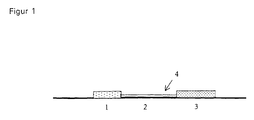
- the absorbent fleece (1) of the analysis element shown in FIG. 1 was soaked in impregnation buffer (10 mM KPO 4 pH 7.5, 100 mM NaCl, 2 or 2.5 M guanidinium thiocyanate (GuSCN), 0.5% Triton-X100, 25 mM NaOH , 2% RPLA type 4 (Roche Diagnostics, cat. No. 1726544-106) and 3 mg / ml herring sperm DNA).
- impregnation buffer 10 mM KPO 4 pH 7.5, 100 mM NaCl, 2 or 2.5 M guanidinium thiocyanate (GuSCN), 0.5% Triton-X100, 25 mM NaOH , 2% RPLA type 4 (Roche Diagnostics, cat. No. 1726544-106) and 3 mg / ml herring sperm DNA.
- a 15 mm nitrocellulose membrane was used as the liquid transport zone (2) used.
- Detection oligonucleotide probes were used to produce the detection zone (4) (40 pmol per test strip) applied to the membrane.
- biotin-labeled oligonucleotides were linked to a Polystreptavidin pre-coated detection zone (4) applied. For this was an oligonucleotide solution (8 pmol / test tire) on the nitrocellulose membrane added and with 10 ⁇ l standard chromatography buffer chromatographed over the detection zone pre-coated with polystreptavidin.
- oligonucleotide with the sequence 5'-GTC TCT was used as the detection probe CAT CGA GAC AAA GTG-3 'from the Chlamydia trachomatis plasmid pCTT1 (C. trachomatis bases 1-7496) corresponding to position 354-374 of pCTT1 used (Sriprakash and Macavoy, Plasmid 18 (1987), 205-214).
- the oligonucleotides CP24 5'-GGGATTCCTGTAACAACAAGTCAGG-3 ' were used as primers for the amplification. (Position 195-219 of pCTT1) and CP27: 5'-CCTCTTCCCCAGAACAATAAGAACAC-3 '(position 401-376 of pCTT1) optionally in the 5'-biotinylated or 5'-digoxigenylated Shape used.
- the reaction volume was 100 ⁇ l (4 mM MgCl 2 , each 0.1 mM dNTP, each 300 nM primer CP24 and CP27, 2.5 U Taq polymerase, 2 U UNG (uracil DNA glycosylase) and template in PCR buffer (Roche Diagnostics Catalog No. 1600753).
- the PCR reaction was carried out with different amounts of template (0 to 100,000 plasmid copies per batch).
- 50 ul amplificate (Example 2) were applied to the absorbent fleece of the test strip and chromatographed for 4 min. Then 30 ⁇ l of standard chromatography buffer (0.15 M NaCl, 9.6 mM KH 2 PO 4 , 40.5 mM K 2 HPO 4 , 0.25% Tween 20, 2% RPLA type 4, 0.09% sodium azide) were added and chromatographed for 4 min. Then 20 .mu.l anti-digoxigenin-antibody-gold conjugate solution (2.1 pmol) were added and chromatographed for 4 min. Then 50 ⁇ l of standard chromatography buffer were applied twice and chromatographed for 4 min.
- standard chromatography buffer (0.15 M NaCl, 9.6 mM KH 2 PO 4 , 40.5 mM K 2 HPO 4 , 0.25% Tween 20, 2% RPLA type 4, 0.09% sodium azide
- Figure 2A shows the result with a test strip according to EP-A-0 926 489, in which the Detection of the nucleic acid by immunological methods using a Sandwich format takes place.
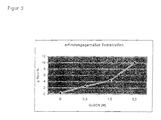
- Figure 2B shows the result of an inventive Detection method with a test strip according to example 1. While the test strip according to FIG. 2A shows a low sensitivity (Detection is only found from> 1000 copies of plasmid per batch) in the method according to the invention, detection is already considerable lower number of plasmids (50) possible. Generally a positive one Evidence given for ⁇ Rem% ⁇ 3. In addition to higher sensitivity, this shows inventive method also a much larger dynamic Area, i.e. a clear signal change over a large concentration range the nucleic acid to be detected.
- Example 1.1 with the exception that the Absorbent fleece was not contained NaOH, analysis elements according to FIG. 1 manufactured. Guanidinium concentrations of 0.5 M, 1.5 M and 2.5 M (near saturation limit) tested.
- Example 1.3 50 ⁇ l PCR amplificate (100 plasmids abandoned per batch), which were prepared according to Example 1.2 was. The detection was carried out in accordance with Example 1.3.
Landscapes
- Chemical & Material Sciences (AREA)
- Organic Chemistry (AREA)
- Life Sciences & Earth Sciences (AREA)
- Zoology (AREA)
- Wood Science & Technology (AREA)
- Proteomics, Peptides & Aminoacids (AREA)
- Health & Medical Sciences (AREA)
- Engineering & Computer Science (AREA)
- Microbiology (AREA)
- Biochemistry (AREA)
- Physics & Mathematics (AREA)
- Molecular Biology (AREA)
- Biotechnology (AREA)
- Biophysics (AREA)
- Analytical Chemistry (AREA)
- Immunology (AREA)
- Bioinformatics & Cheminformatics (AREA)
- General Engineering & Computer Science (AREA)
- General Health & Medical Sciences (AREA)
- Genetics & Genomics (AREA)
- Measuring Or Testing Involving Enzymes Or Micro-Organisms (AREA)
- Apparatus Associated With Microorganisms And Enzymes (AREA)
- Saccharide Compounds (AREA)
Applications Claiming Priority (2)
| Application Number | Priority Date | Filing Date | Title |
|---|---|---|---|
| DE19956820 | 1999-11-25 | ||
| DE19956820A DE19956820A1 (de) | 1999-11-25 | 1999-11-25 | Spezies-spezifischer Nachweis von Nukleinsäuren mittels eines Analyseelementes |
Publications (3)
| Publication Number | Publication Date |
|---|---|
| EP1103622A2 true EP1103622A2 (fr) | 2001-05-30 |
| EP1103622A3 EP1103622A3 (fr) | 2003-08-13 |
| EP1103622B1 EP1103622B1 (fr) | 2005-03-16 |
Family
ID=7930340
Family Applications (1)
| Application Number | Title | Priority Date | Filing Date |
|---|---|---|---|
| EP00125818A Expired - Lifetime EP1103622B1 (fr) | 1999-11-25 | 2000-11-24 | Détection d'acides nucléiques pour des espèces spécifiques utilisant un élément d'analyse |
Country Status (6)
| Country | Link |
|---|---|
| US (1) | US6485915B1 (fr) |
| EP (1) | EP1103622B1 (fr) |
| JP (1) | JP4219085B2 (fr) |
| AT (1) | ATE291098T1 (fr) |
| DE (2) | DE19956820A1 (fr) |
| ES (1) | ES2237377T3 (fr) |
Cited By (2)
| Publication number | Priority date | Publication date | Assignee | Title |
|---|---|---|---|---|
| US7807802B2 (en) | 2002-11-12 | 2010-10-05 | Abbott Lab | Polynucleotides for the amplification and detection of Chlamydia trachomatis and Neisseria gonorrhoeae |
| US20210132067A1 (en) * | 2015-02-06 | 2021-05-06 | Cell Idx, Inc. | Antigen-coupled immunoreagents |
Families Citing this family (6)
| Publication number | Priority date | Publication date | Assignee | Title |
|---|---|---|---|---|
| WO2004099438A1 (fr) * | 2003-05-07 | 2004-11-18 | Coris Bioconcept Sprl | Dispositif oligo-chromatographique rapide et methode d'utilisation |
| WO2006071770A2 (fr) * | 2004-12-23 | 2006-07-06 | I-Stat Corporation | Systeme et procedes de diagnostic moleculaire |
| WO2006128776A1 (fr) * | 2005-05-30 | 2006-12-07 | Qiagen Gmbh | Dispositif et procede de normalisation de concentrations d'acides nucleiques |
| JP5178528B2 (ja) | 2005-12-29 | 2013-04-10 | アボット ポイント オブ ケア インコーポレイテッド | 分子診断用増幅システムおよび方法 |
| WO2009039239A2 (fr) * | 2007-09-18 | 2009-03-26 | Idexx Laboratories, Inc. | Immunochromatographie sur membrane utilisant une force centrifuge |
| DE102008047790A1 (de) * | 2008-09-17 | 2010-04-15 | Qiagen Gmbh | Verfahren zur Normierung des Gehalts von Biomolekülen in einer Probe |
Family Cites Families (9)
| Publication number | Priority date | Publication date | Assignee | Title |
|---|---|---|---|---|
| US4652517A (en) * | 1984-06-11 | 1987-03-24 | Diagnostic Research Limited Partnership | Methods for the in vitro detection and identification of unknown pathogens or genetic entities |
| US4740468A (en) * | 1985-02-14 | 1988-04-26 | Syntex (U.S.A.) Inc. | Concentrating immunochemical test device and method |
| CA1301606C (fr) | 1986-05-02 | 1992-05-26 | David H. Gillespie | Methode chaotropique pour l'evaluation d'acides nucleiques dans un echantillon biologique |
| US4960691A (en) * | 1986-09-29 | 1990-10-02 | Abbott Laboratories | Chromatographic test strip for determining ligands or receptors |
| US5310650A (en) * | 1986-09-29 | 1994-05-10 | Abbott Laboratoires | Method and device for improved reaction kinetics in nucleic acid hybridizations |
| IL102486A (en) * | 1991-10-04 | 1997-11-20 | Orgenics Ltd | Method and apparatus for detection of nucleic acid sequences with a nucleic acid probe |
| US6037127A (en) * | 1994-03-31 | 2000-03-14 | E. I. Du Pont De Nemours And Company | Method for detection of non-denatured nucleic acid fragments |
| WO1995027081A1 (fr) * | 1994-03-31 | 1995-10-12 | E.I. Du Pont De Nemours And Company | Methode de detection de fragments d'acide nucleique |
| DE19816550A1 (de) | 1997-12-24 | 1999-06-24 | Roche Diagnostics Gmbh | Universell verwendbarer Aufbau eines Analysenelements und dessen Einsatz zur Analytbestimmung |
-
1999
- 1999-11-25 DE DE19956820A patent/DE19956820A1/de not_active Withdrawn
-
2000
- 2000-11-17 US US09/716,013 patent/US6485915B1/en not_active Expired - Lifetime
- 2000-11-24 DE DE50009774T patent/DE50009774D1/de not_active Expired - Lifetime
- 2000-11-24 EP EP00125818A patent/EP1103622B1/fr not_active Expired - Lifetime
- 2000-11-24 JP JP2000358273A patent/JP4219085B2/ja not_active Expired - Lifetime
- 2000-11-24 ES ES00125818T patent/ES2237377T3/es not_active Expired - Lifetime
- 2000-11-24 AT AT00125818T patent/ATE291098T1/de active
Cited By (4)
| Publication number | Priority date | Publication date | Assignee | Title |
|---|---|---|---|---|
| US7807802B2 (en) | 2002-11-12 | 2010-10-05 | Abbott Lab | Polynucleotides for the amplification and detection of Chlamydia trachomatis and Neisseria gonorrhoeae |
| US8580495B2 (en) | 2002-11-12 | 2013-11-12 | Abbott Laboratories | Polynucleotides for the amplification and detection of Chlamydia trachomatis and Neisseria gonorrhoeae |
| US9187789B2 (en) | 2002-11-12 | 2015-11-17 | Abbott Molecular Inc. | Polynucleotides for the amplification and detection of chlamydia trachomatis and neisseria gonorrhoeae |
| US20210132067A1 (en) * | 2015-02-06 | 2021-05-06 | Cell Idx, Inc. | Antigen-coupled immunoreagents |
Also Published As
| Publication number | Publication date |
|---|---|
| ES2237377T3 (es) | 2005-08-01 |
| DE19956820A1 (de) | 2001-05-31 |
| DE50009774D1 (de) | 2005-04-21 |
| JP2001190291A (ja) | 2001-07-17 |
| US6485915B1 (en) | 2002-11-26 |
| EP1103622A3 (fr) | 2003-08-13 |
| EP1103622B1 (fr) | 2005-03-16 |
| ATE291098T1 (de) | 2005-04-15 |
| JP4219085B2 (ja) | 2009-02-04 |
Similar Documents
| Publication | Publication Date | Title |
|---|---|---|
| EP0738733B1 (fr) | Méthode pour l'isolation des acides nucléiques | |
| DE69125441T2 (de) | Verfahren zum Gennachweis | |
| DE69637047T2 (de) | Unabhängiges gerät zur extraktion, amplifikation und nachweis von nukleinsäuren | |
| DE69432419T2 (de) | Ein elektrochemiluminescenter nachweis von nukleinsäuren auf basis der selbsttragenden sequenzreplikation | |
| DE69220084T2 (de) | Diagnostische Anwendungen der Bildung von doppelten D-Loops. | |
| DE60127939T2 (de) | Nukleinsäure-Nachweisverfahren mit universellem Priming | |
| DE69524560T2 (de) | Verfahren zum Einfangen und selektiven Freisetzen von Nukleinsäure | |
| DE3586659T2 (de) | Hybridizierungstest fuer nukleinsaeure. | |
| WO2000024929A9 (fr) | Reaction pcr etablie par amplification lineaire | |
| DE60219813T2 (de) | Test-streife-probesystem und verfahren zur nachweis von spezifischen nukleinsäuresequenzen | |
| DE3856224T2 (de) | Nachweis eines Polynukleotids durch Ersätzung einer Kette an einer Fangsonde | |
| EP0892070A2 (fr) | Procédé et système intégrés pour l'amplification et la détection d'acides nucléiques | |
| EP1103622B1 (fr) | Détection d'acides nucléiques pour des espèces spécifiques utilisant un élément d'analyse | |
| DE68909445T2 (de) | Methode zur Bestimmung genetischer Sequenzen und Testsatz hierfür. | |
| EP1595960B1 (fr) | Détection de l'ADN par la formation d'une complexe des brins réassociés | |
| DE69527328T2 (de) | NUKLEINSÄUREPROBEN ZUR DETEKTION VON -i(HAEMOPHILUS INFLUENZA) | |
| EP0523557B1 (fr) | Immobilisation des acides nucléiques | |
| DE69825783T2 (de) | Mittel zur qualitativen und quantitativen analyse mikrobiologischer populationen in einer probe | |
| EP0566050B2 (fr) | Procédé pour la détection d'acides nucléiques | |
| DE60114816T2 (de) | Umgekehrter nachweis zur identifizierung und/oder quantifizierung von nukleotid-zielsequenzen mittels biochips | |
| DE60221964T2 (de) | Verfahren und testkit zur quantitativen bestimmung von variationen der polynukleotidmengen in zell- oder gewebeproben | |
| DE10228785B4 (de) | Detektion von toxischen Algen | |
| EP1141725A2 (fr) | Systeme de test pour reconnaitre differents analytes | |
| DE10051564A1 (de) | Neue Verfahren zur parallelen Sequenzierung eines Nukleinsäuregemisches an einer Oberfläche | |
| DE3853120T2 (de) | Schnelles Verfahren zur Identifizierung einer spezifischen Sequenz von Nukleinsäure. |
Legal Events
| Date | Code | Title | Description |
|---|---|---|---|
| PUAI | Public reference made under article 153(3) epc to a published international application that has entered the european phase |
Free format text: ORIGINAL CODE: 0009012 |
|
| AK | Designated contracting states |
Kind code of ref document: A2 Designated state(s): AT BE CH CY DE DK ES FI FR GB GR IE IT LI LU MC NL PT SE TR |
|
| AX | Request for extension of the european patent |
Free format text: AL;LT;LV;MK;RO;SI |
|
| PUAL | Search report despatched |
Free format text: ORIGINAL CODE: 0009013 |
|
| AK | Designated contracting states |
Designated state(s): AT BE CH CY DE DK ES FI FR GB GR IE IT LI LU MC NL PT SE TR |
|
| AX | Request for extension of the european patent |
Extension state: AL LT LV MK RO SI |
|
| 17P | Request for examination filed |
Effective date: 20030916 |
|
| 17Q | First examination report despatched |
Effective date: 20031103 |
|
| AKX | Designation fees paid |
Designated state(s): AT BE CH CY DE DK ES FI FR GB GR IE IT LI LU MC NL PT SE TR |
|
| GRAP | Despatch of communication of intention to grant a patent |
Free format text: ORIGINAL CODE: EPIDOSNIGR1 |
|
| GRAS | Grant fee paid |
Free format text: ORIGINAL CODE: EPIDOSNIGR3 |
|
| GRAA | (expected) grant |
Free format text: ORIGINAL CODE: 0009210 |
|
| AK | Designated contracting states |
Kind code of ref document: B1 Designated state(s): AT BE CH CY DE DK ES FI FR GB GR IE IT LI LU MC NL PT SE TR |
|
| PG25 | Lapsed in a contracting state [announced via postgrant information from national office to epo] |
Ref country code: IE Free format text: LAPSE BECAUSE OF FAILURE TO SUBMIT A TRANSLATION OF THE DESCRIPTION OR TO PAY THE FEE WITHIN THE PRESCRIBED TIME-LIMIT Effective date: 20050316 Ref country code: FI Free format text: LAPSE BECAUSE OF FAILURE TO SUBMIT A TRANSLATION OF THE DESCRIPTION OR TO PAY THE FEE WITHIN THE PRESCRIBED TIME-LIMIT Effective date: 20050316 Ref country code: TR Free format text: LAPSE BECAUSE OF FAILURE TO SUBMIT A TRANSLATION OF THE DESCRIPTION OR TO PAY THE FEE WITHIN THE PRESCRIBED TIME-LIMIT Effective date: 20050316 Ref country code: NL Free format text: LAPSE BECAUSE OF FAILURE TO SUBMIT A TRANSLATION OF THE DESCRIPTION OR TO PAY THE FEE WITHIN THE PRESCRIBED TIME-LIMIT Effective date: 20050316 |
|
| REG | Reference to a national code |
Ref country code: GB Ref legal event code: FG4D Free format text: NOT ENGLISH |
|
| REG | Reference to a national code |
Ref country code: CH Ref legal event code: EP Ref country code: CH Ref legal event code: NV Representative=s name: A. BRAUN, BRAUN, HERITIER, ESCHMANN AG PATENTANWAE |
|
| GBT | Gb: translation of ep patent filed (gb section 77(6)(a)/1977) |
Effective date: 20050316 |
|
| REG | Reference to a national code |
Ref country code: IE Ref legal event code: FG4D Free format text: GERMAN |
|
| REF | Corresponds to: |
Ref document number: 50009774 Country of ref document: DE Date of ref document: 20050421 Kind code of ref document: P |
|
| PG25 | Lapsed in a contracting state [announced via postgrant information from national office to epo] |
Ref country code: GR Free format text: LAPSE BECAUSE OF FAILURE TO SUBMIT A TRANSLATION OF THE DESCRIPTION OR TO PAY THE FEE WITHIN THE PRESCRIBED TIME-LIMIT Effective date: 20050616 Ref country code: DK Free format text: LAPSE BECAUSE OF FAILURE TO SUBMIT A TRANSLATION OF THE DESCRIPTION OR TO PAY THE FEE WITHIN THE PRESCRIBED TIME-LIMIT Effective date: 20050616 |
|
| REG | Reference to a national code |
Ref country code: ES Ref legal event code: FG2A Ref document number: 2237377 Country of ref document: ES Kind code of ref document: T3 |
|
| NLV1 | Nl: lapsed or annulled due to failure to fulfill the requirements of art. 29p and 29m of the patents act | ||
| PG25 | Lapsed in a contracting state [announced via postgrant information from national office to epo] |
Ref country code: PT Free format text: LAPSE BECAUSE OF FAILURE TO SUBMIT A TRANSLATION OF THE DESCRIPTION OR TO PAY THE FEE WITHIN THE PRESCRIBED TIME-LIMIT Effective date: 20050907 |
|
| REG | Reference to a national code |
Ref country code: IE Ref legal event code: FD4D |
|
| PG25 | Lapsed in a contracting state [announced via postgrant information from national office to epo] |
Ref country code: CY Free format text: LAPSE BECAUSE OF FAILURE TO SUBMIT A TRANSLATION OF THE DESCRIPTION OR TO PAY THE FEE WITHIN THE PRESCRIBED TIME-LIMIT Effective date: 20051124 |
|
| PG25 | Lapsed in a contracting state [announced via postgrant information from national office to epo] |
Ref country code: LU Free format text: LAPSE BECAUSE OF NON-PAYMENT OF DUE FEES Effective date: 20051130 Ref country code: BE Free format text: LAPSE BECAUSE OF NON-PAYMENT OF DUE FEES Effective date: 20051130 Ref country code: MC Free format text: LAPSE BECAUSE OF NON-PAYMENT OF DUE FEES Effective date: 20051130 |
|
| PLBE | No opposition filed within time limit |
Free format text: ORIGINAL CODE: 0009261 |
|
| STAA | Information on the status of an ep patent application or granted ep patent |
Free format text: STATUS: NO OPPOSITION FILED WITHIN TIME LIMIT |
|
| ET | Fr: translation filed | ||
| 26N | No opposition filed |
Effective date: 20051219 |
|
| BERE | Be: lapsed |
Owner name: ROCHE DIAGNOSTICS G.M.B.H. Effective date: 20051130 |
|
| PG25 | Lapsed in a contracting state [announced via postgrant information from national office to epo] |
Ref country code: SE Free format text: LAPSE BECAUSE OF FAILURE TO SUBMIT A TRANSLATION OF THE DESCRIPTION OR TO PAY THE FEE WITHIN THE PRESCRIBED TIME-LIMIT Effective date: 20050616 |
|
| REG | Reference to a national code |
Ref country code: CH Ref legal event code: PFA Owner name: ROCHE DIAGNOSTICS GMBH Free format text: ROCHE DIAGNOSTICS GMBH#SANDHOFER STRASSE 116#68305 MANNHEIM (DE) -TRANSFER TO- ROCHE DIAGNOSTICS GMBH#SANDHOFER STRASSE 116#68305 MANNHEIM (DE) |
|
| REG | Reference to a national code |
Ref country code: CH Ref legal event code: PCAR Free format text: NEW ADDRESS: HOLBEINSTRASSE 36-38, 4051 BASEL (CH) |
|
| PGFP | Annual fee paid to national office [announced via postgrant information from national office to epo] |
Ref country code: ES Payment date: 20141105 Year of fee payment: 15 |
|
| PGFP | Annual fee paid to national office [announced via postgrant information from national office to epo] |
Ref country code: AT Payment date: 20141027 Year of fee payment: 15 |
|
| PGFP | Annual fee paid to national office [announced via postgrant information from national office to epo] |
Ref country code: IT Payment date: 20141118 Year of fee payment: 15 |
|
| REG | Reference to a national code |
Ref country code: FR Ref legal event code: PLFP Year of fee payment: 16 |
|
| REG | Reference to a national code |
Ref country code: AT Ref legal event code: MM01 Ref document number: 291098 Country of ref document: AT Kind code of ref document: T Effective date: 20151124 |
|
| PG25 | Lapsed in a contracting state [announced via postgrant information from national office to epo] |
Ref country code: IT Free format text: LAPSE BECAUSE OF NON-PAYMENT OF DUE FEES Effective date: 20151124 |
|
| PG25 | Lapsed in a contracting state [announced via postgrant information from national office to epo] |
Ref country code: AT Free format text: LAPSE BECAUSE OF NON-PAYMENT OF DUE FEES Effective date: 20151124 |
|
| REG | Reference to a national code |
Ref country code: FR Ref legal event code: PLFP Year of fee payment: 17 |
|
| REG | Reference to a national code |
Ref country code: ES Ref legal event code: FD2A Effective date: 20161229 |
|
| PG25 | Lapsed in a contracting state [announced via postgrant information from national office to epo] |
Ref country code: ES Free format text: LAPSE BECAUSE OF NON-PAYMENT OF DUE FEES Effective date: 20151125 |
|
| REG | Reference to a national code |
Ref country code: FR Ref legal event code: PLFP Year of fee payment: 18 |
|
| REG | Reference to a national code |
Ref country code: FR Ref legal event code: PLFP Year of fee payment: 19 |
|
| PGFP | Annual fee paid to national office [announced via postgrant information from national office to epo] |
Ref country code: DE Payment date: 20191017 Year of fee payment: 20 |
|
| PGFP | Annual fee paid to national office [announced via postgrant information from national office to epo] |
Ref country code: FR Payment date: 20191029 Year of fee payment: 20 |
|
| PGFP | Annual fee paid to national office [announced via postgrant information from national office to epo] |
Ref country code: CH Payment date: 20191028 Year of fee payment: 20 |
|
| PGFP | Annual fee paid to national office [announced via postgrant information from national office to epo] |
Ref country code: GB Payment date: 20191029 Year of fee payment: 20 |
|
| REG | Reference to a national code |
Ref country code: DE Ref legal event code: R071 Ref document number: 50009774 Country of ref document: DE |
|
| REG | Reference to a national code |
Ref country code: CH Ref legal event code: PL |
|
| REG | Reference to a national code |
Ref country code: GB Ref legal event code: PE20 Expiry date: 20201123 |
|
| PG25 | Lapsed in a contracting state [announced via postgrant information from national office to epo] |
Ref country code: GB Free format text: LAPSE BECAUSE OF EXPIRATION OF PROTECTION Effective date: 20201123 |