EP1104004A2 - Cage de collection - Google Patents
Cage de collection Download PDFInfo
- Publication number
- EP1104004A2 EP1104004A2 EP00308072A EP00308072A EP1104004A2 EP 1104004 A2 EP1104004 A2 EP 1104004A2 EP 00308072 A EP00308072 A EP 00308072A EP 00308072 A EP00308072 A EP 00308072A EP 1104004 A2 EP1104004 A2 EP 1104004A2
- Authority
- EP
- European Patent Office
- Prior art keywords
- baffles
- cup
- recited
- baffle
- enclosed volume
- Prior art date
- Legal status (The legal status is an assumption and is not a legal conclusion. Google has not performed a legal analysis and makes no representation as to the accuracy of the status listed.)
- Withdrawn
Links
Images
Classifications
-
- H—ELECTRICITY
- H01—ELECTRIC ELEMENTS
- H01J—ELECTRIC DISCHARGE TUBES OR DISCHARGE LAMPS
- H01J49/00—Particle spectrometers or separator tubes
- H01J49/26—Mass spectrometers or separator tubes
- H01J49/28—Static spectrometers
- H01J49/30—Static spectrometers using magnetic analysers, e.g. Dempster spectrometer
-
- H—ELECTRICITY
- H01—ELECTRIC ELEMENTS
- H01J—ELECTRIC DISCHARGE TUBES OR DISCHARGE LAMPS
- H01J49/00—Particle spectrometers or separator tubes
- H01J49/02—Details
- H01J49/025—Detectors specially adapted to particle spectrometers
Definitions
- the present invention pertains generally to devices for collecting charged particles as they exit from a plasma mass filter. More particularly, the present invention pertains to devices which can be connected to a plasma mass filter to collect and remove relatively low-mass particles as they exit the filter.
- the present invention is particularly, but not exclusively, useful for collecting and removing the low-mass particles that exit a plasma mass filter by first condensing the particles and then combining the condensed particles with each other to create a solid or liquid material which can be subsequently removed from the filter.
- a plasma mass filter includes a cylindrical shaped wall which surrounds a hollow chamber.
- a magnet is mounted on the wall to generate a magnetic field that is aligned substantially parallel to the longitudinal axis of the chamber.
- an electric field is generated within the chamber which is oriented substantially perpendicular to the magnetic field.
- the electric field has a positive potential on the axis relative to the wall which is usually at a zero potential.
- the density of the plasma inside the filter is maintained low to avoid particle collisions within the filter.
- the plasma density is controlled so that the ratio of each particle's cyclotron frequency ( ⁇ ) to the particle's collision frequency ( ⁇ ) exceeds one ( ⁇ / ⁇ >1).
- each ionized or charged particle in the multi-species plasma will travel on a circular orbit in a plane that is substantially perpendicular to the magnetic field lines. The size of this orbit, or orbit radius, is dependent on the mass to charge ratio of the orbiting particle.
- the plasma mass, filter is designed so that high-mass particles will travel on orbits that are so large that the high-mass particles will strike and be captured by the wall surrounding the chamber.
- the low-mass particles will have orbits that are smaller than the chamber radius, and hence are confined inside the chamber so as not to strike the chamber walls.
- the orbiting low-mass particles drift in the direction of the magnetic field lines, and eventually exit the chamber at one end of the cylinder.
- the device of the present invention is a collector cup that is designed to collect and remove the low-mass particles that exit from the plasma mass filter.
- a collector cup which can be positioned in fluid communication with a plasma mass filter for the collection and removal of the low-mass particles that exit from the filter. It is another object of the present invention to provide a collector cup with features that allow for the efficient removal of material that has become deposited on the collector surface. Yet another object of the present invention is to provide a collector cup which is easy to use, relatively simple to manufacture, and comparatively cost effective.
- a collector cup for the collection and removal of the low-mass particles as they exit a plasma mass filter includes a cylindrical shaped wall. One end of the cylinder wall is open for attachment of the collector cup onto a cylindrical plasma mass filter (described above). The second end of the cylinder wall, opposite the plasma mass filter, is covered by a getter plate.
- the getter plate contains internal channels that are used to control the temperature of the getter plate surface; When attached to the filter, the collector cup is oriented so that the axis of the cup cylinder is generally parallel to the magnetic field lines that are generated within the plasma mass filter.
- a plurality of generally circular, concentric baffles are concentrically mounted to each other and the resultant baffle assembly is attached to the cylinder wall.
- the baffle assembly is positioned in a plane that is perpendicular to the cup axis and parallel to the getter plate.
- the baffles of the collector cup are positioned between the getter plate and the plasma mass filter, thereby creating an enclosed volume defined by the getter plate, the baffles and the cylinder wall.
- the collector cup is effectively positioned outside the plasma filter chamber.
- the baffles contain internal cooling channels which can be used to maintain the baffle temperature below the temperature of the plasma.
- entryways are formed between the baffles to allow molecules formed at the baffles to enter the enclosed volume of the collector cup from the plasma mass filter side of the baffles.
- the gas molecules can be condensed onto the surface of the temperature controlled getter plate. After condensation onto the getter plate, the condensed molecules may then combine with each other to form larger molecules.
- oxygen, hydrogen and sodium may condense onto the temperature controlled surface of the getter plate and subsequently combine to form a sodium hydroxide molecule.
- the sodium hydroxide will be formed as a solid. This solid can be allowed to accumulate and to then be periodically removed from the getter plate surface as a liquid. This is done by heating the getter plate to the liquidus temperature of the solid.
- provisions are made whereby additional oxygen or sodium can be introduced into the enclosed volume from a secondary source to combine with any unreacted molecules on the getter plate surface.
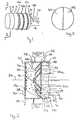
- a collector cup in accordance with the present invention is shown and designated 10. As shown in Figure 1, the collector cup 10 is attached to a plasma mass filter 12.
- a suitable plasma mass filter 12 is disclosed in co-pending Application Serial No. 09/192,945 which was filed on November 16, 1998 for an invention entitled "Plasma Mass Filter” and which is assigned to the same assignee as the present invention.
- Figure 1 shows a multi-species plasma 14 entering the plasma mass filter 12 for filtration. As shown, the multi-species plasma 14 contains electrons 16, low-mass ions 18, 19 and high-mass ions 20.
- a magnetic field is created inside the filter 12, by magnetic coils 22a-c.
- an electric field is created inside the filter 12 by an electrode, such as the ring electrodes 21a-c shown in Figure 2.
- the high-mass ions 20 are set in orbital motion, and travel in large orbits. As indicated above, the high-mass ions 20 strike the inside wall 23 (see Figure 2) of the filter 12 and are captured by the filter 12.
- the low-mass ions 18, 19 and the electrons 16, like the high-mass ions 20 are set in orbital motion by the applied fields, but they travel in small confined orbits within the filter 12. Thus, the low-mass ions 18, 19 and electrons 16 are not captured by the filter 12, but rather, they drift through the filter 12 towards the collector cup 10.
- the collector cup 10 includes a cylindrically shaped wall 24 which defines a longitudinal axis 26.
- a getter plate 28 mounted on one end of the cylinder wall 24 is a getter plate 28.
- Internal cooling channels 30 are provided to maintain the getter plate 28 temperature as required.
- the getter plate 28 may be grounded with a grounding wire 32.
- a plurality of baffles 34 are mounted to each other and the resulting baffle assembly is attached to the inside surface 36 of the cylindrical wall 24.
- the baffles 34 may be composed of a plurality of hollow truncated conical plates. Baffles 34 are distanced from each other to form a plurality of entryways 38 between adjacent baffles 34.
- the baffles 34 are all concentric about the longitudinal axis 26 of the cylindrical wall 24.
- the baffles 34 may be made from any high temperature material such as an INCONELTM allow, and may be coated with a ceramic.
- the baffles 34 are formed with internal cooling channels 40.
- Figure 2 illustratively shows three hollow truncated conical baffles 34 mounted to each other and attached on the cylindrical wall 24 of the collector cup 10.
- each conical baffle 34 has a large end 42 and a small end 44.
- Each end 42,44 forms a circle in a plane perpendicular to the longitudinal axis 26.
- the diameter of the large end 42 of any baffle 34 is larger than the diameter of the small end 44 of any adjacent baffle 34.
- the plurality of baffles 34 are attached to the inside surface 36 of the cylinder wall 24 and are positioned in a plane perpendicular to the longitudinal axis 26 of the collector cup 10 and parallel to the getter plate 28. Further, the baffles 34 are positioned between the getter plate 28 and the plasma mass filter 12, thereby creating an enclosed volume 48 that is defined by the getter plate 28, the baffles 34 and the cylinder wall 24. Importantly, the entryways 38 that are formed between the baffles 34 provide for fluid communication between the enclosed volume 48 and the plasma mass filter 12. In the preferred embodiment, a plurality of ring electrodes 21a-c may be formed integral with the baffles 34 to provide the electric field required by the plasma mass filter 12.
- the magnetic coils 22 generate magnetic field lines 50 in the plasma mass filter 12 that are aligned parallel to the longitudinal axis 26 of the cylinder wall 24.
- low-mass ions 18, 19 and electrons 16 drift in the direction of the magnetic field lines 50 from the plasma mass filter 12 to the collector cup 10.
- the ions 18,19 and electrons 16 drift from the plasma mass filter 12 towards the collector cup 10, they first collide with either the baffles 34 or the blocking plate 46.
- ion 18 may be a hydrogen ion that exits from the plasma mass filter 12.
- the hydrogen ion may recombine with an electron 16 forming a hydrogen atom.
- the heat released due to the recombination may be dissipated by the baffles 34.
- the hydrogen atom may combine with another hydrogen atom in the vicinity of the baffles 34, to form a hydrogen gas (H 2 ) molecule.
- the heat associated with the formation of gas molecules 54 may also be dissipated by the baffles 34. About half of the resulting gas molecules 54 formed at the baffles 34 pass through the entryways 38 and into the enclosed volume 48 of the collector cup 10. The remaining gas molecules 54 formed at the baffles 34 reenter the plasma and again dissociate into ions 18,19 and electrons 16.
- baffles 34 Other reactions may also take place at the baffles 34.
- a low-mass ion 19 such as silicon may combine with oxygen at the surface of the baffle 34 forming a solid silicon oxide on the baffle 34.
- periodic cleaning of the baffles 34 may be required.
- the gas molecules 54 can be condensed onto the surface of the temperature controlled getter plate 28.
- the getter plate 28 temperature required for condensation can be determined after the gas density in the enclosed volume 48 is ascertained.
- the density of gas molecules 54 in the enclosed volume 48 will be proportional to the density of plasma 14 in the plasma mass filter 12.
- a low density of the plasma 14 is maintained inside the filter 12 in order to avoid particle collisions within the filter 12.
- the plasma density is controlled so that the ratio of each particle's cyclotron frequency ( ⁇ ) to the particle's collision frequency ( ⁇ ) exceeds one ( ⁇ / ⁇ >1 ).
- a gas density of about 1mtorr will be created in the enclosed volume 48.
- the getter plate temperature required for condensation to occur can be established. For example, sodium vapor at a pressure of 1 mtorr will condense on the surface of the getter plate 28 at temperatures below about 200 degrees Centigrade.
- the internal cooling channels 30 can be used to control the temperature of the getter plate 28 below the condensation point of the gas molecules 54 in the enclosed volume 48.
- the condensed molecules 56 may combine with each other on the surface of the getter plate 28 to form larger molecules 58.
- oxygen, hydrogen and sodium vapors may condense onto the temperature controlled surface of the getter plate 28 and subsequently combine to form a sodium hydroxide molecule.
- the sodium hydroxide will be deposited on the surface of the getter plate 28 as a solid.
- the solid After allowing the deposited solid to accumulate on the getter plate 28, the solid can be periodically removed from the surface of the getter plate 28 as a liquid, by heating the getter plate 28 to the liquidus temperature of the deposited solid.
- the getter plate 28 can be heated to a temperature of approximately 350 degrees Centigrade for removal of the sodium hydroxide as a liquid.
- the getter plate 28 can include several portions. Figure 3 shows two such portions 60, 62.
- configuring the getter plate 28 in multiple portions 60, 62 allows the use of one portion as a condensing plate while the other portion is heated for liquification and removal of accumulated solids.
- additional oxygen or sodium can be introduced into the enclosed volume 48 from a secondary source to combine with any unreacted molecules on the surface of the getter plate 28.
- each oxygen molecule that condenses on the getter plate 28 from the plasma requires a stoichiometric amount of sodium to form sodium hydroxide.
- this required stoichiometric quantity of sodium is not available from the plasma, it can be added to the enclosed volume 48 from a supplemental source, thereby allowing the complete reaction of all of the condensed oxygen into sodium hydroxide.
Landscapes
- Chemical & Material Sciences (AREA)
- Analytical Chemistry (AREA)
- Physical Or Chemical Processes And Apparatus (AREA)
- Plasma Technology (AREA)
- Electron Tubes For Measurement (AREA)
Applications Claiming Priority (2)
| Application Number | Priority Date | Filing Date | Title |
|---|---|---|---|
| US440547 | 1999-11-15 | ||
| US09/440,547 US6287463B1 (en) | 1999-11-15 | 1999-11-15 | Collector cup |
Publications (2)
| Publication Number | Publication Date |
|---|---|
| EP1104004A2 true EP1104004A2 (fr) | 2001-05-30 |
| EP1104004A3 EP1104004A3 (fr) | 2002-07-31 |
Family
ID=23749194
Family Applications (1)
| Application Number | Title | Priority Date | Filing Date |
|---|---|---|---|
| EP00308072A Withdrawn EP1104004A3 (fr) | 1999-11-15 | 2000-09-15 | Cage de collection |
Country Status (3)
| Country | Link |
|---|---|
| US (1) | US6287463B1 (fr) |
| EP (1) | EP1104004A3 (fr) |
| JP (1) | JP3636982B2 (fr) |
Cited By (3)
| Publication number | Priority date | Publication date | Assignee | Title |
|---|---|---|---|---|
| EP1278229A3 (fr) * | 2001-07-11 | 2004-10-20 | Archimedes Technology Group, Inc. | Collecteur de sels fondus pour séparation par plasma |
| EP1341206A3 (fr) * | 2002-02-28 | 2006-04-26 | Archimedes Operating, LLC | Collecteur d'ions avec substrat liquide |
| CN108787170A (zh) * | 2018-05-28 | 2018-11-13 | 南京信息工程大学 | 一种模块化除雾霾装置 |
Families Citing this family (4)
| Publication number | Priority date | Publication date | Assignee | Title |
|---|---|---|---|---|
| US6797176B1 (en) * | 2003-07-03 | 2004-09-28 | Archimedes Technology Group, Inc. | Plasma mass filter with inductive rotational drive |
| US8398295B2 (en) * | 2004-01-28 | 2013-03-19 | Drexel University | Magnetic fluid manipulators and methods for their use |
| US20220199380A1 (en) * | 2019-06-25 | 2022-06-23 | Applied Materials, Inc. | High efficiency trap for particle collection in a vacuum foreline |
| CN110685820B (zh) * | 2019-10-23 | 2021-01-12 | 西安航天动力研究所 | 一种过滤器 |
Family Cites Families (6)
| Publication number | Priority date | Publication date | Assignee | Title |
|---|---|---|---|---|
| SE338962B (fr) | 1970-06-04 | 1971-09-27 | B Lehnert | |
| WO1984002803A1 (fr) * | 1983-01-13 | 1984-07-19 | Trw Inc | Procede et dispositif de separation d'isotopes |
| US5218179A (en) * | 1990-10-10 | 1993-06-08 | Hughes Aircraft Company | Plasma source arrangement for ion implantation |
| WO1997020620A1 (fr) * | 1995-12-07 | 1997-06-12 | The Regents Of The University Of California | Ameliorations relatives a un procede et un appareil d'enrichissement isotopique dans un appareil a plasma |
| GB9704077D0 (en) | 1996-03-15 | 1997-04-16 | British Nuclear Fuels Plc | Improvements in and relating to processing |
| US5827424A (en) * | 1996-09-26 | 1998-10-27 | International Business Machines Corporation | Contaminant reduction system for disk drives |
-
1999
- 1999-11-15 US US09/440,547 patent/US6287463B1/en not_active Expired - Fee Related
-
2000
- 2000-09-15 EP EP00308072A patent/EP1104004A3/fr not_active Withdrawn
- 2000-10-16 JP JP2000314913A patent/JP3636982B2/ja not_active Expired - Fee Related
Cited By (3)
| Publication number | Priority date | Publication date | Assignee | Title |
|---|---|---|---|---|
| EP1278229A3 (fr) * | 2001-07-11 | 2004-10-20 | Archimedes Technology Group, Inc. | Collecteur de sels fondus pour séparation par plasma |
| EP1341206A3 (fr) * | 2002-02-28 | 2006-04-26 | Archimedes Operating, LLC | Collecteur d'ions avec substrat liquide |
| CN108787170A (zh) * | 2018-05-28 | 2018-11-13 | 南京信息工程大学 | 一种模块化除雾霾装置 |
Also Published As
| Publication number | Publication date |
|---|---|
| EP1104004A3 (fr) | 2002-07-31 |
| JP2001179082A (ja) | 2001-07-03 |
| JP3636982B2 (ja) | 2005-04-06 |
| US6287463B1 (en) | 2001-09-11 |
Similar Documents
| Publication | Publication Date | Title |
|---|---|---|
| JP3573464B2 (ja) | 閉じ込められたイオンビームの中の選択されたイオンの強度を減少させる方法 | |
| US6506292B2 (en) | Film forming apparatus | |
| EP4554336A2 (fr) | Dispositif d'analyse de masse ultra-compact et dispositif d'accélération de particules ultra-compact | |
| JP5529379B2 (ja) | 同重体干渉物を分離する方法および機器 | |
| WO1996041900A1 (fr) | Elements d'optique ioniques paralleles perfectionnes et appareil pour faisceaux ioniques de faible puissance et de courant eleve | |
| CN102150219A (zh) | 在射频场中使用网的离子操纵的方法和设备 | |
| US8672138B2 (en) | Isotope separation by magnetic activation and separation | |
| JP2017084790A (ja) | 質量分光計の真空インターフェース方法および真空インターフェース装置 | |
| JP2642881B2 (ja) | 低速多価イオンによる超高感度水素検出法 | |
| US6287463B1 (en) | Collector cup | |
| JP2015502023A (ja) | 質量分光計の真空インターフェース方法および真空インターフェース装置 | |
| EP0964425A2 (fr) | Appareil pour le traitment d'une cible par un faisceau d'ions uniformement neu tralisé | |
| US6730231B2 (en) | Plasma mass filter with axially opposed plasma injectors | |
| US5382801A (en) | Method for producing minute particles and apparatus therefor | |
| DE69418063D1 (de) | Zykloidisches massenspektrometer | |
| EP1246226A2 (fr) | Spectromètre de masse pour plasma partiellement ionisé | |
| EP3304576A1 (fr) | Guides d'ions à double courbure et dispositifs les utilisant | |
| EP1829436B1 (fr) | Faisceaux de particules anioniques et neutres | |
| US6521888B1 (en) | Inverted orbit filter | |
| Kostko | Photoelectron spectroscopy of mass-selected sodium, coinage metal and divalent metal cluster anions | |
| US6639222B2 (en) | Device and method for extracting a constituent from a chemical mixture | |
| EP1278229A2 (fr) | Collecteur de sels fondus pour séparation par plasma | |
| RU2106186C1 (ru) | Устройство для разделения изотопов | |
| CN1276906A (zh) | 成序电荷分离和成序电荷类型分离 | |
| Kwok et al. | Experimental investigation of electron oscillation inside the filter of a vacuum arc plasma source |
Legal Events
| Date | Code | Title | Description |
|---|---|---|---|
| PUAI | Public reference made under article 153(3) epc to a published international application that has entered the european phase |
Free format text: ORIGINAL CODE: 0009012 |
|
| AK | Designated contracting states |
Kind code of ref document: A2 Designated state(s): AT BE CH CY DE DK ES FI FR GB GR IE IT LI LU MC NL PT SE |
|
| AX | Request for extension of the european patent |
Free format text: AL;LT;LV;MK;RO;SI |
|
| PUAL | Search report despatched |
Free format text: ORIGINAL CODE: 0009013 |
|
| AK | Designated contracting states |
Kind code of ref document: A3 Designated state(s): AT BE CH CY DE DK ES FI FR GB GR IE IT LI LU MC NL PT SE |
|
| AX | Request for extension of the european patent |
Free format text: AL;LT;LV;MK;RO;SI |
|
| RIC1 | Information provided on ipc code assigned before grant |
Free format text: 7H 01J 49/02 A, 7H 01J 49/30 B, 7H 01J 49/28 B, 7B 01D 59/48 B |
|
| 17P | Request for examination filed |
Effective date: 20021025 |
|
| AKX | Designation fees paid |
Designated state(s): DE FR GB |
|
| 17Q | First examination report despatched |
Effective date: 20050329 |
|
| GRAP | Despatch of communication of intention to grant a patent |
Free format text: ORIGINAL CODE: EPIDOSNIGR1 |
|
| RAP1 | Party data changed (applicant data changed or rights of an application transferred) |
Owner name: ARCHIMEDES OPERATING, LLC |
|
| STAA | Information on the status of an ep patent application or granted ep patent |
Free format text: STATUS: THE APPLICATION IS DEEMED TO BE WITHDRAWN |
|
| 18D | Application deemed to be withdrawn |
Effective date: 20060411 |