EP1104429B1 - Ansa bis(.mu.-aluminium)-substituierte gruppe-4-metallkomplexe - Google Patents
Ansa bis(.mu.-aluminium)-substituierte gruppe-4-metallkomplexe Download PDFInfo
- Publication number
- EP1104429B1 EP1104429B1 EP99927519A EP99927519A EP1104429B1 EP 1104429 B1 EP1104429 B1 EP 1104429B1 EP 99927519 A EP99927519 A EP 99927519A EP 99927519 A EP99927519 A EP 99927519A EP 1104429 B1 EP1104429 B1 EP 1104429B1
- Authority
- EP
- European Patent Office
- Prior art keywords
- group
- aluminum
- groups
- atoms
- dimethyl
- Prior art date
- Legal status (The legal status is an assumption and is not a legal conclusion. Google has not performed a legal analysis and makes no representation as to the accuracy of the status listed.)
- Expired - Lifetime
Links
- 229910052751 metal Inorganic materials 0.000 title claims abstract description 24
- 239000002184 metal Substances 0.000 title claims abstract description 24
- AZDRQVAHHNSJOQ-UHFFFAOYSA-N alumane Chemical class [AlH3] AZDRQVAHHNSJOQ-UHFFFAOYSA-N 0.000 title claims abstract description 12
- -1 Lewis acid compound Chemical class 0.000 claims abstract description 98
- 150000001875 compounds Chemical class 0.000 claims abstract description 32
- 238000000034 method Methods 0.000 claims abstract description 25
- 150000004696 coordination complex Chemical class 0.000 claims abstract description 24
- 239000003446 ligand Substances 0.000 claims abstract description 20
- XAGFODPZIPBFFR-UHFFFAOYSA-N aluminium Chemical group [Al] XAGFODPZIPBFFR-UHFFFAOYSA-N 0.000 claims abstract description 17
- 229910052782 aluminium Inorganic materials 0.000 claims abstract description 16
- 239000002841 Lewis acid Substances 0.000 claims abstract description 14
- 150000007517 lewis acids Chemical class 0.000 claims abstract description 11
- IJGRMHOSHXDMSA-UHFFFAOYSA-N nitrogen Substances N#N IJGRMHOSHXDMSA-UHFFFAOYSA-N 0.000 claims abstract description 11
- 229910052757 nitrogen Inorganic materials 0.000 claims abstract description 9
- 230000002378 acidificating effect Effects 0.000 claims abstract description 5
- OAICVXFJPJFONN-UHFFFAOYSA-N Phosphorus Chemical group [P] OAICVXFJPJFONN-UHFFFAOYSA-N 0.000 claims abstract description 4
- 229910052698 phosphorus Chemical group 0.000 claims abstract description 4
- 239000011574 phosphorus Chemical group 0.000 claims abstract description 4
- QJGQUHMNIGDVPM-UHFFFAOYSA-N nitrogen group Chemical group [N] QJGQUHMNIGDVPM-UHFFFAOYSA-N 0.000 claims abstract description 3
- POHPFVPVRKJHCR-UHFFFAOYSA-N tris(2,3,4,5,6-pentafluorophenyl)alumane Chemical compound FC1=C(F)C(F)=C(F)C(F)=C1[Al](C=1C(=C(F)C(F)=C(F)C=1F)F)C1=C(F)C(F)=C(F)C(F)=C1F POHPFVPVRKJHCR-UHFFFAOYSA-N 0.000 claims description 52
- 229910052739 hydrogen Inorganic materials 0.000 claims description 42
- 238000006116 polymerization reaction Methods 0.000 claims description 40
- 239000003054 catalyst Substances 0.000 claims description 30
- 239000000203 mixture Substances 0.000 claims description 26
- 239000001257 hydrogen Substances 0.000 claims description 24
- 125000004429 atom Chemical group 0.000 claims description 20
- 125000001183 hydrocarbyl group Chemical group 0.000 claims description 18
- 230000008569 process Effects 0.000 claims description 18
- 150000002431 hydrogen Chemical class 0.000 claims description 16
- 239000004711 α-olefin Substances 0.000 claims description 14
- 125000002496 methyl group Chemical group [H]C([H])([H])* 0.000 claims description 12
- 125000004122 cyclic group Chemical group 0.000 claims description 11
- NOQGZXFMHARMLW-UHFFFAOYSA-N Daminozide Chemical compound CN(C)NC(=O)CCC(O)=O NOQGZXFMHARMLW-UHFFFAOYSA-N 0.000 claims description 10
- UFHFLCQGNIYNRP-UHFFFAOYSA-N Hydrogen Chemical compound [H][H] UFHFLCQGNIYNRP-UHFFFAOYSA-N 0.000 claims description 8
- 125000004432 carbon atom Chemical group C* 0.000 claims description 6
- 125000002924 primary amino group Chemical group [H]N([H])* 0.000 claims description 6
- 125000000058 cyclopentadienyl group Chemical group C1(=CC=CC1)* 0.000 claims description 5
- OBAJXDYVZBHCGT-UHFFFAOYSA-N tris(pentafluorophenyl)borane Chemical compound FC1=C(F)C(F)=C(F)C(F)=C1B(C=1C(=C(F)C(F)=C(F)C=1F)F)C1=C(F)C(F)=C(F)C(F)=C1F OBAJXDYVZBHCGT-UHFFFAOYSA-N 0.000 claims description 5
- ZSWFCLXCOIISFI-UHFFFAOYSA-N endo-cyclopentadiene Natural products C1C=CC=C1 ZSWFCLXCOIISFI-UHFFFAOYSA-N 0.000 claims description 4
- 125000003837 (C1-C20) alkyl group Chemical group 0.000 claims description 3
- YBYIRNPNPLQARY-UHFFFAOYSA-N 1H-indene Natural products C1=CC=C2CC=CC2=C1 YBYIRNPNPLQARY-UHFFFAOYSA-N 0.000 claims description 3
- 125000003983 fluorenyl group Chemical group C1(=CC=CC=2C3=CC=CC=C3CC12)* 0.000 claims description 3
- 125000003454 indenyl group Chemical group C1(C=CC2=CC=CC=C12)* 0.000 claims description 3
- FVZVCSNXTFCBQU-UHFFFAOYSA-N phosphanyl Chemical group [PH2] FVZVCSNXTFCBQU-UHFFFAOYSA-N 0.000 claims description 3
- 125000000008 (C1-C10) alkyl group Chemical group 0.000 claims description 2
- 125000004178 (C1-C4) alkyl group Chemical group 0.000 claims description 2
- 125000000041 C6-C10 aryl group Chemical group 0.000 claims description 2
- 125000000753 cycloalkyl group Chemical group 0.000 claims description 2
- 238000004519 manufacturing process Methods 0.000 claims description 2
- 125000001181 organosilyl group Chemical group [SiH3]* 0.000 claims 3
- 238000002360 preparation method Methods 0.000 abstract description 7
- UHOVQNZJYSORNB-MZWXYZOWSA-N benzene-d6 Chemical compound [2H]C1=C([2H])C([2H])=C([2H])C([2H])=C1[2H] UHOVQNZJYSORNB-MZWXYZOWSA-N 0.000 description 64
- 238000005481 NMR spectroscopy Methods 0.000 description 30
- 239000007789 gas Substances 0.000 description 28
- YSRFHVJGXPIDGR-UHFFFAOYSA-N dimethylsilane titanium Chemical compound [Ti].C[SiH2]C YSRFHVJGXPIDGR-UHFFFAOYSA-N 0.000 description 27
- VLKZOEOYAKHREP-UHFFFAOYSA-N n-Hexane Chemical compound CCCCCC VLKZOEOYAKHREP-UHFFFAOYSA-N 0.000 description 27
- 239000007788 liquid Substances 0.000 description 23
- 238000006243 chemical reaction Methods 0.000 description 22
- 239000000243 solution Substances 0.000 description 20
- 125000000118 dimethyl group Chemical group [H]C([H])([H])* 0.000 description 19
- YXFVVABEGXRONW-UHFFFAOYSA-N Toluene Chemical compound CC1=CC=CC=C1 YXFVVABEGXRONW-UHFFFAOYSA-N 0.000 description 18
- 239000000178 monomer Substances 0.000 description 18
- 125000000538 pentafluorophenyl group Chemical group FC1=C(F)C(F)=C(*)C(F)=C1F 0.000 description 17
- 239000000047 product Substances 0.000 description 17
- 238000005160 1H NMR spectroscopy Methods 0.000 description 14
- 229920000642 polymer Polymers 0.000 description 14
- 101710097035 4-hydroxyphenylalkanoate adenylyltransferase Proteins 0.000 description 13
- 101710145976 Long-chain-fatty-acid-AMP ligase FadD26 Proteins 0.000 description 13
- 101710145980 Long-chain-fatty-acid-AMP ligase FadD32 Proteins 0.000 description 13
- 101710097703 Probable long-chain-fatty-acid-AMP ligase FadD30 Proteins 0.000 description 13
- 239000010936 titanium Substances 0.000 description 12
- RTZKZFJDLAIYFH-UHFFFAOYSA-N Diethyl ether Chemical compound CCOCC RTZKZFJDLAIYFH-UHFFFAOYSA-N 0.000 description 10
- 238000004293 19F NMR spectroscopy Methods 0.000 description 9
- 239000011541 reaction mixture Substances 0.000 description 9
- 125000003808 silyl group Chemical group [H][Si]([H])([H])[*] 0.000 description 9
- LIKMAJRDDDTEIG-UHFFFAOYSA-N 1-hexene Chemical compound CCCCC=C LIKMAJRDDDTEIG-UHFFFAOYSA-N 0.000 description 8
- KWKAKUADMBZCLK-UHFFFAOYSA-N 1-octene Chemical compound CCCCCCC=C KWKAKUADMBZCLK-UHFFFAOYSA-N 0.000 description 8
- 150000001336 alkenes Chemical class 0.000 description 8
- 238000001644 13C nuclear magnetic resonance spectroscopy Methods 0.000 description 7
- 239000003153 chemical reaction reagent Substances 0.000 description 7
- WSSSPWUEQFSQQG-UHFFFAOYSA-N 4-methyl-1-pentene Chemical compound CC(C)CC=C WSSSPWUEQFSQQG-UHFFFAOYSA-N 0.000 description 6
- PPBRXRYQALVLMV-UHFFFAOYSA-N Styrene Chemical compound C=CC1=CC=CC=C1 PPBRXRYQALVLMV-UHFFFAOYSA-N 0.000 description 6
- 239000007983 Tris buffer Substances 0.000 description 6
- 239000012190 activator Substances 0.000 description 6
- 239000003085 diluting agent Substances 0.000 description 6
- 125000003114 inden-1-yl group Chemical group [H]C1=C([H])C([H])(*)C2=C([H])C([H])=C([H])C([H])=C12 0.000 description 6
- 238000002156 mixing Methods 0.000 description 6
- 230000007935 neutral effect Effects 0.000 description 6
- 125000004224 s-indacen-1-yl group Chemical group [H]C1=C([H])C2=C([H])C3=C([H])C([H])=C(*)C3=C([H])C2=C1[H] 0.000 description 6
- 238000004611 spectroscopical analysis Methods 0.000 description 6
- 238000003756 stirring Methods 0.000 description 6
- VGGSQFUCUMXWEO-UHFFFAOYSA-N Ethene Chemical compound C=C VGGSQFUCUMXWEO-UHFFFAOYSA-N 0.000 description 5
- 239000005977 Ethylene Substances 0.000 description 5
- 125000000129 anionic group Chemical group 0.000 description 5
- 125000005842 heteroatom Chemical group 0.000 description 5
- 238000000655 nuclear magnetic resonance spectrum Methods 0.000 description 5
- JRZJOMJEPLMPRA-UHFFFAOYSA-N olefin Natural products CCCCCCCC=C JRZJOMJEPLMPRA-UHFFFAOYSA-N 0.000 description 5
- 239000002245 particle Substances 0.000 description 5
- 239000002904 solvent Substances 0.000 description 5
- AFFLGGQVNFXPEV-UHFFFAOYSA-N 1-decene Chemical compound CCCCCCCCC=C AFFLGGQVNFXPEV-UHFFFAOYSA-N 0.000 description 4
- 150000001335 aliphatic alkanes Chemical class 0.000 description 4
- 125000001931 aliphatic group Chemical group 0.000 description 4
- 150000004945 aromatic hydrocarbons Chemical class 0.000 description 4
- 239000003795 chemical substances by application Substances 0.000 description 4
- 238000001816 cooling Methods 0.000 description 4
- 125000002147 dimethylamino group Chemical group [H]C([H])([H])N(*)C([H])([H])[H] 0.000 description 4
- 229930195733 hydrocarbon Natural products 0.000 description 4
- TVMXDCGIABBOFY-UHFFFAOYSA-N n-Octanol Natural products CCCCCCCC TVMXDCGIABBOFY-UHFFFAOYSA-N 0.000 description 4
- YWAKXRMUMFPDSH-UHFFFAOYSA-N pentene Chemical compound CCCC=C YWAKXRMUMFPDSH-UHFFFAOYSA-N 0.000 description 4
- 239000002244 precipitate Substances 0.000 description 4
- 229910052719 titanium Inorganic materials 0.000 description 4
- 239000003039 volatile agent Substances 0.000 description 4
- MIPAPDLHDVYRRT-UHFFFAOYSA-M (2,6-ditert-butyl-4-methylphenoxy)-bis(2-methylpropyl)alumane Chemical compound CC(C)C[Al](CC(C)C)OC1=C(C(C)(C)C)C=C(C)C=C1C(C)(C)C MIPAPDLHDVYRRT-UHFFFAOYSA-M 0.000 description 3
- ZWEHNKRNPOVVGH-UHFFFAOYSA-N 2-Butanone Chemical compound CCC(C)=O ZWEHNKRNPOVVGH-UHFFFAOYSA-N 0.000 description 3
- WEVYAHXRMPXWCK-UHFFFAOYSA-N Acetonitrile Chemical compound CC#N WEVYAHXRMPXWCK-UHFFFAOYSA-N 0.000 description 3
- UHOVQNZJYSORNB-UHFFFAOYSA-N Benzene Chemical compound C1=CC=CC=C1 UHOVQNZJYSORNB-UHFFFAOYSA-N 0.000 description 3
- KFZMGEQAYNKOFK-UHFFFAOYSA-N Isopropanol Chemical compound CC(C)O KFZMGEQAYNKOFK-UHFFFAOYSA-N 0.000 description 3
- QQONPFPTGQHPMA-UHFFFAOYSA-N Propene Chemical compound CC=C QQONPFPTGQHPMA-UHFFFAOYSA-N 0.000 description 3
- 125000002723 alicyclic group Chemical group 0.000 description 3
- 229910052786 argon Inorganic materials 0.000 description 3
- 125000003118 aryl group Chemical group 0.000 description 3
- 230000015572 biosynthetic process Effects 0.000 description 3
- 239000007795 chemical reaction product Substances 0.000 description 3
- 238000007334 copolymerization reaction Methods 0.000 description 3
- 125000004407 fluoroaryl group Chemical group 0.000 description 3
- 150000002430 hydrocarbons Chemical class 0.000 description 3
- GYNNXHKOJHMOHS-UHFFFAOYSA-N methyl-cycloheptane Natural products CC1CCCCCC1 GYNNXHKOJHMOHS-UHFFFAOYSA-N 0.000 description 3
- 125000002524 organometallic group Chemical group 0.000 description 3
- 230000000737 periodic effect Effects 0.000 description 3
- 239000002002 slurry Substances 0.000 description 3
- 239000007787 solid Substances 0.000 description 3
- 239000000126 substance Substances 0.000 description 3
- JFLKFZNIIQFQBS-FNCQTZNRSA-N trans,trans-1,4-Diphenyl-1,3-butadiene Chemical compound C=1C=CC=CC=1\C=C\C=C\C1=CC=CC=C1 JFLKFZNIIQFQBS-FNCQTZNRSA-N 0.000 description 3
- JLTRXTDYQLMHGR-UHFFFAOYSA-N trimethylaluminium Chemical compound C[Al](C)C JLTRXTDYQLMHGR-UHFFFAOYSA-N 0.000 description 3
- 238000004260 weight control Methods 0.000 description 3
- PRBHEGAFLDMLAL-GQCTYLIASA-N (4e)-hexa-1,4-diene Chemical class C\C=C\CC=C PRBHEGAFLDMLAL-GQCTYLIASA-N 0.000 description 2
- MYRTYDVEIRVNKP-UHFFFAOYSA-N 1,2-Divinylbenzene Chemical compound C=CC1=CC=CC=C1C=C MYRTYDVEIRVNKP-UHFFFAOYSA-N 0.000 description 2
- XWJBRBSPAODJER-UHFFFAOYSA-N 1,7-octadiene Chemical compound C=CCCCCC=C XWJBRBSPAODJER-UHFFFAOYSA-N 0.000 description 2
- VXNZUUAINFGPBY-UHFFFAOYSA-N 1-Butene Chemical compound CCC=C VXNZUUAINFGPBY-UHFFFAOYSA-N 0.000 description 2
- ZGEGCLOFRBLKSE-UHFFFAOYSA-N 1-Heptene Chemical compound CCCCCC=C ZGEGCLOFRBLKSE-UHFFFAOYSA-N 0.000 description 2
- VQOXUMQBYILCKR-UHFFFAOYSA-N 1-Tridecene Chemical compound CCCCCCCCCCCC=C VQOXUMQBYILCKR-UHFFFAOYSA-N 0.000 description 2
- CRSBERNSMYQZNG-UHFFFAOYSA-N 1-dodecene Chemical compound CCCCCCCCCCC=C CRSBERNSMYQZNG-UHFFFAOYSA-N 0.000 description 2
- PJLHTVIBELQURV-UHFFFAOYSA-N 1-pentadecene Chemical compound CCCCCCCCCCCCCC=C PJLHTVIBELQURV-UHFFFAOYSA-N 0.000 description 2
- HFDVRLIODXPAHB-UHFFFAOYSA-N 1-tetradecene Chemical compound CCCCCCCCCCCCC=C HFDVRLIODXPAHB-UHFFFAOYSA-N 0.000 description 2
- DCTOHCCUXLBQMS-UHFFFAOYSA-N 1-undecene Chemical compound CCCCCCCCCC=C DCTOHCCUXLBQMS-UHFFFAOYSA-N 0.000 description 2
- DJMUYABFXCIYSC-UHFFFAOYSA-N 1H-phosphole Chemical compound C=1C=CPC=1 DJMUYABFXCIYSC-UHFFFAOYSA-N 0.000 description 2
- AQZWEFBJYQSQEH-UHFFFAOYSA-N 2-methyloxaluminane Chemical compound C[Al]1CCCCO1 AQZWEFBJYQSQEH-UHFFFAOYSA-N 0.000 description 2
- XKRFYHLGVUSROY-UHFFFAOYSA-N Argon Chemical compound [Ar] XKRFYHLGVUSROY-UHFFFAOYSA-N 0.000 description 2
- KAKZBPTYRLMSJV-UHFFFAOYSA-N Butadiene Chemical compound C=CC=C KAKZBPTYRLMSJV-UHFFFAOYSA-N 0.000 description 2
- YNQLUTRBYVCPMQ-UHFFFAOYSA-N Ethylbenzene Chemical compound CCC1=CC=CC=C1 YNQLUTRBYVCPMQ-UHFFFAOYSA-N 0.000 description 2
- OWYWGLHRNBIFJP-UHFFFAOYSA-N Ipazine Chemical compound CCN(CC)C1=NC(Cl)=NC(NC(C)C)=N1 OWYWGLHRNBIFJP-UHFFFAOYSA-N 0.000 description 2
- VQTUBCCKSQIDNK-UHFFFAOYSA-N Isobutene Chemical group CC(C)=C VQTUBCCKSQIDNK-UHFFFAOYSA-N 0.000 description 2
- MZRVEZGGRBJDDB-UHFFFAOYSA-N N-Butyllithium Chemical compound [Li]CCCC MZRVEZGGRBJDDB-UHFFFAOYSA-N 0.000 description 2
- VPHORGCJGKWAIW-UHFFFAOYSA-N N-[dimethyl-(2,3,4,5-tetramethylcyclopenta-2,4-dien-1-yl)silyl]butan-1-amine Chemical compound C(CCC)N[Si](C1C(=C(C(=C1C)C)C)C)(C)C VPHORGCJGKWAIW-UHFFFAOYSA-N 0.000 description 2
- RTAQQCXQSZGOHL-UHFFFAOYSA-N Titanium Chemical group [Ti] RTAQQCXQSZGOHL-UHFFFAOYSA-N 0.000 description 2
- 125000000217 alkyl group Chemical group 0.000 description 2
- 125000003368 amide group Chemical group 0.000 description 2
- 239000012298 atmosphere Substances 0.000 description 2
- 230000008901 benefit Effects 0.000 description 2
- UORVGPXVDQYIDP-UHFFFAOYSA-N borane Chemical compound B UORVGPXVDQYIDP-UHFFFAOYSA-N 0.000 description 2
- 230000000052 comparative effect Effects 0.000 description 2
- DMEGYFMYUHOHGS-UHFFFAOYSA-N cycloheptane Chemical compound C1CCCCCC1 DMEGYFMYUHOHGS-UHFFFAOYSA-N 0.000 description 2
- HGCIXCUEYOPUTN-UHFFFAOYSA-N cyclohexene Chemical compound C1CCC=CC1 HGCIXCUEYOPUTN-UHFFFAOYSA-N 0.000 description 2
- LPIQUOYDBNQMRZ-UHFFFAOYSA-N cyclopentene Chemical compound C1CC=CC1 LPIQUOYDBNQMRZ-UHFFFAOYSA-N 0.000 description 2
- SMBQBQBNOXIFSF-UHFFFAOYSA-N dilithium Chemical compound [Li][Li] SMBQBQBNOXIFSF-UHFFFAOYSA-N 0.000 description 2
- 238000009826 distribution Methods 0.000 description 2
- 238000001035 drying Methods 0.000 description 2
- 230000000694 effects Effects 0.000 description 2
- 239000000706 filtrate Substances 0.000 description 2
- 238000005243 fluidization Methods 0.000 description 2
- 238000010528 free radical solution polymerization reaction Methods 0.000 description 2
- 238000012685 gas phase polymerization Methods 0.000 description 2
- 125000003800 germyl group Chemical group [H][Ge]([H])([H])[*] 0.000 description 2
- 229920001903 high density polyethylene Polymers 0.000 description 2
- 239000004700 high-density polyethylene Substances 0.000 description 2
- 238000011065 in-situ storage Methods 0.000 description 2
- 229920001179 medium density polyethylene Polymers 0.000 description 2
- 239000004701 medium-density polyethylene Substances 0.000 description 2
- UAEPNZWRGJTJPN-UHFFFAOYSA-N methylcyclohexane Chemical compound CC1CCCCC1 UAEPNZWRGJTJPN-UHFFFAOYSA-N 0.000 description 2
- 239000002685 polymerization catalyst Substances 0.000 description 2
- 229920000098 polyolefin Polymers 0.000 description 2
- 239000000843 powder Substances 0.000 description 2
- HJWLCRVIBGQPNF-UHFFFAOYSA-N prop-2-enylbenzene Chemical compound C=CCC1=CC=CC=C1 HJWLCRVIBGQPNF-UHFFFAOYSA-N 0.000 description 2
- 125000004805 propylene group Chemical group [H]C([H])([H])C([H])([*:1])C([H])([H])[*:2] 0.000 description 2
- 150000003254 radicals Chemical class 0.000 description 2
- 150000003440 styrenes Chemical class 0.000 description 2
- 125000000999 tert-butyl group Chemical group [H]C([H])([H])C(*)(C([H])([H])[H])C([H])([H])[H] 0.000 description 2
- ZWYDDDAMNQQZHD-UHFFFAOYSA-L titanium(ii) chloride Chemical compound [Cl-].[Cl-].[Ti+2] ZWYDDDAMNQQZHD-UHFFFAOYSA-L 0.000 description 2
- LLLJECCFBAEUOV-UHFFFAOYSA-M (2,6-ditert-butyl-4-methylphenoxy)-(2-methylpropyl)-(2,3,4,5,6-pentafluorophenyl)alumane Chemical compound FC=1C(F)=C(F)C(F)=C(F)C=1[Al](CC(C)C)OC1=C(C(C)(C)C)C=C(C)C=C1C(C)(C)C LLLJECCFBAEUOV-UHFFFAOYSA-M 0.000 description 1
- XRPMMVJGIMZWPO-UHFFFAOYSA-M (2,6-ditert-butyl-4-methylphenoxy)-bis(2,3,4,5,6-pentafluorophenyl)alumane Chemical compound CC(C)(C)C1=CC(C)=CC(C(C)(C)C)=C1O[Al](C=1C(=C(F)C(F)=C(F)C=1F)F)C1=C(F)C(F)=C(F)C(F)=C1F XRPMMVJGIMZWPO-UHFFFAOYSA-M 0.000 description 1
- PMJHHCWVYXUKFD-SNAWJCMRSA-N (E)-1,3-pentadiene Chemical compound C\C=C\C=C PMJHHCWVYXUKFD-SNAWJCMRSA-N 0.000 description 1
- HECLRDQVFMWTQS-RGOKHQFPSA-N 1755-01-7 Chemical class C1[C@H]2[C@@H]3CC=C[C@@H]3[C@@H]1C=C2 HECLRDQVFMWTQS-RGOKHQFPSA-N 0.000 description 1
- XVMORANYUWGSSK-UHFFFAOYSA-N 2-methylpropyl-bis(2,3,4,5,6-pentafluorophenyl)alumane Chemical compound FC=1C(F)=C(F)C(F)=C(F)C=1[Al](CC(C)C)C1=C(F)C(F)=C(F)C(F)=C1F XVMORANYUWGSSK-UHFFFAOYSA-N 0.000 description 1
- 125000003903 2-propenyl group Chemical group [H]C([*])([H])C([H])=C([H])[H] 0.000 description 1
- LDTAOIUHUHHCMU-UHFFFAOYSA-N 3-methylpent-1-ene Chemical compound CCC(C)C=C LDTAOIUHUHHCMU-UHFFFAOYSA-N 0.000 description 1
- LGLDSEPDYUTBNZ-UHFFFAOYSA-N 3-phenylbuta-1,3-dien-2-ylbenzene Chemical compound C=1C=CC=CC=1C(=C)C(=C)C1=CC=CC=C1 LGLDSEPDYUTBNZ-UHFFFAOYSA-N 0.000 description 1
- OOVQLEHBRDIXDZ-UHFFFAOYSA-N 7-ethenylbicyclo[4.2.0]octa-1,3,5-triene Chemical class C1=CC=C2C(C=C)CC2=C1 OOVQLEHBRDIXDZ-UHFFFAOYSA-N 0.000 description 1
- ZOXJGFHDIHLPTG-UHFFFAOYSA-N Boron Chemical compound [B] ZOXJGFHDIHLPTG-UHFFFAOYSA-N 0.000 description 1
- 0 CN(*)CC*(*I)I Chemical compound CN(*)CC*(*I)I 0.000 description 1
- 239000004215 Carbon black (E152) Substances 0.000 description 1
- XDTMQSROBMDMFD-UHFFFAOYSA-N Cyclohexane Chemical compound C1CCCCC1 XDTMQSROBMDMFD-UHFFFAOYSA-N 0.000 description 1
- 229910000799 K alloy Inorganic materials 0.000 description 1
- 239000002879 Lewis base Substances 0.000 description 1
- 229920010126 Linear Low Density Polyethylene (LLDPE) Polymers 0.000 description 1
- 229910000528 Na alloy Inorganic materials 0.000 description 1
- CTQNGGLPUBDAKN-UHFFFAOYSA-N O-Xylene Chemical compound CC1=CC=CC=C1C CTQNGGLPUBDAKN-UHFFFAOYSA-N 0.000 description 1
- ISWSIDIOOBJBQZ-UHFFFAOYSA-N Phenol Chemical compound OC1=CC=CC=C1 ISWSIDIOOBJBQZ-UHFFFAOYSA-N 0.000 description 1
- JKIJEFPNVSHHEI-UHFFFAOYSA-N Phenol, 2,4-bis(1,1-dimethylethyl)-, phosphite (3:1) Chemical compound CC(C)(C)C1=CC(C(C)(C)C)=CC=C1OP(OC=1C(=CC(=CC=1)C(C)(C)C)C(C)(C)C)OC1=CC=C(C(C)(C)C)C=C1C(C)(C)C JKIJEFPNVSHHEI-UHFFFAOYSA-N 0.000 description 1
- 239000004743 Polypropylene Substances 0.000 description 1
- 150000007513 acids Chemical class 0.000 description 1
- 230000004913 activation Effects 0.000 description 1
- 238000012644 addition polymerization Methods 0.000 description 1
- 125000003545 alkoxy group Chemical group 0.000 description 1
- PNEYBMLMFCGWSK-UHFFFAOYSA-N aluminium oxide Inorganic materials [O-2].[O-2].[O-2].[Al+3].[Al+3] PNEYBMLMFCGWSK-UHFFFAOYSA-N 0.000 description 1
- 239000003963 antioxidant agent Substances 0.000 description 1
- 230000003078 antioxidant effect Effects 0.000 description 1
- 125000004104 aryloxy group Chemical group 0.000 description 1
- 125000001797 benzyl group Chemical group [H]C1=C([H])C([H])=C(C([H])=C1[H])C([H])([H])* 0.000 description 1
- UORVGPXVDQYIDP-BJUDXGSMSA-N borane Chemical class [10BH3] UORVGPXVDQYIDP-BJUDXGSMSA-N 0.000 description 1
- 229910000085 borane Inorganic materials 0.000 description 1
- 229910052796 boron Inorganic materials 0.000 description 1
- HQABUPZFAYXKJW-UHFFFAOYSA-N butan-1-amine Chemical compound CCCCN HQABUPZFAYXKJW-UHFFFAOYSA-N 0.000 description 1
- 230000003197 catalytic effect Effects 0.000 description 1
- 239000012986 chain transfer agent Substances 0.000 description 1
- QTMBNCMQGRJAAA-UHFFFAOYSA-N chloro-dimethyl-(2,3,4,5-tetramethylcyclopenta-2,4-dien-1-yl)silane Chemical compound CC1=C(C)C(C)=C(C)C1[Si](C)(C)Cl QTMBNCMQGRJAAA-UHFFFAOYSA-N 0.000 description 1
- 239000002131 composite material Substances 0.000 description 1
- 230000006835 compression Effects 0.000 description 1
- 238000007906 compression Methods 0.000 description 1
- 230000003750 conditioning effect Effects 0.000 description 1
- 239000012084 conversion product Substances 0.000 description 1
- 238000012718 coordination polymerization Methods 0.000 description 1
- 229920001577 copolymer Polymers 0.000 description 1
- 239000013078 crystal Substances 0.000 description 1
- 125000003678 cyclohexadienyl group Chemical group C1(=CC=CCC1)* 0.000 description 1
- 125000004663 dialkyl amino group Chemical group 0.000 description 1
- 150000001993 dienes Chemical class 0.000 description 1
- 238000012674 dispersion polymerization Methods 0.000 description 1
- 229940069096 dodecene Drugs 0.000 description 1
- 230000007613 environmental effect Effects 0.000 description 1
- 125000000816 ethylene group Chemical group [H]C([H])([*:1])C([H])([H])[*:2] 0.000 description 1
- 125000000219 ethylidene group Chemical class [H]C(=[*])C([H])([H])[H] 0.000 description 1
- 239000010419 fine particle Substances 0.000 description 1
- 238000000806 fluorine-19 nuclear magnetic resonance spectrum Methods 0.000 description 1
- 229910052736 halogen Inorganic materials 0.000 description 1
- 150000002367 halogens Chemical class 0.000 description 1
- 238000010438 heat treatment Methods 0.000 description 1
- 229920006158 high molecular weight polymer Polymers 0.000 description 1
- 229920001519 homopolymer Polymers 0.000 description 1
- 125000000743 hydrocarbylene group Chemical group 0.000 description 1
- 125000004435 hydrogen atom Chemical group [H]* 0.000 description 1
- 238000010348 incorporation Methods 0.000 description 1
- 125000003427 indacenyl group Chemical group 0.000 description 1
- 239000003701 inert diluent Substances 0.000 description 1
- 239000011261 inert gas Substances 0.000 description 1
- 230000003993 interaction Effects 0.000 description 1
- 239000000543 intermediate Substances 0.000 description 1
- 125000000959 isobutyl group Chemical group [H]C([H])([H])C([H])(C([H])([H])[H])C([H])([H])* 0.000 description 1
- 125000001449 isopropyl group Chemical group [H]C([H])([H])C([H])(*)C([H])([H])[H] 0.000 description 1
- HWSZZLVAJGOAAY-UHFFFAOYSA-L lead(II) chloride Chemical compound Cl[Pb]Cl HWSZZLVAJGOAAY-UHFFFAOYSA-L 0.000 description 1
- 150000007527 lewis bases Chemical class 0.000 description 1
- CCERQOYLJJULMD-UHFFFAOYSA-M magnesium;carbanide;chloride Chemical compound [CH3-].[Mg+2].[Cl-] CCERQOYLJJULMD-UHFFFAOYSA-M 0.000 description 1
- 239000000463 material Substances 0.000 description 1
- LGRLWUINFJPLSH-UHFFFAOYSA-N methanide Chemical compound [CH3-] LGRLWUINFJPLSH-UHFFFAOYSA-N 0.000 description 1
- 125000004433 nitrogen atom Chemical group N* 0.000 description 1
- 230000000269 nucleophilic effect Effects 0.000 description 1
- ARHHEGZCOOHXNU-UHFFFAOYSA-K oxolane-2-carboxylate oxolane-2-carboxylic acid titanium(3+) chloride Chemical compound [Cl-].[Ti+3].OC(=O)C1CCCO1.[O-]C(=O)C1CCCO1.[O-]C(=O)C1CCCO1 ARHHEGZCOOHXNU-UHFFFAOYSA-K 0.000 description 1
- RGSFGYAAUTVSQA-UHFFFAOYSA-N pentamethylene Natural products C1CCCC1 RGSFGYAAUTVSQA-UHFFFAOYSA-N 0.000 description 1
- 125000005062 perfluorophenyl group Chemical group FC1=C(C(=C(C(=C1F)F)F)F)* 0.000 description 1
- 125000004226 phenanthren-1-yl group Chemical group [H]C1=C([H])C([H])=C2C(C([H])=C([H])C3=C(*)C([H])=C([H])C([H])=C23)=C1[H] 0.000 description 1
- 229930015698 phenylpropene Natural products 0.000 description 1
- XYFCBTPGUUZFHI-UHFFFAOYSA-N phosphine group Chemical group P XYFCBTPGUUZFHI-UHFFFAOYSA-N 0.000 description 1
- 150000004857 phospholes Chemical class 0.000 description 1
- PMJHHCWVYXUKFD-UHFFFAOYSA-N piperylene Natural products CC=CC=C PMJHHCWVYXUKFD-UHFFFAOYSA-N 0.000 description 1
- 150000004291 polyenes Chemical class 0.000 description 1
- 229920002959 polymer blend Polymers 0.000 description 1
- 230000000379 polymerizing effect Effects 0.000 description 1
- 229920001155 polypropylene Polymers 0.000 description 1
- 239000002243 precursor Substances 0.000 description 1
- 238000012545 processing Methods 0.000 description 1
- 125000000719 pyrrolidinyl group Chemical group 0.000 description 1
- 239000000376 reactant Substances 0.000 description 1
- 230000008707 rearrangement Effects 0.000 description 1
- 238000004064 recycling Methods 0.000 description 1
- 230000009467 reduction Effects 0.000 description 1
- 229920006395 saturated elastomer Polymers 0.000 description 1
- 229930195734 saturated hydrocarbon Natural products 0.000 description 1
- ZCBSOTLLNBJIEK-UHFFFAOYSA-N silane titanium Chemical compound [SiH4].[Ti] ZCBSOTLLNBJIEK-UHFFFAOYSA-N 0.000 description 1
- 125000004469 siloxy group Chemical group [SiH3]O* 0.000 description 1
- UOULCEYHQNCFFH-UHFFFAOYSA-M sodium;hydroxymethanesulfonate Chemical compound [Na+].OCS([O-])(=O)=O UOULCEYHQNCFFH-UHFFFAOYSA-M 0.000 description 1
- 239000012453 solvate Substances 0.000 description 1
- 239000003381 stabilizer Substances 0.000 description 1
- 125000001424 substituent group Chemical group 0.000 description 1
- 239000006228 supernatant Substances 0.000 description 1
- 239000000725 suspension Substances 0.000 description 1
- 238000003786 synthesis reaction Methods 0.000 description 1
- ILMRJRBKQSSXGY-UHFFFAOYSA-N tert-butyl(dimethyl)silicon Chemical group C[Si](C)C(C)(C)C ILMRJRBKQSSXGY-UHFFFAOYSA-N 0.000 description 1
- 238000012546 transfer Methods 0.000 description 1
- CYRMSUTZVYGINF-UHFFFAOYSA-N trichlorofluoromethane Chemical compound FC(Cl)(Cl)Cl CYRMSUTZVYGINF-UHFFFAOYSA-N 0.000 description 1
- WXRGABKACDFXMG-UHFFFAOYSA-N trimethylborane Chemical compound CB(C)C WXRGABKACDFXMG-UHFFFAOYSA-N 0.000 description 1
- 125000000026 trimethylsilyl group Chemical group [H]C([H])([H])[Si]([*])(C([H])([H])[H])C([H])([H])[H] 0.000 description 1
- LENZDBCJOHFCAS-UHFFFAOYSA-N tris Chemical compound OCC(N)(CO)CO LENZDBCJOHFCAS-UHFFFAOYSA-N 0.000 description 1
- 239000011882 ultra-fine particle Substances 0.000 description 1
- 125000000391 vinyl group Chemical group [H]C([*])=C([H])[H] 0.000 description 1
- 229920002554 vinyl polymer Polymers 0.000 description 1
- 239000008096 xylene Substances 0.000 description 1
- 229910052726 zirconium Inorganic materials 0.000 description 1
- 238000010507 β-hydride elimination reaction Methods 0.000 description 1
Classifications
-
- C—CHEMISTRY; METALLURGY
- C08—ORGANIC MACROMOLECULAR COMPOUNDS; THEIR PREPARATION OR CHEMICAL WORKING-UP; COMPOSITIONS BASED THEREON
- C08F—MACROMOLECULAR COMPOUNDS OBTAINED BY REACTIONS ONLY INVOLVING CARBON-TO-CARBON UNSATURATED BONDS
- C08F10/00—Homopolymers and copolymers of unsaturated aliphatic hydrocarbons having only one carbon-to-carbon double bond
-
- C—CHEMISTRY; METALLURGY
- C07—ORGANIC CHEMISTRY
- C07F—ACYCLIC, CARBOCYCLIC OR HETEROCYCLIC COMPOUNDS CONTAINING ELEMENTS OTHER THAN CARBON, HYDROGEN, HALOGEN, OXYGEN, NITROGEN, SULFUR, SELENIUM OR TELLURIUM
- C07F17/00—Metallocenes
-
- C—CHEMISTRY; METALLURGY
- C07—ORGANIC CHEMISTRY
- C07F—ACYCLIC, CARBOCYCLIC OR HETEROCYCLIC COMPOUNDS CONTAINING ELEMENTS OTHER THAN CARBON, HYDROGEN, HALOGEN, OXYGEN, NITROGEN, SULFUR, SELENIUM OR TELLURIUM
- C07F5/00—Compounds containing elements of Groups 3 or 13 of the Periodic Table
- C07F5/06—Aluminium compounds
- C07F5/061—Aluminium compounds with C-aluminium linkage
- C07F5/066—Aluminium compounds with C-aluminium linkage compounds with Al linked to an element other than Al, C, H or halogen (this includes Al-cyanide linkage)
-
- C—CHEMISTRY; METALLURGY
- C08—ORGANIC MACROMOLECULAR COMPOUNDS; THEIR PREPARATION OR CHEMICAL WORKING-UP; COMPOSITIONS BASED THEREON
- C08F—MACROMOLECULAR COMPOUNDS OBTAINED BY REACTIONS ONLY INVOLVING CARBON-TO-CARBON UNSATURATED BONDS
- C08F210/00—Copolymers of unsaturated aliphatic hydrocarbons having only one carbon-to-carbon double bond
- C08F210/16—Copolymers of ethene with alpha-alkenes, e.g. EP rubbers
-
- C—CHEMISTRY; METALLURGY
- C08—ORGANIC MACROMOLECULAR COMPOUNDS; THEIR PREPARATION OR CHEMICAL WORKING-UP; COMPOSITIONS BASED THEREON
- C08F—MACROMOLECULAR COMPOUNDS OBTAINED BY REACTIONS ONLY INVOLVING CARBON-TO-CARBON UNSATURATED BONDS
- C08F4/00—Polymerisation catalysts
- C08F4/42—Metals; Metal hydrides; Metallo-organic compounds; Use thereof as catalyst precursors
- C08F4/44—Metals; Metal hydrides; Metallo-organic compounds; Use thereof as catalyst precursors selected from light metals, zinc, cadmium, mercury, copper, silver, gold, boron, gallium, indium, thallium, rare earths or actinides
- C08F4/60—Metals; Metal hydrides; Metallo-organic compounds; Use thereof as catalyst precursors selected from light metals, zinc, cadmium, mercury, copper, silver, gold, boron, gallium, indium, thallium, rare earths or actinides together with refractory metals, iron group metals, platinum group metals, manganese, rhenium technetium or compounds thereof
- C08F4/62—Refractory metals or compounds thereof
- C08F4/64—Titanium, zirconium, hafnium or compounds thereof
- C08F4/659—Component covered by group C08F4/64 containing a transition metal-carbon bond
- C08F4/65908—Component covered by group C08F4/64 containing a transition metal-carbon bond in combination with an ionising compound other than alumoxane, e.g. (C6F5)4B-X+
-
- C—CHEMISTRY; METALLURGY
- C08—ORGANIC MACROMOLECULAR COMPOUNDS; THEIR PREPARATION OR CHEMICAL WORKING-UP; COMPOSITIONS BASED THEREON
- C08F—MACROMOLECULAR COMPOUNDS OBTAINED BY REACTIONS ONLY INVOLVING CARBON-TO-CARBON UNSATURATED BONDS
- C08F4/00—Polymerisation catalysts
- C08F4/42—Metals; Metal hydrides; Metallo-organic compounds; Use thereof as catalyst precursors
- C08F4/44—Metals; Metal hydrides; Metallo-organic compounds; Use thereof as catalyst precursors selected from light metals, zinc, cadmium, mercury, copper, silver, gold, boron, gallium, indium, thallium, rare earths or actinides
- C08F4/60—Metals; Metal hydrides; Metallo-organic compounds; Use thereof as catalyst precursors selected from light metals, zinc, cadmium, mercury, copper, silver, gold, boron, gallium, indium, thallium, rare earths or actinides together with refractory metals, iron group metals, platinum group metals, manganese, rhenium technetium or compounds thereof
- C08F4/62—Refractory metals or compounds thereof
- C08F4/64—Titanium, zirconium, hafnium or compounds thereof
- C08F4/659—Component covered by group C08F4/64 containing a transition metal-carbon bond
- C08F4/6592—Component covered by group C08F4/64 containing a transition metal-carbon bond containing at least one cyclopentadienyl ring, condensed or not, e.g. an indenyl or a fluorenyl ring
-
- C—CHEMISTRY; METALLURGY
- C08—ORGANIC MACROMOLECULAR COMPOUNDS; THEIR PREPARATION OR CHEMICAL WORKING-UP; COMPOSITIONS BASED THEREON
- C08F—MACROMOLECULAR COMPOUNDS OBTAINED BY REACTIONS ONLY INVOLVING CARBON-TO-CARBON UNSATURATED BONDS
- C08F4/00—Polymerisation catalysts
- C08F4/42—Metals; Metal hydrides; Metallo-organic compounds; Use thereof as catalyst precursors
- C08F4/44—Metals; Metal hydrides; Metallo-organic compounds; Use thereof as catalyst precursors selected from light metals, zinc, cadmium, mercury, copper, silver, gold, boron, gallium, indium, thallium, rare earths or actinides
- C08F4/60—Metals; Metal hydrides; Metallo-organic compounds; Use thereof as catalyst precursors selected from light metals, zinc, cadmium, mercury, copper, silver, gold, boron, gallium, indium, thallium, rare earths or actinides together with refractory metals, iron group metals, platinum group metals, manganese, rhenium technetium or compounds thereof
- C08F4/62—Refractory metals or compounds thereof
- C08F4/64—Titanium, zirconium, hafnium or compounds thereof
- C08F4/659—Component covered by group C08F4/64 containing a transition metal-carbon bond
- C08F4/6592—Component covered by group C08F4/64 containing a transition metal-carbon bond containing at least one cyclopentadienyl ring, condensed or not, e.g. an indenyl or a fluorenyl ring
- C08F4/65922—Component covered by group C08F4/64 containing a transition metal-carbon bond containing at least one cyclopentadienyl ring, condensed or not, e.g. an indenyl or a fluorenyl ring containing at least two cyclopentadienyl rings, fused or not
- C08F4/65927—Component covered by group C08F4/64 containing a transition metal-carbon bond containing at least one cyclopentadienyl ring, condensed or not, e.g. an indenyl or a fluorenyl ring containing at least two cyclopentadienyl rings, fused or not two cyclopentadienyl rings being mutually bridged
-
- Y—GENERAL TAGGING OF NEW TECHNOLOGICAL DEVELOPMENTS; GENERAL TAGGING OF CROSS-SECTIONAL TECHNOLOGIES SPANNING OVER SEVERAL SECTIONS OF THE IPC; TECHNICAL SUBJECTS COVERED BY FORMER USPC CROSS-REFERENCE ART COLLECTIONS [XRACs] AND DIGESTS
- Y10—TECHNICAL SUBJECTS COVERED BY FORMER USPC
- Y10S—TECHNICAL SUBJECTS COVERED BY FORMER USPC CROSS-REFERENCE ART COLLECTIONS [XRACs] AND DIGESTS
- Y10S526/00—Synthetic resins or natural rubbers -- part of the class 520 series
- Y10S526/943—Polymerization with metallocene catalysts
Definitions
- the present invention relates to compounds that are useful as catalysts or catalyst components. More particularly, the present invention relates to such compounds comprising two aluminum and one Group 4 metal atom that are particularly adapted for use in the coordination polymerization of unsaturated compounds. Such compounds are particularly advantageous for use in a polymerization process wherein at least one polymerizable monomer is combined under polymerization conditions with a catalyst or catalyst composition to form a polymeric product.
- Lewis acids include tris(perfluorophenyl)borane and tris(perfluorobiphenyl)borane. Examples of such processes are disclosed in USP 5,721,185 and J. Am. Chem. Soc ., 118, 12451-12452 (1996), and elsewhere.
- certain specifically substituted bis-Cp zirconocenedimethyl complexes may be converted to a dicationic derivative at -60 °C using multiple equivalents of trispentafluorophenylborane.
- the resulting metallocenes required the presence of either pendant phosphine moieties or benzyl groups on the cyclopentadienyl ring system and two equivalents of the methyltris(pentafluorophenyl)borate anion for charge balance.
- some or all of the bonds between M, NR' r , X and A' may possess partial bond characteristics.
- the nitrogen of NR' r is not sterically hindered, particularly when R' is a primary alkyl group, an electronic interaction between the nitrogen and either one or both of the Lewis acid moieties, A', may occur.
- the compounds of the invention may be formed by contacting a charge-neutral Group IV metal coordination complex having at least two Lewis basic groups or precursor(s) thereof (catalyst) with at least two molar equivalents of a charge-neutral aluminum coordination complex having Lewis acidic aluminum atoms (activator) such that at least two of the aluminum atoms of the aluminum coordination complex bond to at least two of the Lewis basic groups of the Group IV metal coordination complex.
- a charge-neutral Group IV metal coordination complex having at least two Lewis basic groups or precursor(s) thereof (catalyst) with at least two molar equivalents of a charge-neutral aluminum coordination complex having Lewis acidic aluminum atoms (activator) such that at least two of the aluminum atoms of the aluminum coordination complex bond to at least two of the Lewis basic groups of the Group IV metal coordination complex.
- the molar ratio of catalyst:activator is less than 1:100, more preferably the ratio is from 1:2.1 to 1:10, and most preferably from 1:3 to 1:8.
- the present invented compounds are stable at elevated temperatures of at least 0 °C, preferably at least 20 °C up to as high as 150 °C or higher and are usefully employed in a process for polymerization of ethylenically unsaturated monomers under solution, slurry, high pressure, or gas phase polymerization conditions.
- Relatively high molecular weight polymers may be readily obtained by use of the present metal complexes in the foregoing polymerization processes.
- the present invented complexes may provide polymers having enhanced long chain branch incorporation and increased molecular weights.
- the present invention additionally provides a process for the polymerization of one or more ethylenically unsaturated, polymerizable monomers comprising contacting the same, optionally in the presence of an inert aliphatic, alicyclic or aromatic hydrocarbon, under polymerization conditions with the above metal complex, or alternatively, forming the above metal complex in situ in the presence of or prior to addition to, a reaction mixture comprising one or more ethylenically unsaturated, polymerizable compounds.
- Preferred Lewis basic ligand groups, X are hydrocarbyl, silyl, N,N-dialkylamido and alkanediylamido groups of up to 20 atoms not counting hydrogen, or two such X groups together are an alkanediyl or alkenediyl group which together with M form a metallocycloalkane or metallocycloalkene.
- Preferred Lewis acids are aluminum compounds containing at least one halohydrocarbyl ligand, preferably a fluoroaryl ligand.
- tri(halohydrocarbyl)aluminum compounds having up to 50 atoms other than hydrogen, especially tri(fluoroaryl) aluminum compounds, most preferably tris(perfluoroaryl)aluminum compounds, and most highly preferably tris(pentafluorophenyl)aluminum.
- the Lewis acid may be used in pure form or in the form of an adduct with a Lewis base such as an ether.
- Suitable aluminum containing Lewis acids may be prepared by exchange between tris(pentafluorophenyl)boron and alkylaluminum- or alkyaluminumoxy-compounds such as alumoxanes or diisobutyl(2,6-di-t-butyl-4-methylphenoxy)aluminum, as disclosed in Biagini et.al., USP 5,602,269, and provisional applications 60/096,088 and 60/104,229.
- the aluminum containing Lewis acids may be previously prepared and used in a relatively pure state or generated in situ by any of the foregoing techniques in the presence of the metal complex.
- Tris(perfluoroaryl)aluminum and exchange products obtained by mixing tris(perfluoroaryl)borane complexes with methylalumoxane (MAO) or trialkylaluminum-, especially, triisobutylaluminum- modified methylalumoxane (MMAO) are highly preferred.
- This reaction product with an alumoxane comprises a tris(fluoraryl)aluminum component of high Lewis acidity and a form of alumoxane which is rendered more Lewis acidic by the inherent removal of trimethylaluminum (TMA) via exchange to form trimethylborane.
- Optimized reaction products of these reactions correspond to the empirical formula: (AlAr f 3-w' Q 1 w' ) w (AlAr f 3-x' (OQ 2 ) x' ) x (AlQ 1 3-y' (OQ 2 ) y' ) y [(-AlQ 2 -O-) z' ] z , where; Ar f is a fluorinated aromatic hydrocarbyl moiety of from 6 to 30 carbon atoms; preferably fluoroaryl, more preferably perfluoroaryl, and most preferably pentafluorophenyl; Q 1 is C 1-20 alkyl, preferably methyl; Q 2 is C 1-20 hydrocarbyl, optionally substituted with one or more groups which independently each occurrence are hydrocarbyloxy, hydrocarbylsiloxy, hydrocarbylsilylamino, di(hydrocarbylsilyl)amino, hydrocarbylamino, di(hydrocarbyl)
- the moieties may exist as discrete entities or as dynamic exchange products. That is, the foregoing formula is an idealized representation of the composition, which may actually exist in equilibrium with additional exchange products.
- L' is a cyclic or non-cyclic, aromatic or non-aromatic, anionic or neutral ligand group containing delocalized ⁇ -electrons capable of forming a bond with the Group 4 metal.
- ⁇ -bonded groups are conjugated or nonconjugated, cyclic or non-cyclic diene and dienyl groups, allyl groups, boratabenzene groups, phosphole, and arene groups.
- Each atom in the delocalized ⁇ -bonded group may independently be substituted with a radical selected from the group consisting of hydrogen, halogen, hydrocarbyl, halohydrocarbyl, substituted heteroatom groups wherein the heteroatom is selected from Group 13-17 of the Periodic Table of the Elements, and the substituents are hydrocarbyl, silyl, hydrocarbylene, or another Group 13-17 heteroatom containing moiety, and optionally any of the foregoing hydrocarbyl, silyl, or hydrocarbylene substituents may be further substituted with a Group 13-17 heteroatom group.
- two or more such radicals may together form a fused ring system, including partially or fully hydrogenated fused ring systems.
- hydrocarbyl C 1-20 straight, branched and cyclic alkyl or alkenyl radicals, C 6-20 aromatic radicals, C 7-20 alkyl-substituted aromatic radicals, and C 7-20 aryl-substituted alkyl radicals.
- Suitable heteroatom groups include alkoxy, aryloxy, dialkylamino, alkanediylamino, dialkylphosphino, silyl, germyl, and siloxy groups containing from 1 to 20 atoms not counting hydrogen.
- Examples include N,N-dimethylamino, pyrrolidinyl, trimethylsilyl, triethylsilyl, t-butyldimethylsilyl, methyldi(t-butyl)silyl, triphenylgermyl, and trimethylgermyl groups.
- Suitable anionic, delocalized ⁇ -bonded groups include cyclopentadienyl, indenyl, fluorenyl, tetrahydroindenyl, tetrahydrofluorenyl, octahydrofluorenyl, pentadienyl, cyclohexadienyl, dihydroanthracenyl, hexahydroanthracenyl, decahydroanthracenyl groups, indacenyl, cyclopenta( l )phenanthrenyl, and boratabenzene groups, as well as C 1-10 hydrocarbyl-substituted, C 1-10 amido- substituted, or C 1-10 hydrocarbylsilyl- substituted derivatives thereof.
- the boratabenzenes are anionic ligands that are boron-containing analogues to benzene. They are previously known in the art having been described by G. Herberich, et al., in Organometallics , 14,1, 471-480 (1995).
- Preferred boratabenzenes correspond to the formula: wherein R''' in one occurrence is a covalent bond to Z, and in each remaining occurrence R''' is independently, hydrogen or a hydrocarbyl, silyl, N,N-dihydrocarbylamino, hydrocarbadiylamino, or germyl group, said R''' having up to 20 atoms not counting hydrogen, and optionally one or more R''' groups may be bonded together forming a multicyclic fused ring system.
- Phospholes are anionic ligands that are phosphorus- containing analogues to a cyclopentadienyl group. They are previously known in the art having been described by WO 98/50392, and elsewhere. Preferred phosphole ligands correspond to the formula: wherein R'" is as previously defined.
- a preferred class of charge neutral Group 4 metal complexes used according to the present invention and the resulting compounds of the invention respectively correspond to the formulae: wherein:
- More preferred anionic delocalized ⁇ -bonded groups, L' are cyclopentadienyl, tetramethylcyclopentadienyl, indenyl, 2,3-dimethylindenyl, fluorenyl, 2-methylindenyl, 2-methyl-4-phenylindenyl, 3-dimethylaminoindenyl, 3-pyrrolidinoindenyl, 3-piperidinoindenyl, tetrahydrofluorenyl, octahydrofluorenyl, 1-indacenyl, 3,4-(cyclopenta( l )phenanthren-1-yl), and tetrahydroindenyl.
- charge neutral metal complexes which may be used to prepare the compounds of the invention include:
- bis( ⁇ -substituted) Group 4 metal and aluminum metallocene compounds of the invention include the following:
- the complexes of the invention are prepared in one embodiment by reacting an aluminum containing Lewis acid compound with a charge neutral Group 4 metal complex containing a delocalized ligand group and an amido group, wherein the delocalized ligand group and amido group are covalently bonded to one another by means of a bridging group, the molar ratio of Lewis acid compound to Group 4 metal complex being at least 2:1, preferably from 2:1 to 5:1, most preferably from 2:1 to 2.5:1.
- A' is [(AlAr f 3 ) (AlA f 2 Q 1 ) w' (-AlQ 2 -O-) z' ) z ], where, w" is a number from 0 to 0.5, preferably from 0 to 0.1, more preferably from 0 to 0.01; and Ar 1 , Q 1 , Q 2 , z' and z are as previously defined.
- A' is AlAr f 3 , wherein Ar f is perfluorophenyl.
- the process is conducted at temperatures from -80 to 220°C, preferably from 25 to 50°C, and preferably in a hydrocarbon diluent or solvent, especially C 4-12 aliphatic, cycloaliphatic or aromatic hydrocarbons or a mixture thereof.
- a hydrocarbon diluent or solvent especially C 4-12 aliphatic, cycloaliphatic or aromatic hydrocarbons or a mixture thereof.
- stable refers to metal complexes having sufficient lifetimes to provide useful quantities of polymer under use conditions.
- the conversion products are not necessarily lacking in utility, and in fact, may be active catalyst species or necessary intermediates thereto.
- One measure of the stability of the present complexes is the determination of the compound's half-life under given environmental conditions. The time in which one half of a given product is converted to a different compound or compounds can often be measured.
- Preferred stable compounds are further quantified as those compounds having a half-life of at least 1 second at a temperature greater than 0 °C.
- two polymer chains may propagate simultaneously or approximately simultaneously during polymerizations using the foregoing complexes, thereby providing greater potential for ⁇ -hydride elimination and ⁇ -olefin macromer reincorporation into the growing polymer chains under actual use conditions.
- the two ⁇ -bridging moieties may interact, particularly where the Lewis acid groups are relatively labile, to produce a single, highly active polymerization site.
- Suitable addition polymerizable monomers for use with the foregoing novel catalyst compositions include ethylenically unsaturated monomers, acetylenic compounds, conjugated or non-conjugated dienes, and polyenes.
- Preferred monomers include olefins, for example alpha-olefins having from 2 to 20,000, preferably from 2 to 20, more preferably from 2 to 8 carbon atoms and combinations of two or more of such alpha-olefins.
- alpha-olefins include, for example, ethylene, propylene, 1-butene, isobutylene, 1-pentene, 4-methylpentene-1, 1-hexene, 1-heptene, 1-octene, 1-nonene, 1-decene, 1-undecene, 1-dodecene, 1-tridecene, 1-tetradecene, 1-pentadecene, or combinations thereof, as well as long chain vinyl terminated oligomeric or polymeric reaction products formed during the polymerization, and C 10-30 ⁇ -olefins specifically added to the reaction mixture in order to produce relatively long chain branches in the resulting polymers.
- the alpha-olefins are ethylene, propylene, 1-butene, 1-pentene, 4-methyl-pentene-1, 1-hexene, 1-octene, and combinations of ethylene and/or propene with one or more other alpha-olefins.
- Other preferred monomers include styrene, halo- or alkyl substituted styrenes, vinylbenzocyclobutene, 1,4-hexadiene, dicyclopentadiene, ethylidene norbomene, and 1,7-octadiene. Mixtures of the above-mentioned monomers may also be employed.
- the invention comprises a process for the polymerization of ⁇ -olefins comprising contacting one or more ⁇ -olefins with a catalyst composition comprising:
- the polymerization may be accomplished under conditions well known in the prior art for Ziegler-Natta or Kaminsky-Sinn type polymerization reactions. Suspension, solution, slurry, gas phase or high pressure, whether employed in batch or continuous form or other process conditions, may be employed if desired. Examples of such well known polymerization processes are depicted in WO 88/02009, U.S. Patent Nos. 5,084,534, 5,405,922, 4,588,790, 5,032,652, 4,543,399, 4,564,647, 4,522,987, and elsewhere. Preferred polymerization temperatures are from 0-250°C. Preferred polymerization pressures are from atmospheric to 3000 atmospheres.
- Preferred processing conditions include solution polymerization, more preferably continuous solution polymerization processes, conducted in the presence of an aliphatic or alicyclic liquid diluent.
- continuous polymerization is meant that at least the products of the polymerization are continuously removed from the reaction mixture.
- one or more reactants are also continuously added to the polymerization mixture during the polymerization.
- Suitable aliphatic or alicyclic liquid diluents include straight and branched-chain C 4-12 hydrocarbons and mixtures thereof; alicyclic hydrocarbons such as cyclohexane, cycloheptane, methylcyclohexane, methylcycloheptane, and mixtures thereof; and perfluorinated hydrocarbons such as perfluorinated C 4-10 alkanes.
- Suitable diluents also include aromatic hydrocarbons (particularly for use with aromatic ⁇ -olefins such as styrene or ring alkyl-substituted styrenes) including toluene, ethylbenzene or xylene, as well as liquid olefins (which may act as monomers or comonomers) including ethylene, propylene, 1-butene, isobutylene, butadiene, 1-pentane, cyclopentene, 1-hexene, cyclohexene, 3-methyl-1-pentene, 4-methyl-1-pentene, 1,4-hexadiene, 1-octene, 1-decene, styrene, divinylbenzene, allylbenzene, and vinyltoluene (including all isomers alone or in admixture). Mixtures of the foregoing are also suitable.
- the foregoing diluents may also
- the molar ratio of catalyst:polymerizable compounds employed is from 10 -12 :1 to 10 -1 :1, more preferably from 10 -12 :1 to 10 -5 :1.
- the catalyst composition of the invention may also be utilized in combination with at least one additional homogeneous or heterogeneous polymerization catalyst in separate reactors connected in series or in parallel to prepare polymer blends having desirable properties.
- An example of such a process is disclosed in WO 94/00500.
- a more specific process is disclosed in copending application U. S. Serial Number 08/10958, filed January 29, 1993.
- Molecular weight control agents can be used in combination with the present cocatalysts. Examples of such molecular weight control agents include hydrogen, trialkyl aluminum compounds or other known chain transfer agents.
- a particular benefit of the use of the present cocatalysts is the ability (depending on reaction conditions) to produce narrow molecular weight distribution ⁇ -olefin homopolymers and copolymers in greatly improved catalyst efficiencies.
- Preferred polymers have Mw/Mn of less than 2.5, more preferably less than 2.3. Such narrow molecular weight distribution polymer products are highly desirable due to improved tensile strength properties.
- the catalyst composition of the present invention can also be employed to advantage in the gas phase polymerization and copolymerization of olefins, preferably by supporting the catalyst composition by any suitable technique.
- Gas phase processes for the polymerization of olefins, especially the homopolymerization and copolymerization of ethylene and propylene, and the copolymerization of ethylene with higher alpha olefins such as, for example, 1-butene, 1-hexene, 4-methyl-1-pentene are well known in the art. Such processes are used commercially on a large scale for the manufacture of high density polyethylene (HDPE), medium density polyethylene (MDPE), linear low density polyethylene (LLDPE) and polypropylene.
- HDPE high density polyethylene
- MDPE medium density polyethylene
- LLDPE linear low density polyethylene
- the gas phase process employed can be, for example, of the type which employs a mechanically stirred bed or a gas fluidized bed as the polymerization reaction zone.
- Preferred is the process wherein the polymerization reaction is carried out in a vertical cylindrical polymerization reactor containing a fluidized bed of polymer particles supported above a perforated plate, the fluidization grid, by a flow of fluidization gas.
- the gas employed to fluidize the bed comprises the monomer or monomers to be polymerized, and also serves as a heat exchange medium to remove the heat of reaction from the bed.
- the hot gases emerge from the top of the reactor, normally via a tranquilization zone, also known as a velocity reduction zone, having a wider diameter than the fluidized bed and wherein fine particles entrained in the gas stream have an opportunity to gravitate back into the bed. It can also be advantageous to use a cyclone to remove ultra-fine particles from the hot gas stream.
- the gas is then normally recycled to the bed by means of a blower or compressor and one or more heat exchangers to strip the gas of the heat of polymerization.
- a preferred method of cooling of the bed is to feed a volatile liquid to the bed to provide an evaporative cooling effect.
- the volatile liquid employed in this case can be, for example, a volatile inert liquid, for example, a saturated hydrocarbon having 3 to 8, preferably 4 to 6, carbon atoms.
- the monomer or comonomer itself is a volatile liquid or can be condensed to provide such a liquid, this can be suitably be fed to the bed to provide an evaporative cooling effect.
- olefin monomers which can be employed in this manner are olefins containing from 3 to eight, preferably from 3 to six carbon atoms.
- the volatile liquid evaporates in the hot fluidized bed to form gas which mixes with the fluidizing gas. If the volatile liquid is a monomer or comonomer, it may undergo some polymerization in the bed.
- the evaporated liquid then emerges from the reactor as part of the hot recycle gas, and enters the compression/heat exchange part of the recycle loop.
- the recycle gas is cooled in the heat exchanger and, if the temperature to which the gas is cooled is below the dew point, liquid will precipitate from the gas. This liquid is desirably recycled continuously to the fluidized bed.
- a particularly preferred method of recycling the liquid to the bed is to separate the liquid from the recycle gas stream and to reinject this liquid directly into the bed, preferably using a method which generates fine droplets of the liquid within the bed. This type of process is described in WO 94/28032.
- the polymerization reaction occurring in the gas fluidized bed is catalyzed by the continuous or semi-continuous addition of catalyst.
- catalyst can be supported on an inorganic or organic support material if desired.
- the catalyst can also be subjected to a prepolymerization step, for example, by polymerizing a small quantity of olefin monomer in a liquid inert diluent, to provide a catalyst composite comprising catalyst particles embedded in olefin polymer particles.
- the polymer is produced directly in the fluidized bed by catalyzed (co)polymerization of the monomer(s) on the fluidized particles of catalyst, supported catalyst or prepolymer within the bed. Start-up of the polymerization reaction is achieved using a bed of preformed polymer particles, which, preferably, is similar to the target polyolefin, and conditioning the bed by drying with a dry inert gas such as nitrogen prior to introducing the catalyst, the monomer(s) and any other gases which it is desired to have in the recycle gas stream, such as a diluent gas, hydrogen chain transfer agent, or an inert condensable gas when operating in gas phase condensing mode.
- a dry inert gas such as nitrogen prior to introducing the catalyst, the monomer(s) and any other gases which it is desired to have in the recycle gas stream, such as a diluent gas, hydrogen chain transfer agent, or an inert condensable gas when operating in gas phase condensing mode.
- Tris(perfluorophenyl)aluminum (C 6 F 5 ) 3 Al was prepared by exchange reaction between tris(perfluorophenyl) borane and trimethylaluminum, substantially as reported by Biagini et al., USP 5,602,269. All solvents were purified using the technique disclosed by Pangbom et al, Organometallics , 15, 1518-1520, (1996). All compounds, solutions, and reactions were handled under an inert atmosphere (dry box).
- NMR reactions were carried out in J-Young NMR tubes or NMR tubes with good seals, and the samples were loaded into the NMR tubes in a glove box after mixing the above two reagents ((t-butylamido)dimethyl(tetramethylcyclopentadienyl)silanetitanium dimethyl and FAAL) in 0.7 mL of benzene- d 6 in a 1:2 ratio (0.02 mmol scale). The mixture was allowed to react at room temperature for 20 min before the NMR spectra were recorded. An orange solution was observed and the NMR data are consistent with the structure shown in the above equation. This species has a half-life of 2.5 h at room temperature.
- NMR reactions were carried out in J-Young NMR tubes or NMR tubes with good seals, and the samples were loaded into the NMR tubes in a glove box after mixing the above two reagents ((t-butylamido)dimethyl(tetramethylcyclopentadienyl)silanetitanium dimethyl and FAAL) in 0.7 mL of benzene- d 6 in a 1:2 ratio (0.02 mmol scale). The mixture was allowed to react at room temperature and the reaction was monitored by NMR measurements.
- NMR reactions were carried out in J-Young NMR tubes or NMR tubes with good seals, and the samples were loaded into the NMR tubes in a glove box after mixing the above two reagents ((n-butylamido)dimethyl(tetramethylcyclopentadienyl)silanetitanium dimethyl (prepared analogously to the teachings of USP 5,703,187) and FAAL) in 0.7 mL of benzene- d 6 in a 1:2 ratio (0.03 mmol scale). The mixture was allowed to react at room temperature for 10 to 15 min before the NMR spectra were recorded. A dark green solution was obtained and the NMR data are consistent with the structure as shown in the above equation.
- NMR reactions were carried out in J-Young NMR tubes or NMR tubes with good seals, and the samples were loaded into the NMR tubes in a glove box after mixing the above two reagents ( t -Bu-CGC and FAAL) in 0.7 mL of benzene- d 6 in a 1:1 ratio ( 0.02 mmol scale). The mixture was allowed to react at room temperature for 20 min before the NMR spectra were recorded. A yellow green solution was observed and the NMR data are consistent with the structure shown in the above equation. This species has a half-life of 5 days at room temperature.
- NMR reactions were carried out in J-Young NMR tubes or NMR tubes with good seals, and the samples were loaded into the NMR tubes in a glove box after mixing the above two reagents ((n-butylamido)dimethyl(tetramethylcyclopentadienyl)silanetitanium dimethyl and FAAL) in 0.7 mL of benzene- d 6 in a 1:1 ratio (0.03 mmol scale). The mixture was allowed to react at room temperature for 20 min before the NMR spectra were recorded. A yellow-green colored solution was obtained and the NMR data are consistent with the structure as shown in the above equation.
- Dimethylsilyl(tetramethyl-cyclopentadienyl)(t-butylamido)titanium dimethyl and activator (FAAL in a molar ratio between 1:1 and 1:4 for the invention) or trispentafluorophenylborane (FAB), as dilute solutions in toluene, were mixed and transferred to a catalyst addition tank and injected into the reactor. The polymerization conditions were maintained for 15 minutes with ethylene added on demand.
- the resulting solution was removed from the reactor, quenched with isopropyl alcohol, and stabilized by addition of 10 ml of a toluene solution containing approximately 67 mg of a hindered phenol antioxidant (IrganoxTM 1010 from Ciba Geigy Corporation) and 133 mg of a phosphorus stabilizer (Irgafos 168 from Ciba Geigy Corporation).
- a hindered phenol antioxidant IrganoxTM 1010 from Ciba Geigy Corporation
- a phosphorus stabilizer Irgafos 168 from Ciba Geigy Corporation
- Density values are derived by determining the polymer's mass when in air and when immersed in methylethyl ketone.
Landscapes
- Chemical & Material Sciences (AREA)
- Organic Chemistry (AREA)
- Health & Medical Sciences (AREA)
- Chemical Kinetics & Catalysis (AREA)
- Medicinal Chemistry (AREA)
- Polymers & Plastics (AREA)
- Toxicology (AREA)
- Transition And Organic Metals Composition Catalysts For Addition Polymerization (AREA)
- Adhesives Or Adhesive Processes (AREA)
- Dental Preparations (AREA)
- Polymers With Sulfur, Phosphorus Or Metals In The Main Chain (AREA)
Claims (9)
- Eine ansa-bis(µ-substituierte) Verbindung, die ein Gruppe-4-Metall und Aluminium enthält und der Formel entspricht:worin:
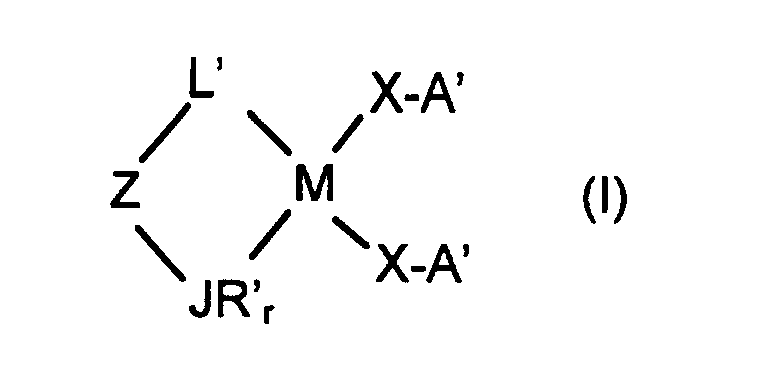 L' eine π-gebundene Gruppe ist:M ein Gruppe-4-Metall ist;J Stickstoff oder Phosphor ist;Z eine divalente verbrückende Gruppe ist;R' ein inerter monovalenter Ligand ist;r gleich 1 oder 2 ist;X unabhängig voneinander bei jedem Auftreten eine Lewis-Base-Ligandengruppe ist, die fähig ist, eine µ-verbrückende Ligandengruppe auszubilden, und wahlweise die zwei X-Gruppen miteinander verbunden sein können undA' unabhängig voneinander bei jedem Auftreten eine aluminiumhaltige Lewis-Säure-Verbindung mit bis zu 50 Nichtwasserstoffatomen ist, die ein Addukt mit dem Metallkomplex mittels µ-verbrückender Gruppen bildet, und wahlweise zwei A'-Gruppen miteinander verbunden sein können und dadurch eine einzige Verbindung mit 2 Lewis-Säure-Funktionen ausbilden.
 - Verbindung nach Anspruch 1, worin X ausgewählt ist aus der Gruppe bestehend aus Hydrocarbyl, Silyl, N,N-Dialkylamido und Alkandiylamidogruppen mit bis zu 20 Atomen, wobei Wasserstoff nicht mitzählt, oder zwei solcher X-Gruppen zusammen eine Alkandiyl- oder Alkendiylgruppe bilden, die zusammen mit M ein Metallocycloalkan oder Metallocycloalken ausbilden.
- Verbindung nach Anspruch 1, worin A' eine Verbindung entsprechend der empirischen FormelArf eine fluorierte aromatische Kohlenwasserstoffeinheit mit 6 bis 30 Kohlenstoffatomen ist;Q1 gleich C1-20-Alkyl ist;Q2 gleich C1-20-Hydrocarbyl ist, das wahlweise mit einer oder mehreren Gruppen substituiert ist, die unabhängig voneinander bei jedem Auftreten Hydrocarbyloxy-, Hydrocarbylsiloxy-, Hydrocarbylsilylamino-, Di(hydrocarbylsilyl)amino-, Hydrocarbylamino-, Di(hydrocarbyl)amino-, Di(hydrocarbyl)phosphino- oder Hydrocarbylsulfidogruppen mit 1 bis 20 Nichtwasserstoffatomen sind, oder wahlweise zwei oder mehr Q2-Gruppen kovalent miteinander verbunden sind, um einen oder mehrere anellierte Ringe oder Ringsysteme auszubilden;w' eine Zahl von 0 bis 3 ist;w eine Zahl von 0 bis 1,0 ist;x' eine Zahl von 0 bis 3 ist;x eine Zahl von 1,0 bis 0 ist;y' eine Zahl von 0 bis 3 ist;y eine Zahl von 1,0 bis 0 ist;z' eine Zahl von 0 bis 30 ist undz eine Zahl von 0 bis 20 ist.
- Verbindung nach Anspruch 3, worin A' durch Austausch zwischen Tris(pentafluorphenyl)boran und einer Alkylaluminium- oder Alkylaluminiumoxyverbindung hergestellt wird.
- Verbindung nach Anspruch 1, entsprechend der Formel:worin:
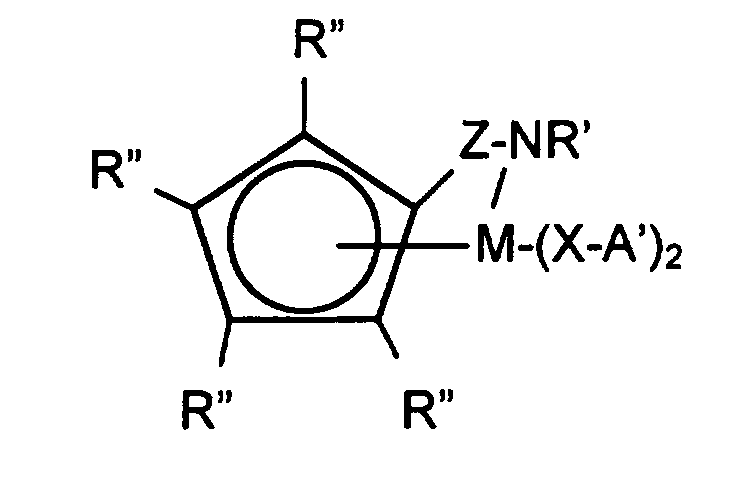 R' Hydrocarbyl oder Silyl mit bis zu 20 Atomen ist, wobei Wasserstoff nicht mitzählt;R" bei jedem Auftreten unabhängig voneinander ausgewählt ist aus der Gruppe bestehend aus Wasserstoff, Hydrocarbyl, Silyl, N,N-Dialkylamino und Alkandiylamino, wobei R" bis zu 20 Atome enthält und Wasserstoffatome nicht mitgezählt sind, oder benachbarte R"-Gruppen miteinander verbunden sind und dabei ein anelliertes Ringsystem ausbilden,X bei jedem Auftreten unabhängig voneinander Hydrocarbyl ist oder zwei X-Gruppen zusammen eine Alkandiyl- oder eine Alkendiylgruppe sind, wobei X bis zu 20 Atome aufweist und Wasserstoff nicht mitzählt;Z gleich SiR*2, CR*2, SiR*2SiR*2, CR*2CR*2, CR*=CR*, CR*2SiR*2, BNR*2, oder GeR*2 ist, worin R* gleich C1-4-Alkyl oder C6-10-Aryl ist, oder wahlweise zwei R*-Gruppen miteinander verbunden sind undA' wie in Anspruch 1 definiert ist.
 - Verbindung nach Anspruch 5, entsprechend der Formel:worin:
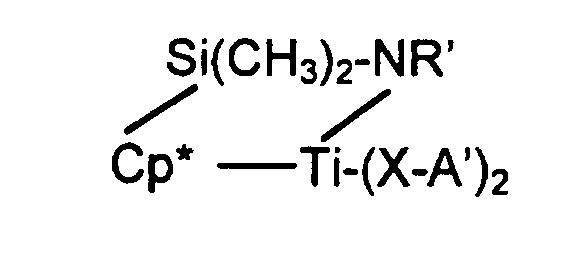 Cp* gleich Tetramethylcyclopentadienyl, 2-Methyl-4-phenylinden-1-yl, 3-Pyrrolidinoinden-1-yl, 1-Indacenyl oder 3,4-(Cyclopenta(l)phenanthren-1-yl ist;R' gleich C1-10-Alkyl oder -Cycloalkyl ist;X gleich Methyl ist undA' wie in Anspruch 1 definiert ist.
 - Verbindung nach Anspruch 5, worin Cp* gleich Cyclopentadienyl, Tetramethylcyclopentadienyl, Indenyl, 2,3-Dimethylindenyl, Fluorenyl, 2-Methylindenyl, 2-Methyl-4-phenylindenyl, 3-Dimethylaminoindenyl, 3-Pyrrolidinoindenyl, 3-Piperidinoindenyl, Tetrahydrofluorenyl, Octahydrofluorenyl, 1-Indacenyl, 3,4-(Cyclopenta(l)-phenanthren-1-yl) oder Tetrahydroindenyl ist.
- Verfahren zur Herstellung eines Metallkomplexes nach Anspruch 1, umfassend Inberührungbringen eines ladungsneutralen Gruppe-IV-Metall-Koordinationskomplexes mit mindestens zwei Lewis-Base-Gruppen entsprechend der Formelmit mindestens zwei molaren Äquivalenten von ladungsneutralen Aluminium-Koordinationskomplexen, A' mit Lewis-sauren Aluminiumatomen, so dass mindestens zwei der Aluminiumatome des Aluminium-Koordinationskomplexes an mindestens zwei der Lewis-Base-Gruppen des Gruppe-IV-Koordinationskomplexes gebunden sind, worin Z, L', R', r, M, X und A' wie in Anspruch 1 definiert sind.

- Verfahren zur Polymerisation von α-Olefinen, umfassend Inberührungbringen eines oder mehrerer α-Olefine mit einer Katalysatorzusammensetzung, enthaltend:wobei das Äquivalentverhältnis von Metallkomplex zu Tris(perfluorphenyl)aluminium von 1:2 bis 1:5 reicht.1) einen Gruppe-4-Metallkomplex entsprechend der Formel:worin Z, L', M, X, R' und r wie zuvor in Anspruch 1 definiert sind, und
 2) Tris(perfluorphenyl)aluminium,
Applications Claiming Priority (11)
| Application Number | Priority Date | Filing Date | Title |
|---|---|---|---|
| US9608898P | 1998-08-11 | 1998-08-11 | |
| US96088P | 1998-08-11 | ||
| US9680098P | 1998-08-17 | 1998-08-17 | |
| US96800P | 1998-08-17 | ||
| US10049098P | 1998-09-16 | 1998-09-16 | |
| US10422998P | 1998-10-14 | 1998-10-14 | |
| US104229P | 1998-10-14 | ||
| US12261599P | 1999-03-03 | 1999-03-03 | |
| US122615P | 1999-03-03 | ||
| PCT/US1999/013344 WO2000009523A1 (en) | 1998-08-11 | 1999-06-11 | Ansa-group-4-metal bis (.mu.-substituted) aluminum complexes |
| US100490P | 2008-09-26 |
Publications (2)
| Publication Number | Publication Date |
|---|---|
| EP1104429A1 EP1104429A1 (de) | 2001-06-06 |
| EP1104429B1 true EP1104429B1 (de) | 2002-05-08 |
Family
ID=27536779
Family Applications (1)
| Application Number | Title | Priority Date | Filing Date |
|---|---|---|---|
| EP99927519A Expired - Lifetime EP1104429B1 (de) | 1998-08-11 | 1999-06-11 | Ansa bis(.mu.-aluminium)-substituierte gruppe-4-metallkomplexe |
Country Status (9)
| Country | Link |
|---|---|
| US (1) | US6140521A (de) |
| EP (1) | EP1104429B1 (de) |
| JP (1) | JP2002522551A (de) |
| AT (1) | ATE217318T1 (de) |
| AU (1) | AU4440499A (de) |
| CA (1) | CA2337024A1 (de) |
| DE (1) | DE69901451T2 (de) |
| MY (1) | MY133950A (de) |
| WO (1) | WO2000009523A1 (de) |
Families Citing this family (29)
| Publication number | Priority date | Publication date | Assignee | Title |
|---|---|---|---|---|
| FI104826B (fi) * | 1996-01-30 | 2000-04-14 | Borealis As | Heteroatomilla substituoituja metalloseeniyhdisteitä olefiinipolymerointikatalyytti-systeemejä varten ja menetelmä niiden valmistamiseksi |
| US6214760B1 (en) * | 1998-08-11 | 2001-04-10 | The Dow Chemical Company | Catalyst activator composition |
| JP5159302B2 (ja) | 2004-03-17 | 2013-03-06 | ダウ グローバル テクノロジーズ エルエルシー | エチレンコポリマーを形成するためのシャトリング剤を含む触媒組成物 |
| RU2375381C2 (ru) | 2004-03-17 | 2009-12-10 | Дау Глобал Текнолоджиз Инк. | Состав катализатора, содержащий челночный агент, для формирования мульти-блок-сополимера высшего олефина |
| NZ549262A (en) | 2004-03-17 | 2010-08-27 | Dow Global Technologies Inc | Catalyst composition comprising shuttling agent for higher olefin multi-block copolymer formation |
| EP1763542B1 (de) | 2004-06-16 | 2011-04-06 | Dow Global Technologies Inc. | Verfahren zur auswahl von polymerisationsmodifikatoren |
| JP2008509277A (ja) * | 2004-08-09 | 2008-03-27 | ダウ グローバル テクノロジーズ インコーポレイティド | ポリマーの製造のための担持ビス(ヒドロキシアリールアリールオキシ)触媒 |
| EP1861438B1 (de) * | 2005-03-17 | 2015-03-04 | Dow Global Technologies LLC | Katalysatorzusammensetzung mit transportwirkstoff zur regio-irregulären multiblock-copolymer-formierung |
| EP1861439B1 (de) | 2005-03-17 | 2013-01-30 | Dow Global Technologies LLC | Katalysatorzusammensetzung mit transportwirkstoff zur taktischen/ataktischen multiblock-copolymer-formierung |
| US9410009B2 (en) | 2005-03-17 | 2016-08-09 | Dow Global Technologies Llc | Catalyst composition comprising shuttling agent for tactic/ atactic multi-block copolymer formation |
| JP5230426B2 (ja) | 2005-09-15 | 2013-07-10 | ダウ グローバル テクノロジーズ エルエルシー | 多中心シャトリング剤(multi−centeredshuttlingagent)によるポリマー構造および分子量分布の制御 |
| SG156614A1 (en) * | 2005-09-15 | 2009-11-26 | Dow Global Technologies Inc | Catalytic olefin block copolymers via polymerizable shuttling agent |
| US8153243B2 (en) | 2005-12-09 | 2012-04-10 | Dow Global Technologies Llc | Interpolymers suitable for multilayer films |
| CN101490094B (zh) | 2006-05-17 | 2013-06-26 | 陶氏环球技术有限责任公司 | 高温聚乙烯溶液聚合法 |
| ITMI20070877A1 (it) | 2007-05-02 | 2008-11-03 | Dow Global Technologies Inc | Processo per la produzione di copolimeri a blocchi multipli con l'utilizzo di solventi polari |
| ITMI20070878A1 (it) | 2007-05-02 | 2008-11-03 | Dow Global Technologies Inc | Processo per la polimerizzazine di polimeri tattici con l'uso di catalizzatori chirali |
| US8420760B2 (en) * | 2007-11-19 | 2013-04-16 | Dow Global Technologies Llc | Long chain branched propylene-alpha-olefin copolymers |
| EP2411424A2 (de) | 2009-03-06 | 2012-02-01 | Dow Global Technologies LLC | Katalysatoren, verfahren zur herstellung von katalysatoren, verfahren zur herstellung von polyolefinzusammensetzungen und polyolefinzusammensetzungen |
| WO2011016992A2 (en) | 2009-07-29 | 2011-02-10 | Dow Global Technologies Inc. | Polymeric chain transfer/shuttling agents |
| JP5726873B2 (ja) | 2009-07-29 | 2015-06-03 | ダウ グローバル テクノロジーズ エルエルシー | 二頭又は多頭連鎖シャトリング剤、及びブロックコポリマーの調製のためのそれらの使用 |
| WO2017058910A1 (en) | 2015-09-30 | 2017-04-06 | Dow Global Technologies Llc | Multi- or dual-headed compositions useful for chain shuttling and process to prepare the same |
| TWI756272B (zh) | 2016-09-30 | 2022-03-01 | 美商陶氏全球科技有限責任公司 | 適用於鏈梭移之封端多頭或雙頭組合物及其製備方法 |
| JP7096236B2 (ja) | 2016-09-30 | 2022-07-05 | ダウ グローバル テクノロジーズ エルエルシー | チェーンシャトリングに有用なマルチヘッドまたはデュアルヘッド組成物、およびそれを調製するプロセス |
| EP4435013A3 (de) | 2016-09-30 | 2024-12-25 | Dow Global Technologies LLC | Verfahren zur herstellung von mehr- oder doppelköpfigen zusammensetzungen für kettenübertragung |
| WO2020140067A1 (en) | 2018-12-28 | 2020-07-02 | Dow Global Technologies Llc | Curable compositions comprising unsaturated polyolefins |
| KR102880619B1 (ko) | 2018-12-28 | 2025-11-04 | 다우 글로벌 테크놀로지스 엘엘씨 | 텔레켈릭 폴리올레핀을 포함하는 경화성 조성물 |
| SG11202107067RA (en) | 2018-12-28 | 2021-07-29 | Dow Global Technologies Llc | Organometallic chain transfer agents |
| SG11202107051UA (en) | 2018-12-28 | 2021-07-29 | Dow Global Technologies Llc | Telechelic polyolefins and processes for preparing the same |
| EP3902809A1 (de) | 2018-12-28 | 2021-11-03 | Dow Global Technologies LLC | Härtbare zusammensetzungen mit ungesättigten polyolefinen |
Family Cites Families (4)
| Publication number | Priority date | Publication date | Assignee | Title |
|---|---|---|---|---|
| US5763549A (en) * | 1989-10-10 | 1998-06-09 | Fina Technology, Inc. | Cationic metallocene catalysts based on organoaluminum anions |
| US5721185A (en) * | 1991-06-24 | 1998-02-24 | The Dow Chemical Company | Homogeneous olefin polymerization catalyst by abstraction with lewis acids |
| JPH05230134A (ja) * | 1992-02-24 | 1993-09-07 | Mitsui Toatsu Chem Inc | 分子量分布の広いポリオレフィンの製造方法 |
| KR100292158B1 (ko) * | 1992-08-04 | 2001-06-01 | 가지와라 야스시 | 올레핀중합용 촉매 및 올레핀의 중합방법 |
-
1999
- 1999-06-11 AU AU44404/99A patent/AU4440499A/en not_active Abandoned
- 1999-06-11 WO PCT/US1999/013344 patent/WO2000009523A1/en not_active Ceased
- 1999-06-11 AT AT99927519T patent/ATE217318T1/de not_active IP Right Cessation
- 1999-06-11 DE DE69901451T patent/DE69901451T2/de not_active Expired - Fee Related
- 1999-06-11 JP JP2000564974A patent/JP2002522551A/ja active Pending
- 1999-06-11 EP EP99927519A patent/EP1104429B1/de not_active Expired - Lifetime
- 1999-06-11 US US09/330,672 patent/US6140521A/en not_active Expired - Fee Related
- 1999-06-11 CA CA002337024A patent/CA2337024A1/en not_active Abandoned
- 1999-07-30 MY MYPI99003260A patent/MY133950A/en unknown
Also Published As
| Publication number | Publication date |
|---|---|
| EP1104429A1 (de) | 2001-06-06 |
| WO2000009523A1 (en) | 2000-02-24 |
| JP2002522551A (ja) | 2002-07-23 |
| MY133950A (en) | 2007-11-30 |
| US6140521A (en) | 2000-10-31 |
| DE69901451T2 (de) | 2002-12-12 |
| CA2337024A1 (en) | 2000-02-24 |
| DE69901451D1 (de) | 2002-06-13 |
| AU4440499A (en) | 2000-03-06 |
| ATE217318T1 (de) | 2002-05-15 |
Similar Documents
| Publication | Publication Date | Title |
|---|---|---|
| EP1104429B1 (de) | Ansa bis(.mu.-aluminium)-substituierte gruppe-4-metallkomplexe | |
| US6214760B1 (en) | Catalyst activator composition | |
| WO1999015534A1 (en) | Modified alumoxane catalyst activator | |
| CA2337346C (en) | Activator composition comprising aluminum compound mixture | |
| US6635597B1 (en) | Perfluoronaphthyl substituted boron containing catalyst activator | |
| US6475945B1 (en) | Functionalized catalyst supports and supported catalyst systems | |
| US6187940B1 (en) | Three coordinate aluminum catalyst activator composition | |
| EP1104430B1 (de) | Ansa gruppe-4-metall bis(.mu.-aluminium) -substituierte metallocene | |
| US6291614B1 (en) | Dinuclear fluoroaryl aluminum alkyl complexes | |
| US6683199B1 (en) | Dicationic non-metallocene group 4 metal complexes | |
| EP1222025A2 (de) | Möglicherweise dikationische nicht-metallocenkomplexe von metallen der gruppe 4 mit anionischen n, o or p liganden | |
| US6673735B1 (en) | Preparation of catalyst compositions | |
| WO2001004167A1 (en) | Coordination polymerization catalysts comprising an ion exchange resin | |
| CA2368012A1 (en) | Dimeric group 4 metallocenes in +3 oxidation state | |
| WO2001038409A1 (en) | Preparation of polymerisation catalyst compositions | |
| CZ2000981A3 (cs) | Modifikovaný aluminoxanový aktivátor katalyzátoru, katalytický systém a způsob polymerace | |
| MXPA01002794A (es) | Soportes de catalizador funcionalizado y sistemas de catalizador soportado |
Legal Events
| Date | Code | Title | Description |
|---|---|---|---|
| PUAI | Public reference made under article 153(3) epc to a published international application that has entered the european phase |
Free format text: ORIGINAL CODE: 0009012 |
|
| 17P | Request for examination filed |
Effective date: 20010312 |
|
| AK | Designated contracting states |
Kind code of ref document: A1 Designated state(s): AT BE CH CY DE DK ES FI FR GB GR IE IT LI LU MC NL PT SE |
|
| GRAG | Despatch of communication of intention to grant |
Free format text: ORIGINAL CODE: EPIDOS AGRA |
|
| GRAG | Despatch of communication of intention to grant |
Free format text: ORIGINAL CODE: EPIDOS AGRA |
|
| GRAH | Despatch of communication of intention to grant a patent |
Free format text: ORIGINAL CODE: EPIDOS IGRA |
|
| 17Q | First examination report despatched |
Effective date: 20011001 |
|
| REG | Reference to a national code |
Ref country code: GB Ref legal event code: IF02 |
|
| GRAH | Despatch of communication of intention to grant a patent |
Free format text: ORIGINAL CODE: EPIDOS IGRA |
|
| GRAA | (expected) grant |
Free format text: ORIGINAL CODE: 0009210 |
|
| AK | Designated contracting states |
Kind code of ref document: B1 Designated state(s): AT BE CH CY DE DK ES FI FR GB GR IE IT LI LU MC NL PT SE |
|
| PG25 | Lapsed in a contracting state [announced via postgrant information from national office to epo] |
Ref country code: LI Free format text: LAPSE BECAUSE OF FAILURE TO SUBMIT A TRANSLATION OF THE DESCRIPTION OR TO PAY THE FEE WITHIN THE PRESCRIBED TIME-LIMIT Effective date: 20020508 Ref country code: IT Free format text: LAPSE BECAUSE OF FAILURE TO SUBMIT A TRANSLATION OF THE DESCRIPTION OR TO PAY THE FEE WITHIN THE PRESCRIBED TIME-LIMIT;WARNING: LAPSES OF ITALIAN PATENTS WITH EFFECTIVE DATE BEFORE 2007 MAY HAVE OCCURRED AT ANY TIME BEFORE 2007. THE CORRECT EFFECTIVE DATE MAY BE DIFFERENT FROM THE ONE RECORDED. Effective date: 20020508 Ref country code: GR Free format text: LAPSE BECAUSE OF FAILURE TO SUBMIT A TRANSLATION OF THE DESCRIPTION OR TO PAY THE FEE WITHIN THE PRESCRIBED TIME-LIMIT Effective date: 20020508 Ref country code: FR Free format text: LAPSE BECAUSE OF FAILURE TO SUBMIT A TRANSLATION OF THE DESCRIPTION OR TO PAY THE FEE WITHIN THE PRESCRIBED TIME-LIMIT Effective date: 20020508 Ref country code: FI Free format text: LAPSE BECAUSE OF FAILURE TO SUBMIT A TRANSLATION OF THE DESCRIPTION OR TO PAY THE FEE WITHIN THE PRESCRIBED TIME-LIMIT Effective date: 20020508 Ref country code: CH Free format text: LAPSE BECAUSE OF FAILURE TO SUBMIT A TRANSLATION OF THE DESCRIPTION OR TO PAY THE FEE WITHIN THE PRESCRIBED TIME-LIMIT Effective date: 20020508 Ref country code: BE Free format text: LAPSE BECAUSE OF FAILURE TO SUBMIT A TRANSLATION OF THE DESCRIPTION OR TO PAY THE FEE WITHIN THE PRESCRIBED TIME-LIMIT Effective date: 20020508 Ref country code: AT Free format text: LAPSE BECAUSE OF FAILURE TO SUBMIT A TRANSLATION OF THE DESCRIPTION OR TO PAY THE FEE WITHIN THE PRESCRIBED TIME-LIMIT Effective date: 20020508 |
|
| REF | Corresponds to: |
Ref document number: 217318 Country of ref document: AT Date of ref document: 20020515 Kind code of ref document: T |
|
| REG | Reference to a national code |
Ref country code: CH Ref legal event code: EP |
|
| PG25 | Lapsed in a contracting state [announced via postgrant information from national office to epo] |
Ref country code: MC Free format text: LAPSE BECAUSE OF NON-PAYMENT OF DUE FEES Effective date: 20020611 Ref country code: LU Free format text: LAPSE BECAUSE OF NON-PAYMENT OF DUE FEES Effective date: 20020611 Ref country code: IE Free format text: LAPSE BECAUSE OF NON-PAYMENT OF DUE FEES Effective date: 20020611 |
|
| REG | Reference to a national code |
Ref country code: IE Ref legal event code: FG4D |
|
| REF | Corresponds to: |
Ref document number: 69901451 Country of ref document: DE Date of ref document: 20020613 |
|
| PG25 | Lapsed in a contracting state [announced via postgrant information from national office to epo] |
Ref country code: CY Free format text: LAPSE BECAUSE OF FAILURE TO SUBMIT A TRANSLATION OF THE DESCRIPTION OR TO PAY THE FEE WITHIN THE PRESCRIBED TIME-LIMIT Effective date: 20020630 |
|
| PG25 | Lapsed in a contracting state [announced via postgrant information from national office to epo] |
Ref country code: SE Free format text: LAPSE BECAUSE OF FAILURE TO SUBMIT A TRANSLATION OF THE DESCRIPTION OR TO PAY THE FEE WITHIN THE PRESCRIBED TIME-LIMIT Effective date: 20020808 Ref country code: PT Free format text: LAPSE BECAUSE OF FAILURE TO SUBMIT A TRANSLATION OF THE DESCRIPTION OR TO PAY THE FEE WITHIN THE PRESCRIBED TIME-LIMIT Effective date: 20020808 Ref country code: DK Free format text: LAPSE BECAUSE OF FAILURE TO SUBMIT A TRANSLATION OF THE DESCRIPTION OR TO PAY THE FEE WITHIN THE PRESCRIBED TIME-LIMIT Effective date: 20020808 |
|
| REG | Reference to a national code |
Ref country code: CH Ref legal event code: PL |
|
| PG25 | Lapsed in a contracting state [announced via postgrant information from national office to epo] |
Ref country code: ES Free format text: LAPSE BECAUSE OF FAILURE TO SUBMIT A TRANSLATION OF THE DESCRIPTION OR TO PAY THE FEE WITHIN THE PRESCRIBED TIME-LIMIT Effective date: 20021128 |
|
| PG25 | Lapsed in a contracting state [announced via postgrant information from national office to epo] |
Ref country code: DE Free format text: LAPSE BECAUSE OF NON-PAYMENT OF DUE FEES Effective date: 20030101 |
|
| EN | Fr: translation not filed | ||
| PLBE | No opposition filed within time limit |
Free format text: ORIGINAL CODE: 0009261 |
|
| STAA | Information on the status of an ep patent application or granted ep patent |
Free format text: STATUS: NO OPPOSITION FILED WITHIN TIME LIMIT |
|
| REG | Reference to a national code |
Ref country code: IE Ref legal event code: MM4A |
|
| 26N | No opposition filed |
Effective date: 20030211 |
|
| PG25 | Lapsed in a contracting state [announced via postgrant information from national office to epo] |
Ref country code: GB Free format text: LAPSE BECAUSE OF NON-PAYMENT OF DUE FEES Effective date: 20030611 |
|
| PG25 | Lapsed in a contracting state [announced via postgrant information from national office to epo] |
Ref country code: NL Free format text: LAPSE BECAUSE OF NON-PAYMENT OF DUE FEES Effective date: 20040101 |
|
| GBPC | Gb: european patent ceased through non-payment of renewal fee |
Effective date: 20030611 |
|
| NLV4 | Nl: lapsed or anulled due to non-payment of the annual fee |
Effective date: 20040101 |