EP1104804A1 - Procede de production de particules detergentes a un seul noyau - Google Patents
Procede de production de particules detergentes a un seul noyau Download PDFInfo
- Publication number
- EP1104804A1 EP1104804A1 EP00937224A EP00937224A EP1104804A1 EP 1104804 A1 EP1104804 A1 EP 1104804A1 EP 00937224 A EP00937224 A EP 00937224A EP 00937224 A EP00937224 A EP 00937224A EP 1104804 A1 EP1104804 A1 EP 1104804A1
- Authority
- EP
- European Patent Office
- Prior art keywords
- component
- weight
- parts
- particle size
- amount
- Prior art date
- Legal status (The legal status is an assumption and is not a legal conclusion. Google has not performed a legal analysis and makes no representation as to the accuracy of the status listed.)
- Granted
Links
Images
Classifications
-
- C—CHEMISTRY; METALLURGY
- C11—ANIMAL OR VEGETABLE OILS, FATS, FATTY SUBSTANCES OR WAXES; FATTY ACIDS THEREFROM; DETERGENTS; CANDLES
- C11D—DETERGENT COMPOSITIONS; USE OF SINGLE SUBSTANCES AS DETERGENTS; SOAP OR SOAP-MAKING; RESIN SOAPS; RECOVERY OF GLYCEROL
- C11D17/00—Detergent materials or soaps characterised by their shape or physical properties
- C11D17/06—Powder; Flakes; Free-flowing mixtures; Sheets
- C11D17/065—High-density particulate detergent compositions
-
- C—CHEMISTRY; METALLURGY
- C11—ANIMAL OR VEGETABLE OILS, FATS, FATTY SUBSTANCES OR WAXES; FATTY ACIDS THEREFROM; DETERGENTS; CANDLES
- C11D—DETERGENT COMPOSITIONS; USE OF SINGLE SUBSTANCES AS DETERGENTS; SOAP OR SOAP-MAKING; RESIN SOAPS; RECOVERY OF GLYCEROL
- C11D11/00—Special methods for preparing compositions containing mixtures of detergents
- C11D11/0082—Special methods for preparing compositions containing mixtures of detergents one or more of the detergent ingredients being in a liquefied state, e.g. slurry, paste or melt, and the process resulting in solid detergent particles such as granules, powders or beads
Definitions
- the present invention relates to a process for preparing uni-core detergent particles being excellent in dissolubility and flowability properties, the uni-core detergent particles formulated with a powdery builder and supporting a surfactant composition.
- General processes for preparing powdery detergent particle containing a powdery builder include a preparation process comprising dissolving or dispersing components which are desired to be formulated in water, and spray-drying the mixture; a preparation process comprising aggregating (granulating) a powdery builder with a liquid binder or by compression; a dry-blend process; an extrusion/disintegration process of a detergent component paste; or combinations of the above processes.
- a preparation process comprising dissolving or dispersing components which are desired to be formulated in water, and spray-drying the mixture
- a preparation process comprising aggregating (granulating) a powdery builder with a liquid binder or by compression
- a dry-blend process an extrusion/disintegration process of a detergent component paste
- an object of the present invention is to provide a process for preparing uni-core detergent particles being excellent in the dissolubility and the flowability properties in the process for preparing detergent particles comprising a powdery builder.
- the present invention relates to:
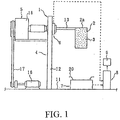
- Figure 1 is a front view showing a measurement device for flowability properties, wherein 1 is a measurement device for flowability properties, 2 is a holding member, 2a is a cascading portion, 3 is powder, 4 is a supporting mechanism, 5 is a tilted device, 6 is a tilted measurement device, 7 is a weight measurement device, 8 is a computer, 9 is an output device, 11 is a base, 12 is a column, 13 is a rotating member, 16 is a motor, 17 is an electric-motor winding mechanism, 18 is a decelerating mechanism, and 20 is a receiver portion of the weight measurement device 7.
- 1 is a measurement device for flowability properties
- 2 is a holding member
- 2a is a cascading portion
- 3 powder
- 4 is a supporting mechanism
- 5 is a tilted device
- 6 is a tilted measurement device
- 7 is a weight measurement device
- 8 is a computer
- 9 is an output device
- 11 is a base
- 12
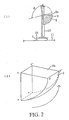
- Figure 2(1) is a partial side view of the measurement device for flowability properties; and Figure 2(2) is a perspective view of the holding member.
- the process for preparing uni-core detergent particles of the present invention can be roughly classified into the following three embodiments.
- Embodiment 1 a process for preparing uni-core detergent particles having a degree of particle growth of 1.5 or less and a bulk density of 500 g/L or more, comprising the steps of:
- Component (a) refers to base particles for supporting a surfactant having an average particle size of from 150 to 500 ⁇ m, and a bulk density of 400 g/L or more.
- Component (a) has an average particle size of from 150 to 500 ⁇ m, preferably from 180 to 350 ⁇ m, from the viewpoint of obtaining detergent particles excellent in the dissolubility and the flowability properties, and a bulk density of 400 g/L or more, preferably 500 g/L or more, from the viewpoint of the compression of the detergent particles, and a bulk density of preferably 1500 g/L or less, more preferably 1200 g/L or less, from the viewpoint of the dissolubility.
- Component (a) has a higher ability of supporting a liquid component (supporting ability).
- the supporting ability is preferably 20 mL/100 g or more, more preferably 40 mL/100 g or more. When the supporting ability is within this range, the aggregation of Components (a) themselves is suppressed, thereby making it favorable for maintaining the uni-core property owned by the particle in the detergent particles.
- Component (a) is harder from the viewpoint of suppressing the disintegration of Component (a) during mixing in Steps (A-I) and (A-II).
- Component (a) has a particle strength of preferably 100 kg/cm 2 or more, more preferably 200 kg/cm 2 or more.
- the average particle size of Component (a) is measured by vibrating a sample with each of standard sieves according to JIS Z 8801 for 5 minutes, and thereafter determining the average particle size from a weight percentage depending upon the size openings of the sieves.
- the bulk density of Component (a) is measured by a method according to JIS K 3362.
- Component (a) The supporting ability of Component (a) is measured as follows.
- a cylindrical mixing vessel of an inner diameter of 5 cm and a height of 15 cm which is equipped with agitation impellers in the inner portion thereof is charged with 100 g of a sample. With stirring the agitation impellers at 350 rpm, linseed oil at 25°C is supplied into the vessel at a rate of 10 mL/min.
- the supporting ability is defined as an amount of linseed oil supplied when the agitation torque reaches the highest level.
- the particle strength is measured by the following method.
- a cylindrical vessel of an inner diameter of 3 cm and a height of 8 cm is charged with 20 g of a sample, and the sample-containing vessel (manufactured by Tsutsui Rikagaku Kikai K.K., "Model TVP1" tapping-type close-packed bulk density measurement device; tapping conditions: frequency of 36 times/minute, free fall from a height of 60 mm) is tapped for 30 times.
- the sample height immediately after the termination of the tapping operation is measured, which is defined as an initial sample height.
- an entire upper end surface of the sample kept in the vessel is pressed at a rate of 10 mm/min with a pressing machine to obtain measurements for a load-displacement curve.
- the slope of the linear portion at a displacement rate of 5% or less in the curve is multiplied by an initial sample height, and the resulting product is divided by a pressed area, to give a quotient which is defined as particle strength.
- Component (a) can be obtained by, for example, drying a slurry comprising a detergent builder and the like. Among them, the particle obtainable by spray-drying a slurry is preferable from the viewpoint of having desired property values.
- Component (a) as described above can be obtained by, for example, spray-drying a slurry comprising a water-insoluble inorganic compound, a water-soluble polymer and a water-soluble salt, in which the contents of each of the components are respectively from 20 to 90% by weight, from 2 to 30% by weight, and from 5 to 78% by weight, on a solid basis of ingredients in the slurry.
- the average particle size, the bulk density, the supporting ability and the particle strength can be controlled by adjusting the drying process and the drying conditions.
- the contents of the water-insoluble inorganic compound, the water-soluble polymer and the water-soluble salt in the slurry are respectively more preferably within the ranges of from 30 to 75% by weight, from 3 to 20% by weight, and from 10 to 67% by weight, especially preferably within the ranges of from 40 to 70% by weight, from 5 to 20% by weight, and from 20 to 55% by weight, on the basis of solid ingredients in the slurry.
- the water-insoluble inorganic compound refers to those having a solubility to water at 25°C of less than 0.5 g/100 g.
- the water-soluble polymer refers to an organic polymer having a solubility to water at 25°C of 0.5 g/100 g or more and a molecular weight of 1000 or more.
- the water-soluble salt refers to those having a solubility to water at 25°C of 0.5 g/100 g or more and a molecular weight of less than 1000.
- Component (a) may comprise auxiliary components suitable for a final detergent composition, such as a surfactant and a fluorescent dye.
- auxiliary components suitable for a final detergent composition such as a surfactant and a fluorescent dye.
- the amount of the auxiliary components formulated is preferably 10% by weight or less.
- the water-insoluble inorganic compound includes aluminosilicates, silicon dioxide, hydrated silicate compounds, clay compounds such as perlite and bentonite, and the like.
- the water-soluble polymer includes carboxylic acid-based polymers, carboxymethyl cellulose, water-soluble starches, sugars, and the like.
- the water-soluble salts include water-soluble inorganic salts representatively exemplified by alkali metal salts, ammonium salts or amine salts, each having carbonate group, hydrogencarbonate group, sulfate group, sulfite group, hydrogensulfate group, hydrochloride group, phosphate group, or the like; and water-soluble organic salts having low molecular weights such as citrates and fumarates, and the like.
- Component (a) preferably has the following structures (1) and/or (2) from the viewpoint of the dissolubility of the uni-core detergent particles.
- Structure (1) a structure having a pore capable of releasing a bubble having a size of preferably 1/10 or more, more preferably 1/5 or more, still more preferably 1/4 or more, especially preferably 1/3 or more, of a particle size of the uni-core detergent particle, when dissolving a uni-core detergent particle in water.
- Structure (2) a structure comprising a water-insoluble inorganic compound, a water-soluble polymer and a water-soluble salt, and being localized so that larger portions of the water-soluble polymer and/or the water-soluble salt (hereinafter referred to as water-soluble polymer and the like) are present near the surface rather than in the inner portion thereof.
- Component (a) takes the structure (1), in a process where the detergent particle is dissolved in water, the detergent particle firstly releases a bubble having a given size from the inner portion of the particle when allowing a small amount of water to enter into the inner portion of the particle, and subsequently the particle itself undergoes disintegration (self-disintegration of the particle) by allowing a large amount of water to enter into the inner portion of the particle. Therefore, not only the dissolution from a portion near the surface takes place but also the dissolution and disintegration from the inner portion of the particle take place, whereby the detergent particle has a fast dissolubility.
- This bubble-releasing phenomenon can be confirmed by a digital microscope or an optical microscope or the like, and the bubble diameter (projected area diameter) can be measured.
- the pore size of Component (a) it is preferable that pores having a size of preferably from 1/10 to 4/5, more preferably from 1/5 to 4/5 of the particle size are present.
- This pore size can be measured as follows. Component (a) is split at a cross section so as to include the maximum particle size without crashing the particle with a surgical knife, or the like. The split cross section is observed by a scanning electron microscope.
- an equivalent diameter of the pore (pore size) [ ⁇ ⁇ m] is measured.
- the equivalent diameter ⁇ ⁇ m is defined as the largest pore size among them.
- the ratio of the pore size to the particle size ( ⁇ / ⁇ ) is calculated.
- Component (a) takes the structure (2), there is exhibited a dissolution behavior in which the water-soluble components present near the surface are dissolved more quickly in water, so that the disintegration of the detergent particle from the particle surface is promoted, whereby the fast dissolubility can be exhibited.
- the most preferable embodiment for exhibiting fast dissolubility is an embodiment where Component (a) takes both structures (1) and (2).
- the localized structure of the water-soluble polymer or the like can be confirmed by the following method.
- Component (a) which is to be measured and a grounded product of Component (a) in which Component (a) is sufficiently pulverized in a uniform state with an agate mortar or the like are prepared. Thereafter, under the conditions that information up to a depth of about 10 ⁇ m is obtained from the surfaces of Component (a) and the grounded product of Component (a), determinations for both are made with a combined method of Fourier transform infrared spectroscopy (FT-IR) and photoacoustic spectroscopy (PAS) (simply referred to as "FT-IR/PAS").
- FT-IR Fourier transform infrared spectroscopy
- PAS photoacoustic spectroscopy
- Component (a) to be measured has a structure such that larger portions of the water-soluble polymer and the like are present near the surface rather than the inner portion thereof.
- the measurement conditions for obtaining information up to about 10 ⁇ m from the surfaces of Component (a) and the grounded product of Component (a) include, for instance, resolution of 8 cm -1 , scanning speed of 0.63 cm/s, and 128 scans.
- the device used includes, for instance, an infrared spectrometer "Model FTS-60A/896" manufactured by Bio-Rad Laboratories, and the PAS cell includes a photoacoustic detector "Model 300" manufactured by MTEC Corporation.
- FT-IR/PAS is described in " APPLIED SPECTROSCOPY ,” 47 , 1311-1316 (1993).
- Component (b) may be aggregated, but is necessary to be a powdery builder of which primary particle has an average particle size of from 3 to 30 ⁇ m, and it means a detergency enhancer or an oil-absorbing agent, which is a powder at an ordinary temperature.
- base materials showing metal ion capturing ability such as citrates
- base materials showing alkalizing ability such as sodium carbonate and potassium carbonate
- base materials having both metal ion capturing ability and alkalizing ability such as crystalline silicates
- powdery surfactants and the like.
- the uni-core detergent particles excellent in the dissolubility and the flowability properties can be prepared by using Component (b) having the average particle size as defined above. Incidentally, the definition of the uni-core detergent particles is described later.
- the base materials showing metal ion capturing ability and/or alkalizing ability are hydrated compounds which retain water in a bound state such as crystal water in the molecule, crystal or cluster.
- the hydrated compounds include, for example, citrates, carbonates, bicarbonates, phosphates or crystalline silicates of alkali metals.
- Preferable Component (b) is a crystalline alkali metal silicate comprising at least SiO 2 and M 2 O (M represents an alkali metal), the crystalline alkali metal silicate having an SiO 2 /M 2 O molar ratio of from 1.5 to 2.6, a maximum value of pH of a 0.1% by weight aqueous dispersion thereof at 20°C of exceeding 11.0, and an ion exchange capacity of 100 mg CaCO 3 /g or more.
- M represents an alkali metal
- crystalline alkali metal silicates crystalline silicates disclosed in Japanese Patent Laid-Open No. Hei 5-279013, column 3, line 17 to column 6, line 24 (especially, those prepared by a process comprising calcinating and crystallizing at a temperature of 500° to 1000°C are preferable); Japanese Patent Laid-Open No. Hei 7-89712, column 2, line 45 to column 9, line 34; and Japanese Patent Laid-Open No. Sho 60-227895, page 2, lower right column, line 18 to page 4, upper right column, line 3 (especially silicates in Table 2 are preferable) can be preferably used.
- 0.1 g of a sample is weighed, and dispersed in 100 mL of 500 ppm (when calculated as CaCO 3 ) aqueous calcium chloride solution.
- the resulting mixture is stirred at 25°C for 10 minutes, and thereafter immediately filtered (with a 0.2 ⁇ m-filter).
- Ten milliliters of the filtrate is taken out, and 50 mL of ion-exchanged water is added thereto.
- One milliliter of a 20% by weight aqueous potassium hydroxide is added to the resulting mixture.
- the average primary particle size of Component (b) is preferably 5 ⁇ m or more, more preferably 8 ⁇ m or more, from the viewpoint of suppressing the aggregation of the base particles themselves.
- the average primary particle size is preferably 25 ⁇ m or less, more preferably 20 ⁇ m or less, from the viewpoint of the adhesiveness to the base particle. Therefore, from the viewpoints of the suppression of aggregation and the adhesiveness to the base particle, the average primary particle size is preferably from 5 to 25 ⁇ m, more preferably from 8 to 20 ⁇ m.
- the average particle size of Component (b) can be measured by a method utilizing light scattering by, for instance, a particle analyzer (manufactured by Horiba, LTD.), or it may be measured by a microscopic observation.
- the average particle size is preferably within the above ranges, from the viewpoints of the pulverizability, the storage stability, and the dissolubility.
- the amount of Component (b) formulated in Step (A-II) is from 5 to 50 parts by weight, based on 100 parts by weight of Component (a).
- the amount formulated is preferably 10 parts by weight or more, more preferably 15 parts by weight or more, from the viewpoint of exhibiting the effect of the powdery builder.
- the amount formulated is preferably 40 parts by weight or less, more preferably 30 parts by weight or less, from the viewpoint of suppressing the deterioration of the flowability properties of the uni-core detergent particles.
- Component (c) is a surfactant composition.
- Component (c), which is to be mixed with Component (a) includes compositions comprising one or more surfactants selected from the group consisting of anionic surfactants, nonionic surfactants, amphoteric surfactants and cationic surfactants, and it is preferable that these compositions are in a liquid state when mixed.
- a more preferable embodiment is a composition
- a composition comprising (i) a nonionic surfactant, (ii) an anionic surfactant having sulfate group or sulfonate group in an amount of from 0 to 300 parts by weight, based on 100 parts by weight of the nonionic surfactant, and (iii) an immobilization agent for the nonionic surfactant in an amount of from 1 to 100 parts by weight, based on 100 parts by weight of the nonionic surfactant.
- the component (ii) is contained in an amount of more preferably from 20 to 200 parts by weight, especially preferably from 30 to 180 parts by weight, in the composition.
- the component (iii) is contained in an amount of more preferably from 5 to 50 parts by weight, especially preferably from 5 to 30 parts by weight, in the composition. It is especially preferable to use this Component (c) because the dissolubility and the flowability properties of the detergent particles can be improved, the disintegration of Component (a) during mixing can be suppressed, and the bleed-out of Component (c) can be suppressed during storage (at an ordinary temperature).
- the formulation of the anionic surfactant having sulfate group or sulfonate group is more advantageous for the improvement in the flowability properties of detergent particles and the suppression of the bleed-out of Component (c) during storage (at an ordinary temperature).
- the immobilization agent for the nonionic surfactant in the present specification means a base material capable of suppressing the flowability of the nonionic surfactant which is liquid at an ordinary temperature and remarkably enhancing the hardness in a state in which the flowability of the surfactant composition is lost.
- the immobilization agent includes, for instance, salts of fatty acids, polyethylene glycols, polypropylene glycols, polyoxyethylene alkyl ethers, Pluronic-type nonionic surfactants, and the like.
- Component (c) may comprise water.
- a salt of a fatty acid is used as the component (iii)
- the water is contained, because the compatibility with the nonionic surfactant is increased, and also because there is an effect of reducing the viscosity at a temperature of the pour point of Component (c) or higher.
- the water content is preferably from 5 to 20 parts by weight, more preferably from 8 to 15 parts by weight, of Component (c).
- the amount of Component (c) formulated in Step (A-I) is from 20 to 100 parts by weight, preferably from 25 to 80 parts by weight, more preferably from 30 to 70 parts by weight, based on 100 parts by weight of Component (a), from the viewpoint of exhibiting the detergency.
- the uni-core detergent particles excellent in the dissolubility and the flowability properties are obtained.
- the fine powder which is Component (d) refers to a powder which is formulated for the purpose of coating the surface of a mixture obtained in Step (A-II), thereby further improving the flowability properties of the particles. Therefore, in Component (d) (Component (d) may be aggregated), its average primary particle size is smaller than the average primary particle size of Component (b). Two or more components may be used for Component (d), and in that case, it is preferable that the average primary particle size of the mixture is smaller than the average primary particle size of Component (b).
- Component (d) is preferably those having a high ion exchange ability and a high alkalizing ability from the viewpoint of the detergency. Concretely, aluminosilicates are desirable.
- inorganic fine powders such as those obtained by further pulverizing Component (b), calcium silicates, silicon dioxide, bentonite, talc, clay, amorphous silica derivatives and silicate compounds are also preferable.
- metal soaps can be similarly used.
- the average primary particle size is preferably from 0.1 to 10 ⁇ m, more preferably from 0.1 to 8 ⁇ m, still more preferably from 0.1 to 5 ⁇ m.
- the average particle size of Component (d) is measured by a method utilizing light scattering, for instance, by a particle analyzer (manufactured by Horiba, LTD.), or it may be measured by a microscopic observation.
- the amount of Component (d) used is 5 parts by weight or more, preferably 10 parts by weight or more, from the viewpoint of the efficiency of surface-coating.
- the amount used is 100 parts by weight or less, preferably 75 parts by weight or less, more preferably 50 parts by weight or less, from the viewpoint of the flowability properties. Therefore, from the viewpoints of the efficiency of surface-coating and the flowability properties, the amount used is preferably from 10 to 75 parts by weight, more preferably from 10 to 50 parts by weight.
- This step comprises mixing Component (a) with Component (c) at a given formulation ratio.
- Component (c) is supported in Component (a).
- the temperature of the mixture during mixing is at a pour point of Component (c) or higher, and the mixing is carried out with the agitation torque which is made as low as possible in the mixable range of each component, from the viewpoints of the suppression of disintegration of Component (a) and the promotion of supports of Component (c).
- the mixer is not particularly limited, as long as a mixer which can satisfy the above-mentioned conditions is employed.
- examples thereof include (1) a mixer in which blending of powders is carried out by having an agitating shaft in the inner portion of a mixing vessel and attaching agitating impellers on the agitating shaft, including Henschel Mixer (manufactured by Mitsui Miike Machinery Co., Ltd.), High-Speed Mixer (Fukae Powtec Corp.), Vertical Granulator (manufactured by Powrex Corp.), Lödige Mixer (manufactured by Matsuzaka Giken Co., Ltd.), PLOUGH SHARE Mixer (manufactured by PACIFIC MACHINERY & ENGINEERING Co., LTD.), and the like; (2) a mixer in which blending is carried out by rotating spiral ribbon impellers in a non-rotatable vessel which is cylindrical or semi-cylindrical,
- the mixer is not particularly limited, as long as a continuous mixer which can satisfy the above-mentioned conditions is employed.
- Component (a) and Component (b) may be mixed by using a continuous-type mixer among the above-mentioned mixers.
- Preferable mixing time (in the case of batch process) and average residence time (in the case of continuous process) are, for instance, preferably from 1 to 20 minutes, especially preferably from 2 to 10 minutes.
- Step (A-II) refers to a process from the initiation of addition of Component (b) to initiation of addition of Component (d) in Step (A-III).
- the timing of addition of Component (b) may be adding immediately after the termination of the addition of Component (c) in Step (A-I), or adding after addition of Component (c) and subsequent sufficient mixing, and the timing can be appropriately selected as desired.
- Component (b) may be added in two or more stepwise portions.
- Step (A-III) a part of Component (d) which is to be added in Step (A-III) can be added simultaneously with the addition of Component (b), provided that it is preferable that the amount of Component (d) formulated is in a range so that the coating of Component (b) to the mixture is not hindered.
- the operating conditions for the disintegration impellers may be appropriately set, from the viewpoints of suppressing the disintegration of Component (a) and promoting the dispersion of Component (b).
- Step (A-I) those mixers exemplified in Step (A-I) may be used. It is preferable that the same mixer is used in Step (A-I) and Step (A-II) by appropriately setting the operating conditions for the mixer, from the viewpoint of simplification of the equipments.
- the mixing time is preferably from 0.3 to 5 minutes or so.
- This step comprises mixing a mixture obtained in Step (A-II) with Component (d).
- Component (d) coats the surface of the mixture, whereby the uni-core detergent particles having excellent flowability properties can be obtained.
- Preferable mixing conditions and mixers are mixers comprising both agitation impellers and disintegration impellers, from the viewpoint of enhancing the dispersibility of Component (d).
- the additives such as an enzyme and a perfume can be simultaneously added. It is preferable to add Component (d) by using a vessel rotary mixer as in a drum mixer, from the viewpoint of simplification of the equipments.
- the mixing time is 0.5 to 3 minutes or so. In the case where the vessel rotary mixer is used, it is preferable that the mixing time is from 0.5 to 10 minutes or so.
- Component (a) used in this embodiment may be the same as those of Embodiment 1 described above.
- Component (b') is a powdery builder having an average primary particle size of from 5 to 50 ⁇ m, and it means a detergency enhancer or an oil-absorbing agent, which is a powder at an ordinary temperature. Concretely, there are included the same kinds as those of Component (b) described above except that the average primary particle size is from 5 to 50 ⁇ m.
- the uni-core detergent particles excellent in the dissolubility and the flowability can be prepared by using Component (b') having an average particle size as defined above. Incidentally, the definition of the uni-core detergent particles is described later.
- the base materials showing metal ion capturing ability and/or alkalizing ability are hydrated compounds which retain water in a bound state such as crystal water in the molecule, crystal or cluster.
- the hydrated compounds include, for example, citrates, carbonates, bicarbonates, phosphates or crystalline silicates of alkali metals.
- Preferable Component (b') is a crystalline alkali metal silicate comprising at least SiO 2 and M 2 O (M represents an alkali metal), the crystalline alkali metal silicate having an SiO 2 /M 2 O molar ratio of from 1.5 to 2.6, a maximum value of pH of a 0.1% by weight aqueous dispersion thereof at 20°C of exceeding 11.0, and an ion exchange capacity of 100 mg CaCO 3 /g or more.
- the method for measuring ion exchange capacity is the same as that of Embodiment 1 described above.
- the average primary particle size of Component (b') is from 5 to 50 ⁇ m (Component (b') may be aggregated).
- the average primary particle size is preferably 8 ⁇ m or more, more preferably 15 ⁇ m or more, from the viewpoint of suppressing the aggregation of the base particles themselves.
- the average primary particle size is preferably 40 ⁇ m or less, more preferably 30 ⁇ m or less, from the viewpoint of the adhesiveness to the base particle. Therefore, from the viewpoints of the suppression of aggregation and the adhesiveness to the base particle, the average primary particle size is preferably from 8 to 40 ⁇ m, more preferably from 15 to 30 ⁇ m.
- the average particle size of Component (b') can be measured by a method utilizing light scattering by, for instance, a particle analyzer (manufactured by Horiba, LTD.), or it may be measured by a microscopic observation.
- the average particle size is preferably within the above ranges, from the viewpoints of the pulverizability, the storage stability, and the dissolubility.
- the amount of Component (b') formulated in Step (B-I) is from 5 to 50 parts by weight, based on 100 parts by weight of Component (a).
- the amount formulated is preferably 10 parts by weight or more, more preferably 15 parts by weight or more, from the viewpoint of exhibiting the effect of the powdery builder.
- the amount formulated is preferably 40 parts by weight or less, more preferably 30 parts by weight or less, from the viewpoint of suppressing the aggregation of the base particles themselves.
- Component (c) used in this embodiment may be the same as those of Embodiment 1 described above.
- the amount of Component (c) formulated is from 20 to 100 parts by weight, preferably from 25 to 80 parts by weight, more preferably from 30 to 70 parts by weight, based on 100 parts by weight of Component (a), from the viewpoint of exhibiting the detergency.
- the uni-core detergent particles excellent in the dissolubility and the flowability properties are obtained.
- the fine powder which is Component (d') refers to a powder which is formulated for the purpose of coating the surface of a mixture obtained in Step (B-I), thereby further improving the flowability of the particles. Therefore, in Component (d') (Component (d') may be aggregated), its average primary particle size is smaller than the average primary particle size of Component (b'). Two or more components may be used for Component (d'), and in that case, it is preferable that the average primary particle size of the mixture is smaller than the average primary particle size of Component (b').
- the fine powder is preferably those having a high ion exchange ability and a high alkalizing ability from the viewpoint of the detergency. Concretely, the fine powder may be the same as those of Embodiment 1 described above.
- the amount of Component (d') used is 5 parts by weight or more, preferably 10 parts by weight or more, from the viewpoint of the efficiency of surface-coating.
- the amount used is 100 parts by weight or less, preferably 75 parts by weight or less, more preferably 50 parts by weight or less, from the viewpoint of the flowability properties. Therefore, from the viewpoints of the efficiency of surface-coating and the flowability properties, the amount used is preferably from 10 to 75 parts by weight, more preferably from 10 to 50 parts by weight.
- This step comprises mixing Component (a), Component (b') and Component (c) at a given formulation ratio.
- Component (c) is supported in Component (a) and Component (b'), and much of Component (b') adheres to the surface of Component (a).
- the addition method for each component is arbitrary as long as the above-mentioned action can be achieved.
- the preferable addition process is, for instance, a process comprising previously mixing Component (a) with Component (b'), and thereafter adding Component (c) thereto by spraying.
- the temperature of the mixture during mixing is at a pour point of Component (c) or higher, and the mixing is carried out with the agitation torque which is made as low as possible in the mixable range of each component, from the viewpoints of the suppression of disintegration of Component (a) and the promotion of supports of Component (c).
- the mixer is not particularly limited, and the same ones as those in Embodiment described above are used, as long as the mixers which can satisfy the above conditions are used.
- the mixer is not particularly limited, as long as a continuous mixer which can satisfy the above-mentioned conditions is employed.
- Component (a), Component (b') and Component (c) may be mixed by using a continuous-type mixer among the above-mentioned mixers.
- Preferable mixing time (in the case of batch process) and average residence time (in the case of continuous process) are, for instance, preferably from 1 to 20 minutes, especially preferably from 2 to 10 minutes.
- This step comprises mixing a mixture obtained in Step (B-I) with Component (d') at a given formulation ratio.
- the fine powder coats the surface of the mixture, whereby the uni-core detergent particles having excellent flowability can be obtained.
- Preferable mixing conditions are to use mixers comprising both agitation impellers and disintegration impellers, from the viewpoint of enhancing the dispersibility of Component (d'), and the operating conditions for agitation impellers and the disintegration impellers (rotation speed, and the like) may be appropriately set, so that Component (a) is not disintegrated as much as possible, from the viewpoint of enhancing the dispersibility of Component (a).
- Preferable mixers include those mixers comprising both agitation impellers and disintegration impellers among the mixers usable in Step (B-I).
- the mixers as described above it is preferable that the same mixer is used in Step (B-I) and Step (B-II), from the viewpoint of simplification of the equipments.
- the mixers as described above include Lödige Mixer, PLOUGH SHARE Mixer, and the like.
- the mixing time is preferably from 0.5 to 3 minutes or so.
- This embodiment refers to a technique in which a powdery builder can be formulated in a large amount without impairing the dissolubility and the flowability properties of the uni-core detergent particles in Embodiment 1 and Embodiment 2.
- this embodiment refers to a technique in which the dissolubility and the flowability properties are further improved when the amount of the powdery builder formulated is the same as in Embodiment 1 and Embodiment 2.
- Component (a) used in this embodiment may be the same as those of Embodiment 1 described above.
- Component (b) and Component (b') used in this embodiment may be the same as those of Embodiment I and Embodiment 2 described above.
- Each of the amount of Component (b') formulated in Step (C-I) and the amount of Component (b) formulated in Step (C-II) is from 5 to 50 parts by weight, based on 100 parts by weight of Component (a).
- the amount formulated is preferably 10 parts by weight or more, more preferably 15 parts by weight or more, from the viewpoint of exhibiting the effect of the powdery builder.
- the amount formulated is preferably 40 parts by weight or less, more preferably 30 parts by weight or less, from the viewpoints of suppressing the aggregation of the base particles themselves and suppressing the deterioration of the flowability properties of the uni-core detergent particles.
- the total amount of Component (b') and Component (b) formulated is preferably from 10 to 60 parts by weight, more preferably 15 parts by weight or more and 40 parts by weight or less, based on 100 parts by weight of Component (a).
- the amount of Component (b') formulated to the amount of Component (b) formulated in the case where the water content in Component (c) is less than 5%, the amount of Component (b') formulated is preferably from 50 to 500 parts by weight, more preferably from 70 to 300 parts by weight, based on 100 parts by weight of Component (b).
- the amount of Component (b') formulated is preferably from 25 to 250 parts by weight, more preferably from 35 to 200 parts by weight, based on 100 parts by weight of Component (b).
- Component (c) used in this embodiment may be the same as those of Embodiment 1 described above.
- the amount of Component (c) formulated in Step (C-I) is from 20 to 100 parts by weight, preferably from 25 to 80 parts by weight, more preferably from 30 to 70 parts by weight, based on 100 parts by weight of Component (a). Within the above ranges, the uni-core detergent particles excellent in the dissolubility and the flowability properties are obtained.
- Component (c) in an amount of 5% by weight or more and a hydrated builder is used as Component (b'), it is necessary to pay sufficient attention to the amount of Component (b') formulated in Step (C-I) and the water content of Component (c) for the reasons described below.
- the viscosity changes depending on the water content, so that a phenomenon of remarkable thickening is exhibited when the water content is considerably decreased. Therefore, when Component (c) comprising water and hydrated Component (b') are mixed in Step (C-I), water in Component (c) is taken away by the hydration reaction of Component (b'), so that Component (c) is locally or entirely thickened. Thickened Component (c) then acts as a binder, and accelerates the aggregation of Component (a) and/or Component (b'). As a result, the dissolubility of the detergent particles is lowered in some cases.
- the fine powder which is Component (d) refers to a powder which is formulated for the purpose of coating the surface of a mixture obtained in Step (C-II), thereby further improving the flowability properties of the particles, and has a size smaller than the average primary particle size of Component (b).
- Component (d) may be the same as those of Embodiment 1 described above.
- the amount of Component (d) formulated in Step (C-III), based on 100 parts by weight of the mixture obtained in Step (C-II), is 5 parts by weight or more, more preferably 10 parts by weight or more, from the viewpoint of the efficiency of surface-coating.
- the amount formulated is 100 parts by weight or less, preferably 75 parts by weight or less, more preferably 50 parts by weight, from the viewpoint of the flowability properties. Therefore, from the viewpoints of the efficiency of surface-coating and the flowability properties, the amount formulated is preferably from 10 to 75 parts by weight, more preferably from 10 to 50 parts by weight.
- This step comprises mixing Component (a), Component (b') and Component (c) at a given formulation ratio.
- Component (c) is supported in Component (a) and Component (b'), and much of Component (b) adheres to the surface of Component (a).
- the addition method for each component is arbitrary as long as the above-mentioned action can be achieved.
- the preferable addition process is, for instance, a process comprising previously mixing Component (a) with Component (b'), and thereafter adding Component (c) thereto by spraying.
- the temperature of the mixture during mixing is at a pour point of Component (c) or higher, and the agitation torque is made as low as possible in the mixable range of each component, from the viewpoints of the suppression of disintegration of Component (a) and the promotion of supports of Component (c).
- the mixer is not particularly limited, and the same ones as those in Embodiment described above are used, as long as the mixers which can satisfy the above conditions are used.
- the mixer is not particularly limited, as long as a continuous mixer which can satisfy the above-mentioned conditions is employed.
- Component (a), Component (b') and Component (c) may be mixed by using a continuous-type mixer among the above-mentioned mixers.
- Preferable mixing time (in the case of batch process) and average residence time (in the case of continuous process) are, for instance, preferably from 1 to 20 minutes, especially preferably from 2 to 10 minutes.
- Step (C-II) refers to a process from the initiation of addition of Component (b) to initiation of addition of Component (d) in Step (C-III).
- the timing of addition of Component (b) may be adding immediately after the termination of the addition of Component (c) in Step (C-I), or adding after addition of Component (c) and subsequent sufficient mixing, and the timing can be appropriately selected as desired.
- Component (b) may be added in two or more stepwise portions.
- Step (C-III) a part of Component (d) which is to be added in Step (C-III) can be added simultaneously with the addition of Component (b), provided that it is preferable that the amount of Component (d) formulated is in a range so that the coating of Component (b) to the mixture is not hindered.
- the operating conditions for the disintegration impellers may be appropriately set, from the viewpoints of suppressing the disintegration of Component (a) and promoting the dispersion of Component (b).
- Step (A-I) those mixers exemplified in Step (A-I) may be used. It is preferable that the same mixer is used in Step (C-I) and Step (C-II) by appropriately setting the operating conditions for the mixer, from the viewpoint of simplification of the equipments.
- the mixing time is preferably from 0.3 to 5 minutes or so.
- This step comprises mixing a mixture obtained in Step (C-II) with Component (d).
- Component (d) coats the surface of the mixture, whereby the uni-core detergent particles having excellent flowability properties can be obtained.
- Preferable mixing conditions and mixers are mixers comprising both agitation impellers and disintegration impellers, from the viewpoint of enhancing the dispersibility of Component (d).
- the additives such as an enzyme and a perfume can be simultaneously added. It is preferable to add Component (d) by using a vessel rotary mixer as in a drum mixer, from the viewpoint of simplification of the equipments.
- the mixing time is from 0.5 to 3 minutes or so. In the case where the vessel rotary mixer is used, it is preferable that the mixing time is from 0.5 to 10 minutes or so.
- the uni-core detergent particles prepared by the process of Embodiment 1, Embodiment 2 or Embodiment 3 described above refer to detergent particles prepared by using Component (a) as a core, the detergent particles substantially comprise one base particle as a core in one detergent particle.
- the uni-core detergent particles as referred to in the present invention have a degree of particle growth of 1.5 or less, preferably 1.3 or less, more preferably 1.2 or less.
- Degree of Particle Growth Average Particle Size of Final Detergent Particles Average Particle Size of Component (a)
- final detergent particles refers to detergent particles obtained after Step (A-III), Step (B-II) or Step (C-III).
- the uni-core detergent particles have a bulk density of 500 g/L or more, preferably from 500 to 1000 g/L, more preferably from 600 to 1000 g/L, especially preferably from 650 to 850 g/L.
- the uni-core detergent particles have an average particle size of preferably from 150 to 500 ⁇ m, more preferably from 180 to 350 ⁇ m.
- the methods for measuring the bulk density and the average particle size are the same as those for Component (a).
- the uni-core detergent particles obtained by the process of the present invention are those excellent in the flowability properties.
- excellent in the flowability properties is concretely defined as described below.
- the uni-core detergent particles have a variance of powder dropping rate (V) of preferably 2.0 or less, more preferably 1.5 or less, still more preferably 1.0 or less, especially preferably 0.8 or less, still more preferably 0.6 or less.
- the variance of the powder dropping rate V is measured in the following manner.
- the measurement is carried out by using a "measuring device for powder flowability properties" as shown in Figure 1.
- the measurement device 1 for powder flowability properties is provided for measuring the flowability properties of a powder 3 retained by a holding member 2, wherein the holding member 2 comprises a supporting mechanism 4, a tilted device 5, a tilted measurement device 6, a weight measurement device 7, and a computer 8.
- the supporting mechanism 4 comprises a base 11, a column 12 arranged thereon, and a rotating member 13 rotatably supported by the column, centering about a horizontal shaft, and the holding member 2 is detachably arranged to a tip end of the rotating member 13.
- the holding member 2 is a vessel having an upper aperture which is characterized in that its side surface has a shape of a sector, wherein the aperture is a cascading portion 2a of the powder 3.
- a computer 8 is connected to an output device 9.
- the tilted device 5 transmits the rotations of a motor 16 arranged on the base 11 to the above rotating member 13 through an electric-motor winding mechanism 17 and a decelerating mechanism 18.
- a motor 16 arranged on the base 11 to the above rotating member 13 through an electric-motor winding mechanism 17 and a decelerating mechanism 18.
- the holding member 2 supported by the above supporting mechanism 4 is gradually tilted at a set velocity.
- the powder 3 retained in the holding member 2 can be dropped from the cascading portion 2a.
- the motor 16 is connected to a rate-regulating device not illustrated in the figure, and the tilting velocity of the holding member 2 can be regulated by varying the rotational speed.
- a cascading portion 2a is provided in the holding member 2 such that the cascading portion has a height of 20 cm from a receiver 20 of the weight measurement device 7, and then an angle ⁇ of the holding member 2 is set at 0°.
- a measurement sample is poured to a cascading portion 2a in a sufficient amount using a funnel from a height of 10 cm above the cascading portion 2a, and thereafter a sample filled over the brim of the cascading portion 2a is removed by gentle leveling.
- the holding member 2 is rotated at an angular velocity of 6.0° per one second, until the angle ⁇ of the holding member 2 is changed from 0° to 180° ( Figure 2(1), (2)). During this period, the measurement of the dropped weight of the sample is taken every 1/80 seconds with a weight measurement device, and the ⁇ and the dropped weight at an instant time are sequentially recorded.
- the differentiation value of the dropping ratio at a slanted angle ⁇ of the holding member 2 is defined as a dropping rate at an angle ⁇ (%/deg.), and denoted as v( ⁇ ).
- the dropping ratio and the dropping rate at a slant ⁇ of the holding member are defined by carrying out the following data processing.
- the dropping ratio (%) at an angle ⁇ is defined by a ratio of a dropped weight at an angle ⁇ to an entire weight of the measurement sample, wherein the dropped weight at an angle ⁇ is an average value of measurement values of the dropped weights of a total of 40 points from an angle of(0 - 2.925)° to an angle ⁇ .
- the dropping rate at an angle ⁇ is defined as a value (%/deg.) of a slope of a straight line obtained by plotting an angle as abscissa and the dropping ratio (%) described above as coordinate for a total of 19 points from angles ( ⁇ - 0.675)° to ( ⁇ + 0.675)°, and obtaining the slope of a straight line by using least square method.
- the value of the slope of the straight line obtained by least square approximation can be obtained in accordance with JIS Z 8901.
- the dropping rate v( ⁇ ) (%/deg.) of the sample powder to the slanted angle ⁇ (°) of the holding member 2 is measured, and the variance of the v( ⁇ ) value against the ⁇ , in which the dropping ratio Y( ⁇ ) of the sample powder falls between 1% and 99%, is calculated by the following equation. This variance is defined as the variance of the powder dropping rate V.
- V (n ⁇ (v( ⁇ )) 2 -( ⁇ v( ⁇ )) 2 )/n 2 wherein n is a total number of data in which Y( ⁇ ) falls between 1% and 99%.
- the uni-core detergent particles have a flow time of preferably 7 seconds or shorter, more preferably 6.5 seconds or shorter.
- the flow time refers to a time period required for cascading 100 mL of powder from a hopper used in a measurement of bulk density as defined in JIS K 3362.
- the detergent particles have an anti-caking property as evaluated by sieve permeability of preferably 90% or more, more preferably 95% or more.
- the testing method for caking property is as follows.
- An open-top box having dimensions of 10.2 cm in length, 6.2 cm in width, and 4 cm in height is made out of a filter paper (No. 2, manufactured by ADVANTEC) by stapling the filter paper at four corners.
- An acrylic resin plate (15 g) and a lead plate (250 g) are placed on the box charged with a 50 g sample.
- the caking state after allowing the box to stand in an atmosphere of a temperature of 35°C and a humidity of 40% for 2 weeks is evaluated by calculating the permeability as follows. ⁇ Permeability>
- a sample obtained after the above test is gently placed on a sieve (sieve opening: 4760 ⁇ m, as defined by JIS Z 8801), and the weight of the powder passing through the sieve is measured.
- the permeability (%) based on the sample obtained after the above test is calculated.
- the evaluation by the following test methods is preferably 2 rank or better, more preferably 1 rank, because contrivances are not necessary for prevention of deposition of the nonionic surfactant-containing powder to equipments during transportation, or for prevention for bleed-out to vessels.
- the testing method for bleed-out property Bleed-out state of a surfactant is visually examined at bottom (side not contacting with powder) of the vessel made of the filter paper after the anti-caking test. The examination is made based on the area of wetted portion occupying the bottom in the following 1 to 5 ranks.
- Rank 1 not wetted; Rank 2: about 1/4 of the bottom area being wetted; Rank 3: about 1/2 the bottom area being wetted; Rank 4: about 3/4 of the bottom area being wetted; Rank 5: the entire bottom area being wetted.
- the dissolution rate of the detergent particles is preferably 90% or more, more preferably 95% or more.
- the method for measuring the dissolution rate is as follows.
- a 1-L beaker (a cylindrical form having an inner diameter of 105 mm and a height of 150 mm, for instance, a 1-L glass beaker manufactured by Iwaki Glass Co., Ltd.) is charged with 1 L of hard water cooled to 5°C and having a water hardness corresponding to 71.2 mg CaCO 3 /L (a molar ratio of Ca/Mg: 7/3).
- a stirring bar length: 35 mm and diameter: 8 mm, for instance, Model "TEFLON MARUGATA-HOSOGATA", manufactured by ADVANTEC) at a rotational speed (800 rpm), such that a depth of swirling to the water depth is about 1/3.
- the uni-core detergent particles which are sample-reduced and weighed so as to be 1.0000 ⁇ 0.0010 g are supplied and dispersed in water with stirring, and stirring is continued. After 60 seconds from supplying the particles, a liquid dispersion of the uni-core detergent particles in the beaker is filtered with a standard sieve (diameter: 100 mm) having a sieve-opening of 74 ⁇ m as defined by JIS Z 8801 (corresponding to ASTM No. 200) of a known weight. Water-containing uni-core detergent particles remaining on the sieve are collected in an open vessel of a known weight together with the sieve. Incidentally, the operation time from the start of filtration to collection of the sieve is set at 10 ⁇ 2 sec.
- the insoluble remnants of the collected uni-core detergent particles are dried for one hour in an electric desiccator heated to 105°C. Thereafter, the dried insoluble remnants are kept in a desiccator containing a silica gel (25°C) for 30 minutes, and then cooled.
- Dissolution Rate (%) ⁇ 1 - (T/S) ⁇ ⁇ 100 wherein S is a weight (g) of the uni-core detergent particles supplied; and T is a dry weight (g) of insoluble remnants of the detergent particles remaining on the sieve when an aqueous solution obtained under the above stirring conditions is filtered with the sieve [Drying Conditions: The particles are kept at a temperature of 105°C for one hour, and thereafter kept in a desiccator containing a silica gel (25°C) for 30 minutes.]. Here, the weight is determined by using a precision balance.
- Base particles were prepared as follows.
- the base particles had an average particle size of 260 ⁇ m, a bulk density of 590 g/L, a supporting ability of 52 mL/100 g, a particle strength of 280 kg/cm 2 , and a composition (weight ratio) of zeolite/sodium polyacrylate/sodium carbonate/sodium sulfate/water of 42/8/25/20/5.
- Detergent particles were obtained according to the following process.
- Detergent particles were obtained in the same manner as in Example I-1 with each of the compositions listed in Table 1. The properties of the resulting detergent particles are shown in Table 1. The detergent particles of Example I-2 were more excellent in the flowability properties, the anti-caking property and the bleed-out property than the detergent particles of Example I-1.
- Detergent particles were obtained in the same manner as in Example I-1 with each of the compositions listed in Table 1, except that all of the crystalline alkali metal silicate and a part (10 parts by weight out of 15 parts by weight) of the crystalline aluminosilicate were added in Step (A-II).
- the properties of the resulting detergent particles are shown in Table 1.
- the detergent particles of Example I-3 were more excellent in the dissolubility than the detergent particles of Example I-2.
- Detergent particles were obtained in the same manner as in Example I-1 with each of the compositions listed in Table 1, except that the crystalline aluminosilicate were formulated in Step (A-II), and that an amorphous aluminosilicate was added and mixed for 2 minutes by using a cylindrical drum mixer having a diameter of 400 mm in Step (A-III).
- the properties of the resulting detergent particles are shown in Table 1.
- the detergent particles of Example I-4 were more excellent in the flowability properties than the detergent particles of Examples I-2 and I-3.
- Detergent particles were obtained according to the following process.
- Detergent particles were obtained in the same manner as in Example I-1 except for the average particle size of the powdery builder.
- the properties of the resulting detergent particles are shown in Table 1.
- the detergent particles of Comparative Example I-1 were poor in their flowability properties.
- Detergent particles were obtained in the same manner as in Example I-1, except for the process of adding the powdery builder, in which Step (A-II) was omitted, and the powdery builder was added in Step (A-III).
- the properties of the resulting detergent particles are shown in Table 1. The resulting detergent particle were poor in their flowability properties.
- Detergent particles were obtained according to the following process.
- Detergent particles were obtained in the same manner as in Example II-1 with each of the compositions listed in Table 2. The properties of the resulting detergent particles are shown in Table 2. The detergent particles of Examples II-2 were more excellent in the flowability properties, the anti-caking property and the bleed-out property than the detergent particles of Example II-1.
- Detergent particles were obtained in the same manner as in Example II-1 with each of the compositions listed in Table 2. The properties of the resulting detergent particles are shown in Table 2. The detergent particles of Example II-3 were more excellent in the deterging ability than the detergent particles of Example II-1.
- Detergent particles were obtained in the same manner as in Example II-1 except for the average particle size of the powdery builder.
- the properties of the resulting detergent particles are shown in Table 2. From the finding that the detergent particles of Comparative Example II-1 had a large degree of particle growth, the resulting detergent particles were not uni-core detergent particles. In addition, the dissolubility thereof was poor.
- the detergent particles of Comparative Example II-2 were uni-core detergent particles, but they were poor in their flowability properties.
- Detergent particles were obtained in the same manner as in Example II-1, except that the crystalline alkali metal silicate *6), the powdery builder, was added in Step (B-II) but not in Step (B-I).
- the properties of the resulting detergent particles are shown in Table 2.
- the resulting detergent particles were uni-core detergent particles, but they were poor in their flowability properties.
- Detergent particles were obtained according to the following process.
- Detergent particles were obtained according to the following process.
- uni-core detergent particles having a large amount of surfactants formulated, being excellent in the flowability properties and the dissolubility, and being also excellent in the suppression of the bleed-out of the nonionic surfactant and in the anti-caking property.
Landscapes
- Chemical & Material Sciences (AREA)
- Life Sciences & Earth Sciences (AREA)
- Engineering & Computer Science (AREA)
- Chemical Kinetics & Catalysis (AREA)
- Oil, Petroleum & Natural Gas (AREA)
- Wood Science & Technology (AREA)
- Organic Chemistry (AREA)
- Detergent Compositions (AREA)
Applications Claiming Priority (5)
| Application Number | Priority Date | Filing Date | Title |
|---|---|---|---|
| JP16731899 | 1999-06-14 | ||
| JP16731899 | 1999-06-14 | ||
| JP17036399 | 1999-06-16 | ||
| JP17036399 | 1999-06-16 | ||
| PCT/JP2000/003858 WO2000077149A1 (fr) | 1999-06-14 | 2000-06-14 | Procede de production de particules detergentes a un seul noyau |
Publications (3)
| Publication Number | Publication Date |
|---|---|
| EP1104804A1 true EP1104804A1 (fr) | 2001-06-06 |
| EP1104804A4 EP1104804A4 (fr) | 2002-08-28 |
| EP1104804B1 EP1104804B1 (fr) | 2005-04-20 |
Family
ID=26491398
Family Applications (1)
| Application Number | Title | Priority Date | Filing Date |
|---|---|---|---|
| EP00937224A Expired - Lifetime EP1104804B1 (fr) | 1999-06-14 | 2000-06-14 | Procede de production de particules detergentes a un seul noyau |
Country Status (5)
| Country | Link |
|---|---|
| US (1) | US6602846B1 (fr) |
| EP (1) | EP1104804B1 (fr) |
| JP (1) | JP3875098B2 (fr) |
| DE (1) | DE60019533T2 (fr) |
| WO (1) | WO2000077149A1 (fr) |
Cited By (1)
| Publication number | Priority date | Publication date | Assignee | Title |
|---|---|---|---|---|
| EP1770067A4 (fr) * | 2004-06-30 | 2009-12-23 | Asahi Glass Co Ltd | Procédé d'estimation de la tendance à s'agglomérer d'un grain cristallin d'hydrogénocarbonate de sodium |
Families Citing this family (4)
| Publication number | Priority date | Publication date | Assignee | Title |
|---|---|---|---|---|
| WO2000023560A1 (fr) * | 1998-10-16 | 2000-04-27 | Kao Corporation | Procede de fabrication de particules de detergent |
| JP3444817B2 (ja) | 1999-06-16 | 2003-09-08 | 花王株式会社 | 洗剤粒子群の製法 |
| HK1049496B (zh) * | 1999-06-16 | 2006-11-03 | 花王株式会社 | 颗粒状洗涤剂组合物 |
| JP5103702B2 (ja) * | 2001-07-30 | 2012-12-19 | ダイキン工業株式会社 | 樹脂水性分散組成物 |
Family Cites Families (12)
| Publication number | Priority date | Publication date | Assignee | Title |
|---|---|---|---|---|
| US4406808A (en) * | 1977-10-06 | 1983-09-27 | Colgate-Palmolive Company | High bulk density carbonate-zeolite built heavy duty nonionic laundry detergent |
| JPS6166799A (ja) * | 1984-09-07 | 1986-04-05 | 花王株式会社 | 粒状洗剤の改質方法 |
| DE3818829A1 (de) * | 1988-06-03 | 1989-12-14 | Henkel Kgaa | Koerniges adsorptionsmittel mit verbessertem einspuelverhalten |
| GB8907187D0 (en) * | 1989-03-30 | 1989-05-10 | Unilever Plc | Detergent compositions and process for preparing them |
| TR27586A (tr) * | 1992-09-01 | 1995-06-13 | Procter & Gamble | Yüksek yogunlukla zerre deterjanin yapilmasi icin islem ve islem ile yapilan bilesimler. |
| JPH06128598A (ja) * | 1992-10-16 | 1994-05-10 | Lion Corp | 高嵩密度粒状洗剤の製造方法 |
| EP0651050A1 (fr) * | 1993-11-03 | 1995-05-03 | The Procter & Gamble Company | Agglomérat de tensioactifs en forme de particule |
| TW326472B (en) * | 1994-08-12 | 1998-02-11 | Kao Corp | Method for producing nonionic detergent granules |
| JP3513313B2 (ja) * | 1996-03-13 | 2004-03-31 | 花王株式会社 | 衣料用高密度粒状洗剤組成物 |
| JPH09241678A (ja) * | 1996-03-13 | 1997-09-16 | Kao Corp | 非イオン性高密度粒状洗剤組成物 |
| DE69635575T2 (de) * | 1996-07-04 | 2006-09-14 | The Procter & Gamble Company, Cincinnati | Verfahren zur Herstellung von Reinigungsmittelzusammensetzungen |
| WO1999029829A1 (fr) | 1997-12-10 | 1999-06-17 | Kao Corporation | Particules detergentes et leur procede de preparation |
-
2000
- 2000-06-14 WO PCT/JP2000/003858 patent/WO2000077149A1/fr not_active Ceased
- 2000-06-14 JP JP2001503988A patent/JP3875098B2/ja not_active Expired - Fee Related
- 2000-06-14 EP EP00937224A patent/EP1104804B1/fr not_active Expired - Lifetime
- 2000-06-14 DE DE60019533T patent/DE60019533T2/de not_active Expired - Lifetime
- 2000-06-14 US US09/762,934 patent/US6602846B1/en not_active Expired - Fee Related
Cited By (2)
| Publication number | Priority date | Publication date | Assignee | Title |
|---|---|---|---|---|
| EP1770067A4 (fr) * | 2004-06-30 | 2009-12-23 | Asahi Glass Co Ltd | Procédé d'estimation de la tendance à s'agglomérer d'un grain cristallin d'hydrogénocarbonate de sodium |
| US8420403B2 (en) | 2004-06-30 | 2013-04-16 | Asahi Glass Company, Limited | Method for evaluating caking property of sodium hydrogencarbonate crystal particles |
Also Published As
| Publication number | Publication date |
|---|---|
| DE60019533D1 (de) | 2005-05-25 |
| JP3875098B2 (ja) | 2007-01-31 |
| US6602846B1 (en) | 2003-08-05 |
| EP1104804B1 (fr) | 2005-04-20 |
| WO2000077149A1 (fr) | 2000-12-21 |
| EP1104804A4 (fr) | 2002-08-28 |
| DE60019533T2 (de) | 2006-02-23 |
Similar Documents
| Publication | Publication Date | Title |
|---|---|---|
| TWI441917B (zh) | 界面活性劑擔載用顆粒群 | |
| KR960001011B1 (ko) | 미립자 세제 조성물 또는 성분 | |
| WO1999029829A1 (fr) | Particules detergentes et leur procede de preparation | |
| US7098177B1 (en) | Process for producing detergent particles | |
| EP1534812B1 (fr) | Particules de detergent | |
| JP4056557B2 (ja) | 高密度粒状洗剤の製造方法及び該方法により製造された組成物 | |
| EP1104804B1 (fr) | Procede de production de particules detergentes a un seul noyau | |
| JP3444817B2 (ja) | 洗剤粒子群の製法 | |
| EP1104803B1 (fr) | Granules destines a porter un tensioactif et leur procede de production | |
| JPWO2000077149A1 (ja) | 単核性洗剤粒子群の製法 | |
| EP1085080B1 (fr) | Composition de tensioactif | |
| EP1186651A1 (fr) | Detergent particulaire | |
| JP4393862B2 (ja) | 洗剤粒子群の製法 | |
| JP4785405B2 (ja) | 洗剤粒子 | |
| JP4870339B2 (ja) | 界面活性剤担持用顆粒群 | |
| WO2004022694A1 (fr) | Particules de detergent | |
| JP5729871B2 (ja) | 洗剤組成物の製造方法 | |
| EP1212399B1 (fr) | Procede de preparation de compositions detersives a poids specifique apparent eleve | |
| EP0660873B2 (fr) | Detergent en poudre de haute densite | |
| EP1788071A1 (fr) | Procédé pour la production de particules de détergents à noyau unique | |
| JP4173728B2 (ja) | 界面活性剤組成物 | |
| JP4173729B2 (ja) | 界面活性剤組成物 | |
| JP2000351999A (ja) | ベース顆粒群 | |
| JP2007045865A (ja) | 単核性洗剤粒子群の製造方法 |
Legal Events
| Date | Code | Title | Description |
|---|---|---|---|
| PUAI | Public reference made under article 153(3) epc to a published international application that has entered the european phase |
Free format text: ORIGINAL CODE: 0009012 |
|
| 17P | Request for examination filed |
Effective date: 20010214 |
|
| AK | Designated contracting states |
Kind code of ref document: A1 Designated state(s): AT BE CH CY DE DK ES FI FR GB GR IE IT LI LU MC NL PT SE |
|
| A4 | Supplementary search report drawn up and despatched |
Effective date: 20020711 |
|
| AK | Designated contracting states |
Kind code of ref document: A4 Designated state(s): AT BE CH CY DE DK ES FI FR GB GR IE IT LI LU MC NL PT SE |
|
| 17Q | First examination report despatched |
Effective date: 20040212 |
|
| RBV | Designated contracting states (corrected) |
Designated state(s): DE FR GB |
|
| GRAP | Despatch of communication of intention to grant a patent |
Free format text: ORIGINAL CODE: EPIDOSNIGR1 |
|
| GRAS | Grant fee paid |
Free format text: ORIGINAL CODE: EPIDOSNIGR3 |
|
| GRAA | (expected) grant |
Free format text: ORIGINAL CODE: 0009210 |
|
| AK | Designated contracting states |
Kind code of ref document: B1 Designated state(s): DE FR GB |
|
| REG | Reference to a national code |
Ref country code: GB Ref legal event code: FG4D |
|
| REG | Reference to a national code |
Ref country code: IE Ref legal event code: FG4D |
|
| REF | Corresponds to: |
Ref document number: 60019533 Country of ref document: DE Date of ref document: 20050525 Kind code of ref document: P |
|
| PLBE | No opposition filed within time limit |
Free format text: ORIGINAL CODE: 0009261 |
|
| STAA | Information on the status of an ep patent application or granted ep patent |
Free format text: STATUS: NO OPPOSITION FILED WITHIN TIME LIMIT |
|
| ET | Fr: translation filed | ||
| 26N | No opposition filed |
Effective date: 20060123 |
|
| PGFP | Annual fee paid to national office [announced via postgrant information from national office to epo] |
Ref country code: GB Payment date: 20140611 Year of fee payment: 15 |
|
| PGFP | Annual fee paid to national office [announced via postgrant information from national office to epo] |
Ref country code: DE Payment date: 20140611 Year of fee payment: 15 |
|
| PGFP | Annual fee paid to national office [announced via postgrant information from national office to epo] |
Ref country code: FR Payment date: 20140609 Year of fee payment: 15 |
|
| REG | Reference to a national code |
Ref country code: DE Ref legal event code: R119 Ref document number: 60019533 Country of ref document: DE |
|
| GBPC | Gb: european patent ceased through non-payment of renewal fee |
Effective date: 20150614 |
|
| REG | Reference to a national code |
Ref country code: FR Ref legal event code: ST Effective date: 20160229 |
|
| PG25 | Lapsed in a contracting state [announced via postgrant information from national office to epo] |
Ref country code: DE Free format text: LAPSE BECAUSE OF NON-PAYMENT OF DUE FEES Effective date: 20160101 Ref country code: GB Free format text: LAPSE BECAUSE OF NON-PAYMENT OF DUE FEES Effective date: 20150614 |
|
| PG25 | Lapsed in a contracting state [announced via postgrant information from national office to epo] |
Ref country code: FR Free format text: LAPSE BECAUSE OF NON-PAYMENT OF DUE FEES Effective date: 20150630 |