EP1106342B1 - Vitrage en verre feuilleté pour une structure en verre - Google Patents
Vitrage en verre feuilleté pour une structure en verre Download PDFInfo
- Publication number
- EP1106342B1 EP1106342B1 EP00403404A EP00403404A EP1106342B1 EP 1106342 B1 EP1106342 B1 EP 1106342B1 EP 00403404 A EP00403404 A EP 00403404A EP 00403404 A EP00403404 A EP 00403404A EP 1106342 B1 EP1106342 B1 EP 1106342B1
- Authority
- EP
- European Patent Office
- Prior art keywords
- laminated glass
- glass
- structure according
- support element
- pane
- Prior art date
- Legal status (The legal status is an assumption and is not a legal conclusion. Google has not performed a legal analysis and makes no representation as to the accuracy of the status listed.)
- Expired - Lifetime
Links
- 239000011521 glass Substances 0.000 title claims abstract description 24
- 239000005340 laminated glass Substances 0.000 title claims description 46
- 239000000853 adhesive Substances 0.000 claims description 7
- 230000001070 adhesive effect Effects 0.000 claims description 7
- 239000000463 material Substances 0.000 claims description 5
- 229910000851 Alloy steel Inorganic materials 0.000 claims description 3
- 229920002037 poly(vinyl butyral) polymer Polymers 0.000 claims description 3
- 239000004033 plastic Substances 0.000 claims description 2
- 229920003023 plastic Polymers 0.000 claims description 2
- 239000010410 layer Substances 0.000 claims 7
- 239000011230 binding agent Substances 0.000 claims 6
- 239000002346 layers by function Substances 0.000 claims 1
- 150000001875 compounds Chemical class 0.000 abstract 2
- 239000000470 constituent Substances 0.000 abstract 1
- 229920001169 thermoplastic Polymers 0.000 description 6
- 239000004416 thermosoftening plastic Substances 0.000 description 6
- 241001639412 Verres Species 0.000 description 3
- 238000004519 manufacturing process Methods 0.000 description 2
- 238000000034 method Methods 0.000 description 2
- 239000002985 plastic film Substances 0.000 description 2
- 239000005336 safety glass Substances 0.000 description 2
- 229910000831 Steel Inorganic materials 0.000 description 1
- 230000005540 biological transmission Effects 0.000 description 1
- 230000015572 biosynthetic process Effects 0.000 description 1
- 239000003795 chemical substances by application Substances 0.000 description 1
- 239000002131 composite material Substances 0.000 description 1
- 238000010276 construction Methods 0.000 description 1
- 238000005553 drilling Methods 0.000 description 1
- 230000005670 electromagnetic radiation Effects 0.000 description 1
- 238000001914 filtration Methods 0.000 description 1
- 239000002241 glass-ceramic Substances 0.000 description 1
- 238000005259 measurement Methods 0.000 description 1
- 239000002184 metal Substances 0.000 description 1
- -1 polyethylene terephthalate Polymers 0.000 description 1
- 229920000139 polyethylene terephthalate Polymers 0.000 description 1
- 239000005020 polyethylene terephthalate Substances 0.000 description 1
- 230000036316 preload Effects 0.000 description 1
- 230000005855 radiation Effects 0.000 description 1
- 238000005476 soldering Methods 0.000 description 1
- 238000001228 spectrum Methods 0.000 description 1
- 238000010186 staining Methods 0.000 description 1
- 230000003068 static effect Effects 0.000 description 1
- 239000010959 steel Substances 0.000 description 1
- 239000000126 substance Substances 0.000 description 1
- 239000012780 transparent material Substances 0.000 description 1
Images

Classifications
-
- E—FIXED CONSTRUCTIONS
- E06—DOORS, WINDOWS, SHUTTERS, OR ROLLER BLINDS IN GENERAL; LADDERS
- E06B—FIXED OR MOVABLE CLOSURES FOR OPENINGS IN BUILDINGS, VEHICLES, FENCES OR LIKE ENCLOSURES IN GENERAL, e.g. DOORS, WINDOWS, BLINDS, GATES
- E06B3/00—Window sashes, door leaves, or like elements for closing wall or like openings; Layout of fixed or moving closures, e.g. windows in wall or like openings; Features of rigidly-mounted outer frames relating to the mounting of wing frames
- E06B3/54—Fixing of glass panes or like plates
- E06B3/5436—Fixing of glass panes or like plates involving holes or indentations in the pane
- E06B3/5445—Support arms engaging the holes or indentations
-
- B—PERFORMING OPERATIONS; TRANSPORTING
- B32—LAYERED PRODUCTS
- B32B—LAYERED PRODUCTS, i.e. PRODUCTS BUILT-UP OF STRATA OF FLAT OR NON-FLAT, e.g. CELLULAR OR HONEYCOMB, FORM
- B32B17/00—Layered products essentially comprising sheet glass, or glass, slag, or like fibres
- B32B17/06—Layered products essentially comprising sheet glass, or glass, slag, or like fibres comprising glass as the main or only constituent of a layer, next to another layer of a specific material
- B32B17/10—Layered products essentially comprising sheet glass, or glass, slag, or like fibres comprising glass as the main or only constituent of a layer, next to another layer of a specific material of synthetic resin
- B32B17/10005—Layered products essentially comprising sheet glass, or glass, slag, or like fibres comprising glass as the main or only constituent of a layer, next to another layer of a specific material of synthetic resin laminated safety glass or glazing
- B32B17/10009—Layered products essentially comprising sheet glass, or glass, slag, or like fibres comprising glass as the main or only constituent of a layer, next to another layer of a specific material of synthetic resin laminated safety glass or glazing characterized by the number, the constitution or treatment of glass sheets
- B32B17/10036—Layered products essentially comprising sheet glass, or glass, slag, or like fibres comprising glass as the main or only constituent of a layer, next to another layer of a specific material of synthetic resin laminated safety glass or glazing characterized by the number, the constitution or treatment of glass sheets comprising two outer glass sheets
- B32B17/10045—Layered products essentially comprising sheet glass, or glass, slag, or like fibres comprising glass as the main or only constituent of a layer, next to another layer of a specific material of synthetic resin laminated safety glass or glazing characterized by the number, the constitution or treatment of glass sheets comprising two outer glass sheets with at least one intermediate layer consisting of a glass sheet
-
- B—PERFORMING OPERATIONS; TRANSPORTING
- B32—LAYERED PRODUCTS
- B32B—LAYERED PRODUCTS, i.e. PRODUCTS BUILT-UP OF STRATA OF FLAT OR NON-FLAT, e.g. CELLULAR OR HONEYCOMB, FORM
- B32B17/00—Layered products essentially comprising sheet glass, or glass, slag, or like fibres
- B32B17/06—Layered products essentially comprising sheet glass, or glass, slag, or like fibres comprising glass as the main or only constituent of a layer, next to another layer of a specific material
- B32B17/10—Layered products essentially comprising sheet glass, or glass, slag, or like fibres comprising glass as the main or only constituent of a layer, next to another layer of a specific material of synthetic resin
- B32B17/10005—Layered products essentially comprising sheet glass, or glass, slag, or like fibres comprising glass as the main or only constituent of a layer, next to another layer of a specific material of synthetic resin laminated safety glass or glazing
- B32B17/10165—Functional features of the laminated safety glass or glazing
- B32B17/10293—Edge features, e.g. inserts or holes
-
- B—PERFORMING OPERATIONS; TRANSPORTING
- B32—LAYERED PRODUCTS
- B32B—LAYERED PRODUCTS, i.e. PRODUCTS BUILT-UP OF STRATA OF FLAT OR NON-FLAT, e.g. CELLULAR OR HONEYCOMB, FORM
- B32B17/00—Layered products essentially comprising sheet glass, or glass, slag, or like fibres
- B32B17/06—Layered products essentially comprising sheet glass, or glass, slag, or like fibres comprising glass as the main or only constituent of a layer, next to another layer of a specific material
- B32B17/10—Layered products essentially comprising sheet glass, or glass, slag, or like fibres comprising glass as the main or only constituent of a layer, next to another layer of a specific material of synthetic resin
- B32B17/10005—Layered products essentially comprising sheet glass, or glass, slag, or like fibres comprising glass as the main or only constituent of a layer, next to another layer of a specific material of synthetic resin laminated safety glass or glazing
- B32B17/10165—Functional features of the laminated safety glass or glazing
- B32B17/10366—Reinforcements of the laminated safety glass or glazing against impact or intrusion
-
- B—PERFORMING OPERATIONS; TRANSPORTING
- B32—LAYERED PRODUCTS
- B32B—LAYERED PRODUCTS, i.e. PRODUCTS BUILT-UP OF STRATA OF FLAT OR NON-FLAT, e.g. CELLULAR OR HONEYCOMB, FORM
- B32B17/00—Layered products essentially comprising sheet glass, or glass, slag, or like fibres
- B32B17/06—Layered products essentially comprising sheet glass, or glass, slag, or like fibres comprising glass as the main or only constituent of a layer, next to another layer of a specific material
- B32B17/10—Layered products essentially comprising sheet glass, or glass, slag, or like fibres comprising glass as the main or only constituent of a layer, next to another layer of a specific material of synthetic resin
- B32B17/10005—Layered products essentially comprising sheet glass, or glass, slag, or like fibres comprising glass as the main or only constituent of a layer, next to another layer of a specific material of synthetic resin laminated safety glass or glazing
- B32B17/1055—Layered products essentially comprising sheet glass, or glass, slag, or like fibres comprising glass as the main or only constituent of a layer, next to another layer of a specific material of synthetic resin laminated safety glass or glazing characterized by the resin layer, i.e. interlayer
- B32B17/10761—Layered products essentially comprising sheet glass, or glass, slag, or like fibres comprising glass as the main or only constituent of a layer, next to another layer of a specific material of synthetic resin laminated safety glass or glazing characterized by the resin layer, i.e. interlayer containing vinyl acetal
-
- E—FIXED CONSTRUCTIONS
- E04—BUILDING
- E04F—FINISHING WORK ON BUILDINGS, e.g. STAIRS, FLOORS
- E04F13/00—Coverings or linings, e.g. for walls or ceilings
- E04F13/07—Coverings or linings, e.g. for walls or ceilings composed of covering or lining elements; Sub-structures therefor; Fastening means therefor
- E04F13/08—Coverings or linings, e.g. for walls or ceilings composed of covering or lining elements; Sub-structures therefor; Fastening means therefor composed of a plurality of similar covering or lining elements
- E04F13/14—Coverings or linings, e.g. for walls or ceilings composed of covering or lining elements; Sub-structures therefor; Fastening means therefor composed of a plurality of similar covering or lining elements stone or stone-like materials, e.g. ceramics concrete; of glass or with an outer layer of stone or stone-like materials or glass
- E04F13/145—Coverings or linings, e.g. for walls or ceilings composed of covering or lining elements; Sub-structures therefor; Fastening means therefor composed of a plurality of similar covering or lining elements stone or stone-like materials, e.g. ceramics concrete; of glass or with an outer layer of stone or stone-like materials or glass with an outer layer of glass
-
- E—FIXED CONSTRUCTIONS
- E06—DOORS, WINDOWS, SHUTTERS, OR ROLLER BLINDS IN GENERAL; LADDERS
- E06B—FIXED OR MOVABLE CLOSURES FOR OPENINGS IN BUILDINGS, VEHICLES, FENCES OR LIKE ENCLOSURES IN GENERAL, e.g. DOORS, WINDOWS, BLINDS, GATES
- E06B1/00—Border constructions of openings in walls, floors, or ceilings; Frames to be rigidly mounted in such openings
- E06B1/04—Frames for doors, windows, or the like to be fixed in openings
- E06B1/36—Frames uniquely adapted for windows
- E06B1/38—Frames uniquely adapted for windows for shop, show, or like large windows
-
- E—FIXED CONSTRUCTIONS
- E06—DOORS, WINDOWS, SHUTTERS, OR ROLLER BLINDS IN GENERAL; LADDERS
- E06B—FIXED OR MOVABLE CLOSURES FOR OPENINGS IN BUILDINGS, VEHICLES, FENCES OR LIKE ENCLOSURES IN GENERAL, e.g. DOORS, WINDOWS, BLINDS, GATES
- E06B3/00—Window sashes, door leaves, or like elements for closing wall or like openings; Layout of fixed or moving closures, e.g. windows in wall or like openings; Features of rigidly-mounted outer frames relating to the mounting of wing frames
- E06B3/54—Fixing of glass panes or like plates
-
- E—FIXED CONSTRUCTIONS
- E06—DOORS, WINDOWS, SHUTTERS, OR ROLLER BLINDS IN GENERAL; LADDERS
- E06B—FIXED OR MOVABLE CLOSURES FOR OPENINGS IN BUILDINGS, VEHICLES, FENCES OR LIKE ENCLOSURES IN GENERAL, e.g. DOORS, WINDOWS, BLINDS, GATES
- E06B3/00—Window sashes, door leaves, or like elements for closing wall or like openings; Layout of fixed or moving closures, e.g. windows in wall or like openings; Features of rigidly-mounted outer frames relating to the mounting of wing frames
- E06B3/54—Fixing of glass panes or like plates
- E06B3/5436—Fixing of glass panes or like plates involving holes or indentations in the pane
Definitions
- the invention relates to a laminated glass pane for a glass structure having the features of the preamble of claim 1.
- laminated glass safety glass units In architecture, glazed facades and glass building elements, for which laminated safety glass is used in most cases for security reasons, are being used to an increasing extent. In the present case, laminated glass safety glass units must be suitably attached to an infrastructure, support rails or foundation.
- a laminated glass pane of the type mentioned in the introduction known from the document EP 0 525 690 B1
- the support members have platelike zones of flat material with which they are inserted into the connecting layer between two individual panes in the edge regions of the laminated glass pane.
- the support elements are provided with holes in their zones embedded in the bonding layer, so that the bonding layer passes therethrough and forms, after its setting, an indeformable assembly with the elements of the bonding layer. support.
- the invention aims to provide a laminated glass pane of the type mentioned in the introduction, which does not have the aforementioned drawbacks and which can be manufactured in a simple manner. According to the invention, this object is achieved by the features of claim 1. The features of the secondary claims indicate advantageous variants of this object.
- the laminated glass pane according to the invention for a glass structure, is distinguished by the fact that the support element is arranged in a groove between two individual panes, the groove being formed by separating at least two single pane essentially by at least one other individual pane, hereinafter called central pane, set back from the edge of the laminated glass pane.
- the individual panes and the support member are glued to each other on their mutually facing surfaces by means of an organic bonding layer, respectively.
- the support member exits the wafer out of the laminated glass pane thus formed.
- the mechanical load capacity of the support element can be adapted in its thickness to any static load, for this purpose, it is only necessary to modify the dimension of the groove by adjusting the thickness of the recessed central pane and / or its distance from the edge of the laminated glass.
- window By window, individual window and central pane, it is intended here plate-shaped elements, which preferably consist of glass, glass ceramic or plastic, and which are preferably translucent or transparent. However, it is also possible to use opaque elements in the form of metal plates or other non-transparent material. The different materials can also be used in combination in the laminated glass pane according to the invention.
- the elements called individual windows can in turn be part of a composite of the type of a laminated glass pane or insulating glass.
- the outer outgoing support member segment is not welded or stuck on a support structure or an infrastructure, it must be be provided with means for fixing it, such as drilled holes, soldering nuts or the like. Naturally, it is also possible to provide bent regions for fixing it, however, preferred are solutions in which the support elements do not protrude beyond the main faces of the laminated glass pane.
- the support elements are preferably in the form of plates, and the material that has become essential is the alloy steel.
- one or more of the panes of the laminated glass pane according to the invention is (are) made of prestressed glass.
- prestressed glass For safety reasons, this is certainly not necessary, because the individual panes are indeed bonded to each other with an organic bonding layer, and the tensile and flexural strength, the hardness surface temperature and resistance to temperature changes can be improved by these measurements.
- the prestressing can be applied chemically or thermally, the thermal preload being more economical in the case of relatively large thicknesses of glass for glazed structures.
- the assembly of the panes with each other and with the support element is advantageously carried out with an assembly method known per se using heat and / or pressure.
- a thermoplastic polyvinyl butyral adhesive sheet has been found to be adequate.
- other suitable organic bonding layers can also be used, if they only give a sufficiently high adhesion and their ability to withstand the ambient chemical and physical agents is sufficient. In this case, the assembly method must naturally be chosen accordingly.
- the organic bonding layers can also fulfill other functions, for example soundproofing, filtering the UV radiation of sunlight or staining of the laminated glass pane.
- This one then consists of two connecting layers, between which is placed another plastic sheet, for example polyethylene terephthalate.
- This plastic sheet may for example be itself colored or be provided with a thin transparent layer, reflecting a specific spectrum of electromagnetic radiation.
- the laminated glass pane 1 consists of two individual outer panes 2 and 3 with a thickness of 12 mm, an individual central pane 4 with a thickness of 10 mm, enclosed between these, a support member 5 with a thickness of 10 mm of alloy steel and three thermoplastic adhesive sheets 6, 7 and 8 made of polyvinylbutyral, which form the organic bonding layers.
- the three panes 2, 3 and 4 consisting of glass are thermally prestressed.
- the central pane 4 is set back about 200 mm from the lower edge of the laminated glass pane 1 and thus forms a groove in which the support member 5 is inserted.
- the support element 5 and the central pane 4 are adhered to the entire surface, using the thermoplastic adhesive sheets 6 and 7, on the main faces of the individual panes 2 and 3, which face the central pane 4, respectively to the support member 5.
- a strip of thermoplastic adhesive sheet 8 is placed between the end faces turned towards one another of the central pane 4 and the support element 5.
- FIG. 2 shows another embodiment of the laminated glass pane 1, in which the outer pane 2 and 3 are separated from each other by a central pane consisting of two panes 41 and 42 of a glass pane. thickness of about 4 mm.
- the two panes 41 and 42 are glued again to each other with a thermoplastic adhesive sheet 43.
- the arrangement of the other individual parts of the laminated glass pane 1 is similar to that of the representation of FIG. 1, except for an additional screw connection 14 of the support element 5 with the individual panes 2 and 3.
- the screw connection 14 is made without any part protruding into the main faces of the laminated glass pane 1.
- a chamfered drilled hole 15 is provided respectively in the individual panes 2 and 3, in which the embedded head of a screw or a nut is housed, if necessary with the interposition of an elastic lining.
- a drilled hole 16 is slightly larger than the threaded rod of the screwed assembly 14. The two individual panes 2 and 3 can thus be clamped on the support member 5 by means of a screw / nut assembly.
- the support member 5 may extend over all or part of the lower edge of the laminated glass pane 1, just as it is also possible, however, to have a plurality of narrow support members spaced apart from one another along the lower edge of the laminated glass pane. In this case, the intermediate space between the support elements must naturally be occupied by corresponding projections of the central pane 4 or by inserted strips of a suitable material.
- the laminated glass pane for a glazed structure is not limited to a fixation by its lower edge.
- support members may be made in the upper end face or in a lateral end face or in a plurality of end faces.
Landscapes
- Engineering & Computer Science (AREA)
- Civil Engineering (AREA)
- Structural Engineering (AREA)
- Architecture (AREA)
- Chemical & Material Sciences (AREA)
- Ceramic Engineering (AREA)
- Joining Of Glass To Other Materials (AREA)
- Securing Of Glass Panes Or The Like (AREA)
- Laminated Bodies (AREA)
- Materials For Medical Uses (AREA)
Description
- L'invention se rapporte à un vitrage en verre feuilleté pour une structure en verre présentant les caractéristiques du préambule de la revendication 1.
- En architecture, on utilise dans une mesure croissante des façades entièrement vitrées et des éléments de construction en verre, pour lesquels on emploie dans la plupart des cas du verre de sécurité feuilleté, pour des raisons de sécurité. En l'espèce, les ensembles vitrés en verre de sécurité feuilleté doivent être fixés de manière convenable à une infrastructure, à des rails de support ou à une fondation.
- Dans un vitrage en verre feuilleté du type mentionné dans l'introduction, connu par le document EP 0 525 690 B1, il est proposé d'insérer, dans la feuille intermédiaire thermoplastique d'un vitrage en verre feuilleté se composant d'au moins deux vitres individuelles, des éléments de support à rigidité propre, qui sont prolongés hors du vitrage en verre feuilleté du côté de la face d'extrémité. Les éléments de support présentent des zones en forme de plaques en matériau plat, avec lesquelles ils sont insérés dans la couche de liaison entre deux vitres individuelles, dans les régions du bord du vitrage en verre feuilleté. En l'occurrence, les éléments de support sont pourvus de trous dans leurs zones noyées dans la couche de liaison, de sorte que la couche de liaison passe à travers ceux-ci et forme, après sa prise, un assemblage indéformable avec les éléments de support. Pour la fabrication de tels éléments vitrés, il ne faut certes pas de perçages ou de trous dans les vitres, mais néanmoins, si l'on a besoin d'éléments de support relativement épais pour la transmission d'efforts ou de couples élevés, la couche de liaison organique doit elle aussi présenter une épaisseur correspondante, pour y loger les éléments de support. Ceci n'est cependant pas dénué de difficultés, parce que la fluidité des couches intermédiaires organiques habituellement utilisées ne suffit pas pour combler les trous. Ainsi, non seulement la résistance de l'élément vitré est réduite, mais en outre il se forme des soufflures, qui dégradent fortement l'aspect esthétique.
- L'invention a pour objet de proposer un vitrage en verre feuilleté du type mentionné dans l'introduction, qui ne présente pas les inconvénients précités et qui peut être fabriquée de manière simple.
Conformément à l'invention, cet objectif est atteint par les caractéristiques de la revendication 1. Les caractéristiques des revendications secondaires indiquent des variantes avantageuses de cet objet. - Le vitrage en verre feuilleté conforme à l'invention, pour une structure en verre, se distingue par le fait que l'élément de support est disposé dans une rainure entre deux vitres individuelles, la rainure étant formée en écartant au moins deux vitres individuelles essentiellement par au moins une autre vitre individuelle, appelée par la suite vitre centrale, placée en retrait par rapport au bord du vitrage en verre feuilleté. Les vitres individuelles et l'élément de support sont collés les uns aux autres sur leurs surfaces se faisant mutuellement face respectivement au moyen d'une couche de liaison organique. L'élément de support sort par la tranche hors du vitrage en verre feuilleté ainsi formé. La capacité de charge mécanique de l'élément de support peut être adaptée par son épaisseur à toute sollicitation statique, à cet effet, il faut uniquement modifier la dimension de la rainure en adaptant l'épaisseur de la vitre centrale en retrait et/ou sa distance à partir du bord du vitrage en verre feuilleté.
- Il est également possible sans difficulté de combler la région du vitrage en verre feuilleté située dans l'alignement avec l'élément de support au moyen de plusieurs vitres assemblées les unes aux autres, qui forment alors ensemble la vitre centrale.
- Par vitre, vitre individuelle et vitre centrale, on vise ici des éléments en forme de plaques, qui se composent de préférence de verre, de vitrocéramique ou de matière plastique, et qui sont de préférence translucides ou transparents. Il est cependant également possible d'utiliser des éléments opaques en forme de plaques en métal ou en une autre matière non transparente. Les différentes matières peuvent également être employées en combinaison dans le vitrage en verre feuilleté conforme à l'invention. Les éléments dénommés vitres individuelles peuvent à leur tour faire à nouveau partie d'un composite du type d'un vitrage en verre feuilleté ou d'un vitrage isolant.
- Il s'est avéré particulièrement avantageux de prévoir une bande d'une couche de liaison organique entre les faces d'extrémité d'un élément de support et de la vitre centrale. On remplit ainsi des cavités provoquées par des dilatations thermiques différentes ou par des tolérances de fabrication, de sorte qu'il n'apparaît pas de bulles d'air qui dégradent l'aspect esthétique.
- Dans le cas d'une forte sollicitation du collage de l'élément de support et des vitres avec la couche de liaison organique ou lorsque, pour des raisons de sécurité, on désire un second assemblage en plus du collage, on peut installer en supplément un assemblage indesserrabte ou indéformable. Le plus simplement, ceci peut être réalisé au moyen d'un perçage traversant toutes les couches du vitrage en verre feuilleté et l'élément de support. En utilisant un couple vis/écrou, les vitres situées à l'extérieur sont alors serrées contre l'élément de support. De même il est possible d'introduire une cheville dans un perçage exactement ajusté et de garantir ainsi un assemblage indéformable. Une autre solution consiste à forer un trou borgne de façon à ne traverser le vitrage en verre feuilleté qu'à partir d'une face principale et de poursuivre le forage jusque dans l'élément de support. Si l'on désire un assemblage vissé, on réalise un filetage intérieur dans le trou foré dans l'élément de support. Naturellement, il est également possible de réaliser un assemblage à la fois indesserrable et indéformable.
- Si le segment de l'élément de support sortant à l'extérieur n'est pas soudé ou coincé sur une structure de support ou sur une infrastructure, il doit être pourvu de moyens destinés à le fixer, comme des trous forés, des écrous à souder ou analogues. Naturellement, on peut également prévoir des régions coudées pour sa fixation, on préfère cependant tes solutions dans lesquelles les éléments de support ne débordent pas au-delà des faces principales du vitrage en verre feuilleté. Les éléments de support ont ainsi de préférence la forme de plaques, et le matériau qui s'est imposé est l'acier allié.
- Dans une autre forme de réalisation, une ou plusieurs des vitres du vitrage en verre feuilleté conforme à l'invention est (sont) constituée(s) de verre précontraint. Pour des raisons de sécurité, ceci n'est certes pas nécessaire, parce que les vitres individuelles sont en effet collées l'une à l'autre avec une couche de liaison organique, et la résistance à la traction et à la flexion, la dureté superficielle ainsi que la résistance aux variations de température peuvent être améliorées par ces mesures. La précontrainte peut être appliquée par voie chimique ou thermique, la précontrainte thermique étant plus économique dans le cas des épaisseurs relativement grandes des vitres pour des structures vitrées.
- L'assemblage des vitres l'une à l'autre et avec l'élément de support est avantageusement réalisé avec un procédé d'assemblage connu en soi en utilisant la chaleur et/ou la pression. Pour la couche de liaison organique, une feuille adhésive thermoplastique en polyvinylbutyral s'est révélée adéquate. On peut cependant aussi utiliser d'autres couches de liaison organiques appropriées, si elles donnent seulement une adhérence suffisamment élevée et que leur capacité de résister aux agents chimiques et physiques ambiants est suffisante. Dans ce cas, le procédé d'assemblage doit naturellement être choisi en conséquence.
- Les couches de liaison organiques peuvent aussi remplir d'autres fonctions, par exemple d'insonorisation, de filtrage du rayonnement UV de la lumière solaire ou de coloration du vitrage en verre feuilleté. Par ailleurs, il est possible de réaliser une ou plusieurs des couches de liaison organiques assemblant les vitres individuelles et/ou l'élément de support sous la forme d'un stratifié ayant une fonction supplémentaire. Celui-ci se compose alors de deux couches de liaison, entre lesquelles est placée une autre feuille de plastique, par exemple en téréphtalate de polyéthylène. Cette feuille de plastique peut par exemple être elle-même colorée ou être pourvue d'une mince couche transparente, réfléchissant un spectre déterminé de rayonnement électromagnétique.
- D'autres détails et avantages de l'objet de l'invention découleront, sans aucune intention de limitation, des dessins d'un exemple de réalisation et de sa description détaillée qui suivra.
- Dans ces dessins constituant une représentation simplifiée :
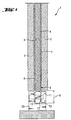
- la figure 1 montre une première forme de réalisation du vitrage en verre feuilleté vissé à une infrastructure pour une structure en verre, représentée en coupe ; et
- la figure 2 montre une seconde forme de réalisation du vitrage en verre feuilleté avec une fixation supplémentaire de l'élément de support.
- Suivant la figure 1, le vitrage en verre feuilleté 1 conforme à l'invention se compose de deux vitres individuelles extérieures 2 et 3 d'une épaisseur de 12 mm, d'une vitre centrale individuelle 4 d'une épaisseur de 10 mm, enserrée entre celles-ci, d'un élément de support 5 d'une épaisseur de 10 mm en acier allié ainsi que de trois feuilles adhésives thermoplastiques 6, 7 et 8 en polyvinylbutyral, qui forment les couches de liaison organiques. Les trois vitres 2, 3 et 4 se composant de verre sont thermiquement précontraintes. La vitre centrale 4 est placée en retrait d'environ 200 mm par rapport au bord inférieur du vitrage en verre feuilleté 1 et forme ainsi une rainure, dans laquelle l'élément de support 5 est introduit. L'élément de support 5 et la vitre centrale 4 sont collés sur toute la surface, à l'aide des feuilles adhésives thermoplastiques 6 et 7, sur les faces principales des vitres individuelles 2 et 3, qui font face à la vitre centrale 4, respectivement à l'élément de support 5. Pour éviter la formation de cavités à cause de coefficients de dilatation thermique différents et pour empêcher l'apparition de bulles de gaz, une bande de feuille adhésive thermoplastique 8 est posée entre les faces d'extrémité tournées l'une vers l'autre de la vitre centrale 4 et de l'élément de support 5.
- Pendant l'opération d'assemblage avec utilisation de pression et de chaleur, ces faces d'extrémité doivent être légèrement pressées l'une contre l'autre avec interposition de la feuille adhésive 8, afin d'obtenir un collage intime et sans défauts. Le segment 9 de l'élément de support 5 en saillie au-delà de la face d'extrémité du vitrage en verre feuilleté 1 est serré dans un support 10 lié à la fondation, au moyen d'une mâchoire de serrage 11 et d'un assemblage vissé 12. Entre l'élément de support 5 et le support de fondation 10 respectivement la mâchoire de serrage 11, on peut placer des couches intermédiaires ou des rondelles d'appui 13 habituellement utilisées dans la construction en acier.
- Dans la figure 2 est représentée une autre forme de réalisation du vitrage en verre feuilleté 1, dans laquelle les vitres extérieures 2 et 3 sont écartées l'une de l'autre par une vitre centrale se composant de deux vitres 41 et 42 d'une épaisseur d'environ 4 mm. Les deux vitres 41 et 42 sont à nouveau collées l'une à l'autre avec une feuille adhésive thermoplastique 43. La disposition des autres parties individuelles du vitrage en verre feuilleté 1 est analogue à celle de la représentation de la figure 1, excepté pour un assemblage vissé supplémentaire 14 de l'élément de support 5 avec les vitres individuelles 2 et 3. L'assemblage vissé 14 est réalisé sans qu'aucune partie ne dépasse dans les faces principales du vitrage en verre feuilleté 1. A cet effet, il est prévu respectivement dans les vitres individuelles 2 et 3 un trou foré chanfreiné 15, dans lequel est logé(e) la tête noyée d'une vis respectivement un écrou, le cas échéant avec interposition d'une doublure élastique. Dans l'élément de support 5 est ménagé un trou foré 16, qui est légèrement plus grand que la tige filetée de l'assemblage vissé 14. Les deux vitres individuelles 2 et 3 peuvent ainsi être serrées sur l'élément de support 5 au moyen d'un assemblage vis/écrou.
- L'élément de support 5 peut s'étendre sur la totalité ou sur une partie de l'arête inférieure du vitrage en verre feuilleté 1, tout comme il est cependant également possible de disposer plusieurs éléments de support étroits espacés les uns des autres le long de l'arête inférieure du vitrage en verre feuilleté. Dans ce cas, l'espace intermédiaire entre les éléments de support doit naturellement être occupé par des saillies correspondantes de la vitre centrale 4 ou par des bandes insérées d'un matériau approprié. Bien entendu, le vitrage en verre feuilleté destiné à une structure vitrée n'est pas non plus limité à une fixation par son arête inférieure. De la même manière, on peut réaliser des éléments de support dans la face d'extrémité supérieure ou dans une face d'extrémité latérale ou dans plusieurs faces d'extrémité.
Claims (10)
- Vitrage en verre feuilleté pour une structure en verre, avec plusieurs vitres individuelles, avec chaque fois une couche de liaison organique entre deux vitres individuelles voisines et avec au moins un élément de support à rigidité propre saillant hors d'une face d'extrémité, qui présente au moins une zone en forme de plaque en un matériau plat, avec laquelle il est introduit entre deux vitres individuelles dans la région du bord du vitrage en verre feuilleté, caractérisée en ce que le vitrage en verre feuilleté (1) se compose d'au moins trois vitres individuelles (2, 3, 4), en ce qu'au moins une vitre centrale (4) logée entre deux vitres individuelles (2, 3) est placée en retrait par rapport à la région du bord du vitrage en verre feuilleté (1) en formant une rainure, dans laquelle la zone en forme de plaque de l'élément de support (5) est disposée, et en ce que l'élément de support (5) est assemblé aux vitres individuelles contiguës (2, 3) au moyen de couches de liaison organiques (6, 7).
- Vitrage en verre feuilleté pour une structure en verre suivant la revendication 1, caractérisé en ce que la vitre centrale se compose de plusieurs vitres (41, 42).
- Vitrage en verre feuilleté pour une structure en verre suivant La revendication 1 ou 2, caractérisé en ce qu'une bande d'une couche de liaison organique (8) est disposée entre les faces d'extrémités tournées l'une vers l'autre de la vitre centrale (4) et de l'élément de support (5).
- Vitrage en verre feuilleté pour une structure en verre suivant l'une quelconque des revendications précédentes, caractérisé en ce que l'élément de support (5) est assemblé à au moins une vitre individuelle (2, 3) du vitrage en verre feuilleté (1) à l'aide d'un assemblage indesserrable ou indéformable (14, 15, 16) en plus des couches de liaison organiques (6, 7).
- Vitrage en verre feuilleté pour une structure en verre suivant l'une quelconque des revendications précédentes, caractérisé en ce qu'il est prévu, sur le segment (9) de l'élément de support (5) débordant vers l'extérieur, des moyens pour fixer (12) le vitrage en verre feuilleté (1) à une infrastructure ou à une structure de support (10).
- Vitrage en verre feuilleté pour une structure en verre suivant l'une quelconque des revendications précédentes, caractérisé en ce que l'élément de support (5) a la forme d'une plaque.
- Vitrage en verre feuilleté pour une structure en verre suivant l'une quelconque des revendications précédentes, caractérisé en ce que l'élément de support (5) est fabriqué en acier allié.
- Vitrage en verre feuilleté pour une structure en verre suivant l'une quelconque des revendications précédentes, caractérisé en ce qu'une ou plusieurs des vitres individuelles (2, 3, 4) sont précontraintes par voie thermique ou chimique.
- Vitrage en verre feuilleté pour une structure en verre suivant l'une quelconque des revendications précédentes, caractérisé en ce que la couche de liaison organique (6, 7, 8, 43) se compose de polyvinylbutyral.
- Vitrage en verre feuilleté pour une structure en verre suivant l'une quelconque des revendications précédentes, caractérisé en ce qu'une des couches de liaison organiques (6, 7, 8, 43) est un produit stratifié composé de deux couches de colle avec une feuille de plastique noyée entre elles et portant une couche fonctionnelle.
Applications Claiming Priority (2)
| Application Number | Priority Date | Filing Date | Title |
|---|---|---|---|
| DE19958372 | 1999-12-06 | ||
| DE19958372A DE19958372C1 (de) | 1999-12-06 | 1999-12-06 | Verbundglasscheibe für eine Glaskonstruktion |
Publications (2)
| Publication Number | Publication Date |
|---|---|
| EP1106342A1 EP1106342A1 (fr) | 2001-06-13 |
| EP1106342B1 true EP1106342B1 (fr) | 2006-01-04 |
Family
ID=7931335
Family Applications (1)
| Application Number | Title | Priority Date | Filing Date |
|---|---|---|---|
| EP00403404A Expired - Lifetime EP1106342B1 (fr) | 1999-12-06 | 2000-12-05 | Vitrage en verre feuilleté pour une structure en verre |
Country Status (6)
| Country | Link |
|---|---|
| EP (1) | EP1106342B1 (fr) |
| AT (1) | ATE314926T1 (fr) |
| DE (2) | DE19958372C1 (fr) |
| DK (1) | DK1106342T3 (fr) |
| ES (1) | ES2255961T3 (fr) |
| PT (1) | PT1106342E (fr) |
Families Citing this family (13)
| Publication number | Priority date | Publication date | Assignee | Title |
|---|---|---|---|---|
| ES1048566Y (es) * | 2001-03-15 | 2001-12-16 | Torres Agustin Martinez | Mochila con protector de columna incorporado. |
| ES2209568A1 (es) * | 2001-03-15 | 2004-06-16 | Construccions Metal Liques Bellapart, S.A. | Sistema de fijacion de paneles de vidrio laminados. |
| BRPI0411258A (pt) * | 2003-06-13 | 2006-08-01 | Du Pont | sistema de laminado de fixação de ponto direto e processos para a preparação e fabricação de um sistema de envidraçamento |
| AT412968B (de) * | 2003-12-22 | 2005-09-26 | Neugebauer Juergen Dipl Ing | Verbundglasscheibe |
| DE102004003960B4 (de) * | 2004-01-27 | 2005-11-03 | Eckelt Glas Gmbh | Verbindungsanordnung für Verbundscheiben |
| DE102004029766A1 (de) * | 2004-06-21 | 2006-01-12 | Dorma Gmbh + Co. Kg | Verbundsicherheitsglaselement |
| DE102005010823A1 (de) * | 2005-03-07 | 2006-09-14 | Joh. Sprinz Gmbh & Co. Kg | Glasplatten-Wandbausystem |
| DE102006003078A1 (de) * | 2006-01-20 | 2007-07-26 | Bergische Universität Wuppertal | Scheibenanordnung |
| BE1018384A5 (nl) * | 2008-08-13 | 2010-10-05 | Assa Abloy Nv | Paneel uit gelaagd glas met een daarin opgenomen metaalstuk, en werkwijze voor het vervaardigen daarvan. |
| ITMI20110332U1 (it) * | 2011-10-19 | 2013-04-20 | Vetreria F Lli Paci Srl | Vetro stratificato di sicurezza con supporto o borchia troncoconica di fissaggio posta internamente al vetro |
| AT518542B1 (de) * | 2016-09-30 | 2017-11-15 | Ing Richard Feuerhuber | Verkleidungselement |
| AT520199B1 (de) | 2017-12-05 | 2019-02-15 | Ing Richard Feuerhuber | Verkleidungselement |
| DE102019103516B3 (de) * | 2019-02-12 | 2020-03-26 | sedak GmbH & Co. KG | Glasverbundeinheit und Verwendung einer Glasverbundeinheit als funktionelles Element eines Gebäudes |
Family Cites Families (6)
| Publication number | Priority date | Publication date | Assignee | Title |
|---|---|---|---|---|
| NL24944C (fr) * | 1929-08-16 | 1931-09-15 | ||
| US3498871A (en) * | 1955-05-05 | 1970-03-03 | Triplex Safety Glass Co | Laminated transparent assemblies |
| GB842657A (en) * | 1956-08-08 | 1960-07-27 | Lockheed Aircraft Corp | Transparent enclosure |
| DE3301757C2 (de) * | 1983-01-20 | 1985-02-21 | Messerschmitt-Bölkow-Blohm GmbH, 8012 Ottobrunn | Fahrzeugfenster |
| DE4125182A1 (de) * | 1991-07-30 | 1993-02-04 | Bischoff Glastechnik | Element fuer eine glaskonstruktion |
| GB2296279B (en) * | 1994-12-22 | 1998-04-15 | Glaverbel | A multiple glazing unit and method for its construction |
-
1999
- 1999-12-06 DE DE19958372A patent/DE19958372C1/de not_active Expired - Lifetime
-
2000
- 2000-12-05 EP EP00403404A patent/EP1106342B1/fr not_active Expired - Lifetime
- 2000-12-05 DK DK00403404T patent/DK1106342T3/da active
- 2000-12-05 AT AT00403404T patent/ATE314926T1/de active
- 2000-12-05 PT PT00403404T patent/PT1106342E/pt unknown
- 2000-12-05 ES ES00403404T patent/ES2255961T3/es not_active Expired - Lifetime
- 2000-12-05 DE DE60025322T patent/DE60025322T2/de not_active Expired - Lifetime
Also Published As
| Publication number | Publication date |
|---|---|
| ES2255961T3 (es) | 2006-07-16 |
| ATE314926T1 (de) | 2006-02-15 |
| PT1106342E (pt) | 2006-05-31 |
| DK1106342T3 (da) | 2006-05-15 |
| EP1106342A1 (fr) | 2001-06-13 |
| DE60025322D1 (de) | 2006-03-30 |
| DE19958372C1 (de) | 2001-01-25 |
| DE60025322T2 (de) | 2006-08-17 |
Similar Documents
| Publication | Publication Date | Title |
|---|---|---|
| EP1106342B1 (fr) | Vitrage en verre feuilleté pour une structure en verre | |
| EP0282468B1 (fr) | Panneau vitré cintré | |
| EP1297237B1 (fr) | Dispositif de fixation pour un element de paroi feuillete | |
| EP0014141B1 (fr) | Vitrage composite à haute résistance aux impacts | |
| EP1954488B1 (fr) | Vitre feuilletee presentant un element de maintien integre | |
| EP0340089B1 (fr) | Elément de vitrage pour façade rideau | |
| EP1711341B1 (fr) | Ensemble des vitrages feuilletes | |
| EP1654431B1 (fr) | Element feuillete en forme de plaque avec une fixation de position pour un assemblage colle | |
| FR2927113A1 (fr) | Ouvrants dans le domaine de la menuiserie | |
| EP3468792B1 (fr) | Vitrage anti-feu | |
| BE1013037A3 (fr) | Vitrage feuillete de securite. | |
| EP1313924B1 (fr) | Assemblage d'elements verriers | |
| EP1518034B1 (fr) | Systeme de fixation d'un panneau de materiau fragile | |
| FR2836523A1 (fr) | Assemlblage d'elements, notamment verriers | |
| FR2718174A1 (fr) | Profilé porteur à haute résistance thermique et agencement par exemple verrière comportant un tel profilé. | |
| EP0887484A1 (fr) | Façade, notammant vitrée | |
| EP0675243B1 (fr) | Profilé porteur stable au feu, par exemple pour verrière et agencement comprenant un tel profilé | |
| EP1908913A1 (fr) | Fixation de vitrage | |
| FR2822881A1 (fr) | Systeme de fixation d'un panneau de materiau fragile | |
| FR2736962A1 (fr) | Systeme de fixation d'un vitrage dans une baie | |
| EP3163001A1 (fr) | Panneau de porte | |
| FR2559815A1 (fr) | Panneau structural a structure composite, destine a la construction immobiliere |
Legal Events
| Date | Code | Title | Description |
|---|---|---|---|
| PUAI | Public reference made under article 153(3) epc to a published international application that has entered the european phase |
Free format text: ORIGINAL CODE: 0009012 |
|
| AK | Designated contracting states |
Kind code of ref document: A1 Designated state(s): AT BE CH CY DE DK ES FI FR GB GR IE IT LI LU MC NL PT SE TR |
|
| AX | Request for extension of the european patent |
Free format text: AL;LT;LV;MK;RO;SI |
|
| 17P | Request for examination filed |
Effective date: 20011203 |
|
| AKX | Designation fees paid |
Free format text: AT BE CH CY DE DK ES FI FR GB GR IE IT LI LU MC NL PT SE TR |
|
| GRAP | Despatch of communication of intention to grant a patent |
Free format text: ORIGINAL CODE: EPIDOSNIGR1 |
|
| GRAS | Grant fee paid |
Free format text: ORIGINAL CODE: EPIDOSNIGR3 |
|
| GRAA | (expected) grant |
Free format text: ORIGINAL CODE: 0009210 |
|
| AK | Designated contracting states |
Kind code of ref document: B1 Designated state(s): AT BE CH CY DE DK ES FI FR GB GR IE IT LI LU MC NL PT SE TR |
|
| PG25 | Lapsed in a contracting state [announced via postgrant information from national office to epo] |
Ref country code: IE Free format text: LAPSE BECAUSE OF FAILURE TO SUBMIT A TRANSLATION OF THE DESCRIPTION OR TO PAY THE FEE WITHIN THE PRESCRIBED TIME-LIMIT Effective date: 20060104 Ref country code: FI Free format text: LAPSE BECAUSE OF FAILURE TO SUBMIT A TRANSLATION OF THE DESCRIPTION OR TO PAY THE FEE WITHIN THE PRESCRIBED TIME-LIMIT Effective date: 20060104 |
|
| REG | Reference to a national code |
Ref country code: GB Ref legal event code: FG4D Free format text: NOT ENGLISH |
|
| REG | Reference to a national code |
Ref country code: CH Ref legal event code: EP |
|
| REG | Reference to a national code |
Ref country code: IE Ref legal event code: FG4D Free format text: LANGUAGE OF EP DOCUMENT: FRENCH |
|
| REF | Corresponds to: |
Ref document number: 60025322 Country of ref document: DE Date of ref document: 20060330 Kind code of ref document: P |
|
| REG | Reference to a national code |
Ref country code: CH Ref legal event code: NV Representative=s name: KIRKER & CIE SA |
|
| REG | Reference to a national code |
Ref country code: SE Ref legal event code: TRGR |
|
| GBT | Gb: translation of ep patent filed (gb section 77(6)(a)/1977) |
Effective date: 20060322 |
|
| REG | Reference to a national code |
Ref country code: DK Ref legal event code: T3 |
|
| REG | Reference to a national code |
Ref country code: PT Ref legal event code: SC4A Effective date: 20060331 |
|
| REG | Reference to a national code |
Ref country code: ES Ref legal event code: FG2A Ref document number: 2255961 Country of ref document: ES Kind code of ref document: T3 |
|
| REG | Reference to a national code |
Ref country code: IE Ref legal event code: FD4D |
|
| PLBE | No opposition filed within time limit |
Free format text: ORIGINAL CODE: 0009261 |
|
| STAA | Information on the status of an ep patent application or granted ep patent |
Free format text: STATUS: NO OPPOSITION FILED WITHIN TIME LIMIT |
|
| 26N | No opposition filed |
Effective date: 20061005 |
|
| PG25 | Lapsed in a contracting state [announced via postgrant information from national office to epo] |
Ref country code: MC Free format text: LAPSE BECAUSE OF NON-PAYMENT OF DUE FEES Effective date: 20061231 |
|
| PGFP | Annual fee paid to national office [announced via postgrant information from national office to epo] |
Ref country code: CH Payment date: 20071128 Year of fee payment: 8 |
|
| PG25 | Lapsed in a contracting state [announced via postgrant information from national office to epo] |
Ref country code: GR Free format text: LAPSE BECAUSE OF FAILURE TO SUBMIT A TRANSLATION OF THE DESCRIPTION OR TO PAY THE FEE WITHIN THE PRESCRIBED TIME-LIMIT Effective date: 20060405 |
|
| PG25 | Lapsed in a contracting state [announced via postgrant information from national office to epo] |
Ref country code: TR Free format text: LAPSE BECAUSE OF FAILURE TO SUBMIT A TRANSLATION OF THE DESCRIPTION OR TO PAY THE FEE WITHIN THE PRESCRIBED TIME-LIMIT Effective date: 20060104 |
|
| PGFP | Annual fee paid to national office [announced via postgrant information from national office to epo] |
Ref country code: PT Payment date: 20080930 Year of fee payment: 9 |
|
| PG25 | Lapsed in a contracting state [announced via postgrant information from national office to epo] |
Ref country code: CY Free format text: LAPSE BECAUSE OF FAILURE TO SUBMIT A TRANSLATION OF THE DESCRIPTION OR TO PAY THE FEE WITHIN THE PRESCRIBED TIME-LIMIT Effective date: 20060104 |
|
| REG | Reference to a national code |
Ref country code: CH Ref legal event code: PL |
|
| PG25 | Lapsed in a contracting state [announced via postgrant information from national office to epo] |
Ref country code: CH Free format text: LAPSE BECAUSE OF NON-PAYMENT OF DUE FEES Effective date: 20081231 Ref country code: LI Free format text: LAPSE BECAUSE OF NON-PAYMENT OF DUE FEES Effective date: 20081231 |
|
| REG | Reference to a national code |
Ref country code: PT Ref legal event code: MM4A Free format text: LAPSE DUE TO NON-PAYMENT OF FEES Effective date: 20100607 |
|
| PG25 | Lapsed in a contracting state [announced via postgrant information from national office to epo] |
Ref country code: PT Free format text: LAPSE BECAUSE OF NON-PAYMENT OF DUE FEES Effective date: 20100607 |
|
| REG | Reference to a national code |
Ref country code: FR Ref legal event code: PLFP Year of fee payment: 16 |
|
| REG | Reference to a national code |
Ref country code: FR Ref legal event code: PLFP Year of fee payment: 17 |
|
| REG | Reference to a national code |
Ref country code: FR Ref legal event code: PLFP Year of fee payment: 18 |
|
| PGFP | Annual fee paid to national office [announced via postgrant information from national office to epo] |
Ref country code: LU Payment date: 20191125 Year of fee payment: 20 |
|
| PGFP | Annual fee paid to national office [announced via postgrant information from national office to epo] |
Ref country code: DE Payment date: 20191119 Year of fee payment: 20 Ref country code: NL Payment date: 20191212 Year of fee payment: 20 Ref country code: SE Payment date: 20191210 Year of fee payment: 20 |
|
| PGFP | Annual fee paid to national office [announced via postgrant information from national office to epo] |
Ref country code: DK Payment date: 20191210 Year of fee payment: 20 Ref country code: FR Payment date: 20191213 Year of fee payment: 20 Ref country code: BE Payment date: 20191118 Year of fee payment: 20 Ref country code: IT Payment date: 20191209 Year of fee payment: 20 |
|
| PGFP | Annual fee paid to national office [announced via postgrant information from national office to epo] |
Ref country code: AT Payment date: 20191125 Year of fee payment: 20 |
|
| PGFP | Annual fee paid to national office [announced via postgrant information from national office to epo] |
Ref country code: ES Payment date: 20200102 Year of fee payment: 20 Ref country code: GB Payment date: 20191206 Year of fee payment: 20 |
|
| REG | Reference to a national code |
Ref country code: DE Ref legal event code: R071 Ref document number: 60025322 Country of ref document: DE |
|
| REG | Reference to a national code |
Ref country code: DK Ref legal event code: EUP Expiry date: 20201205 |
|
| REG | Reference to a national code |
Ref country code: NL Ref legal event code: MK Effective date: 20201204 |
|
| REG | Reference to a national code |
Ref country code: GB Ref legal event code: PE20 Expiry date: 20201204 |
|
| REG | Reference to a national code |
Ref country code: AT Ref legal event code: MK07 Ref document number: 314926 Country of ref document: AT Kind code of ref document: T Effective date: 20201205 |
|
| PG25 | Lapsed in a contracting state [announced via postgrant information from national office to epo] |
Ref country code: GB Free format text: LAPSE BECAUSE OF EXPIRATION OF PROTECTION Effective date: 20201204 |
|
| REG | Reference to a national code |
Ref country code: BE Ref legal event code: MK Effective date: 20201205 |
|
| REG | Reference to a national code |
Ref country code: ES Ref legal event code: FD2A Effective date: 20210326 |
|
| PG25 | Lapsed in a contracting state [announced via postgrant information from national office to epo] |
Ref country code: ES Free format text: LAPSE BECAUSE OF EXPIRATION OF PROTECTION Effective date: 20201206 |
|
| REG | Reference to a national code |
Ref country code: SE Ref legal event code: EUG |