EP1108451A2 - Planche de glisse - Google Patents
Planche de glisse Download PDFInfo
- Publication number
- EP1108451A2 EP1108451A2 EP00126801A EP00126801A EP1108451A2 EP 1108451 A2 EP1108451 A2 EP 1108451A2 EP 00126801 A EP00126801 A EP 00126801A EP 00126801 A EP00126801 A EP 00126801A EP 1108451 A2 EP1108451 A2 EP 1108451A2
- Authority
- EP
- European Patent Office
- Prior art keywords
- entropy
- elastic
- board according
- sliding board
- elastic insert
- Prior art date
- Legal status (The legal status is an assumption and is not a legal conclusion. Google has not performed a legal analysis and makes no representation as to the accuracy of the status listed.)
- Withdrawn
Links
- 239000002344 surface layer Substances 0.000 claims abstract description 16
- 239000000463 material Substances 0.000 claims abstract description 12
- 229920003052 natural elastomer Polymers 0.000 claims abstract description 11
- 229920001194 natural rubber Polymers 0.000 claims abstract description 11
- 229920003051 synthetic elastomer Polymers 0.000 claims abstract description 9
- 239000005061 synthetic rubber Substances 0.000 claims abstract description 9
- 244000043261 Hevea brasiliensis Species 0.000 claims abstract description 5
- 239000010410 layer Substances 0.000 claims description 43
- 239000004593 Epoxy Substances 0.000 claims description 8
- KAKZBPTYRLMSJV-UHFFFAOYSA-N Butadiene Chemical compound C=CC=C KAKZBPTYRLMSJV-UHFFFAOYSA-N 0.000 claims description 6
- PPBRXRYQALVLMV-UHFFFAOYSA-N Styrene Chemical compound C=CC1=CC=CC=C1 PPBRXRYQALVLMV-UHFFFAOYSA-N 0.000 claims description 6
- 238000004519 manufacturing process Methods 0.000 claims description 6
- OKTJSMMVPCPJKN-UHFFFAOYSA-N Carbon Chemical compound [C] OKTJSMMVPCPJKN-UHFFFAOYSA-N 0.000 claims description 4
- JOYRKODLDBILNP-UHFFFAOYSA-N Ethyl urethane Chemical compound CCOC(N)=O JOYRKODLDBILNP-UHFFFAOYSA-N 0.000 claims description 4
- 239000004721 Polyphenylene oxide Substances 0.000 claims description 4
- XAGFODPZIPBFFR-UHFFFAOYSA-N aluminium Chemical compound [Al] XAGFODPZIPBFFR-UHFFFAOYSA-N 0.000 claims description 4
- 229910052782 aluminium Inorganic materials 0.000 claims description 4
- 229910052799 carbon Inorganic materials 0.000 claims description 4
- 239000011152 fibreglass Substances 0.000 claims description 4
- 239000006260 foam Substances 0.000 claims description 4
- 229920000570 polyether Polymers 0.000 claims description 4
- 229920002725 thermoplastic elastomer Polymers 0.000 claims description 4
- 229920001577 copolymer Polymers 0.000 claims description 3
- 229920006267 polyester film Polymers 0.000 claims description 3
- 238000003825 pressing Methods 0.000 claims description 3
- 229910001220 stainless steel Inorganic materials 0.000 claims description 3
- 239000010935 stainless steel Substances 0.000 claims description 3
- 230000001413 cellular effect Effects 0.000 claims description 2
- NINIDFKCEFEMDL-UHFFFAOYSA-N Sulfur Chemical compound [S] NINIDFKCEFEMDL-UHFFFAOYSA-N 0.000 abstract description 2
- 229910052717 sulfur Inorganic materials 0.000 abstract description 2
- 239000011593 sulfur Substances 0.000 abstract description 2
- 238000013016 damping Methods 0.000 description 9
- 230000027455 binding Effects 0.000 description 3
- 238000009739 binding Methods 0.000 description 3
- 229910000831 Steel Inorganic materials 0.000 description 1
- 239000006096 absorbing agent Substances 0.000 description 1
- 230000015572 biosynthetic process Effects 0.000 description 1
- 239000004566 building material Substances 0.000 description 1
- 238000000034 method Methods 0.000 description 1
- 238000000465 moulding Methods 0.000 description 1
- 230000009894 physiological stress Effects 0.000 description 1
- 239000010959 steel Substances 0.000 description 1
- 229920001169 thermoplastic Polymers 0.000 description 1
- 239000004416 thermosoftening plastic Substances 0.000 description 1
Images

Classifications
-
- A—HUMAN NECESSITIES
- A63—SPORTS; GAMES; AMUSEMENTS
- A63C—SKATES; SKIS; ROLLER SKATES; DESIGN OR LAYOUT OF COURTS, RINKS OR THE LIKE
- A63C5/00—Skis or snowboards
- A63C5/12—Making thereof; Selection of particular materials
Definitions
- the invention relates to a sliding board with at least one, at any point of the sliding board between its surface layer and the ones below Layers of entropy-elastic insert.
- Sliding boards in the sense of the invention can be, for example, skis or snowboards.
- DE 39 14 189 A1 already discloses a manufacturing process for a Ski described, in which a so-called shell ski is made, which in Bond area also an entropy-elastic damper layer below the Has surface layer.
- the object of the invention is to develop a gliding board such that its ability to absorbing impact energy (energy waves) absorbed during skiing, is further improved.
- this task is based on a generic Gliding board solved by the characterizing features of claim 1. Therefore is the area of the surface layer under which the entropy-elastic insert is arranged, raised above the remaining surface of the gliding board. It will be here that is, an entropy-elastic layer which is thicker than the rest of the layer structure provided that has a corresponding elasticity.
- the entropy-elastic insert acting as a friction body can between Upper flange and surface layer can be arranged.
- it can also the upper chord or the upper chords in the areas of entropy-elastic Insert be added so that the entropy-elastic insert in the recessed Areas of the upper chord or the upper chords reach into it.
- the entropy-elastic inlays can vary depending on the desired damping behavior of the sliding board can be arranged on this.
- the entropy-elastic Deposits for example, starting from the middle of the sliding board up to its Extend the tip or from the middle of the sliding board to its end.
- the entropy-elastic inserts can be drawn towards the side walls Area between the middle and the tip of the gliding board as well as between the middle and the end of the slide board each laterally opposite the imaginary center line of the sliding board.
- the entpieelastic ones Inlays both in the edge area of the surface and in the area of the Sidewalls may be arranged.
- the advantage here is that in addition to the Vibration damping, for example, from another ski or can be well dampened by tilting rods on the top edge of the ski.
- the at least one entropy-elastic insert can advantageously be such a strong one Resetting behavior that they after pressing the sliding board in a Shape with a flat surface in the areas where it is arranged is to bulge the surface layer over the otherwise flat gliding board surface leads out.
- Sliding board with three-dimensional surface structure can be created.
- the entropy-elastic insoles can be one-sided or two-sided by a Compulsory shift must be covered.
- a constraint layer can consist of a thin one Stainless steel layer, a thin aluminum layer, a correspondingly thin Polyester film, epoxy fiberglass laminates or epoxy carbon laminates exist.
- the constrained layers are dimensioned so thin that the three-dimensional bulges the surface in the area of the entropy-elastic layers without corresponding Counterparts in the mold cover, and thus after removal from the mold Mold cover by arching the entropy-elastic layer of can arise themselves.
- the entropy-elastic insert can be made of natural or synthetic rubber materials consist.
- the natural rubber material can be made from a 1 up to 10 percent by weight of sulfur-containing natural rubber.
- the synthetic Rubber material can be made from a copolymer of styrene and butadiene consist.
- the entropy-elastic insert can consist of a foam, which is made of a natural or synthetic rubber material.
- the viscoelastic damping layer can also be made of a mixed-cell polyether urethane (PUR), as it is sold, for example, under the trade name " Silomer ®”.
- PUR mixed-cell polyether urethane
- thermoplastic elastomers consist.
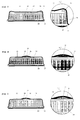
- a conventional ski 10 is shown in section. It is about here a so-called shell ski, which has a surface layer 12 in shape covers a bowl. As usual, the bottom of the ski has a sliding surface 20 and laterally attached steel edges 22. Inside is a core 18 and an upper chord 14, which can also be constructed in multiple layers.
- the top chord 14 in the embodiment as shown in Fig. 1 consists, for example Epoxy fiberglass, laminate or prepreg, aluminum or epoxy carbon laminate or Prepreg.
- an entropy-elastic Arranged friction body 16 which in the present embodiment consists of a foam that is based on a synthetic Rubber material made, for example, as a copolymer of styrene and butadiene has been.
- the entropy-elastic insert is in the embodiment shown here arranged in the center and does not run, as here in the sectional view 1, from the center of the ski to the tip of the ski. It bulges the entropy-elastic layer 16 outwards. That means the part the surface layer 12, under which the entropy-elastic layer 16 is arranged is bulged outwards so that it protrudes beyond the gliding board surface raised area arises.
- FIG. 2 corresponds essentially to that according to Fig. 1.
- the upper chord 14 is in the area in which the Entropy-elastic layer 16 is arranged, interrupted, so that the entropy-elastic Layer 16 between the ski core 18 and the surface layer 12 extends.
- Figure 3 shows a cross section by a ski 10 during the pressing between an upper mold part 24 and a lower mold part 26, in which between the surface layer 12 and the core, which is not identified in detail in FIG. 3, is an entropy-elastic one Insert 16 is arranged. In the area of the entropy-elastic insert 16 the upper chord 14 interrupted.
- FIG 4 shows the ski produced by means of the molding process according to FIG the demolding from the mold 24, 26 shown. Because of the resetting behavior of the entropy-elastic insert, the surface layer 12 is in the area in which the upper chord 14 is interrupted, pressed outwards, so that a corresponding increase shown here is achieved. Because of the resetting behavior The entropy-elastic insert can therefore increase more or less be achieved.
- the three-dimensional design of the surface achieved in this way of the ski can be achieved without the lid of the upper part of the Form 24 must be designed in accordance with three dimensions, which according to the previous State of the art was necessary.
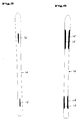
- FIG. 5 and 6 show positions for entropy-elastic layers 16 shown on the ski 10.
- one is entropy-elastic Insert in the symmetry center line of the layer in the front part of the ski and placed in the back of the ski.
- FIG. 6 in turn shows a ski 10 in which the entropy-elastic inserts 16 between the surface layer and the core laterally in the area and are attached behind the binding. This way, in addition to vibration damping also dampened edge hits.
- the entropy-elastic inserts can advantageously be made of light foams consist of natural or synthetic rubber materials become.
- Thermoplastic elastomers can also be used. Through commitment These light building materials can significantly reduce the weight of the skis. So far one had to design surfaces on prepregs in three dimensions or thermoplastic inlays with appropriately designed Use molded lids, creating a ski with a three-dimensional surface built comparatively heavier.
- FIG. 17 shows a further embodiment variant of the ski according to the invention, in which the upper flange 14 is pulled down laterally as a shell over the core 18 is.
- the entropy-elastic or visco-elastic layer 16 is both in the Edge region of the surface 13 and also arranged in the region of the side cheeks 10.
- the advantage of this variant is that in addition to the Vibration damping Impacts on the top edge of the ski, such as through a knock hit with another ski or a tipping bar can be damped much better than with a design in which the entropy-elastic damping layer only on the surface in the area of the upper edge is arranged.
- FIGS. 8 and 9 design variants are shown in which the dampers are designed as a compulsory damping system.
- a one-sided constraint layer is provided.
- the viscoelastic layer is both above with the upper layer 23 as well as below via one below lying compulsory layer 24 covered.
- layers of stainless steel in thicknesses can be used as forced layers Insert 0.025 mm, 0.038 mm, 0.051 mm, 0.127 mm or 0.254 mm.
- layers of aluminum which have a layer thickness of 0.127 mm, 0.203 mm, 0.254 mm or 0.305 mm.
- polyester films with a A thickness of 0.036 mm can be used, as can epoxy fiberglass laminates or epoxy carbon laminates. It is essential that the restoring force of the viscoelastic Layer is sufficient in spite of compulsory layers after the demolding of the Ski to achieve the intended three-dimensional shape.
- the forced layers on the other hand must be chosen so thin that the three-dimensional Formation of the surface in the area of the viscoelastic layers also with forced layers without corresponding counterparts in the mold cover, i.e. after demoulding.
- the entropy-elastic damping layers consist of mixed-cell polyether urethane (PUR).
- PUR mixed-cell polyether urethane
- Silomer® a cellular polyether urethane
Landscapes
- Laminated Bodies (AREA)
Applications Claiming Priority (2)
| Application Number | Priority Date | Filing Date | Title |
|---|---|---|---|
| DE29921881U | 1999-12-13 | ||
| DE29921881U DE29921881U1 (de) | 1999-12-13 | 1999-12-13 | Gleitbrett |
Publications (2)
| Publication Number | Publication Date |
|---|---|
| EP1108451A2 true EP1108451A2 (fr) | 2001-06-20 |
| EP1108451A3 EP1108451A3 (fr) | 2002-06-12 |
Family
ID=8082894
Family Applications (1)
| Application Number | Title | Priority Date | Filing Date |
|---|---|---|---|
| EP00126801A Withdrawn EP1108451A3 (fr) | 1999-12-13 | 2000-12-06 | Planche de glisse |
Country Status (5)
| Country | Link |
|---|---|
| US (1) | US20010005072A1 (fr) |
| EP (1) | EP1108451A3 (fr) |
| JP (1) | JP2002017941A (fr) |
| DE (1) | DE29921881U1 (fr) |
| NO (1) | NO20006322L (fr) |
Cited By (2)
| Publication number | Priority date | Publication date | Assignee | Title |
|---|---|---|---|---|
| FR2918291A1 (fr) * | 2007-07-06 | 2009-01-09 | Salomon Sa Soc Par Actions Sim | Paire de skis |
| JP2022107494A (ja) * | 2021-01-08 | 2022-07-21 | 東莞顛覆産品設計有限公司 | 高エントロピー合金のスキー用具における用途 |
Families Citing this family (2)
| Publication number | Priority date | Publication date | Assignee | Title |
|---|---|---|---|---|
| US6612605B2 (en) * | 1999-09-29 | 2003-09-02 | K-2 Corporation | Integrated modular glide board |
| AT501312B1 (de) * | 2005-02-04 | 2009-05-15 | Hexcel Holding Gmbh | Verfahren zur herstellung eines gleitgeräts und gleitgerät |
Citations (2)
| Publication number | Priority date | Publication date | Assignee | Title |
|---|---|---|---|---|
| DE3914189A1 (de) | 1989-04-28 | 1990-10-31 | Blizzard Oesterreich Ges M B H | Skiherstellungsverfahren und ski, hergestellt nach diesem verfahren |
| EP0419779A1 (fr) | 1989-09-27 | 1991-04-03 | BLIZZARD Ges.m.b.H | Ski |
Family Cites Families (4)
| Publication number | Priority date | Publication date | Assignee | Title |
|---|---|---|---|---|
| FR2672505B1 (fr) * | 1991-02-08 | 1993-05-21 | Salomon Sa | Ski pour sport d'hiver comprenant une plateforme de montage des fixations. |
| FR2709673B1 (fr) * | 1993-09-07 | 1995-10-06 | Rossignol Sa | Procédé pour la fabrication d'un ski en forme. |
| DE4402669A1 (de) * | 1994-01-29 | 1995-08-03 | Franz Voelkl Gmbh & Co Ski Ten | Ski |
| DE29720177U1 (de) * | 1997-11-06 | 1998-01-15 | Franz Völkl GmbH & Co. Ski und Tennis Sportartikelfabrik KG, 94315 Straubing | Ski, Snowboard o.dgl. Schneegleitelement |
-
1999
- 1999-12-13 DE DE29921881U patent/DE29921881U1/de not_active Expired - Lifetime
-
2000
- 2000-12-06 EP EP00126801A patent/EP1108451A3/fr not_active Withdrawn
- 2000-12-12 NO NO20006322A patent/NO20006322L/no not_active Application Discontinuation
- 2000-12-13 JP JP2000404171A patent/JP2002017941A/ja active Pending
- 2000-12-13 US US09/734,545 patent/US20010005072A1/en not_active Abandoned
Patent Citations (2)
| Publication number | Priority date | Publication date | Assignee | Title |
|---|---|---|---|---|
| DE3914189A1 (de) | 1989-04-28 | 1990-10-31 | Blizzard Oesterreich Ges M B H | Skiherstellungsverfahren und ski, hergestellt nach diesem verfahren |
| EP0419779A1 (fr) | 1989-09-27 | 1991-04-03 | BLIZZARD Ges.m.b.H | Ski |
Cited By (2)
| Publication number | Priority date | Publication date | Assignee | Title |
|---|---|---|---|---|
| FR2918291A1 (fr) * | 2007-07-06 | 2009-01-09 | Salomon Sa Soc Par Actions Sim | Paire de skis |
| JP2022107494A (ja) * | 2021-01-08 | 2022-07-21 | 東莞顛覆産品設計有限公司 | 高エントロピー合金のスキー用具における用途 |
Also Published As
| Publication number | Publication date |
|---|---|
| DE29921881U1 (de) | 2000-02-03 |
| EP1108451A3 (fr) | 2002-06-12 |
| US20010005072A1 (en) | 2001-06-28 |
| NO20006322L (no) | 2001-06-14 |
| NO20006322D0 (no) | 2000-12-12 |
| JP2002017941A (ja) | 2002-01-22 |
Similar Documents
| Publication | Publication Date | Title |
|---|---|---|
| DE4322300C2 (de) | Ski mit einer Schale, einem Untergurt sowie einem vorzugsweise in die Schale integrierten Obergurt und Verfahren zum Herstellen eines Skis | |
| DE69400500T2 (de) | Snowboard | |
| AT401350B (de) | Alpinski | |
| DE69108001T2 (de) | Ski für Wintersport mit Montagebühne für Skibindungen. | |
| DE3240717A1 (de) | Ski | |
| DE19810035A1 (de) | Kern für ein Gleitbrett | |
| DE69201341T2 (de) | Ski mit einem nicht-rechteckigen Durchschnitt. | |
| DE69821177T2 (de) | Sportschuh | |
| AT508022A4 (de) | Brettartiges gleitgerät in der gestalt eines schis oder snowboards | |
| DE3521441A1 (de) | Schneeski, insbesondere abfahrtsski | |
| DE2406145A1 (de) | Ski | |
| DE3418568A1 (de) | Verfahren zum herstellen eines skis im spritzguss | |
| DE60319631T2 (de) | Gleitgerät mit zwei Wänden | |
| DE69922586T2 (de) | Schneegleitbrett | |
| EP1169098B1 (fr) | Ski alpin | |
| AT405610B (de) | Verbundplatte zur montage einer bindung für einen schuh auf einem alpinski | |
| DE3314579A1 (de) | Mehrschichtenski in sandwichbauweise | |
| AT398380B (de) | Ski, insbesondere alpinski, und verfahren zu seiner herstellung | |
| DE69922299T2 (de) | Verfahren zur Herstellung eines Schneegleitbretts | |
| DE69414852T2 (de) | Platte für einen billiardartigen spieltisch | |
| DE9316962U1 (de) | Skiaufbau | |
| EP0394835B1 (fr) | Procédé de fabrication de ski et ski fabriqué par ce procédé | |
| DE29921881U1 (de) | Gleitbrett | |
| DE69604350T2 (de) | Gleitbrett mit Plattform zur Aufnahme und Erhöhung der Skibindung | |
| DE602004013218T2 (de) | Ski für Alpineskifahren |
Legal Events
| Date | Code | Title | Description |
|---|---|---|---|
| PUAI | Public reference made under article 153(3) epc to a published international application that has entered the european phase |
Free format text: ORIGINAL CODE: 0009012 |
|
| AK | Designated contracting states |
Kind code of ref document: A2 Designated state(s): AT BE CH CY DE DK ES FI FR GB GR IE IT LI LU MC NL PT SE TR |
|
| AX | Request for extension of the european patent |
Free format text: AL;LT;LV;MK;RO;SI |
|
| PUAL | Search report despatched |
Free format text: ORIGINAL CODE: 0009013 |
|
| AK | Designated contracting states |
Kind code of ref document: A3 Designated state(s): AT BE CH CY DE DK ES FI FR GB GR IE IT LI LU MC NL PT SE TR |
|
| AX | Request for extension of the european patent |
Free format text: AL;LT;LV;MK;RO;SI |
|
| 17P | Request for examination filed |
Effective date: 20020827 |
|
| AKX | Designation fees paid |
Designated state(s): AT CH DE FR IT LI |
|
| STAA | Information on the status of an ep patent application or granted ep patent |
Free format text: STATUS: THE APPLICATION IS DEEMED TO BE WITHDRAWN |
|
| 18D | Application deemed to be withdrawn |
Effective date: 20051213 |