EP1108603B1 - Procédé pour la prédiction et délimitation d'un trajet pour un véhicule - Google Patents
Procédé pour la prédiction et délimitation d'un trajet pour un véhicule Download PDFInfo
- Publication number
- EP1108603B1 EP1108603B1 EP00125311A EP00125311A EP1108603B1 EP 1108603 B1 EP1108603 B1 EP 1108603B1 EP 00125311 A EP00125311 A EP 00125311A EP 00125311 A EP00125311 A EP 00125311A EP 1108603 B1 EP1108603 B1 EP 1108603B1
- Authority
- EP
- European Patent Office
- Prior art keywords
- value
- vehicle
- quotients
- wheel
- correction factor
- Prior art date
- Legal status (The legal status is an assumption and is not a legal conclusion. Google has not performed a legal analysis and makes no representation as to the accuracy of the status listed.)
- Expired - Lifetime
Links
Images

Classifications
-
- B—PERFORMING OPERATIONS; TRANSPORTING
- B60—VEHICLES IN GENERAL
- B60W—CONJOINT CONTROL OF VEHICLE SUB-UNITS OF DIFFERENT TYPE OR DIFFERENT FUNCTION; CONTROL SYSTEMS SPECIALLY ADAPTED FOR HYBRID VEHICLES; ROAD VEHICLE DRIVE CONTROL SYSTEMS FOR PURPOSES NOT RELATED TO THE CONTROL OF A PARTICULAR SUB-UNIT
- B60W30/00—Purposes of road vehicle drive control systems not related to the control of a particular sub-unit, e.g. of systems using conjoint control of vehicle sub-units
- B60W30/14—Adaptive cruise control
- B60W30/16—Control of distance between vehicles, e.g. keeping a distance to preceding vehicle
-
- B—PERFORMING OPERATIONS; TRANSPORTING
- B60—VEHICLES IN GENERAL
- B60K—ARRANGEMENT OR MOUNTING OF PROPULSION UNITS OR OF TRANSMISSIONS IN VEHICLES; ARRANGEMENT OR MOUNTING OF PLURAL DIVERSE PRIME-MOVERS IN VEHICLES; AUXILIARY DRIVES FOR VEHICLES; INSTRUMENTATION OR DASHBOARDS FOR VEHICLES; ARRANGEMENTS IN CONNECTION WITH COOLING, AIR INTAKE, GAS EXHAUST OR FUEL SUPPLY OF PROPULSION UNITS IN VEHICLES
- B60K31/00—Vehicle fittings, acting on a single sub-unit only, for automatically controlling vehicle speed, i.e. preventing speed from exceeding an arbitrarily established velocity or maintaining speed at a particular velocity, as selected by the vehicle operator
- B60K31/0008—Vehicle fittings, acting on a single sub-unit only, for automatically controlling vehicle speed, i.e. preventing speed from exceeding an arbitrarily established velocity or maintaining speed at a particular velocity, as selected by the vehicle operator including means for detecting potential obstacles in vehicle path
-
- B—PERFORMING OPERATIONS; TRANSPORTING
- B60—VEHICLES IN GENERAL
- B60W—CONJOINT CONTROL OF VEHICLE SUB-UNITS OF DIFFERENT TYPE OR DIFFERENT FUNCTION; CONTROL SYSTEMS SPECIALLY ADAPTED FOR HYBRID VEHICLES; ROAD VEHICLE DRIVE CONTROL SYSTEMS FOR PURPOSES NOT RELATED TO THE CONTROL OF A PARTICULAR SUB-UNIT
- B60W30/00—Purposes of road vehicle drive control systems not related to the control of a particular sub-unit, e.g. of systems using conjoint control of vehicle sub-units
- B60W30/18—Propelling the vehicle
- B60W30/18009—Propelling the vehicle related to particular drive situations
- B60W30/18145—Cornering
-
- B—PERFORMING OPERATIONS; TRANSPORTING
- B60—VEHICLES IN GENERAL
- B60W—CONJOINT CONTROL OF VEHICLE SUB-UNITS OF DIFFERENT TYPE OR DIFFERENT FUNCTION; CONTROL SYSTEMS SPECIALLY ADAPTED FOR HYBRID VEHICLES; ROAD VEHICLE DRIVE CONTROL SYSTEMS FOR PURPOSES NOT RELATED TO THE CONTROL OF A PARTICULAR SUB-UNIT
- B60W2520/00—Input parameters relating to overall vehicle dynamics
- B60W2520/28—Wheel speed
-
- B—PERFORMING OPERATIONS; TRANSPORTING
- B60—VEHICLES IN GENERAL
- B60W—CONJOINT CONTROL OF VEHICLE SUB-UNITS OF DIFFERENT TYPE OR DIFFERENT FUNCTION; CONTROL SYSTEMS SPECIALLY ADAPTED FOR HYBRID VEHICLES; ROAD VEHICLE DRIVE CONTROL SYSTEMS FOR PURPOSES NOT RELATED TO THE CONTROL OF A PARTICULAR SUB-UNIT
- B60W2540/00—Input parameters relating to occupants
- B60W2540/14—Clutch pedal position
Definitions
- the invention relates to a method for the predictive determination of a driving corridor of a motor vehicle for an automatic distance control and monitoring system, in which the future driving corridor is determined from the wheel speeds of the vehicle wheels of an axle of the motor vehicle.
- a method for predictive determination of a travel corridor of a motor vehicle is known.
- the yaw rate of the vehicle is determined and determines the curve radius for each vehicle wheel of an axis as a quotient of the wheel speed and the determined yaw rate.
- this driving corridor it is determined which position the vehicle will occupy after a predetermined period of time and which vehicles or obstacles in front are in the driving corridor of the own vehicle.
- the distance control system determines the object to which the distance of the vehicle to be controlled is set.
- the wheel speed is determined from the wheel speeds, which are each measured on a wheel of an axle.
- the tire diameter of the two wheels, which are used for this measurement must be exactly the same. Different tire diameters of the wheels mean that the calculated driving corridor does not coincide with the actual driving corridor traveled by the vehicle. So it may happen that when driving straight ahead of the vehicle, the calculated driving corridor is not straight ahead.
- the generic Publication WO 99/10747 discloses a method for accurately determining the velocity of a rotating component, wherein from the actual distribution of the discontinuities on the rotating component a correction value is determined with which a corrected speed is determined.
- the invention is therefore based on the object of specifying a method for the predictive determination of a driving corridor of the motor vehicle, in which with the help of the wheel speeds of the calculated driving corridor corresponds to the actual Fahrkorridor, which will drive the vehicle in the future.
- the object is achieved by the features of claim 1. It is provided that at least the wheel speed of a vehicle wheel is subjected to a variable tire correction factor before determining the travel corridor. Due to the automatic wheel alignment, this correction factor is recalculated and tracked at predetermined time intervals.
- the wheel speeds of the wheels of the axle are determined over a predetermined distance to determine the correction factor and formed from the thus formed wheel speeds of the two wheels a quotient.
- the speed quotient which is either with the help of the wheels of the driven axle or the non-driven one Axis is determined, an evaluation of the route of the vehicle is easily possible. It should be emphasized that the assessment of the route takes place independently of the driving speed of the motor vehicle.
- the correction factor is constantly redetermined in the course of a driving cycle of the motor vehicle, a simple and advantageous adaptation of the driving corridor determined with the aid of the variable tire correction factor to the actual driving corridor of the motor vehicle is thus possible.
- the wheel speeds of both belonging to an axle vehicle wheels are subjected to the tire correction factor.
- the tire correction factor is only determined when the vehicle is traveling in the straight ahead.
- a plurality of quotients determined over a certain period are checked with regard to the frequency of occurrence of similar values of the quotients, the number of quotients each having a similar value being counted and stored in a frequency distribution. Due to the large number of quotients that are used to determine the driving corridor, a statistical statement about the driving corridor is possible, so that the future driving corridor of the motor vehicle can be calculated with great certainty.
- the last determined correction factor is stored and at the beginning of a new driving cycle, the frequency distribution is re-determined from the stored correction value, wherein the stored correction value and the newly determined frequency distribution are used to determine the wheel speeds of the wheels. This ensures that the driving corridor can be determined even in the starting situation of the motor vehicle, although not enough quotients could be determined on the current driving cycle.
- the number of the quotient with the smallest value or the number of the quotient with the largest value is changed numerically.
- a particularly accurate tire correction factor results when the number of the quotient with the smallest value and the number of the quotient with the largest value are alternately reduced by the same value.
- the tire correction factor is only calculated at a vehicle speed that is greater than a vehicle speed threshold.
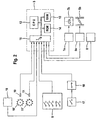
- FIG. 1 In the FIG. 1 is on the bumper 2 of a motor vehicle 1, an automatic speed and distance control system 3 arranged to maintain the safety distance of vehicles, which in a housing a radar sensor, a Signalauswerteschari and the distance control device contains.
- Vehicles traveling ahead or other obstacles are detected by the sensor beam 6 of the radar sensor 16.
- the automatic speed and distance control system 3 for example, with the engine control 5, a transmission 7 and a brake 8 is connected.
- Electronic commands generated by the automatic speed and distance control 3 automatically regulate the speed and thus the distance of the controlled vehicle 1 to a preceding, slower vehicle.
- an operating element 9 is connected to the bus system 4, which is actuated by the driver and inputs his wishes corresponding signals in terms of speed, or the distance control.
- the rotational speeds of the individual vehicle wheels are detected by connected to the bus system 4 speed sensors 10, 11,12, 13.
- the speed sensors consist of incremental disks 10 'and 11', which are arranged on the respective two front wheels of the motor vehicle not shown. These incremental disks 10 ', 11' are scanned with respect to the rotational speed by wheel sensors 10, 11, which are arranged opposite the incremental disks 10 and 11 '.
- the speed signals are, as already explained, supplied to the distance and control system 3.
- This consists of a powerful microcomputer, which is composed of a central processing unit 12, a main memory 13, a read-only memory 4 and an input and output unit 15.
- the radar sensor 16 and the operating element 9 are also connected to the input / output unit 15.
- the wheel sensors 10, 11 may be inductive sensors or Hall sensors.
- the microprocessor 12 calculates from the signals supplied by the radar sensor 6 (distance signal and relative speed signal) and the intrinsic speed of the vehicle to be controlled, the speed difference between both vehicles and determines from these the safe minimum distance. If the distance mode is activated by the driver, the distance to the vehicle in front is automatically adjusted to a selectable distance. By pressing a button on the control switch 9 a desired speed and / or the desired distance is set and stored and maintained by the system.
- the distance control 3 When approaching a slower vehicle takes the distance control 3 by automatically closing the throttle valve 5b, a reduction in the vehicle speed and thus regulates the set target distance to the vehicle in front.
- the nominal distance is always the same / greater than the safety distance prescribed by law.
- the speed and distance control system 3 is connected to switches of the vehicle brake 17 and the vehicle clutch 18, respectively. If these are actuated by the driver via the clutch and brake pedals, they normally cause the distance control to be switched off.
- the CPU 12 determines the respective speed of a wheel. For the determination of the estimated travel corridor, always the wheel speed of the wheels of an axle must be made. These can be either the wheels of the driven or the wheels of the non-driven axle.
- a correction factor stored in the ROM 14 is read into the working memory 13 of the microprocessor. The microprocessor determines from the stored correction factor a frequency distribution which runs symmetrically around the stored correction factor.
- the correction factor of the current driving cycle of the vehicle is determined.
- the respective speeds of the right and left wheels of an axle are determined from the wheel speeds which the wheel sensors 10 and 11 deliver.
- Both wheel speeds V R and V L are set in ratio and form the correction factor Q.
- Q i V L / V R
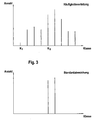
- This frequency distribution has different classes K1 to Kn.
- Each class represents the number of correction factors Q i at which approximately the same speed was measured.
- K 1 forms the number of correction factors with the lowest value
- K n denotes the correction factor with the highest value.
- Fig. 3 such a distribution is shown.
- the wheel speed is calculated from the right and from the left via a defined path and the quotient of the values speed V R is formed by the speed V L.
- the number of quotients stored in these classes is decremented by 1 alternately from the smallest or the largest assigned class of the frequency distribution.
- the average value is formed from the speed coefficients Q, which is multiplied as the current tire correction factor for determining the speed of the right wheel.
- the calculation of the correction factor only takes place if it was estimated using the location deviation determined from the mean value that the route course is characterized by straight lines or long curves. If this is the case, the standard deviation will in most cases include less than 3 classes.
- the determined by means of Kurvenradiusses driving tube has at least the width of the distance between the two wheels, but can also be wider.
Landscapes
- Engineering & Computer Science (AREA)
- Transportation (AREA)
- Mechanical Engineering (AREA)
- Automation & Control Theory (AREA)
- Chemical & Material Sciences (AREA)
- Combustion & Propulsion (AREA)
- Regulating Braking Force (AREA)
- Control Of Driving Devices And Active Controlling Of Vehicle (AREA)
- Control Of Vehicle Engines Or Engines For Specific Uses (AREA)
Claims (7)
- Procédé pour la détermination prévisionnelle d'une voie de marche d'un véhicule automobile pour un système automatique de régulation et de contrôle de la distance, dans lequel la voie future est déterminée sur la base des vitesses des roues d'un essieu du véhicule, au moins la vitesse d'une roue du véhicule étant chargée avec un coefficient de correction de pneumatique variable avant la détermination de la voie de marche,
caractérisé en ce que, pour la détermination du coefficient de correction, les vitesses des roues de l'essieu sont déterminées sur la base d'une distance parcourue prédéterminée et un quotient est formé à partir des vitesse des roues qui sont ainsi formées. - Procédé selon la revendication 1, caractérisé en ce que le coefficient de correction de pneumatique n'est déterminé que lorsque le véhicule marche approximativement en ligne droite.
- Procédé selon la revendication 1 ou 2, caractérisé en ce que plusieurs quotients obtenus sur une période déterminée sont soumis à un contrôle de la fréquence d'apparition de valeurs similaires des quotients, le nombre des quotients d'une valeur similaire étant compté et enregistré dans une distribution des fréquences.
- Procédé selon la revendication 3, caractérisé en ce qu'après l'achèvement d'un nouveau cycle de marche, la distribution des fréquences est déterminée sur la base de l'indice de correction enregistré, l'indice de correction enregistré et la distribution des fréquences nouvellement déterminée étant utilisés pour la détermination des vitesses des roues.
- Procédé selon la revendication 3, caractérisé en ce qu'après la détermination d'un nombre prédéterminé de quotients, le nombre des quotients de la plus petite valeur ou le nombre des quotients de la plus grande valeur est modifié numériquement.
- Procédé selon la revendication 5, caractérisé en ce que le nombre des quotients de la plus petite valeur et le nombre des quotients de la plus grande valeur sont réduits de la même valeur en alternance.
- Procédé selon une des revendications 2 et 3, caractérisé en ce qu'une valeur moyenne est formée à partir des quotients enregistrés dans la distribution des fréquences, cette valeur moyenne étant comparée à une valeur limite et étant identifiée comme indication d'une marche approximativement en ligne droite du véhicule lorsqu'elle est inférieure à la valeur limite.
Applications Claiming Priority (4)
| Application Number | Priority Date | Filing Date | Title |
|---|---|---|---|
| DE19960100 | 1999-12-14 | ||
| DE19960100 | 1999-12-14 | ||
| DE10006855 | 2000-02-16 | ||
| DE10006855A DE10006855A1 (de) | 1999-12-14 | 2000-02-16 | Verfahren zur vorausschauenden Bestimmung eines Fahrkorridors eines Kraftfahrzeuges |
Publications (3)
| Publication Number | Publication Date |
|---|---|
| EP1108603A2 EP1108603A2 (fr) | 2001-06-20 |
| EP1108603A3 EP1108603A3 (fr) | 2004-02-18 |
| EP1108603B1 true EP1108603B1 (fr) | 2008-10-08 |
Family
ID=26004357
Family Applications (1)
| Application Number | Title | Priority Date | Filing Date |
|---|---|---|---|
| EP00125311A Expired - Lifetime EP1108603B1 (fr) | 1999-12-14 | 2000-11-29 | Procédé pour la prédiction et délimitation d'un trajet pour un véhicule |
Country Status (1)
| Country | Link |
|---|---|
| EP (1) | EP1108603B1 (fr) |
Families Citing this family (2)
| Publication number | Priority date | Publication date | Assignee | Title |
|---|---|---|---|---|
| DE10160189B4 (de) | 2001-12-07 | 2019-06-06 | Bayerische Motoren Werke Aktiengesellschaft | ACC-Fahrspurprädiktionsbreitenadaption abhängig von Navigationssystemdaten und Objektdaten |
| JP4285330B2 (ja) * | 2004-05-31 | 2009-06-24 | 株式会社デンソー | 車両運動制御システム |
Family Cites Families (5)
| Publication number | Priority date | Publication date | Assignee | Title |
|---|---|---|---|---|
| DE19749306A1 (de) * | 1996-12-20 | 1998-06-25 | Mannesmann Vdo Ag | Verfahren und Anordnung zur vorausschauenden Bestimmung eines Fahrkorridors eines Kraftfahrzeuges |
| JP2002537542A (ja) * | 1997-08-25 | 2002-11-05 | マンネスマン ファウ デー オー アクチエンゲゼルシャフト | 制御対象物を突き止めるための方法および装置 |
| DE19736965C1 (de) * | 1997-08-25 | 1999-05-06 | Mannesmann Vdo Ag | Verfahren und Anordnung zur Überprüfung der Gierrate eines sich bewegenden Objektes |
| EP0954751A1 (fr) * | 1997-08-25 | 1999-11-10 | Mannesmann VDO Aktiengesellschaft | Procede et dispositif pour determiner avec precision la vitesse d'un composant entraine en rotation, notamment la vitesse d'une roue d'un vehicule |
| DE10160189B4 (de) * | 2001-12-07 | 2019-06-06 | Bayerische Motoren Werke Aktiengesellschaft | ACC-Fahrspurprädiktionsbreitenadaption abhängig von Navigationssystemdaten und Objektdaten |
-
2000
- 2000-11-29 EP EP00125311A patent/EP1108603B1/fr not_active Expired - Lifetime
Also Published As
| Publication number | Publication date |
|---|---|
| EP1108603A3 (fr) | 2004-02-18 |
| EP1108603A2 (fr) | 2001-06-20 |
Similar Documents
| Publication | Publication Date | Title |
|---|---|---|
| EP3177504B1 (fr) | Procédé servant à manoeuvrer au moins de manière semi-autonome un véhicule automobile, système d'assistance au conducteur ainsi que véhicule automobile | |
| DE10006403B4 (de) | Verfahren zur Geschwindigkeits- und Abstandsregelung eines Kraftfahrzeuges | |
| EP3554907B1 (fr) | Procédé de régulation automatique de la vitesse d'une motocyclette | |
| EP0846587B1 (fr) | Méthode et dispositif pour régler la vitesse d'un véhicule à moteur | |
| EP1292462B1 (fr) | Procede et systeme pour reguler la distance entre un vehicule de reference et un vehicule roulant devant ce dernier | |
| DE19637245C2 (de) | Verfahren und Vorrichtung zur Regelung der Geschwindigkeit eines Fahrzeugs | |
| EP1007384B1 (fr) | Procede et dispositif permettant de definir un objet regulateur | |
| EP3565757B1 (fr) | Unité de commande et procédé permettant de mettre à disposition une man uvre de correction pour un système d'aide à la marche arrière | |
| DE19635892A1 (de) | Automatische Fahrvorrichtung | |
| DE3506048A1 (de) | Fahrzeug mit lenkbaren vorder- und hinterraedern und verfahren zum lenken eines solchen fahrzeugs | |
| EP1558945B1 (fr) | Procede de determination de donnees geometriques pour l'assistance au stationnement de vehicules | |
| DE102014210174B4 (de) | Bestimmen eines kritischen Fahrzeugzustands und einer Fahrzeugmindestentfernung | |
| DE102014002856B4 (de) | Verfahren zur Steuerung einer Fahrt eines Kraftfahrzeugs und Kraftfahrzeug | |
| EP1750236B1 (fr) | Procédé et dispositif de commande d'un système d'assistance d'un conducteur | |
| DE102013004900A1 (de) | Verfahren zum Bestimmen eines aktuellen Umfangs eines Rades eines Kraftfahrzeugs, Fahrerassistenzeinrichtung und Kraftfahrzeug | |
| DE102018108276A1 (de) | Fahrunterstützungssystem mit Spurwechselvorschlag | |
| DE60305089T2 (de) | Automatisches Lenkregelsystem und -verfahren | |
| EP0899543B1 (fr) | Procédé et dispositif pour la détermination de la vitesse de lacet d'un objet mobile | |
| EP1195669B1 (fr) | Procédé de commande longitudinale d'un véhicule dans lequel des informations d'un système de navigation sont captées | |
| DE19711819A1 (de) | Verfahren zur Geschwindigkeitsregelung eines Kraftfahrzeuges | |
| EP1108603B1 (fr) | Procédé pour la prédiction et délimitation d'un trajet pour un véhicule | |
| DE19835518A1 (de) | Verfahren und Anordnung zur Bestimmung eines Regelobjektes | |
| DE2901504C2 (de) | Verfahren und Vorrichtung zum Einparken von Kraftfahrzeugen | |
| DE19736964A1 (de) | Verfahren und Anordnung zur Bestimmung eines Regelobjektes | |
| DE19736966C2 (de) | Verfahren und Anordnung zur Bestimmung eines Regelobjektes |
Legal Events
| Date | Code | Title | Description |
|---|---|---|---|
| PUAI | Public reference made under article 153(3) epc to a published international application that has entered the european phase |
Free format text: ORIGINAL CODE: 0009012 |
|
| AK | Designated contracting states |
Kind code of ref document: A2 Designated state(s): AT BE CH CY DE DK ES FI FR GB GR IE IT LI LU MC NL PT SE TR |
|
| AX | Request for extension of the european patent |
Free format text: AL;LT;LV;MK;RO;SI |
|
| RAP1 | Party data changed (applicant data changed or rights of an application transferred) |
Owner name: SIEMENS AKTIENGESELLSCHAFT |
|
| PUAL | Search report despatched |
Free format text: ORIGINAL CODE: 0009013 |
|
| AK | Designated contracting states |
Kind code of ref document: A3 Designated state(s): AT BE CH CY DE DK ES FI FR GB GR IE IT LI LU MC NL PT SE TR |
|
| AX | Request for extension of the european patent |
Extension state: AL LT LV MK RO SI |
|
| RIC1 | Information provided on ipc code assigned before grant |
Ipc: 7G 01C 21/16 B Ipc: 7G 01S 13/93 B Ipc: 7B 60K 31/00 A Ipc: 7G 05D 1/02 B |
|
| 17P | Request for examination filed |
Effective date: 20040308 |
|
| AKX | Designation fees paid |
Designated state(s): DE FR GB |
|
| 17Q | First examination report despatched |
Effective date: 20071217 |
|
| GRAP | Despatch of communication of intention to grant a patent |
Free format text: ORIGINAL CODE: EPIDOSNIGR1 |
|
| RAP1 | Party data changed (applicant data changed or rights of an application transferred) |
Owner name: CONTINENTAL AUTOMOTIVE GMBH |
|
| GRAS | Grant fee paid |
Free format text: ORIGINAL CODE: EPIDOSNIGR3 |
|
| GRAA | (expected) grant |
Free format text: ORIGINAL CODE: 0009210 |
|
| AK | Designated contracting states |
Kind code of ref document: B1 Designated state(s): DE FR GB |
|
| REG | Reference to a national code |
Ref country code: GB Ref legal event code: FG4D Free format text: NOT ENGLISH |
|
| REF | Corresponds to: |
Ref document number: 50015388 Country of ref document: DE Date of ref document: 20081120 Kind code of ref document: P |
|
| PLBE | No opposition filed within time limit |
Free format text: ORIGINAL CODE: 0009261 |
|
| STAA | Information on the status of an ep patent application or granted ep patent |
Free format text: STATUS: NO OPPOSITION FILED WITHIN TIME LIMIT |
|
| 26N | No opposition filed |
Effective date: 20090709 |
|
| REG | Reference to a national code |
Ref country code: FR Ref legal event code: PLFP Year of fee payment: 16 |
|
| REG | Reference to a national code |
Ref country code: FR Ref legal event code: PLFP Year of fee payment: 17 |
|
| REG | Reference to a national code |
Ref country code: FR Ref legal event code: PLFP Year of fee payment: 18 |
|
| PGFP | Annual fee paid to national office [announced via postgrant information from national office to epo] |
Ref country code: DE Payment date: 20191130 Year of fee payment: 20 |
|
| PGFP | Annual fee paid to national office [announced via postgrant information from national office to epo] |
Ref country code: FR Payment date: 20191120 Year of fee payment: 20 |
|
| PGFP | Annual fee paid to national office [announced via postgrant information from national office to epo] |
Ref country code: GB Payment date: 20191120 Year of fee payment: 20 |
|
| REG | Reference to a national code |
Ref country code: DE Ref legal event code: R071 Ref document number: 50015388 Country of ref document: DE |
|
| REG | Reference to a national code |
Ref country code: GB Ref legal event code: PE20 Expiry date: 20201128 |
|
| PG25 | Lapsed in a contracting state [announced via postgrant information from national office to epo] |
Ref country code: GB Free format text: LAPSE BECAUSE OF EXPIRATION OF PROTECTION Effective date: 20201128 |