EP1108764B1 - Silikonkautschuk zur Beschichtung von Airbags - Google Patents
Silikonkautschuk zur Beschichtung von Airbags Download PDFInfo
- Publication number
- EP1108764B1 EP1108764B1 EP20000311010 EP00311010A EP1108764B1 EP 1108764 B1 EP1108764 B1 EP 1108764B1 EP 20000311010 EP20000311010 EP 20000311010 EP 00311010 A EP00311010 A EP 00311010A EP 1108764 B1 EP1108764 B1 EP 1108764B1
- Authority
- EP
- European Patent Office
- Prior art keywords
- sio
- silicone rubber
- units
- weight
- composition
- Prior art date
- Legal status (The legal status is an assumption and is not a legal conclusion. Google has not performed a legal analysis and makes no representation as to the accuracy of the status listed.)
- Expired - Lifetime
Links
Images

Classifications
-
- D—TEXTILES; PAPER
- D06—TREATMENT OF TEXTILES OR THE LIKE; LAUNDERING; FLEXIBLE MATERIALS NOT OTHERWISE PROVIDED FOR
- D06N—WALL, FLOOR, OR LIKE COVERING MATERIALS, e.g. LINOLEUM, OILCLOTH, ARTIFICIAL LEATHER, ROOFING FELT, CONSISTING OF A FIBROUS WEB COATED WITH A LAYER OF MACROMOLECULAR MATERIAL; FLEXIBLE SHEET MATERIAL NOT OTHERWISE PROVIDED FOR
- D06N3/00—Artificial leather, oilcloth or other material obtained by covering fibrous webs with macromolecular material, e.g. resins, rubber or derivatives thereof
- D06N3/12—Artificial leather, oilcloth or other material obtained by covering fibrous webs with macromolecular material, e.g. resins, rubber or derivatives thereof with macromolecular compounds obtained otherwise than by reactions only involving carbon-to-carbon unsaturated bonds, e.g. gelatine proteins
- D06N3/128—Artificial leather, oilcloth or other material obtained by covering fibrous webs with macromolecular material, e.g. resins, rubber or derivatives thereof with macromolecular compounds obtained otherwise than by reactions only involving carbon-to-carbon unsaturated bonds, e.g. gelatine proteins with silicon polymers
-
- C—CHEMISTRY; METALLURGY
- C09—DYES; PAINTS; POLISHES; NATURAL RESINS; ADHESIVES; COMPOSITIONS NOT OTHERWISE PROVIDED FOR; APPLICATIONS OF MATERIALS NOT OTHERWISE PROVIDED FOR
- C09D—COATING COMPOSITIONS, e.g. PAINTS, VARNISHES OR LACQUERS; FILLING PASTES; CHEMICAL PAINT OR INK REMOVERS; INKS; CORRECTING FLUIDS; WOODSTAINS; PASTES OR SOLIDS FOR COLOURING OR PRINTING; USE OF MATERIALS THEREFOR
- C09D183/00—Coating compositions based on macromolecular compounds obtained by reactions forming in the main chain of the macromolecule a linkage containing silicon, with or without sulfur, nitrogen, oxygen, or carbon only; Coating compositions based on derivatives of such polymers
- C09D183/04—Polysiloxanes
-
- D—TEXTILES; PAPER
- D06—TREATMENT OF TEXTILES OR THE LIKE; LAUNDERING; FLEXIBLE MATERIALS NOT OTHERWISE PROVIDED FOR
- D06M—TREATMENT, NOT PROVIDED FOR ELSEWHERE IN CLASS D06, OF FIBRES, THREADS, YARNS, FABRICS, FEATHERS OR FIBROUS GOODS MADE FROM SUCH MATERIALS
- D06M15/00—Treating fibres, threads, yarns, fabrics, or fibrous goods made from such materials, with macromolecular compounds; Such treatment combined with mechanical treatment
- D06M15/19—Treating fibres, threads, yarns, fabrics, or fibrous goods made from such materials, with macromolecular compounds; Such treatment combined with mechanical treatment with synthetic macromolecular compounds
- D06M15/37—Macromolecular compounds obtained otherwise than by reactions only involving carbon-to-carbon unsaturated bonds
- D06M15/643—Macromolecular compounds obtained otherwise than by reactions only involving carbon-to-carbon unsaturated bonds containing silicon in the main chain
-
- D—TEXTILES; PAPER
- D06—TREATMENT OF TEXTILES OR THE LIKE; LAUNDERING; FLEXIBLE MATERIALS NOT OTHERWISE PROVIDED FOR
- D06M—TREATMENT, NOT PROVIDED FOR ELSEWHERE IN CLASS D06, OF FIBRES, THREADS, YARNS, FABRICS, FEATHERS OR FIBROUS GOODS MADE FROM SUCH MATERIALS
- D06M15/00—Treating fibres, threads, yarns, fabrics, or fibrous goods made from such materials, with macromolecular compounds; Such treatment combined with mechanical treatment
- D06M15/693—Treating fibres, threads, yarns, fabrics, or fibrous goods made from such materials, with macromolecular compounds; Such treatment combined with mechanical treatment with natural or synthetic rubber, or derivatives thereof
-
- B—PERFORMING OPERATIONS; TRANSPORTING
- B60—VEHICLES IN GENERAL
- B60R—VEHICLES, VEHICLE FITTINGS, OR VEHICLE PARTS, NOT OTHERWISE PROVIDED FOR
- B60R21/00—Arrangements or fittings on vehicles for protecting or preventing injuries to occupants or pedestrians in case of accidents or other traffic risks
- B60R21/02—Occupant safety arrangements or fittings, e.g. crash pads
- B60R21/16—Inflatable occupant restraints or confinements designed to inflate upon impact or impending impact, e.g. air bags
- B60R21/23—Inflatable members
- B60R21/235—Inflatable members characterised by their material
- B60R2021/23504—Inflatable members characterised by their material characterised by material
- B60R2021/23509—Fabric
- B60R2021/23514—Fabric coated fabric
-
- Y—GENERAL TAGGING OF NEW TECHNOLOGICAL DEVELOPMENTS; GENERAL TAGGING OF CROSS-SECTIONAL TECHNOLOGIES SPANNING OVER SEVERAL SECTIONS OF THE IPC; TECHNICAL SUBJECTS COVERED BY FORMER USPC CROSS-REFERENCE ART COLLECTIONS [XRACs] AND DIGESTS
- Y10—TECHNICAL SUBJECTS COVERED BY FORMER USPC
- Y10T—TECHNICAL SUBJECTS COVERED BY FORMER US CLASSIFICATION
- Y10T428/00—Stock material or miscellaneous articles
- Y10T428/31504—Composite [nonstructural laminate]
- Y10T428/31652—Of asbestos
- Y10T428/31663—As siloxane, silicone or silane
Definitions
- the present invention relates to silicone rubber compositions for coating air bags such as are used for safety purposes in vehicles. More specifically, the invention relates to silicone rubber compositions for coating air bags, which compositions have an adhesive strength capable of withstanding the shock of deployment, and especially high-temperature deployment. Preferably it relates in particular to silicone rubber compositions for coating air bags which, when coated on a base fabric to a thickness of 20 to 50 ⁇ m, can prevent air from escaping for a period of several seconds.
- Air bags are in wide use today as a safety device for protecting automobile occupants. Such air bags are generally made of a base fabric composed of a nylon woven fabric coated with chloroprene rubber. Yet, chloroprene rubber-coated base fabrics are not conducive to a lighter air bag construction. In addition, their properties tend to deteriorate over time, which is a particular concern.
- Air bag base fabrics coated with silicone rubber have recently been described (see JP-A 63-78744).
- a silicone rubber-coated air bag base fabric provides excellent high-temperature properties, in addition to which the ability to coat the base fabric with a thin film of silicone rubber makes it possible to achieve a lightweight construction.
- silicone rubbers generally have poor adhesion strength to the synthetic woven fabrics such as nylon 66 used in air bags. Investigations on coating materials aimed at enhancing the adhesive strength and doing away with the use of solvents have led to the development of aqueous emulsion-type silicone coating materials (see, for example, JP No. 2513101 corresponding to USP 5,399,402, JP-A 9-208899, JP-A 9-208900) and liquid silicones.
- a present aim is to provide new silicone rubber compositions suitable for coating air bag fabric. Particular aspects addressed herein include excellent adhesive strength to synthetic-woven fabrics such as are used to make air bags. In the resulting air bags, preferred properties to be provided include folding and packing properties or flexibility, airtightness or sealability, and deployability or openability, also minimal change in properties or deterioration over time.
- Another aim is fabric coating methods using silicone rubbers, and fabrics and finished air bags with the coatings. We have found that a certain type of silicone rubber composition, when coated onto a synthetic woven fabric of the type used in air bags, provides an air bag base fabric having excellent strength, adhesive properties and airtightness.
- the invention provides a silicone rubber composition for coating air bags, which composition comprises (A) 100 parts by weight of an organopolysiloxane having at least two silicon-bonded alkenyl groups per molecule, (B) at least 0.5 part by weight but less than 5 parts by weight of finely divided silica, (C) 0.1 to 20 parts by weight of an adhesive component, (D) 5 to 40 parts by weight of a silicone-soluble resin containing a R 3 SiO 1/2 unit and a SiO 2 unit or RSiO 3/2 unit or both (i.e., a R 3 SiO 1/2 unit and a SiO 2 unit and/or a RSiO 3/2 unit), and bearing at least one alkenyl group per molecule, wherein R is a substituted or unsubstituted monovalent hydrocarbon group, (E) an organohydrogenpolysiloxane containing at least two units per molecule selected from among HR 1 2 SiO 1/2 , HR 1 SiO and HSiO 3/2 units, wherein
- FIG. 1 schematically illustrates the method for testing airtightness (gas transmission) used in evaluating the silicone rubber compositions of the invention.
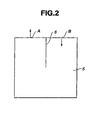
- FIG. 2 schematically illustrates the method for testing tear strength used in evaluating the silane rubber compositions of the invention.
- Component (A) in the silicone rubber composition of the invention is an organopolysiloxane which serves as the base polymer of the composition.
- the organopolysiloxane In order for the composition to form a silicone rubber coat having rubbery elasticity after curing, the organopolysiloxane must have at least two silicon-bonded alkenyl groups per molecule.
- the organopolysiloxane is preferably a substantially linear diorganopolysiloxane of the average compositional formula (1); this is entirely conventional: R 2 n SiO (4-n)/2 wherein R 2 is a substituted or unsubstituted monovalent hydrocarbon group, and n is a positive number from 1.9 to 2.1.
- R 2 groups are silicon-bonded substituted or unsubstituted monovalent hydrocarbon groups having 1 to 12 carbons, and preferably 1 to 8 carbons, including alkyls such as methyl, ethyl, propyl, isopropyl, butyl, isobutyl, tert-butyl, pentyl, neopentyl, hexyl, heptyl, octyl, nonyl, decyl and dodecyl; cycloalkyls such as cyclopentyl, cyclohexyl and cycloheptyl; alkenyls such as vinyl, allyl, propenyl, isopropenyl, butenyl, isobutenyl, hexenyl and cyclohexenyl; aryls such as phenyl, tolyl, xylyl, naphthyl and biphenyl; aralkyls such as
- substitution options are very well known, e.g. in any of the above, one or more hydrogen atoms are replaced with suitable substituents such as halogen atoms (e.g., fluorine, chlorine, bromine) or cyano groups, examples of which include chloromethyl, 2-bromoethyl, 3,3,3-trifluoropropyl, 3-chloropropyl and cyanoethyl.
- suitable substituents such as halogen atoms (e.g., fluorine, chlorine, bromine) or cyano groups, examples of which include chloromethyl, 2-bromoethyl, 3,3,3-trifluoropropyl, 3-chloropropyl and cyanoethyl.
- the organopolysiloxane is one in which at least 90 mole percent (i.e., 90 to 99.99 mol%, more preferably 95 to 99.98 mol%) of the substituted or unsubstituted monovalent hydrocarbon groups represented by R 2 are methyl groups.
- the organopolysiloxane also has, on average, at least two alkenyl groups.
- the alkenyl groups typically represent 0.01 to 10 mole percent, and preferably 0.02 to 5 mole percent, of all the R 2 groups. The presence of too few alkenyl groups may lower the curability of the resulting composition, whereas the presence of too many may diminish the physical properties of the cured product, such as its tensile strength, tear strength and elongation.
- the alkenyl groups may be bonded to silicon atoms at the ends of the molecular chain or silicon atoms at the middle of the molecular chain, or may be present on both.
- the alkenyl groups are preferably vinyl.
- R 2 groups other than methyl and vinyl are preferably phenyl or 3,3,3-trifluoropropyl.
- the letter n is a positive number from 1.9 to 2.1, and especially from 1.95 to 2.05. It is advantageous for the organopolysiloxane to have a molecular structure which is basically a linear diorganopolysiloxane composed of repeating diorganosiloxane units (R 2 2 SiO 2/2 ) and having alkenyl groups at both ends of the molecular chain, although the molecule may have in portions thereof a branched structure containing R 2 SiO 3/2 units or SiO 4/2 units.
- the organopolysiloxane molecular chain is end-capped with triorganosilyl groups (or R 2 3 SiO 1/2 units) such as trivinylsilyl, methyldivinylsilyl, dimethylvinylsilyl or trimethylsilyl.
- triorganosilyl groups or R 2 3 SiO 1/2 units
- the organopolysiloxane (A) preferably has a viscosity of at least 100 centistokes at 25°C, and a viscosity of at least 1,000 centistokes at 25°C is especially preferred for attaining a good silicone rubber coat strength and to ensure that the composition is easy to blend.
- a viscosity of not more than 100,000 mm 2 /s (centistokes) and especially not more than 50,000 mm 2 /s (centistokes) is preferred.
- organopolysiloxanes include dimethylpolysiloxane capped at both ends with dimethylvinylsiloxy groups, dimethylsiloxanemethylvinylsiloxane copolymer capped at both ends with dimethylvinylsiloxy groups, dimethylsiloxanemethylvinylsiloxane copolymer capped at both ends with trimethylsiloxy groups, and dimethylsiloxanemethylphenylsiloxane copolymer capped at both ends with dimethylvinylsiloxy groups.
- Component (B) in the silicone rubber composition of the invention is a finely divided silica.
- Any well-known finely divided silica which is employed as a reinforcing filler in silicone rubber may be used without particular limitation.
- Examples of such silica include fumed silica and precipitated silica.
- Surface-treated silica such as silica that has been surface treated with an organosilane, organosilazane or diorganocyclopolysiloxane, is especially preferred.
- One parameter responsible for the distinctive features of the invention is the amount of finely divided silica added to the silicone rubber composition.
- Addition in an amount of less than 0.5 part by weight per 100 parts by weight of the alkenyl group-containing organopolysiloxane (A) fails to impart thixotropic properties to the silicone rubber composition, as a result of which a large amount of the composition penetrates into the base fabric, lowering the airtightness of the coated fabric.
- the addition of 5 or more parts by weight lowers the tear strength of a base fabric coated with the composition.
- addition of the finely divided silica in an amount of at least 0.5 part by weight but less than 5 parts by weight per 100 parts by weight of the alkenyl group-containing organopolysiloxane (A) resolves the problem of silicone rubber coat formability on the base fabric and also confers the coated base fabric with strength and airtightness.
- Addition in an amount of 0.5 to 4.5 parts by weight, especially 1 to 4 parts by weight is preferred.
- an adhesive component is used as component (C) in the inventive composition for the purpose of enhancing the ability of the silicone rubber composition to adhere to the material of which the base fabric is made, such as nylon 6, nylon 66 or polyester.
- the adhesive component is preferably an organosilicon compound, such as an organosilane or a linear or cyclic organopolysiloxane, having an epoxy group bonded to a silicon atom through an alkylene group such as a methylene, ethylene, propylene, tetramethylene or methylethylene group.
- Illustrative examples include epoxy group-bearing organoalkoxysilanes such as ⁇ -glycidoxypropyltrimethoxysilane and 3,4-epoxycyclohexylethyltrimethoxysilane; and epoxy group-bearing organopolysiloxanes such as epoxy group-bearing organopolysiloxanes which have vinyl and alkoxy groups, epoxy group-bearing organopolysiloxanes which have silicon-bonded hydrogen atoms, and epoxy group-bearing organopolysiloxanes which have silicon-bonded hydrogen atoms and alkoxy groups.
- epoxy group-bearing organoalkoxysilanes such as ⁇ -glycidoxypropyltrimethoxysilane and 3,4-epoxycyclohexylethyltrimethoxysilane
- epoxy group-bearing organopolysiloxanes such as epoxy group-bearing organopolysiloxa
- Other compounds that may be used for the same purpose include compounds having a vinyl or hydrosilyl group (i.e., SiH group) and a silicon-bonded alkoxy group, and polysiloxanes having alkoxysilyl groups. Any of the above may be used alone or in combinations thereof as component (C).
- the adhesive component (C) is included in an amount of 0.1 to 20 parts by weight, and preferably 0.2 to 5 parts by weight, per 100 parts by weight of component (A). Too little adhesive component fails to provide the desired adhesive effects. The use of too much results in excessive thixotropy, which makes the silicone rubber composition difficult to coat onto the base fabric, and is moreover uneconomical.
- Component (D) is a silicone-soluble resin (i.e., organopolysiloxane having three-dimensional network structure) which contains R 3 SiO 1/2 units and SiO 2 and/or RSiO 3/2 units, and which bears at least one alkenyl group (preferably having 2 to 6 carbon atoms) per molecule.
- the silicone-soluble resin (D) is used for the purpose of imparting strength to the silicone rubber composition.
- R is a substituted or unsubstituted monovalent hydrocarbon group similar to R 2 described above, preferably one having 1 to 10 carbons, and especially 1 to 8 carbons.
- R is exemplified by the same groups as mentioned above for R 2 .
- the resin (D) contains 30 to 60 mole percent, and especially 35 to 55 mole percent, of R 3 SiO 1/2 units; 30 to 70 mole percent, and especially 40 to 65 mole percent, of SiO 2 units and/or RSiO 3/2 units. If necessary, the resin may further contain up to 20 mole percent of R 2 SiO 2/2 units.
- the resin has a mole ratio of SiO 2 units to R 3 SiO 1/2 units or of RSiO 3/2 units to R 3 SiO 1/2 units or of RSiO 3/2 units and SiO 2 units combined to R 3 SiO 1/2 units in a range of 0.6 to 1.1.
- the resin (D) has an alkenyl group content of preferably 1 to 8% by weight, and especially 2 to 5% by weight. At less than 1% by weight, resin molecules containing no alkenyl groups may form and become incorporated within the organopolysiloxane resin (D). At more than 8% by weight, the silicone rubber obtained by curing the composition may have a lower elongation and less heat resistance.
- the organopolysiloxane resin (D) may also contain in its molecule up to 0.5 mole of silanol or alkoxysilyl groups per 100 g of resin.
- the essential constituents in all of these examples are a R 3 SiO 1/2 unit and a SiO 2 and/or RSiO 3/2 unit.
- the presence in the organopolysiloxane resin (D) of 5% by weight or more of silicone resin molecules containing no vinyl or other alkenyl groups lowers the strength of the coated base fabric. For this reason, it is critical that the molecules contain at least one vinyl or other alkenyl group.
- the amount of this resin containing no vinyl or other alkenyl groups incorporated during production (usually unintendedly) should be held to less than 5% by weight.
- the resin (D) is included in the silicone rubber composition in an amount of 5 to 40 parts by weight, and preferably 10 to 30 parts by weight, per 100 parts by weight of component (A). Too little resin (D) fails to provide the desired strength-imparting effect, whereas too much lowers the elongation of the cured silicone rubber and is uneconomical.
- Component (E) of the inventive silicone rubber composition is an organohydrogenpolysiloxane containing at least two units per molecule selected from among HR 1 2 SiO 1/2 units, HR 1 SiO units and HSiO 3/2 units (that is, monofunctional, difunctional or trifunctional siloxane units having silicon-bonded hydrogen atoms, or SiH groups).
- R 1 is a substituted or unsubstituted monovalent hydrocarbon unit free from aliphatic unsaturation.
- Component (E) may be, in particular, an organohydrogenpolysiloxane of the average compositional formula (2): R 1 a H b SiO (4-a-b)/2 which is a liquid at room temperature.
- R 1 be a substituted or unsubstituted monovalent hydrocarbon unit of 1 to 10 carbons free from aliphatic unsaturation; the letter "a” be 0.7 to 2.1, and especially 1 to 2; the letter “b” be 0.001 to 1.0, and especially 0.01 to 1.0; and the sum a+b be from 0.8 to 3.0, and especially 1 to 2.4.
- R 1 is a substituted or unsubstituted monovalent hydrocarbon group of 1 to 10 carbons, and preferably 1 to 8 carbons, which may be exemplified by those groups mentioned above for R 2 which do not contain an aliphatic unsaturated bond.
- Preferred examples include alkyl, aryl, aralkyl and substituted alkyl groups, such as methyl, ethyl, propyl, phenyl and 3,3,3-trifluoropropyl.
- Component (E) has a molecular structure which may be linear, cyclic, branched or a three-dimensional network.
- the SiH groups (silicon-bonded hydrogen atoms) may be present at the ends, in the middle, or at both the ends and the middle of the molecular chain.
- the type of organohydrogenpolysiloxane (E) most suitable in the inventive composition is one in which the number of silicon atoms on the molecule is preferably about 3 to 100, and especially about 10 to 50. It is desirable for the mole ratio of hydrogen atoms bonded directly to silicon atoms to be in a range of 30 to 95 mole percent, based on all the silicon atoms in the organohydrogenpolysiloxane.
- the organohydrogenpolysiloxane in which "b" in formula (2) is 0.3 to 0.95 is preferred. At a mole ratio above 95 mole percent, the tear strength of the coated base fabric tends to decline, whereas a mole ratio of less than 30 mole percent may result in slowing of the crosslinking reaction and reduced base fabric strength.
- organohydrogenpolysiloxane (E) examples include 1,1,3,3-tetramethyldisiloxane, methylhydrogen cyclic polysiloxane, methylhydrogensiloxanedimethylslloxane cyclic copolymer, methylhydrogenpolysiloxane capped at both ends with trimethylsiloxy groups, dimethylsiloxane-methylhydrogensiloxane copolymer capped at both ends with trimethylsiloxy groups, dimethylpolysiloxane capped at both ends with dimethylhydrogensiloxy groups, dimethylsiloxane-methylhydrogensiloxane copolymers capped at both ends with dimethylhydrogensiloxy groups, methylhydrogensiloxane-diphenylsiloxane copolymers capped at both ends with trimethylsiloxy groups, methylhydrogensiloxane-diphenylsiloxanedimethylsiloxane copo
- the organohydrogenpolysiloxane (E) is added in an amount containing 0.5 to 3.0 moles of SiH groups of the organohydrogenpolysiloxane (E) per mole of alkenyl groups (alkenyl groups bonded to silicon atoms) supplied by components (A) and (D) combined.
- the addition of less than 0.5 mole makes the surface of the applied silicon rubber coat after it has been cured feel tackier, whereas the addition of more than 3.0 moles lowers the strength of the coated base fabric.
- Component (F) of the silicone rubber composition according to the invention is a platinum group catalyst.
- platinum group catalysts include those commonly used in addition-curable silicone compositions, such as finely divided platinum powder, platinum black, hexachloroplatinic acid, tetrachloroplatinic acid, olefin complexes of hexachloroplatinic acid, complexes of hexachloroplatinic acid with methylvinylsiloxane, rhodium compounds and palladium compounds.
- the platinum group catalyst is added in an amount containing 1 to 2,000 parts by weight, and preferably 5 to 1,000 parts by weight, of platinum group metal atoms per million parts by weight of components (A) to (E) combined.
- the inventive composition is generally used as a two-part system, the two parts being mixed and stirred together prior to use.
- a reaction inhibitor commonly used in addition-curable silicone rubber compositions may be employed to adjust the composition so as to attain a good balance between the curing time and the period during which the composition may be used.
- known inhibitors suitable for this purpose include acetylene alcohol compounds, cyclic or aliphatic vinyl group-bearing polysiloxanes, triallylisocyanurate and silyl-modified derivatives thereof, and alkyne-bearing silane or siloxane compounds.
- silicone rubber additives including inorganic fillers, pigments and heat stabilizers, may be added and blended into the inventive composition, insofar as the objects of the invention are attainable.
- specific examples of such additives include titanium oxide, carbon black, red iron oxide (Fe 2 O 3 ), rare earth oxides and cerium silanolate.
- the inventive composition is particularly suitable for use in curtain air bags, in connection with which airtightness is often a concern. Accordingly, for the film applied onto the base fabric to have a low thickness and yet maintain the ability to block the airtightness, it is effective to impart thixotropy to the composition and thereby reduce penetration of the composition to the interior of the base fabric.
- the inventive composition preferably has a viscosity of 4 to 100 Pas (40 to 1,000 poise) as measured with a viscometer at 25°C and 20 rpm, and a thixotropy index, given by a ratio of the viscosity at 4 rpm to the viscosity at 20 rpm, within a range of 1.05 to 4.0, and especially 1.1 to 2.0.
- a thixotropy index lower than 1.05 tends to result in easy penetration by the composition to the fabric interior, lowering the airtightness of the thin coat. Such penetration can be avoided by increasing the viscosity of the composition, although a higher viscosity makes it more difficult to apply a thin coat.
- a thixotropy index greater than 4.0 usually make it impractical to apply a thin coat of the composition to a base fabric. The foregoing problems can be resolved by setting the thixotropy index within the above-indicated range.
- the silicone rubber composition of the invention is coated onto a suitable synthetic woven fabric such as used for airbags, e.g. woven fabrics made of polyamide fibers such as nylon 6, nylon 66 or nylon 46, aramid fibers, polyalkylene terephthalate and other polyester fibers, polyetherimide fibers, sulfone fibers and carbon fibers. After coating, the composition is cured to give a silicone rubber-coated air bag base fabric.
- the synthetic fiber air bag fabric most preferable for use together with the inventive composition is a woven fabric made of nylon 66 fibers.
- the viscosity of the inventive composition may be adjusted to facilitate coating by adding an organic solvent such as xylene or toluene.
- the composition of the invention is typically produced by first uniformly blending components (A) and (B), or components (A), (B) and (D), in a mixing apparatus such as a two-roll mill, a kneader mixer, a pressure kneader mixer or a Ross mixer to form a silicone rubber base. Components (C), (E) and (F) are then added to the rubber base and blended to give the silicone rubber composition.
- a mixing apparatus such as a two-roll mill, a kneader mixer, a pressure kneader mixer or a Ross mixer.
- components (A) to (F) are added to above components (A) to (F) and the mixture is uniformly blended, following which the resulting composition is coated onto the synthetic woven air bag fabric.
- the coated fabric is placed in a hot-air drying oven, where it is heat-cured, thereby giving a silicone rubber-coated base fabric for air bags.
- the heat-cured silicone rubber obtained from the inventive composition preferably has a JIS-A hardness in a range of 20 to 60.
- the use of a composition which cures to this hardness (in a test piece) in combination with a synthetic woven air bag fabric results in strong, integral bonding of the silicone rubber coat to the fabric.
- the following components were mixed to uniformity in a Ross mixer to give a silicone rubber base: 100 parts of a dimethylpolysiloxane having a viscosity of 1,000 cst and capped at both ends of the molecular chain with dimethylvinylsiloxy groups, 3.0 parts of hexamethyldisilazane-treated fumed silica having a specific surface area of 200 m 2 /g, and 20 parts of a vinyl group-bearing methylpolysiloxane resin composed of Vi(Me) 2 SiO 1/2 units, Me 3 SiO 1/2 units and SiO 4/2 units (vinyl group content, 2.2% by weight).
- a liquid silicone rubber coating composition was then prepared by adding to the above silicone rubber base and mixing to uniformity the following: 7.2 parts of methylhydrogenpolysiloxane of the average molecular formula Me 3 SiO(MeHSiO) 6 (Me 2 SiO) 4 SiMe 3 (which amount corresponds to a mole ratio of SiH groups in the methylhydrogenpolysiloxane to vinyl groups in the vinyl group-bearing dimethylpolysiloxane and the vinyl group-bearing methylpolysiloxane resin combined, abbreviated hereinafter as "H/Vi," of 1.8), 0.4 part of a complex of hexachloroplatinic acid and divinyltetramethyldisiloxane (platinum concentration, 0.4% by weight), 0.3 part of 3,5-dimethyl-1-hexyl-3-ol as a curing inhibitor, and 1 part of ⁇ -glycidoxypropyltrimethoxysilane as the adhesive component.
- the resulting composition was coated onto a woven fabric made of nylon 66 fibers (210 denier) and heated in an oven at 180°C for 1 minute to effect curing. Coating was carried out with a coater using the minimum amount of liquid silicone rubber coating composition capable of evenly and uniformly covering the woven fabric. The silicone rubber-coated fabric was subjected to the tests described below.
- the fire retardance was determined by performing a FMVSS302 flammability test.
- FIG. 1 An airtightness test was carried out in which the apparatus shown in FIG. 1 was pressurized to two atmospheres and the amount of air leakage measured. Samples having an air leakage of 0.02% or more failed the test.
- a vessel 1 having a 10-liter volume was equipped with an air inlet 2 through which air was introduced into the vessel 1, and an air outlet 3 having an inside diameter of 60 mm over which the aforementioned silicone rubber-coated fabric 4 was placed and fastened such that the silicone rubber-coated side thereof faced the air outlet 3 .
- the test was conducted by holding the pressure within the vessel 1 at 2 atmospheres and measuring the amount of air that leaked from the vessel.
- a tear test was performed in which the coated synthetic fiber air bag fabric was cut as shown in FIG. 2 and the tear strength measured. Samples with a tear strength of less than 120 N/cm failed the test. Referring to FIG. 2, the sample was a 10 ⁇ 10 cm square piece of coated fabric having a 5-cm cut 6 at the center. Sections A and B were pulled in opposite directions indicated by the arrows at a rate of 200 mm/min, and the tear strength was measured.
- Example 1 Aside from changing the amount of hexamethyldisilazane-treated fused silica having a specific surface area of 200 m 2 /g from 3.0 parts to 1.0 part, a silicone rubber-coated fabric was produced in the same way as in Example 1. The properties of the resulting coated fabric were tested as in Example 1. The results are given in Table 1.
- Example 2 The same procedure was followed as in Example 1, except that the amount of hexamethyldisilazane-treated fused silica having a specific surface area of 200 m 2 /g was changed to 0 part in Comparative Example 1, and to 6.0 parts in Comparative Example 2.
- the resulting silicone rubber composition was similarly coated onto a woven fabric made of nylon 66 fibers (210 denier) and heated in an oven at 180°C for 1 minute to effect curing.
- the properties of the resulting coated fabrics were tested as in Example 1. The results are given in Table 1.
- the following components were mixed to uniformity in a Ross mixer to give a silicone rubber base: 100 parts of a dimethylpolysiloxane having a viscosity of 10,000 cst and capped at both ends of the molecular chain with dimethylvinylsiloxy groups, 1.0 part of hexamethyldisilazane-treated fumed silica having a specific surface area of 200 m 2 /g, and 30 parts of a vinyl group-bearing methylpolysiloxane resin composed of Vi(Me) 2 SiO 1/2 units, Me 3 SiO 1/2 units and SiO 4/2 units (vinyl group content, 2.2% by weight).
- a liquid silicone rubber coating compositions was then prepared by adding to the above silicone rubber base and mixing to uniformity the following: 8.3 parts of methylhydrogenpolysiloxane having the average molecular formula Me 3 SiO(MeHSiO) 6 (Me 2 SiO) 4 SiMe 3 (which amount corresponds to a H/Vi ratio of 2.1), 0.29 part of a complex of hexachloroplatinic acid and divinyltetramethyldisiloxane (platinum concentration, 0.4% by weight), 0.2 part of 3,5-dimethyl-1-hexyl-3-ol and 1.0 part of tetramethyltetravinylcyclotetrasiloxane as curing inhibitors, 1 part of vinyltrimethoxysilane as the adhesive component, and 1 part of the compound having the formula indicated below.
- Example 2 As in Example 1, the resulting composition was coated onto a woven fabric made of nylon 66 and cured, following which the properties of the silicone rubber-coated fabric were tested. The results are presented in Table 2.
- a liquid silicone rubber coating composition was prepared in the same way as in Example 3, except that the amount of hexamethyldisilazane-treated fused silica having a specific surface area of 200 m 2 /g was changed from 1.0 part to 10 parts.
- the liquid silicone rubber composition was similarly coated onto a woven fabric made of nylon 66 fibers (210 denier) and heated in an oven at 180°C for 1 minute to effect curing. The properties of the resulting coated fabric were tested as in Example 1. The results are given in Table 2.
- Example 5 The same procedure was followed as in Example 3, except that the 8.3 parts of Me 3 SiO(MeHSiO) 6 (Me 2 SiO) 4 SiMe 3 used in Example 3 was changed to 8.5 parts of Me 3 SiO(MeHSiO) 2 (Me 2 SiO) 18 SiMe 3 (corresponding to a H/Vi ratio of 0.4) in Comparative Example 4, and to 7.3 parts of Me 3 SiO(MeHSiO) 40 SiMe 3 (corresponding to a H/Vi ratio of 3.8) in Comparative Example 5.
- the resulting silicone rubber composition was similarly coated onto a woven fabric made of nylon 66 fibers (210 denier) and cured by 1 minute of heating at 180°C.
- the silicone rubber compositions embodying the invention gave excellent adhesive strength to synthetic woven air bag fabric. Accordingly, when used together with such woven fabric, such compositions can provide air bag base fabrics of outstanding flexibility, sealability and deployability whose properties remain stable over time.
Landscapes
- Chemical & Material Sciences (AREA)
- Engineering & Computer Science (AREA)
- Chemical Kinetics & Catalysis (AREA)
- Textile Engineering (AREA)
- Organic Chemistry (AREA)
- Wood Science & Technology (AREA)
- Materials Engineering (AREA)
- Life Sciences & Earth Sciences (AREA)
- Dispersion Chemistry (AREA)
- Air Bags (AREA)
- Paints Or Removers (AREA)
- Treatments For Attaching Organic Compounds To Fibrous Goods (AREA)
- Compositions Of Macromolecular Compounds (AREA)
Claims (6)
- Silikonkautschuk-Zusammensetzung, die zum Beschichten von Airbag-Geweben geeignet ist, wobei die Zusammensetzung Folgendes umfasst:(A) 100 Gewichtsteile Organopolysiloxan mit zumindest zwei Silizium-gebundenen Alkenylgruppen pro Molekül,(B) 0,5 bis weniger als 5 Gewichtsteile feinverteiltes Siliziumdioxid,(C) 0,1 bis 20 Gewichtsteile Klebstoffbestandteil,(D) 5 bis 40 Gewichtsteile eines Silikon-löslichen Harzes, das eine R3SiO1/2-Einheit und eine SiO2-Einheit oder RSiO3/2-Einheit oder beide umfasst und zumindest eine Alkenylgruppe pro Molekül aufweist, worin R eine substitutierte oder unsubstituierte, einwertige Kohlenwasserstoffgruppe ist,(E) Organohydrogenpolysiloxan, das pro Molekül zumindest zwei Einheiten, ausgewählt aus HR1 2SiO1/2-, HR1SiO- und HSiO3/2-Einheiten aufweist, worin R1 eine substituierte oder unsubstituierte, einwertige Kohlenwasserstoffeinheit ohne aliphatische ungesättigte Bindung ist, und zwar in ausreichender Menge, um 0,5 bis 3,0 Mol SiH-Gruppen pro Mol der Alkenylgruppen in den Komponenten (A) und (D) zusammen bereitzustellen, und(F) einen Platingruppenkatalysator in ausreichender Menge, um - bezogen auf das Gewicht der Komponenten (A) und (E) zusammen - 1 bis 2.000 ppm Metallatome der Platingruppe bereitzustellen.
- Silikonkautschuk-Zusammensetzung nach Anspruch 1, worin der Klebstoffbestandteil (C) eine Silizium-organische Verbindung mit einer Epoxygruppe ist, die durch eine intervenierende Alkylengruppe an ein Siliziumatom gebunden ist.
- Silikonkautschuk-Zusammensetzung nach Anspruch 1, worin die durch Mischen der Komponenten (A) bis (E) erhaltene Zusammensetzung eine bei 25 °C und 20 U/min mit Hilfe eines Viskosimeters gemessene Viskosität von 4 bis 100 Pa.s (40 bis 1.000 Poise) und einen Thixotropie-Index von 1,05 bis 4,0, berechnet als Verhältnis der Viskosität bei 4 U/min zur Viskosität bei 20 U/min, aufweist.
- Verwendung einer Zusammensetzung nach einem der Ansprüche 1 bis 3 zur Beschichtung eines Kunstfasergewebes.
- Kunstfasergewebe mit einer Beschichtung aus einer gehärteten Zusammensetzung nach einem der Ansprüche 1 bis 3.
- Airbag, hergestellt aus einem Gewebe nach Anspruch 5.
Applications Claiming Priority (2)
| Application Number | Priority Date | Filing Date | Title |
|---|---|---|---|
| JP35353499 | 1999-12-13 | ||
| JP35353499A JP3695516B2 (ja) | 1999-12-13 | 1999-12-13 | エアーバッグコーティング用シリコーンゴム組成物 |
Publications (3)
| Publication Number | Publication Date |
|---|---|
| EP1108764A2 EP1108764A2 (de) | 2001-06-20 |
| EP1108764A3 EP1108764A3 (de) | 2001-12-12 |
| EP1108764B1 true EP1108764B1 (de) | 2003-05-02 |
Family
ID=18431496
Family Applications (1)
| Application Number | Title | Priority Date | Filing Date |
|---|---|---|---|
| EP20000311010 Expired - Lifetime EP1108764B1 (de) | 1999-12-13 | 2000-12-11 | Silikonkautschuk zur Beschichtung von Airbags |
Country Status (5)
| Country | Link |
|---|---|
| US (1) | US6425600B1 (de) |
| EP (1) | EP1108764B1 (de) |
| JP (1) | JP3695516B2 (de) |
| KR (1) | KR100699382B1 (de) |
| DE (1) | DE60002420T2 (de) |
Cited By (1)
| Publication number | Priority date | Publication date | Assignee | Title |
|---|---|---|---|---|
| CN101365840B (zh) * | 2005-12-06 | 2012-09-26 | Nexis纤维股份公司 | 用于无上浆织造的纱线、纤维和长丝 |
Families Citing this family (58)
| Publication number | Priority date | Publication date | Assignee | Title |
|---|---|---|---|---|
| ATE362561T1 (de) * | 2001-02-01 | 2007-06-15 | Asahi Chemical Ind | Mit silicon beschichtete gewebe sowie luftsack |
| JP4643071B2 (ja) * | 2001-08-08 | 2011-03-02 | 日本プラスト株式会社 | 側部用エアバッグ |
| JP3824072B2 (ja) * | 2001-12-26 | 2006-09-20 | 信越化学工業株式会社 | プラスチックフィルム基材に密着良好なシリコーンエマルジョン組成物及び剥離フィルム |
| KR100798133B1 (ko) * | 2001-12-29 | 2008-01-28 | 주식회사 케이씨씨 | 에멀젼을 포함하는 액상 실리콘 고무 조성물 및 이의 제조방법 |
| JP3871037B2 (ja) * | 2002-02-28 | 2007-01-24 | 信越化学工業株式会社 | エアバック目止め材用シリコーンゴム組成物及びエアバック |
| US6713131B2 (en) | 2002-04-08 | 2004-03-30 | Dow Corning Corporation | Methods of coating fabrics with emulsions of elastomeric polymers and polyurethane dispersions |
| US6825263B2 (en) * | 2002-04-08 | 2004-11-30 | Dow Corning Corporation | Curable coating compositions from emulsions of elastomeric polymers and polyurethane dispersions |
| JP2003327910A (ja) * | 2002-05-10 | 2003-11-19 | Shin Etsu Chem Co Ltd | エアーバッグ用コーティング剤組成物及びエアーバッグ |
| JP4231996B2 (ja) * | 2002-11-14 | 2009-03-04 | 信越化学工業株式会社 | エアバッグ目止め材用シリコーンゴム組成物 |
| JP4088778B2 (ja) * | 2003-04-25 | 2008-05-21 | 信越化学工業株式会社 | エアバック目止め材用シリコーンゴム組成物、エアバック及び接着性向上方法 |
| US20050100692A1 (en) * | 2003-11-06 | 2005-05-12 | Parker Richard H. | Textile products and silicone-based copolymeric coating compositions for textile products |
| US20050245154A1 (en) * | 2004-04-30 | 2005-11-03 | Highland Industries, Inc. | Coated airbag fabric |
| US20050245153A1 (en) * | 2004-04-30 | 2005-11-03 | Highland Industries, Inc. | Coated airbag fabric |
| US20050244596A1 (en) * | 2004-04-30 | 2005-11-03 | Highland Industries, Inc. | Coated airbag fabric |
| JP2005336270A (ja) * | 2004-05-25 | 2005-12-08 | Shin Etsu Chem Co Ltd | 液状シリコーンゴムコーティング剤組成物およびエアーバッグ |
| US7468334B2 (en) * | 2004-10-04 | 2008-12-23 | Highland Industries, Inc. | Silicone vulcanizate coated fabric |
| US7528209B2 (en) * | 2004-10-29 | 2009-05-05 | Shin-Etsu Chemical Co., Ltd. | Curable silicone release composition and sheet having a releasability using the same |
| DE602006002040D1 (de) | 2005-01-18 | 2008-09-18 | Shinetsu Chemical Co | Flüssige Siliconkautschuk-Beschichtungszusammensetzung und damit beschichteter Airbag |
| WO2006083339A1 (en) | 2005-02-01 | 2006-08-10 | Dow Corning Corporation | Curable coating compositions |
| JP4993914B2 (ja) * | 2005-02-04 | 2012-08-08 | 信越化学工業株式会社 | 液状シリコーンゴムコーティング剤組成物およびカーテンエアーバッグ |
| EP1688463B1 (de) | 2005-02-04 | 2008-07-23 | Shin-Etsu Chemical Co., Ltd. | Flüssige Silikongummi-Beschichtung und Seiten-Airbag |
| US7407898B2 (en) | 2005-03-28 | 2008-08-05 | Milliken & Company | Liquid polymeric coating compositions and air bags coated therewith |
| JP4785037B2 (ja) * | 2005-06-23 | 2011-10-05 | 旭化成ワッカーシリコーン株式会社 | 繊維基材用コーティング組成物 |
| US7767754B2 (en) * | 2005-11-08 | 2010-08-03 | Momentive Performance Materials Inc. | Silicone composition and process of making same |
| FR2894591A1 (fr) * | 2005-12-09 | 2007-06-15 | Rhodia Recherches & Tech | Vernis silicone polyaddition anti-salissures, application de ce vernis sur un support et support ainsi traite |
| JP4952882B2 (ja) * | 2006-01-13 | 2012-06-13 | 信越化学工業株式会社 | 液状シリコーンゴムコーティング剤組成物、カーテンエアーバッグ及びその製造方法 |
| US20070190872A1 (en) * | 2006-02-16 | 2007-08-16 | Weber Robert F | Fire retardant silicone textile coating |
| FR2903112A1 (fr) * | 2006-06-29 | 2008-01-04 | Rhodia Recherches & Tech | Composition silicone reticulable pour la realisation de revetements anti-adherents pour supports souples et additif promoteur d'accrochage contenu dans cette composition |
| EP2066757A1 (de) * | 2006-10-05 | 2009-06-10 | Dow Corning Corporation | Silikonharzfolie und verfahren zu ihrer herstellung |
| US20080085942A1 (en) * | 2006-10-05 | 2008-04-10 | Scott Jackson | Coating system, method of coating, and coated articles |
| FR2910909A1 (fr) * | 2006-12-27 | 2008-07-04 | Rhodia Recherches & Tech | Composition silicone adhesive et procede de collage utilisant une telle composition. |
| JP4895879B2 (ja) * | 2007-03-19 | 2012-03-14 | サンユレック株式会社 | 発光素子封止用シリコーン樹脂組成物及びこれを用いたポッティング方式による光半導体電子部品の製造方法 |
| TWI458780B (zh) | 2007-07-31 | 2014-11-01 | Dow Corning Toray Co Ltd | 提供高透明矽酮硬化物之硬化性矽酮組合物 |
| FR2919615A1 (fr) * | 2007-08-02 | 2009-02-06 | Bluestar Silicones France Soc | Composition elastomere silicone adhesive |
| EP2310458B1 (de) * | 2008-07-30 | 2016-08-17 | Bluestar Silicones France SAS | Silikonzusammensetzung zum beschichten eines flexiblen trägers zur bildung eines vernetzten überzugs mit verbesserter haftung, mechanischer festigkeit und reaktivität |
| CN102112556B (zh) | 2008-07-31 | 2014-01-01 | 道康宁东丽株式会社 | 多成分型海绵形成性液体硅橡胶组合物和硅橡胶海绵的制造方法 |
| PL2382271T5 (pl) * | 2008-12-30 | 2018-08-31 | Bluestar Silicones | Kompozycje powłokowe i tkaniny włókiennicze nimi pokryte |
| JP5475296B2 (ja) | 2009-02-02 | 2014-04-16 | 東レ・ダウコーニング株式会社 | 高透明のシリコーン硬化物を与える硬化性シリコーン組成物 |
| JP5475295B2 (ja) | 2009-02-02 | 2014-04-16 | 東レ・ダウコーニング株式会社 | 高透明のシリコーン硬化物を与える硬化性シリコーン組成物 |
| JP5568240B2 (ja) * | 2009-02-02 | 2014-08-06 | 東レ・ダウコーニング株式会社 | 硬化性シリコーンゴム組成物 |
| DE102009002828A1 (de) * | 2009-05-05 | 2010-11-11 | Wacker Chemie Ag | Zusammensetzungen für Textilbeschichtungen |
| FR2946365A1 (fr) * | 2009-06-05 | 2010-12-10 | Bluestar Silicones France | Procede d'enduction d'un support textile |
| US8109534B2 (en) * | 2009-07-22 | 2012-02-07 | Highland Industries, Inc. | Highly thermal resistant material for a vehicle safety device |
| JP5906192B2 (ja) | 2009-11-12 | 2016-04-20 | ダウ コーニング コーポレーションDow Corning Corporation | 被コーティング織物製品 |
| JP5894924B2 (ja) | 2009-11-12 | 2016-03-30 | ダウ コーニング コーポレーションDow Corning Corporation | 被覆ファブリック製品 |
| KR101801265B1 (ko) * | 2009-12-30 | 2017-11-27 | 다우 코닝 코포레이션 | 에어 백 상의 실리콘 코팅 |
| CA2782143A1 (en) | 2009-12-30 | 2011-07-07 | Dow Corning Corporation | Silicone coating composition for air bags |
| JP5844742B2 (ja) | 2009-12-30 | 2016-01-20 | ダウ コーニング コーポレーションDow Corning Corporation | 減摩性塗膜 |
| JP5220875B2 (ja) * | 2011-01-21 | 2013-06-26 | 日本プラスト株式会社 | カーテンエアバッグの製造方法 |
| JP5761103B2 (ja) * | 2012-03-30 | 2015-08-12 | 信越化学工業株式会社 | カーテンエアーバッグ用液状シリコーンゴムコーティング剤組成物及びその製造方法 |
| JP5794207B2 (ja) * | 2012-06-07 | 2015-10-14 | 信越化学工業株式会社 | 付加硬化型シリコーンエマルジョン組成物及び剥離フィルム |
| JP2016199680A (ja) * | 2015-04-10 | 2016-12-01 | 信越化学工業株式会社 | カーテンエアーバッグ用液状シリコーンゴムコーティング剤組成物及びその製造方法 |
| JP6531724B2 (ja) * | 2016-07-01 | 2019-06-19 | 信越化学工業株式会社 | エアーバッグ用シリコーンゴムコーティング基布の製造方法、紫外線硬化型エアーバッグコーティング剤及びエアーバッグ用基布 |
| KR102457711B1 (ko) * | 2017-03-15 | 2022-10-24 | 신에쓰 가가꾸 고교 가부시끼가이샤 | 난연성 에어백, 난연성 에어백의 제조 방법, 및 난연성 에어백용 부가 경화형 액상 실리콘 고무 조성물 |
| CN114096627B (zh) | 2019-06-21 | 2023-09-22 | 陶氏东丽株式会社 | 形成减摩性涂膜的水性涂膜形成性组合物、使用它的气囊 |
| JP7575180B2 (ja) | 2019-06-21 | 2024-10-29 | ダウ・東レ株式会社 | 水中油型シリコーンエマルジョン組成物およびその用途 |
| CN110863363A (zh) * | 2019-11-30 | 2020-03-06 | 南通大学 | 一种低粘着性高涂层耐高温的安全气囊面料及其制备方法 |
| JP7478645B2 (ja) * | 2020-10-29 | 2024-05-07 | 信越化学工業株式会社 | 難燃性エアーバッグ用付加硬化型液状シリコーンゴム組成物 |
Family Cites Families (11)
| Publication number | Priority date | Publication date | Assignee | Title |
|---|---|---|---|---|
| JPS6378744A (ja) | 1986-09-22 | 1988-04-08 | 帝人株式会社 | エヤバツク用基布 |
| JP2513101B2 (ja) | 1992-01-23 | 1996-07-03 | 信越化学工業株式会社 | エアバッグ用コ―ティング組成物及びエアバッグ |
| JP2592021B2 (ja) * | 1992-01-31 | 1997-03-19 | 東レ・ダウコーニング・シリコーン株式会社 | エアーバッグコーティング用液状シリコーンゴム組成物 |
| JP3072216B2 (ja) | 1993-08-31 | 2000-07-31 | 東レ・ダウコーニング・シリコーン株式会社 | エアーバッグ用シリコーンゴムコーティング布 |
| JP3165312B2 (ja) | 1993-12-28 | 2001-05-14 | 東レ・ダウコーニング・シリコーン株式会社 | エアーバッグ用難燃性シリコーンゴムコーティング布 |
| US5529837A (en) * | 1994-02-28 | 1996-06-25 | Shin-Etsu Chemical Co., Ltd. | Silicone coated base material and air bag base material |
| JP3115808B2 (ja) | 1995-09-21 | 2000-12-11 | 東レ・ダウコーニング・シリコーン株式会社 | 液状シリコーンゴムコーティング剤組成物 |
| JP3121756B2 (ja) | 1996-02-01 | 2001-01-09 | ジーイー東芝シリコーン株式会社 | エアバッグ用皮膜形成エマルジョン型シリコーン組成物及びエアバッグ |
| JP3121755B2 (ja) | 1996-02-01 | 2001-01-09 | ジーイー東芝シリコーン株式会社 | エアバッグ用皮膜形成エマルジョン型シリコーン組成物及びエアバッグ |
| FR2751980B1 (fr) * | 1996-08-02 | 1999-02-05 | Rhone Poulenc Chimie | Composition silicone pour l'enduction de substrats en matiere textile |
| JP3945082B2 (ja) * | 1999-08-24 | 2007-07-18 | 信越化学工業株式会社 | コーティング用液状シリコーンゴム組成物及びエアーバッグ布 |
-
1999
- 1999-12-13 JP JP35353499A patent/JP3695516B2/ja not_active Expired - Fee Related
-
2000
- 2000-12-11 EP EP20000311010 patent/EP1108764B1/de not_active Expired - Lifetime
- 2000-12-11 DE DE2000602420 patent/DE60002420T2/de not_active Expired - Fee Related
- 2000-12-12 KR KR1020000075423A patent/KR100699382B1/ko not_active Expired - Fee Related
- 2000-12-13 US US09/734,743 patent/US6425600B1/en not_active Expired - Fee Related
Cited By (1)
| Publication number | Priority date | Publication date | Assignee | Title |
|---|---|---|---|---|
| CN101365840B (zh) * | 2005-12-06 | 2012-09-26 | Nexis纤维股份公司 | 用于无上浆织造的纱线、纤维和长丝 |
Also Published As
| Publication number | Publication date |
|---|---|
| DE60002420T2 (de) | 2004-03-11 |
| EP1108764A3 (de) | 2001-12-12 |
| US6425600B1 (en) | 2002-07-30 |
| DE60002420D1 (de) | 2003-06-05 |
| KR100699382B1 (ko) | 2007-03-26 |
| JP2001164187A (ja) | 2001-06-19 |
| JP3695516B2 (ja) | 2005-09-14 |
| KR20010062338A (ko) | 2001-07-07 |
| EP1108764A2 (de) | 2001-06-20 |
Similar Documents
| Publication | Publication Date | Title |
|---|---|---|
| US6425600B1 (en) | Silicone rubber composition for coating air bags | |
| EP0553840B1 (de) | Flüssige Silikonkautschuküberzugszusammensetzung und deren Anwendung für Airbags | |
| JP2978319B2 (ja) | エアーバッグ用基布 | |
| US7059627B2 (en) | Air bag coating composition | |
| EP1078823B1 (de) | Flüssige Polysiloxankautschukbeschichtungszusammensetzung und Airbaggewebe | |
| EP1013817B1 (de) | Textilbeschichtungszusammensetzungen | |
| JP3165312B2 (ja) | エアーバッグ用難燃性シリコーンゴムコーティング布 | |
| JP5663035B2 (ja) | エアバッグのシリコーンコーティング | |
| US20040222618A1 (en) | Liquid silicone rubber coating composition and airbag | |
| WO2008020605A1 (en) | Silicone rubber composition for coating of woven fabric, and coated woven fabric | |
| EP1808467A2 (de) | Flüssige Silicongummi-Beschichtungszusammensetzung, Vorhang-Airbag und Herstellungsverfahren | |
| US20120289110A1 (en) | Silicone coating composition for air bags | |
| EP1865039A1 (de) | Flüssige Silikon-Gummi-Beschichtungszusammensetzung, Vorhangsairbag und Herstellungsverfahren dafür | |
| JP2013209517A (ja) | カーテンエアーバッグ用液状シリコーンゴムコーティング剤組成物及びその製造方法 | |
| EP2028233A1 (de) | Flüssige Silikon-Gummi-Beschichtungszusammensetzung, Vorhangsairbag und Herstellungsverfahren dafür | |
| KR101402583B1 (ko) | 액상 실리콘 고무 코팅제 조성물, 커튼 에어백, 및 그의제조 방법 | |
| US8304084B2 (en) | Liquid silicone rubber coating composition and air bag | |
| US7608657B2 (en) | Liquid silicone rubber coating agent composition and air bag using the composition | |
| EP3505570A1 (de) | Additionshärtbare silikonkautschukzusammensetzung und airbag | |
| JP2006225636A (ja) | 液状シリコーンゴムコーティング剤組成物および該組成物を用いたエアーバッグ | |
| JP2006063208A (ja) | 液状シリコーンゴムコーティング剤組成物およびエアーバッグ | |
| WO2025081423A1 (en) | Silicone coatings for textiles and fabrics | |
| WO2020184193A1 (ja) | エアーバッグコーティング用シリコーンゴム組成物 |
Legal Events
| Date | Code | Title | Description |
|---|---|---|---|
| PUAI | Public reference made under article 153(3) epc to a published international application that has entered the european phase |
Free format text: ORIGINAL CODE: 0009012 |
|
| AK | Designated contracting states |
Kind code of ref document: A2 Designated state(s): AT BE CH CY DE DK ES FI FR GB GR IE IT LI LU MC NL PT SE TR Kind code of ref document: A2 Designated state(s): DE FR GB |
|
| AX | Request for extension of the european patent |
Free format text: AL;LT;LV;MK;RO;SI |
|
| PUAL | Search report despatched |
Free format text: ORIGINAL CODE: 0009013 |
|
| AK | Designated contracting states |
Kind code of ref document: A3 Designated state(s): AT BE CH CY DE DK ES FI FR GB GR IE IT LI LU MC NL PT SE TR |
|
| AX | Request for extension of the european patent |
Free format text: AL;LT;LV;MK;RO;SI |
|
| RIC1 | Information provided on ipc code assigned before grant |
Free format text: 7C 09D 183/07 A, 7B 60R 21/16 B, 7D 06M 15/643 B, 7C 09D 183/04 B |
|
| 17P | Request for examination filed |
Effective date: 20020306 |
|
| GRAH | Despatch of communication of intention to grant a patent |
Free format text: ORIGINAL CODE: EPIDOS IGRA |
|
| AKX | Designation fees paid |
Free format text: DE FR GB |
|
| GRAH | Despatch of communication of intention to grant a patent |
Free format text: ORIGINAL CODE: EPIDOS IGRA |
|
| GRAA | (expected) grant |
Free format text: ORIGINAL CODE: 0009210 |
|
| AK | Designated contracting states |
Designated state(s): DE FR GB |
|
| REG | Reference to a national code |
Ref country code: GB Ref legal event code: FG4D |
|
| REF | Corresponds to: |
Ref document number: 60002420 Country of ref document: DE Date of ref document: 20030605 Kind code of ref document: P |
|
| REG | Reference to a national code |
Ref country code: IE Ref legal event code: FG4D |
|
| ET | Fr: translation filed | ||
| PLBE | No opposition filed within time limit |
Free format text: ORIGINAL CODE: 0009261 |
|
| STAA | Information on the status of an ep patent application or granted ep patent |
Free format text: STATUS: NO OPPOSITION FILED WITHIN TIME LIMIT |
|
| 26N | No opposition filed |
Effective date: 20040203 |
|
| REG | Reference to a national code |
Ref country code: IE Ref legal event code: MM4A |
|
| PGFP | Annual fee paid to national office [announced via postgrant information from national office to epo] |
Ref country code: GB Payment date: 20041208 Year of fee payment: 5 Ref country code: FR Payment date: 20041208 Year of fee payment: 5 |
|
| PGFP | Annual fee paid to national office [announced via postgrant information from national office to epo] |
Ref country code: DE Payment date: 20041209 Year of fee payment: 5 |
|
| PG25 | Lapsed in a contracting state [announced via postgrant information from national office to epo] |
Ref country code: GB Free format text: LAPSE BECAUSE OF NON-PAYMENT OF DUE FEES Effective date: 20051211 |
|
| PG25 | Lapsed in a contracting state [announced via postgrant information from national office to epo] |
Ref country code: DE Free format text: LAPSE BECAUSE OF NON-PAYMENT OF DUE FEES Effective date: 20060701 |
|
| GBPC | Gb: european patent ceased through non-payment of renewal fee |
Effective date: 20051211 |
|
| PG25 | Lapsed in a contracting state [announced via postgrant information from national office to epo] |
Ref country code: FR Free format text: LAPSE BECAUSE OF NON-PAYMENT OF DUE FEES Effective date: 20060831 |
|
| REG | Reference to a national code |
Ref country code: FR Ref legal event code: ST Effective date: 20060831 |